Students find a creative break during midterm week at Black History Month Paint Night

Students traded textbooks for paintbrushes at a Black History Month event led by Ottawa speed painter Allan André
Photo: Talitha Kumi Scott
Allan Andrรฉ standing in front of his finished artwork while showing students how to recreate it.

Algonquin College students gathered in the Observatory on Feb. 25 for a Black History Month Sip n’ Paint event hosted by Ottawa speed painter Allan André and the Students’ Association. The free event invited students to relax, learn from André and celebrate Black culture through art.

Held during one of the busiest weeks of the semester, the event was scheduled intentionally to give students a chance to relax, be creative and connect with culture outside the classroom, said organizer Ilona Goldfarb.

André, an Ottawa-based artist and founding member of the Ottawa Black Artist Collective, returned to campus for a third time to guide participants through a step-by-step painting session. Known for his live speed-painting performances, he also uses his work to support the community. One of his paintings recently raised $1,000 for the Ottawa Food Bank through a silent auction.

Allan Andrรฉ showing students step by step how to recreate his artwork.
Allan Andrรฉ showing students step by step how to recreate his artwork. Photo credit: Talitha Kumi Scott

Throughout the evening, André encouraged students to focus less on perfection and more on the creative process.

“Art to me is like jazz — somehow all the crappy individual parts sound good together,” he told the class.

The reference painting created by Allan Andre that students replicated.
The reference painting created by Allan Andre that students replicated. Photo credit: Talitha Kumi Scott

The event drew students from a range of programs, everyone looking for a mental break from heavy workloads.

“We just came back from the lab and wanted to do something creative to de-stress,” said Winnie Demanou, a Level 2 biotechnology student who attended with her friend and classmate Brickelle Silvera.

For Silvera, the night also provided a meaningful way to reflect on her culture.

“In the Black community, a lot of our culture is in art, like music or dances, so it’s like connecting with our roots,” she said.

A closeup of one of the student's recreations in process.
A closeup of one of the student's paintings in process. Photo credit: Talitha Kumi Scott

Cecilia Che, an early childhood education student, said she attended for a similar reason — to relieve stress and learn something new.

The classroom atmosphere was relaxed, with students quietly painting, singing along to songs and encouraging one another as their canvases took shape.

By the end of the evening, many students left not only with finished artwork and a lighter mindset, but also with a deeper appreciation for the role of art in celebrating Black history, culture and contemporary voices — the central focus of Black History Month events across campus.


Monthly Horoscope – March Energy

This month is all about reset, clarity, and quiet growth. You may feel pulled to reevaluate your priorities, especially around relationships, money, and long-term goals. Trust that any delays are […]

This month is all about reset, clarity, and quiet growth. You may feel pulled to reevaluate your priorities, especially around relationships, money, and long-term goals. Trust that any delays are actually protecting you and helping you realign with what truly matters. 

Communication becomes important. Speak your truth, but also listen closely. Opportunities may show up in subtle ways, so stay observant. By the end of the month, youโ€™ll feel more grounded, confident, and ready to move forward with a clearer vision. 

Key themes: Boundaries โ€ข Self-worth โ€ข Fresh starts โ€ข Strategic movesย 

Your reminder this month: Not everything needs to be rushed. Whatโ€™s meant for you will meet you halfway.

Aries March 21 โ€“ April 19ย 

This month pushes you to slow down and rethink your next move. Behind-the-scenes planning will pay off soon. Protect your energy and donโ€™t overcommit. 

Taurus April 20 โ€“ May 20ย 

Your social circle shifts. You may outgrow certain connections while stronger ones deepen. Say yes to collaborations that align with your future. 

Gemini May 21 โ€“ June 20ย 

Career and reputation take center stage. People are watching SO make sure your actions match your goals. Recognition is possible if you stay consistent. 

Cancer June 21 โ€“ July 22ย 

Youโ€™re craving something bigger โ€” travel, learning, or a mindset shift. Trust your intuition and step outside your comfort zone. 

Leo July 23 โ€“ August 22ย 

Money, shared resources, and emotional boundaries are highlighted. Handle financial matters carefully and be honest about what you need. 

Virgo August 23 โ€“ September 22ย 

Relationships come into focus. Whether romantic or business, balance and communication are key. Donโ€™t settle for less than mutual effort. 

Libra September 23 โ€“ October 22ย 

Daily routines and health need attention. Small changes now create big results later. Get organized your future self will thank you. 

Scorpio October 23 โ€“ November 21ย 

Creativity, romance, and self-expression are lit up. Do what makes you feel alive. Let yourself enjoy it without overthinking. 

Sagittarius November 22 โ€“ December 21ย 

Home and family matters take priority. You may be redefining what โ€œsecurityโ€ really means. Make your space match your peace. 

Capricorn December 22 โ€“ January 19ย 

Conversations bring important clarity. Speak up โ€” your voice matters more than you think. Networking opens unexpected doors. 

Aquarius January 20 โ€“ February 18ย 

Finances and self-worth are themes. Be smart with spending and confident in your value. A new income idea could show up. 

Pisces February 19 โ€“ March 20ย 

Itโ€™s your season โ€” focus on yourself. Personal goals, appearance, and confidence get a boost. This is a fresh start energy.

Algonquin College’s Board of Governors votes to suspend 30 programs

The board voted unanimously in favour of the college's recommendation during an online meeting on Monday
Photo: Ernest Ko
Algonquin College loses 30 more programs after March 2 Board of Governors vote.

The Board of Governors in an online meeting Monday voted unanimously in favour of cutting 30 programs at Algonquin College, citing ongoing financial shortfalls due to provincial and federal policy changes.

Speaking at the meeting, president Claude Brulé outlined the college’s stance that the decision could no longer be put off.

“At this juncture, time is of the essence,” Brulé said. “Delaying decisions materially increases expenditure levels, compounds program deficits and cost subsidization and reduces future flexibility to invest in deferred maintenance, deferred internal capacity and advancing innovative programming into key sectors.”

Academic senior vice-president Julie Beauchamp echoed the call for urgency.

“The recommendation before you is the result of a multi-stage and continuous evidence-informed review, and it is being brought forward because in the current environment we need to act decisively and rapidly to protect the college’s sustainability,” Beauchamp said.

Presenting a review of the college’s recommendation process, Beauchamp said the college must align with provincial education mandates, as well as deal with the effects of federal changes to student visas.

“We are seeing material declines in student enrolment…the budget shortfall related to unmet international enrolment alone is more than $4.7 million,” she said. “And the broader context matters. Over the past year, changes in federal and provincial policy have materially altered the environment for colleges.

“Delaying necessary action would carry greater financial risk and greater consequences for learners and employees if our position weakens further,” Beauchamp added.

The board vote was originally scheduled for an in-person board meeting in February but was delayed when the provincial government announced new funding for post-secondary institutions and ended the tuition freeze.

On Feb. 26, Brulé announced in an email statement that the vote would be rescheduled for March 2. He wrote that “financial mitigation efforts must continue to ensure the college’s long-term sustainability.”

Referring to the province’s funding increase, Board of Governors chair Rodney Wilson asked Brulé during the meeting on Monday how the college would allocate the provincial funding.

“Knowing the province hasn’t fully released the formula, but to what degree do you think the college is going to be able to direct some of that funding of its own accord?” Wilson said.

Brulé said funding from the government must be used in accordance with provincial mandates.

“The funding that were spoken of are indicative of where priorities of government lie, and towards that, we’re going to want to make sure we allocate sufficient dollars to ensure that those programs are fully viable,” Brulé said.

“There are strings attached to some of the funding we already receive, and those strings will remain in place,” Brulé added.

In an emailed statement following the vote, Beauchamp acknowledged concerns from current students.

“If you are currently enrolled in an impacted program, or have been admitted for the Spring 2026 term in an impacted program, you will be given the opportunity to complete your studies and graduate as planned, provided you meet all academic requirements,” Beauchamp said in the statement.

The board-approved recommendation cancels seven academic programs and suspends 23 programs, including one apprenticeship program.

The journalism program, which has long produced the Algonquin Times, is among the suspended programs.

The changes will come into effect starting in the Fall 2026 term. The full list of program suspension recommendations has been published on the college’s website.

It’s the second major wave of program suspensions at the college since the beginning of 2025.

In February 2025, the Board of Governors voted to suspend 37 programs and to close the college’s Perth campus. Spring 2026 will be the last term for all programs at that satellite campus.

Robert Junior Ntoko wins student seat as Board of Governors considers more program cuts at Algonquin College

Algonquin College students voted Feb. 25 in the annual election for student representative to the Board of Governors
Photo: Amanda McLeod
Algonquin College faces the possibility of further program cuts despite investments from the Ontario government.

Robert Junior Ntoko, a full-time business student, has been elected student representative on Algonquin College’s Board of Governors.

Grant Perry, vice-president of finance and administration, sent an email to students Feb. 27 sharing the results from the Feb. 25 vote.

Ntoko received 109 of the total 170 votes cast, while 61 students voted for Luna Arrighi, an applied museum studies student.

Robert Junior Ntoko will serve as Student Representative on the Board of Governors following his Feb. 25 election win.
Robert Junior Ntoko will serve as Student Representative on the Board of Governors following his Feb. 25 election win. Photo credit: Provided by source.

In a pre-election interview with the Algonquin Times, Ntoko said his experience as a student will allow him to represent student concerns at the board.

“I’m a student first. I served as class representative and I’m also involved in the student leadership program. My association with (these} have shown me how important it is for students to be heard at the higher levels of decision-making. I want to bring my experiences and my perspectives to the board table,” he said. “I want decisions to reflect the real lives of students.”

The election happened in the middle of a tumultuous time for the college.

In February 2025, the Board of Governors voted to suspend 37 programs and to close the college’s Perth campus

In early 2026, Algonquin College president Claude Brulé announced the college was recommending another 30 programs to be cut, with the vote originally scheduled for Feb. 23.

The vote was briefly postponed following the Ontario government’s Feb. 12 announcement that it would invest $6.4 billion into post-secondary institutions.

The vote has since been rescheduled and will be held virtually on March 2 via Zoom.

The Board of Governors will vote March 2 on proposed program cuts.
The Board of Governors will vote March 2 on proposed program cuts. Photo credit: Amanda McLeod

On Feb. 26, Brulé wrote in a statement to staff that while the college welcomed the province’s investment, further action was still required.

“What remains clear is that financial mitigation efforts must continue to ensure the College’s long-term sustainability. This includes aligning programming with enrolment demand, labour market needs, provincial priorities, and financial reality,” Brulé said in his statement.

When asked how he would respond if program cuts were put to a vote again, Ntoko said, “Not everyone is always happy, but you try your best to make sure you serve the most that you can.

“I look at things from two perspectives — from the administration’s perspective and the student’s perspective. (And) I feel like I have to speak up and represent students in a way that their needs are met, because that’s the whole point why I’m there. I’m there for the students.”

The Algonquin College Board of Governors meeting on March 2 will be held virtually at 5 p.m. and is open to the public. People wanting to watch the meeting must register via Eventbrite.

News Briefs: School transportation authority offers bus service to more students after identifying hazard zones

Top stories in your community and around the world as noted by Algonquin Times journalists​


Local

Ottawa Citizen: The Ottawa Student Transportation Authority (OSTA) plans to extend bus service to about 60 students after designating parts of downtown as community hazard zones due to proximity to shelters and supervised consumption sites.

Somerset Coun. Ariel Troster called the decision a “Band-Aid solution,” arguing it does not address broader concerns related to addiction, mental health and community safety.

Some parents say they will continue walking their children to school despite being eligible for bus service.

National

CBC: Holly and Maui, two sea lions from Marineland, are getting a new home at the Vancouver Aquarium.

Their move is part of Canada’s Accredited Zoos and Aquariums’ coordinated effort to find long-term homes for animals previously located at Marineland. The shuttered Niagara Falls, Ont., amusement park is relocating other animals as well, including 30 belugas, four dolphins, seals, bears and deer.

According to a recent news release, the aquarium reports that they are getting used to their new space. They will be staying in a separate pool until they’re ready to meet Señor Cinco — the resident male sea lion.

International

CBC: Bill Clinton was scheduled to face a congressional deposition on Jeffrey Epstein, a first for a former president in living memory.

Clinton, 79, was to give a closed-door deposition Friday about matters related to Epstein’s investigations.

He denies any wrongdoing or knowledge of Epstein’s crimes. His former investigator, Kenneth Starr, reportedly had a longer-lasting relationship with Epstein. Hillary Clinton was also questioned by the committee this week.

Students say OSAP changes are shutting the door on their futures

A small but determined group of around 30 to 35 University of Ottawa and Algonquin College students marched through the uOttawa campus on Feb. 23, warning that Ontario’s OSAP changes are pushing low-income and marginalized youth out of higher education and deeper into debt
Photo: Sienna Gauthier
A student leads chants through a megaphone during an OSAP protest at the University of Ottawa, as demonstrators call for accessible education and increased financial support for post-secondary students.

Chanting “Fix OSAP ASAP,” a small but vocal group of students gathered at the University of Ottawa on Feb. 23 to protest recent changes to the Ontario Student Assistance Program (OSAP), saying the cuts threaten access to post-secondary education for low-income, disabled and marginalized students.

The crowd, made up of current and future of uOttawa and Algonquin, marched through campus with signs and chants, describing a growing fear that financial aid reforms will prevent many from entering higher education.

The Ontario government says it will overhaul OSAP starting in the fall of 2026, reducing the maximum share of non-repayable grants from about 85 per cent to 25 per cent.

Under the changes, at least 75 per cent of student aid will come in the form of repayable loans. The province is also ending a seven-year tuition freeze, allowing colleges and universities to raise fees annually.

Among the protesters was Cyrus Andromeda Harper, 18, who plans to study museum studies at Algonquin College. Harper said their family’s financial situation recently changed after their mother lost her job, eliminating two-thirds of their household income.

“I’m disabled and would have likely been eligible for a higher percentage of grants before the changes,” Harper said. “Now I’m going to be forced further and further into debt. Combined with the fact that getting a job is near impossible right now, I may genuinely not be able to afford to go to school despite having wanted this my whole life.”

Harper also warned that education cuts extend beyond funding.

“I’m actively watching programs be cut,” they said. “My biggest fear is that it won’t just be so-called ‘useless’ programs, but the arts, language, literature, philosophy, history. We will watch the state of education and quality of life in Ontario plummet.”

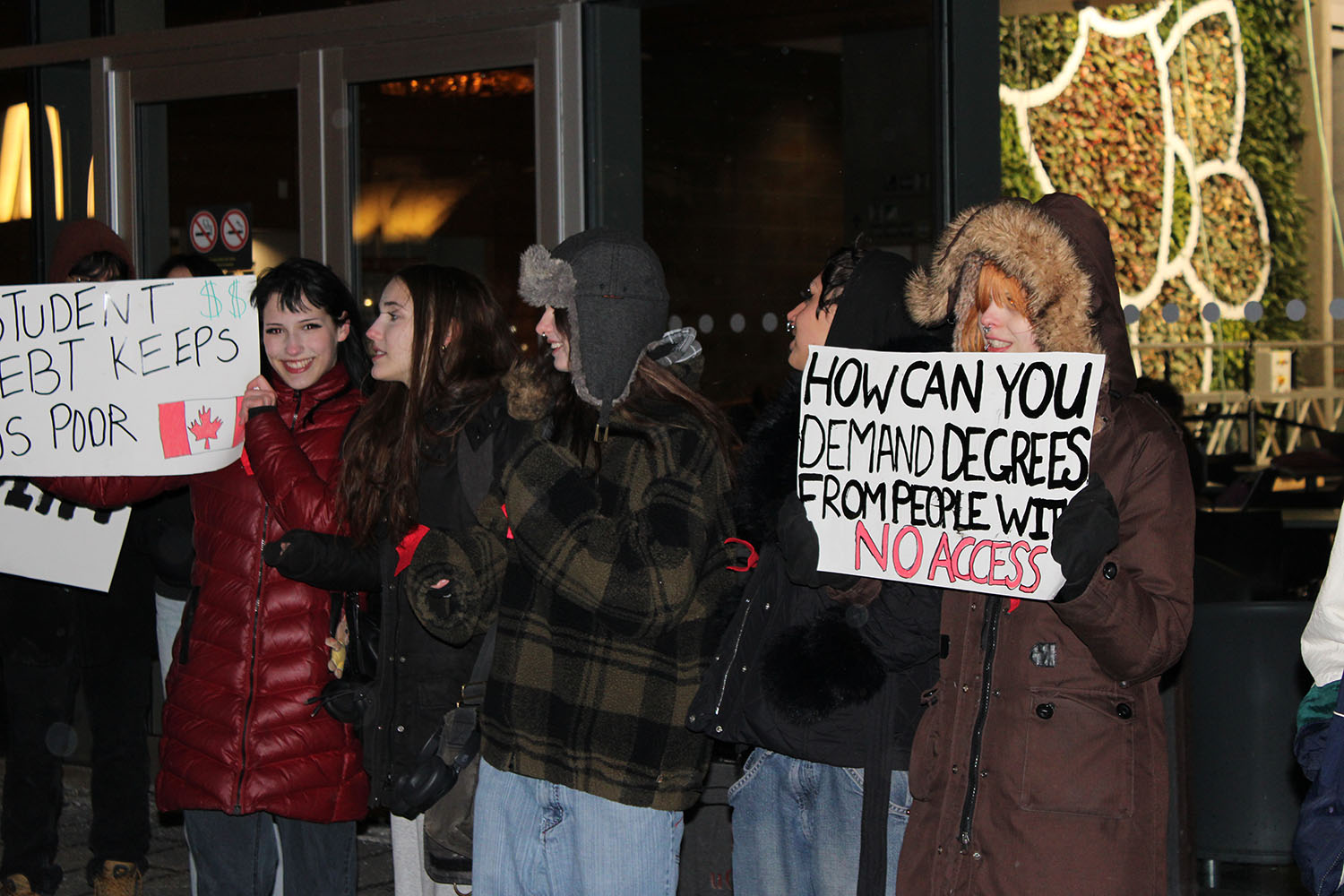
Students march through the University of Ottawa campus during an OSAP protest, holding signs calling attention to student debt and barriers to post-secondary access.
Students march through the University of Ottawa campus during an OSAP protest, holding signs calling attention to student debt and barriers to post-secondary access. Photo credit: Sienna Gauthier

Adrianna Levigne, 19, currently in Algonquin’s social work program, said students were not consulted before the changes.

“First it was program cuts, then OSAP cuts, then grants were taken away, and now tuition increases,” Levigne said. “Students just can’t afford to go to school anymore. People are giving up on becoming doctors, teachers, scientists, not because they lack ability, but because they can’t afford the debt.”

Gabrielle Arnatsiaq Jean-Pierre, 17, who plans to start graphic design at Algonquin next fall, said financial aid is the only path forward for her family.

“I come from a home with a single mother raising two kids,” she said. “She can’t afford my tuition alone, even with my part-time job. I need financial aid, and now the only option is debt.”

Protesters repeatedly emphasized the changes disproportionately affect marginalized communities, including low-income families, Indigenous students, first-generation Canadians, disabled students and young parents.

“This will absolutely hurt low-income and marginalized students the most,” Harper said. “This is a targeted attack on the communities that already struggle to access education.”

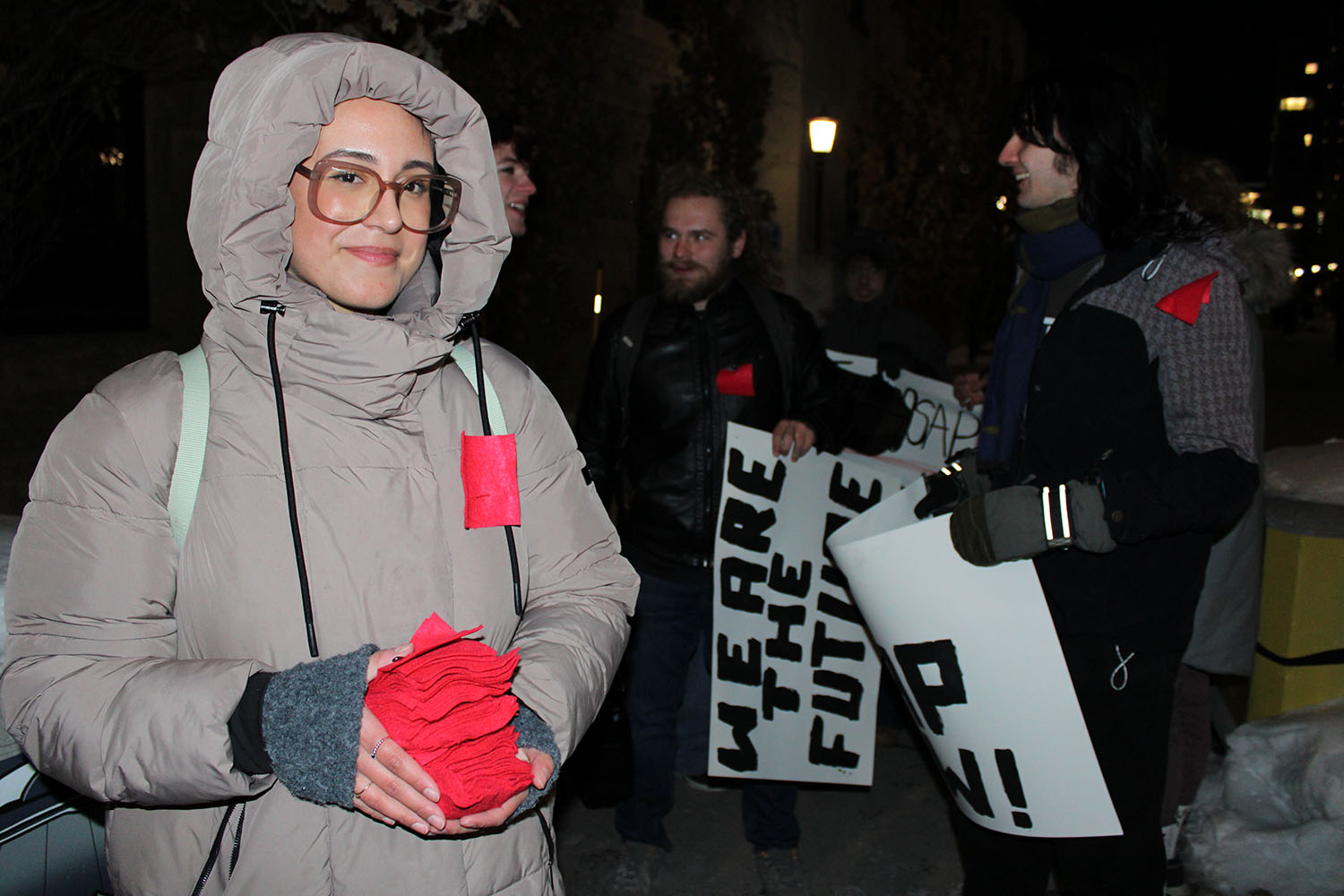
A protester holds red fabric squares distributed during the OSAP demonstration at the University of Ottawa. Students adopted the squares as a symbol of solidarity, visibility and support for accessible education, wearing them on jackets and coats throughout the march.
A protester holds red fabric squares distributed during the OSAP demonstration at the University of Ottawa. Students adopted the squares as a symbol of solidarity, visibility and support for accessible education, wearing them on jackets and coats throughout the march. Photo credit: Sienna Gauthier

Students also criticized Premier Doug Ford, accusing the provincial government of widening wealth inequality.

“Low-income people are being barred from post-secondary education,” Harper said. “This is an attack on everyday people that widens the wealth gap in this province.”

Throughout the protest, students wore and distributed red belt fabric squares pinned to jacket pockets and chests. The squares represent solidarity, visibility and resistance, a visual marker showing support for accessible education and collective action. Students described them as a way to identify allies in the movement and signal commitment to the cause.

Organizers say more protests are planned throughout the week, coordinated through social media platforms, including Instagram and Reddit.

News Briefs: Cuba says ‘armed infiltration’ planned after four shot dead on U.S.-registered speedboat

Top stories in your community and around the world noted by Algonquin Times journalists

Local

Ottawa Citizen: A man in his 70s was killed and two people were in critical condition after an SUV crashed into the Capital City Mission Drop-In Centre on Feb. 25.

Paramedics received a call for the collision around 9 a.m. Two other men were transported to hospital in critical but non-life-threatening condition. Four pedestrians in total were struck by the SUV. The building’s facade sustained damage.

Police asked any witness or anyone with dash-cam or any video of the incident to reach out.

National

CBC News: The parliamentary budget officer predicts Canada’s population growth will remain flat in 2026. This is mostly due to cuts to non-permanent residents from the federal government’s recent immigration policies.

There was also no population growth in Canada during 2025 due to a decline in the population of non-permanent residents by 382,000 people. The federal immigration plan includes a large cut in the number of new temporary work and student visas.

The parliamentary budget officer predicts Canada’s population will increase by 0.3 per cent in 2027 before stabilizing at 0.8 per cent annually.

International

BBC News: Cuba has accused 10 people of planning “an infiltration with terrorist aims” after the country intercepted a Florida-registered vessel off its coast.

Cuban border guards shot dead four people and injured six others on the boat. The Cuban interior minister alleged that those on the vessel shot first. According to an online statement from the Cuban interior ministry, the vessel was “one nautical mile off Cayo Falcones” on the country’s north coast when the incident happened.

Cuban authorities said all 10 people on board were Cuban nationals residing in the U.S., and that most of them had “prior records involving criminal and violent activity.”

Algonquin College Board of Governors to vote Monday on 30 program cuts

The board will vote during a public Zoom meeting on a proposal to suspend the programs as the college responds to ongoing financial pressures and declining enrolment
Photo: Tyrell Taylor
Algonquin College's Board of Governors is poised to vote on 30 program suspension recommendations.

The Algonquin College Board of Governors will meet virtually on Monday to vote on a recommendation to suspend 30 academic programs.

The 5 p.m. meeting is open to the public, but anyone wishing to watch must register through Eventbrite to receive a Zoom link.

According to the agenda, the vote on program suspensions will be the main focus of the one-hour session. After a brief opening, 35 minutes are scheduled for the consolidated program suspension recommendation, presented by college president Claude Brulé and senior leadership.

The proposal to the board follows an announcement in January that the college is considering suspending up to 30 programs starting in fall 2026.

Programs under review include journalism, horticulture, design foundations, culinary programs and several legal programs, among others.

The potential cuts have already sparked concern across campuses. Students in legal programs have been organizing and speaking out about the possible impact on their education and career paths.

The proposed suspension of the Music Industry Arts program has also drawn reaction from Ottawa’s music community, with industry professionals warning the loss could affect the city’s creative sector.

The board’s decision was previously delayed while the college waited for details on new provincial funding. On Feb. 12, Ontario announced new investments, lifted the tuition freeze and introduced a new OSAP funding model.

Image of the sign outside the Board of Governors office
Image of the sign outside the Board of Governors office. Photo credit: Amanda McLeod

In a message to staff on Thursday, Brulé said the college welcomes the investment but emphasized that financial challenges remain.

“What remains clear is that financial mitigation efforts must continue to ensure the College’s long-term sustainability,” he wrote.

He added that the college must align programs with enrolment demand, labour market needs and financial realities.

“We recognize these decisions are difficult, but immediate steps are necessary to ensure stability for our learners, employees, and the College’s future.”

Like many Ontario colleges, Algonquin is facing financial pressure linked in part to declining international student enrolment following federal caps on study permits.

If approved by the board, the suspensions at Algonquin would affect future intakes, although current students would be able to complete their programs.

Algonquin College students spend a day at Madahoki Farm for Indigenous teachings

Students escape the busy city to unwind in nature, make bannock and learn about Indigenous culture
Photo: Delaney St. Pierre
A student takes her turn smudging.

A group of Algonquin College students and Mamidosewin Centre staff took a day trip to Madahoki Farm on Feb. 13 to learn about Indigenous culture and practices.

The staff and students took a bus to the farm, where they were greeted by the farm’s friendly staff with a traditional Haudenosaunee welcome song. This would be the first of many practices the group would have the privilege of experiencing firsthand.

An Inuit elder taught the group about Inuit culture and her own upbringing and experiences. She ended her visit by lighting the qulliq, a traditional Inuit oil lamp that is a crucial heat source in the Arctic and symbolizes spirituality and women’s strength.

A flame burning the oil in the qulliq.
A flame burning the oil in the qulliq. Photo credit: Delaney St. Pierre

Inside a teepee, the group participated in a smudging ceremony to clear away bad energy.

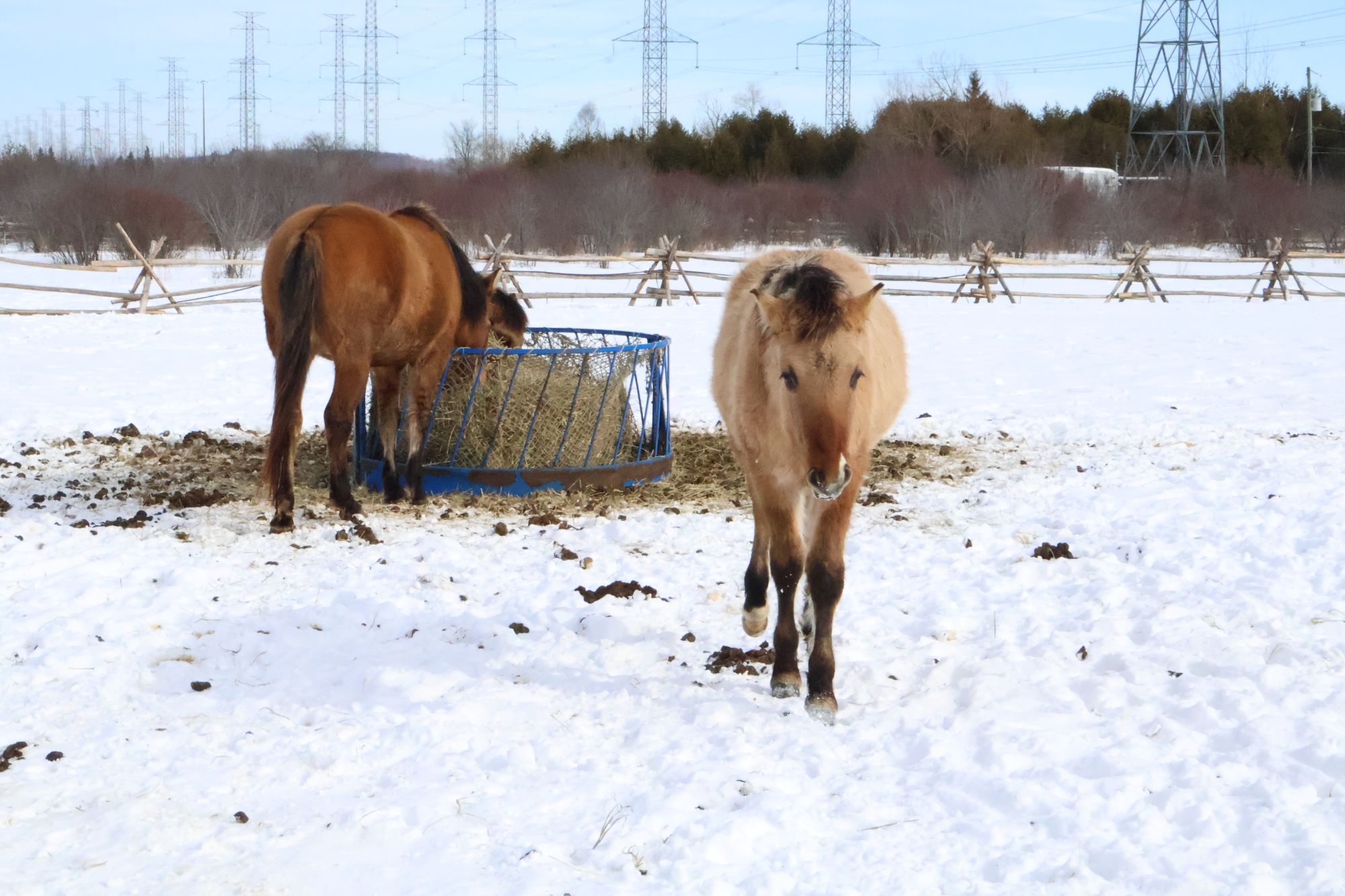
The group visited the farm’s Ojibwe spirit horses, which they learned was the only breed Indigenous to Canada. They were shown multiple paintings depicting stories about these horses.

Madahoki staff told the stories about how these horses can understand a human’s emotions. Many students believed it was the highlight of the trip.

“The workshops were really nice, and seeing and learning about the horses was really cool,” said Jesse Kavanaugh, an Algonquin College student and Mamidosewin Centre staff member.

Jules Kok agreed.

“I didn’t know the existence of this horse species. I knew they felt emotion, but I didn’t know they could tell when someone was in distress, so I found that really interesting,” said Kok, another Algonquin College student and Mamidosewin Centre staff member.

Three Ojibwe spirit horses, one approaching the attendees.
Three Ojibwe spirit horses, one approaching the group. Photo credit: Delaney St. Pierre

After the horses, it was back to the teepee to finish off the visit with a bannock-making session. Madahoki staff member Awema Tendesi gave a quick demonstration before letting participants make their dough and roast their own fresh piece of bannock.

Tendesi said he loves working at the farm.

“For me it’s the ability to do what I love for a living. I’m a dancer and a singer, I grew up around the culture, so when I work with culture doing what I love, I’m not even working,” said Tendesi.

Everyone went home with new knowledge and fresh perspectives on Indigenous culture and practices.

“The goal is always awareness, it is about spreading awareness of all the other nations and filling in those education gaps,” said Tendesi.

Students build bears for Valentine’s Day

By building stuffed animals, the SA made sure no one had to be alone on Valentine's Day
Photo: Naomi Cabassu
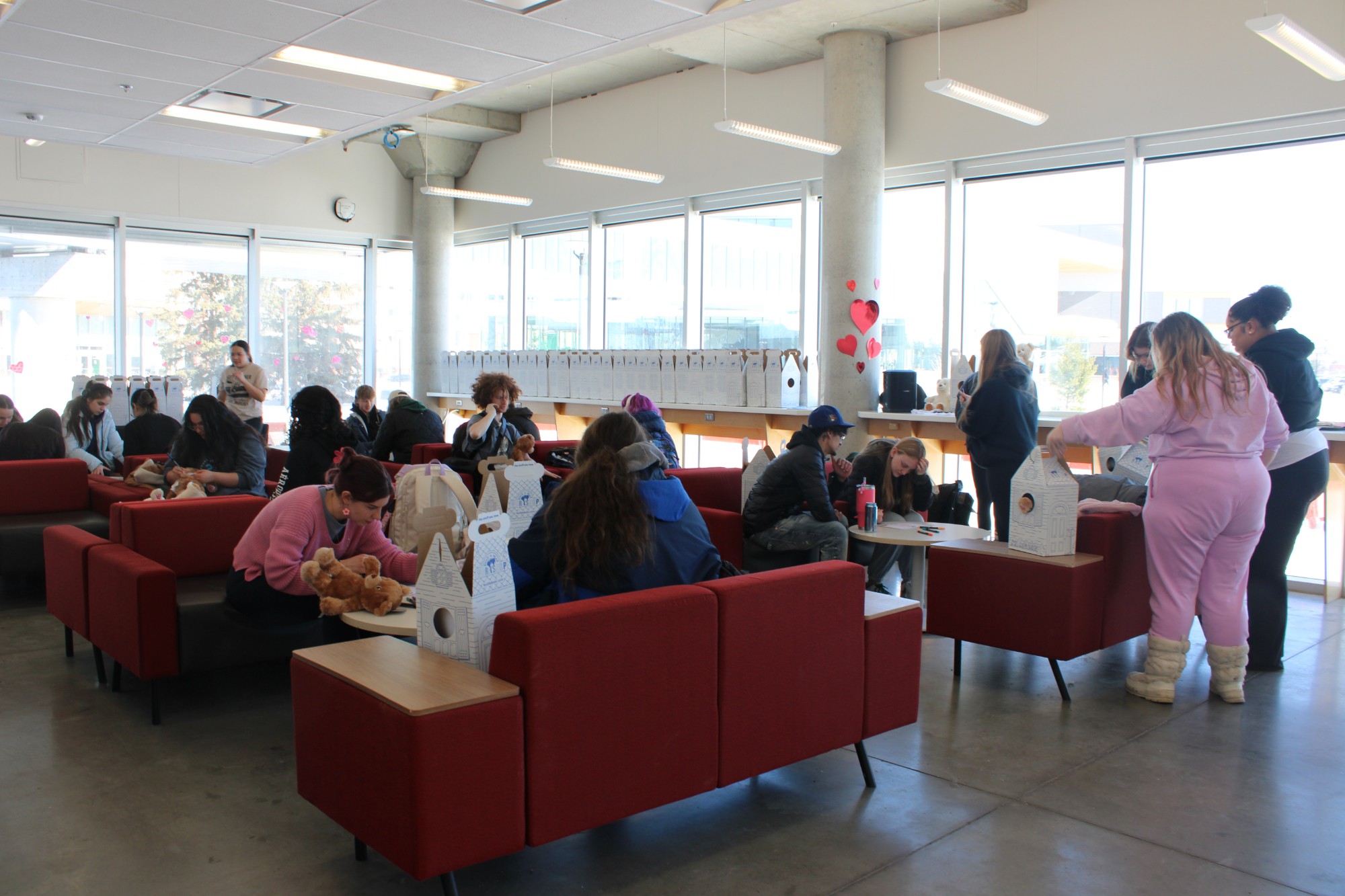
Students after building the bear.

On Feb. 13, the Students’ Association hosted Self-Care with a Bear to ensure everyone had a Valentine’s Day gift.

According to Alain Cyr-Russo, the senior manager student life, the idea was based on a uOttawa event.

In the previous two years the SA organized A Blind Date with a Book to celebrate Valentine’s Day.

This year they decided to be more inclusive to non-readers.

They worked with the Bayshore Mall store Build-A-Bear. The Build-a-Bear company allows you to create your own stuffed animal.

They also wanted people without partners to have something as a gift for themselves or a friend.

Sofia Factor, a student at the college, felt joy participating in the event.

“I have never done a Build-a-Bear so it makes me happy,” said Factor.

She did it for the experience and also because she really loves bears. Also, it’s cheaper than the actual Build-A-Bear at the mall.

The assistant manager of Build-A-Bear, Amber Mcmillan, was at the event. She started at the company as a party leader.

Mcmillan’s background as a “party princess” for children’s birthday parties helped her cover work events when she first started at the Build-a-Bear company.

Algonquin Times podcast

Stay Informed

Sign up for our newsletter

Subscribe

* indicates required