main

Municipal voting starts today: Here’s what you need to know

Oct. 1 allows Ottawa voters the first chance to cast a ballot for mayor, city councilor and school trustees
Photo: Stock Image
Special advance voting begins today for the City of Ottawa in this years municipal election.

The first day of October not only brings the month of Halloween to Ottawa, but also the start of voting for the municipal election.

Special Advance Voting

The City of Ottawa is holding Special Advance Voting Days from Oct. 1 to Oct. 4 between the hours of 10 a.m. and 8 p.m. at 10 locations across the city. Early voters can cast their ballots for mayor, city councillor and school board trustee.

The Special Advance Voting offers “anywhere voting” with no restrictions on where an individual needs to vote, allowing residents to vote at the location of their choosing rather than a location specific to their place of residence.

The 10 locations are:

CARDELREC Recreation Complex Goulbourn, 1500 Shea Rd.

Churchill Seniors Recreation Centre, 345 Richmond Rd.

City Hall, 110 Laurier Ave. W.

François Dupuis Recreation Centre, 2263 Portobello Blvd.

Greely Community Centre, 1448 Meadow Dr.

Diane Deans Greenboro Community Centre, 363 Lorry Greenberg Dr.

Minto Recreation Complex – Barrhaven, 3500 Cambrian Rd.

Nepean Sportsplex, 1701 Woodroffe Ave.

Richcraft Recreation Complex – Kanata, 4101 Innovation Dr.

St-Laurent Complex, 525 Côté St.

Voters can cast a ballot at any of the Special Advance Voting stations until Sunday, Oct. 4.

Advance Voting Day and Election Day

Advance voting will take place on Friday, Oct. 16 with Election Day on Monday, Oct. 26. Both days will see polling stations open from 10 a.m. to 8 p.m.

Residents who vote on either Oct. 16 or Oct. 26 are required to vote at their assigned voting station.

Mayoral candidates Mark Sutcliffe, Jeff Leiper and Neil Saravanamuttoo debated environmental policy on Sept. 17 at an event hosted by Ottawa's CAFES community group.
Mayoral candidates Mark Sutcliffe, Jeff Leiper and Neil Saravanamuttoo debated environmental policy on Sept. 17 at an event hosted by Ottawa's CAFES community group. Photo credit: Amanda McLeod

What do you need to vote?

Electors are required to show a piece of identification at the polling station to receive a ballot. The piece of identification must show their name and qualifying address.

Voters must be 18 years or older and a Canadian citizen.

A list of accepted identification can be found under the heading “Voter identification” at ottawa.ca. Voters are encouraged to bring their letter of voter notification to the polling station, but it is not required.

Electors who wish to amend their information on the official Voters’ List can do so at any polling station.

Some students can vote twice

Ontario legislation allows students who study away from their permanent place of residence to vote in both their “home” municipality and the municipality where they attend school.

Election results

Official election results will be declared as soon as possible after polls close, with unofficial results available after voting closes at 8 p.m. on Voting Day. Residents can follow results at ottawa.ca/vote.

Elected candidates will serve on the 2026-2030 term of council, from Nov. 15, 2026, to Nov. 14, 2030.

Built by students, pitched to industry: Algonquin’s robotics club shows off their tech to investors

From humble beginnings in school labs to the GCXpo, Algonquin College’s robotics club is looking for bigger opportunities
Photo: Reilly Armstrong
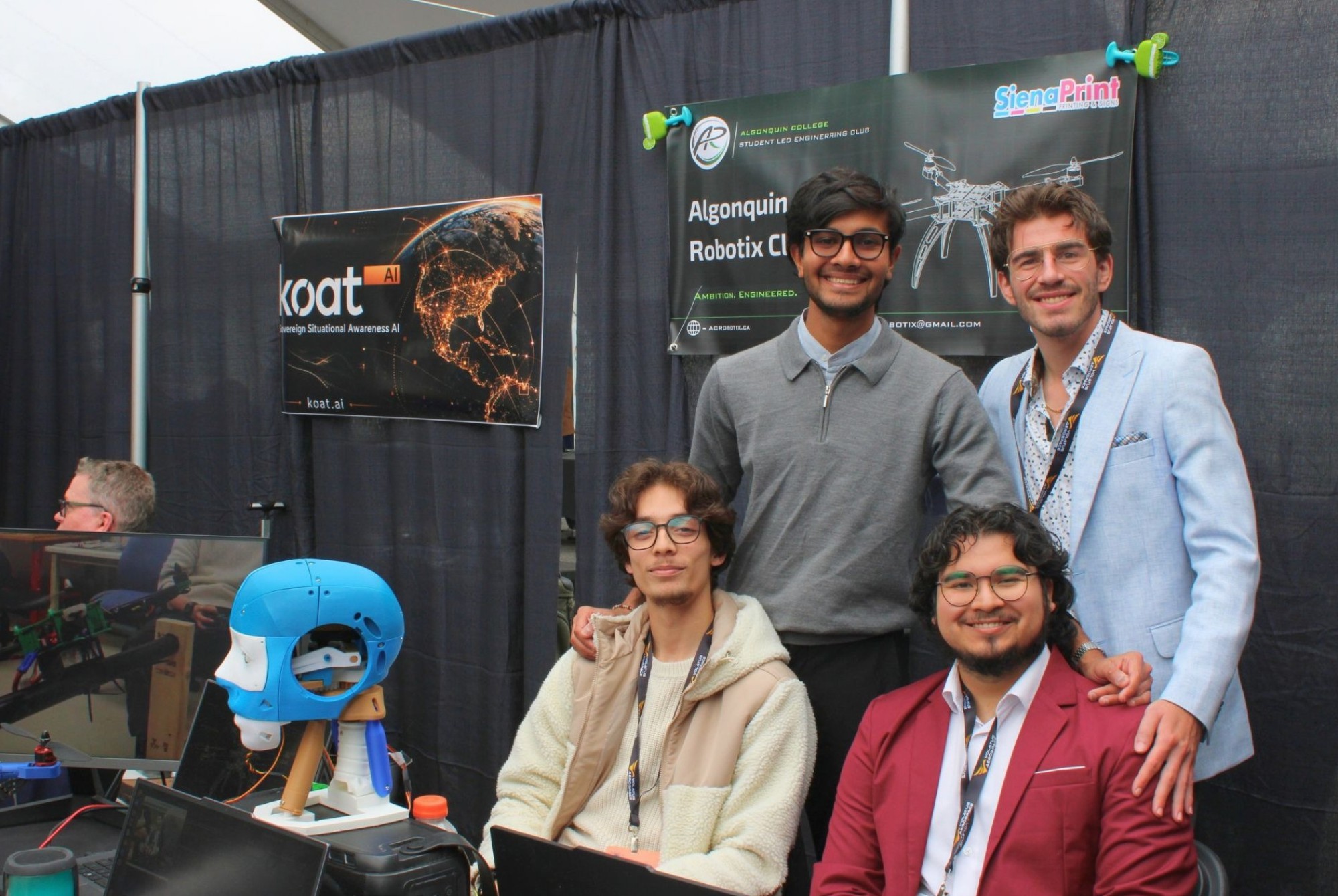
Robotics club co-founders Dwij Brahmbhatt (top left), Iliya Papoulias (top right), Miguel Fausto (bottom right) and member Haeden Fethi-Henriquez (bottom left) spent the day showing off their tech and pitching to investors.

The fields of Area X.O were still dark on Sept. 29 when members of Algonquin College’s robotics club, lugging their drone and robot head, arrived at 5:30 a.m. after a long night of last-minute repairs.

One of the drone’s legs was printed in the wrong material, which took eight hours to replace. Club members worked late into the night on the replacement, with others taking time away from their internships to make it to one of Ottawa’s biggest technology showcases.

By the time GCXpo opened, they were ready to pitch. Sitting a block south of the Nepean Sportsplex, Area X.O was splattered with tents, the skies above dotted with drones.

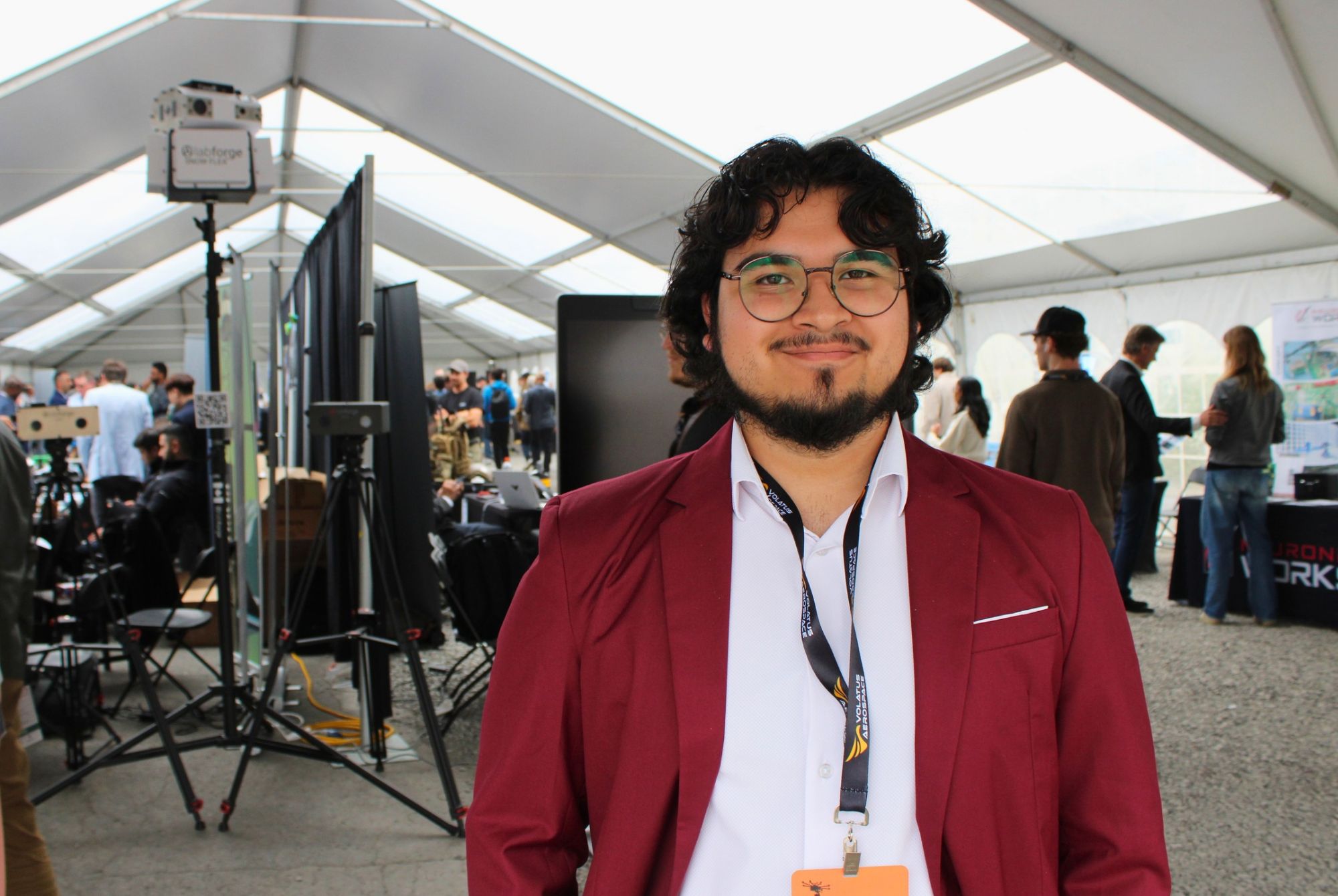
“We’ve been pitching the entire day,” said Haeden Fethi-Henriquez, a robotics club member and computer systems technician student.

“It’s exhausting, but I think we got a bunch of bites. And, if I remember correctly, we have about six companies that might be interested.”

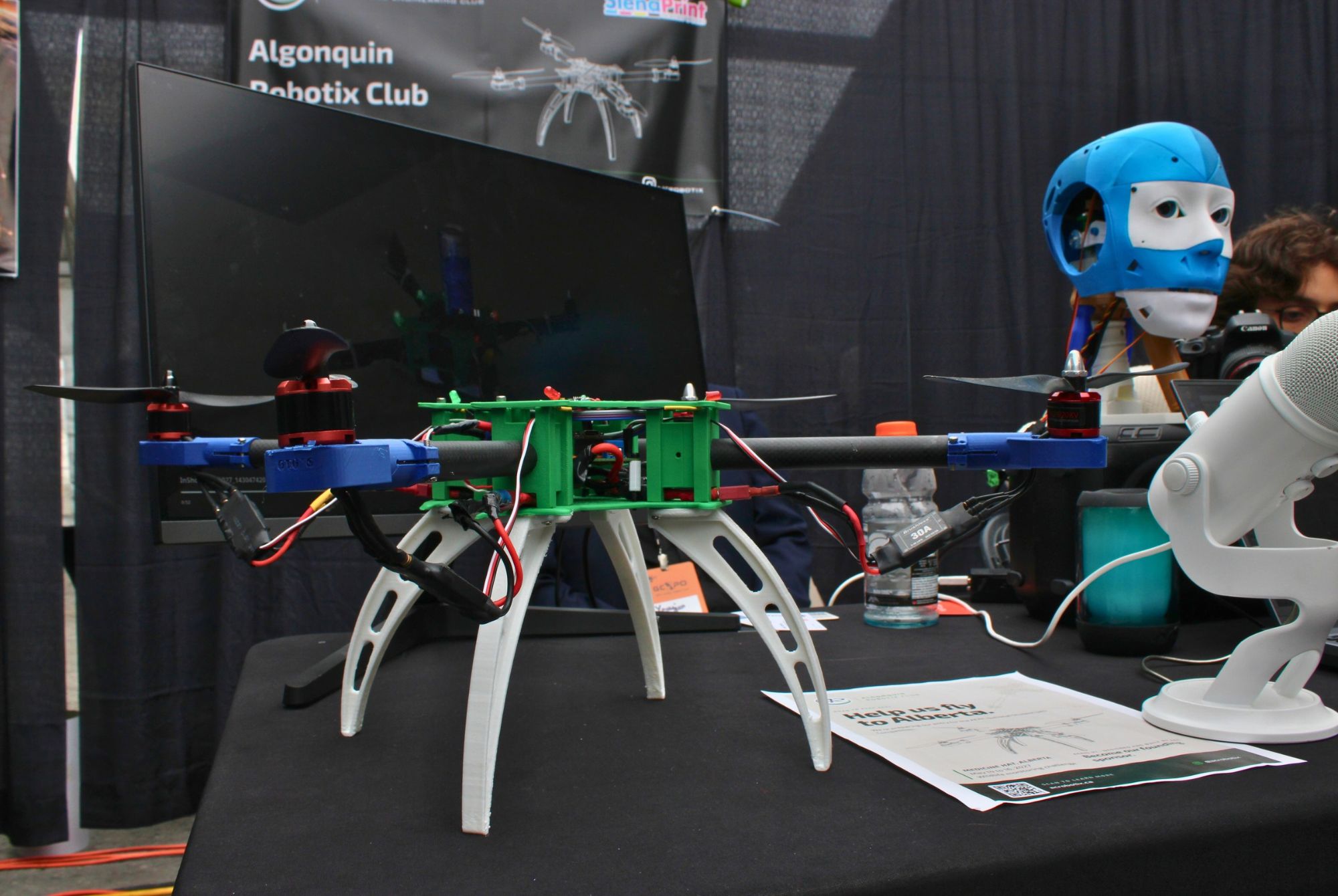
The club's drone was centre stage at GCXpo, drawing attention from potential sponsors.
The club's drone was centre stage at GCXpo, drawing attention from potential sponsors. Photo credit: Reilly Armstrong

GCXpo (Government of Canada Exposition) is a Canadian technology event, designed to connect innovators with government, industry and investors through live demonstrations of emerging technology.

It began in 2022 under the name TCXpo, and through the years has evolved to expand its focus beyond smart mobility to all kinds of cutting-edge tech, including robotics.

Visibility was the main goal for the club at the expo. One of the club’s co-founders, Dwij Brahmbhatt, described their need for funding.

“We don’t have a set revenue coming in every month or every year. We don’t sell products,” said Brahmbhatt.

“The idea coming here is to find industry sponsors to either give us parts, money, connections in general, because that’s the only way we can get (a) good amount of money to make something which actually we can take it to compete or make something worthwhile for people.”

Miguel Fausto, one of the club’s co-founders, said the opportunity to meet potential sponsors face-to-face was an opportunity they couldn’t miss.

“It’s really different to talk with someone than sending an email,” said Fausto.

“Being here…gives the opportunity to show our projects and people can come to us, to ask about the projects and we can talk — show our passion about what we do.”

Miguel Fausto says he worked late into the night on the AI systems within NIKO, getting the robotic head ready for the expo.
Miguel Fausto says the night before the expo, he worked late into the night on the AI systems within NIKO, getting the robotic head ready for demonstrations. Photo credit: Reilly Armstrong

Fausto said the club has learned how to adapt their pitches, depending on who’s in front of the booth.

“The drone is more attractive for the tech guys,” said Fausto. “The robotic head is for the people that (are) not really in tech, but (are) really interested in knowing more about it.”

Their booth, located in the event’s main exposition tent, was a chance to show off the club’s projects, which are fully built by students rather than being purchased or assembled using commercial products.

“Besides the motor (of the drone), everything you see was completely built by students at Algonquin, using the labs of Algonquin,” said Brahmbhatt.

“So the idea is that’s (the) main selling point…I can buy a drone from Costco by myself. Where’s the engineering in that?”

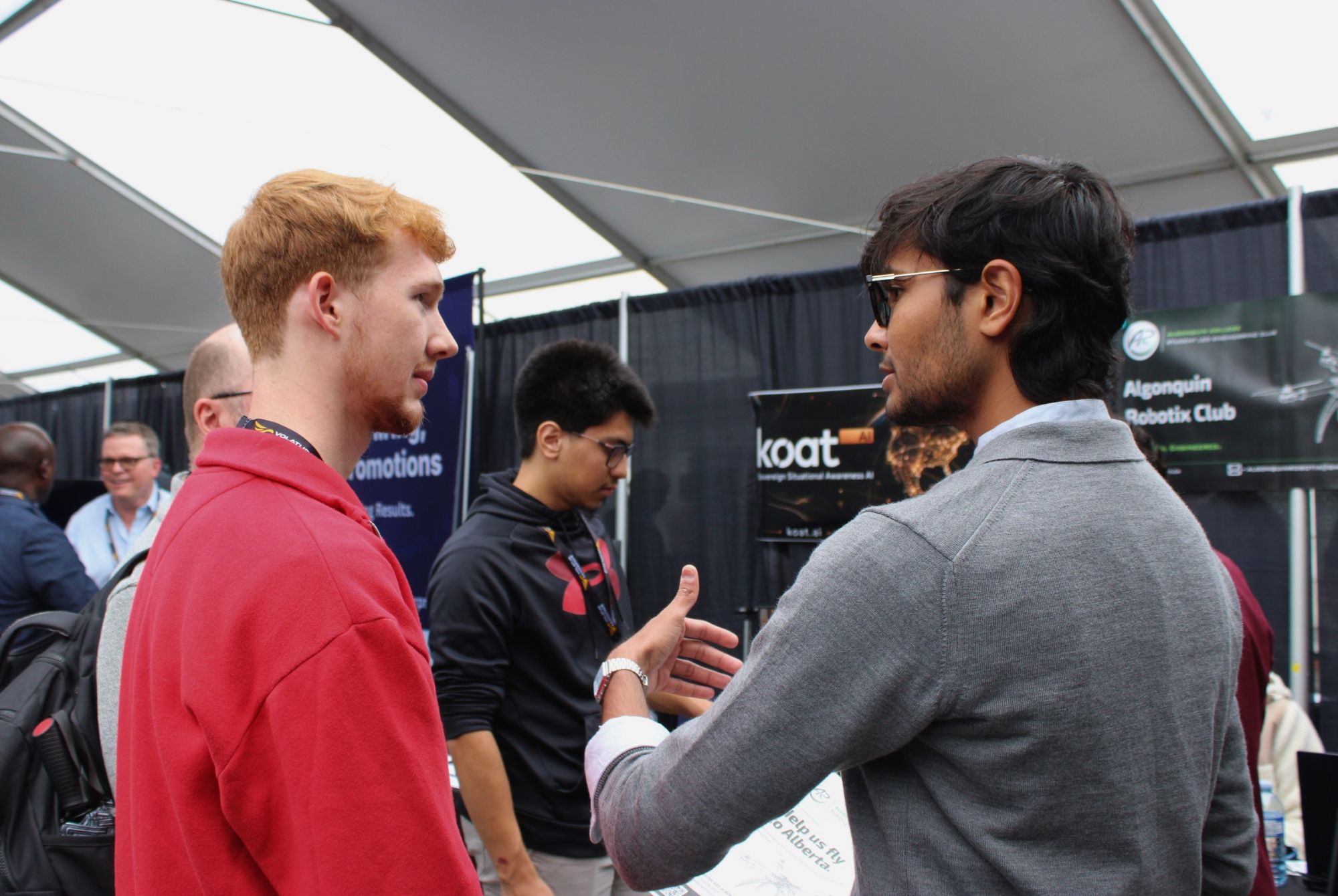
Dwij Brahmbhatt (right) explained the club's projects to eventgoers, hoping to spark interest.
Dwij Brahmbhatt (right) explained the club's projects to eventgoers, hoping to spark interest. Photo credit: Reilly Armstrong

Alongside their drone, the club’s robotic head NIKO (neural intelligence knowledge operator) got an update in time for the expo that drew lots of attention. NIKO can now actually converse with and react to what it’s seeing.

That meant eventgoers were able to interact with the robot in real time. NIKO was overheard telling someone they “had nice glasses.”

Also helping with the booth was AC alumna Albatoul Abusneina.

Abusneina has been busy after graduation, enjoying her new position at Revolution Data Platforms as an associate business and project coordinator, but she still made time to come support her old club.

“Dwij said they finally figured it out, how to get in,” said Abusneina. “So I was really happy. I was like, you guys need any help?”

Algonquin College alumna Albatoul Abusneina took a day away from her post-grad job to support the club.
Algonquin College alumna Albatoul Abusneina took a day away from her post-grad job to support the club. Photo credit: Reilly Armstrong

The team all agreed the event was a success.

However, the club’s fundraising efforts were about more than simply expanding their projects.

The students are preparing for the 18th annual Aerial Revolution Association of Canada’s National Student Uncrewed Aircraft Systems competition, taking place in May 2027 in Medicine Hat, Alta.

Their current drone AERIS (autonomous exploration and reconnaissance system) holds around 500 grams, while the competition will require a much higher payload.

They estimate they’ll need another $8,000 for the parts and materials to build the competition aircraft.

“We’re not starting from zero,” said Fausto.

“But there’s a long, long way to go.”

Businesses concerned about multi-year construction around Bank Street and Heron Road

In the area of Bank Street and Heron Road, seemingly endless construction is reshaping Ottawa’s roads and testing the patience of drivers navigating the area
Photo: Daniel Sundaresan
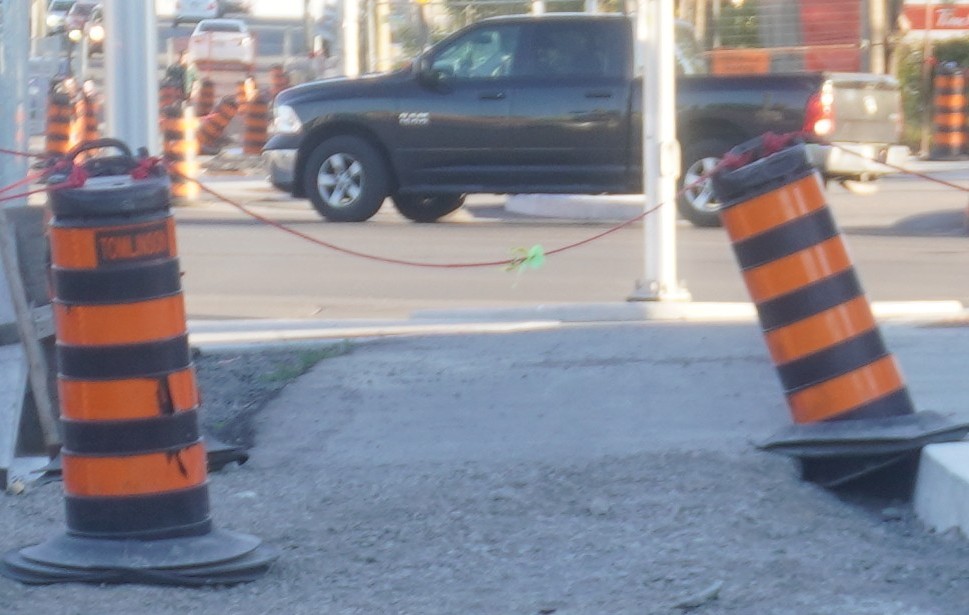
Construction on Bank and Heron.

Ongoing construction around Bank Street and Heron Road is creating disruptions in Ottawa’s Alta Vista neighbourhood, with local business owners raising concerns about the pace of the work and how long the disruptions will continue.

The Bank Street Renewal project began in June 2024 and is expected to continue into 2027. Phase 1 of the project covers Bank Street from Riverside Drive to Collins Avenue.

According to the City of Ottawa, the project is intended to address aging infrastructure while improving transportation and pedestrian access in the area. The work includes replacing underground watermains, sanitary sewers and storm sewers, as well as reconstructing roads and sidewalks and adding cycle tracks, improved transit stops, street lighting and other streetscape features.

The project will also change how vehicles access some properties along Bank Street. The city says some left in and left out access points will be restricted as part of the new median design. According to the city, the changes are intended to reduce vehicle conflicts and improve safety along the corridor.

Local business owners say they have also been affected by the prolonged construction.

Grace Quirola, manager of Le Salon at 1587 Bank St., said many of the salon’s clients, particularly older customers, have been discouraged by the construction.

“The construction has affected our business big time due to no sidewalk, and there are so many signs for construction that a lot of clients don’t know where to come in to park,” said Quirola.

Le Salon on Bank and Heron
Le Salon on Bank at Heron. Photo credit: Daniel Sundaresan

The city says access to businesses will be maintained throughout construction and that efforts will be made to minimize disruptions to businesses and their customers.

Elias Ayouv, owner of Cigar Man located at 1555 Bank Street, said the construction has made it difficult for customers to access his business.

“So many customers avoid Bank Street because they don’t know how to get in and get out properly due to the construction,” said Ayouv.

Ayouv said the difficulty accessing the area has contributed to an approximately 50 per cent decline in sales at his business.

Construction has continued in several stages, with crews working on underground utilities, roads and sidewalks throughout the project area. The city says work will continue through the winter, with crews focusing on utility relocations and other work that can continue during colder weather.

Some major milestones have already been completed. Underground infrastructure work at the Bank Street and Riverside Drive intersection has wrapped up, which allowed restricted westbound lanes on Riverside Drive to reopen on Aug. 31. However, intermittent lane closures are expected to continue for longer as crews complete paving and other intersection work.

The city says Bank Street will remain restricted to one lane in each direction between Riverside Drive and Collins Avenue while watermain, sewer and road reconstruction continues. The project is currently expected to be complete by fall 2027.

With Phase 1 expected to continue into 2027, businesses along Bank Street will continue operating alongside the construction as the remaining work moves forward on schedule.

Nuit Blanche Ottawa 2026: How the city celebrated 200 years after dark

Behind the installations that filled downtown Ottawa, artists shared the ideas and creative processes that brought their work to life
Photo: Mariana Vega Andrade
The performers of Cubo in action.

Thousands of people gathered across downtown Ottawa for Nuit Blanche on Saturday night and Sunday morning for a contemporary art festival that transformed the city after dark.

Streets and public spaces were transformed into open-air galleries at 7 p.m. featuring interactive installations, performances and visual displays.

People gathered to enjoy the fist Cubo performance of the day.
People gathered to enjoy the first Cubo performance of the day. Photo credit: Mariana Vega Andrade

The event featured a variety of interactive installations across the downtown core.

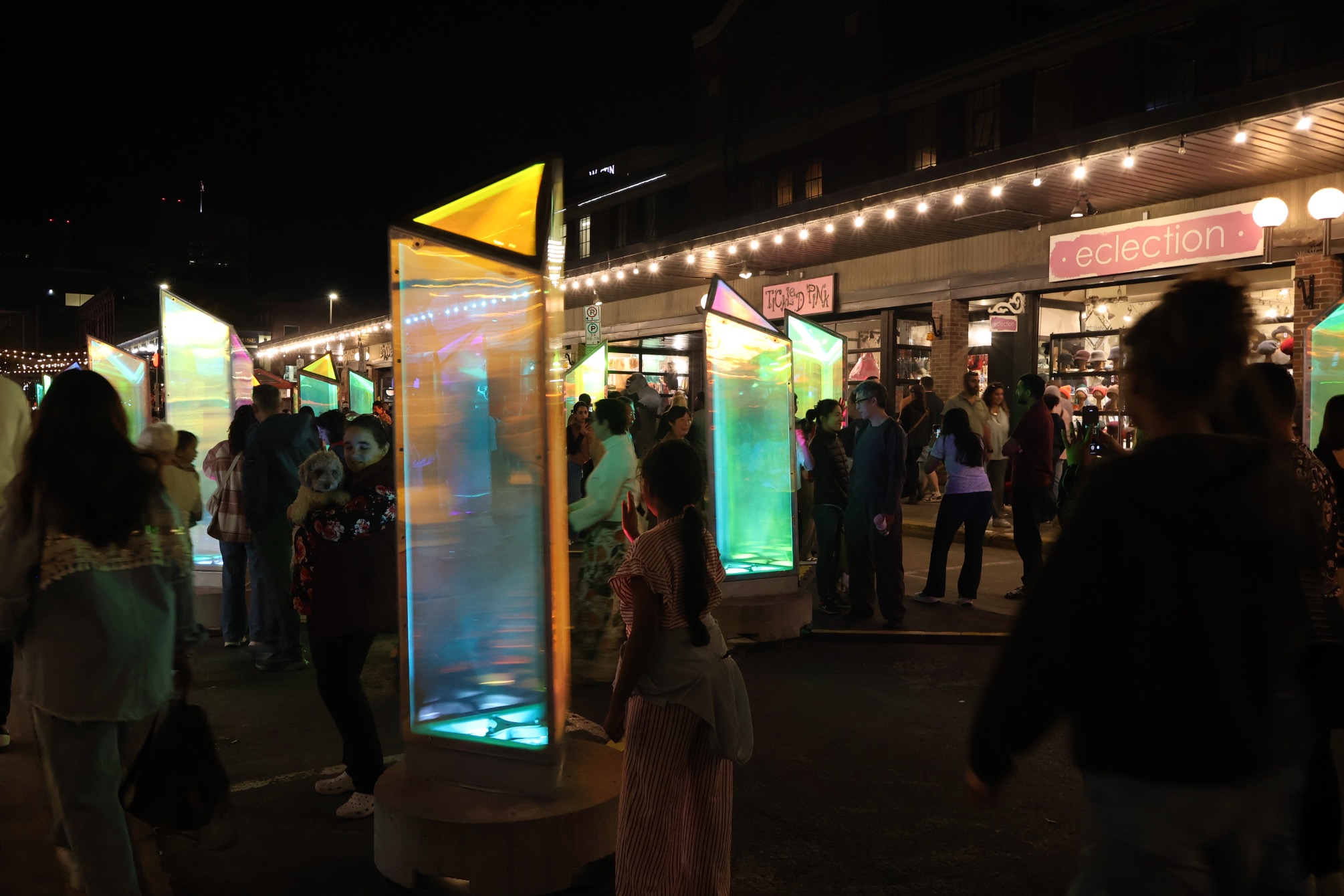
Among the most popular attractions was Prismatica with interactive illuminated prisms that changed colours as attendees moved them, and Impulse, a series of glowing seesaws that responded to movements with light.

attendees interacting with prismatica, one of the installations.
Attendees interacting with Prismatica, one of the installations. Photo credit: Mariana Vega Andrade

Andres Urdaneta said he attended the event to celebrate Ottawa’s 200th anniversary and be part of the festivities.

“It helps us connect together and learn more about the culture of Ottawa,” he said.

“I feel like it’s better for all of us to meet here and enjoy some time.”

He added that one of his favourite aspects of the event was the variety of experiences available, from light installations to live music and performances.

Gaia Pascolo performed in three showings of CUBO, a vertical dance and aerial acrobatics performance. She reflected on her artistic journey and the message she hopes audiences take away from the show, and the warm response they received throughout the event.

Pascolo comes from a background in artistic gymnastics and later trained at the Carampa Circus School in Madrid, where she graduated as a circus artist. Pascolo is part of eVenti Verticali, the Italian theatre company behind CUBO.

“I train every day because this is my passion, it’s not just a job,” Pascolo said.

“When I’m here with my big family eVenti Verticali, for me this is a pleasure and a way to grow not just as an artist, but also as a person.”

Claudia Cipollina, Valeria Ugone, Valeria Serra, Gaia Pascolo and the Director Andrea Piallini after the show.
Claudia Cipollina, Valeria Ugone, Valeria Serra, Gaia Pascolo and the director Andrea Piallini after the show. Photo credit: Mariana Vega Andrade

CUBO also features climbing techniques on walls and specially designed structures.

For eVenti Verticali, bringing CUBO to Canada for the first time was a meaningful experience.

Pascolo added that the enthusiastic reaction from people was one of the most fulfilling aspects of the experience.

“The crowd was incredibly warm and there were so many people ready to support us and share every moment of the show,” she said.

CUBO director Andrea Piallini said the performance emerged from years of artistic experimentation with vertical dance and theatre. The company explored ways of combining movement on walls with storytelling, using performers to create characters and narratives while suspended. Seeking to expand those ideas, Piallini and his team suspended a wall from a circular structure and eventually developed a three-dimensional structure. The result of that creative process was CUBO.

Judging by the audience’s enthusiastic response, CUBO’s blend of movement, theatre and aerial performance left a lasting impression on people throughout Nuit Blanche.

Bicentennial birthday bash: How Ottawa is celebrating its 200th year

Two hundred years of history were celebrated on Saturday with activities, entertainment, food and much more
Photo: Tyson Purvis
The Ottawa Art Gallery set up a miniature art studio for children to paint to their hearts desires with previous works strung up in the background.

Celebrating 200 years of existence is no easy feat, but Ottawa pulled out all the stops during Saturday’s Ottawa 200 Block Party at city hall.

“I’m just listening to the music,” Chris Vickers said. “I got a poutine and I got a nice, tasty beverage from a local brewery.”

Ottawa 200 was a free, all-ages celebration of all things Ottawa.

A person continuing the number line representing all 200 years of Ottawa's existense.
A person continuing the number line representing all 200 years of Ottawa's existense. Photo credit: Tyson Purvis

The Ottawa of today was first established in 1826 during the construction of the Rideau Canal. Initially, it was named Bytown after the British military engineer, Colonel John By, the man responsible for the Rideau Waterway construction project.

In 1855 it would be renamed Ottawa, deriving its name from the Algonquin word “adawe” meaning “to trade.”

For Aaron Taylor, the day was a long-awaited opportunity to experience Ottawa as a community.

Aaron Taylor holds a sign which represents his love for the city which has given him so much already.
Aaron Taylor holds a sign which represents his love for the city which has given him so much already. Photo credit: Tyson Purvis

“I think they’ve put on a fabulous event,” Taylor said.

“We came downtown to check everything out, walked around, sampled one of the local beers which was really nice and got some swag.

“It’s nice to see everyone so happy,” he said. “People are really enjoying the day, enjoying the sunshine and celebrating the city.”

The block party was just one of many events held by the city to celebrate the bicentennial. Ever since June, all kinds of events have been held across the city, such as an opportunity to try 200 different sports all for free on June 6 and June 7, Family Fun Day held on July 25 and a community Thanksgiving meal set to be held on Oct. 10.
Ottawa's town crier Daniel Richer being interviewed by CBC news at the Ottawa 200 Block Party.
Ottawa's town crier Daniel Richer being interviewed by CBC news at the Ottawa 200 Block Party. Photo credit: Tyson Purvis

The event area was split into four zones: a performance zone, a family zone, a food zone and an interactive art zone.

Performances included live music from Ottawa-based artists such as Izzy Rose, musical duo The Blind And The Beautiful and Jessy Lindsay.

Izzy Rose singing her music live on stage at the Ottawa 200 Block Party.
Izzy Rose singing her music live on stage at the Ottawa 200 Block Party. Photo credit: Tyson Purvis

Some partygoers found the music to be the highlight of the event, with the performances bringing “an exciting vibe to the place,” Vickers said.

The family zone held many stalls ranging from information booths and miniature art studios held by the Ottawa Art Gallery, to pop-up markets selling merchandise themed around the city made by Ottawa locals.

The most busy zone — besides the food area, of course — was the interactive art zone.

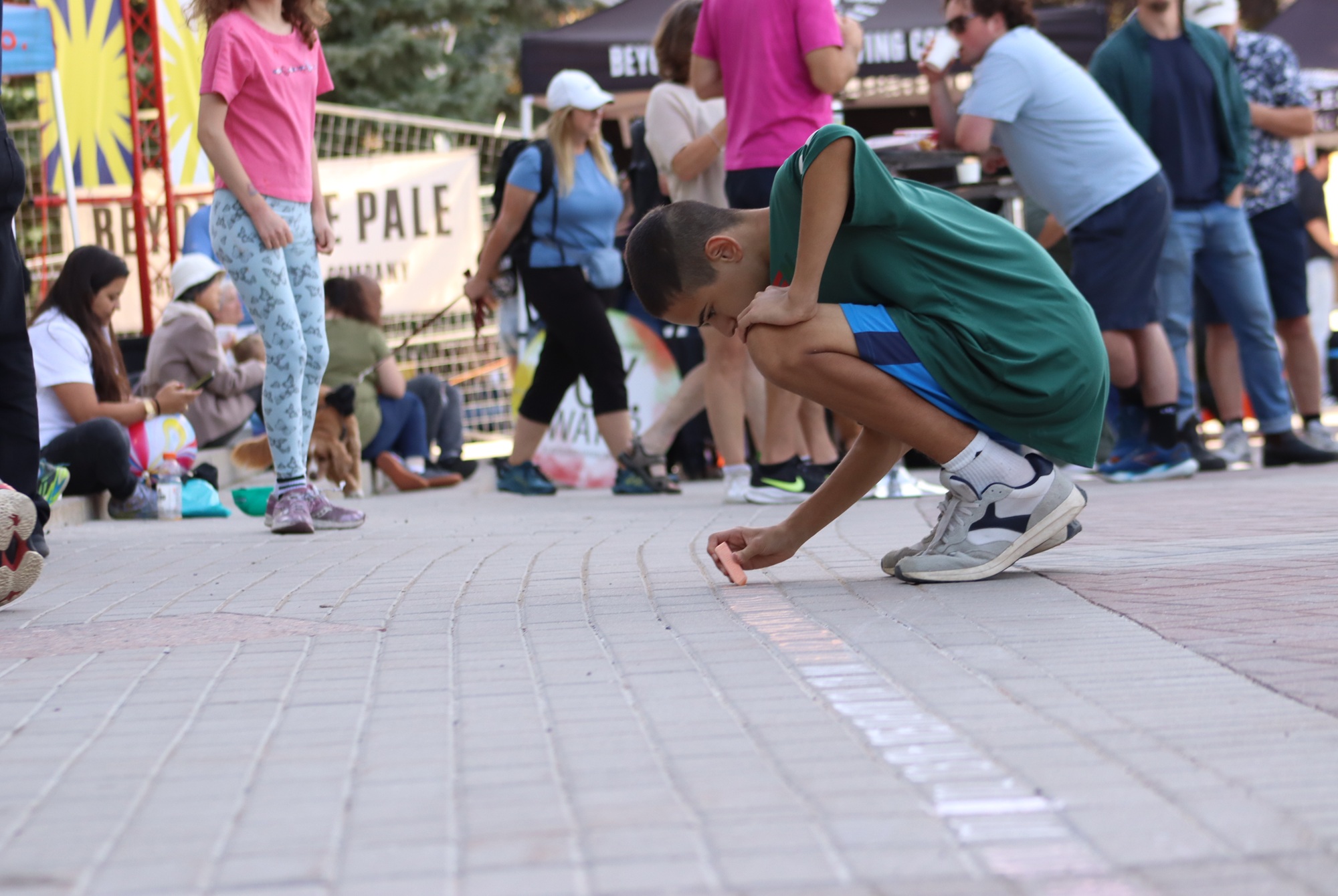
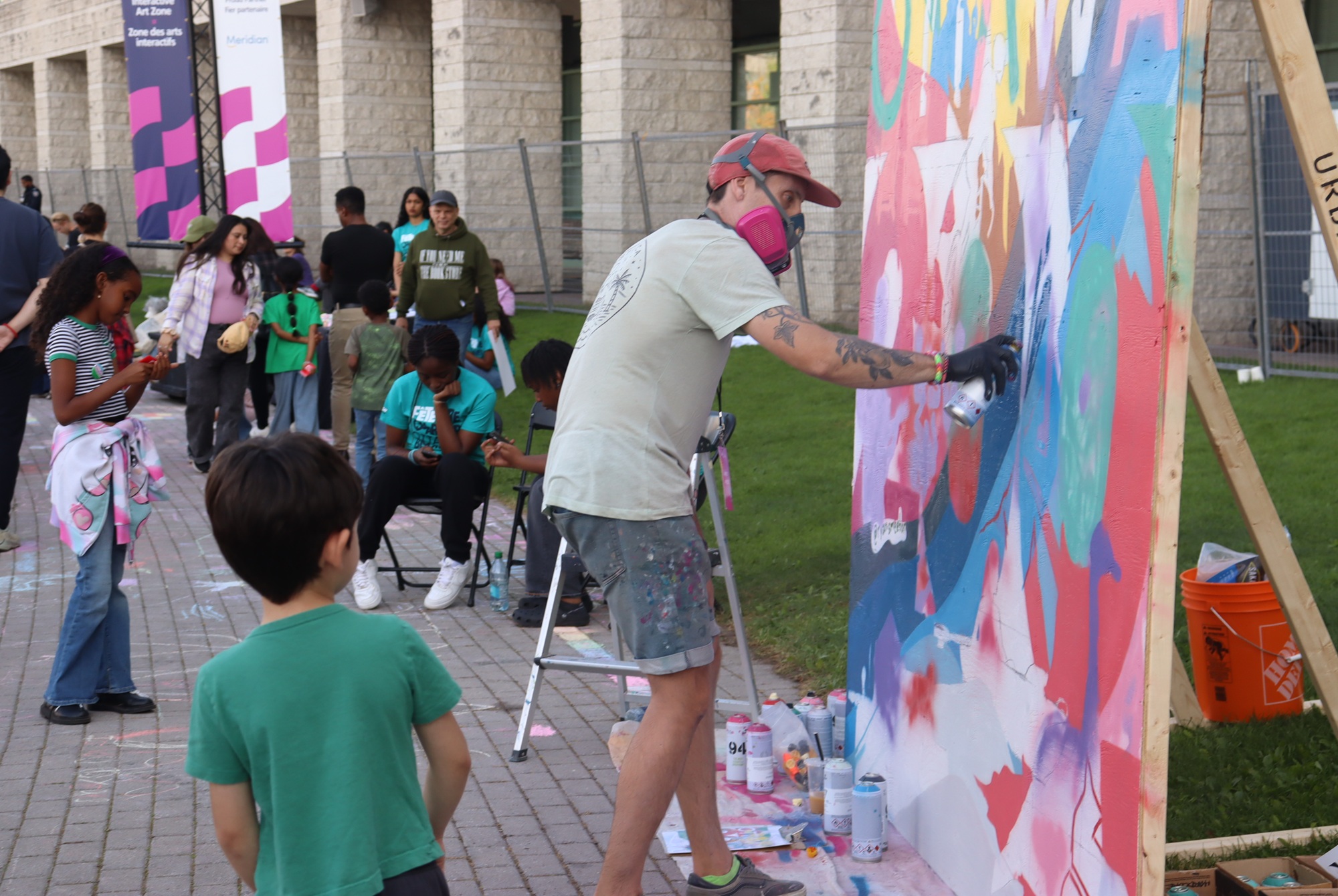
Seniors, adults and children took part in all sorts of activities including wood carving, a chalk art station and a live mural creation by Ryan Smeeton commemorating the anniversary of the city.

A child watches Ryan Smeeton create his spray-painted mural celebrating Ottawa's 200-year-long history.
A child watches Ryan Smeeton create his spray-painted mural celebrating Ottawa's 200-year-long history. Photo credit: Tyson Purvis

For many people, however, the real highlight of the day wasn’t the party itself, but what it represents. For Ottawa residents, 200 years means an endless amount of memories.

Hary Ngo’s fondest memories are also some of the most recent.

“It was last year, my first time in the city,” Ngo said. “It was winter, so not much to do, but I had an opportunity to go skating on the canal. It was a really great experience with my friends.”

Now that Ngo works full-time in Ottawa he hopes to settle into the city for a long time.
Now that Hary Ngo works full-time in Ottawa, he hopes to make the city his new home for a long time. Photo credit: Tyson Purvis

Taylor shared the same sentiment.

“Skating on the canal is 100 per cent the best, hands down,” he said.

“You get a BeaverTail, spend time with friends and maybe get some bruises, too. I fall a few times on the canal every time, for sure.”

For some, the best memories may be the experiences they have in the city; for others it’s the relationships they grow from within their communities.

Vickers said one of the best parts about his nearly two decades living in Ottawa was joining his local ultimate frisbee team. He said joining his team is what made Ottawa finally feel like home.

“The crew that I met there have become essentially lifelong friends now,” he said.

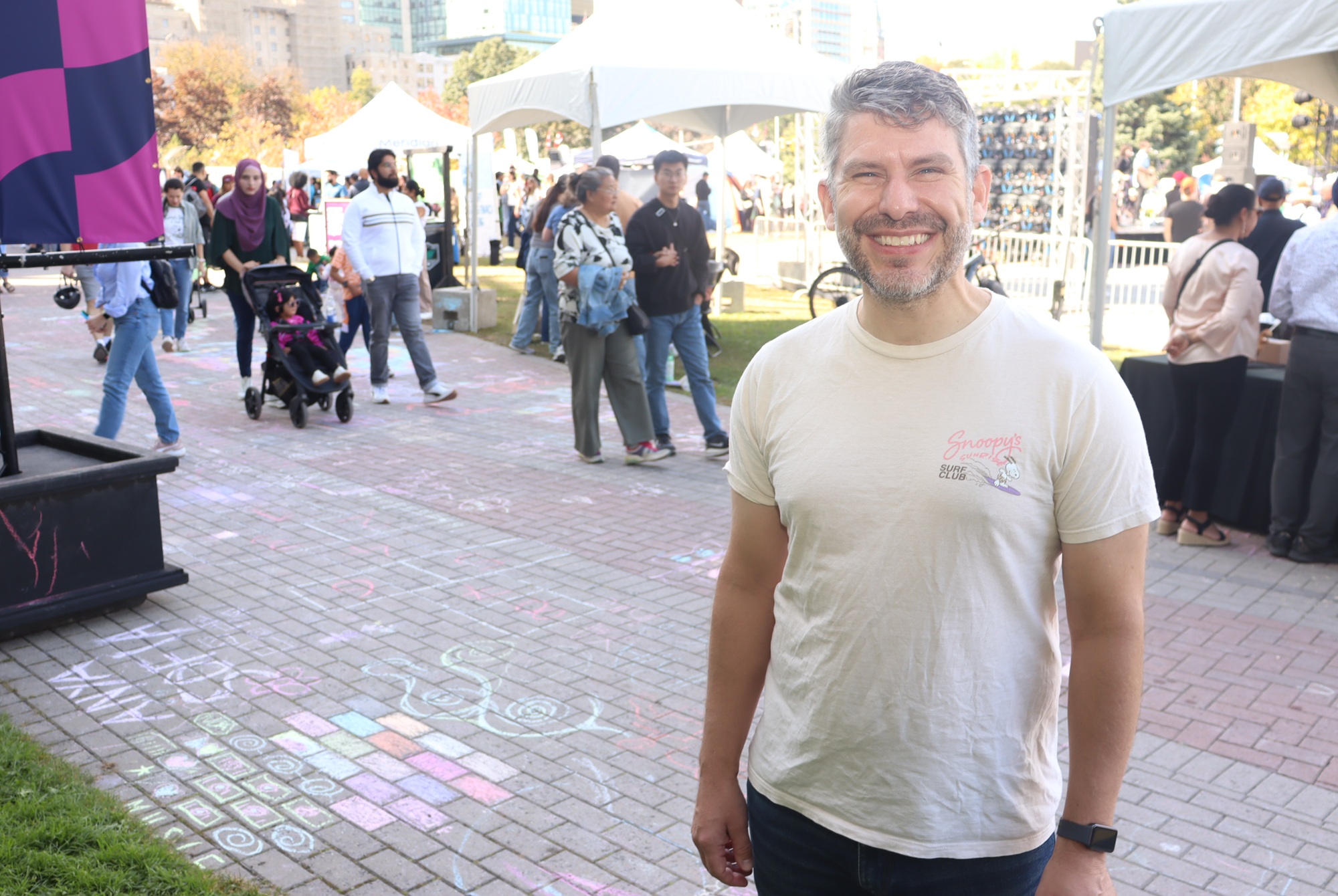
Chris Vickers stands in front of the interactive art zone where chalk drawings are dotted across the walkway.
Chris Vickers stands in front of the interactive art zone where chalk drawings are dotted across the walkway. Photo credit: Tyson Purvis

Beyond Taylor’s cherished memories skating on the canal, he said Ottawa has also given him so much more than he could ever ask for.

“I’ve been living here for 10 years,” Taylor said. “Ottawa really feels like home for me and my husband. We met each other here.”

Ottawa Gem Show puts Earth’s treasures on display

Collectors, vendors and curious visitors came together for the weekend to showcase gems, minerals and the stories behind them
Photo: Marcos Somarriba
A variety of scultpures made from rocks and minerals on display in Sarina's Gems, one of the shops set up in the event.

The Ottawa Lapsmith and Mineral Club (OLMC) hosted its annual gem show on Sept. 19 and Sept. 20 in the Nepean Sportsplex.

Multiple vendors and club members set up tables in the curling arena, ready for a weekend of mineral exploration.

Vendors were selling a variety of items from jewelry, decorations, polished rocks, metals and crystals.

Janelle Guillemette, a vendor for Candy's Crystals, holding minerals
Janelle Guillemette, a vendor for Candy's Crystals, holding minerals. Photo credit: Marcos Somarriba

Janelle Guillemette, whose shop Candy’s Crystals is in Gatineau, was one of the vendors at the gem show.

“We handpick all our stones and that’s why we have a lot of different kinds on our table,” said Guillemette. “We love to source all over the world and have quality over quantity.”

Candy’s Crystals sells a variety of crystals for various purposes.

Janelle Guillmette showcasing the crystals on her table for Candy's Crystals at the event.
Janelle Guillmette showcasing the crystals on her table for Candy's Crystals at the event. Photo credit: Marcos Somarriba

“I personally like to collect them because I find them beautiful, but we help a lot of people through spirituality,” said Guillemette. “Amethyst is really good for people with depression to help you sleep better.”

OLMC club members ran demonstration workshops demeonstrating gem faceting

John Lavoie, a club member operating a faceting machine, holds a passion for gem faceting, the craft of cutting and polishing minerals to maximize its reflections.

“I have been faceting gemstones for fifteen years and it’s been great,” said Lavoie. “It’s very rewarding art because at the end you produce one of these (gemstones) and get to look back.”

Lavoie took the time to explain and demonstrate how he facets gemstones.

John Lavoie, faceting a gemstone to demonstrate the club's workshop to the public
John Lavoie, faceting a gemstone to demonstrate the club's workshop to the public Photo credit: Marcos Somarriba

“There’s a lot that goes into the types of laps, cutting laps, polishing and sequences,” said Lavoie. “I like doing different kinds of courses, peridots, different barrels like aquamarine and emeralds. I cut a bit of everything.”

Lavoie has been doing this for 15 years and continues to enjoy his time with the OLMC.

“There’s lots of good people. It’s nice to sit with like-minded people. I teach faceting at the club on Thursdays along with another gentleman.”

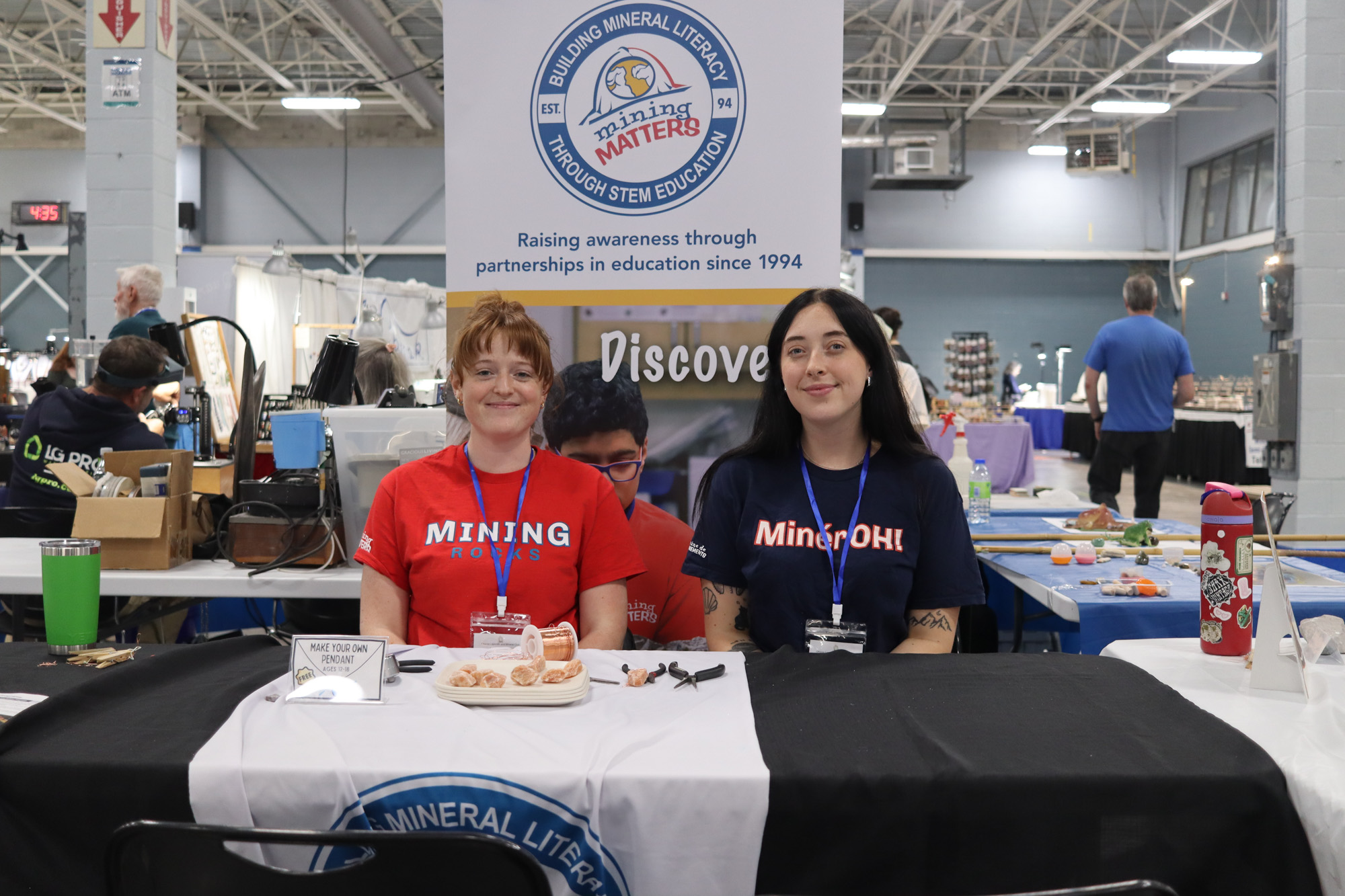
Vendors were not the only ones setting up their tables. Jordan Gush, a member of the organization Mining Matters, set up a table to inform visitors of the organization.

“We are a non-profit organization based out of Toronto,” said Gush.

Mining Matters teaches several subjects related to rocks and minerals in different events. They also have information available in other languages.

Alex Stones (left) and Jordan Gush (Right) at their table representing the organization, Mining Matters.
Alex Stones (left) and Jordan Gush at their table representing the organization Mining Matters. Photo credit: Marcos Somarriba

“We teach about earth sciences, mining, geology, minerals and all sorts of stuff like that,” said Gush. “We work just nationally in Canada, but we do have some resources translated into French and Spanish.”

The Ottawa Lapsmith club was founded in 1966. The club eventually combined with the local mineral club to form the OLMC, leading it to be incorporated in 1997. The OLMC is a for-profit organization that is fully run and managed by volunteers. Their workshop is located at Unit F, 136 Billings Ave. in Ottawa.

Wolves soccer teams turn home opener into scoring frenzy

The teams made their presence known in matches against Fleming
Photo: Nylah Henry
Midfielder Annika Dubeau dribbling down centerfield.

Twenty Goals. Two wins. One dominant home opener on the pitch.

The Algonquin Wolves women’s soccer team beat the Fleming Phoenix 11-0, while the Wolves men’s soccer team beat the Phoenix 9-1 on Sept. 19 at the Algonquin College sports field.

“I think this victory is really what we needed to kick off the new season,” said Zoe Kuchlein, a midfielder for the women’s team. “Especially since we have so many new rookies, I would say this stellar performance really helped show them what our team is capable of.”

A notable performance came from team captain Jasmine Young, who scored an astonishing four goals.

The women’s team controlled the match until the 90th minute, outshooting the Phoenix 29-0.

Algonquin soccer fans holding up signs made during the half time sign making competition
Algonquin soccer fans holding up signs made during the half time sign making competition Photo credit: Nylah Henry

The women’s victory was only the beginning of a dominant day for the Wolves. The men’s team looked to follow suit in the second half of the home-opener doubleheader.

“The vibe of the stadium was electric,” said Owen Pelc, a second-year goaltender for the men’s team. “It’s always great to have a lot of fans out for a home opener. You can feel it in the air as soon as you walk onto the pitch.”

Wolves forward Alessandro Vivolo scored five goals in the span of 31 minutes.

Riding off the energy of their first home game win, the Wolves look to carry that dedication and teamwork into the rest of the season.

“We’re doing well so far, but throughout the season we need to stay together. Even if we concede a goal or lose a game, we need to keep our heads up and keep on going,” said Dexter Great, a first-year left winger for the Wolves men’s team.

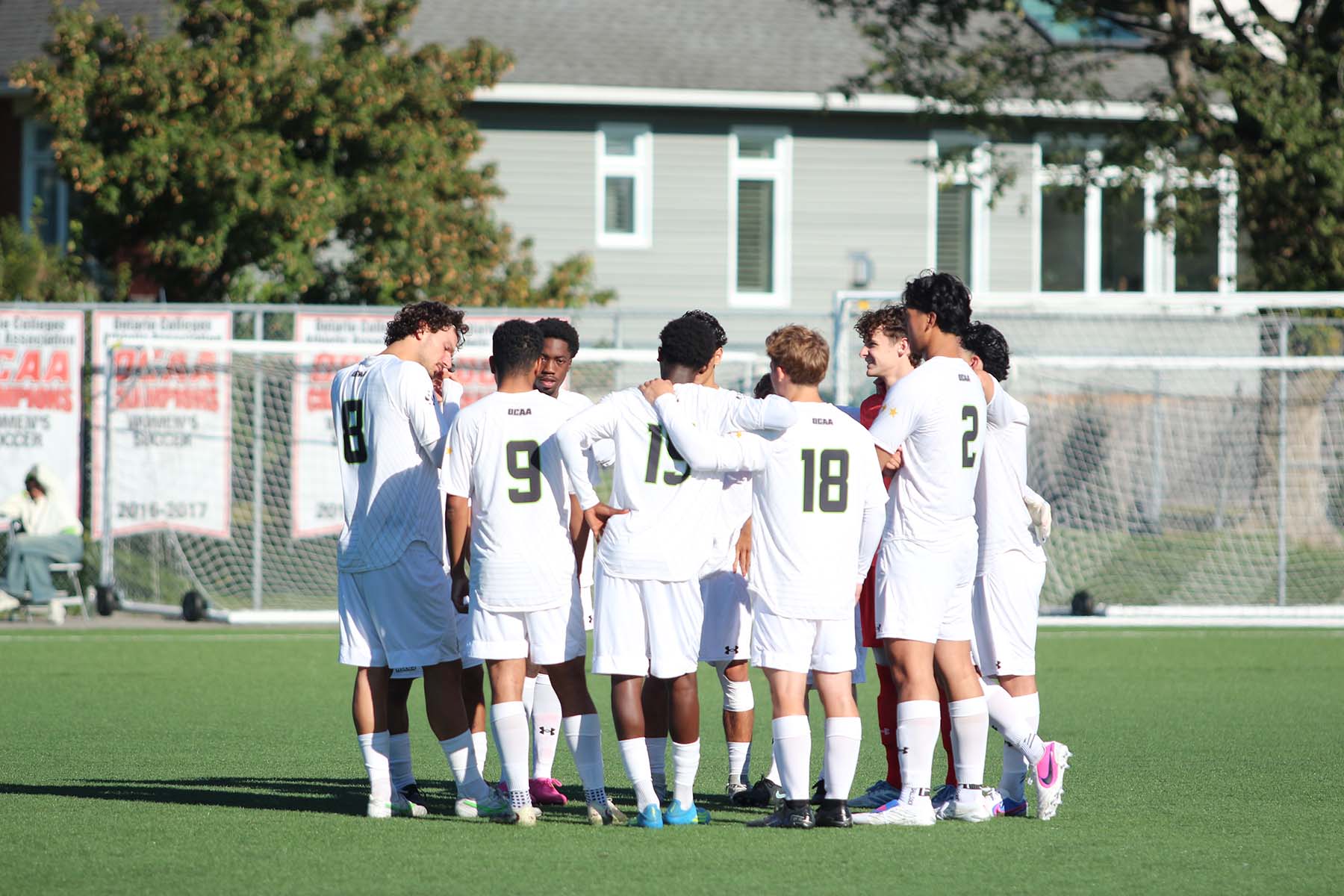
Algonquin Wolves men's team in a huddle awaiting the second half of the game to commence
The Algonquin Wolves men's in a huddle awaiting the second half of the game. Photo credit: Nylah Henry

With both teams starting the season on a high note, they aim to bring that momentum into their next away games.

The women’s team will return to action on Sept. 26 at 1 p.m. against the Seneca Sting at Seneca’s home field, while the men’s team return on Sept. 26 at noon against the Durham Lords at Durham’s home field.

To find the full Algonquin Wolves varsity schedule, visit https://algonquinwolves.com/landing/index.

Student advocacy, transit among Algonquin Students’ Association priorities

Student leaders say data and direct feedback will shape advocacy efforts throughout the academic year
Photo: Amanda McLeod
Jacob Stewart, Algonquin Students' Association president, and Cianah Miller, vice-president, want to connect with students to advocate for their concerns to the college.

Algonquin Students’ Association president Jacob Stewart says collecting student data will be a key priority this year as the organization prepares to advocate for students to the college’s Board of Governors.

“We want to tackle the big problems, the long-term problems and our goal is to work with the college,” said Stewart. “We have a strong relationship with the college…and they actually listen to us as long as we bring the data.”

Stewart says he and SA vice-president Cianah Miller are making a point of being available to students who want to share their concerns. They plan to gather feedback through SA-conducted surveys, meetings with class representatives and conversations with students on campus.

While Stewart is relatively new to the student association — this is his first term on the Board of Directors — Miller has had several roles within the SA.

“This is going on my fourth year. I’ve worked in different positions in the SA and I’ve always loved the work,” said Miller. “I had a classmate two years ago that was on the board, and learning what it meant to her and how much I can make an impact made me want to go for it.”

Stewart and Miller say maintaining an open line of communication with college leadership is important. Stewart says his previous experience as a student representative taught him the importance of speaking up.

“I really liked being able to get things done for the other people in my corner, and I thought to myself, ‘What if I could do this for more people?’” said Stewart.

One key concern for students is how they get to and from the college amid ongoing problems with Ottawa’s public transit system.

In June 2026, City of Ottawa’s auditor general released the Audit of Bus Service and Scheduling, a scathing report about OC Transpo that highlighted issues with the reliability and timeliness of services.

OC Transpo's ongoing reliability issues are on the advocacy agenda for Algonquin College's Students' Association.
OC Transpo's ongoing reliability issues are on the advocacy agenda for Algonquin Students' Association. Photo credit: Amanda McLeod

Algonquin College students pay a mandatory $240-per-semester transit fee as part of their tuition, with limited ways to opt out. College policy does not allow for refunds if a student lives within the OC Transpo or Société de transport de l’Outaouais (STO) service area, regardless of service reliability or length of commute, which for some can be up to two or three hours one way.

Stewart says he and Miller have heard from many students with concerns about paying for an unreliable service and they will be bringing those concerns to the college and OC Transpo working groups.

“Transit is one of our priorities for the year and we are actively working as best we can,” said Stewart. “My goal for this year is when they come to ask for an increase (in fees) — it hasn’t increased in five or six years, since pre-COVID — is to find a compromise. I’ll try to find a realistic number.”

Stewart also plans to raise concerns about the rules governing transit-fee exemptions with the college.

“I can’t go out there and say I’m going to fundamentally change the way that the service fee works. I just don’t have that power,” he said. “But that data I’ve also received and it’s top of my mind.”

Beyond advocacy, the SA provides a wide range of services and events throughout the year.

The association organizes events such as the long-running Dirty Bingo program and movie nights, intramurals and offers a wide variety of on-campus clubs. It also provides a student health and dental coverage plan.

“A lot of what we do is long-term, but the biggest thing we do short-term is just helping with student life, giving them an experience outside of their (academics), helping them to have a break,” said Stewart.

“Academics are top of mind for students, but students still want distractions once in a while. To be able to offer them safe spaces to go, whether it’s for an hour or a couple of hours to go to a movie or play…the student association is very valuable to students.”

The Algonquin Students’ Association is located in E114 and is open Monday to Friday, 8 a.m. to 4 p.m.

Algonquin Wolves’ first cheer team springs into action

The Wolves have partnered with Carleton University's Ravens Rhythm to launch the cheerleading team at Algonquin College
Photo: Tianna Lawless-Musgrave
Ruby Whyte, a student in the paramedic program who is trying out for the cheerleading team.

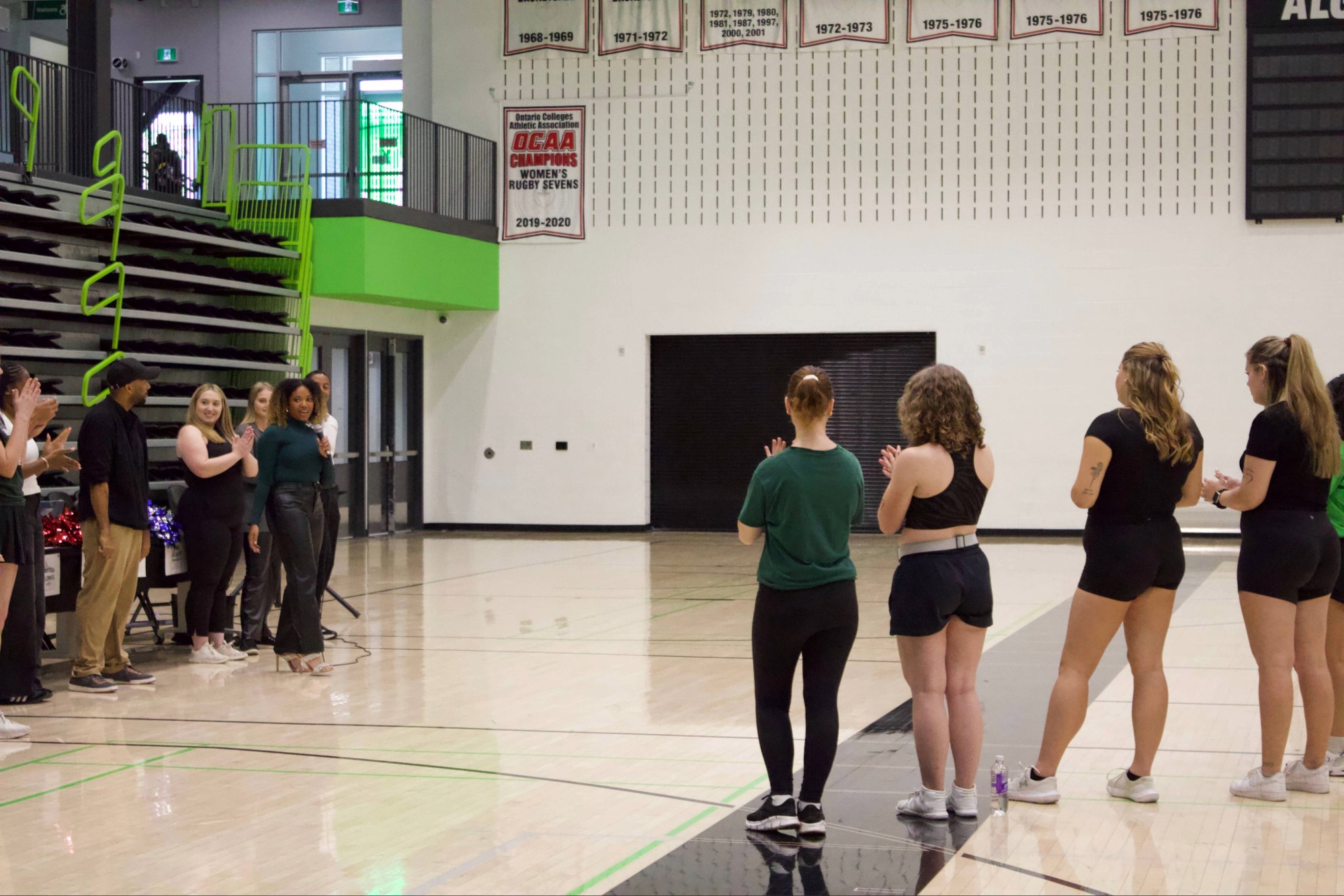
Algonquin College’s first official cheer team in its history held tryouts in the ARC gym on Sept. 12 and students felt excited, nervous and ready to go.

Ruby Whyte, a student in Algonquin College’s paramedic program, explained why she tried out.

“I saw the post on Instagram, and I’ve been cheering for years,” Whyte said.

“I’ve always wanted to do it post-secondary and this is finally the opportunity to do so. I was very excited to see that.”

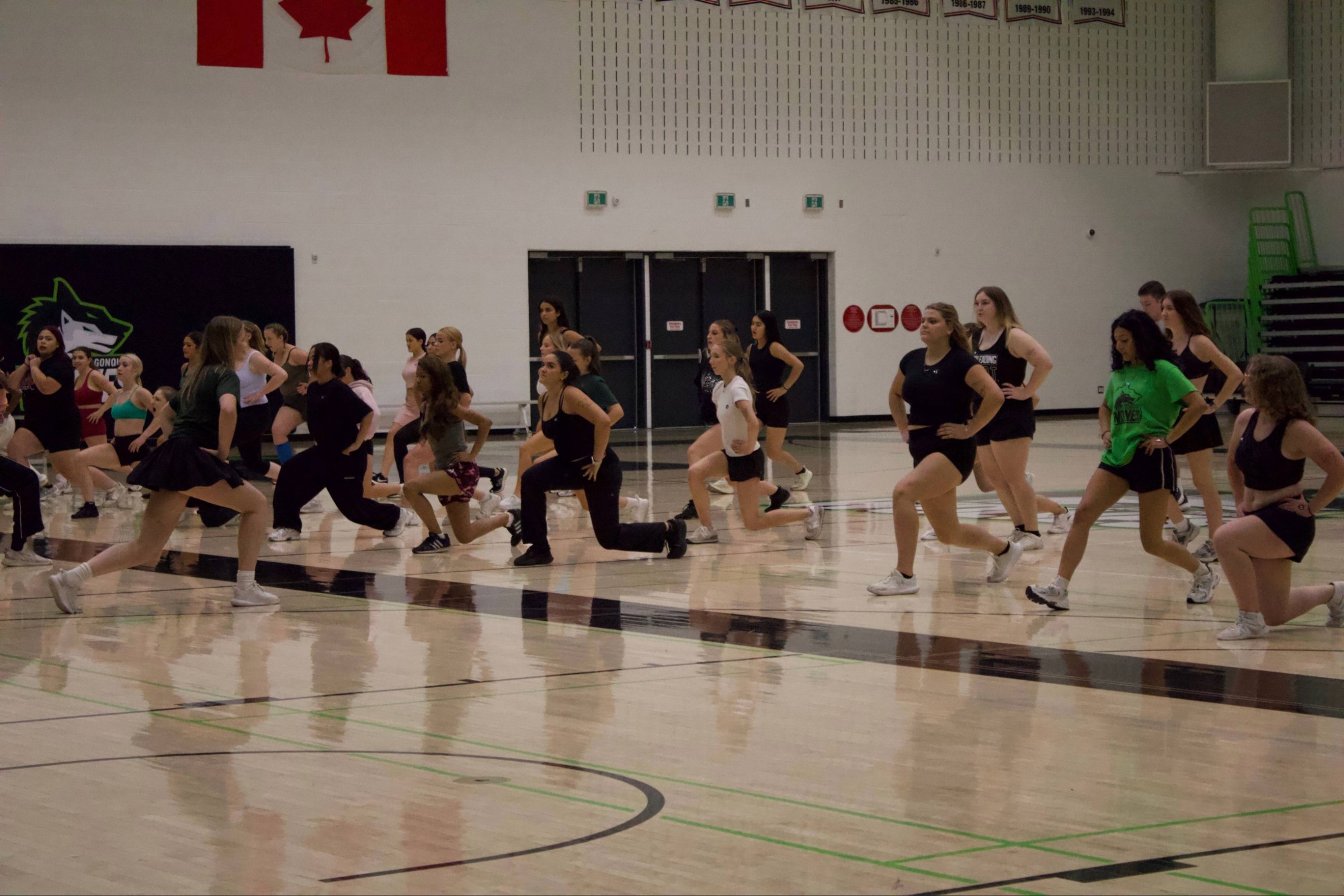
The tryouts started with a guided stretch and exercise session to get everyone moving.
The tryouts started with a guided stretch and exercise session to get everyone moving. Photo credit: Tianna Lawless-Musgrave

Despite some jitters, the environment was welcoming and friendly, something that was very intentional for Sissi Malula, the director of Ravens Rhythm and head coach and coordinator of the cheerleading team.

“A hope is to build community, make friends, and to have them really go out and put on their best show,” said Malula.

Cheerleading competitors in Canada are about 98 per cent women and girls, according to a 2023 Globe and Mail feature on the sport.

One in three Canadians (34 per cent) say that women’s sports are “less exciting” than men’s, while 33 per cent say some sports are just “unwomanly,” according to research by the Angus Reid Institute.

Sissi Malula, the head coach and coordinator of the team, gave an encouraging speech to the nervous cheerleaders.
Sissi Malula, the head coach and coordinator of the team, gave an encouraging speech to the nervous cheerleaders. Photo credit: Tianna Lawless-Musgrave

The opinion on women’s sports and women-dominated sports is often attributed to perceived aspects of “femininity” found in activities like cheer. Malula aims to crush this stereotype.

“First of all, cheer is not feminine; that stereotype is absolutely that. It’s just a stereotype. It’s for all people, and I think that’s the most important part,” Malula said.

“Cheerleading is about leading in cheer, community-oriented people. We are brand ambassadors here for the college, and we really just wanna have fun and encourage people to have fun with us.

“They’re students first, making real change in the world, focusing on their careers, being able to be strong students and making positive change wherever they go.”

Mayoral race heats up as candidates debate transit and housing in front of students

Common student issues put front and centre as candidates try to appeal to youth before next month's municipal election
Photo: Ryan Harkness
Alex Lawson (left), Jeff Leiper (centre) and Neil Saravanamuttoo (right) remained respectful of one another throughout and laughed at some light hearted humour that occurred throughout the debate

Three of the four frontrunners in this year’s mayoral election debated policy ideas in front of an audience of over 300 students, ranging from buses to bylaws.

The Tuesday evening debate in the Carleton University Minto Building was organized by multiple organizations, including the Carleton University Students Association (CUSA), Ottawa Youth Vision Project (OYVP) and the UOttawa Students Union (UOSU).

Mayoral candidates Alex Lawson, Jeff Leiper and Neil Saravanamuttoo debated housing, transit, culture and nightlife, as well as city services and safety, over a two-hour period. Notably absent was incumbent Mark Sutcliffe, who was invited but did not attend.

After the candidates shared their opening remarks by introducing themselves, the first question asked how they would lower rent for students. The candidates outlined how the city could provide assistance for housing, including building public housing.

Leiper wants to create a city acquisition fund “so that the city has not-for-profit partners and can purchase those properties and keep them affordable in perpetuity.”

Saravanamuttoo questioned why the city has made little progress on affordable housing. “It’s quite simple. It’s because developers run the city, I hate to say it,” said Saravanamuttoo.

Lawson intends to implement a 12-month period for the reduction of development charges to be passed down to the homeowners and renters, something that Leiper doesn’t believe will help.

“I can pretty much guarantee you that when development charges are cut, those will flow to the developers’ bottom line,” said Leiper.

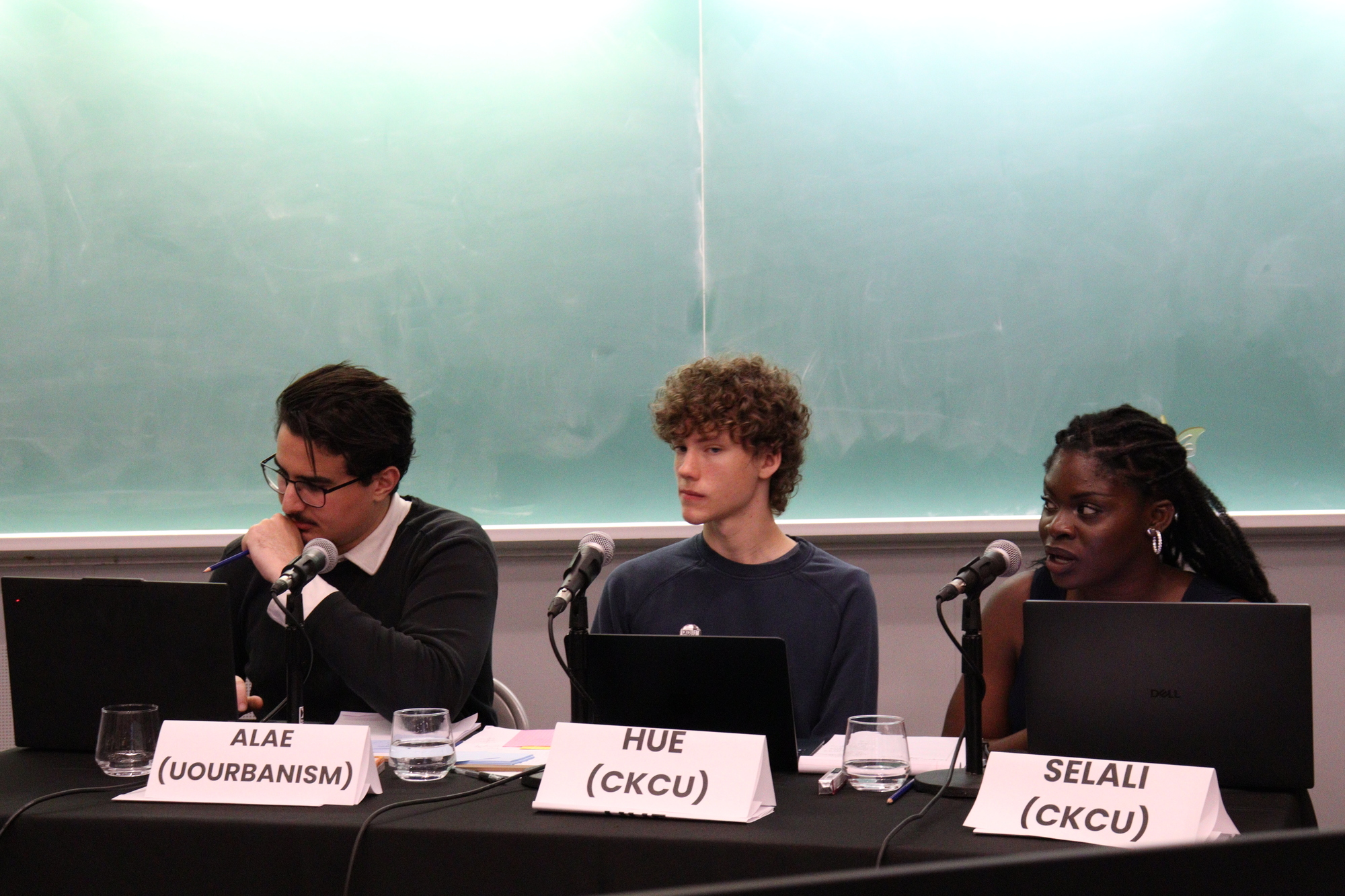
As moderators, Alae Boufarrachene (left), Hue Hetherington (centre) and Selali Ayitey-Wallace (right) asked questions and made rebuttals throughout the debate
As moderators, Alae Boufarrachene (left), Hue Hetherington (centre) and Selali Ayitey-Wallace (right) asked questions and made rebuttals throughout the debate. Photo credit: Ryan Harkness

When it came to transit, the candidates had different ideas on how to improve reliability and set a fare that reflects the service that is being provided.

Leiper blames the New Ways to Bus cuts by the city as a major contributor to the transit problems students experience.

“One of the first things that I am going to do in my very first budget as mayor is reverse the cuts that have been made by Mark Sutcliffe to our bus system. That is job one,” said Leiper, who also would like to work towards a fare freeze.

Saravanamuttoo proposes a buck-a-ride fare to tackle transit affordability.

“Let’s have a price that actually reflects more the quality of the service that we’re currently providing,” said Saravanamuttoo.

“So it’s going to be terrible, but at least it will be cheaper,” Lawson jokingly rebutted.

Saravanamuttoo questioned why Leiper, formerly on the transit commission, didn’t raise the red flag as to why the city was not buying new buses.

Leiper said that the priority of Sutcliffe and former mayor Jim Watson “has been the lowest possible tax increase. When I am mayor, I am going to prioritize purchasing buses.”

Lawson and Leiper disagreed with Saravanamuttoo’s buck-a-ride proposal.

“I don’t think providing less funding is going to be the solution and I don’t think just saying that it’s a terrible service that we should charge less is a solution. I mean, we probably all bought headphones at the dollar store. You only do that once,” said Lawson, who would like to bring back express bus routes and have on-demand shuttle buses in rural communities.

Leiper does not believe that the uploading of the LRT system to the province will help with budget shortfalls from buck-a-ride.

“That is going to rob several hundred million dollars that would need to be replaced in order to put fuel in buses and to pay drivers and mechanics,” said Leiper.

When Leiper and Lawson emphasized the importance of nightlife and the arts are to economic development, Saravanamuttoo felt safety concerns were keeping people away from the downtown. “The whole issue of how we build a vibrancy at nightlife, we have to talk about the homelessness issue first,” said Saravanamuttoo, who mentioned La Village Transitiôn in Gatineau, where homes are made from shipping containers, as a possible solution.

The candidates generally supported the ANCHOR (Alternative Neighbourhood Crisis Response) project, recognizing that there should be alternative means of dealing with mental health crises instead of having the police involved.

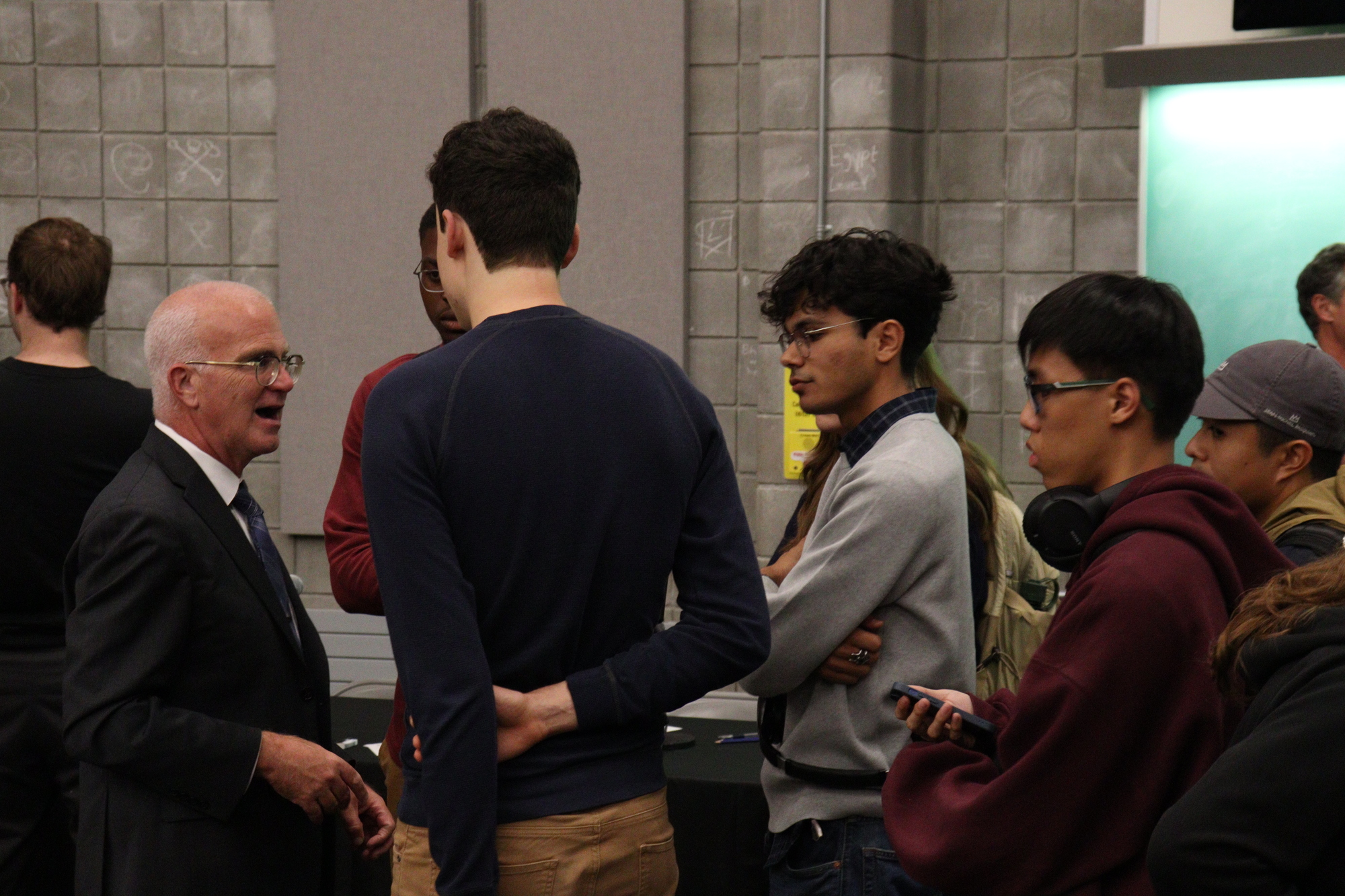
Like the other candidates, Jeff Leiper (second to far left) stayed back after the debate concluded to chat with students
Like the other candidates, Jeff Leiper (second to far left) stayed back after the debate concluded to chat with students Photo credit: Ryan Harkness

“It is important that the police do the work, that police are supposed to deal with criminal issues,” said Leiper. “For every increase in the police budget comes forward, we need alternative responses to mental health.”

“When it’s just somebody that needs to be talked down to or has experienced an episode that they can’t get through, police showing up can make it a lot worse,” said Lawson.

All of the candidates disagree with the Lansdowne 2.0 project, a revitalization project that has been approved by city council, budgeted for $419 million.

“Lansdowne 2.0, if it’s a good idea, it is not a good idea right now, and it has been shrouded in secrecy, and the decisions that were made were made quickly. I’m glad that Jeff Leiper voted against it,” said Lawson.

The municipal election is being held on Oct. 26, with the advanced voting day happening on Oct.16. Polls will be open from 10 a.m. to 8 p.m.

Algonquin Times podcast

Stay Informed

Sign up for our newsletter

Subscribe

* indicates required