OC Transpo is changing bus routes as part of their New Ways to Bus program
Nathan Heatherington
Photos: Nathan Heatherington
April 17, 2025 Revised: April 17, 2025 4:29pm
Photo: Nathan Heatherington
Students disembarking Route 88 outside of C-building at Algonquin College
On April 27, OC Transpo will be making several changes to bus routes to improve transportation around the city.
The program, called New Ways to Bus, will make changes to more than 100 routes as part of OC Transpo’s five-year roadmap. The changes will focus on frequency, local service in neighbourhoods and connections to key destinations, according to OC Transpo’s website.
This will include changes to the busy Route 88.
“It’s written in every bus, but I wish I had an email,” said Vanshika Vanshika, a student studying computer programming at Algonquin College. “I have no idea how it is going to change.”
Route 88 bus sign outside of C-building at Algonquin College. Photo credit: Nathan Heatherington
Route 88 will be getting a new symbol, a blue hexagon for frequent routes, replacing the blue circle for rapid routes. Frequent routes will be every 15 minutes or less from 6 a.m. to 6 p.m. on weekdays and run seven days a week along main roads.
Godwin Biju, a student taking the development social worker program at Algonquin College, is hoping that these changes will be for the better.
“The buses would always be late or get cancelled sometimes. If I needed to be somewhere at a certain time, the bus would never be there. More buses and less stops could make transportation much smoother,” said Biju.
According to OC Transpo’s website, Route 88 “will be changed to run between Bayshore and Hurdman stations. It will be changed to run from Queensway-Carleton Hospital on John Sutherland Drive, Richmond Road, and Holly Acres Road. Service west of Queensway-Carleton Hospital will be removed and replaced by a new Route 68. Special Sunday trips to and from Preston Street or Carling Avenue will be removed.”
Route 88 will have two O-Train connections: Hurdman Station and Mooney’s Bay Station.
Cosmo Welch, a student studying illustration and concept art at Algonquin College, is no stranger the frustrating experiences with the old Route 88.
“I take it all the way to Hurdman, about a half hour, and then another hour before I am home,” said Welch. “It’s awful to be on because it is so busy, and there aren’t enough buses.”
“I’m looking forward to it hopefully changing for the better,” said Welch.
With Algonquin College suspending programs for the 2025-2026 academic year due to financial reasons, how does it affect the Wolves' teams?
Jaiden Martin
Photos: Jaiden Martin
April 17, 2025 Revised: April 17, 2025 9:20am
Photo: Jaiden Martin
Everton Senior coaches the Wolves women's volleyball team on Jan. 24 at the Jack Doyle Athletic and Recreation Centre.
Some Algonquin College varsity coaches worry program suspensions and caps on international students could impact their teams.
The Algonquin Students’ Association pays for the varsity sports at Algonquin College, which is a separate budget from Algonquin College itself.
“We don’t know how Algonquin College’s program cuts will impact enrolment in 2025-26 and beyond, and we can’t project their potential impact on Students’ Association finances. However, we don’t anticipate an impact on our varsity teams’ ability to operate in the foreseeable future,” said Chris Lackner, a spokesman with the Students’ Association.
The college has announced several program suspensions in response to budget challenges.
On Jan. 10, Algonquin College announced its plan to shut down its Perth campus, citing “unprecedented financial challenges.”
On Feb. 24, Algonquin College’s board of governors announced that it will suspend 41 programs for the 2025-2026 academic year.
On top of that, the college is registering fewer international students because of policy decisions by the federal and provincial governments impacting all colleges in Ontario.
Some of the programs being cut can bring uncertainty, but Dan Gauthier, head coach of the Wolves women’s rugby 7s team, thinks that the campus closure may help some players in his program.
Since the team is based at the Ottawa campus, the closure of the Perth “might help our rugby program as some of the student-athletes that took courses at that campus will now be brought into the fold here at the Ottawa campus, making it easier for them to participate,” Gauthier said.
“We have dealt with budget cuts in the past and have always enjoyed tremendous support and resources from the Student Association and Athletics. I expect that they will do everything humanly possible to keep us as well supported as we have in the past,” Gauthier said.
Gauthier knows that the rugby program will save money from hosting a tournament, which saves travel costs.
Basil Phillips, head coach of the women’s soccer team, thinks the cuts won’t affect his team as much as others.
“I think anytime there are cuts, there will be some kind of trickle-down effect. I am not sure if the programs being cut will have a significant effect as players have been leaning more towards the two-to-four-year programs, which don’t seem to be the programs being cut,” Phillips said.
However, Phillips acknowledges that fewer students coming into the college means less funding.
“Less revenue does come with the worry of less funding for sports. We have been assured of the college’s support moving forward, but the situation does make you think and have a bit of worry. Hopefully, there will not be any negative impact for varsity soccer,” Phillips said.
Everton Senior, the head coach of the women’s volleyball team, believes he will see the impact of the cuts and less funding during next season.
“I haven’t seen any effect to our volleyball program as a result of the cuts. We may know more after the commencement of the fall semester. I am hopeful that our budget will remain the same next season, but we may see some cutbacks for the following year,” Senior said.
The Students’ Association expects its varsity sports program will continue to attract talent.
“We expect the Jack Doyle Athletics and Recreation Centre, our stellar Algonquin Wolves’ coaching staff, and our track record for varsity success to continue to be recruitment draws,” Lackner said.
“The Algonquin Wolves’ teams are coming off a highly successful varsity season, including our men’s soccer team winning silver medals at both the provincial and national championships and our women’s basketball team winning a bronze medal after its third-straight undefeated regular season. We are proud of our track record for varsity excellence and expect it will continue to draw talented student-athletes.”
"We lost a great friend, a sister, a daughter, an aunt"
Vasileios Tselios
Photos: Merissa May
April 15, 2025 Revised: April 15, 2025 10:29am
Photo: Merissa May
“She could alway make you smile and feel loved and appreciated. Her presence when she entered the room was mesmerizing,” said friend Merissa May about Sheila Berroa.
Sheila Berroa, an Algonquin College alumna, died in the nightclub roof collapse in the Dominican Republic on April 8.
Berroa was one of the 231 people who lost their lives in the incident, according to the latest reports from health officials in the Caribbean country.
The 24-year-old woman attended Algonquin College’s business management and entrepreneurship program between 2018 and 2020.
Berroa worked as a manager at the Planet Fitness on Merivale Road in Ottawa before she went back to the Dominican Republic in March due to her work visa expiring, according to Merissa May, a close friend.
“She had so much potential. Her work ethic and her positive attitude and outlook on life was one of a kind,” said May.
The former student was in the Jet Set nightclub in Santo Domingo early on April 8 when the club’s concrete roof collapsed.
The death toll last reported on April 15 was 231 people. There were 189 people who were rescued alive from the rubble, according to officials.
May said Berroa would have still been alive had it not been for her visa issues.
“She could always make you smile and feel loved and appreciated. Her presence when she entered the room was mesmerizing,” said May.
“She was such a kind soul and we lost her too soon.”
Candidates clashed over crime, misinformation and federal funding, each offering their own solutions for the riding’s future
Delaney Smith
Photos: Delaney Smith
April 15, 2025 Revised: April 15, 2025 9:42am
Photo: Delaney Smith
Four federal candidates offered their positions during the Ottawa West-Nepean all-candidates meeting on April 8 at Ben Franklin Place.
Federal election candidates in Ottawa West-Nepean gathered at Ben Franklin Place on April 8 for a lively debate, discussing everything from aging infrastructure to rising crime and disinformation within the riding.
Four candidates — Anita Vandenbeld (Liberal), Glen Armstrong (People’s Party), Josh Bizjak (NDP) and Prashanta Dhakal (Green Party) — shared their views on key issues affecting the local community ahead of the April 28 federal election.
The Conservative Party candidate for Ottawa West-Nepean, Ryan Telford, was not present for the debate.
Municipal Funding
One of the key discussions of the night focused on the cities aging infrastructure and whether more federal funding should go to cities to help them modernize.
Bizjak was quick to agree.
“Our cities are overburdened, and there’s an opportunity for the federal government to upload some of those costs,” he said.
Bizjak emphasized that improving Ottawa’s transit system and expanding housing options should be at the top of the list.
Vandenbeld also supported more funding and emphasized her party’s successes in Ottawa West-Nepean.
“Since 2019, we’ve invested over a billion dollars on infrastructure in Ottawa,” she said.
She specifically referenced the Housing Accelerator Fund, which granted $176 million to help build 3,200 new units in the city, a program she said the Conservatives would cut.
Dhakal agreed on the need for federal support but urged a more strategic approach.
“We need conditions attached to that funding,” Dhakal said. “We shouldn’t encourage urban sprawl. We should focus on cities that prioritize public transit.”
Armstrong also voiced support for more funding, particularly for transportation, but quickly pivoted to criticize the housing policies of other parties.
“Carney wants prefabricated homes… Poilievre wants Hong Kong-style high rises,” Armstrong said, questioning whether either of these options would be affordable or built with rental units in mind.
Four federal candidates offered their positions during the Ottawa West-Nepean all-candidates meeting on April 8 at Ben Franklin Place. Photo credit: Delaney Smith
Improving Access to Services
When asked about improving access to federal services, the candidates offered a mix of solutions, pointing out the current challenges constituents face when asking help from government offices.
Vandenbeld embraced the Liberal government’s creation of a minister dedicated to addressing casework, highlighting her office’s efforts in solving over 4,000 issues since the last election.
“Three hard-working staff should not have to solve all these problems,” she said.
Dhakal proposed hiring more staff to improve efficiency.
“We need more resources,” he said.
Bizjak suggested MPs’ offices should be open and accessible to everyone.
“It would be wonderful if, when you called, a real person picked up the phone,” he said.
Armstrong used the question to criticize the exclusion of PPC leader Maxime Bernier from national debates, wondering how a government that limits participation could effectively serve its constituents.
Combatting Fraud and Coercion
The issue of fraud, especially targeting seniors, was another topic that brought strong reactions from the candidates.
Dhakal shared a personal story about a foreign student who was scammed out of $12,000.
“Unfortunately, it happens to the most vulnerable,” he said. “This should be a solvable problem, and we should solve it.”
Armstrong called for stronger legislation against robocalls and online scams, recounting how his own mother had to change her phone number after being targeted.
“She had to just recently change her phone number after 25 years because of this,” he said.
Bizjak emphasized the need for accountability from financial institutions.
“The government has a responsibility to step in and work with banks… People who have been scammed should get their money back,” Bizjak said.
Vandenbeld pointed to the Liberal government’s mandatory regulations in the banking sector, saying, “Banks should be held accountable,” and she highlighted the importance of establishing public awareness campaigns, especially marketed in stores like Shoppers Drug Mart, to help seniors recognize fraud.
Crime and Community Safety
The candidates also addressed concerns about rising crime, particularly theft and violence, in Ottawa West-Nepean.
Armstrong focused on car theft, calling for increased border enforcement.
“People are getting their cars stolen, and they know about it at the port, but they don’t even tell the victim,” he said.
Bizjak took a more social approach, saying addressing the root causes of crime, like poverty and inequality, is key.
“I believe every person has good intentions,” he said. “We need to look at why these crimes are happening.”
Vandenbeld pointed to the government’s firearms legislation, including the ongoing freeze on handguns.
“I don’t ever want to sit in a living room in our riding talking to a mother whose child was shot,” she said, stressing the importance of stricter gun control.
Dhakal suggested reducing jurisdictional overlap in policing and improving rehabilitation programs.
“There have been several reports of a jurisdictional problem,” he said. “We could be doing more.”
Disinformation and Democracy
With the rise of disinformation and foreign interference, the candidates were asked how they would protect Canadian democracy.
Bizjak called for stricter regulations on digital platforms to curb disinformation.
“These digital companies are given free range far too often,” he said. “We need to regulate them more strictly.”
Vandenbeld defended the Liberal government’s efforts to combat election interference, pointing to the work of the Canadian Security Intelligence Service and the Privy Council.
“Transparency is the best defence,” she said, noting that any interference should be made public.
Dhakal also emphasized the importance of public broadcasting in fighting misinformation. “This is why we need CBC,” he said. “We need diverse sources of news to combat the lies.”
Armstrong, on the other hand, raised concerns about the role of CBC, questioning its objectivity.
“We have to question whether CBC is a truly independent and unbiased news source,” he said.
“There’s been a lot of talk about its reliability, and we need to ensure that we’re not just relying on one source of information.”
Visit Elections Canada for more information on your riding, candidates and dates.
A night of cheeky prizes and a packed room of eager students, Dirty Bingo made its grand finale for the semester at Algonquin College on April 2
Ana Silva
Photos: Ana Silva
April 14, 2025 Revised: April 14, 2025 9:41am
Photo: Ana Silva
Zelda Marshall and Crystal Caring, long-time hosts of Dirty Bingo, pose for a photo during the final event of the academic year, held on April 2 in the Observatory.
More than 50 students packed the Observatory on April 2 for the final Dirty Bingo of the semester, with some arriving before doors opened, ready for a cheeky night of games, laughter and adult-themed prizes.
Hosted by drag performers Zelda Marshall and Crystal Caring, Dirty Bingo is a long-standing Algonquin College tradition that mixes classic bingo with not-so-classic rewards like vibrators, lube and even non-sexual prizes for asexual folks.
Zelda Marshall and Crystal Caring, long-time hosts of Dirty Bingo, pose for a photo during the final event of the academic year, held on April 2 in the Observatory. Photo credit: Ana Silva
“I started hosting Dirty Bingo in 2010,” said Marshall. “Bill Kitchen (the Students’ Association’s senior manager of hospitality services) asked me about a year later, ‘Do you want to bring somebody along?’ So, of course, immediately I thought of Crystal, and we’ve been doing it as a joint thing since 2011.”
With music playing, drinks flowing and students shouting out bingo numbers, the energy in the room stayed high all evening. Security staff checked IDs at the entrance, handing green bracelets to those drinking, keeping the vibe fun but safe.
Over the course of 10 games, one of which included a hilarious tiebreaker where two participants raced to stretch a condom over an entire water bottle without it breaking, the first to succeed was declared the winner.
Two participants race to break a tie by stretching condoms over water bottles during Dirty Bingo, held on April 2 in the Observatory. The first to cover the bottle without breaking the condom won the round. Photo credit: Ana Silva
Students got more than just a chance to win. They got an experience.
“There was a time we only got nine games in because the fire alarm went off,” Marshall said laughing. “And one year, the last game of the year had to be cancelled because of an ice storm in April.”
Throughout the night, Marshall and Caring interacted directly with the crowd. Students picked the bingo numbers themselves, adding a fun twist to each round. After five games, players got a break to grab drinks, stretch out and gear up for more chaos.
For long-time fans like Fiona Smith, a student in the radio broadcasting program, the event is more than just a night out — it’s a monthly ritual.
Fiona Smith, a student in the radio broadcasting program, celebrates being the first winner of the night at Dirty Bingo, held on April 2 in the Observatory. Photo credit: Ana Silva
“I’ve been going ever since I started college,” Smith said. “There’s nothing like this anywhere else, not to the same calibre that Algonquin does it. They do an amazing job of making sure everyone’s included. It makes you want to come back every single time.”
Another regular, Bryden Lessard, agreed.
“It’s really fun,” he said. “I maybe wouldn’t bring your parents.”
Marshall, however, noted that for some, it’s a family affair.
“The students bring their parents, too,” she said. “So it becomes a multi-generational, fun night out.”
For Caring, it’s all about the impact.
“There were a couple of guys on the football team that came out after seeing how open their friends were with me joking around with them,” she said. “That’s the big thing, knowing people can enjoy themselves, have a good experience and maybe even change their lives.”
This was the last Dirty Bingo of the academic year, but fans of the event won’t have to wait too long. As Marshall reminded the crowd, she and Caring will be back in the fall to do it all again.
Commuters have experienced some much-needed relief. But will the price of gas affect their vote in the upcoming election?
Kevin Clasper-Inglis
Photos: Kevin Clasper-Inglis
April 11, 2025 Revised: April 11, 2025 2:59pm
Photo: Kevin Clasper-Inglis
A Petro-Canada gas station down the road from Algonquin College on Woodroffe Avenue.
The federal consumer carbon tax dropped to zero per cent on April 1, immediately impacting gas prices in Ottawa and helping the budgets of Algonquin College students.
Gas prices across Ottawa dropped by an average of 20 cents per litre. For many students and staff who rely on their vehicles to get to the college, it’s a welcome respite to their wallets.
A Nepean resident fuels up his car Wednesday morning. Photo credit: Kevin Clasper-Inglis
Daylin Wilcott says it will allow him to fill his tank more often.
“Recently, I’ve just been putting in the bare minimum to be able to get me from place to place,” Wilcott said.
But on April 1, he was filling the tank up.
Prime Minister Mark Carney, who recently replaced Justin Trudeau as leader of the Liberal party, made the removal of the unpopular policy a priority after taking office. Eliminating the controversial tax had been a key policy plank of Pierre Poilievre, the leader of the opposition Conservative Party.
Conservative and Liberal election signs next to a Petro-Canada on Woodroffe Avenue near Algonquin College. Photo credit: Kevin Clasper-Inglis
Henry Trepanier, a student at Algonquin College, is happy for the extra relief at the gas pump and believes it was right to remove the consumer portion of the carbon tax while leaving the industrial portion of the tax on.
“The carbon tax is good if it’s charged to the right people,” Trepanier said.
Carney has not pledged to removing the industrial portion of the tax, which taxes industries on their carbon emissions. The Conservatives have pledged to go further and scrap the industrial carbon price.
“I appreciate Mark Carney’s point of view,” Trepanier said.
Algonquin student Henry Trevalier with his car. Trevalier supports the removal of the consumer carbon tax.
He says the removal of the carbon tax is just “sprinkles on the donut” and was planning to vote for Carney regardless.
“Certainly saving a few bucks at the pump is great. That little isn’t enough to sell my soul to either party, but I think it will make a difference for sure,” Trepanier said, speaking on the April 28 federal election.
“It will definitely get him (Carney) votes.”
Willcott wasn’t sure if lower gas prices would inform his vote choice in the upcoming election.
“It’s definitely a consideration given the trade wars with the U.S. and everything that’s going on. A lot is going on for our government right now and gas does add to it,” he said.
Algonquin Student Daylin Wilcott fuels up his car at Petro-Canada on Woodroffe on April 1, the first day of the carbon levy dropping to zero percent. Photo credit: Kevin Clasper-Inglis
Saving money at the pump is crucial to Willcott. He has a 35-minute long commute to school and the removal of the carbon tax helps.
After the Perth campus closure, Pembroke's mayor says he received assurance from the college president that the waterfront campus is safe
Kevin Clasper-Inglis
Photos: Kevin Clasper-Inglis
April 10, 2025 Revised: April 10, 2025 4:40pm
Photo: Kevin Clasper-Inglis
The waterfront campus in Pembroke.
It has been a challenging year for Ontario’s post-secondary education sector.
With the announced suspension of 41 programs and the Perth campus’ planned closure, Algonquin College has not been spared the pain.
The college benefits the communities in which it operates and Pembroke is no exception.
Algonquin is intricately tied into the economic livelihood of the Ottawa Valley city and its surrounding community. Through the educational opportunities on offer, the waterfront campus greatly contributes to the sectors that drive the region’s economy, such as forestry, the military and health-care services, according to faculty and students.
The recently announced program suspensions and the future closure of the Perth campus have triggered anxiety throughout Pembroke about the future of its own campus.
Amy Lagree, a nursing student at the Pembroke campus, enjoys the smaller size of the campus, which is a tight-knit community reflective of the small-town vibe of Pembroke overall.
Lagree says that students get to know professors more on a personal level compared to the larger Ottawa campus.
“When my friends were at those bigger campuses, they were just a number,” she said.
Lagree says the campus is important to the city of Pembroke.
“I think if it closed, it would be really unfortunate,” she said. “I have other friends here who were in nursing and were able to get jobs in town.”
Peter Arbour has been teaching in the forestry technician program at the waterfront campus for six years and is program coordinator. Arbour, who recently won an Excellence in Teaching Award from the college, says the program offers a direct path into the Ottawa Valley forestry sector.
“Eastern Ontario still has a very robust forestry industry and our grads are lapped up by these organizations as they graduate,” Arbour said. “There’s a great impact from this program out to eastern Ontario forestry.”
He says teaching at Algonquin has been the most meaningful career he’s ever had.
Arbour’s conviction that the waterfront campus is pivotal to the city of Pembroke and the regional economy was backed up by Ron Gervais, who has been the mayor of Pembroke since 2022.
He admits that he was deeply concerned about the fate of the campus in Pembroke when he heard the announcement of the Perth campus closing.
“I’d be kidding you if I said I hadn’t already thought about ‘what if’,” Gervais said. “When the closure of the Perth campus was announced, I spoke with President Brulé (college president Claude Brulé) about whether there was going to be any consequences to Pembroke and he reassured me we were safe.”
Pembroke Mayor Ron Gervais wearing his chain of office. Photo credit: Kevin Clasper-Inglis
“Without the campus there, you have a number of good-paying positions which will no longer be here, which would have negative consequences,” Gervais said about the importance of the college campus in Pembroke.
“In addition to that, we simply wouldn’t have that student body that is contributing positively to our economy.”
The waterfront campus also has a close working relationship with the nearby Canadian Forces Base at Petawawa.
“We are privileged to be just down the road from Garrison Petawawa, one of the largest military bases in Canada,” said Jodi Bucholtz, manager of community and students affairs at the campus.
“We have a strong and ever-growing relationship. About 30 per cent of our student population is either a dependant, a spouse, or an exiting military member or veteran.”
Bucholtz says the staff population at the waterfront campus also reflects the strong ties to the CAF.
“We’re lucky to have a community and organizational partner like the Garrison Petawawa,” Bucholtz added.
Bucholtz says that attending Algonquin can act as a transitional support for Canadian Armed Forces members wanting to return to civilian life.
A variety of services and supports are available at the campus to Armed Forces members to help smooth out their transition from military life to student life. These include specific financial aid for students coming straight from the Armed Forces and a variety of bursaries.
For Marcie Lane, an Algonquin alumna who attended the college coming out of a military career, says the Pembroke campus offered her a lot of support in her transition.
“I was reluctant to go back to school,” she said. “I was a mature student and didn’t think I would fit in with younger students, but Algonquin had such a warm and welcoming environment.”
Lane says she learned a lot from younger students and also became a mentor.
“I felt valued, accepted and respected,” she said.
Peter Arbour teaches an engaged classroom. Photo credit: Kevin Clasper-Inglis
For Lane, the welcoming and supportive environment nurtured by the faculty and students at the Pembroke campus helped recreate the feeling of community and cohesion she had not felt since the Forces.
“Algonquin helped me realize my sense of purpose,” she said.
Featured Hero | Featured Story | Home Feature | Home Hero | News
The Wolves basketball program stole the show in a night honouring the school's best athletes at this year's varsity awards banquet
Gavin Oregan
Photos: Ellen Bond
April 10, 2025 Revised: April 10, 2025 4:19pm
Photo: Ellen Bond
The Wolves men's soccer team celebrates after being named the Team of the Year at this year's Athlete Banquet on March 26 in the Student Commons Theatre.
The Algonquin Wolves basketball program stole the show at this year’s varsity awards banquet, with two of its biggest stars walking away with the college’s top athletic honours.
On March 26 at the Algonquin Commons Theatre, the college celebrated the 2024–25 season in style, but it was the hardcourt heroes who left the biggest impression.
Women’s basketball standout Dasia McDonald and men’s veteran Simon Desta were named the female and male athletes of the year respectively, capping off historic seasons that cemented their legacies and highlighting a banner year for Wolves basketball.
McDonald, a four-time OCAA East first-team all-star, dominated the league from every angle, leading in assists, steals, assist-to-turnover ratio and three-point percentage. She also ranked top four in field goal percentage and scoring. Her efforts earned her a trifecta of major honours: OCAA East Player of the Year, East Defensive Player of the year and CCAA All-Canadian for the third consecutive season.
“This reflects everything Dasia brings to the program — leadership, intensity and consistency,” said head coach Jaime McLean. “She’s left her mark on the Wolves and the OCAA.”
Dasia Mcdonald stands on stage after winning Female Athlete of the Year at the Athlete Banquet on March 2, at the Student Commons Theatre. Photo credit: Ellen Bond
On the men’s side, Desta wrapped up his fifth and final season with a performance to remember. He became Algonquin’s all-time leading scorer, tallying 1,298 career points, and was named OCAA East Sixth Man Of The Year. In his last regular-season game, he lit up the scoreboard with 29 points and nine three-pointers, a statement finish to an unforgettable career.
“To be honest, talking to myself from five years earlier, I’d tell you that you were talking to the wrong person,” Desta said. “The way I grew up being doubted and underrated — it’s just a surreal feeling. Words can’t describe.”
A season of success across the board
While basketball ruled the night’s major awards, the entire Wolves varsity program had plenty to celebrate after a record-breaking season.
Before team and individual honours were handed out, 32 student-athletes were recognized as OCAA all-academics, earning a GPA of 3.6 or higher in the fall semester. Six student-athletes earned an even higher distinction as CCAA Academic All-Canadians and OCAA Academic and Athletic Excellence Award recipients, highlighting their achievements both on the field and in the classroom.
The honourees were:
Women’s soccer: Olivia Bradley, Alexandra Aubin, Samantha Jones
Men’s soccer: Jaeden Mercure
Women’s rugby 7s: Nicolle Boeyenga, Sydney Seymour
Team awards and recognitions
Each Wolves varsity team took a moment in the spotlight as coaches named their rookie of the year and most valuable player award winners.
Women’s soccer
Rookie of the year: Olivia Bradley
Most valuable player: Samantha Jones
Men’s soccer
Rookie of the year: Alaa Mahfouz
Most valuable player: Jaeden Mercure
Men’s rugby
Rookie of the year: Tiago Kiala
Most valuable player: Aung Thein
Women’s volleyball
Rookie of the year: Carys Tenthorey
Most valuable player: Gabrielle Paquette
Men’s volleyball
Rookie of the year: Mateo Nunez Kruus
Most valuable player: Gavin Hassell
Women’s basketball
Rookie of the year: Paige Foster
Most valuable player: Cianah Miller
Men’s basketball
Rookie of the year: Shyeem Brown
Most valuable player: Tesloch Luk
The basketball program’s success was built on more than just individual accolades. With strong rookie classes and veteran leadership, both teams showed promise and grit throughout the season, laying a foundation for future championship runs.
Team of the year: Men’s soccer
To cap off an incredible night of athletic celebration the most prestigious award of all, team of the year, was awarded to the men’s soccer team, which made Wolves history with a season to remember.
After finishing the regular season 7-1-2, they claimed the OCAA East Division title and went on to win silver medals at both the OCAA and CCAA championships, the first national medal in Wolves history.
The team also earned several individual accolades, including OCAA Coach of the Year honours for head coach Angus Wong.
Simon Desta stands on stage after winning Male Athlete of the Year at the Athlete Banquet on March 26 at the Student Commons Theatre. Photo credit: Ellen Bond
The 2024–25 varsity awards banquet was more than just a celebration, it was a reflection of a growing culture of excellence within Wolves athletics. From record-breaking basketball performances to national-level soccer success and academic recognition across every sport, the Wolves continue to raise the bar.
And if this year’s basketball sweep is any indication, the future of Algonquin athletics looks nothing short of championship calibre.
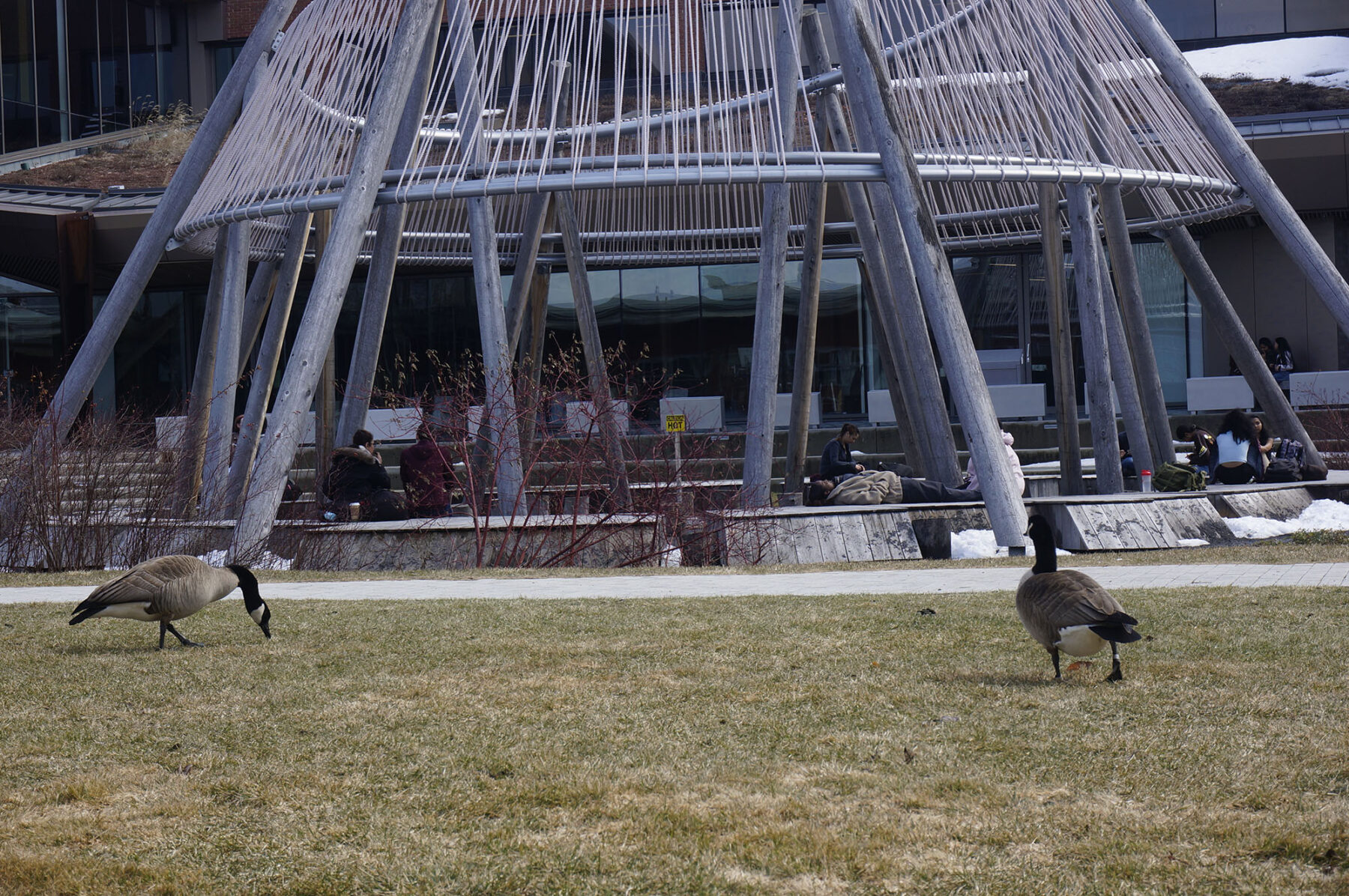
Geese wandering around outside of the library at Algonquin College on April 3.
Johnn Charles, a 20-year-old advertising and marketing communications management student at Algonquin College, believes the school might be onto something with its efforts to rid the grounds of the Canadian icons.
“I got chased by a goose when I was in the ninth grade,” said Charles.
After that terrifying encounter, Charles said he doesn’t see any need for geese on campus, believing they could be dangerous and pose a threat to the grass with their droppings.
“No need for geese,” he said.
“I’m anti-goose.”
Johnn Charles in the library at Algonquin College where he was looking at the geese from above on April 3. Photo credit: Nicklaus Korim
Algonquin College sent an email on March 21 notifying staff that the grounds team will begin spraying parts of the Ottawa campus with goose repellent in an effort to keep the honking fliers away.
“The Grounds team will be applying a repellent to deter geese from nesting,” said the college in its email. “The product will be applied to both nesting and foraging areas and may emit an odour for up to 24 hours before dissipating.”
However, not everyone shares the anti-goose perspective.
Kaitlyn Vallentgoed, 19, a professional writing student from Brockville, Ont., is used to geese and doesn’t mind their presence.
“No, not usually,” Vallentgoed said, when asked if the waddlers ever bothered her while studying outside the library, the goose hotspot on campus.
“I am definitely pro-goose.”
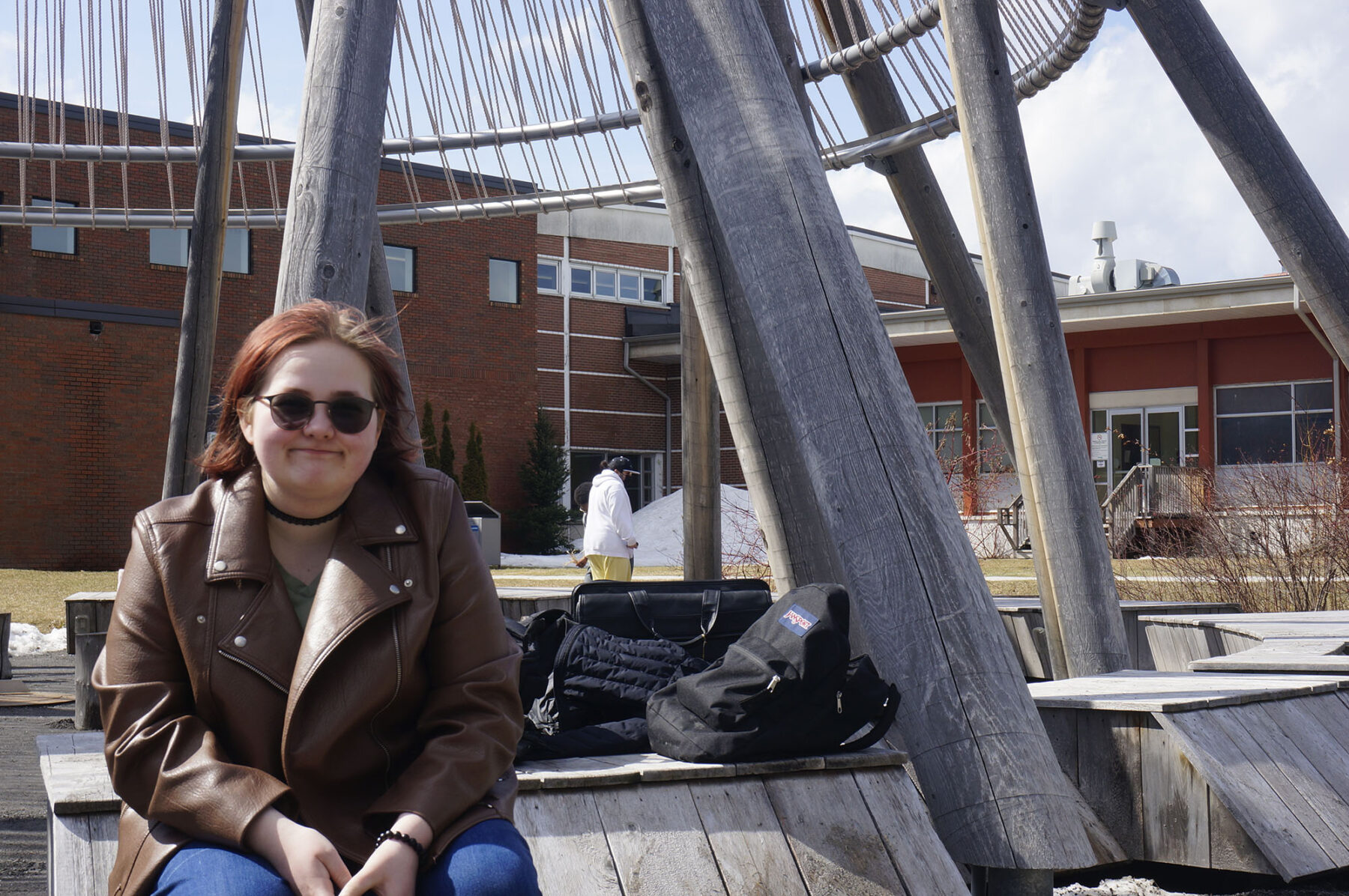
Kaitlyn Vallentgoed, outside the library at Algonquin College, where the geese were waddling around April 3. Photo credit: Nicklaus Korim
There is no need to worry if you are a pro-gooser. The college states in their email the chemical used for the spray does not pose “any risks to the College community or the geese.”
A common chemical used for goose spray repellent is methyl anthranilate. According to Bird B Gone, a company selling the chemical, methyl anthranilate is a grape extract. Once sprayed on the ground, it gives the grass a taste geese cannot stand, forcing them to find other areas to forage and nest.
Molly Seegmiller, 19, also in the advertising and marketing communications management program, said she doesn’t have strong feelings either way.
“I’m neutral-goose,” Seegmiller said.
While she admitted the droppings can be annoying, she also finds the birds to be a calming presence as they waddle across campus.
“I like looking at them,” she said laughing.
Featured Hero | Featured Story | Home Feature | Home Hero | News
The two-day thrift shop raised funds while promoting sustainability and affordability for students
Hau Ting Ng
Photos: Hau Ting Ng
April 10, 2025 Revised: April 10, 2025 9:17am
Photo: Hau Ting Ng
PR students organized a two-day thrift shop to raise funds for Rideauwood Addiction and Family Services.
The Algonquin College public relations program hosted the Spring Clean for the Cause thrift shop on March 25-26, fundraising for the Rideauwood Addiction and Family Services.
“We chose to do a thrift shop simply because it was the lowest amount of overhead that we could have and the biggest return that we could give towards raising money,” said Scott Sullivan, a member of the Spring Clean for the Cause.
Sullivan emphasized more reasons for establishing the thrift shop to benefit the world.
“We’re all living in tough economic times right now, and there’s a lot of uncertainty going on in the world, and we don’t want any of the students or anybody who will contribute to feel any kind of financial pressure.”
“We also try to run it as completely eco-friendly as possible, using no plastics and nothing of that sort because we want to send a message about sustainability and the importance of well-being in everyday life,” Sullivan added.
The thrift shop raised about $700.
Rideauwood Addiction and Family Services offers counselling and resources for individuals and families dealing with addiction and mental health issues, along with programs focused on youth and prevention services.
Felipe Higuera, the thrift shop’s secretary, said affordable prices make students happy.
“You see the smiles on people’s faces as they realize how cheap all the clothes they’re buying are because we realize we’re all students here, and we want to keep the prices as low as we can,” Higuera said.
Collin Kellert, a student in the graphic design program, bought a t-shirt. Photo credit: Hau Ting Ng
Collin Kellert, a student in the graphic design program, bought a T-shirt.
“It’s a really good sale. I find it really cool because it brings a sense of community. The shop is able to have a variety and the price is affordable,” Kellert said.