College residence staff invited students to experience an annual Ottawa tradition
Matthew Grieve
Photos: Matthew Grieve
May 16, 2025 Revised: May 16, 2025 12:27pm
Photo: Matthew Grieve
Colorful flowers were on display at Commissioners Park during the Canadian Tulip Festival on May 10.
Algonquin College residence staff organized an outing to the annual Canadian Tulip Festival on May 10, offering students a chance to explore Ottawa’s vibrant history and culture.
Running from May 9 to May 19, the city continues to celebrate and honour its rich history through the annual Tulip Festival. The festival has been a part of Ottawa’s culture since its inception in 1953.
College residence staff arranged transportation to the festival.
Dimercia Sakina, a student living in residence, went on the trip with her roommate.
“It was well organized. Fiona and I were late, and they called us to check in,” Sakina said.
Silvia Alvarado paints at Commissioners Park on May 10 during the Canadian Tulip Festival. Photo credit: Matthew Grieve
Upon arrival, students explored the festival at their own pace, with a designated time to return. Students got to see Ottawa’s history by experiencing a rich tradition filled with colour and community that highlights the friendship between Canada and the Netherlands.
The tulips are a gift from the Netherlands to thank Canada for sheltering the Dutch royal family during the Second World War and for its role in the country’s liberation during the war.
“The history behind it…I thought it was just a flower festival, but I didn’t know the reason why it happened,” said Shubhang Saksena, an Algonquin College resident.
Many Algonquin College residents agreed that more events like this should be organized in the future since it helps students learn about traditions and local events in a safe environment and encourages exploration outside the campus.
“This is the first time I’ve attended a shuttle event hosted by the residence, and I think there are a lot of good opportunities for people to enjoy themselves and explore the city of Ottawa more. I think the residence should make more effort to do stuff like this,” said Andre Rosal, an Algonquin College resident.
Other residents agreed.
“It’s a good way to get out of residence and meet new people,” said Saksena.
“It’s also a good way to get intermingled in the culture of the city because we don’t know how the city works, what the vibe is. It shows us the history of the places, the community that forms around it, I wasn’t expecting as many people to come to this thing. I haven’t seen a crowd that large in Ottawa.”
Crowds gather around flowers at Commissioners Park during the Canadian Tulip Festival on May 10. Photo credit: Matthew Grieve
The festival not only brought people together but also provided a change of pace for students occupied with schoolwork.
“It’s a break from my normal routine because I don’t normally go to city events. I wish I knew about this earlier,” said Henry Manosalvas, an Algonquin College resident. “It gives me opportunities to explore new things. I really like it. It’s very convenient.”
Although many students heard of the event before, academic responsibilities and lack of transportation often prevented them from attending.
“I really regret not having the freedom and time during my schooling. I don’t have a car,” Rosal said, adding that his bus pass comes in handy sometimes for attending events.
“I’m lucky I have my friends here in residence to go with and I think being able to go with groups that you trust and feel comfortable with is very important. It’s a very good opportunity that many more people should take.”
Featured Hero | Featured Story | Home Feature | Home Hero | News
Top stories in your community and around the world noted by Algonquin Times journalists
Marcos Somarriba
Photos:
May 16, 2025 Revised: May 16, 2025 12:04pm
Local
CTV – Porter Airlines launched its new non-stop route from Ottawa International Airport to Victoria International Airport on the morning of May 15.
The plane from the airline departed from Ottawa at 8:35 a.m. and was expecting to land in Victoria around 11:50 a.m.
Porter Airlines said the flight will run four times a week, and seven times a week during peak summer period.
The new flight comes weeks after the Canadian airline announced non-stop flights from Ottawa to Las Vegas for the summer.
National
CBC – Flags were lowered at half-mast after two people were killed in Manitoba as wildfires are blazing across the province.
Premier Wab Kinew, who declared a state of emergency earlier this week, offered his condolences to the families of the deceased.
“The news of this loss of life changes what was an emergency into a tragedy,” said Kinew.
As of May 15, there are 21 active wildfires across the province.
International
Global News –Mexican beauty influencer Valeria Marquez, 23, was shot dead on a TikTok livestream inside of a salon in Zapopan, near Guadalajara.
According to Mexican authorities, Marquez was employed and working at the salon when a man entered the salon and shot her.
Moments before the incident, Marquez was seen on a TikTok livestream sitting on a table saying “They’re coming” before another voice in the background was heard saying “Hey, Vale?”
Marquez responded with yes, before muting the livestream and being shot to death. Shortly after, a person grabbed their phone and shut the video off.
Mexican police are investigating the murder as a femicide.
Ottawa’s professional women's hockey team is one win way from clinching a spot in the league final
Scott Crowell
Photos: Scott Crowell
May 15, 2025 Revised: May 15, 2025 3:19pm
Photo: Scott Crowell
Ottawa Charge and Montreal Victoire fans enter TD Place for Game 3 of the PWHL semi-final series on May 13, 2025.
Algonquin College students are electrified as the Ottawa Charge inch closer to clinching a spot in the Professional Women’s Hockey League final.
The Ottawa Charge are in full command with a 2-1 series lead heading into Game 4 of their best-of-five semi-final series against the Montreal Victoire.
Students have mixed thoughts on if the Charge can win the series in Game 4 on May 16 at TD Place but they have faith that the team can prevail.
Ruby Whyte, a paramedic student at Algonquin College, believes more people on the college campus will pay attention to the Charge.
“Oh, definitely with a big win in this series will attract a much larger audience, especially with young people here at Algonquin College,” said Whyte.
Marie Philip Poulin is one of the highest decorated women’s hockey players ever. The star Victoire forward has made a huge impact so far in the series.
Morgan Picard, a community and justice services student, isn’t worried about Poulin’s legendary status.
“Well of course, she is the GOAT of women’s hockey, she’s going to be a challenge just like any other amazing player on the ice…That doesn’t signal defeat right away at all,” said Picard. “She for sure poses a threat but that’s nothing that this charge team can’t overcome. We have lots of really good players on our team too.”
Game 3 at TD Place marked the first-ever PWHL playoff game in the nation’s capital. After a disappointing close playoff miss last season by only three points, the Charge looked to bring all the excitement to their play heading into the first home playoff game on May 13, and they did exactly that with a win over the Victoire.
In Game 2, the Victoire brought the series even after a quadruple overtime winner by forward Catherine Dubois in a 3-2 thriller.
Heading into Game 4, the Charge will want to carry the momentum and feed off the crowd once again.
The Ransome family ready to take in their first PWHL hockey game at TD Place on May 13. Photo credit: Scott Crowell
Cole Owens, a radio student at Algonquin College, agrees there’s a playoff buzz still in Ottawa.
“Oh, still a lot of buzz, not as much as the Senators playoffs, but lots of chatter about the women’s playoffs,” said Owens.
One of many new Ottawa Charge street signs put up on Bank Street around TD Place for the Professional Women's Hockey League playoffs. Photo credit: Scott Crowell
The 9,862 fans at Game 3 in Ottawa marked a sellout crowd, signalling growth for the PWHL in Ottawa. Mayor Mark Sutcliffe was among those in attendance.
The winner of the series will face the Minnesota Frost orToronto Sceptres in the final.
Featured Hero | Featured Story | Home Feature | Sports & Recreation
New gym franchise offers a student discount, but some students still prefer using the ARC
Janella Milord Ashford
Photos: Janella Milord Ashford
May 15, 2025 Revised: May 16, 2025 1:34pm
Photo: Janella Milord Ashford
Rudin Bahran, general manager of the Anytime Fitness in College Square, with staff member Annika Ouellet at the grand opening on May 13.
Despite Algonquin College having its own fitness centre, Anytime Fitness has opened a new location inside College Square, a popular hub for students just steps away from campus.
With 25 locations and three more opening soon across the city, Jeff Christison, the owner of the Ottawa franchises, says they are filling a need in the Nepean area.
“This was just another neighbourhood where we saw a demand, which happened to be next to Algonquin College, which is a great place where I went to school, so I’m happy to be back around,” said Christison.
A grand opening on May 13 featured a live DJ and fitness challenges, all while people were working out. To keep attendees engaged, fitness brand MATRIX offered three different fitness challenges, and as a prize, they were gifting a spinning bike. Other brands, like Popeye’s Supplements, were offering their own challenges and giveaways.
Popeye's supplements stacked inside the club during the grand opening. Photo credit: Janella Milord Ashford
Algonquin College students have access to the Jack Doyle Athletics and Recreation Centre (ARC) through their tuition, however, the new Anytime Fitness club nearby is open 24 hours. The ARC is open from 7 a.m. to 10 p.m., and members can’t enter the facility 30 minutes before close, which can be an issue for students with schedules that aren’t as flexible.
Students who are away during summer months and can’t use the ARC may access Anytime Fitness in their hometowns since the gym has over 5,000 locations across North America.
College Square’s Anytime Fitness location offers a discount for Algonquin College students.
“It entails a one-year membership for $29.95 biweekly, and the first two weeks are free to serve as a trial,” said Rudin Bahran, general manager of the gym.
Anytime Fitness at College Square. Photo credit: Janella Milord Ashford
Some students who use the ARC are indifferent by the Anytime Fitness grand opening.
“The ARC is included in my tuition, so it’ll remain my main gym,” said Jackson Dunning, a student who, before a back injury, regularly used the ARC. “I see the benefits of a 24/7 gym and sometimes the ARC’s hours are limited, but the (ARC) is bigger, has more variety and is on campus so I think it’s superior.”
Antonio Fernando, a second-year student in the interactive media design program, has a different perspective based on his experience using the ARC.
“The ARC has been closing an hour early these days, and they actually rush to close by switching off the lights at 8:40 p.m.,” said Fernando. “Otherwise, I enjoy the massaging chairs and other amenities to relax, but I don’t feel any different about either gyms.”
The 125,000-square-foot ARC doesn’t just have a gym but features a bowling alley, a pool table, golf simulator and other activities. The ARC is not offering public memberships at the moment, but alumni who have purchased a pass one month at a time or more can buy a day pass and bring a guest on Saturdays and Sundays for $20 before tax.
Jenny Duval, interim senior manager of the ARC, said the SA doesn’t consider Anytime Fitness a competitor.
“Although we both offer personal training, cardio and strength training equipment, the Jack Doyle Athletics and Recreation Centre’s unique features, programming, and inclusive environment make it the ideal fitness facility for SA-fee-paying members,” Duval said in an email.
Duval said the majority of students already have access to the ARC through their fees.
According to Duval, the SA regularly monitors the fitness sector to ensure what the ARC offers its patrons aligns with emerging trends in both the private and post-secondary education sectors.
Update May 16: This story was updated to include comment from the SA.
Featured Hero | Featured Story | Home Feature | Home Hero | News
“Policing isn’t a job, it's a calling. Most people who get into policing, women specifically, it’s because they already have that certain characteristic within them,” says Maria Keen
Lara Simard
Photos: Lara Simard
May 7, 2025 Revised: May 7, 2025 3:48pm
Photo: Lara Simard
Maria Keen and Hadley Claudette pose in the P-building at Algonquin College on April 3, 2025.
Hadley Claudette stares at a photo of herself, sitting in a police car. Her smile is wide and her eyes full of excitement, arms barely long enough to reach the steering wheel.
From a young age, she has been preparing for a career in policing, and her time in the Algonquin College police foundations program has helped solidify that dream.
“I’m confident this is what I need to do. I could make a difference in the law enforcement world,” she said.
A young Hadley Claudette in a police car. Photo credit: Supplied
Although policing has its challenges for women, Claudette believes they are needed to ensure all victims of crime have proper representation.
“I was compelled to do it. It’s important that the community and the people that we’re dealing with feel comfortable,” Claudette said.
The program has worked closely with the Ottawa Police Service (OPS) toward the goal of having more female officers in the force for over 20 years.
Hadley Claudette sits in the AC Hub on April 3, 2025. Photo credit: Lara Simard
Police services strive to be inclusive to better serve the community. However, there is not enough interest among women around policing as a career.
Today, less than 25 per cent of police officers in forces are women. The OPS is looking to expand its diversity initiative and hire as many eager and capable candidates as they can.
“We have 200 years of existence, of developing a profession, of which 177 years have been with nothing but men. So we need to identify (how to) recognize the experience of women,” OPS Deputy Chief Steve Bell said in an interview with CBC News in 2017.
On March 7, 2025, the OPS hosted the Women in Policing Forum to celebrate International Women’s Day. The event was held to increase policing exposure and inspire a next generation of women in law enforcement.
Women now make up 36 per cent of the OPS workforce, compared to an average of 25 per cent in other police services, reflecting ongoing efforts to promote gender diversity and representation within the service.
Sergeant Maria Keen was the first Filipino woman to serve for the OPS, becoming highly respected for her 29 years in the service.
In her final year at Carleton University, she was hired by the OPS as the first racialized female officer.
“We didn’t have many females, let alone racialized minority females,” Keen said about the work culture when she was first recruited.
“A lot of the officers were very ignorant in terms of my culture and as a female. They were very traditional. Men didn’t think females belonged in policing. There was a belief that they had to ‘take care of us’ or protect us. I had to prove myself by being physically engaged and present on calls. It took a few years, but I earned their respect.”
Although Keen faced challenges in the past, she said the force is a lot more diverse and accommodating now than when she first started.
To be recruited by a police force in Ontario, all candidates must complete a fitness test, which mainly consists of strength and cardio endurance testing.
Although the fitness standards for some police forces have been lowered to increase representation in the force, the OPS has decided these requirements are essential.
When asked about whether women should receive accommodations for these tests in Ontario, Keen emphasized the importance of having equal treatment for all future candidates.
“Physiologically and biologically, (men and women are) different. When we’re out there, we’re the same, we do the exact same job,” she said.
“If we set up accommodations and give them (women) special treatment, how are they going to be perceived on the job?”
Keen, a former recruiting officer for the OPS, believes these requirements should be the same for everybody, regardless of their gender.
Barbara Bal agrees. She is a police officer with OPS and was the Conservative candidate in the riding of Nepean in the recent federal election.
“Once you have merit and you’re hired, you should have the same opportunities as everyone else. You shouldn’t have extra opportunities because of your gender, but you shouldn’t be denied opportunities because of your gender either,” Bal said.
She believes some cases require the strong communication and sensitivity of a woman’s nature.
“There are some aspects of policing that you can’t do if you’re not a female,” Bal said.
Barbara Bal shakes hands with Conservative Leader Pierre Poilievre on Nov. 11, 2023 Photo credit: Melanie Lefebvre
Bal first served in the Royal Canadian Artillery for 10 years, until one of her coworkers was hired with the Halton Regional Police Service and submitted her application. She has been working as a public safety professional for over 25 years.
“I am one of those examples that was very prevalent among women. They don’t really consider policing a career. Someone else has to suggest it,” Bal said.
“It’s a very different environment than even 28 years ago,” Bal said. “When I first started policing, the biggest skill an officer could have was good communication. You can talk someone into an arrest, you can talk someone into a fight. But I find now, when I see some of the issues with the drugs on the street, every arrest is a fight.”
She is concerned about the increased crime rate in Canada and how the negative perception and defunding of the police is contributing to a lack of resources, specifically in child exploitation units.
Bal took a leave from policing during her political campaign. She said it was getting difficult for her to see so many cases of child violence crimes, especially being a mother of three.
“Policing isn’t as glamorous as it used to be,” she said. “We’ve been villainized…demonized…it’s okay to attack the police now. That was unheard of when I started out.”
“I was sick of being on that side of the table,” she said, feeling as though not enough was being done to solve these issues. She hoped to bring about change to these issues in federal politics. (Liberal Mark Carney, the prime minister, won the Nepean seat in the April 28 election).
Despite challenges, Bal believes policing is a meaningful, impactful career where you can “make a difference in a lot of people’s lives.”
“When you’re dealing with human trafficking victims, it’s more difficult for male officers. In that case, it would be better to have a female officer, where you don’t get that unhealthy dynamic between a victim and an officer,” she said.
In some religions, it is also not culturally appropriate for a woman to be searched by a male officer.
Federal officer Jennifer Segal, a professor for the diversity in Canada course in Algonquin College’s police foundations program, also touched on the importance of having female applicants in the police force.
“Women bring empathy, compassion,” Segal said.
“We rely more on communication, de-escalation and connection.”
Despite positive changes, Segal believes there is a barrier in education and harmful stereotypes of what a career in law enforcement can look like for a woman.
“We can’t draw people in and keep the system the same. We have to actually determine what’s not bringing them in. Part of it is that balance of life and work,” she said.
Segal thinks there need to be more support systems for female officers, such as providing daycare and a bigger sense of community and support.
“I had the fortune of having my family to support me. Not everyone has that support,” she said.
RCMP officer Natasha Loewen says she has always wanted to be a police officer.
“I knew at a young age, the way that I grew up, that my way of dealing with people was different. I had that thing in me, a fire. I was built to deal with people in crisis,” she said.
Natasha Loewen stands with her coworkers in the RCMP. Photo credit: Natasha Loewen
Loewen was a paramedic for several years before she was a police officer. She applied to the RCMP and was recruited in 2015. She says her job was mainly focused on the medical side, but her heart leaned toward stopping crime and preventing casualties.
She said at first it was a long process for her to earn respect within the force as a female officer because it is still a male-dominated field.
Starting out in the force, she was immediately placed into the gang task force in North Battleford, where there are five First Nations reserves. She said it was a very violent place, “a constant warzone.” Loewen was in charge of getting drugs and guns off the road, doing search warrants, going after drug lords and preventing gang activity.
In the beginning of her career as an officer, she was shocked that some male officers undermined her capabilities. Loewen admits it took time to earn respect.
“I was doing the same work as everybody else, but when I presented something at the table, I had to justify how I got it.”
Regardless of initial challenges, things improved as she went along. She was greatly respected in the community for the quality of her work. Loewen says she has the ability to command authority, and her investigations led to one of the biggest drug busts in the city.
Loewen is now working in a general investigation unit in which she finds her presence and role as a woman appreciated.
“I do think that there’s something to be said for a more sensitive investigation,” Loewen said.
In a sexual assault investigation, Loewen took most of the statements from the victims, and she was told that they were grateful to speak with her. As Bal noted, with a rise in child crimes and sexual assault crimes, many victims feel more comfortable speaking with a woman because of their nurturing nature.
Women have been offering valuable assets to our community as they serve in the police sectors. The future of our police force is in the hands of the next generation, and they may even be hidden within the brick walls of our school.
Hadley Claudette is currently exploring several police organizations where she hopes to apply, inspired by the impactful officers who have come before her. Like Keen, she believes that policing is more than a profession — it’s a calling. Eager to bring about change, Hadley is determined to stand alongside the strong, assertive women in policing who continue to shape the future of the force.
Featured Hero | Featured Story | Features | Home Feature | Home Hero
Algonquin College students are learning while surrounded by history inside a working hangar at the Canada Aviation and Space Museum
Ana Silva
Photos: Ana Silva
April 30, 2025 Revised: April 30, 2025 12:38pm
Photo: Ana Silva
A Piper Apache used by Algonquin College aircraft maintenance students at the Canada Aviation and Space Museum on April 10, 2025.
In a hangar tucked away at the Canada Aviation and Space Museum, the hum of aircraft engines and the sound of tools clinking against metal fill the air.
For students in Algonquin College’s aircraft maintenance technician (AMT) program, this is more than just a workspace — it’s where their dreams take flight.
The partnership between the college and the museum is one of the key elements that sets the AMT program apart, blending classroom theory with hands-on learning in an environment surrounded by history. But, as with any partnership, there are challenges.
Since 2016, the AMT program has operated as a two-year course after previously offering only one year of study. Program coordinator Daniel Maslow says the change came with growing pains.
“We outgrew the space,” said Maslow. “The museum was fine when we were just doing theory in the first year, but now that we have more hands-on components, we need a bigger facility.”
Although the museum’s hangar gives students access to aircraft from Canada’s aviation history, its location — a 34-minute drive from Algonquin’s main campus — can be a hurdle.
“It’s tough getting there for some people, especially those who live farther out,” said Maslow.
For student Caleb Rampley-Starr, the commute isn’t an issue.
“For me, the museum works better because I live two kilometres away,” he said. “But I know a lot of people don’t live too close, so overall, the college would work better for the majority. But for me, the museum is perfect.”
Though hands-on training is essential, Maslow says it’s not always as thrilling as people think.
“Honestly, it’s not the most glamorous part of the program,” he said. “But we spend a lot of time teaching students about the process — the importance of understanding what went wrong when aircraft incidents happen and how to prevent them.”
He says the program puts a strong focus on history, from the early days of aviation to modern advancements.
“Aviation has come a long way. In the beginning, people died just trying to learn to fly,” said Maslow. “We’ve learned a lot from accidents, and that’s how we continue to improve. It’s not sexy, but it’s necessary.”
Rampley-Starr, who used to do mechanical work on his car, says moving into aircraft maintenance felt like a natural progression.
“I’ve always liked planes. I used to do maintenance and mechanic stuff on my car, so two and two made four,” he said. “The most exciting things are probably the labs because you do hands-on stuff and it’s a lot more fun than sitting in class for hours on end just listening and taking notes.”
The program’s strict structure can be intense, with attendance and project completion tied directly to accreditation.
“You have to meet specific criteria to pass,” said Maslow. “If you miss even one project or fall short of the required attendance, you can’t get accredited and that means more time spent in apprenticeship after graduation.”
Student Chloe Clemens says the workload can be tough.
“We’ve got a lot of classes to juggle and that’s a challenge,” she said. “But when we get to work on the planes, it makes it all worth it. Plus, there’s a lot of money in aviation and you get to work on cooler things than cars.”
From left, students Chloe Clemens and Samuel Clavea relax as professor Mark Ward checks in with them during a slower day at the Canada Aviation and Space Museum on April 10, 2025. Photo credit: Ana Silva
For some students, the path to the program came from a personal passion.
“I had a great affinity for planes. I love planes and I had no clue what else to do with my life, so I decided to make my hobby my job,” said Kit Senez. “Coming to the museum is the coolest part — lots of hands-on stuff and I get to work with airplanes up close.”
Like others, Senez says attendance is a major challenge.
“The class hours are definitely the hardest part,” he said. “You can only miss five per cent of the program.” Still, he’s happy with the experience overall. “Aside from that, I’m pretty happy with how the program’s going and how they’re teaching.”
Sebastian Ouillard agrees.
“The most challenging part is probably showing up to the classes because they count your hours, so it gets a little hard keeping a consistent schedule, especially when you’re trying to balance it with your personal life,” he said.
But, like the others, he finds the hands-on work rewarding.
“The most exciting part would be to actually get to apply your skills at the hangar.”
While the college gives students a solid theoretical foundation, the museum offers something more unique: a direct connection to aviation history.
“Being surrounded by all the planes here, it’s just amazing,” said Ouillard. “You don’t get that kind of experience at college.”
Maslow echoes the sentiment.
“It’s not just about fixing planes. It’s about understanding their legacy and how they fit into the bigger picture of aviation,” he said.
When it comes to favourite aircraft, the students all have their picks.
“I like big planes, so probably the Buffalo,” said Rampley-Starr.
“Probably the Buffalo, the very large yellow one — it’s a search and rescue plane, it’s really cool,” said Ouillard.
Clemens prefers the quirky ones.
“I like all the small ones with quirky names. There are a lot of animal ones like Beaver and Chipmunk.”
A Taylorcraft aircraft sits on display in front of a retired Trans-Canada Air Lines Viscount at the Canada Aviation and Space Museum on April 10, 2025. Photo credit: Ana Silva
Senez is drawn to the DC-9.
“There are some Second World War and First World War-era aircraft, but definitely the giant airliner DC-9 is probably my favourite.”
The program is also preparing for growth. With the recent opening of a new Porter Airlines facility in Ottawa, Maslow says the future is promising.
“We’ve started a partnership with Porter and we’re looking to grow together,” he said. “Porter needs more technicians and we’re providing them with skilled graduates ready to join the workforce.”
Some students think a bit more time in the program could help.
“Two years feels a little short for everything we’re learning,” said Ouillard. “Some subjects feel a little cramped and the time balance between classes is a bit unbalanced.”
Clemens agrees.
“Maybe if it was spread out a bit more — even a half-year longer or another semester — I think it’d be easier.”
Even with its challenges, the aircraft maintenance technician program at Algonquin College offers a unique and valuable opportunity for students who are passionate about aviation. For those like Rampley-Starr, Clemens, Senez and Ouillard, the chance to work with aircraft from all over the world, including historic planes, makes it all worthwhile.
In a hangar filled with historic aircraft, these students are writing about the future of aviation — one bolt, one lesson, one Buffalo at a time.
Featured Hero | Featured Story | Features | Home Feature | Home Hero
After decades of graduates, the program and 36 others are scheduled for suspension once its current students graduate
Ernest Ko
Photos: Ernest Ko
April 25, 2025 Revised: April 25, 2025 10:40am
Photo: Ernest Ko
Radio students Iain Sewell, Charlie Kassam, Tommy Young (alumnus) and Alex Gonzales.
When Ottawans settle into their cars for the morning commute, many skip the podcasts and playlists. Instead, they reach for a familiar button — radio.
From breaking news and morning banter to the latest tunes, Ottawa Valley’s 34 radio stations have long been part of the city’s media landscape. For decades, stations like KiSS 105.3, TSN 1200 and MOVE 100.3 have shaped the capital’s soundtrack and conversation.
So have the voices behind the mics: Sandra Plagakis, Gord Wilson and Stuntman Stu — names as familiar as the stations themselves. All three built successful careers in Ottawa radio, and all three began at Algonquin College’s broadcasting – radio and podcasting program.
Now, that program is set to sign off.
In February, Algonquin College President and CEO Claude Brulé announced 37 program closures, including the college’s longstanding radio broadcasting program. The decision was later ratified during the Feb. 28 Board of Governors meeting. Once current students graduate, the college will cease to offer those programs.
In an email to students, Brulé attributed the cuts to “shifts in learner interest, changes in federal policies, provincial funding and our focus on programs that offer strong career pathways.”
With grads working across the country, those who know the radio program say it does offer opportunity, and it’s exactly what they fear these cuts will eliminate.
For the students in room N101, that’s not the only casualty they’re grappling with.
CKDJ 107.9 — Algonquin College’s student-run community radio station is the program’s pulse. Broadcasting local music, news and youthful voices since 1972, the station offers students a chance to make radio, rather than simply study it.
At the helm of the program is Dan Mellon. With over 30 years of broadcasting experience, Mellon has mentored class after class of radio students for over a decade.
To him, this program isn’t just about music charts and ad reads, it’s about opportunity.
“There are so many places that (radio) students have wound up going to, and different industries as well,” Mellon said. From communications and public relations to even real estate marketing, the possibilities are vast, he says.
Dan Mellon, the broadcasting radio and podcasting program coordinator, has been teaching at Algonquin College for over a decade. Photo credit: Ernest Ko
But Mellon says his greatest achievement isn’t shaping careers, it’s helping students build character and find their purpose.
He’s proud of his program’s ability to attract students of all creative backgrounds and personalities and give them a home and the inspiration to hone their craft.
“When they’re in this program and learning, many of these students realize for the first time what they’re passionate about,” Mellon said.
Without it, he fears future students will lose the chance to embark on that creative journey.
His students echo that idea. Charlie Kassam and Iain Sewell, both in Level 4, share a deep appreciation for what the program has given them — and frustration with its suspension.
“I was angry when I first found out. But now that the confusion’s passed, it’s just melancholy,” Sewell said. “Not only are we losing the program, we’re losing a friendly environment where people can connect through radio.”
The program’s been “about building a relationship with your audience and becoming a pillar in your community,” Kassam said. “Sure, we’re all going to graduate, but it’s not about that. It’s about radio’s future in Ottawa and maybe even in Canada.”
Late last year, Mohawk College followed suit, suspending multiple broadcast programs, including radio and TV and laying off 20 per cent of its administrative staff.
The students say alarms should be raised. To them, losing a dedicated, hands-on program means threatening the future of radio in Ottawa and across the province.
Now a communications manager for the Nepean Raiders, recent radio graduate Tommy Young understands just how prestigious Algonquin’s program is. He’s learned that graduates are hired all across Canada, while Ottawa radio stations often look specifically for AC graduates.
“Algonquin shutting down its program is a huge blow to their hiring practices and the industry as a whole,” Young said. “There are graduates in high positions all across the country, and a lot of the industry is retiring soon. We need the influx of youth.”
Without Ottawa’s only radio-specific program, students seeking education in radio will be forced to move elsewhere in the province, attracting local talent away from the capital.
This reality hasn’t sat well with many in Ottawa’s radio community, including Algonquin radio broadcasting alumnus and radio personality Stu Schwartz, known to listeners as Stuntman Stu. He said the program’s suspension was “a disgrace to a whole new generation of future leaders, who could have revolutionized radio broadcasting.”
KiSS 105.3’s Sandra Plagakis, another successful graduate, called the program “a game-changer.” Without it, she said she would not have enjoyed the same success.
Algonquin’s offering of “real-world experience” with CKDJ was invaluable to Plagakis. “It plays a crucial role in training future broadcasters by offering everything from on-air opportunities to involvement in the everyday operations of a radio station,” she said.
Plagakis said losing the program “doesn’t just mean a lack of future broadcasters — it would mean losing storytellers who keep the community connected.”
If nothing else, community connection is what strikes at the heart of N101. Walk past anytime, and music will often play on the speakers, but not just any music. “CKDJ is a rare home for local Ottawa-based artists,” Young said. Many up-and-coming artists depend on CKDJ as their sole source of public exposure. These changes don’t just empty a classroom, Young argues. It could silence voices.
Although the radio program will be suspending, radio station CKDJ 107.9 FM will still operate on a volunteer basis, as its current broadcasting licence is valid until 2030. Photo credit: Ernest Ko
As it stands, CKDJ holds an active broadcasting licence until 2030. Alumni and volunteers will still run the radio station after the program’s suspension, but licence renewal is not guaranteed.
Mellon and his students would like the college’s Students’ Association to adopt the station, making it Ottawa’s third campus-based community radio station alongside the University of Ottawa’s 89.1 CHuO FM and Carleton University’s 93.1 CKCU FM. Both are also volunteer-driven.
However, the SA’s communications and strategy manager Chris Lackner said, “At present, the Students’ Association has no plans to acquire 107.9 CKDJ FM.”
Regardless of what the future holds, radio broadcasting students remain appreciative of the inspiration and knowledge their professors provided them.
“Most professors are part-time, but they still put up so much work, effort and time teaching us,” Sewell said. “I wouldn’t rather have had a professor anywhere else. They’re all fantastic people.”
Once the program closes, part-time professors will likely lose their positions if they cannot find new placements at the college. Mellon takes comfort in knowing they all actively work full-time in the industry, but he knows they’ll miss teaching.
As for him, he too could return to the industry full-time. But that’s never been the point. “That’s what hurts the most,” he said, “I love working here. I’m not worried about finding another job, but I don’t know if I’d love it as much as this.”
Still, Mellon says his work isn’t finished. His students are still learning and the station is still humming. Looking back, he’s proud of the voices he’s helped shape over the years, the program’s welcoming culture, and the role CKDJ still plays in the campus community. Mellon does not doubt the impact his program has made.
“I’m proud,” he said. “I’m proud of them all.”
Featured Hero | Featured Story | Features | Home Feature | Home Hero
This year’s Algonquin College event management program raised over $14,000 for the charity, reaching a new milestone since the partnership began in 2020
Kendra Mendrisky
Photos: Kendra Mendrisky
April 23, 2025 Revised: April 23, 2025 11:57am
Photo: Kendra Mendrisky
Abby Harrod, Claire Campeau and Ishita Malhotra pose in front of their selfie station at The Mill Tavern.
“Opa!” someone from the audience shouts out, earning smiles from the dancers as they remain focused on the intricate footwork of Zorba dance. The Odyssey Dance Troupeis made up of six members dressed in black attire,complete with black shoes and a red waist sash. As they performed hand in hand and arm to armupstairs at The Mill Tavern, it didn’t matter that the dance floor was barely large enough for their routine.Spectators clapped along to the beat, making the energy in the room a warm contrast to the dark clouds outside splattering raindrops along Manotick Main Street.
Eight hours earlier, Algonquin College event management students,Stefanie Burch, Abby Harrod, Ishita Malhotra, Dana Rojas and Gioia Morin arrived onsite to set up for their fundraising event, Take a Chance on Greece.
Like the rest of their class, the students were raising money for the Dave Smith Youth Treatment Centre, which offers live-in care and services to those facing addiction and mental health challenges.
While the restaurant typically resembles a classic UK corner pub,it was transformed on Monday, March 24 into what Burch describes as “a little Greek oasis,” dressed up with blue tablecloths and curtains, white pillars and flowers, greenery and a shimmering disco ball.
“So the inspiration, (we were) just kind of brainstorming as a team back at the beginning of the semester and somebody had mentioned Greece as a theme,” said Harrod, the team’s administrative director.
“Me and another one of our members were like, ‘oh, we love Mamma Mia,’ like the movies, so let’s do a combination of those two things and that’s kind of where it came from.”
The Mill Tavern had a special menu for the evening including Greek chickpea soup, a pita board, pork souvlaki wraps and classic Greek salad. They even had a special cocktail called Voulez Vodka.
“It took us eight months to plan the event,” said Rojas, the team’s marketing director. “Also, we had no budget, so we had to send so many emails every week, trying to reach out to everyone that will be able to help.”
Maadelyn Emboltura (middle) volunteered with event hosts, Dana Rojas (left) and Stefanie Burch (right) for Take a Chance on Greece. Photo credit: Kendra Mendrisky
All the groups’ emailing was worth it, as they received over 50 donors for their silent auction. The 50/50 draw raised $540, leaving the Dave Smith Youth Treatment Centre and one lucky winner each with $270.
“We raised about $4,800, which made us really happy because our original goal was $5,000 if we would have had 80 attendees, and we only had 60, but fell $200 short,” said Burch, the team’s venue director.
“So, to me, if you had proportioned the ratio, we surpassed what we thought we were going to make, so I think we did really well there.”
This year, through the seven fundraising events put on by the eventmanagement Ontario college graduate certificate program, students raised $14,839.58.
Kim Leavy, the treatment centre’s philanthropy coordinator was present at Take a Chance on Greece to share information with the event’s attendees.
“All the youth that come to us, they get allotted care,” said Leavy. “There’s practitioners, we have addiction therapists, we have addiction counselors, and all of them see the psychiatrist.”
Kim Leavy spoke to the event's attendees and applauded the students' work raising money for the Dave Smith Youth Treatment Centre. Photo credit: Kendra Mendrisky
Clients stay at the facility for three months and then continue to receive care after they leave.
“If you ever have a friend in the community that needs help, they don’t have to re-mortgage their house to come to our treatment centre,” said Leavy.
“It’s all covered by OHIP, which a lot of treatment centres in Ontario are not.”
Students in the event management program are sponsoring the classrooms in the treatment centre, which opened its new facility last spring.
These funds mark over $100,000raised since the program began itspartnership with the Dave Smith Youth Treatment Centre in 2020, according to Professor Sylvia Densmore.
Densmore has been working with the two-term event management graduate certificate program since 2021, when she started out as the program’s coordinator.
“I’ve always taught the event projects course, which is the course where students take what they learn in the theory classes, and they bring it into that course, and then they plan and execute an event for a charitable organization in the community,” said Densmore.
Students are tasked with the assignment in September, and they work throughout the fall and winter terms to prepare for their fundraising events in March. The other challenge: the students receive zero funding.
“They need to go out and find a partner venue, then they work within the community and within our event industry with entertainment, and they have to find entertainers who are willing to donate their time and energy to be at the events,” said Densmore.
Students create themes for their events, and plan any activities, food and decor around the theme. They create a name, a website and market it to the college community and greater Ottawa area.
“Then they have a whole social media campaign, and then they have to sell the tickets, and they also have to acquire numerous donations,” said Densmore.
Rajath Nair, Sourav Thomas and Joel Navarro decided on a Mexican theme for their event, Tacos, Tequila and Trivia, inspired by Navarro’s culture.
Nair and Thomas are from India, but whenthey found out other groups were incorporating Indian culture into their themes, they considered a different approach.
“We wanted to stand out from the crowd, we wanted to do something different,” said Thomas.
Other groups that included India in their fundraising events were Splash of Joy, a Holi celebration, The Great Indian Wedding Show, with activities involved in traditional Indian weddings, and Cultural Fusion, which incorporated the Philippines, Afghanistan and India in theirmusic, dancing and games.
Tacos, Tequila and Trivia took place at Mexicali Rosa’s on March 21, and featured Mexican food, music, trivia, a silent auction and lotería, often called Mexican bingo.
But like any project, their planning had ups and downs.
“In the beginning, we were supposed to have a Mariachi band for our entertainment,” said Nair. “But unfortunately, in Ottawa, there’s only one Mariachi band and they were booked because it’s a Friday night.”
Luckily, the group stumbled upon the solution totheir problem one day at school.
“We were walking around campus, and we found a girl who was singing with a guitar, so we just asked her if she could perform for us,” said Nair.“That’s how we found our entertainer.”
Last fall, groups were formed so every team had at least five members, according to Nair. Unfortunately, two members of his original group left.
Sourav Thomas (left) and Rajath Nair hosted Tacos, Tequila and Trivia with Joel Navarro (not pictured). Photo credit: Kendra Mendrisky
“I think that made the professors think that we’d do better than the rest of the teams because communication would be easier among the three of us,” said Nair.
While this may have been true, the team felt they were at a disadvantage when it came to delegating tasks.
Family emergencies and sickness meant that when one person couldn’t complete their task, it was up to the other two to take it on.
“I still remember, it was raining and (Rajath and I) both walked and we got sick,” said Thomas.“I got fever, same time as him, and for one week, I was not able to join the class, and he was the one who was doing all the work.”
Tacos, Tequila and Trivia was a sold-out event, but the group had to work hard for their ticket sales.
Nair, Thomas and Navarro are all international students, who did not have contacts in the area they could reach out to.
“Some of the teams sold out within the first three days because they had their family, their family friends coming in,” said Nair. “We actually walked out, walked around, even around campus and near our house to promote the event.”
In the end, the team sold 35 tickets, earning around $280 through ticket sales. Their 50/50 raffle brought in around $150 for the charity and they charged a $5 fee to playlotería, which Nair says most people participated in.
Overall, the group is happy with how their event turned out.
“It was really fun,” said Nair. “It’s stressful, but you make something out of it at the end. That’s rewarding.”
In her time with the program, Densmore has seen how fast-paced the program is, but she knows students can handle it.
“I always say there’s lots of blood, sweat and tears that go into the creation of these events,” said Densmore.
“It’s not easy, and I love it when they are proud of themselves after, and they have a great sense of accomplishment and we’re very proud of them and what they do, because it’s quite amazing to see what they’re able to pull together.”
Featured Hero | Featured Story | Features | Home Feature | Home Hero
Spring is here, and so are the geese — and apparently with a virus. Here’s what you need to know.
Nicklaus Korim
Photos: Nicklaus Korim
April 18, 2025 Revised: April 18, 2025 5:08pm
Photo: Nicklaus Korim
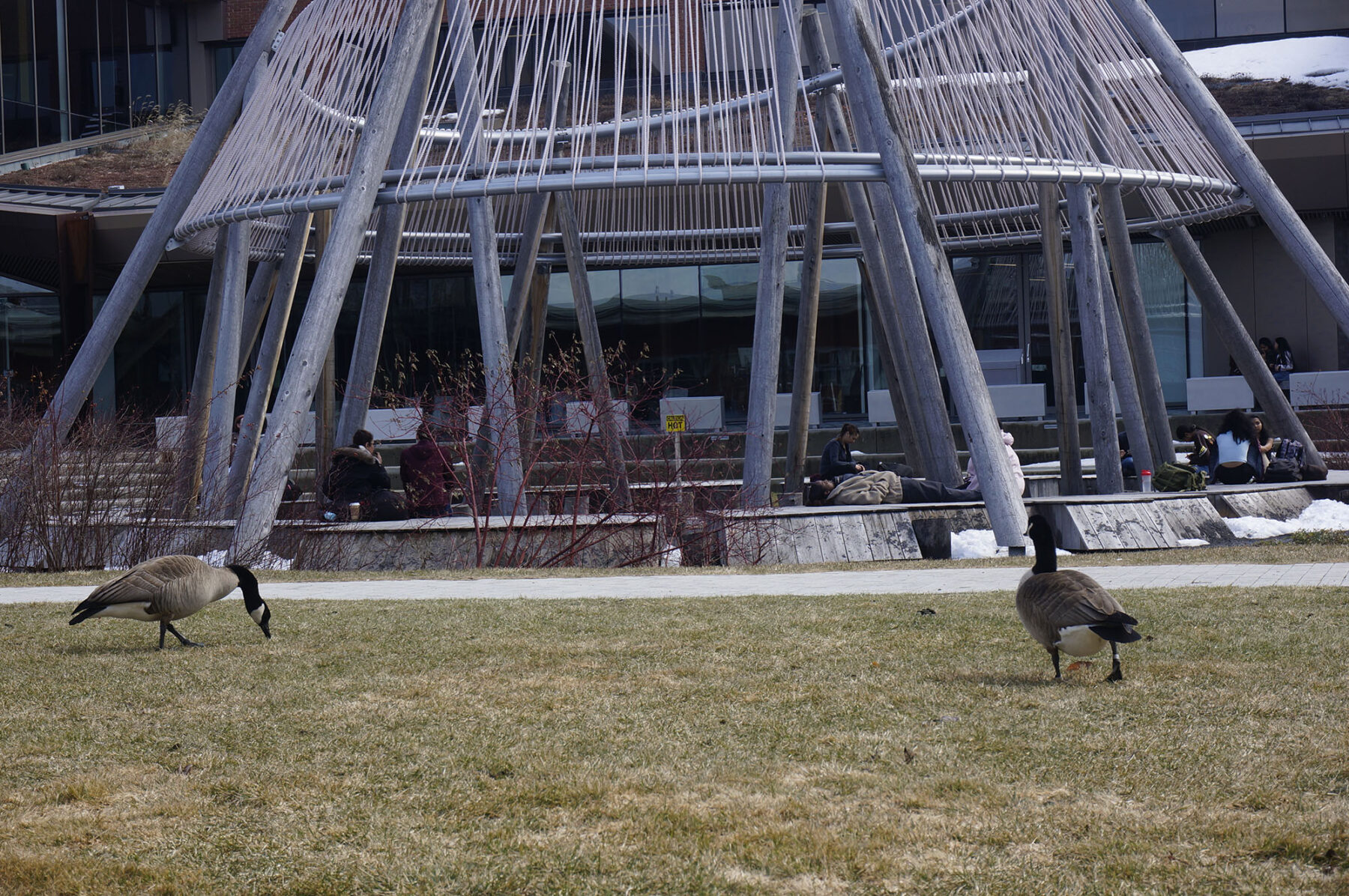
Geese wandering around outside of the library at Algonquin College on April 3.
Algonquin College sent an email to students on April 8 cautioning them to be wary of geese on campus due to avian influenza becoming more common in northern bird populations.
“With the arrival of spring comes the return of geese and other birds to Algonquin College campuses. Unfortunately, avian influenza (also known as bird flu or AI) is currently prevalent among North American wild bird populations,” the college said.
What is avian influenza?
Avian influenza is a viral infection commonly found in birds, but it can be transmitted to humans, according to the Government of Canada.
How can you get it?
According to the Government of Canada, avian influenza can be spread to humans through a bird’s fecal matter, saliva or mucus. A person can contract the virus if it comes into contact with their eyes, mouth or is inhaled. That said, human cases are rare. A good rule of thumb is don’t pick up geese or other wild birds.
What happens if you contract it?
Ottawa Public Health says, “Symptoms of avian influenza are similar to those of seasonal influenza and may include fever, chills, runny nose, cough, sore throat, body aches, headache, diarrhea, vomiting, red or watery eyes, or difficulty breathing.”
Geese at Brewer Park on April 17. Photo credit: Nicklaus Korim
What should you do if you’re experiencing symptoms?
The Government of Canada recommends early recognition of the virus for the best chance at treatment. If exposed to an animal carrying the virus, a doctor may suggest antiviral medication to prevent symptoms and reduce the risk of further infection. It’s advised to speak with your local health-care provider.
What do students think?
“The geese don’t really bug me — not too concerned with avian influenza, to be honest,” said Sydney Melmoth, a 20-year-old esthetics graduate visiting a friend on campus.
“Personally, I don’t plan on picking up any dead geese.”
Gavin McLean, 20, a Level 1 student in the electrical apprenticeship program, also doesn’t seem overly worried.
“They are literally just birds,” said McLean.
“Doubt I’m going to get sick because there’s a goose in my general vicinity.”
The college recently launched an anti-goose campaign with hopes of repelling the birds from the Ottawa campus.
Students showed off projects in Algonquin College’s C-building
Nathan Heatherington
Photos: Nathan Heatherington
April 17, 2025 Revised: April 17, 2025 5:53pm
Photo: Nathan Heatherington
Mohamed Ali and Ziya Gurel show off their Rubik's Cube app on applied research day in C-building of Algonquin College.
On April 11, students at Algonquin College gathered in C-building to show off months of hard work on applied research projects.
“It’s research they picked based on their interests,” said Joey McGrath, a student in the business fundamentals program at Algonquin College. “There are apps, tech demos and at the end of the day, there are judges and the top three projects get a reward.”
The event featured more than 150 different applied research projects.
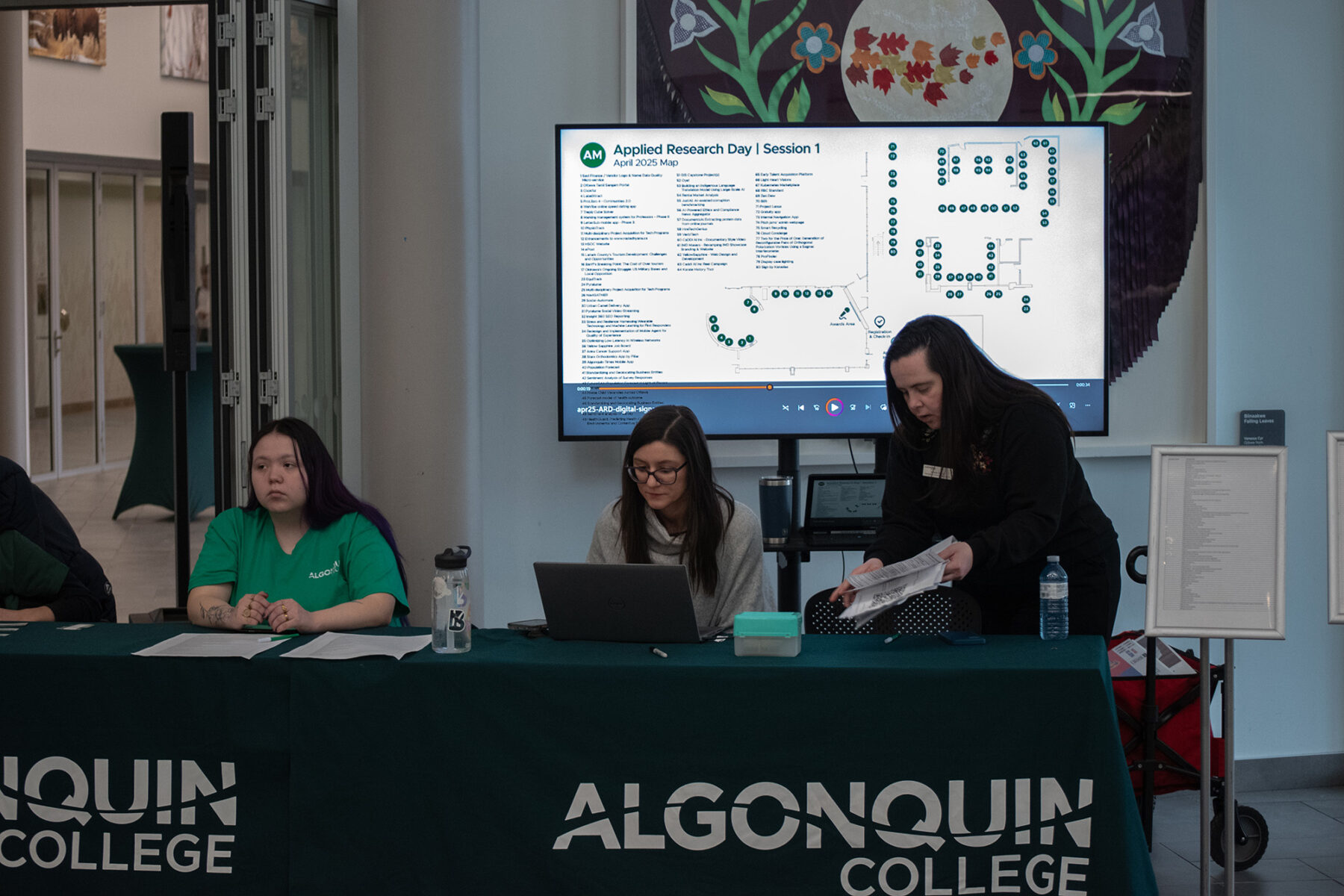
Welcome booth for the applied research day in C-building at Algonquin College. Photo credit: Nathan Heatherington
Brayden Warrell and his team worked on a project that used a piece of wearable technology to monitor breathing, electrical activity of the heart, skin conductivity and movement, all designed to capture data related to stress for first-responders.
“There’s lots to do with mental health, but it’s a tech project,” said Warrell. “We will be developing an AI model that will analyze all the data we’ve collected with this garment.”
“It’s really more about seeing what we get from the data and what we can detect and predict. If we can detect stress and when the first responders are coming out of a stressful state, we will try predicting post-traumatic stress disorder,” said Warrell.
Amir Kobaisse and his team redesigned a website for the Hindu Society of Ottawa.
“We enhanced the website by incorporating an event management system, updated the design and incorporated a matrix to count visitors to the page,” said Kobaisse. “You can donate to children in India, register for upcoming events, and view pictures of the events posted.”
Ziya Gurel and his team developed an app that helped beginners solve the Rubik’s Cube.
“It’s for beginners, shows them step-by-step instructions on how to solve the cube,” said Gurel. “They can visualize it in 3D and follow along to solve it, time themselves solving the cube and if you log in, all their progress will be saved.”
“Our next step is to add camera detection for the cube,” said Gurel.
Applied research is an important part of Algonquin College and is “dedicated to transforming the latest knowledge and technologies into practical solutions, developing innovative products, services, and processes that meet industry needs,” according to the college’s website.
The next applied research day is scheduled for
August.
Featured Hero | Featured Story | Home Feature | Home Hero | News