main

Discussions continue as OC Transpo looks to raise U-Pass fees
College ward Councillor Laine Johnson says Ottawa can’t raise the U-Pass cost without a deal
Photo: Mickey Banks
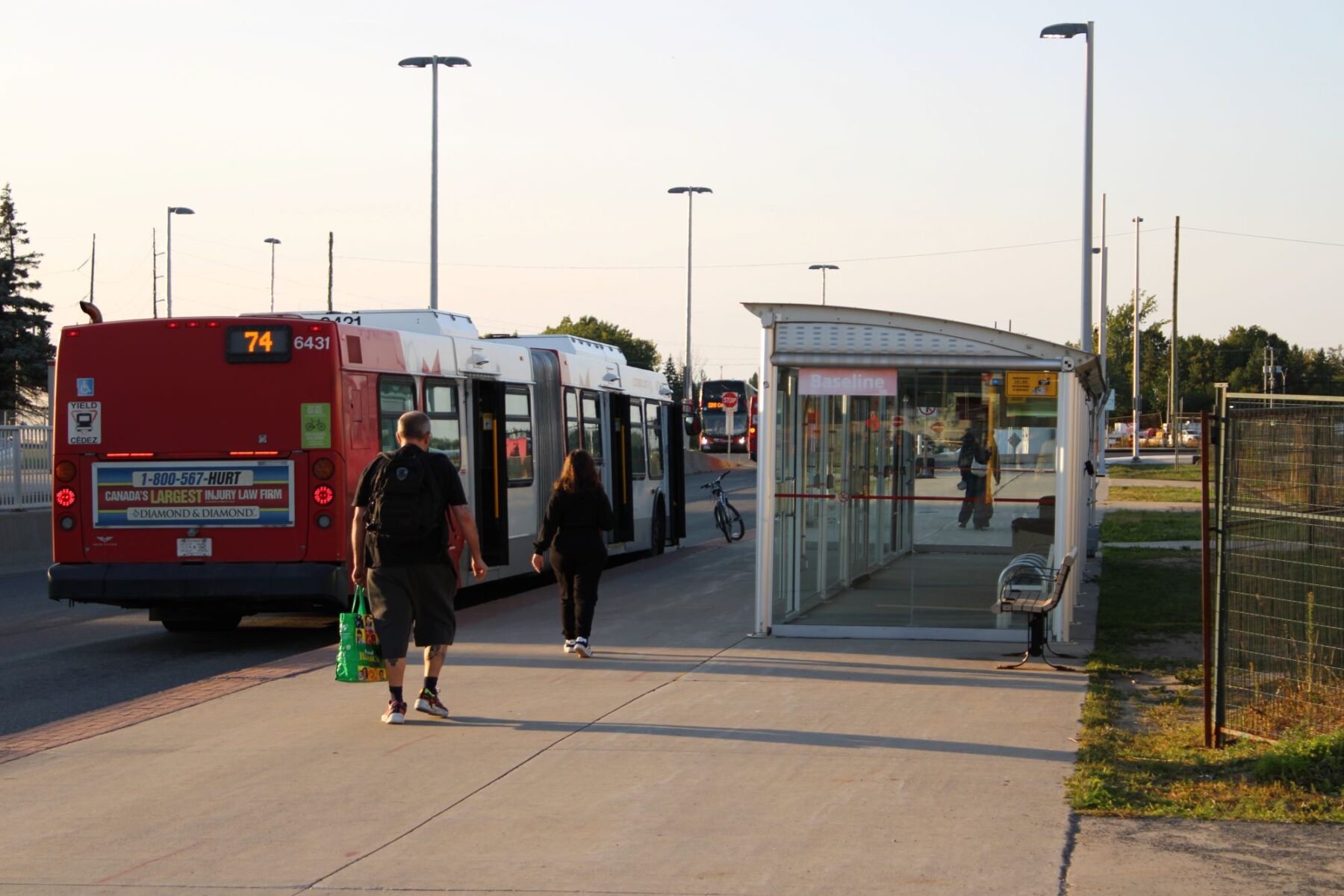
The 74 bus arriving at Baseline station.

As OC Transpo seeks to increase U-Pass rates, the Algonquin Students’ Association is speaking with key players to represent students, says SA president Vanshika Sharma.

“The Algonquin Students’ Association advocates for cost-effective, reliable public transit for students,” Sharma said in an email statement. “Any resolution must prioritize the students’ needs.”

During a City of Ottawa transit commission meeting in November 2024, the transit staff proposed a five per cent increase to most fares in 2025. This included the U-Pass, which would have increased from $229.07 to $240.52. However, this year the U-Pass went up the agreed upon 2.5 per cent instead, going to $234.80, according to Algonquin College’s website.

The U-Pass is mandatory for all students, regardless of whether they use the bus service. Students who do not have access to OC Transpo or STO (a public transportation provider in Gatineau) areas, those with a U-Pass from another institution or those who have a disability or another medical condition, are allowed to opt out of the U-Pass.
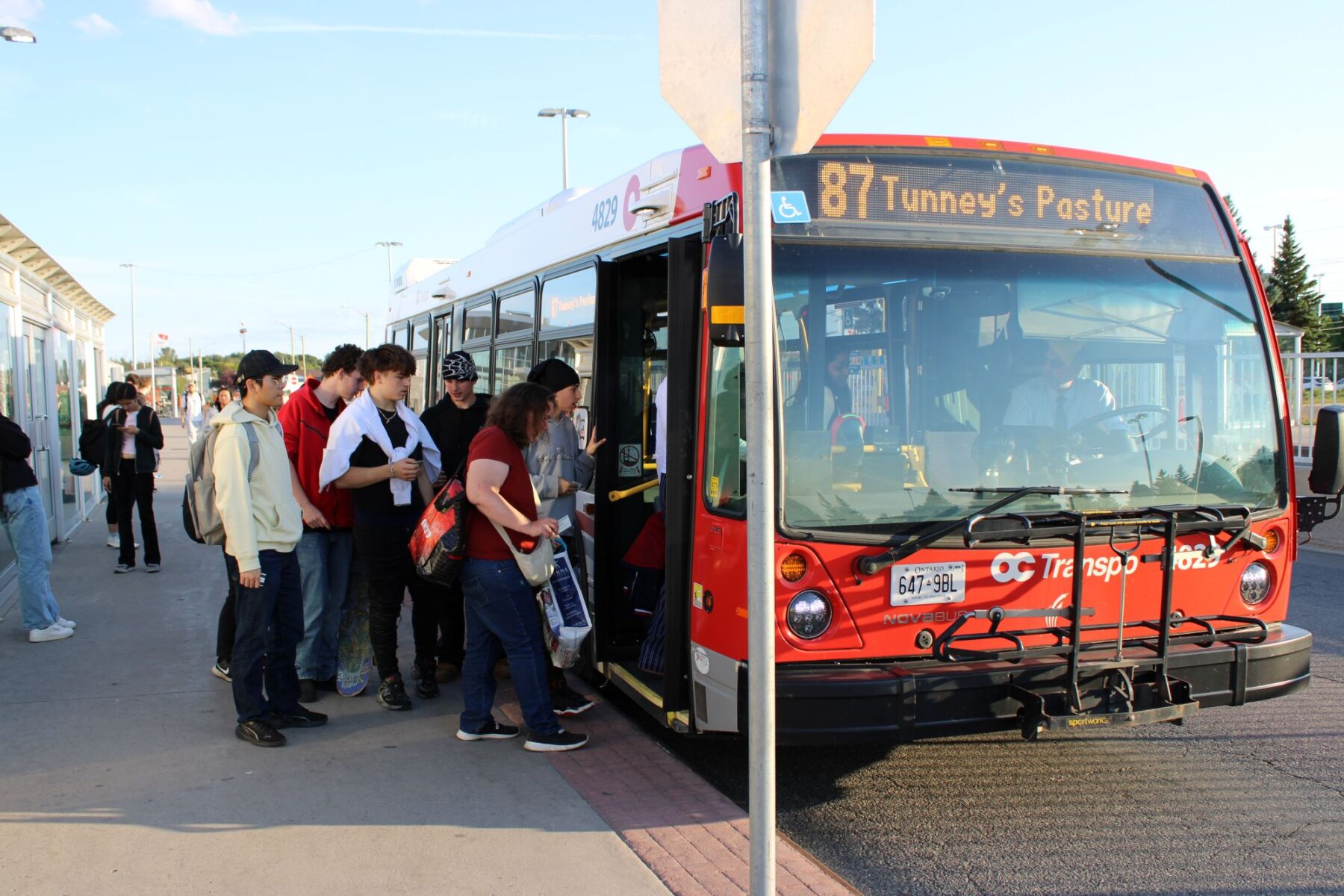
A group of people boarding the 87 to Tunney's Pasture.
A group of people boarding the 87 to Tunney's Pasture. Photo credit: Mickey Banks

“The U-Pass provides a discount between 41 and 50 per cent compared to student monthly passes, and a discount between 53 and 62 per cent compared to adult monthly passes,” according to Algonquin College’s website.

College ward councillor Laine Johnson, who voted against the motion to raise the U-Pass, said she’s been in contact with the SA.

“I do not believe the City of Ottawa has the right to unilaterally increase the cost of the U-Pass without negotiations with the four student associations, including the Algonquin Students’ Association,” Johnson said in an email statement.

The other three colleges in the agreement are the University of Ottawa, Saint Paul and Carleton University.

Students have long debated the value of the U-pass when considering the state of Ottawa’s transit system.

Robert Kemp, who’s taking practical nursing at Algonquin College, has dealt with some early morning bus cancellations, but he still sees the U-Pass as a benefit.

“I think it’s a useful service,” Kemp said. “I think including it in tuition is a helpful part for most students. Not everyone can afford a car, so it’s nice to have a reliable form of transportation.”

Robert Kemp boarding his bus at Baseline station. Kemp believes including the U-Pass in the college tuition is helpful for most students.
Robert Kemp boarding his bus at Baseline station. Photo credit: Mickey Banks

Adam Ames, who’s taking automation engineering at the college, said when he started taking the bus three years ago the system was good, but he believes it’s gone downhill since then.

“The buses came a lot more regularly and a lot more consistently, and they seemed to be less affected by the (local) high school,” Ames said.

Ames takes the 87 and has seen problems with overcrowding.

“Any time from about 2 p.m. till about 5:30 (or) 6 p.m., the buses are completely unusable, for anywhere in that area. And same with 6:30 a.m., till about 9 a.m., the buses are completely unusable.”

Adam Ames eyeing the 87 bus as it parks at Baseline station. Ames says the transit system isn't as good as it was three years ago.
Adam Ames eyeing the 87 bus as it parks at Baseline station. Ames says the transit system isn't as good as it was three years ago. Photo credit: Mickey Banks

Johnson says she’s disappointed with the “New Ways to Bus” changes that were made in the spring, but said the introduction of the LRT Stage 2 would be “the biggest improvement to public transit for Algonquin College students.”

“That would improve the value,” Ames said, “but not to the point of what they want to increase it (the U-Pass), because generally they still have poor coverage of routes around this area.”

Johnson says the LRT Stage 2 extension, which will link the college to downtown by train, is expected to open late 2026 or early 2027.


Wolves strike early but fade late at OCAA women’s rugby sevens tournament

Algonquin's women’s rugby team leaves first tournament of the year with one win and two losses
Photo: Leena King
Wolves players take a breather awaiting their next substitution on Sept. 13 in Belleville.

Algonquin College’s women’s rugby team battled through three fast-paced games at the OCAA women’s rugby sevens tournament on Sept. 13 in Belleville, starting strong with a win before dropping their next two matches.

Despite finishing with a losing record, the Algonquin Wolves showed resilience, grinding out an impressive victory against St. Lawrence Surge before being challenged against stronger opponents such as Durham and Loyalist.

Morgan Payne, a star forward for the Wolves, said team chemistry is key.

“It’s been exciting. We’ve got a lot of talent, but with only five practices, it’s about putting it all together and building that team chemistry,” Payne said.

Star back Princess Ikeson said it’s the intangibles that make the team work.

“We’re working toward being the most hardworking team. Even if mistakes happen, we keep battling until the end,” Ikeson said.

In their opening game against St. Lawrence, Algonquin set this hardworking tone by capitalizing on turnovers and turning them into points. A penalty opened the door for a length-of-the-field run early in the game by Faiza Faucher-Ahmed, followed by more pressure near the halfway line.

Though the team missed several conversions, they did enough to close out a 15–5 win.

Players Morgan Payne, Faiza Faucher-Ahmed and Princess Ikeson celebrate after a big win against the St. Lawrence Surge on Sept. 13 in Belleville.
Players Morgan Payne, Faiza Faucher-Ahmed and Princess Ikeson celebrate after a big win against the St. Lawrence Surge on Sept. 13 in Belleville. Photo credit: Leena King

But the victory was bittersweet. Late in the match, back-line player Wren Doucette went down hard after a collision near midfield and stayed on the ground as play stopped. Medics rushed onto the field, and after several minutes of attention, Doucette was helped off with what was later confirmed to be a broken collarbone.

The injury drew a hush over the sideline and dampened the celebration of Algonquin’s first win. What should have been a momentum-builder quickly became a sobering moment for the Wolves, who now faced the rest of the tournament without one of their key backs.

Coach Dan McNeil said the injury had a lingering affect on the team.

“Whenever an injury happens like that, it can kind of linger through the team, so that put us in a difficult space, especially against a tough squad like Durham,” McNeil said.

In their second game, Durham’s well-drilled side quickly took control, forcing repeated handling errors and dictating the pace from kickoff. The Wolves struggled to recover and Durham pulled away with a dominant 57–0 victory, leaving Algonquin with lessons to take forward.

Tegan Egli takes the ball up field against Durham College on Sept. 13 in Belleville.
Tegan Egli takes the ball up field against Durham College on Sept. 13 in Belleville. Photo credit: Leena King

The Wolves bounced back in their third match against Loyalist, striking first with a long run downfield to take a 5–0 lead. Loyalist responded with a run of their own with a converted try, and the game stayed tight until turnovers in the second half shifted momentum. Loyalist sealed a 17–5 win, despite Algonquin’s defensive stands in the closing minutes.

Faiza Faucher-Ahmed makes a run down field against the Loyalist's, earning the team 5 points,
Faiza Faucher-Ahmed makes a run down field against the Loyalist's, earning the team five
points. September 13th, Belleville. Photo credit: Leena King

For McNeil, the weekend was about building a foundation rather than focusing on results.

“This isn’t the end of the season. we just did our first tournament of five this year, so it’s not the end of our journey but rather the beginning,” McNeil said.

The Algonquin Wolves’ results from each event will contribute to their overall OCAA standing, with four more tournaments scheduled this fall.

Three campus food locations close for the academic year

Algonquin College is currently looking for an outside food provider
Photo: Vasileios Tselios
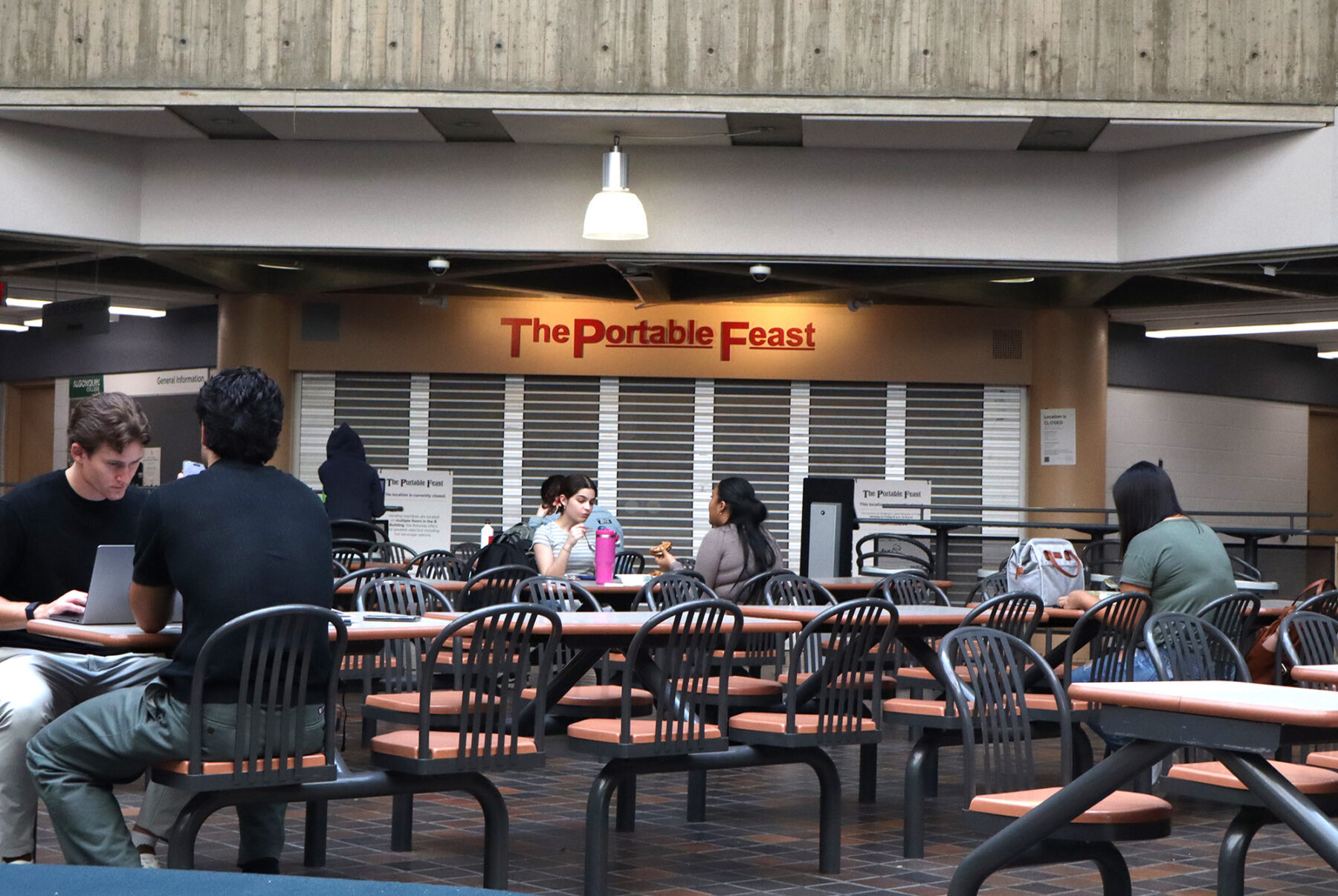
Students studying in the B-building cafeteria, in front of the Portable Feast.

Algonquin College has closed three of its food service locations at the Ottawa campus for the fall semester as it plans to contract out the school’s food services.

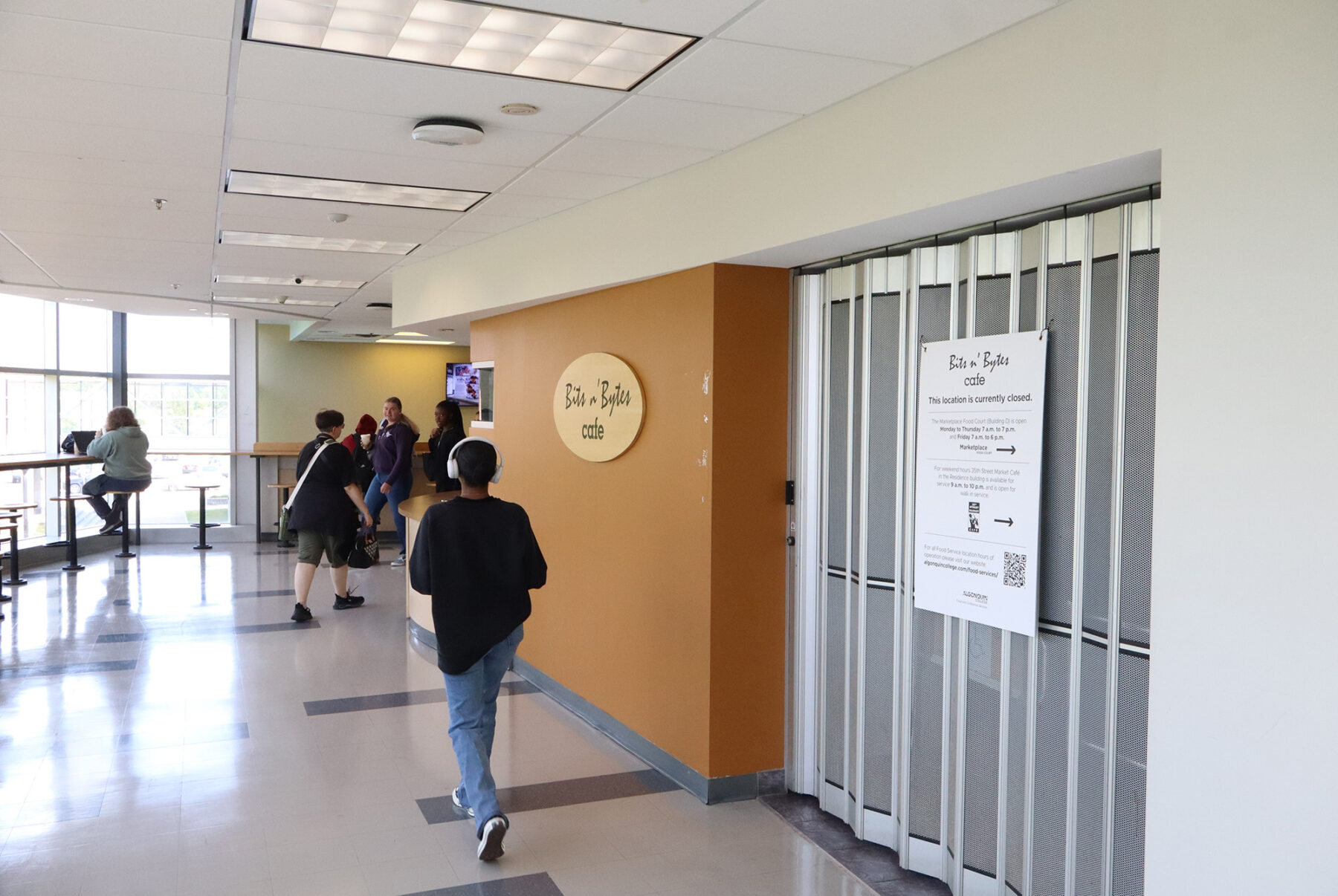
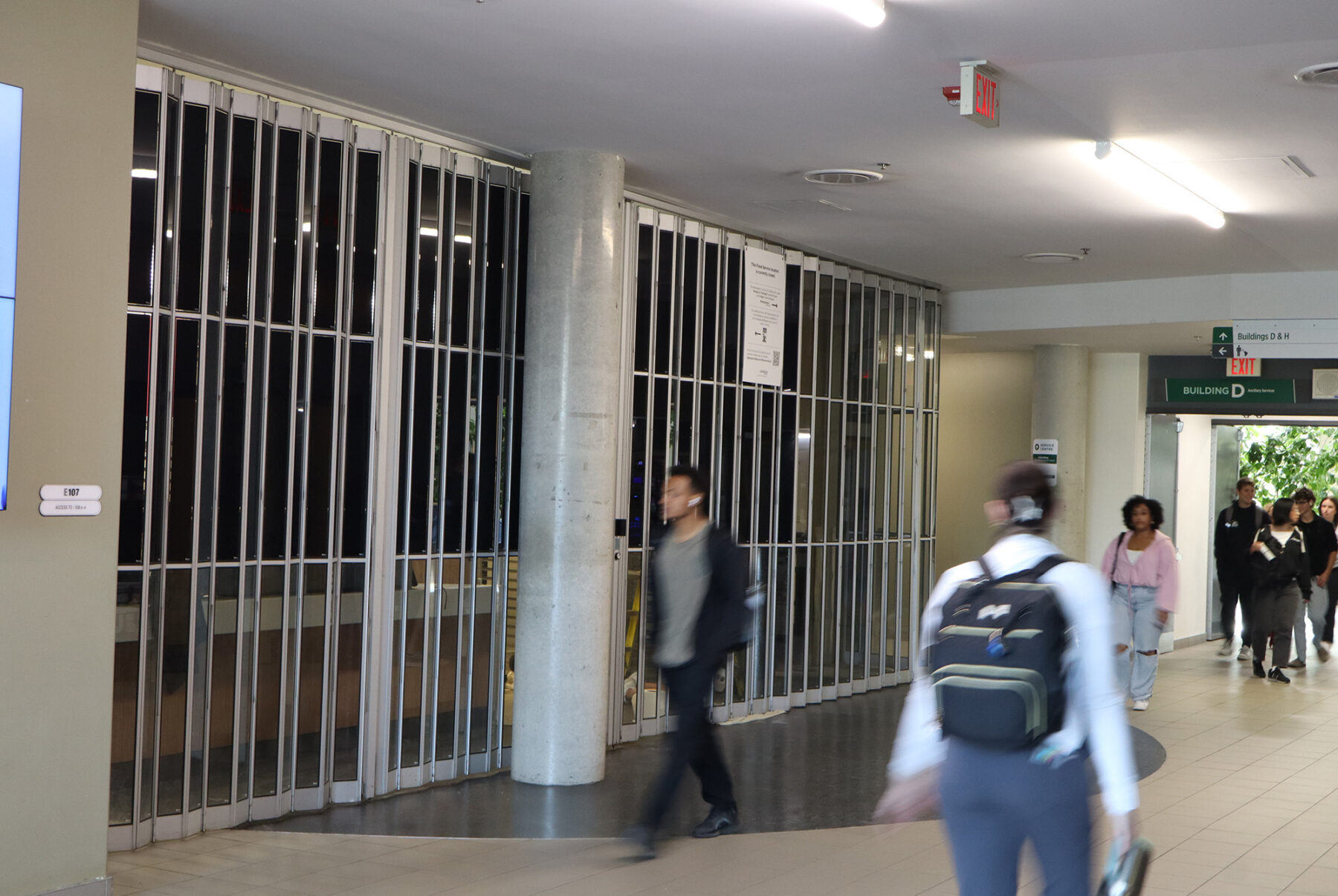
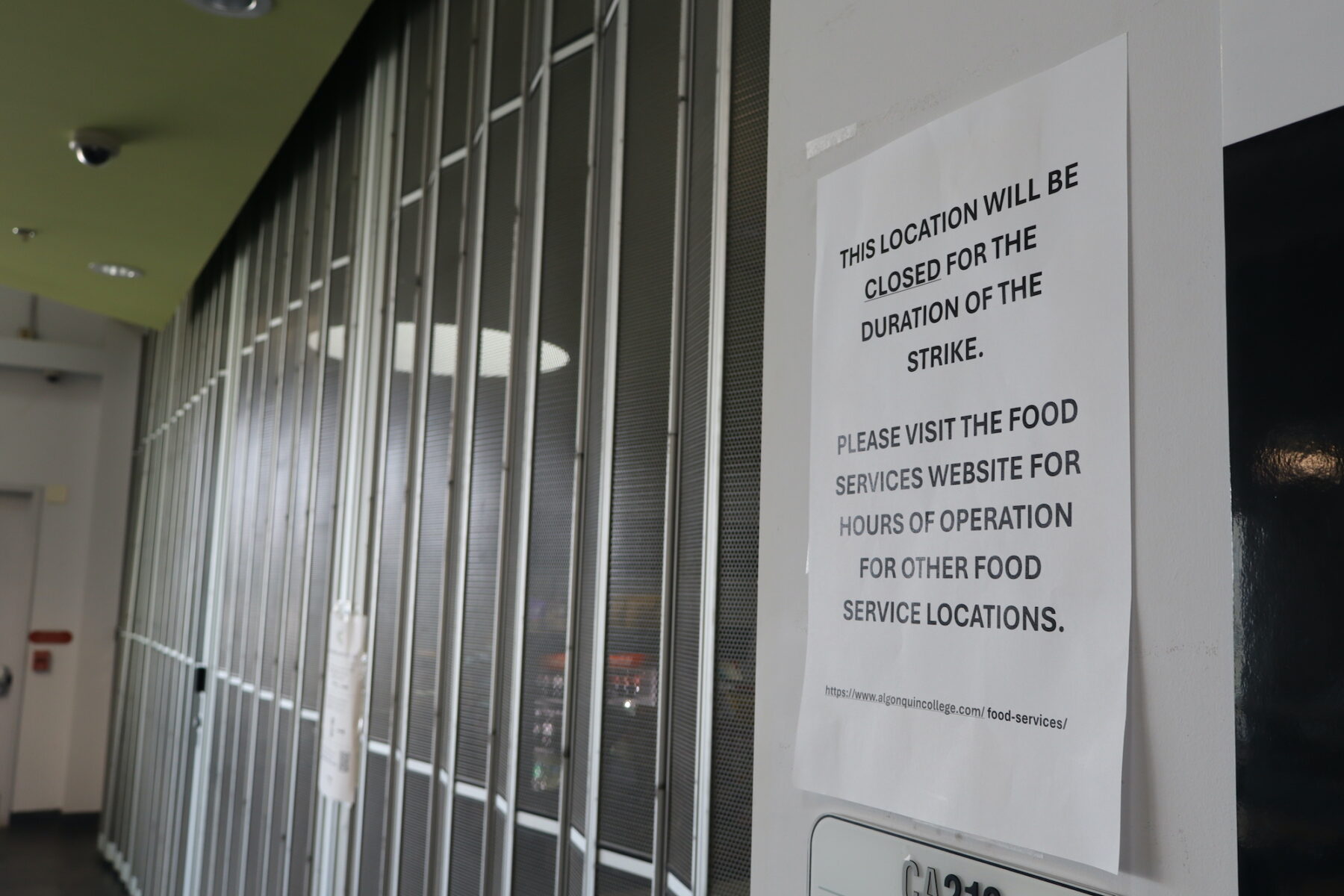
Bits n’ Bytes in T-building, Booster Juice in E-building and The Portable Feast in B-building are all temporarily closed, with no formal announcement from the school. At each of these locations, there are signs encouraging students to use the remaining food service locations along with the vending machines all around campus.

These closures coincide with the Students’ Association closing the Observatory as a campus pub, making it a space that can only be rented.

Originally, the college expected six food locations to remain open for the semester, alongside the school’s vending machines. However, Tim Hortons in A-building and The Fix in ACCE-building temporarily closed due to the ongoing full-time support staff strike.

The only campus food locations open during the strike are the Wolves Den, Starbucks, the food market in D-building and the 35th Street Market Cafe in residence.

Students are left with significantly fewer food options on campus than they were offered during the last fall and winter term.

“It’s a shame,” said Darian Cassidy, a music industry arts student. “On campuses, you want to have a lot of options. If you go to a university, they have one or two cafés, a student bar (and) fast food on site,” he said.

Cassidy explained that he is also thinking about the students who were employed in these locations.

“It sucks, because you are taking jobs away from people who probably need them.”

Algonquin College students walking past the closed Bits n' Bytes in T-building
Algonquin College students walking past the closed Bits n' Bytes in T-building. Photo credit: Vasileios Tselios

Mary Baxter, the general manager of Food Conference Services, said the decision of these closures “was based on reduced enrolment and financial performance.”

“Ahead of the fall, we review enrolment numbers and financial forecasts to plan food service hours for the upcoming academic year,” she said in a written response. “As a result of this planning, we decided to open a number of locations based on the forecasted demand.”

All of the impacted employees from these locations were relocated to other food locations, according to Baxter.

When asked about the effect this will have on students with meal plans, Baxter said: “Based on previous sales within the closed locations and the reduction of enrolment on campus, the impact is expected to be minimal.”

Students with meal plans are able to purchase food from the locations remaining open. However, they are not able to use their meal plans at the campus vending machines, which have been presented as an alternative by the school.

While Tim Hortons and The Fix are expected to reopen after the strike, the three closed-down food locations are not expected to open this academic year, according to Baxter.

This change to the campus locations is coming alongside the recent announcement that the school is planning to contract out food services.

On Aug.18, Grant Perry, the vice president of Finance and Administration, told the campus community about the college’s plan to outsource food services.

“Over the past several years, our food services operations have experienced sustained financial losses,” stated Perry. “Rising operational costs and increased competition have made it increasingly difficult to maintain a financially viable model.”

The school has started a request for proposal process in order to find a suitable partner to take over the food services. The school is hoping to make the transition in the 2026 spring/summer term if the process goes as planned, according to Perry.

If the college does not find a partner, the school will continue operating food services and will reassess its options.

Perry’s message to the campus stated the school is prioritizing financial sustainability, service quality, affordability and alignment with the college’s values during this process.

Claude Brulé, the president of the college, discussed these same difficulties in February.

In a message to the campus community, Brulé mentioned a potential $60-million deficit for the current academic year and a $93-million deficit in 2026/2027 if the school does not intervene.

Brulé identified measures taken by the school, which included the program cuts. Food services losing locations and being contracted out were never mentioned in the February message, although Brulé acknowledged that there would need to be action to eliminate the deficit.

Students walking past the closed Booster Juice in E-building
Students walking past the closed Booster Juice in E-building. Photo credit: Vasileios Tselios

Cassidy is not sure how to feel about the food services being contracted out, but there is one thing he hopes stays the same.

“Ideally, I would like students to be employed, especially on campus,” Cassidy said.

Due to the process still being underway, Baxter was not able to comment on the potential changes this may bring to the campus food locations.

Brulé and Perry couldn’t be reached for comment on the future of food services.

Baseline and Clyde development remains paused amid financial issues

No timeline has been set for completion of the two half-finished buildings
Photo: Duncan Roi
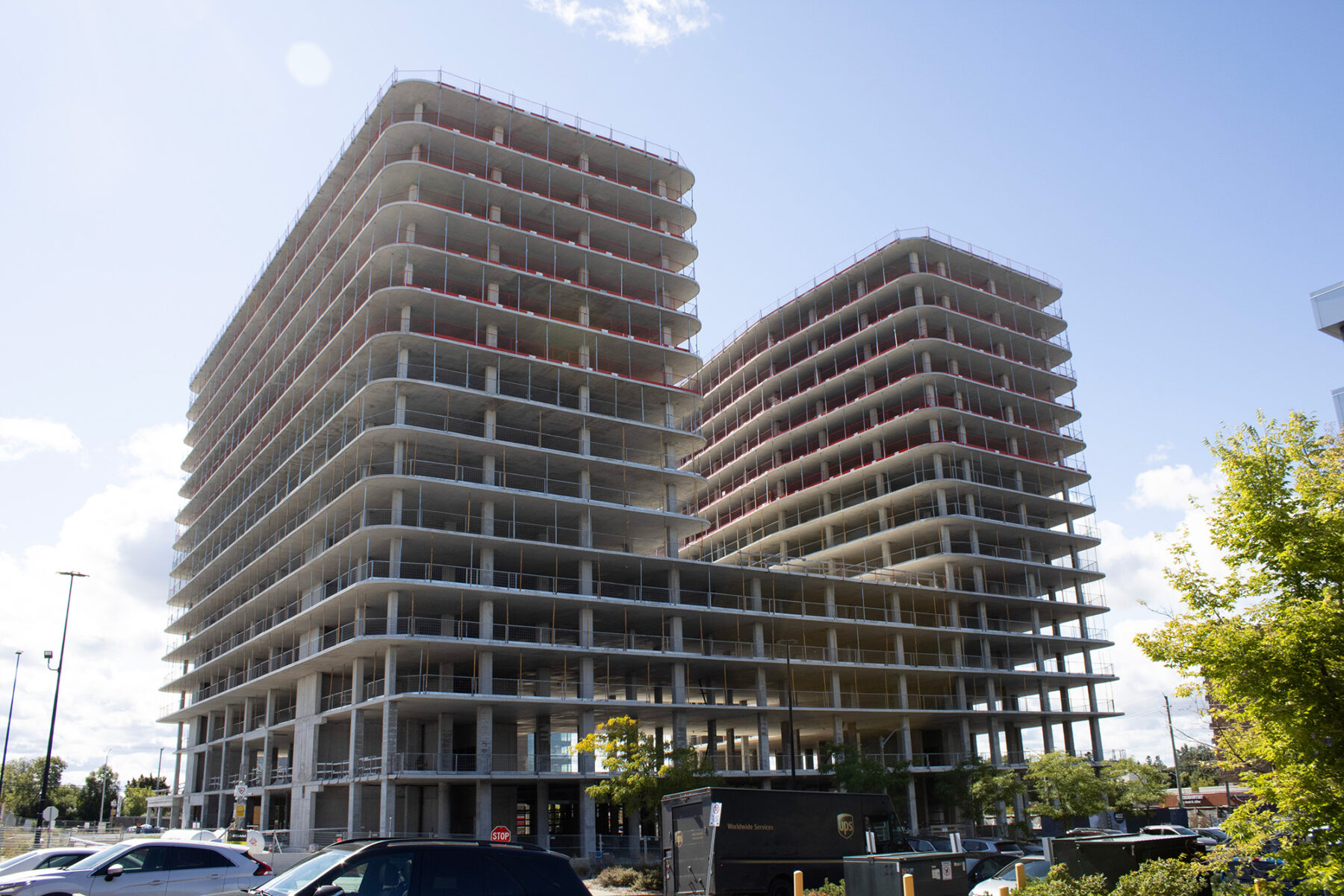
Two unfinished residential towers stand beside the Laurentian Plaza strip mall at Baseline Road and Clyde Avenue.

Since 2023, two unfinished towers at 1357 Baseline Rd. have loomed over the intersection of Baseline Road and Clyde Avenue. The buildings next to the Laurentian Plaza strip mall appear idle, leaving locals searching for answers.

For River Ward Councillor Riley Brockington, these buildings have been a constant source of interest for his constituents.

“In my office, I get asked on average at least once a week what’s happening here,” Brockington said.

Nearby resident Daniel Williamson has been keeping an eye on the site over the past few years.

“You know, when I saw it go up, I actually thought it would be a good thing for the area, but it’s really disappointing to see it stuck like this. I hope it’ll be done soon,” he said.

Retiree Susan Tremblay took a harsher view, referring to the unfinished structures as an eyesore. “Every time I go by, it feels like nothing changes,” she said.

Originally planned as a retirement residence, construction paused in late 2022 when the project contractor went bankrupt. SmartCentres, owner of the Laurentian Plaza strip mall, then fully acquired the property with plans to continue the development.

The project’s plan was converted from a retirement residence to residential apartments. SmartCentres, which specializes in commercial properties, has since been trying to secure financing and hire a new contractor to complete the project. Construction resumed in 2023 before pausing again in 2024.

Located a few blocks from Algonquin College along bus routes and close to grocery stores and other services, the site is considered desirable. Baseline Road will also be part of a future cross-town bus transit corridor planned for completion next fall.

Brockington said the situation at 1357 Baseline Rd. is not unique, but part of a wider trend in Ottawa.

“There are other projects, even in River Ward, where a contractor has gone bankrupt and the project had to be sold and started over again,” he said.

According to the Canada Mortgage and Housing Corp.’s fall 2024 housing supply report, the first half of 2024 saw a decrease in housing starts by 21 per cent in Ottawa, nearly the lowest level in a decade.

Competition and financial issues continue to strain the market and developments across the city.

Although the timeline for completion remains unclear, Brockington said the property remains secure with 24-hour surveillance, and the structure itself is not at risk of damage or collapse.

He expressed his desire to see these towers finished as much as the locals in the area.

“It is SmartCentres’ intent to build and complete this project. But they need to find the money, hire a contractor and get a new site plan. Then we’re on their time,” he said.

SmartCentres could not be reached for comment.

Six off-campus spots every student should know about

What are AC students eating off campus?
Photo: Jade Louise Greenwood
Kieron Jackson eats a salted caramel donut at Kettleman's.

Algonquin College students crave food almost as much as they crave good grades, but now that some campus restaurants and eateries are closed, where do students go?

The following six restaurants are perfect spots that AC students have recommended. They’re places to study, decompress, catch up with friends and occasionally overhear a breakup story from the table next to you.

Dao Café – 1558 Merivale Rd.

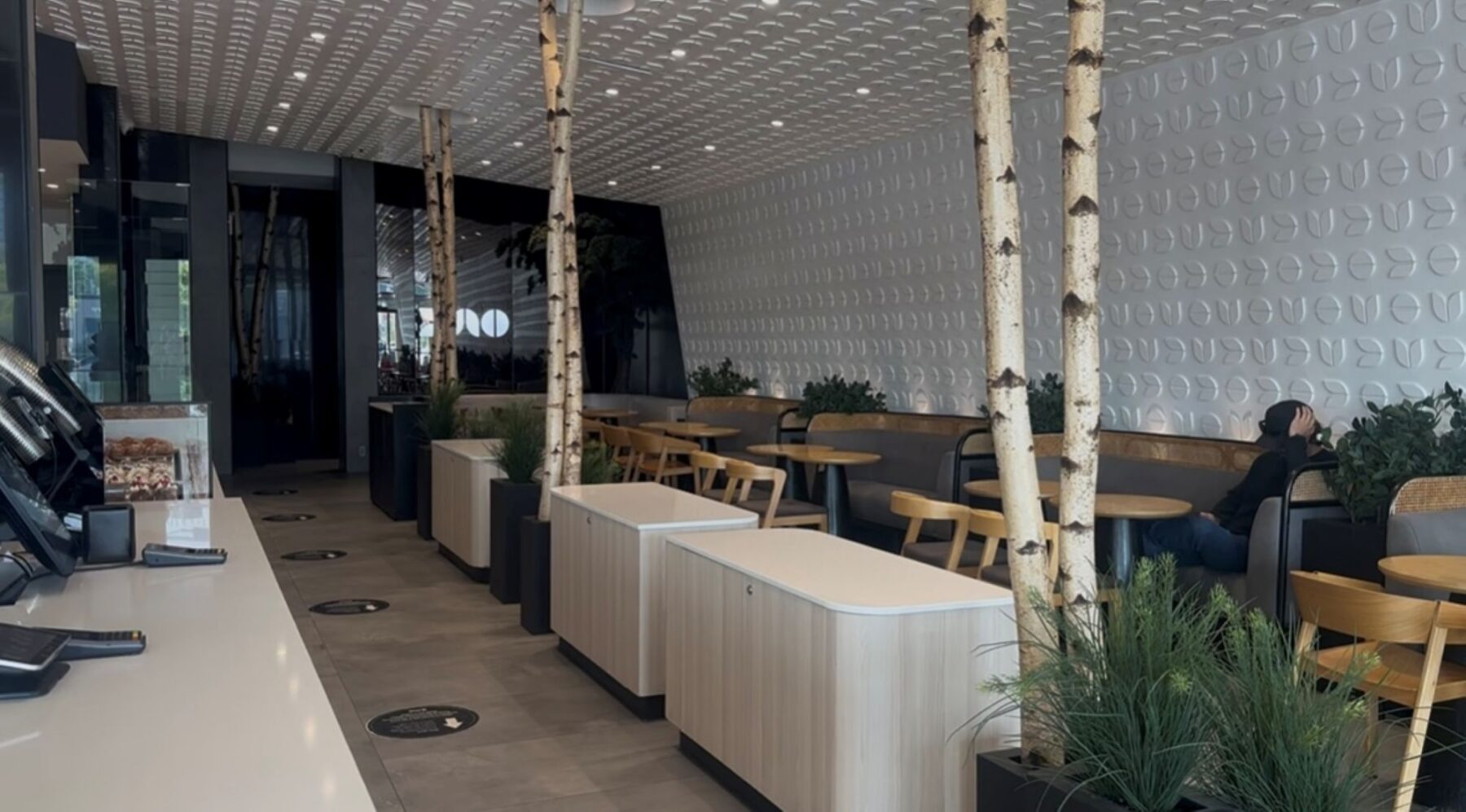
Inside Dao Cafe, just after opening.
Inside Dao Cafรฉ, just after opening. Photo credit: Jade Louise Greenwood

Tucked into a strip mall, just a 27-minute walk away from campus, lies an Euro-Asian inspired bakery, Dao Café, that one Algonquin College student raves about.

“A lot of people study in there, it’s calm and quiet,” says Willow Pomerleau. The leafy plants, tranquil atmosphere and soft lighting promote a cozy setting, perfect for laptops and lattes.

According to Pomerleau, the macaroons are fascinatingly clever and the strawberry shortcake “tastes like a dream.”

Kettlemans Bagel – 1365 Woodroffe Ave.

Inside the heart of Kettleman's, where workers are cooking in the open fire and others are bagging them up.
Inside the heart of Kettleman's, where workers are cooking in the open fire and others are bagging them up. Photo credit: Jade Louise Greenwood

A staple for many, Kettlemans Bagel is the kind of place where you can study at 3 a.m. or go after a light morning jog. “It’s kind of pricey,” says Kiara Hanna, “but so is everywhere. And honestly? I feel like it’s worth what you are getting.”

With endless bagel options and proximity to campus, Kettlemans is undeniably inviting, with its burning fire open for the public to watch workers create doughy Montreal miracles.

Whether you’re there for a meal, a meltdown, or a moment of clarity over a toasted sesame bagel, it’s the perfect go-to breakfast spot.

Summerhays Grill – 1971 Baseline Rd.

From left to right, Zanti Murray, Kieron Jackson, and Saige Boston pose in the cafeteria to approve the off-campus choices on this list.
From left to right, Zanti Murray, Kieron Jackson, and Saige Boston pose in the Marketplace Foodcourt to approve the off-campus choices on this list. Photo credit: Jade Louise Greenwood

Three students in early childhood education all agree on one favourite breakfast spot. “Summerhays is definitely the new unofficial ECE hangout,” says Kieron Jackson. Just across Woodroffe Avenue, Summerhays Grill offers a student breakfast that is not only affordable but also delicious.

The deal consists of two eggs, bacon, home fries and toast, while including tea or coffee for only $7.50, compared to the regular price of $9 for the same meal without a drink.

The manager, Marcy Smith, explained why the menu item deviates from the regular: “It’s cheaper for students because we know that they are in school.”

While the breakfast is a hit, the two other ECE students, Saige Boston and Zanti Murray, rave about the mimosas and how they come with their own personal bottle of champagne. With affordable comfort food that is stacked a mile high, this restaurant is perfect for post-class debriefs or pre-exam pep talks.

Allô! Mon Coco – 1377 Woodroffe Ave.

Inside Allo! Mon Coco, in the slow afternoon. Students believe this to be the best time to go, after the rush.
Inside Allรด! Mon Coco, in the slow afternoon. Students believe this to be the best time to go, after the rush. Photo credit: Jade Louise Greenwood

Located just steps from Algonquin College, Allô! Mon Coco is constantly buzzing with students. A restaurant employee, Shaun Pilla, says the most ordered meal is the Choco Coco De Luxe, a two-egg breakfast topped off with a strawberry crepe. “It’s put right there, at the front of the menu and it is there for a reason.”

Sometimes, if you are lucky, you can get a side dish of gossip with your crepe, just like Jackson, who once caught a breakup story from the table next to him involving Olivia Rodrigo and a car speaker. “She blasted Good For You by Olivia Rodrigo for an hour,” he recounted.

Breakfast with a side of drama? Yes, please.

Edo Japan – 1377 Woodroffe Ave.

Edo Japan, where the lights are dimmed and the sushi is fresh.
Edo Japan, where the lights are dimmed and the sushi is fresh. Photo credit: Jade Louise Greenwood

For students craving sushi, ramen or bubble tea, Edo Japan has it all, not to mention tasty Halal options.

“My girlfriend hates sushi, but I finally found a place she likes,” Jackson says proudly.

The hours go from 9:30 a.m. to 11:00 p.m., making it a reliable spot for lunch and dinner. Students say the staff are friendly and helpful and the food is consistently fresh and satisfying, perfect for a quick stop or a low-key dinner with friends.

McDonald’s – 1850 Baseline Rd.

McDonald's, a place for students to go for a cheap meal after school.
McDonald's, a place for students to go for a cheap meal after school. Photo credit: Jade Louise Greenwood

Just down the street, the 24-hour McDonald’s is where the real nightlife is.

“It always ends the same: a Jr. McChicken and let’s be honest, an Oreo McFlurry,” says pre-health student Sophia Serviss. She and her roommate often venture out past midnight and end up finding “people making out in booths while fights are going on outside.”

It’s chaos. It’s romance. It’s the Algonquin College McDonald’s; cheap, consistent and wildly entertaining.

Algonquin College students question potential public prayer ban in Quebec

The Quebec government wants immigrants in the province to embrace a "common culture"
Photo: Lara Simard
Adnan Saiyed (left) and Kareem Idris (right) participate in Jummah prayer on Sept. 5 in the old college gym.

Some Algonquin College student are worried about a Quebec bill, scheduled to pass this fall, that would ban praying in public spaces.

Coalition Avenir Quebec, the provincial party in power, has been planning the proposal for months, requiring immigrants to embrace the “common culture.”

On May 28, Quebec’s immigration minister tabled Bill 84 to guide immigrants to integrate with the province’s belief system.

“The premier of Quebec has given me the mandate to strengthen secularism, and I am determined to fulfil this mandate diligently,” said secularism minister Jean-François Roberge before announcing this motion on Aug. 28.

The plan is to extend Bill 21, which was previously issued to limit religious attire from being worn in the workplace.

The Canadian Muslim Forum said street prayers are a manifestation of freedom of expression and inhibiting such activities would cause communities to become further stigmatized.

Kareem Idris, a student at Algonquin College, agrees.

“As of right now, Islam has a really bad look on it around the world. It’s very obvious,” he said. Idris attends Jummah prayer on Fridays in the old Algonquin College gym.

He believes the ongoing Israel-Palestine war causes the world to have a generally negative view of Islam. Idris believes public prayer is a positive initiative to raise awareness and paint his religion in a different light. He said passing this bill would only increase growing stigmas towards his culture.

“Having that in place, people will even get a worse view on it (Islam) than what it is already. So it’s not really helping our case at all.”

Divine Ishimwe, a first-year student at Algonquin College, attends Christian prayer sessions on campus regularly.

“I would say faith is a very big part of some people’s survival,” she said.

“Personally, if you stopped me from praying, my life would be so fragile. I can’t imagine someone stopping me from praying whenever I need to, because that’s my biggest support system.”

“It supports my mental health, it supports my performance, so I don’t think it’s reasonable for people to be stopping or banning prayer for people that need it.”

Ishimwe says if people are not disturbing the peace in public spaces, they should be allowed to pray wherever they see fit.

Divine Ishimwe sits in front of piano in prayer room on Sept. 4  during a daily Christian prayer session
Divine Ishimwe sits in front of piano in prayer room on Sept. 4 during a daily Christian prayer session Photo credit: Lara Simard

Ahmed Khan shares similar views. He has been leading the Muslim Students Club at Algonquin College for four years.

“When you’re talking about disruptive cases, you have to look at it case by case,” Khan said.

“For example, here at Algonquin, we once had an issue where we weren’t given the room to pray, and we had about 100-something people. We couldn’t fit. But we have to pray — it’s a necessity. So they went outside, and they prayed in public.”

On Sept. 11, a public prayer event was held on campus by InterVarsity, a Christian ministry that runs prayer groups on campus throughout the year.

Cristy Dagenais, the campus minister who co-organized the event, believes religion is one of the biggest unifiers for students. Without it, she says, life on campus would become sterile.

“There are so many students that go through their whole degree here and all they have is maybe some classmates, but they don’t have that sense of family,” she said.

“Maybe they’re asking bigger, deeper questions, but they don’t feel like they have a safe place to ask those questions. We try to do that through events. Becoming visible helps students be able to practice their faith.”

In her opinion, expressing religion is a fundamental right and should be exercised. She is grateful to have this opportunity at the college.

“If they don’t have freedom to be able to express their belief systems — of course, where it’s still safe and good for other people — it’s like you’re taking away the essence of being human,” Dagenais said.

“To take that away completely, it doesn’t make any sense to me.”

Students notice change in on-campus services during first day of support staff strike

Full-time support staff launched a strike Thursday during an ongoing labour dispute affecting colleges across Ontario
Photo: Bradley Richards
The Fix Eatery in the ACCE building was closed for the strike.

By Nathan Heatherington, Kendra Mendrisky, Ève Bélanger, Jade Louise Greenwood, Bradley Richrads, Janella Milord Ashford, Jackie Beeston, Robyn Lanktree and Vasileios Tselios

A strike by full-time support workers started to impact several services at Algonquin College on Thursday

“All classes and academic activities are continuing as scheduled. While some campus services may be delayed or reduced, our priority remains supporting learners and employees throughout this disruption,” read a notice on the Algonquin College website.

Some businesses around campus were closed, including Bits N’ Bytes, The Portable Feast, The Fix and Tim Hortons. However, the Marketplace in D-building was open with part-time workers and student workers.

Students took notice of the reduced food options on the first day of the strike.

“It’s kind of annoying. I had an hour break in between my two classes, and I was going to come get food (at Tim Hortons),” said Teaghan Guidon, a student in the business and administration program.

According to the frequently asked questions section on the Algonquin College website, many services will remain open to help throughout the academic year, including the Student Learning Centre, counselling services, Centre for Accessible Learning and the registrar’s office. Bursary funding and purchases for students with disabilities programs are limited.

“I’ve been here for the last two years, so obviously, some of the services have helped me,” said Hannah Richard, a student in the massage therapy program.

“I eat on campus regularly, so having that type of nutritionist there would always be helpful. I would never want any of these people to be without the money that they deserve, and they shouldn’t be replaced, so I hope that everything can figure itself out.”

Facilities run by the Students’ Association, such as the Wolves Den and Starbucks, remained open and are unaffected by strike activity.

‘Nobody wants to be on strike.’ Support workers launch picket lines in labour dispute

Picket lines went up outside Algonquin College’s Woodroffe campus on Thursday as full-time support staff walked off the job
Photo: Mila Leclair
A protester holds a sign on Woodroffe Avenue on Sept. 11.

By Gavin Oregan, William Barritt, Mila Leclair, Delaney Smith, Robyn Lanktree and Vasileios Tselios

Picket lines went up outside Algonquin College’s Woodroffe campus on Thursday as support staff walked off the job, marking the first day of strike action in a dispute over wages, workload and job security.

The strike shut down several services across the college. Buildings remained opened and the college said classes were to continue.

John Hanson, a former president in the Ontario Public Service Employees Union (OPSEU), said full-time support staff work in “everything that goes on in the college, anything except for the actual teaching of the students.”

College staff took to the picket lines on Woodroffe Avenue, walking back and forth with signs that read “Save our colleges” and “College cuts hurt communities.”

Staff said the strike has been difficult to discuss with students, many of whom are worried about how classes and services will be affected.

“We didn’t want to talk about it, because you’re scared to scare the students,” said Stella Ludlow, an organizer at the picket line. “Because you’re already uncertain, it’s a lot of new stuff.”

Ludlow has worked with OPSEU since 2012 and has never seen people work so well together while on strike.

Protesters hold signs on a picket line on Woodroffe Avenue on Sept. 11. Full-time support staff launched a strike in an ongoing labour dispute.
Protesters hold signs on a picket line on Woodroffe Avenue on Sept. 11. Full-time support staff launched a strike in an ongoing labour dispute. Photo credit: Mila Leclair

As for students, the strike leaves an uncertain thought about what is to come.

“As far as I’m aware, it’s about wages,” said Devon Payette, who is in his first year of the client relations program. “I don’t feel any type of way about it because it’s something that needs to happen for things to change.”

According to Hanson, staff rather not be on the picket lines.

“Nobody wants to be on strike. They want to be doing their job. These people love what they do, I know that,” Hanson said.

The goal between the labour union and full-time college support staff across Ontario remains to arrive at a deal as soon as possible.

OPSEU, which represents the workers, says rising costs and increased demands on staff have made a fair contract essential.

In a message to the Algonquin College community on Thursday, president and CEO Claude Brulé said: “We deeply value the contributions of our support staff and respect their right to participate in this legal process. Our priority is to continue supporting our students and employees while maintaining a respectful, safe, and inclusive campus environment.”

Across Algonquin College’s northern entrances, full-time support staff make their voices heard

Having failed to reach an agreement with the province Wednesday night, full-time support staff across Ontario were out on strike
Photo: Matthew Grieve
Algonquin College support staff on strike protest service cuts on Navaho Drive on Sept. 11.

By Ernest Ko, Matthew Grieve, Kevin Clasper-Inglis, Elyse Barker, Mickey Banks, Duncan Roi, Lara Simard, Nicklaus Korim, Robyn Lanktree and Vasileios Tselios

Abby Rabishaw has been working at Algonquin College’s registrar’s office since 2023. She loves her job.

“It’s one of the best jobs I’ve ever had,” she said. It allows her to “give back and help students in ways I would have loved while I was in school.

“There’s nothing better than making it more accessible and easier for people to study and achieve their goals.”

However, she wasn’t with students Thursday. Instead, she walked out of her job alongside her full-time support coworkers, throughout three picket lines at the college’s north entrances at Wàbisheshi Private and Wajashk Private along Navaho Drive.

Another picket line had also been organized at the college’s Woodroffe Avenue entrance.

Throughout every line, among the protesters, supporters and passersby, their message remained clear: students and staff are suffering from colleges being defunded.

Rabishaw said when she joined in 2023 her team consisted of 28 employees. But after layoffs and attrition throughout the past three years, that number has been reduced to 16 employees, including part-time staff.

“That means significantly longer wait times for students, especially during the start of the school year,” Rabishaw said. Students currently inquiring about timetable issues, course changes or late program registrations could be forced to wait more than two hours for assistance. With the college’s tuition refund date of Sept. 15 fast approaching, time is ticking.

As provincial shortfalls continue, Ontario colleges have seen 10,000 layoffs coinciding with 650 program closures in 2025 alone. In February, Algonquin College announced the suspension of 37 programs and the closure of its Perth satellite campus.

OPSEU (Ontario Public Service Employees Union) Local 416, the union representing college full-time support staff, and the College Employer Council have been negotiating a collective agreement since June. The union exercised their right to initiate job action after failing to reach an agreement with the CEC by a Thursday morning deadline.

“We’re essentially just asking for fair pay,” said Zachary Deorksen, an employee in Financial Services.

“We also want to make the point that right now, the colleges are underfunded. With provincial cuts to international enrolment and the post-secondary student tuition freeze, the colleges are in a bind.

“Right now, we want more funding for the colleges, because public education is important,” Deorksen says.

The protests, however, have not been well-received by the entire campus community. Some students feel the protests blocking the college’s entrances are disruptive. Mohamad Dwaydar, a part-time student, was one of them..

“Part-time students like us, we take the one day off work that we could have been making money in our living (to attend class). But when we are blockaded, it really does hinder our day-to-day lives,” he says.

When business administration student Bryson Cameron drove to school on Thursday, he was stopped and asked by protesters if he supported their cause. Despite giving them his approval, “they kept blocking me off.”

Protesters on Navaho Drive in front of the parking lot by A-building.
Protesters on Navaho Drive in front of the parking lot by A-building. Photo credit: Mickey Banks

Others acted on their frustrations, even though the college requested that people respect protesters.

Coco Kurelek, an automechanic student, shouted insults at protesters and she flipped them off.

“This morning, it took me 45 minutes to (drive two blocks),” she said with a frustrated glare. “As a paying student, I do not support these protests if they stop me from getting my paid education.

“Blocking traffic to paying students who just want to get to their class and get educated is not the way to gain support,” Kurelek said.

As she spoke, a protester repeatedly blew a whistle to interrupt the flow of incoming traffic.

“It’s creating a nuisance instead of a peaceful protest.”

Nevertheless, protesters remained positive about their situation.

“There’s been a good sense of solidarity so far amongst everyone,” said Dave Gabie, a full-time plumber at the college.

Some part-time staff at the college have volunteered at picket lines, while faculty have been seen offering snacks and refreshments.

Despite the long day and some frustrated commuters, Gabie said it had been a good day overall.

“My wife made me some muffins, so it’s all good,” he said with a smile.

Algonquin College warns community about possible strike by support staff on Thursday

Should a deal not be reached by midnight Wednesday, full-time support staff will hit the picket lines
Photo: Janella Milord Ashford
Algonquin College support staff walk along the practice picket line at Woodroffe Avenue on Sept. 10.

By Ernest Ko and Janella Milord Ashford

Algonquin College president and CEO Claude Brulé on Wednesday warned the campus community about possible strike by full-time college support staff across Ontario, including Algonquin College, beginning Thursday.

“While we remain hopeful that a resolution will be reached, we must also be prepared for the possibility of a labour disruption,” an emailed message from Brulé said.

This disruption will most likely result in a strike, with picket lines happening at entrances for the Woodroffe, Perth and Pembroke campuses. However, the campuses will all remain open and operational, Brulé said.

While the college said it remained hopeful that an agreement can be reached before Thursday, precautions and communications were being made to “support our learners and ensure the continuity of college operations as much as possible,” Brulé said in the email.

Why is a strike happening?

In a message from OPSEU (Ontario Public Service Employees Union), president JP Hornick alleges that Ontario’s college system is in a “crisis” due to Ontario Premier Doug Ford and his administration’s “accelerated agenda to gut public education and privatize post-secondary education for good.”

Hornick mentions 10,000 recent job cuts and 650 programs shuttered across Ontario. At Algonquin College, 37 programs and the Perth campus were set for suspension last February. Brulé cited provincial shortfalls as a main reason for the decision.

OPSEU, which represents full-time college support staff across Ontario, is currently negotiating a new collective agreement with the College Employer Council (CEC). The previous agreement expired on Aug. 31. The two parties have been negotiating since June.

Will this strike affect my classes?

No, according to the college. “At this time, all classes and related academic activities for the Fall 2025 term are scheduled to continue as planned,” the college said. Should there be any changes, students will be notified.

Faculty members at the college received an email on Tuesday from Hornick instructing them not to perform support staff work, in solidarity with the support staff union.

“Our support staff colleagues are fighting not only for a fair contract but also for a stronger, more sustainable college system — and we have an opportunity to stand with them,” the message from Hornick said.

What will be affected?

The Algonquin Students’ Association confirmed to the Algonquin Times that its operations and events will not be impacted.

While no comprehensive list of affected services is available, the college can expect disruptions in the following areas: tech support, food services, the registrar’s office, parking services, library assistance, printing services, the Centre for Accessible Learning, clerical duties, facilities and maintenance work and more.

Due to the strike protests, the college is recommending students and staff to dedicate “extra time when coming to campus, and to walk or drive carefully when approaching a picket line.”

“Consider using public transportation, carpooling, or arranging to be dropped off to help minimize delays,” the college suggested.

What is the union looking for?

According to a Sept. 6 media release by OPSEU, the union is looking to fight back against looming mergers, closures and the “systematic defund(ing)” of Ontario’s public colleges.” Job security remains a top concern for the union.

During negotiations, OPSEU made two demands: “A complete ban on college or campus mergers or closures during the life of the agreement,” and “a total prohibition on any staff reductions, regardless of circumstance.”

CEC, meanwhile, has labelled these demands as unacceptable “poison pills,” which are preventing a settlement from being made.

According to Veronica Attard, a full-time support staff at Algonquin College and a member of the OPSEU’s full-time support bargaining team, many of the union’s concerns are realized at Algonquin.

Layoffs and employee attrition have led to longer wait times for services, while recent closures and contracting out of food services have cost over 200 employees their jobs, Attard said.

Attard described all these changes as “a deterioration of services,” which she says will ultimately affect students’ education.

Protesters at a practice picket line on Sept. 10, holding signs saying "Save Our Colleges" and "On Strike! For Student Supports."
Support staff, who held a practice picket line outside the college on Wednesday, say the defunding of colleges and the lack of job security are a top concern. Photo credit: Janella Milord Ashford

Have the CEC made any offers?

Yes. Their most recent proposal, dated Aug. 31, proposed annual monetary and benefit increases, enhanced severance, vacation carry-over rights, and increases to on-call premiums, among other incentives.

The CEC has also offered to “withdraw its proposals on split shifts, increases to on-call hours, and limits on bumping rights and grievances.”

However, Attard and other OPSEU bargaining agents have alleged that their CEC counterparts did not show up at the negotiation table in Toronto on Tuesday.

Can I cross the picket lines?

Tracey Henderson, an Algonquin College professor and president of OPSEU Local 415, which represents faculty members, encouraged students to join protestors at picket lines if the strike happens.

Members of the college community “can exercise their right to not cross the [picket] line,” Henderson said. “However, if you do need to cross the picket line, we ask that you do so respectfully.”

The college has also asked students and staff to “avoid confrontation (with protesters), remain calm and courteous, and be patient” if trying to cross the picket line.

Algonquin Times podcast

Stay Informed

Sign up for our newsletter

Subscribe

* indicates required