A recent report shows that the 18-34 age demographic is most likely to order delivery from a restaurant, despite inflation
Kevin Clasper-Inglis
Photos: Kevin Clasper-Inglis
October 7, 2025 Revised: October 7, 2025 2:58pm
Photo: Kevin Clasper-Inglis
Nicolas Paquette enjoys the last sip of his beer on the Wolves Den terrace.
Nicolas Paquette, a commerce student at Algonquin, orders takeout five days a week because it’s cheaper than the grocery store.
A recent report by Restaurants Canada, the lobby group representing Canada’s restaurant industry, shows that 75 per cent of Canadians are eating out less due to the rising cost of living.
For those aged 18-34, that stat rises to 81 per cent. However, this demographic leads the pack for ordering delivery, with 79 per cent of Gen Z having ordered takeout in the past 6 months compared to only 49 per cent for baby boomers.
“I’ll buy one meal for the day. So I’ll buy a pizza for the day or I’ll buy a calorie-heavy meal, and then eat that throughout the day,” says Paquette
Paquette mainly orders from fast food joints with calorie-heavy options such as McDonald’s, Milano’s, Pizza Pizza, and A&W.
“Gen Z would have come up, many of them, through the pandemic, where we saw this big shift towards takeout and away from on-premises dining,” says Milena Stanoeva, the senior director of public affairs and communications for Restaurants Canada.
“Whereas baby boomers would have had many adult years of on-premises dining. For them, it’s a bit more of a habit to go to the restaurant,” she says.
Stanoeva says that, despite ordering in more often, young people are still spending strategically to get the best bang for their buck when they order from restaurants.
“A lot of them are forgoing alcohol, for example,” she says.
“Or they might be going for snacks instead of full meals,” she adds, alluding to another stat from the report, which indicates that Gen Z is most likely to forego a meal for a snack instead.
A student's card gets declined at a campus vending machine. Photo credit: Kevin Clasper-Inglis
Fiona Fox, a computer programming student at Algonquin, is one of those people. She says that spending on restaurants is a luxury she’s cutting back on.
“It’s challenging to eat out as much if we’re spending so much on groceries and rent and all those other things,” says Fox.
Fox estimates that she orders in maybe once a month.
When she does, she tries to order more economical options while also sticking to the basics.
“We don’t drink,” she says, referring to herself and her partner, “so we just stick to water. And we don’t do dessert either.”
“I’m a light eater, anyway,” she adds.
Arianna Cuglietta, an early learning and community development student, is on a $3,500 meal plan with residence, so she feels compelled to use that for restaurant meals.
Arianna Cuglietta splurges on a $20 plate of nachos at the Wolves Den. Photo credit: Kevin Clasper-Inglis
“I’m not working right now, in college with a full course load, so whenever I’m not working, I’m not eating out as much because I don’t have the money,” says Cuglietta.
“These nachos are actually $20,” she says, referring to the plate of Wolves Den nachos in front of her.
“Who can afford that when they’re not working? Sure, I paid for the meal plan, but the meal plan has a maximum.”
Cuglietta admits that she most often tries to order the cheaper and less substantial menu items from the Wolves Den, such as spinach dip, which costs $10.99, to avoid burning through her meal plan.
Stanoeva says that in the current climate of food inflation, all prepared food should be sold untaxed.
She points out that during the temporary GST holiday earlier this year, Canadians spent 8.6 per cent more on restaurants, indicating that people would go out and order in more often if costs were lower.
Besides the fact that it would lower costs for cash-strapped young people, it could also help create more of the food service jobs that young people, especially students, often work.
“During the tax holiday, we saw the creation of an additional 24,000 restaurant jobs,” says Stanoeva.
“This is during the January-February period, when typically restaurants are laying off staff because, after the holiday rush, it’s the quietest time of the year and sales tend to be lower,” she adds.
“So, to see a 24,000 increase, which is more than the entire 12 months prior, is really telling.”
Featured Hero | Featured Story | Features | Home Feature | Home Hero
Second annual wellness fair brings community together for health, resources and connection
Delaney Smith
Photos: Delaney Smith
October 7, 2025 Revised: October 7, 2025 2:52pm
Photo: Delaney Smith
Community members browse booths at the Wellness Fair at Ben Franklin Place.
Ben Franklin Place in Nepean buzzed with activity on Sept. 26 as community members and students passed from table to table at the second annual wellness fair.
This event was designed to connect people with organizations and services promoting physical, mental and social health.
The fair was set up in a marketplace style with rows of booths, each one representing a local not-for-profit, health agency or resource provider.
In the morning, Fred May, lead facilitator with Connected Canadians, was the first guest speaker of the day in The Chamber, with a message about connection and mental health.
Fred May speaks about the link between social connection and physical health, emphasizing its role in reducing stress, lowering the risk of dementia, and improving total well-being. Photo credit: Delaney Smith
A retired engineer who has volunteered for over four years, May helps seniors gain confidence in technology and strengthen social ties.
May said digital tools are not a replacement for human connection, but they can extend, deepen and sustain it.
“Personal connections are vital to your mental and physical health,” he said. “It’s possible to arrange one-on-one sessions with volunteers across the country who speak many languages.”
He also encouraged people to strengthen existing relationships.
“Reconnecting with my cousin this summer reminded me, sometimes it’s not about finding new people, but nurturing the ones already in your life,” May said.
In the afternoon, Khalid Bastawisy, Community Engagement Coordinator with Ottawa Public Health (OPH), delivered an overview of public health services.
Bastawisy explained OPH’s Health, Equity, Diversity & Inclusion department, which emerged during the pandemic to target outreach to racialized, low-income and underserved communities.
He emphasized their citywide “catchments” model, pointing out how they partner with local groups to deliver programs situationally.
Neighborhood Health and Wellness Hubs are drop-in community sites where residents can receive vaccines, dental screenings, social support and senior programs.
These hubs operate with no health card required and often reside within community facilities.
“At the hubs, you’ll see services like vaccinations, dental screening, prenatal supports, workshops, newcomer services. We want these to operate as one-stop shops for free supports,” said Bastawisy.
Walking the floor, visitors encountered pamphlets, displays, giveaways, assistive tools and knowledgeable representatives ready to answer questions and distribute information.
Here’s a more descriptive look at what each organization showed (and what they do) to connect with their audiences.
The Dementia Society of Ottawa & Renfrew County – dementiahelp.ca
Pamphlets from the Dementia Society of Ottawa and Renfrew County offer advice on preventing dementia and communicating with loved ones living with the condition. Photo credit: Delaney Smith At their table, volunteers handed out pamphlets titled 10 Tips to Communicate Well With a Person Living With Dementia and 8 Healthy Habits to Help Prevent Dementia.
The Society provides caregiver coaching, educational sessions, memory café events and support groups.
Attendees could ask about their First Connections and Dementia Inclusive Training programs, which teach organizations how to better accommodate people living with dementia.
This booth projected the long heritage of Good Companions: more than 60 years of offering programs for older adults and adults with disabilities.
They promoted more than 100 services to choose from, like fitness classes, social events, support groups and arts and culture programs, emphasizing volunteer partnerships.
Canadian Mental Health Association (Ottawa) – cmha.ca
A Canadian Mental Health Association Ottawa pamphlet lists crisis lines, shelters, counseling services, and community supports available to residents in need. Photo credit: Delaney Smith
The CMHA table was stocked with pamphlets on stress, anxiety, crisis lines and mental wellness.
They also distributed a purse-sized sheet of local phone numbers: counselling lines, crisis hotlines and access points for mental health services.
Their booth featured pamphlets and booklets on coping strategies, survivor stories, screening guidelines and support groups.
One of their key tools is the Financial Navigator, which helps people figure out what financial supports they might qualify for, things like travel costs, medications or other expenses associated with breast cancer treatment.
WOCRC helps people who want to remain in their homes but need help with daily tasks, which include homemaking and cleaning, personal care, home maintenance and repairs and coordinating trusted service providers.
They also run Meals on Wheels,which delivers meals to homes and offers frozen nutritious meals to support people who might find it difficult to cook regularly.
COA brings together older adult groups, government agencies, community partners and businesses to influence city planning, health services, transportation and housing in ways that better fit seniors’ realities.
OWCS programs include personal support care, homemaking, transportation to medical appointments and assisted living for high-risk seniors.
They also run an Adult Day Program for frail or cognitively impaired seniors, offering meals, activities and socialization.
Pinecrest-Queensway Community Health Centre – pqchc.com
Their table offered a broad view of their role as a multiservice health hub, integrating primary care, mental health, dental and social support under one roof.
They handed out brochures on their clinics, social work support and slide displays on how they coordinate care for vulnerable populations.
Library staff promoted the Homebound Services program: free monthly delivery of books, audiobooks, DVDs and more to Ottawa residents unable to visit branches due to age, illness or disability.
They explained that users can request specific titles or have staff pick materials based on their interests.
This fun booth featured a spin-the-wheel game to win small prizes, and brochures were spread out about free energy-saving upgrades such as lighting, fridges and freezers and tips on cutting utility costs.
Many attendees spun the wheel to win a free night light, and also asked about insulation supports, rebate programs and how to make their homes more efficient.
A Heart & Stroke Foundation handout at the Wellness Fair teaches attendees the FAST method for spotting stroke symptoms: Face drooping, Arm weakness, Speech difficulty, and Time to call 911. Photo credit: Delaney Smith
At this table, visitors could pick up fact sheets about how conditions like earlier menopause, diabetes or certain pregnancy complications raise heart disease risk in women.
There were also infographics showing preventative steps and the signs of cardiovascular trouble specific to women.
“It’s important to have some connections, either digital or non-digital, because they can give you a sense of acceptance, safety and purpose in your life,” May said.
Diehard AC/DC fans in Ottawa were "Thunderstruck" as 21 Gun Salute brings the '80s to Algonquin College
Marcos Somarriba
Photos: Marcos Somarriba
October 6, 2025 Revised: October 6, 2025 9:45pm
Photo: Marcos Somarriba
Lead vocalist Mimmo Oli (left) watching lead guitarist Angus Yan (right) play the guitar as Oli prepares to sing along
Canadian band 21 Gun Salute rocked the Algonquin Commons Theatre on Sept. 26, delivering an explosive AC/DC Tribute that took fans back to the early ’80s.
The crowd was mostly filled with elderly people in rock-style clothes, singing word for word to every song performed by the band. The crowd was went wild when Thunderstruck played.
In an interview with the Algonquin Times before the concert, the band said their only purpose was making the fans feel like they were back in their younger years.
Mimmo Oli pretending to play a guitar while performing. Photo credit: Marcos Somarriba
“Tonight it seems like an older AC/DC crowd so we’re going to take it back,” said Mimmo Oli, the lead singer of 21 Guns Salute. “We have to play all the hits. If we don’t play Thunderstruck, we’ll get crucified on the papers and all over the internet.”
The band played the best of AC/DC’s music such as Highway to Hell, Back in Black, For Those About to Rock (We Salute You), Thunderstruck and more classics. The bass was heard all over E-building as the cannons on the stage started to fire smoke.
Audience member Kat Westlie loved every minute of the night. She took her son to the concert but said it was more a night for herself.
“That (concert) was so much fun, they killed it,” said Westlie. “It was a blast. I think I lost my voice from yelling all the lyrics but I feel like I’m in my teen years again.”
Audience member Leo Raguseo drove from Montreal to see the concert. He said it was worth the drive.
“I spoke with a few other people around the venue and we all loved the show,” said Raguseo. “It felt more like an actual AC/DC concert than just a tribute concert.”
The band was founded by Angus Yan, the lead guitarist and the person who also performs the role of Angus Young, the legendary guitarist from AC/DC, known for his famous dance, the duckwalk.
Lead guitarist Angus Yan playing on stage. Photo credit: Marcos Somarriba
“I was playing in another AC/DC tribute band for eight years. Things started to get really weird between the two brothers who ran the band,” said Yan. “Me, the bass player and my good friend Bob decided to leave and start own our own band.”
Soon after, the band found Oli through an audition and decided to hire him as the lead vocalist. Eventually, Oli would choose the name of the band.
Lead vocalist Mimmo Oli standing behind a cannon acting as a fog machine while singing in front of the audience. Photo credit: Marcos Somarriba
“It’s in a song called For Those About To Rock and at the end of the last verse it says, ‘Pick up your balls and roll up your cannons for 21 gun salute’ and it doesn’t get better than that,” said Oli.
As the band prepares for their next show in Liverpool, N.S. on Nov. 7, fans have one question: How do they do it?
“It’s the sound, man. If you don’t do it right then it’s not authentic,” said Oli. “It’s easier to dress up and act like a goof and act like AC/DC but it doesn’t work like that. You need to know how to play and we’re in our 60s to late 50s, so we come from that era.”
For a crowd reliving their youth and a band still performing AC/DC’s music decades later, it was the perfect night.
Arts & Entertainment | Featured Hero | Featured Story | Home Feature
Canadian comedian Glen Foster is headlining Tickle me Tuesday at the Summerhays Grill on Oct. 7.
Glen Foster is brining Tickle me Tuesday at Summerhays Grill on Oct. 7, hoping to establish a new comedy spot in Ottawa.
The show features Foster and four fellow comedians: Serge Nkusi, Alex Callahan, Jake Daly and Colin Smith, who is hosting the whole event.
The Summerhays Grill on Baseline Road. Photo credit: Vasileios Tselios
Summerhays is not one of the traditional comedy spots in Ottawa, but Foster and Smith saw an opportunity to turn the restaurant into an underground comedy club.
“Well, we actually have wings there every week. So, we were just looking around the place one day and there’s this private back room,” Foster said. “We thought, ‘Geez, that might be a good place to do comedy.’”
The show has been in the works for a couple of months, with Smith talking to the Summerhays owner and finding a suitable lineup.
“I talked to the owner of Summerhays back in the spring and (he said), ‘Yeah, we could do that. Let’s wait ‘till the fall when the kids are back in school,’” Smith said.
As Smith explained, the show will be around 90 minutes, with all the comedians getting a chance to perform their best material on stage before Foster delivers the longest set of the night.
“We have three comedy clubs in Ottawa. The most (stage time) you can get, unless you’re headlining, is maybe 10 or 15 minutes,” Foster explained. “If I want to do anything in the half-hour-plus range, I have to set up my own gigs.”
Foster has been doing comedy for the last 40 years and started off as an unknown opening act, before going on to be featured in Comedy Now! and Just for Laughs.
Smith and Foster emphasized the importance of a strong lineup, when planning out the event.
“We’re doing (the show) kind of low price out the door just to get people in. But I’ll tell you, this is a high-value show,” Foster said.
The lineup features three young local comics in Callahan, Daly and Nkusi who have all been making waves in the local scene.
Nkusi is having a particularly good year, after winning Yuk Yuk’s Mike MacDonald competition this summer and gaining a huge boost to his popularity and opportunities.
“It’s been wild. I’ve never been booked so much in my life,” Nkusi said. “It’s just so much attention all at once.”
His work ethic and frequenting of comedy shows have only increased with this recent success.
From sneaking into a Dave Chappelle show dressed as a cameraman to showing up at the Comedy Cellar in New York as a 20-year-old with no planned set, Nkusi lives and breathes comedy both as a performer and a fan.
“I just love stand-up. I was born for this, I was out my diapers cracking jokes,” he said.
The show starts at 8 p.m., with only 40 tickets available. The smaller venue should make the experience all the more worthwhile, according to Foster and Nkusi.
“My favourite comedy setting is the way comedy should be done and that is a dark basement or an attic,” Foster said.
Nkusi described the Pour Boy Pub on Somerset Street as “a small room, (that) feels humongous, because the laughs are bouncing off (the wall).” Summerhays is expected to bring a similar vibe.
The comedy show is set to become a recurring event if it gains enough traction. Smith invited any Algonquin College students who want to pursue comedy locally to contact him through his website.
Show tickets can be found online, with the discount code “ACSTUDENT” for $2 off the purchase. Tickets are $11.98 online and $15 at the door.
Arts & Entertainment | Featured Hero | Featured Story | Home Feature
Four pillars in Algonquin College’s Student Commons are wrapped with orange paper shirts for Orange Shirt Day: My ReconciliACTION, each with a handwritten action toward reconciliation
Ana Silva
Photos: Ana Silva
October 3, 2025 Revised: October 3, 2025 10:48pm
Photo: Ana Silva
Niamh O’Shea hangs her orange paper shirt on one of the pillars on Sept. 30 in the Student Commons.
Paper orange shirts will hang in the Student Commons in October as a reminder of actions people can take to further reconciliation with Indigenous people.
The event Orange Shirt Day: ReconciliACTION was organized by the SA to mark the National Day for Truth and Reconciliation on Sept. 30.
For Mateo Mangroo, an SA staff member, the event was about turning awareness into action.
Mateo Mangroo, a Student Association staff member, hosted the Orange Shirt Day: My ReconciliACTION event Sept. 29-30 in the Student Commons. Photo credit: Ana Silva
“(What) I hope people take from this event is, first of all, to know what Truth and Reconciliation Day is and what it means to people,” said Mangroo. “And then with this event, we want students to take action to support the Indigenous community.”
Mangroo added that the month-long display is meant to encourage ongoing reflection.
“We’re hoping that during that time, students will walk through the Student Commons, see what people have written, get ideas and hopefully think, ‘Oh, I’m going to do that,’” he said.
For some students, the event was a chance to deepen their understanding of reconciliation in Canada.
“I think it’s meaningful, not just for Indigenous people, but also for the whole community because they are part of our diversity and inclusion,” said Hana Tin. “I’m so happy to support their rights, celebrate their culture and build a sustainable future together.”
Siyh Chartrand said Orange Shirt Day is a reminder of the children who never returned home from residential schools.
“It’s about raising awareness for all the Indigenous kids that lost their lives in the residential schools,” said Chartrand. “And it’s about showing your support and how much you care.”
Siyh Chartrand holds his orange paper shirt with his action written on it Sept. 30 in the Student Commons. Photo credit: Ana Silva
The SA partnered with the Mamidosewin Centre to design the activities. Alain Cyr-Russo, senior manager of student life with the SA, said the event was meant to go beyond symbolic gestures.
“The installation brings the symbol of the orange shirt to life on campus,” said Cyr-Russo. “It’s a reminder of the children who never returned home, and a call for our community to reflect, learn and take part in reconciliation.”
Cyr-Russo added that Orange Shirt Day is part of a year-round commitment.
“We can’t impose action on individuals, but we can educate and raise awareness so students are inspired to act,” he said. “We encourage the college community to carry the spirit of the day forward by supporting ReconciliACTION efforts throughout the year.”
For Niamh O’Shea, manager of international student integration at the International Education Centre, the event highlighted the responsibility of the college community.
“To me, it’s about both learning and uncovering information I probably always should have known as someone who is a guest on these lands,” said O’Shea. “And then thinking about what kind of relationships I want to have with Indigenous communities, and with the land itself.”
As the orange shirts remain on display, students will continue to see their peers’ pledges, a tangible reminder to turn reflection into action long after Sept. 30 has passed.
Strikers blocked all three of Woodroffe campus entrances on Oct. 2
Ernest Ko
Photos: Ernest Ko
October 3, 2025 Revised: October 3, 2025 10:35pm
Photo: Ernest Ko
Cars pilling up outside Algonquin College due to the active picket line on Oct. 2.
By Ernest Ko and Jade Louise Greenwood
Cars honked and swerved as students tried to find a way into Algonquin College on Oct. 2., while striking staff worked to guide students away from the picket lines, redirecting some to College Square and off-site parking lots.
The blockade led to a chaotic day, and some students felt it was overkill.
“I supported them. I agree they should be getting more money. They do a lot of stuff, but as soon as they started blocking traffic, that’s when everything fell apart,” said Jack Frederick, a student in the HVAC technician program.
Frederick said he is growing more frustrated by the day with the strike.
It’s been three weeks since full-time support staff started advocating for better job security, when they walked out of their jobs on Sept. 11. As they marked their fourth week, staff gathered at large college campuses on Thursday to make their voices heard across Ontario.
“All of the masses are coming together to one particular college to really show the strength of our numbers and let people know that this isn’t okay,” said Jana Johnson.
For Eastern Ontario, that location was Algonquin. From Belleville to Cornwall, staff gathered to show their support for their profession, which they say is under attack.
Support staff walking on crosswalks, holding signs on Oct. 2. Photo credit: Ernest Ko
Johnson came from Kingston’s St. Lawrence College. She was laid off after 10 years working as a student success facilitator.
She said she was at Algonquin College to ensure that 2025’s 10,000 layoffs in the college sector do not continue.
“What we have been doing hasn’t been working, so we are trying to garner some attention and really connect with students,” said Johnson.
With supportive honks and frustrated insults from passersby heard throughout the day, there’s no doubt staff got students’ attention. But whether they embraced the picketters’ message remains unclear.
Impacted by the blockade herself, Mackenzie Sneid said she did not agree with the strategy.
“I feel like there are way better ways than blocking traffic,” she said.
Sneid felt that the blocked entrances were unnecessary and a hindrance to students trying to get to class.
At Navaho Drive, the picket line stands strong as support staff walk. Photo credit: Jade Louise Greenwood
With all three of the campus’s entrances blocked during the day, striking staff said it was an effort to raise attention and support from students. The tactic got students’ attention, but support did not come as easily.
Efforts have been made to end the job action. Last Friday, OPSEU and the CEC announced that they would be resuming negotiations with the assistance of a government-appointed mediator.
Until an agreement is made, the picket lines will remain.
Students were visually frustrated on Thursday. Some, were crying, scared of being punished for being late or missing an important test. Despite all these intense emotions, Johnson said it was purposeful.
“We want the students to put pressure on (and contact) their college presidents, their employer council, their member of provincial parliament, the minister of colleges and the premier of Ontario that we need proper funding for your colleges and that you need to put staff back in the building,” she said.
Striking staff were handing out pamphlets to students throughout the day, with a QR code attached, inviting them to contact administration.
Jana Johnson, a support staff worker, displays fliers being passed out on Oct. 2. Photo credit: Jade Louise Greenwood
Sneid herself said that she won’t be emailing the school, but she believes that something good could come out of it. “Maybe the students complaining to the leadership, maybe that’ll do something?” she said.
Featured Hero | Featured Story | Home Feature | Home Hero | News
By the third week on strike, union workers hoped they would be able to return to their regular activities
Lara Simard
Photos: Lara Simard
October 2, 2025 Revised: October 2, 2025 2:47pm
Photo: Lara Simard
Erin McCue-Houlahan (left) and Sharon McCauley (right) proudly hold up their signs during the third week of the strike on Sept. 26, at Navaho Drive.
Cinds Chapman stands near the crosswalk with her phone in hand, ready to record anyone who impulsively turns their car into the staff as they hold right-of-way.
Chapman is a strike captain for the Navaho Drive picket line and has been a member of the full-time support staff union for nearly 21 years. She has worked a four-hour shift on the picket line every afternoon since the strike started on Sept. 11, ensuring the safety of support staff.
According to Chapman, the police had to get involved in a few cases where impatient drivers disrespected the group.
“I’m trying to stop people getting hit by aggressive drivers. There’s been a few. We had two guys hit by a car,” she said.
On Sept. 26, the Ontario Public Service Employees Union (OPSEU) bargaining committee met with Ontario college officials in hopes of reaching a collective agreement.
Their first meeting was held for 15 hours where they negotiated with the College Employer Council (CEC) on adequate funding for the colleges. During the meeting, full-time support staff continued to plead their cause on the picket lines, hopeful for a resolution.
The mediation process played out over three days, from Sept. 26 to Sept. 29 but they didn’t reach a deal.
The CEC says it tabled over $155 million toward tech change protections, increasing wages, bereavement leave and on-call pay. Despite these offers, the union refused to settle for an increase in funding for their programs as they felt job security was not fully established.
“None of the employer’s proposals save a single job. True job security looks like protections against the elimination of jobs, not extended notice or streamlining new pathways for layoffs,” the OPSEU bargaining team wrote in a recent bargaining update to members.
The union had presented two ultimatums, which were rejected, ultimately causing conflict between both parties. The CEC calls these proposals “poison pills.”
The union found the CEC’s response declining their requests “insulting,” and refused to stop the strike.
After nearly 40 hours of negotiations with a government appointed mediator, the OPSEU announced in a press release the strike would continue to take place.
Union workers continue to strike against program cuts and inadequate funding, walking across the picket line at Navaho Drive in the morning of Sept. 26. Photo credit: Lara Simard
Back on the picket lines, a few full-time employees at Algonquin College had hopes for a positive outcome from three days of mediation.
“They’re back to the bargaining tables, the two sides,” said Sharon McAuley on the first day of negotiations.
“I think it’s good that we heard that. We just started week three. We’re fighting for the students. We’re fighting for more funding.”
In general, McAuley felt the atmosphere change on the picket lines and that the union was gaining more support, despite facing occasional backlash from angry students commuting to the college.
“I think the more we’re out here, people are understanding the ‘why’ behind it. And lots of honks and support for our strength, our mission,” said McAuley.
Cinds Chapman stands at her regular outpost where she mediates traffic tension on Navaho Drive during the strike on Sept. 26 Photo credit: Lara Simard
Chapman continues to stand strong for the union’s cause. She believes the colleges should receive more government funding, seeing as a portion of the Skills Development Fund — a $2.5 billion program launched by Doug Ford in 202, to train workers for in-demand jobs — has recently been distributed to privatized schools.
“$2.5 billion. Can you imagine what the colleges could do with that?” said Chapman.
“We’re not saying give it to us for pay. Give it to the colleges so they can fix their buildings. They can pay all their staff properly. They can do more for the students.”
Another full-time worker who hopes to return to work is Erin McCue-Houlahan. She has been coming to the picket line alongside fellow support staff since the very beginning. McCue-Houlahan generally makes timetables for students throughout the year and hopes to return to her tasks soon.
“We’re worried about work that’s piled up. We’re worried about students that haven’t been getting what they need in our absence,” said McCue-Houlahan.
“That’s why we’re here. We love working at the school, we love working with the students and the sooner that we can get back to it, the better.”
Featured Hero | Featured Story | Home Feature | Home Hero | News
The SA is developing a five-year strategic plan that will guide its future to remain relevant, impactful and progressive
Janella Milord Ashford
Photos: Image obtained through @sa_algonquin instagram page.
September 30, 2025 Revised: November 5, 2025 9:44am
Photo: Image obtained through @sa_algonquin instagram page.
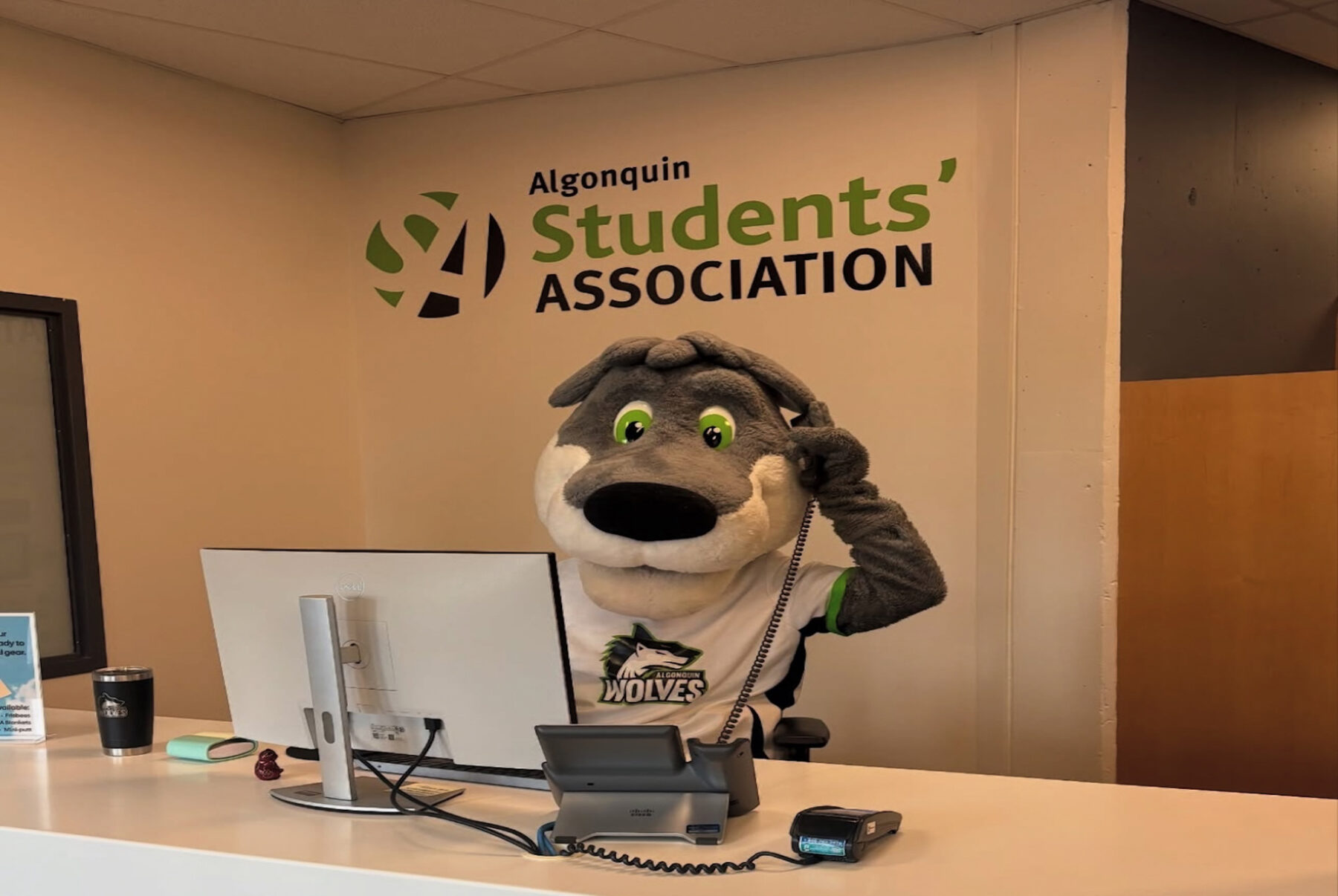
The Algonquin Wolves mascot is seen sitting and taking a call by the reception desk of the SA's office on campus.
The Algonquin Student’s Association is working on a timeline chronicling important moments in the organization’s history as it celebrates its 55th anniversary.
“These stories will showcase how the SA has helped shape experiences, build community and create opportunities for generations of students. It’s about looking back with pride and forward with excitement,” says Ben Dinh, the SA’s general manager.
Founded in 1970, three years after the Ottawa campus opened its doors, the SA was launched by students for students to help give them a voice within the college’s administration, along with making sure to address and, over the years, adapt to student needs.
“Change is constant, but so is our commitment to being there for students in meaningful ways. The SA has always adapted by listening to students and stepping up when needed,”says Dinh.
If you’re not familiar with the SA’s direct impact on students today, here’s a quick rundown:
The Student Health Plan, led by the SA, gives you health and dental coverage outside of what is offered through the Ontario Health Insurance Plan. It’s offered through WeSpeakStudent and helps reduce the fees for private health coverage.
The Wolves Den restaurant, bar and games room, along with the Starbucks, are SA-run facilities to help ease stress and offer varying food options.
The pool table room, run by the Students' Association is located inside of the Wolves Den, right next to the bowling area. Photo credit: Image provided by Chris Lackner
The Food Cupboard is a support service that helps students experiencing food insecurity and offers other basic necessities such as soap and toiletries.
The SA fully owns and operates the Jack Doyle Athletics and Recreation Centre (ARC), which opened in 2021. The facility offers an entire gym to students, along with fitness classes and much more.
One of many success stories that stands out today, according to Dinh, is the opening of the fitness centre.
The established landmark student space, Jack Doyle Athletics and Recreation Centre. One of the Students' Associations biggest accomplishment according to many members, is the ARC itself. Photo credit: Image provided by Chris Lackner
“The ARC is the busiest spot on campus and has become more than just a fitness space — it’s a hub of connection, wellness and community. It represents what can be achieved when students come together with a vision and see it through,” says Dinh.
Fun fact: the ARC was named after former SA general manager and CEO Jack Doyle. Doyle worked for and mentored more than 270 student board members and was set on elevating the student experience. He is now retired and watching the fruits of his labour grow in real time.
Public relations student Pyper Waldroff believes the SA is an important component of the student experience at Algonquin College and appreciates everything it offers.
“I’ve gone to a lot of the thrifting events held on campus and those are super fun. Many students use the services and events provided by the student association to help refresh, clear space of mind or even just help when needed,” says Waldroff. “Having a job offered (to me) by the students association has let me have an escape from school. It makes going to school fun, knowing that I’ll be doing something I enjoy and being with my work friends.”
President Vanshika Sharma says listening to students and advocating for their needs is crucial to the SA’s mission.
“We noticed over time that the demand for access to food was becoming more crucial,” says Sharma. “Our response was to open a food cupboard on campus to provide food security for students. It is confidential and well-used.”
Among many milestones and accomplishments there are always challenges to overcome. An issue rampant today, according to Dinh, is the decline in international student enrolment, which has been significant for the college community.
“Each challenge has compelled us to rethink, refocus and find innovative ways to continue serving students effectively. What hasn’t changed is our resilience and determination to support students, regardless of the circumstances,” says Dinh.
In addition to all the initiatives taken on to celebrate their anniversary, the SA makes sure to fulfill their mission and is focused on helping students feel prepared for their careers, feeling fully supported in leadership roles and advocating for better public transit.
“We are working closely with the college to improve co-op, applied projects and placement processes so students can fully understand the resources available to them and feel job-ready,” says Sharma.
“We’re also investing in our network of board members, class reps, varsity athletes or club leaders so they can better support their peers and increase awareness of the services available on campus. A pilot program in Pembroke and ongoing work with OC Transpo is also incoming, to ensure students have easier access to the college.”
Danika Mader completed a hat trick as the Wolves kept another clean sheet
Duncan Roi
Photos: Duncan Roi
September 29, 2025 Revised: September 29, 2025 12:45pm
Photo: Duncan Roi
Alex Aubin dribbles past defenders on the edge of the box at Algonquin Sports Field on Sept. 27.
The Wolves women’s soccer team defeated the Fleming Phoenix 7-0 at the Algonquin Sports Field on the afternoon of Sept. 27, continuing their unbeaten streak as they prepare to face two of the top teams in their division next weekend.
From the opening kickoff, the Wolves quickly took control of the game, dictating the tempo and showing their quality.
The Wolves struck early, netting three goals in the opening 15 minutes courtesy of Danika Mader, Alex Aubin and Cayla Latimer.
Ashley Woodcock dribbles down the left wing at Algonquin Sports Field.
In the 30th minute, defender Mercedes Veninga scored her first of the season with a powerful right-footed strike to make it 4-0.
Just before halftime, Olivia Bradley launched a long pass from her own half and found Mader, who calmly took it around the keeper and rolled the ball into an empty net. Mader’s goal made it 5-0, capping off a dominant first-half performance.
The backline of Bradley, Veninga and Ashley Woodcock was instrumental, with key interceptions and strong tackles; the defenders confined Fleming to their own half for much of the game. Midfielder Kassandra Da Cruz was also key, winning the ball in midfield and finding teammates with her passing vision.
The standout player was undoubtedly Mader, who netted her first hat trick of the season. She was ruthless in front of goal, taking advantage of her chances. Jasmine Young, who assisted Mader on her third goal, was ecstatic over Mader’s achievement.
“I was really happy seeing Danika score three goals. She’s been working really hard for it,” said Young. “She finally got three goals. She’s been getting two. And now she got a hat trick.”
Danika Mader after completing her hat trick on Sept. 27 at the Algonquin Sports Field.
Though modest about her performance, Mader was happy to see her effort and practice pay off.
“It feels good. I’ve been working really hard to try and achieve goals and hat tricks and all that,” said Mader.
Head coach Basil Phillips credited his team’s performance to possession and control.
“We controlled the ball well today. We just dictated the pace and moved the ball extremely well. So I think that was our best thing today,” said Phillips.
Algonquin was also relentless from corners, taking 13 of them in total and scoring from two in the second half.
Jasmine Young delivers a cross from the corner at Algonquin Sports Field. Photo credit: Duncan Roi
Hannah Parks scored the final goal to make it 7-0, sealing the victory.
The Wolves now head on the road to face Seneca on Oct. 4 and Centennial on Oct. 5. Both teams are also unbeaten so far this season.
Philips believes his team will be ready to face off against the other top teams in the division.
“We have a week to get ready for them, so it’s going to be just an intense week of training,” said Phillips. “Just looking to prepare, to execute what we’ve been doing, but just do it at a higher level to prepare for those two games.”
Young feels confident that the team can win their tougher matchups next weekend.
“We feel good. We feel confident. We’re a really good squad, and I have confidence that we are gonna do well if we put our minds to it and we keep working. I feel like we can win,” said Young.
Mader also feels the team is ready for those big games.
“As long as we don’t panic and keep communicating and stay composed, then I think we’ll do good,” said Mader.
The next Wolves home game is scheduled for Oct. 11, where they will host the George Brown Huskies.
Featured Hero | Featured Story | Home Feature | Sports & Recreation
The program provides women with mentorship and networking opportunities in the tech and trades sectors
Hau Ting Ng
Photos: Hau Ting Ng
September 29, 2025 Revised: September 29, 2025 10:42am
Photo: Hau Ting Ng
Opetorera Afinmo assembles a computer during a hands-on IT lab session.
Algonquin College launched the newly rebranded women in tech and trades (WiTT) program on Sept. 10, aiming to achieve several key goals, including boosting representation, visibility and outreach. The college aims to foster a supportive and inclusive community, ultimately increasing retention and graduation rates.
Dean Morgan, a professor of the electrical principles program, said that when he was studying in college 30 years ago, there were only two women in his electrical principles class.
“Now the gender balance is still not high, but it’s a lot better. And in the industry, I’m seeing a lot more women in engineering,” Morgan said. “ I think we should have more women in the field, just as you have a diversity of opinions and a diversity of approaches to a problem.”
Glen Sauve (left), part-time lab technician, and Professor Dean Morgan (right) in the lab. Photo credit: Hau Ting Ng
The WiTT program promotes long-term student success, encourages resilience and ultimately enhances gender diversity in fields with a persistent gender imbalance.
Kathryn Reilander, program coordinator of both the electrical engineering technology and powerline technician programs, pointed out that women only make up 10 per cent of Algonquin’s School of Advanced Technology.
“We want to be aware of the problems that women face in these programs. There’s still a culture in the tech and trades that is not very kind to women, not very accepting,” Reilander said.
The WiTT program, previously known as We Saved You a Seat, marks a renewed commitment to equity and inclusion in fields with gender disparity in STEM and the skilled trades.
“The program is going to make sure that women are feeling belonging and inclusion and that they’re being treated equally,” Reilander said. “I think it’s important that all the students in a class understand the importance of gender diversity. It makes teams stronger.”
WiTT is open to learners across various programs, including the School of Advanced Technology, Media and Design and the Algonquin Centre for Construction Excellence. It builds connections and leadership development.
Thanks to a $100,000 yearly commitment over three years from the Leacross Foundation, WiTT launched this fall with the necessary resources for events such as coffee clubs and networking opportunities.
Opetorera Afinmo studies computer systems technician networking. Photo credit: Hau Ting Ng
Opetorera Afinmo, a Level 3 computer systems technician-networking student, said people don’t expect women to be in the technology field. Afinmo felt helpless the first time she enrolled in the program.
“I feel much more comfortable when I communicate with women. I don’t feel shy, I know that I’m talking to people with whom I can connect at the same level that I am,” Afinmo said.
“The program helps us as women know that there is no limit to us because we get to do things that men are also doing.”