Top stories in your community and around the world as noted by Algonquin Times journalists
Reilly Armstrong
Photos:
February 13, 2026 Revised: February 13, 2026 9:18pm
Local
CBC Ottawa: Ottawa police have identified the victim of a fatal shooting in Manotick on Feb. 11 as 19-year-old Majed Al-Ar.
Hussein Kaddoura, 22, has been charged with manslaughter, kidnapping and possession of a restricted firearm. He appeared in court on Feb. 12. Another suspect has been released from custody.
This marks Ottawa’s third homicide of the year.
National
CBC: RCMP have now identified all eight victims in the Tumbler Ridge, B.C. mass shooting on Feb. 10. Six of the victims are between 11 and 13 years old.
The shooting left nine dead including the shooter and was one of the worst in Canadian history.
Prime Minister Mark Carney and Governor General Mary Simon were expected to attend a vigil in the small community on Feb. 13.
International
NBC: Ukrainian Olympic skeleton racer Vladyslav Heraskevych lost his appeal to compete at the Milan Winter Olympics.
Heraskevych was disqualified on Feb. 12 ahead of his race due to his refusal to remove his helmet, which breached rules on political neutrality.
The helmet depicts Ukrainian athletes killed during Russia’s invasion of Ukraine, which is entering its fifth year.
Students and staff are relieved to hear proposed program suspensions will be delayed while college reviews new funding from Ontario government
Amanda Mcleod
Photos: Amanda McLeod
February 13, 2026 Revised: February 13, 2026 9:23pm
Photo: Amanda McLeod
Algonquin College will receive financial support as a result of recent funding increases from the Ontario government.
Algonquin College president Claude Brulé announced on Friday the upcoming Feb. 23 Board of Governors vote on proposed program cuts would be rescheduled.
The statement comes a day after Nolan Quinn, Ontario’s minister of colleges, universities, research excellence and security announced $6.4 billion in funding from the province for public colleges and universities over the next four years and a removal of the current tuition cap, allowing for a two per cent increase per year over the next three years. Tuition has been frozen since 2019.
The proposed cuts to 30 programs were announced in January by senior vice-president Julie Beauchamp. Under the college’s proposal, the program cuts would take effect in the fall of 2026.
Brulé’s statement outlined the college’s plan in response to the announcement from the Ontario government.
“Once we receive the technical brief regarding the announcement and the details of our allocation, we will complete a full assessment,” Brulé said in a message to college staff.
“It is essential that our decisions going forward are made with a thorough understanding of the impact this announcement will have on the College.”
Tracy Henderson, president of the Ontario Public Service Employees Union Local 415, represents Algonquin College full-time and partial-load faculty.
In an interview with Algonquin Times on Friday, Henderson expressed cautious relief regarding the sequential announcements from the provincial government and the college.
“The union is very pleased to see that college leadership has taken that approach following Minister Quinn’s announcement yesterday. The union did reach out to (the college) and asked that they would reconsider in light of the new information that we have been given,” Henderson said.
Henderson added she hoped the college would be “pausing any decisions until we truly understand how much of that money is coming our way and that will be designated. To be looking at any further program closures at this point would be inappropriate.”
Tracy Henderson, president of OPSEU Local 415. Photo credit: provided by source
Algonquin College students had mixed reactions to the provincial government announcements.
Emily Villeneuve, a first-year student in pre-health, expressed relief when she heard the board vote would be postponed.
“I think it’s a good thing. I know a lot of people were taken by shock, so a pause to (program cuts) is good. Also, I don’t think it would make sense if they’re given more money, why are they canceling programs?” said Villeneuve.
Claire McConnell, an advertising and marketing first-year student, said she thought the college cuts were concerning for newly accepted students trying to plan their education path.
“Even last year when they were doing the cuts…I just got accepted into the program I’m in now, and what if it was marketing? I was like, ‘why are they cutting (programs)? I just got accepted’,’” McConnell said.
Villeneuve also expressed concern for her instructors at the college.
“I know a lot of teachers had a hard time adjusting because they’re losing their jobs next year. I don’t understand it — our teachers are explaining there’s 400 people on a wait list to enter the program. So to cancel it just doesn’t make sense,” she said.
Algonquin College students Emily Villeneuve, left, and Claire McConnell are relieved to hear the college will be holding off on an immediate program cuts. Photo credit: Amanda McLeod
In a statement on Facebook, College Ward Coun. Laine Johnson applauded the increase in funding while also expressing concern about the changes to tuition caps and OSAP funding.
“I am very pleased to read that Algonquin College will hold off on cutting several important programs. I have been working with the college, students, and the community over the past weeks to stress how effective these programs are and what they mean to both the city and residents,” Johnson said in the post.
“That said, I am concerned by the changes to OSAP and the impact of tuition increases on low income students. We can’t leave anyone behind!”
Henderson echoed Johnson’s concern.
“We all need to engage. This affects every one of us – not only within the institutions, but in our community. What happens when there are no script writers, when there are no cameramen, and there are no journalists? Where will our community be?” Henderson said.
Featured Hero | Featured Story | Home Feature | Home Hero | News
The Algonquin Students' Association hosted another Dirty Bingo event, where students came together to unwind in a sexually positive and stigma-free environment
Ryan Harkness
Photos: Ryan Harkness
February 12, 2026 Revised: February 13, 2026 7:28am
Photo: Ryan Harkness
Zelda Marshall (left) and Krystal Caring (right) are the current hosts of the Algonquin Students' Association's monthly Dirty Bingo.
The Observatory had a collective sense of warmth on the evening of Feb. 4, not from the indoor temperature or the poutine being served, but from the spiciness of Dirty Bingo.
Dirty Bingo is a version of regular bingo, but with sex toys as the prizes. The winner from each round of bingo chooses from a selection of toys, such as dildos and bottles of lubrication.
Hosts Zelda Marshall and Krystal Caring called out the letters and numbers. Attendees also had the opportunity to call out the bingo letters in a dirty fashion, for example, substituting the “O” for “Orgasm.”
If two guests called out “bingo” at the same time, they would go to the prize desk to battle it out over a challenge, such as putting a condom over a water bottle.
Students heard about this event through the SA’s social media, as well as word of mouth. Thomas Beaudoin, an Algonquin College student, first heard about this event through a friend in September and has been attending each Dirty Bingo event ever since.
“I’ve made new friends. It kind of encourages community building,” said Beaudoin. “I know a lot of high schools don’t talk about these things. They don’t talk about sex at all. Actually, my high school didn’t.”
Thomas Beaudoin participates in the first of many rounds of Dirty Bingo. Photo credit: Ryan Harkness
Dirty Bingo has been hosted at Algonquin College since 2010, creating a space for adults to socialize and become better educated on sex.
“We want people to basically feel free to express themselves, to meet people that are like-minded themselves, and to basically have an area where they can come and have fun,” said Matteo Mongroo, an events assistant with the SA who helped organize Dirty Bingo. “It’s been running for 15 years. At this point, we are getting to the point where it’s kind of running itself.”
Mongroo said that Dirty Bingo was previously targeted towards the college community and the general public, but this year it’s only targeting Algonquin College students.
Matteo Mongroo, an events assistant with the Students’ Association, poses outside the Observatory during the intermission. Mongroo helped organize this event. Photo credit: Ryan Harkness
Marshall, a drag performer who also hosts a weekly Thursday night drag show at Swizzles Bar and Grill downtown, uses Dirty Bingo to dispel some myths about sex.
“We try to make it a positive educational experience as well as a fun experience,” said Marshall.
Caring, an Algonquin College alumni and drag performer, said that the audience’s sense of humour has changed over the past 15 years.
“They want everything politically correct, very safe, which I don’t think comedy needs to be like that. I think we need to open it up and have a good time,” said Caring.
Marshall and Caring said it’s good to take people away from stress and to let them have a good time.
“We have also had people, because of our show, come out to their friends. They realized that their friends are actually very positive and supportive of the event and of gay people,” said Caring.
They also plan to do Dirty Bingo events in Pembroke, Ont. and Kingston, Ont.
“Here’s to another 15 great years,” said Marshall.
Arts & Entertainment | Featured Hero | Featured Story | Home Feature | Home Hero
According to Algonquin College students, you don't need a fancy dinner to enjoy the special day
Pedro Mendez
Photos:
February 12, 2026 Revised: February 12, 2026 10:29pm
Photo of Damon Merrikin carry Grace Johnston on his back. Courtesy of Grace Johnston.
As Valentine’s Day approaches, local stores begin to sell special gifts, from sweet chocolates to soft plushies. The rush of getting gifts might feel like the purpose of Feb. 14 loses its value.
However, some Algonquin College students know that to express love, the sentiment doesn’t need to come out of their wallets.
“One of the most important factors of Valentine’s Day in my opinion is just being together, it doesn’t need to be anything fancy,” said Nick Thivierge.
Thivierge’s girlfriend, Abby Ankersmit, who is a current Algonquin College student in the early childhood education program, agrees with him.
Photo of Abby Ankersmit and Nick Thivierge. Courtesy of Abby Ankersmit.
For many, quality time is more important than the amount of money spent on one another. In those moments, something magical could happen, making it memorable.
“Being able to have those deep conversations and having that deep connection with that one person, I believe that’s what could make Valentine’s Day feel magical,” said Grace Johnston, an Algonquin College student in the early childhood education program.
Her boyfriend, Damon Merrikin, who is in the police foundation program at the college, agrees and appreciates having one-on-one connection.
“I think something that is magical is to take things slow and have a moment to talk and being able to relax at the end of the day,” said Merrikin.
Others suggest it depends on the location where you choose to celebrate Valentine’s Day.
“I would want to take Damon on a vacation to P.E.I. or take him somewhere to have a break from all the stress he has from school and work,” said Johnston.
Johnston isn’t the only one who would take their significant other away from the stress of life.
A photo of Victoria Blake and Zach Labelle standing together. Courtesy of Zach Labelle
“I wish I could go on a getaway like a vacation or road trip. This can get us away from all the distractions and focus on us,” said Zach Labelle, an Algonquin College student in the business program.
Victoria Blake, Labelle’s girlfriend, agrees with the idea of a “dream getaway,” where they would both be able to “have time away purely for ourselves.”
Wolves successfully hunt down a flawless victory after a previous loss to the undefeated Seneca Sting
Tyrell Taylor
Photos: Tyrell Taylor
February 11, 2026 Revised: February 11, 2026 11:02am
Photo: Tyrell Taylor
Wolves setter Gabbie Paquette motivating her team during the game at Jack Doyle Athletic Recreation Centre
The Algonquin Wolves women’s volleyball team secured a playoff spot with a 3-0 win over the Georgian Grizzlies on Feb. 7 at Jack Doyle Athletics and Recreation Centre.
The win improved the Wolves’ record to 11–5 in the OCAA standings.
The Wolves started strong in the first set winning 25-18 as they battled through the Grizzlies’ rabid defence.
Wolves setter Gabbie Paquette got the first ace in the game, with Wolves middle blocker Riley Lancia following it up with her own not too long after.
Wolves setter Gabbie Paquette motivating her team during the game at Jack Doyle Athletic Recreation Centre Photo credit: Tyrell Taylor
Once the Wolves latched on, it was hard for the Grizzlies to escape their jaws.
The Grizzlies fell short againin the second set as they called another time out after an ace by Wolves left striker Chanel Ethier.
With a great offensive strategy and an improved court IQ, which helped them secure points from refusing to hit balls going out of bounds, the Wolves closed the second set 25-16.
It was a tougher fight in the third set, with both teams keeping it close before the Grizzlies took the lead by one.
As the Grizzlies tried to extend their lead by two, they were stopped by Paquette with an amazing dive to tie it up 5-5. On the next serve Paquette made an assist to Lancia and the Wolves took the lead 6-5.
Paquette later had a great block against Grizzlies outsider hitter Emma Cot, tying the set at 11 points.Throughout the match, Paquette made great setups for her teammates who capitalized on the ample opportunities.
The Wolves mascot hyping the crowd during the third set Photo credit: Tyrell Taylor
Aftera back-and-forth fight, the Wolves closed out the match with a 25-21 third set.
Although the day ended in flawlessvictory,it started with an emotional moment before the first serve.
Everton Senior said farewell to four senior players who will be leaving the team at the end of the season.
Wolves coach speaking about the four seniors leaving before the game starting, wishing them well and hoping for a good game Photo credit: Tyrell Taylor
The match was the final home game of the regular season for Wolves libero Jordan Faig, Wolves middle blocker Isabella Tourangeau, Wolves right striker Ella Howell and Wolves right striker Natasha Lauzon.
Featured Hero | Featured Story | Home Feature | Sports & Recreation
Top stories in your community and around the world as noted by Algonquin Times journalists
Tyrell Taylor
Photos:
February 10, 2026 Revised: February 10, 2026 9:11pm
Local
CTV News: The federal government terminated at least 145employees and suspended 783 without paybecause of more than 2,600 cases of wrongdoing and misconduct.
Among the others, 705 received reprimands and 1,048 faceother disciplinary actions. The allegations of misconduct and wrongdoings include but are not limited to sexual harassment, racial discrimination, workplace violence and other offences.
The reports of misconduct dates back to 2024, when Correctional Service Canada, Canada Revenue Agency, Global Affairs Canada, Canada Border Services Agency and Canadian Security Intelligence Service reported incidents of misconduct.
“Without proper transparency, taxpayers aren’t able to hold the government and politicians accountable,” said Canadian Taxpayers Federation director Franco Terrazzano.
National
CBC: Canada won silver in the short-stack speed skating mixed relay, making it the third medal Canada captured in the Winter Olympics.
Italy won gold. Canada’s silver medal took the country to thetwelfth spot in the Olympic medal standings.
Meanwhile in women’s hockey, the United States beat Canada 5-0 in a preliminary round game.
International
CTV News: Canadians were waiting at airports in Cuba as the Trump administration continued to cut off the country’s fuel sources, plunging the island into an energy crisisaffecting the home of almost 11 million people.
Flights to Cuba were suspended by WestJet, Air Canada and Air Transat. The airlines said they’ll bring the Canadians back home.
The Canadian government released a travel advisory for Cuba on Feb. 4. Flights for Air Transatwon’t return until April 30. WestJet and Air Canada have not commented on when services will resume.
Algonquin College services dazzled students with the Campus Village on Jan. 22
Daniel Sundaresan
Photos: Daniel Sundaresan
February 10, 2026 Revised: February 10, 2026 10:47am
Photo: Daniel Sundaresan
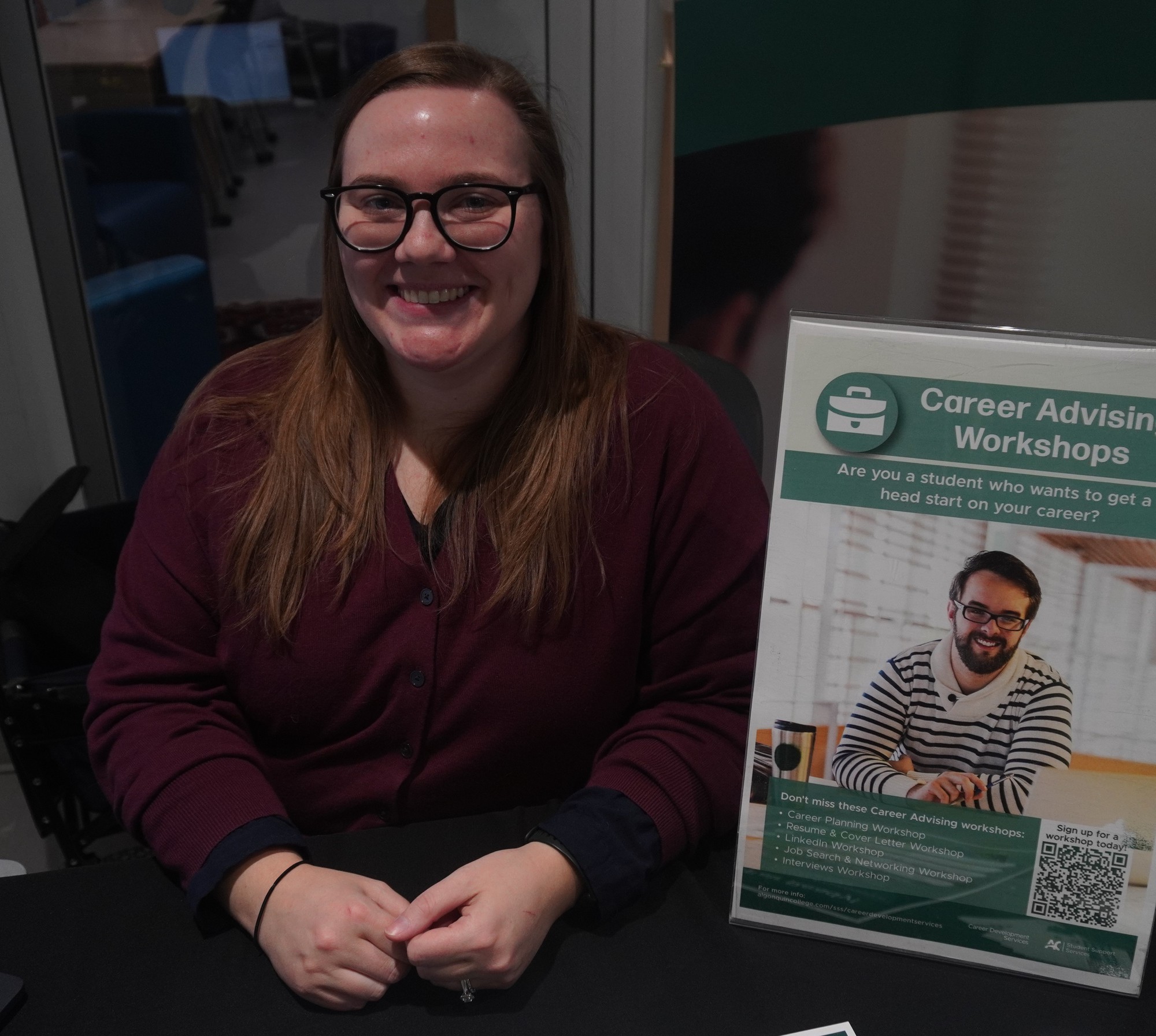
Jessica Andrews, a career advisor, helped make this event a success.
The Campus Village event on Jan. 22 showcased how Algonquin College offers a wide range of services to their students who are seeking guidance from matters like job search to peer tutoring and everything in between.
Several student service counsellors observed that the event was bustling and very well attended, and they anticipated speaking with multiple students that day.
Jessica Andrews, a career advisor, said that when students are early in their semester they are overwhelmed with academics and finding their classes. They often miss out on what services are available to them.
The timing of this event was important because once students are well into their semester, they can start to circle back on following up on these issues.
Andrews said some of the services her group offers include workshops, events and one-on-one advising. She emphasized that Algonquin students are concerned about finding jobs. More specifically, their concerns are about finding jobs related to their program as well as finding successful jobs after their graduation. Her services include assistance with job searches during studies and also after graduation.
Mahdi Raboudi, an international student in the building construction technician program said the the part-time job market in Ottawa is tight for international students like himself.
Raboudi pointed out that international students are exposed to work earlier in their country of origin (in his case Tunisia), and consequently, he said international students are often considered overqualified for part-time work. He offered an example in which he accidentally applied for full-time work and was immediately granted a couple of interviews. When he submitted the same resume for part-time jobs, he struggled to get interviews.
Mahdi had a productive day speaking with career advising and counselling services and he was able to book an appointment for a follow-up discussion regarding jobs.
Top stories in your community and around the world as noted by Algonquin Times journalists
Ben Charles
Photos:
February 9, 2026 Revised: February 9, 2026 9:32pm
Local
CityNews Ottawa – A federal union says Transport Canada’s job cuts could threaten safety oversight and inspection roles crucial for protecting Canadians, particularly in Ottawa, where federal operations are centred.
The union highlighted risks to oversight and inspection services for dangerous goods transportation amid planned workforce reductions.
National
Toronto CityNews – Ontario’s police watchdog has launched a provincewide review to assess how well police services and boards can prevent, detect and respond to corruption, following the arrest of several current officers in an organized crime investigation.
The inspection aims to strengthen systems and restore public trust.
International
Global News – Canada expressed disappointment after Hong Kong pro-democracy media tycoon Jimmy Lai was sentenced to 20 years in prison under the National Security Law.
Canadian officials criticized the conviction as politically motivated and harmful to free expression and human rights in the region.
Refuge often begins with shelter, a warm bed and enough food to survive. But what’s often overlooked is the sense of community newcomers need to truly feel safe.
Delaney Smith
Photos: Supplied by source
February 9, 2026 Revised: February 11, 2026 3:56pm
Photo: Supplied by source
God's Beloved group huddled outside of Kitchissippi United Church after a Sunday service.
Anthony Chukwuebuka remembers arriving in Canada March of 2025 with no winter clothing, no contacts and nowhere to stay. The Nigerian newcomer, who fled after his sexuality became known in his community, spent his first night outside in Toronto after struggling to find a hotel that accepted cash.
“I didn’t even know there was a place where minus weather exists,” Chukwuebuka said.
“I came out at ten-thirty at night in just trousers and a simple shirt. It was pretty cold, so I had to run back inside. I had cash with me to lodge in a hotel because my destination was Ottawa. But no hotel would accept cash, so I had to sleep outside under the cold.”
Chukwuebuka loved business and built a career in real estate and marketing in eastern Nigeria, but he said life changed quickly when his sexuality became public.
“Everything began to vanish, including my business,” he said.
“I grew up with a pain of isolation. But you can’t express how you feel openly, not in school, not in your family, not in society. Your sexuality becomes something you have to hide all the time. Our lives became a nightmare. We had to start looking for a way out of the country because the community will come after you and society will condemn you. And not just that, it’s more like a criminal offence.”
He later travelled to Ottawa, where he heard someone speaking his local language on a city bus. This newcomer led him to God’s Beloved, a group at Kitchissippi United Church that supports Christian LGBTQI+ refugees and asylum seekers.
“I had been searching online for a community or a church where I will see people that have same story as me or people that will understand my pains and people that will be a friend, people that will comfort me,” Chukwuebuka said.
God’s Beloved officially launched in August 2024, with only six participants. Within months, more than 30 LGBTQI+ newcomers were regularly attending the weekly gatherings.
Kitchissippi is led by Rev. Jenni Leslie, while the God’s Beloved group is led by Rev. Daniel Addai Fobi, who provides pastoral support, accompanies members to hearings and helps them navigate housing, mental health concerns and settlement challenges.
“For us, it is about affirming the inherent worth of every person,” Fobi said.
“People come to us carrying trauma, fear, sometimes shame. Our work is to remind them that they are seen, valued and beloved.”
Jenni Leslie (left) and Daniel Addai Fobi speaking at the triennial General Council meeting in Calgary summer of 2025. Photo credit: Supplied by source
Leslie said many members arrive to Canada carrying experiences they have never had the freedom to share.
“What God’s Beloved offers is a place where people can breathe again,” she said.
“A place where they can bring their whole selves without fear. For many, this is the first time in their lives that’s been possible.”
The growth of God’s Beloved mirrors national trends in refugee movement. Across Canada, refugee protection claims have risen sharply. The Immigration and Refugee Board of Canada reported more than 170,000 asylum claims in 2024-2025, one of the highest totals on record. Since 1980, the country has welcomed over one million refugees, with 76,685becoming permanent residents in 2024 alone.
LGBTQI+ refugee claimants are considered among the most vulnerable due to criminalization, violence and family rejection in many countries.
For lifelong member Mary Laidlaw, the presence of newcomers has brought renewed engagement to a congregation she has attended since childhood.
“I’ve been here since the beginning, all my life,” Laidlaw said.
“The United Church has always been a place where anybody can come, and anybody is welcome. So why wouldn’t we have people of different experiences and cultures? We can all learn from each other.”
Laidlaw said the ministry has encouraged more conversations in the wider congregation.
“People are talking more about their traditions,” she said. “They’re asking, ‘Why did we always do that?’ Change can be good.”
What stands out most to her is the level of participation from God’s Beloved.
“Their belief and their practices are so ingrained,” Laidlaw said.
“Young people don’t come as much anymore. But God’s Beloved comes with real commitment, and I think it’s wonderful.”
Chukwuebuka said fleeing Nigeria meant losing more than his home. His partner escaped to France, and he has no contact with him today. His family no longer speaks to him.
“I didn’t know what therapy was,” he said.
“I was passing through my pains alone. But Reverend Daniel and Reverend Jenni helped me. They listened to me and worked with me.”
He said the support has helped him find community.
“Since then, I’ve met lots of friends and good people from all the people, church members, Reverend Daniel, Reverend Jenni,” Chukwuebuka said.
According to Kitchissippi United Church’s website, God’s Beloved is designed to offer “numerous opportunities for socialization, emotional support, and mutual care, fostering a culture of love, acceptance, and empathy.” The program offers weekly gatherings, community meals, pastoral care and practical assistance.
The church describes the ministry as an expression of its commitment to inclusion, reconciliation and justice, values rooted in the wider United Church of Canada.
“Everyone deserves a place where they are loved,” Fobi said. “That is the heart of this ministry.”
At Kitchissippi United, many of these newcomers have found not just an accepting place to worship, but a place to heal.
Featured Hero | Featured Story | Features | Home Feature
Amid economic uncertainty and growing demand for Indigenous hires, Indigenous students and employers gathered for the Ottawa Indigenous Student Career Fair
Kindra Paul
Photos: Kindra Paul
February 6, 2026 Revised: February 6, 2026 4:30pm
Photo: Kindra Paul
Students come to the employers with many questions in regards to their future.
In one cafeteria with countless possibilities, Ottawa’s Indigenous Student Career Fair was where culture, talent, and opportunity met on campus.
The seven-hour event on Jan. 27 brought together nearly 40 employers actively seeking Indigenous students and graduates. While some organizations were recruiting for Indigenous-specific roles, others were open to all applicants. Many students said they decided to attend after noticing the fair while on campus.
Organizers said the timing was important as students navigate the economy and limited job opportunities while employers increasingly prioritize Indigenous hiring as part of workforce renewal and reconciliation efforts.
“Ever since the Truth and Reconciliation report came out I feel like reconciliation…has really been a big part of that conversation…and this is how employers want to participate in reconciliation,” said Summer Wabasse, events and communications officer for the Mamidosewin Centre.
Employers direct students thoughtfully. Photo credit: Kindra Paul
Shayna Shawongonabe, an applied museum studies graduate and Indigenous student navigator at the Mamidosewin Centre, said Indigenous representation across sectors remains essential.
“Our knowledge is sacred and what we have to offer is sacred. First and foremost this is our land,” she said, noting that that diversity has become a priority.
Several employers highlighted the value Indigenous students bring through lived experience and cultural knowledge. Makonsag, an Indigenous-led daycare, indicated it was hiring more Indigenous staff to strengthen cultural representation.
“Indigenous students bring their lived experience…which also is a good connection to the children and the families. Be confident and remember what you’ve learned and bring all of that to the table because that’s what makes you special and unique and it’s a great way to step into the workforce,” said Makonsag’s Indigenous childcare manager Pauline McKay.
Several employers pointed to the importance of Indigenous representation in their workforce, specifically in regions where projects are rooted in Inuit land.
Jean-Francois Etuk-Fortier, an Inuit recruitment specialist with Baffinland Iron Mines, said, “Indigenous people have the first priority when it comes to hiring because we are operating on their own land,” and he encouraged students to seek training and experience through different roles.
“Unfortunately, Indigenous people make up a good percentage of the incarcerated population in Canada, probably like a quarter,” said Marielle Latour, a case management representative at the Correctional Services of Canada. Latour said staff with lived experience can better understand client realities.
The fair gave students an opportunity to meet employers, explore career paths and access job opportunities in a challenging market.
“In this economy a lot of work is being done in Indigenous territories and on Indigenous lands,” Wabasse said. “Naturally these employers want to make sure the voices of the people and communities that they’re working with are represented.”