main

How this refugee group at Kitchissippi United Church is helping people find an accepting community

Refuge often begins with shelter, a warm bed and enough food to survive. But what’s often overlooked is the sense of community newcomers need to truly feel safe.
Photo: Supplied by source
God's Beloved group huddled outside of Kitchissippi United Church after a Sunday service.

Anthony Chukwuebuka remembers arriving in Canada March of 2025 with no winter clothing, no contacts and nowhere to stay. The Nigerian newcomer, who fled after his sexuality became known in his community, spent his first night outside in Toronto after struggling to find a hotel that accepted cash.

“I didn’t even know there was a place where minus weather exists,” Chukwuebuka said.

“I came out at ten-thirty at night in just trousers and a simple shirt. It was pretty cold, so I had to run back inside. I had cash with me to lodge in a hotel because my destination was Ottawa. But no hotel would accept cash, so I had to sleep outside under the cold.”

Chukwuebuka loved business and built a career in real estate and marketing in eastern Nigeria, but he said life changed quickly when his sexuality became public.

“Everything began to vanish, including my business,” he said.

“I grew up with a pain of isolation. But you can’t express how you feel openly, not in school, not in your family, not in society. Your sexuality becomes something you have to hide all the time. Our lives became a nightmare. We had to start looking for a way out of the country because the community will come after you and society will condemn you. And not just that, it’s more like a criminal offence.”

He later travelled to Ottawa, where he heard someone speaking his local language on a city bus. This newcomer led him to God’s Beloved, a group at Kitchissippi United Church that supports Christian LGBTQI+ refugees and asylum seekers.

“I had been searching online for a community or a church where I will see people that have same story as me or people that will understand my pains and people that will be a friend, people that will comfort me,” Chukwuebuka said.

God’s Beloved officially launched in August 2024, with only six participants. Within months, more than 30 LGBTQI+ newcomers were regularly attending the weekly gatherings.

Kitchissippi is led by Rev. Jenni Leslie, while the God’s Beloved group is led by Rev. Daniel Addai Fobi, who provides pastoral support, accompanies members to hearings and helps them navigate housing, mental health concerns and settlement challenges.

“For us, it is about affirming the inherent worth of every person,” Fobi said.

“People come to us carrying trauma, fear, sometimes shame. Our work is to remind them that they are seen, valued and beloved.”

Jenni Leslie (left) and Daniel Addai Fobi speaking at the triennial General Council meeting in Calgary summer of 2025
Jenni Leslie (left) and Daniel Addai Fobi speaking at the triennial General Council meeting in Calgary summer of 2025. Photo credit: Supplied by source

Leslie said many members arrive to Canada carrying experiences they have never had the freedom to share.

“What God’s Beloved offers is a place where people can breathe again,” she said.

“A place where they can bring their whole selves without fear. For many, this is the first time in their lives that’s been possible.”

The growth of God’s Beloved mirrors national trends in refugee movement. Across Canada, refugee protection claims have risen sharply. The Immigration and Refugee Board of Canada reported more than 170,000 asylum claims in 2024-2025, one of the highest totals on record. Since 1980, the country has welcomed over one million refugees, with 76,685 becoming permanent residents in 2024 alone.

LGBTQI+ refugee claimants are considered among the most vulnerable due to criminalization, violence and family rejection in many countries.

For lifelong member Mary Laidlaw, the presence of newcomers has brought renewed engagement to a congregation she has attended since childhood.

“I’ve been here since the beginning, all my life,” Laidlaw said.

“The United Church has always been a place where anybody can come, and anybody is welcome. So why wouldn’t we have people of different experiences and cultures? We can all learn from each other.”

Laidlaw said the ministry has encouraged more conversations in the wider congregation.

“People are talking more about their traditions,” she said. “They’re asking, ‘Why did we always do that?’ Change can be good.”

What stands out most to her is the level of participation from God’s Beloved.

“Their belief and their practices are so ingrained,” Laidlaw said.

“Young people don’t come as much anymore. But God’s Beloved comes with real commitment, and I think it’s wonderful.”

Chukwuebuka said fleeing Nigeria meant losing more than his home. His partner escaped to France, and he has no contact with him today. His family no longer speaks to him.

“I didn’t know what therapy was,” he said.

“I was passing through my pains alone. But Reverend Daniel and Reverend Jenni helped me. They listened to me and worked with me.”

He said the support has helped him find community.

“Since then, I’ve met lots of friends and good people from all the people, church members, Reverend Daniel, Reverend Jenni,” Chukwuebuka said.

According to Kitchissippi United Church’s website, God’s Beloved is designed to offer “numerous opportunities for socialization, emotional support, and mutual care, fostering a culture of love, acceptance, and empathy.” The program offers weekly gatherings, community meals, pastoral care and practical assistance.

The church describes the ministry as an expression of its commitment to inclusion, reconciliation and justice, values rooted in the wider United Church of Canada.

“Everyone deserves a place where they are loved,” Fobi said. “That is the heart of this ministry.”

At Kitchissippi United, many of these newcomers have found not just an accepting place to worship, but a place to heal.

Indigenous students connect with employers at career fair

Amid economic uncertainty and growing demand for Indigenous hires, Indigenous students and employers gathered for the Ottawa Indigenous Student Career Fair
Photo: Kindra Paul
Students come to the employers with many questions in regards to their future.

In one cafeteria with countless possibilities, Ottawa’s Indigenous Student Career Fair was where culture, talent, and opportunity met on campus.

The seven-hour event on Jan. 27 brought together nearly 40 employers actively seeking Indigenous students and graduates. While some organizations were recruiting for Indigenous-specific roles, others were open to all applicants. Many students said they decided to attend after noticing the fair while on campus.

Organizers said the timing was important as students navigate the economy and limited job opportunities while employers increasingly prioritize Indigenous hiring as part of workforce renewal and reconciliation efforts.

“Ever since the Truth and Reconciliation report came out I feel like reconciliation…has really been a big part of that conversation…and this is how employers want to participate in reconciliation,” said Summer Wabasse, events and communications officer for the Mamidosewin Centre.

Employers direct students thoughtfully.
Employers direct students thoughtfully. Photo credit: Kindra Paul

Shayna Shawongonabe, an applied museum studies graduate and Indigenous student navigator at the Mamidosewin Centre, said Indigenous representation across sectors remains essential.

“Our knowledge is sacred and what we have to offer is sacred. First and foremost this is our land,” she said, noting that that diversity has become a priority.

Several employers highlighted the value Indigenous students bring through lived experience and cultural knowledge. Makonsag, an Indigenous-led daycare, indicated it was hiring more Indigenous staff to strengthen cultural representation.

“Indigenous students bring their lived experience…which also is a good connection to the children and the families. Be confident and remember what you’ve learned and bring all of that to the table because that’s what makes you special and unique and it’s a great way to step into the workforce,” said Makonsag’s Indigenous childcare manager Pauline McKay.

Several employers pointed to the importance of Indigenous representation in their workforce, specifically in regions where projects are rooted in Inuit land.

Jean-Francois Etuk-Fortier, an Inuit recruitment specialist with Baffinland Iron Mines, said, “Indigenous people have the first priority when it comes to hiring because we are operating on their own land,” and he encouraged students to seek training and experience through different roles.

“Unfortunately, Indigenous people make up a good percentage of the incarcerated population in Canada, probably like a quarter,” said Marielle Latour, a case management representative at the Correctional Services of Canada. Latour said staff with lived experience can better understand client realities.

The fair gave students an opportunity to meet employers, explore career paths and access job opportunities in a challenging market.

“In this economy a lot of work is being done in Indigenous territories and on Indigenous lands,” Wabasse said. “Naturally these employers want to make sure the voices of the people and communities that they’re working with are represented.”

News Briefs: Cellblock video captures Ottawa councillor blowing twice the legal limit after arrest

Top stories in your community and around the world as noted by Algonquin Times journalists

Local

CBC News: A cellblock video shown in court captures Ottawa city councillor Matthew Luloff blowing twice the legal blood-alcohol limit after his arrest for suspected impaired driving. The video was released to the media two weeks after it was shown during his trial.

Luloff, who pleaded not guilty at the beginning of the trial, tells the officer the arrest will be politically damaging for him. He was a federal Conservative candidate for Orléans at the time of the arrest.

National

CBC News: Former prime minister Stephen Harper urged Canada to reduce its economic dependence on the United States, warning that U.S. political instability makes overreliance risky.

He spoke at a gala in Ottawa marking the 20th anniversary of forming a Conservative government, insisting that Canada should diversify its trade relationships, strengthen its resource sector and be prepared to use tariffs when necessary to protect national interests.

International

The Globe and Mail: Fulton County is asking a federal court to order the FBI to return 2020 ballots and election records that were seized from a county warehouse.

The move comes as President Donald Trump starts pushing the idea of federal “takeovers” of elections in Democratic areas, reviving his disproved fraud claims and raising concerns among election officials.

Algonquin College launches new nursing program

The college celebrates its 50th year of nursing programs by introducing a new four-year degree, but wants to cut pathway program
Photo: Rory Haley
Level 2 practical nursing students, Shaira Bobiles (Left) and Nuzhat Kavir (Right), are photographed in their scrubs on Feb. 5, 2026.

In the fall of 2026, Algonquin College will begin accepting applications for a new nursing program, a bachelor of science in nursing (honours) (BScN), at the Woodroffe and Pembroke campuses.

The new program, traditionally four-years long, will be condensed into three years and four months, and will allow students to both meet the College of Nurses of Ontario capabilities, and be eligible to register as a registered nurse (RN) in Ontario.

Hawa Mire, a second-level practical nursing student at Algonquin College, is looking forward to the new program.

“It’s a really good opportunity for people who want to do the RN program, but they can’t get into the uOttawa or the Carleton one,” she said. “The Algonquin program is a good opportunity for those people.”

Second-level practical nursing student, Hawa Mire, smiles for the camera on Feb. 5, 2026.
Second-level practical nursing student, Hawa Mire, photographed on Feb. 5, is looking forward to the new program launched by the college. Photo credit: Rory Haley

On Jan. 29, Algonquin College hosted a panel of nursing experts to celebrate the launch of the new nursing program and to discuss the development of the nursing field over the past 50 years. Algonquin Times reporters were not permitted to attend the panel and were unable to report on it firsthand.

Nolan Quinn, Ontario’s minister of colleges, universities, research excellence, and security, spoke through a video message at the panel where he noted the province’s $56.8-million investment to expand nursing enrolment, with the goal to train up to 2,200 more nurses.

Algonquin College president and CEO Claude Brule vowed to continue encouraging and investing in the college’s nursing programs.

“This anniversary is a powerful reminder of the impact our graduates have had on communities for half a century,” he said. “As we celebrate 50 years of nursing education, we are also looking ahead with excitement and purpose through the launch of our standalone bachelor of science in nursing.”

Brulé also said that Algonquin College has raised over $50,000 to support nursing education, with more donations expected to come.

Sue LeBeau, a francophone nursing leader with extensive experience across Ontario, also spoke at the panel, commending the college.

“I applaud the work that Algonquin is doing,” she said. ”I applaud the fact that the community and the local employers have really nurtured this college, and I applaud the many students that are graduating or have graduated from this institution. You are our future.”

Since Algonquin launched its first nursing program in 1975, almost 16,000 students have graduated from the nursing school.

Currently, the college offers several different nursing programs, including a one-year pre-health science pathway, which is among the 30 programs Algonquin College is considering cutting in the fall of 2026.

Mire voiced concern about the college ending the one-year pathway program and how it may affect others who want to pursue nursing in the future.

“I’m not really happy they’re cutting that program, I don’t see why they would,” Mire said. “I was actually in the pre-health program. It helped me get into the college, get used to the routine and everything, and it also helped me prepare for the practical nursing program.”

Nuzhat Kavir, who is also a Level 2 practical nursing student, agrees with Mire.

“I think it’s a very crucial program,” she said. “It’s a good pathway toward nursing and nursing bachelor’s.”

On Jan. 27, Ottawa Mayor Mark Sutcliffe met with Brulé and college nursing students, presenting them with a certificate to commemorate the 50-year milestone.

Mayor Mark Sutcliffe presents a plaque, honouring 50 years of nursing at Algonquin College on Feb. 5, 2026.

The last two paragraphs of the proclamation read:

“Algonquin practice-ready graduates play a critical role in supporting Ottawa’s health-care sector, working in a diversity of acute care, long-term care, community health, rehabilitation and mobile units to meet the ever-changing needs of patient care.

As Head of Council, I salute Algonquin College, the School of Health Studies and Nursing Studies Department for successfully training highly skilled and talented nursing professionals, who are a pillar of Ottawa’s health-care system.”

Students feel the pinch on campus from rising food prices

Food prices are adding to the financial strain of students grappling with tuition and living costs
Photo: Noureddine Zerrad
A selection of food and beverages sold on the Algonquin College campus.

Algonquin College students say rising food prices on campus are adding to financial strain as the cost of living and tuition continue to climb.

“To get essential items like coffee and water from a vending machine, you shell out almost six dollars,” said Izabelle Engelharf, a second-year child and youth care student. “If you want to buy food, you have to pay way more. Pizza is the only thing that feels affordable.”

While pizza remains one of the most popular food options on campus, students say its appeal is driven less by taste and more by price.

For other favourites, the choice isn’t as easy.

Hamada Hussein, a first-year biotechnology student, loves sushi, but she said the prices are simply out of reach.

“I really like sushi, but it’s just too expensive on campus,” she said. “Sometimes you can’t indulge in the meals you actually want.”

For many students, convenience no longer outweighs cost. Hanna Chezel, a second-year nursing student, said she often buys food off campus.

“The prices here are beyond the financial means of most of us, especially international students,” Chezel said. “I usually go to Loblaws nearby. It’s cheaper.”

Chezel added that buying food off campus often requires extra time and effort, but it is necessary to stay within budget. Other students echoed that sentiment, saying the choice is often between saving money or saving time.

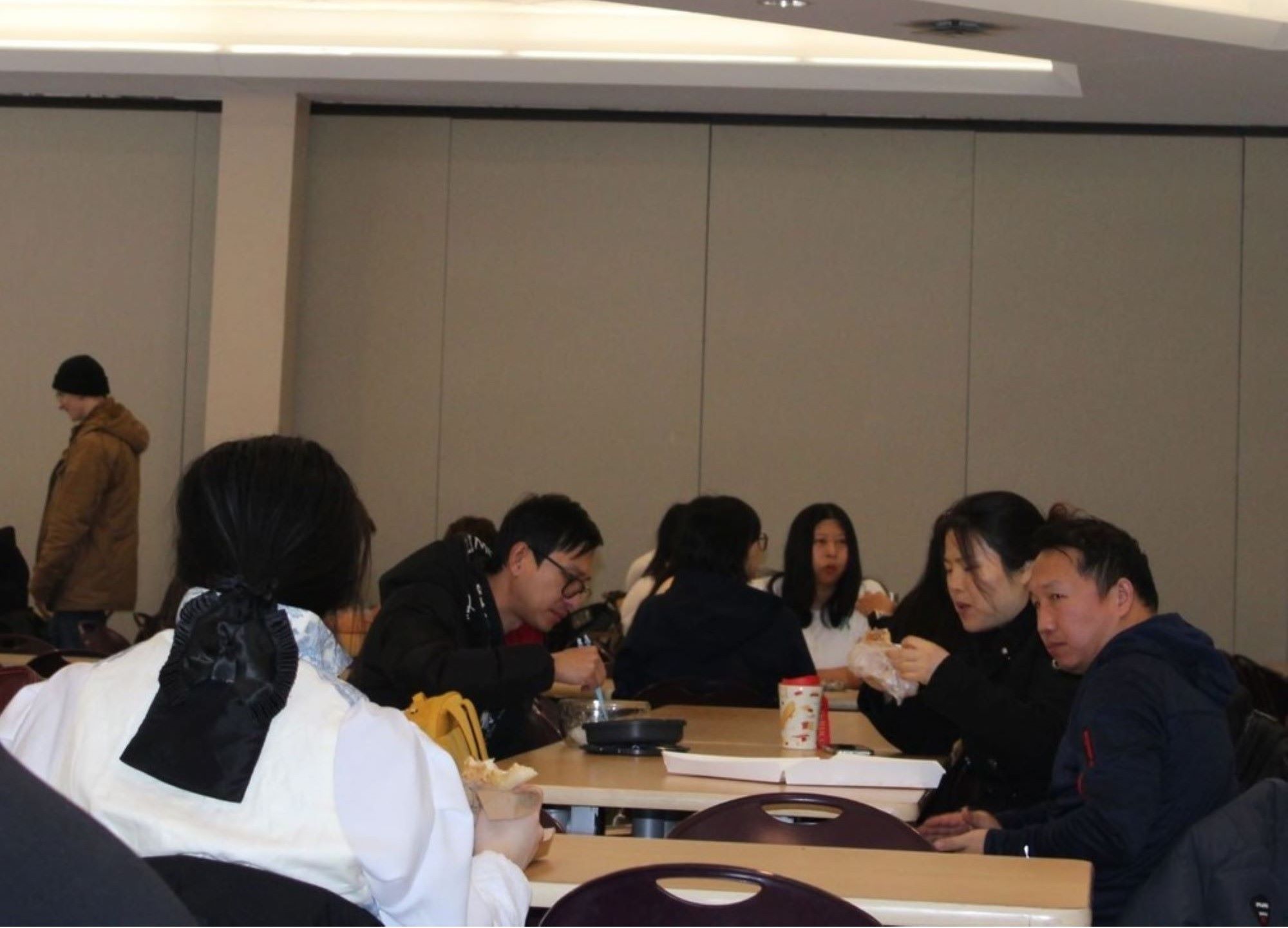
Students eat lunch in  the dining hall at Algonquin College on Jan. 19, 2026
Students eat lunch in the dining hall at Algonquin College on Jan. 19. Photo credit: Noureddine Zerrad

Joam Elisma, a construction engineering student, said he can get better value elsewhere.

“For $12, I can get my favourite meal — chicken, rice and sides —outside campus,” Elisma said. “I usually go to Osmow’s a few blocks away. It’s more filling and better priced.”

Elisma said portion size and value play a major role in his decision to eat off campus, even if it means rushing between classes.

Others rely on packing meals to avoid spending money on campus food, as their budget leaves little room for flexibility. “I generally bring food and drinks from home,” Hussein said. “My budget doesn’t allow me to stretch my spending.”

Hussein added that tight schedules make buying food on campus unavoidable. “Sometimes with back-to-back classes, you have no choice but to buy food on campus, even though the prices are excessive.”

International students said the issue is particularly challenging, as many already face higher tuition fees, limited work hours and increased living expenses.

Ricky So, a first-year construction engineering student from Hong Kong, said he prepares meals at home to avoid overspending.

“It’s a bit challenging, but I prefer to make my meals at home and bring them with me,” So said. “Prices on campus are almost the same as outside. An effort should be made for students. In my country, students always get a 20 per cent discount.”

Students’ concerns come amid a broader rise in living costs across Canada, including higher grocery prices, housing costs and transportation expenses. At the same time, tuition and ancillary fees have continued to climb, leaving many students with less disposable income for daily expenses such as food.

In response, Algonquin College said its food pricing reflects broader pressures in the hospitality industry.

Mary Baxter, general manager of Food and Conference Services, said the college takes a “measured approach” when reviewing prices and faces rising costs similar to those experienced by the public.

“We are not immune to cost variations,” Baxter said, citing wages, food purchasing prices, packaging and supply chain challenges.

Baxter added that the college works to manage costs by bulk buying, offering a range of price points, preparing food from scratch on campus, and focusing on local and seasonal purchasing to maintain value for students.

Despite those efforts, students say affordability remains a concern, particularly for those balancing full course loads, work commitments and rising living expenses. For many, the cost of campus food has become another factor shaping daily student life.

Resolution rush overcrowds Jack Doyle Recreation Centre

What starts as “new year, new me” is turning into crowded floors and stalled workouts at the Jack Doyle Athletics and Recreation Centre
Photo: Kindra Paul
Students are welcomed to the Jack Doyle Athletics and Recreation Centre.

New Year’s resolutions have led to a sharp increase in gym attendance, disrupting workouts due to overcrowding at the Jack Doyle Athletics and Recreation Centre.

Staff say the annual surge is expected, but this year’s increase has been especially noticeable. The combination of new students arriving on campus and others committing to fitness-related resolutions has pushed gym usage beyond normal levels compared to a typical semester during peak hours.

“With the new year and the new semester, crowding has definitely picked up,” said Adam Voutier, a full-time staff member at the centre.

Part-time staff member Mateo Nunez Kruus said the spike has been more pronounced than usual.

“We normally see an increase but since New Year’s even more, the past two or three weeks have been significant.” said Nunez Kruus.

Although staff believe that the beginning of the winter semester contributes to the overcrowding, many agree that the newcomers are driven by New Year’s resolutions.

Student walks past the south entrance of the Jack Doyle Centre.
A student walks past the south entrance of the Jack Doyle Centre. Photo credit: Kindra Paul

Staff estimate attendance increases by roughly 25 to 35 per cent at the start of the year, resulting in crowded workout floors and longer wait times for equipment.

According to National Council on Strength and Fitness (NCSF) research, this type of surge is common as motivation peaks when people set short-term goals tied to a specific date, such as the New Year.

However, motivation alone is often not enough to sustain long-term behaviour change. These are patterns which Jack Doyle staff say they see each January.

Students say the overcrowding has made workouts more difficult and, in some cases, discouraging.

Part-time staff member and gym user Juan Clive said the overcrowding makes it difficult to complete a workout.

“I couldn’t do anything, every machine was just taken,” said Clive.

Second-level police foundations student Ethan Bos said the congestion has slowed his routine. “It’s slowing us down because all the machines we need are taken constantly and there’s a lineup for everything,” said Ethan Bos, a second-level police foundations student.

Level 2 fitness and health student Saniyah Johnson described the atmosphere as overwhelming.

“It’s really crowded, it’s horrifying right now,” she said.

Johnson said she now adjusts her schedule to avoid peak times. “I just go on different days sometimes, to make it better.”

Others say the busy environment affects motivation.

“It just makes me a bit unmotivated,” said Tessa Gibson, a second-level fitness and health student.

She said many students overestimate how often they can realistically attend the gym.

“A lot of people [say] I’m going to go five days a week and then they realize that that’s not really sustainable for a lot of people,” said Gibson.

NCSF research emphasizes that long-term fitness success depends on habit formation, realistic goal setting and consistency, rather than bursts of motivation. Staff and students expect attendance to drop as these realities set in.

“By early to mid February at least 30 per cent of the new people will be gone,” said Nathaniel Rolland, another part-time fitness representative.

Second-level police foundations student Nolan Tarantino agreed attendance typically drops after the initial rush.

“You have that … energy in the first few weeks and then it’s gone,” said Tarantino.

While the gym is expected to become more manageable in the coming weeks, some students say it is disappointing that many people abandon their fitness goals altogether.

Clive noted consistency remains the most important factor in achieving long-term health and fitness success, something many students hope to maintain once the January rush fades.

News Briefs: Local athletes represent Canada, other countries at Olympics

Top stories in your community and around the world as noted by Algonquin Times journalists

Local

CBC News: Multiple Canadians at this year’s Winter Olympics come from the Ottawa-Gatineau area: three each in speed skating, alpine skiing, bobsleigh and hockey. Two athletes each will compete in biathlon, cross-country, skiing, curling and figure skating.

There are also athletes playing on local teams representing other counties, including the United States, Finland, Denmark, Germany and Italy.

National

CBC News: In Truro, Nova Scotia, two children — siblings six-year-old Lilly and four-year-old Jack Sullivan — went missing nine months ago.

Their mother Malehya Brooks-Murray, has not spoken to the media since she participated in a volunteer search earlier this year. Her circle of friends and family say she hasn’t been doing well and is also a naturally quiet person.

The only thing police found was Lilly’s pink blanket.

International

CBC News: After two people were shot last month by U.S. Immigration and Customs Enforcement (ICE) and Customs and Border Patrol (CBP) officers, the Trump administration announced it is reducing the number of federal immigration enforcement officers in the state.

A brother of Renee Good said “ICE is beyond explanation.” Good was one of the people who was killed.

Paige Foster

Tech club building more than just robots at Algonquin

Nestled in T-building, the robotics club has created a community for people from all over campus to share their love of technology
Photo: Reilly Armstrong
Members of Algonquin's robotics club.

When Dwij Brahmbhatt came to Algonquin College in 2023 to pursue his bachelor of engineering (automation and robotics engineering), he sought out a robotics club, only to find the college didn’t offer one. So he did the next natural thing: he made one.

“(I thought) if I can’t find it, maybe perhaps I’ll start my own so somebody like me who comes newer, they can join our club as well,” Brahmbhatt said.

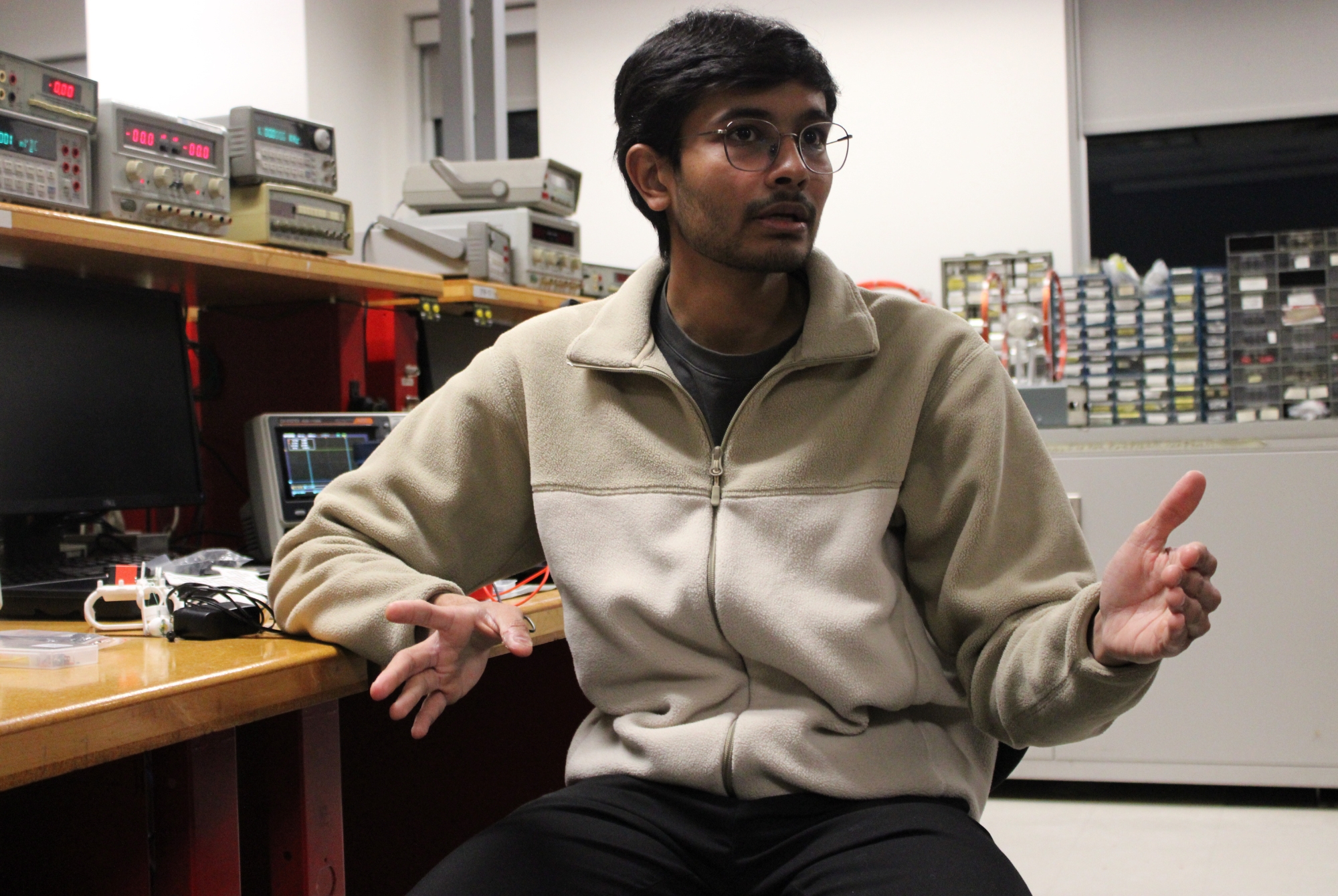
Dwij Brahmbhatt, one of the club's three founders.
Dwij Brahmbhatt, one of the club's three founders. Photo credit: Reilly Armstrong

Brahmbhatt, along with co-founders Miguel Fausto and Iliya Papoulias, had club meetings for the next two years, collecting members along the way from similar technology programs.

The club, now recognized by the Students’ Association, has become a place not just for engineering and tech students, but for students from all programs to come work and learn.

“Now, we even expand it to outside of tech people – like arts, PR people, we have marketing, culinary arts, travelling students,” Brahmbhatt said, explaining that he wants to continue diversifying the club.

“People join from whatever background that they have,” said Fausto. “And not only learn (but) also have their own ideas, have their own projects.”

Fausto came to Algonquin from Mexico, where he had attended a robotics school in his youth, to pursue his engineering degree. He recalls the in-class project that inspired the club’s first real brainchild: a robotic arm that they decided to take to the next level and turn into a gauntlet.

“Our next project from there was the robotic head…We (decided) to build the head because it’s more visual. And the eyes move, and you can talk back. It was a great project,” recalls Fausto.

The robotic head is named NIKO (neural intelligence knowledge operator), an AI-powered virtual assistant. It solves problems, tells jokes and has a camera in its eyes that tracks your movement, making its eyes follow in that direction.

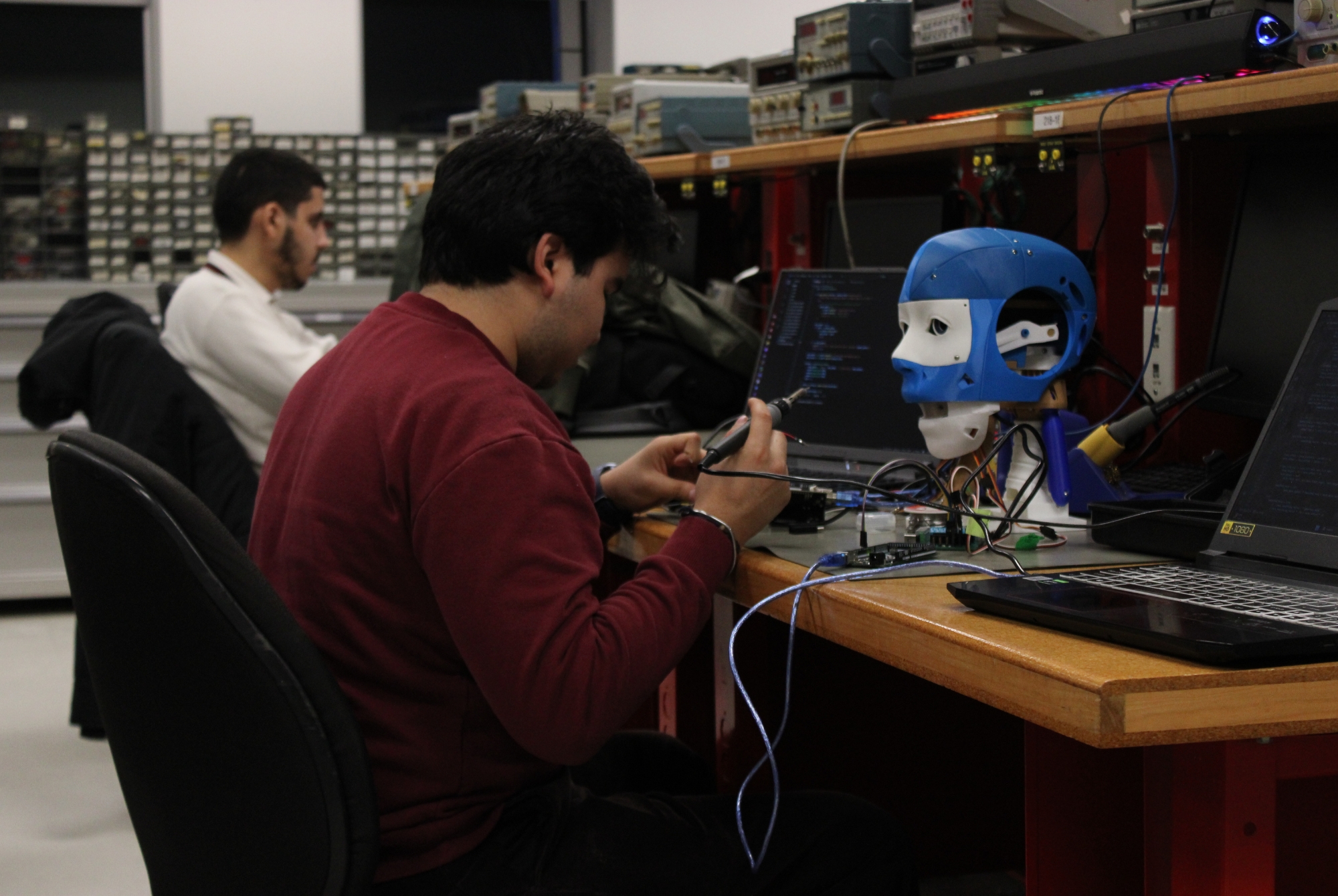
Mahmoud Hajoui (left), Miguel Fausto working on NIKO.
Mahmoud Hajoui (left) and Miguel Fausto working on NIKO. Photo credit: Reilly Armstrong

Newer member Haeden Fethi-Henriquez describes being excited about something they’re working on now, a drone called AERIS (autonomous exploration and reconnaissance intelligence system), that could potentially be used to send into volatile environments like nuclear facilities rather than sending people.

The drone is part of an initiative the club has called “Engineering That Gives Back”, where the club focuses on projects that benefit both professional growth and the community. Along with the drone, they’re developing a low cost prosthetic hand aimed at improving accessibility and quality of life.

“We need a bunch of sensors for (the drone) to be able to work and communicate with itself. But we need to have those sensors communicate with themselves. 
And that’s called fusing the sensors, or centrifusion. And for that, we have to kind of code little pathways to each other,” said Fethi-Henriquez.

A computer systems technician student, Fethi-Henriquez grew up moving around a lot as an army brat. He says the connections he’s made here in the club are important.

“I have made, probably, the closest friends I’ve had in my entire life,” says Fethi-Henriquez.

“The club has been the place where I’ve been learning the most compared to my program or my personal hobbies. I’ve been learning so much to the point where all I can think of are the projects that I do for the club.”

Taking a look at Haeden Fethi-Henriquez under a microscope.
Taking a look at Haeden Fethi-Henriquez under the microscope. Photo credit: Reilly Armstrong

It’s clear the club has been influential in its members’ lives, and possibly to Brahmbhatt and Fausto’s program as well.

In 2025, the bachelor of engineering (automation and robotics engineering) program was accredited by Engineers Canada.

“Our program started from 2019, and they’ve been trying to get accredited,” said Brahmbhatt. “One of the criteria (for) accreditation is how are your students actually applying whatever they are learning? In that, some of the members from the club actually got interviewed and they talked about what they actually do in the club.”

The Canadian Engineering Accreditation Board had visited the college every year for six years. Last year was the first visit to result in the program being added to their accredited list. It’s the only program of Algonquin’s on the list.

As Brahmbhatt and Fausto prepare to graduate next year, Brahmbhatt is reflecting on what he wants for the future of the club.

“Our goal is to create a big community where even (when) we go, we pass down to other people and it stays long in Algonquin,” said Brahmbhatt. ”So, whenever someday I come back and I see, oh, this club is still running. Because that was the plan from day one.”

Computer engineering technology student and new club member Mahmoud Hajoui plans to do just that.

“(This has been) the best experience I could have had. I had my expectations, but this is much better,” said Hajoui, who is set to graduate in 2029.

“It’s so fun. I love it. I cannot wait to get to come to this club after I finish my classes.”

Students get their voices heard in a panel discussion with Ottawa city councillors

Students were presented with a unique opportunity to engage with city councillors in to raise concerns and share feedback on issues affecting their campus and community
Photo: Mohamed Abdallah Jbili
The Ottawa city councillors, along with event organizers, lining up for a photo.

Students filled the Algonquin Commons Theatre on Jan. 29 for a candid conversation with Ottawa city councillors, speaking directly on their own issues and representing themselves in an unfiltered setting.

“When we are making city decisions, we’ll often hear from people who speak on behalf of young people,” said Laine Johnson, councillor for College Ward. “I believe that young people and students have a strong idea of what they want and need.

Hosted by the Algonquin Students’ Association, the panel opened with brief introductions from each councillor, who outlined the priorities shaping their work during this term.

In addition to Johnson, the councillor panel also included Jeff Leiper, chair of the planning and housing committee; Glen Gower, chair of the transit committee; and, Tim Tierney, chair of the public works and infrastructure committee.

College Ward Councillor Laine Johnson (sitting)
Councillor Laine Johnson in the backstage, poses for a photo before joining the rest of the council members on stage. Photo credit: Mohamed Abdallah Jbili

Johnson opened the discussion by acknowledging the past few weeks on campus and drawing a connection to the city’s own financial strain, while providing consolation to the students.

“I know that the tenor at Algonquin College has been somewhat sombre over the last week or so, and I’m very disappointed to hear that the college has had to make further cuts,” said Johnson. “We feel similarly at the City of Ottawa as an institution that gets, our financial support from other levels of government.”

When the discussion switched to current student issues, housing was one of the first topics.

Johnson mentioned that during her campaign, housing emerged as the primary concern, with discussions centred on older homes being divided into multiple rooms or apartments to address the demand for affordable housing, which was deemed unsuitable for students.

“They weren’t necessarily meeting the needs of students. And so, one of the things that we really wanted to see happen was more purpose-built rental housing,” said Johnson. “When you build multi-unit properties, you actually get more control over garbage, storage, parking and things like that, that you wouldn’t necessarily have when you slice and dice a home.”

The discussion quickly shifted to the topic of transit which was brought up by many students.

Gower talked about his community that predominantly travels by car, and he emphasized the need for reliable public transit that supports the entire city.

“People say, ‘Why am I paying more for transit on my taxes? Why are they running? Who uses the bus?’ I try to remind them,” said Gower. “Without transit, our society does not work. It amazes me sometimes how some members of the public don’t have that perspective because they drive.”

He also pointed to a major funding proposal now under discussion: shifting ownership of the LRT system to the province.

“What that will do is free up tens of billions of dollars a year that the city is paying that we can reinvest into our bus system so we can add more frequency to routes,” said Gower. “Whether they’re along Baseline or coming from Kanata or Leitrim or Barrhaven or wherever it may be, and I think in the coming years that’s going to be a real thing.

The council has all sorts of responsibilities that they have to deal with, such as transit, homelessness, public health and infrastructure like sewers, roads, parks and community centres. Despite having property taxes as a tool, city council members still struggle when it comes to funding.

“We need good public services because good public services make life more affordable,” said Leiper. “But, we’re really struggling on how to properly pay for those services. So, it’s a real challenge and something that we deal with in many ways at city council.”

After having answered many of the audience-submitted questions and offering great insight on the inner workings of the Ottawa city council, the presentation ended with a closing address from Johnson, who encouraged students to reach out to their city councillors, noting that the councillors are accountable to residents and often act based on the feedback they receive.

Algonquin Times podcast

Stay Informed

Sign up for our newsletter

Subscribe

* indicates required