While many dream of making it to the Olympics for sport, television and streaming video professors Matthew McCooeye and Michelle Young's dreams were behind the camera
Nylah Henry
Photos: Supplied by Michelle Young
March 26, 2026 Revised: March 26, 2026 3:02pm
Photo: Supplied by Michelle Young
Broadcasting – Television and Streaming Video alumna and faculty member Michelle Young, pictured at the 2026 Milano Cortina Olympic Games.
Michelle Young, a professor in Algonquin College’s television and streaming program, braved the mountain region of Cortina d’Ampezzo to document the sport known as “chess on ice”: curling.
“Working at the Olympics is a goal I’ve had for a long time, so realizing that was super rewarding,” said Young, an alumna of the very program she now teaches in.
Young is continuing to show her students in the television and streaming video program the endless, non-stereotypical job opportunities their career has to offer.
Her job at the Olympics was an enhanced video server operator, specifically as a multi-clips feed operator for curling, mixed doubles and team events. She provided footage outside of the main broadcast that could be used later.
As an educator, Young frequently relates her experiences to how she can improve learning for her students.
“I think just letting students know that making connections in this industry is what will take you further. It’s what led me to this opportunity,” she said.
“Being professional, dependable, and above all else, a good person is what will ultimately set you apart and make people remember you.”
Television and streaming video professor Matthew McCooeye is no stranger to documenting the Olympic Games. In addition to working at the 2026 Milano Cortina Winter Olympic Games on curling coverage, McCooeye has worked at four previous Olympics.
He noticed something different at the recent Winter Olympics.
“There were at least 10 graduates of the broadcasting-television and streaming video program working in Milano Cortina, working at both the curling and hockey Olympic venues,” said McCooeye. “I’m proud to work on the same productions as the students I taught.”
Broadcasting experts working behind the scenes at Olympic Games put in long, demanding hours, but the effort is priceless, said McCooeye.
“It’s a lot of work, and a lot of hours, but it’s all worthwhile,” he said, “I worked on curling throughout the Games — there were great games, controversy and a Canadian gold medal. There were no boring days!”
Algonquin College partnered with C’est Bon cooking school to create a fund in memory of Joshua Qiyuk, a student killed in October 2025
Tianna Lawless-Musgrave
Photos: Tianna Lawless-Musgrave
March 26, 2026 Revised: March 26, 2026 2:29pm
Photo: Tianna Lawless-Musgrave
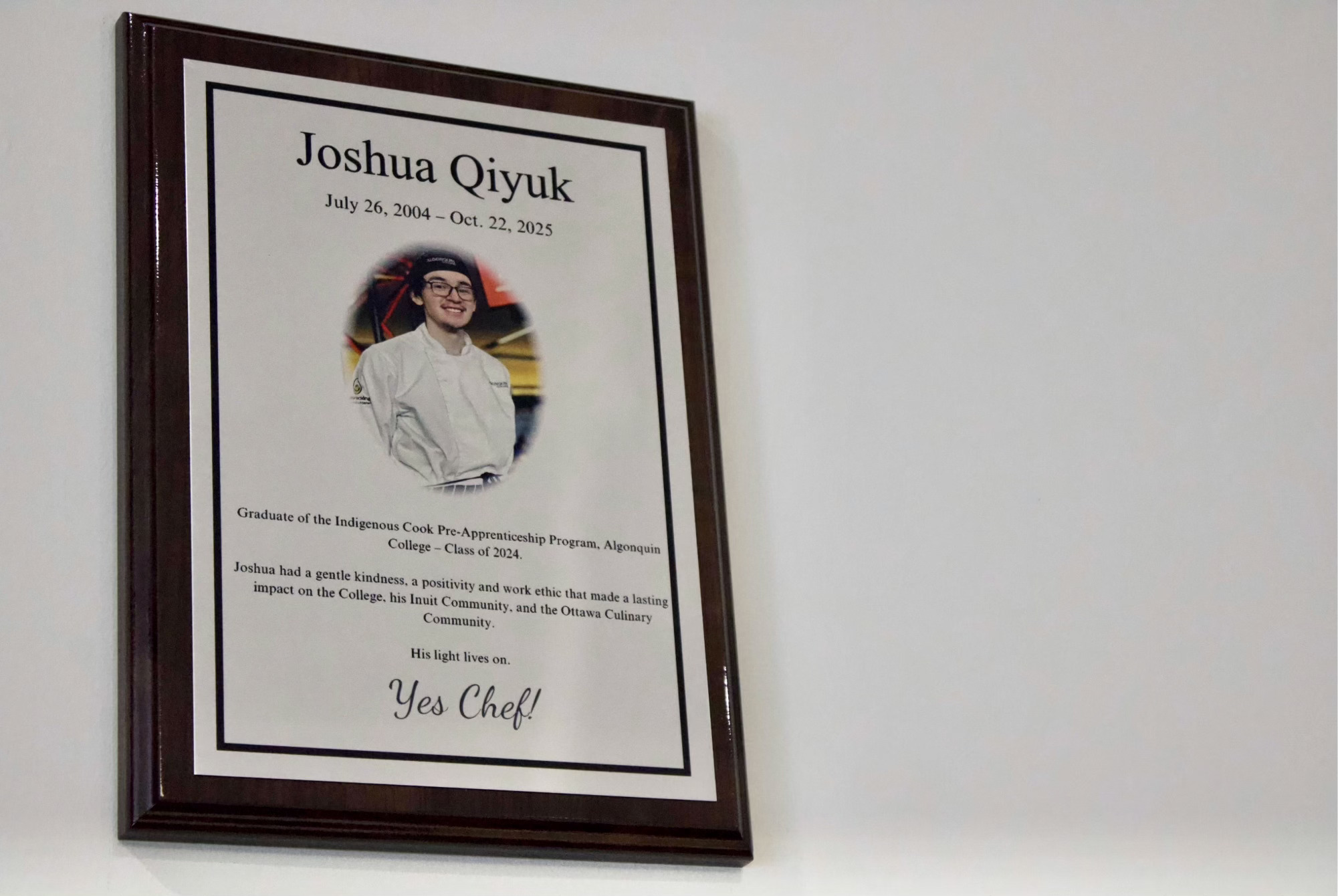
The memorial plaque made in honour of Joshua Qiyuk hangs in the Mamidosewin Centre at Algonquin College.
The Joshua Qiyuk Memorial Funds are an Indigenous, need-based bursary and scholarship made in partnership with C’est Bon Ottawa and Anita Tenasco, director of Indigenous initiatives at Algonquin College.
The funds were announced on March 9.
“We are very honoured that C’est Bon has put forth Algonquin College, the Mamidosewin Centre and Indigenous education here at the college. Their relationship with the college is quite strong,” Tenasco said. “They’re looking into other ways as well to bring support to our students.”
Joshua Qiyuk was a young, inspiring Inuk man from Baker Lake, Kivalliq Region, Nunavut. He attended C’est Bon cooking school before arriving at the college. He completed the Indigenous cook pre-apprenticeship program at Algonquin and then started a career in cooking at the restaurant Absinthe.
In October 2025, Qiyuk was the victim of a violent and fatal attack in Ottawa’s east end. Police are still searching for his killer.
The fund will support Indigenous students who generally have a harder time obtaining post-secondary education. Indigenous students face a 60-63 per cent high school graduation rate compared to 83-91 per cent for their non-Indigenous peers, making the climb to post-secondary a steep one.
“Indigenous students have to make a lot of concerted effort to get to post-secondary education,” Tenasco said. “When they have their family’s support and their community’s support, that’s certainly a huge step forward. But now, even with those supports, in today’s economy, it’s still really hard.
“To leave a small and isolated community, or the North, for a large urban centre with one bag and a couple of hundred dollars…now imagine a student who doesn’t have those supports; the difficulty has just doubled.”
Qiyuk was an example of Indigenous perseverance and the hard work required to complete post-secondary studies. His loss has been felt by many at Algonquin College, including Cory Haskins, the dean of business and hospitality.
The entrance to the Culinary section of the college, located close to the Dean's office. Photo credit: Tianna Lawless-Musgrave
“Typically, as students are going through all of our programs, you see the student who’s there all the time, who’s participating, who’s engaging and then the other students start to connect with that individual because they are there and involved and engaged. And that was Josh,” Haskins said. “Always pleasant, always had a smile, very calm demeanour in a kitchen and just always very, very consistent and steady.”
Haskins elaborated on what a loss Joshua’s passing was for his community, following impressive career progress he had made throughout his young adulthood.
“Up until that day, here was a young individual who had taken a career path. He came to Algonquin, he found his home at Absinthe and the community he was with, and he was really happy in doing what he wanted to do,” Haskins said.
“The hope of coming to Algonquin, our mission, is to transform hopes and dreams into lifelong success. And I think that is so true because students come here with hope and desires on where they want to go and what they want to do. Josh’s passing is a very tragic loss of himself and that success he made.”
Tenasco said fear and grief, especially following Joshua’s passing, should not deter Indigenous students from following their career paths and dreams, insisting that all students have a place at the college.
“Indigenous students have every right to be in post-secondary. They have every right to be at Algonquin College. They have every right to live in what is now called Ottawa,” Tenasco said.
“They are bright, they are capable, they have a lot to offer, they have a lot to teach others, and we need them.”
Culinary students in assorted programs eligible for the Joshua Qiyuk Memorial Funds. Photo credit: Tianna Lawless-Musgrave
The programs eligible for the funds include: culinary management, baking and pastry arts management, the culinary skills certificate, the baking and pastry arts certificate and the culinary skills – cook apprenticeship. Program specifics may apply.
“There’s a huge need for Indigenous cooks and Indigenous foods in the Ottawa area. We have a shortage of traditional foods that are available here in restaurants and catering services, so we’re really pleased that this scholarship is going to take place now and in the future,” Tenasco added.
Indigenous students (Inuit, First Nations, or Métis) studying in any previously mentioned culinary arts at Algonquin College can apply for the Joshua Qiyuk Memorial Funds by using the Algonquin College online application system.
Spanning from Feb. 19 to March 19, Muslims all around the globe celebrated one of the holiest months, a time centred on prayer, reflection and strengthening bonds within the community
Mohamed Abdallah Jbili
Photos: Mohamed Abdallah Jbili
March 26, 2026 Revised: March 26, 2026 1:58pm
Photo: Mohamed Abdallah Jbili
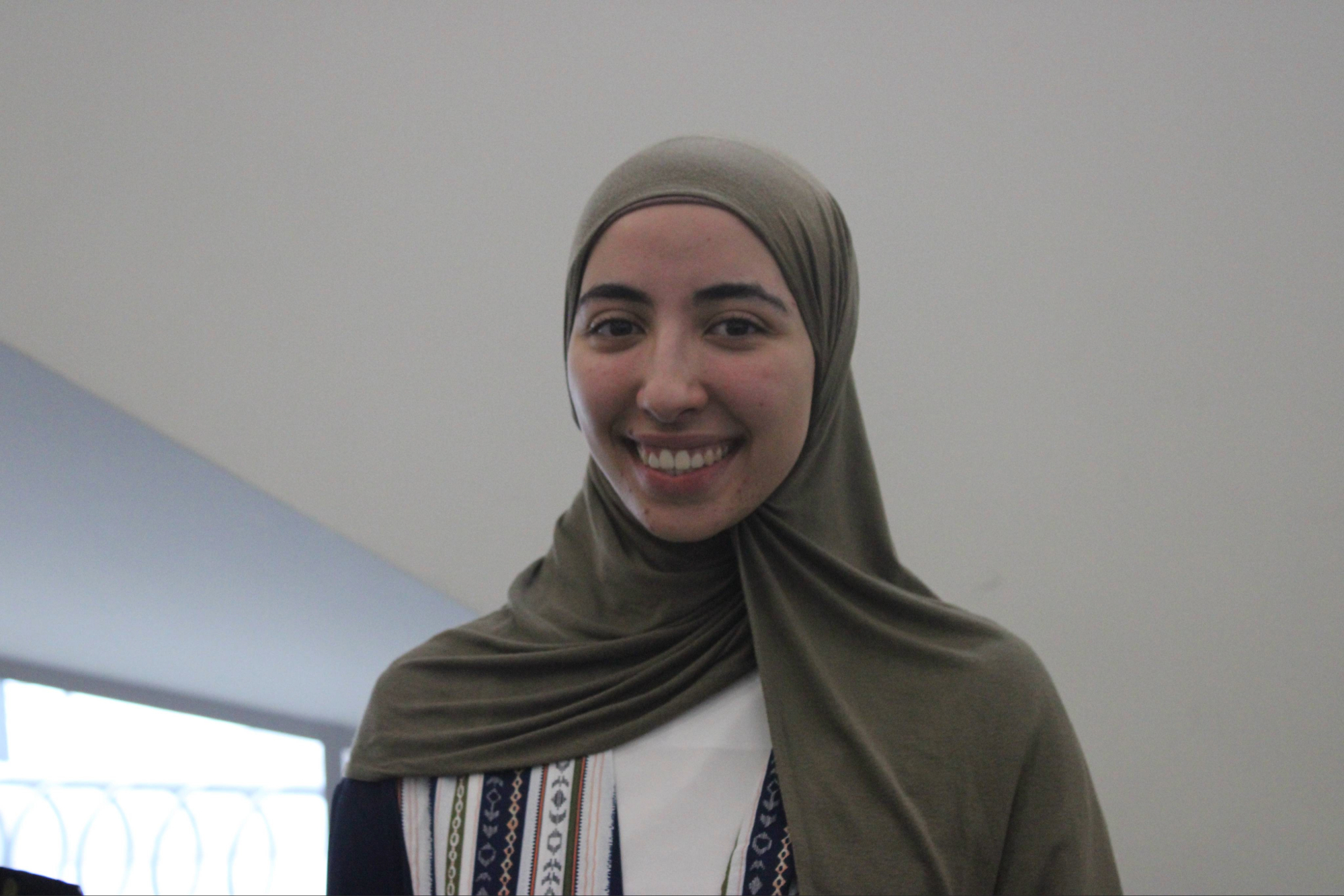
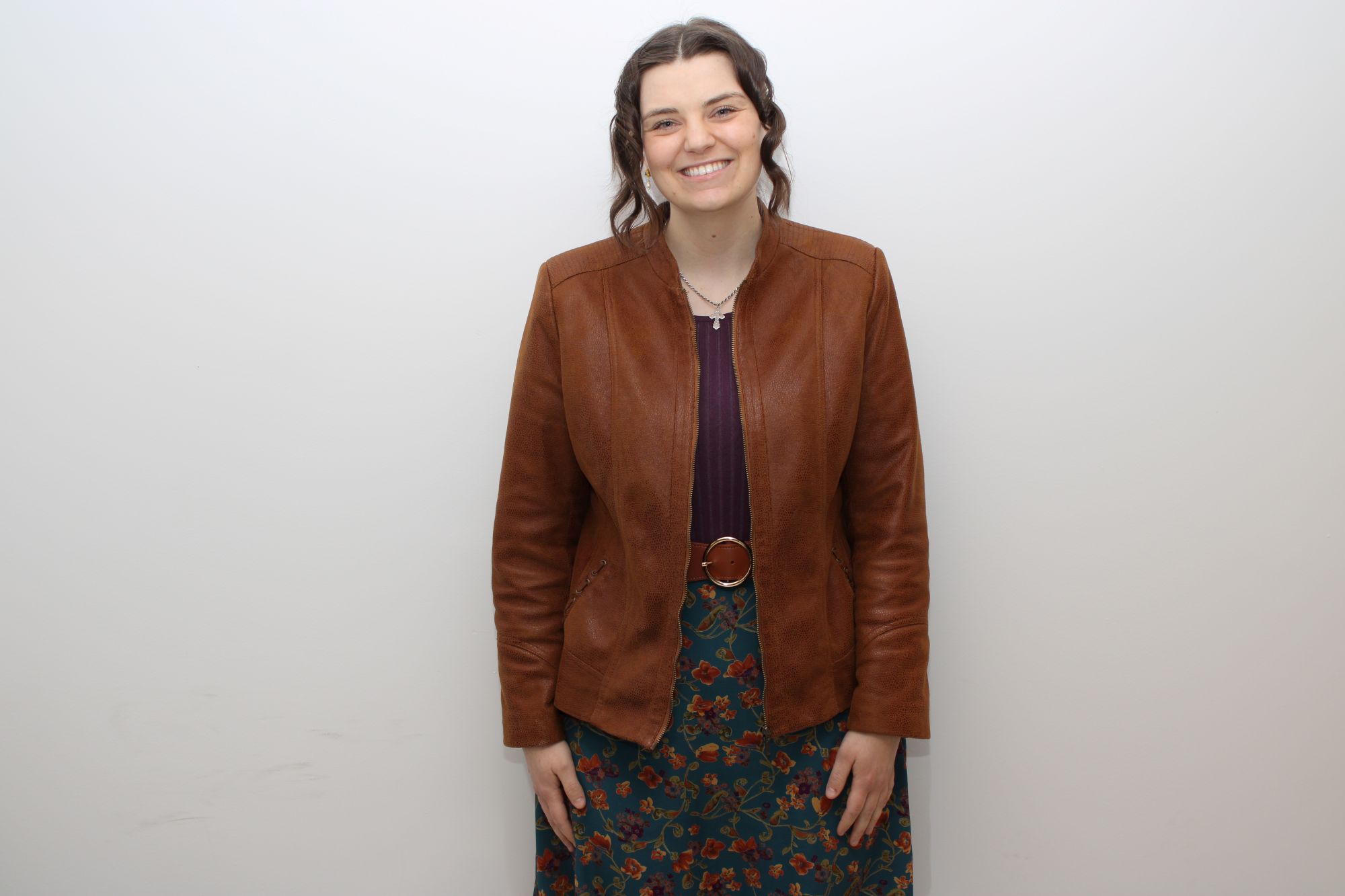
Bonolo Dlamini poses for a picture during the Islamic Awareness Week event held in E-building.
Ramadan has a huge relevance to Muslims because it is the month the Qur’an was revealed and it focuses on strengthening one’s connection with God, practising empathy for the less fortunate and fostering community solidarity.
It remains one of the holiest months in Islam, serving as a time for spiritual renewal, self-discipline and deep reflection.
For many Muslim students at Algonquin College, the first days of Ramadan were pretty tough when it came to navigating their daily tasks.
With Ramadan ending, students can reflect on what they achieved during the month, from the level of hard work they put in while enduring the struggles that come with fasting, to the prayers and family gatherings.
During Ramadan, the day begins with a pre‑dawn meal and the Fajr prayer, followed by fasting through work or school while staying as patient as possible and maintaining their spiritual focus. When it finally reaches sunset, the fast is broken with water, usually along with dates at the time of Maghrib, then a meal, and spending time with the family, and making sure to do the Isha and Taraweeh prayers afterwards and ending with rest before the next Sahur.
Sahur is the pre-dawn meal consumed by Muslims early in the morning before they start their daily fast during the holy month, and Fajr (meaning “dawn” or “daybreak”) signifies the first light of day before sunrise, representing new beginnings and hope. It is primarily used in Islam to denote the obligatory early morning prayer (the first of five daily prayers) performed before sunrise to begin the day with spiritual awareness.
Across the different programs and routines, students described Ramadan as a demanding and yet deeply rewarding month that can reshape the days of the believers, strengthening their faith and bringing them a sense of peace even in the middle of a busy semester.
Elias Nasser, a second-year business student, didn’t find fasting to be difficult.
“Yeah, I’m thirsty right now,” he said, “but there are a lot of times in life when we’re thirsty and we don’t drink water. It’s just a small challenge, and then we look forward to Maghrib.”
Elias Nasser poses for a picture during the Islamic Awareness Week event, held in E-building. Photo credit: Mohamed Abdallah Jbili
Third‑year software engineering student Bonolo Dlamini said the month felt unusually quick but meaningful.
“It went by very fast this year, but it was a good opportunity for me to connect with my Deen,” she said. “I was able to pray a lot more than I usually do. It’s hard managing it with school, but it made me realize that I really have to prioritize my time and prioritize my Deen.”
Deen is an Arabic term that often translates as “religion,” though it would more accurately signifies a comprehensive “way of life,” which can include faith, worship, laws and daily conduct governed by divine guidance.
It goes even beyond just the rituals, encompassing social, moral and personal behavior as prescribed by Allah in Islam
Dlamini also said that she got to build a better connection with her family.
“Waking up for Sahur allows me to feel a connection with Allah,” she said. “I’m able to wake up and prayTahajjud. I spend time with my family early in the morning, and then we pray Fajr together.”
Tahajjud is a highly recommended voluntary night prayer in Islam performed after Isha (one of the five daily prayers) and before Fajr, ideally after waking up from sleep in the last third of the night.
Dlamini explained how she managed her time to avoid exhaustion throughout the month.
“I always try to do my studying early in the morning when I’m least exhausted,” she said. “So I do that in the morning, and then I spend the rest of my afternoons just praying. That’s how I manage everything.”
Third‑year biotechnology student Abd el-Karim described the final stretch of the month as both tiring and emotional because of his attachment to the month and the good that comes with it.
“It’s been tough the last couple of days,” he said. “You’re waiting for Eid to come, but you’re also sad that Ramadan is leaving.”
The Observatory was filled with cheers, clapping and encouragement which poured into the halls
Tyrell Taylor
Photos: Tyrell Taylor
March 25, 2026 Revised: March 25, 2026 3:57pm
Photo: Tyrell Taylor
Cole Martin, singing along to "Go with the Flow" at the Observatory.
The Students’ Association held another karaoke night, giving more students a chance to showcase their vocal skills in the Observatory on March 20.
People in the crowd clapped, cheered and whistled their approval, and in some cases they were surprised by amazing vocal performances.
The night started off with an explosive performance from a member of the event staff, singing the exhilarating trackJust Like Youby ThreeDaysGrace.
“Our objective and our goal is to basically supply students with a fun experience on campus,” saidMatteo Mongroo, an event associate from the Students’ Association.
“We have events like karaoke night where we have the space open, students can drop in and come by, it’s a social event.They can order food, have drinks, goup and sing, express themselves,” Mongroo said.
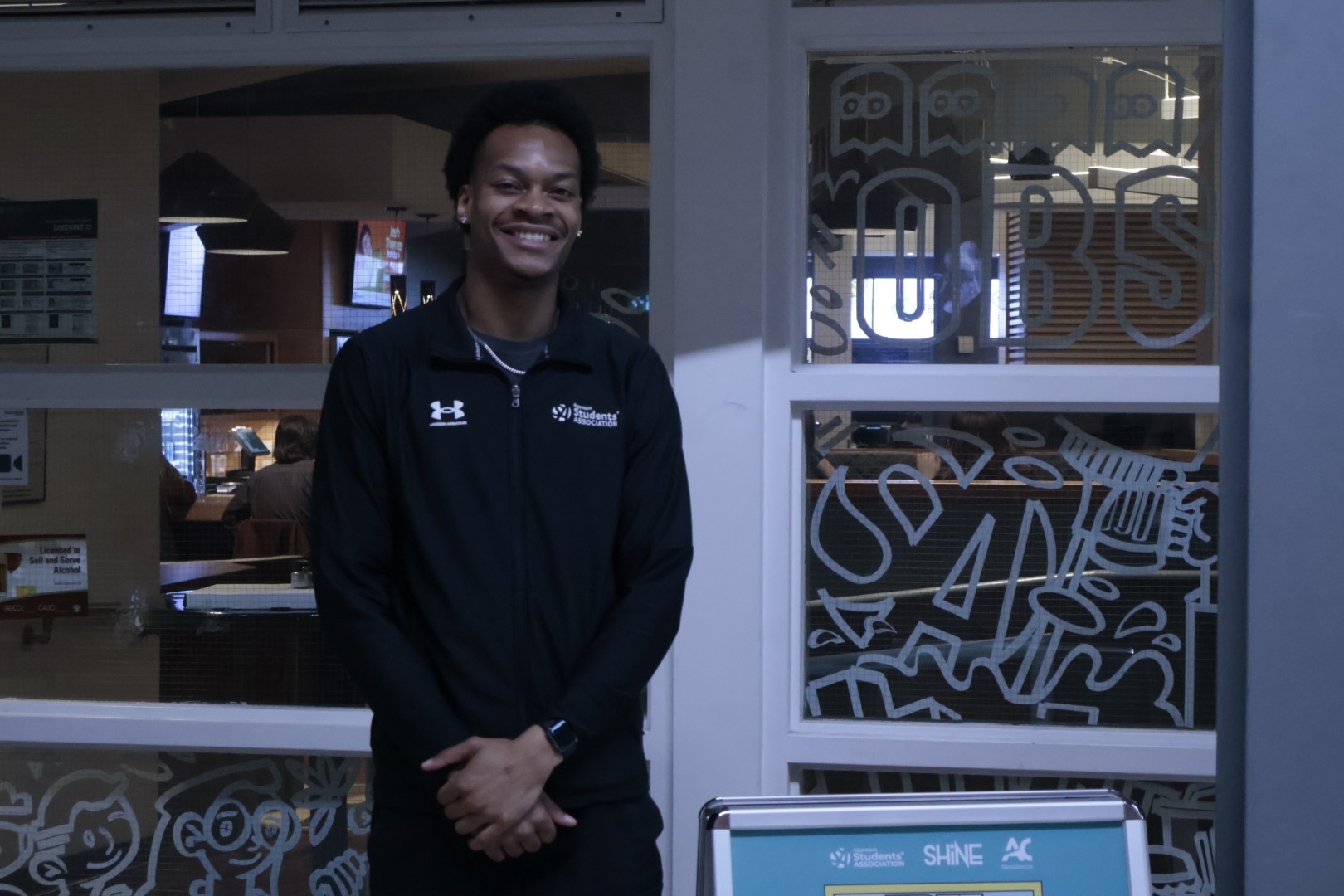
Matteo Mongroo posing outside of the Observatory. Photo credit: Tyrell Taylor
Dryden Lahaie, a first-year library and information technician student, performedKiss of Life by Sade, using his love of singing to ease any of his worries.
“I just get stage fright generally. What helped me push through it is I just love to sing, no matter what, even if it’s in front of a big crowd,” Lahaie said.
Emilie Leger and Lucas Lebreche, who performedSincerely, Mefrom the musical Dear Evan Hansen, had their own ways for calming their nerves.
“Don’tstress about it. You’re here to have fun and picture everyone as a potato chip,” Leger said.
Emilie Leger (left) and Lucas Lebreche (right) singing along to "Sincerely, me" at the Observatory. Photo credit: Tyrell Taylor
Lebreche offered advice to people curious about karaoke nights: “Go with a larger group of friends.”
Brandon Taylor, a first-year drawing foundation for animation and illustrationstudent, was one of the first to get the crowd involved, clapping along to the hook of Welcome to the Internetby Bo Burnham.
“When people started clapping it was a lot easier,” Taylor said. “There’s no risk in going and doing it. The only risk is you thinking you’ll embarrassyourself, but embarrassment is a choice that you choose to feel.”
Cole Martin, a second-year horticultural industries student, put his vocals to the test with Go with the Flowby Queens of the Stone Age. His advice to future performers was blunt and straight to the point: “Just do it. We’re here to appreciate everyone.Be a part of the community.”
Arts & Entertainment | Featured Hero | Featured Story | Home Feature
A few Algonquin College students won't be having bad dreams anytime soon, thanks to a recent arts and crafts workshop
Delaney St. Pierre
Photos: Delaney St. Pierre
March 25, 2026 Revised: March 25, 2026 12:36pm
Photo: Delaney St. Pierre
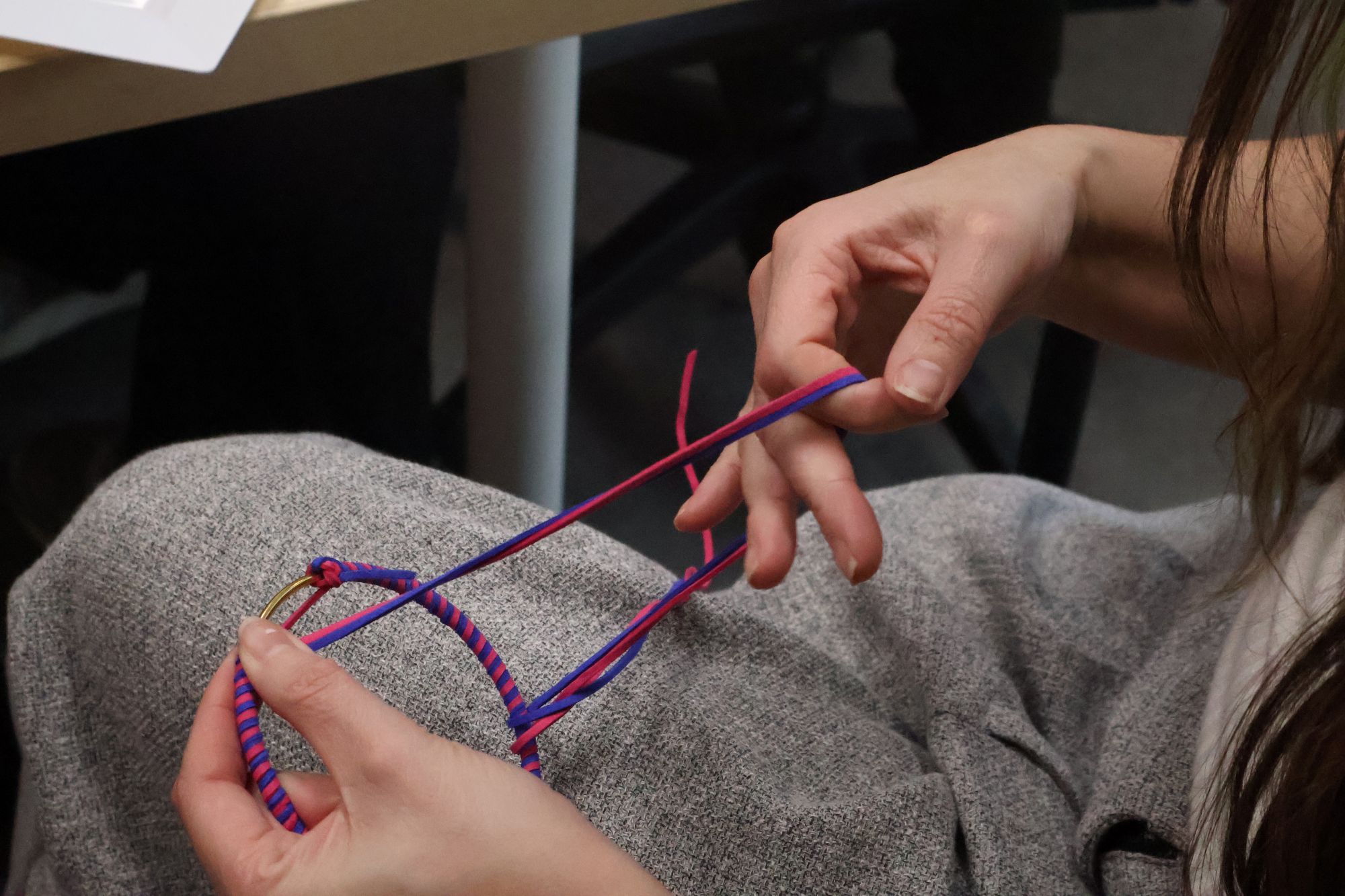
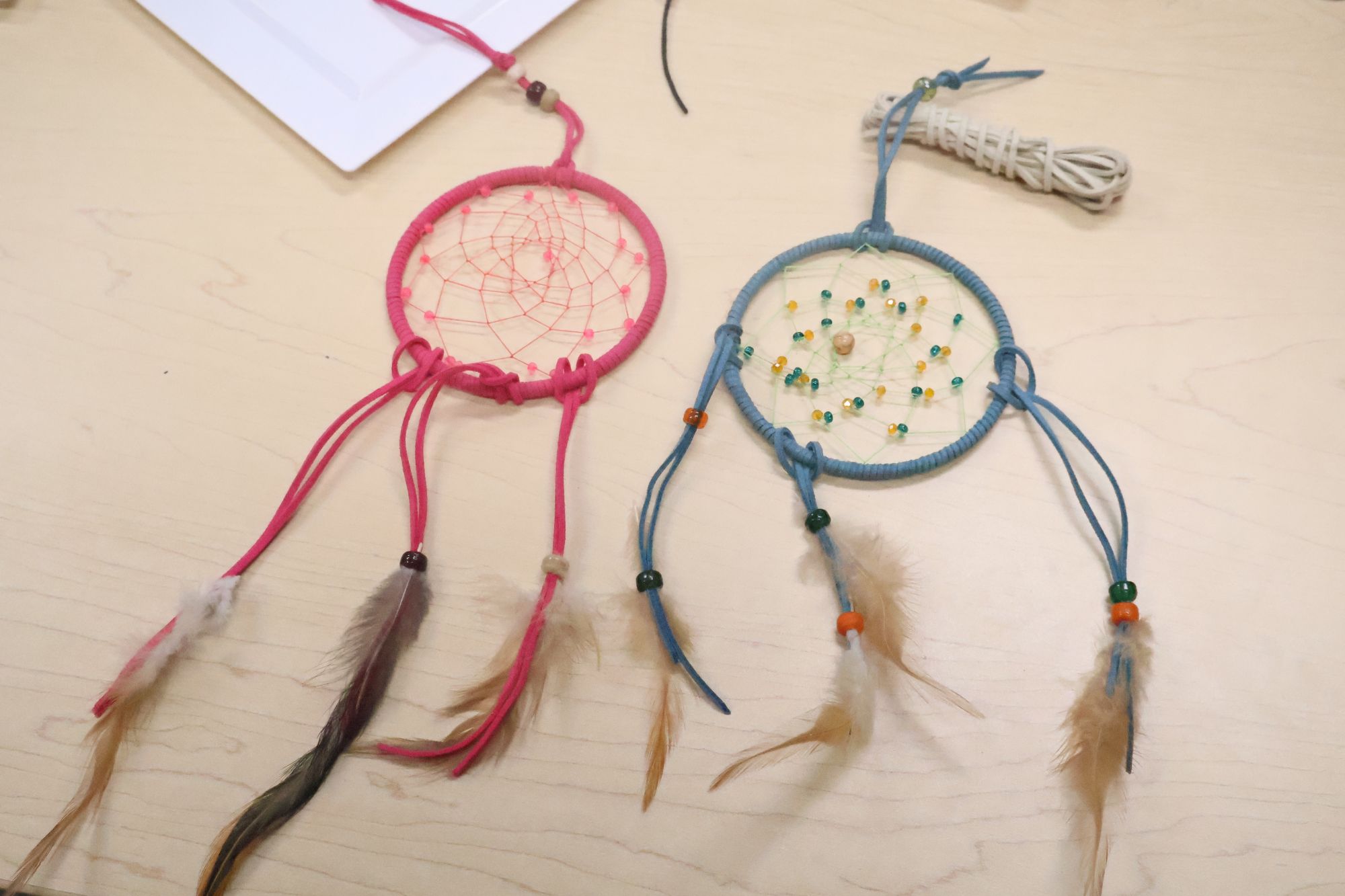
Geraldine Dion St-Pierre weaving thread around the metal ring, one of the fist steps to making a dreamcatcher.
The Mamidosewin Centre’s sewing room recently hosted a unique arts and crafts activity.
Indigenous and non-Indigenous students were invited to a dreamcatcher workshop on March 19. Students made their own dreamcatchers using metal rings, colourful beads and thread.
The workshop was facilitated by Ashley Clark, the founder and CEO of Bougie Birch, a social enterprise that holds a variety of Indigenous-led workshops. Clark assisted students with making their dreamcatchers while teaching them about their meanings.
“Dreamcatchers to me are so many things,” said Clark. “It represents a very special relationship that I have in my life with my aunt who passed away, and the dreamcatcher is a way for me to express my appreciation for the beautiful things in my culture.”
Ashley Clark helps a student new to making dreamcatchers. Photo credit: Delaney St. Pierre
One of the most important things taught about dreamcatchers is that they do not need to be perfect, and when you make them, you must put positive energy into them.
“The trickiest part of making a dreamcatcher is battling the desire for perfection that is cultivated in urban colonial centres, because perfect doesn’t exist in nature,” said Clark. “So, you’re able to really connect with your spirit hopefully by the end of the workshop.”
Geraldine Dion St-Pierre, an ASPIRE AC mentor, agreed with Clark.
“I really like what Ashley said, that there is no perfection in nature, so it doesn’t have to be perfect. I’m somebody that really agrees with that philosophy, that perfection doesn’t exist,” said St-Pierre.
“I could see some of the students around me were struggling with the fact that it wasn’t perfect, they wanted theirs to be symmetrical, but they ended up being beautiful. Mine wasn’t symmetrical but I was okay with it because I listened to Ashley.”
A couple completed dreamcatchers. Photo credit: Delaney St. Pierre
ASPIRE AC is a resource that helps students through multiple aspects of their post-secondary school journey, from helping them transition to college, to finding employment after graduating. ASPIRE partnered with the Mamidosewin Centre to make this workshop possible and brought free merchandise for the participants, such as notebooks, toques and stress balls.
The dreamcatchers came out beautifully, and students enjoyed making and learning about them. Each student had their own opinion of what dreamcatchers mean to them.
“It’s a traditional gift that helps with catching bad dreams,” said Jesse Kavanaugh, an Algonquin College student and Mamidosewin Centre staff member. “I think it also shows that you care about somebody, and it means a lot especially when you make it yourself and it is beautiful.”
Through engaging activities and informative booths, Islam Awareness Week highlighted Islam’s teachings, traditions and artistic heritage
Noureddine Zerrad
Photos: Noureddine Zerrad
March 25, 2026 Revised: March 25, 2026 12:53pm
Photo: Noureddine Zerrad
Omran Amin, Emeka Okwechime and Abelkareem Roustom animate the Tawhid booth, explaining the concept of the oneness of God in Islam.
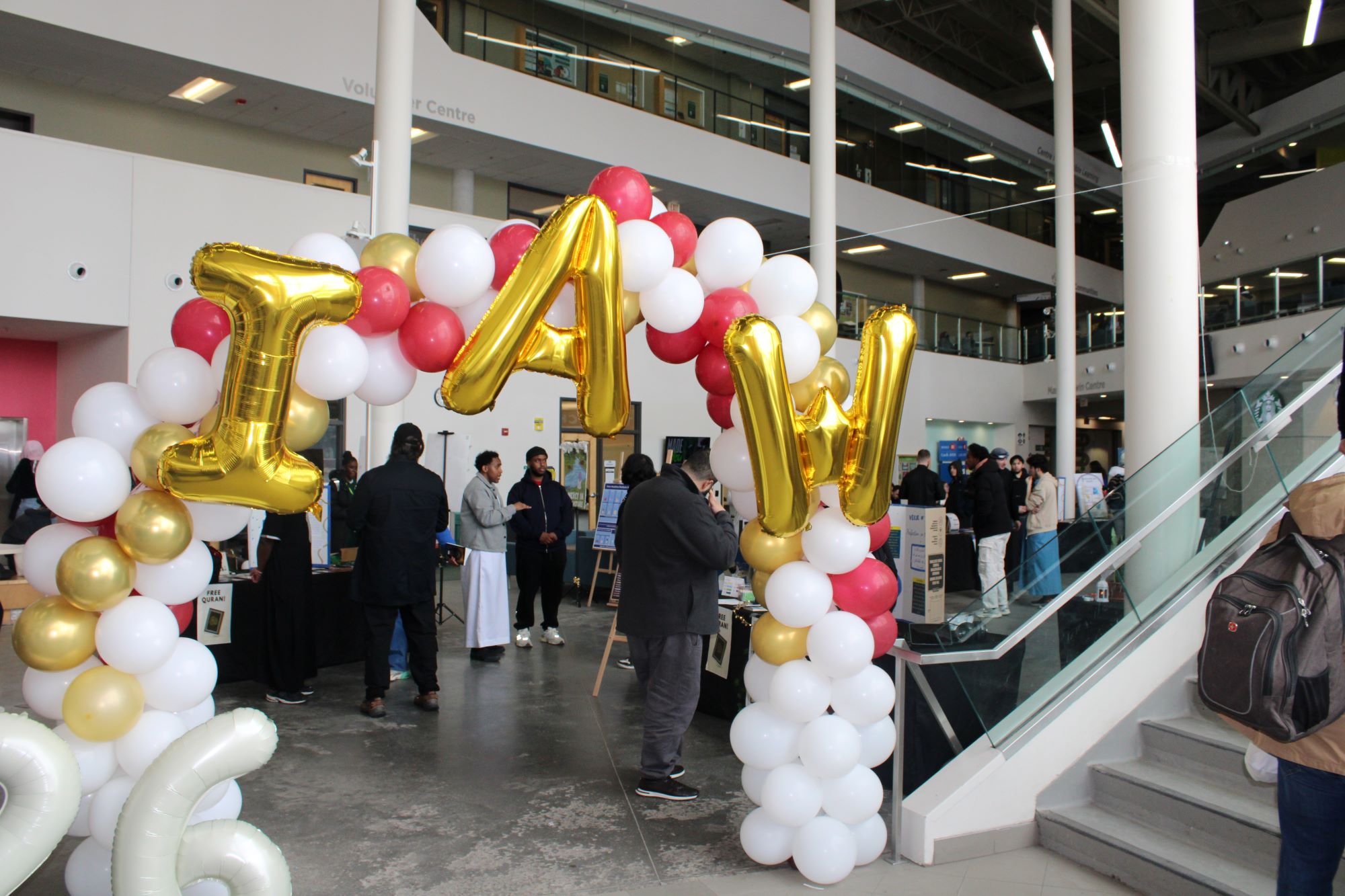
What do calligraphy, hijabs, Qur’ans, painting and dialogue have in common? They were all part of Islam Awareness Week (IAW), organized at Algonquin College by the Muslim Alliance Association on March 16 and 17 in the Student Commons.
Tawfik Mohammadpur, co-president of the alliance and a first-year cybersecurity student, explained that the main goal of the event was to bring communities together while also addressing some of the challenges faced by Muslim students on campus.
He noted that the event provided a space to discuss solutions, adding, “we did not previously have a prayer space. Now, we have one in the Spiritual Centre, and for Friday prayers, we gather in the gym next to Tim Hortons.”
Running annually since 2023, the event aims to answer questions about Islam, celebrate its teachings and foster dialogue across the campus community.
Event coordinator Shahd Alnashed, a decorating program graduate, freelance media professional and filmmaker, emphasized that the week was an opportunity to showcase Islam as a religion of tolerance and peace while highlighting its rich artistic and cultural traditions.
The two-day celebration featured informative booths including Discover Islam, Tawheed, the Prophet Muhammad and Ramadan.
Islam Awareness Week launches its activities in the Student Commons at Algonquin College on March 16, 2026. Photo credit: Noureddine Zerrad
Ilyass Mohammed, a general business student and co-organizer, said that IAW was intended to promote a positive image of Islam and explain some of its core pillars, particularly prayer and Ramadan. He acknowledged that while praying five times a day and fasting during Ramadan may seem daunting to some, these practices are primarily about spiritual elevation through meditation and direct communication with the Creator.
Participants actively engaged with the displays and activities, which included the hijab try-on experience, calligraphy workshops and collaborative painting projects. The interactive sessions fostered creativity, cultural exchange, and meaningful dialogue, providing students with the opportunity to learn about Islamic culture while addressing common misconceptions.
The artistic and cultural dimensions of Islam were especially prominent.
Fatime Limane Mahamat, a psychology student at the University of Ottawa, said painting served as “a moment of peace and a common bridge between people, regardless of their faith or background,” and described it as “a celebration of culture and artistic expression, and a reminder of how beautiful humanity can be.”
Similarly, Mauhiba Mollah, a graphic design student, observed that “Islam is also a religion of art, and painting is one of the most beautiful ways to interact with other cultures. It creates a moment of unity and peace.”
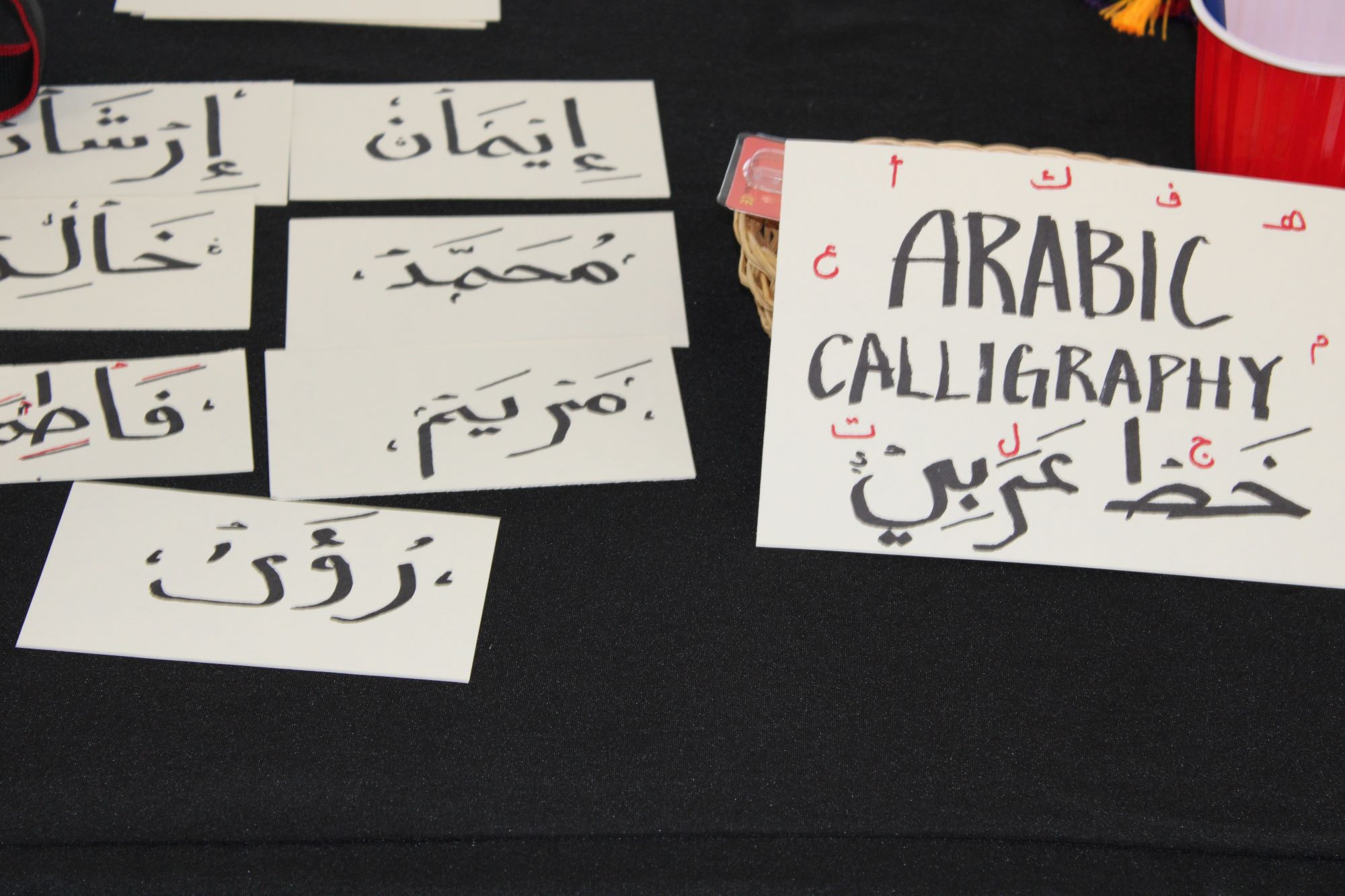
Arabic calligraphy drew considerable interest among visitors.
Iman Joubran, an information technology student, led a calligraphy booth, guiding students as they wrote their names in Arabic for the first time. She explained that Arabic calligraphy is “so beautiful that it is celebrated all over the world. It is one of the finest expressions of Arab and Islamic cultures. The Qur’an, written in Arabic, has contributed to the spread of both the language and Islam. Through its artistic lettering, Arabic has become a celebrated medium, carrying and spreading the core messages of Islam to the world.”
Arabic calligraphy, one of the main forms of artistic expression in Islam, was highly appreciated by visitors during Islam Awareness Week. Photo credit: Noureddine Zerrad
The hijab try-on station also attracted many students curious about the Islamic dress code.
Olivia Norlock, a first-year psychology student at uOttawa who converted to Islam in 2025, explained that many people mistakenly view the hijab as a symbol of male oppression, but for her, it is “simply a part of a Muslim woman’s identity. I see the hijab as a blessing and a part of who I am. Wearing it allows me to carry Islam with me wherever I go.”
Norlock also shared her journey to Islam, noting that volunteer work with newcomers, particularly Muslim families, inspired her exploration of the religion.
She said, “Allah guided me to His path, and I then began learning about this religion, the Prophet, and the miracles of the Qur’an. I am proud to be part of the Muslim community.”
The week also encouraged interfaith dialogue. Co-organizers engaged in a friendly discussion with non-Muslims who came to learn more about Islam and its core messages.
Jonathan Adminmi, a business marketing student, explained that as a Christian, he has always been curious about Islam and hoped the event would answer some of his questions. He noted that Christians and Muslims worship the same God, but he wanted to understand the new theological perspectives that Islam offers. Through his discussions with other students, he realized that the two religions are closely related.
Adminmi said if there was one word emphasized during the discussions, it was “peace.”
“The event is an opportunity to build bridges between communities and reiterate a collective call for harmony during difficult times,” Adminmi said.
For next year, organizers hope to host an even larger event that builds on the same platform for learning, reflection, and connection.
“We will continue our work to serve Muslim students, but also foster a culture of understanding and welcome among students from diverse backgrounds,” Alnashed said.
Featured Hero | Featured Story | Home Feature | Home Hero | News
Top stories in your community and around the world as noted by Algonquin Times journalists
Tianna Lawless-Musgrave
Photos:
March 24, 2026 Revised: March 24, 2026 8:44pm
Local
Ottawa Citizen: Ottawa police have arrested a 19-year-old man following a fatal hit-and-run collision involving a school crossing guard near a Barrhaven elementary school.
The arrest was made on Tuesday. The crossing guard has been identified as Peter Clark. He was struck by a pickup truck around 8:20 a.m on Monday while on duty at Cedarview Road and Kennevale Drive, police said.
Investigators asked anyone who witnessed the collision or who may have dashcam footage to contact them.
National
CBC: An RCMP-led corruption investigation is underway at Calgary city hall, with at least one current and one former Calgary city councillor being subjected to search warrants executed last week.
During the warrants, Ward 10 Coun. Andre Chabot’s cellphone was seized, as well as a warrant being executed for property belonging to former Ward 4 Coun. Sean Chu. Both are noted as being cooperative in the investigation.
“No charges have been laid, and I look forward to a swift conclusion of this investigation,” said Chu’s lawyer, Shamsher Kothari, in a written statement.
International
CBC: A record-breaking heat dome is expanding to cover nearly the entire U.S. Weather historians say the dome has surpassed statewide records in 14 states.
The heat dome will leave Flagstaff, Ariz., with 11 to 12 days of temperatures higher than the city’s previous March record. On Friday, a group of international climate scientists determined that the national record heat was “virtually impossible” and approximately 800 times more likely due to climate change.
The heat dome will move on by late next week, meteorologist Jeff Masters of Yale Climate Connections said. “We just have to give it time.”
Urban Camel is taking its first steps with the help of current and former AC students
Mickey Banks
Photos: Mickey Banks
March 23, 2026 Revised: March 23, 2026 8:56am
Photo: Mickey Banks
Sienna Hermary is the founder of Urban Camel. She came up with the idea for the company after moving to Ottawa.
Urban Camel, started in late 2024, is mapping the road ahead with help from former and current Algonquin College students.
Its founder, Sienna Hermary, describes it as “Uber or SkipTheDishes for small moves and furniture delivery.”
Hermary said the idea for the company came after she moved to Ottawa. Born in Alberta before moving to England and British Columbia, Hermary was no stranger to new locations. However, this was the first time she hadn’t been able to furnish her apartment.
“I had no friends, no family, nothing,” Hermary said. “I didn’t have a car at the time either. I didn’t have anybody to help me move anything. I think that’s when I first started really experiencing issues that a lot of people experience when they’re moving.”
She began discussing the idea with friends and family and then went through Invest Ottawa’s ignition accelerator program.
“That helped me a lot with defining the business direction and really validating the business concept that I felt there was a market,” Hermary said.
One major obstacle was handling the technological aspects of the business. Hermary said students from the Algonquin College of applied arts and technology built the first iteration of the minimum viable product.
Luis Cortorreal is a graduate of Algonquin College’s mobile app design and development program.
Cortorreal joined Urban Camel as a co-founder to help with the design of the app. He says there are two sides of the app, one for the customers and the other for the movers (the company currently has five movers, all of whom work as independent contractors).
On the customer side of the app, once you’ve entered some basic information, you can then book the move. You’ll be asked about the logistics and timing of the move. The price of the move is dependent on what you’re moving, how far and whether you’re able to assist with the move.
“And when that’s obvious we give you an upfront price, so we are super transparent with that,” Cortorreal said. “Then when the date arrives, you will start getting notifications from the mover that it’s heading to your direction. So, we have real time tracking so you will see the mover going in.”
Hermary said they’re catering to two main groups, one is people renting apartments as they may not have a car or truck to assist them. The other is university and college students.
“Because university students, we find are often moving twice a year,” Hermary said. “Depending if you’re living on campus or not.”
While Urban Camel is still finding its footing, its next step forward is marketing.
“A lot of our focus is on getting content out more consistently on social media,” Hermary said. “We’re looking to do some bold marketing campaigns with the universities and apartments and some of our target markets across Ottawa.
Hermary said she’s hoping to get more students from the college to help with the marketing as well as furthering the tech and AI integration.
Their ultimate goal is to go international, starting in Canada and focusing on major cities.
“There’s so many people in Toronto, Montreal, Vancouver, that they don’t have cars,” Hermary said. “They just use the trains because it’s terrible to drive there. So, thinking about where the pain points are the most evident and then targeting those regions.”
Featured Hero | Featured Story | Home Feature | News
After dropping a tough game to Oshawa on March 20, the 67’s faced their first-round opponents, the Kingston Frontenacs, in a regular season finale game that was heated
Scott Crowell
Photos: Scott Crowell
March 23, 2026 Revised: March 23, 2026 7:54am
Photo: Scott Crowell
Ottawa 67's players thank Billet families in pre-game ceremony at TD Place on March 21, 2026
There were some very important things on the line for both the Ottawa 67’s and Kingston Frontenacs on March 21 as they wanted to gain momentum and an edge over each other as game one of the first round draws nearer.
Both hockey teams came out of the gate with heavy physicality and made the game have that playoff feel that was expected.
The first period was very quiet on the score sheet and both goalies Jaeden Nelson (Ottawa) and Matthew Minchak (Kingston) had to be on the ball for some grade A chances. The shots were 9-8 Kingston after 20 minutes.
Jack Dever (Kingston) takes opening face-off against Zach Houben (Ottawa) at TD Place on March 21, 2026 Photo credit: Scott Crowell
Ottawa got into some penalty trouble once again as they had three penalties to start the first half of the second period including one at the end of the first period.
Kingston’s Matthew Henderson finally broke through on power play number four walked into the slot off a nice pass and blew it by Jaeden Nelson for his second of the season to break the tie and make it 1-0 Kingston at 9:53 of the second. The assists came from Robin Kuzma and Landon Wright.
67’s forward Thomas Vandenberg evened up the hockey game with his 25th of the season, off a pass that was centered from a flying Frankie Marrelli and Vandenberg put home the pass. It was a 1-1 game at 12:57. Cooper Foster had the other assist.
Thomas Vandenberg scores tying goal against Kingston Frontenacs on March 21, 2026 at TD Place. Photo credit: Scott Crowell
It took the 67’s only 37 seconds after the Vandenberg goal to capture the lead as defenceman David Bedkowski stepped right below the hashmarks and ripped it blocker side to give Ottawa the 2-1 lead. He received the pass from Nic Sima and Jasper Kuhta at 13:34.
Ottawa began to take over the game as the shots were 23-17 after 40 minutes of play.
At the end of the second period, there was a big scrum that resulted in the officials calling Kingston’s Andre Mondoux for slashing which sent Ottawa to their first power-play to start the third period.
67’s captain Cooper Foster capitalized on that 67’s power-play for his 29th of the season to extend Ottawa’s led to 3-1 with a tip in from Kohyn Eshkawkogan’s point shot, 34 seconds into the third period.
67's captain Cooper Foster celebrates insurance goal against Kingston Frontenacs on March 21, 2026 at TD Place Photo credit: Scott Crowell
67’s forward Teddy Spitznagel knocked home the rebound on another power-play to extend the 67’s lead to three as he scores his second OHL goal in back-to-back games. Assists came from Sam McCue and Connor Bewick at 11:27 to make it 4-1 Ottawa.
Jasper Kuhta extended the 67’s goal with a beautiful shot that was set up by Nic Whitehead and Nic Sima at 15:10 of the third to make it 5-1 67’s.
Sam McCue puts extra insurance on a dominant third period with a give and go play with defenceman Frankie Marrelli to make it 6-1 Ottawa at 17:53. Zach Houben got the secondary assist.
67’s goalie Jaeden Nelson stopped 24 of 25 shots faced on goal and made some marquee saves when needed in the 6-1 win.
There were no post-game interviews due to a team banquet.
The 67’s will kick off game one of the OHL Playoffs on March 27 at TD Place against the same Kingston Frontenacs they just played.
Athletes cheered each other on in a friendly contest to showcase their development and celebrate their progress in weightlifting
Rory Haley
Photos: Rory Haley
March 20, 2026 Revised: March 20, 2026 9:28am
Photo: Rory Haley
Winners of the women's bench press category at the Algonquin Wolves Powerlifting Competition stand at the podium on March 14. Left is Ashley Driscoll, who came in third, middle is Jasmine Hunt, who came in first, right is Chloe Pearson, who came in second.
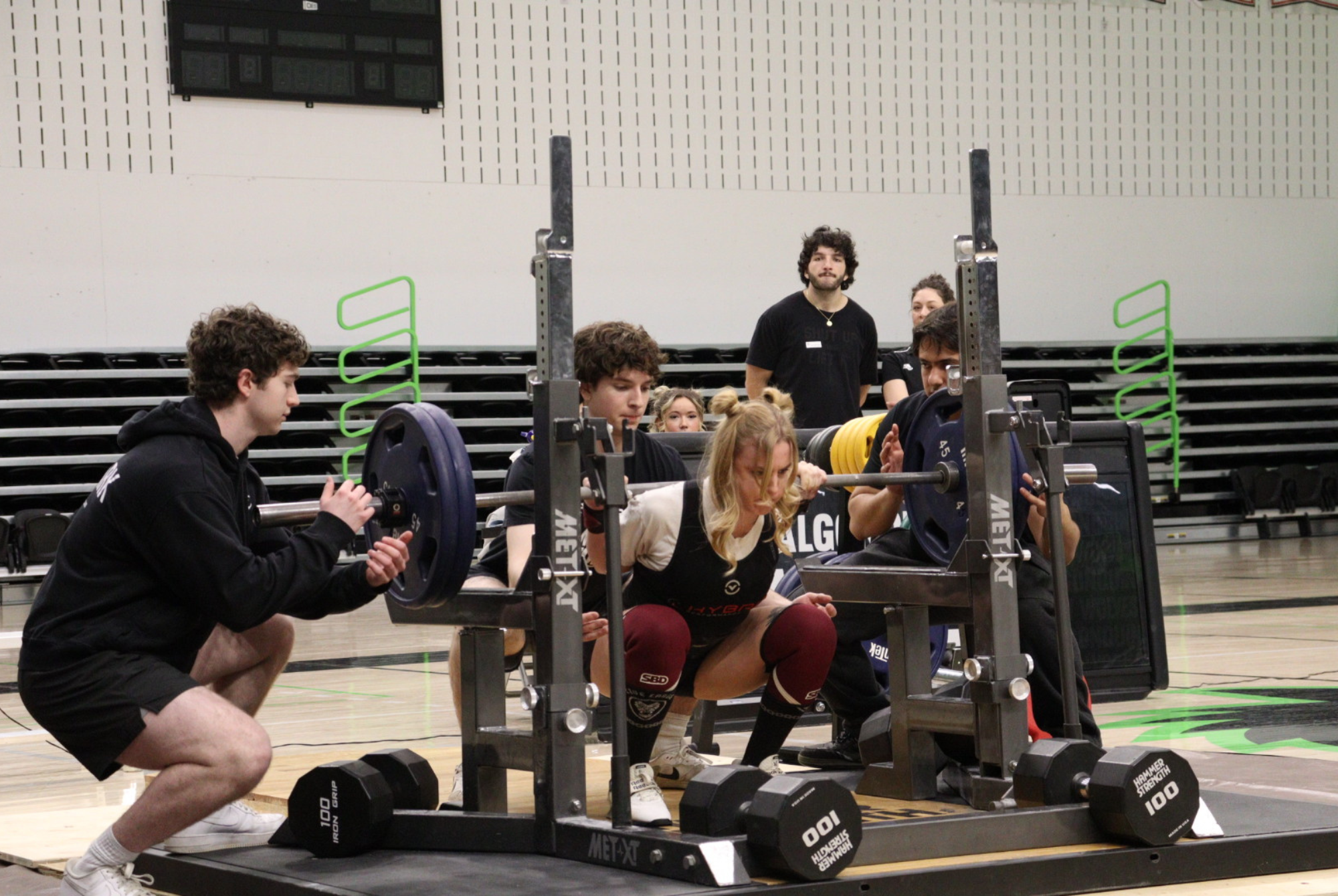
Algonquin College students lined up to squat, bench press and deadlift at a powerlifting competition in the Jack Doyle Athletics and Recreation Centre on March 14.
Divided into women’s and men’s sections, 20 competitors had three attempts at one rep in each category. The winner would be calculated by the competitor’s body-to-weight lifted ratio.
Adam Voutier, event facilitator and a past competitor, was excited for the athletes ahead of the event.
“Just look out for some guys lifting some heavy weight, and some girls putting up serious numbers,” said Voutier, who trained many of the competitors. “It’s gonna be a really fun time, and a lot of good experience, and hopefully it opens the door for some students to go and do this competitively outside with the IPF.”
The IPF, or International Powerlifting Federation, is the largest governing body for the sport.
Chloe Pearson, one of the competitors, said she was looking forward to competing with her friends in the event.
“I’m honestly just excited. All my friends are here,” she said. “It’s just nice to kind of do a competition for fun. I’ve done one official meet, but it’s kind of nice to have no pressure really, and just have fun.”
The competition began with women’s squat attempts. Jasmine Hunt took first place after squatting 285 pounds. Second place went to Mary Rose Gallagher, who squatted 270 pounds, followed by Ashley Driscoll, who squatted 240 pounds, earning third.
Ashley Driscoll squats 240 pounds at Algonquin Wolves' Powerlifting Competition on March 14 in the Jack Doyle Recreation Centre. Photo credit: Rory Haley
After her first win of the day, Hunt praised the competition and the organizers.
“I mean, I love this competition,” she said. “I think it’s a great space for people to learn and experience powerlifting. I would say it’s a lovely experience with all the coaches, all the people who set it up.”
On the men’s side in the squat competition, Sebastien Ellis won after squatting 460 pounds. Lennon Leyland-Pang came second after squatting 405 pounds, and Avery Hagley took third with 515 pounds.
Following his first win, Ellis said he was excited for himself and the accomplishments of other competitors.
“I’m really excited to go into the rest (of the competition),” he said. “I’m proud of my squat. You know, I’m proud of all the guys here. All put in their work.”
The next event of the day was bench press.
The women went first, with Hunt securing her second first-place finish after pressing 165 pounds, and Driscoll pressing 135 pounds to achieve another third-place finish. Pearson joined them on the podium, taking second place after pressing 160 pounds.
The men’s bench press champion was Ellis, pressing 350 pounds. Leyland-Pang came in second place with 260 pounds and Keenan Brewley took third by pressing 180 pounds.
Winners of the men's bench press category at the Algonquin Wolves Powerlifting Competition stand at the podium on March 14. Left is Keenan Brewley, who came in third, middle is Sebastein Ellis, who came in first, right is Lennon Leyland-Pang, who came in second. Photo credit: Rory Haley
To finish up the day, athletes competed in deadlifts.
Hunt three-peated the women’s competition, earning first place after lifting 325 pounds. Driscoll finished on the podium for the third time of the day, achieving second after lifting 285 pounds. Joining them on the podium for the second time was Mary Rose Gallagher, who lifted 295 pounds.
The men’s deadlifting competition had the largest number of competitors in the event with 13 entries. Darian Para finished in first place after he lifted an astounding 525 pounds. Achieving second place for the third time was Leyland-Pang, who lifted 555 pounds, the heaviest weight of the day, and following him in third place was Al-Ameen Kareem, who lifted 445 pounds.
Featured Hero | Featured Story | Home Feature | Home Hero | Sports & Recreation