Planes and passions take off in aircraft maintenance technician program

Algonquin College students are learning while surrounded by history inside a working hangar at the Canada Aviation and Space Museum
Photo: Ana Silva
A Piper Apache used by Algonquin College aircraft maintenance students at the Canada Aviation and Space Museum on April 10, 2025.

In a hangar tucked away at the Canada Aviation and Space Museum, the hum of aircraft engines and the sound of tools clinking against metal fill the air.

For students in Algonquin College’s aircraft maintenance technician (AMT) program, this is more than just a workspace — it’s where their dreams take flight.

The partnership between the college and the museum is one of the key elements that sets the AMT program apart, blending classroom theory with hands-on learning in an environment surrounded by history. But, as with any partnership, there are challenges.

Since 2016, the AMT program has operated as a two-year course after previously offering only one year of study. Program coordinator Daniel Maslow says the change came with growing pains.

“We outgrew the space,” said Maslow. “The museum was fine when we were just doing theory in the first year, but now that we have more hands-on components, we need a bigger facility.”

Although the museum’s hangar gives students access to aircraft from Canada’s aviation history, its location — a 34-minute drive from Algonquin’s main campus — can be a hurdle.

“It’s tough getting there for some people, especially those who live farther out,” said Maslow.

For student Caleb Rampley-Starr, the commute isn’t an issue.

“For me, the museum works better because I live two kilometres away,” he said. “But I know a lot of people don’t live too close, so overall, the college would work better for the majority. But for me, the museum is perfect.”

Though hands-on training is essential, Maslow says it’s not always as thrilling as people think.

“Honestly, it’s not the most glamorous part of the program,” he said. “But we spend a lot of time teaching students about the process — the importance of understanding what went wrong when aircraft incidents happen and how to prevent them.”

He says the program puts a strong focus on history, from the early days of aviation to modern advancements.

“Aviation has come a long way. In the beginning, people died just trying to learn to fly,” said Maslow. “We’ve learned a lot from accidents, and that’s how we continue to improve. It’s not sexy, but it’s necessary.”

Rampley-Starr, who used to do mechanical work on his car, says moving into aircraft maintenance felt like a natural progression.

“I’ve always liked planes. I used to do maintenance and mechanic stuff on my car, so two and two made four,” he said. “The most exciting things are probably the labs because you do hands-on stuff and it’s a lot more fun than sitting in class for hours on end just listening and taking notes.”

The program’s strict structure can be intense, with attendance and project completion tied directly to accreditation.

“You have to meet specific criteria to pass,” said Maslow. “If you miss even one project or fall short of the required attendance, you can’t get accredited and that means more time spent in apprenticeship after graduation.”

Student Chloe Clemens says the workload can be tough.

“We’ve got a lot of classes to juggle and that’s a challenge,” she said. “But when we get to work on the planes, it makes it all worth it. Plus, there’s a lot of money in aviation and you get to work on cooler things than cars.”
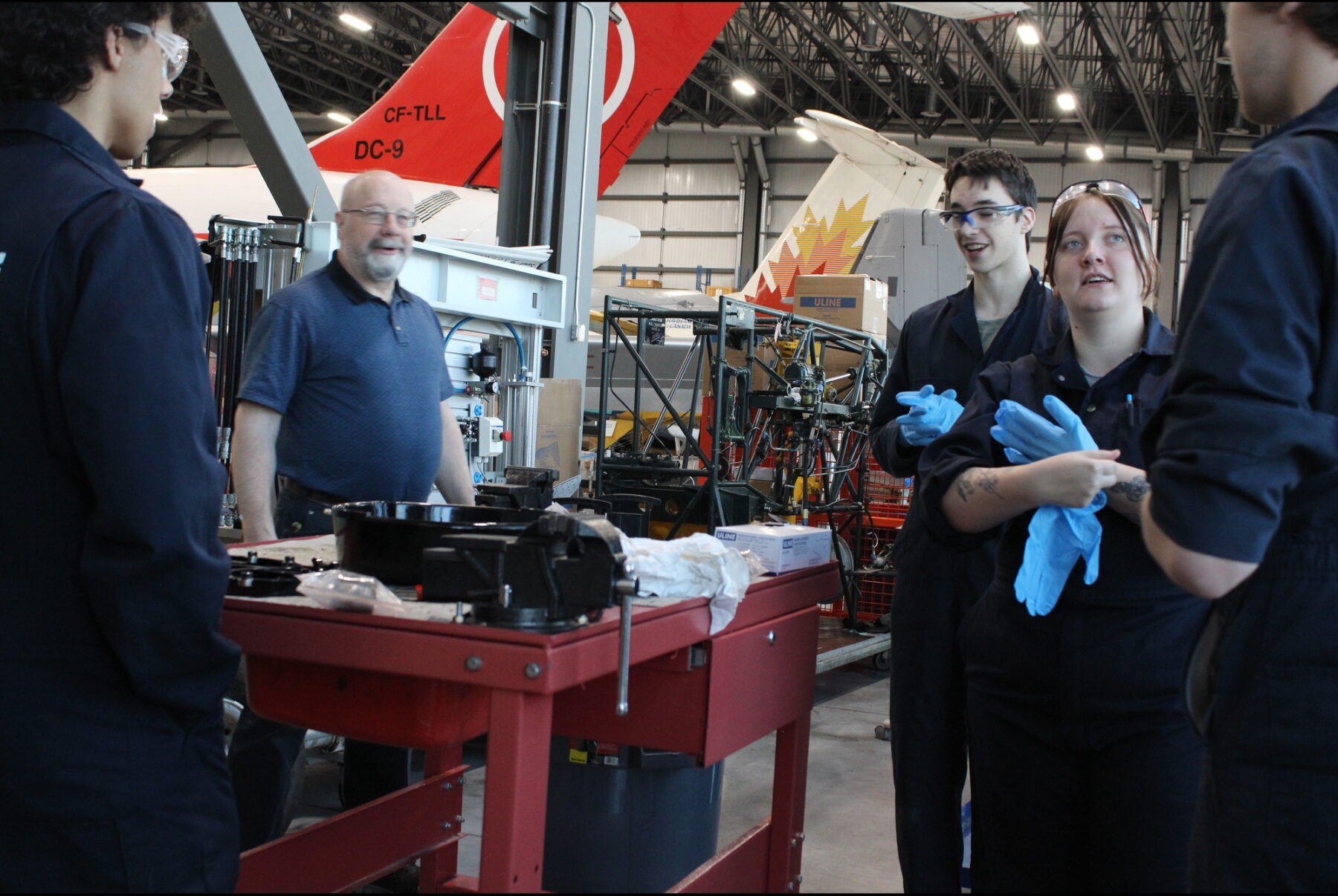
From left, students Chloe Clemens and Samuel Clavea relax as professor Mark Ward checks in with them during a slower day at the Canada Aviation and Space Museum on April 10, 2025.
From left, students Chloe Clemens and Samuel Clavea relax as professor Mark Ward checks in with them during a slower day at the Canada Aviation and Space Museum on April 10, 2025. Photo credit: Ana Silva

For some students, the path to the program came from a personal passion.

“I had a great affinity for planes. I love planes and I had no clue what else to do with my life, so I decided to make my hobby my job,” said Kit Senez. “Coming to the museum is the coolest part — lots of hands-on stuff and I get to work with airplanes up close.”

Like others, Senez says attendance is a major challenge.

“The class hours are definitely the hardest part,” he said. “You can only miss five per cent of the program.” Still, he’s happy with the experience overall. “Aside from that, I’m pretty happy with how the program’s going and how they’re teaching.”

Sebastian Ouillard agrees.

“The most challenging part is probably showing up to the classes because they count your hours, so it gets a little hard keeping a consistent schedule, especially when you’re trying to balance it with your personal life,” he said.

But, like the others, he finds the hands-on work rewarding.

“The most exciting part would be to actually get to apply your skills at the hangar.”

While the college gives students a solid theoretical foundation, the museum offers something more unique: a direct connection to aviation history.

“Being surrounded by all the planes here, it’s just amazing,” said Ouillard. “You don’t get that kind of experience at college.”

Maslow echoes the sentiment.

“It’s not just about fixing planes. It’s about understanding their legacy and how they fit into the bigger picture of aviation,” he said.

When it comes to favourite aircraft, the students all have their picks.

“I like big planes, so probably the Buffalo,” said Rampley-Starr.

“Probably the Buffalo, the very large yellow one — it’s a search and rescue plane, it’s really cool,” said Ouillard.

Clemens prefers the quirky ones.

“I like all the small ones with quirky names. There are a lot of animal ones like Beaver and Chipmunk.”

A Taylorcraft aircraft sits on display in front of a retired Trans-Canada Air Lines Viscount at the Canada Aviation and Space Museum.
A Taylorcraft aircraft sits on display in front of a retired Trans-Canada Air Lines Viscount at the Canada Aviation and Space Museum on April 10, 2025. Photo credit: Ana Silva

Senez is drawn to the DC-9.

“There are some Second World War and First World War-era aircraft, but definitely the giant airliner DC-9 is probably my favourite.”

The program is also preparing for growth. With the recent opening of a new Porter Airlines facility in Ottawa, Maslow says the future is promising.

“We’ve started a partnership with Porter and we’re looking to grow together,” he said. “Porter needs more technicians and we’re providing them with skilled graduates ready to join the workforce.”

Some students think a bit more time in the program could help.

“Two years feels a little short for everything we’re learning,” said Ouillard. “Some subjects feel a little cramped and the time balance between classes is a bit unbalanced.”

Clemens agrees.

“Maybe if it was spread out a bit more — even a half-year longer or another semester — I think it’d be easier.”

Even with its challenges, the aircraft maintenance technician program at Algonquin College offers a unique and valuable opportunity for students who are passionate about aviation. For those like Rampley-Starr, Clemens, Senez and Ouillard, the chance to work with aircraft from all over the world, including historic planes, makes it all worthwhile.

In a hangar filled with historic aircraft, these students are writing about the future of aviation — one bolt, one lesson, one Buffalo at a time.


Off the air: Algonquin College radio students lament beloved program

After decades of graduates, the program and 36 others are scheduled for suspension once its current students graduate
Photo: Ernest Ko
Radio students Iain Sewell, Charlie Kassam, Tommy Young (alumnus) and Alex Gonzales.

When Ottawans settle into their cars for the morning commute, many skip the podcasts and playlists. Instead, they reach for a familiar button — radio.

From breaking news and morning banter to the latest tunes, Ottawa Valley’s 34 radio stations have long been part of the city’s media landscape. For decades, stations like KiSS 105.3, TSN 1200 and MOVE 100.3 have shaped the capital’s soundtrack and conversation.

So have the voices behind the mics: Sandra Plagakis, Gord Wilson and Stuntman Stu — names as familiar as the stations themselves. All three built successful careers in Ottawa radio, and all three began at Algonquin College’s broadcasting – radio and podcasting program.

Now, that program is set to sign off.

In February, Algonquin College President and CEO Claude Brulé announced 37 program closures, including the college’s longstanding radio broadcasting program. The decision was later ratified during the Feb. 28 Board of Governors meeting. Once current students graduate, the college will cease to offer those programs.

In an email to students, Brulé attributed the cuts to “shifts in learner interest, changes in federal policies, provincial funding and our focus on programs that offer strong career pathways.”

With grads working across the country, those who know the radio program say it does offer opportunity, and it’s exactly what they fear these cuts will eliminate.

For the students in room N101, that’s not the only casualty they’re grappling with.

CKDJ 107.9 — Algonquin College’s student-run community radio station is the program’s pulse. Broadcasting local music, news and youthful voices since 1972, the station offers students a chance to make radio, rather than simply study it.

At the helm of the program is Dan Mellon. With over 30 years of broadcasting experience, Mellon has mentored class after class of radio students for over a decade.

To him, this program isn’t just about music charts and ad reads, it’s about opportunity.

“There are so many places that (radio) students have wound up going to, and different industries as well,” Mellon said. From communications and public relations to even real estate marketing, the possibilities are vast, he says.

Broadcasting radio and podcasting program coordinator Dan Mellon sitting in front of a monitor, microphone and soundboard in the CKDJ studio.
Dan Mellon, the broadcasting radio and podcasting program coordinator, has been teaching at Algonquin College for over a decade. Photo credit: Ernest Ko

But Mellon says his greatest achievement isn’t shaping careers, it’s helping students build character and find their purpose.

He’s proud of his program’s ability to attract students of all creative backgrounds and personalities and give them a home and the inspiration to hone their craft.

“When they’re in this program and learning, many of these students realize for the first time what they’re passionate about,” Mellon said.

Without it, he fears future students will lose the chance to embark on that creative journey.

His students echo that idea. Charlie Kassam and Iain Sewell, both in Level 4, share a deep appreciation for what the program has given them — and frustration with its suspension.

“I was angry when I first found out. But now that the confusion’s passed, it’s just melancholy,” Sewell said. “Not only are we losing the program, we’re losing a friendly environment where people can connect through radio.”

The program’s been “about building a relationship with your audience and becoming a pillar in your community,” Kassam said. “Sure, we’re all going to graduate, but it’s not about that. It’s about radio’s future in Ottawa and maybe even in Canada.”

Amid increasing financial pressure in Ontario’s post-secondary education sector, the closure of radio programs has become a troubling trend. In 2023, Loyalist College suspended its broadcasting – radio program, citing low enrolment.

Late last year, Mohawk College followed suit, suspending multiple broadcast programs, including radio and TV and laying off 20 per cent of its administrative staff.

The students say alarms should be raised. To them, losing a dedicated, hands-on program means threatening the future of radio in Ottawa and across the province.

Now a communications manager for the Nepean Raiders, recent radio graduate Tommy Young understands just how prestigious Algonquin’s program is. He’s learned that graduates are hired all across Canada, while Ottawa radio stations often look specifically for AC graduates.

“Algonquin shutting down its program is a huge blow to their hiring practices and the industry as a whole,” Young said. “There are graduates in high positions all across the country, and a lot of the industry is retiring soon. We need the influx of youth.”

Without Ottawa’s only radio-specific program, students seeking education in radio will be forced to move elsewhere in the province, attracting local talent away from the capital.

This reality hasn’t sat well with many in Ottawa’s radio community, including Algonquin radio broadcasting alumnus and radio personality Stu Schwartz, known to listeners as Stuntman Stu. He said the program’s suspension was “a disgrace to a whole new generation of future leaders, who could have revolutionized radio broadcasting.”

KiSS 105.3’s Sandra Plagakis, another successful graduate, called the program “a game-changer.” Without it, she said she would not have enjoyed the same success.

Algonquin’s offering of “real-world experience” with CKDJ was invaluable to Plagakis. “It plays a crucial role in training future broadcasters by offering everything from on-air opportunities to involvement in the everyday operations of a radio station,” she said.

Plagakis said losing the program “doesn’t just mean a lack of future broadcasters — it would mean losing storytellers who keep the community connected.”

If nothing else, community connection is what strikes at the heart of N101. Walk past anytime, and music will often play on the speakers, but not just any music. “CKDJ is a rare home for local Ottawa-based artists,” Young said. Many up-and-coming artists depend on CKDJ as their sole source of public exposure. These changes don’t just empty a classroom, Young argues. It could silence voices.

A banner for Algonquin College radio station CKDJ 107.9 FM
Although the radio program will be suspending, radio station CKDJ 107.9 FM will still operate on a volunteer basis, as its current broadcasting licence is valid until 2030. Photo credit: Ernest Ko

As it stands, CKDJ holds an active broadcasting licence until 2030. Alumni and volunteers will still run the radio station after the program’s suspension, but licence renewal is not guaranteed.

Mellon and his students would like the college’s Students’ Association to adopt the station, making it Ottawa’s third campus-based community radio station alongside the University of Ottawa’s 89.1 CHuO FM and Carleton University’s 93.1 CKCU FM. Both are also volunteer-driven.

However, the SA’s communications and strategy manager Chris Lackner said, “At present, the Students’ Association has no plans to acquire 107.9 CKDJ FM.”

Regardless of what the future holds, radio broadcasting students remain appreciative of the inspiration and knowledge their professors provided them.

“Most professors are part-time, but they still put up so much work, effort and time teaching us,” Sewell said. “I wouldn’t rather have had a professor anywhere else. They’re all fantastic people.”

Once the program closes, part-time professors will likely lose their positions if they cannot find new placements at the college. Mellon takes comfort in knowing they all actively work full-time in the industry, but he knows they’ll miss teaching.

As for him, he too could return to the industry full-time. But that’s never been the point. “That’s what hurts the most,” he said, “I love working here. I’m not worried about finding another job, but I don’t know if I’d love it as much as this.”

Still, Mellon says his work isn’t finished. His students are still learning and the station is still humming. Looking back, he’s proud of the voices he’s helped shape over the years, the program’s welcoming culture, and the role CKDJ still plays in the campus community. Mellon does not doubt the impact his program has made.

“I’m proud,” he said. “I’m proud of them all.”

Students raise $100,000 for Dave Smith Youth Treatment Centre

This year’s Algonquin College event management program raised over $14,000 for the charity, reaching a new milestone since the partnership began in 2020
Photo: Kendra Mendrisky
Abby Harrod, Claire Campeau and Ishita Malhotra pose in front of their selfie station at The Mill Tavern.

“Opa!” someone from the audience shouts out, earning smiles from the dancers as they remain focused on the intricate footwork of Zorba dance. The Odyssey Dance Troupe is made up of six members dressed in black attire, complete with black shoes and a red waist sash. As they performed hand in hand and arm to arm upstairs at The Mill Tavern, it didn’t matter that the dance floor was barely large enough for their routine. Spectators clapped along to the beat, making the energy in the room a warm contrast to the dark clouds outside splattering raindrops along Manotick Main Street.

Eight hours earlier, Algonquin College event management students, Stefanie Burch, Abby Harrod, Ishita Malhotra, Dana Rojas and Gioia Morin arrived onsite to set up for their fundraising event, Take a Chance on Greece.

Like the rest of their class, the students were raising money for the Dave Smith Youth Treatment Centre, which offers live-in care and services to those facing addiction and mental health challenges.

While the restaurant typically resembles a classic UK corner pub, it was transformed on Monday, March 24 into what Burch describes as “a little Greek oasis, dressed up with blue tablecloths and curtains, white pillars and flowers, greenery and a shimmering disco ball.

So the inspiration, (we were) just kind of brainstorming as a team back at the beginning of the semester and somebody had mentioned Greece as a theme,” said Harrod, the team’s administrative director.

“Me and another one of our members were like, ‘oh, we love Mamma Mia,’ like the movies, so let’s do a combination of those two things and that’s kind of where it came from.

The Mill Tavern had a special menu for the evening including Greek chickpea soup, a pita board, pork souvlaki wraps and classic Greek salad. They even had a special cocktail called Voulez Vodka.

“It took us eight months to plan the event,” said Rojas, the team’s marketing director. “Also, we had no budget, so we had to send so many emails every week, trying to reach out to everyone that will be able to help.”

Maadelyn Emboltura (middle) volunteered with event hosts, Dana Rojas (left) and Stefanie Burch (right) for Take a Chance on Greece.
Maadelyn Emboltura (middle) volunteered with event hosts, Dana Rojas (left) and Stefanie Burch (right) for Take a Chance on Greece. Photo credit: Kendra Mendrisky

All the groups’ emailing was worth it, as they received over 50 donors for their silent auction. The 50/50 draw raised $540, leaving the Dave Smith Youth Treatment Centre and one lucky winner each with $270.

“We raised about $4,800, which made us really happy because our original goal was $5,000 if we would have had 80 attendees, and we only had 60, but fell $200 short,” said Burch, the team’s venue director.

So, to me, if you had proportioned the ratio, we surpassed what we thought we were going to make, so I think we did really well there.”

This year, through the seven fundraising events put on by the event management Ontario college graduate certificate program, students raised $14,839.58.

Kim Leavy, the treatment centre’s philanthropy coordinator was present at Take a Chance on Greece to share information with the event’s attendees.

“All the youth that come to us, they get allotted care,” said Leavy. “There’s practitioners, we have addiction therapists, we have addiction counselors, and all of them see the psychiatrist.

Kim Leavy spoke to the event's attendees and applauded the students' work raising money for the Dave Smith Youth Treatment Centre.
Kim Leavy spoke to the event's attendees and applauded the students' work raising money for the Dave Smith Youth Treatment Centre. Photo credit: Kendra Mendrisky

Clients stay at the facility for three months and then continue to receive care after they leave.

“If you ever have a friend in the community that needs help, they don’t have to re-mortgage their house to come to our treatment centre,” said Leavy.

“It’s all covered by OHIP, which a lot of treatment centres in Ontario are not.”

Students in the event management program are sponsoring the classrooms in the treatment centre, which opened its new facility last spring.

These funds mark over $100,000 raised since the program began its partnership with the Dave Smith Youth Treatment Centre in 2020, according to Professor Sylvia Densmore.

Densmore has been working with the two-term event management graduate certificate program since 2021, when she started out as the program’s coordinator.

“I’ve always taught the event projects course, which is the course where students take what they learn in the theory classes, and they bring it into that course, and then they plan and execute an event for a charitable organization in the community,” said Densmore.

Students are tasked with the assignment in September, and they work throughout the fall and winter terms to prepare for their fundraising events in March. The other challenge: the students receive zero funding.

“They need to go out and find a partner venue, then they work within the community and within our event industry with entertainment, and they have to find entertainers who are willing to donate their time and energy to be at the events,” said Densmore.

Students create themes for their events, and plan any activities, food and decor around the theme. They create a name, a website and market it to the college community and greater Ottawa area.

“Then they have a whole social media campaign, and then they have to sell the tickets, and they also have to acquire numerous donations,” said Densmore.

Rajath Nair, Sourav Thomas and Joel Navarro decided on a Mexican theme for their event, Tacos, Tequila and Trivia, inspired by Navarro’s culture.

Nair and Thomas are from India, but when they found out other groups were incorporating Indian culture into their themes, they considered a different approach.

“We wanted to stand out from the crowd, we wanted to do something different,” said Thomas.

Other groups that included India in their fundraising events were Splash of Joy, a Holi celebration, The Great Indian Wedding Show, with activities involved in traditional Indian weddings, and Cultural Fusion, which incorporated the Philippines, Afghanistan and India in their music, dancing and games.

Tacos, Tequila and Trivia took place at Mexicali Rosa’s on March 21, and featured Mexican food, music, trivia, a silent auction and lotería, often called Mexican bingo.

But like any project, their planning had ups and downs.

“In the beginning, we were supposed to have a Mariachi band for our entertainment,” said Nair. “But unfortunately, in Ottawa, there’s only one Mariachi band and they were booked because it’s a Friday night.”

Luckily, the group stumbled upon the solution to their problem one day at school.

We were walking around campus, and we found a girl who was singing with a guitar, so we just asked her if she could perform for us,” said Nair. That’s how we found our entertainer.

Last fall, groups were formed so every team had at least five members, according to Nair. Unfortunately, two members of his original group left.

Sourav Thomas (left) and Rajath Nair hosted Tacos, Tequila and Trivia with Joel Navarro (not pictured).
Sourav Thomas (left) and Rajath Nair hosted Tacos, Tequila and Trivia with Joel Navarro (not pictured). Photo credit: Kendra Mendrisky

“I think that made the professors think that we’d do better than the rest of the teams because communication would be easier among the three of us,” said Nair.

While this may have been true, the team felt they were at a disadvantage when it came to delegating tasks.

Family emergencies and sickness meant that when one person couldn’t complete their task, it was up to the other two to take it on.

“I still remember, it was raining and (Rajath and I) both walked and we got sick,” said Thomas. I got fever, same time as him, and for one week, I was not able to join the class, and he was the one who was doing all the work.”

Tacos, Tequila and Trivia was a sold-out event, but the group had to work hard for their ticket sales.

Nair, Thomas and Navarro are all international students, who did not have contacts in the area they could reach out to.

Some of the teams sold out within the first three days because they had their family, their family friends coming in,” said Nair. “We actually walked out, walked around, even around campus and near our house to promote the event.”

In the end, the team sold 35 tickets, earning around $280 through ticket sales. Their 50/50 raffle brought in around $150 for the charity and they charged a $5 fee to play lotería, which Nair says most people participated in.

Overall, the group is happy with how their event turned out.

“It was really fun,” said Nair. “It’s stressful, but you make something out of it at the end. That’s rewarding.”

In her time with the program, Densmore has seen how fast-paced the program is, but she knows students can handle it.

“I always say there’s lots of blood, sweat and tears that go into the creation of these events,” said Densmore.

It’s not easy, and I love it when they are proud of themselves after, and they have a great sense of accomplishment and we’re very proud of them and what they do, because it’s quite amazing to see what they’re able to pull together.”

Geese are back, and apparently they’ve got the flu

Spring is here, and so are the geese — and apparently with a virus. Here’s what you need to know.
Photo: Nicklaus Korim
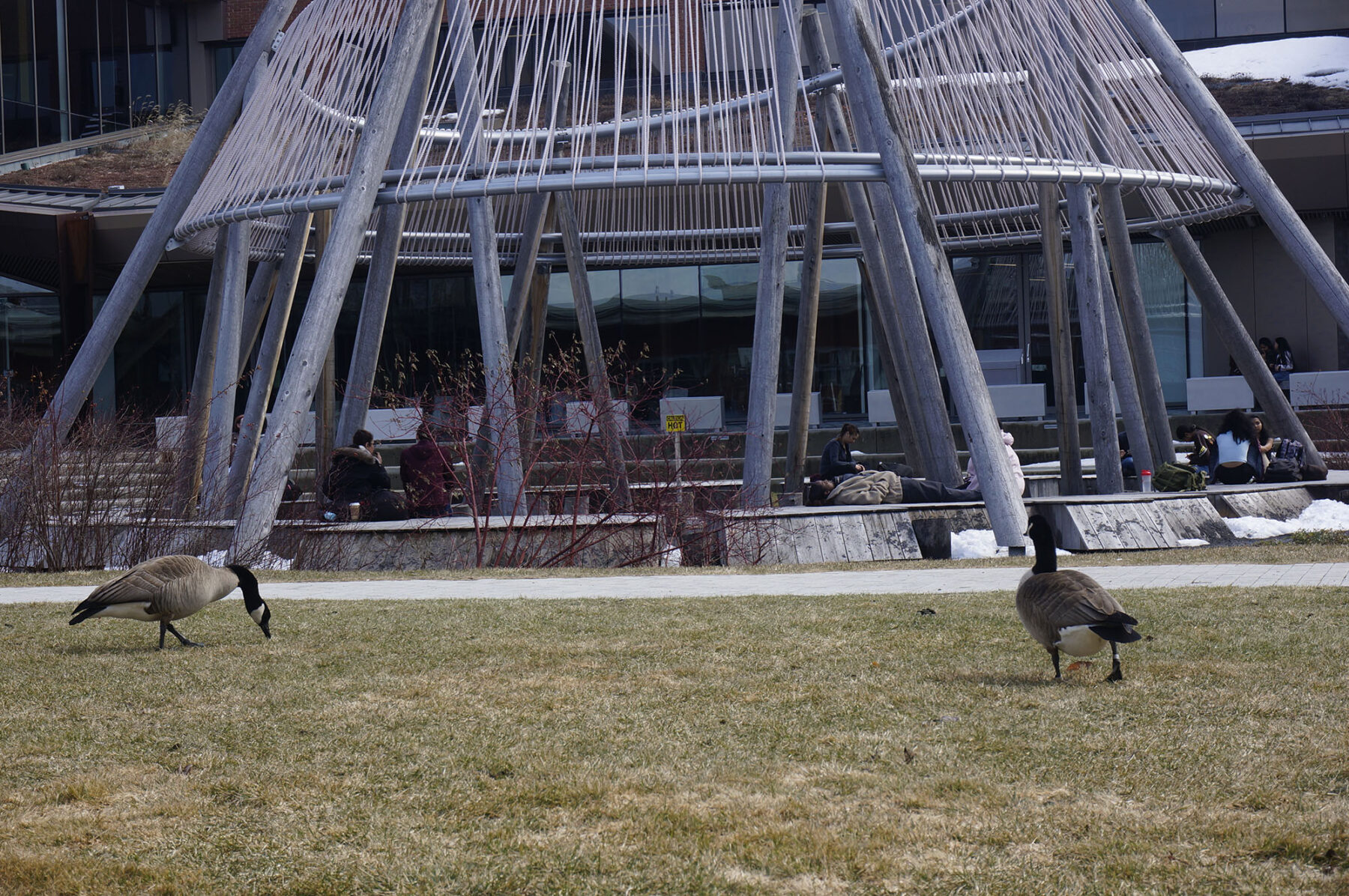
Geese wandering around outside of the library at Algonquin College on April 3.

Algonquin College sent an email to students on April 8 cautioning them to be wary of geese on campus due to avian influenza becoming more common in northern bird populations.

“With the arrival of spring comes the return of geese and other birds to Algonquin College campuses. Unfortunately, avian influenza (also known as bird flu or AI) is currently prevalent among North American wild bird populations,” the college said.

What is avian influenza?

Avian influenza is a viral infection commonly found in birds, but it can be transmitted to humans, according to the Government of Canada.

How can you get it?

According to the Government of Canada, avian influenza can be spread to humans through a bird’s fecal matter, saliva or mucus. A person can contract the virus if it comes into contact with their eyes, mouth or is inhaled. That said, human cases are rare. A good rule of thumb is don’t pick up geese or other wild birds.

What happens if you contract it?

Ottawa Public Health says, “Symptoms of avian influenza are similar to those of seasonal influenza and may include fever, chills, runny nose, cough, sore throat, body aches, headache, diarrhea, vomiting, red or watery eyes, or difficulty breathing.”

Local geese at Brewer Park April 17
Geese at Brewer Park on April 17. Photo credit: Nicklaus Korim

What should you do if you’re experiencing symptoms?

The Government of Canada recommends early recognition of the virus for the best chance at treatment. If exposed to an animal carrying the virus, a doctor may suggest antiviral medication to prevent symptoms and reduce the risk of further infection. It’s advised to speak with your local health-care provider.

What do students think?

“The geese don’t really bug me — not too concerned with avian influenza, to be honest,” said Sydney Melmoth, a 20-year-old esthetics graduate visiting a friend on campus.

“Personally, I don’t plan on picking up any dead geese.”

Gavin McLean, 20, a Level 1 student in the electrical apprenticeship program, also doesn’t seem overly worried.

“They are literally just birds,” said McLean.

“Doubt I’m going to get sick because there’s a goose in my general vicinity.”

The college recently launched an anti-goose campaign with hopes of repelling the birds from the Ottawa campus.

Hard work showcased at Applied Research Day

Students showed off projects in Algonquin College’s C-building
Photo: Nathan Heatherington
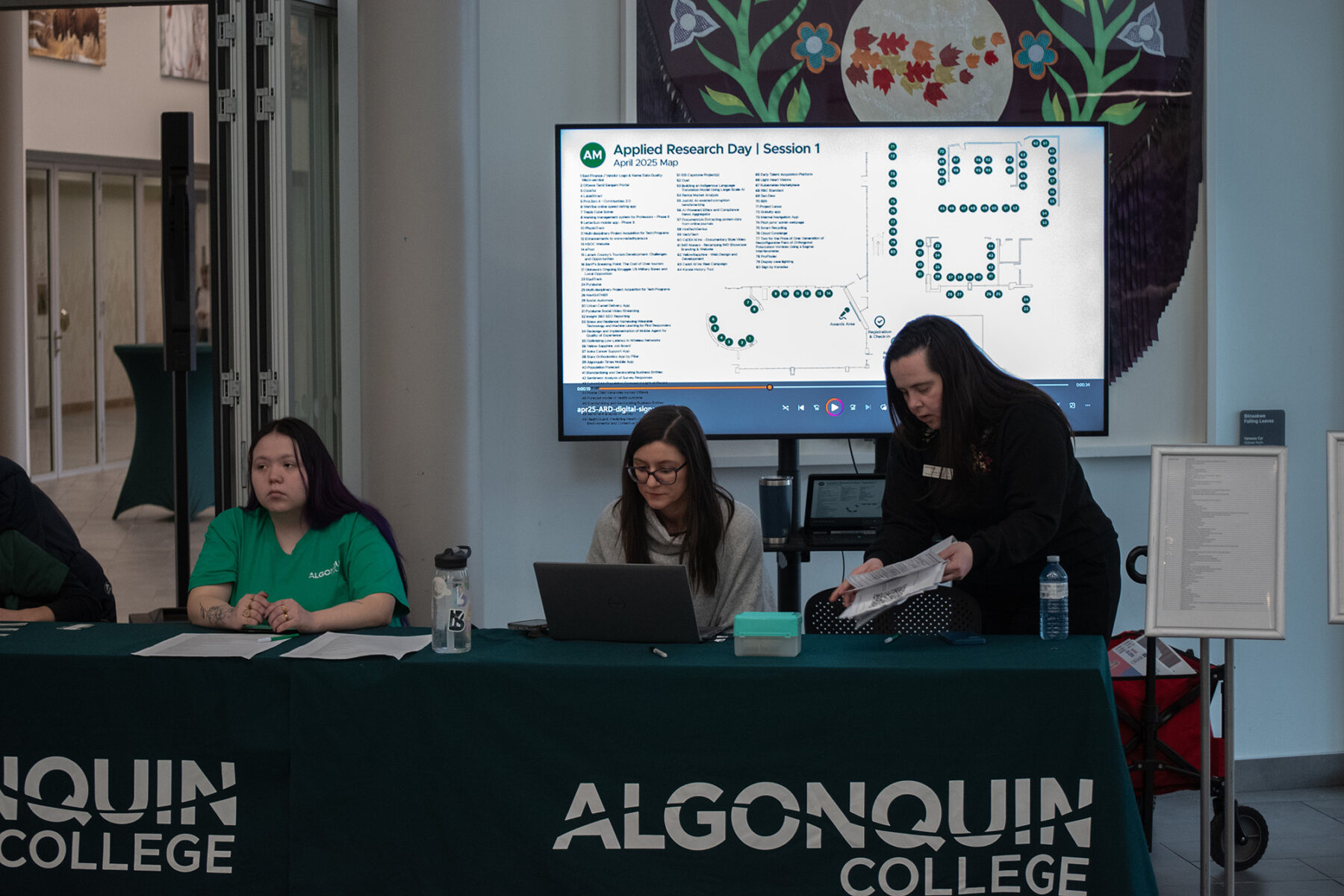
Mohamed Ali and Ziya Gurel show off their Rubik's Cube app on applied research day in C-building of Algonquin College.

On April 11, students at Algonquin College gathered in C-building to show off months of hard work on applied research projects.

“It’s research they picked based on their interests,” said Joey McGrath, a student in the business fundamentals program at Algonquin College. “There are apps, tech demos and at the end of the day, there are judges and the top three projects get a reward.”

The event featured more than 150 different applied research projects.

Welcome booth for the applied research day in C-building at Algonquin College
Welcome booth for the applied research day in C-building at Algonquin College. Photo credit: Nathan Heatherington

Brayden Warrell and his team worked on a project that used a piece of wearable technology to monitor breathing, electrical activity of the heart, skin conductivity and movement, all designed to capture data related to stress for first-responders.

“There’s lots to do with mental health, but it’s a tech project,” said Warrell. “We will be developing an AI model that will analyze all the data we’ve collected with this garment.”

“It’s really more about seeing what we get from the data and what we can detect and predict. If we can detect stress and when the first responders are coming out of a stressful state, we will try predicting post-traumatic stress disorder,” said Warrell.

Amir Kobaisse and his team redesigned a website for the Hindu Society of Ottawa.

“We enhanced the website by incorporating an event management system, updated the design and incorporated a matrix to count visitors to the page,” said Kobaisse. “You can donate to children in India, register for upcoming events, and view pictures of the events posted.”

Ziya Gurel and his team developed an app that helped beginners solve the Rubik’s Cube.

“It’s for beginners, shows them step-by-step instructions on how to solve the cube,” said Gurel. “They can visualize it in 3D and follow along to solve it, time themselves solving the cube and if you log in, all their progress will be saved.”

“Our next step is to add camera detection for the cube,” said Gurel.

Applied research is an important part of Algonquin College and is “dedicated to transforming the latest knowledge and technologies into practical solutions, developing innovative products, services, and processes that meet industry needs,” according to the college’s website.

The next applied research day is scheduled for
August.

April bus route changes include the busy 88

OC Transpo is changing bus routes as part of their New Ways to Bus program
Photo: Nathan Heatherington
Students disembarking Route 88 outside of C-building at Algonquin College

On April 27, OC Transpo will be making several changes to bus routes to improve transportation around the city.

The program, called New Ways to Bus, will make changes to more than 100 routes as part of OC Transpo’s five-year roadmap. The changes will focus on frequency, local service in neighbourhoods and connections to key destinations, according to OC Transpo’s website.

This will include changes to the busy Route 88.

“It’s written in every bus, but I wish I had an email,” said Vanshika Vanshika, a student studying computer programming at Algonquin College. “I have no idea how it is going to change.”

Route 88 bus sign outside of C-Building at Algonquin College
Route 88 bus sign outside of C-building at Algonquin College. Photo credit: Nathan Heatherington

Route 88 will be getting a new symbol, a blue hexagon for frequent routes, replacing the blue circle for rapid routes. Frequent routes will be every 15 minutes or less from 6 a.m. to 6 p.m. on weekdays and run seven days a week along main roads.

Godwin Biju, a student taking the development social worker program at Algonquin College, is hoping that these changes will be for the better.

“The buses would always be late or get cancelled sometimes. If I needed to be somewhere at a certain time, the bus would never be there. More buses and less stops could make transportation much smoother,” said Biju.

According to OC Transpo’s website, Route 88 “will be changed to run between Bayshore and Hurdman stations. It will be changed to run from Queensway-Carleton Hospital on John Sutherland Drive, Richmond Road, and Holly Acres Road. Service west of Queensway-Carleton Hospital will be removed and replaced by a new Route 68. Special Sunday trips to and from Preston Street or Carling Avenue will be removed.”

Route 88 will have two O-Train connections: Hurdman Station and Mooney’s Bay Station.

Cosmo Welch, a student studying illustration and concept art at Algonquin College, is no stranger the frustrating experiences with the old Route 88.

“I take it all the way to Hurdman, about a half hour, and then another hour before I am home,” said Welch. “It’s awful to be on because it is so busy, and there aren’t enough buses.”

“I’m looking forward to it hopefully changing for the better,” said Welch.

Coaches watching if Algonquin College’s academic cuts impact varsity programs

With Algonquin College suspending programs for the 2025-2026 academic year due to financial reasons, how does it affect the Wolves' teams?
Photo: Jaiden Martin
Everton Senior coaches the Wolves women's volleyball team on Jan. 24 at the Jack Doyle Athletic and Recreation Centre.

Some Algonquin College varsity coaches worry program suspensions and caps on international students could impact their teams.

The Algonquin Students’ Association pays for the varsity sports at Algonquin College, which is a separate budget from Algonquin College itself.

“We don’t know how Algonquin College’s program cuts will impact enrolment in 2025-26 and beyond, and we can’t project their potential impact on Students’ Association finances. However, we don’t anticipate an impact on our varsity teams’ ability to operate in the foreseeable future,” said Chris Lackner, a spokesman with the Students’ Association.

The college has announced several program suspensions in response to budget challenges.

On Jan. 10, Algonquin College announced its plan to shut down its Perth campus, citing “unprecedented financial challenges.”

On Feb. 24, Algonquin College’s board of governors announced that it will suspend 41 programs for the 2025-2026 academic year.

On top of that, the college is registering fewer international students because of policy decisions by the federal and provincial governments impacting all colleges in Ontario.

Some of the programs being cut can bring uncertainty, but Dan Gauthier, head coach of the Wolves women’s rugby 7s team, thinks that the campus closure may help some players in his program.

Since the team is based at the Ottawa campus, the closure of the Perth “might help our rugby program as some of the student-athletes that took courses at that campus will now be brought into the fold here at the Ottawa campus, making it easier for them to participate,” Gauthier said.

“We have dealt with budget cuts in the past and have always enjoyed tremendous support and resources from the Student Association and Athletics. I expect that they will do everything humanly possible to keep us as well supported as we have in the past,” Gauthier said.

Gauthier knows that the rugby program will save money from hosting a tournament, which saves travel costs.

Basil Phillips, head coach of the women’s soccer team, thinks the cuts won’t affect his team as much as others.

“I think anytime there are cuts, there will be some kind of trickle-down effect. I am not sure if the programs being cut will have a significant effect as players have been leaning more towards the two-to-four-year programs, which don’t seem to be the programs being cut,” Phillips said.

However, Phillips acknowledges that fewer students coming into the college means less funding.

“Less revenue does come with the worry of less funding for sports. We have been assured of the college’s support moving forward, but the situation does make you think and have a bit of worry. Hopefully, there will not be any negative impact for varsity soccer,” Phillips said.

Everton Senior, the head coach of the women’s volleyball team, believes he will see the impact of the cuts and less funding during next season.

“I haven’t seen any effect to our volleyball program as a result of the cuts. We may know more after the commencement of the fall semester. I am hopeful that our budget will remain the same next season, but we may see some cutbacks for the following year,” Senior said.

The Students’ Association expects its varsity sports program will continue to attract talent.

“We expect the Jack Doyle Athletics and Recreation Centre, our stellar Algonquin Wolves’ coaching staff, and our track record for varsity success to continue to be recruitment draws,” Lackner said.

“The Algonquin Wolves’ teams are coming off a highly successful varsity season, including our men’s soccer team winning silver medals at both the provincial and national championships and our women’s basketball team winning a bronze medal after its third-straight undefeated regular season. We are proud of our track record for varsity excellence and expect it will continue to draw talented student-athletes.”

Algonquin College alumna among the victims of Dominican Republic nightclub collapse

"We lost a great friend, a sister, a daughter, an aunt"
Photo: Merissa May
“She could alway make you smile and feel loved and appreciated. Her presence when she entered the room was mesmerizing,” said friend Merissa May about Sheila Berroa.

Sheila Berroa, an Algonquin College alumna, died in the nightclub roof collapse in the Dominican Republic on April 8.

Berroa was one of the 231 people who lost their lives in the incident, according to the latest reports from health officials in the Caribbean country.

The 24-year-old woman attended Algonquin College’s business management and entrepreneurship program between 2018 and 2020.

Berroa worked as a manager at the Planet Fitness on Merivale Road in Ottawa before she went back to the Dominican Republic in March due to her work visa expiring, according to Merissa May, a close friend.

“She had so much potential. Her work ethic and her positive attitude and outlook on life was one of a kind,” said May.

The former student was in the Jet Set nightclub in Santo Domingo early on April 8 when the club’s concrete roof collapsed.

The death toll last reported on April 15 was 231 people. There were 189 people who were rescued alive from the rubble, according to officials.

May said Berroa would have still been alive had it not been for her visa issues.

“She could always make you smile and feel loved and appreciated. Her presence when she entered the room was mesmerizing,” said May.

“She was such a kind soul and we lost her too soon.”

Ottawa West-Nepean candidates debate riding issues ahead of federal election

Candidates clashed over crime, misinformation and federal funding, each offering their own solutions for the riding’s future
Photo: Delaney Smith
Four federal candidates offered their positions during the Ottawa West-Nepean all-candidates meeting on April 8 at Ben Franklin Place.

Federal election candidates in Ottawa West-Nepean gathered at Ben Franklin Place on April 8 for a lively debate, discussing everything from aging infrastructure to rising crime and disinformation within the riding.

Four candidates — Anita Vandenbeld (Liberal), Glen Armstrong (People’s Party), Josh Bizjak (NDP) and Prashanta Dhakal (Green Party) — shared their views on key issues affecting the local community ahead of the April 28 federal election.

The Conservative Party candidate for Ottawa West-Nepean, Ryan Telford, was not present for the debate.

Municipal Funding

One of the key discussions of the night focused on the cities aging infrastructure and whether more federal funding should go to cities to help them modernize.

Bizjak was quick to agree.

“Our cities are overburdened, and there’s an opportunity for the federal government to upload some of those costs,” he said.

Bizjak emphasized that improving Ottawa’s transit system and expanding housing options should be at the top of the list.

Vandenbeld also supported more funding and emphasized her party’s successes in Ottawa West-Nepean.

“Since 2019, we’ve invested over a billion dollars on infrastructure in Ottawa,” she said.

She specifically referenced the Housing Accelerator Fund, which granted $176 million to help build 3,200 new units in the city, a program she said the Conservatives would cut.

Dhakal agreed on the need for federal support but urged a more strategic approach.

“We need conditions attached to that funding,” Dhakal said. “We shouldn’t encourage urban sprawl. We should focus on cities that prioritize public transit.”

Armstrong also voiced support for more funding, particularly for transportation, but quickly pivoted to criticize the housing policies of other parties.

“Carney wants prefabricated homes… Poilievre wants Hong Kong-style high rises,” Armstrong said, questioning whether either of these options would be affordable or built with rental units in mind.

Anita Vandenbeld takes the stand on important questions asked by the audience.
Four federal candidates offered their positions during the Ottawa West-Nepean all-candidates meeting on April 8 at Ben Franklin Place. Photo credit: Delaney Smith

Improving Access to Services

When asked about improving access to federal services, the candidates offered a mix of solutions, pointing out the current challenges constituents face when asking help from government offices.

Vandenbeld embraced the Liberal government’s creation of a minister dedicated to addressing casework, highlighting her office’s efforts in solving over 4,000 issues since the last election.

“Three hard-working staff should not have to solve all these problems,” she said.

Dhakal proposed hiring more staff to improve efficiency.

“We need more resources,” he said.

Bizjak suggested MPs’ offices should be open and accessible to everyone.

“It would be wonderful if, when you called, a real person picked up the phone,” he said.

Armstrong used the question to criticize the exclusion of PPC leader Maxime Bernier from national debates, wondering how a government that limits participation could effectively serve its constituents.

Combatting Fraud and Coercion

The issue of fraud, especially targeting seniors, was another topic that brought strong reactions from the candidates.

Dhakal shared a personal story about a foreign student who was scammed out of $12,000.

“Unfortunately, it happens to the most vulnerable,” he said. “This should be a solvable problem, and we should solve it.”

Armstrong called for stronger legislation against robocalls and online scams, recounting how his own mother had to change her phone number after being targeted.

“She had to just recently change her phone number after 25 years because of this,” he said.

Bizjak emphasized the need for accountability from financial institutions.

“The government has a responsibility to step in and work with banks… People who have been scammed should get their money back,” Bizjak said.

Vandenbeld pointed to the Liberal government’s mandatory regulations in the banking sector, saying, “Banks should be held accountable,” and she highlighted the importance of establishing public awareness campaigns, especially marketed in stores like Shoppers Drug Mart, to help seniors recognize fraud.

Crime and Community Safety

The candidates also addressed concerns about rising crime, particularly theft and violence, in Ottawa West-Nepean.

Armstrong focused on car theft, calling for increased border enforcement.

“People are getting their cars stolen, and they know about it at the port, but they don’t even tell the victim,” he said.

Bizjak took a more social approach, saying addressing the root causes of crime, like poverty and inequality, is key.

“I believe every person has good intentions,” he said. “We need to look at why these crimes are happening.”

Vandenbeld pointed to the government’s firearms legislation, including the ongoing freeze on handguns.

“I don’t ever want to sit in a living room in our riding talking to a mother whose child was shot,” she said, stressing the importance of stricter gun control.

Dhakal suggested reducing jurisdictional overlap in policing and improving rehabilitation programs.

“There have been several reports of a jurisdictional problem,” he said. “We could be doing more.”

Disinformation and Democracy

With the rise of disinformation and foreign interference, the candidates were asked how they would protect Canadian democracy.

Bizjak called for stricter regulations on digital platforms to curb disinformation.

“These digital companies are given free range far too often,” he said. “We need to regulate them more strictly.”

Vandenbeld defended the Liberal government’s efforts to combat election interference, pointing to the work of the Canadian Security Intelligence Service and the Privy Council.

“Transparency is the best defence,” she said, noting that any interference should be made public.

Dhakal also emphasized the importance of public broadcasting in fighting misinformation. “This is why we need CBC,” he said. “We need diverse sources of news to combat the lies.”

Armstrong, on the other hand, raised concerns about the role of CBC, questioning its objectivity.

“We have to question whether CBC is a truly independent and unbiased news source,” he said.

“There’s been a lot of talk about its reliability, and we need to ensure that we’re not just relying on one source of information.”

Visit Elections Canada for more information on your riding, candidates and dates.

Dirty Bingo wraps up the semester with laughs, lube and legacy

A night of cheeky prizes and a packed room of eager students, Dirty Bingo made its grand finale for the semester at Algonquin College on April 2
Photo: Ana Silva
Zelda Marshall and Crystal Caring, long-time hosts of Dirty Bingo, pose for a photo during the final event of the academic year, held on April 2 in the Observatory.

More than 50 students packed the Observatory on April 2 for the final Dirty Bingo of the semester, with some arriving before doors opened, ready for a cheeky night of games, laughter and adult-themed prizes.

Hosted by drag performers Zelda Marshall and Crystal Caring, Dirty Bingo is a long-standing Algonquin College tradition that mixes classic bingo with not-so-classic rewards like vibrators, lube and even non-sexual prizes for asexual folks.

Zelda Marshall and Crystal Caring, long-time hosts of Dirty Bingo, pose for a photo during the final event of the academic year.
Zelda Marshall and Crystal Caring, long-time hosts of Dirty Bingo, pose for a photo during the final event of the academic year, held on April 2 in the Observatory. Photo credit: Ana Silva

“I started hosting Dirty Bingo in 2010,” said Marshall. “Bill Kitchen (the Students’ Association’s senior manager of hospitality services) asked me about a year later, ‘Do you want to bring somebody along?’ So, of course, immediately I thought of Crystal, and we’ve been doing it as a joint thing since 2011.”

With music playing, drinks flowing and students shouting out bingo numbers, the energy in the room stayed high all evening. Security staff checked IDs at the entrance, handing green bracelets to those drinking, keeping the vibe fun but safe.

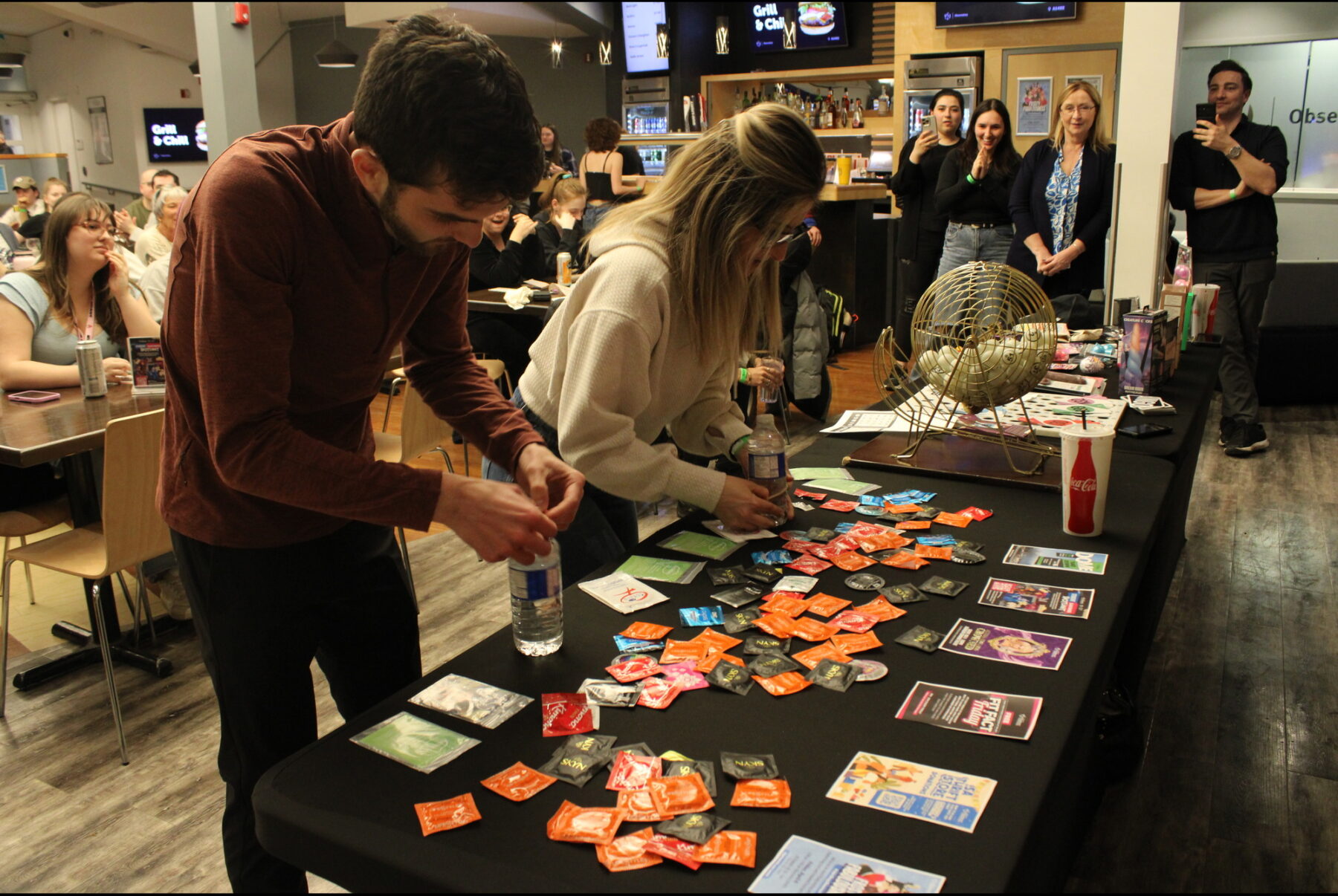
Over the course of 10 games, one of which included a hilarious tiebreaker where two participants raced to stretch a condom over an entire water bottle without it breaking, the first to succeed was declared the winner.

Two participants race to break a tie by stretching condoms over water bottles during Dirty Bingo, held on Wednesday, April 2, in the Observatory. The first to cover the bottle without breaking the condom won the round.
Two participants race to break a tie by stretching condoms over water bottles during Dirty Bingo, held on April 2 in the Observatory. The first to cover the bottle without breaking the condom won the round. Photo credit: Ana Silva

Students got more than just a chance to win. They got an experience.

“There was a time we only got nine games in because the fire alarm went off,” Marshall said laughing. “And one year, the last game of the year had to be cancelled because of an ice storm in April.”

Throughout the night, Marshall and Caring interacted directly with the crowd. Students picked the bingo numbers themselves, adding a fun twist to each round. After five games, players got a break to grab drinks, stretch out and gear up for more chaos.

For long-time fans like Fiona Smith, a student in the radio broadcasting program, the event is more than just a night out — it’s a monthly ritual.

Fiona Smith, a student in the radio broadcasting program, celebrates being the first winner of the night at Dirty Bingo, held on Wednesday, April 2, in the Observatory.
Fiona Smith, a student in the radio broadcasting program, celebrates being the first winner of the night at Dirty Bingo, held on April 2 in the Observatory. Photo credit: Ana Silva

“I’ve been going ever since I started college,” Smith said. “There’s nothing like this anywhere else, not to the same calibre that Algonquin does it. They do an amazing job of making sure everyone’s included. It makes you want to come back every single time.”

Another regular, Bryden Lessard, agreed.

“It’s really fun,” he said. “I maybe wouldn’t bring your parents.”

Marshall, however, noted that for some, it’s a family affair.

“The students bring their parents, too,” she said. “So it becomes a multi-generational, fun night out.”

For Caring, it’s all about the impact.

“There were a couple of guys on the football team that came out after seeing how open their friends were with me joking around with them,” she said. “That’s the big thing, knowing people can enjoy themselves, have a good experience and maybe even change their lives.”

This was the last Dirty Bingo of the academic year, but fans of the event won’t have to wait too long. As Marshall reminded the crowd, she and Caring will be back in the fall to do it all again.

Algonquin Times horoscopes
Algonquin Times on Instagram
Follow Algonquin Times on Instagram
Algonquin Times podcast
Algonquin Times on Instagram
Algonquin Times horoscopes
Algonquin Times podcast
Follow Algonquin Times on Instagram

Stay Informed

Sign up for our newsletter

Subscribe

* indicates required