Festival season is here. Are concerts becoming a luxury for AC students?

Music-loving students at Algonquin College are finding different ways to combat rising concert prices amidst high living costs.
Photo: Mila Leclair
The Furious Bongos, a Frank Zappa tribute band, performing a show at Salle Jean-Desprez in Gatineau on Sept. 5, 2024.

Festival and concert tickets are more costly than ever, but students like Lucas Bear are enjoying the best of both worlds by volunteering at events to save money without sacrificing fun.

“After a while, I started noticing the volunteer community in Bluesfest, and someone told me that if you volunteer, you’d get to go for free,” Bear said. “I started volunteering every year since then. I started volunteering for CityFolk, and even Dragon Boat. I realized if I volunteer for stuff, I can start seeing the shows for free.”

Bear, a tourism and hospitality student, has made good use of his resources by getting involved with the festival community and fostering helpful connections.

Lucas Bear enjoying an afternoon beer at the Wolves Den on May 28.
Lucas Bear enjoying an afternoon beer at the Wolves Den on May 28. Photo credit: Mila Leclair

“It gives you more opportunities to meet other people in the space to give you a spare ticket or know how to get you one,” Bear said. “Once you are part of the concert community, it gets a little bit easier and a little bit cheaper. People will know you’re a concert person and think of you.”

Single-band concerts can be different because volunteering is not always an option. Resellers are a root cause for limited tickets and skyrocketing prices. Business marketing students Lotus Fakhrani and Abigail Mehari are adapting to inflated costs by finding second jobs to balance with school.

“It’s so expensive. It’s unaffordable to go to a concert at this point. Especially when you work minimum wage and you’re doing part-time because you also have school,” Fakhrani said. “It was almost $1,000 just for regular general admission for The Weeknd in Toronto. That’s why I went to the Montreal one, because it was $300 and it’s all floor.”

Many concert-goers who want to save money will purchase tickets with an obstructed view for a discounted price.

“It is a luxury going to front row concerts,” Mehari said. “The cheaper (tickets) are not the best seats either. You’d be far back, you can barely see the artist in front performing, and it doesn’t even sound right.”

Music lovers are sticking to what works when it comes to affording live events.

“I’m going to Montreal for My Chemical Romance. I might be going to the HOPE Volleyball SummerFest and I think I’m going to the Ottawa Jazz Festival, but those are as volunteering,” said Neve Gerow, a music industry arts student. “I noticed (concert) prices have definitely gone up. The ones I like to see are more expensive. Smaller acts are more affordable, but the bigger ones aren’t. The prices can be pretty high.”

Smaller live events held at local pubs and music venues can be a great outlet for students looking to dive into the music scene and save money, all while supporting local artists.

Posters advertising upcoming events at the Algonquin Commons Theatre on May 28.
Posters advertising upcoming events at the Algonquin Commons Theatre on May 28. Photo credit: Mila Leclair

With bigger festivals like Escapade, Bluesfest and Osheaga coming up, students are weighing their options and contemplating affordability.

“I saw the lineup for Osheaga and every single day has at least three artists that I love,” Fakhrani said. “Then I saw that the tickets are almost $400 for each day. This is too unaffordable, I just can’t do it.”

Bands like The All-American Rejects have found a creative solution to regain control of their affordability and accessibility by performing at house parties on their latest tour across the United States. This eliminates predatory resellers and boosts fan engagement.

Here’s what Bear thinks about ticket scalping today.

“The upselling of tickets by scalpers is an issue even more so now. It’s just going to keep on making tickets rise in cost. In a weird way, (resellers) see this as a thing that people are going to buy anyway, so they keep charging more,” Bear said. “I’m not sure if that’s really on us for spending the money, or scalpers for taking advantage of it.”

Moose Hide Campaign is trying to end violence one pin at a time

Algonquin College students wore pins made of moose hide on May 15 to raise awareness of violence against women and children
Photo: Skyla Murray
Summer Wabasse and Hollie Sabourin write letters to their members of Parliament.

The Moose Hide Campaign is an Indigenous-led grassroots initiative to end violence against women and children across Canada. It was started in British Columbia, along a stretch of Highway 16, known as the Highway of Tears because of the high number of disappearances that have occurred along it.

The Moose Hide Campaign was started by Raven Lacerte from Lake Babine First Nation and her father, Paul Lacerte from Carrier First Nation. They sell pins made of moose hide on the campaign’s official website.

On May 15, in the AC hub at Algonquin College, the Mamidosewin Centre and Project Lighthouse got together to encourage students to write letters to their member of Parliament. Moose hide pins were set out for students to wear, with the hopes of raising awareness of, and putting a stop to, violence against women and children.

“Unfortunately, domestic violence and violence against children happens everywhere,” said Summer Wabasse, the event coordinator for the Mamidosewin Centre. “It can happen here at the college, and I’m sure that some of our students are affected by this issue. And it’s lovely to be able to stand with them, and show them that we care and that there are resources available for them.”

Summer Wabasse, the events organizer for the Mamidosewin Centre.
Summer Wabasse, the events organizer for the Mamidosewin Centre. Photo credit: Skyla Murray

According to Statistics Canada, one in three women have reported experiencing violence in their lifetime. The Moose Hide Campaign aims to raise awareness and empower people to end violence against women and children. Pins made from moose hide are worn as a symbol of solidarity and empowerment on this day.

Red Dress Day, which happened on May 5, is another movement designed to raise awareness of violence against women and children. Red dresses are hung on May 5 due to the belief among some First Nations tribes that the spirits of the deceased can only see the colour red.

“So we did recognize Red Dress Day here at the college by putting red dresses all around campus that displayed facts about Red Dress Day and about different women who have been impacted,” said Wabasse. “The two events are very inherently tied together, just with missing and murdered indigenous women, a lot of those cases are caused by domestic violence.”

Moose hide pins are laid out for students to wear to show their support.
Moose hide pins are laid out for students to wear to show their support. Photo credit: Skyla Murray

Wabasse emphasized the significance of the Moose Hide Campaign, highlighting its impact and the vital message it aims to share.

“I think the Moose Hide Campaign Day is great,” said Wabasse. “I mean, it’s a nationwide campaign. So this is what we do here during the summer for Algonquin College because it falls every year on May 15. But nationwide, they have these huge marches with thousands of people, and there are a bunch of different campus partners like us all over Canada. So it’s definitely a far reach considering how new the campaign is.”

Algonquin College computer engineering student launches indie game on Steam

Conrad Joshi turned a side project into his first publicly released video game
Photo: Matthew Grieve
Conrad Joshi sits with his laptop with his Unreal Engine code open.

Conrad Joshi, an 18-year-old Algonquin College student studying computer engineering, has created and released his own indie video game on Steam.

Balancing studies and solo development, he built Wraith, a rogue-like first-person shooter under his self-made studio, ConnorADever, and documented the process on YouTube.

Conrad Joshi’s video game Wraith, available on Steam and was published by ConnorADever.
Conrad Joshi’s video game Wraith, available on Steam, was published by ConnorADever. Photo credit: Matthew Grieve

While most students are juggling homework and exams, Joshi has been tackling academics on top of pursuing his passion for game development.

Steam, developed by Valve, is an online distribution platform offering various services related to video games, with over 132 million monthly active users. It’s a great stepping stone for aspiring developers like Joshi, who released his game on Steam on April 4.

The initial excitement of starting a project often drives developers, but maintaining motivation becomes challenging once that spark fades.

“The hardest parts are once you have a new idea, it’s easy to have the motivation to work on it,” said Joshi. “But after that, after you’ve created a base and have a proof of concept, then it’s about finishing it to make a product people can play. That part’s the hardest.

“You start to get in your own head, is this a good idea? You become more realistic about what you can and can’t do,” said Joshi. “It turns into tedious work.”

Balancing school with a personal passion project can be demanding, but for Joshi, managing both has come naturally.

“Algonquin College has been easy, considering I’ve worked with computers a lot,” said Joshi, explaining his strategy for balancing school work with his game development. “It was just finishing the assignment in the two hours after they gave it to me, and the rest of the time is free to work on the game, so it hasn’t been too hard.”

According to Howard Rosenblum, the program coordinator for computer engineering, independent learning is important for a student’s self-growth.

“I encourage students to work on side projects to improve their technical and time management skills,” said Rosenblum. “It is also a low-risk introduction to entrepreneurship.”

Conrad Joshi using his laptop to create his game on Unreal Engine
Conrad Joshi uses his laptop to create his game on Unreal Engine. Photo credit: Matthew Grieve

That balance between both responsibilities has given him time to develop his game and refine it through ongoing feedback, including from peers.

“I’m very impressed. He was always passionate about game development,” said Tyrell Jennings, a computer science student at Algonquin College who playtested the game. “Doing school and making the game at the same time is definitely very difficult and impressive.”

Conrad offered advice for Algonquin College students who also want to make a video game.

“Honestly, just start. You’re never going to feel completely ready or like you know everything,” said Joshi.

“Even after releasing my first game, if I made it again, I’d have to relearn a lot. The whole time you’re learning. Just download something you can make a game with, and start looking up how to use it on YouTube. Just start!”

What should the Ottawa Senators do on draft day? AC students have tips for team brass.

With draft day slowly creeping up amid the end of the Stanley Cup playoffs, Algonquin College students have a lot of questions for the local team
Photo: Scott Crowell
Two Senators fans show off custom jerseys at a Game 3 tailgate.

Algonquin College students are weighing in on what the local NHL team should do ahead of the draft and on draft day.

The 2025 NHL Draft happens June 27 and June 28 in Los Angeles at the Peacock Theatre.

Ottawa Senators fans waving playoff rally towels as players burst onto the ice before puck drop
Ottawa Senators fans waving playoff rally towels as players burst onto the ice before puck drop. Photo credit: Scott Crowell

According to TSN’s mock draft as of May 2025, the Senators could draft a forward which fits the team’s timeline and current needs.

However, there is a looming question: could general manager Steve Staios end up trading the first-round pick?

Staios did say that they will “highly likely” keep the first-round pick, but nothing is ever certain when it comes to a general manager’s word in the National Hockey League.

The Senators were defeated in the first round of the 2025 Stanley Cup playoffs by the Toronto Maple Leafs in six games.

Algonquin College Senators fans have some mixed feelings as the draft approaches to begin a crucial off-season.

Ottawa Senators fans surround CTC for Game four pre game tailgate
Ottawa Senators fans surround CTC for a Game 4 pre-game tailgate. Photo credit: Scott Crowell

Nathan Leitch, an accounting student at the college, believes there should only be two ideas in the management plan heading into the draft.

“The play should be either you use the pick and go draft a forward, which they need badly to insulate the bottom six,” Leitch said. “Or you trade the pick and go get an impact forward for the current vision of the team.”

Myles Frech, an HVAC student, has a very strong opinion on why the Senators should trade the pick.

“They should be moving late first-rounders like this pick to rebuilding or cap-strapped teams who have good players,” Frech said. “I personally would like a guy like Alex Tuch from Buffalo or Marco Rossi from Minnesota.”

With a sour taste in his mouth after losing to the Maple Leafs, Senators fan and radio student Jakob Casey wants them to get more aggressive with spending draft capital.

“After finally making the playoffs, they should most certainly be more enticed to spend draft capital like first-round picks, even the first-rounder in this year’s draft,” Casey said. “I fully believe even on July 1, free agency, they should be aggressively buying for the bottom six of the forward core.”

Ottawa has a salary cap space of $15 million to spend on extensions or signing free agents. They have eight current unrestricted free agents and two restricted free agents on expiring contracts. The team can either sign the players to new contracts or let them hit the free agency.

The Senators are forfeiting their first-round pick in the 2026 draft because of a league-imposed penalty related to the Evgenii Dadonov no-trade clause complications in 2021.

Algonquin College researchers develop new greenhouse design to tackle food insecurity in Canada

A research team from Algonquin Centre for Construction Excellence has taken the creative route to help Canada produce more fresh, organic fruits and vegetables locally
Photo: Vasuman Ravichandran
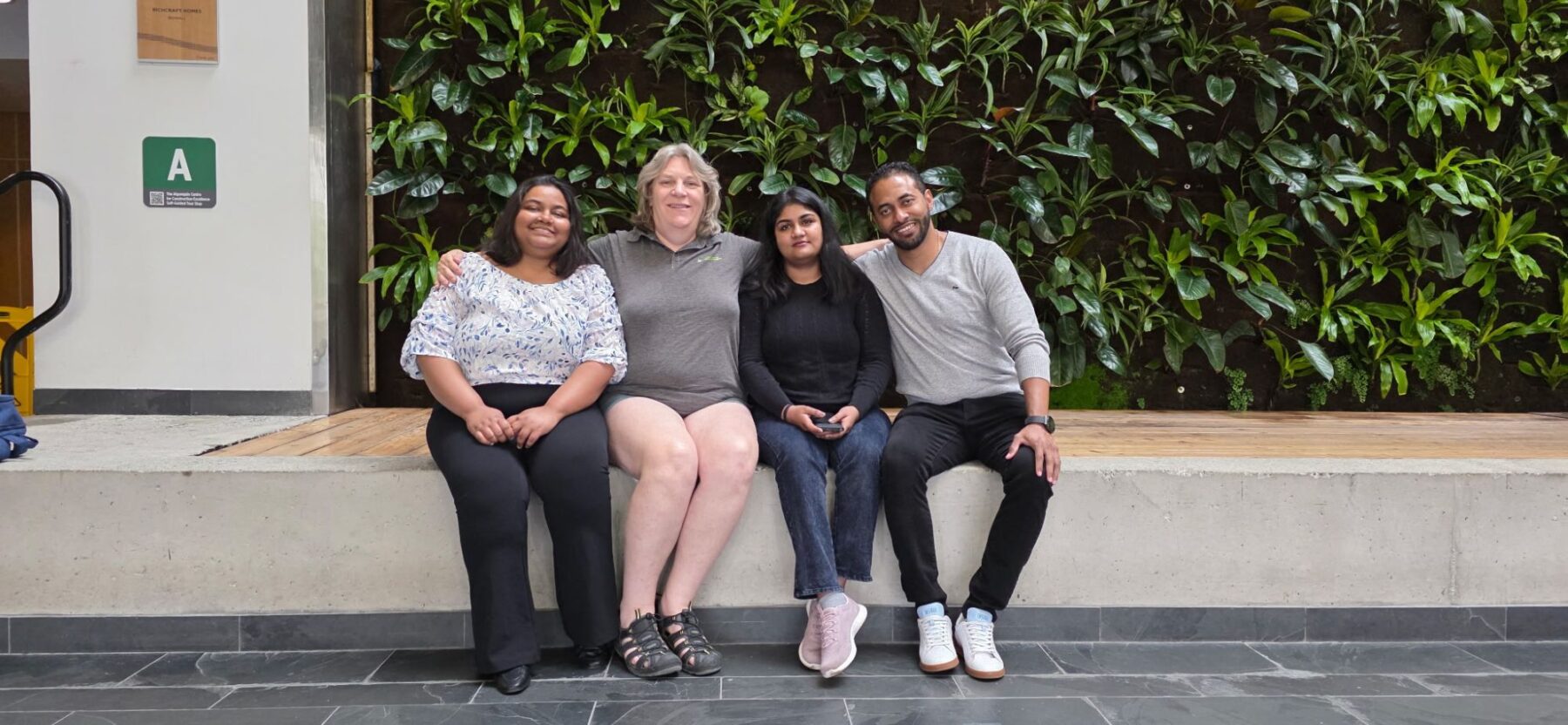
The aquaponic greenhouse team (from left to right) Amrisha Singh, Carolyn Lorimer, Chitra Omanakuttan Sreerangathu and Jose Angulo.

A student research team led by professor Carolyn Lorimer from the Algonquin Centre for Construction Excellence (ACCE) has developed an innovative greenhouse design that could become the long-term solution for Canada’s food insecurity crisis.

Canada’s fleeting summers and long winters mean that the only way to produce fruits and vegetables year-round is by using greenhouses. So what’s stopping Canadians from doing that?

Greenhouses in Canada rely heavily on natural gas for heating and lighting during winter. This results in high energy bills and significant greenhouse gas emissions, according to Greenhouse Canada.

To produce locally at a fair price for consumers, greenhouses need to be completely redesigned to make it a cost-effective option, according to Lorimer.

For Lorimer and her team, even a problem as complex as this can be untangled by their penchant for innovation.

Led by her expertise, students at ACCE have designed a greenhouse that is wheelchair accessible, cost-effective, energy efficient, beyond self-sustaining and more than eco-friendly. It will absorb far more carbon than is produced in constructing and maintaining the facility, according to Lorimer.

The greenhouse will look something like this.
The navy blue roof will support solar panels, and the water tanks below will be home to the fish
The greenhouse will look something like this.
The navy blue roof will support solar panels, and the water tanks below will be home to the fish. Photo credit: Provided by Jose Angulo

“The first step is redesigning the insulation so that the heat stays inside the greenhouse, so we don’t need to spend all that money heating it,” says Lorimer. “Plants need about 14 hours of sunlight. If the glass of the greenhouse faces south, we can use natural sunlight during the day. We’re gonna put solar panels on top to power LED lights to come on whenever we need extra light during winter.”

Chithra Omanakuttan Sreerangathu is one of the students who has worked on the project.

“The prototype is going to be built in Morris Island, Ont,” says Omanakuttan. “It will include a hydroponic system, where plants are grown in water (without soil). This will be integrated into an aquaponic system, where fish and plants are cultivated together in a self-sustaining ecosystem: fish waste provides a natural fertilizer for the plants. The plants filter and purify the water when they use the fish waste. The water is then recirculated back into the fish tanks.”

Jose Angulo, another student who worked on the project, offered more insight into its scope.

“The aim of this project was to implement a design that is also scalable,” says Angulo. “It can be built on different sites, according to the needs of different communities. For this particular plan, it can produce 6,500 kilograms of fish annually, not just produce.”

According to Statistics Canada, over 10 million Canadians currently live with food insecurity. Right now, buying local is not a sustainable option unless it’s cheaper to do so. The nation’s challenge is to find a way to become self-sufficient when it comes to food.

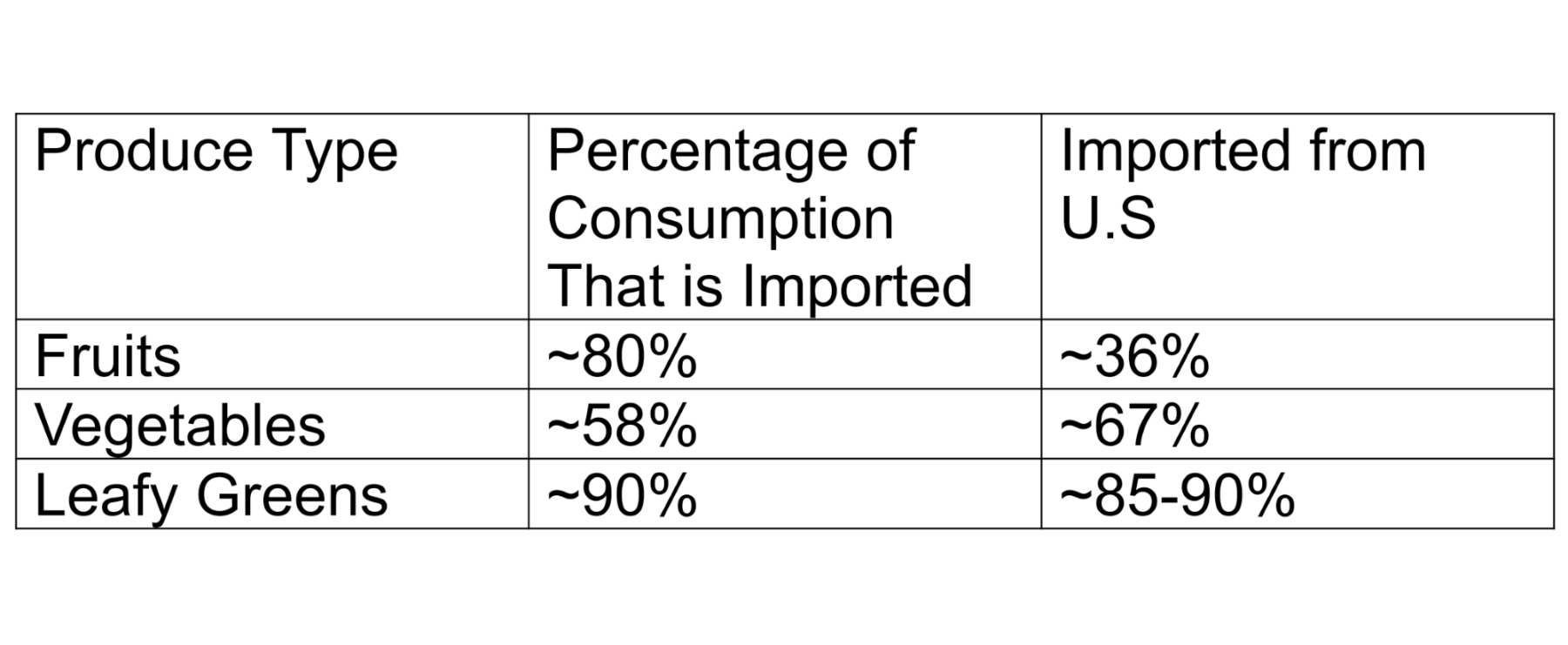
According to Canada’s Food Price Report from 2024, Canada relies on imports for roughly 30 per cent of its food and beverage consumption.

When it comes to dairy and meat products, Canada is largely self-sufficient. A large portion of the imports is, in fact, fruits and vegetables.

Table of Canadian reliance on imports.
The table shows Canada's reliance on imports, according to Canadian Agri-food Policy Institute and a study done by York University. Canada is the 6th largest food importer in the world, according to York University's study Food Policy for Canada. Photo credit: Vasuman Ravichandran

Lorimer’s greenhouse design would help Canada rely less on imports by producing locally grown fruits and vegetables according to the needs of communities across the country.

“My long-term goal with this project is to make inexpensive, fresh, organic produce and fish available to us, forcing Loblaws to reduce their prices,” says Lorimer. “Calculation-wise, we’ve shown that this prototype produces way more energy than is required for it to operate. It is more than enough energy to charge delivery vehicles that can stop by.”

According to Lorimer, the design plans for the greenhouse are available to anyone for free.

“If I give you a dollar, and you give me a dollar, we each have one dollar,” says Lorimer. “But if I give you an idea and you give me an idea, we each have two ideas.”

Should Algonquin College offer Indigenous students free tuition?

The University of Ottawa announced it will be offering free tuition to members of the Algonquin First Nations. A prof says the college should consider following suit.
Photo: Mickey Banks
On May 6 the University of Ottawa announced it is offering free tuition to Indigenous students, the fourth university to do so.

Algonquin College should consider following a local university’s lead in offering free tuition to First Nations students, a professor says.

On May 6, the University of Ottawa announced that federally recognized members of the Algonquin First Nations can now enrol free of tuition fees.

The University of Ottawa is the fourth university in Canada to offer free tuition to Indigenous students, with Humber College in Toronto being the only college to do so, according to Humber’s website.

Algonquin College declined to say if it would also offer free tuition to students from Algonquin First Nations communities. However, in an emailed statement, the college highlighted its commitment to helping Indigenous students.

“We are continually exploring new ways to enhance access and inclusion, and we value ongoing dialogue with our Indigenous community partners as part of that commitment,” the college said.

The college also offers various financial assistance programs to Indigenous students.

The college has five scholarships, 15 bursaries and four awards that are exclusively for Indigenous learners, as well as nine bursaries and two other awards that give them special consideration. Indigenous women can also apply for the “We Saved You a Seat” entrance awards for women in the STEM fields, according to the college’s website.

But is it enough?

Robert-Falcon Ouellette, an associate professor at the University of Ottawa who specializes in Indigenous education, believes the college should consider following the university’s lead.

“As an institution situated on unceded Algonquin territory, there is both a unique opportunity and a responsibility to support Indigenous learners in a tangible way,” Ouellette said in an email.

The term “unceded” refers to the fact there is no formal treaty between the Algonquin people and Canada.

Ouellette says the University of Ottawa’s decision on tuition is a “significant act of reconciliation.”

“Historically, education in Canada was used as a tool to assimilate and erase Indigenous identities and cultures,” Ouellette said. “Residential schools, often staffed by teachers trained through colonial systems, played a central role in this. So, when a university takes concrete steps to support Indigenous learners, it is not just policy — it is part of a larger healing journey.”

News briefs: René Amilcar prepares to leave OC Transpo after four years in charge

Top stories in your community and around the world as noted by Algonquin Times journalists​

Local

CBC Ottawa: OC Transpo’s general manager of transit services, Renée Amilcar is leaving her position at the agency.

City manager Wendy Stephanson stated in a memo that Amilcar will be pursuing new career opportunities following four years in the organization.

The director of transit service delivery and rail operations for OC Transpo, Troy Charter, will serve as the interim general manager after Amilcar departs, according to Stephanson.

Amilcar’s last day will be on July 18.

National

CTV News: Many Manitoba First Nations have evacuated their homes and people are looking for shelter in Niagara Falls, Ont. in the midst of wildfires.

Niagara Falls Mayor Jim Diodati told CTV News Toronto the city is doing its part to make sure “everybody in Manitoba is safe.”

Manitoba’s provincial government declared a state of emergency in effect for 30 days, but it could be extended.

International

CTV News: U.S. President Donald Trump is looking to block all foreign students from studying at Harvard University.

Trump signed an executive order on Wednesday saying national security would be threatened if Harvard were to continue hosting foreign students on its campus in Cambridge, Mass.

Harvard officials declared that Trump’s decision to stop Harvard from enrolling foreign students creates an environment of fear, concern and confusion. Harvard immigration services director Maureen Martin said many international students are asking about transferring from the university.

Algonquin College launches AI hub with Amazon Web Services

Students can expect a big improvement in local artificial intelligence innovation, all thanks to the launch of the new AI Accelerator Hub
Photo: William Barritt
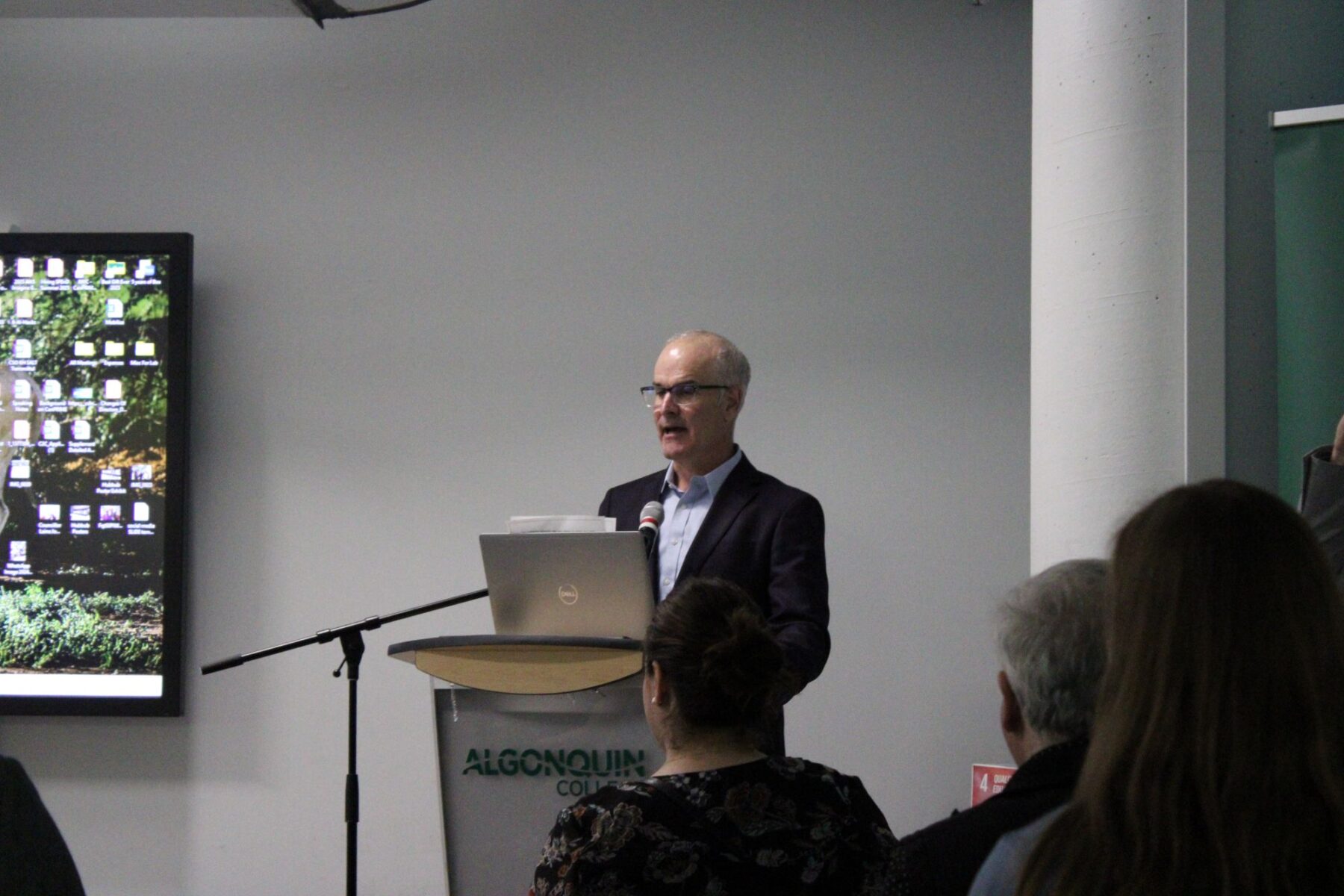
Kevin Holmes, the director of the Social Innovation Lab at Algonquin College, giving a speech on the new AI Accelerator Hub. photographed on May 27.

Algonquin College and Amazon Web Services have started a new artificial intelligence “hub,” hoping to boost the implementation of AI in community and business sectors.

The college’s applied research group hosted a launch for the Artificial Intelligence Accelerator Hub (AAH) on May 27 in the C-building.

Artificial intelligence student Andrei Grobnic enjoyed the presentation but wants to see the plan followed through before he makes a judgment on the partnership.

“I like what they showed, it seems like a great partnership, but presenting it is one thing, actually doing it is what matters,” said Grobnic.

The director of the applied research program, Phillip Dawe, summarized the plan for the AAH and what students and faculty can expect in the collaboration with AWS

“Algonquin is about making stuff happen, and the AI Accelerator Hub builds on our strong foundation in AI academic programming, research, and innovation,” said Dawe.

The director of the applied research program, Phillip Dawe begins launch event.
The director of the applied research program, Phillip Dawe, begins launch event on May 27. Photo credit: William Barritt

The AAH is an applied research project designed to accelerate the implementation of artificial intelligence in community and business sectors.

They will offer specialized training programs led by experts in the field to improve efficiency and decision-making.

AWS is a computing platform offering over 200 services, including networking, analytics and storage.

AWS has offices in 36 locations across the world, including Calgary and Montreal.

Morgan Lim, the AWS head of academic research strategy for Canada, described the company’s contribution to the collaboration.

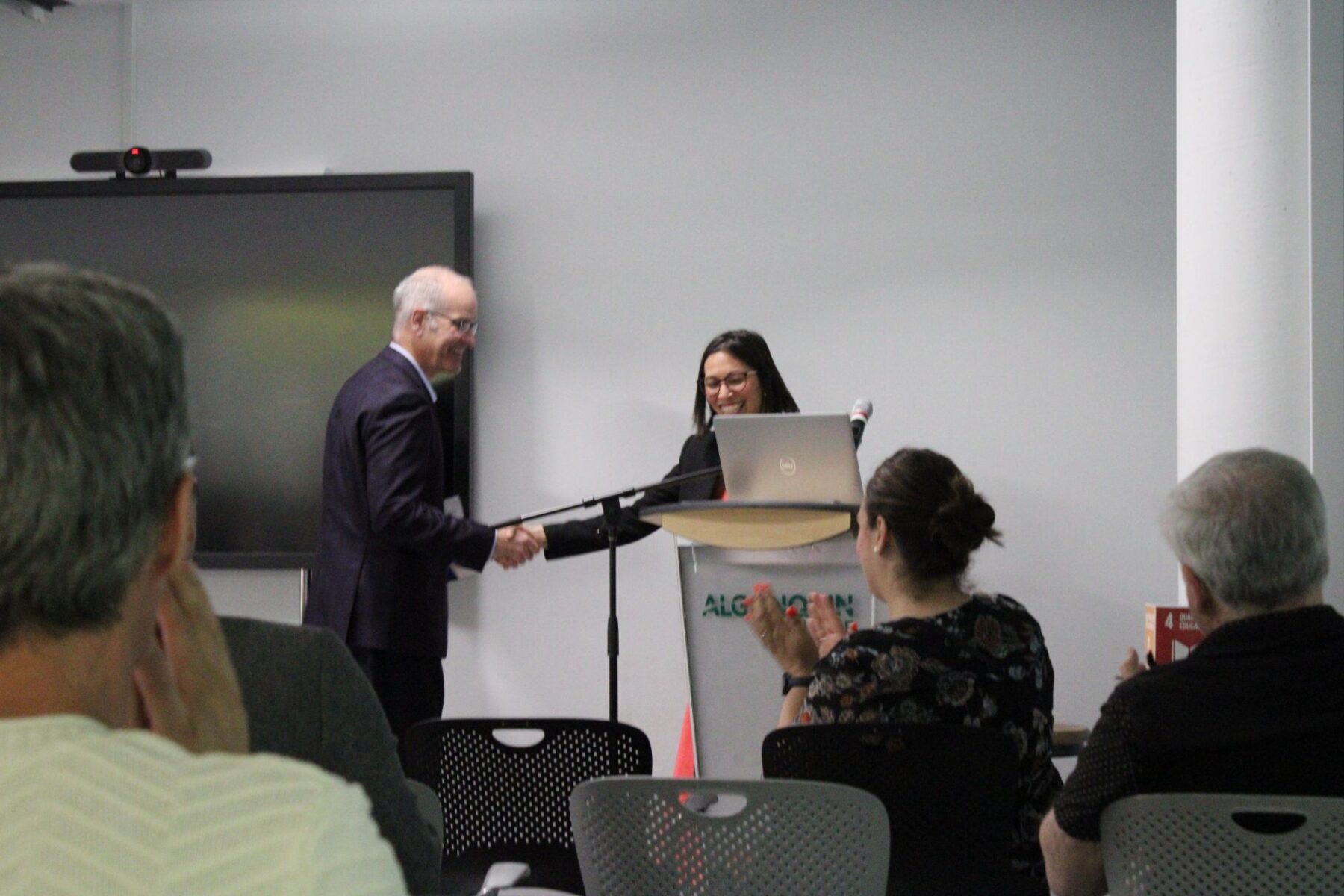
Morgan Lim being welcomed to the stage by Phillip Dawe
Morgan Lim being welcomed to the stage by Phillip Dawe on May 27. Photo credit: William Barritt

We are committed to bringing the best of our training, enablement and expertise to Algonquin College,” said Lim. “We will support the hub by providing research credits, grant applications support and technical expertise.”

Kevin Holmes, senior program manager and the director of the Social Innovation Lab at Algonquin College, said AWS was the right choice for the project.

Strictly for reliability, and hope for scalability, and that’s what AWS is known for,” said Holmes. “Their infrastructure is incredibly reliable, and that’s why we went there.

Holmes has seen AWS’s capabilities through his work with the Children’s Hospital of Eastern Ontario (CHEO).

During the COVID-19 pandemic, the Social Innovation Lab collaborated with CHEO to develop a clinical research tool called InsightScope. AWS developed the InsightScope software to determine the necessary treatment for patients and help increase evidence-based decisions in healthcare.

For more news about applied research plans, check out the college’s applied research website.

News briefs: Ottawa constable convicted of assault in 2023, ordered to resign

Top stories in your community and around the world as noted by Algonquin Times journalists​

Local

CTV Ottawa: Ottawa Police Services Const. Goran Beric has been ordered to resign from the force. Beric was found guilty of discreditable conduct and insubordination.

The hearing officer, former Ontario Provincial Police Supt. M.P.B. Elbers said Beric will be fired if he doesn’t resign within the next seven days.

In October 2023, Beric was found guilty of assault and assault with a deadly weapon after striking a man with his baton and pinning him down by his neck for over two minutes.

Beric’s lawyer has requested that he be demoted instead.

National

CTV news: In response to a U.S. court striking down President Donald Trump’s tariffs on most countries, Prime Minister Mark Carney said he “welcomes” the decision.

Carney said it was in keeping with Canada’s position that the tariffs were unlawful and unjustified. But he mentioned that there are still tariffs on aluminum, steel, and the auto sector, as well as threats of other tariffs.

Trump has not yet commented on the court’s decision. However, White House press secretary Karoline Leavitt has spoken out against it.

International

CBC news: The Israeli government has approved the establishing of 22 new Jewish settlements in the West Bank.

The move has received criticism from multiple sources, including Britain’s minister for the Middle East.

Britain, along with Canada, and France, recently called for the war in Gaza to end.

Could a suspended AC program miss out on launching the next Miss McLeod?

Performing arts grad drops third album ahead of summer Bluesfest performance
Photo: Supplied by Marlayah Mcleod
Miss Mcleod singing during a musical performance at Room 104 on Clarence Street in downtown Ottawa.

Marlayah McLeod credits a soon-to-be silenced Algonquin College program for getting her closer to her musical dreams.

In an interview with the Algonquin Times, the singer expressed how the performing arts program shaped her as a performer and an artist.

“That program helped me get one of my dream roles,” McLeod said. “It’s really life-changing, it opens your eyes to the world of the arts.”

People might wonder why a program producing strong talent may be closing.

The college announced earlier this year performing arts was one of 41 programs being suspended as it faces major budget deficits.

Performing arts program coordinator and professor Teri Loretto said in an email that there was no warning to the program closure and she lamented an arts program being cut when the COVID-19 pandemic showed people how much they needed art.

“It’s usually performing arts grads who sing at AC convocations, act in film and media projects, so their loss will be felt across campus in many ways, for years to come,” Loretto said.

“It was an incredibly diverse and inclusive group of students, with really unique perspectives. You won’t find learners like them anywhere else on campus. And losing my own job after 6 six years full-time and 18 years part-time? It’s painful.”

McLeod graduated in spring 2024, months before AC announced the decision to cut the performing arts program, allowing her journey to fully begin. Fast forward a year — McLeod has released her third studio album, When A Flower Dies.

Miss McLeod&squot;s cover art for her recent album , "When A Flower Dies".
Miss McLeod's cover art for her recent album , "When A Flower Dies". Photo credit: Supplied by Marlayah McLeod
Track list of Miss McLeod&squot;s newest album, "When A Flower Dies".
Track list of Miss McLeod's newest album, "When A Flower Dies." Photo credit: Supplied by Marlayah McLeod

“It’s about the story of a connection that you have with somebody dying out,” McLeod said about the meaning behind the project. “Mainly from mistreating and not being able to nurture it properly.”

McLeod considers herself a pop star and through her music, she hopes to make others feel seen and connect with it.

Being a graduate of Canterbury High School, which has a focus on the arts, she’s been putting her performance skills to use. At 17 years old, she performed at the Apollo Theatre in Harlem, N.Y. Since then, she’s sung the O Canada for an Ottawa Senators game and other events like the Liberal national convention. This summer, she will be taking over the Bluesfest stage on July 12.

“Performing in musicals has also shaped my creativity and became a big part of my identity,” McLeod said. “It’s built my on-stage confidence as well.”

Miss McLeod performing during an arts show
Miss McLeod performing during an arts show. Photo credit: Supplied by Marlayah McLeod

Her school peers and friends in the community appreciate McLeod’s talents and have high hopes for her future. Sarah Budzinski, a classmate and class rep, said McLeod motivated people around her.

“Marlayah was a constant source of inspiration for her classmates,” Budzinski said. “I’m grateful I had the opportunity to be part of the performing arts program, before it was shut down. Without it, I wouldn’t have met some of my closest friends.”

Ethan James Carty, a dance instructor from the performing arts program, said his experience was nothing short of amazing with McLeod, and he’s proud to have met and worked with her.

“I think she separated herself from others in a good way. She’s driven, she’s very talented and never turned down a challenge,” Carty said. “I really do think Marlayah is one of the most talented artists to ever come out of the performing arts program, and I see her going very far in this field.”

Miss McLeod singing during a musical performance.
Miss McLeod singing during a musical performance. Photo credit: Supplied by Marlayah McLeod

Justin Gunderson, known as J Morris, founder of the Cranium Arts Project, a local organization that provides show opportunities to local artists, set the stage for McLeod during a hip hop food drive back in 2023.

“I first discovered Miss McLeod while I worked as a radio host at CHUO 89.1 FM, then we had an interview. I could tell she was a star, something about her old school soul sets her apart from other artists in her realm,” Gunderson said.

When A Flower Dies is available on all streaming platforms.

Algonquin Times horoscopes
Follow Algonquin Times on Instagram
Algonquin Times podcast
Algonquin Times on Instagram
Algonquin Times horoscopes
Algonquin Times podcast
Follow Algonquin Times on Instagram

Stay Informed

Sign up for our newsletter

Subscribe

* indicates required