The Students’ Association Food Cupboard is finding new ways to raise money, responding to heightened food insecurity among students
Bradley Richards
Photos: Bradley Richards
September 19, 2025 Revised: September 19, 2025 11:37am
Photo: Bradley Richards
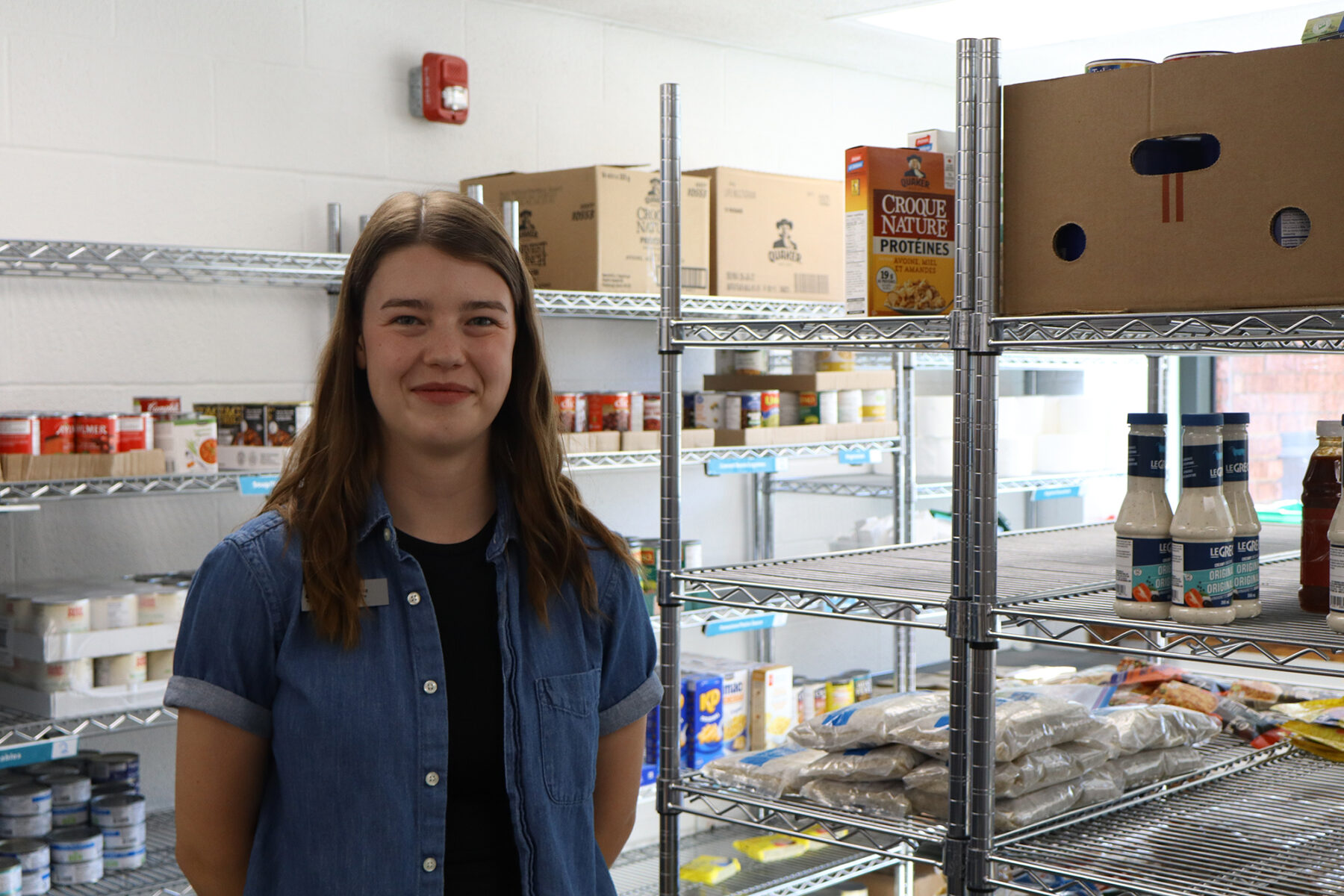
Abby Muir surrounded by food in the food cupboard in Room B102.
A new fundraising campaign partnering the SA Food Cupboard with the college’s varsity teams is set to begin Sept. 19 to address increasing food insecurity among students.
The partnership entails special Feed the Pack game days where ticket proceeds will be donated to the Food Cupboard. Food donations can also be made at the game entrances.
The first Feed the Pack games of this varsity season will take place on Friday with the Wolves women’s soccer team playing Cambrian at 6 p.m. Followed by the Wolves men’s soccer team playing Cambrian at 8:15 p.m.
This comes as one of the responses to growing levels of food insecurity among Algonquin College students, according to Food Cupboard coordinator Abby Muir.
“It keeps going up,” said Muir. “We gathered data from students visiting the Food Cupboard last fall and found that it was one in 22 students facing food insecurity, which is a crazy number.”
The increase in demand from students facing food insecurity worsened after the Ottawa Food Bank made cuts to all 98 of its local food programs this year, including the SA Food Cupboard which is now receiving around 50 per cent less since these cuts have taken effect.
“It’s been quite a huge impact,” said Muir. “We’ve had to put out notices to the students that they may not receive the same amount of food or the same variety of foods.”
Alongside the new campaign with the varsity teams, the Food Cupboard is also looking to raise funds through other events on campus, such as the SA thrift store. They also accept food donations and monetary donations in Room E114.
Students have noted the difficulties of affording food while in school.
“It’s just a really important thing that everyone needs to be aware of,” said Isabella Schwartz. “I know a lot of classmates who struggle with the prices of food.”
Isabelle Schwartz sitting outside of N-building. Photo credit: Bradley Richards
Schwartz offered a suggestion for students struggling with food insecurity.
“Meal prep. It’s cheaper, you save a lot of money doing it and you save a lot of time as well, especially as a college student,” said Schwartz.
Ward Elali, another student at Algonquin College, said she wasn’t surprised by the numbers of students facing food insecurity because of the financial challenges while in school.
“Everything now is very expensive and it’s very hard to maintain a living with school and other necessities,” said Elali. “Try to save and be on a budget at the same time, that’s what I’ve been doing.”
As more students at Algonquin face the pressure of food insecurity, the Food Cupboard provides a service that is personalized to each student with a one-on-one process.
Ward Elali standing outside of the Student Commons. Photo credit: Bradley Richards
“It can seem kind of scary and intimidating to ask for help, but there are no worries there. We’re completely confidential and we try to meet students where they’re at,” said Muir.
The SA Food Cupboard in Room B102 of the Ottawa campus. For more information about the Food Cupboard, you can visit their website. Intake forms and appointment bookings to visit the Food Cupboard can also be made on their website for students new to the food cupboard.
The residence courtyard was filled with crabapples as volunteers harvested to help reduce waste and collect fruits for use
Marcos Somarriba
Photos: Marcos Somarriba
September 18, 2025 Revised: September 18, 2025 2:32pm
Photo: Marcos Somarriba
A pile of crabapples under a crabapple tree in the residence courtyard.
Algonquin College students and staff turned the residence courtyard into a harvest site on Sept. 9, gathering crabapples from trees during this year’s crabapple event.
Hosted by Facilities Management and the School of Business and Hospitality, the event ran from noon to 2 p.m., giving students a chance to participate in a sustainability project and collect volunteer hours.
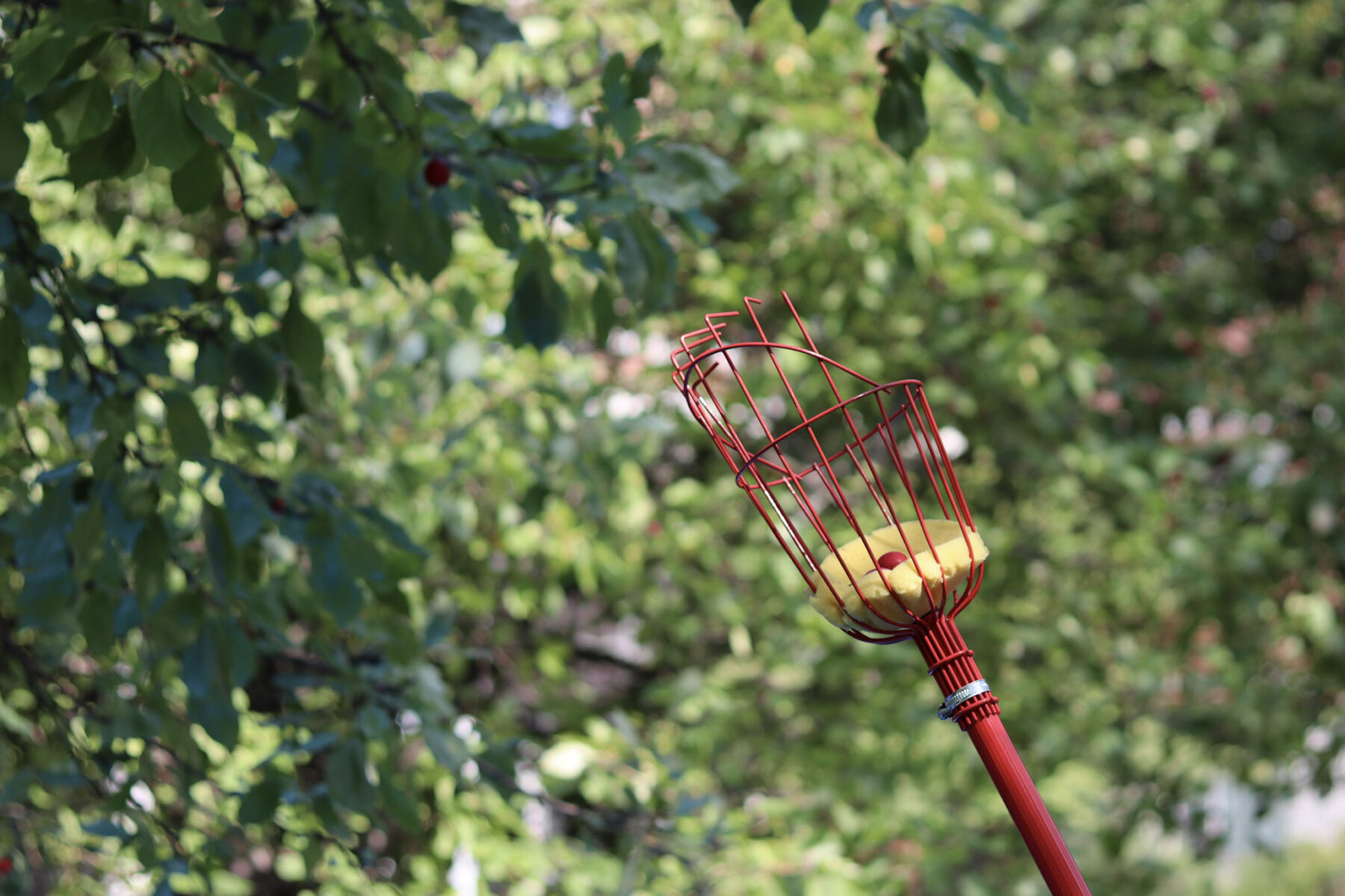
These small apples were falling everywhere as attempts were made to pick them with apple pickers, a metal pole with a basket attached at the end. Once the basket makes contact with a tree, it causes the crabapples to fall into the basket.
An apple picker with a crabapple inside. Photo credit: Marcos Somarriba
This year’s event marked the third annual crabapple harvest. The event was created to help clean up and reduce waste from fallen crabapples, while reducing the presence of wasps and other insects.
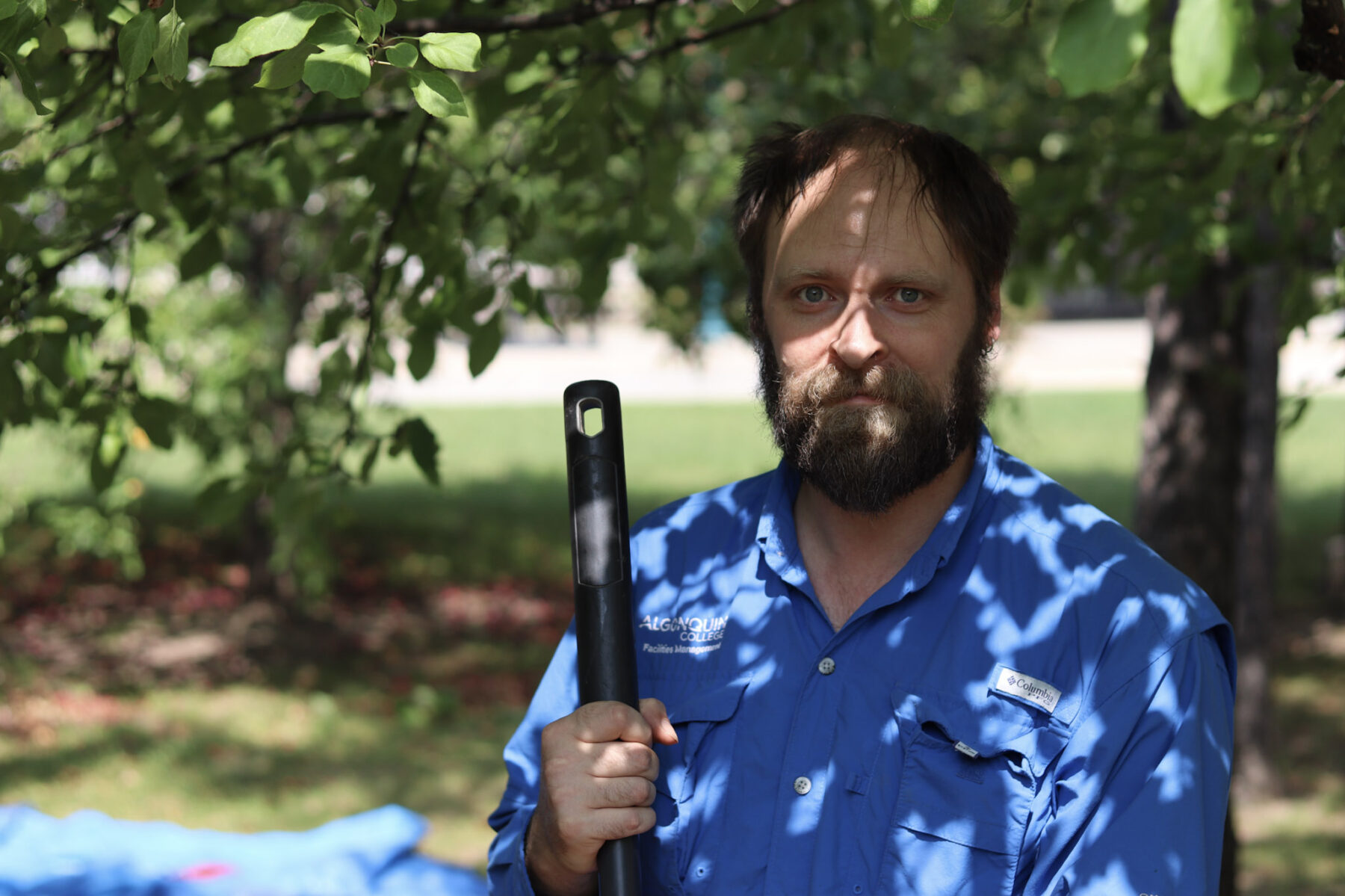
Arlen Findley, a horticulturist with Facilities Management, helped organize the event and explained where the harvested apples would go.
“With clean crabapples, we’ve donated them to various organizations,” said Findley. “The apples from today will be donated to the Canada Agriculture and Food Museum.”
Some of the crabapples that are not taken home or have no use in the college will be donated to a few organizations.
Arlen Findley, one of the organizers of the event. Photo credit: Marcos Somarriba
“We’ve been trying to reach out to any organizations that have a use for it rather than just letting it all go to waste. We’ve also let any volunteers take some home to make jams or whatever” said Findley.
The crabapples that are left at the college will be used for culinary purposes in the college.
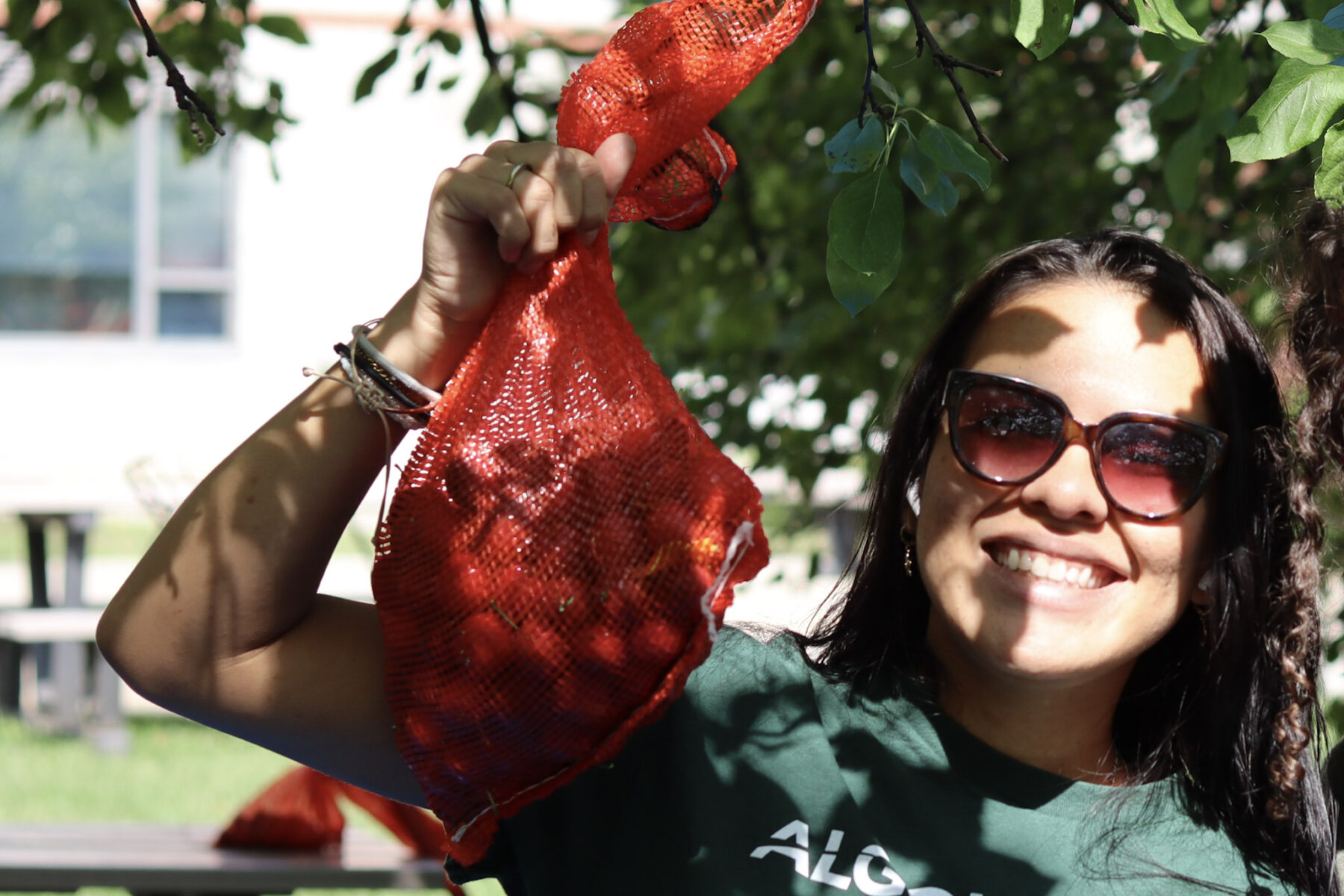
Interior design student Celeste Romero, 21, was one of the student volunteers at the event.
“I come from an island where you don’t have many fruits,” said Romero, who’s from Aruba. “When I read that we could be part of this crabapple picking event, I was interested to see the fruits on campus.”
Romero and a friend raced to see who could get the most crabapples. Soon after, they started thinking about which recipes they would make with the crabapples once they got home.
Celeste Romero holding up her bag of crabapples at the event on Sept. 9. Photo credit: Marcos Somarriba
“I think I’ll cook a pie for sure, but now that they sell alcohol almost everywhere, I might make cocktails or even my own alcohol, but I need to learn first,” said Romero.
Volunteers left the event with a reward of bags of fruit and a sense of accomplishment.
Hear students' thoughts about the effort that goes into their daily wardrobes
Jackie Beeston
Photos: Jackie Beeston
September 18, 2025 Revised: September 18, 2025 10:23am
Photo: Jackie Beeston
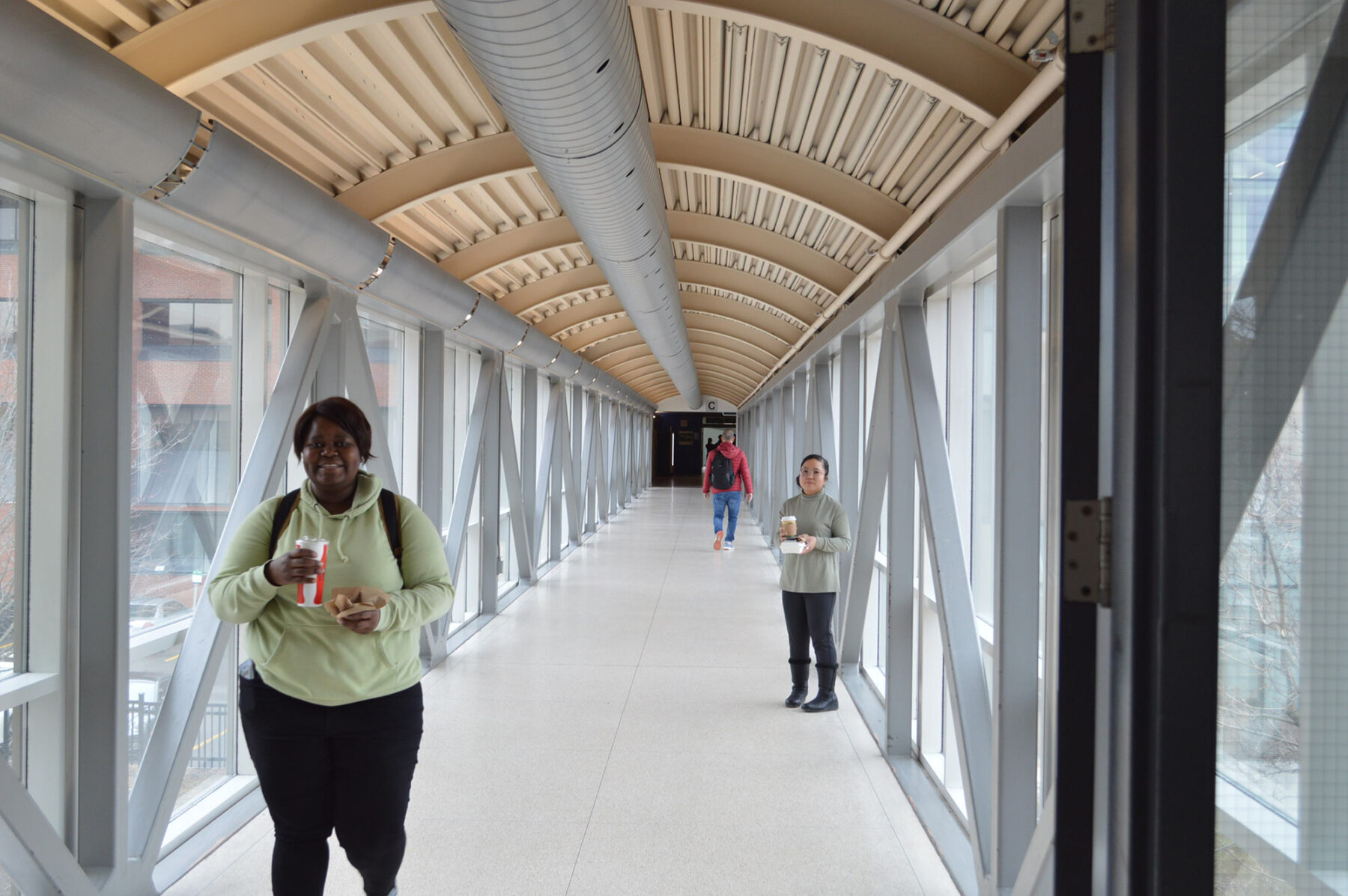
A student smiling while walking past with a drink in her hand, a student walking away and a faculty member smiling with food and drink in hand.
As classes are back into full swing for many, the campus halls are once again being filled with eager students. They could be checking out the Students’ Association thrift store, hopping off the bus, or getting a workout in at the Jack Doyle Athletics and Recreation Centre. Everyone has their unique established look within all of these spaces.
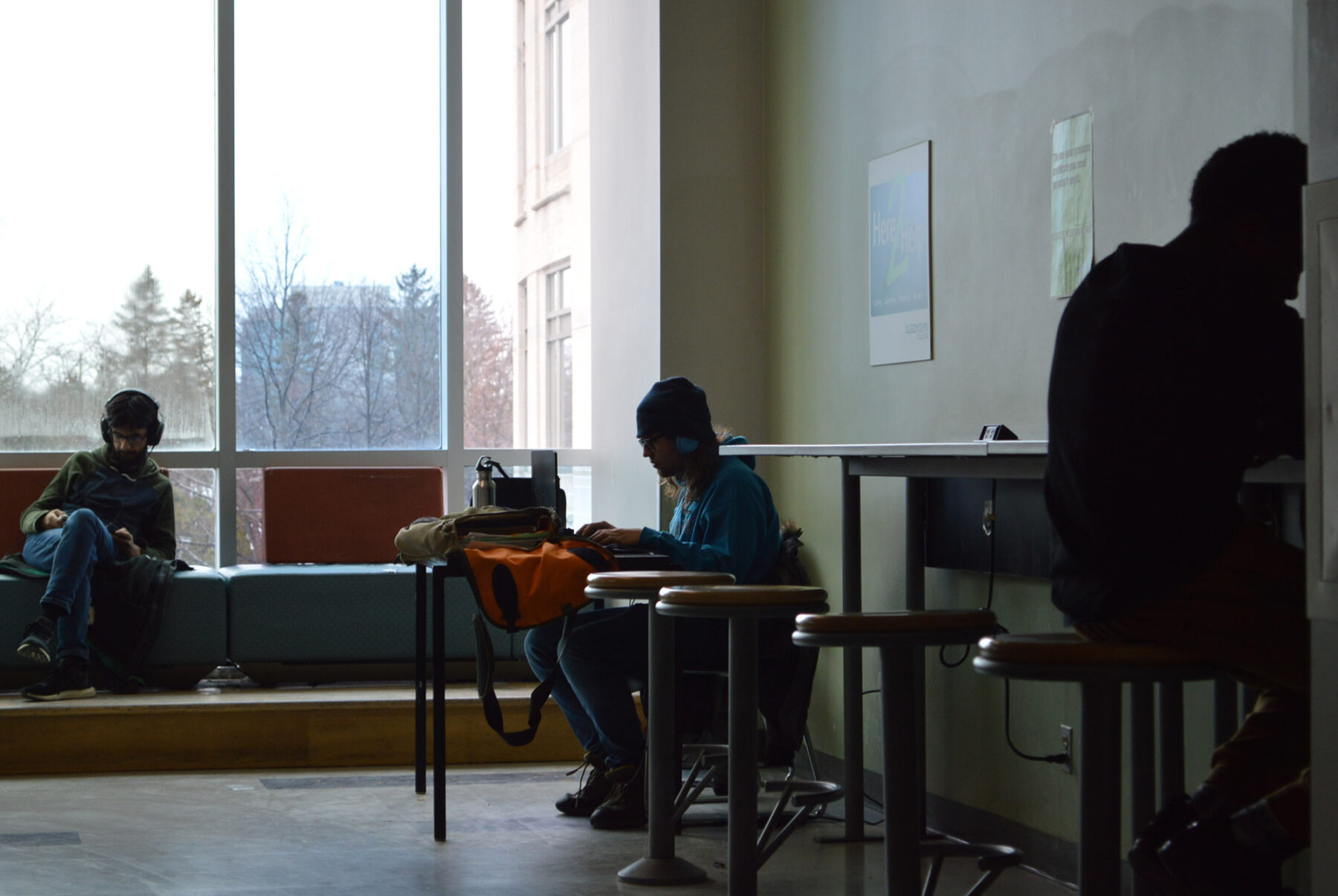
Every outfit tells a story, requiring various levels of effort. Thrifting is a great example of achieving a stylish look with minimal labour and capital.A still featuring three students using the common space in T-building to work Photo credit: Jackie Beeston
This is in contrast to high-effort outfits and the expensive nature of the crafting looks using designer brands.
Various outfits that fit these descriptions can be found at Algonquin College.
Sometimes, if it ain’t broke, don’t fix it.
Student Cole Moore sad “to be honest, it’s just what I’ve always worn” in reference to his day-to-day outfits
To some, like Alex Brown, another student at the college, “sweater weather can’t come soon enough…it’s always sweaters,” Brown said when asked about which piece of her wardrobe she’s excited to debut.
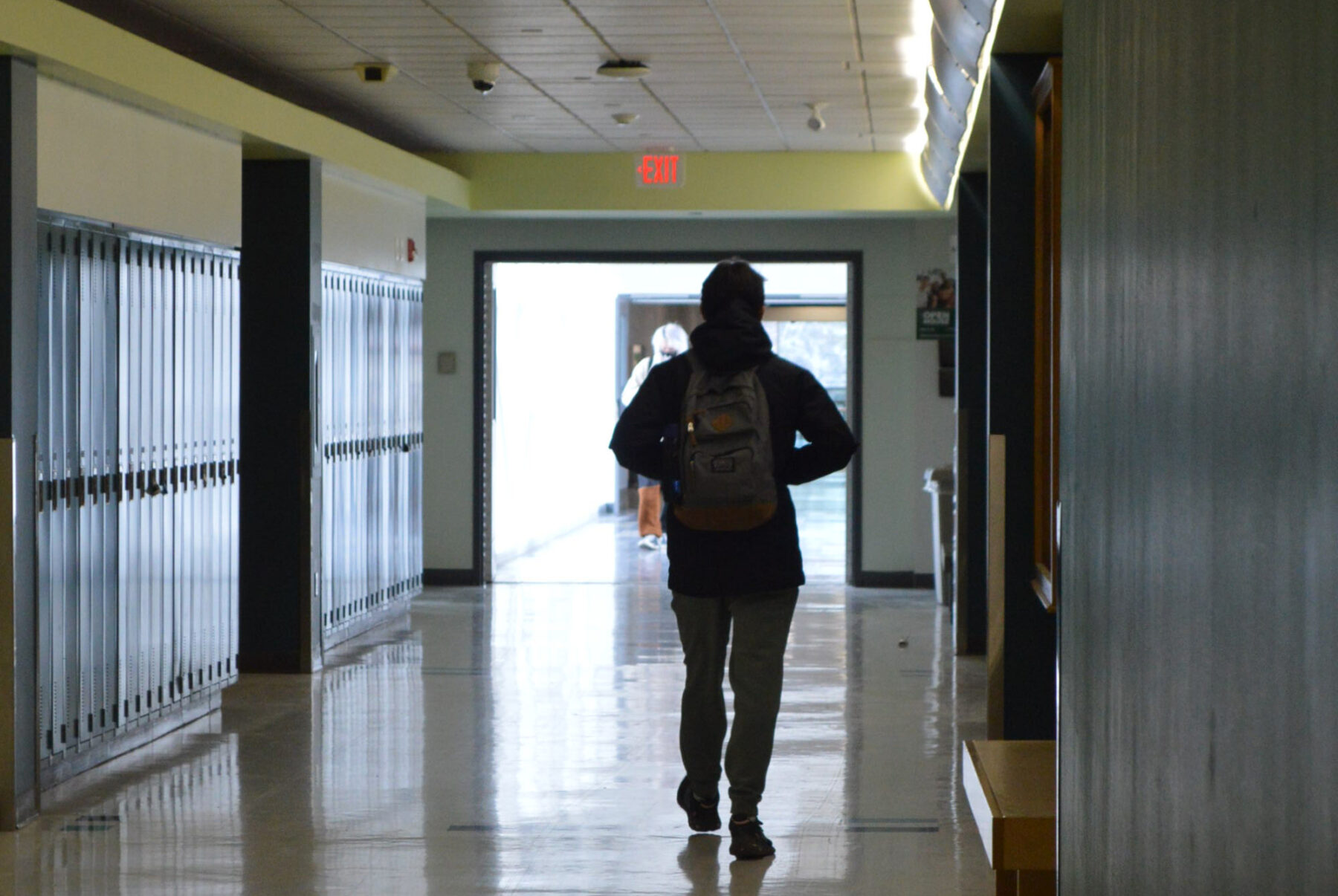
A student walking in the hallway with their hands on their bag straps Photo credit: Jackie Beeston
Although the effort put into both outfits is vastly different, Brown and Moore still possess their own unique qualities that lend them a rich aesthetic.
Why put effort into an outfit when wearing your favourite shirt puts a smile on your face, the same as going full glam does?
A coat can do just that.
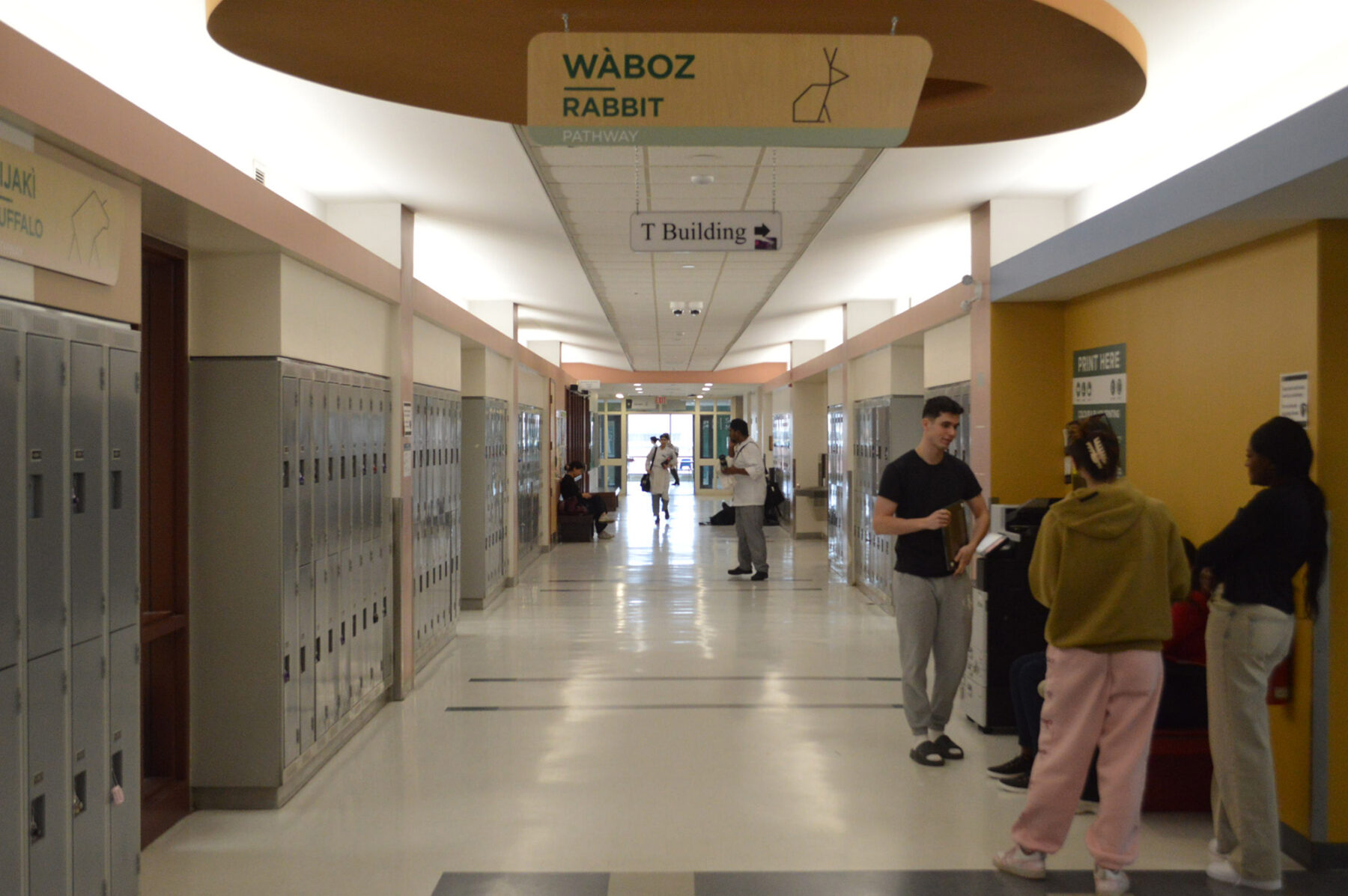
The hallway of J building showcasing some vibrant student activity Photo credit: Jackie Beeston
“I’m excited,” said Graham Longair, a professor and data and analytics support officer at Algonquin. “I got a really nice new peacoat that I replaced my old one with.
Because at the end of the day, it really is all just about perception and portraying a certain identity to others without speech. The outfits do the talking.
Thrifting is such a useful tool for students; it has a history of success on campus. With previous public relations student-run thrifts and SA-run ones, too, it’s easier than ever to thrift yourself a brand new look.
Algonquin College students volunteered as camera operators for music festival at Lansdowne Park
Matthew Grieve
Photos: Matthew Grieve
September 17, 2025 Revised: September 17, 2025 8:55pm
Photo: Matthew Grieve
Penny Levetsovitis, a TV broadcasting and streaming video student, volunteering as camera operator for CityFolk on Sept.14.
Algonquin College television students were at CityFolk to gain hands-on experience as camera operators and put into practice the knowledge they have developed throughout their studies.
CityFolk is an annual event in Ottawa held at Lansdowne Park. This year, the festival ran from Sept. 10 to Sept. 14.
Originally created as the Ottawa Folk Festival in 1994 to highlight folk music, the festival was rebranded as CityFolk in 2014 to showcase a wider range of music genres, including alt-country, hip-hop, roots and blues.
Matt McCooeye, a program coordinator for the broadcasting, television, and streaming video program, said many students have participated in live event coverage at CityFolk.
“I think any opportunity outside the classroom to learn in a real-world environment benefits our students,” said McCooeye. “We have a lot of students who want to work, who want the experience and these festivals provide our students with real hands-on experience that elevates what they’ve learned in the classroom.”
McCooeye added that students benefit from working with people who bring in varying perspectives on the industry and can give them advice to hone their skills.
Events like CityFolk allow television students to develop their skills with filming and live event coverage. By working alongside professionals in the industry, they learn valuable information and build connections that can help them after graduation.
Ethan Jeon, a TV broadcasting student who had the chance to volunteer as a camera operator at Bluesfest and CityFolk, said he enjoyed the opportunity the college gave him.
“It’s really great that Algonquin College students can actually volunteer and get their field placement at those big festivals,” said Jeon.
Ethan Jeon, a TV broadcasting student who volunteered at CityFolk. Photo credit: Matthew Grieve
Jeon recognizes the nervousness that comes with covering major events, but he said mistakes are part of the learning process. He recalled advice from his director while working at Bluesfest, who told him slip-ups happen, even to him, during live shows.
“Don’t let nervousness stop you and give it your best shot,” said Jeon.
Penny Levetsovitis, another TV broadcasting student, said her time at Algonquin College prepared her for event coverage at major festivals like CityFolk.
“Algonquin gives you time to work with cameras and work with live audiences to have you prepared for a moment like this,” said Levetsovitis.
The CityFolk stage lights up the night at Ottawa’s Lansdowne Park on Sept. 14. Photo credit: Matthew Grieve
Levetsovitis said her second night at the festival was the most memorable.
“We had some guy in a wheelchair crowd surf. That was crazy,” she said.
Naomi Runstedtler, an alumna from the film and media productions program who has worked at the Ottawa Jazz Festival, Bluesfest and CityFolk, described the unique feel of the music festival at Lansdowne Park.
“City Folk is unique because the venue is much smaller. I feel like it’s a bit more of a niche festival in comparison to Bluesfest and Jazz Fest,” said Runstedtler. “It’s a way to kick off the end of the summer. It feels like a nice transitional festival. Small, intimate and a good time.”
Naomi Runstedtler, alumna from the Film and Media Productions Program, volunteering for CityFolk on Sept.14. Photo credit: Matthew Grieve
Looking past the music, Runstedtler emphasizes the importance of volunteering to help shape student development and maximize the opportunities the college gives students.
“CityFolk helps students get more involved in the community for networking opportunities. It proved the skill set I’ve built through Algonquin is valuable beyond the school walls and applicable to real-world scenarios,” said Runstedtler. “It’s another way to practise and will help me sharpen my skills for what I want to pursue in the future, filmmaking.”
As the festival came to a close and students returned to class with new experiences, they were reminded of Matt McCooeye’s words.
“The goal is for our students to graduate with a broad set of skills that they can use to adapt to whatever production environment they find themselves in,” said McCooeye. “That’s ultimately our goal.”
Often stigmatized, our community must realize the un-housed population did not choose this lifestyle.
Lara Simard
Photos: Lara Simard
September 17, 2025 Revised: September 17, 2025 7:40am
Photo: Lara Simard
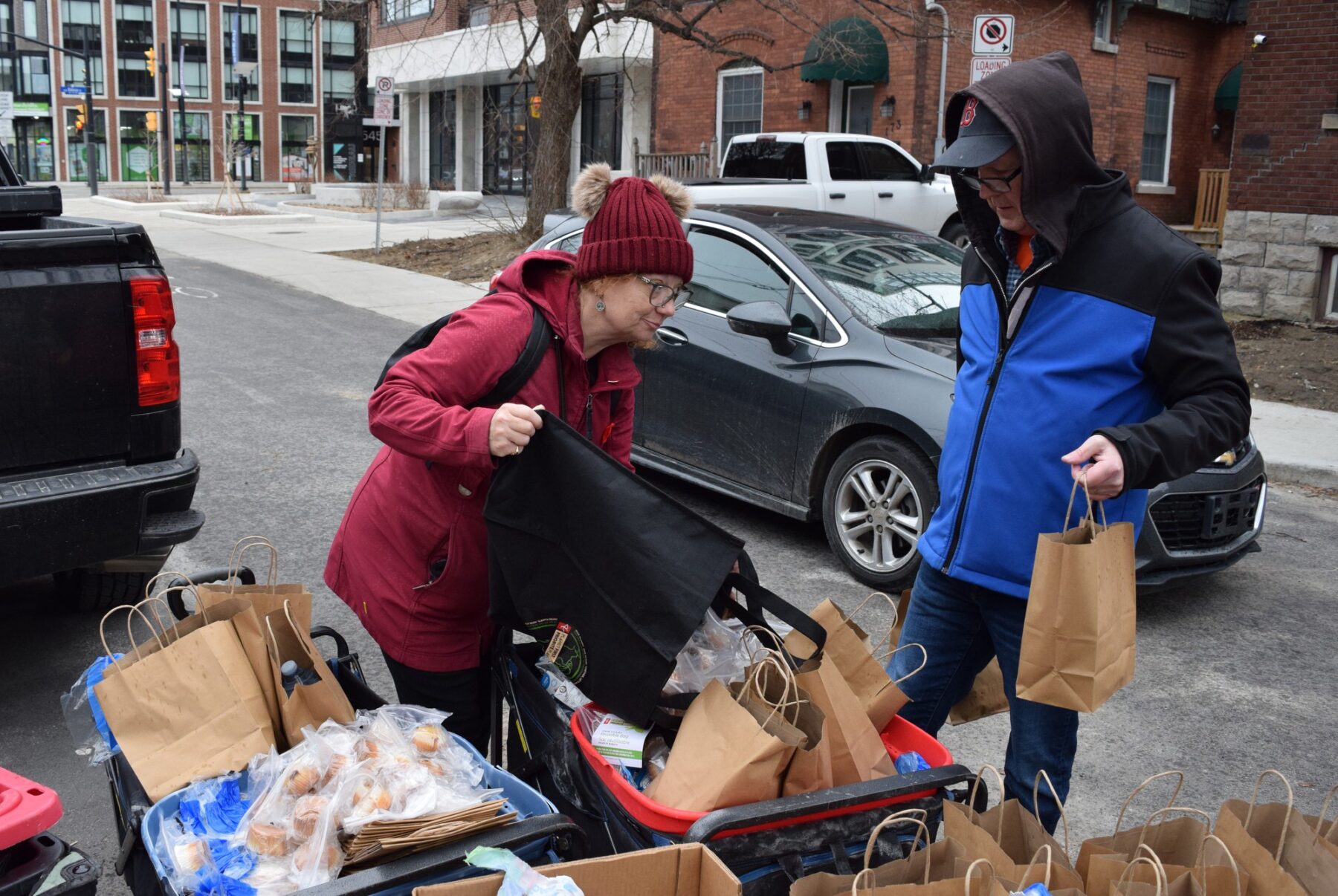
Susan Lannigan (left) and Richard Blute (right) fill wagons with supplies for the street early afternoon on March 22, 2025.
“Got any spare change?”
It’s a shrill voice — a frail woman wobbling toward me. Her lower abdomen is fully exposed, the curvature of starvation visible beneath a torn shirt marked with several burn scars.
Her bloodshot eyes dart intensely into mine. My stomach churns with each new meth-infused breath as her face inches closer. I become more and more aware of the corroding teeth crowding her smile.
At first, I don’t respond. The tightness in my chest inhibits my ability to speak or reason. I clear my throat and force myself to blink, the colour draining from my face.
“I don’t have any change,” I stammered.
“Can you buy me a hot dog at least? I really need food,” she says. “Haven’t eaten all week.”
I walk toward the hotdog cart sitting next to the Beavertails trailer, my hand shaking with my debit card in hand.
“We’re all out of hotdogs.”
I turn to the woman, feeling hopeless.
“There’s nothing I can do for you,” I lie. “I’m sorry.”
Ever since that day, my conscience has tugged on me to change my outlook on the homeless. I began to wonder: what was causing my disposition to be so timid and judgmental? Why couldn’t I see this woman as another human being? I had always been told not to give spare change to the homeless — because they would use it to feed their addictions. I stayed far away from the filth I believed they carried.
Growing up, whenever a homeless person approached our car window, my mother would almost always roll it down and give them the little bit of spare change we had. My upbringing, grounded in Christian values, made this seem like a charitable gesture at the time. However, as I matured into my teenage years, I began to question whether sparing change to the poor was truly the best course of action. I had been told that homeless individuals were in their situations due to poor life choices, and that donating to them would only fund their addictions. Now, when a homeless person asks me for change, my pity for them is divided. I’m sure I’m not the only one.
Since 2021, there have been approximately 300 new victims of homelessness in the city of Ottawa. According to a 2014 study by the Canadian Observatory on Homelessness, an average of 235,000 people in Canada experience homelessness each year. Between 30,000 and 35,000 people are homeless on any given night. The homeless population continues to grow each year, driven by poverty, addiction, and trauma, yet many people don’t know how to help.
Especially as the economy continues to crumble, many people are finding themselves in desperate situations, often turning to quick fixes. These people didn’t choose to be homeless.
I began to realize how damaging stereotypes around addiction are to real, long-term support and change. These were the same stereotypes I had carried.
Walking past Three Brothers Shawarma on 530 Rideau St., I nervously made my way down the street until I came across ten collapsible wagons filled with essential supplies.
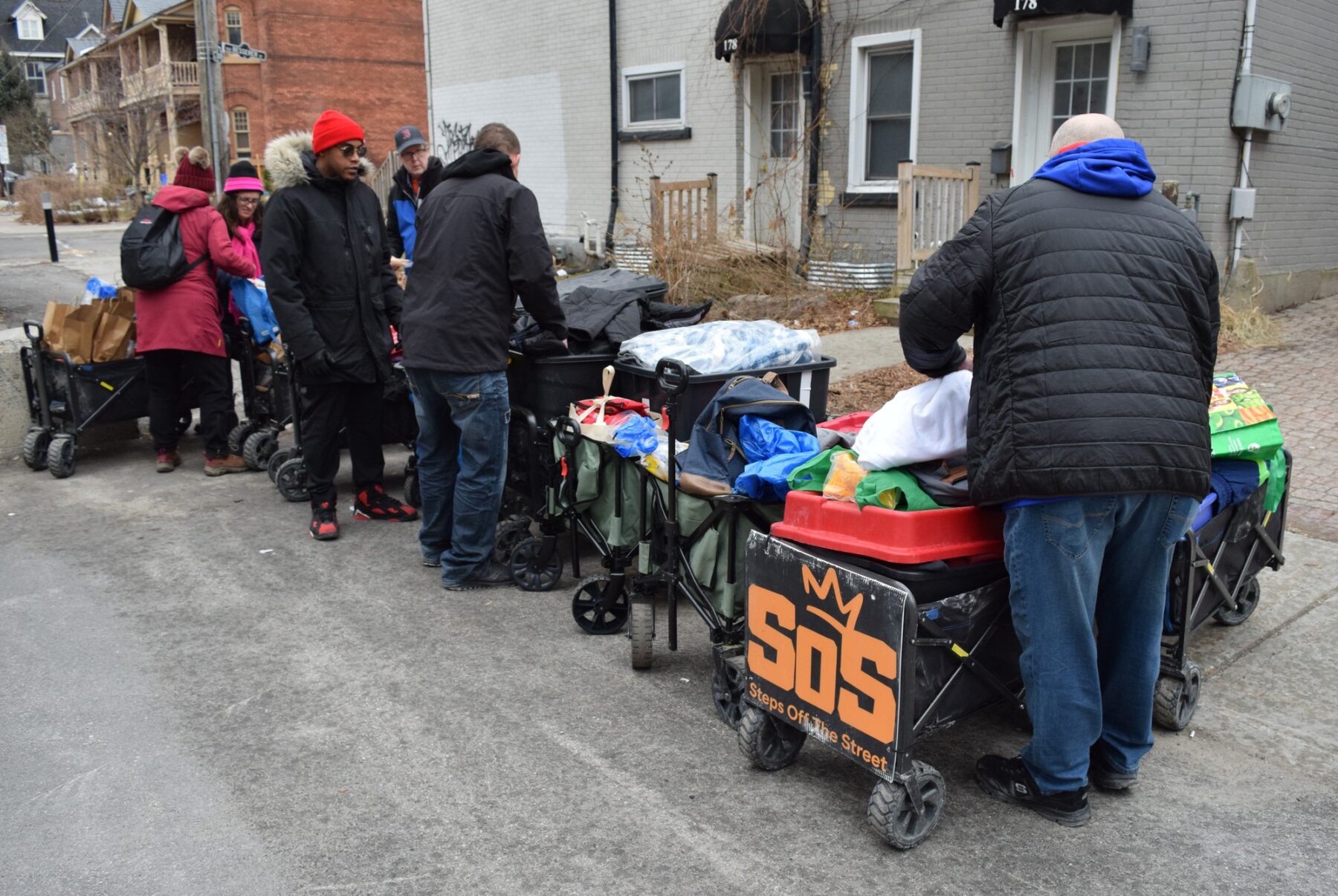
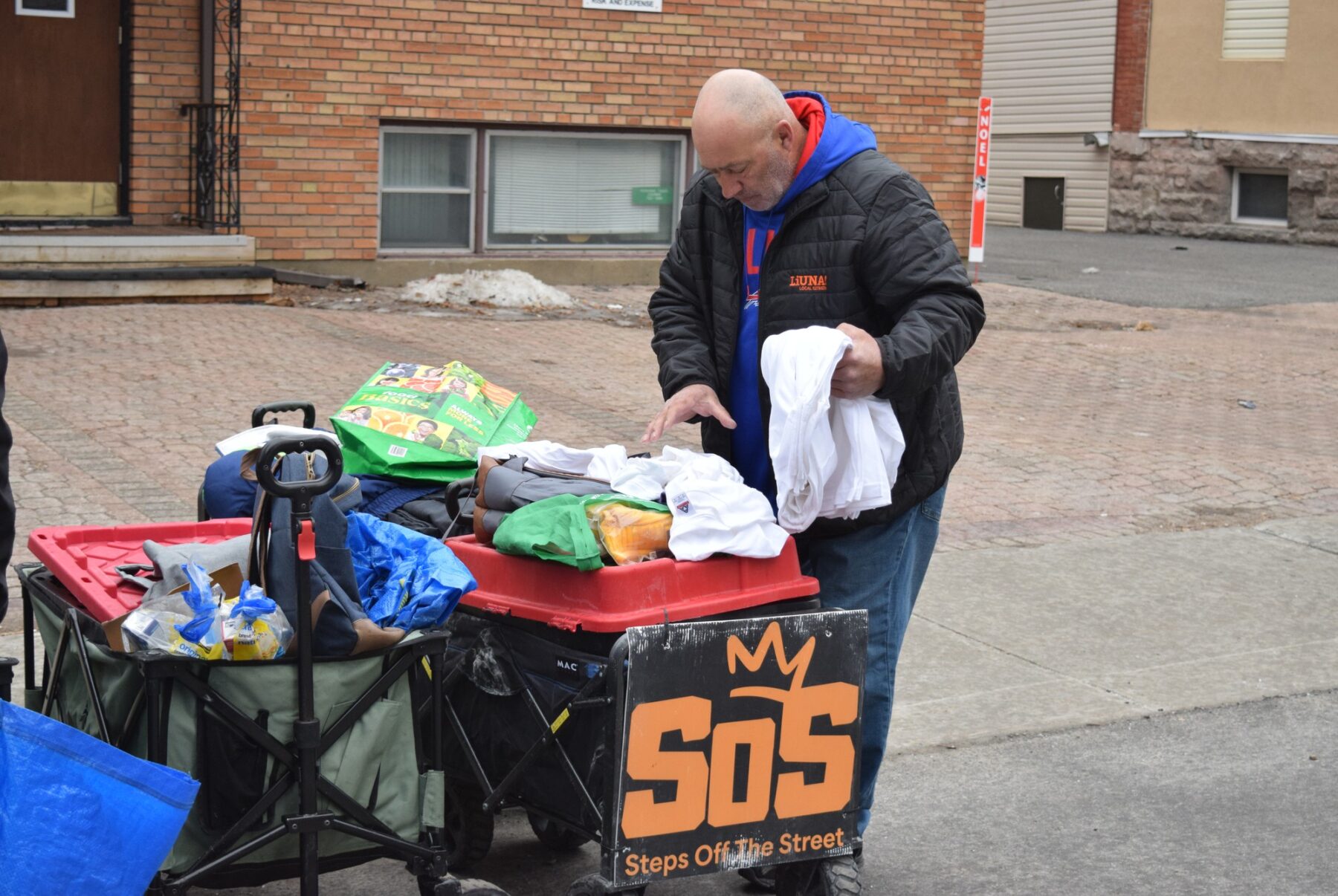
The wagons were all the same kind, square-shaped with classic handles on the end and four big wheels at the base. Some carried toiletries, some carried men’s sweaters and pants and others carried bags of sandwiches. Each wagon was filled to the brim.
A man leaned into his truck, grabbing the final items he needed to fill the carts.
“Hi, are you Gerald?” I asked, my voice unsteady. I had to admit, I was a little anxious about the task ahead.
To fight my fear of the streets and discover the proper way to reach out, I decided to go down there myself and help the community firsthand.
I was inspired by Gerald Jorgensen, a man who had suffered from addiction since the age of 18, was homeless for two and a half years, and has now been sober for 26 months.
After completing their nine-month residential addiction recovery program at Jericho Road, which is an addiction recovery service, he became passionate about helping others in his community find healing.
“We grew from one wagon to now having ten wagons on the street. We now have six routes, two on Bank Street and four on Rideau,” said Gerald. He now runs a non-profit organization called Steps Off The Street (SOS).
He and a group of volunteers head to multiple different locations in downtown Ottawa to bring essential supplies to those in need.
SOS team gets wagons ready to hit the road in the early afternoon of March 22, 2025. Photo credit: Lara Simard
What started with one man and one wagon quickly expanded. Today, 26 volunteers regularly join. On this overcast day, we were about nine, including myself.
“The main objective out here is to meet people where they’re at. We’re looking for guys and girls who may want to find recovery,” Gerald said before we headed to Sandy Hill to begin distribution.
“They’re probably having a worse day than us, so we just kill them with love. And if there’s aggression, we just walk away.”
We were instructed to give each person one sandwich and one juice box, but we were allowed to offer second helpings. Other wagons held men’s and women’s pants, sweaters, socks, boots, shoes and hand warmers. The goal was to make people feel seen and cared for.
Before we left, Gerald prayed over the team. I felt inspired and determined to be a witness for those downtown. Susan Lannigan, one of the volunteers, shared what the ministry means to her.
“It’s not really about the people that do it. It’s about the people we’re helping. They have nothing, and they are worth so much more than they’re given credit for,” she said.
Through her words, I realized that the outreach focuses on those being served — not on the volunteers. It’s about restoring dignity to people who’ve lost almost everything. They deserve a voice too.
Gerald's cousin Michael Swerdfeger prepares wagons for outreach March 22, 2025. Photo credit: Lara Simard
Not long before we set out, a tall man approached, lightly bouncing on his feet towards us, with Air Jordans — the sole of the shoe holding on by a thread. He wore a rusted gold-coloured chain around his neck and faded glasses shielding his pocketed eyes.
The man recognized Gerald, stunned at how far he had come from the man he once knew on the streets. Gerald shared his story, offered support, and exchanged contact information with the man. They exchanged a hug and I could see genuine gratitude in his eyes.
Though startled at first, the interaction warmed my heart. An uncontrollable smile spread across my face. I realized this wouldn’t be the last person we would help that day.
As the rain began to fall, I picked up the handle of my wagon. Gerald smiled softly next to his truck. “Isn’t this amazing?” he said, proud of the work being done.
Across the street, a woman lay under a tarp she had propped up into a dome just big enough for herself. She had blankets laid down and a box of chicken beside her. She told us that every time she set up her encampment, someone would steal it, desperate for shelter. We gave her fresh blankets and a cupcake. Susan and others took time to speak with her. Their conversation meant everything to her, and she laughed and hugged Susan tightly.
“God bless you,” she said, her face glowing.
In the Sandy Hill neighbourhood, people began crowding the wagons 一 some wanted food, others clothes, and others just conversation. A woman came to my station while her boyfriend stood in the rain, scrubbing shampoo into his hair. She picked out a pair of Levi’s jeans for him.
“He likes to be stylish,” she said.
I could see the pureness in her eyes. Broken, but human.
I recently spoke with Kevin Williams, the executive director at Jericho Road, the nine-month addiction recovery program Gerald attended.
“There’s a lot of stigma around addiction, and breaking that stigma is difficult, especially with the political landscape and the pressure for quick fixes,” he said.
This stigma had once trapped my thinking. My goal in this experience was to understand what fuels that stigma and how we can begin to dismantle it.
“Most people don’t understand addiction and think it’s either a choice or something people can control,” Williams said. “The opposite of addiction is connection. Supporting those who are stuck and giving them resources to rebuild their lives is key.”
Many government systems offer only temporary fixes. It’s only through love and consistent support that we’ll make a real difference. Too often, society judges the broken instead of listening. Williams says the most important thing we can do for the homeless is to make them feel they have a voice in their situations.
I saw that downtown. When I stepped out of my comfort zone and treated the homeless as I would my own family, I felt something change. I no longer worried that giving them help would enable them. Instead, I realized that simply being seen is often the first step toward healing.
“When people in recovery first come in, all they really want is to be listened to. They’ve spent so much of their life feeling like they don’t matter or have a voice. When someone calls for help, we have a small window of opportunity to respond. If we don’t act, we may lose that chance to help them.” ー Kevin Williams
They didn’t choose this life; realize the false stereotypes against of the un-housed.
College ward Councillor Laine Johnson says Ottawa can’t raise the U-Pass cost without a deal
Mickey Banks
Photos: Mickey Banks
September 17, 2025 Revised: September 17, 2025 1:41pm
Photo: Mickey Banks
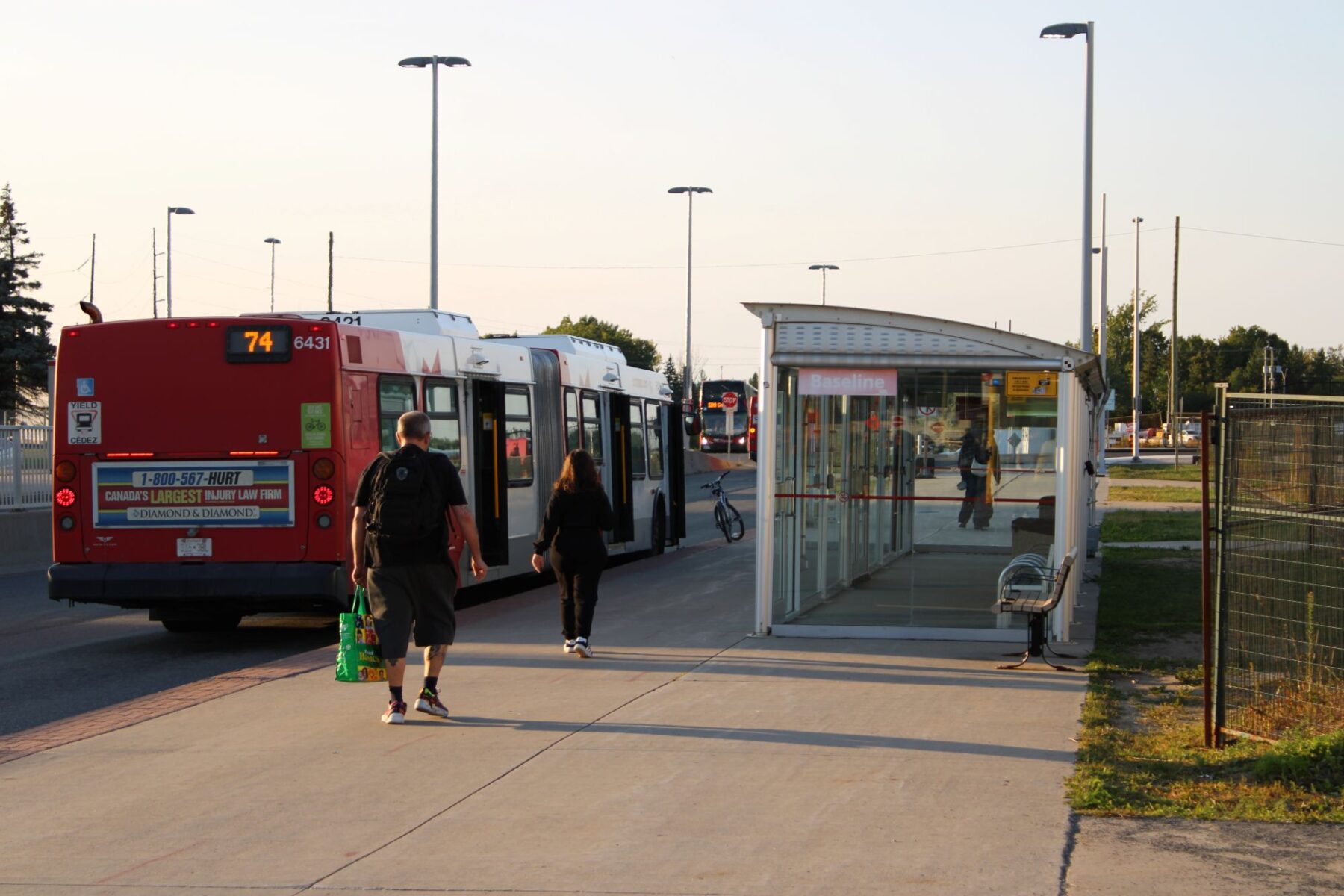
The 74 bus arriving at Baseline station.
As OC Transpo seeks to increase U-Pass rates, the Algonquin Students’ Association is speaking with key players to represent students, says SA president Vanshika Sharma.
“The Algonquin Students’ Association advocates for cost-effective, reliable public transit for students,” Sharma said in an email statement. “Any resolution must prioritize the students’ needs.”
During a City of Ottawa transit commission meeting in November 2024, the transit staff proposed a five per cent increase to most fares in 2025. This included the U-Pass, which would have increased from $229.07 to $240.52. However, this year the U-Pass went up the agreed upon 2.5 per cent instead, going to $234.80, according to Algonquin College’s website.
The U-Pass is mandatory for all students, regardless of whether they use the bus service. Students who do not have access to OC Transpo or STO (a public transportation provider in Gatineau) areas, those with a U-Pass from another institution or those who have a disability or another medical condition, are allowed to opt out of the U-Pass.
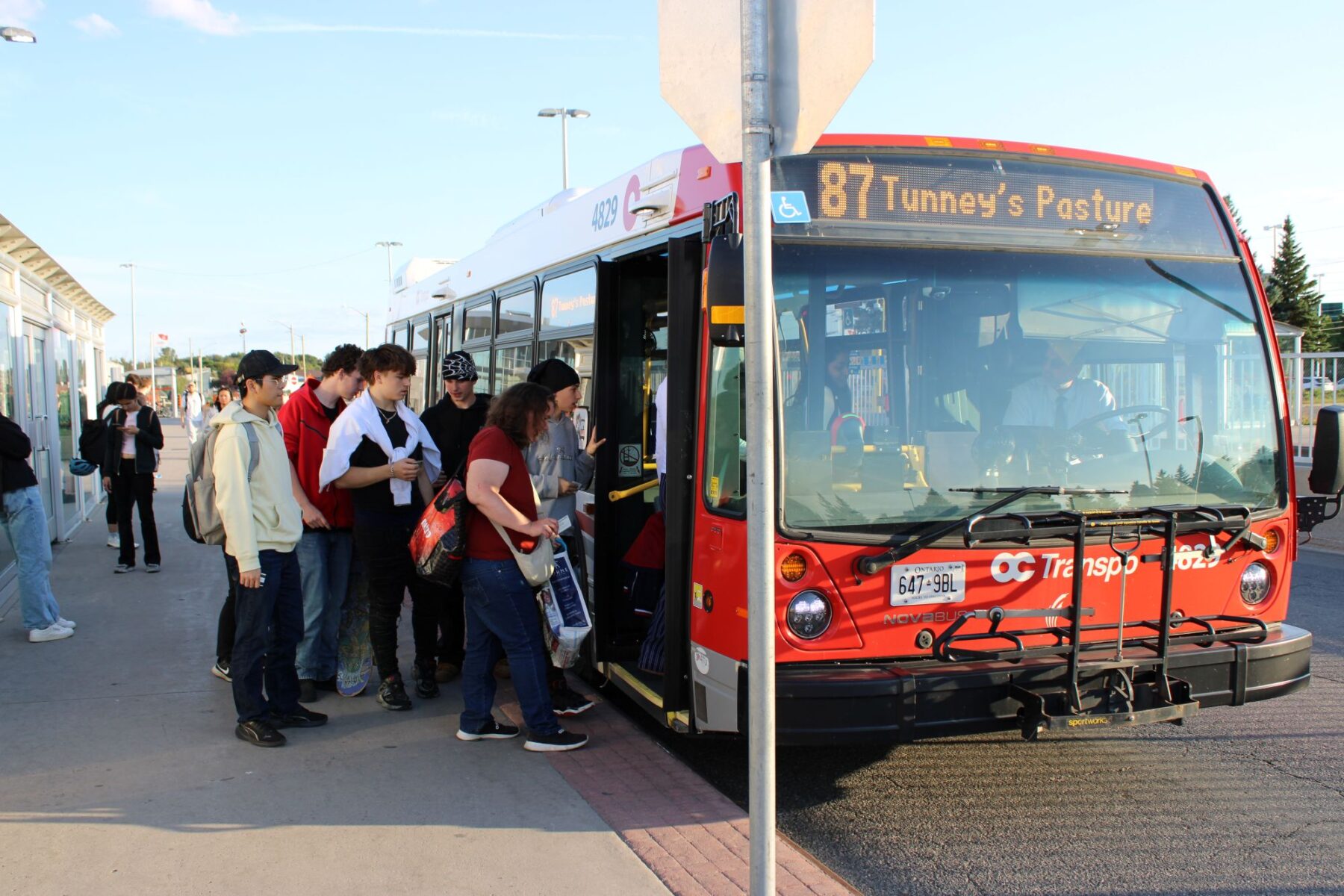
A group of people boarding the 87 to Tunney's Pasture. Photo credit: Mickey Banks
“The U-Pass provides a discount between 41 and 50 per cent compared to student monthly passes, and a discount between 53 and 62 per cent compared to adult monthly passes,” according to Algonquin College’s website.
College ward councillor Laine Johnson, who voted against the motion to raise the U-Pass, said she’s been in contact with the SA.
“I do not believe the City of Ottawa has the right to unilaterally increase the cost of the U-Pass without negotiations with the four student associations, including the Algonquin Students’ Association,” Johnson said in an email statement.
The other three colleges in the agreement are the University of Ottawa, Saint Paul and Carleton University.
Students have long debated the value of the U-pass when considering the state of Ottawa’s transit system.
Robert Kemp, who’s taking practical nursing at Algonquin College, has dealt with some early morning bus cancellations, but he still sees the U-Pass as a benefit.
“I think it’s a useful service,” Kemp said. “I think including it in tuition is a helpful part for most students. Not everyone can afford a car, so it’s nice to have a reliable form of transportation.”
Robert Kemp boarding his bus at Baseline station. Photo credit: Mickey Banks
Adam Ames, who’s taking automation engineering at the college, said when he started taking the bus three years ago the system was good, but he believes it’s gone downhill since then.
“The buses came a lot more regularly and a lot more consistently, and they seemed to be less affected by the (local) high school,” Ames said.
Ames takes the 87 and has seen problems with overcrowding.
“Any time from about 2 p.m. till about 5:30 (or) 6 p.m., the buses are completely unusable, for anywhere in that area. And same with 6:30 a.m., till about 9 a.m., the buses are completely unusable.”
Adam Ames eyeing the 87 bus as it parks at Baseline station. Ames says the transit system isn't as good as it was three years ago. Photo credit: Mickey Banks
Johnson says she’s disappointed with the “New Ways to Bus” changes that were made in the spring, but said the introduction of the LRT Stage 2 would be “the biggest improvement to public transit for Algonquin College students.”
“That would improve the value,” Ames said, “but not to the point of what they want to increase it (the U-Pass), because generally they still have poor coverage of routes around this area.”
Johnson says the LRT Stage 2 extension, which will link the college to downtown by train, is expected to open late 2026 or early 2027.
Featured Hero | Featured Story | Home Feature | Home Hero | News
Algonquin's women’s rugby team leaves first tournament of the year with one win and two losses
William Barritt
Photos: Leena King
September 16, 2025 Revised: September 16, 2025 12:06pm
Photo: Leena King
Wolves players take a breather awaiting their next substitution on Sept. 13 in Belleville.
Algonquin College’s women’s rugby team battled through three fast-paced games at the OCAA women’s rugby sevens tournament on Sept. 13 in Belleville, starting strong with a win before dropping their next two matches.
Despite finishing with a losing record, the Algonquin Wolves showed resilience, grinding out an impressive victory against St. Lawrence Surge before being challenged against stronger opponents such as Durham and Loyalist.
Morgan Payne, a star forward for the Wolves, said team chemistry is key.
“It’s been exciting. We’ve got a lot of talent, but with only five practices, it’s about putting it all together and building that team chemistry,” Payne said.
Star back Princess Ikeson said it’s the intangibles that make the team work.
“We’re working toward being the most hardworking team. Even if mistakes happen, we keep battling until the end,” Ikeson said.
In their opening game against St. Lawrence, Algonquin set this hardworking tone by capitalizing on turnovers and turning them into points. A penalty opened the door for a length-of-the-field run early in the game by Faiza Faucher-Ahmed, followed by more pressure near the halfway line.
Though the team missed several conversions, they did enough to close out a 15–5 win.
Players Morgan Payne, Faiza Faucher-Ahmed and Princess Ikeson celebrate after a big win against the St. Lawrence Surge on Sept. 13 in Belleville. Photo credit: Leena King
But the victory was bittersweet. Late in the match, back-line player Wren Doucette went down hard after a collision near midfield and stayed on the ground as play stopped. Medics rushed onto the field, and after several minutes of attention, Doucette was helped off with what was later confirmed to be a broken collarbone.
The injury drew a hush over the sideline and dampened the celebration of Algonquin’s first win. What should have been a momentum-builder quickly became a sobering moment for the Wolves, who now faced the rest of the tournament without one of their key backs.
Coach Dan McNeil said the injury had a lingering affect on the team.
“Whenever an injury happens like that, it can kind of linger through the team, so that put us in a difficult space, especially against a tough squad like Durham,” McNeil said.
In their second game, Durham’s well-drilled side quickly took control, forcing repeated handling errors and dictating the pace from kickoff. The Wolves struggled to recover and Durham pulled away with a dominant 57–0 victory, leaving Algonquin with lessons to take forward.
Tegan Egli takes the ball up field against Durham College on Sept. 13 in Belleville. Photo credit: Leena King
The Wolves bounced back in their third match against Loyalist, striking first with a long run downfield to take a 5–0 lead. Loyalist responded with a run of their own with a converted try, and the game stayed tight until turnovers in the second half shifted momentum. Loyalist sealed a 17–5 win, despite Algonquin’s defensive stands in the closing minutes.
Faiza Faucher-Ahmed makes a run down field against the Loyalist's, earning the team five
points. September 13th, Belleville. Photo credit: Leena King
For McNeil, the weekend was about building a foundation rather than focusing on results.
“This isn’t the end of the season. we just did our first tournament of five this year, so it’s not the end of our journey but rather the beginning,” McNeil said.
The Algonquin Wolves’ results from each event will contribute to their overall OCAA standing, with four more tournaments scheduled this fall.
Featured Hero | Featured Story | Home Feature | Sports & Recreation
Algonquin College is currently looking for an outside food provider
Vasileios Tselios
Photos: Vasileios Tselios
September 16, 2025 Revised: September 17, 2025 7:45am
Photo: Vasileios Tselios
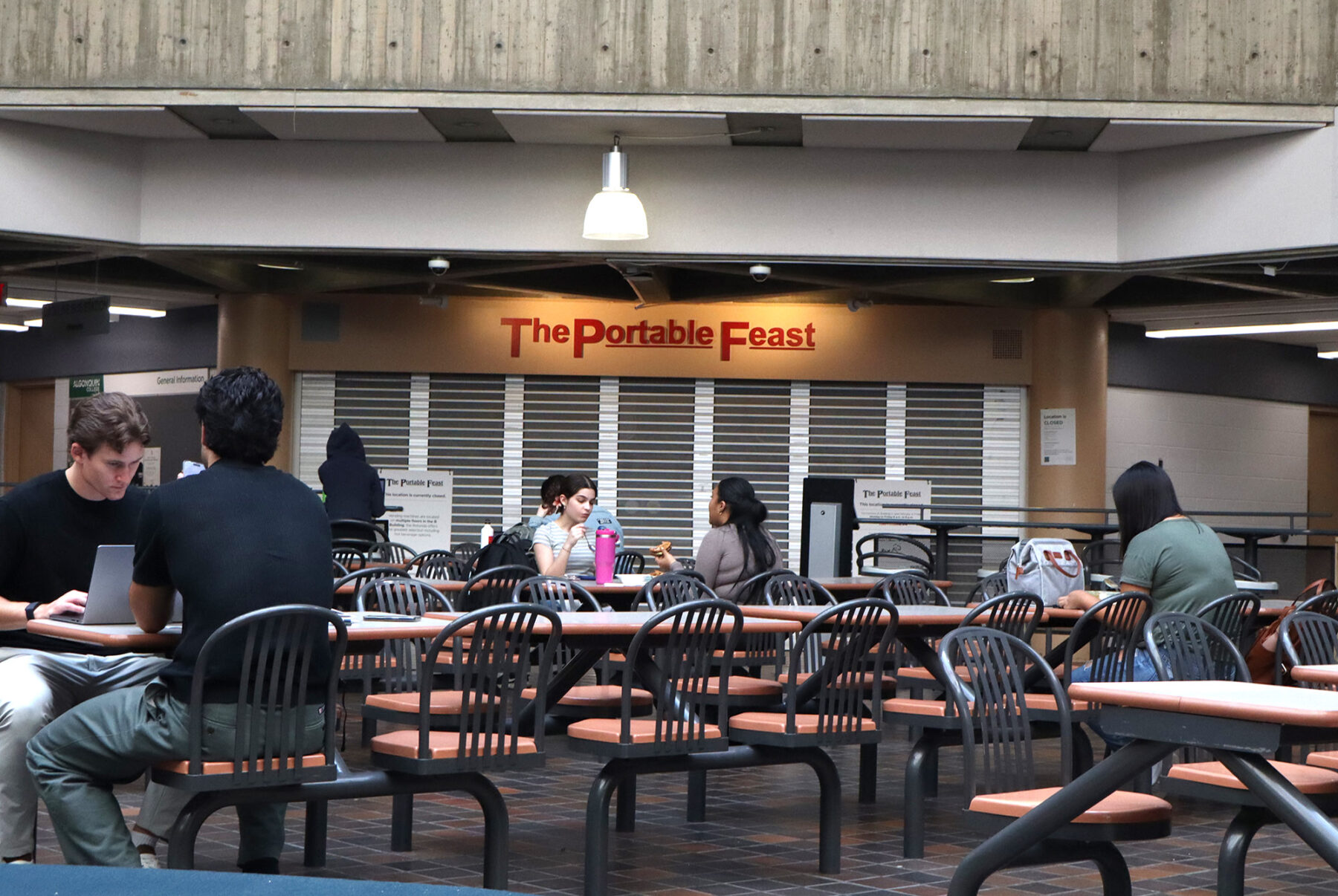
Students studying in the B-building cafeteria, in front of the Portable Feast.
Algonquin College has closed three of its food service locations at the Ottawa campus for the fall semester as it plans to contract out the school’s food services.
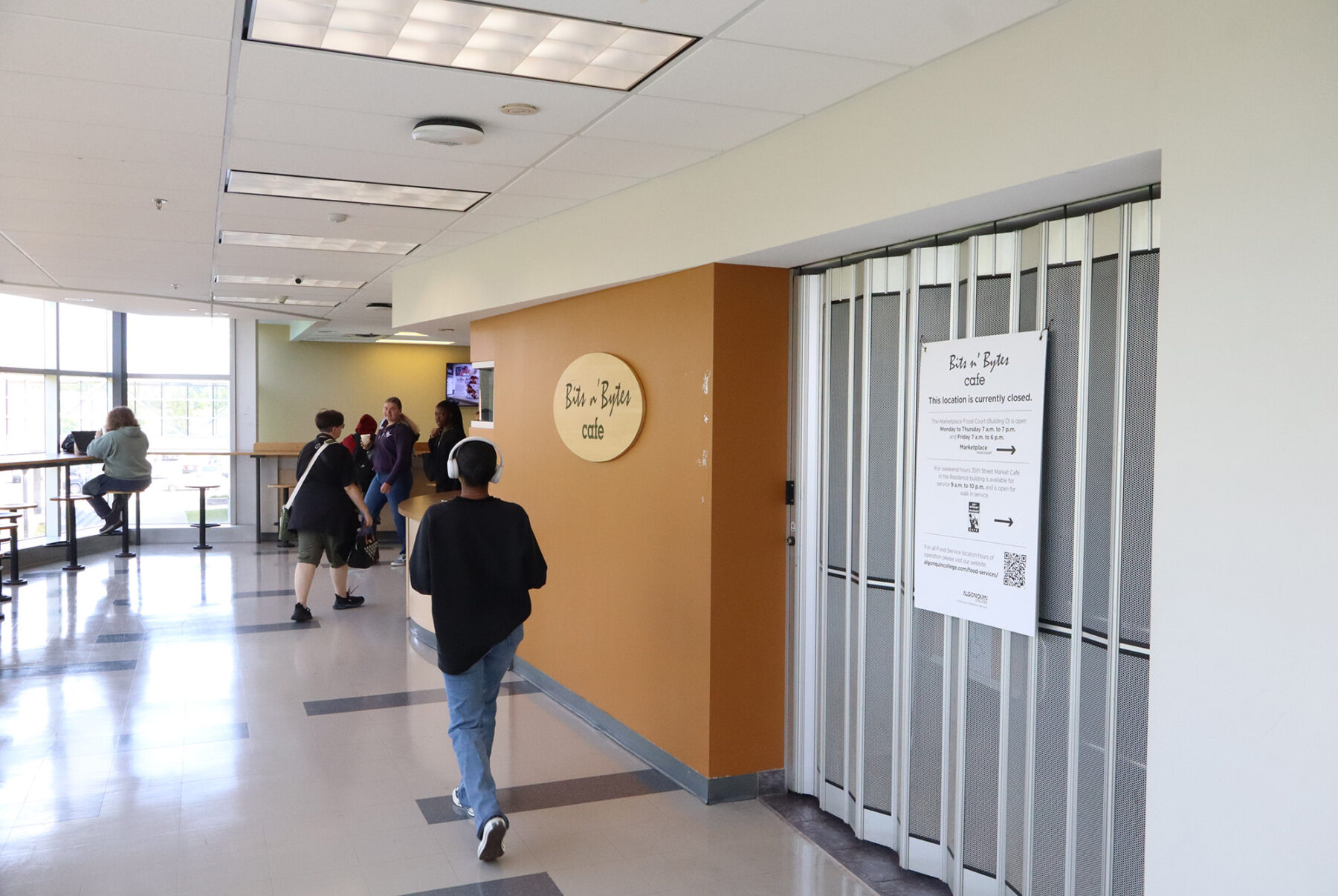
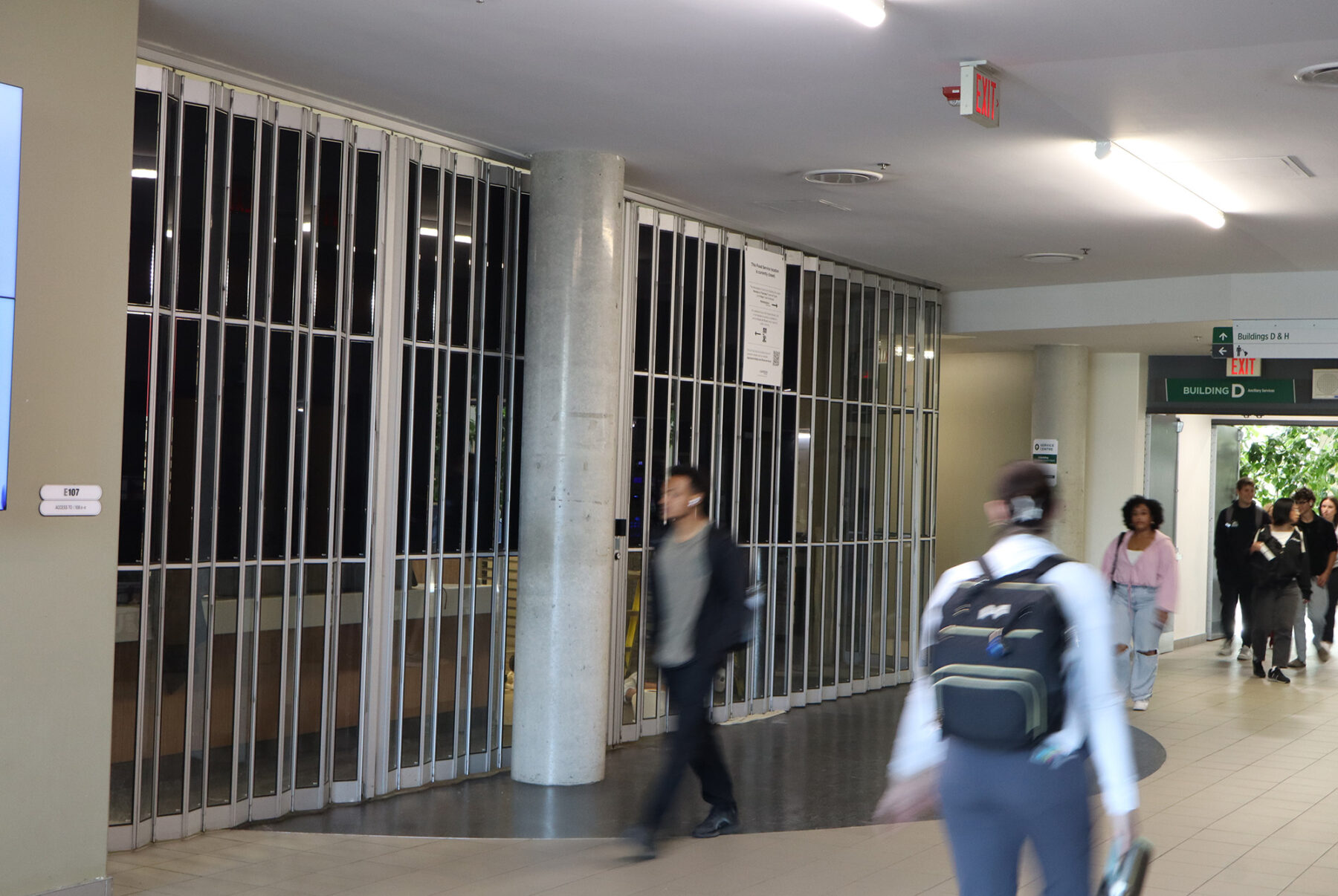
Bits n’ Bytes in T-building, Booster Juice in E-building and The Portable Feast in B-building are all temporarily closed, with no formal announcement from the school. At each of these locations, there are signs encouraging students to use the remaining food service locations along with the vending machines all around campus.
These closures coincide with the Students’ Association closing the Observatory as a campus pub, making it a space that can only be rented.
Originally, the college expected six food locations to remain open for the semester, alongside the school’s vending machines. However, Tim Hortons in A-building and The Fix in ACCE-building temporarily closed due to the ongoing full-time support staff strike.
The only campus food locations open during the strike are the Wolves Den, Starbucks, the food market in D-building and the 35th Street Market Cafe in residence.
Students are left with significantly fewer food options on campus than they were offered during the last fall and winter term.
“It’s a shame,” said Darian Cassidy, a music industry arts student. “On campuses, you want to have a lot of options. If you go to a university, they have one or two cafés, a student bar (and) fast food on site,” he said.
Cassidy explained that he is also thinking about the students who were employed in these locations.
“It sucks, because you are taking jobs away from people who probably need them.”
Algonquin College students walking past the closed Bits n' Bytes in T-building. Photo credit: Vasileios Tselios
Mary Baxter, the general manager of Food Conference Services, said the decision of these closures “was based on reduced enrolment and financial performance.”
“Ahead of the fall, we review enrolment numbers and financial forecasts to plan food service hours for the upcoming academic year,” she said in a written response. “As a result of this planning, we decided to open a number of locations based on the forecasted demand.”
All of the impacted employees from these locations were relocated to other food locations, according to Baxter.
When asked about the effect this will have on students with meal plans, Baxter said: “Based on previous sales within the closed locations and the reduction of enrolment on campus, the impact is expected to be minimal.”
Students with meal plans are able to purchase food from the locations remaining open. However, they are not able to use their meal plans at the campus vending machines, which have been presented as an alternative by the school.
While Tim Hortons and The Fix are expected to reopen after the strike, the three closed-down food locations are not expected to open this academic year, according to Baxter.
This change to the campus locations is coming alongside the recent announcement that the school is planning to contract out food services.
On Aug.18, Grant Perry, the vice president of Finance and Administration, told the campus community about the college’s plan to outsource food services.
“Over the past several years, our food services operations have experienced sustained financial losses,” stated Perry. “Rising operational costs and increased competition have made it increasingly difficult to maintain a financially viable model.”
The school has started a request for proposal process in order to find a suitable partner to take over the food services. The school is hoping to make the transition in the 2026 spring/summer term if the process goes as planned, according to Perry.
If the college does not find a partner, the school will continue operating food services and will reassess its options.
Perry’s message to the campus stated the school is prioritizing financial sustainability, service quality, affordability and alignment with the college’s values during this process.
Claude Brulé, the president of the college, discussed these same difficulties in February.
In a message to the campus community, Brulé mentioned a potential $60-million deficit for the current academic year and a $93-million deficit in 2026/2027 if the school does not intervene.
Brulé identified measures taken by the school, which included the program cuts. Food services losing locations and being contracted out were never mentioned in the February message, although Brulé acknowledged that there would need to be action to eliminate the deficit.
Students walking past the closed Booster Juice in E-building. Photo credit: Vasileios Tselios
Cassidy is not sure how to feel about the food services being contracted out, but there is one thing he hopes stays the same.
“Ideally, I would like students to be employed, especially on campus,” Cassidy said.
Due to the process still being underway, Baxter was not able to comment on the potential changes this may bring to the campus food locations.
Brulé and Perry couldn’t be reached for comment on the future of food services.
No timeline has been set for completion of the two half-finished buildings
Duncan Roi
Photos: Duncan Roi
September 15, 2025 Revised: September 15, 2025 10:58am
Photo: Duncan Roi
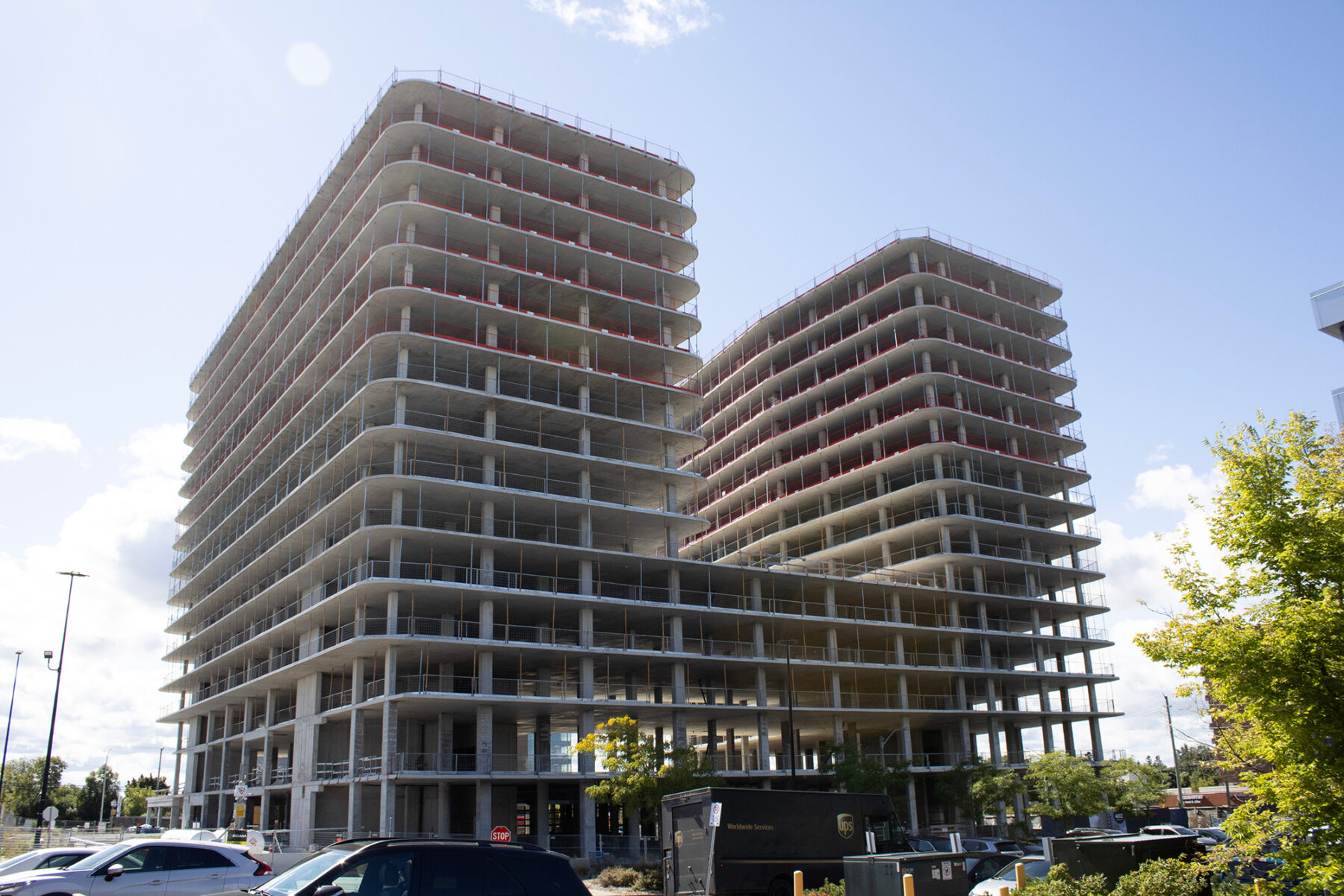
Two unfinished residential towers stand beside the Laurentian Plaza strip mall at Baseline Road and Clyde Avenue.
Since 2023, two unfinished towers at 1357 Baseline Rd. have loomed over the intersection of Baseline Road and Clyde Avenue. The buildings next to the Laurentian Plaza strip mall appear idle, leaving locals searching for answers.
For River Ward Councillor Riley Brockington, these buildings have been a constant source of interest for his constituents.
“In my office, I get asked on average at least once a week what’s happening here,” Brockington said.
Nearby resident Daniel Williamson has been keeping an eye on the site over the past few years.
“You know, when I saw it go up, I actually thought it would be a good thing for the area, but it’s really disappointing to see it stuck like this. I hope it’ll be done soon,” he said.
Retiree Susan Tremblay took a harsher view, referring to the unfinished structures as an eyesore. “Every time I go by, it feels like nothing changes,” she said.
Originally planned as a retirement residence, construction paused in late 2022 when the project contractor went bankrupt. SmartCentres, owner of the Laurentian Plaza strip mall, then fully acquired the property with plans to continue the development.
The project’s plan was converted from a retirement residence to residential apartments. SmartCentres, which specializes in commercial properties, has since been trying to secure financing and hire a new contractor to complete the project. Construction resumed in 2023 before pausing again in 2024.
Located a few blocks from Algonquin College along bus routes and close to grocery stores and other services, the site is considered desirable. Baseline Road will also be part of a future cross-town bus transit corridor planned for completion next fall.
Brockington said the situation at 1357 Baseline Rd. is not unique, but part of a wider trend in Ottawa.
“There are other projects, even in River Ward, where a contractor has gone bankrupt and the project had to be sold and started over again,” he said.
According to the Canada Mortgage and Housing Corp.’s fall 2024 housing supply report, the first half of 2024 saw a decrease in housing starts by 21 per cent in Ottawa, nearly the lowest level in a decade.
Competition and financial issues continue to strain the market and developments across the city.
Although the timeline for completion remains unclear, Brockington said the property remains secure with 24-hour surveillance, and the structure itself is not at risk of damage or collapse.
He expressed his desire to see these towers finished as much as the locals in the area.
“It is SmartCentres’ intent to build and complete this project. But they need to find the money, hire a contractor and get a new site plan. Then we’re on their time,” he said.
SmartCentres could not be reached for comment.
Featured Hero | Featured Story | Home Feature | Home Hero | News
September 15, 2025 Revised: September 15, 2025 9:28am
Photo: Jade Louise Greenwood
Kieron Jackson eats a salted caramel donut at Kettleman's.
Algonquin College students crave food almost as much as they crave good grades, but now that some campus restaurants and eateries are closed, where do students go?
The following six restaurants are perfect spots that AC students have recommended. They’re places to study, decompress, catch up with friends and occasionally overhear a breakup story from the table next to you.
Dao Café – 1558 Merivale Rd.
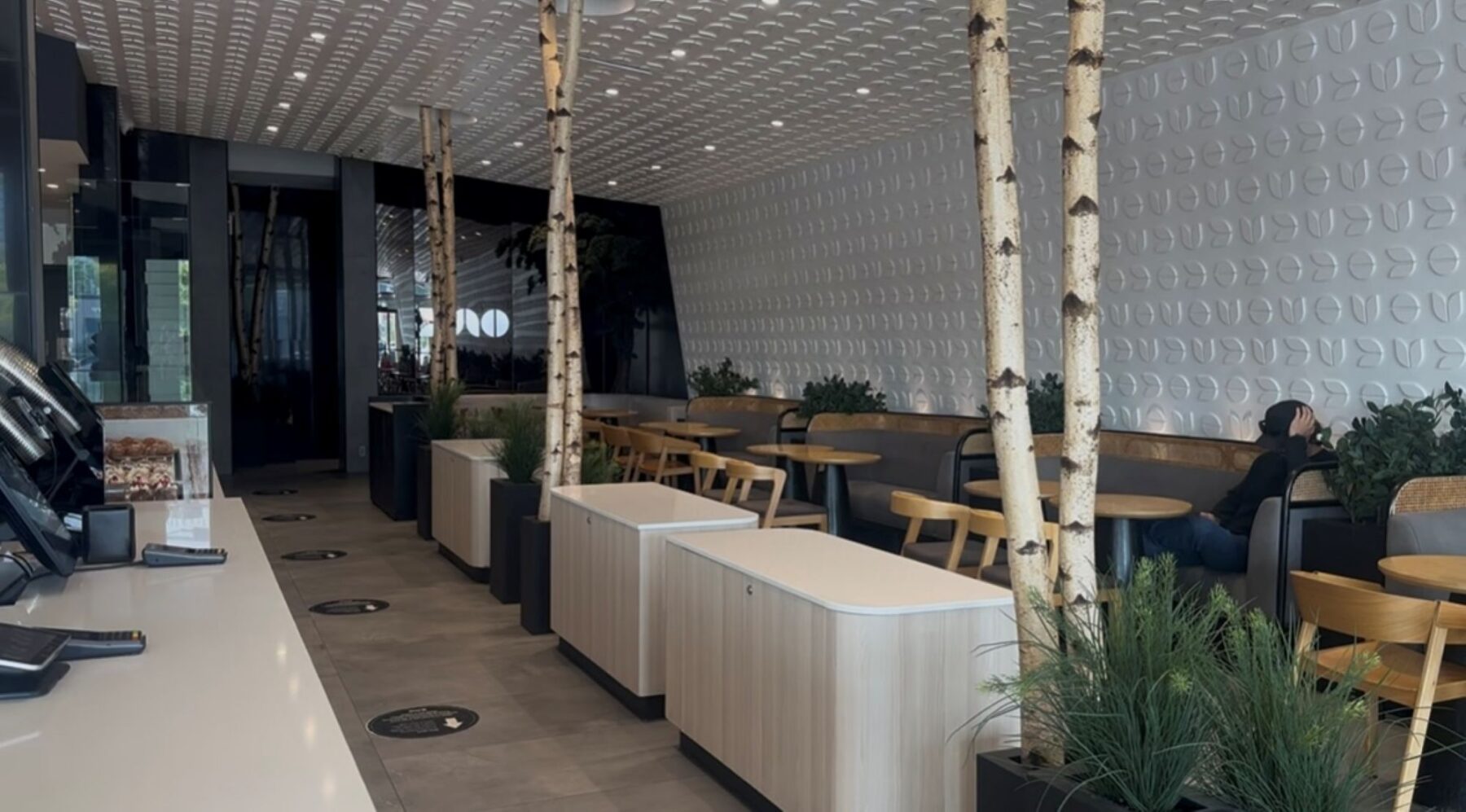
Inside Dao Café, just after opening. Photo credit: Jade Louise Greenwood
Tucked into a strip mall, just a 27-minute walk away from campus, lies an Euro-Asian inspired bakery, Dao Café, that one Algonquin College student raves about.
“A lot of people study in there, it’s calm and quiet,” says Willow Pomerleau. The leafy plants, tranquil atmosphere and soft lighting promote a cozy setting, perfect for laptops and lattes.
According to Pomerleau, the macaroons are fascinatingly clever and the strawberry shortcake “tastes like a dream.”
Kettlemans Bagel – 1365 Woodroffe Ave.
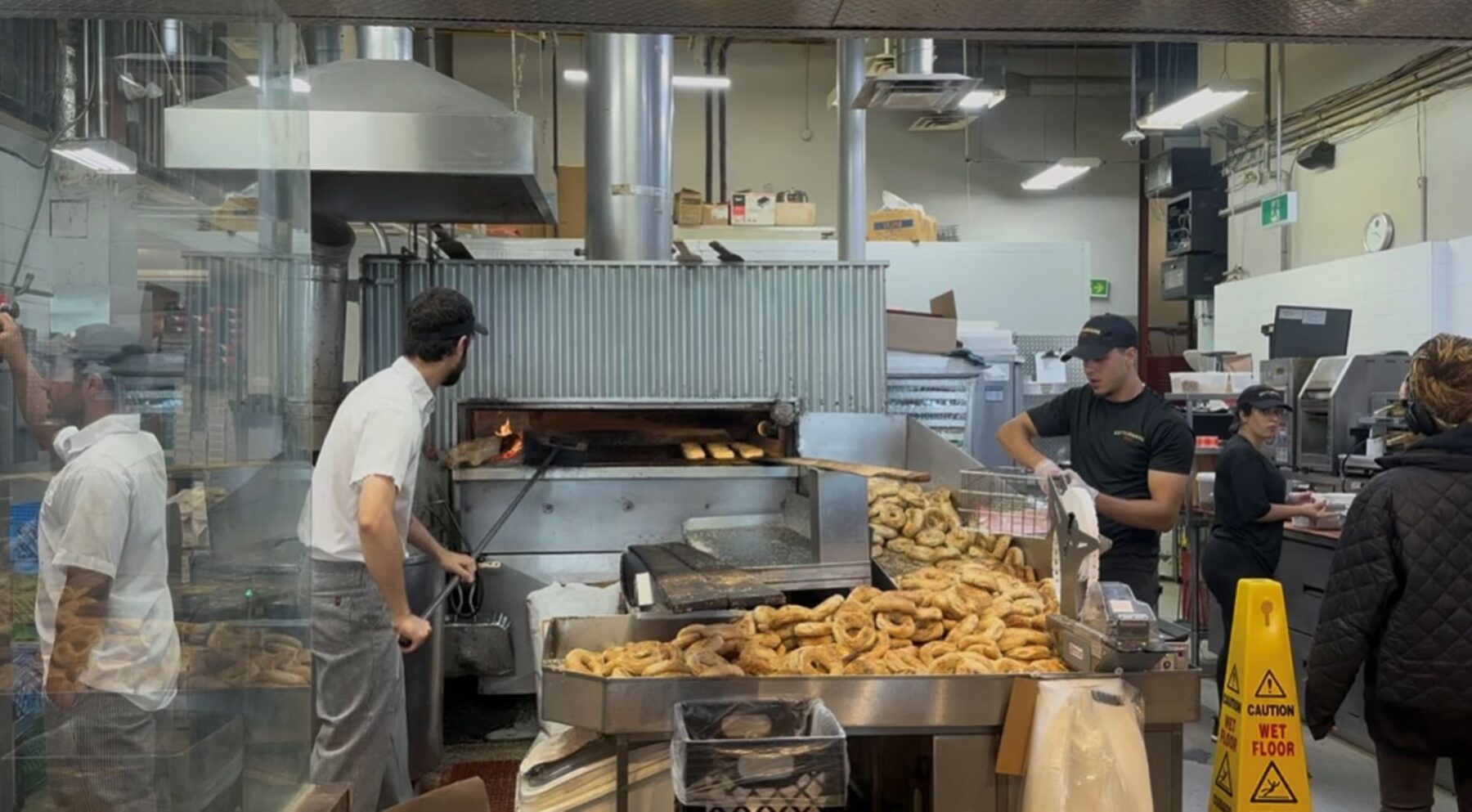
Inside the heart of Kettleman's, where workers are cooking in the open fire and others are bagging them up. Photo credit: Jade Louise Greenwood
A staple for many, Kettlemans Bagel is the kind of place where you can study at 3 a.m. or go after a light morning jog. “It’s kind of pricey,” says Kiara Hanna, “but so is everywhere. And honestly? I feel like it’s worth what you are getting.”
With endless bagel options and proximity to campus, Kettlemans is undeniably inviting, with its burning fire open for the public to watch workers create doughy Montreal miracles.
Whether you’re there for a meal, a meltdown, or a moment of clarity over a toasted sesame bagel, it’s the perfect go-to breakfast spot.
Summerhays Grill – 1971 Baseline Rd.
From left to right, Zanti Murray, Kieron Jackson, and Saige Boston pose in the Marketplace Foodcourt to approve the off-campus choices on this list. Photo credit: Jade Louise Greenwood
Three students in early childhood education all agree on one favourite breakfast spot. “Summerhays is definitely the new unofficial ECE hangout,” says Kieron Jackson. Just across Woodroffe Avenue, Summerhays Grill offers a student breakfast that is not only affordable but also delicious.
The deal consists of two eggs, bacon, home fries and toast, while including tea or coffee for only $7.50, compared to the regular price of $9 for the same meal without a drink.
The manager, Marcy Smith, explained why the menu item deviates from the regular: “It’s cheaper for students because we know that they are in school.”
While the breakfast is a hit, the two other ECE students, Saige Boston and Zanti Murray, rave about the mimosas and how they come with their own personal bottle of champagne. With affordable comfort food that is stacked a mile high, this restaurant is perfect for post-class debriefs or pre-exam pep talks.
Allô! Mon Coco – 1377 Woodroffe Ave.
Inside Allô! Mon Coco, in the slow afternoon. Students believe this to be the best time to go, after the rush. Photo credit: Jade Louise Greenwood
Located just steps from Algonquin College, Allô! Mon Coco is constantly buzzing with students. A restaurant employee, Shaun Pilla, says the most ordered meal is the Choco Coco De Luxe, a two-egg breakfast topped off with a strawberry crepe. “It’s put right there, at the front of the menu and it is there for a reason.”
Sometimes, if you are lucky, you can get a side dish of gossip with your crepe, just like Jackson, who once caught a breakup story from the table next to him involving Olivia Rodrigo and a car speaker. “She blasted Good For You by Olivia Rodrigo for an hour,” he recounted.
Breakfast with a side of drama? Yes, please.
Edo Japan – 1377 Woodroffe Ave.
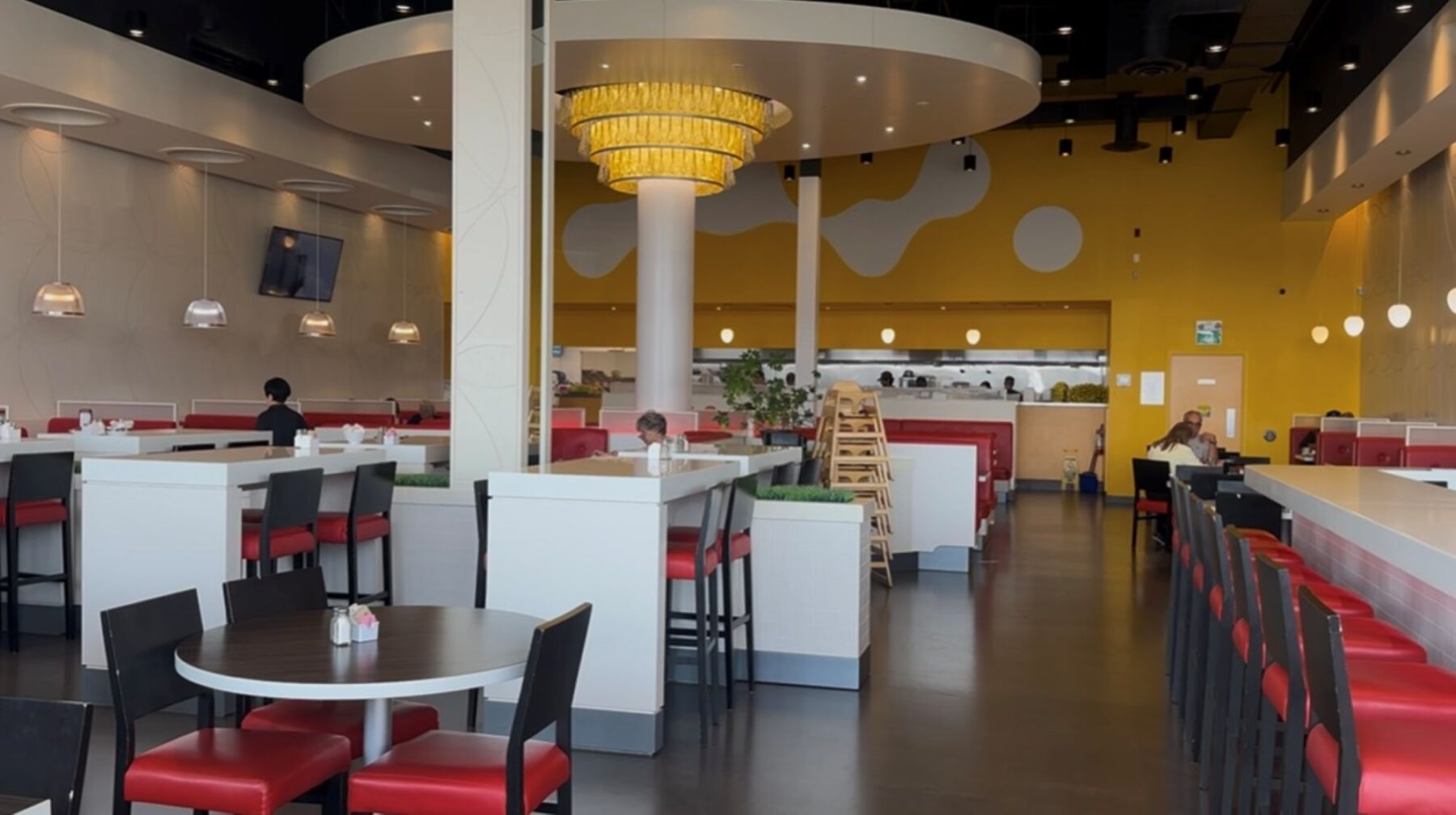
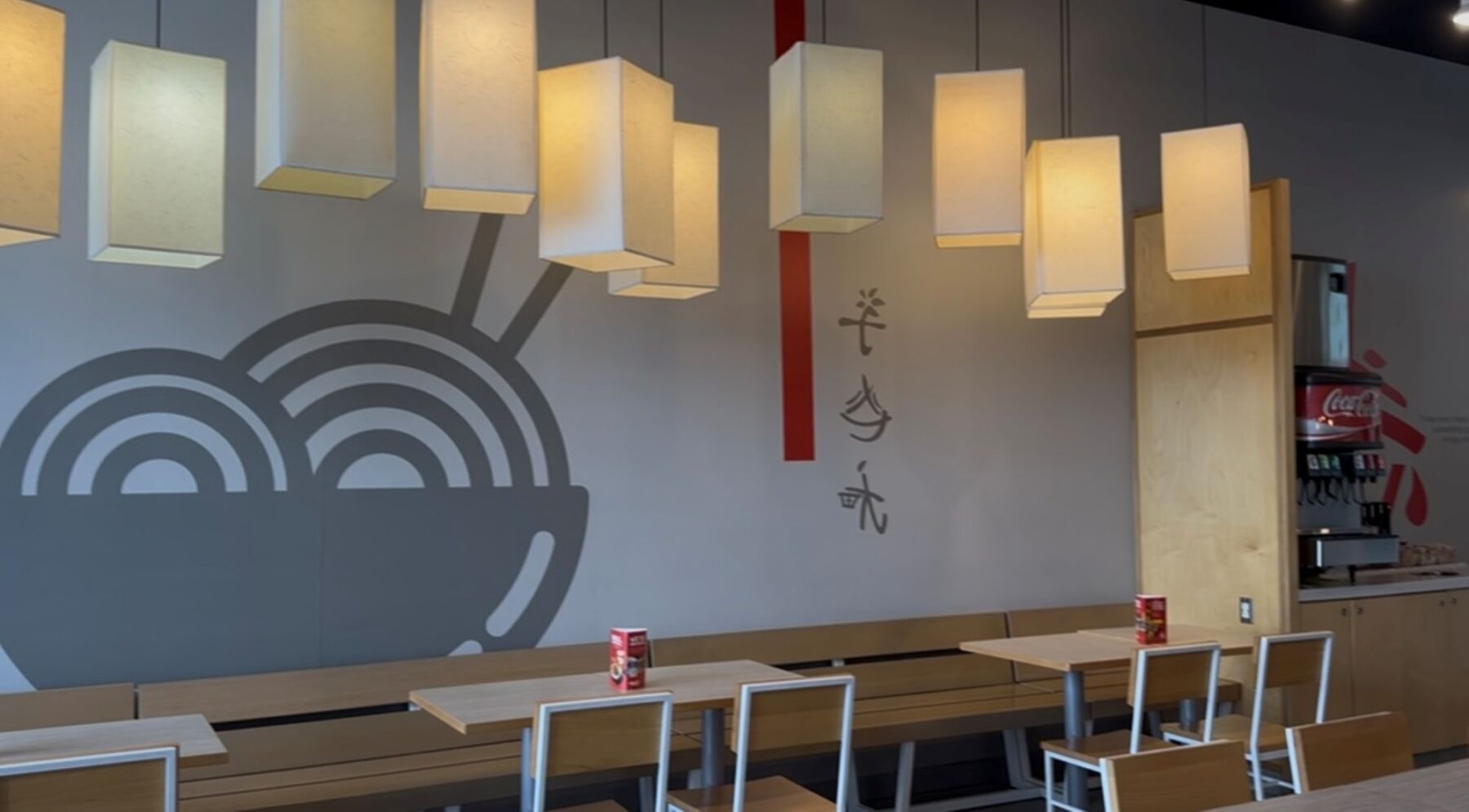
Edo Japan, where the lights are dimmed and the sushi is fresh. Photo credit: Jade Louise Greenwood
For students craving sushi, ramen or bubble tea, Edo Japan has it all, not to mention tasty Halal options.
“My girlfriend hates sushi, but I finally found a place she likes,” Jackson says proudly.
The hours go from 9:30 a.m. to 11:00 p.m., making it a reliable spot for lunch and dinner. Students say the staff are friendly and helpful and the food is consistently fresh and satisfying, perfect for a quick stop or a low-key dinner with friends.
McDonald’s – 1850 Baseline Rd.
McDonald's, a place for students to go for a cheap meal after school. Photo credit: Jade Louise Greenwood
Just down the street, the 24-hour McDonald’s is where the real nightlife is.
“It always ends the same: a Jr. McChicken and let’s be honest, an Oreo McFlurry,” says pre-health student Sophia Serviss. She and her roommate often venture out past midnight and end up finding “people making out in booths while fights are going on outside.”
It’s chaos. It’s romance. It’s the Algonquin College McDonald’s; cheap, consistent and wildly entertaining.