First Person: Bringing perspective on homelessness in the downtown core
“Got any spare change?”
It’s a shrill voice — a frail woman wobbling toward me. Her lower abdomen is fully exposed, the curvature of starvation visible beneath a torn shirt marked with several burn scars.
Her bloodshot eyes dart intensely into mine. My stomach churns with each new meth-infused breath as her face inches closer. I become more and more aware of the corroding teeth crowding her smile.
At first, I don’t respond. The tightness in my chest inhibits my ability to speak or reason. I clear my throat and force myself to blink, the colour draining from my face.
“I don’t have any change,” I stammered.
“Can you buy me a hot dog at least? I really need food,” she says. “Haven’t eaten all week.”
I walk toward the hotdog cart sitting next to the Beavertails trailer, my hand shaking with my debit card in hand.
“We’re all out of hotdogs.”
I turn to the woman, feeling hopeless.
“There’s nothing I can do for you,” I lie. “I’m sorry.”
Ever since that day, my conscience has tugged on me to change my outlook on the homeless. I began to wonder: what was causing my disposition to be so timid and judgmental? Why couldn’t I see this woman as another human being? I had always been told not to give spare change to the homeless — because they would use it to feed their addictions. I stayed far away from the filth I believed they carried.
Growing up, whenever a homeless person approached our car window, my mother would almost always roll it down and give them the little bit of spare change we had. My upbringing, grounded in Christian values, made this seem like a charitable gesture at the time. However, as I matured into my teenage years, I began to question whether sparing change to the poor was truly the best course of action. I had been told that homeless individuals were in their situations due to poor life choices, and that donating to them would only fund their addictions. Now, when a homeless person asks me for change, my pity for them is divided. I’m sure I’m not the only one.
Since 2021, there have been approximately 300 new victims of homelessness in the city of Ottawa. According to a 2014 study by the Canadian Observatory on Homelessness, an average of 235,000 people in Canada experience homelessness each year. Between 30,000 and 35,000 people are homeless on any given night. The homeless population continues to grow each year, driven by poverty, addiction, and trauma, yet many people don’t know how to help.
Especially as the economy continues to crumble, many people are finding themselves in desperate situations, often turning to quick fixes. These people didn’t choose to be homeless.
I began to realize how damaging stereotypes around addiction are to real, long-term support and change. These were the same stereotypes I had carried.
Walking past Three Brothers Shawarma on 530 Rideau St., I nervously made my way down the street until I came across ten collapsible wagons filled with essential supplies.
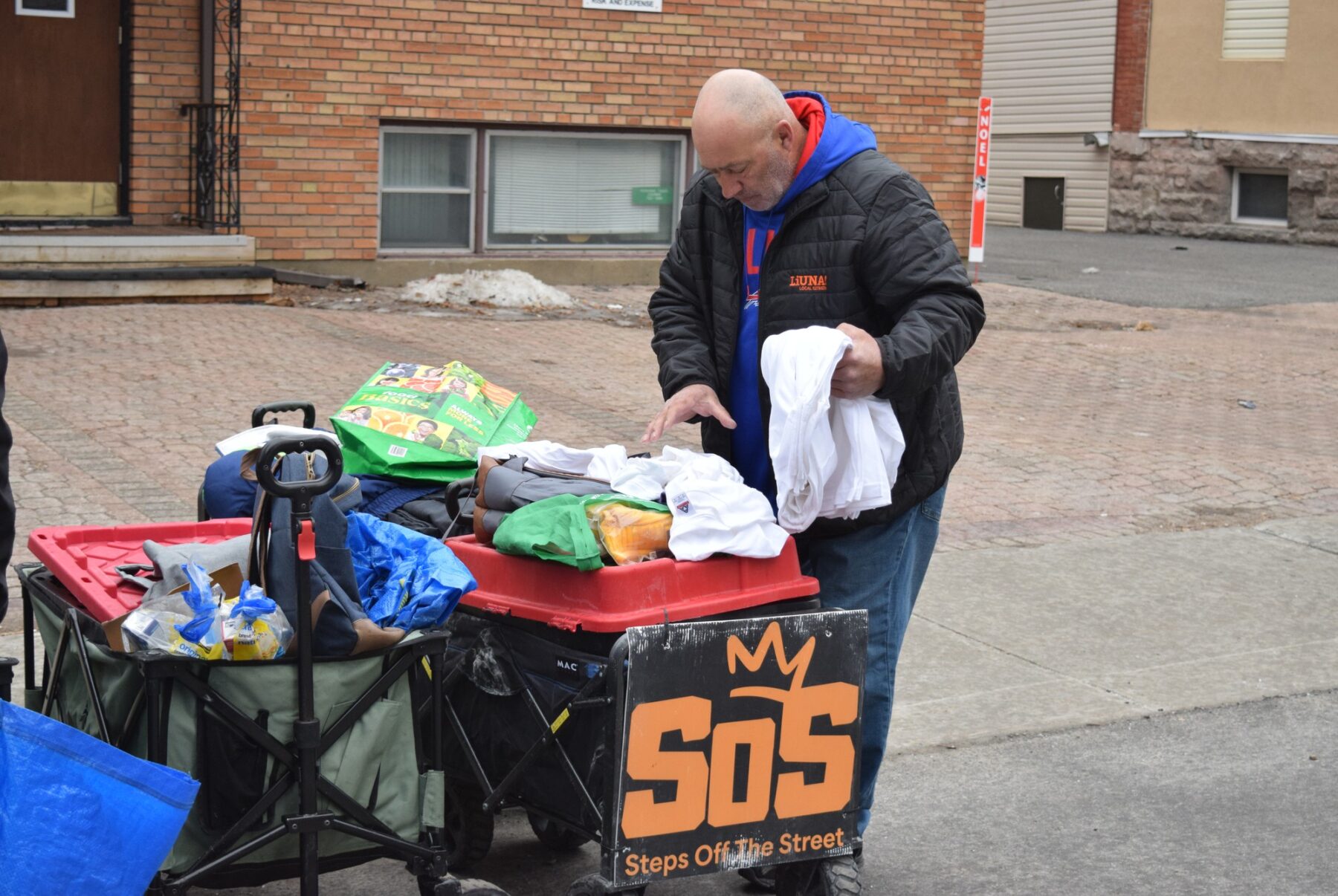
The wagons were all the same kind, square-shaped with classic handles on the end and four big wheels at the base. Some carried toiletries, some carried men’s sweaters and pants and others carried bags of sandwiches. Each wagon was filled to the brim.
A man leaned into his truck, grabbing the final items he needed to fill the carts.
“Hi, are you Gerald?” I asked, my voice unsteady. I had to admit, I was a little anxious about the task ahead.
To fight my fear of the streets and discover the proper way to reach out, I decided to go down there myself and help the community firsthand.
I was inspired by Gerald Jorgensen, a man who had suffered from addiction since the age of 18, was homeless for two and a half years, and has now been sober for 26 months.
After completing their nine-month residential addiction recovery program at Jericho Road, which is an addiction recovery service, he became passionate about helping others in his community find healing.
“We grew from one wagon to now having ten wagons on the street. We now have six routes, two on Bank Street and four on Rideau,” said Gerald. He now runs a non-profit organization called Steps Off The Street (SOS).
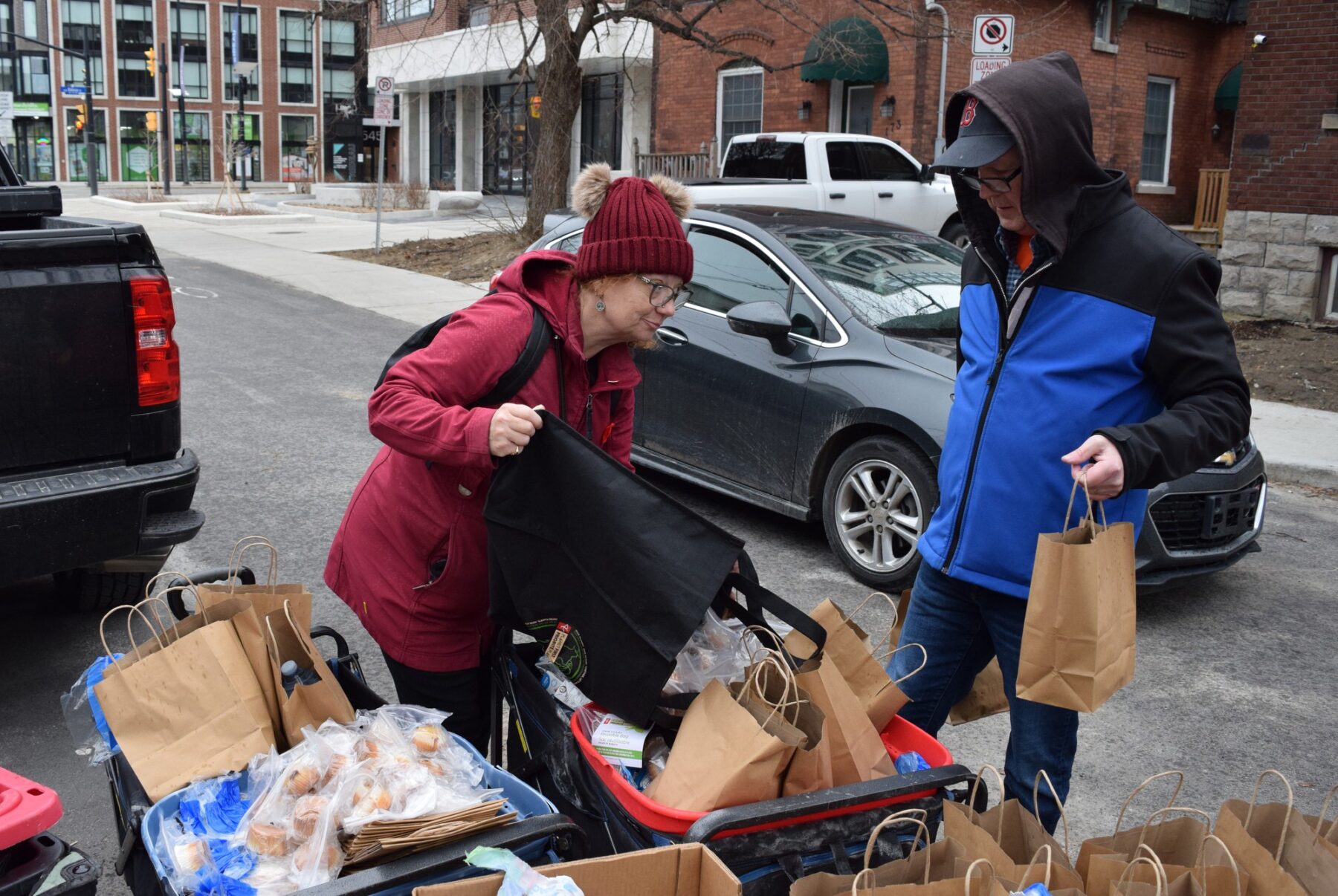
He and a group of volunteers head to multiple different locations in downtown Ottawa to bring essential supplies to those in need.
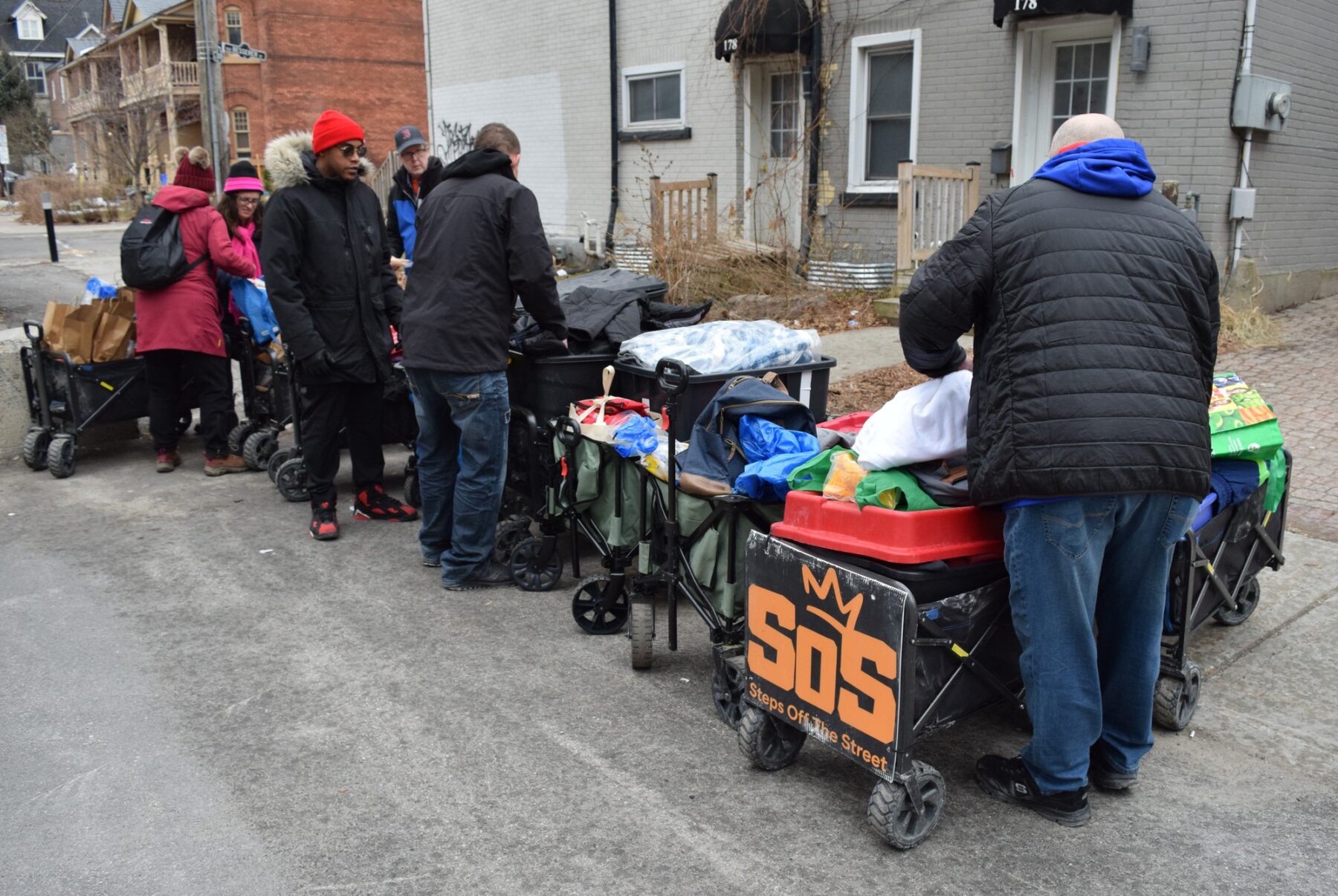
What started with one man and one wagon quickly expanded. Today, 26 volunteers regularly join. On this overcast day, we were about nine, including myself.
“The main objective out here is to meet people where they’re at. We’re looking for guys and girls who may want to find recovery,” Gerald said before we headed to Sandy Hill to begin distribution.
“They’re probably having a worse day than us, so we just kill them with love. And if there’s aggression, we just walk away.”
We were instructed to give each person one sandwich and one juice box, but we were allowed to offer second helpings. Other wagons held men’s and women’s pants, sweaters, socks, boots, shoes and hand warmers. The goal was to make people feel seen and cared for.
Before we left, Gerald prayed over the team. I felt inspired and determined to be a witness for those downtown. Susan Lannigan, one of the volunteers, shared what the ministry means to her.
“It’s not really about the people that do it. It’s about the people we’re helping. They have nothing, and they are worth so much more than they’re given credit for,” she said.
Through her words, I realized that the outreach focuses on those being served — not on the volunteers. It’s about restoring dignity to people who’ve lost almost everything. They deserve a voice too.
Not long before we set out, a tall man approached, lightly bouncing on his feet towards us, with Air Jordans — the sole of the shoe holding on by a thread. He wore a rusted gold-coloured chain around his neck and faded glasses shielding his pocketed eyes.
The man recognized Gerald, stunned at how far he had come from the man he once knew on the streets. Gerald shared his story, offered support, and exchanged contact information with the man. They exchanged a hug and I could see genuine gratitude in his eyes.
Though startled at first, the interaction warmed my heart. An uncontrollable smile spread across my face. I realized this wouldn’t be the last person we would help that day.
As the rain began to fall, I picked up the handle of my wagon. Gerald smiled softly next to his truck. “Isn’t this amazing?” he said, proud of the work being done.
Across the street, a woman lay under a tarp she had propped up into a dome just big enough for herself. She had blankets laid down and a box of chicken beside her. She told us that every time she set up her encampment, someone would steal it, desperate for shelter. We gave her fresh blankets and a cupcake. Susan and others took time to speak with her. Their conversation meant everything to her, and she laughed and hugged Susan tightly.
“God bless you,” she said, her face glowing.
In the Sandy Hill neighbourhood, people began crowding the wagons 一 some wanted food, others clothes, and others just conversation. A woman came to my station while her boyfriend stood in the rain, scrubbing shampoo into his hair. She picked out a pair of Levi’s jeans for him.
“He likes to be stylish,” she said.
I could see the pureness in her eyes. Broken, but human.
I recently spoke with Kevin Williams, the executive director at Jericho Road, the nine-month addiction recovery program Gerald attended.
“There’s a lot of stigma around addiction, and breaking that stigma is difficult, especially with the political landscape and the pressure for quick fixes,” he said.
This stigma had once trapped my thinking. My goal in this experience was to understand what fuels that stigma and how we can begin to dismantle it.
“Most people don’t understand addiction and think it’s either a choice or something people can control,” Williams said. “The opposite of addiction is connection. Supporting those who are stuck and giving them resources to rebuild their lives is key.”
Many government systems offer only temporary fixes. It’s only through love and consistent support that we’ll make a real difference. Too often, society judges the broken instead of listening. Williams says the most important thing we can do for the homeless is to make them feel they have a voice in their situations.
I saw that downtown. When I stepped out of my comfort zone and treated the homeless as I would my own family, I felt something change. I no longer worried that giving them help would enable them. Instead, I realized that simply being seen is often the first step toward healing.
“When people in recovery first come in, all they really want is to be listened to. They’ve spent so much of their life feeling like they don’t matter or have a voice. When someone calls for help, we have a small window of opportunity to respond. If we don’t act, we may lose that chance to help them.” ー Kevin Williams
They didn’t choose this life; realize the false stereotypes against of the un-housed.