First Person: A guide to dating while dying

Telling someone you're dying isn’t exactly first-date material, but I had to do it every time I met someone new
Photo: Jade Louise Greenwood
A collage of medicine pieces used daily, along with images of the machine in use.

If a stranger glanced at me on the street, they would see me as a normal, typical girl. But if they looked closer, they would see the sun reflecting wrong on my chest, my skin jutting out in the wrong way. They would see a thin white tube, the size of a stir stick, threaded in my chest, over my collarbone.

“Wait, what do you have?”

Every time I went on a first date in my late teens and early 20s, and told the person my diagnosis, they asked that question. And then, “How does it work? It’s a tube?” and then, “Are you dying?”

Well, yes. I was dying.

I have a serious lung disease, pulmonary arterial hypertension. A doctor told me when I was 18 years old that I had 10 years to live.

I would watch every muscle on their face and wait for the twitch in their brows to navigate their mind. I hoped for a response, the perfect one. The one where I didn’t feel like falling six feet below the café floorboards. A kind smile, a gentle look, a simple “I understand.”

It wasn’t always that way.

“Hi! It is so nice to meet you!” I greeted my date, who was wearing a grey sweater and jeans, his winter boots clomping on the floor, slush shooting out from underneath. My hands sweated as I scraped my painted nails on the table in front of me.

People walked by and sat down at nearby tables as I wracked up the courage to tell Grey Sweater about my diagnosis. His side-eye notified me he knew something, but just didn’t know how to bring it up.

“Do you think they have soy milk?” Grey Sweater asked, getting up to grab a cup right next to me. The conversation flowed, but I knew my time was running out–literally and metaphorically.

I battled myself day and night over this. Was I worth staying with when I knew I didn’t have a future? How was it fair to ask someone to watch me die? It was not. But neither was the face Grey Sweater gave me when I told him about my tube. A mix of disgust and terror, like he wanted to crawl away from the subject on all fours.

Before I continue, I should say that was the worst reaction I ever got. People are not inherently bad. I do not want you to be afraid of falling in love, but I do want to share my honest experiences, and it isn’t all sugar and cookies. It can hurt, it can be scary, but it can be beautiful too.

On an icy winter day, an entire year after Grey Sweater, I met a boy who wore an orange T-shirt. I was bundled up in a scarf, and he was in summer clothing.

We spent a couple of hours walking along Bank Street, sitting on cold benches, looking for a warm coffee shop to sit down in. When we did, I knew it was time.

“That’s so cool!” said Orange T-shirt, “Can I see your tube?” He looked at me with bright, curious eyes. Surprised by the reaction, I showed him, and he started firing questions at me. This was the first time the reaction was more curiously excited than curiously afraid. We spoke for hours about it, and it was nice not having a disgusted face to look at. This face was open, kind. The expression was similar to one I had seen years before.

It was my first date about 10 months after my three-week hospital stay with all its blinding lights and endless procedures. I met a man, and we spent hours walking around a lake, discussing everything. He was the first person I told about my diagnosis who did not know me before the tube. Mr. Lake Walk let me vent everything that had happened to me. He listened. The wind blew in the trees around us, the water perfectly rippling onto the grassy shore. Mr. Lake Walk wasn’t scared. He wasn’t disgusted, didn’t try taking on the Canadian geese on all fours to get away from me. He was thoughtful and kind.

I used to battle with myself about whether I should even try to date. Should I let someone fall in love with me when I knew how and when I would die? I was hesitant about letting people in, but now, looking back, I am learning to let the world take me where it wants. But every once in a while, the most absurd plot twists come along.

Take last summer, for example, when my doctor told me that I am no longer going to die at 28. I can look toward the future and plan for a much longer time. That change in itself showed me that in life, anything can happen.

Sometimes, Mr. Lake Walk comes up to you in the Algonquin College cafeteria, four years after your first date and asks if you remember him. Sometimes, guys like Grey Sweater find you on Bumble, and you start talking again. Sometimes, a boy with an orange t-shirt shows you that your body isn’t scary and disgusting.

From all of this, I have learned a few things, but mainly: Do not be afraid to love others. I am 23, and I am still learning how to navigate love, but I am trying, and that is all I can honestly ask for.

Be selfish, be brave, and fall in love whenever you can.

Algonquin College dome is set up for the winter

The Algonquin College Dome is back. Here's what this means for the college, community and student body.
Photo: Jaiden Martin
Photo of the dome and Z-building on Nov 12. 2025.

On Nov. 6, the college’s Students’ Association had the Z-building’s field dome put up for the rest of the semester. Last year, the SA allowed students to help set up the dome and get paid for it. This year, that was not an option.

The field runs year-round, with the dome covering the surface from November to April. In the summer months from May to October, the field is back to a regular outdoor pitch.

The SA prioritizes intramurals in the dome, but Wolves varsity coaches look forward to their field time to continue skill development. All fall sports have come to an end in the OCAA, but for the Wolves student athletes, the dome gives them year-round access to training, something other OCAA colleges don’t have.

Dan Gauthier, head coach of the Wolves’ women’s Rugby sevens team, said the dome is great for the women to still train and practise during the off-season. Gauthier said it’s also an opportunity for him to show recruits what practice is like.

“In the past, we had one session a week so that the girls could still get together and do some work on skills. I could also bring in potential recruits for the following season to try to assess them and how they may acclimate to the training environment,” said Gauthier.

The varsity practice schedule for the winter hasn’t been finalized yet, but the Wolves women’s soccer team has a similar schedule to the women’s rugby team, practising once a week. Head coach Basil Phillips tries to have the women do a little bit more than the other programs by playing some exhibition games at the dome to stay in top shape.

“Nothing has been confirmed as of yet, but typically we will have training time of once a week for two hours. In the past, it has been Tuesdays from 9-11 p.m. We also try to arrange some exhibition games to play throughout the winter,” said Phillips.

The SA hosts a variety of intramural leagues, including a three-on-three soccer tournament on Nov. 20.

Stephanie Rheaume, the campus recreation coordinator of the SA, said there will be leagues for soccer and flag football starting the first week of February.

Rheaume wanted to remind students that registration for the winter semester intramurals tournaments and leagues opens Jan. 12 and closes Jan. 28.

The dome is a large source of revenue for the SA and also provides a large service to the community, being one of the few domes across Ottawa. The dome is available to rent from November to August. Rates change depending on the season of the year. From November to April, the dome charges $425 plus HST per hour. During the summer months, May to August, the field’s hourly rate is $115 plus HST.

Community works to save Algonquin College’s special needs program

Parents of current and future students in the program are calling the college's decision a step backwards
Photo: Mitchell Ansell
The AAADD program takes place on the second floor of the A-building on the Ottawa campus.

Algonquin College’s academic assistance for adults with developmental disabilities (AAADD) is the only program of its kind in the city, and the community is coming together in an attempt to save it.

Algonquin’s AAADD program offers those with developmental disabilities the chance to receive post-secondary education when no other school in Ottawa will.

Earlier this year, Algonquin College announced that it was terminating the program due to the financial difficulties the school is facing.

The AAADD program takes place on the second floor of the A-building on the Ottawa campus.
The AAADD program takes place on the second floor of the A-building on the Ottawa campus. Photo credit: Mitchell Ansell

However, the families of current students and those who were planning to register for the program are coming together to try and save it by bringing attention to the issue.

Charlene White, whose son Brennan, 23, is in his third year of the AAADD program, said that getting the word out is the main goal.

“We need lots of media attention, and we have been reaching out in that direction as much as possible, whether that is through television, radio, newspaper, or Algonquin College,” said White.

White said it’s important that the program remain at the college as a resource for the community.

“The location itself is integral to giving all students with learning exceptionalities the same opportunity for inclusiveness to attend post-secondary education,” she said.

Eric Burgin’s daughter Angie, 18, has completed Grade 12 and Burgin said that the AAADD is the only program in the city she could attend in a post-secondary capacity.

“The AAADD program was the one program that she would qualify for with her intellectual disabilities,” he said.

Burgin is also part of the group of parents fighting to save the program and he said that the support from the community has been overall positive.

The advocacy group has been working closely with Chandra Pasma, the NDP MPP for Ottawa West-Nepean, who hosted a community town hall earlier this year about the program’s benefits.

“It’s been an eye-opening experience working with an MPP. When she hosted the town hall earlier this year, there were four MPPs in attendance from two different political parties. That doesn’t happen very often unless the topic is important and non-partisan,” said Burgin.

Pasma has also circulated a petition that calls on the Ontario Progressive Conservative government to save the program.

“The parents and community members have been incredible. They keep sending stacks and stacks of petitions. So I have tabled petitions twice, because I went to Queen’s Park with a big stack and when I came home that weekend, there was already another stack of petitions,” said Pasma.

Pasma believes the AAADD program should be preserved for several reasons.

“I think it’s fundamentally a matter of fairness that these young adults have the same access to post-secondary education as neurotypical young adults. There are also benefits to us, as a community and as a society, when we assist people with developmental disabilities to further their studies,” she said.

Burgin and several other parents met with Claude Brulé, the president and chief executive officer of Algonquin College, and Janet Trakalo, the dean of the school of wellness and public safety and community studies, in September to discuss the importance of the AAADD program and hear Algonquin’s side.

“We let them know how we felt the program was vital to the community being one-of-a-kind,” said Burgin. “They had a chance to share from their side as well, that they have cut other programs to try and trim the budget. We don’t see them as the bad guys, we see them as an institution trying to save money. We just wish it wasn’t this program.”

The college plans to end the AAADD program effective April 30, 2026 and will continue to support the program until then.

The Algonquin Times asked Algonquin College for comment but did not hear back by the deadline for the story.

Wolves men’s basketball team finds optimism after close loss to Georgian College

The Wolves may still be chasing a home win, but their battle with Georgian proved they’re trending in the right direction
Photo: Nicklaus Korim
Albert Opena taking a three on Nov. 15 in the Jack Doyle Athletics and Recreation Centre at Algonquin College.

The Algonquin Wolves men’s basketball team is still seeking its first win at home after losing to the Georgian College Grizzlies 84-78 on Nov. 15 in the Jack Doyle Athletics and Recreation Centre.

The Wolves, now 1-5 to start the season, have had a shaky opening after going 12-6 in the previous 2024-2025 season. Defensively, the team could not create a firm stop and allow themselves to take the lead they needed to win. However, they remain hopeful about the future of the team.

“We were in the game the whole way, but inexperience showed at the end,” said head coach Trevor Costello.

Shyeem Brown taking to the air for a layup Nov. 15 in the Jack Doyle Athletics and Recreation Centre at Algonquin College.
Shyeem Brown taking to the air for a layup on Nov. 15 in the Jack Doyle Athletics and Recreation Centre at Algonquin College. Photo credit: Nicklaus Korim

“Lack of running our offence properly, we needed leadership, and we didn’t have leadership,” he said.

Most notably, the Georgian offence brought with them a three-point attack that the Wolves could not stop. Sean Marseille came off the Georgian bench to go 7-for-9 from the field and find holes to get open, going 4-for-5, draining threes behind the line.

“We knew they were shooters. We had a couple of defensive lapses in this game,” said Wolves forward Haven Holder.

Holder had an efficient yet unproductive game. He made six buckets on only seven shot attempts, all coming from inside the paint as he muscled his way to the rim, while going 3-for-6 on the charity line. Holder finished the game with 15 points, five rebounds and one steal.

“As the two option on the team, I’ve got to do more to get to the basket, shooting a little more, contributing a little more on the offensive end,” said Holder.

Haven Holder rises for the opening tip on Nov. 15 at the Jack Doyle Athletics and Recreation Centre at Algonquin College.
Haven Holder rises for the opening tip on Nov. 15 at the Jack Doyle Athletics and Recreation Centre at Algonquin College. Photo credit: Nicklaus Korim

They may have lost, but the Wolves walked away with a new outlook on their season after proving they could hang with the one-loss Georgian Grizzlies.

“We played a decent game and turned a corner. We’ve just got to tighten up,” said Holder.

Albert Opena, the starting guard for the Wolves, shared the same positive outlook on the season after the loss.

“Even though it’s a loss, I think we can take a lot of positives from that game, especially after how poorly we played as a team the weekend before,” said Opena.

“I think everybody played the right way, helping get easier shots. It’s a team effort for sure,” he said.

Opena was the lead scorer in the game, finishing with 23 points, eight rebounds, five assists and a steal. While having a fairly attractive game on the scoresheet, Opena realized there were issues in his own game and needed to tighten up his defensive energy.

With the team playing as well as it ever has together, the Wolves kept themselves in a game against a clear favourite in Georgian College. They have more than enough hope to rally, come back and get the next one.

“We can battle with these guys, and you know what? The guys are optimistic,” said Costello.

The Wolves’ next game on Nov. 22 is in Toronto against George Brown.

First Person: People watch women’s sports too

Canada’s biggest ringette tournament will take place in Ottawa for the second year in a row. Will people be watching?
Photo: Kendra Mendrisky
Kendra poses with a trophy at nine years old after playing in the 2013 year-end tournament.

Three, two, one. The buzzer sounds in a small arena in North Bay. In the stands, parents, coaches, players young and old erupt in cheers. Unfortunately, they’re not for my team.

This was the most gut-wrenching moment in my ringette career of 16 years.

On March 13, 2019, my ringette team—the City of Ottawa Ringette Association, affectionately known as CORA—traveled four hours north for the Ontario Ringette A” Provincial Championships. Three days and six games later, we found ourselves tied for the third-place semi-final spot with our biggest rivals: the Metcalfe Hornets. True to their name, the Hornets were speedy, aggressive and knew right where to sting. But only one team could claim this spot, earning the chance to play Sunday morning for a shot at the gold-medal game in the afternoon.

So, how did the tournament decide?

A mini game. Ten minutes of sweat and tears, pushing 30 teenage girls to their mental and physical limits.

“Mad dog! Mad dog! Mad dog!”

I could hear my teammates’ parents chanting my nickname as I used every ounce of energy to fight for the win. It wasn’t enough. As hard as my team tried, we fell short to a heartbreaking 1-0 loss. Not only had we lost the semi-final spot, we also lost the opportunity to play in the Eastern Canadian Ringette Championships.

After that year, I stopped playing competitively, but I never lost my love for the sport.

When I was younger, I used to be surprised when people didn’t know about ringette. After all, my childhood was spent at the rink at least four times a week from September to March.

Now, at 21, I am surprised when people do recognize ringette.

It was invented by a man named Sam Jacks in 1963. According to Ringette Canada, “Jacks, who was the director of parks and recreation for North Bay, dreamed up ringette in an effort to draw more women to play sports.”

Ringette is still played mostly by women, which is part of what makes it so special. Fun fact: It is also known as the fastest sport on ice.

Next spring, Ottawa has the honour of hosting the Canadian Ringette Championships for the second year in a row. The 2025 tournament, which took place this past March and April, marked the first time the region has hosted since 1996, when the championship tournament was held in Gloucester.

If my mini game during provincials of 2019 was the most intense moment of my ringette career, I can only imagine the exhilaration of a national title on the line. Viewers feel the intensity of the sport as well. When I was younger, I would beg my parents to let me stay after my practices and games to watch the older kids play. But then you grow up and become the “older kids.”

And then who do you watch?

For me, the CRC brings that feeling back. I know it ignites that feeling in other players too. But what I really want is for more people to experience it, especially young girls.

According to a 2020 report by Canadian Women and Sport, only 18 per cent of women aged 16-63 years stay involved in sport. One in three girls who have participated in sport drop out by late adolescence, while the dropout rate among boys is one in 10. Some of the reasons girls do not participate include perceived lack of skill, poor perceptions of belonging and not feeling welcomed.

I know I wouldn’t feel like I was welcome in sports either if I didn’t have those older ringette players to look up to. Girls don’t see themselves in the NHL or NFL or NBA games that receive so much coverage and attention in the media.

When I was in elementary school, you couldn’t just be a hockey player. The boys would call you a girl hockey player, and, of course, you’d never be as good as them. You’d never make as much money as they would in the industry. I didn’t question it. It’s just the way things were—the way things are.

Sixty years ago, Sam Jacks recognized the need for a space where girls and women could thrive in sport.

To carry on Jacks’ work, the current president of CORA, Jean-François Bordeleau, says he’s “doing everything possible so that our players have the best experience possible and keep coming back.”

Although I no longer play for CORA, I keep coming back. Ringette gives me joy. It gives me life. I would not be who I am or where I am without it.

Birch bark canoe building fosters knowledge of traditional Algonquin culture

The event in the college library at the Knowledge Keeper's Place aimed to educate students and staff in an ancient and historically significant tradition
Photo: Kevin Clasper-Inglis
Commanda's completed birch bark canoe.

If you walked through the college library at any point between Nov. 3 and Nov.14, you may have noticed an unexpected sight — a man working on a birchbark canoe.

That man is Chuck Commanda, knowledge keeper and master canoe builder. Commanda is Algonquin from the Kitigan Zibi Anishinabeg First Nation outside of Maniwaki, Que.

The canoe, completed on Friday after almost two weeks of work, was built in the traditional Anishinaabe method using birch bark. Commanda was commissioned to build the canoe to coincide with the launching of two new Indigenous studies programs at the college.

Chuck Commanda with one of the many birch bark canoes he's built.
Chuck Commanda with one of the many birch bark canoes he's built. Photo credit: Chuck Commanda

Commanda has built dozens of canoes over his lifetime and is involved with the Canadian Canoe Museum in Peterborough, Ont. The experience has helped him see the canoe as an important symbol of how Canada was founded, acting as a bridge between Indigenous Canadians and Europeans.

He believes that without the canoe, Canada would have developed at a much slower pace.

Commanda's workspace in the Knowledge Keeper's Place.
Commanda's workspace in the Knowledge Keeper's Place. Photo credit: Kevin Clasper-Inglis

“When Champlain got here, he took a ship and he came up the St. Lawrence,” Commanda said.

“But he couldn’t get any further than what they refer to as the Lachine Rapids, which was just east of Montreal. And so, how do you explore more in the country? By befriending the Algonquin people, because it would have been the eastern part of our territory. And they had the canoes. And because he (Champlain) was able to do that, well, that’s kind of what started the Hudson’s Bay Company.”

For Commanda, who already has eight more upcoming canoe builds that he has been commissioned for, upholding this kind of traditional knowledge is one small step in reviving parts of Algonquin culture that were lost through historical assimilation policies such as residential schools.

Birch bark, a material that many Indigenous people traditionally used to craft canoes.
Birch bark, a material that many Indigenous people traditionally used to craft canoes. Photo credit: Kevin Clasper-Inglis

Commanda’s grandparents, who spoke Algonquin, raised him until the age of six and so he had been fluent in the Algonquin language from a young age.

When Commanda started going to school in town, he had to quickly learn to communicate in English and French or else face ridicule. He eventually lost the use of the Algonquin language over time.

“It wasn’t considered cool to speak the language, and there was fear of beatings passed on from older people, so that’s how you lost it,” said Commanda.

Besides traditional canoe building, Commanda is aiding in the restoration of lost customs in other ways. He’s an executive board member of the Ginawaydaganuc (pronounced Jin-away-dag-a-nuk) Village, a non-profit organization aiming to promote and restore historical Algonquin knowledge.

A poster depicting an aerial rendering of Ginawaydaganuc Village.
A poster depicting an aerial rendering of Ginawaydaganuc Village. Photo credit: Kevin Clasper-Inglis

The organization has plans to build a full “village” just outside Ottawa, with an elders’ teaching lodge and an educational/tourist centre, complete with accommodations and academic spaces for classes on everything from canoe building and social entrepreneurship to traditional cuisine and building methods.

Commanda sees events such as this, along with the opening of new Indigenous studies programs at the college, as a solid step in reconciling the harms of the past.

“I think the biggest client for canoe builds is the Catholic school board at this point,” Commanda said.”

“You can only assume the reason why that is, is maybe they’re trying to right the wrongs.”

The canoe will eventually be put up for display inside the college once a location is determined for it.

Listen: Algonquin Times podcast

Fall 2025, Episode 3: Times journalist Matthew Grieve joins hosts Mickey Banks and Vasileios Tselios to discuss his reporting on recent mixed martial arts matches on campus, and William Barritt has the top headlines

Listen to podcasts and other audio features produced by the Algonquin Times.

A warm welcome to winter: Event helps international students embrace Ottawa’s cold season

From free coats to friendly advice, students and staff came together to show that surviving winter isn’t just about staying warm — it’s about thriving mentally and physically in it
Photo: Delaney Smith
Ozlem Telli (middle) and her friend pose with Sibeso Kehinde (right) from the International Education Centre during Algonquin College’s Winter for Beginners event.

As temperatures started to dip and Ottawa’s first snow began to fall, questions filled the Student Commons at Algonquin College for the Winter for Beginners event on Nov. 4.

Hosted by the International Education Centre (IEC) and the Students’ Association, the event helps newcomers prepare for Canada’s famously harsh season.

Representatives from the Ottawa Fire Department taught students how to use heaters safely and check smoke detectors, while staff from Gatineau Park encouraged them to explore outdoor adventures nearby.

“Winter for Beginners emerged from the need we saw to continue educating international students about how they can prepare for the winter season,” said Niamh O’Shea, manager of international student integration at the IEC.

“We know it can be a very big transition for international students to experience their first winter, and we wanted to take a holistic approach, not just about what to wear, but also how to make the most of what’s special about wintertime.”

Winter coats line the racks at Algonquin College’s Winter for Beginners event, where students could take one free coat to prepare for the cold season.
Winter coats line the racks at Algonquin College’s Winter for Beginners event, where students could take one free coat to prepare for the cold season. Photo credit: Delaney Smith

Free winter clothing like coats, boots, scarves, hats and gloves filled each corner, with some students leaving proudly wearing their new attire.

Ozlem Telli, a student from Turkey, is going into her second winter in Canada. She says she remembers being nervous during her first snowfall but now embraces the season with enthusiasm.

“My country is much warmer than Canada, so I needed information not to be scared, but to be ready,” Telli said.

“Thanks to this event and the college activities, I actually like winter now.”

Telli said she’s tried everything from snow tubing and snowshoeing to skating lessons at the college.

“They took us to ski, to skate. It was so much fun,” she said.

“Because of that, I’m really thankful to my college. They made me like winter.”

Telli’s advice to new students?

“Don’t be afraid of winter. I learned there’s no cold weather, only wrong clothes,” Telli said.

“Prepare yourself, wear good boots and a warm coat, and you’ll be okay.”

For Sibeso Kehnide, an international student from Zambia and the international programming coordinator for IEC, the spirit of the event is in helping others feel welcome and less isolated.

“When you come from a place where it’s warm year-round, it’s easy to feel overwhelmed,” Kehnide said.

“So, it’s amazing to see everyone come together, to talk and share experiences. You see students’ faces light up when they realize they’re not the only ones nervous about winter.”

The Algonquin Counselling Services booth at the Winter for Beginners event displays a poster board about Seasonal Affective Disorder, filled with hand-written student suggestions for staying positive during the colder months.
The Algonquin Counselling Services booth at the Winter for Beginners event displays a poster board about Seasonal Affective Disorder, filled with hand-written student suggestions for staying positive during the colder months. Photo credit: Delaney Smith

Between the practical tips and equipment demonstrations, the day’s true lesson is about confidence, community and finding happiness even in difficult times.

According to O’Shea, that sense of belonging is exactly what the IEC hopes to build.

“We want students to be prepared physically but also emotionally for winter,” she said.

“It’s normal to feel a wide range of emotions. The winter blues are real, but there are ways to make it easier, like getting daylight every day, staying active, and being part of the community.”

She added that many misconceptions persist among newcomers about how extreme Canadian winters can be.

“Students are often surprised by how long it lasts, and how cold it actually gets,” O’Shea said.

“Sometimes they buy clothes at home that aren’t made for this climate. We always encourage them to wait and buy winter gear here.”

Abby Muir, the Food Cupboard coordinator with the Students’ Association, agrees that the event creates connection and comfort in equal measure.

“It’s all staff, students, alumni, people from the community who donated everything you see here,” Muir said, looking at the table piled with neatly folded scarves and hats.

“For newcomers, there’s so much information everywhere. Having it all in one spot helps. It’s like a one-stop shop where you can meet organizations, ask questions, and get free gear. You can’t go wrong.”

Muir, who helped organize the event alongside IEC staff, said the goal is much broader than just giving out warm clothes.

“There are so many aspects to thriving in winter,” Muir said.

“It’s not just about staying warm, it’s about mental health, learning how to get around, and finding fun activities so students can really enjoy the season. Winter gets a bad reputation; people think it’s scary or depressing. But if you bundle up, get out there, and try to make the best of it, you’ll succeed in winter.”

Students design, print and paint success with art fundraiser

Illustration and concept art students raise money for graduation showcase after learning funding from the Students’ Association is not guaranteed this year
Photo: Kendra Mendrisky
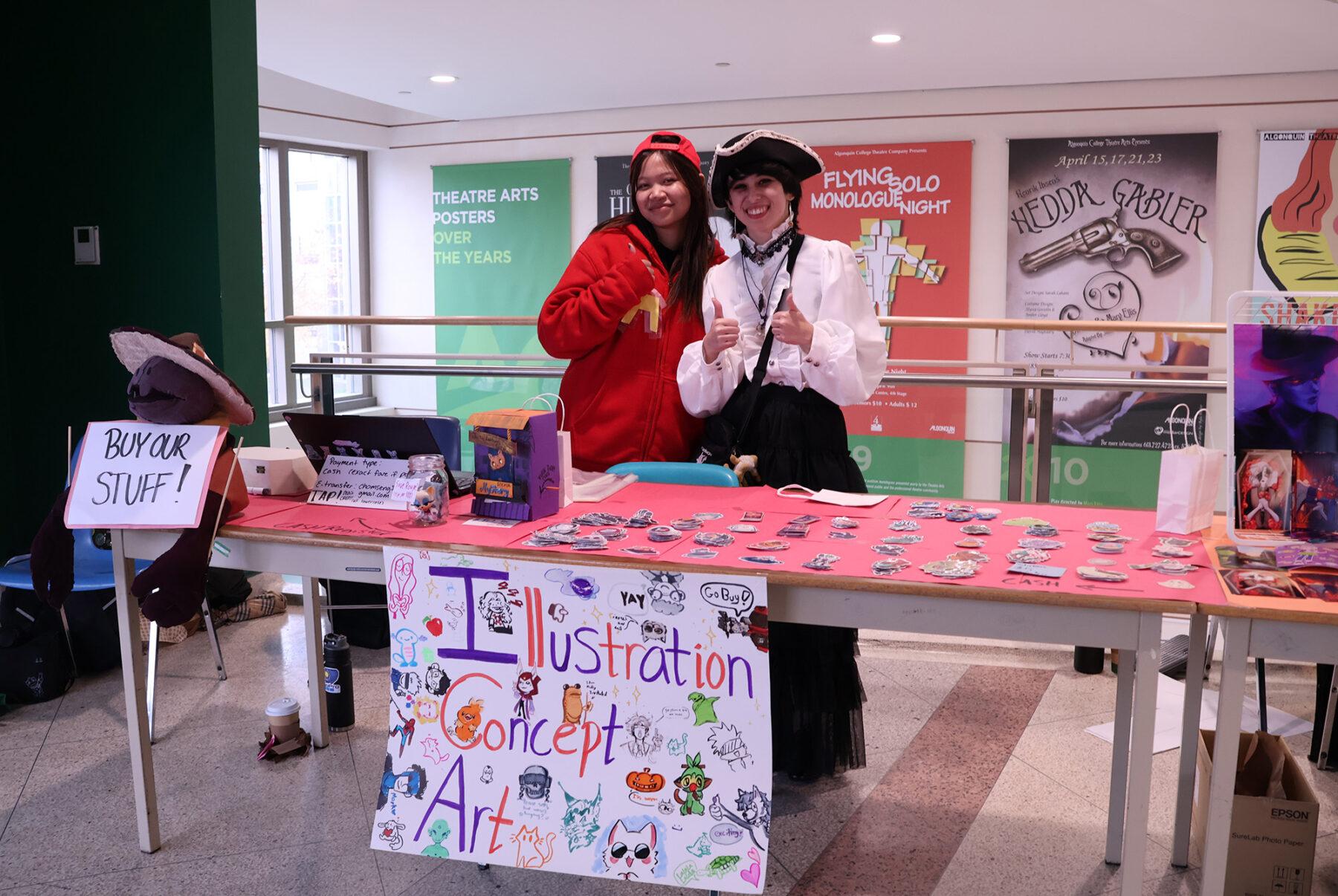
Sabella Chomseng (left) and Dustin Larocque wore costumes the day before Halloween at their fundraiser.

Sabella Chomseng enrolled in the illustration and concept art program to pursue a career creating art — something she’s passionate about.

“I like illustration (and) concept art because you get a lot of freedom of doing different types of things like media and digital media, with drawing,” said Chomseng, a program representative. I feel like it’s very versatile and I really wanted to do something in the future to help me do something fun, like go into a studio or maybe freelance.

On Oct. 30, two of her designs were displayed on a table in a fundraiser for the program, among the work of her classmates.

Sabella Chomseng holds up two of her prints for sale: an original piece and one inspired by KPop Demon Hunters.
Sabella Chomseng holds up two of her prints for sale: an original piece and one inspired by KPop Demon Hunters. Photo credit: Kendra Mendrisky

From 8:30 a.m. to 5:30 p.m., the first-year students sold stickers, prints and paintings in J-building to raise money for their 2027 graduation showcase.

In past years, the Algonquin SA covered the cost of the showcase through employer networking funding, according to Rich Lauzon, the program’s previous coordinator.

This year, students must raise the money to pay for it themselves in the absence of the employer networking fund.

In a written statement, the SA said, “The Algonquin Students’ Association reviewed our model and process for supporting grad funding and employer networking funding. This review led to the creation of the Student Leadership and Activities Fund, which is broader in scope and focused on providing financial support for academic and co-curricular projects that enrich student life on campus.”

According to the SA, a grad show would potentially qualify for some funding if it meets the Fund’s eligibility criteria,” which includes events, activities, and initiatives that foster engagement, community, and learning within students’ programs.

The cost of the showcase has not yet been determined.

Students sold stickers for $5 and prints for $10 and $15, with bundle deals available for multiple pieces on Oct. 30.
Students sold stickers for $5 and prints for $10 and $15, with bundle deals available for multiple pieces on Oct. 30. Photo credit: Kendra Mendrisky

Dustin Larocque, who is a first-year program representative alongside Chomseng, was pleased with the fundraiser.

It pretty much meets the expectations, maybe even exceeds (them) a little bit,” said Larocque. “You do these things (and) you’re worried about who’s going to show up, if it’s going to actually work. But so far, we’ve been getting a lot of support.

He said the group raised “about $1,335.

Secondyear students held a fundraiser on Halloween for their showcase taking place April 15, 2026, which gives students the opportunity to connect with people in the industry and create art books as a way to share their portfolios.

Chris Dainty, the current program coordinator, praised the student-led fundraisers and looks forward to the showcases.

“One of my big things that I’m going to be promoting is (sending) these books out to people,” said Dainty. “We want to try and get as many people to come as possible.

Firefighting students at Algonquin College light the way in community safety event

Students in the pre-service firefighter program take their expertise beyond the classroom
Photo: Bradley Richards
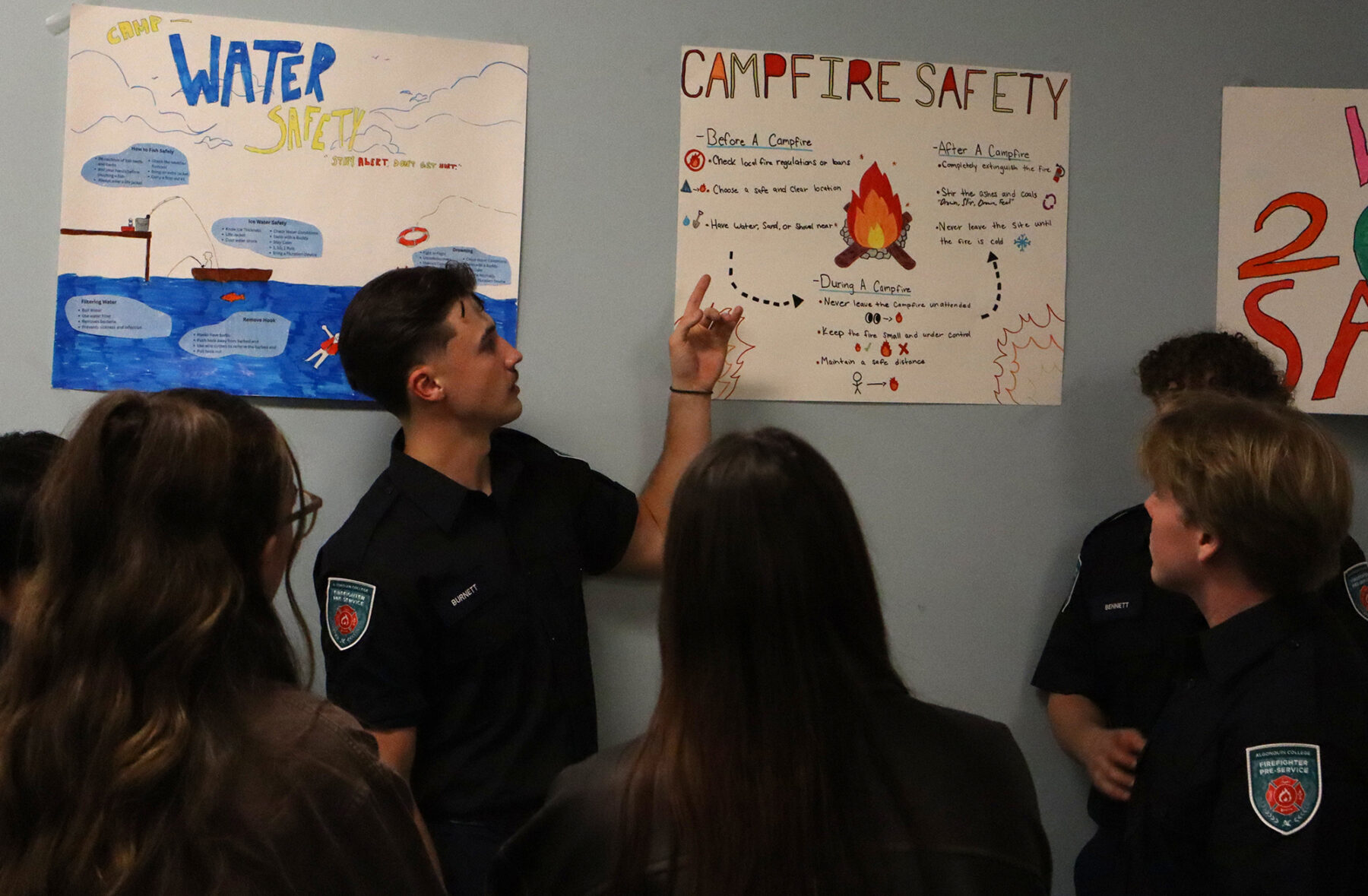
A student at the camp safety booth giving a presentation on campfire safety to attendees of the event.

Stop, drop and listen.

Did you know that fireworks can hit 150 decibels when exploding — loud enough to cause immediate ear damage if you’re too close?

Or that Narcan is available for free at pharmacies? That’s good to know in case you ever face the nightmare of finding someone unresponsive from an opioid overdose.

But wait — would you recognize the signs of a potential opioid overdose if you saw them?

If you attended the Community Risk Reduction Show, hosted by pre-service firefighter education and training students on Nov. 3, you’d know all of this and much more.

The educational event was open to the public and saw a variety of interactive booths covering everything from forest fire prevention and lithium-ion battery safety, to mental health awareness among first responders.

Participants could even win a piece of candy by answering questions about what people learned throughout the night, which transformed the informative event into a safety trivia showdown.

Three of the students standing at their booth focused on mental health awareness of first responders.
Three of the students standing at their booth focused on mental health awareness of first responders. Photo credit: Bradley Richards

“Lithium-ion batteries are actually the most common rechargeable batteries found in Canadian households,” said Ben Gates, a student at the battery safety booth. “They’re a very dangerous technology because they are so easily damaged by things such as water.”

Although it may not sound like much, lithium-ion batteries can burn at 1,000 degrees Celsius and they are the leading cause of dump fires in North America.

Maybe you already knew that. But how’s your knowledge of personal protective equipment (PPE) in sports?

“It’s better to have more gear than not enough,” said Andy Lighte-blais, one of the students at the PPE booth. “And if you didn’t know, hockey helmets actually have an expiry date on them.”

Sure enough, a small sticker on the back of the helmets will tell you when the trusty bucket should be set aside for good. The helmet on display showed it was only good until 2029.

At another booth, students gave an example of a 72-hour emergency safety kit for natural disasters. Essential items such as water filters, portable batteries and non-perishable food were on the list. But there were other items people might not have expected, like a portable radio.

Students at the Community Risk Reduction Show running the 72-hour emergency safety kit booth.
Students at the Community Risk Reduction Show running the 72-hour emergency safety kit booth. Photo credit: Bradley Richards

“You don’t know if the phone lines might go down,” said student Liam Suzuki. “You still need to establish communication. That’s the key.”

And that’s not all. Suzuki and his team also recommended reflective vests for emergencies like ice storms.

“It’s a low visibility situation and you want to be seen so you don’t get hit by a car,” said Suzuki.

The event was a mixture of important safety facts and interactive learning. And while some topics such as fire hazards and addiction were frightening to hear about, the warm atmosphere created by the students transformed safety education into something welcoming to those who attended.

It was more than just teaching others how to stay safe. For the future firefighters, this was a chance to practise what community service is all about.

Follow Algonquin Times on Instagram
Algonquin Times on Instagram
Algonquin Times podcast
Algonquin Times horoscopes
Algonquin Times podcast
Algonquin Times on Instagram
Follow Algonquin Times on Instagram

Stay Informed

Sign up for our newsletter

Subscribe

* indicates required