Algonquin College students question potential public prayer ban in Quebec

The Quebec government wants immigrants in the province to embrace a "common culture"
Photo: Lara Simard
Adnan Saiyed (left) and Kareem Idris (right) participate in Jummah prayer on Sept. 5 in the old college gym.

Some Algonquin College student are worried about a Quebec bill, scheduled to pass this fall, that would ban praying in public spaces.

Coalition Avenir Quebec, the provincial party in power, has been planning the proposal for months, requiring immigrants to embrace the “common culture.”

On May 28, Quebec’s immigration minister tabled Bill 84 to guide immigrants to integrate with the province’s belief system.

“The premier of Quebec has given me the mandate to strengthen secularism, and I am determined to fulfil this mandate diligently,” said secularism minister Jean-François Roberge before announcing this motion on Aug. 28.

The plan is to extend Bill 21, which was previously issued to limit religious attire from being worn in the workplace.

The Canadian Muslim Forum said street prayers are a manifestation of freedom of expression and inhibiting such activities would cause communities to become further stigmatized.

Kareem Idris, a student at Algonquin College, agrees.

“As of right now, Islam has a really bad look on it around the world. It’s very obvious,” he said. Idris attends Jummah prayer on Fridays in the old Algonquin College gym.

He believes the ongoing Israel-Palestine war causes the world to have a generally negative view of Islam. Idris believes public prayer is a positive initiative to raise awareness and paint his religion in a different light. He said passing this bill would only increase growing stigmas towards his culture.

“Having that in place, people will even get a worse view on it (Islam) than what it is already. So it’s not really helping our case at all.”

Divine Ishimwe, a first-year student at Algonquin College, attends Christian prayer sessions on campus regularly.

“I would say faith is a very big part of some people’s survival,” she said.

“Personally, if you stopped me from praying, my life would be so fragile. I can’t imagine someone stopping me from praying whenever I need to, because that’s my biggest support system.”

“It supports my mental health, it supports my performance, so I don’t think it’s reasonable for people to be stopping or banning prayer for people that need it.”

Ishimwe says if people are not disturbing the peace in public spaces, they should be allowed to pray wherever they see fit.
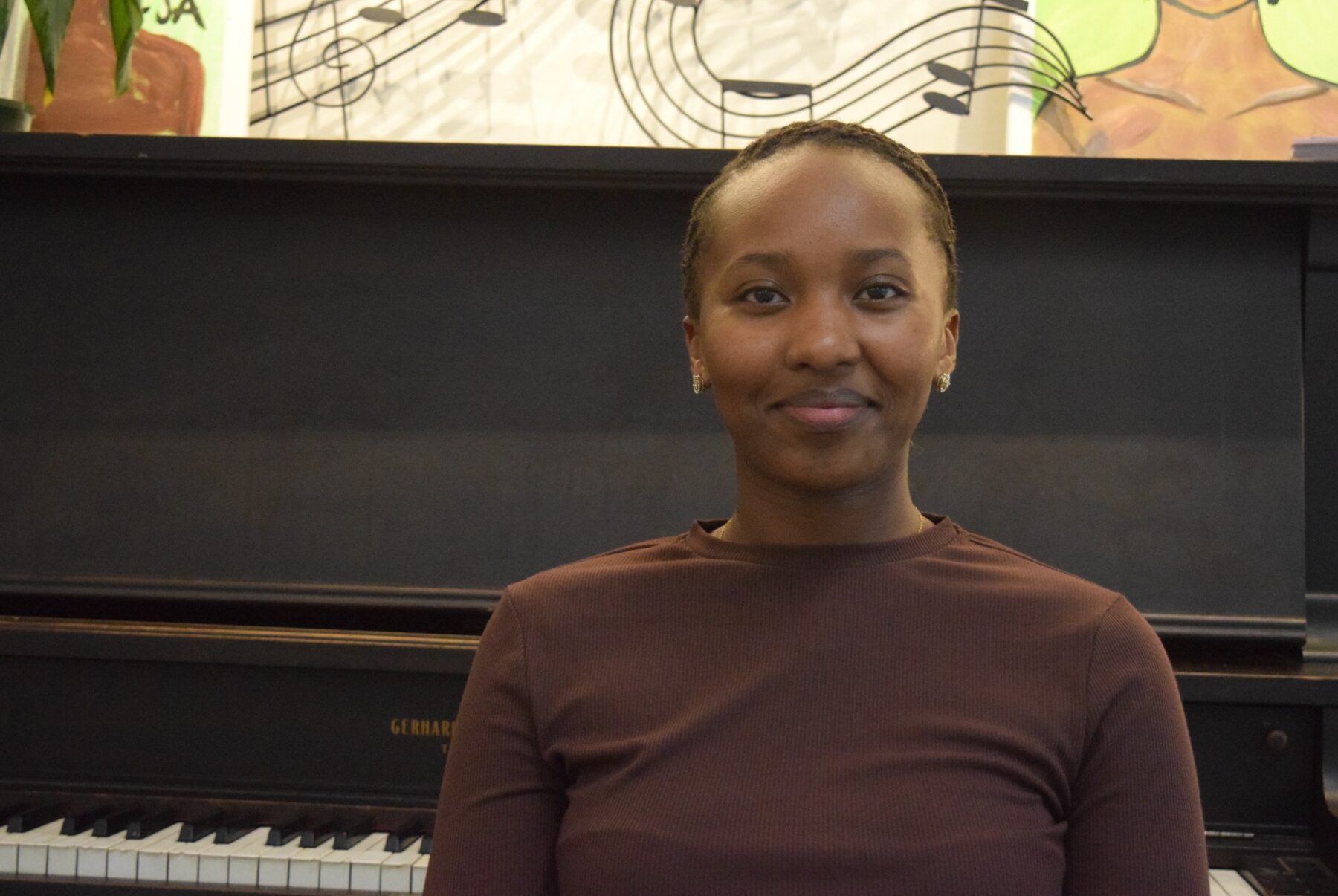
Divine Ishimwe sits in front of piano in prayer room on Sept. 4  during a daily Christian prayer session
Divine Ishimwe sits in front of piano in prayer room on Sept. 4 during a daily Christian prayer session Photo credit: Lara Simard

Ahmed Khan shares similar views. He has been leading the Muslim Students Club at Algonquin College for four years.

“When you’re talking about disruptive cases, you have to look at it case by case,” Khan said.

“For example, here at Algonquin, we once had an issue where we weren’t given the room to pray, and we had about 100-something people. We couldn’t fit. But we have to pray — it’s a necessity. So they went outside, and they prayed in public.”

On Sept. 11, a public prayer event was held on campus by InterVarsity, a Christian ministry that runs prayer groups on campus throughout the year.

Cristy Dagenais, the campus minister who co-organized the event, believes religion is one of the biggest unifiers for students. Without it, she says, life on campus would become sterile.

“There are so many students that go through their whole degree here and all they have is maybe some classmates, but they don’t have that sense of family,” she said.

“Maybe they’re asking bigger, deeper questions, but they don’t feel like they have a safe place to ask those questions. We try to do that through events. Becoming visible helps students be able to practice their faith.”

In her opinion, expressing religion is a fundamental right and should be exercised. She is grateful to have this opportunity at the college.

“If they don’t have freedom to be able to express their belief systems — of course, where it’s still safe and good for other people — it’s like you’re taking away the essence of being human,” Dagenais said.

“To take that away completely, it doesn’t make any sense to me.”

Students notice change in on-campus services during first day of support staff strike

Full-time support staff launched a strike Thursday during an ongoing labour dispute affecting colleges across Ontario
Photo: Bradley Richards
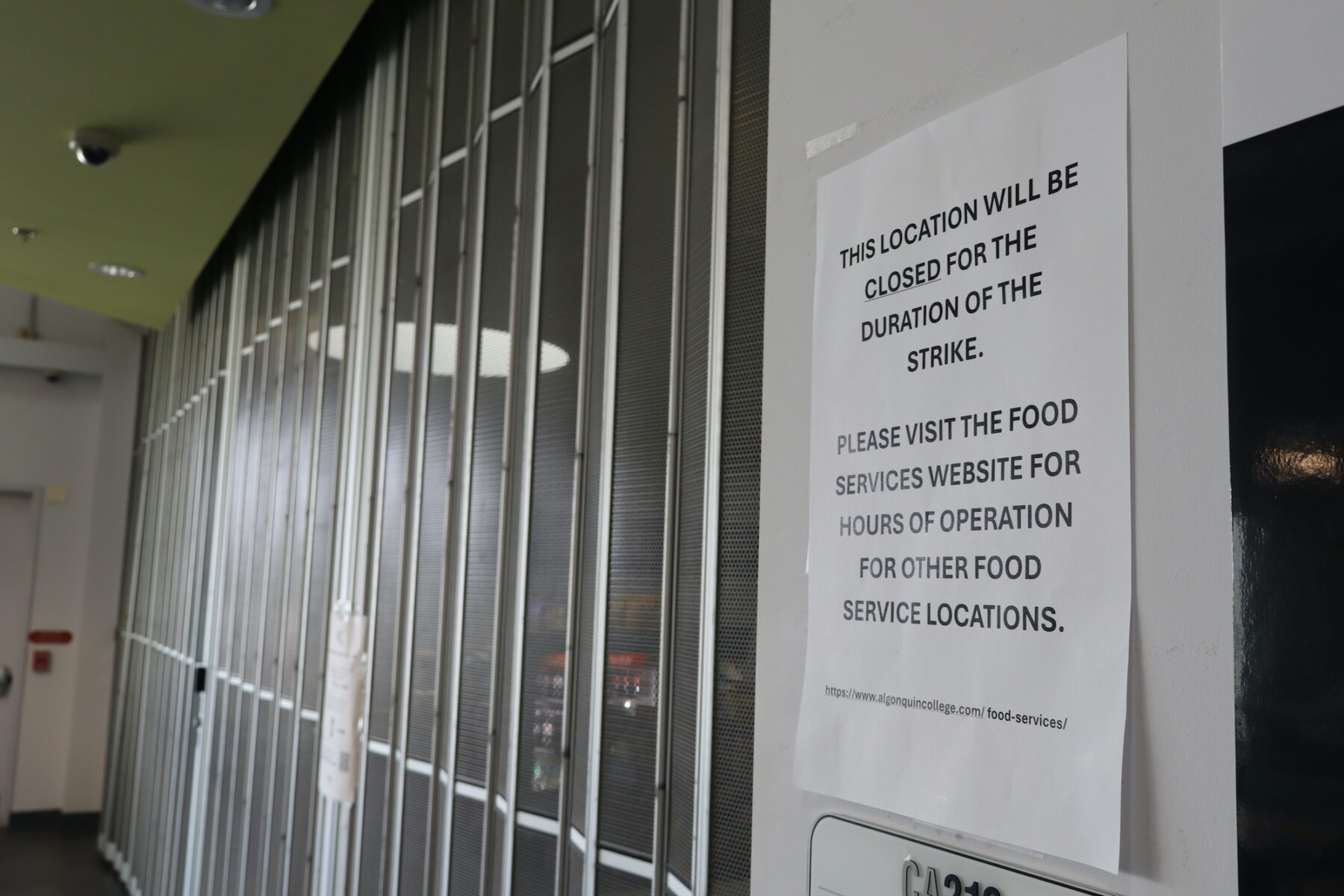
The Fix Eatery in the ACCE building was closed for the strike.

By Nathan Heatherington, Kendra Mendrisky, Ève Bélanger, Jade Louise Greenwood, Bradley Richrads, Janella Milord Ashford, Jackie Beeston, Robyn Lanktree and Vasileios Tselios

A strike by full-time support workers started to impact several services at Algonquin College on Thursday

“All classes and academic activities are continuing as scheduled. While some campus services may be delayed or reduced, our priority remains supporting learners and employees throughout this disruption,” read a notice on the Algonquin College website.

Some businesses around campus were closed, including Bits N’ Bytes, The Portable Feast, The Fix and Tim Hortons. However, the Marketplace in D-building was open with part-time workers and student workers.

Students took notice of the reduced food options on the first day of the strike.

“It’s kind of annoying. I had an hour break in between my two classes, and I was going to come get food (at Tim Hortons),” said Teaghan Guidon, a student in the business and administration program.

According to the frequently asked questions section on the Algonquin College website, many services will remain open to help throughout the academic year, including the Student Learning Centre, counselling services, Centre for Accessible Learning and the registrar’s office. Bursary funding and purchases for students with disabilities programs are limited.

“I’ve been here for the last two years, so obviously, some of the services have helped me,” said Hannah Richard, a student in the massage therapy program.

“I eat on campus regularly, so having that type of nutritionist there would always be helpful. I would never want any of these people to be without the money that they deserve, and they shouldn’t be replaced, so I hope that everything can figure itself out.”

Facilities run by the Students’ Association, such as the Wolves Den and Starbucks, remained open and are unaffected by strike activity.

‘Nobody wants to be on strike.’ Support workers launch picket lines in labour dispute

Picket lines went up outside Algonquin College’s Woodroffe campus on Thursday as full-time support staff walked off the job
Photo: Mila Leclair
A protester holds a sign on Woodroffe Avenue on Sept. 11.

By Gavin Oregan, William Barritt, Mila Leclair, Delaney Smith, Robyn Lanktree and Vasileios Tselios

Picket lines went up outside Algonquin College’s Woodroffe campus on Thursday as support staff walked off the job, marking the first day of strike action in a dispute over wages, workload and job security.

The strike shut down several services across the college. Buildings remained opened and the college said classes were to continue.

John Hanson, a former president in the Ontario Public Service Employees Union (OPSEU), said full-time support staff work in “everything that goes on in the college, anything except for the actual teaching of the students.”

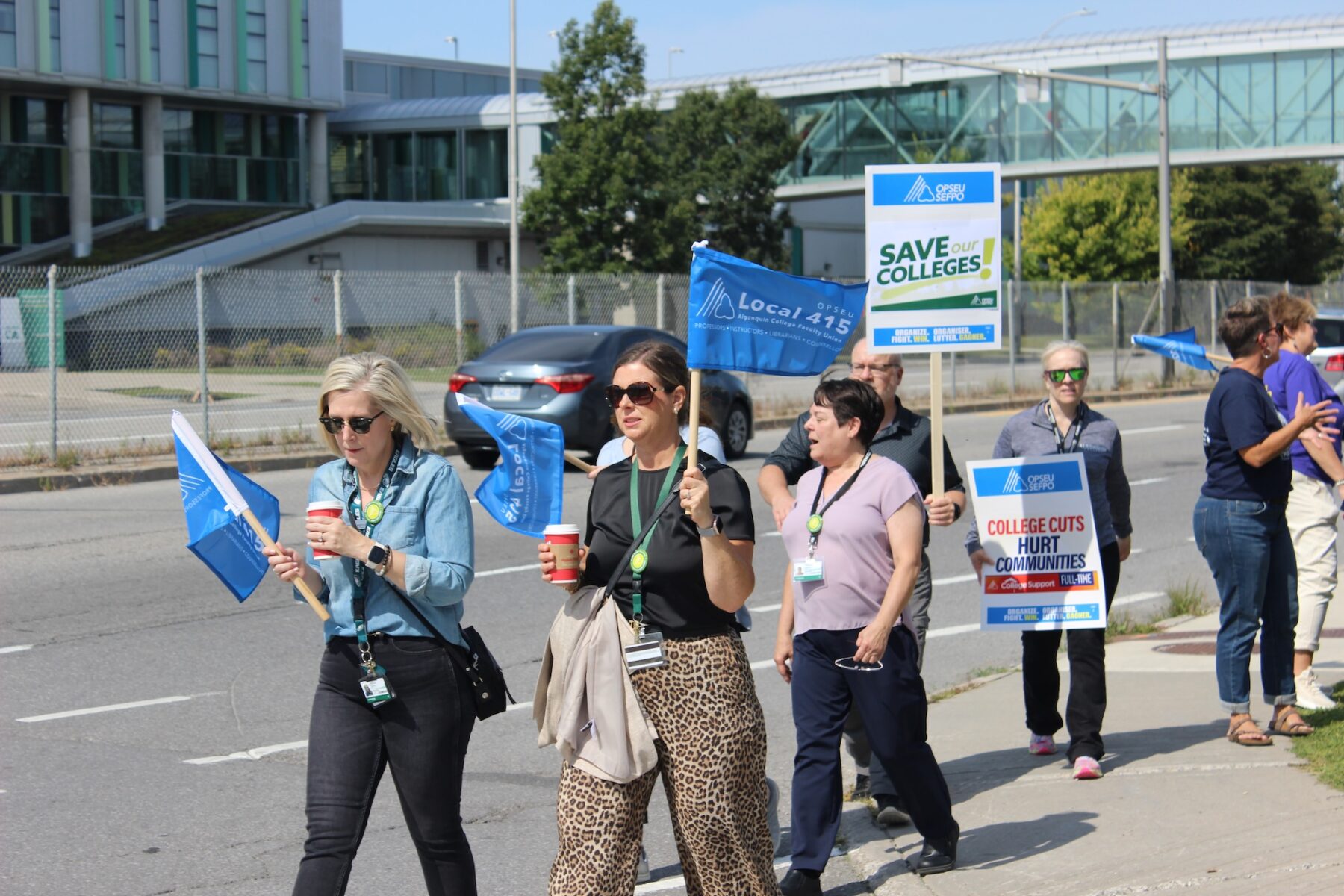
College staff took to the picket lines on Woodroffe Avenue, walking back and forth with signs that read “Save our colleges” and “College cuts hurt communities.”

Staff said the strike has been difficult to discuss with students, many of whom are worried about how classes and services will be affected.

“We didn’t want to talk about it, because you’re scared to scare the students,” said Stella Ludlow, an organizer at the picket line. “Because you’re already uncertain, it’s a lot of new stuff.”

Ludlow has worked with OPSEU since 2012 and has never seen people work so well together while on strike.

Protesters hold signs on a picket line on Woodroffe Avenue on Sept. 11. Full-time support staff launched a strike in an ongoing labour dispute.
Protesters hold signs on a picket line on Woodroffe Avenue on Sept. 11. Full-time support staff launched a strike in an ongoing labour dispute. Photo credit: Mila Leclair

As for students, the strike leaves an uncertain thought about what is to come.

“As far as I’m aware, it’s about wages,” said Devon Payette, who is in his first year of the client relations program. “I don’t feel any type of way about it because it’s something that needs to happen for things to change.”

According to Hanson, staff rather not be on the picket lines.

“Nobody wants to be on strike. They want to be doing their job. These people love what they do, I know that,” Hanson said.

The goal between the labour union and full-time college support staff across Ontario remains to arrive at a deal as soon as possible.

OPSEU, which represents the workers, says rising costs and increased demands on staff have made a fair contract essential.

In a message to the Algonquin College community on Thursday, president and CEO Claude Brulé said: “We deeply value the contributions of our support staff and respect their right to participate in this legal process. Our priority is to continue supporting our students and employees while maintaining a respectful, safe, and inclusive campus environment.”

Across Algonquin College’s northern entrances, full-time support staff make their voices heard

Having failed to reach an agreement with the province Wednesday night, full-time support staff across Ontario were out on strike
Photo: Matthew Grieve
Algonquin College support staff on strike protest service cuts on Navaho Drive on Sept. 11.

By Ernest Ko, Matthew Grieve, Kevin Clasper-Inglis, Elyse Barker, Mickey Banks, Duncan Roi, Lara Simard, Nicklaus Korim, Robyn Lanktree and Vasileios Tselios

Abby Rabishaw has been working at Algonquin College’s registrar’s office since 2023. She loves her job.

“It’s one of the best jobs I’ve ever had,” she said. It allows her to “give back and help students in ways I would have loved while I was in school.

“There’s nothing better than making it more accessible and easier for people to study and achieve their goals.”

However, she wasn’t with students Thursday. Instead, she walked out of her job alongside her full-time support coworkers, throughout three picket lines at the college’s north entrances at Wàbisheshi Private and Wajashk Private along Navaho Drive.

Another picket line had also been organized at the college’s Woodroffe Avenue entrance.

Throughout every line, among the protesters, supporters and passersby, their message remained clear: students and staff are suffering from colleges being defunded.

Rabishaw said when she joined in 2023 her team consisted of 28 employees. But after layoffs and attrition throughout the past three years, that number has been reduced to 16 employees, including part-time staff.

“That means significantly longer wait times for students, especially during the start of the school year,” Rabishaw said. Students currently inquiring about timetable issues, course changes or late program registrations could be forced to wait more than two hours for assistance. With the college’s tuition refund date of Sept. 15 fast approaching, time is ticking.

As provincial shortfalls continue, Ontario colleges have seen 10,000 layoffs coinciding with 650 program closures in 2025 alone. In February, Algonquin College announced the suspension of 37 programs and the closure of its Perth satellite campus.

OPSEU (Ontario Public Service Employees Union) Local 416, the union representing college full-time support staff, and the College Employer Council have been negotiating a collective agreement since June. The union exercised their right to initiate job action after failing to reach an agreement with the CEC by a Thursday morning deadline.

“We’re essentially just asking for fair pay,” said Zachary Deorksen, an employee in Financial Services.

“We also want to make the point that right now, the colleges are underfunded. With provincial cuts to international enrolment and the post-secondary student tuition freeze, the colleges are in a bind.

“Right now, we want more funding for the colleges, because public education is important,” Deorksen says.

The protests, however, have not been well-received by the entire campus community. Some students feel the protests blocking the college’s entrances are disruptive. Mohamad Dwaydar, a part-time student, was one of them..

“Part-time students like us, we take the one day off work that we could have been making money in our living (to attend class). But when we are blockaded, it really does hinder our day-to-day lives,” he says.

When business administration student Bryson Cameron drove to school on Thursday, he was stopped and asked by protesters if he supported their cause. Despite giving them his approval, “they kept blocking me off.”

Protesters on Navaho Drive in front of the parking lot by A-building.
Protesters on Navaho Drive in front of the parking lot by A-building. Photo credit: Mickey Banks

Others acted on their frustrations, even though the college requested that people respect protesters.

Coco Kurelek, an automechanic student, shouted insults at protesters and she flipped them off.

“This morning, it took me 45 minutes to (drive two blocks),” she said with a frustrated glare. “As a paying student, I do not support these protests if they stop me from getting my paid education.

“Blocking traffic to paying students who just want to get to their class and get educated is not the way to gain support,” Kurelek said.

As she spoke, a protester repeatedly blew a whistle to interrupt the flow of incoming traffic.

“It’s creating a nuisance instead of a peaceful protest.”

Nevertheless, protesters remained positive about their situation.

“There’s been a good sense of solidarity so far amongst everyone,” said Dave Gabie, a full-time plumber at the college.

Some part-time staff at the college have volunteered at picket lines, while faculty have been seen offering snacks and refreshments.

Despite the long day and some frustrated commuters, Gabie said it had been a good day overall.

“My wife made me some muffins, so it’s all good,” he said with a smile.

Algonquin College warns community about possible strike by support staff on Thursday

Should a deal not be reached by midnight Wednesday, full-time support staff will hit the picket lines
Photo: Janella Milord Ashford
Algonquin College support staff walk along the practice picket line at Woodroffe Avenue on Sept. 10.

By Ernest Ko and Janella Milord Ashford

Algonquin College president and CEO Claude Brulé on Wednesday warned the campus community about possible strike by full-time college support staff across Ontario, including Algonquin College, beginning Thursday.

“While we remain hopeful that a resolution will be reached, we must also be prepared for the possibility of a labour disruption,” an emailed message from Brulé said.

This disruption will most likely result in a strike, with picket lines happening at entrances for the Woodroffe, Perth and Pembroke campuses. However, the campuses will all remain open and operational, Brulé said.

While the college said it remained hopeful that an agreement can be reached before Thursday, precautions and communications were being made to “support our learners and ensure the continuity of college operations as much as possible,” Brulé said in the email.

Why is a strike happening?

In a message from OPSEU (Ontario Public Service Employees Union), president JP Hornick alleges that Ontario’s college system is in a “crisis” due to Ontario Premier Doug Ford and his administration’s “accelerated agenda to gut public education and privatize post-secondary education for good.”

Hornick mentions 10,000 recent job cuts and 650 programs shuttered across Ontario. At Algonquin College, 37 programs and the Perth campus were set for suspension last February. Brulé cited provincial shortfalls as a main reason for the decision.

OPSEU, which represents full-time college support staff across Ontario, is currently negotiating a new collective agreement with the College Employer Council (CEC). The previous agreement expired on Aug. 31. The two parties have been negotiating since June.

Will this strike affect my classes?

No, according to the college. “At this time, all classes and related academic activities for the Fall 2025 term are scheduled to continue as planned,” the college said. Should there be any changes, students will be notified.

Faculty members at the college received an email on Tuesday from Hornick instructing them not to perform support staff work, in solidarity with the support staff union.

“Our support staff colleagues are fighting not only for a fair contract but also for a stronger, more sustainable college system — and we have an opportunity to stand with them,” the message from Hornick said.

What will be affected?

The Algonquin Students’ Association confirmed to the Algonquin Times that its operations and events will not be impacted.

While no comprehensive list of affected services is available, the college can expect disruptions in the following areas: tech support, food services, the registrar’s office, parking services, library assistance, printing services, the Centre for Accessible Learning, clerical duties, facilities and maintenance work and more.

Due to the strike protests, the college is recommending students and staff to dedicate “extra time when coming to campus, and to walk or drive carefully when approaching a picket line.”

“Consider using public transportation, carpooling, or arranging to be dropped off to help minimize delays,” the college suggested.

What is the union looking for?

According to a Sept. 6 media release by OPSEU, the union is looking to fight back against looming mergers, closures and the “systematic defund(ing)” of Ontario’s public colleges.” Job security remains a top concern for the union.

During negotiations, OPSEU made two demands: “A complete ban on college or campus mergers or closures during the life of the agreement,” and “a total prohibition on any staff reductions, regardless of circumstance.”

CEC, meanwhile, has labelled these demands as unacceptable “poison pills,” which are preventing a settlement from being made.

According to Veronica Attard, a full-time support staff at Algonquin College and a member of the OPSEU’s full-time support bargaining team, many of the union’s concerns are realized at Algonquin.

Layoffs and employee attrition have led to longer wait times for services, while recent closures and contracting out of food services have cost over 200 employees their jobs, Attard said.

Attard described all these changes as “a deterioration of services,” which she says will ultimately affect students’ education.

Protesters at a practice picket line on Sept. 10, holding signs saying "Save Our Colleges" and "On Strike! For Student Supports."
Support staff, who held a practice picket line outside the college on Wednesday, say the defunding of colleges and the lack of job security are a top concern. Photo credit: Janella Milord Ashford

Have the CEC made any offers?

Yes. Their most recent proposal, dated Aug. 31, proposed annual monetary and benefit increases, enhanced severance, vacation carry-over rights, and increases to on-call premiums, among other incentives.

The CEC has also offered to “withdraw its proposals on split shifts, increases to on-call hours, and limits on bumping rights and grievances.”

However, Attard and other OPSEU bargaining agents have alleged that their CEC counterparts did not show up at the negotiation table in Toronto on Tuesday.

Can I cross the picket lines?

Tracey Henderson, an Algonquin College professor and president of OPSEU Local 415, which represents faculty members, encouraged students to join protestors at picket lines if the strike happens.

Members of the college community “can exercise their right to not cross the [picket] line,” Henderson said. “However, if you do need to cross the picket line, we ask that you do so respectfully.”

The college has also asked students and staff to “avoid confrontation (with protesters), remain calm and courteous, and be patient” if trying to cross the picket line.

Opinion: Don’t kill the radio program, fuse it with journalism to future-proof media education

As the media landscape evolves, Algonquin College must adapt by merging its journalism and radio programs into a dynamic multimedia curriculum, argues Mickey Banks
Photo: Mickey Banks
The CKDJ news station which runs out of Algonquin College, has a contract set to last until 2030. It could be ran by volunteers “But why not give this opportunity to students?” Writes the author.
The CKDJ news station which runs out of Algonquin College, has a contract set to last until 2030. It could be ran by volunteers “But why not give this opportunity to students?” Writes the author. Photo credit: Mickey Banks

Algonquin College is shooting the messenger. It should combine its radio and podcasting program with journalism instead of executing it in the face of program cuts.

This fall is the radio and podcasting program’s final year, at least for the foreseeable future. It was announced in February the program will be suspended along with 36 others, amounting to 16 per cent of the total programs offered by the college. Current students in the program can finish but the school will not be taking any new enrolments.

Among the reasons the college gave for suspending the programs were retention and graduation rates. Ben Purdy, a radio and podcasting alumni, said his program started with about 30 students in the fall of 2023 and ended with about 17 of them graduating.

Purdy also said he’s the only student to his knowledge to have found a career in radio, being hired by 580 CFRA, an Ottawa radio station.

Ted Simpson, a professor in the journalism program who took radio broadcasting said that while radio is fun, it’s not the best program for preparing students for the working world. Simpson believes this is true for the television and journalism programs as well.

“The whole thing is grounded in a traditional job that just doesn’t really exist anymore or is existing less,” Simpson said.

There are currently two colleges in Ontario offering radio programs and seven colleges offering journalism programs, with Humber and Durham College’s journalism programs offering experience with radio stations, according to ontariocolleges.ca.

In 2023 radio jobs in Canada dropped by over 800 from the previous year, according to IBISWorld, and national journalism outlets such as the CBC are increasingly expecting its reporters to have multimedia knowledge.

The CBC said in an article released March 11 that it would be adding “Up to 30 permanent reporters to work in 23 under served Canadian communities.” And that these roles “will focus on broadening our coverage and ensuring the stories and voices of communities are reflected in our journalism across digital, radio, social, streaming and TV.”

So, if the media world is changing, how can the college change with it?

“The only way that this is gonna survive and work is if we start smashing the walls down and bring stuff together,” Simpson said.

So instead of keeping television, radio and journalism separate, bring them together into one program.

Now this has already been done to a point. All three programs share five classes in their first term. And the only classes journalism students take that radio and television students don’t, are news writing and strangely enough, media law and ethics.

There’s also a two-month class in level four of journalism that has students work at CKDJ.

But would combining these programs be overwhelming for students. David Smith, a professor who teaches audio storytelling and works in the radio industry, says learning radio is not difficult and that you can learn it on the job.

According to the college’s radio broadcasting Facebook page, the CKDJ news station which runs out of Algonquin College, has a contract set to last until 2030.

Now it could be run primarily by volunteers like at CKCU FM 93.1 and CHUO-FM out of Carleton University and the University of Ottawa, respectively. But why not give this opportunity to students?

After all, the benefit of college as opposed to university is that it provides a more hands on education.

Purdy spoke about how this applied to radio.

“It’s one thing to pre-record stuff in a studio and then edit it (and) play it, but it’s another thing to have to do all of that live. And it was a great way of giving us this live radio experience, learning how to properly conduct yourself on air,” Purdy said.

Also, running a radio station, along with writing for the Algonquin Times (the journalism program’s student news website) would give students another opportunity to build their portfolio.

Could this however, take the focus off television and streaming video for students more interested in that component? Possibly.

For students interested in really digging into television media, the program could provide some electives to focus on this. Or the television and streaming video program could remain a separate entity. In the wildest case, a combined multimedia program should contain a robust video component, along with radio and journalism, to make the curriculum well rounded.

Mickey Banks is a level-two journalism student at Algonquin College.

Making medicine for the soul with Indigenous peoples at Algonquin College

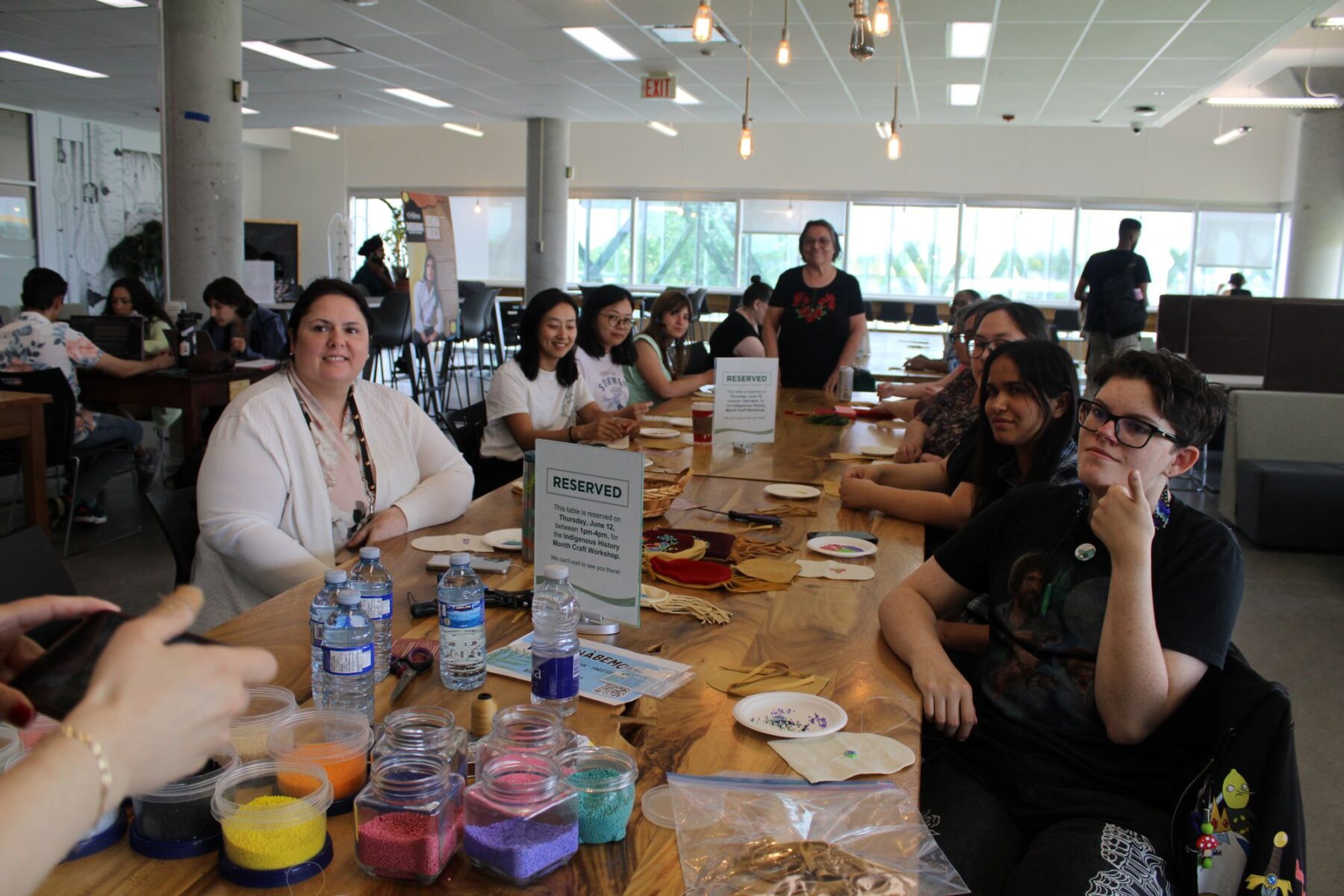
On June 12, 2025, the Mamidosewin Centre and the Algonquin Students’ Association held an Indigenous crafts workshop in the AC Hub, with a focus on traditional beading and creating medicine pouches
Photo: Skyla Murray
Stephanie Tenasco (far left), Jenny Tenasco (middle), and several students who attended the workshop on June 12.

The workshop was led by Stephanie Tenasco and Jenny Tenasco of Kitigan Zibi First Nation. They showed students how to sew and create the beautiful and intricate beadwork seen on the pouches.

“I’ve been making, I guess, I don’t like to call them crafts per se, but I’ve been making, like, mittens, moccasins, leather work, I guess you can call it,” said Stephanie Tenasco. “I’ve been doing leather work since I was eight years old. Some women in my community, older women in my community, had a workshop when I was eight, and that’s where I learned how to do the stuff that I do now today and I didn’t really want to go to this workshop when I was small. I didn’t understand the importance or didn’t even think I’d like it, but, here I am today at Algonquin College, showing what I learned when I was eight years old, which was many, many years ago.”

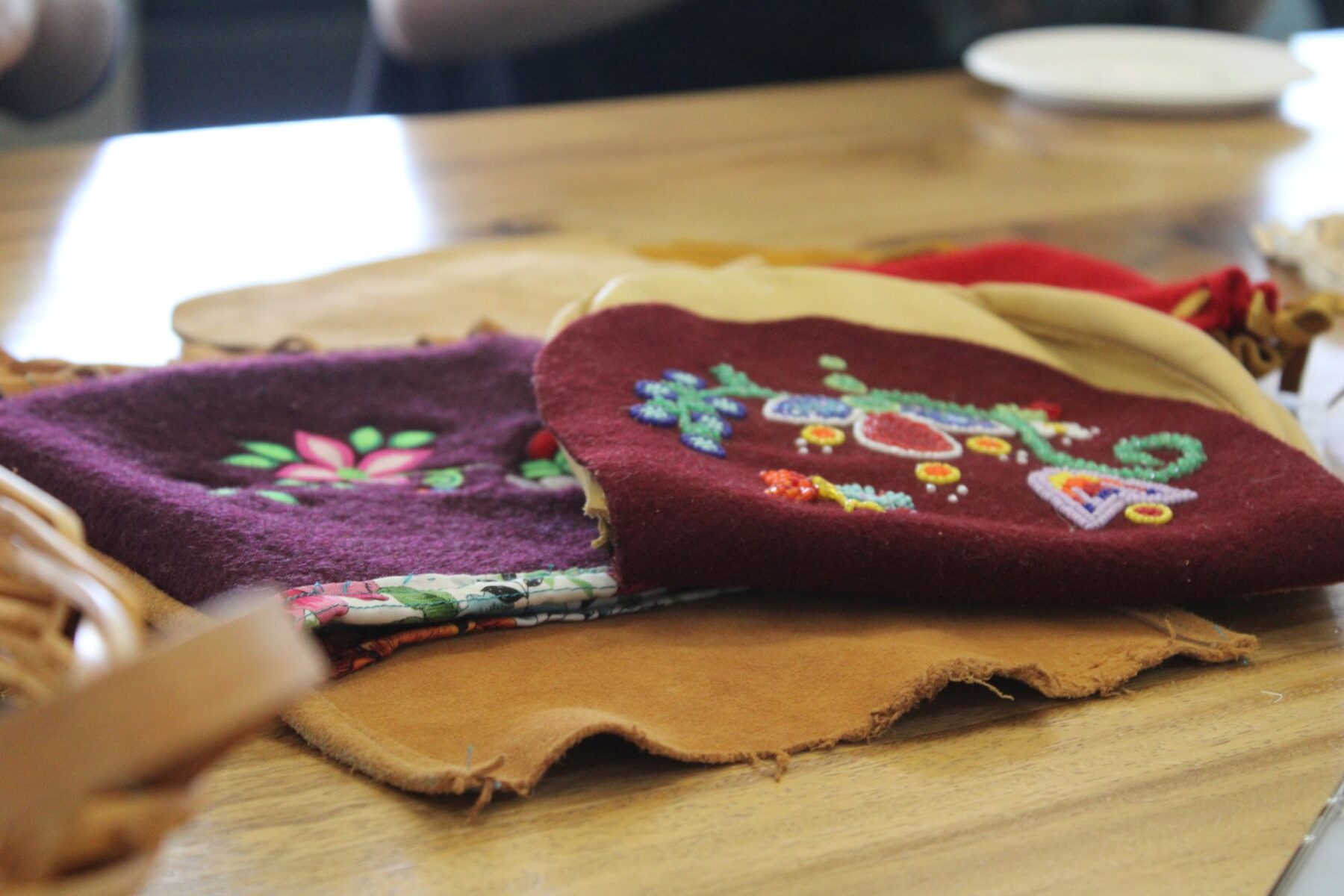
A medicine pouch made by a student during the workshop.
A medicine pouch made by a student during the workshop. Photo credit: Skyla Murray

A medicine pouch is traditionally made from deer or moose hide and worn as a necklace or under the clothing. It traditionally carries sacred medicines and items that hold personal or religious significance to the wearer.

“There’s four sacred medicines that indigenous people generally use, which are sage, tobacco, sweetgrass, and cedar,” said Jenny Tenasco.

The sacred medicines are sage, sweetgrass, cedar and tobacco. These medicines are typically used in smudging ceremonies, where they are placed in a small bowl or shell and burned. The smoke is then used as a means of spiritual cleansing.

Medicine pouches made during the workshop.
Medicine pouches made during the workshop. Photo credit: Skyla Murray

The workshop involved students sewing a piece of deer hide and fabric together, and adding beads to make their own unique designs. Then, the pouches were sealed with string, and students could fill them with the sacred medicines on another table.

June was the month of Indigenous history, and craft events like this help Indigenous people to show that they’re still here, and that their history and traditions are being celebrated and honoured, even today.

“Workshops like this, it’s just a small start to show people that indigenous people are still here. We have been here, and we are still here. And, it’s just a small part, but it’s a start,” said Tenasco.

Bella Donnas in bloom: Milestone changes on horizon for Ottawa punk band

Student members of rising punk band Bella Donna are on the road to rock graduation with new tracks you can finally stream
Thomas Burr performing with his band at House of TARG on May 29.
Leeah Sullivan playing guitar for Bella Donna at House of TARG on May 29.

Local band Bella Donna is quickly carving out their place in the Ottawa live-music scene and says their streamable music is on the way. With an upcoming show at local favourite House of TARG on Aug. 13, the group of five can’t wait to get back on stage at Ottawa’s favourite arcade.

Bella Donna was first formed in 2022 by music industry arts student Thomas Burr and high school friend Oliver Wright. They experimented with different names before landing on Atropa Bella Donna, the poisonous plant rumoured to have killed Roman emperor Augustus.

The band bloomed as they added new members from their high school, Lisgar Collegiate Institute. Today, the band consists of Burr on lead vocals, Leeah Sullivan on guitar and backing vocals, Darian Cassidy on bass and backing vocals, Evan Chamberlin on guitar and Jake Gareau on the drums.

Jake Gareau on the drums at House of TARG on May 29.
Jake Gareau on the drums at House of TARG on May 29. Photo credit: Emma Fazakas

The founding members wanted to present their stance against authoritarianism and used Bella Donna as a platform to write with political intention. Defining their sound by one particular genre is difficult for the band because bending norms is what makes them glow. Songs like Piss Train, Funny Orange Cat and I Hate Cars use humour and outlandish metaphors to express their criticism against authority. Off-Screen Death and Trade dive into personal feelings of love and sacrifice while maintaining the post-punk Bella Donna vibe. “

Together, these create a balance with our raw, chaotic energy and emotional depth, using both satire and sincerity to challenge power structures while expressing the complexities of the human experience,” Burr said.

Whether it’s writing about personal struggles or their frustrations with the world, punk is always in the air around Bella Donna. “Musically, we love punk music for the high energy,” Burr said. “It’s always fun to play fast, loud music, whether in the basement during practice or on stage at a show.”

Thomas Burr performing with his band at House of TARG on May 29.

The band blossoms at creating new music, performing live at venues and playing with new bands. “We plan to continue to work on music and live shows, and we have no plans on changing that whether we’re in school or not,” Chamberlin said.

Bella Donna has found a strong community in the local scene and says they’ve had nothing but positive experiences. “We’re super grateful for all the venues we’ve played at,” Chamberlin said. “One of the best parts of being in a band is playing an original song in front of an audience for the first time, it’s such a rewarding and exciting feeling.”

The band is eager to share raw recordings on major streaming platforms before finished releases. Bella Donna is also planning another show in Ottawa on Aug. 30.

AC student to publish mythology inspired book of political satire

18-year-old Algonquin student is counting down the days until the release of his fiction novel that currently ranks #1 in gay fiction on Amazon
Photo: Mila Leclair
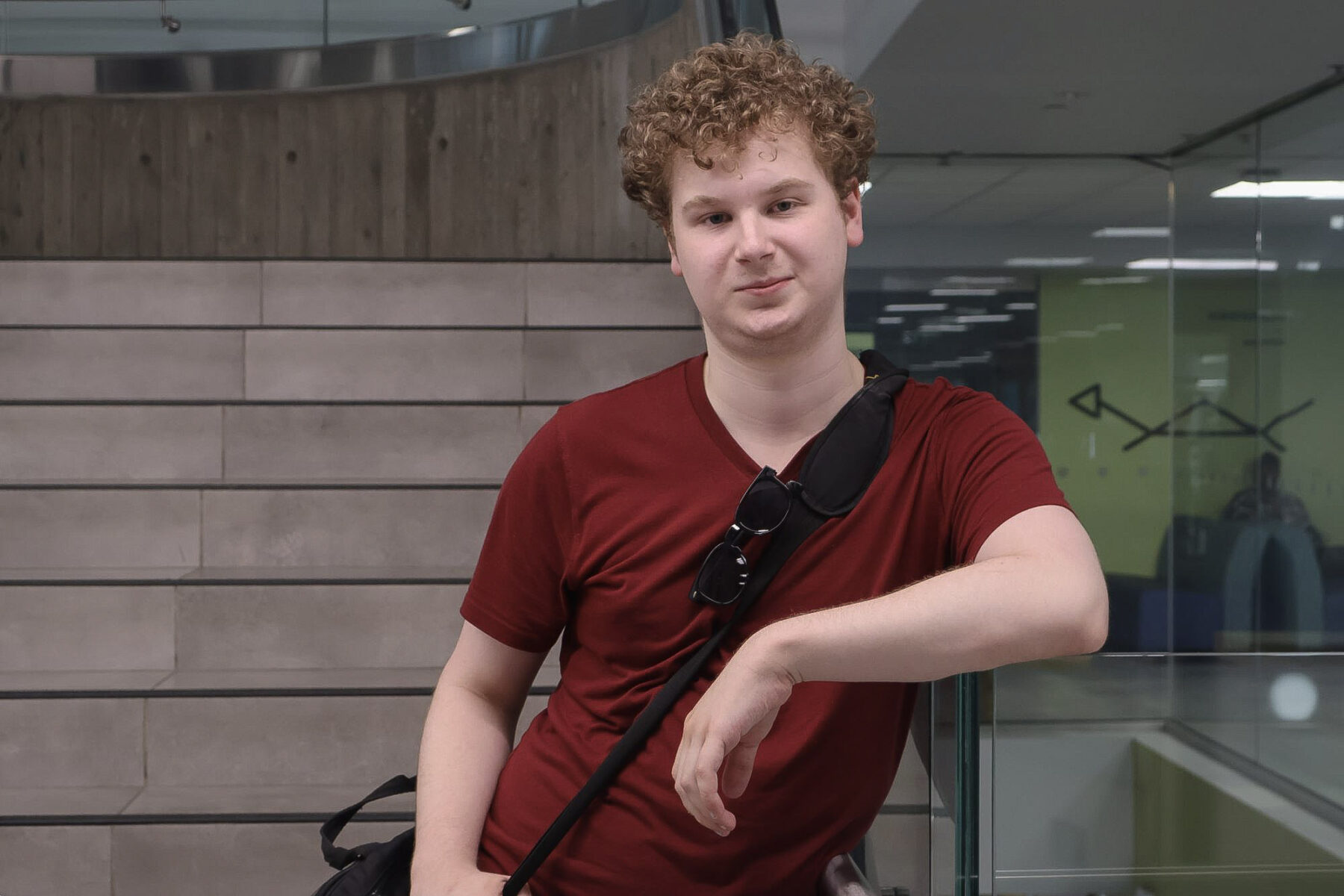
Chapman after a class on Jul. 17.

Barrhaven-raised Alec Chapman jumped right into the music media and film foundations program after high school.

It’s been the perfect “pathway program” for his future career as a writer. Now almost graduated, he’s got an odyssey to share.

Cover art for Bane of The Gods: Tears of the Black Sky by Alec Chapman.
Cover art for Bane of The Gods: Tears of the Black Sky by Alec Chapman. Photo credit: Supplied by Alec Chapman

The fiction novel follows a naive 19-year-old boy, Anastasios, or Anakin for short, who wakes up in an abandoned temple with no memory of who he is or how he got there, and trouble ensues. He discovers he is being hunted by the Greek gods and cannot remember why. A book of survival, escape, love and tragedy, Bane of the Gods: Tears of the Black Sky draws influence from mythologically influenced Percy Jackson and God of War.

Chapman likes to write stories through a video-gaming lens. He’s informal and conversational. The book works in game-like levels and is filled with “boss-fights,” where the gamer is confronted with their most challenging foe. The cover art reveals a boss fight that takes place midway through the story when the crew uses magic to battle a leviathan overseas. The art was created by Cheeze, or @blu3_ch33z3_official on Instagram.

Catrina McBride, Chapman’s mother, is a professor at the Algonquin College School of business and is also the editor of her son’s book. “I tell him the honest truth to ensure that he can believe me when I say that something is great,” she said.

This is the first book McBride has edited. “Alec has always been into Greek mythology from an early age, so I’m not surprised to see him integrate it into his writing,” she said. “The coming-of-age character developments are something Alec has gone through and is certainly a universal experience.”

Former geology professor at Queens University and grandmother to Chapman, Sandra McBride, takes the role of his second editor. After two years and four drafts, Bane of the Gods is finally ready for the public eye, they say.

Chapman always knew he was going to be in the entertainment industry. His imagination and creativity were a helpful outlet in the face of adversity growing up. “I initially decided to start writing because I needed a way to create mental room for me to function. I write because I have to. The way my brain works leaves me no other choice.”

Chapman after a class on Jul. 17.
Chapman after a class on Jul. 17. Photo credit: Mila Leclair

Behind elements of fantasy and fiction, Chapman’s novel, at its core, reflects on an over-reaching government. “This book comes from a very real place of frustration with governmental powers. With out-of-touch people making unilateral decisions about people who have no say in how their lives are run,” he said.

After graduating from the music, media and film foundations program, he plans to study film.

Chapman is currently writing another book called The Royal Apothecary that he plans to make, starting the first of a seven-book series called The Legacy of Vronos. Chapman plans to work other jobs to support himself as he publishes more work and paves his way in the industry. “

Bane of the Gods: Tears of the Black Sky is Chapman’s first published book and will be available in hardcopy and digital on Amazon.

The stories behind the pathway murals on Algonquin College campus

There are five murals on Woodroffe campus that symbolize the teachings of Indigenous Algonquin culture, each in their own unique way
Photo: Vasuman Ravichandran
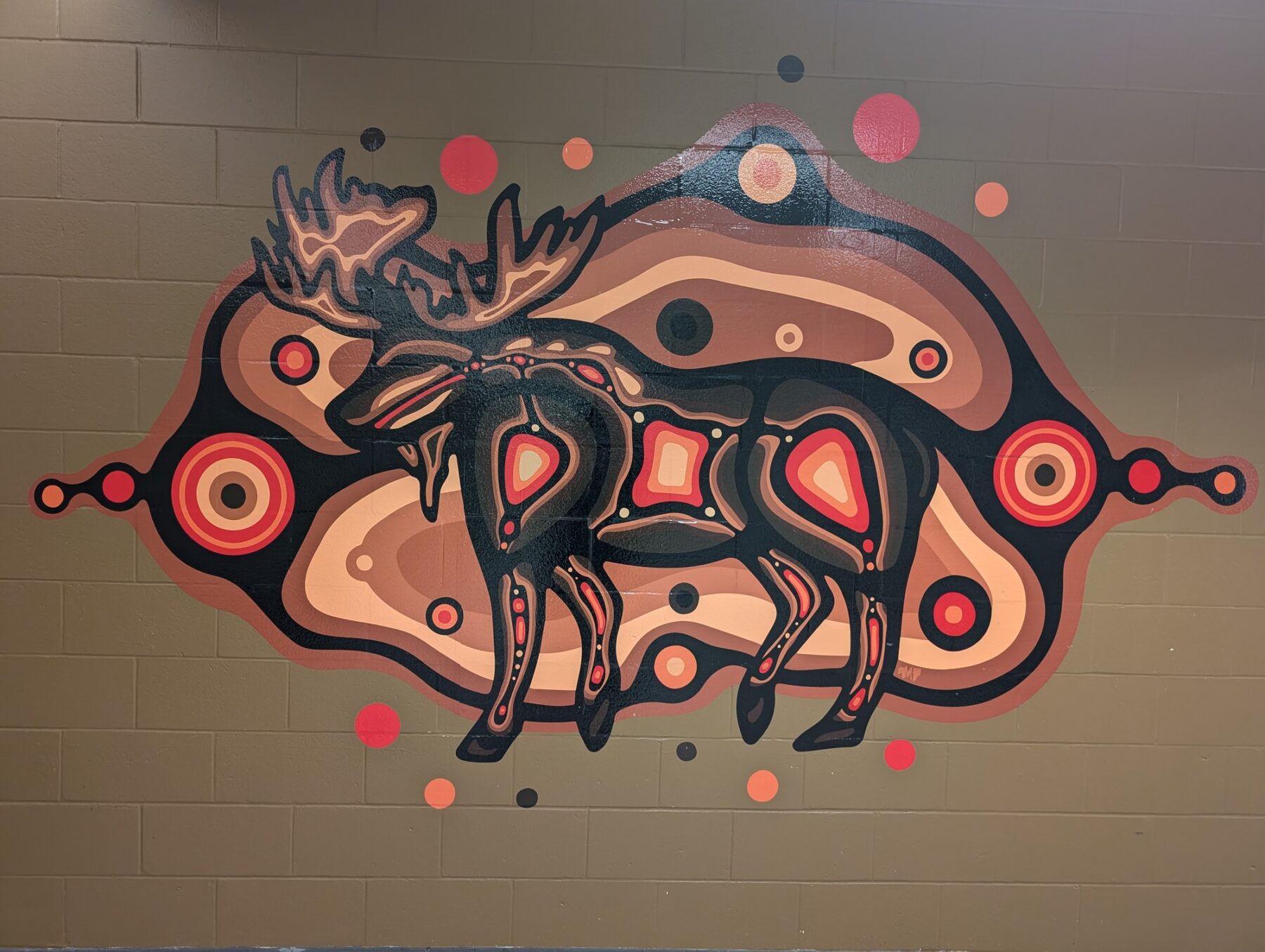
Monz (moose) is located at the Marketplace in the pathway from E-building to D-building.

Exactly three years ago, Miskomin Twenish, an Indigenous Algonquin artist and alumna of the college, created five animal murals to portray the values of Indigenous Algonquin culture in vivid colour.

Her murals are on display across the pathways on campus.

Twenish selected the five animals portrayed in her murals based on their significance in Indigenous Algonquin culture. Makwa (bear), Mahingan (wolf), Tendesi (blue jay), Monz (moose) and Wawaskeshi (deer).

“When I make art, I want it to be uplifting,” said Twenish. “I like colours that are bold, bright, vibrant and alive.”

Makwa(Bear), pathway between A-building and C-building.
Makwa(Bear), pathway between A-building and C-building. Photo credit: Vasuman Ravichandran

Makwa (Bear): The bear mural can be seen on the pathway between A-building and C-building. The bear is a central figure in Algonquin culture. It is considered a guardian, and an animal that embodies spiritual strength.

The bear hibernates. it goes away from the rest of the world. The Algonquin people believe that In order for us to heal, we need to step away from the chaos of life, go within, find ourselves, reflect on our lives, so that we can emerge refreshed and ready to face the world once more, according to Algonquian anthropologist, F.G. Speck.

Mahingan(Wolf), pathway between D-building and A-building.
Mahingan(Wolf), pathway between D-building and A-building. Photo credit: Vasuman Ravichandran

Mahingan (wolf): This mural can be seen on the pathway between D-building and A-building. In Algonquin tradition, the wolf is known to control the flow of animals. He teaches respect for the food chain and humility. The wolf also exemplifies teamwork and cooperative behavior for the greater good, reinforcing its place as a model of community values, according to Algonquin elder, Lionel Whiteduck.

Tendesi(Blue jay), pathway between C-building and B-building
Tendesi(Blue jay), pathway between C-building and B-building Photo credit: Vasuman Ravichandran

Tendesi (blue jay): This mural is visible in the pathway between C-building and B-building. The blue jay is described as kind to those who show kindness, but also as having predatory and fierce qualities, embodying both friendliness and a capacity for assertiveness or aggression.
This dual nature can be seen as reflecting lessons about balance, respect, and the nuanced relationships between beings in Algonquin teachings, according to Indigenous author, Sylvia Ross.

Top: Monz(moose) mural, pathway between E-building and D-building.
Bottom: Wawaskeshi(deer) mural, pathway from C to CA building, second floor
Top: Monz(moose) mural, pathway between E-building and D-building.
Bottom: Wawaskeshi(deer) mural, pathway from C to CA building, second floor Photo credit: Vasuman Ravichandran

Monz (moose): This mural greets passersby of the Marketplace at the pathway from E-building to D-building. The moose is regarded as the leader of the forest. It symbolizes strength and resilience. Its image is used to honour nature and the interdependence of all living things, according to Indigenous Algonquin author, Pat Gatz.

Wawaskeshi(deer): This mural can be seen on the pathway from C-building and CA-building on the second floor. Deer are considered to be kindhearted and compassionate. In Algonquin culture, they are seen as pacifists and as poets, according to Nathalie Bertin, an Indigenous author of the Waawaashkeshi (Deer Clan).

“It was really nice to see Indigenous art while on campus. I hope everyone, and especially Indigenous youth in post-secondary studies see this and feel good mentally, spiritually, inspired and not so isolated” said Twenish.

Amongst many observers of the murals is Naomi Runstedtler, who has studied film and media production.

“The murals remind me of the Indigenous woodland painting style with dark outlines and the blocked colours,” said Runstedtler.

“But I love how the artist has put her own spin on the style with the shapes and colours she has chosen. She has a way of making the shapes flow really well.”

MacKenzie Garon who recently graduated from the photography- content creation program says that looking back at images of the murals brings fond memories.

“I remember when during my first few weeks, the murals in the pathways were like visual cues that helped me find my way around college,” said Garon.
“With time, they became like bookmarks in my memory and they remind me of the college vibe now.”

Algonquin Times on Instagram
Follow Algonquin Times on Instagram
Algonquin Times horoscopes
Algonquin Times podcast
Algonquin Times on Instagram
Follow Algonquin Times on Instagram
Algonquin Times horoscopes

Stay Informed

Sign up for our newsletter

Subscribe

* indicates required