Local CTV: The Ottawa Black Bears, a professional lacrosse team, will be coming to Ottawa next season. A news conference at the Canadian Tire Centre on Wednesday announced the New […]
Laiyiady Lam
Photos:
February 22, 2024 Revised: February 23, 2024 10:12am
Local
CTV: The Ottawa Black Bears, a professional lacrosse team, will be coming to Ottawa next season.
A news conference at the Canadian Tire Centre on Wednesday announced the New York Riptide team from the National Lacrosse League will be moving to Ottawa later this year.
New York Riptide will change its name to Ottawa Black Bears shortly. Their home games will be played at the Canadian Tire Centre.
Erik Baker, a Co-Founder and Managing Director of GF Sports and Entertainment said the reason for the league chose Ottawa includes the strength of the Senators Sports and Entertainment brand, plus the large demands of box lacrosse in the region and Ottawa’s fantastic arena.
Baker said the name Ottawa Black Bears not only reflects the attributes of Ottawa but also reflects their team’s values.
“We will be a community-dedicated team that will be relentless, proud, passionate and gritty,” Baker said.
The regular home game is anticipated to take place in December.
National
CTV: The federal government announced an allocation of funds to strengthen efforts to combat auto theft.
The federal government officially announced on Feb. 21 to allocate $15 million in federal funding to combat the recent increase in auto theft.
Public Safety Minister Dominic Leblanc, Transport Minister Pablo Rodriguez and Montreal’s police chief outlined the future utilization of funds during a press conference on Wednesday.
The Government of Canada will allocate $9.1 million to provincial, territorial and municipal forces, $3.5 million will be used to enhance information sharing with Interpol’s joint transnational vehicle project.
An additional $2.4 million will be invested to continue supporting the government’s domestic and international partners.
International
CTV: A suspect in the death of Audrii Cunningham was charged with capital murder after a girl’s body was found in Texas.
According to court documents filed in Polk County, Texas, Don Steven McDougal, a family friend accused in the death of the 11-year-old girl, was charged with capital murder on Feb. 21.
The body was found tied to a large rock in Trinity River, Texas and the rope on the body was consistent with the rope observed on McDougal’s vehicle, the complaint states.
In the complaint, a sheriff’s deputy said they had evidence that McDougal lied about his whereabouts and activities.
McDougal was already in jail due to an unrelated assault case and without bail. No court documents were filed and jail records showed the presence of his attorney on Wednesday.
Based on Netflix's Squid Game series, Students' Association hosted their own version called Wolf Game
Itel Sapozhnikov
Photos: Kate Ardidon, Bobby Ford, Elyse Fowler and Haylie Boucher. Photo credit
February 22, 2024 Revised: February 22, 2024 12:09pm
Photo: Kate Ardidon, Bobby Ford, Elyse Fowler and Haylie Boucher. Photo credit
The Students' Association coordinators,
from left to right
With $170 on the line, students brought their best to an elimination-style Wolf Game competition on Feb. 15, in hope of winning what is, to a student, a small fortune.
Fayth Ford, a second-year outdoor adventure student, arrived at the event without much hope. Three hours later she emerged as the champion.
“I am honestly very surprised, I didn’t think I was going to win, but here I am,” said Fayth Ford.
The competition was held in the gymnasium of the Pembroke campus on Feb. 15. The three-hour event was filled with various interactive inflatable games.
Based on the Netflix show Squid Game, students competed against each other in multiple minigames, the goal was to be the last person standing.
Fayth Ford after winning Wolf Game with the trophy.
Bobby Ford, a fitness and lifestyle coordinator, was one of the organizers and the emcee of the event. (He is unrelated to the contest’s winner.)
“It’s a chance [for students] to win a cash prize,” he said. “Every student that shows up, five dollars gets added to the pot.”
With waivers signed and everyone numbered, 34 students were ready to compete.
Each student got three chances to stay in the game. The organizers would randomly draw a few numbers using a bingo wheel.
The first game was a mechanical rotating obstacle. Four students would enter the obstacle and attempt to either jump or duck when a beam swung at them, the last one standing once the timer went off, won the round.
“Everyone here is very cooperative and very friendly,” said Sayana Udayakumar, an environmental management and assessment student at the Pembroke campus.
Halfway through the first round, the inflatable machine had technical difficulties, forcing a move to round two.
The second game was human whack-a-mole. Four students entered the obstacle at a time and attempted to collect as many balls as they could without getting whacked by one of the coordinators. If they got whacked, they had return all the balls they collected and start again before the time ran out.
“It’s fun to see all the students have fun,” said Bobby Ford. “It’s a good way for students to relieve stress in tough times.”
The third game was an course where students raced through relay style. The teams were randomly selected in groups of three and whichever group was the fastest, advanced.
Tensions rose and the group of students shrunk, some were disappointed and frustrated while others were smiling from ear to ear.
The fourth and fifth games involved a jousting arena, where students played two different games.
Pinnie tag was played first. Four students entered the arena with a fourth of a nylon vest tucked into their pants. The goal is to grab the opponent’s pinnie before the 15-second timer runs out.
Followed by jousting, where students attempted to knock their opponents off the platform using an inflatable lance.
For the last game that determined the winner, the finalists competed against each other on the mechanical rotating obstacle.
It was a close competition as two outdoor adventure students were left. Everyone was on the edge of their seats.
Fayth Ford was the last person standing, the gym erupted into cheers as she won Wolf Game and got to claim her cash prize.
Although Ivin Saji, a practical nursing student and a contestant, did not win, he was pleased with his experience. He would participate in next year’s competition at the Pembroke campus.
“Everyone should come and enjoy the day,” Saji said.
Featured Story | Home Feature | Sports & Recreation
"The celebration provides us with a great opportunity to show and communicate Chinese traditional culture," ACCA president says
Laiyiady Lam
Photos: Laiyiady Lam
February 21, 2024 Revised: February 22, 2024 8:35am
Photo: Laiyiady Lam
The HongMen Lion Dance Team led by ACCA's president performed the lion dance on stage near Parliament Hill on Feb. 17.
The president of the Algonquin College Chinese Alumni Association (ACCA) led students in performing a lion dance at the Chinese Lunar New Year celebration hosted by Chandra Arya near Parliament Hill on Feb. 17.
As the children from Buddha’s Light Dharma Drum Team rhythmically beat a Chinese drum with a golden shell, the Chinese Year of the Dragon celebration, hosted by Arya, the Member of Parliament for Nepean, officially kicked off in the Sir John A. Macdonald Building.
The celebration was primarily organized by Arya, along with the Chinese Community Association of Ottawa and the HuaXing Arts Group Toronto. ACCA was one of the community organizations participating, contributing performances and collaborating with other community members to present the celebration.
When the celebration reached its climax, the Hongmen Youth Lion Dance Team, led by ACCA president Xuefeng Wang, confidently stepped onto the stage.
Wang is currently a student in project management after graduating from the interactive media design program.
The iconic sounds of drums and cymbals attracted the lions, arousing their eagerness to capture the Big Head Buddha. As the performers danced, the red and green patterns on the lion’s body flowed like a waterfall, while the scales shimmered with dazzling light.
According to Wang, there are about 10 people on the team. They include students and alumni from the college, as well as people who are studying at other schools or working. None of the team members had any experience or knowledge of the lion dance before.
“We are beginners and we learned the dance through YouTube,” Wang said. “There were some mistakes, but the outcome exceeded our expectations.”
A Cantonese Opera "The Love of ChunXiang" was performed by Mengwei Yue-Opera Studio during the celebration at Parliament Hill on Feb.17. Photo credit: Laiyiady Lam
Woxuan Ma is a student studying in the electrical engineering technician program at Algonquin College. She was in charge of cymbals during the performance. Compared with the previous performance, she feels more confident in showcasing Chinese culture today.
Ma felt deeply touched by the performance. “The determination in their eyes deeply moved me,” she said.
The Lion Dance Team members expressed great honour and excitement about the invitation from Arya. They saw it as a recognition of their efforts and an opportunity to promote traditional Chinese culture.
When asked why he wanted to host this event, Arya said Chinese culture and heritage are long and profound, and they have been integrated into Canada’s diverse culture.
“Chinese culture, Chinese heritage, it has got a long history. Now it is part of the Canadian multicultural family,” he said. “It is not just limited to Chinese, Koreans, but it is there for every single Canadian to watch and enjoy.”
The MPs wish Algonquin College and people who are celebrating the Lunar New Year, “a very happy, healthy, prosperous year of the dragon,” Arya said.
Arts & Entertainment | Featured Hero | Featured Story | Home Feature | Home Hero
Local Global: The Treasury Board is asking Parliament for an extra $8.9 billion for the fiscal year, which would go towards finance charges, health care for Indigenous children and military […]
Chantal Lapierre
Photos:
February 21, 2024 Revised: February 21, 2024 5:14pm
Local
Global: The Treasury Board is asking Parliament for an extra $8.9 billion for the fiscal year, which would go towards finance charges, health care for Indigenous children and military projects for home and abroad.
Anita Anand, Treasury Board president, tabled the spending request in the House of Commons on Feb. 15.
Various parliamentary committees will now study the different requests for new funding before all MPs will vote on them.
The Department of Indigenous Services is asking for $2 billion more than at the beginning of the fiscal year.
The Department of Finance to get $3.2 billion to service the national debt, and have asked for $1.9 billion for military support in Latvia and Ukraine.
This new increase of money represents a 2.8 per cent increase from last fiscal year and would have the government putting in $496.6 billion for the 2023-2024 fiscal year.
National
CBC: A Manitoba man lost $600,000 in a wire transfer phone fraud.
Peter Squire, a 68-year-old man from Winnipeg, lost $600,000 that was supposed to be his retirement fund, to a fraudster.
The call occurred on Oct. 31, 2022 from a man identifying himself as a senior investment portfolio manager for the bank Bank of Montreal.
Squire looked up the caller’s name, saw it was real, and continued business with him.
The first transfer was $175,000 and the second one, occurring days later, was $473,290.08.
In 2023 alone, the Canadian Anti-Fraud say they saw 1,608 victims losing over $170 million to scam callers.
International
Global: A disembodied leg has been found in the New York City subway.
The limb was found around 1 p.m. on Saturday and the identity of the limb or how it got in the subway has not been released publicly.
According to the New York Postal, the leg had its pant leg attached as well as being severely charred.
New York City has had its run of violence in the subway station as the leg had been removed from the scene and cars were up and running again Saturday afternoon.
According to NBC New York, police say that the limb was found on the No. 4 subway line in between 167th and 170th streets in the Bronx.
Algonquin Wolves women's basketball team continued their streak as they defeated rival team on Saturday
Kimberly Tremblay
Photos: Kimberly Tremblay
February 21, 2024 Revised: February 21, 2024 3:23pm
Photo: Kimberly Tremblay
Cianah Miller (right) and Andie Maylen (left) during the wolves vs condors game on Saturday
The Algonquin College women’s basketball team won in the first round of the OCAA playoffs 62-44 against the Conestoga Condors on Feb. 17 at the Jack Doyle Athletics and Recreation Centre.
Fans cheered for their home team as the Wolves faced their rivals’ strong defence. The Wolves fell behind in the first quarter, with Condors leading ahead with 13-11.
Wolves guard Chloe Lapointe made an impressive 3-point jump shot just before the first quarter ended.
Wolves fan Leah MacFadyen wasn’t worried about the Wolves falling behind in the first quarter.
“The girls have done really well throughout the season. They’ll pick it up,” said MacFadyen. “I think they’ll have another victory today.”
Wolves team gather around before Saturday's game Photo credit: Kimberly Tremblay
The Wolves and the Condors were neck-and-neck throughout the second quarter of the game. The Wolves bounced back, ending the second quarter ahead at 28-24. Coach Jaime McLean was impressed.
“We didn’t have a great first half, and then in the second the resilience really showed with our defence and our effort. I think we played really well in that second half,” said McLean.
The Wolves pulled ahead with guard Cianah Miller earning the team two more points in the final 40 seconds of the third quarter. The team had a 47-37 advantage against the Condors.
The game ended with the Wolves winning 62-46. Fans cheered as both teams lined up, shaking hands after the game.
The Wolves celebrate another victory as their win streak continues. The women’s basketball team have been undefeated this season, marking their 15th consecutive win.
McLean was excited about the win, as the women’s basketball team had dominated previous games.
Coach Jaime McLean during the game at the Jack Doyle Athletics and Recreation Centre Photo credit: Kimberly Tremblay
“We knew last year after our success that we’d have a strong team returning,” said McLean. “It was all about preparing and being as consistent as we can be and that’s where we’ve been able to prepare for this kind of weekend.”
When asked about a player who stood out to him during the game, McLean named Lapointe, noting her excellent defence and hustle during the game.
“She was doing all the things coaches love to see and make a big difference in the game beyond just the points and the rebounds,” said McLean.
Lapointe is proud of how the team played together.
“I think together we all kind of picked it up in the second half and it really showed. We came out a lot stronger helping each other out with defence,” said Lapointe.
When asked about the playoffs, Lapointe said the team is ready for upcoming games.
“Every game is important from the start to the end of the season,” said Lapointe.
The Wolves are scheduled to play against the Mohawk Mountaineers on Saturday Feb. 24 at 2 p.m. at the Jack Doyle Athletics and Recreation Centre.
Featured Hero | Featured Story | Home Feature | Innovations | Sports & Recreation
Roughly 80 employers and 2,500 students and alumni attended the event around the C-building
Ben Seabrook
Photos: Ben Seabrook
February 21, 2024 Revised: February 21, 2024 9:29am
Photo: Ben Seabrook
Students and Alumni having conversations with employers
Algonquin College hosted its annual career networking fair on Feb. 13 in the C-building to provide information about full-time, part-time and summer work opportunities to students and alumni.
The event was previously hosted in the gymnasium, but the Co-op and Career Centre couldn’t get that space anymore, so it was moved to the C-building where it happened across the first two floors.
“The layout is much more different and we’re showcasing more space – the Indigenous space, the Nawapon, our DARE Districts, the Makerspace – so I think it’s great to show our employers a lot more of Algonquin,” said Carol Ann Mahoney, an AC employment outreach officer.
Roughly 80 employers and 2,500 students and alumni attended. There were booths set up around the C-building where people were engaging with employers and showing interest in their companies.
According to Alexis Gunawardena, associate manager of marketing and systems for AC, the goal for this event was for Algonquin to expand its partnerships with employers in the larger Ottawa area.
“We have an external partnerships team that works out of our Co-op and Career Centre that goes out to create as many partnerships in as many sectors as possible,” Gunawardena said.
According to Gunawardena, the employers are specifically looking to hire Algonquin students and graduates because they know about the AC grads’ work ethic.
Sienna Senior Living had a booth offering many opportunities in health care, ranging from personal support worker and nursing positions to receptionists, care support assistants and dietary housekeeping.
“In terms of working in long-term care it takes a specific person,” said Jessica Babcock, the executive director. “We really need that passion for seniors’ care as well as someone who’s customer service centered.”
Approximately 65 students from various programs volunteered for the fair, where they wore bright green shirts, performing different tasks including photography and navigating students.
Heta Gadhiya, a level 1 human-centred design student, believes it’s more engaging to volunteer than walk around as a student. She wanted to network with employers at the same time.
“Because I’m a level 1 student, I just wanted to get to know companies and see if I fit in any of them rather than seek opportunities right now,” Gadhiya said.
The Co-op and Career Centre will host its next career networking fair in 2025, which Gunawardena says will be bigger and better.
Organization working hard to attract new volunteers during national volunteer shortage
Brahim Ait Ouzineb
Photos: Brahim Ait Ouzineb
February 20, 2024 Revised: February 20, 2024 9:18pm
Photo: Brahim Ait Ouzineb
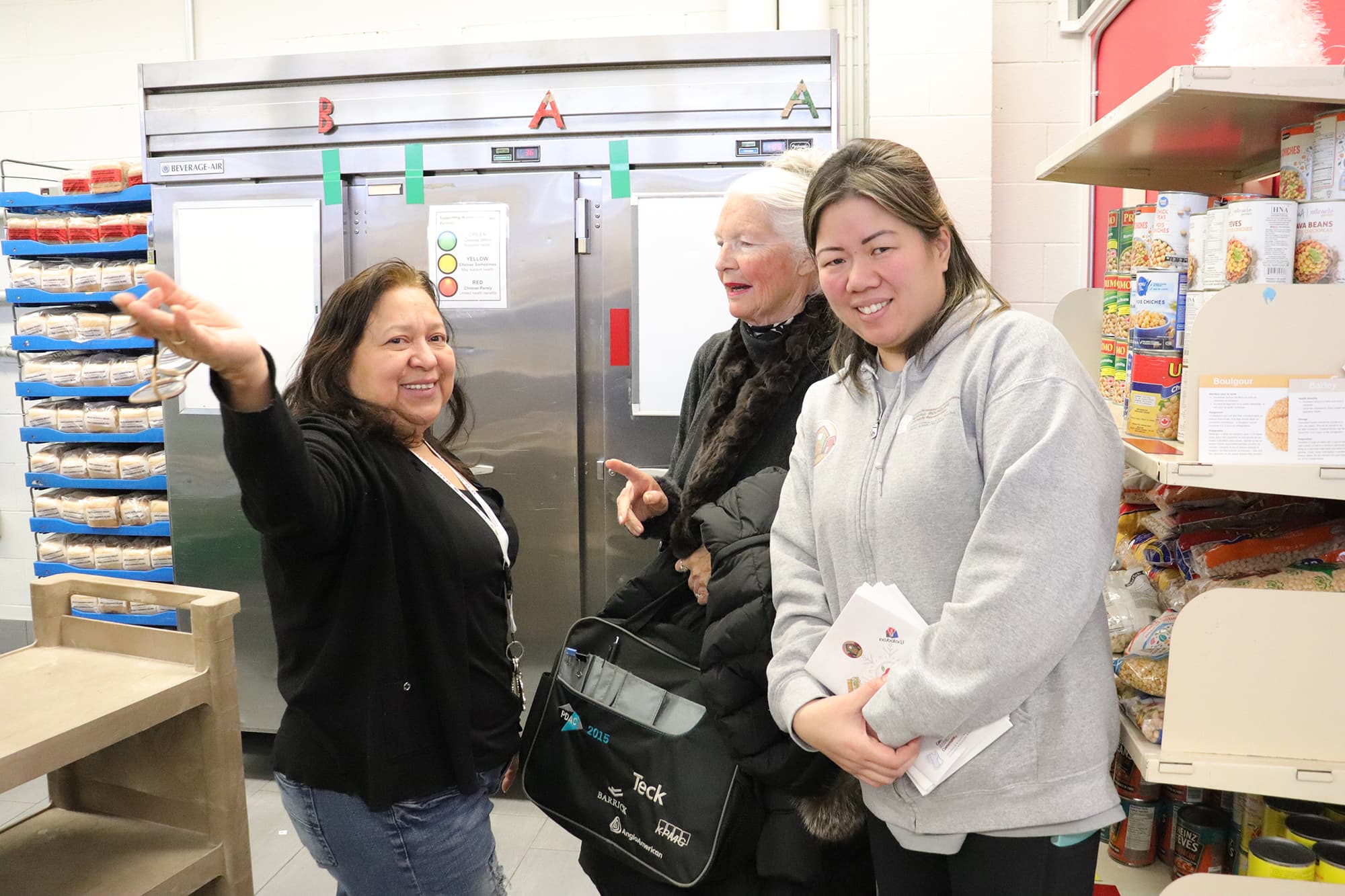
(From left) Patricia Pau, food bank director, with volunteer Elizabeth Heatherington and Catherine Burnett, the coordinator, finance and administration at the Rideau-Rockcliffe Community Resource Centre.
With tears in her eyes, Shirley Whitford talked about her volunteering years as she received the Outstanding Senior Volunteer Award at the 2023 gala of Volunteer Ottawa (VO).
Whitford started volunteering for the Rideau-Rockcliffe Community Resource Centre (RRCRC) during COVID times and has never stopped.
“Rideau-Rockcliffe is my second home. I do not like holidays, and I do work more than 40 hours a week and I wish it was more hours,” said Whitford when she received the award.
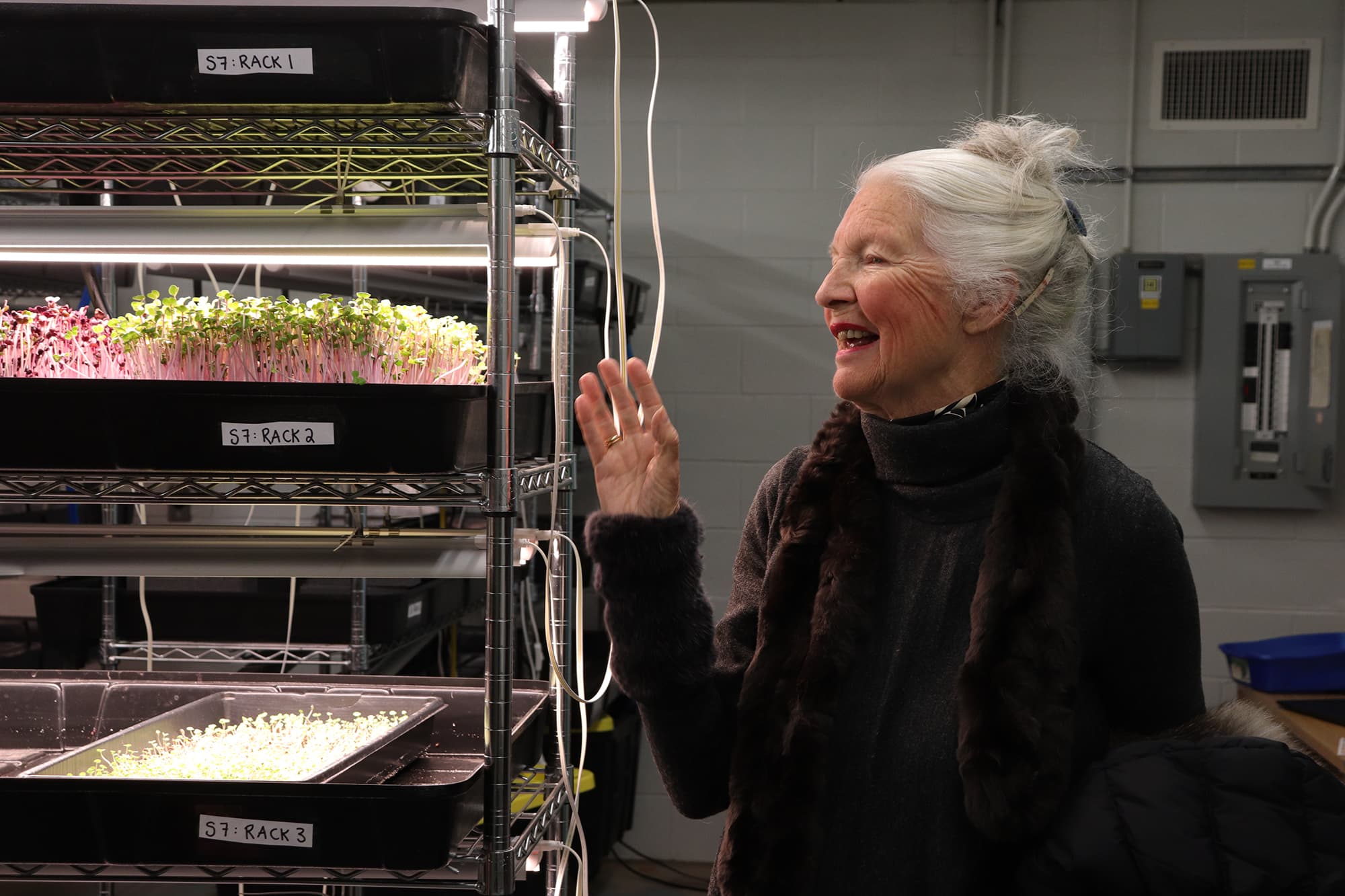
Elizabeth Heatherington is one of the longtime volunteers at the RRCRC who has been on the board of directors over the years. She was also honoured at the VO gala with the Mayor’s Award for volunteer spirit.
Heatherington was initiated at an early age since her parents moved to Canada in 1949. She grew up to become a master in fundraising and an infallible volunteering marketer.
“There’s a lot of room for volunteering,” said Heatherington. “I worked in the last census, and I realized there is a high percentage of people living alone. There may be seniors with issues of dyslexia or other reading problems. There may be a need for a kids’ volleyball or a hockey coach.”
“There is so much bonus in volunteering, and I look forward to volunteering for the rest of my life. The more you volunteer, the more you learn about yourself and maybe you will meet some very interesting people who will teach you a lot,” said Heatherington. Photo credit: Brahim Ait Ouzineb
Volunteering has been a defining trait of Canadian society since 1900 when credit unions began in Quebec. Canadians have always been supportive of each other.
Statistics Canada in its latest report on volunteering and charitable giving in Canada found out that 79 per cent of Canadians volunteered. The time volunteers give is equivalent to 2.5 million jobs every year.
COVID brought the numbers to a halt, but many organizations kept serving the community.
VO, which was founded in 1957, continued to offer several opportunities to volunteers. It is acting seriously to solve the eternal dilemma of adding more and more volunteers without losing sight of its survival.
“We want to tell people about volunteering because it will have positive returns in your life. Even if you are whatever type of volunteer, it builds your resume,” said Amy VanTorre, the communication manager and an Algonquin College graduate.
VO has a great educational institution partner in Carleton University and it is negotiating with Algonquin College to provide more opportunities for the college community to serve the Ottawa region.
In the 2023 Gala which Algonquin College sponsors, college president Claude Brulé said: “It is our second year sponsoring the event of Volunteer Ottawa. Volunteering is a critical part of education at Algonquin College. When students volunteer during their time at Algonquin College, they receive a co-curricular credit that complements their academic transcript and helps build their resume by the time of their graduation.”
Volunteer Ottawa does not only promote volunteerism or engage communities, but it also builds expertise through offering substantial training. The organization has become a reference in linking over 10,000 volunteers to its 371 member organizations of all sizes.
It fosters collaboration with other entities through its VOscars awards gala, Volunteer Expo and Fall 2022 Learning Path. It is keen on raising awareness to decision-makers as to the organization’s contribution to the community. The portfolio of projects fills the year and yet the organization’s strategy is seeking ways for better engagement and service.
“We are the hub of the wheel in a sort,” said Christine Trauttmansdorff, the executive director for VO. “We connect volunteers to organizations that need them.”
The opportunities may be online, indoor, outdoor and on a regular basis.
“If you do not know what you want to do, just create a profile on our website volunteerottawa.ca then our members who need your skill set and availability would come to you,” said Trauttmansdorff.
VO is conscious of the versatility of the sector, and they are setting up strategies to adapt. They initiated a Connect Program which makes it easy for companies to engage in a wide variety of volunteering activities.
“We’re noticing still a national volunteer shortage. All of our members are reporting an increase in demand for services and a decrease in volunteers. So, we’re really doing our best to get more people into volunteering and make it easier to connect them to those organizations,” said VanTorre.
Volunteer Ottawa is trying to increase both the supply and the demand for volunteers. Yet the biggest challenge for VO, according to VanTorre, is creating more self-generated revenue. The organization aspires to be a stable, well-funded part of the community.
“The first threshold of success is to see more sign-ups in our website and more volunteers engage in the community. The second step is recruiting more membership organizations,” said Alvaro Caso, who was the partnerships and learning manager at VO.
“Running a website that has thousands of volunteers actually costs a lot of money. We may do it in a cost-effective way,” says Alvaro Caso the then-partnerships and learning manager at VO. Photo credit: Brahim Ait Ouzineb
VO seeks partnerships with businesses to keep the engine rolling, especially with the cut of the government’s grants.
“Running a website that has thousands of volunteers actually costs a lot of money. We may do it in a cost-effective way. However, running educational and learning opportunities along with supporting volunteers would require even more and more investments,” said Caso.
The organization has a resourceful website, helping organizations like RRCRC.
“We received 400 volunteer applications but after all the checks and interviews, about 143 are retained to operate our several operations,” said Catherine Burnett, the finance and administration coordinator at RRCRC.
The centre is constantly looking for volunteers to help with their great initiatives for Ward 13’s constituents.
“Well, it’s a little bit more difficult now because some people need to spend more time finding or perhaps having part-time jobs to feed themselves. So it’s not as simple as it used to be,” said Heatherington.
Walking gracefully and humbly around the centre at the old Rideau high school, Heatherington knows everyone and has a word for all. She takes congratulations on her latest award as a greeting because she is always eager to hear the others.
“There is so much bonus in volunteering, and I look forward to volunteering for the rest of my life,” said Heatherington. “The more you volunteer, the more you learn about yourself and maybe you will meet some very interesting people who will teach you a lot.”
College redefines Valentine's, highlighting community, self-love, and unexpected friendships
Yuye Jiang
Photos: Yuye Jiang
February 20, 2024 Revised: February 20, 2024 4:38pm
Photo: Yuye Jiang
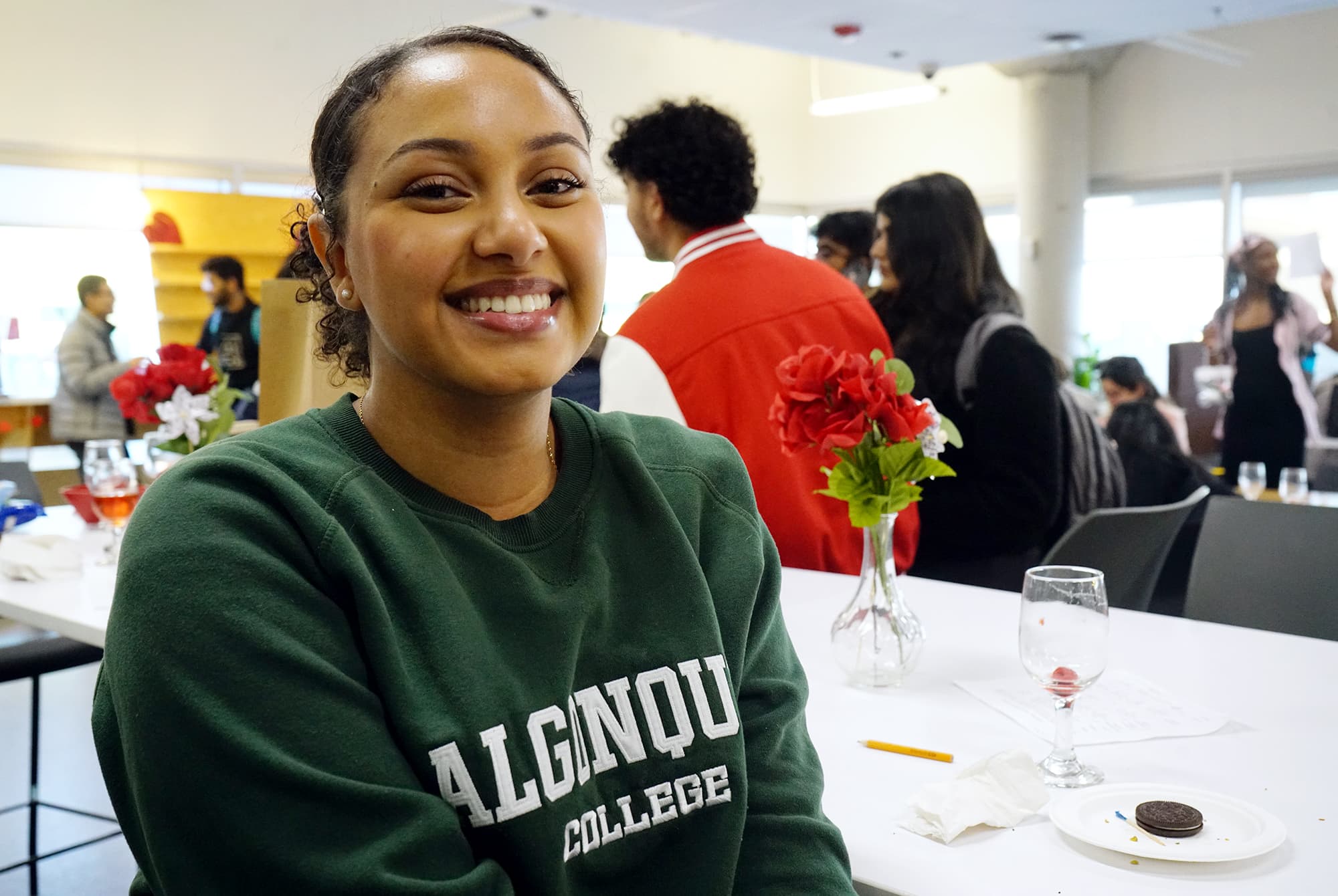
Delina Hailu, a student majoring in business administration at Algonquin College, enjoys snacks, drinks, and chatting with a new friend at the AC Hub.
Valentine’s Day is no longer exclusively a day for romance. Many students now enjoy diverse expressions of love on this day, celebrating with family and new friends.
Algonquin College organized a lively social event at the AC Hub on Valentine’s Day, transforming traditional romantic celebrations into an inclusive social experience.
From music and sweet treats to bingo games, the event not only provided relaxation for students amidst midterm tests but also offered opportunities to make new friends.
Yasmine El Bouberri, a student in international business management at Algonquin College, found herself enjoying the social atmosphere at the Valentine’s Day event, despite attending alone.
“I was just sitting here playing on my phone, and then many people approached me because they needed help filling out their bingo paper,” Bouberri said. “It’s much easier, cause you don’t have to initiate a greeting anymore. Just ask, ‘Can you help me fill out this paper?’ It’s enough.”
Bingo became the highlight of the entire event, not only because it connected students but also broke the social barriers through a simple and enjoyable game, redefining how new friendships are formed beyond emotional compatibility.
Harsh Rajgor and Natasha Singh, studying business and event management at Algonquin College respectively, praised the content planning of the Valentine’s Day event.
“We saw this event on the website and came here right away,” Rajgor said. “We got some donuts and drinks, and now just stay chilling here with music, bingo, and making friends from different places.”
Samantha Therrien, Algonquin College’s event officer, aims to create new connections among students and change perceptions of Valentine’s Day, moving away from its exclusive link to romantic relationships.
“We’re hoping the students can realize that Valentine’s Day can mostly be like a community thing,” Therrien said. “It isn’t only about romantic relationships; it’s about the love between friends and self-love.”
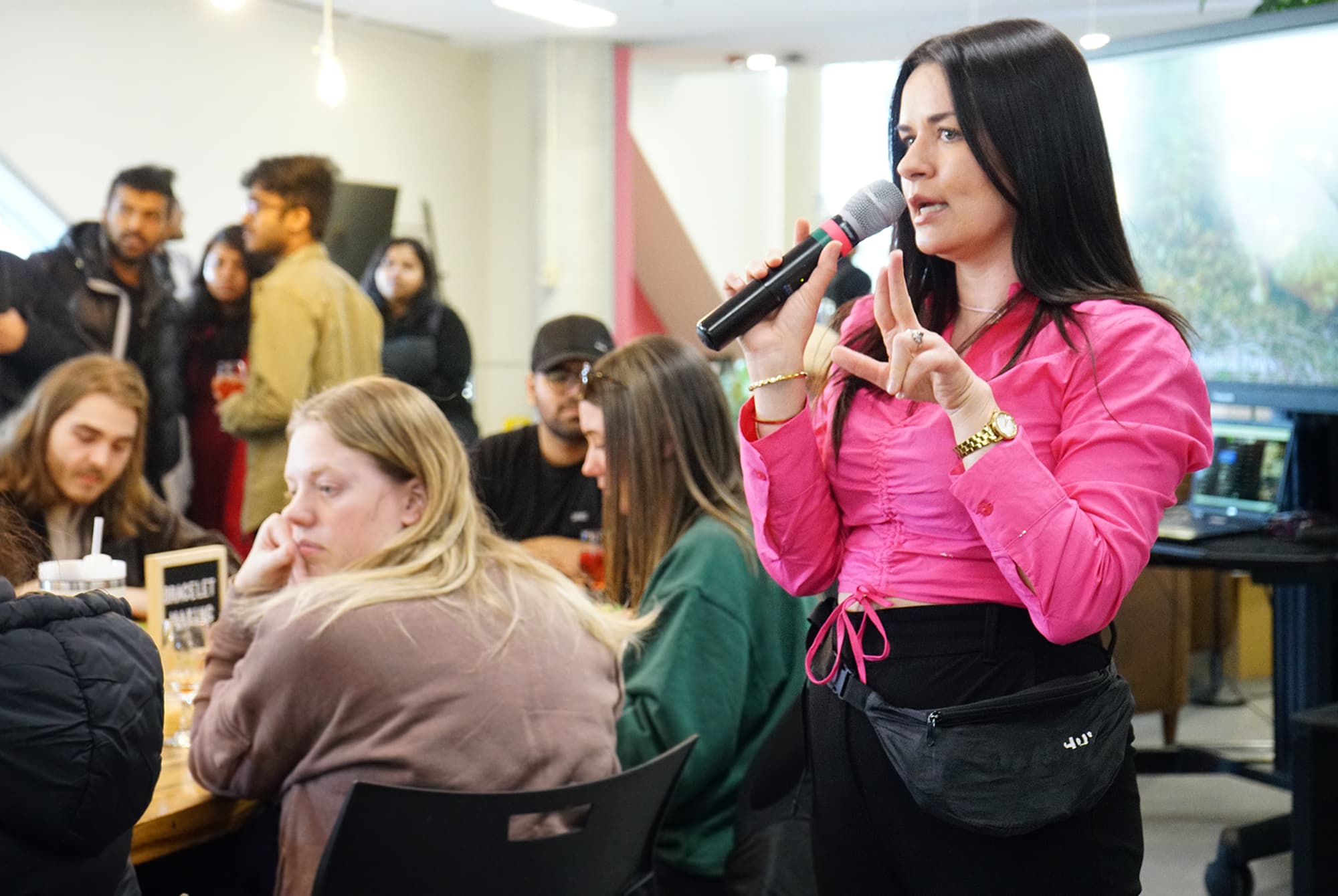
Samantha Therrien, the event officer at Algonquin College, gives a speech for the Valentine's Day Social event at the AC Hub and goes over the bingo game instructions. Photo credit: Yuye Jiang
“A social setting like this is really useful, because it’s all about the networking,” Bouberri said. “You meet new people, they might refer you to a job. So, it’s not about being together, falling in love, but more like visiting new places and getting resources.”
“Whether you take care of someone in a friendship or romantic relationship, we should take care of ourselves first,” Singh said. “Only when we know how to love ourselves, can we provide the same things to others.”
Therrien said that the Algonquin college is definitely planning to roll out similar events in the future. More information on upcoming events can be found out on AC Hub’s official website.
Baskets filled with uplifting cards and candy will be found all over campus to give students kindness during exam season
Kaitlyn Lemay
Photos: Kaitlyn Lemay
February 20, 2024 Revised: February 20, 2024 4:29pm
Photo: Kaitlyn Lemay
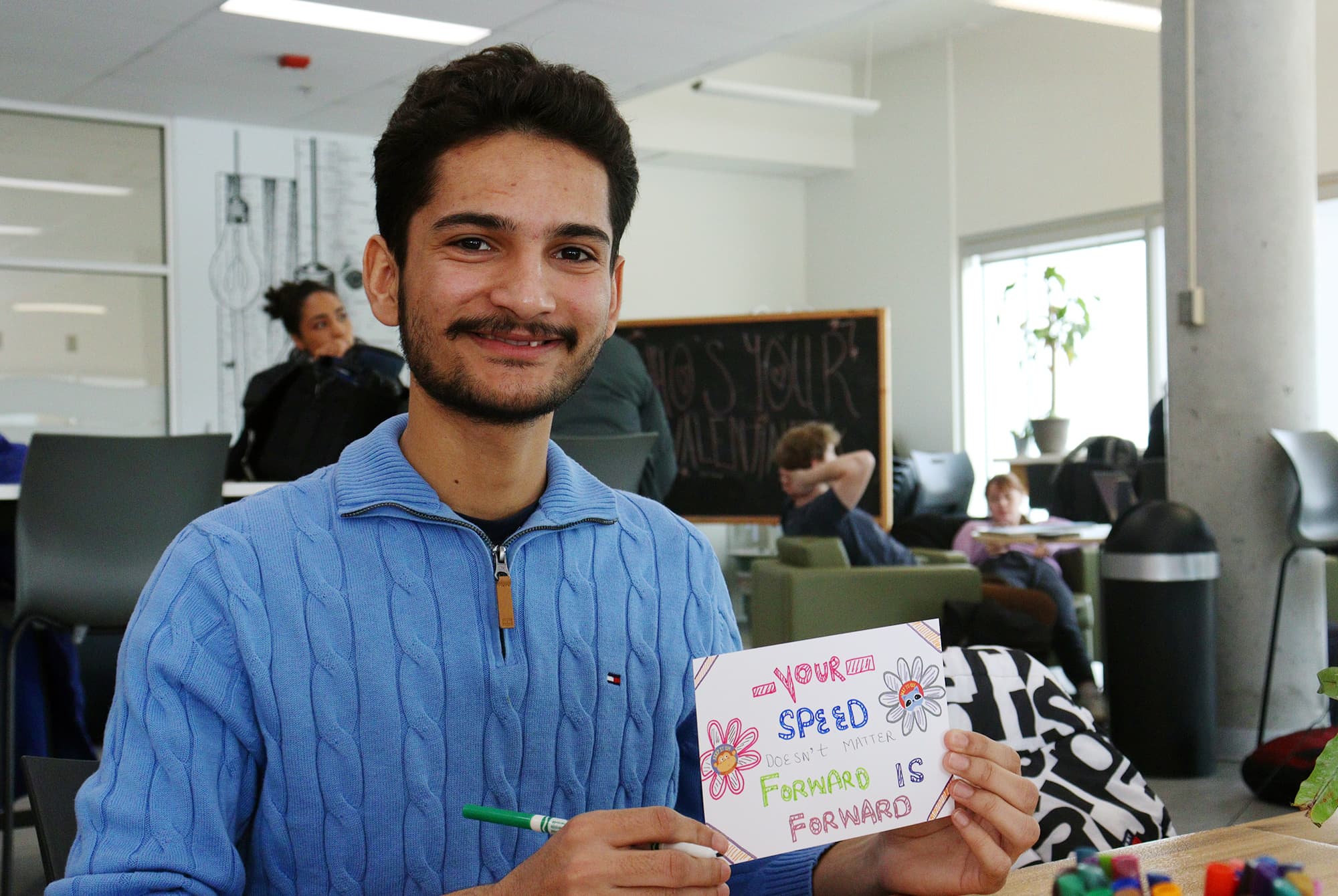
Arshpreet Singh showing off one of his motivational cards
Three hundred “kindness” cards spreading encouragement are popping up around campus during a stressful period for students.
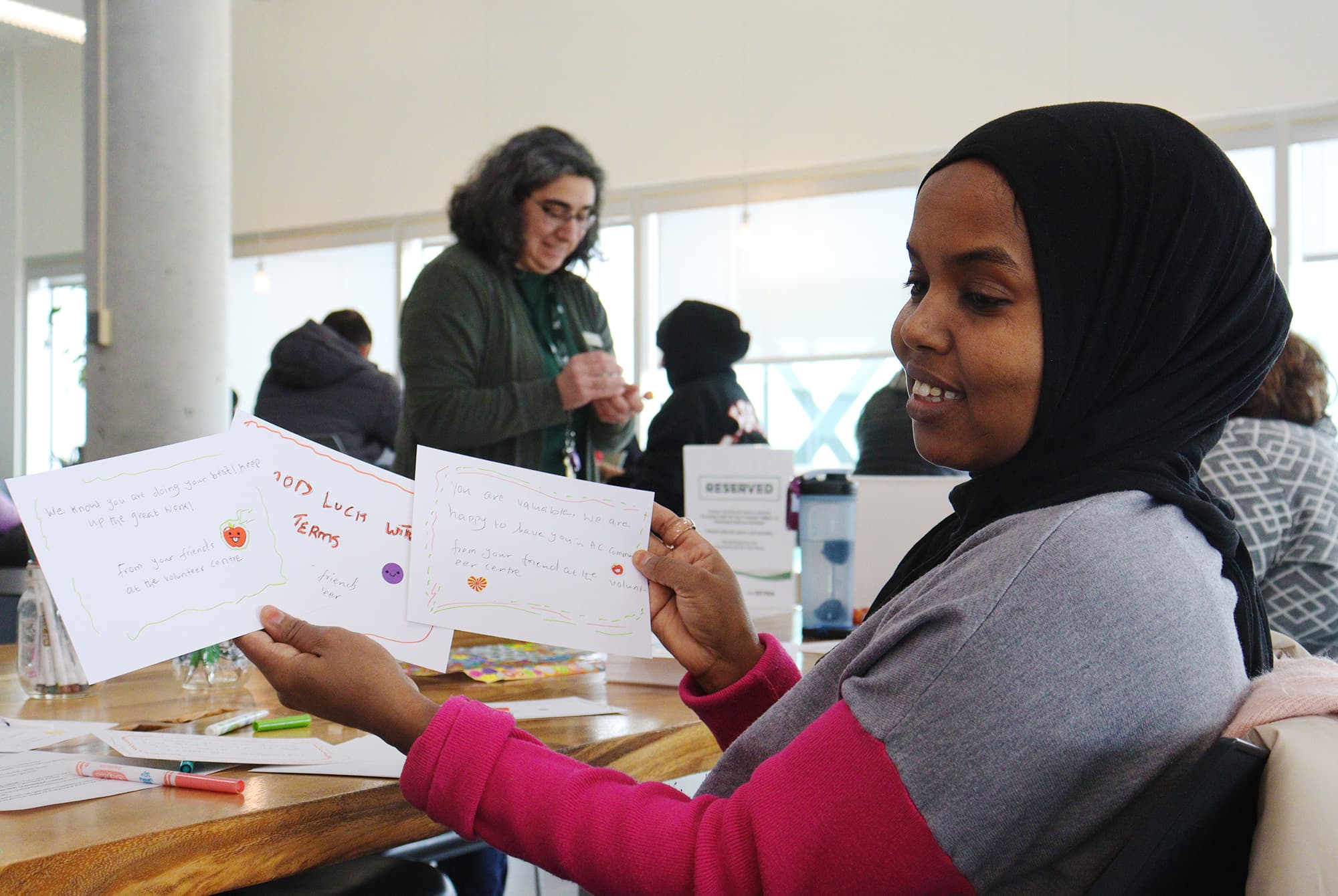
The Volunteer Centre organized a community event on Feb. 15 that had students gathered around a table in the AC Hub writing on brightly decorated cards with encouraging messages to uplift the community during exams.
Fathi Mohamed, an early childhood education student, was decorating her third kindness card with cheerful stickers and colours. She knew the importance of finding positivity during exams.
“This is a very stressful time of the semester, we all know that,” said Mohamed.
Fathi Mohamed showing off her first three kindness cards Photo credit: Kaitlyn Lemay
A piece of candy was added to the cards and they were put in a bin to be distributed across the Algonquin College’s Woodroffe campus throughout exam season.
“It’s the first time we’re doing one like this, where students can actually write messages to other students,” said Amanda Rickerd, marketing officer and AC Hub coordinator.
The Volunteer Centre typically does cards or events to help external communities such as seniors but “this time with midterms and exams, Jenny decided to do it internally to give positive messaging and words of encouragement to other students,” Rickerd added.
Jenny Rizk, a volunteer support specialist, organized the event and stocked the tables with supplies like markers, stickers and sunflower-themed cards.
Although the Volunteer Centre offers community hours that can be applied to classes, the opportunity to join was open to all students.
Arshpreet Singh, a student who volunteered for the entire two hours of the event, had offered his time with the Volunteer Centre on two other occasions without claiming hours.
“I just want to be in the college community,” said Singh.
Fifteen students volunteered their time decorating kindness cards, and a group of eight students even stayed for over one hour.
Messages on the cards are meant to motivate students during exams. Each card has simple encouragements written by students, for students, in need of positivity.
“There will be a sign on the basket that says, ‘Do you need some kindness today? Take a card’,” said Rizk.
Arts & Entertainment | Featured Hero | Featured Story | Home Feature
Cultural cuisine was one of the main attractions at event in Student Commons
Yuye Jiang
Photos: Fortina Chen, Yanrong Wang, and Leah Grimes. Photo credit
February 19, 2024 Revised: February 19, 2024 9:08pm
Photo: Fortina Chen, Yanrong Wang, and Leah Grimes. Photo credit
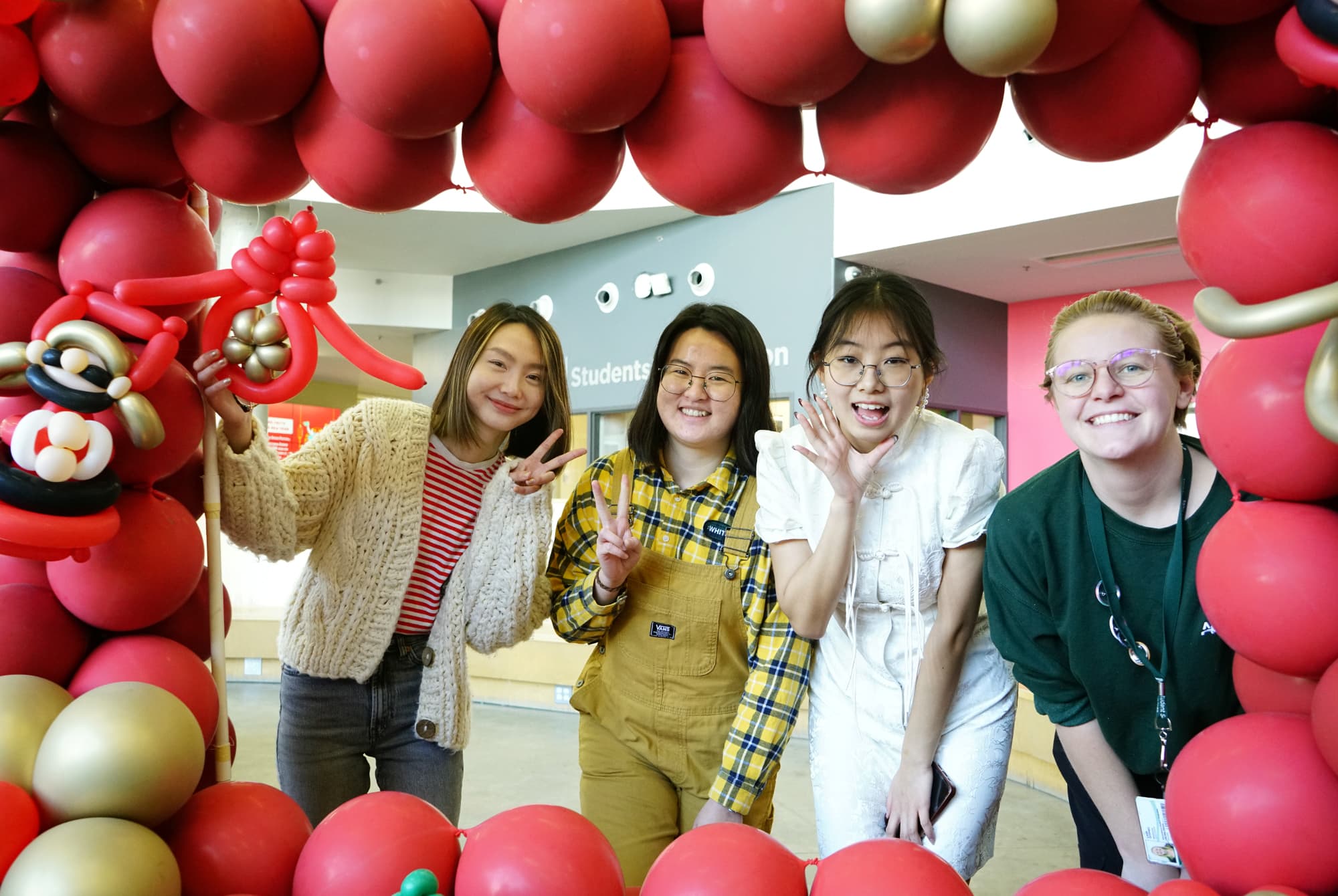
Woxuan Ma, wearing a short white cheongsam, had her picture taken with three
staff members from the International Education Centre of Algonquin College (from left to right)
With the Lunar New Year of the dragon underway, Algonquin College hosted a grand celebration in the Student Commons on Feb. 12. The campus buzzed with life as students immersed themselves in a rich experience of culinary delights, traditional attire and cultural exchange.
The Lunar New Year holds great significance in many East Asian countries, particularly in China, where it represents a time for family reunions and the embodiment of traditional culture. During this period, people engage in traditional rituals and activities, such as visiting relatives and friends, writing couplets, watching lion dances and savouring festive meals with family.
Jieyu Chen, a Chinese student in the early childhood education program, has been away from home for quite some time. She eagerly anticipated the celebration. Being in a foreign land, she highly values traditional cultural events like those on campus.
“Like the Diwali celebration the school had not long ago, I think it’s really nice to be able to share your own culture and cuisine with people from different countries,” Chen said. “I’m also really looking forward to today’s lion dance performance because that lively drumbeat really gets you excited, just like back home.”
Noémie Rossignol, a student in culinary management, believes that this Lunar New Year event has created a great cultural exchange experience for people from different places.
“Because I come from Quebec, I had only heard about lion dances before but never seen it before, so I’m really looking forward to today’s performance,” Rossignol said.
During the celebration event, a showcase of traditional attire captivated the attention of many students. A girl, dressed in a white short cheongsam and adorned with earrings featuring Chinese elements, stood on the stage, confidently displaying the beauty of Chinese traditional clothing and sharing the cultural significance behind it.
Woxuan Ma, a former electrical engineering technician student at Algonquin College, joined the Lunar New Year celebration with the intention of fostering friendly cultural exchange and communication.
“I’ve always had a habit of wearing traditional clothing, so during this event, I hope to show our Chinese attire to people from different countries,” Ma said. “I‘m here to meet new people today and look forward to more opportunities in the future to showcase our traditional clothing.”
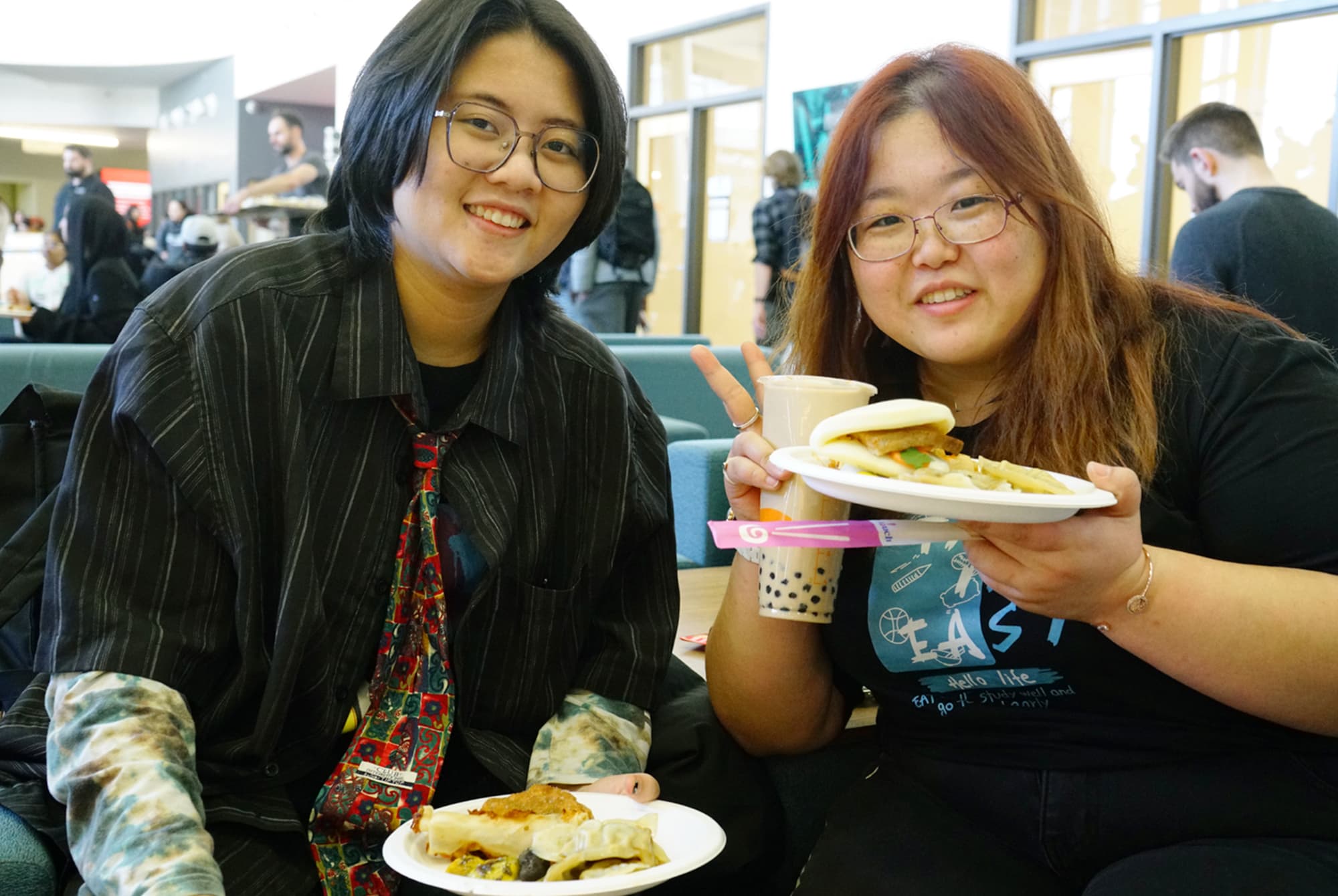
The food lineup stole the spotlight at the Lunar New Year celebration. Approximately 10 minutes before the festivities commenced, student groups from various cultures gathered in the shared student space, eagerly anticipating a taste of delicious New Year dishes. With offerings like pulled pork sandwiches, spring rolls, dumplings, rice cakes, and bubble tea, the students’ enthusiasm and curiosity for diverse cultural cuisine turned the food area into the liveliest spot at the event.
Jieyu Chen (left) and Xueting Wang (right) are early childhood education students who arrived early at the Student Commons to wait for the Lunar New Year event to begin. Photo credit: Yuye Jiang
“We’ve got a diverse team here, and we’re always trying to do different things and make diverse dishes because there’s a mix of students who come in and enjoy the food, so we really try to represent that diversity well,” Nathan Buschmann said.
Buschmann serves as the culinary operations manager at Algonquin College, marking their third year of collaboration with the Students’ Association in providing food. This Lunar New Year, the delicious offerings were crafted with assistance from students in the culinary and baking programs at the college.
“For this New Year event, it took us about three days to whip up around 2,000 pieces of food. While it did take some time to experiment and practice these new cuisines, it was a fun experience exploring different flavours,” Buschmann said. “We’re a cool team and will continue to check through for various cultural events in the future.”