Jack Labrie: At just 18 years old, Jack Labrie, hailing from the serene suburbs of Almonte, Ontario, is already making waves in the music scene with his unique blend of […]
Emma Stronge
Photos:
February 19, 2024 Revised: February 19, 2024 1:56pm
Jack Labrie: At just 18 years old, Jack Labrie, hailing from the serene suburbs of Almonte, Ontario, is already making waves in the music scene with his unique blend of vocals, mixing, and mastering skills. Growing up surrounded by his family—mom, dad, brother, and
sister—Jack found solace and inspiration in the art of music, beginning his journey into music production in 2021. Dabbling in a diverse array of genres, including melodic rap, R&B, and grunge, Jack’s music is characterised by its medium to slow-paced melodies that effortlessly embed themselves into the listener’s mind. Despite his wide-ranging taste in music, Jack strives to keep his own sound organic and authentic, a reflection of his commitment to musical purity. His most recent release, “LULLABY,” featuring his twin brother Diego, known by the moniker “DEEVIUS,” showcases Jack’s dedication to pushing creative boundaries and collaborating with like-minded artists.
Looking ahead, Jack is determined to leave a lasting legacy through his music and aspiring to achieve monumental success. “I aim to be like taylor swift big, might sound delusional but that’s what you need to be to achieve something like that.” He says. In his own words, Jack articulates his lofty ambitions, stating, “My #1 priority in life is to leave behind a legacy with my music.” While he acknowledges that major accomplishments are yet to come, he remains steadfast in his pursuit of greatness. With unwavering determination and a passion for storytelling through music, Jack Labrie is poised to carve his name into the annals of musical history.
The event was organized by the Student Health & Wellness Zone and Aspire AC
Jude Osmond
Photos:
February 19, 2024 Revised: February 19, 2024 12:05pm
Students enjoying their free pancakes at the event on Feb. 14.
The Valentine’s Day Brunch With Us event gave away the last of their free pancakes to students lining up from outside the AC Hub at about 11:23 a.m.
The event, which was scheduled to run until noon, occurred in the AC Hub on the second floor of the Algonquin College campus E-building and was hosted by the the Student Health & Wellness Zone and Aspire AC.
But by 11:25 a.m., about a dozen students had already eaten all the pancakes and the one syrup bottle was still half full.
“Valentine’s Day can be lonely for some, so to even out the community feels good,” said Harrison Pringle, a Health & Wellness Zone employee.
This is the fourth Brunch With Us event was organized by the Student Health & Wellness Zone and Aspire AC.
The event was crowded with about 40 students lined up, with everybody trying to get free pancakes and hot chocolate. Despite the event’s popularity, the organizers forgot to boil water for warm beverages.
“We usually have nobody for our brunches, but today it was different,” said Lea Ntayeolikamumgu, who works for the Student Health & Wellness Zone.
The event offered free pancakes, beverages and condoms. “The goal was to make Valentine’s Day a good day,” said Ntayeolikamumgu.
The event was promoted via social media, specifically Instagram and Twitter. Algonquin College students said that’s how they learned about the event.
“The event was to promote the Student Health & Wellness Zone and Aspire AC,” said Shelina Syed.
The event organizer, Rebecca Valerio, wanted students to learn about the Aspire AC. Every five minutes, she would shout to the crowd to promote the abilities of the Aspire AC and the Student Health & Wellness Zone.
The line outside the AC Hub started before 11 a.m., which caused the event to start earlier than advertised. The event coordinators were scrambling to get the pancakes out while advertising the student Health & Wellness Zone and Aspire AC.
They wanted to make Valentine’s Day a better experience for people.
The event ended at about 11:40 a.m., about 20 minutes earlier than expected.
They started packing up when the pancakes ran out, but they served juice to people still waiting in line.
The Students' Association at Perth campus holds weekly ice hockey scrimmages for all students, staff and alumni
Itel Sapozhnikov
Photos: Itel Sapozhnikov
February 19, 2024 Revised: February 19, 2024 12:38pm
Photo: Itel Sapozhnikov
Evan Lennon (left) defending William Inoue with Kyle Cobus (goalie) at the net.
Students and alumni gathered together for an ice hockey scrimmage game on Feb. 13 at the Perth & District Community Centre arena.
To participants, the scrimmages have become a part of their weekly routine and a way to connect with fellow students and alumni in the community.
“It’s good to just keep in contact with the college and some of the students,” said Evan Lennon.
Lennon is a heritage and carpentry alumni who has been playing in the weekly scrimmages since he was a student. After graduating four years ago, he shows up almost every week to play.
The arena is reserved for the Algonquin College group every Tuesday from 5 p.m. to 6 p.m. but sometimes the students from a nearby high school join in.
“It’s a good way to come up and have a good skate,” said Lennon.
The Students’ Association has been hosting games for years. This season’s scrimmages have been opened to Algonquin College since Sept. 19, and will run until Mar. 29.
Before the pandemic, there used to be a larger amount of people showing up to play; most of them being alumni. Now there’s a maximum of 10 players.
Eight men attended, one of them was a goalie which resulted in a three against four man game where all players shoots at the same goalie.
In scrimmage rules, once an opposing team touches the puck, they must skate to the middle of the arena with the puck to ‘clear’ it before they can attack.
“We’re missing a few guys, usually we have two goalies,” said William Inoue, a heritage and carpentry student at the Perth campus. “We tend to get 10-ish players.”
The players took around 20 minutes to warm up, shooting at either a goalie or empty net, practicing skill moves and skating around. For the rest of the hour, they played scrimmage ice hockey.
“We just go by jersey colour. It’s just pickup so it’s just for fun,” said Inoue about the method of selecting teams.
Kyle Cobus was the goalie for the game. He is a heritage and carpentry student at the Perth campus of Algonquin College.
“[I’m] just playing hockey, I come out every Tuesday,” said Cobus, he’s attended almost every game since the season started. “I played a good game.”
Noah Leroux is another alumni comes out to play almost every week when he is not working. Like Lennon, he started playing as a student but continued to show up after graduating.
“Kyle was pretty on play today,” said Leroux, referring to the goalie. “He’s doing really well, he’s improving quite a bit.”
The Perth Student Association also hosts free skate on Thursdays from 4 to 5 p.m.
The next scrimmage ice hockey game is Tuesday, Feb. 20, from 5 to 6 p.m.
Featured Hero | Featured Story | Sports & Recreation
Local CTV: A blazing fire overtook a historic church in Richmond late Wednesday night. Firefighters were unable to save the steeple and cross, but no one was injured. Ottawa Fire […]
Kaitlyn Lemay
Photos:
February 16, 2024 Revised: February 16, 2024 4:34pm
Local
CTV: A blazing fire overtook a historic church in Richmond late Wednesday night.
Firefighters were unable to save the steeple and cross, but no one was injured. Ottawa Fire Services responded to a call around 9 p.m. and got control of the fire within two hours.
The St. Philip’s Parish is the “oldest English-speaking parish in the Archdiocese of Ottawa and since 1818 it has been the religious, social and cultural centre for Catholics in the area,” according to the Richmond Heritage website.
There were no fire hydrants in the area, so OFS had to bring in tanker trucks to transport water to defeat the flames. Several parts of the church’s roof were lifted to fight the fire.
Firefighters prevented further damage to the heritage building by laying down tarps to protect the surviving interior from water damage. The cause of the fire is still unknown, but a fire Investigator was dispatched to evaluate the scene.
National
CTV: Vineyards and wineries in B.C. are facing up to 99 per cent production drop due to intense January cold.
The grapes, mostly coming from the typically mild Fraser Valley and Vancouver Island, are estimated to only produce one-to-three per cent of typical crop growth.
Temperatures dropped below -20 C across the Okanagan Valley, where 86 per cent of B.C.’s vineyard acreage is located. This is the second year straight that yields have been damaged due to extreme cold, say B.C.’s wineries and vineyards.
A report from Wine Growers British Columbia and consulting firm Cascadia Partners said the damage done “confirmed the industry’s worst fears” and that “appropriate pruning practices will be ineffective at mitigating against severe crop losses.
The report describes the loss as “an almost complete writeoff of the 2024 vintage” and might trigger $346 million in revenue losses for vineyards and wineries.
International
CTV: A Norwegian convicted mass murderer failed in his second attempt at suing the state.
He had claimed a breach of human rights.
Anders Behring Breivik killed 77 people in a bombing and shooting rampage in 2011 and has been held in isolation since the beginning of his sentence. Breivik argued that this isolation is an inhumane punishment under the European Convention on Human Rights.
Breivik was transferred to Ringerike prison two years ago and is held, “in a two-story complex with a kitchen, dining room and TV room with an Xbox, several armchairs and black and white pictures of the Eiffel Tower on the wall. He also has a fitness room with weights, treadmill and a rowing machine, while three parakeets fly around the complex.”
The Oslo District Court rejected his claim against the Norwegian Justice Ministry. The government’s lawyer, Kristoffer Nerland, said he was “very satisfied” with the judge’s finding.
Breivik is still considered dangerous by the Norwegian authorities and has not yet shown remorse for his crimes.
Cardiovascular technology students were given a presentation on the most prevalent cause of death for women worldwide: heart disease
Stephanie Taylor
Photos: Stephanie Taylor
February 16, 2024 Revised: February 16, 2024 3:27pm
Photo: Stephanie Taylor
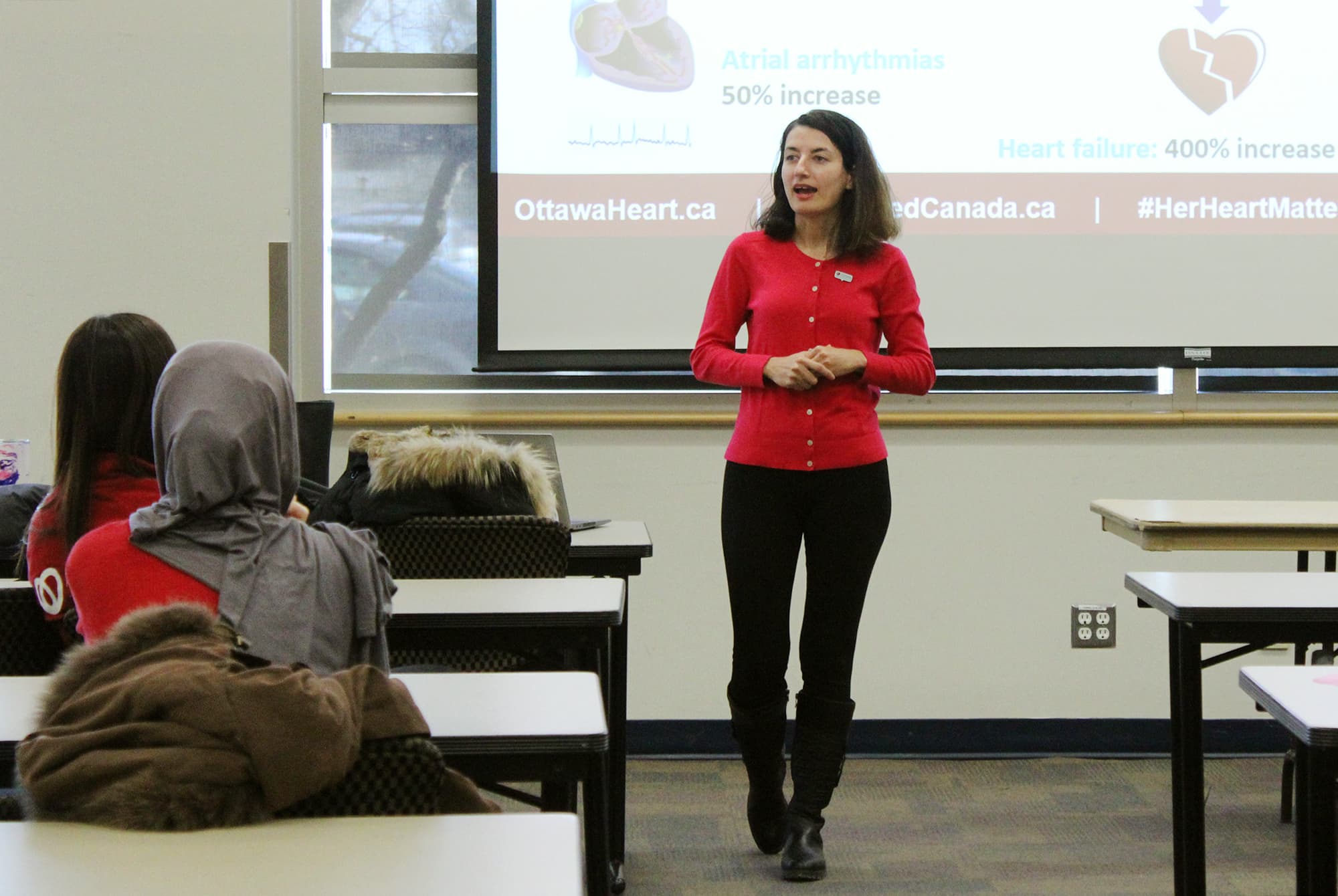
Nazil Parast discusses with Level 2 cardiovascular technology students how heart disease presents differently in women.
Heart disease is the leading cause of death for women worldwide, according to the Canadian Women’s Heart Health Alliance. Despite this, women’s heart health is understudied and underdiagnosed.
“[The] majority of the research that has been done [on heart disease] in the past has been done on caucasian men,” said Lisa Comber, the knowledge translation lead at the CWHHA.
Comber and her colleague Nazil Parast, an advanced practice nurse, came to Algonquin College’s Woodroffe campus on Feb. 14 to deliver a presentation on women’s heart health.
Level 2 cardiovascular technology students attended the presentation in room 102ab in T-building. Every student wore red in honour of February being heart health month.
This was the first time Parast and Comber presented to the cardiovascular technology students at Algonquin College.
Parast and Comber work with the CWHHA to bring awareness to women’s heart health.
Part of how the CWHHA plans on raising awareness is by sending experts, such as Parast and Comber, to post-secondary schools to speak with students on topics that may not be covered in their curriculum.
The lack of heart disease research conducted on women leads to a hole in education curriculums as these curriculums are based on research that has been done previously.
During Parast’s segment of the presentation, she talked about how over 50 per cent of women have heart attack symptoms that aren’t recognized by most health-care providers.
Health-care providers only have a limited amount of time with their patients – the students all said they have around five minutes to talk with a patient.
Parast showed the students the outline she follows when talking with her patients. Parast believes the best method is to just let patients talk without interruption.
“I don’t know what I’m missing when they reroute,” said Parast.
The Level 2 cardiovascular technology students aren’t quite ready to make their own plans on how to talk with patients.
“Right now the importance for them is to get that knowledge,” said Karen Tran, the cardiovascular technology program coordinator. “Once they have that knowledge then they can decide ‘okay, what can I do with this knowledge?’”
Another part of how the CWHHA plans on raising awareness is by educating women on how heart disease can present differently in men than women. The CWHHA also hopes to encourage women to participate in studies on heart health and to go out and get their annual blood work.
According to Parast, since women have historically been the primary caregivers, they often aren’t able to focus on their own health.
“It’s time to put ourselves first,” said Parast. “If you go on an airplane, they always say to put your mask on first before you help someone else.”
Comber agreed with Parast’s analogy.
“If you are not putting yourself at least first, second, third, then it’s going to impact the family in a negative way,” said Comber. “You have to be able to look after yourself to be able to look after your family.”
Parast and Comber hope to continue going to post-secondary schools to give presentations.
“The last two Novembers we’ve done awareness events [with the nursing students at Algonquin], which has been phenomenal,” said Comber. “But, we need to do more.”
Whether he's inside a mascot suit, unable to see, or working as a festival photographer, Greg Scriver has an insider's view of the February event
Kerry Slack
Photos: Kerry Slack
February 16, 2024 Revised: February 17, 2024 11:46am
Photo: Kerry Slack
Papa Ice Hog fixes Mama Ice Hog's scarf as they pose for pictures along Sparks Street.
Amidst the frosty landscape Algonquin College alumnus, Greg Scriver is wearing his favourite pair of shorts and a t-shirt – and he’s still too hot.
Scriver, the embodiment of the Canadian spirit, is eager to bask in winter’s icy embrace however he finds himself donning summer clothing under the huge Papa Ice Hog costume.
Greg has worn the mascot suit since 2017.
“When Heritage Canada said they needed someone to be a mascot, I threw my hand up,” said Scriver. “It’s exhausting, but it’s so rewarding.”
Despite the many challenges of wearing the suit, it remains one of Scriver’s best Winterlude memories. Having worn the suit for seven years he delights in making people smile.
“The suit is incredibly hot,” he said. “We don’t talk, and we can’t see in the costume, so it’s a challenge but it’s the best.”
Papa Ice Hog and Mama Ice Hog pose for a photo on Sparks Street. Photo credit: Kerry Slack
“We have handlers who help us a great deal. We take short shifts with the suit on, and it’s thumbs up or thumbs down to signal our handlers,” said Scriver.
Scriver is highly regarded by his Heritage Canada coworkers as well.
“Greg is great at getting people to engage with him, without saying a word,” said Micheline Roy, a fellow volunteer and Papa Ice Hog handler. “Because we know that Papa Ice Hog does not speak. Winterlude guest community loves Papa Ice Hog and cannot wait to hug him.”
When he is not volunteering to wear the Papa Ice Hog suit at Winterlude Scriver spends a lot of time on the other side of a camera lens as a photographer.
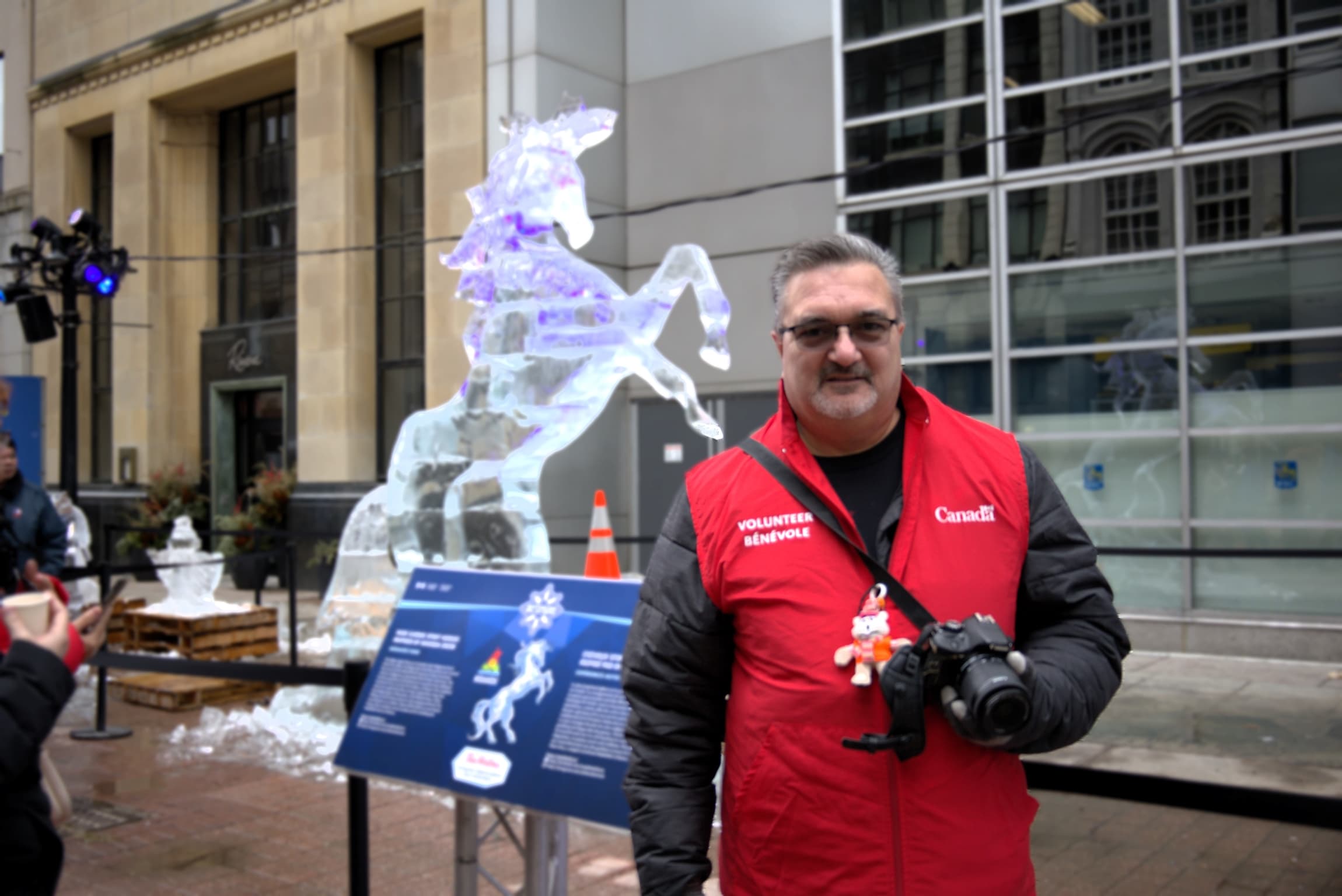
Capturing the essence of the festival for Heritage Canada, Greg Scriver enjoys his second volunteer role. Photo credit: Kerry Slack
Nature is his favourite thing to capture, and sunset and sunrise photos were a source of enrichment for Scriver through the COVID lockdowns.
“I started photography back in high school, but I got away from it. It was COVID that got me back into my photography,” said Scriver. “I originally started putting the photos on my Facebook page. I drew so much traffic that I made a Greg Scriver photography page.”
He is not the only one who has enjoyed his daily posts.
“There was one lady who said she suffered from anxiety and depression for years, but seeing my photos daily reduced her anxiety and depression and gave her something to look forward to each day,” said Scriver. “That felt amazing. What do you say to that?”
His photos often appear on CTV photos of the day and APTN photos of the day.
His wife prepares any time they leave the house.
“I wear a lot of layers. We are sometimes out here for hours, and I have a good time watching him do his thing and getting to know people,” said Kim Scriver.
Scriver graduated from the computer science specialist program at Algonquin in 2000.
“Back then I attended an office building on Elgin Street, that’s where the classes were,” said Scriver. “I graduated with honours in January 2000 and now I work for the federal government as an IT professional.”
In his spare time, Scriver volunteers all over the city at many events including being a volunteer for Heritage Canada.
“Being Papa Ice Hog is my favourite role. To see, in my case not see, a child, waddling towards you with their arms out to hug your knees, it melts your heart,” said Scriver.
“I call it therapy because I’m smiling, they’re smiling. Even adults want a big hug and a photo,” he said.
Greg Scriver arriving on Sparks Street for an afternoon of photography. Photo credit: Kerry Slack
Winterlude festivities extend beyond the confines of ice and snow, encompassing culinary delights, live music performances, and cultural exhibitions.
Despite the frosty temperatures that typify Ottawa in February, Winterlude proves that the cold months need not dampen our spirits.
If you find yourself strolling through Ottawa during the last weekend of this year’s Winterlude and happen upon Papa Ice Hog, say hello.
Depending on which role he’s in that day, you may see the red vest and the camera, or you may see the big, fluffy suit.
Either way, Scriver is grateful to be a part of it.
Arts & Entertainment | Featured Hero | Featured Story | Home Feature
Students smelled the winds of change when a new de-icing provider used a beet brine to prepare for snow
Nathalia Lencioni
Photos: Nathalia Lencioni
February 16, 2024 Revised: February 22, 2024 6:29pm
Photo: Nathalia Lencioni
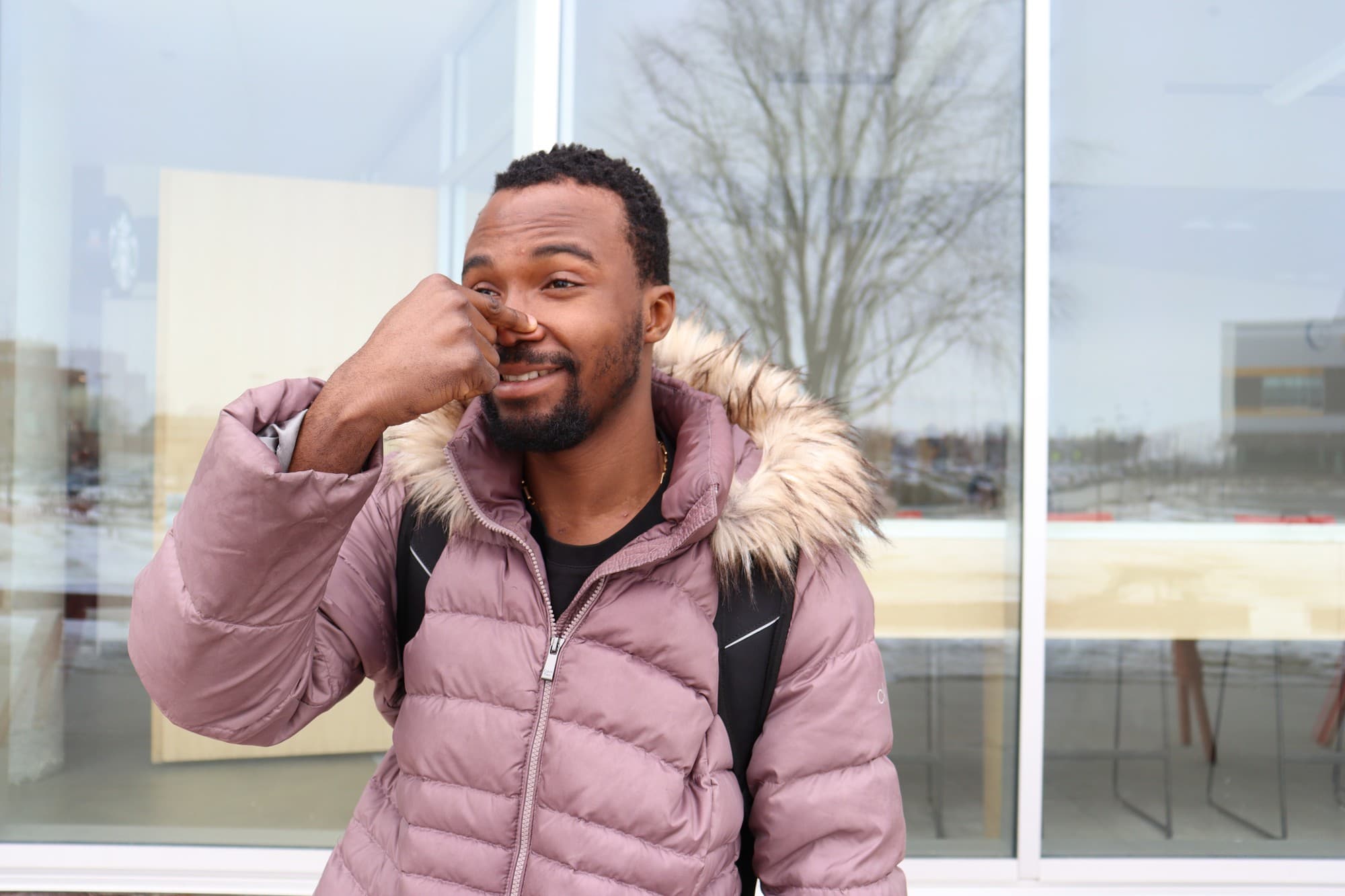
Student Marie-Pier Caron, trying to curb the smell at the parking lot in front of E-building on Feb. 15.
Marie-Pier Caron, a student in the illustration program at Algonquin College, said she was relieved other people noticed the smell at the campus main parking lot, on Feb. 15.
“I thought I put my bag or jacket down somewhere and it got poop or something on it,” she said. “I’m glad it’s not just me, I thought I was carrying the smell in my bag because it was so strong.”
It certainly wasn’t. The smell became a topic of conversation easily overheard in the hallways of the campus.
The college has recently signed a new contract with service provider for snow removal, de-icing, and salting, according to Ryan Southwood, executive director of facilities management. The name of the service provider was not revealed.
“It’s a new contract this year, so they’re learning,” said Southwood. “So, there have been some adjustments. Before we signed this contract, we had been examining opportunities to go greener instead of just using rock salt, we investigated beet brine, but we found out about the smell.”
Ryan Southwood, executive director of facilities management, explained the reasons for the smell issue at his office in G-building. Photo credit: Nathalia Lencioni
Beet brine, which is used commonly as an alternative to rock salt on sidewalks and roads, is made up primarily of sugar, beet molasses and salt. The sugar in the beet molasses is effective at lowering the freezing point of water.
“We were very clear with our service provider that we were not going to use beet brine,” said Southwood. “But I believe other clients in Ottawa do use it, what we’ve been told is they didn’t use beet brine, but there may have been beet brine contamination of the de-icer that they use.”
Eli Sliwa, a student in the broadcasting television and streaming video program, said he first noticed the smell outside of N-building and was surprised and upset.
“It’s really weird that it smells like that,” said Sliwa. “It smells so bad, it makes Ottawa U smell good.”
Student Umas Emiola, covering his nose from the smell while waiting for bus outside of Student Commons. Photo credit: Nathalia Lencioni
Southwood said the smell in the parking lot is expected to fade within the next few days. However, it may remain in students’ memories — and the carpeting of campus buildings.
“It’ll dissipate throughout the day and overnight,” said Southwood, on Feb. 15. “Another challenge is it might be in some of the carpets. So there may be some lingering smells, but I’m hoping that by overnight, it actually dissipates and becomes much less noticeable for people on campus.”
Customers order custom sweaters to show pride in their college programs
Nathalia Lencioni
Photos: Nathalia Lencioni
February 16, 2024 Revised: February 16, 2024 9:36am
Photo: Nathalia Lencioni
Chorn Lo, sales associate at the Connections store, takes an order for a custom hoodie from Shannon Reid, veterinary program curriculum coordinator.
The custom hoodie service, which is available once per semester, originated in response to requests from students, according to Ashish Talwar, manager of Connections.
“This service started with the students asking for it a number of years ago. We used to have to order a minimum of hoodies from each program, but the way we do it now even if it’s just one student from that program we’re still able to do that,” said Talwar. “It’s not really a design-your-own custom hoodie.”
Custom Hoodie Week ran from Feb. 5 to 9, and online until Feb. 11. The hoodies were $69.99 plus tax in any style and colour.
Katie Rystenbil, a first-year student in the concept art and illustration program, said she would like more custom options. “I saw the booth as I walked by and my friends were interested in getting one, I thought the hoodies felt very soft, but I wish there were more options,” she said.
Talwar said it is possible that the college will work with a supplier on more custom designs in the future.
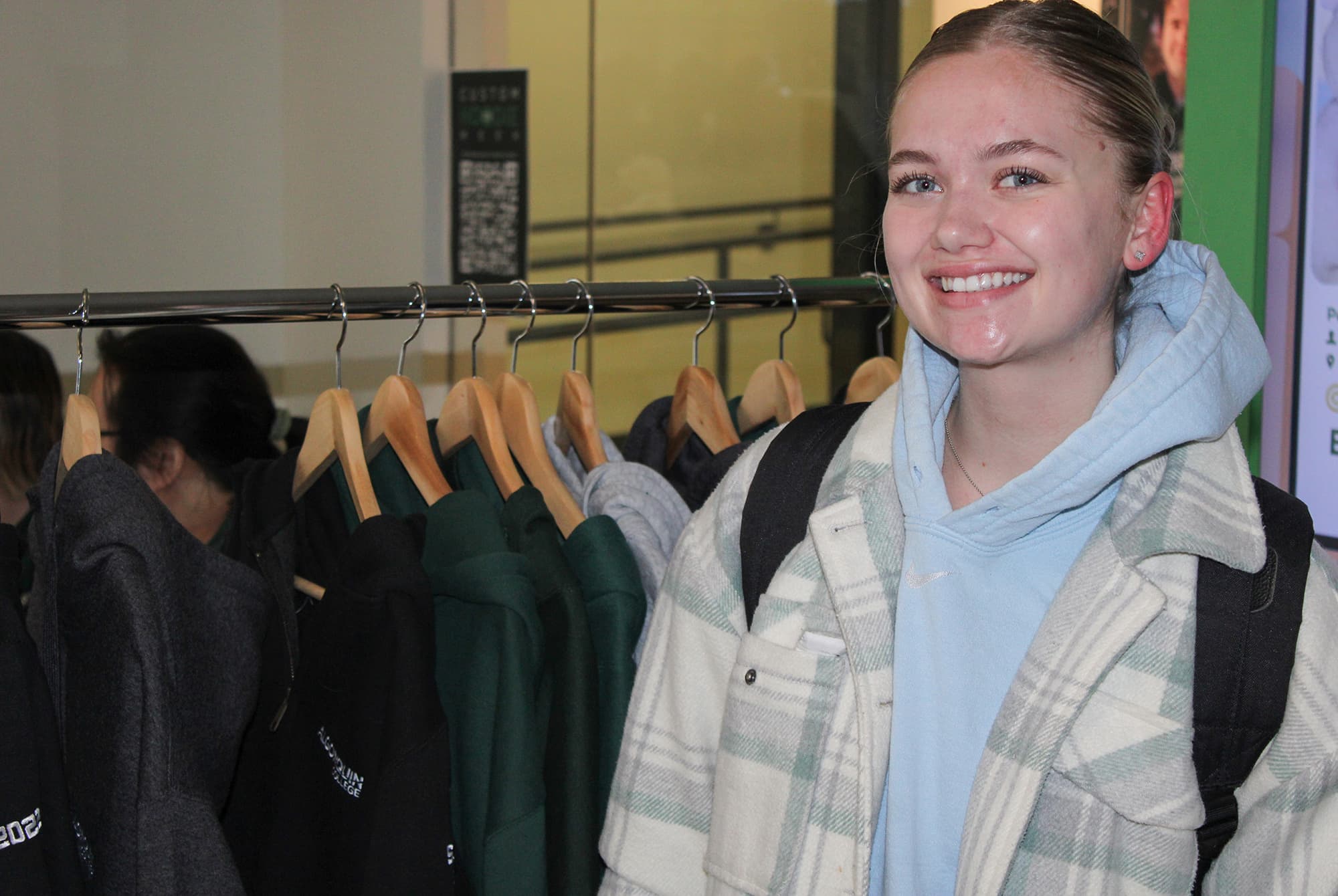
Maddy MacDonald, a student in the business and marketing program, looks at the hoodie options. Photo credit: Nathalia Lencioni
Talwar said although the custom hoodie service is the same as last term, there was a new marketing campaign.
“It’s a new person that’s on the face of all of our posters. He’s a student here, studying in bachelor of digital marketing communications. And he’s doing his co-op within Campus Services,” said Talwar.
Shannon Reid, veterinary program curriculum coordinator, wanted to order a hoodie that would represent and honour all of her students.
“I’m excited about Custom Hoodie Week because I heard about it happening, but I didn’t know it was happening now. So, I’m glad I was walking by when I did,” said Reid. “You can never have enough Algonquin pride.”
Custom Hoodie Week will return to campus in October.
Event every Tuesday provides oasis of calm for Algonquin College community
Korbin Amaya
Photos: Korbin Amaya
February 15, 2024 Revised: February 15, 2024 5:34pm
Photo: Korbin Amaya
Christina Latifa and Elizabeth Peña-Fernández, organizers of the Mindfulness Hour, lead sessions every Tuesday in the Student Commons.
The counsellors who organize the Mindfulness Hour every Tuesday in the Spiritual Centre want students to take time for their well-being through meditation.
“We want to start creating mindfulness breaks, allowing people to become more mindfully aware,” said Christina Latifa, from Counselling Services. “Mindfulness is being aware of what you’re doing, being present at that moment, and paying attention to what you’re doing, rather than being automatic.”
The Mindfulness Hour happens at 11 a.m. in Room E211 on the second floor of the Student Commons.
People are greeted by the two counsellors, Latifa and Elizabeth Peña-Fernández, sitting in front of 12 yoga mats.
An hour into the session, Latifa introduced the purpose of the Mindfulness Hour.
“Participating in these sessions can help you achieve a sense of calmness and realign your concentration, facilitating clearer thinking amidst the busyness of your day,” said Latifa. “Our exercises promote the creation of new neural pathways through mindfulness and meditation, leading to improved focus and reduced anxiety.”
Peña-Fernández, seated across from Latifa, addressed the daily pressures and habits affecting individuals in the Algonquin College community.
“But in terms of spirituality, it can be challenging to embrace activities that nourish this area because wellness encompasses various aspects such as social life, physical health, emotional health, spiritual health, and financial health,” said Peña-Fernández, health promotion and education coordinator.
Peña-Fernández described spirituality as a harmonious melody resonating within, bringing inner peace and balance.
Latifa and Peña-Fernández aim to assist people in balancing their lives, urging them to take a moment and open their hearts to mindfulness opportunities.
The Mindfulness Hour features a series of events scheduled throughout February and March, with the next event scheduled for Feb. 20. The event is open to all Algonquin College students. No prior experience is necessary.
Local CBC: House to Home, an Ottawa non-profit that helps refugees furnish their homes, lost thousands of dollars worth of donations in a robbery earlier this week. The non-profit provides […]
Nathalia Lencioni
Photos:
February 15, 2024 Revised: February 15, 2024 3:09pm
Local
CBC: House to Home, an Ottawa non-profit that helps refugees furnish their homes, lost thousands of dollars worth of donations in a robbery earlier this week.
The non-profit provides refugees in need with pre-owned furniture, clothes and other appliances.
House to Home has, since its start in 2020 in the owner’s garage, helped over 500 refugee families.
After nearly losing its warehouse location in March 2023, only to learn its landlord extended their allowed stay to the spring of 2024, House to Home owner Suzi Shore Sauvé says they want to push it as long as they can to help more people.
“We really want [a] new space so we can serve the next 500 families,” she said in an interview with CBC.
National
CBC: Environment Minister Steven Guilbeault clarified his original remarks that the federal government will stop investments in new road infrastructure.
Guilbeault told reporters on Wednesday Feb. 14 that Ottawa will not invest in “large” road projects, but federal policy is unchanged and Ottawa will support provinces with maintenance.
“There will be no more envelopes from the federal government to enlarge the road network,” Guilbeault said, according to a quote from the Montreal Gazette.
Guilbeault’s previous statement received attacks from the Opposition Conservatives, who said the climate activist turned politician is out of touch.
International
CBC: Canada is sending $60 million to Ukraine for F-16 training said Defence Minister Bill Blair on Feb. 14 as allies met in Brussels ahead of NATO ministerial meeting.
The new funds will help Ukraine pay for F-16 supplies and equipment such as spare parts and ammunition according to Blair.
The contribution follows a $15 million donation to pay for civilian pilot instructors. The F-16s are being donated by Norway, Denmark and the Netherlands.