main

Birch bark canoe building fosters knowledge of traditional Algonquin culture

The event in the college library at the Knowledge Keeper's Place aimed to educate students and staff in an ancient and historically significant tradition
Photo: Kevin Clasper-Inglis
Commanda's completed birch bark canoe.

If you walked through the college library at any point between Nov. 3 and Nov.14, you may have noticed an unexpected sight — a man working on a birchbark canoe.

That man is Chuck Commanda, knowledge keeper and master canoe builder. Commanda is Algonquin from the Kitigan Zibi Anishinabeg First Nation outside of Maniwaki, Que.

The canoe, completed on Friday after almost two weeks of work, was built in the traditional Anishinaabe method using birch bark. Commanda was commissioned to build the canoe to coincide with the launching of two new Indigenous studies programs at the college.

Chuck Commanda with one of the many birch bark canoes he's built.
Chuck Commanda with one of the many birch bark canoes he's built. Photo credit: Chuck Commanda

Commanda has built dozens of canoes over his lifetime and is involved with the Canadian Canoe Museum in Peterborough, Ont. The experience has helped him see the canoe as an important symbol of how Canada was founded, acting as a bridge between Indigenous Canadians and Europeans.

He believes that without the canoe, Canada would have developed at a much slower pace.

Commanda's workspace in the Knowledge Keeper's Place.
Commanda's workspace in the Knowledge Keeper's Place. Photo credit: Kevin Clasper-Inglis

“When Champlain got here, he took a ship and he came up the St. Lawrence,” Commanda said.

“But he couldn’t get any further than what they refer to as the Lachine Rapids, which was just east of Montreal. And so, how do you explore more in the country? By befriending the Algonquin people, because it would have been the eastern part of our territory. And they had the canoes. And because he (Champlain) was able to do that, well, that’s kind of what started the Hudson’s Bay Company.”

For Commanda, who already has eight more upcoming canoe builds that he has been commissioned for, upholding this kind of traditional knowledge is one small step in reviving parts of Algonquin culture that were lost through historical assimilation policies such as residential schools.

Birch bark, a material that many Indigenous people traditionally used to craft canoes.
Birch bark, a material that many Indigenous people traditionally used to craft canoes. Photo credit: Kevin Clasper-Inglis

Commanda’s grandparents, who spoke Algonquin, raised him until the age of six and so he had been fluent in the Algonquin language from a young age.

When Commanda started going to school in town, he had to quickly learn to communicate in English and French or else face ridicule. He eventually lost the use of the Algonquin language over time.

“It wasn’t considered cool to speak the language, and there was fear of beatings passed on from older people, so that’s how you lost it,” said Commanda.

Besides traditional canoe building, Commanda is aiding in the restoration of lost customs in other ways. He’s an executive board member of the Ginawaydaganuc (pronounced Jin-away-dag-a-nuk) Village, a non-profit organization aiming to promote and restore historical Algonquin knowledge.

A poster depicting an aerial rendering of Ginawaydaganuc Village.
A poster depicting an aerial rendering of Ginawaydaganuc Village. Photo credit: Kevin Clasper-Inglis

The organization has plans to build a full “village” just outside Ottawa, with an elders’ teaching lodge and an educational/tourist centre, complete with accommodations and academic spaces for classes on everything from canoe building and social entrepreneurship to traditional cuisine and building methods.

Commanda sees events such as this, along with the opening of new Indigenous studies programs at the college, as a solid step in reconciling the harms of the past.

“I think the biggest client for canoe builds is the Catholic school board at this point,” Commanda said.”

“You can only assume the reason why that is, is maybe they’re trying to right the wrongs.”

The canoe will eventually be put up for display inside the college once a location is determined for it.

Listen: Algonquin Times podcast

Fall 2025, Episode 3: Times journalist Matthew Grieve joins hosts Mickey Banks and Vasileios Tselios to discuss his reporting on recent mixed martial arts matches on campus, and William Barritt has the top headlines

Listen to podcasts and other audio features produced by the Algonquin Times.

A warm welcome to winter: Event helps international students embrace Ottawa’s cold season

From free coats to friendly advice, students and staff came together to show that surviving winter isn’t just about staying warm — it’s about thriving mentally and physically in it
Photo: Delaney Smith
Ozlem Telli (middle) and her friend pose with Sibeso Kehinde (right) from the International Education Centre during Algonquin Collegeโ€™s Winter for Beginners event.

As temperatures started to dip and Ottawa’s first snow began to fall, questions filled the Student Commons at Algonquin College for the Winter for Beginners event on Nov. 4.

Hosted by the International Education Centre (IEC) and the Students’ Association, the event helps newcomers prepare for Canada’s famously harsh season.

Representatives from the Ottawa Fire Department taught students how to use heaters safely and check smoke detectors, while staff from Gatineau Park encouraged them to explore outdoor adventures nearby.

“Winter for Beginners emerged from the need we saw to continue educating international students about how they can prepare for the winter season,” said Niamh O’Shea, manager of international student integration at the IEC.

“We know it can be a very big transition for international students to experience their first winter, and we wanted to take a holistic approach, not just about what to wear, but also how to make the most of what’s special about wintertime.”

Winter coats line the racks at Algonquin Collegeโ€™s Winter for Beginners event, where students could take one free coat to prepare for the cold season.
Winter coats line the racks at Algonquin Collegeโ€™s Winter for Beginners event, where students could take one free coat to prepare for the cold season. Photo credit: Delaney Smith

Free winter clothing like coats, boots, scarves, hats and gloves filled each corner, with some students leaving proudly wearing their new attire.

Ozlem Telli, a student from Turkey, is going into her second winter in Canada. She says she remembers being nervous during her first snowfall but now embraces the season with enthusiasm.

“My country is much warmer than Canada, so I needed information not to be scared, but to be ready,” Telli said.

“Thanks to this event and the college activities, I actually like winter now.”

Telli said she’s tried everything from snow tubing and snowshoeing to skating lessons at the college.

“They took us to ski, to skate. It was so much fun,” she said.

“Because of that, I’m really thankful to my college. They made me like winter.”

Telli’s advice to new students?

“Don’t be afraid of winter. I learned there’s no cold weather, only wrong clothes,” Telli said.

“Prepare yourself, wear good boots and a warm coat, and you’ll be okay.”

For Sibeso Kehnide, an international student from Zambia and the international programming coordinator for IEC, the spirit of the event is in helping others feel welcome and less isolated.

“When you come from a place where it’s warm year-round, it’s easy to feel overwhelmed,” Kehnide said.

“So, it’s amazing to see everyone come together, to talk and share experiences. You see students’ faces light up when they realize they’re not the only ones nervous about winter.”

The Algonquin Counselling Services booth at the Winter for Beginners event displays a poster board about Seasonal Affective Disorder, filled with hand-written student suggestions for staying positive during the colder months.
The Algonquin Counselling Services booth at the Winter for Beginners event displays a poster board about Seasonal Affective Disorder, filled with hand-written student suggestions for staying positive during the colder months. Photo credit: Delaney Smith

Between the practical tips and equipment demonstrations, the day’s true lesson is about confidence, community and finding happiness even in difficult times.

According to O’Shea, that sense of belonging is exactly what the IEC hopes to build.

“We want students to be prepared physically but also emotionally for winter,” she said.

“It’s normal to feel a wide range of emotions. The winter blues are real, but there are ways to make it easier, like getting daylight every day, staying active, and being part of the community.”

She added that many misconceptions persist among newcomers about how extreme Canadian winters can be.

“Students are often surprised by how long it lasts, and how cold it actually gets,” O’Shea said.

“Sometimes they buy clothes at home that aren’t made for this climate. We always encourage them to wait and buy winter gear here.”

Abby Muir, the Food Cupboard coordinator with the Students’ Association, agrees that the event creates connection and comfort in equal measure.

“It’s all staff, students, alumni, people from the community who donated everything you see here,” Muir said, looking at the table piled with neatly folded scarves and hats.

“For newcomers, there’s so much information everywhere. Having it all in one spot helps. It’s like a one-stop shop where you can meet organizations, ask questions, and get free gear. You can’t go wrong.”

Muir, who helped organize the event alongside IEC staff, said the goal is much broader than just giving out warm clothes.

“There are so many aspects to thriving in winter,” Muir said.

“It’s not just about staying warm, it’s about mental health, learning how to get around, and finding fun activities so students can really enjoy the season. Winter gets a bad reputation; people think it’s scary or depressing. But if you bundle up, get out there, and try to make the best of it, you’ll succeed in winter.”

Students design, print and paint success with art fundraiser

Illustration and concept art students raise money for graduation showcase after learning funding from the Students’ Association is not guaranteed this year
Photo: Kendra Mendrisky
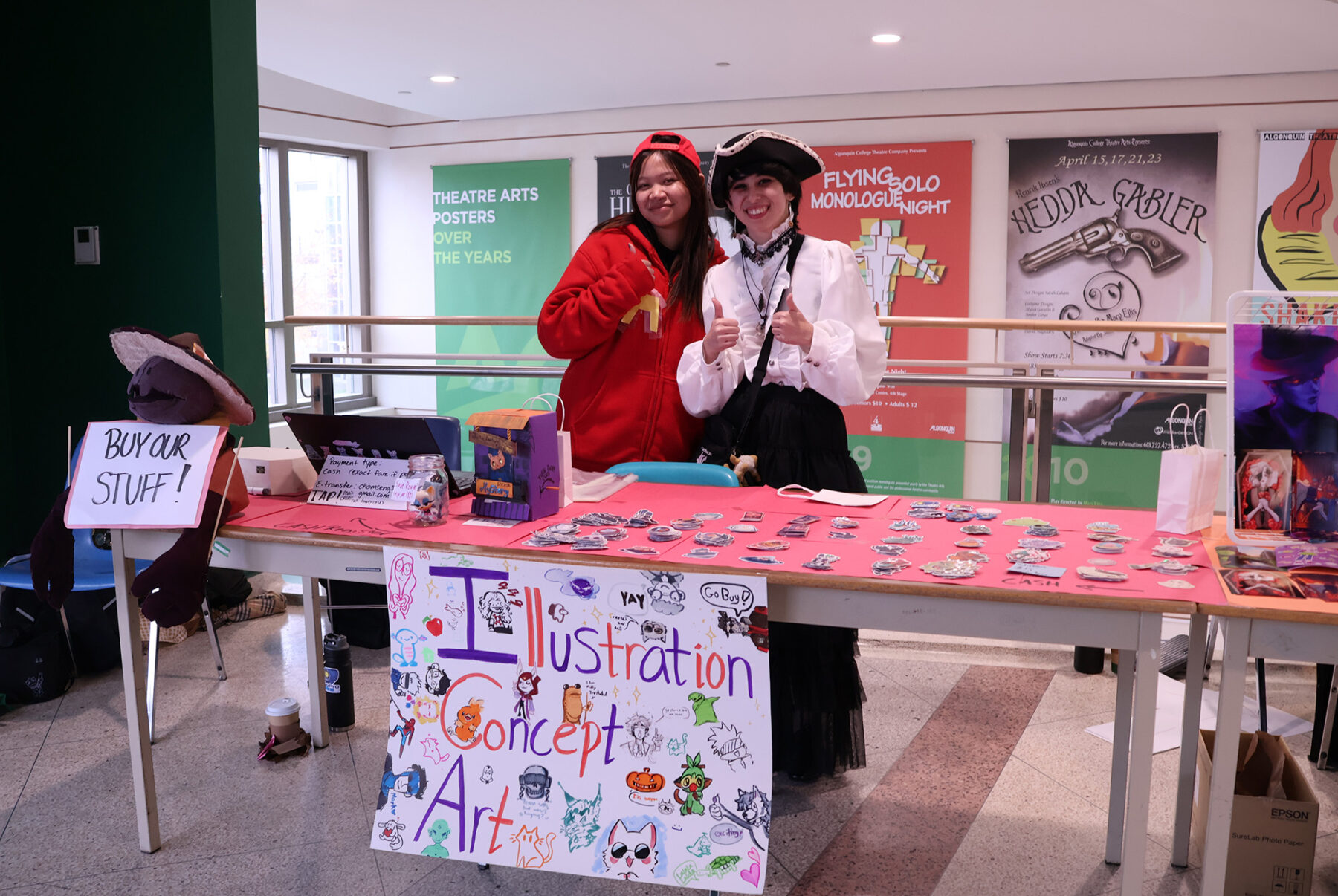
Sabella Chomseng (left) and Dustin Larocque wore costumes the day before Halloween at their fundraiser.

Sabella Chomseng enrolled in the illustration and concept art program to pursue a career creating art — something she’s passionate about.

“I like illustration (and) concept art because you get a lot of freedom of doing different types of things like media and digital media, with drawing,” said Chomseng, a program representative. “I feel like it’s very versatile and I really wanted to do something in the future to help me do something fun, like go into a studio or maybe freelance.”

On Oct. 30, two of her designs were displayed on a table in a fundraiser for the program, among the work of her classmates.

Sabella Chomseng holds up two of her prints for sale: an original piece and one inspired by KPop Demon Hunters.
Sabella Chomseng holds up two of her prints for sale: an original piece and one inspired by KPop Demon Hunters. Photo credit: Kendra Mendrisky

From 8:30 a.m. to 5:30 p.m., the first-year students sold stickers, prints and paintings in J-building to raise money for their 2027 graduation showcase.

In past years, the Algonquin SA covered the cost of the showcase through employer networking funding, according to Rich Lauzon, the program’s previous coordinator.

This year, students must raise the money to pay for it themselves in the absence of the employer networking fund.

In a written statement, the SA said, “The Algonquin Students’ Association reviewed our model and process for supporting grad funding and employer networking funding. This review led to the creation of the Student Leadership and Activities Fund, which is broader in scope and focused on providing financial support for academic and co-curricular projects that enrich student life on campus.”

According to the SA, “a grad show would potentially qualify for some funding if it meets the Fund’s eligibility criteria,” which includes events, activities, and initiatives that foster engagement, community, and learning within students’ programs.

The cost of the showcase has not yet been determined.

Students sold stickers for $5 and prints for $10 and $15, with bundle deals available for multiple pieces on Oct. 30.
Students sold stickers for $5 and prints for $10 and $15, with bundle deals available for multiple pieces on Oct. 30. Photo credit: Kendra Mendrisky

Dustin Larocque, who is a first-year program representative alongside Chomseng, was pleased with the fundraiser.

“It pretty much meets the expectations, maybe even exceeds (them) a little bit,” said Larocque. “You do these things (and) you’re worried about who’s going to show up, if it’s going to actually work. But so far, we’ve been getting a lot of support.”

He said the group raised “about $1,335.”

Second–year students held a fundraiser on Halloween for their showcase taking place April 15, 2026, which gives students the opportunity to connect with people in the industry and create art books as a way to share their portfolios.

Chris Dainty, the current program coordinator, praised the student-led fundraisers and looks forward to the showcases.

“One of my big things that I’m going to be promoting is (sending) these books out to people,” said Dainty. “We want to try and get as many people to come as possible.”

Firefighting students at Algonquin College light the way in community safety event

Students in the pre-service firefighter program take their expertise beyond the classroom
Photo: Bradley Richards
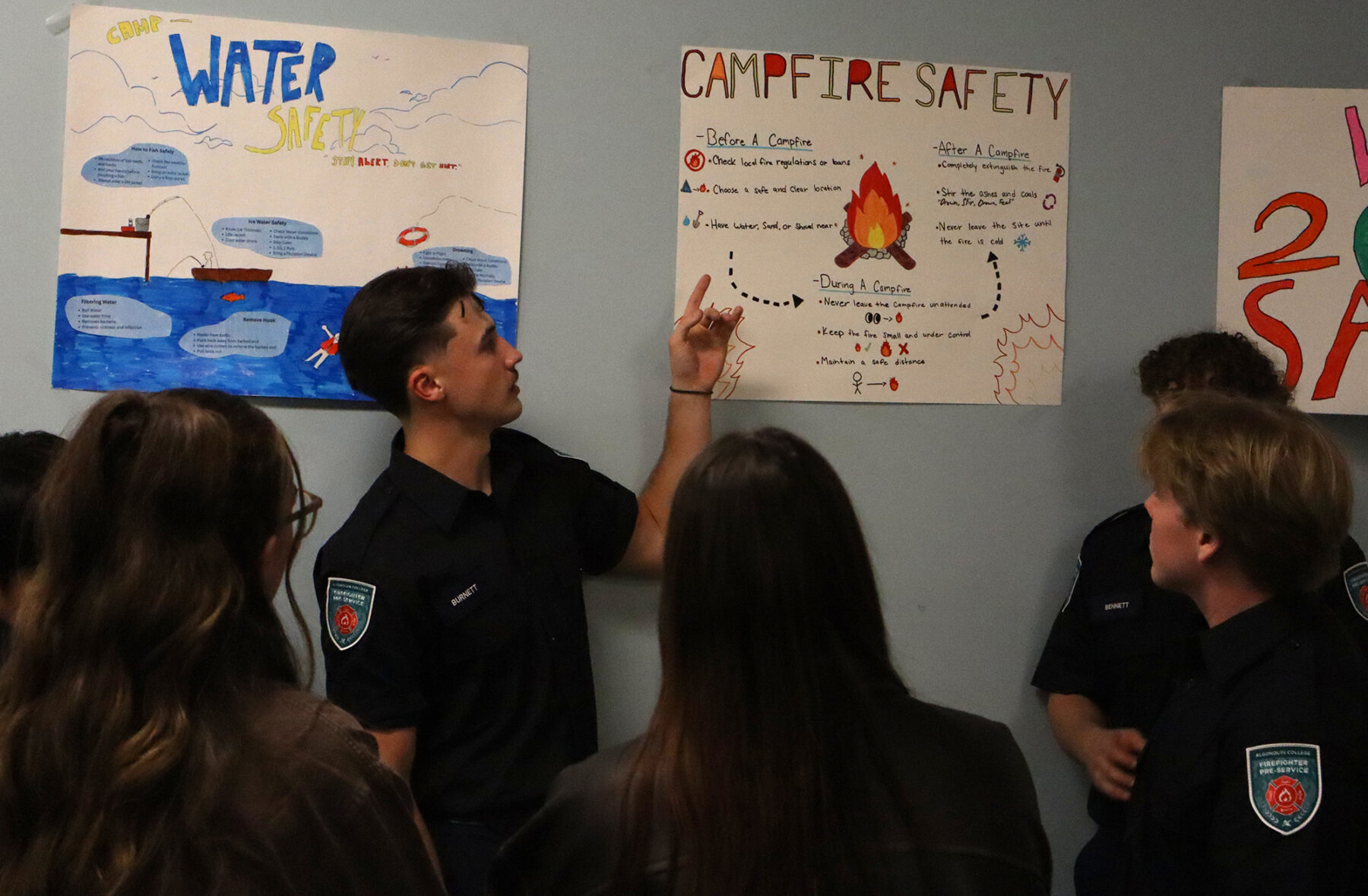
A student at the camp safety booth giving a presentation on campfire safety to attendees of the event.

Stop, drop and listen.

Did you know that fireworks can hit 150 decibels when exploding — loud enough to cause immediate ear damage if you’re too close?

Or that Narcan is available for free at pharmacies? That’s good to know in case you ever face the nightmare of finding someone unresponsive from an opioid overdose.

But wait — would you recognize the signs of a potential opioid overdose if you saw them?

If you attended the Community Risk Reduction Show, hosted by pre-service firefighter education and training students on Nov. 3, you’d know all of this and much more.

The educational event was open to the public and saw a variety of interactive booths covering everything from forest fire prevention and lithium-ion battery safety, to mental health awareness among first responders.

Participants could even win a piece of candy by answering questions about what people learned throughout the night, which transformed the informative event into a safety trivia showdown.

Three of the students standing at their booth focused on mental health awareness of first responders.
Three of the students standing at their booth focused on mental health awareness of first responders. Photo credit: Bradley Richards

“Lithium-ion batteries are actually the most common rechargeable batteries found in Canadian households,” said Ben Gates, a student at the battery safety booth. “They’re a very dangerous technology because they are so easily damaged by things such as water.”

Although it may not sound like much, lithium-ion batteries can burn at 1,000 degrees Celsius and they are the leading cause of dump fires in North America.

Maybe you already knew that. But how’s your knowledge of personal protective equipment (PPE) in sports?

“It’s better to have more gear than not enough,” said Andy Lighte-blais, one of the students at the PPE booth. “And if you didn’t know, hockey helmets actually have an expiry date on them.”

Sure enough, a small sticker on the back of the helmets will tell you when the trusty bucket should be set aside for good. The helmet on display showed it was only good until 2029.

At another booth, students gave an example of a 72-hour emergency safety kit for natural disasters. Essential items such as water filters, portable batteries and non-perishable food were on the list. But there were other items people might not have expected, like a portable radio.

Students at the Community Risk Reduction Show running the 72-hour emergency safety kit booth.
Students at the Community Risk Reduction Show running the 72-hour emergency safety kit booth. Photo credit: Bradley Richards

“You don’t know if the phone lines might go down,” said student Liam Suzuki. “You still need to establish communication. That’s the key.”

And that’s not all. Suzuki and his team also recommended reflective vests for emergencies like ice storms.

“It’s a low visibility situation and you want to be seen so you don’t get hit by a car,” said Suzuki.

The event was a mixture of important safety facts and interactive learning. And while some topics such as fire hazards and addiction were frightening to hear about, the warm atmosphere created by the students transformed safety education into something welcoming to those who attended.

It was more than just teaching others how to stay safe. For the future firefighters, this was a chance to practise what community service is all about.

Algonquin College CJS students raise nearly $5,000 for Operation Come Home

Professor Cat Baron believes this experience allows the students to gain a small perspective on being a marginalized person
Photo: Photo provided by Cat Baron
Students of the CJS program in Minto Park on the following day, Oct. 18, during the 24-hour homelessness event.

Students of the community and justice services program camped outside for 24 hours between Oct. 17 and 18, raising nearly $5,000 during an event held annually to draw awareness to at-risk youth in Ottawa.

Algonquin College CJS students work closely with Operation Come Home, where they complete placements and seek work following graduation. Located on Gloucester Street, the centre serves homeless or at-risk youth and offers employment, education, hot meals and support services.

CJS professor Cat Baron has been teaching students about the criminal justice system, ethics, mental illness and corrections since 2006. Many of her students voluntarily wanted to camp out after being inspired by a guest presentation

“Operation Come Home came to school, told the students about the initiative where they raise money and camp out,” says Baron. “Some of the students were like, ‘I wanna do that. Can we do our own?’ The staff were like, ‘yeah give me a date and time and I’ll meet you downtown’.”

Operation Come Home, previously known as Operation Go Home, was launched in 1971 by Rev. Norman Johnston, who realized there was a need to assist runaway youth across the country.

After 14 years, CJS students raised over $70,000 for Operation Come Home.

Sixty-five per cent of the funds go to support homeless and at-risk youth every year, and 35 per cent of the funds go to the CJS program bursary to help students in financial need, as students attending school also experience homelessness.

The students who camp don’t bring any food or water. They solely rely on donations.

Haileigh Dyke, CJS student, jumped at the opportunity when offered to camp out, but admitted she felt tested.

“In the beginning, the weather was good, we were excited. The donations were coming in, but as the day progressed, it got dark, wet, rainy,” says Dyke. “Some individuals weren’t very nice to us, it started to get miserable, and we were like okay, this is starting to get serious. This is not fun anymore.”

Students truly had a taste of what living on the street is like.

“We can learn in a classroom with a screen and books any day, but to actually go out and try to experience what these individuals are going through, you learn more than what a textbook could ever do,” says Dyke.

The students experienced getting robbed, ignored and rejected. Still, their support for one another and optimism helped them navigate every emotion.

“Drunk kids coming out of the bar threw up on our sidewalk, we were like wow, some individuals experience this 10 times worse than we did and now we have an understanding,” says Dyke. “Something would come up, some people were starting to get a little wary so we would all try to talk to each other and debrief.”

Alyssa Mccoshen, a CJS student who also participated in the event, admired everyone’s resilience.

“I got there at about 6 o’clock in the morning on Saturday because I had family plans the night before, and it was weird. Some people were sleeping, but everyone else seemed in really high spirits,” says Mccoshen. “From what I’ve heard, people had so many different experiences. I think that the differences between the classmates have a lot of different outcomes in terms of race or what people look like.”

Following a press conference last September, Mayor Mark Sutcliffe announced a series of investments in prevention and diversion tasks. They are underway to end youth homelessness in Ottawa by 2030.

“The mayor’s office is so fascinated with the initiative, they asked us to visit. The Board of Governors, my chair, nominated the students for a Board of Governors Student ChangeMaker Award, so they’re presenting to the Board of Governors in December,” says Baron.

Donations are still being collected. If you’re feeling generous, you can donate here.

Supporters can still donate to the Operation Come Home's GoFundMe page.
Supporters can still donate to the Operation Come Home's GoFundMe page. Photo credit: Janella Milord Ashford

MMA ignites the Algonquin College Commons Theatre

Future Fight League hosted an MMA event at Algonquin Commons Theatre on Nov. 2
Photo: Matthew Grieve
Winged C and Nickita Darii face off in the ring at Algonquin Collegeโ€™s Commons Theatre during an event hosted by Future Fight League on Nov. 2.

The Algonquin Commons Theatre turned into an octagon of chaos on Nov. 2 as the audience gathered for an intense night of MMA action.

Organized by Future Fight League (FFL), the event aimed to bring real and high-energy combat to the college, giving local fighters, including those from Ottawa, Quebec and Toronto, a stage to showcase their skills.

The ring located at Algonquin College's Communs Theater. Nov. 2
The MMA ring set up inside Algonquin Collegeโ€™s Commons Theatre on Nov. 2 before the start of the Future Fight League event. Photo credit: Matthew Grieve

The main event of the night was Malcolm Schuyler, known in the ring as Winged C, and Nickita Darii.

Fighting out of the blue corner and weighing in at 145 pounds with an amateur record of seven wins and zero losses was Darii. Ranked number one as an amateur fighter, he is Romanian and lives in Montreal.

Nickita Darii about to walk into the ring. Nov 2
Nickita Darii prepares to enter the ring at Algonquin Collegeโ€™s Commons Theatre on Nov. 2. Photo credit: Matthew Grieve

In the other corner, weighing in at 136 pounds with an amateur record of five wins and one loss, was Winged C. This fighter flew from Lancaster, Pa.

Winged C about to walk into the ring. Nov.2
Winged C prepares to enter the ring at Algonquin Collegeโ€™s Commons Theatre on Nov. 2. Photo credit: Matthew Grieve

With months of training leading up to this fight, it was anyone’s guess who would win.

Before the match, Darii alluded to what fans would see that night.

“People can expect beautiful violence. I’ll show that there are levels to this game,” said Darii.

Nickita Darii kicking Winged C in the face
Nickita Darii lands a kick to Winged Cโ€™s face during their match at Algonquin Collegeโ€™s Commons Theatre on Nov. 2. Photo credit: Matthew Grieve

As the match date drew closer, nervousness began to creep in. Instead of letting the fear take control, Darii chose to face it head-on.

“The best way to get rid of the demons chasing you is to stop and turn around, face your fears and use them as fuel,” said Darii. “Don’t let fear stop you from doing what you want. At the end of the day, without fear, there’s no bravery.”

As fighters walked into the ring, Winged C set the mood for the audience with a quick dance to his anthem Golden from KPop Demon Hunters. As the match started and blows were exchanged, the crowd’s chants engulfed the theatre as Darii landed sharp kicks to Winged C’s face.

Each fighter had his name chanted through the rounds. Darii and Winged C fought with opposite energy during the match. Darii was focused on giving hard kicks to his opponent, while Winged C was taunting Darii with dance moves and gestures, often looking at the crowd during the fight.

Winged C taunting Darii during the fight
Winged C taunts Nickita Darii during their match at Algonquin Collegeโ€™s Commons Theatre on Nov. 2. Photo credit: Matthew Grieve

As the judges cast their votes, Winged C was crowned the winner of the match, securing another hard-fought victory to add to his record.

Winged C winning at Algonquin College Commun Theater
Winged C wins his match during the Future Fight League event at Algonquin Collegeโ€™s Commons Theatre, Nov. 2. Photo credit: Matthew Grieve

The audience felt Winged C’s aura as he gave a playful post-fight interview with a monologue inspired by the 2020 anime Jujutsu Kaisen with expressive gestures as he spoke.

“So this guy was really hard,” said Winged C about his opponent. “I’ve never been kicked in the face like that…but it’s my first time out of the country. I had to perform for y’all.”

Does AI have a place in music?

Professor and program coordinator Colin Mills says music industry leaders are still waiting to see how AI will impact jobs in the field
Photo: Janella Milord Ashford
Xania Monet is the first ever AI artist to appear on the Billboard airplay chart.

Music industry arts student Thomas Burr laughed when he first heard you could make music using artificial intelligence.

“No way people are bumping AI music,” says Burr. “Music is about the feeling, it’s about the human connection.”

On the other hand, music industry arts program coordinator and professor Colin Mills says AI can be a useful tool for the industry.

Music industry arts professor Jason Jaknunas teaching a class in the N building's music studio. Mills says they have some some plug-ins in the recording studio that have some AI elements to facilitate music production.
Music industry arts professor Jason Jaknunas teaching a class in the N-building's music studio. Plugins in the recording studio with some AI elements to facilitate music production are now available. Photo credit: Janella Milord Ashford

“I think it’s a valuable tool to use in music production and even in marketing, you can create some assets,” says Mills. “It can be very beneficial, at least to spark some ideas that someone might not be able to think of on their own.”

AI artist Xania Monet is the project of a Mississippi poet and design-studio owner, Telisha Jones, who used Suno to turn her lyrics into music. Monet just signed a $3-million record deal with Hallwood Media and released an album on all platforms, sitting at over 17 million streams.

The news has creatives wondering whether this was a loophole for record labels to make more money.

Burr says the AI program appropriates vocals and sounds from a library database that holds songs created by artists all over the world.

“A lot of our students that are songwriters and producers want to make sure that AI isn’t going to take materials that they put out there, and use it for something new that they’re not going be compensated for or connected to in any way, and that’s the big concern,” says Mills.

“Labels will start prioritizing AI artists because the rich are money hungry and they always choose the easiest option,” says Burr. “Not the option that supports the artists.”

Mills says it’s still a give-and-take situation.

“There’s going be some companies out there who realize, ‘We can create our own content and control everything and own everything and put it out there and not have to pay someone’, but they’re still paying staff to do that,” says Mills.

Juno Award-winning songwriter and producer Daniel “GoldStripes” Desir is exploring a trial run of Suno himself.

Music producer Triston "TD Smoove" Douglas, working with his beat machine.
Music producer Triston "TD Smoove" Douglas, works with his beat machine. Photo credit: Janella Milord Ashford

“Recently I started experimenting with Suno just to see what power it has,” says Desir. “I’m not afraid that it’s going be able to copy me ever, and if it does, that means I made it.”

The use of AI in any field right now has the world divided.

“It’s going get a lot harder to make it big because the industry will become so saturated with AI music that is then going to inspire more AI music,” says Burr. “We need to continue to push for supporting artists and continue to push for real good music.”

But music industry experts are not intimidated by AI — they are actually embracing it.

“I think AI is going to have its place. I don’t think AI artists are going to replace other artists,” says Mills.

As a creative, Desir believes you must use the tools at your disposal and ignore the outside perspectives of what may be right or wrong. He believes that using AI to help curate art does not take away from the artist.

“At the end of the day, we hear something, it inspires us, and we keep going. Maybe AI is just a tool to allow us to hear and open up our mind a bit more,” says Desir.

Students bring Halloween indoors with pumpkin carving at Algonquin College

The smell of pumpkin filled the air inside the Student Commons on Oct. 30 as students carved their way into the Halloween spirit
Photo: Ana Silva
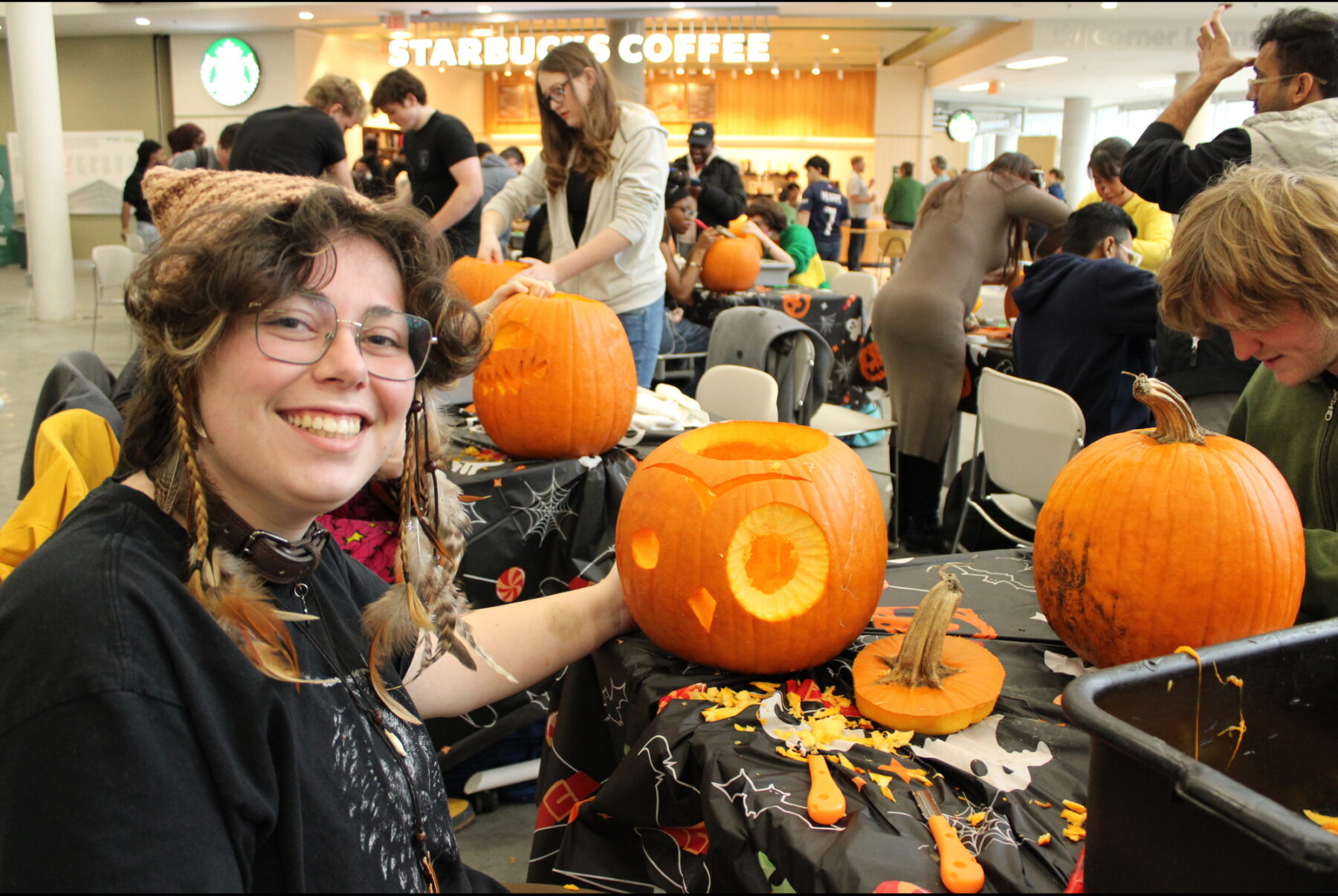
Sparrow Kaye shows off their almost finished pumpkin in the Student Commons on Oct. 30.

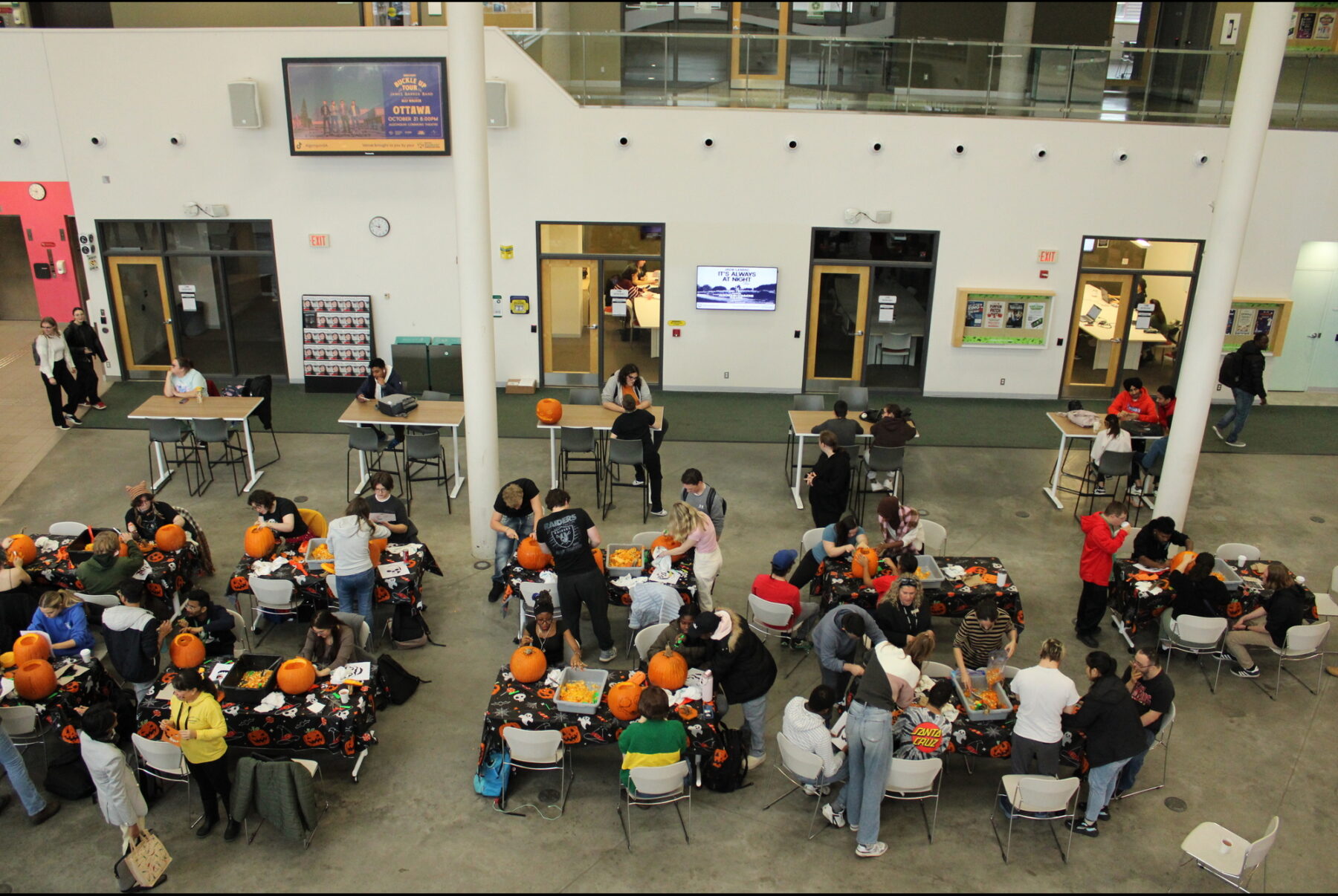
The Student Commons vibrated with spooky music, laughter and had an aroma of pumpkin guts as the Students’ Association hosted the Pumpkin Patch Party on Oct. 30.

The event, originally planned for the front lawn, moved indoors due to the rainy weather. Even with the change, more than 80 students took part, filling the room with the sounds of knives carving and a sweet chocolate smell.

Nine tables were spread out with carving tools and each had a bin for people to scoop out and dump their pumpkin insides. Students could sit with friends or join new tables to carve alongside others.

Halloween music played in the background, featuring classics like Monster Mash and This Is Halloween. Hot chocolate was served to keep everyone warm and cozy while they worked on their creations.

The Student Commons was packed with students enjoying the Pumpkin Patch Party on Oct. 30.
The Student Commons was packed with students enjoying the Pumpkin Patch Party on Oct. 30. Photo credit: Ana Silva

Sparrow Kaye, a horticultural industries student, carved an owl design.

“I’m carving a little owl in my pumpkin because they’re my favourite animal,” Kaye said. “It’s definitely messier than I expected. It’s also been a while since I’ve carved pumpkins, but I’m having a great time, 10 out of 10.”

Specter Aubin, from design foundations, went for a spooky look.

“I’m carving a really creepy monster,” Aubin said. “I didn’t plan it out too much. I just started carving and went with the flow. I’m leaving it for the contest.”

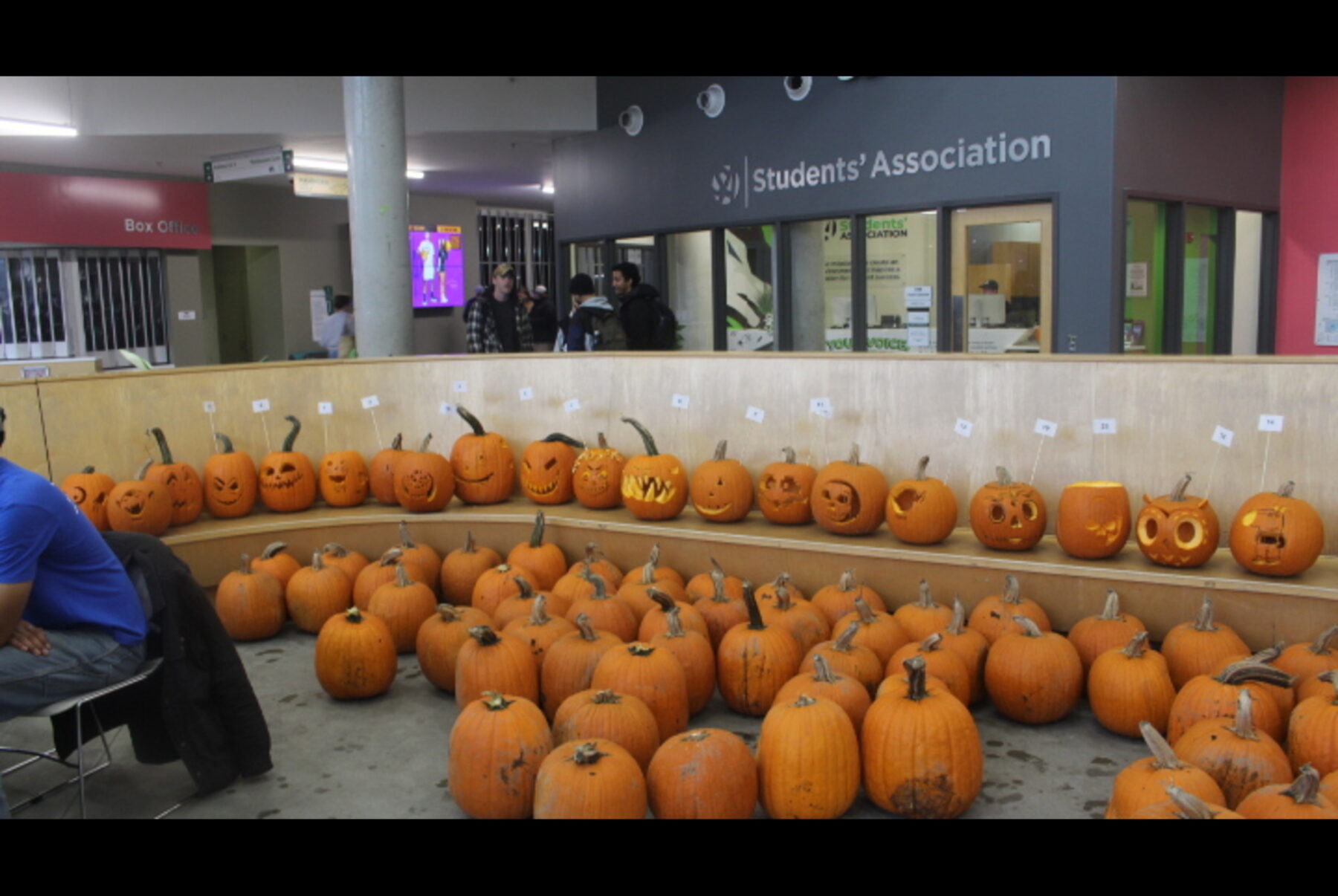
Students had the option to leave their pumpkins behind and have them entered into the jack-o’-lantern contest on Oct. 31.

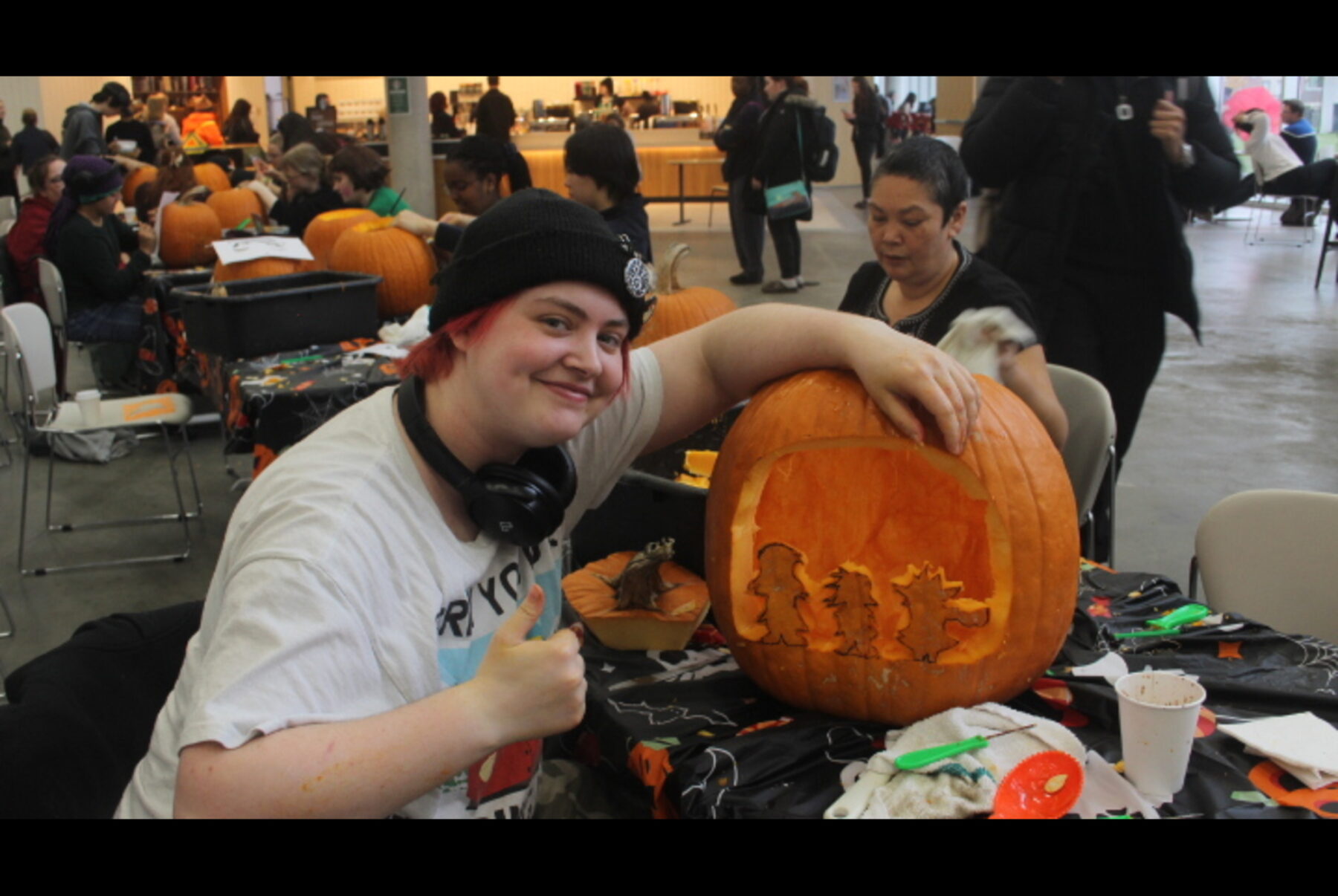
Film student Luca Arnold took inspiration from a video game.

“I’m carving the fountain in Deltarune and the three main characters,” Arnold said. “There’s this pumpkin game by the developers of A Short Hike and it gave me the idea. I came in planning to win. I hope to win.”

Luca Arnold poses for a photo after adding some finishing details to their Deltarune pumpkin carving in the Student Commons on Oct. 30.
Luca Arnold poses with their Deltarune-inspired pumpkin after adding the finishing touches in the Student Commons on Oct. 30. Photo credit: Ana Silva

According to SA coordinator Alain Cyr-Russo, this is the third year the event has been held.

“We’ve been watching the weather for a week,” Cyr-Russo said. “Normally, this event is held outside, but we moved it inside this year. We had over 80 students take part in our pumpkin patch party, and 38 entered the contest.”

More than 30 pumpkins were left to be entered in the contest on Friday, Oct. 31, after the event in the Student Commons on Oct. 30.
More than 30 pumpkins were left to be entered in the contest on Oct. 31, after the event in the Student Commons on Oct. 30. Photo credit: Ana Silva

After the contest, the leftover pumpkins were sent to be composted through the Tomlinson Group, while the pumpkin insides were sent to the Wolves Den’s compost program.

Whether they carved owls, monsters or video game fountains, students left the event smiling, pumpkins in hand and ready for sugar and pumpkin spice and all things nice.

Rage and reason: Tom Morello’s intimate Ottawa evening

Guitar legend Tom Morello fused personal stories with political anthems in a solo show at Meridian Theatres at Centrepointe on Oct. 29
Photo: Jackie Beeston
Tom Morello jamming out "One Man Revolution" in Ottawa on Oct 29.

Tom Morello celebrated Halloween by going from rock god to storyteller on Oct. 29, trading arena-sized fury for intimate theatre acoustics in a performance that bridged generations of fans at Meridian Theatres at Centrepointe.

The guitarist is well-known for his roles in Rage Against the Machine and Audioslave.

Morello presented his Night of Stories & Music to a sold-out crowd, blending personal anecdotes with the political fire that has defined his four-decade career.

For many in attendance, the evening offered both validation and a call to action amid current global tensions.

“I’ve been listening to Rage Against the Machine since I was a kid,” said fan Tracy Ludmer. “He speaks to me because he scratches that part of my brain that needs to be validated with everything going on in the world right now.”

Tracy (L) and Maeve posing for a photo before experiencing the show
Tracy (left) and Maeve (right) Ludmer posing for a photo before the show. Photo credit: Jackie Beeston

The sentiment was echoed by her daughter Maeve Ludmer, who admired Morello’s unwavering stance. “He’s so outspoken and unabashedly unspoken,” she said. “He talks about hard conversations because he knows it’s the right thing to do.”

For older concertgoers like Bob Godwin, Morello represents a continuation of music’s protest tradition. “Music and politics have always been linked,” said Godwin. He prefers smaller venues like Centrepointe these days. “I grew up in the ’60s and ’70s, and those were very political times musically.”

Bob Godwin (left) and his wife (right) attending the show
Bob Godwin and his wife attending the show. Photo credit: Jackie Beeston

On stage, Morello traced his journey from being “the only brown kid” in Libertyville, Ill., to studying at Harvard University and eventually to rock stardom.

He credited his mother, activist Mary Morello, as his foundational influence, while demonstrating how he developed his signature “DJ as guitarist” approach using ordinary pedals to create extraordinary sounds.

“If I ever made a mistake on the guitar, I would play it plenty of times until it sounded right. It was my way of making my guitar my own,” said Morello on stage.

He also mentioned the role his absent father, Ngethe Njoroge, a Kenyan journalist and diplomat, played in his life. Despite never hearing his son pluck a note on a guitar, Morello credits his father for instilling in him his anti-authoritarian views on stage. Njoroge was involved in the Mau Mau Uprising for Kenyan independence (1952–1960).

The format of the show allowed for both quiet reflection and blistering intensity as Morello built complex arrangements alone on stage. Stories about political awakening flowed seamlessly into solo versions of One Man Revolution and Killing in the Name, each anecdote providing context for the fury that followed.

Throughout the evening, Morello returned to his concept of the guitar as a “weapon” — not of violence, but of truth and justice.

For the diverse audience of longtime fans and new adherents, the message resonated across generational lines, proving that protest music remains as relevant as ever in challenging times.

Algonquin Times podcast

Stay Informed

Sign up for our newsletter

Subscribe

* indicates required