A huge crowd gathers in front of Parliament Hill to march through downtown Ottawa in support of Black Lives Matter.
Thousands of people gathered in downtown Ottawa Friday to support the growing movement against police brutality, shouting their demands to end racism in Canada.
Protesters held up signs declaring “Black Lives Matter” and also called for a decrease in funding for police in Canada.
No Peace Until Justice organized Ottawa’s protest, which started at Parliament Hill and marched down to the human rights monument on Elgin Street.
A sign calls the defunding of police Photo credit: Kristy Jones
“There have been recent announcements from our government officials discussing the defunding of the Ottawa Police Services. Although this is encouraging to hear, we continue to make the voices of the black people amplified. This shows change is coming. This is encouraging to hear but it does not end here. The voices of the black community need to be heard,” said Sameha Ahmed, the founder of No Peace Until Justice, when she spoke at the protest.
Sameha Ahmed speaks to the crowd on Parliament Hill on June 5 Photo credit: Kristy Jones
Tributes were made at the protest for George Floyd who died on May 25, after a Minneapolis police officer held his knee on Floyd’s neck. Floyd’s death was a significant trigger for people of colour and allies, who said enough is enough.
“I can’t breathe. You’re gonna kill me. How many of these words are we going to hear? How many black lives?” Yvette Ashiri, a member of the African Canadian Association, told the crowd.
Members of No Peace Until Justice and protesters urge Canadians to wake up and see the problems in their own backyard. This is not just America’s issue, it exists in Canada too, they said.
Demonstrator walks through crowd with a sign reading "It happens here too". Photo credit: Kristy Jones
“Millions across the globe are embarking on a conscious journey, a realization, that anti-black racism is real. That police brutality is real. That systemic racism is real, and it is real in Canada. Canada wake up,” said Farhia Ahmed, chairperson of the Justice for Abdirahman Coalition.
Abdirahaman Abdi, 37, a Somali Canadian, was killed during an altercation with Ottawa police in 2016.
Many protesters Friday said they are fighting for accountability for not only the murder of Floyd, but all the black lives taken by police officers.
Many protesters held up signs that voiced their fear for the children, such as “Our kids are NOT a target,” and “It saddens me that I will need to teach my kids to brave through discrimination.”
“We’re gonna have to raise children that they’re going to have to coexist with people that treat them differently because they are different. It’s really the time for action for the future. I know I’ll have to educate my children on discrimination, but why do I have to?” said a protester who chose to not share their name for safety reasons.
Those who attended the protest all had the same goal, to achieve equality. They demanded change from the government and the Ottawa police.
“Change has to come, these changes require concrete actions from our government and changes to be made to end anti-black racism. These emotions of despair do not have to be experienced again, let us use today to make a crucial call to action,” Sameha Ahmed said.
Prime Minister Justin Trudeau also briefly attended the event. Trudeau was accompanied by Ahmed Hussen, minister of Families, Children and Social Development.
Teachers and students throughout Ottawa helped create a guide to staying on point
Chance Hawthorn
Photos:
June 7, 2020 Revised: June 7, 2020 12:47pm
With so many textbooks and notes to keep track of, staying organized can be difficult.
With Algonquin College and other schools closed due to Covid-19, students have had to go online for education. Students and teachers at Algonquin College and Carleton University have had to find ways to help stay focused in those online classes.
One way to maintain focus is buying items to help keep track of all the assignments due and help people who need a way to organize the flood of work and due dates.
“I have a small whiteboard in my room that I just bought from the dollar store. I write all my homework for each class and when it’s due. That way I can prioritize what needs to be done first along with helping me figure out how much time I can dedicate to each assignment,” says Lila Bajraktari, an art student at Algonquin College who had live online classes in the winter 2020 semester.
Getting advice from teachers on how to stay focused can also help students in not just that specific class, but other classes as well.
Mathew Roloson, an engineering geosciences teacher at Carleton University said:”I sit down for two hours every morning with noise cancelling headphones. You don’t need those of course, but I plan out my entire day from 9 a.m. to 11 at night.”
“I like to make plans in half an hour blocks so if something took an hour and a half, I would give it three blocks,” Roloson said.
Gabrielle Bruneau, a psychology student at Carleton, shared a list of ideas on how to stay focused and her regimen for keeping on track when it came to recorded classes:
· Take breaks
· Do a few smaller tasks and then anything more demanding
· Watch the first half hour then take a 15-minute break (works for homework, too)
· Don’t take two-hour breaks
· Don’t write-off anything as useless in your classes
· Find out what time you operate the best at, daytime or nighttime
· Get in touch with classmates
· Be responsible to watch your classes on your own
· Get in touch with the necessary staff that can help plan a schedule with you or find other ways to stay focused.
Hundreds of trade students are missing the opportunity to advance in their careers financially and professionally. On March 17, test centres were forced to close because they were deemed non-essential. […]
Jocelyn Galloway
Photos:
June 7, 2020 Revised: June 7, 2020 12:39pm
Trade students are having a difficult time keeping up with their studies since returning to work.
Hundreds of trade students are missing the opportunity to advance in their careers financially and professionally.
On March 17, test centres were forced to close because they were deemed non-essential. The test centres administer the government certificate of qualification exam for the Red Seal trade programs.
The six offices in the Ontario Eastern region have approximately 360 clients waiting to write their exams, according to Janet Deline, Ministry spokesperson. The six eastern offices are located in Ottawa, Kingston, Cornwall, Belleville, Peterborough and Pembroke.
The Ministry of Labour, Training and Skills Development Ottawa test centre is located at 347 Preston Street, Suite 310.
Shaun Barr, chairman of construction trades and building systems at Algonquin College, said he has been talking with the Ministry of Labour.
“I have offered our space for them, when we get them back, to increase the amount of exams we can do. They like that idea, but they have to go up the chain of command to get an answer,” said Barr.
The government exam is the last step for trade students. After students pass, they receive their journeyperson status and federal Red Seal certificate. The Red Seal certification means individuals are recognized as licensed in their trade all across Canada.
“The ministry is looking at all appropriate options for hosting certificate of qualification exams once local offices are reopened and safety protocols are in place to protect Ontarians,” Deline said in an email.
An electrician trade student, who asked to remain nameless for fear of repercussions at work, said his group completed Algonquin College’s apprenticeship program and is now waiting to write the government exam.
“Luckily we finished. We wrote our last [school] exams before the college got shut down,” he said.
After five years of accumulating 9,000 hours of trade time, he said it has been disappointing to not be able to finish.
“Unfortunately, no raise and that’s the frustrating thing right now… but it’s a small thing compared to what some people have to go through, not being able to work at all. I just feel lucky that I’m at least working,” he said referring to those who have been laid off during the COVID-19 pandemic.
Trade students who complete and pass their government exam are eligible to receive the $2,000 Apprenticeship Completion Grant through the Government of Canada.
He said students will receive a $5 to $6 raise per hour once they pass the government exam. The average electrician’s wage in Ottawa is $34.24, according to Indeed, an online job site.
The electrician student said he has been working since finishing the program at Algonquin College. His workplace is considered essential.
“I honestly haven’t been studying at all anymore. I was. I have this app… I’ve been kind of doing that on and off but recently not as much. Just been busy with work,” he said.
In order for students to pass the government exam, they are required to achieve a 70 per cent or higher. If a student fails the exam two times, they will be asked to provide the Ontario College of Trades proof of upgrading before being allowed to try again. This proof is examined on a case to case basis.
Barr said the faculty is keeping study material available for students to access during this period of waiting. He said if there are any students struggling, he encourages them to reach out for help.
All apprentices, under normal circumstances, have one year to write the government exam after they complete their schooling and trade hours. Recently, the Ministry of Labour changed the timeframe regulation.
“Journeyperson candidates whose status is expiring soon, or has already expired, may have their status extended by 120 days. This extension would also apply to those whose certificates and memberships expired between March 18, 2020 and Sept. 18, 2020,” said Deline.
The extension allows those who are affected by the closure to have more time and gives them the ability to continue working legally in their trade, according to Deline.
“The trades will overcome. They will adapt. We always do,” said Barr.
The name of the sports teams at Algonquin College is changing from the Thunder to the Wolves.
Frankie Benvenuti
Photos: Frankie Benvenuti
June 3, 2020 Revised: June 3, 2020 2:39pm
Photo: Frankie Benvenuti
Picture of the Algonquin soccer field during the COVID-19 pandemic, taken by Frankie Benvenuti
While Algonquin will play under the Thunder name for the 2020-21 season for its sports, a name change is coming.
On April 2, the Algonquin College Students’ Association announced the new name will be the Algonquin Wolves.
“The SA held a college-wide survey to gauge the community’s preference for a name and narrative that would establish an Algonquin College identity, and not just a varsity athletic identity,” said the SA in a news release.
“Survey results . . . showed that Thunder received the majority of votes by a slim margin, but that more students in total voted for some version of Wolves,” said the SA.
“Other considerations included the feedback received through Board linkage with students, the values expressed in the narratives for Thunder and Wolves, the marketability of the name and the ability to establish an identity on all campuses of Algonquin College,” said the SA.
When the poll was conducted in October 2019, a mix of current students, staff, and alumni were polled. They were presented with four options, Thunder, Wolves, Grey Wolves and Good Wolves.
Thunder won the poll with 49 per cent of the votes, but 51 per cent of those polled voted for names that included the word ‘Wolves’. From there, it was decided that the name should be changed to Wolves despite the outcome of the poll.
Despite the vote taking place and the college considering people’s opinions, many people are still unhappy with the name change.
“I’m personally not the biggest fan of the name change. I think the whole college community really rallies behind the Thunder name and it’s a bit of a shame to see them changing it,” said Connor Thompson, an Algonquin graduate.
Many students and alumni are against this move. There was a petition created on change.org that you can find here. As of May 31, 2020, it has received 1,918 signatures.
“This does not make any sense at all. Many people participated in this survey in good faith and have the expectation that the SA would respect the results. If not, why bother having a survey in the first place,” says the petition.
Others are taking the name and looking for a deeper meaning.
“Maybe the college wants to represent dominance. Wolves are at the top of the food chain, and something like that is a threat to other teams. The name makes sense because thunder is something that can’t be controlled and occurs randomly. On the other hand, wolves are organized and are stronger in a group,” said Tod Davaakhuu, a former student at Algonquin.
The name change will take effect for the 2021 seasons to coincide with the opening of the new athletic centre being built on the Algonquin campus. It is currently unclear when live sports will resume because of the Cover-19 pandemic.
International News BBC – Tensions between civilians and law enforcement have been fraught in the U.S. following the death of George Floyd, an African American man who was killed while […]
Kaeli Cheng
Photos:
June 2, 2020 Revised: June 4, 2020 12:47am
International News
BBC – Tensions between civilians and law enforcement have been fraught in the U.S. following the death of George Floyd, an African American man who was killed while in police custody. Protests began in Minneapolis on May 26, 2020, resulting in the arrest of police officer Derek Chauvin after three days. By the sixth night, protests spread to New York, Chicago, Philadelphia, and LA, with many instances of violence as riot police attempted to disperse crowds using tear gas and rubber bullets.
Where once streets were deserted due to concerns of COVID-19, demonstrators are now gathered in large crowds across more than 75 cities to protest in the name of George Floyd.
CBC – After a decade of no launches, NASA has teamed up with Elon Musk’s company SpaceX to launch the SpaceX built rocket ship into space.
For the first time ever, a private company sent a rocket into space. This was formerly only achieved by three countries (U.S.A., Russia, and China).
The rocket was successfully launched at 3:22 p.m. without issue using the same launch pad used to send the Apollo 11 mission to space half a century ago.
Local News
Global News – City council has approved the proposed urban boundary expansion – in the next 25 years, Ottawa will grow by almost 1,300 hectares in a bid to satiate rising housing demands. The vote, which concluded following 100 virtual delegations and 27 hours of debate over the long standing, contentious issue, came with a result of 15 – 6.
Those who voted “nay” wanted to fulfill Ottawa’s need to house an extra 400,000 residents over the following 25 years exclusively through infill development. Conversely, the “yays” voted to see the amount of buildable land in Ottawa increase by 1,350 – 1650 hectares by 2046.
Human Interest:
The Globe and Mail – One of the unintended side-effects of COVID-19 is a new slew of nocturnal teenagers. With school and public gatherings shut down and no formal schedule to keep them operating at regular hours, teens have turned into night owls. Fortunately, according to sleep experts, this shouldn’t have any negative bearing on their development – and that teenage bodies are naturally attuned to be more nocturnal than their adult counterparts. Natural sleep cycles are regulated by circadian rhythms, a body’s internal clock that determines when we sleep, and when we wake.
On May 2 2020, protesters gathered at Parliament Hill to oppose Ontario’s emergency lockdown procedures to fight COVID-19. Twenty people gathered for the protest to speak against the measures in […]
Ilona Hlovyak
Photos:
June 1, 2020 Revised: June 1, 2020 12:43pm
On May 2 2020, protesters gathered at Parliament Hill to oppose Ontario’s emergency lockdown procedures to fight COVID-19.
Twenty people gathered for the protest to speak against the measures in place to prevent the spread of COVID-19. Those who attended the protest, claimed the new social distancing laws were too restrictive.
Protests have also taken place on the legislature grounds in Toronto.
The Ottawa protest was in violation of emergency orders which ban gatherings of more than five people, and the maximum fine for this goes up to $880. However, according to Ottawa Police, no tickets were issued.
“Had this protest taken place online, or had these individuals called their local representative to voice their opinion I think it would have been justified. Even if the viewpoint is disagreeing with social distancing orders, you cannot argue science and experts. In my opinion, it’s selfish and tickets should have been dealt out accordingly,” says Mikayla Ramsay, studying general arts, science-media, and communications at Algonquin College.
Many protesters help up signs to show what they are fighting for. “I want to see my friends”, “We pay (with our taxes) to play! Reopen our parks and green spaces!”, “We can’t fight a season of virus with a generation of death and despair.”
Not everyone is in agreement with those sentiments.
“If we start to open up parks and businesses, this will result in a longer pandemic and there is a much higher risk in the virus spreading. If we can just stay inside this summer, this pandemic can be cut way shorter,” says Andrea Al-jouni, an esthetician student at Algonquin.
A big concern that many protesters voiced was that they would not be able to recover financially as quickly as those who are more fortunate. They believe their rights are being ignored.
“I am a strong believer in collective action, unfortunately, in order to save the lives of those compromised, it means economic recessions. Lacking the comprehensive ability or empathy to put yourself in someone else’s shoes is an unfortunate reality for many global issues. In order to contain, control and manage this virus, collective sacrifice is crucial,” says Ramsay.
Algonquin students are worried about this hurting their education, and the longer this lasts, the more damage it could cause, they fear.
“If these protests continue, it can very much affect my education. I am in the esthetician program which is very hands-on learning and face to face interactions with classmates and clients. It has already pushed my third semester to the fall term,” says Al-jouni.
“I understand that people want to get out there, but we have to be responsible. We have to make sure that we protect the health and well-being of every single person in this province,” Ontario Premier Doug Ford said about anti-lock down protests.
Dr. Vera Etches, Ottawa’s medical officer of health, has issued a statement saying the current restrictions are working, and she encouraged the public not to give up.
“Physical distancing is working but we can’t let up. Limiting outings to essential trips only is working. We all need to continue to do these things, so that we can be confident in moving forward with relaxing current restrictions,” Etches said.
More information on Covid-19 plans and openings can be found at ottawapublichealth.ca and ontario.ca.
Delays and postponements in co-ops and placements amidst the pandemic have caused worry and fear among students about their future. Algonquin College is recognized for its high placement rates and […]
Kavya Nair
Photos: Pruthvi Desai
May 31, 2020 Revised: June 3, 2020 7:57pm
Photo: Pruthvi Desai
Pruthvi Desai, construction engineering technician student at Algonquin College began his co-op on June 1, losing four weeks due to COVID-19
Delays and postponements in co-ops and placements amidst the pandemic have caused worry and fear among students about their future.
Algonquin College is recognized for its high placement rates and the widely held co-op programs which provide students with mandatory hands-on work experience.
“In the 2019-20 academic year, we had over 1,300 co-op work-terms. This includes Fall 2019, Winter 2020, and Summer 2020,” said David Hall, manager of co-operative education.
As COVID-19 caused a worldwide uproar, it didn’t take long for the pandemic to impact postsecondary students from its wrath. According to Statistics Canada, a crowdsourcing initiative found out that about one-third, 35 per cent, of all participants faced cancellation or postponement of their work-integrated learning.
“As of May 21, 139 students have had their co-op work-term offer cancelled by their employers,” said Hall. “Although, during these unprecedented times, we also have 220 students who received co-op work-term job offers,” he said.
Pruthvi Desai, a construction engineering technician student at Algonquin, had paid to get into the college’s co-op program. He said, “I lost four weeks of my four-month-long co-op.”
“I got interviews from 10 different companies between February and March, but didn’t hear back from any of them due to COVID-19,” he said.
Meanwhile, seasonal workers like horticulturists weren’t affected considerably by the pandemic.
Kishan Prajapati, a horticulture student at Algonquin, suffered a delay of two and a half weeks. However, he said, the hours or pay weren’t affected by the virus.
“My co-op was delayed thrice but I was informed at least three days before the start date,” said Prajapati.
To help the students take a sigh of relief, the college has extended the start date for co-op work-terms by two months.
It was not just the co-ops that were affected; the global pandemic has also derailed the placements of several students.
Daniel White’s winter placement at a community centre was put to a halt due to Coronavirus.
White, a recreation and leisure service student at Algonquin, had to complete 46 hours before his winter semester ended. But due to the pandemic, he still has 16 hours left to complete.
“The organization is closed at the moment. I’ll have to look elsewhere to finish the required hours,” said White.
“Our professors have been supportive during these tough times. They have ensured that every student will get an opportunity to complete the required hours,” he said.
Presently, White is supported by CERB and plans to complete his placement hours at a golf course located in Aylmer, Que.
Not every student was lucky enough to get financial assistance. Desai, an international student, could not claim the benefits of government funds, putting him under financial strain.
Desai said: “I dedicated the entire September concentrating on my co-op term. I also worked lesser to focus more on interviews for the co-op.”
“My goals for summer went down the drain! I had to use my savings, which included my fees for next semester. I was also planning to get a car by working a little extra in the summer but it’s all a dream now,” he said.
Algonquin College made numerous strategies as soon as the pandemic spread to Ottawa.
“The workload of our co-op advisers has increased to 89 per cent since the beginning of the pandemic. We have added regular student FAQ sessions through Zoom where students can ask questions and get quick answers,” said Hall.
The college is also amending rules to reduce pressure. Students who don’t find work for summer 2020 will still have a chance at a co-op, rather than being removed, which was the traditional rule before Coronavirus.
The co-op department has also planned for ‘replacement work-terms’ before graduation of the affected students.
Students can seek help from Student Support Services. Keeping an eye on college e-mail and HireAC for updates is beneficial.
As the province reopens, Greenbank Animal Hospital staff share what they wish clients knew.
Kristy Jones
Photos: Kristy Jones
May 25, 2020 Revised: May 27, 2020 1:22pm
Photo: Kristy Jones
Sydney Marcon, a vet assistant, stands outside the animal hospital where she works.
Animal hospitals began resuming regular hours on May 25.
At Greenbank Animal Hospital, pet owners can bring their cats and dogs for elective surgeries. Annual vaccines will also resume.
However, people shouldn’t bring their pets just because they can as it can pose risk to the clinic staff.
When the clinic was only accepting urgent patients, they had to turn clients away.
“Clients claim their dogs are in discomfort just to get a nail trim,” says Chanda Vodden, a veterinary technician at Greenbank Animal Hospital. Owners are using the animal hospitals as an outing.
Though the staff have closed their door to clients, sanitize regularly and use personal protective equipment, they risk catching COVID-19 during procedures.
“I do feel that coming to work increases my risk of contracting the disease,” says Athena Van Hoof, a veterinary technician at Greenbank Animal Hospital and graduate from Algonquin College. “Despite our best efforts to distance, there are many procedures in veterinary medicine that depend on getting within two meters of my co-workers.”
Vodden describes the trouble of taking blood from an animal. At least two people need to be in the room – one holding the animal and one drawing blood. If the animal is hyper, a third person needs to be present to provide assistance keeping the animal still.
“Social distance, not accomplished,” says Vodden.
It’s not just social distancing, pets also pose a second risk to staff.
“I have learned that pets can contract the COVID-19 virus, especially if someone in their home has been sick with it. It’s rare, but the risk is there,” says Sydney Marcon, another Algonquin graduate and veterinary assistant at Greenbank Animal Hospital.
“Owners don’t take the same precautions with their pets as with humans,” says Vodden. It could be simple things like owners petting their animals without washing hands.
The province may be reopening and the animal hospitals may be offering more services, but do not use it as an excuse to leave the house that puts these frontline workers at higher risk.
Certain appointments should be made. Other problems can be dealt with at home.
Important appointments include annual vaccines – especially for puppies and kittens.
Neutering and spaying has been reinstated. It is safe for your pet to go into heat one time, but if they go into heat a second time they are at a higher risk of developing cancer later in life.
Only 20% of dogs and 10% of cats feel uncomfortable with long hair during the summer, says Jessica Knight, a veterinarian at the Prescott Animal Hospital. Shaving is for the owner’s convenience but not a necessity.
“Brushing daily can help prevent matting,” says Van Hoof. Matting will cause your pet discomfort and can cause sores, so it’s important to brush them regularly.
“If a pet will tolerate it, clipping with electric clippers is an option, even if it doesn’t look as pretty as when the groomer does it,” she says.
Pet grooming kits can be purchased online or in stores such as Walmart.
“Avoid using scissors – it is very easy to cut your pet!” says Van Hoof.
If you’re worried about your pet, call your local animal hospital for a consultation before booking an appointment. This will keep you, your pet and the staff at these clinics much safer.
Normally at this time of year, Nicolas Bisaillon would be training and playing soccer with teammates, getting ready for the upcoming Algonquin College soccer season. However, this spring the Algonquin […]
Kassia Skorzewska
Photos:
April 27, 2020 Revised: April 27, 2020 7:06pm
Nicolas Bisaillon practicing in the indoor soccer dome before the shutdown sent everyone home.
Normally at this time of year, Nicolas Bisaillon would be training and playing soccer with teammates, getting ready for the upcoming Algonquin College soccer season. However, this spring the Algonquin College Thunder soccer player and computer engineering student is stuck at home training alone, without soccer.
“It’s our own intensity so we have to be motivated by ourselves and we can’t work on team aspects so we just have to adapt to the situation and work with what we have and do our best with that,” Bisaillon said.
Like many in Canada, Algonquin Thunder athletes have been affected by COVID-19 and the restrictions that come with it. This includes shutting down in-person team training and meetings.
Those restrictions also meant shutting down the Algonquin College Athletics facilities on March 16.
However, while the Algonquin College community continues to look ahead to the future despite the challenges and uncertainty, its athletes are continuing to persevere by staying in shape while training at home. For Bisaillon, it means individual workouts.
Over time, he realized more and more how serious the situation would be.
“At first, I thought the situation wouldn’t be too bad,” he said. “I thought Canada is a healthy country and then three weeks ago, they started closing down everything so I thought it’s going to be pretty serious. We’re used to training usually once a week during the offseason as a team and it’s really good high-intensity.”
His training routine includes fitness and weight training. He has a home gym, including a treadmill, which he uses to do interval training.
Mentally for him, it’s about staying organized and motivated to train. That’s one of the challenges that comes from being away from teammates.
“You have to stay motivated, you have to make sure you make plans through the week,” Bisaillon said. “It’s way easier to train when you’re as a team. You’re all there helping out each other but now, we’re on our own pretty much and we just have to make sure we carry that focus point and get all the work done.”
One of the things Bisaillon does to stay focused is telling friends and siblings his plans and goals for the week. He said he also finds that writing down his goals also helps him get training done.
The workouts are simple for him but he can’t do soccer specific training with teammates.
“You don’t need much space. All you need is weights pretty much,” he said. “The soccer stuff is hard because you need a field, you need everything else. You need teammates so that’s the hard part but through lifting weights, I’ve done my cardio-wise. You can still run outside so I used to love to do that so those are the easiest parts.”
He also misses the social aspect outside of soccer of being able to interact with friends.
“It’s also all the fact that the activities you do walking to school, busing, hanging out, going downtown,” he said. “All that activity, also playing other sports just for fun, those are activities to make friends and to keep yourself in shape so that’s also some of the things you can’t do. It’s not only soccer. We can’t do the entire aspect of it, like stuff for fun and hanging out with friends.”
Nicolas Bisaillon, center, trains with fellow athletes in pre-COVID-19 days.
Algonquin rugby player and police foundations student Taha Chahrour is in the similar situation. He works out at home while not being able to play rugby.
Chahrour said that with rugby cancelled, he can’t play on club teams, in tournaments or at the Ontario team trials that he would usually do.
He doesn’t have access to a gym at home so he’s been doing full body workouts and circuit training. Chahrour called it a new type of training regime he’s not used to.
“I love pushups and pullups due to them hitting all upper body parts in two simple workouts,” he said.
Chahrour said that while he’s “fully immersed” in his new lifestyle, he wishes he could go back to his old lifestyle. His days now consist on walking up, drinking coffee, eating meals, working out and watching cat videos. He said he does 100 pushups an hour.
However, he said he misses playing rugby. This includes working on new skills as he and his team prepare for the upcoming season. This also includes seeing his teammates. “I miss the comradery and the ability to see my skills get better,” he said. “Without the training, my rugby skills are declining.”
The team aspect is something Bisaillon misses as well.
“Obviously, with time, it’s going to get more and more boring if you’re always training on your own,” he said. “The fun part of soccer I find is playing with your teammates, having fun, playing games and stuff like that.”
Nicolas Bisaillon's team headshot
While he and his teammates would usually be training in indoor domes at this time of year, the domes have been shut down.
In the meantime, he and his teammates still watch game film – of both their own play and of professional games. “The only thing is that it’s harder because there’s no new games and we’re not playing so we can’t watch live stuff,” he said.
Nutrition-wise, he said that while he’s eating a little less because he’s not working out as much as he usually would.
“Grocery stores are still open, you can still cook,” he said. “If you want to eat out, you can still take food out. I think I’m eating about the same, just maybe a little less calories because I’m at home a bit more.”
He’s also been making sure not to work out too much. “You do have to balance soccer training and then you have to move onto something else,” he said. “You have to analyze games or other things. You can’t just be working out for three, four hours. You’re going to burn yourself out.”
While most of the Algonquin College sports seasons have already concluded by February, the 2020 OCAA Indoor Soccer Championship was cancelled after initially, according to Ian Campbell, the Thunder’s coordinator of communications and events.
“A notice came out from the league that day that ‘only essential personnel be permitted at any OCAA sanctioned event; including student-athletes, coaches, trainers, team staff, convenors and host staff. All other persons will be prohibited until further notice,’” Campbell recalled. “They also planned to scrap the traditional post-game handshake. However, on March 20 the situation had evolved to the point that the 2020 OCAA Indoor Soccer Championship was officially cancelled.”
Campbell said it would have been devastating if COVID-19 hit earlier in the season.
“This time of year is always a bit of a valley in terms of team activity. It would have been a far different scenario had the pandemic hit between September and February,” said Campbell.
Campbell said there is a lot of uncertainty with planning going forward given the fluid situation with COVID-19.
“You are kind of moving ahead as best you can without a lot of solid answers in terms of timelines or knowing exactly what is going to happen, so you are trying to prepare for a few different possible scenarios all while being ready to adjust your plans if the situation changes,” he said.
This includes uncertainty about future games for the upcoming season.
Campbell said that while this is a quiet time of the year for all the teams, the outdoor sports teams could be affected the most. “They finished their seasons back in November and with the change in season coming, they might be getting antsy to get outside again,” he noted.
One of the events cancelled is the in-person varsity athletic banquet. Campbell continued to do work preparing the awards online.
“So, when I went home from Algonquin when we closed our facilities down, not a lot changed for me in terms of my work flow because it was all banquet-related work and that’s largely done on my laptop,” Campbell recalled.
“Our banquet was scheduled for Thursday, April 9 and at that point events had not been cancelled, so I went on about my work. Even when we reached the point where the actual banquet had been cancelled, there was still lots of work to do. In fact, because the banquet was cancelled and we were to be locked out of the college, the online celebration of our season and delivery of our award-winners seemed that much more important to me because that was all our athletes were going to get this year.”
One of the things that the athletes and coaches are missing out on is face-to-face interaction. Campbell also misses it as part of his job.
“At a personal level, I think it is the loss of the face-to-face interactions,” he said. “The ones with coworkers and the ones with students. There are functions we carry out in our jobs and we can continue to do most of those remotely, but there is a human aspect to what we do as well, and that is lacking right now.”
Campbell has been keeping busy with work but the lack of face-to-face interaction within the Thunder community stands out.
“It isn’t easy being away from everyone,” he said. “I miss my coworkers. I miss our athletes. I miss the random interactions of the day at the college that give life flavour and as much as technology can help us stay in touch and keep the wheels turning, there is just no substitute for human interaction.”
There is uncertainty about next season with nothing certain about upcoming schedules, according to Campbell.
“We are in the midst of a world event right now and I think it would be foolish to make any guarantees,” he said. “I’ve read articles online suggesting that large scale concerts and sporting events may not make a return to North America until 2021 when a vaccine is expected to be ready.”
Another question is what would constitute a safe environment for athletes to return to action, according to Campbell.
“We don’t get thousands of people at our games, but would a packed gym be a totally safe environment? Would an outdoor rugby match in open air be safer? I don’t know the answer to those questions, but they are on my radar, so we’ll wait and see where we are at as time goes on,” he said.
Part of the process involves consulting and working with different organizations to give the okay to proceed with next season.
“It goes without saying that the federal, provincial, and city governments, not to mention Algonquin College and the Students’ Association, need to tell us it is okay to run the season before we could do so,” he said. “There are a lot of parties that need to say ‘yes’ before a decision even gets down to our level. I know your article is about the [Wolves] point-of-view, but this story is just so much bigger than us. We can only follow it where it takes us.”
Campbell has doesn’t know if the teams have individual offseason training plans.
“I have noticed a few of our athletes posting videos of themselves being active during the lockdown and also athletes and coaches posting pictures from this past season and mentioning how much they miss their teams right now, but I haven’t heard anything directly,” he said.
Bisaillon doesn’t know when he’ll be able to get back into training with his teammates. He said that due to the athletes already working out at home, it won’t take long for everyone to get back into shape for soccer.
“It’s also offseason so we don’t have to be at the best fitness,” he said. “Usually we start getting in shape start of the summer so it’s around that time where we all start stepping it up but if everyone’s been doing their thing, it should be fine, only a week or two. If people are out of shape, it would show and it wouldn’t help the team very much.”
One thing he does know is that when he and his teammates return to playing, there will be an excitement to get back to playing the sport they love.
“I know everyone on our team is so excited to get back to playing,” he said. “After the first week, we were already bored of not playing soccer so I think everyone’s definitely going to be more excited and the intensity’s going to be even higher because we all want to play that much more, knowing how much we miss not having soccer.”
Sports & Recreation
Coronavirus | Covid-19 | Shut down | Thunder | Varsity
In a new, bright lab at Algonquin’s Woodroffe campus, a detailed mural of a vineyard rolling over sunny hills spans almost an entire wall. Students of the sommelier program normally […]
Katelin Belliveau
Photos:
April 27, 2020 Revised: April 27, 2020 6:31pm
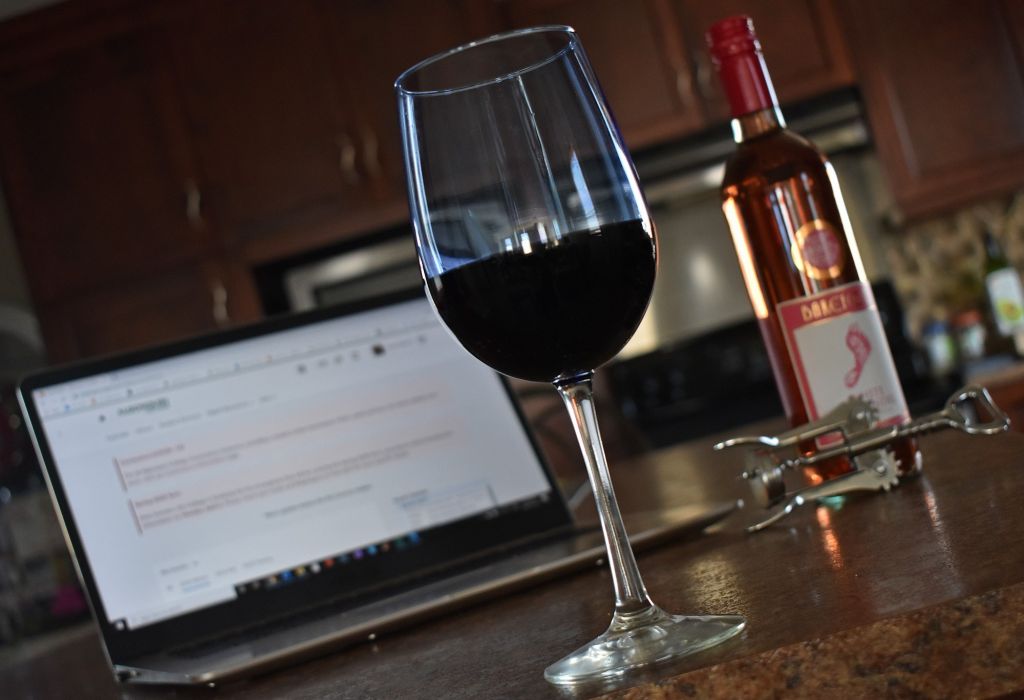
In a new, bright lab at Algonquin’s Woodroffe campus, a detailed mural of a vineyard rolling over sunny hills spans almost an entire wall. Students of the sommelier program normally join there for a year of sampling, swirling and sipping, getting the chance to become well-rounded wine stewards.
Now, the mural has gone dark and the lab’s doors are closed. The 28-year-old program has seen its fair share of changes, but its latest has come from COVID-19.
The college’s measures to stop the spread of the pandemic included shutting its doors and shifting its classes online March 23. The sommelier program has been no exception – even with its hands-on learning approach.
Program coordinator of the sommelier and bartending programs, Marie-France Champagne, said students have been positive about the shift, but have had to get creative at home.
“Out of the three hours, we’re going to be tasting [wine] for at least an hour of that,” Champagne explained about their usual in-class meetings. “So, it’s always a combination of lectures and tasting. There is not a class where we don’t taste wine.”
Champagne said luckily students are far enough into their year to have tasted an impressive amount of different wines. They have become familiar with textures, tastes and structures and can use that knowledge to have virtual discussions for the remainder of the term.
“They have the knowledge of the different varietals to say, ‘okay, we’re talking about New Zealand this week’ and you know, the big wine in New Zealand is Sauvignon Blanc,” she said. “It’s fun to now incorporate some of that knowledge and say, ‘let’s talk about what this wine should and would taste and smell like.’”
While students complete 15 courses, the program has only been offered full-time since 2017.
Liam Doody, a professor teaching courses in old world wines and wine and food, completed the program in 1993 when “there were only four classes you had to take.” In an email, he said he is impressed at how involved the program is today.
“We have a very close relationship with the industry,” Champagne explained. “We have a program advisory committee that we listen very closely to, and we’ve made changes over the years to really meet the demands of the industry.”
Champagne explained that, because the program is so well-rounded, students get careers in vineyards, liquor stores and restaurants and become consultants, wine agents and winemakers.
The program helped Doody get a job as a consultant at LCBO after he graduated. He said he now enjoys being a part of a program filled with experts in their field.
“I like how everyone who is an instructor in the program works in the wine business, either at retail or in sales or in hospitality or even in production,” Doody explained. “There is an incredible amount of experience and knowledge in the team here.”
Tim Ouellette is also part of that team. He is the professor of a nationally recognized certification in the program, the Wine and Spirit Education Trust (WSET) Level 2 in Spirits. WSET is a non-profit organization and awarding body that offers wine and spirit enthusiasts eight different qualifications in over 72 countries. Ouellette’s class is one of the two WSET certifications students receive through the program, along with WSET Level 2 in wines.
Ouellette’s passion for wine grew from his first experience at a make-your-own-wine shop when he was 19, to taking WSET Level 2 and making an immediate mark on his instructors there. “The teacher actually singled me out and told me that I should keep going,” he said in an email. “Having already worked in the industry six or seven years I already knew a lot of the information.”
The next year, he took WSET Level 3 and started the diploma program. “The WSET Diploma was a big jump; it takes two years assuming you pass everything first try,” which is not common, Ouellette added. He graduated “without a hitch” in 2019, but said the class’ failure rate was very high.
Later, he was hired by Champagne to pass-on his knowledge at Algonquin. “After a few interviews I was hired on to teach the WSET 2 in Spirits, and my students did very well, no one failed,” he said.
Until he teaches the class again in the fall, Ouellette continues to work as a product consultant at LCBO in Ottawa, where he has been for over a year.
As LCBO has been deemed an essential service during the pandemic and currently remains open to the public, Ouellette explained that business is booming.
“Wine has been through the ‘Medieval warm period,’ the ‘Little Ice Age,’ Phylloxera, World War 2 and many other things,” said Ouellette. “It’s as close to a sure thing as you can get.”
While people are continuing to clear shelves, Ouellette said a phenomenon in the industry has changed. “An important trend in the wine and spirits market in more affluent nations is something called premiumization. “People are buying less alcohol but are spending more,” he explained. “So higher quality products are being purchased.”
However, financial challenges brought-on by COVID-19 have been changing this trend. “People drink higher quality wine in good times and lower quality wine in bad times,” Ouellette said. “I noticed when the issues started getting serious here with the virus, people were buying high end wines, but once it became worse, they started to prioritize quantity.”
While some areas such as restaurants struggle during this time, other common career paths for grads are getting a chance to thrive.
Champagne explained that, as a result of people staying home, wine agents are getting more business. “It’s a good opportunity for wine agents though, which is a good outlet for graduates coming out of the program,” she explained. “So, consignment wines and wine agents can deliver directly to your home for those not wanting to go to the LCBO.”
For grads that are hoping to, or are currently, working in vineyards, springtime usually means grapes begin to bud and vines must be chopped, tied and prepared to make wine. Champagne said there may be issues with the harvest if the impacts of COVID-19 continue to escalate.
“For the Ontario wine industry, there’s a lot of foreign workers that come and do these tasks,” she said. “And right now, they can’t get in, so the government is looking at what’s going to be done.” Grapes have a short, two to three-week period during which they are ripe, after which they cannot be used depending on the wine being made.
Although some aspects of the industry remain uncertain for now, Champagne is focused on keeping her students safe. “My message to everybody is please stay home,” she said. “Don’t go anywhere if you don’t have to.”
Once this year’s group of sommelier students graduate, Champagne hopes to continue to find grads all over the city, working in what they are passionate about.
“We always say we like to see an Algonquin graduate in every trade and every restaurant,” she said. “So that’s what I want to continue to see, I want to see our grads out there.”