main

Game development students unveil final projects at grad show
Students in Algonquin College’s game development program showcased their final projects at Nawapon on Wednesday afternoon. Seven projects were displayed on tables throughout the room with a diverse selection of […]
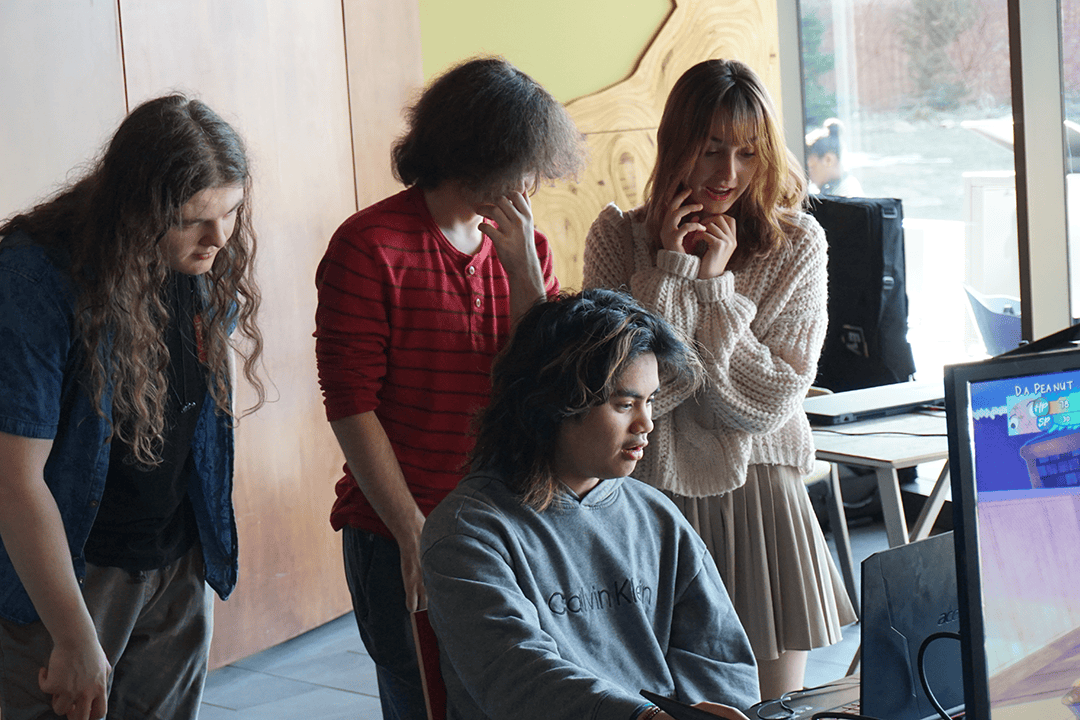
Onlookers watch a student play a video game at the game development grad show at Nawapon on April 12. Game development students were on hand to show players how the games work.

Students in Algonquin College’s game development program showcased their final projects at Nawapon on Wednesday afternoon.

Seven projects were displayed on tables throughout the room with a diverse selection of games to try out. The students who worked on them are soon-to-be graduates of the game development program. Games shown at the event incorporated the use of VR technology, big screen monitors and laptop computers.

Project Artemis is a game developed entirely for use with VR technology. It depicts an immersive simulation of NASA’s upcoming Artemis space program. During the game, players suit up at the International Space Station and board a spacecraft before being sent off to the moon.

Alex Achorn, developer of Project Artemis, discussed what happens in the game.

“You board the ship, do a pre-launch sequence, and (then) you land on the moon,” Achorn said. “We have three different missions you do while you’re on the moon.”

Another video game at the event, Axel ‘n’ Oddol, is a 3D platformer collect-a-thon inspired by the works of Banjo-Kazooie and Super Mario 64. Players carry a character called Axel that can be used as a tool to progress through the game. Axel can be used as a platform when climbing walls, thrown as a boomerang to collect hard-to-reach objects and as a weapon against enemies.

Kayla Grant, a member of the development team, said the final product was different from the group’s original vision.

“We had something very different in mind beforehand,” Grant said. “But as things sort of changed in terms of the members we were going to receive, so too did the design vision.”

Grant said the group experienced significant challenges during the development process.

“I actually ended up having five weeks off due to a combination of surgery and COVID,” Grant said. “We were down a person for a long time. So we ended up having to cut out a lot of content that we had planned to have in.”

Those who missed the event can check out all of the games showcased here.

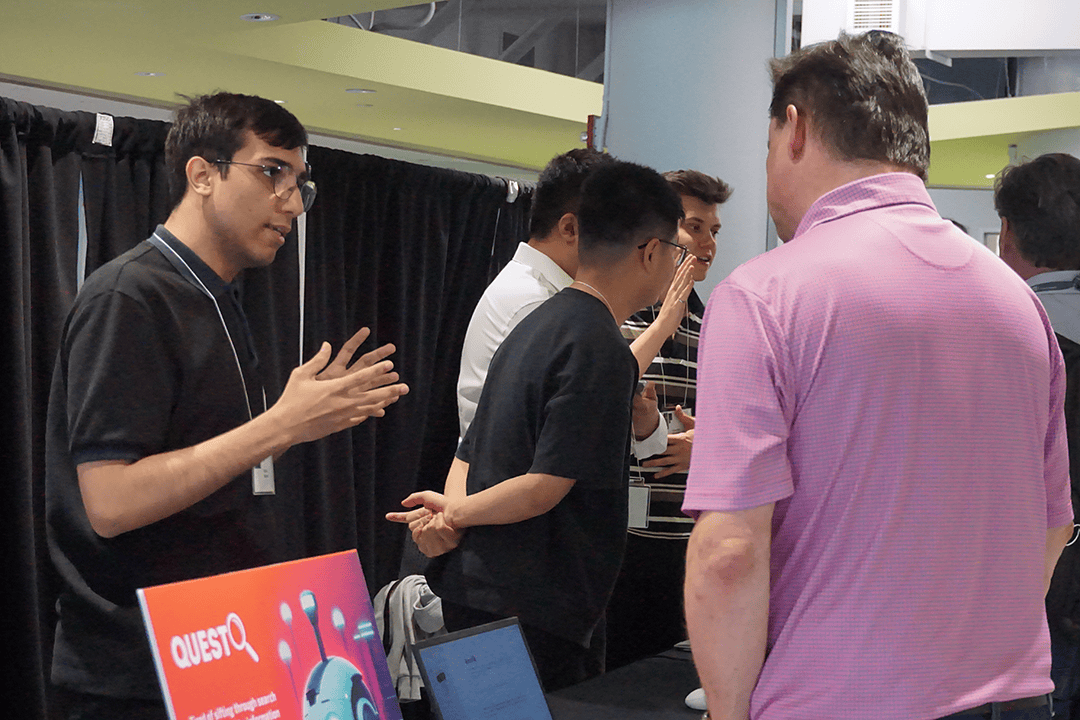
Student project uses artificial technology to simplify search results

Artificial intelligence and software development student Rafael Moraes hopes to simplify the way people search for information on the internet. His new project, QuestChat, was revealed at the Re/Action Applied […]
Photo: TJ Sider
Rafael Moraes, an artificial intelligence software development student, talks with an attendee of the Re/Action Applied Research Showcase at the DARE District on April 14. His project, QuestChat, uses artificial intelligence to simplify search queries.

Artificial intelligence and software development student Rafael Moraes hopes to simplify the way people search for information on the internet.

His new project, QuestChat, was revealed at the Re/Action Applied Research Showcase in the DARE District at C-building on Friday morning. He developed the program as a way to simplify the process of search queries in order to push the most relevant information to the user. The project was inspired by and builds upon the functions of Bing’s AI chatbot and ChatGPT.

Moraes explains how QuestChat works in more detail.

“This project is essentially an automated version of prompt engineering,” Moraes said. “So when you take ChatGPT and you want it to answer a question for you, usually you have to paste all of the information you want it to know and then at the end ask the question. (QuestChat) will look in the internet, try to find the information that answers your question, feed that into something like ChatGPT and then that will provide the answer for you.”

Moraes says the project is open source, meaning that anyone can input their own data into the program for a variety of uses.

“If you compare it with the Bing engine, which does something very similar, they are closed source,” Moraes said. “You can’t actually modify it yourself.”

Moraes envisions QuestChat as a tool in the private sector. He says the open source development of QuestChat will allow companies to input their own proprietary data for employees to ask questions about the company.

“You can use that data instead of using ChatGPT which can leak that data for some reason,” Moraes said. “You can change the system so it behaves the way you want it to behave instead of having this preset behaviour.”

Moraes started working on the project in his free time. He wanted to see how a program would use internet data to answer questions. His development of the program was inspired by difficulties he encountered in the past on search engines trying to find the information he needed.

“The first version took about two weeks,” Moraes said. “It was very barebones kind of thing. As people started using it, I started iterating and it took basically three to four months to become what it is now, which is a more modular kind of approach to this automated prompt engineering.”

New bachelor program in event management sees big demand ahead of fall launch

The bachelor of event, sport and entertainment management honours degree program is officially launching on Sept. 23 with over 80 applications and counting. “We’re very excited with the numbers that […]
Photo: Marco Ghosn
"Weโ€™re very excited with the numbers that are coming in," said chair Michael Tarnowski on the topic of applications.

The bachelor of event, sport and entertainment management honours degree program is officially launching on Sept. 23 with over 80 applications and counting.

“We’re very excited with the numbers that are coming in. The demand for this program is interesting, as a first-year degree program in a college, you never know where it’s going to go, but it’s being received very well at the high schools,” said Michael Tarnowski, academic chair in the School of Business and Hospitality.

Originally, the number of seats available for the program was 20, but because there has been an extraordinary amount of interest, the college extended the number of seats to 40. The college is willing to go up to 50 seats if needed.

“The fact that it’s a bachelor’s degree, typically, a lot of high school students look to universities,” said Tarnowski.

“Normally, it takes a few years for a new degree to get mainstream and get known at the high schools, so for it to get picked up this quickly, I was very surprised,” added Tarnowski.

As the only event, sport & entertainment management program in Ottawa, industries are very happy to see the program implemented as there is a need for workers.

Brian Henry, a former radio and TV broadcasting student at Algonquin College and president of Quality Entertainment, chimed in on the subject.

“This industry has really needed this degree program for a long time, we need more people in our industry than ever before, so excitement would be the word I would use,” said Henry, who has also been awarded an honorary diploma from the college.

“There has been a lot of change in the last three years due to the pandemic. There were a lot of layoffs, lots of changes and lots of growth. So, what has happened is that has created an instant need for qualified people.”

“So, this program becoming available is going to be really good for students who want to get into an exciting industry with a lot of jobs,” added Henry.

Henry encourages people to enter the program because of how the industry has adapted. There are now hybrid models and many different opportunities with flexible schedules and good-paying jobs.

SA wants college to create a designated smoking area

The college enforces a smoke-free policy but there’s no designated smoking spot anywhere on campus. The Students’ Association wants that to change. Matt Regnier, the SA board communications and process […]
Photo: Mingan Wang
A student smokes in front of the residence building.

The college enforces a smoke-free policy but there’s no designated smoking spot anywhere on campus.

The Students’ Association wants that to change.

Matt Regnier, the SA board communications and process manager, said on April 6 during a press conference with the Algonquin Times that the SA is in favour of a designated smoking spot on campus.

“Students should have a safe, designated place to smoke that is away from main intersections. That’s our policy. That’s what we envisioned the campus should be, based on that, we talked to thousands of students in 2019 when the college announced the smoke-free policy,” said Regnier.

Some people also doubt the smoke-free policy is working at all.

“It’s nice if the policy actually works, but the truth is, people won’t quit smoking because of this policy, so that left smokers smoke on random places all around campus,” said architecture student Sofia Trinidad, “I really think it would be helpful to set a smoking area on campus where it’s accessible to smokers that’s away from main roads,”

It also bothers smokers.

Anthony Budiman, an animation student, expressed his frustrations over the lack of smoking spots.

“I’ve been smoking for years, and I smoke quite a few times per day, so it’s not realistic for me to quit easily. I support the college’s decision to go smoke-free, and it’s fine during summer or spring when it’s not cold, I can walk outside of campus to smoke, but during winter it’s just impossible. I think having a designated smoking area is good for everybody,” said Budiman.

Psychic fair at attracts eager participants despite long lines

As temperatures rose in Ottawa, excitement grew among attendees at the psychic fair, held in the Student Commons on Tuesday, April 11. Four semi-private spaces enclosed by black curtains attracted […]
Photo: Huijun Li
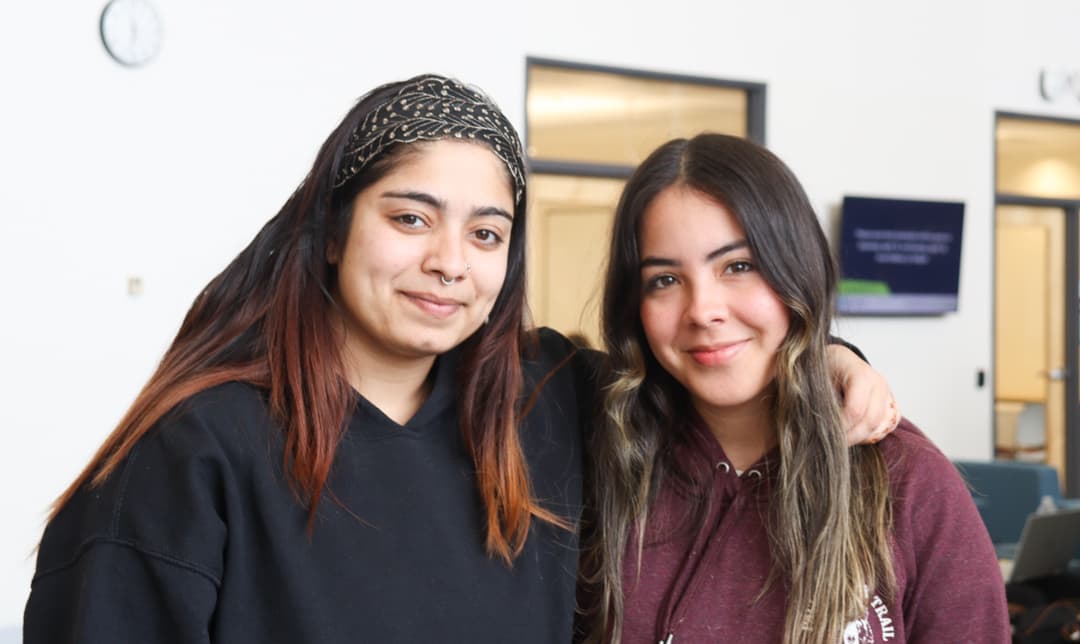
Kareen Koul and Nice Gonzalez, students in bakery and pastry arts management program, were going to the gym when they spotted the long queue and the mysterious black curtain in the Student Commons. "Since we have time, let's have fun," said Koul.

As temperatures rose in Ottawa, excitement grew among attendees at the psychic fair, held in the Student Commons on Tuesday, April 11.

Four semi-private spaces enclosed by black curtains attracted long lines of eager students who waited up to half and hour for their turns.

The event, which was organized by the Students’ Association and ran from 11 a.m. to 2 p.m., aimed to provide students with a unique and engaging experience.

“This isn’t the first time we’ve run this event,” said Amanda Logan, events programmer with the Students’ Association. “We’ve done it three or four times before, once a year. In fact, we recently held a psychic fair on AC Day 1, and the response was so positive. The students were incredibly interested and had so much fun that we thought, why not do it again?”

Individuals curious about psychics and seers could experience a free reading by lining up for a ten-minute session. The fair offered various psychic practices, including tarot card readings, palmistry and clairvoyance.

Tarot cardn fortune teller Darline Foley has the longest and the most popular queue in the psychic fair.
Tarot card reader and fortune teller Darlaine Foley had the longest and the most popular queue at the psychic fair. Photo credit: Huijun Li

Somali Dhruv, a fitness and health promotion student, attended the AC Day 1 psychic fair on Jan. 9.

“I wasn’t really going to ask the psychic anything specific,” she said. “I just really liked the experience. The way they interpreted it and led the session was very interesting. It instantly created an immersive atmosphere when they talked about cosmic energy and similar concepts.”

Kareen Koul and Nice Gonzalez, bakery and pastry arts management students, stumbled upon the event.

“We were going to the gym but we saw that there was a lot of activity over here,” said Gonzalez. “Everyone seemed to be having a good time so we felt curious and came to check it out.”

She found the event’s set up made it easy for students to join in the activities and queue up.

“I’m not a big believer, nor do I completely disbelieve in metaphysics,” Koul said, “but prophecy and fortune-telling are more of a fun thing for me most of the time.”

Police foundations students present surprising data with striking research

On April 6 and April 14, graduating students in the police foundations program presented their capstone thesis projects related to justice, community service and law enforcement. Both events were held […]
Photo: Anthony Peck
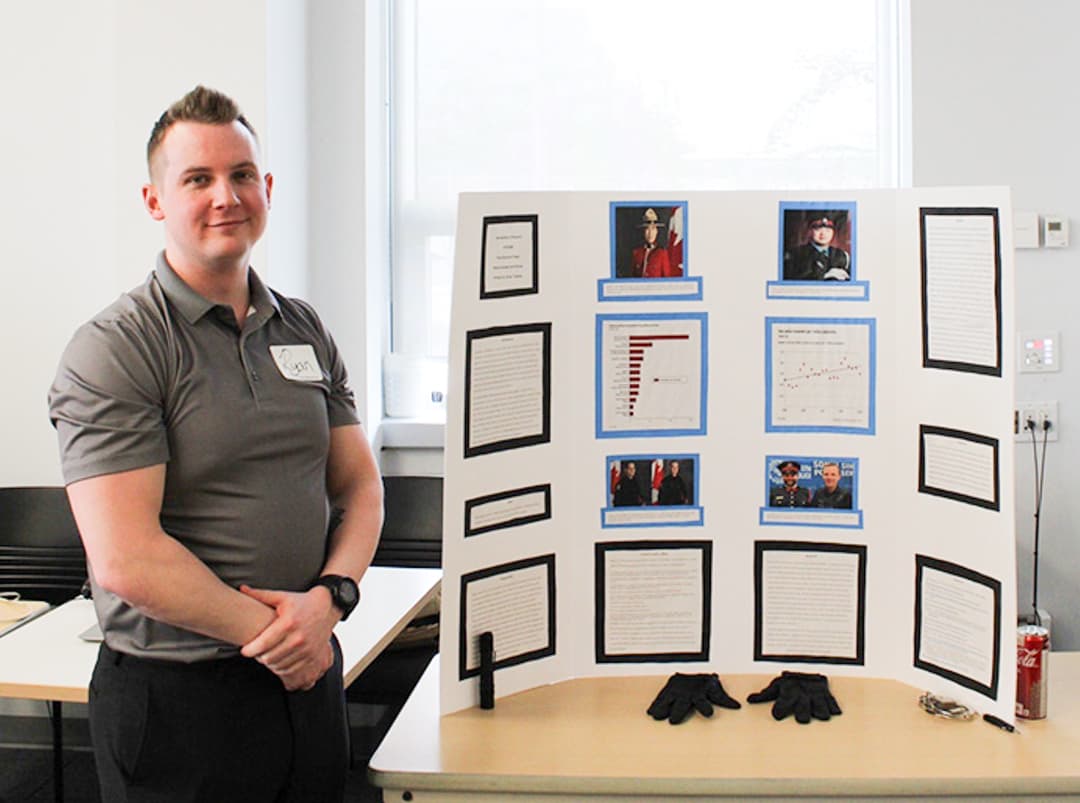
Ryan Topping, 31, used classic bristol board for his presentation on April 6.

On April 6 and April 14, graduating students in the police foundations program presented their capstone thesis projects related to justice, community service and law enforcement.

Both events were held in the CA-building and open to Algonquin College students alongside faculty. Roughly 60 fourth-level police foundations students presented the culmination projects they started earlier in the year.

Ryan Topping, a graduating student, presented his research on the benefits of added mental health training in policing.

“My thesis specifically was that mental health calls have a better outcome when first responders have more training for nonviolent crisis intervention or community outreach programs,” Topping said.

He compiled data on documented instances of police officers dying on the job while responding to mental health calls.

On top of scouring through eight academic studies, Topping also drew upon his own personal knowledge for his thesis.

“Working on the mental health unit at the hospital, we deal with a lot of people in crisis. When they come in on their first day they’re in crisis and sometimes day to day they’ll have breakdowns or they’ll go into crisis,” he said. “Nonviolent crisis intervention is de-escalation through communication, being responsive to the person and addressing their needs but not lying to them about the situation.”

“One in five calls you go to, you’re dealing with someone who’s just had the worst day of their life,” Topping added. “So, you need that training – that empathy – to really help with whatever the situation is.”

Jill Reeves, the police foundations program coordinator, left the April 14 event impressed.

“I was impressed by the knowledge the students shared in terms of the detail. The fact that they previously submitted research papers, and received feedback earlier in the semester, led to being able to deliver a really smooth presentation quite confidently,” Reeves said.

Another student, Josh Eaylin, sought to prove whether football players are likely to commit a crime due to chronic traumatic encephalopathy, a brain condition caused by repeated blows to the head.

“I played football when I was younger, so I thought it’d be a cool thing to relate football back with policing and law,” he said.

Although he didn’t find any direct links between CTE and committing crime, he did uncover possible contributing factors.

“Brain injuries make you more susceptible to anger, poor judgment and impulsivity as well, but there’s no specific link between crime and CTE,” Eaylin added.

Jane Trakalo, the dean of health, public safety and community studies, attended the April 6 event and talked to several students.

“I was very surprised by the wide variety of topics students chose. There were very few duplicates and it just goes to show the level of breadth and depth of their work,” Trakalo said.

The dean also touched on the possibility of next year’s fourth-level students getting a similar event.

“I think I’d like to hear from the students and if they felt it was a worthwhile event. I certainly thought it was and I would definitely like to see it become a yearly event,” she added.

College implements new standards to assist international students

Colleges Ontario has implemented new common standards to help international students in their relocation to the province. Algonquin College is one of the many colleges in the province to implement […]
Photo: Brandon Plant
An outside view of the administrative building for Algonquin College on a sunny day in April.

Colleges Ontario has implemented new common standards to help international students in their relocation to the province. Algonquin College is one of the many colleges in the province to implement the new common standards, with the latest criteria set to be administered by June 2024.

The college believes that these new standards will provide essential resources and increased support for potential new students

“This is an opportunity to have a sector-wide approach to providing greater clarity on the information and support we give international students at the start of the process and throughout their experience,” a statement from Algonquin College said.

“Ultimately, the goal is to make sure that our international students are provided with the best possible support at Algonquin College and across the college system in Ontario,” the college’s communications department added.

Colleges Ontario announced the initiative in mid-March.

Aditya Singh, an Algonquin College business student, believes the changes are a positive step for what is otherwise an “anxious” process.

“When I applied to my program last year, it was difficult to make the choice because I was so far away from the country [Canada]. I was very anxious when making my decision,” Singh said.

“Adding more resources would be a great help for incoming international students,” added Singh.

The college says “these are sector-wide standards being implemented to strengthen the programs and supports for international students that already exist across Ontario.”

According to a press release from Algonquin College, the new standards will:

  • Ensure the marketing of programs to international students is accurate and transparent.
  • Require international agents working for Ontario’s colleges to have completed a sector-endorsed agent training program.
  • Ensure information on services, supports and facilities are provided to students before they arrive in Ontario and once they are in the province. This would include information on mental well-being, student housing and employment opportunities.
  • Provide targeted assistance to help international students adjust to a new environment.

“I think the most important thing that was announced is the school focusing on the housing and employment issue for international students,” Singh said.

“That was another big stress for me before coming here, so that would definitely help students make an easier transition when moving here because the cost of living is very high.”

Ottawa temperature breaks heat record set in 1945

Local CBC: A 78-year-old daily heat record was broken in Ottawa on Thursday, just eight days after an ice storm blanketed the city. The temperature reached 21 C at 11 […]

Local

CBC: A 78-year-old daily heat record was broken in Ottawa on Thursday, just eight days after an ice storm blanketed the city.

The temperature reached 21 C at 11 a.m., making it the hottest day of the year thus far. Two hours later, the April 13 record was shattered.

To make the most of the nice weather while it lasts, restaurants in the downtown hurriedly created patios.

However, Environment Canada predicts the heat won’t persist.

National

CTV news: The Canadian Real Estate Association projects that by year’s end, the average price of a home will be 4.8 per cent lower than in 2022, but predicts that prices would increase by nearly the same percentage in 2024.

According to the association’s forecast released on Friday, the average price will be $670,389 this year and $702,214 the following year, when prices are predicted to rise by 4.7 per cent.

In a press release, CREA’s chair, Jill Oudil, said “the intense market conditions of recent years have not gone anywhere, they’ve just been on pause.”

International:

CTV news: Ukraine continues to demand that Russia leave Crimea and all other areas of the country.

According to Ukraine’s foreign minister, Dmytro Kuleba, in order for the war to stop, Russia must withdraw its troops from Crimea and other regions of Ukraine that it recently illegally acquired.

Calling the conflict in Ukraine “a bleeding wound in the middle of Europe,” Foreign Minister Dmytro Kuleba said all his country’s territory must be treated equally in dealing with the Kremlin after its full-scale invasion more than 13 months ago.

Students spread love with Easter cards for seniors

The AC Hub Volunteer Centre had paper, colour pens and stickers ready for students to make Easter cards for seniors on the Thursday before the holiday weekend. The Volunteer Centre […]
Photo: Naomie Twagirumukiza
Elizabeth Holmes, community engagement officer, makes an Easter card for a senior in the AC Hub on April 6.

The AC Hub Volunteer Centre had paper, colour pens and stickers ready for students to make Easter cards for seniors on the Thursday before the holiday weekend.

The Volunteer Centre sends cards to local seniors in the community for different celebrations. Last year, it invited students to make Christmas cards.

“We send the cards to a different senior home every time we do the event,” said Elizabeth Holmes, the AC Hub community engagement officer. “This time, the Easter cards are going to Perley Health.”

As small as it seems, Easter cards are one of the little things that help spread love and joy.

“Who doesn’t like receiving cards,” asked Patrick Hakizimana, an accounting student. “I’ve never received an Easter card, so I think it a really great idea.”

In case you forgot to send a card, it’s always better late than never. If you missed the event, make sure to stay alert for the next holiday card event from the AC Hub.

Anna Maria Tremonti’s speech shares timely messages for students

With the end of the winter term looming, a talk given by long-time journalist Anna Maria Tremonti hosted by the Pembroke campus on Monday, March 27, continues to have timely […]
Photo: Madeleine Fargo
Anna Maria Tremonti spoke in a virtual event hosted by Algonquin College's Pembroke campus on Monday, March 27.

With the end of the winter term looming, a talk given by long-time journalist Anna Maria Tremonti hosted by the Pembroke campus on Monday, March 27, continues to have timely messages for students.

Tremonti, in her role as a journalist, has reported on the changing world for decades. Most notably, she was at the Red Square when the Soviet Union fell, watching the red flag being lowered. She thought that it would be the most world-altering event she would ever cover.

But then the pandemic happened. “COVID-19 has kind of driven us into what I think of as kind of an intersection,” said Tremonti.

Tremonti spoke over Zoom about how the pandemic has left many people confused, angry and uncertain about the future.

“It’s almost as if we’re at a crossroads with medicine, and science, and politics, and geopolitics, economics, business and society – every aspect of society – how we work, how we play, how we learn, how we interact,” said Tremonti.

The stress of the changing world is familiar to many Algonquin College students.

Ahmed Elbadri, a student success specialist who works with students in the School of Media and Design, tends to see more students when these big world events happen.

“With COVID-19 as one factor, I do see more students now,” said Elbadri.

Elbadri has always seen students who struggle with anxiety, personal skills and depression, but after COVID-19, more students seem to be struggling in this way than before.

“It’s hard to go from being relatively isolated to being in the world,” said Elbadri.

According to Elbadri, the best way to work through these difficult issues is to acknowledge them and talk about them.

“There’s nothing wrong with being depressed, being sad,” said Elbadri. “But when you don’t talk about it, it lingers, and then when it lingers, everything else just piles on top of it.”

Ahmed Elbadri, Algonquin student success specialist. Elbadri works with students in Algonquins school of media and design.
Ahmed Elbadri, a student success specialist, works with students in the School of Media and Design. The best way to work through difficult issues, he says, is to acknowledge them and talk about them. Photo credit: Madeleine Fargo

Loneliness was another big theme in Tremonti’s speech.

Tremonti did not just speak of the loneliness caused by a confusing and changing world, but also the loneliness caused by her own experience with intimate partner violence.

Her experience, which she speaks about in her new podcast Welcome to Paradise, left her with feelings of guilt and self-blame. At the same time, she believed she hadn’t suffered enough to share her story.

“I did judge myself at the time. There’s a stigma about abuse as if we deserve it, as if we choose it,” said Tremonti.

Once Tremonti started sharing her story, emails to her started pouring in. Tremonti’s story helped others realize they were far from alone.

Students aren’t alone either.

“Our Project Lighthouse website is all about students who’ve experienced violence, resources in community, online and in person,” said Sarah Crawford, Algonquin’s sexual violence prevention and harm reduction coordinator.

“It is very hard to come forward and talk to people about it,” said Crawford. “Algonquin College has counselling services where you’ll always be believed.”

Algonquin Times podcast

Stay Informed

Sign up for our newsletter

Subscribe

* indicates required