main

Q&A: Entrepreneur has tips for students about how to save money
One morning in mid-September, three students wearing hoodies and small waist bags, rummaged through big boxes of different electronic gadgets at an Ottawa discount store. Visiting big shopping malls to […]
Photo: Brahim Ait Ouzineb
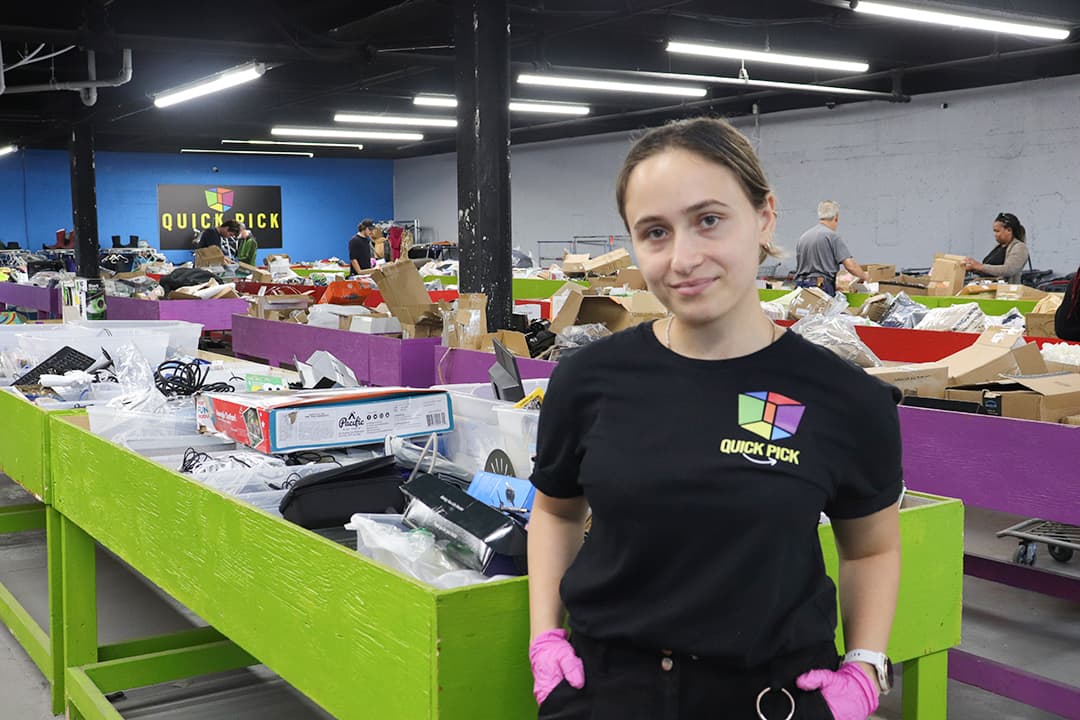
Despite not having any formal experience in the retail business, entrepreneur Nidaa Yassin has already opened seven stores.

One morning in mid-September, three students wearing hoodies and small waist bags, rummaged through big boxes of different electronic gadgets at an Ottawa discount store. Visiting big shopping malls to find deals is not for them.

Loyal customers of Quick Pick, a liquidation store with eight locations in the Ottawa area, sets a fixed price for all freshly stocked bin items. This means shopping there is like a hunt for a treasure amongst the huge pile of boxes of different sizes.

Every day, the price of each item gradually drops from $25.99 to $0.99.

Algonquin College students often visit the closest store to the Woodroffe campus at 2444 Wildwood Ave. There they can purchase items ranging from electronics and clothes to tools, home accessories, beauty products and more. With the rising cost of living, the store is coming to the aid of those in need.

“Many students get their school supplies from here,” says Nidaa Yassin, manager and founder of Quick Pick. Yassin launched her first store in 2021 and it has been growing ever since.

Growing up in business next to her father, Yassin knows the value of every penny. Fame does not interest her but serving her community to the best of her ability does.

Q. How did you start your business journey?

I am a Palestinian but was born and raised in Jordan. I came here for a few years ago. Prior to founding Quick Pick, I took online business courses at various universities and earned several scholarships.

I was inspired by my father and always wanted to be a businesswoman. When I was 10 years old, I travelled with him on business trips. I used to go with him every day to the company.

Q. Do you have any tips about the best deals in your store?

Yeah, for sure. Friday, Saturday and Sunday are the best days after the restocking day. Products are brand new, and the boxes are not ransacked by the first coming customers.

We just added the Free Gift Raffle. Customers who get two products from the bins get to enter a draw. They have the chance to buy premium items for the same amount of money.

It’s better to come the first three days. Although the price is higher, the products are intact. If you’re looking for cheaper stuff – $5.99, $2.99 or $0.99 – come the other days.

Q. Why would you encourage college and university students to come?

Basically, having everything for cheaper prices. Why would you spend money on something when you can actually save? It just calls for patience and a thorough search. For a student these days a penny saved is a penny earned.

Currently, there are no ongoing offers aimed at students, but we plan in October to introduce a 10 per cent discount specifically for students.

Q. What initiatives did you take to reduce costs in these hard times?

Right now, everything is really getting expensive hence the importance of our store.

There are a lot of bin stores in the U.S. which inspired us to open one. We have, of course, our own identity and have different pricing scheme and strategy. That’s why we’re branding and franchising Quick Pick to serve those in need in the best possible way.

Q. What is your favourite customer story?

Honestly, there are a lot of people who come to me saying we sell your products for a living. They would resell these as a side hustle and they would live on that money and that warms my heart.

Q. What are the challenges that you face as a female entrepreneur?

I personally encountered this bias of being a woman at the beginning but my strength and self-confidence helped. I’m determined not to let anyone take advantage of me.

Launching and franchising our business is just the beginning. Until then, I prefer to remain relatively low-key. It’s interesting how most customers assume I’m an employee, and I’m quite content with that.

Looking ahead, my future plans involve working on various innovative business ventures to address gaps in the Canadian market and benefit all communities.


Missed the City Folk Festival? Here are the 5 things you need to know

If you missed celebrating the start of the new school year by attending the City Folk Festival, don’t fear: consider this a reminder to go next year. The festival, which […]
"Every time I see the Arkells, they just get me so fired up," said Liam Powers, a Carleton University student. "My friends and I just start dancing from the moment they come on stage until the moment they leave."

If you missed celebrating the start of the new school year by attending the City Folk Festival, don’t fear: consider this a reminder to go next year.

The festival, which ran between Sept. 13-17, was back in Ottawa for the 29th time. Originally founded as the “Ottawa Folk Festival,” it was inspired by the folk scene in the city.

“The event is modelled on long-standing major Canadian festivals and features multifaceted artistic disciplines and an inclusive programming philosophy,” according to the City Folk website.

Here are the five things you need to know about this year’s festival:

1. Busty and the Bass are the band to get a festival up and going

The band started the festival on Sept. 13 and according to some fans, they were the perfect ones to get the festival started. “I really enjoyed the way those guys started the evening for us,” said Shana Parsons, a student at Algonquin College. “It was an interesting type of music and really started the night off right.”

2. Ever need to feel so strong you could run through a wall? The Arkells could help you get there

To close out the show on Sept. 14 CP, the Arkells performed and had an impact on fans. “Every time I see the Arkells, they just get me so fired up,” said Liam Powers, a Carleton University student. “My friends and I just start dancing from the moment they come on stage until the moment they leave.”

3. Fortunate Ones are the reason that the festival is called the City “Folk” Festival

The band was the last performance of the evening on Sept. 15 and some students said they were very impressed. “I hadn’t listened to the Fortunate Ones before, but I really enjoyed their music,” said Mckenzy Walker, a hairstyling program student at Algonquin College. “It was very folky and I really hope they come and play next year.”

4. Canadian music is alive and well and Kristine St-Pierre is a Canadian star

St-Pierre opened the Sept. 16 show and showed everyone that folk music can be written by a Canadian and sang perfectly by one as well. St-Pierre was nominated for a Canadian Folk Music award in 2018 and is currently working on her fourth album that she plans on releasing soon.

5. Hozier needs to play at the City Folk Festival every year

Hozier made his name in 2013 when releasing his hot single “Take Me To Church” and students at this years festival were loving it. “I remember when that song first came out, I would listen to it all the time,” said Will Rice, a Carleton University student. “I really hope he comes back and plays again next year.”

City Folk has confirmed they will be back next year and the dates will be determined at a later time.

Climate zone: while some hands on campus are damp, waste has been reduced

Students and staff at the Woodroffe campus do not all have a case of jazz hands: They are flicking their dripping hands and wiping them on their clothing after washing […]
Photo: Kerry Slack
Students risk being late for class while taking the time to blow dry their hands. On some machines, it can take more than a minute and a half to get to dry digits.

Students and staff at the Woodroffe campus do not all have a case of jazz hands: They are flicking their dripping hands and wiping them on their clothing after washing them in the bathrooms.

The wet handprints on everyone’s jeans are indicative of valuable savings: savings to the environment, to labour and with money. All three Algonquin College campuses are cutting waste by changing the way we dry our hands.

Paper towels are not recyclable paper which means they were all going to landfills.

At the Woodroffe campus, hand paper towels alone represented 44,200 garbage bags last year that went to landfills.

“The college is not only avoiding costs with less garbage collection but this initiative also supports our goal of reducing waste,” said Ryan Southwood, executive director of Facilities Management on campus.

Costing $44.69 per case, removing paper towels from the campus bathrooms has saved the campus a lot of money.

In 2022 the college spent $190,000 on paper towels and related labour costs.

That’s $96,100 in paper and $ 93,900 in labor-related costs per year at 313 days of campus life.

Additionally, 60 hours per week of labour costs are saved on restocking, removing and replacing garbage bags in the 170 bathrooms on campus. That’s 26 hours removing waste and 34 hours spent replacing paper towels. (Note: all of the previous numbers refer to the Woodroffe campus alone.)

Patrica Thome, supervisor of custodial and grounds operations shared a fun fact:

“The Woodroffe campus was using approximately 2900 kms of paper towel in a year,” said Thome. “That’s the distance from Quebec City to Miami.”

For some, however, there are some downsides to the move away from paper towels.

Reagan Mellan, a second-year culinary management student who has taken her Canada Safe Food Handlers course, understands the importance of proper hand washing and drying.

“We wash our hands every time we walk into the lab anyway but it is a lot more sanitary to use paper towel than a hand dryer,” said Mellan. “When we come through doors we touch them, contaminating our hands again.”

More fun, random numbers – because who doesn’t like random number facts?

Based on this reporter’s informal survey of several older-style hand dryers – the ones with the silver nozzles – at several locations around campus, it takes approximately 45 seconds for one dry cycle. It thus takes three rounds of drying to effectively dry one’s hands.

But replacing the old dryers is not as simple as it seems, explained James Hopkins, associate director of facilities engineering, operations and maintenance. In keeping with the spirit of reducing waste, the old ones still in place won’t be thrown away as long as they are functional.

The cost of replacing the dryers in the older buildings is approximately $1,000 in labour alone. This amount includes the cost of replacing the circuits from the panel. And in the older buildings on campus, the capacity of the electrical panels is lower than it is in the new buildings, hence the older hand dryers.

The Algonquin Times also conducted an informal study where this reporter stood outside three bathrooms on campus and listened to 100 students at each. The findings?

Most students don’t even bother to stop to dry at all.

In the DARE District near the Maker Space, 28 students used hand dryers while 72 did not.

In the B-building near room B165, 24 students used the dryers while 76 did not.

In the ACCE-building near the level one entrance, 38 people dried while 62 did not.

The decision to remove the paper towels comes with big ecological and fiscal savings. So digit-drip seems to be something community members will have to get used to.

Perhaps it’s time to pack a hand towel in our bags?

Sunshine and soccer make a bright start for the intramural season

A sunny Thursday at Algonquin College had the sports field full of eager students in sports gear ready for the season’s start of intramural sports. Campus recreation coordinator Stephanie Rheaume […]
Photo: Rebekah Houter
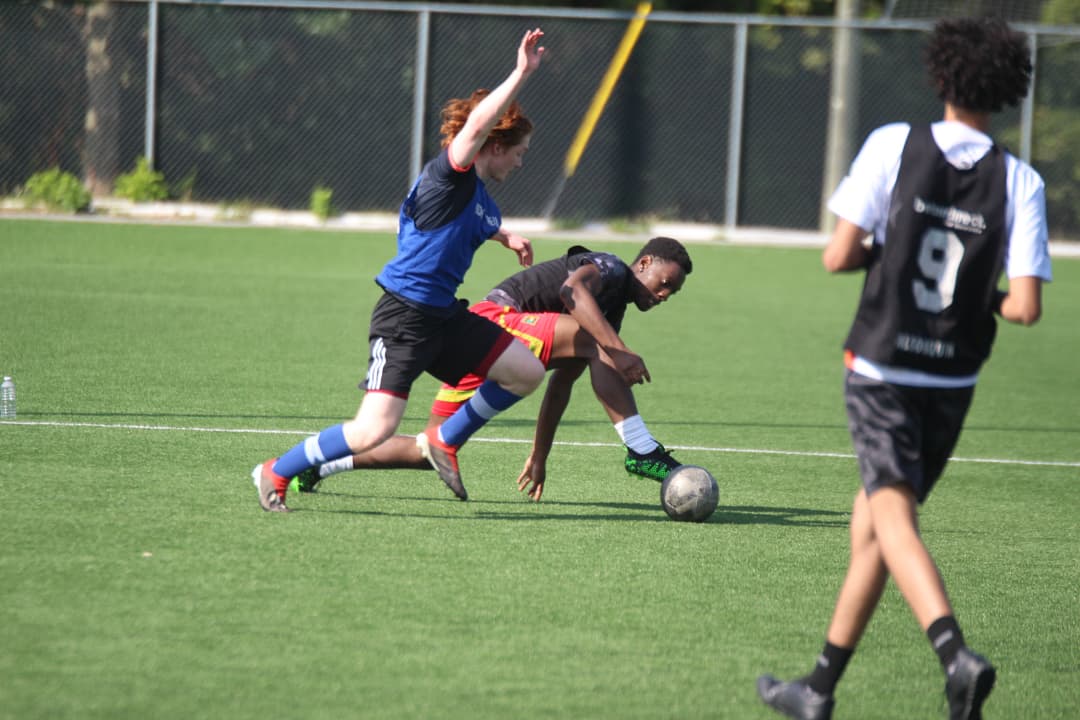
Liam Holtzhaver (left) and William Wafo (right) fight it out during the first soccer game of the season.

A sunny Thursday at Algonquin College had the sports field full of eager students in sports gear ready for the season’s start of intramural sports.

Campus recreation coordinator Stephanie Rheaume stood with clipboard in hand on the sideline keeping score for the players on the field.

She said it’s the busiest time of year as everything is starting up after the summer break.

“This is our soccer intramurals,” Rheaume said, gesturing to the soccer players in their bright jerseys running by. “This is actually our first year doing it outside.”

All sports were originally held inside of the Jack Doyle Athletics and Recreation Centre, but soccer moved outdoors for the first time this year for more space, a move Rheaume says the players have been happy about. She jokes people have been enjoying not running into walls.

The sports offered for intramurals are co-ed, open to all part-time, full-time, and online students and host roughly 600 to 800 students per semester depending on what is offered, according to Rheaume, herself an Algonquin College graduate of the rec and leisure program.

As intramurals at Algonquin College have been running for roughly 45 years, Rheaume says it’s time to expand into other types of activities. A first-time bowling league is one of the first changes happening, with a one-day pickleball, badminton, and table tennis tournament also in the works.

And the most requested sports not currently offered? Ice hockey and cricket.

“We do want to do cricket again. We do want to bring back ultimate frisbee,” Rheaume said. “We talked about doing baseball just so we would be off campus. We used to do a hockey tournament as well, so there are definitely ideas.”

The future plans for expansions also include expanding existing sports into competitive and non-competitive teams, depending on how many players sign up.

Soccer, basketball, volleyball, ball hockey, and bowling are offered this fall, with volleyball and soccer being the most popular. Wintertime sees more sports offered in the dome, such as touch football and ultimate frisbee.

Emeric Wall races for the soccer ball during the first game of the season.
Emeric Wall races for the soccer ball during the first game of the season. Photo credit: Rebekah Houter

Thomas Poulin from the electrical technician program says it’s a fun time even though people don’t always follow the rules, like not showing up when the game is supposed to start or entering the playing field from the corner instead of the middle as the rules state.

“Disappointed that three people on my team didn’t show up, and one didn’t show up till halfway through the game. That makes it kind of hard when you don’t have any subs,” Poulin said.

Having played soccer for three semesters during his time in the business administration program, Denzel Manzi says his advice for those looking to join up is to register early, whether that means talking to classmates or signing up by yourself.

“Find the team early, which may be tough because you don’t know who is in your class, or if it’s completely new people who don’t know how to play,” Manzi said. “Sometimes you have to look around for someone familiar you know.”

Manzi added, “But it’s all good fun. I came here, I didn’t have a team and I just wrote my name down to (a new) team.

“I just like the game so getting to play is nice because usually, I don’t know, everyone has a tight schedule, but it’s nice just taking your mind off of classes.”

The winter intramurals registration date has yet to be announced, but drop-ins are welcome for open badminton and volleyball on Mon. and Tues. for the rest of the semester at the ARC.

Crabapple-picking events on campus bring out students and faculty

Crabapples filled the trees, and the ground was covered in them. Students and faculty gathered to pick small crabapples on campus Sept. 14 just outside the B- building near parking […]
Photo: Linda Verreault
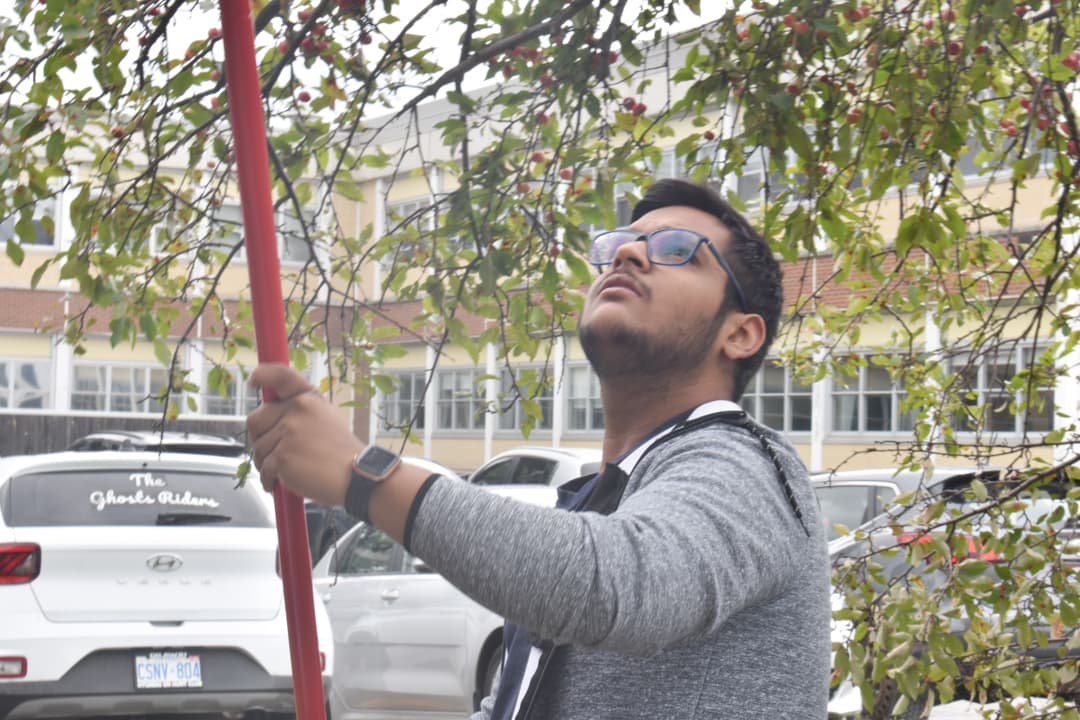
Eshaan Bansal volunteered to pick apples for the culinary student program to reduce waste.

Crabapples filled the trees, and the ground was covered in them. Students and faculty gathered to pick small crabapples on campus Sept. 14 just outside the B- building near parking lot 1.

These tiny apples were a handful to capture as attempts were made to reach them with apple pickers.

The devices used were long adjustable metal poles, with a basket attached at the end. The tiny apples slipped through the baskets as pickers gathered them and landed on their heads. But this did not deter any attempts to capture them.

The crabapple picking event was held for the first time this year. The event was created by the volunteer center and the Facilities Management team to help clean up and reduce waste from the fallen apples, while reducing the presence of bees and wasps.

The college is hoping to make it an annual event. Two previous events were held on Aug. 31 and Sept. 7.

“As you can see, we have an abundance of crabapples available on site,” said Amanda Barr, grounds coordinator. “In the past, they’ve just been allowed to fall and rot and it’s quite a waste of resource so we’re trying to leverage that we’re actually having these apples donated to our culinary department.”

Carol Ann Mahoney - Volunteer Centre 
Amanda Barr - Grounds Coordinator 
Arlen Findley - Horticulturist
Carol Ann Mahoney of the volunteer centre,
Amanda Barr, the grounds coordinator, and
Arlen Findley, a horticulturist, all took part in the event on Sept. 14. Photo credit: Linda Verreault

They were able to collect over forty bags of ten pounds each of apples.

“They’re beautiful apples and actually, the bigger ones are quite tasty compared to smaller apples that are more sour and more bitter,” said Barr.

“Some students stayed for an hour, some stay for 20 minutes between classes just to get some fresh air and some sunshine and a break,” said Carol Ann Mahoney, community engagement officer with the AC Hub.

Students and faculty can register with the volunteer center and whenever there are activities and volunteer opportunities they get contacted through email.

Eshaan Bansal, 18, a student in the computer system technician program, heard about the event from the volunteer center and decided to participate.

“I don’t know anything about apples trust me if I am taking them home, I am wasting them,” said Bansal.

He decided to help collect them for the culinary program.

Sara Cherif, 37, a student in the autism and behavioural studies program also participated.

“I like volunteering and I love nature,” said Cherif. She was also going to take some home to make jam or a dessert. Cherif is going to get her mom to teach her how to make some jam as all her aunts make jams, like strawberry and orange.

Andrew Skorzewski, an instructor in the culinary arts program, is one of the chefs involved in this initiative.

“Last week we cooked and strained about 150 pounds of crab apples producing 40 liters of apple sauce,” said Skorsewski. “This week we are cooking it all up and should end up with about 25-30 liters of finished product.”

The products should be available for sale at Savoir Faire on campus shortly.

Performing arts student Fern Marwood wants to make a difference with her music

Fern Marwood aims to show Canada her country-folk playing jams. Marwood recently joined the performing arts program at Algonquin College to expand her skills and gain a professional following. Getting […]
Photo: Noah Leafloor
Graham Lindsey and Fern Marwood play music for the Tay Valley Township Anniversary Picnic in the Maberly Community Park on Sept. 16.

Fern Marwood aims to show Canada her country-folk playing jams.

Marwood recently joined the performing arts program at Algonquin College to expand her skills and gain a professional following.

Getting agents and connections is one of her main goals while she’s at the college. But she would also love to start acting more. Marwood said she may decide to continue in another program after her one year of performing arts.

Outside of school, she’s a multi-instrumentalist. Marwood plays the fiddle, banjo and is improving on her singing for future performances.

So who is she really? She’s a horseback-riding country girl playing folk music.

Her biggest inspiration are the East Pointers, and specifically, banjo player Koady Chaisson. “He’s the reason I started playing banjo,” she said.

Marwood plays Celtic, Irish and Scottish folk music with her sister Willow Marwood and long-time folk musician Graham Lindsey. They play as a trio called the Broken Bridges which they formed in 2020.

The Marwood sisters met Lindsey in past gigs and events like festivals. He decided to help them with their careers and they formed the group later on.

However, soon after the trio formed, the COVID-19 pandemic hit, forcing them to practise and play virtually.

At one point, it was unknown whether the group would still be intact after the pandemic. Fortunately, Lindsey was able to be in their bubble so they could practice and produce together.

They ended up producing the 2021 album The Porch Sessions where all of the sales went to Fern and Willow to support their careers. They were then nominated for the 2021 Canadian Folk Music Awards.

The Marwoods also joined with Amelia Shadgett, whose stage name is Irish Millie, to form the band the Receivers in 2022. They were then nominated for a 2023 Canadian Folk Music Awards. The Receivers flew out to Vancouver where the awards were presented. They ultimately did not win but were just as happy to be recognized.

The Marwood’ first played in Prince Edward Island in 2015 and then in a film festival every year there.

The Receivers played in Prince Edward Island this year where they performed on stage for the first time and then later recorded three tracks in Lindsey’s home after the awards.

Now, back in Ontario, Fern Marwood travels across the province to performs gigs with the Broken Bridges while also in school.

The trio performs in all types of events. They bring along Chase, a dancing dog, to wow the audience with something fresh.

Although Marwood has branched coast to coast, she’s unsure about what she really wants to do with her music.

“My sister and I are going through a bit of an identity crisis right now because we don’t know where we fit in just yet,” said Marwood.

“I just want to play the right type of music to get a big enough following so that we can make it as musicians because it’s very hard to make it in the folk world unless you have a really good gig,” she said. “We would like to keep playing the music that we love, but also the music that other people will listen to.”

Marwood added, “There’s also this love to have enough reach to really make a difference in the world. That’s all we really want is to make a living out of events and try to make a difference for people.”

The Broken Bridges also find it hard to get a following with the type of music they play, which is why they started to sing. “People love the singing. Even when we have some folk songs, people freak out,” she said.

The Broken Bridges’ ambitions are high but the members have different performance goals. Fern Marwood prefers bigger audiences for more reactions, while Lindsey loves to connect with small crowds.

“I love seeing their reactions and dances while we play,” said Marwood. “I get animated when I see they’re enjoying the show, because it’s hard to pull myself out for a small crowd.”

Huge turnout at Clubfest as organizers hunt for more space

As the fall Clubfest had “maxed out the space” they originally had in E-building, organizer Cassandra Jones is on the hunt for a more spacious location to host the next […]
Photo: Annika Schlarb
Leader of the Middle Eastern and North African Club, Dana Farejellah explains how having clubs for international students gives a sense of community at school. โ€œIโ€™ve noticed that many Arabs donโ€™t really know each other,โ€ she said, โ€œand this club is a great way to get everyone togetherโ€.

As the fall Clubfest had “maxed out the space” they originally had in E-building, organizer Cassandra Jones is on the hunt for a more spacious location to host the next one.

With a mission to “create an environment that inspires a passion for student success,” the Algonquin College Students’ Association runs all clubs offered at school.

The Students’ Association suitably appointed the Clubs and Community Coordinator, Jones, as the Clubfest organizer. Jones explained how fall 2023 had “the most amount of engagement” she has ever seen at Clubfest.

On Sept. 14, members, leaders and Clubfest attendees took over the Student Commons from 11 a.m. to 2 p.m. Club leaders decorated their tables and lined up in front of Starbucks to promote their clubs, looking for new members.

While students circulated the Student Commons, club leaders provided information and sign-up sheets for those interested in joining. With 60 active clubs on campus, there is no shortage of options and opportunities for students to engage in the school community.

Rose Audu described how she and other international club members understand what it is like being a student in a new country. Through events and group meetings, there are opportunities to connect with members who have similar and different backgrounds.

Audu is looking to plan a gathering for her club at Christmas. “I understand the feeling of being alone,” she said. “When you move to Canada, there is nowhere to go and no one to stay with during the holidays.”

The relationship Audu and other members have gained through attending the club gives a sense of community. “Even if I don’t know you that well, the fact that we go to the same club makes me feel connected enough to invite you to spend Christmas at my house,” said Audu.

Creating connections is an important aspect of school clubs. “The idea of the Latino Club is to create a community and support new Latino students,” said the club leader, Rebecca Fiera. Members can help new students find comfort with the school and city environment.

If you are looking for a club that lets you explore a community that you are already familiar with, there are still opportunities to find something new. “Some of the Latino Club members can teach Spanish,” said Fiera, offering the opportunity for students who want to learn a new language.

The AC Powerlifting Club is a fitness and health-focused group that club leader Aaron Perkins started two years ago after popular demand. “A lot of people want to get into fitness and they don’t know where to start,” said Perkins. “We’re really that starting point for them.”

The Powerlifting Club is a great way to find a workout partner who can become a friend with similar interests and goals. Perkins said he is at the school gym very often and is happy to be a workout partner to any member who may need one.

Making friends is club leader Ari Kamal’s most valued aspect of the Algonquin College E-Sports Club. “There are people that I would not have met previously to being in the club,” said Kamal, “I am very happy to have met the people that I have along the journey to becoming the person I am today.”

While keeping up with school work and friendships, it is also important to check in with yourself. Sky Algonquin is a meditation club organized by Akhil Ravindran Nair, who teaches workshops on meditation.

“I wanted to show my friends so they could feel the same,” Nair said. Since starting Sky Algonquin, he has been able to help a diverse group of members learn mindful meditation.

Joining a club is a great way to meet new people with similar interests and connect with students within or outside your program.

The Students’ Association’s events assistant, Veronica Sanchez, explained the process of creating a club through the Club Portal, which is also a way students can join clubs if they did not attend Clubfest.

Brazilian ‘Sinatra’ answers the question: What is Brazil?

What comes to your mind when you hear the word Brazil? Carnivals? Coffee? The statue of Jesus in Rio de Janeiro? How about the Brazilian handshake? Two pairs of hands […]
Photo: Arty Sarkisian
Geraldo Azevedo, one of the most famous Brazilian singers today, sings to his fellow Brazilians at the Algonquin Commons Theatre. During the military dictatorship, he spent 41 days in a Brazilian prison where he was tortured for his artistic independence.

What comes to your mind when you hear the word Brazil? Carnivals? Coffee? The statue of Jesus in Rio de Janeiro?

How about the Brazilian handshake? Two pairs of hands and a very good look in the eyes. That’s Brazil.

Maybe the very Brazilian habit of asking one’s name? How many times have you had an hour-long conversation with a person whose name you never bothered to ask?

Brazilians always ask your name. It’s their way of saying, “Yes, you made me care.”

The Brazilian community in Ottawa gathered at the Algonquin Commons Theatre on Sept. 14 to celebrate its heritage and appreciate the music of Geraldo Azevedo — the person who is one of the main faces of Brazilian culture for several generations of his compatriots.

The concert was presented by the Brazil in Canada Association (BRINCA). Its Ottawa branch was created in 2019 and this concert was the biggest event ever organized by this association vowing to answer the very question, “What is Brazil?”

Almost every one of the 321 people who came to the concert grew up with his music. For them, at that point and time, Azevedo was Brazil.

“It brings me back to my childhood,” said Marcia Carvalho, the president of BRINCA. “My dad used to put on this music for us on Sundays when we were getting together as a family.”

People knew many of his songs by heart. Azevedo for Brazil is like Sinatra for North America. Many of us could easily sing along with My Way and New York, New York. Well, every single one of those 321 people, young and old, could sing along with Canção da Despedida, Dia Branco and many other songs that this 78-year-old with long hair and brimmed hat had to offer.

“This guy was my childhood, my teenage years,” said Dr. Fabio Jacobovitz, who was one of the sponsors of the event. “For me, he was one of the best singers in Brazil.”

While some sang, others split into pairs and started slowly swaying to the music between the seats. And it was not the kind of slow dancing high school students would do on their graduation. No, it was for real. It was easy and natural.

It was Brazil.

Sinatra’s biography is very “American,” and Azevedo’s is very “Brazilian.” All the ups and downs of this country aligned with his ups and downs.

In 1964, the coup d’état overthrew the Brazilian government and established a military dictatorship.

In 1969, Azevedo was arrested. He spent 41 days where they tortured him for not being “Brazilian enough” in the opinion of the military junta.

Musicians, artists and journalists were fleeing Brazil, but Azevedo refused to do so.

“To leave was to accept that things wouldn’t get better,” Azevedo said in Portuguese. Then he stopped for a moment. His eyes were open, but they froze. Those were the eyes of a person who remembered something. Something that shall not be said.

“I wanted things to get better,” he said. “They did.”

They did. They really did. Twenty-one years later.

Twenty-one years of censorship, torture and executions.

Yes, today, Azevedo can sing without the fear of prison or torture. Yes, political activists and journalists are no longer executed. Yes, the government does seem more humane.

But Azevedo and his life are good reminders – those 21 years are also Brazil. As much as the coffee, the carnivals and the Jesus of Rio de Janeiro.

That’s all Brazil.

Residence Carnival kicks off fall semester

The Residence Carnival on Sep. 9 kicked off the new academic year for students living on campus, creating an opportunity for people to connect. The event featured a henna tattoo […]
Photo: Mingan Wang
Gitta Petri and Sofia Trinidad celebrate by taking pictures of their cotton candy at the Residence Carnival on Sept. 9.

The Residence Carnival on Sep. 9 kicked off the new academic year for students living on campus, creating an opportunity for people to connect.

The event featured a henna tattoo stand, a cotton candy cart and several games such as basketball and volleyball.

“I really enjoyed the event,” said Jaeeon Son, an animation student. “Especially the temporary tattoo stand. I already got one and I want to get even more.”

The cotton candy cart was also popular.

“Who wouldn’t want some free cotton candy?” said Thalerni Uththaradevan, a returning resident who is currently in her second year in the medical radiation technology program. “I just got here yesterday from home and I’m so happy to see all the friends I made last year from residence.”

Home to 859 new students and 181 returning students from 39 countries, Algonquin College’s residence is a diverse community consisting of students of various backgrounds, age groups and areas of study.

The residence management team is also excited about the upcoming school year.

“I always look forward to the same thing, seeing the growth and change our residents will experience over the next year,” said William Logan, the residence life manager.

“We provide an environment for students to live with their peers,” Logan added. “Many people meet best friends for life while living in residence. Others will find their life’s passion which will set the course for the rest of their lives. Most, if not all of our residents, will leave a different person in April than they came to us last weekend and seeing that unfold is always moving.”

Logan also promised there would be more events in residence in the future. “If residents have an idea for a program they’d like to see run, they should let us know and we’ll see what we can do.”

Wolves soccer openers bring back-to-back blowout victories for women and men

Both Wolves soccer teams made a massive statement during their home openers Saturday afternoon as the Sault Cougars’ defence was shredded in consecutive 11-0 defeats. The women’s soccer match kicked […]
Photo: Naomie Twagirumukiza
Olivia Lambert gears up to strike the ball into the Cougars' zone on Sept. 9.

Both Wolves soccer teams made a massive statement during their home openers Saturday afternoon as the Sault Cougars’ defence was shredded in consecutive 11-0 defeats.

The women’s soccer match kicked off the afternoon, as the Wolves put relentless pressure on the Cougars right out of the gate. Eventually, Makayla Pearl would set the tone by getting the Wolves on the board in the 12th minute.

From there, the field was an open playground for the Wolves.

Jasmine Young added another goal in the 16th minute, followed by Lisa Hartill in the 22nd minute. Pearl and Young would close out the half each with their second goals of the match in the 41st and 43rd minutes respectively, increasing the Wolves’ lead to 5-0 at halftime.

“We were given a lot of space and time to operate,” said Caitlin Pavone. “As a result, we used those open gaps to make smart plays and ultimately capitalize on our scoring chances.”

Pearl scored quickly out of halftime to complete the hat trick in the 48th minute. Samantha Jones got her name on the score sheet three minutes later before Pearl tallied her fourth goal of the game, stretching the Wolves’ lead to 8-0.

Nada Ghadban and Kayla DaSilva scored their first goals in the 63rd and 66th minutes, and Jones would add her second of the match in the 90th minute to end the game with an 11-0 Wolves win.

“It was a great game not only for the home opener, but for the first game of the season,” said Pearl. “Everyone was working out there, and we trained hard to be ready for the season. It was a good effort all around.”

The men’s soccer game would bring eerily identical results.

The Wolves had the Cougars pinned in their zone for almost the entire game.

The first goal was scored by Michael Iliopoulos 11 minutes in, but it remained 1-0 Wolves for a while. It wasn’t until the 32nd minute when Iliopoulos would score his second goal of the game, bringing the score to 2-0.

The floodgates opened.

Gershom Dupuy and Cristian Aviles-Molina chipped in with goals in the 40th and 42nd minutes respectively before Dupuy double dipped in the 45th minute.

The men’s Wolves team would also lead the Cougars 5-0 by the end of the first half.

Alix Tshimpaka Basa and Alessandro Vivolo got in on the offensive action in the 60th and 67th minutes, followed by a pair of goals from Yousef Ibrahim in the 71st and 75th minutes. The lead grew to nine.

Vivolo added two late goals in the 88th and 89th minutes for a hat trick of his own.

It was another 11-0 victory for the Wolves, with the men never allowing a single shot from the Cougars.

“We found success against them by playing with a high line and playing in behind our opponents,” said Aviles-Molina. “This gave us the ability to make passes through the defence, and we were able to take our chances from there.”

Algonquin Times podcast

Stay Informed

Sign up for our newsletter

Subscribe

* indicates required