Solutions: For homeless youth, this leasing program can be a bridge to housing

A home is many things. A place of belonging where friends or family welcome you in and ask, “how was your day?” A place where you can walk through the door and not notice its unique scent. A place that brings instant safety and security. But where do you go, when there is no home […]
Photo: Meg Wall
Operation Come Home launched a new program called HousingWorks in October 2022. It works as a master leasing arrangement to provide a home for homeless and at-risk youth in Ottawa.

A home is many things.

A place of belonging where friends or family welcome you in and ask, “how was your day?” A place where you can walk through the door and not notice its unique scent. A place that brings instant safety and security.

But where do you go, when there is no home to come home to?

In October 2022, local youth social services organization Operation Come Home launched a new program titled HousingWorks to help combat youth homelessness.

The program works as a master leasing – also known as “block leasing” – arrangement to provide a home for homeless and at-risk youth in Ottawa. While normal rental agreements are between the landlord and the tenant, OCH becomes a “middleman” and sublets the units out to vulnerable local youth between the ages of 16 and 24 who are facing or experiencing homelessness.

Alicia Martinez, the master lease administrator for OCH who oversees the master lease agreements between the private market landlords and the clients, said the program has proved to be effective.

“Within the first year of being housed, six of 11 clients have registered for secondary or post-secondary education independently, requested access to mental health and harm reduction support and otherwise stabilized into housing with a goal of improving their future,” said Martinez.

In addition to building their education, some clients have won scholarships.

While this program benefits the community long-term by helping maintain the supply of affordable housing, OCH recognizes the need for affordable housing is still very great.

“The largest barrier we face is a lack of affordable rental rates,” said Martinez. “Our occupants are eligible to access a housing allowance from the City of Ottawa, however, there is a maximum rent that units must fall within. That maximum rent is not in line with current market rates.”

Since its launch a little over a year ago, HousingWorks has worked with 12 different landlords within Ottawa and is continuing to expand its operations. Currently, they have 11 units, all occupied by clients of OCH.

“Our lease terms are for three years, with the intention of being able to house clients at that affordable rate for a period of up to three years. Our hope is we can continue to keep our rents affordable in perpetuity,” said Martinez.

With homeless rates in Ottawa and across the country increasing, facing homelessness is an experience not too far from reality for many Canadian youth and young adults.

"Every single time I have been at the risk of homelessness, I have called shelters," said McDonald. "But our resources are so full, and unless you are fleeing domestic violence... [being] human trafficked, or some insane bad situation, you&squot;re being put on a list for about two to three years. That is two to three years where you are left out on your own."
Unsheltered homelessness refers to "those who, at some point in their life, have lived in a homeless shelter, on the street or in parks, in a makeshift shelter or an abandoned building." Photo credit: Guillaume Laflamme

This is a situation Algonquin College music industry arts student Ally McDonald has lived.

“A lot of times when people say they’re homeless, people think ‘well, you don’t have money’ or ‘you’re addicted to drugs,'” said McDonald in an audio interview with reporter Elizabeth Gallant. “But a lot of the time, it is just really misfortunate situation after misfortunate situation and not enough resources for people to get ahold of. Our system kind of fails with that.”

McDonald first became independent when she left the foster care system a month before finishing Grade 11. Between subletting various apartments to staying with friends and acquaintances, staying in a safe place long-term has proved difficult due to varying factors, such as not having a parent or guardian to co-sign a lease, despite having the financial means to afford rent.

“As time went on and, like, life happened, I think I ended up moving in with a boyfriend, and that did not go well,” said McDonald. “I had to leave right away.”

McDonald further explained that once you leave the foster care system, you can’t go back in. At the time, she was receiving financial support from the Voluntary Youth Services Agreement (VYSA) program, but it wasn’t enough to cover both the first and last months’ rent.

Receiving this financial support also made her ineligible to receive additional financial support from other government programs.

“Every single time I have been at the risk of homelessness, I have called shelters,” said McDonald. “But our resources are so full, and unless you are fleeing domestic violence… (being) human trafficked, or some insane bad situation, you’re being put on a list for about two to three years. That is two to three years where you are left out on your own.”

Now in her early twenties, she has struggled to maintain stable housing, bouncing between homes across eastern Ontario. Though she currently has a place to call home, McDonald was forced to sleep outside her first week of school this year.

Collecting data for the homeless population can be challenging, as homelessness is not always apparent or chronic.

In March 2022, Statistics Canada released a study titled A portrait of Canadians who have been homeless to examine rates of homelessness within various demographic groups and which group was more likely to experience homelessness.

The study separated the state of homelessness into two camps: unsheltered and hidden.

Unsheltered homelessness refers to “those who, at some point in their life, have lived in a homeless shelter, on the street or in parks, in a makeshift shelter or an abandoned building.”

Hidden homelessness refers to “those who had to temporarily live with family or friends, or anywhere else because they had nowhere else to live.”

It found that two per cent of individuals between the ages of 15 and 29 were reported to be unsheltered, and 18.3 per cent of those in the same age group were hidden.

Similar to the program offered at OCH, another local organization is working to provide housing for those facing homelessness, but for those who are fleeing violent situations from across Canada.

Matthew House provides transitional housing and refugee settlement assistance within the Ottawa area for refugee claimants who have come to Canada without any form of assistance from family, friends or the government.

Matthew House provides transitional housing and refugee settlement assistance within the Ottawa area for refugee claimants who have come to Canada without any form of assistance from family, friends or the government.
Matthew House provides transitional housing and refugee settlement assistance within the Ottawa area for refugee claimants who have come to Canada without any form of assistance from family, friends or the government. Photo credit: Guillaume Laflamme

“Our clients with the Refugee Services program are only the refugees who are coming into Canada with no other sponsorship,” fundraising and communications coordinator of Matthew House Brynn Brieda told the Algonquin Times in September.

“They don’t have a sponsorship family who’s helping them set up here. They basically cross the border with absolutely nothing, and are most of the time homeless.”

As the HousingWorks program keeps expanding and reaching more people, McDonald hopes less youth and young adults will have to go through similar situations as her.

“Someone like me, who, in my brain, was doing everything right – like, I had a job, I was getting money, I was doing everything right – I didn’t understand why I wasn’t getting a house, why it was so hard,” said McDonald. “I think for a lot of people, it is really discouraging.”


Solutions: Student-developed app aims to support access to green home grants

For some homeowners, the accessibility of clean energy retrofits for homes is a source of frustration and confusion. “I heard about (grants),” said Sun Jie, an Ottawa homeowner. “But if they really want people to be interested in it, they have to simplify the application process, as well as the compliance requirements.” Jie is not […]
Photo: Tyler Griffin (team lead), Yasir Elamin, Ksenia Chornokondratenko, Jasreet Kaur, Jay Jao and Charan Sai Photo credit
Stack Labs posing during the final presentation for the Enerpik app project. Right to left

For some homeowners, the accessibility of clean energy retrofits for homes is a source of frustration and confusion.

“I heard about (grants),” said Sun Jie, an Ottawa homeowner. “But if they really want people to be interested in it, they have to simplify the application process, as well as the compliance requirements.”

Jie is not alone. Pratigga Chowdhury, the communications and events organizer for Ecology Ottawa, shares Jie’s frustrations and said that the process to access these green energy grants is not affordable.

Having to wait a year for funding, people can’t afford that,” Pratigga said. “For these big changes, say you want to switch to a heat pump, that’s a lot of money. And especially when we are facing a cost of living crisis, it is hard for most people to maintain a household. How can we really say that we are encouraging people to make the right choice when they have to wait a year for funding?”

In June 2021, the federal government launched the Canada Greener Homes Grant. The grant aims to help homeowners across Canada make their homes more energy-efficient and lower their energy bills. The government says it will help reduce energy waste, create good jobs and foster a green economic recovery.

Canadians seem to be taking advantage of this opportunity.

As of January 2022, over 184,000 applications have been registered.

However, there are issues surrounding access to the grant. There is often a long wait period to hear back from the government after applying and homeowners can discover that their retrofits are not covered under the grant.

Students at Algonquin College helped develop a possible solution to tackle this issue.

EnerPik is a web app that helps homeowners determine eligibility for clean energy grants. According to the EnerPik website, the app helps guide homeowners through the retrofit process, so they can feel confident in their decisions and track their progress along the way.” It also details how much carbon emissions a home is producing and gives tips on how to reduce it.

Screenshot of the EnerProfile of a homeowner. https://www.algonquincollege.com/applied-research/2023/04/enerpik/
A screenshot of the EnerProfile of a homeowner.

The app also aims to help homeowners through the process of finding reputable contractors to conduct the work.

Tyler Griffin, a graduate of the mobile application design and development program, led a team of five students to develop the app based on the client’s desires in the winter 2023 semester.

“We met weekly with our client,” Griffin said. “Our design lead and designers went back and forth with him for the vision, checking what they wanted and delivering what they wanted.

The client for this project is Shakir Ismail, a senior project manager and sustainability advisor for WSP Canada. He pitched his vision of an accessible, minimalistic cross-platform mobile application to the faculty at Algonquin College. Shakir wanted an app not only to connect both homeowners and contractors, but guide homeowners through its knowledge base to qualify for eligible grants.

“That idea (app) would be something the government would jump upon because it is unique in the market,” said Ismail.

Ismail said that while the barrier to entry is greater, the retrofits can help consumers save money in the long run.

The switch to electricity is a bit more expensive, from a utility cost standpoint. But it also means that you’re saving up because you’re paying less money for gas,” said Ismail.

“homeowners through the retrofit process, so they can feel confident in their decisions and track their progress along the way.” It also details how much carbon emissions a home is producing and gives tips on how to reduce it.
The app details how much carbon emissions a home is producing and gives tips on how to reduce it.

The app itself has its challenges. For starters, it hasn’t actually been tested yet with real homeowners. The limited development time for the app meant that the development team had to cut some corners to complete the app on time for Ismail.

“This project is way too big to get it done in a semester,” Griffin said. “It is essentially two apps, one for users and one for contractors. So we faked the contractors with ten to twenty dummy contractors.”

According to Ismail, the app from the technical side is a good starting point but operations-wise, it needs a lot of upgrades.

I wasn’t entirely confident in the sampling size nor the quality of data. To be honest, I think a lot of it was just them trying to get done with things. I don’t think it had its full extent of like academic analysis. From a market research standpoint, there’s a bit more to do there. This really affects the business case for the project itself,” said Ismail.

However, Ismail trusts the proof of concept is usable with improvements. He still expects the government to request proposals like his that build upon the work of projects like EnerPik.

While waiting for the government’s action, Ismail reached out to local community leaders but found that they are interested in other solutions and not the app itself.

“They were looking for hands-on solutions to reduce energy which is not the business case of EnerPik,” said Ismail.


Solutions: Indigenous education camp empowers students through cultural immersion

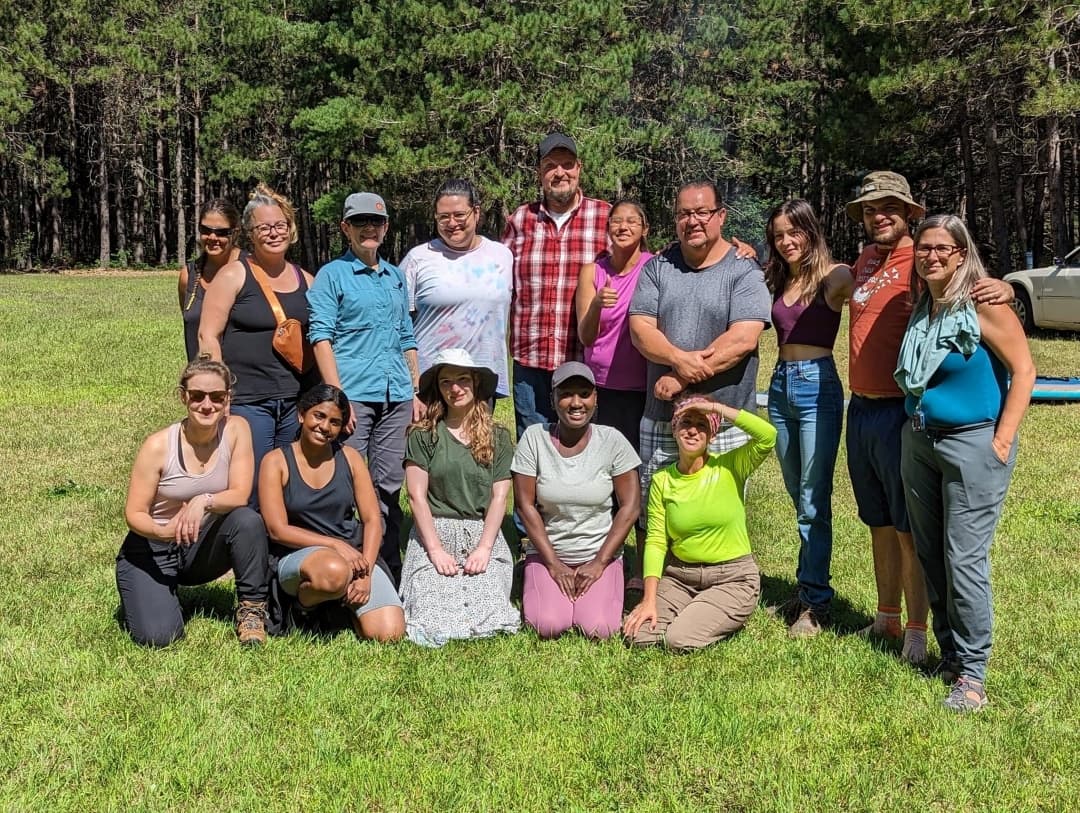
While warm summer breezes blew and city dwellers hugged their air conditioning units, while wildfires raged in the west and war continued to rage in Ukraine, 13 Algonquin College students embarked on a life-changing adventure. While they’d been strangers up until that point, they would soon become family. From Aug. 22 to 27, Algonquin College’s […]
Photo: Submitted by Caleigh Ward
Algonquin College's Pembroke campus hosted its first Indigenous Education Camp, from Aug. 22 to 27. Thirteen students embarked on a life-changing adventure. Pictured back row, right side, Brenda Slomka, Dawson Lemaire and Caleigh Ward, with 12 others in attendance at Pikwakanagan First Nation.

While warm summer breezes blew and city dwellers hugged their air conditioning units, while wildfires raged in the west and war continued to rage in Ukraine, 13 Algonquin College students embarked on a life-changing adventure.

While they’d been strangers up until that point, they would soon become family.

From Aug. 22 to 27, Algonquin College’s Pembroke campus hosted its first Indigenous Education Camp, allowing students to engage in transformative activities that deepened their understanding of Indigenous histories and provided emotional and spiritual fulfillment.

Areas of learning centered around residential schools & Sixties Scoop, the Seven Grandfather Teachings, the clan system, self-governance, forestry management and the Truth and Reconciliation Commission’s Calls to Action.

The camp, organized as part of the Mamiwi Maadaadizi Project, aimed to advance Indigenization efforts at the campus and foster reconciliation among all students and community members.

Over the course of six days, participants moved from the Pembroke campus to Pikwakanagan First Nation to Foy Provincial Park, where they immersed themselves in a diverse range of activities.

These included artistic expression through painting and journaling, sharing talents, partaking in ceremonial practices, sitting in circles, gathering around bonfires and participating in the Kairos Blanket Exercise.

Through these experiences, students were able to learn truths about Indigenous communities and their rich histories.

Caleigh Ward, a public relations student who attended the camp, expressed her heartfelt attachment to the experience. “It was so tough to leave,” she said. “I would go back every year – more than once a year.”

Ward highlighted the well-prepared nature of the camp, which provided ample food, gear and engaging activities.

The Mamiwi Maadaadizi Project, a collaborative effort between Algonquin College, the Circle of Turtle Lodge, Pikwakanagan First Nation, Mashkiwizii Manido Foundation, Ontario Parks and Queen’s University’s Health, Communications and Environments Research Lab (HEC Lab), played a crucial role in conceptualizing the camp.

The initiative aimed to embed Indigenous knowledge across the Pembroke campus, identify best practices for Indigenization, and foster reconciliation for all community members.

Murray Sinclair, former Canadian senator and commissioner of the TRC, emphasized the critical role education plays in reconciliation during a Zoom discussion with college students and staff on Jan. 30, 2023.

“Education got us into this mess. Education will get us out,” said Sinclair. “I said that on the final day of the Truth and Reconciliation Commission. Education is not about being in school. Education is about learning what it means to be a human being.”

This project aligns with the Ottawa campus’ efforts to integrate Indigenous ways of knowing into campus life, as seen through the installation of murals and the naming of streets after historically significant Indigenous names.

The funding for the Mamiwi Maadaadizi Project was provided through a three-year grant from the Government of Canada’s Social Sciences and Humanities Research Council (SSHRC).

The COVID-19 pandemic, however, meant that the camp was only able to be held once during the three-year grant period.

Brenda Slomka, program manager of applied research, innovation & entrepreneurship at the Pembroke campus, remains optimistic about the future of the camp.

“Finding future accommodations may be challenging but I want to stress the importance of finding a home that preserves the camp’s essence and maintains the meaningful partnerships and community relationships it has cultivated,” said Slomka.

For the participants, the highlight of the camp was the sense of community, where individuals formed deep connections with one another.

When Ward first arrived at the camp, she only knew one other person, Dawson Lemaire, an Aboriginal studies student.

“Dawson was the only person I knew going into it, but I came out with a whole family” she said. “We hope to all go camping together again this summer.”

She emphasized the genuine and judgment-free environment that allowed for open sharing among strangers.

Dawson Lemaire echoes Ward’s sentiment. “Everyone had something to bring to the table, and we really formed a family when we were there,” said Lemaire.

The camp’s impact resonated in the participants’ experiences with nature, where they encountered extraordinary moments filled with awe and wonder.

Lemaire recounted an episode when they all sang The Eagle song, and an eagle circled directly above their group, disappearing into the clouds.

Lemaire (in orange) and Ward (in purple) watch in amazement as the eagle circles the camp after singing The Eagle Song.

“We were all doing The Eagle song, and as we finished our final circle, the eagle came down and started circling exactly over our group before disappearing into the sky,” said Lemaire. “It solidified that we were supposed to be doing this. We were meant to be there, together. Like a fulfillment of prophecy. It was really emotional.”

Such experiences exemplified the powerful connection between the participants and the land.

While uncertainty remains surrounding the future of the camp, Slomka believes the groundwork has been established for ongoing progress.

Ward, too, remains hopeful, accentuating that as long as the program can provide a location and accommodations, she is ready to participate again.

-With files from Emanuelle Aubin Desousa

Wolves’ stellar defence leads to dominance over cross-city rivals

The Wolves men’s basketball team came out swinging against La Cité Coyotes on Dec. 1, scoring a 90-65 win after enduring a heartbreaking loss against their Ottawa rivals last month. “That last game really took a piece out of us,” said Wolves guard Riley Partington about their Nov. 10 loss to La Cité. “Coming back […]
Photo: Andrew Sorokan
Carter Normand jumps to save a ball going out of bounds. Normand finished the game with eight points, three rebounds and two assists.

The Wolves men’s basketball team came out swinging against La Cité Coyotes on Dec. 1, scoring a 90-65 win after enduring a heartbreaking loss against their Ottawa rivals last month.

“That last game really took a piece out of us,” said Wolves guard Riley Partington about their Nov. 10 loss to La Cité. “Coming back we were just like, we gotta get them this time.”

And the Wolves sure did.

They beat La Cité by 25 points in the Dec. 1 rematch, their second-biggest winning margin of the season.

“We came into this game knowing it was a must-win game because we’ve been on a little bit of a losing streak,” said Wolves guard Eddie Laurent.

Opening tip-off for the Wolves and Coyotes.
Opening tip-off for the Wolves and Coyotes. Riley Partington took the tip for the Wolves. Photo credit: Andrew Sorokan

The Wolves’ win mostly came from their two biggest runs in the first and fourth quarters.

La Cité came out strong midway through the first quarter and took a 17-11 lead over the Wolves. But the Wolves didn’t take long to get going. Algonquin went on an 18-2 run late in the first to take a commanding 29-19 lead into the second quarter.

The Wolves continued their hot streak early in the second quarter. They went on a 6-0 run out of the gate, extending their lead to 16 points and their run to 24-2.

The fourth quarter was also all Wolves. They played lockdown defence and held La Cité to only five points, outscoring them 21-5.

“We’ve been working all week on D, preaching D, preaching rebounds,” said Wolves head coach Trevor Costello. “Guys were dogs and they played hard.”

The Wolves struggled midway through the game and allowed La Cité back into it with only a six-point lead at the half. La Cité outscored the Wolves in the second quarter 23-19 despite the Wolves coming out hot.

“It’s the veteran guys on our team. We have guys like Simon (Desta), CJ (Gallaza)., Carter (Normand). All of those guys, they are talking to us. They are keeping our heads on straight. They are letting us know we still have this game,” said Laurent.

Wolves guard Sydney Abdedi Okongo takes a free throw. Abdedi Okongo finished the game second in points for the Wolves with 14.
Wolves guard Sydney Abdedi Okongo takes a free throw. Abdedi Okongo finished the game second in points for the Wolves with 14. Photo credit: Andrew Sorokan

The Wolves also beat La Cité in shooting percentage. They shot an efficient 44.4 per cent from three, compared to La Cité’s 18.8 per cent. The Wolves also shot nine points higher from the field, at 46.9 per cent.

The Wolves are done for the 2023 portion of their schedule. They will be back in action at home after the new year on Jan. 12 at 8 p.m.

“We have a month after this and we are happy we got to come out with a W. It’s a great feeling,” said Partington.

Solutions: Culinary students learn to cook mass portions while helping those in need

During their weekly food production classes, Algonquin College culinary management students learn to handle, prepare and serve dishes in bulk. Half of all dishes produced go to the college’s fine dining restaurant, Restaurant International, and the other half are served to people in need at Shepherds of Good Hope. The portions bound for the shelter […]
Photo: Noah Leafloor
Elizabeth Kamau, Luc Prevost and Omar Atyeh, left to right, make egg sandwiches for the Shepherds of Good Hope Foundation on Nov. 22 in H118.

During their weekly food production classes, Algonquin College culinary management students learn to handle, prepare and serve dishes in bulk.

Half of all dishes produced go to the college’s fine dining restaurant, Restaurant International, and the other half are served to people in need at Shepherds of Good Hope.

The portions bound for the shelter made by just one class can often feed up to 150 people. The college’s culinary program has four production classes where each group makes 150 meals. This means that a lot of hungry people in Ottawa can benefit from their efforts.

Almost two years ago, during the COVID-19 pandemic lockdowns, a partnership between the college’s culinary program was formed with the organization. The shelter had issues with volunteer limits and services necessary to operate their community kitchen. The students were able to step in to help prepare the food.

But what was supposed to be a temporary event has turned into an opportunity that benefits both parties.

Culinary students who make the Shepherds food feel value when doing it.

“I feel good after making the food because of all the people that eat it,” said Preetkamal Kaur, level-two culinary student. “Making different dishes for the first time, I want people to like it.”

“It feels good to combine all the ingredients,” said Kaur.

Kaur wants to open a bakery after she graduates because she loves to bake.

Following the weekly food-making, Shepherds collect Algonquin’s culinary food for their services.

“When Algonquin college students take the time to work with raw ingredients and turn them into nutritious meals, this alleviates pressure of staff and volunteers who can then focus strictly on getting the food on to the plates of those visiting the community kitchen,” said Bernie Forestell, senior communications manager of Shepherds.

“The relationship was mutually beneficial and worked so well, Algonquin started to make it part of their classes. The skill and expertise of the culinary program and it’s student had a direct and immediate impact on the people who visit Shepherds in search of a meal,” he said.

Gordon Richards, kitchen manager at Shepherds agrees.

“With the food Algonquin provides, we’re able to bolster our sandwich numbers, and have a few dinners per week made in a way we don’t, and using ingredients we can’t,” he said. “It has been a great help to us, not only from the meals provided to our service users, but from a stock and food waste/management perspective.”

In addition to operating the largest adult shelter, and the only one in Ottawa for all, Shepherds offers a range of services to those in need and is one of the largest supportive housing providers in Ottawa.

Though not explicitly for those experiencing homelessness, the Shepherds’ community kitchen stands as a vital resource for Ottawa during Canada’s ongoing homeless epidemic –– with 235,000 people experiencing some form of homelessness across Canada, as of 2023 according to Statistics Canada.

Nov. 21: The Shepherds of Good Hope building is where many people seek hospitality.
The Shepherds of Good Hope building is a place where many people seek hospitality. Photo credit: Chris Sokulski

With the help of donations and food collaborations, Shepherds supplied 330,000 meals through their community kitchen and housing programs, between 2022 and 2023, according to Forestell.

As a charity organization, Shepherds relies on volunteers and donations from sources across Ottawa – with $8,393,443 donated by the City of Ottawa between 2022 and 2023.

However, the organization is facing challenges too. Shepherds has lost 80 per cent of their volunteer service from the peak of COVID-19. Slowly they are building it back up. But with the rise of food insecurity, they can only help so many. Staff limitations are still an issue. And cooking is usually left to one volunteer or staff, while the rest do daily prep.

The Algonquin culinary program came through for Shepherds in one of their toughest times. But they have also came through for others.

The program reached notable charitable milestones over the years. For instance, in the spring students prepared 950 meals for the Ottawa Food Bank.

Today, the students learn contemporary food production once per week, and are primarily focused on the process behind bulk food production.

“The really nice thing about the students, is that built into our program is their need to cook food in quantity – we make certain we send larger meals to Shepherds of Good Hope,” said Scott Warrick, an Algonquin College culinary management professor.

“They get graded on the quality of the food, the amounts they’re making, and following recipes,” said Warrick. “Instead of making something for twelve, you’re making it for three hundred.”


Detailed information regarding donations, volunteering, and events is available through Shepherds of Good Hope’s official website.


Campus celebrates cultural diversity at fair

The International Education Centre brought back the Culture Fair on Nov. 23, following a well-received debut earlier this year. There are numerous cultures that make up the international community at Algonquin College. There were booths at the college dedicated to the different countries and cultures that are represented, along with games and foreign snacks. “We’ve […]
Photo: Zaynab Safa
Students show off their table with information about their people, food and country.

The International Education Centre brought back the Culture Fair on Nov. 23, following a well-received debut earlier this year.

There are numerous cultures that make up the international community at Algonquin College. There were booths at the college dedicated to the different countries and cultures that are represented, along with games and foreign snacks.

“We’ve done this in the past (at) the culture fair where students get invited to kind of put together a team, usually from their country of origin, and then they are encouraged to put together a booth that represents their country, as well as to bring in some snacks and anything that they really want to showcase that represents their culture/country,” said Leah Grimes, intercultural programming support officer with the International Education Centre.

Each year, educational establishments and governments worldwide celebrate International Education Week during the third week of November to acknowledge, honour and advance international education on a global scale.

“We’re showcasing the different things that are going on in the International Education Centre, we have cultural activities and events funds, where students if they have culture activities that they want to put on, we support them financially. They do all the planning and we help with logistics for booking spaces and stuff like that,” said Grimes.

Algonquin College demonstrates through the event the diversity of the student community. Domestic students get the chance to socialize with international students and educate others about their backgrounds.

“In this cultural fair, we want to represent our country which is Morocco, as an African country. It’s contributed in many things such as in the World Cup. A lot of people don’t know where Morocco is situated and we want to present them the many different cultures in our country,” said Safae Moudkar, a business management and entrepreneurship student.

Solutions: Learning about tap water helps students value, conserve and protect it

Tracy Webb used to teach science classes in Wolfville, N.S. Most of the time those classes were very similar to what millions of schoolkids in thousands of Canadian classrooms usually experienced. But once a year, her students had a very special class. A class that many of them would later call “the best class” in […]
Photo: Safe Drinking Water Foundation
Students get to test their local water quality and learn about the importance of water preservation. Here, a student is doing an arsenic test. “We are teaching students about the environment and our role in being responsible citizens,” Tracy Webb says. “They need to know what’s valid to be able to make informed decisions.”

Tracy Webb used to teach science classes in Wolfville, N.S. Most of the time those classes were very similar to what millions of schoolkids in thousands of Canadian classrooms usually experienced.

But once a year, her students had a very special class. A class that many of them would later call “the best class” in their end-of-year feedback.

They used educational water testing kits distributed by the Safe Drinking Water Foundation to test their local water.

This might not sound very exciting at first, but students loved it.

A couple of days before the class, Webb would ask five volunteers to bring water samples from their homes. The school had a large feeder zone, so she would try to have samples from different geographical areas in and beyond Wolfville.

The students would then put on some lab coats and safety goggles and do some science.

They would test the samples from their kitchens and bathrooms for alkalinity, ammonia, arsenic, copper, iron, manganese, nitrate, sulphate, chlorine and other things the municipal governments usually test the water for.

Student doing an alkalinity test.
A student doing an alkalinity test. Photo credit: Safe Drinking Water Foundation

“The students would get into debates. ‘Oh my God, look at my water, I’ve got so much chlorine. It’s gross!’” Webb said, remembering her students’ comments.

Webb would then ask them: “Why do you think there’s so much chlorine in your water? What time of the year is it? Is it in the spring when they’re trying to get rid of any algal blooms (seaweed-like organisms) in the water?”

Webb is the longest-serving board member of the Safe Drinking Water Foundation. She has dedicated 20 years of her life to the foundation whose goal aligns perfectly with her own – to educate.

“We are teaching students about the environment and our role in being responsible citizens,” Webb said. “They need to know what’s valid to be able to make informed decisions.”

When the Foundation was created in 1996 its purpose was to help developing countries with their water issues. However, soon the founders felt the need for more “environmental education, public awareness and environmental literacy” here in Canada, according to the foundation’s executive director, Nicole Hancock.

The foundation has created educational water testing kits that they send out to schools across Canada. Those kits have reached more than half a million students in more than 3,100 schools.

Safe Drinking Water Foundation has created educational water testing kits that they send out to schools across Canada. Those kits have reached more than half a million students in more than 3,100 schools.
“We are teaching students about the environment and our role in being responsible citizens,” says Tracy Webb, the longest-serving board member at the Foundation.
Source: Safe Drinking Water Foundation
Safe Drinking Water Foundation has created educational water testing kits that they send out to schools across Canada. Those kits have reached more than half a million students in more than 3,100 schools.
“We are teaching students about the environment and our role in being responsible citizens,” says Tracy Webb, the longest-serving board member at the Foundation.
Source: Safe Drinking Water Foundation Photo credit: Arty Sarkisian

Four schools in Ottawa have received the kits recently and are planning to use them in the upcoming year.

The foundation is always surveying the participating students before they get the classes.

The question is simple: “Where does your water come from?” Less than four per cent can answer.

That’s also one of the first questions professor Catherine Eimers asks her second-year students in her water resources class at Trent University.

“Knowing the source of water where you’re drinking from pushes people to try and protect it,” said Eimers.

However, even in the university students are unable to give the source.

And the source – Otonabee River – flows right through their campus.

“Ignorance is a big threat to our drinking water,” Eimers said. “Students should have more information about drinking water so that they can make good choices.”

Eimers says there can be a lack of trust in municipal water, and it’s prompting people to buy bottled water and contribute to plastic pollution even though it’s not necessarily better.

“Bottled water is not tested as well as tap,” she said. “It’s treated as food and there is less scrutiny.”

So, Eimers thinks that the program’s main benefit is that students are learning that they can and should trust in the quality of the tap water.

“Municipal drinking water is so heavily tested that it would be very difficult nowadays post-Walkerton for a contaminant to slip through,” Eimers said.

She is referring to the drinking water contamination in the City of Walkerton in south-east Ontario in May 2000. That spring more than 2,300 people fell sick in this community of 5,000. Seven died.

After that, Ontario adopted the Safe Drinking Water Act implementing mandatory drinking water testing standards in all communities. Now the drinking water has to be tested every six hours which adds up to more than 6,000 times a year.

The kits are not intended as something that would be able to spot dangerous pollution in a water sample. Students can’t follow all the necessary procedures required to accurately test the water. However, using them to test samples can still give them an idea of how the process works.

Webb always calls them “science in the box.”

The prices for these “boxes” vary from $76 to $170 for a single class.

Most of the distributed kits are sponsored by independent charities, individual donors or the schools themselves. But still, the number of sponsored kits is limited and occasionally teachers who want to incorporate those kits in their classes have to pay the full price themselves.

“That is a huge limitation,” Webb said. “Teachers either choose to pay for the kit out of their own pockets or just don’t do it.”

Nicole Hancock, president of the Safe Drinking Water Foundation, provided an in-depth interview about the purpose and future of the water testing kits. You can listen to it in an audio version of the article:

Leadership program promotes idea that ‘anyone can become a leader’

Algonquin College students and professors gathered for a presentation about the Mindtrust Leadership Development Program (MLDP) at the AC Hub on Dec. 1. Founded in 2001, Mindtrust is a charity that is focused on providing youth leadership development programs. With other programs run by Mindtrust, such as the Youth Leadership Program and the Mentorship Program, […]
Photo: William Bailey
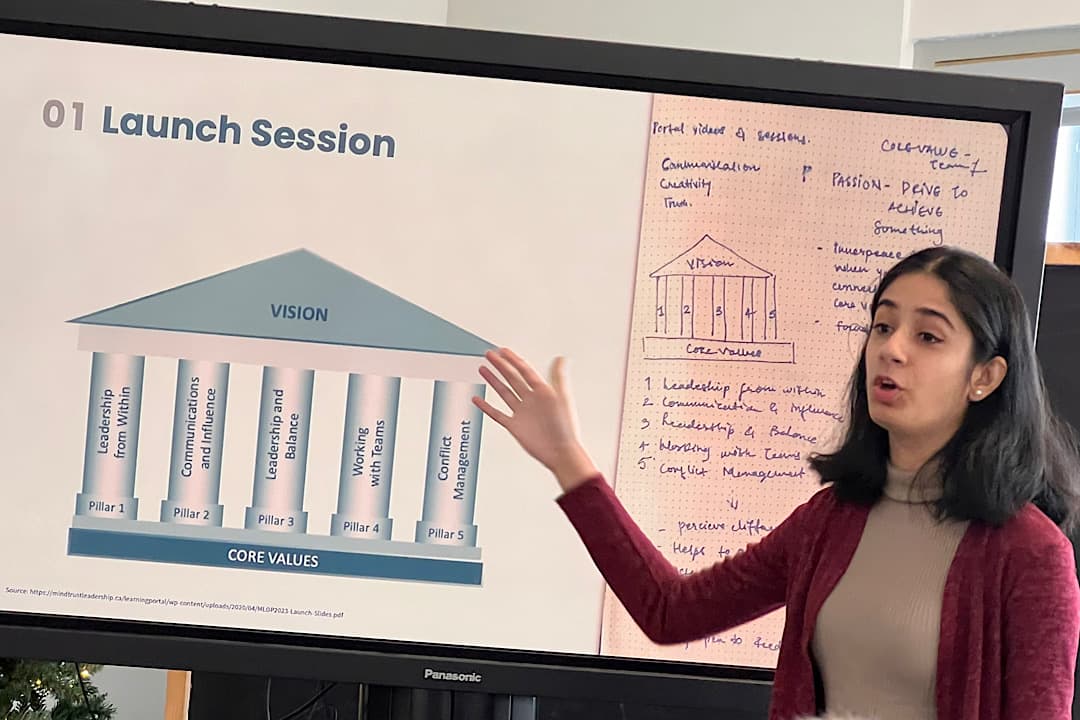
“Learning about leadership is a great way to get involved with the community and help grow self-confidence," said Miti Akhani, a student in the Mindtrust Leadership Development Program’s 2023 session.

Algonquin College students and professors gathered for a presentation about the Mindtrust Leadership Development Program (MLDP) at the AC Hub on Dec. 1.

Founded in 2001, Mindtrust is a charity that is focused on providing youth leadership development programs. With other programs run by Mindtrust, such as the Youth Leadership Program and the Mentorship Program, the MLDP dives into the basics of what it truly means to be a leader.

“The program itself is a hybrid program, with seven modules total,” said Matthew Haw, Mindtrust’s director of programs and technology.

“Modules one, four and seven will be delivered in person, at the University of Ottawa, Carlton University and Bayview Yards respectively. The other four modules will be delivered through Zoom. As long as you have some interest in leadership, this program is for you.”

The first module is a launch session, where students learn about the characteristics of a leader.

Module two dissects this further by teaching what makes a great leader.

The third module focuses on communication and how can one’s influence lead others.

Module four is all about team collaboration and how to work effectively in groups.

The fifth module teaches about balanced leadership and how to maintain a work/life balance.

Module six consists of learning how to use leadership skills to manage conflict.

In the final module, students present leadership statements to the class, stating what being a leader means to them.

Although the MLDP stresses attendance and active participation, one’s success of this course is not determined through evaluations or letter grades, but through feedback.

“It is important to realize that this is not management, this is leadership,” said Jason Abt, Mindtrust’s director of funding.

“In management, you’re a line manager and people are reporting to you from an organizational standpoint. The MLDP has nothing to do with that. This is about helping a group of people trying to achieve some kind of common goal. Whether you’re a designated line manager of an organization or not, it makes no difference at all. But through our lives, we have the opportunity to help people around us and that’s by showing leadership in our professional or personal lives. Every leader can be a manager, but not every manager is a leader.”

Miti Akhani, a student in the MLDP’s 2023 session, believes anyone who signs up will be in for a life-changing experience.

“Anyone can become a leader,” she said.

“Learning about leadership is a great way to get involved with the community and help grow self-confidence. Being in this program has helped me break boundaries and be more vocal than ever before. It’s tiny changes like this that can really make you feel better about yourself.”

Thirty spots are available for Algonquin College students to sign up for the 2024 session, but you must be within six months of graduating to be eligible. The first module will be covered at the University of Ottawa on Jan. 19.

Students look ahead to holiday events on campus and surrounding city

With the fall semester wrapping up and the holiday season upon us, students are looking for fun activities to take part in and enjoy the most wonderful time of the year. “I was a fan of Christmas as a child, but now that I am older, I mostly enjoy the family time,” says Shelby Johnston, […]

With the fall semester wrapping up and the holiday season upon us, students are looking for fun activities to take part in and enjoy the most wonderful time of the year.

“I was a fan of Christmas as a child, but now that I am older, I mostly enjoy the family time,” says Shelby Johnston, an early childhood education student. “My family enjoys participating in fun events like going to see Christmas lights or watching Christmas movies together.”

While many students are excited to wrap up the fall semester and spend time with their loved ones, some won’t be able to do that until well into December.

“I am living away from my family to go to school here in Ottawa and I am missing the tree decorating, the baking and everything while I am here at school,” says Stephanie Pedneault, a hairstyling student. “Being away from family is always tricky this time of year so I am always looking for something festive to do.”

For students who enjoy the holiday season and are looking for ways to relieve stress while enjoying this time of year, there are options.

Here are three things you can do on or near campus this holiday season.

Annual Christmas Tree Lighting

The AC Hub and the Students’ Association have organized the 12th Annual Christmas Tree Lighting event that will take place on Dec. 4 in the Algonquin College Student Commons. The event will be held from 3 p.m. to 6 p.m. and will include activities like festive face painting, a gingerbread house-making contest, stories and photos with Santa, hot chocolate, cookies and music.

“I like that the SA is creating events like this for us,” says Matthew Baker, a business student. “Who doesn’t want to watch a giant tree being lit? Events like that start the holiday season off right.”

The Nutcracker

The Algonquin Commons Theatre and Trio Danceworkers present the Nutcracker Ballet on Dec. 9 and Dec. 10. The story follows a young girl, Clara, as she falls asleep at a Christmas party and dreams that her Nutcracker doll comes to life to defend her from an army of rats.

“All our ballet students over the age six have the opportunity to perform. Our students appreciate the opportunity to participate in a professional-quality full-length ballet, and an opportunity not available at other ballet studios,” says the Trio Danceworkers website.

Ottawa Christmas Market

The Christmas Market is back in Ottawa and there are a ton of things you can do at Landsdowne Park this holiday season. The market runs from Nov. 24 to Dec. 31 and will hold many different exciting events, like performances from local stars, pictures with Santa and shopping at more than 45 vendors.

Students’ Association helps wrap up the term with Food Cupboard fundraiser

The Students’ Association offered a gift wrapping station at the Holiday Market in the Student Commons on Nov. 29 to raise money for the campus Food Cupboard. “This year we hosted our second annual Holiday Market and had the idea to set up a gift wrapping station alongside the event,” said Amanda Logan, events programmer […]
Photo: Guillaume Laflamme
Matteo Mongroo and Veronica Sanchez offer gift wrapping services in exchange for donations to the campus Food Cupboard during the Holiday Market.

The Students’ Association offered a gift wrapping station at the Holiday Market in the Student Commons on Nov. 29 to raise money for the campus Food Cupboard.

“This year we hosted our second annual Holiday Market and had the idea to set up a gift wrapping station alongside the event,” said Amanda Logan, events programmer for the Students’ Association, in an email. “The holiday season is also a giving season, therefore we thought this was the perfect opportunity to collect donations for our Food Cupboard.”

The new initiative came as a surprise for many students who were caught off guard by the offering from the Students’ Association.
The new initiative came as a surprise for many students who were caught off guard by the offering from the Students’ Association. Photo credit: Guillaume Laflamme

The gift wrapping station offered a fun way for people to donate canned goods, as well as clothing items and monetary donations in exchange for having their presents wrapped.

“It’s a gift wrapping drive so students, faculty or anybody can come and make a donation to the Food Cupboard, either a monetary donation, a clothing item or a food item,” said Matteo Mongroo, an events assistant for the Students’ Association and a student of the commerce marketing bachelor’s program.

The new initiative came as a surprise for many students.

“It’s been busy so far. A lot of students that came today didn’t know that this was going on, so they didn’t have anything to donate. Like for example, not a lot of people carry cash. If we were doing debit or credit people would be able to donate,” said Mongroo.

Eventually, anyone could get a gift wrapped without making a donation.

“We kinda switched it now so anyone who wants to can come by and just get (presents) wrapped,” said Mongroo.

Veronica Sanchez, event assistant for the SA, was excited about the opportunity to help wrap gifts for students.

“I love it, I think it’s very useful,” said Sanchez. “I think most people struggle with wrapping presents for Christmas, or it’s the annoying part of giving a present. Maybe you don’t know how to wrap it correctly, so having somebody who has an idea, is very helpful.”

The Students’ Association was happy about how the event unrolled and are looking at the possibility of holding gift wrapping drives in the future. “Overall, we are quite happy with how the gift-wrapping station went. We won’t have another this year, but we will consider bringing it back for next year!” said Logan
“Overall, we are quite happy with how the gift-wrapping station went. We won’t have another this year, but we will consider bringing it back for next year!” said Amanda Logan, events programmer for the Students’ Association Photo credit: Guillaume Laflamme

“Also it’s for free and it’s for a good cause, which is the Food Cupboard. We’re really happy to help the Food Cupboard and the students at the same time,” she added

“Honestly it’s great,” said Mongroo. “Like me personally, when I used to wrap gifts I was terrible at wrapping. I would shove it all together and put them under the tree. So there are people that are still like that out there. So it’s kind of a great opportunity for them to get their gifts wrapped almost professionally I would say, while still supporting a good cause right? So it’s like a win-win situation.”

“Overall, we are quite happy with how the gift-wrapping station went. We won’t have another this year, but we will consider bringing it back for next year,” said Logan.

Algonquin Times podcast
Follow Algonquin Times on Instagram
Algonquin Times horoscopes
Algonquin Times on Instagram
Follow Algonquin Times on Instagram
Algonquin Times on Instagram
Algonquin Times horoscopes
Algonquin Times podcast

Stay Informed

Sign up for our newsletter

Subscribe

* indicates required