Students encouraged to plan post-graduation life through career counselling
November was recognized as global “career month,” with schools holding events to highlight the initiative. At Algonquin College, Counselling Services helped students choose small, doable steps that will add up to a significant impact on putting them on the correct career path in the future. Counselling Services encourages students to participate in their top career […]
Photo: Zaynab Safa
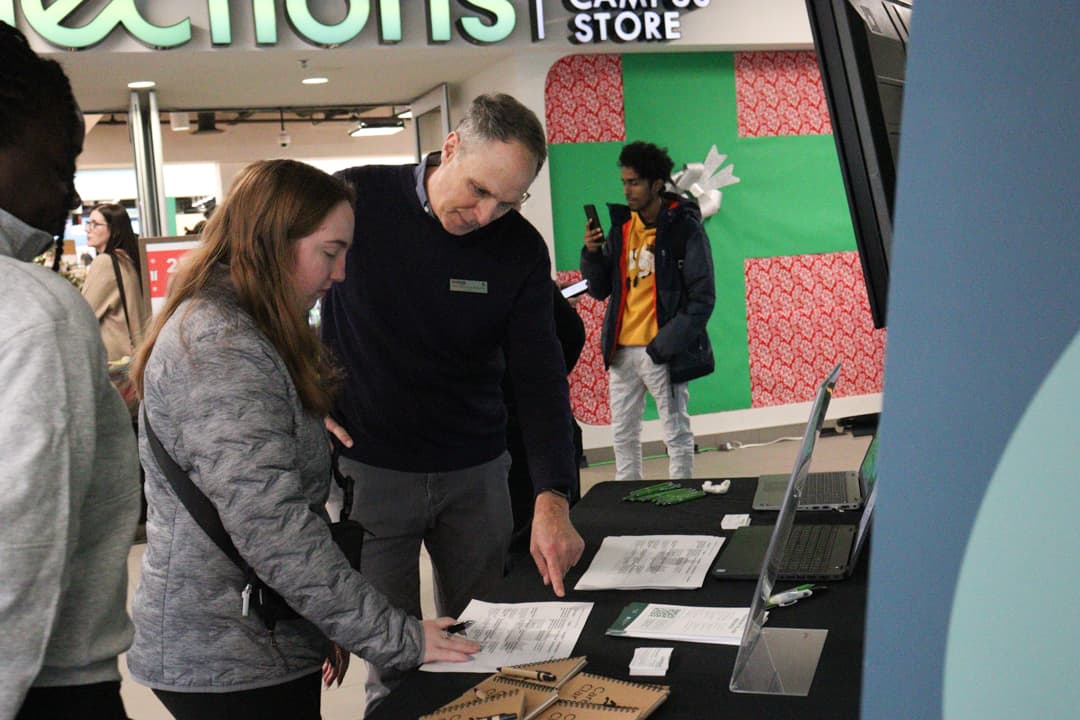
David Glickman, a counsellor, guides a student step by step during a "career month" event.

November was recognized as global “career month,” with schools holding events to highlight the initiative.

At Algonquin College, Counselling Services helped students choose small, doable steps that will add up to a significant impact on putting them on the correct career path in the future.

Counselling Services encourages students to participate in their top career priority activity.

“What we hope to do is to raise awareness about steps that people can take to move towards their career, so to get people ideas and suggestions and then they can choose from a menu of options and then walk away with a plan,” said David Glickman, a career and academic counsellor.

According to statistics by the careers exploration website AllAboutCareers.com, 44 per cent of undergrads are unable to identify the industry they would like to work in after graduating.

“We want students to walk away with some ideas and action steps that they can take, because a lot of students wait until graduation to come up with a plan and so there’s a lot of things that you can do well before you graduate. But we understand the focus on studies and prioritizing finding a job or taking steps while in school but there’s a lot of steps that people can do,” said Glickman.

Peace Lyunade, a volunteer who was helping during a career month event, said students often don’t plan beyond their academic careers.

“It’s career month, and most students don’t really have an idea about what their going to do after graduation and most of the time everyone assumes they know what their going to do, but the thing is, you have to plan ahead and so this initiative is to just let them know where they are at right now and what steps to take and to speak to a career counsellor, it’s just to help know what they are going to do before graduating,” said Lyunade, a computer programming student.

One of Melissa Spears’ specialties is career counseling. Spears said career decision-making and planning are specific to each person. It’s not a one size that fits all.

“November is globally career month and so we are having lots of different activities celebrating just the importance of career development and finding purposeful and meaningful work in the future and so one of our events today is just identifying some quick career priorities some things students and others can do that can help with moving towards their future career,” said Spears, who is a counsellor.


First Person: What happens when your soccer career doesn’t go as planned?

When I was 13 years old, I knew what my passion was. That passion was running as hard as I could and winning the ball to make a pass. Most people growing up don’t have a clue what they want to be when they got older. But I knew. From something that just started as […]

Photo: Alex Lambert
Everything happens for a reason. Embrace what life has in store for you.

When I was 13 years old, I knew what my passion was. That passion was running as hard as I could and winning the ball to make a pass.

Most people growing up don’t have a clue what they want to be when they got older. But I knew.

From something that just started as a hobby quickly turned into my whole life. Something that I couldn’t go a day without thinking about. When I was working, in school or just doing everyday life activities, soccer would always be on my mind.

When I was 15 years old there was nothing I wanted more than to be a professional soccer player. It was something I manifested to the point where I thought it was inevitable. I trained almost every day from early mornings to late nights to pursue my dream.

However, at 18 years old, reality hit. I was playing for Futuro, which was a very good team in Ottawa. I did my job. I worked harder than anybody and played my best on the pitch. But although I had some college interests, I was not willing to move away because I didn’t want to leave my family and friends. I knew play time would be limited as I would be a new player and it wasn’t something I was willing to sacrifice leaving my loved ones.

So, I made that decision and after that, my life changed. I went from playing something every day to just stopping. Not only did I stop doing what I loved, I had to find another career choice.

I know that other students or people my age have change their goals when they get older but It feels a bit more different when you visualize a blueprint, and the idea doesn’t go as planned. Now, what I have to figure out and others like me, is what to do with uncertainty after have being so focused for so long.

Like me, Matin Ljajic, made the decision to change his goal.

“I got an opportunity to go to Portugal to tryout to play soccer professionally. I played there for two weeks and played very well with my age group,” said Ljajic

“The team really liked the way I played. They invited me back for another two weeks to tryout with the first team. The coaches were telling me how much they wanted me on the team.”

“They offered me a U23 contract which was only 50 euros a month. I didn’t want to take it. I was only going to sign there if it was for the first team because 50 euros a month would not be livable as an 18 year old with no education yet.”

“Now I am uncertain if I will get another opportunity again, I will keep working hard and see what will come from it.”

David Shvartsman also made a choice.

“Soccer here in Canada is very expensive. If you want to be professional, you need to play for the best teams which cost a crazy amount of money,” said Shvartsman.

“I probably had enough to be able to pay that amount, but I just didn’t think it was worth it. I didn’t want to pay that much just for nothing to come from it. I made a choice not to fully pursue it.”

In my case, soccer was my life, I wanted to do something that involved the sport. I took the journalism program at Algonquin College to write about soccer and sports.

This was something I really enjoyed. When I think everything is going right, another roadblock hits. I learnt the difficulty of securing a job with a sustainable salary while writing about sports.

I have a coaching job that I do which I really enjoy. It’s for sure something I can see myself doing for a very long time. There could be ways I can make it a career, but it’s most likely to end up a hobby.

This is where my uncertainty lies. I have opportunities to do jobs that I like but won’t likely make enough financially.

This uncertainty won’t be for long. I will find a way. I always do in the end.

First Person: Fungi can help us or harm us but they’re always fascinating

While stepping over the large roots holding up the Merrickville forest last August, cracking twigs as I walked, I stumbled upon a body. Not human, but once alive all the same. A rabbit corpse laid in front of me, its pungent smell yet to be dragged from its bones like the coyotes did to its […]
Photo: Mathew Dicsi
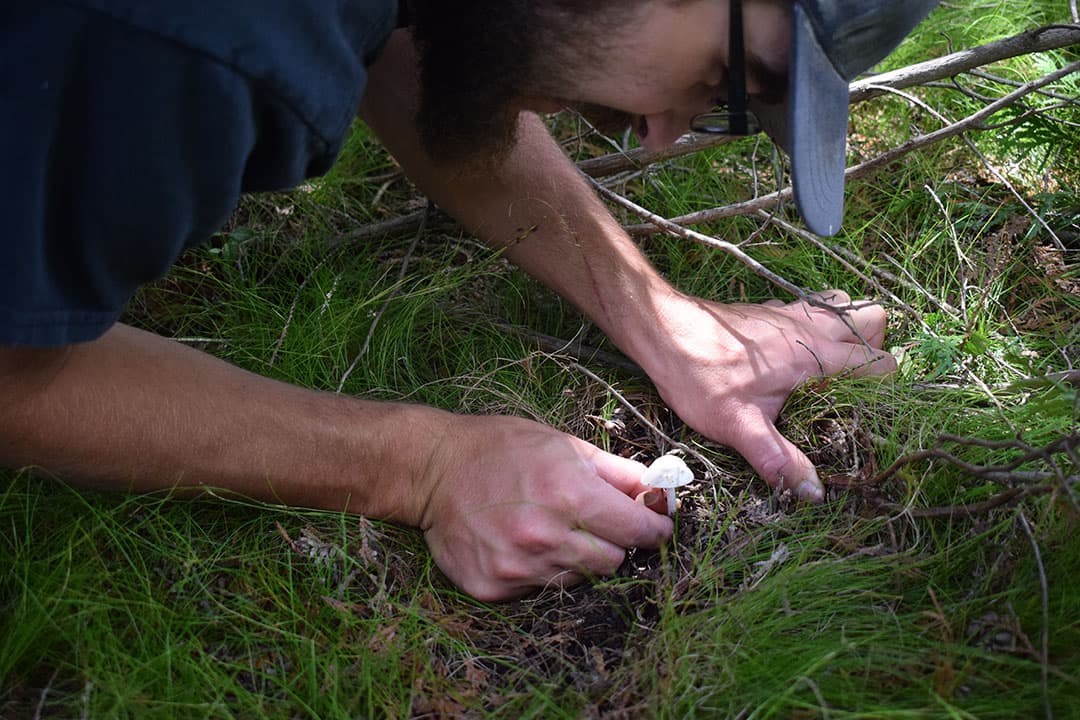
Ottawa-based forager, Gabe Roulston, 19, picks a young meadow mushroom.

While stepping over the large roots holding up the Merrickville forest last August, cracking twigs as I walked, I stumbled upon a body.

Not human, but once alive all the same. A rabbit corpse laid in front of me, its pungent smell yet to be dragged from its bones like the coyotes did to its flesh.

Yet out of this horrid display stemmed a small show of beauty in the form of mushrooms, growing around the body, feeding off its nutrients. Despite the disgusting scent of rot, I couldn’t help but appreciate how beautiful nature’s recyclers are.

I have always been fascinated by fungus, but only fell in love with it ethrough early high school. Originally, mushrooms were this weird, creepy, unlovable plant that I would kick every time I saw them.

The ones around my home, and most kickable, were the Coprinus comatus – otherwise known as the Shaggy ink cap. These mushrooms look like they perpetually shed their skin while getting blacker and blacker the lower down the cap they go. While edible, they begin to decay once picked, and they’ll turn to an odorous black sludge within 10 hours. Seeing this when I was eight years old left me with nightmares for weeks.

What if I turned into sludge too? Would it hurt? Can I still watch my cartoons as sludge?

My creepy feelings around mushrooms were proven valid in recent years with fungus being adopted by the horror medium with shows like The Last of Us and The Blob along with books like What Moves The Dead by T.kingfisher and Mexican Gothic by Silvia Moreno-Garcia.

“There are thousands of mushrooms and millions of fungi, most of which we don’t see,” said Charles Naesmith, an Algonquin College professor who teaches the general elective course Fungus Among Us. “Like an apple tree shows apples, the mushroom is the fruit that fungus decides to show us.”

Some of these mushrooms are downright nasty, like the Hydnellum peckii, otherwise known as a bleeding tooth. A fitting name for this white, porous mushroom loosely resembles a tooth. The only difference is this tooth exudes a blood-like liquid to spread its spores. While we don’t know exactly why this liquid is red, it is speculated the colour helps to attract bugs who then spread their spores even more.

“When people think of fungus, they think of gross and weird,” said Brooke Caicco, an interior design student.

“These are organisms that aren’t interested in our interest of them, they just do what they do,” said Naesmith. “They can harm us, and they can help us, but they are what they are.”

A crop of witches hats sprouting out from the Merrickville Forest
A crop of witches hats sprouting out from the Merrickville Forest. Photo credit: Mathew Dicsi

But the creepiest fungus of all is the Cordyceps.

Most commonly found in ants, Cordyceps will infiltrate the nervous system of an insect before cutting off the brain’s connection to the muscles. Once the creature is immobile, the Cordyceps release chemicals in the brain, taking control of the creatures’ movement and bringing them to an area with perfect humidity and temperature for the Cordyceps to grow.

The creature will be forced to chomp down as hard as possible to lock their body in place before the Cordyceps begins to bloom, sprouting a cream coloured mushroom from the head of its victim, and spreading its spores. Through this entire, excruciating experience, the insect stays alive and conscious, but the Cordyceps stole the wheel.

“You’ve got a fungus that in it’s own evolutionary pathway, alters socialized insects like ants,” said Naesmith. “It doesn’t just kill them, but changes what insects do to the benefit of them.”

If you were thinking Cordyceps would make a great antagonist for a thriller, you’d be right.

With the recent Last of Us television adaptation, Cordyceps have been getting a lot of love. The show takes place in a postapocalyptic world following a zombie-like infection caused by Cordyceps infecting humans These zombies lose control once infected, as the Cordyceps’ hyphae (roots) burrow their way to the brain from underneath the skin, taking control of the muscles. Once fully infected, the no-longer-human sprouts these greyish orange mushrooms around the head, the same way real Cordyceps would to insects.

“It’s scary real,” said Gabe Roulston, an Ottawa-area forager. “We eat a lot of fungus as humans and the human body is unpredictable. Who’s to say Cordyceps won’t evolve and affect us too.”

The Last of Uslove is far reaching, even hitting Algonquin College in this years Halloween costume contest where first place went to Grace Thompson, an illustration concept student, and her zombie costume including the Cordyceps growing out of her head.

Though some find fear in fungus, others find beauty.

“Seeing fungus makes me imagine a weird world where people could live in it. It’s a whole new world,” said Roulston.

What is strange to some, is safe to others.

“Mushrooms give off a homely vibe,” said Caicco. “The Smurfs had the right idea.”

December Horoscopes

Top 10’s

As exam season approaches, students are scouring the halls for the best study spots. Here are the top ten study spots on campus to help you stay productive and ace those exams:

As exam season approaches, students are scouring the halls for the best study spots. Here are the top ten study spots on campus to help you stay productive and ace those exams:

  1. The Students Commons 
  2. The AC Hub
  3. Silent Study Room (A Building)
  4. Student Learning Center
  5. Algonquin Library
  6. Club and Community Center 
  7. Minto Hall
  8. Corner Lounge (Behind Starbucks)
  9. Classroom Spaces (T Building)
  10. Highchairs (located by Bits n Bytes)

Hunter Brothers bring the country into Algonquin Commons Theatre

Smoke, strobe lights and a packed theatre of fans wearing camo, plaid and cowboy boots gave the Hunter Brothers concert at the Algonquin Commons Theatre on Dec. 2 a country feel to a city venue. The concert was one stop on the band’s cross-country Canadian tour to promote its new album Burning Down the Barn. […]
Photo: Rebekah Houter
The Hunter Brothers bring their best to the Algonquin's Commons Theatre on Dec. 2.

Smoke, strobe lights and a packed theatre of fans wearing camo, plaid and cowboy boots gave the Hunter Brothers concert at the Algonquin Commons Theatre on Dec. 2 a country feel to a city venue.

The concert was one stop on the band’s cross-country Canadian tour to promote its new album Burning Down the Barn.

All ages came out, with 11-year-old Julie Rickard saying it was her first time at a concert.

“Probably Born and Raised,” she said about her favourite song. “Or Lost. I really like Lost.”

A long line formed even before the doors opened at the apparel booth, lined with sweaters, baseball caps, toques, t-shirts with “Hunter Brothers” on them and even baby onesies reading “Born and raised.”

The night began with Jake Vaadeland and the Sturgeon River Boys opening the show with an arrangement of original bluegrass songs and getting the crowd on their feet with the fast-paced tunes.

Vaadeland, a recent winner of the Roots or Folk Artist of the Year for 2023 from the Saskatchewan Music Awards, said he faced no small amounts of criticism growing up but learned how to stay true to himself and take his passion and unique style and make a career.

“Follow your heart and do what you are good at. Education is good and I’m only 20, but don’t let it hinder what you are good at,” said Vaadeland. “We don’t need to be cookie cutters. Everyone needs to have their own unique part to make the world a real special place.”

The Hunter Brothers opened their set with Long Way Home and Northern Lights, with some people waving posters, and one young fan holding up a sign reading, “Why’d the chicken cross the road? To get to this party,” lyrics from the hit song Burn Down the Barn.


The energetic brothers from Saskatchewan brought people to their feet, with fans dancing and singing along and some audience members getting involved with the act.

Alberta-born-and-raised Mackenzie Salmon and her boyfriend of six years, Brett Young, came up from Montreal to take a break from school and enjoy the evening together, but became part of the act when lead singer Ty Hunter got Young to sing an opening line of Salmon’s favourite song Northern Lights.

“A little nerve-wracking,” said Young about how he felt about singing for the crowd. “There’s nothing else you can do other than sing on the spot.”

Young added while he would prefer to see a country show out west in the open air, country music is good wherever you end up.

“The outside venues are always a little bit better to get the atmosphere, but it’s always good. Wherever you go it’s always good,” said Young.

“We love the Hunter Brothers, they are honestly my favourite band of all time,” said Salmon. “We’ve seen them a couple of times and I was excited when I heard they were doing a tour across Canada and this was the closest place. I was like, we have to go.”

Salmon said she is in the middle of her final exams in her dentistry program in Montreal and the concert was a nice break from exam studying.

“I would recommend a Hunter Brothers concert to anyone, no matter what you’re going through. It’s a good thing to stress relief and live in the moment,” said Salmon.

“It’s like a piece of home listening to their music.”

African Student Association organizes first paint-and-sip event

In a lively and colourful celebration of culture and creativity, the African Student Association (ASA) organized its first-ever paint-and-sip event on Nov. 24, with students creating their own paintings and having drinks in the B-Building. The event aimed to bring students together for an evening of artistic expression and community building. “This is the first […]
Photo: Naomie Twagirumukiza
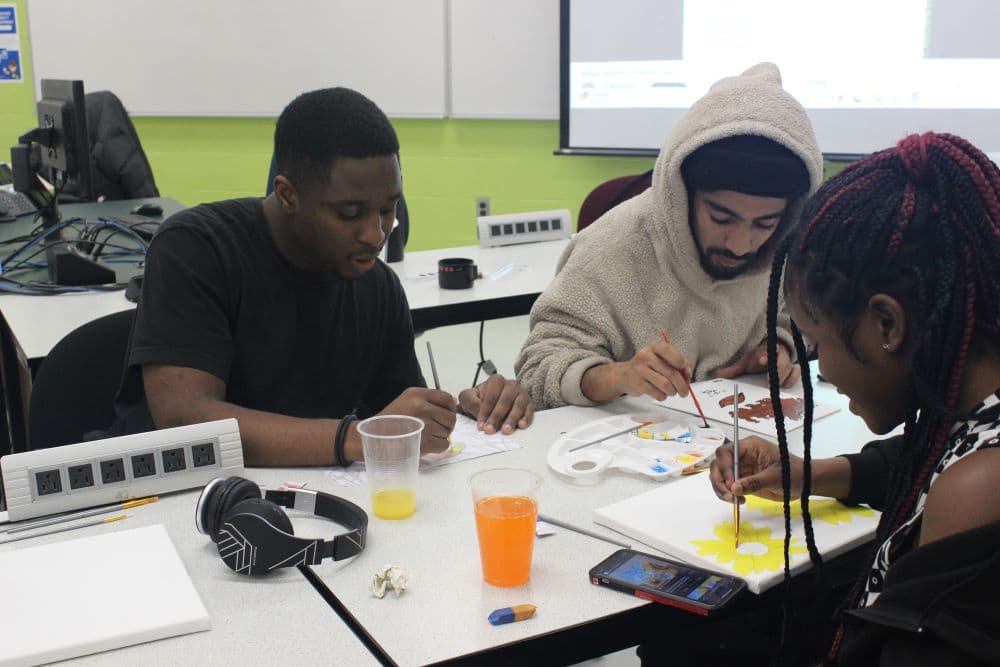
The paint-and-sip event not only showcased the artistic talents within the ASA community, but it also served as a reminder of the importance of fostering connections and providing support for international students

In a lively and colourful celebration of culture and creativity, the African Student Association (ASA) organized its first-ever paint-and-sip event on Nov. 24, with students creating their own paintings and having drinks in the B-Building.

The event aimed to bring students together for an evening of artistic expression and community building.

“This is the first time organizing an arts and crafts type of event,” said Elsie Mukomeza Akuzwe, the vice-president of the ASA. The initiative was part of ASA’s ongoing efforts to create a sense of community among African students.

Despite the lower turnout, the atmosphere was vibrant, with attendees expressing enthusiasm for the unique event.

“The turn-up was not as much as we expected, but I also think the choice of the day was what affected it the most,” Akuzwe said about the attendance.

Assumpta Nwokorie, a business management and entrepreneurship student who has been attending ASA events for some time, expressed her appreciation for the community and the connections she has formed.

“It was better than I expected. I loved the people I met there,” Nwokorie said of the event.

The paint-and-sip event not only showcased the artistic talents within the ASA community, but it also served as a reminder of the importance of fostering connections and providing support for international students.

“ASA is a community, and we mostly hang out and have fun. We also focus on helping newcomers if they have any questions about Canada. There are a lot of international students from Africa, and it is good for them to have support and a community to go to,” Akuzwe said, shedding light on the broader mission of ASA beyond just organizing events.

New mental health crisis hotline, 988, now available

The Canadian Radio-Television and Telecommunications Commission adopted 988 as the new mental health crisis and suicide prevention hotline as of Nov. 30, 2023. Those who call or text 988 will be redirected to one of several mental health crisis services based on the caller’s area code and availability of services. “Right now, unless you are […]
Photo: Melinda La Riccia, Oniqua Kanmaka, Victoria Fancy and Mehdia Htibe sat in the college's Mental Health Resource Centre on the third floor of Student Commons. Photo credit
Left to right

The Canadian Radio-Television and Telecommunications Commission adopted 988 as the new mental health crisis and suicide prevention hotline as of Nov. 30, 2023.

Those who call or text 988 will be redirected to one of several mental health crisis services based on the caller’s area code and availability of services.

“Right now, unless you are suicidal and they know that, you won’t be getting help – you’ll be on a waitlist for like three years,” said Melinda La Riccia, an early childhood education student speaking about the mental health crisis service providers who answer the phone. “They just don’t have the resources to deal with the people in distress.”

However, the federal government is trying to rectify this.

The Canadian government will be investing $156 million to the Centre of Addiction and Mental Health over the next three years in support of the 988 change. All calls and texts to 988 are free of charge, with long-distance charges being settled at the cost of the service provider.

Service for 988 will be available 24/7 including culturally appropriate care for certain groups and Indigenous communities across Canada.

“It’s important because mental illness doesn’t work on a set schedule,” said La Riccia, of the 24/7 service.

“I come from an immigrant background and back there it was seen as like, if you seek help, you’re deemed one level shy of Joker-like insanity,” said Mehdia Htibe who is interested in apply to computer engineering technology. “Now, even though Canada lets you be as open as you can, you still have those scars of the handcuffs from back then.”

With the decline of Canadian mental health since 2018, new mental health services are needed more and more every day.

Photo credit: Mathew Dicsi

[StatCan, NLM, StatsCan]

“It’s good to seek support right away, as soon as you can,” said Victoria Fancy, a bachelor of early learning and community development student. “It doesn’t have to be a professional at first. It could be a friend or maybe a family member, but it is always good to have support systems where you can talk to someone.”

“Holding it in will cause an eruption,” said Ahmed Elbadri, a student success specialist for media and design. “Having someone to talk to is a good thing. whether it’s a professional, a friend, or a support line like 988.”

The Canadian 988 number implementation is following America’s 2022 creation of the 988 mental health hotline. The Canadian and American 988 mental health hotlines will function separately, however.

While the Public Health Agency of Canada and the Centre of Addiction and Mental Health have been “onboarding a large cohort of organizations to the 988 network,” according to a press release published on the CAMH website, no official list of partnered organizations has been provided.

For more information, please visit the Government of Canada’s official website.

Explorer: Ottawa Art Gallery show tells an untold story in Canadian history

During the Second World War, the Canadian government detained approximately 22,000 Japanese-Canadians for security concerns. These individuals were forcibly relocated, suffering a loss of property and civil rights. “Because of the nature of Japanese culture, people have not talked about this history a lot,” said Catherine Sinclair, one of three curators of Shapes In Between, […]
Photo: Stephen Priel
Artist Norman Takeuchi used his own past as the source of his inspiration to create art and tell his story.

During the Second World War, the Canadian government detained approximately 22,000 Japanese-Canadians for security concerns. These individuals were forcibly relocated, suffering a loss of property and civil rights.

“Because of the nature of Japanese culture, people have not talked about this history a lot,” said Catherine Sinclair, one of three curators of Shapes In Between, an exhibit at the Ottawa Art Gallery showcasing work by Japanese-Canadian Norman Takeuchi. “Even young Japanese-Canadians don’t even know a lot about this history, because their parents or grandparents don’t talk about.”

The exhibit showcases Takeuchi’s remarkable works of art and is a place for his story and other social injustices to be told.

“It’s because it’s shameful still,” said Sinclair. “Art is a cool way to get into a topic people just should know about. “

Takeuchi has been painting since his time as a young artist attending the Vancouver School of Art in 1957 and has put an increasing emphasis over the course of his career to really engage with his own heritage and to accept the legacy of his ancestors. He has created various types of art pieces ranging from graphic art to abstract art and everything in between to convey his message.

“Norman was part of the founding group of artists to create the Ottawa Art Gallery,” said Sinclair. “He never had a retrospective exhibition, so it was an absolute pleasure to be able to finally work with him so that we could bring it all together to really tell his story and the story of his art. It’s very well deserved after a long career and contribution to Ottawa.”

The abstract style of painting is one that strongly appeals to Takeuchi. In Takeuchi’s mind, the abstraction represents him. The title of this show comes from this style of painting and is at the crux of this exhibit.

“The title of the show actually came from the abstraction,” said Sinclair.

Bryce Kanbara, one of the other curators of the show along with Sachiko Okuda, asked Takeuchi in the studio about his artistic style with regard to a specific painting, explained Sinclair.

When he was asked “Where do you find yourself in this painting?” Takeuchi replied, “In the shapes in between,” she said.

After careful consideration from curators in trying to pick which art pieces of nearly 300 artworks should be displayed and collaboration with Takeuchi himself, this exhibit was finally opened on April 1, 2023. Why should you visit?

1. Shapes In Between is an exhibit that cultivates deep philosophical thinking.

It compiles all of Takeuchi’s best work – approximately 60 years worth of art pieces – and is curated by people who have strong knowledge of his artistic vision and the story he wants his work to tell.

2. It offers the chance to learn about Canada’s history through an artistic lens.

The Shapes In Between offers a way to learn about a significant part of Canada’s history in an interactive and engaging way.

“I think art is a very powerful way to show histories that people are not as aware of,” said Sinclair.

It will show you components of the Japanese-Canadian internment in a way that paints a vivid picture in your mind almost as if you were there at that time.

3. It’s a cost-Free exhibit.

This exhibit is completely free and available to visit Tuesday to Sunday and will remain on show until March 2024.

4. The exhibit unveils many eras and a multitude of themes that symbolize Takeuchi’s works over the course of his career.

There are seven distinct themes to explore including abstraction, depictions of global violence, reflections on Japanese heritage, narratives related to the Japanese internment during World War II, graphic art and more.

5. The art is very thought-provoking and forces you to analyze the attention to detail put into each piece of art.

This exhibit naturally stimulates a thought-provoking experience. Each artwork demands analysis both on the elements of its creation and connecting with the message of the artist.

6. The exhibit has drawn a lot of public interest and caters to any age demographic.

This exhibit has drawn a lot of positive feedback and commendations and has become a popular exhibit at the OAG.

“We’ve had some amazing responses to this show, particularly from people of colour especially people from the younger generation,” said Sinclair.

Solutions: Hate food waste? This app can help

Food waste and insecurity have been rising steadily over the past few years. Canada alone creates 50 million tonnes of food waste a year, with one in eight households being food-insecure, according to an article by Made in CA. Danish-made app, Too Good To Go, is fighting food waste one paper bag at a time. […]
Photo: Alex Lambert
Francis Valentine Omotayo of Uplands Afri & Caribbean Store standing in front of products he brought from Nigeria.

Food waste and insecurity have been rising steadily over the past few years. Canada alone creates 50 million tonnes of food waste a year, with one in eight households being food-insecure, according to an article by Made in CA.

Danish-made app, Too Good To Go, is fighting food waste one paper bag at a time. With the help of partners across Canada like Tim Hortons and Metro, Ottawa residents can enjoy a reduced waste lifestyle on a budget.

App-users can order “surprise bags” filled with unsold food at partnered stores for pick-up, kind of like Uber Eats but for a lesser price. The food consists of items that are just about to expire, while still being edible or fruits and veggies with aesthetic defects.

“I think it’s a great way to reduce food waste, but also address some of the symptoms of food insecurity, which would be really great,” said Abby Muir, coordinator of the food cupboard at Algonquin College. “From what I hear and what I’ve seen and experienced (food insecurity is) at an all-time high right now, with the cost of food and everything else.”

The app was founded as a start-up eight years ago and has since saved around 78.8 million meals according to their 2022 annual impact report, with 80,000 new store partners. It launched in Canada in July 2021.

One of those partners is an Ottawa bakery called Keepin’ it Vegan. They say they’ve sold around six or ten surprise bags a week since joining the app about a year ago, adding up to over 300 meals sold.

“We’re not in it to really make money. It reduces a lot of waste, which is what we appreciate,” said Eva Laflamme, co-owner of Keepin’ it Vegan. “It’s also nice to be able to just cut down on the losses rather than throwing it out or giving it away.”

She says the app also helps bring people into their business. “A lot of people who come in will either buy something else or they’ll come back and say, ‘I tried your stuff’ because it’s kind of expensive, so people are hesitant to try it.”

But, it could use some tweaks. “It’s just the management app’s a little bit slow (to load). That’s the really big deal,” Laflamme said.

Another Ottawa partnered store owner Francis Valentine Omotayo of Uplands Afri & Caribbean Store spoke about how the app has changed business.

“Instead of wasting food, it all has the growth and benefit of the public at large,” said Omotayo.

He also said the app helps to cut costs of food waste for his business, just like Keepin’ it Vegan.

“Instead of losing out on the products, at least it gets something back, which it covers the cost.”

Omotayo explains the way Too Good to Go has helped promote his business through their app. “They put the store on the site, which creates an awareness for people to know about this store.”

To Good To Go saved 479,424 meals in their first year. In 2022, they saved 78,873,299. They’ve had a 16351% increase since their first year of operation.
Too Good To Go was founded in 2016 and saved 479,424 meals in their first active year. With 80,000 additional store partners, they’ve had a 16351% increase since then. Photo credit: Alex Lambert

While the app saves meals to cut down on food waste, they also provide statistics on how much of a carbon footprint they produce. According to their 2022 impact report, the company reported 6564.5 metric tonnes of CO2 and equivalent greenhouse gases or tCO2e.

This number is further broken down into direct emissions, indirect owned emissions and indirect unowned emissions. Company owned facilities and services only take up around 333.19 tCO2e or around 5.1 per-cent of these emissions and the rest come from indirect unowned sources like employee commutes and purchased goods and services.

However, the app still has a long way to go.

Too Good To Go is only currently available in 17 countries: Denmark, France, Germany Spain, the US, the UK and Canada, to name a few. It’s only available in two continents: Europe and North America.

The app still plans to continue and develop over the coming years. Their plan is to contribute to the UN’s Sustainable Development goal reducing food waste by 50 per-cent by 2030, as outlined in their 2022 impact report.

Follow Algonquin Times on Instagram
Algonquin Times horoscopes
Algonquin Times podcast
Algonquin Times on Instagram
Follow Algonquin Times on Instagram
Algonquin Times podcast
Algonquin Times on Instagram
Algonquin Times horoscopes

Stay Informed

Sign up for our newsletter

Subscribe

* indicates required