Serious stabbing at apartment building near Algonquin College

Residents of 1845 Baseline Rd. say a man was allegedly stabbed in their building and one of their neighbours was taken away in handcuffs in the early hours of Sept. 20.
Photo: Jon Willing
An Ottawa police cruiser is parked in front an apartment building at 1845 Baseline Rd., near Navaho Drive, as officers investigate a stabbing on Sept. 20.

An Algonquin College staff member exited his apartment on the morning of Sept. 20 to find blood on the floor of the hallway.

It happened at 1845 Baseline Rd., at the corner of Navaho Drive. Residents say that one of their neighbours allegedly stabbed a man, on the ninth floor, around 5:40 a.m.

“We just got out of our unit and we saw blood,” said Dorian, who said the commotion happened next door to his unit. He didn’t want his full name used.

Though residents describe the area as rough, they say crime is not common in their building.

“It’s normally quiet,” said Dorian. “On the ninth floor, it’s mostly families.”

Residents of the ninth floor said they heard what they described as a normal conversation around 5:40 a.m. According to residents, there was no screaming or clear sounds of struggle. One resident, who did not want to be identified, described seeing the victim lying on the floor in the hallway. Residents said police arrived just before 6 a.m. and took a man away in handcuffs.

Residents said there was a substantial amount of blood on the floor of the lobby. By 10 a.m., there were bloodstains visible on the front steps of the building. There were three marked police cruisers in front of the building.

Building staff declined to comment.

An Ottawa police officer exited the building around 9 a.m. with several bags labelled evidence.

Many residents said they are still uncertain of what exactly happened and have received information about the situation from either social media or from their neighbours.

“What we heard from the police officers is they told us to not go to the ninth floor,” said resident Atef Ben Otahmen. “There are a lot of students here. It’s kind of close to AC.”

According to Ottawa police, officers arrived at the building and found a man with serious stab wounds.

Police said just before 7:30 a.m. they “have located all involved parties and there is no threat to public safety at this time.”

Police had not announced any charges or arrests as of 12:30 p.m.

Library workshop on research strategies attracts one student

The start of the semester drew one student to learn about academic resources.
Photo: Isabella Disley
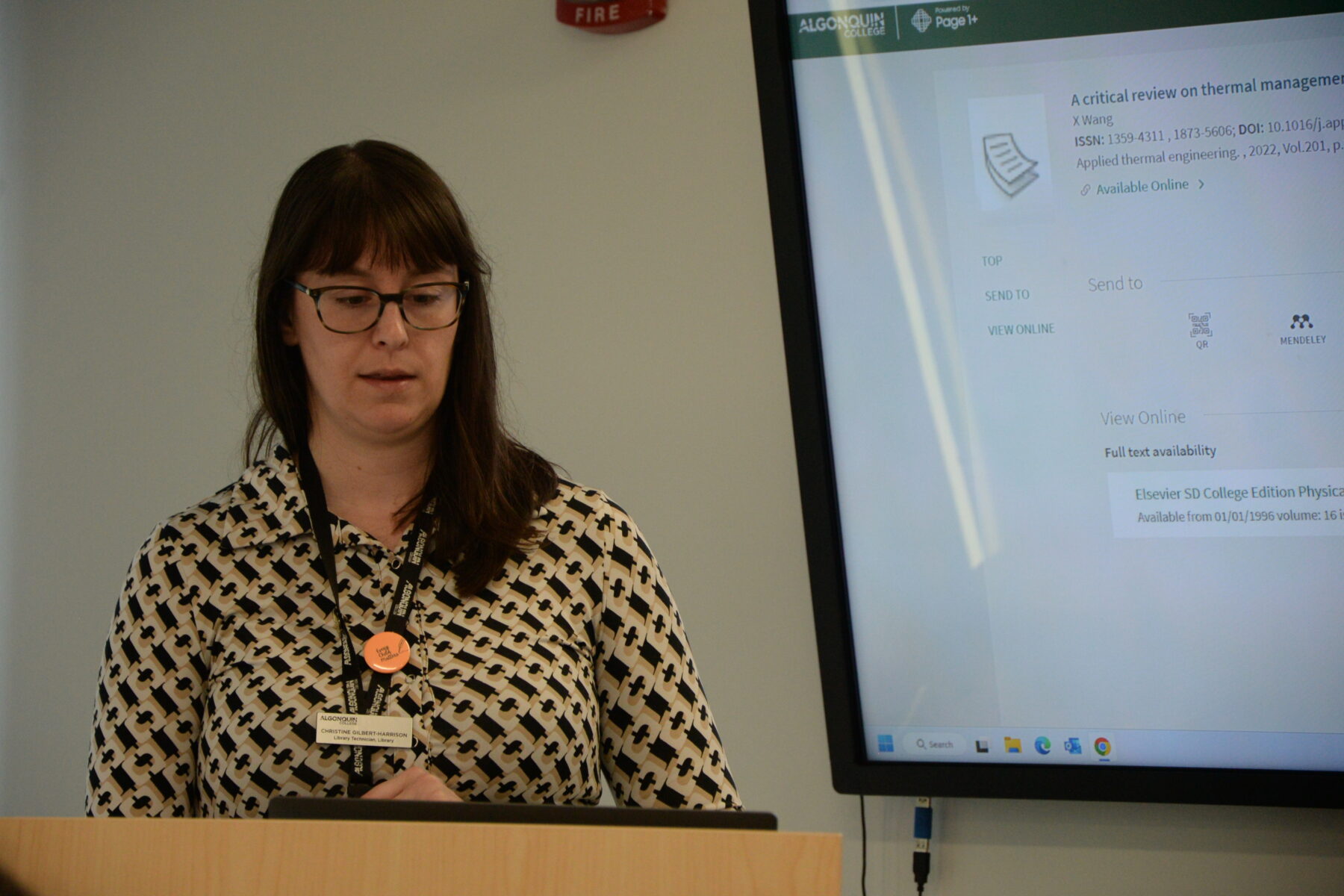
Christine Gilbert-Harrison, a library technician speaking at the navigating academic tools workshop in Room 263 of the C-building, from 10-11 a.m. on Sept. 17.

Amen Bdira, a biotechnology student, found a one-hour research workshop to be useful.

“I wanted to learn about strategies in terms of how to effectively search because I find that when I search for something, I don’t get all the information I need. I was participating to be able to learn different methods in terms of how to get better further information,” said Bdira.

The AC Library hosted a Research Quest workshop for navigating academic tools for assignments in room 263 of the C-building, from 10 to 11 a.m. on Sept. 17.

Christine Gilbert-Harrison, a library technician, shared a PowerPoint with a variety of resources to use when completing assignments.

Bdira benefited from one-on-one advice from staff; she was the only student who attended the workshop.

“It helped me find some ways that I can apply to my research so that I can actually get results better and also to not rely heavily on Google,” said Bdira.

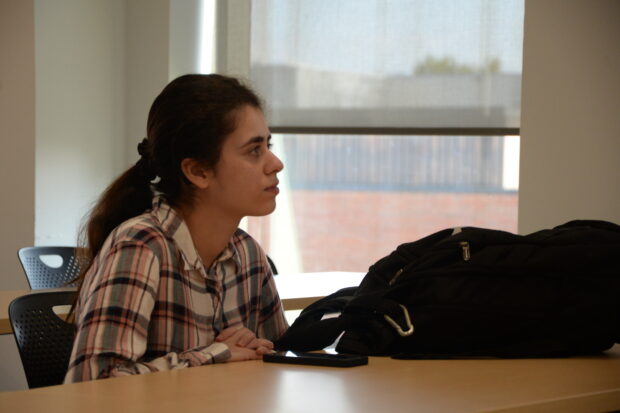
Amen Bdira, a biotechnology student, paying attention to the navigating academic tools workshop in Room 263 of the C-building, from 10-11 a.m. on Sept. 17. Photo credit: Isabella Disley

Gilbert-Harrison said the workshop is meant to inform and improve students’ research methods.

“A lot of students come right from high school where they don’t have a lot of experience doing academic research and it can be overwhelming,” said Gilbert-Harrison.

“We also have a lot of students come and go who use Google for all their research, and we show them ways to improve their Google use to get more valuable academic material,” said Gilbert-Harrison.

Bdira said the workshop is a good resource.

“It helps to give you more websites that you can use for more academic purposes. I think that should really help those who are struggling with research especially when it comes to knowing what to use,” said Bdira.

“Using the college website is more effective and you don’t have to try to find it through the searches on Google,” said Bdira.

Gilbert-Harrison advised students on how to get the most out of Google searches.

“Most people will go straight to Google because they’re very familiar with it. If you’re looking for more academic material, try Google Scholar first,” said Gilbert-Harrison.

“You could actually attach Google Scholar to the library’s catalogue and get direct access to the library through it,” said Gilbert-Harrison.

Gilbert-Harrison said researching is a good skill to have, even outside of academics.

“Learning to do research will be valuable throughout your life. If you go out and you could buy a car in the future, what type of research are you going to do to ensure that’s the right car you want? It has more applications,” said Gilbert-Harrison.

AC residence services help students find affordable housing

Students are wondering how to find affordable accommodations and what Algonquin College is doing to combat rental prices.
Photo: Siobhan Rollo
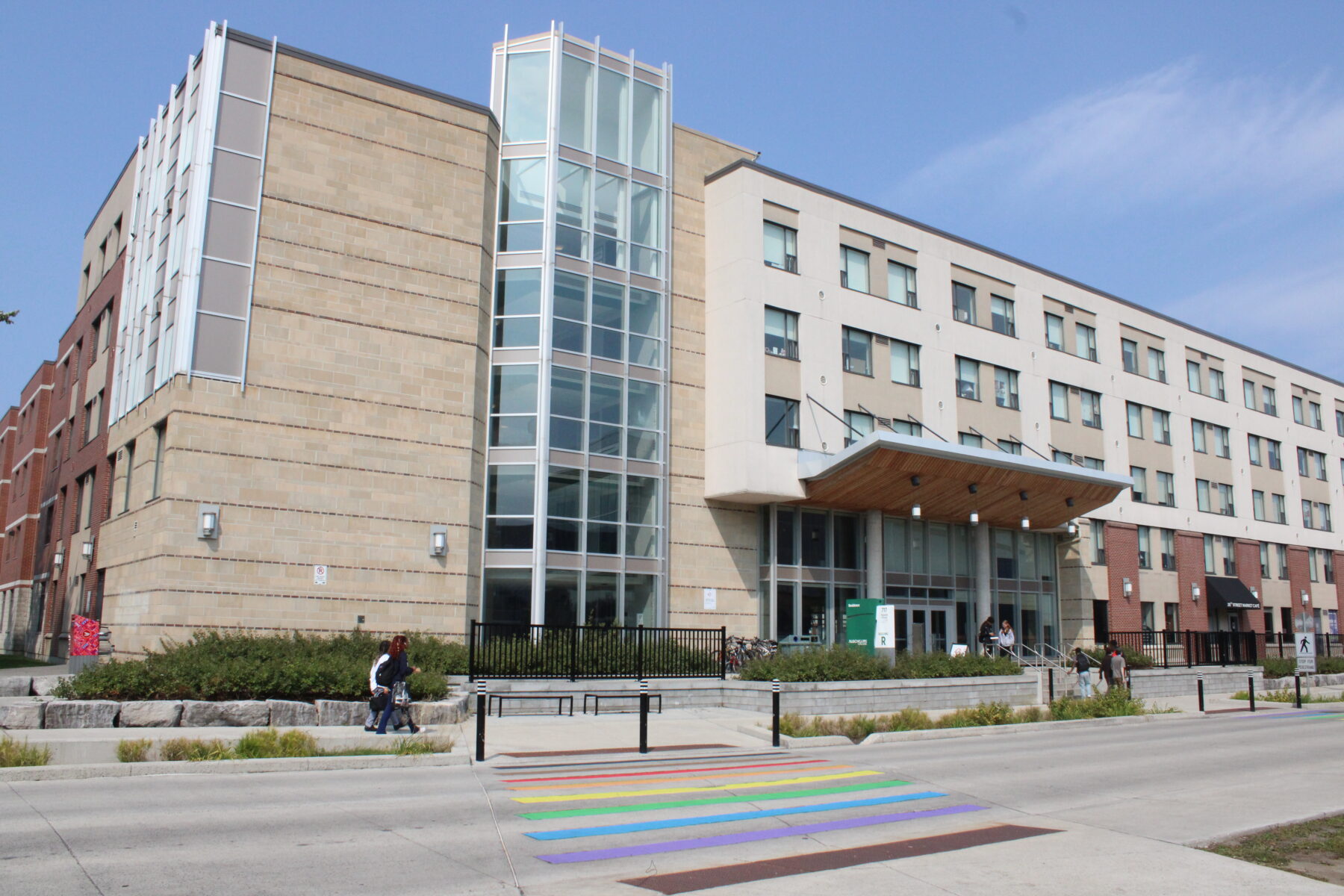
Algonquin College's Residence, otherwise known as the R Building.

For Abby Ankersmit, housing proved to be more difficult than getting herself enrolled at Algonquin College.

“I had applied to go into residence. I was on the waiting list since March and nothing. I was just told it was full,” said Ankersmit, a first-year early childhood education student. “I almost didn’t go to Algonquin College because I couldn’t find a place.”

For many students, finding appropriate and affordable accommodations can be challenging. According to Zumper.ca, a rental finding service which uses its own algorithm to calculate averages based on user listings, the average cost of a two-bedroom apartment is $2,537 a month in Ottawa. That is a four per cent increase from July to August 2024.

Initially, Ankersmit’s plan was to go into residence. Now, she pays nearly $800 a month for her room in a four-bedroom apartment.

“I live in a house with three other girls,” she said.

Finding affordable housing is a common concern for students. Algonquin College’s residence team is aware of the economic struggles of student accommodations.

Brittany Moore is Algonquin College’s student housing coordinator. The role is new to the college, with Moore joining in April 2024.

“I do offer workshops that help students budget for a place,” she said. “I also offer one-on-one meetings for all students.”

Moore runs financial workshops to help first-time renters find living accommodations before the school year.

“I start as soon as three months before school,” Moore said.

Some of the webinars Moore hosts include tips on living away from home for the first time. Moore talks about the average rental costs in the Ottawa, Pembroke, and Perth areas. She also has webinars dedicated to tips on how to be a good tenant.

First-year architecture student Max Raymond commutes to the campus for almost two hours because of the cost of Algonquin College’s residences.

“Residence is mad expensive. I drive an hour and 40 minutes, that’s how expensive it is,” Raymond said. “I’ve spent $50 on gas this week alone.”

The cost for Algonquin College’s Ottawa campus residence is $12,970 for a regular, two-term occupation with a meal plan.

Moore mentioned that the cost of student residence is comparable to off-campus housing and that in her opinion, residence has added value.

“There’s no stress: your heating is on, your water is on, your lights are always on,” she said. “The meal plan can hugely help with groceries… (it) can save time for people who are living alone for the first time.”

Students who live off-campus are also feeling defeated when it comes to trusting their landlords.

“The cost of living is too high. We can’t find jobs, the rate of inflation is increasing, and we can’t do anything about it,” said second-year game development student Danik Bellavance.

Bellavance said they distrust their landlord because of the laws surrounding rent control.

“I was there for a year, and suddenly I got an email saying he was raising the rent,” they said.

As for students in residence, the question is, do they find it worth the money?

Second-year radio broadcasting student Alice Fournier thinks so.

“There’s lots of (amenities), like the cafe downstairs,” she said. “I’m very thankful my parents are paying for it.”

Fournier plans to pay back her parents once employed after her schooling.

“If you break it down, it’s comparable to off-campus housing,” Moore said. “We don’t control the (cost of) rent, unfortunately.”

The college has also made efforts to find ways to make off-campus housing cheaper through partnerships with rental platforms, including Spaces Shared.

Spaces Shared allows people over 18 to list their rooms and offers benefits like helper’s discounts for tenants agreeing to do chores around the house. Spaces Shared’s demographic is empty-nesters.

College coffee provider inspired by community, consistency, quality and sustainability

A police foundation AC graduate quit policing to open Ottawa Valley Coffee, which is sold at Bits n' Bytes in the J-building at the Ottawa campus.
Photo: Angel Belair-Poirier
Ottawa Valley Coffee located in the Bits n' Bytes, J-building, Ottawa campus.

Josh Curley-Lanthier retired from policing after 12 years of service. Working as a patrol officer, surveillance officer and undercover officer, Curley-Lanthier found policing to be emotionally demanding and it caused exhaustion, as he witnessed crime over and over again.

In 2020, Curley-Lanthier and his wife Lisa Lanthier started the Ottawa Valley Coffee (OVC) enterprise.

“Our business model is to help support veterans and police officers, and people in a different ways. We do monthly donations through supportive organizations,” said Curley-Lanthier, OVC owner. “We also sell craft beers and homemade baked goods at all our locations.”

Ottawa Valley Coffee has four shop locations: one in Renfrew, Almonte, Arnprior, and a fourth shop will be opening in Petawawa on Oct. 1. Their mission was constructed around four pillars: community, consistency, quality and sustainability.

“I would drive around the city and find stuff people wanted to throw away, my wife and I refurbished it and gave it a second life,” said Curley-Lanthier. “Everything in our stores have been built with recycled products. The counters, the bathrooms, the chairs and tables, decor and more is all from recycled stuff.”

Josh Curley-Lanthier and Lisa Lanthier inside their Ottawa Valley Coffee shop. Photo credit: Angel Belair-Poirier

Curley-Lanthier and Lanthier thrive to offer good quality coffee, in-house fresh baked goods and local craft beers to their clients. Their focus, dedication and motivation comes from the four-pillar mission they have created for themselves.

“I am not a coffee roaster but we partnered up with a local coffee roaster that delivers fresh roasted coffee to all our locations every week. Our coffee is amongst the freshest coffee across town. We had sampled about 40 different coffees roasters and this one was the one we wanted to sell in our shops,” said Curley-Lanthier. “The beans are purchased in Guatemala, Brazil, Columbia and Peru. Our master roaster roasts the beans every Monday and we receive them every Wednesday to deliver to our locations, including Algonquin College Bits n’ Bytes.

“You will never drink a cup of Ottawa Valley Coffee that will be older than seven days, most coffees are one month old.”

The new coffee location in AC is receiving positive reviews from customers.

“I have tried all their flavours. One of them taste like white chocolate,” said Rohan Bhatt, an energy management Level 3 student.

“I love the coffee here. Its affordable and still very good quality,” said Bhagya Patel, an energy management Level 3 student.

The OVC coffee is a recent addition to the Bits n’ Bytes menu. They plan to keep the coffee on their shelves as long as the customers are still satisfied.

International students may see increased off-campus work hours in 2024

International students’ off-campus part-time working hours limit may increase in the fall, said Immigration, Refugees and Citizenship Canada.

Algonquin College’s international students are divided over an anticipated cap increase in part-time off-campus working hours. They are wondering whether four more hours per week would make any difference.

The policy for working in Canada as an international student states that to work off campus part-time, international students should be enrolled in a post-secondary academic, vocational or professional training program.

The policy requires that the program lead to a degree, diploma or certificate and be at least six months long. Students must have started their studies and hold a Social Insurance Number. Eligible students can work up to 20 hours per week during regular school terms and may hold multiple jobs as long as study permit conditions are met, according to Immigration, Refugees and Citizenship Canada’s off-campus work rules.

Some Algonquin College international students think working 20 hours is not enough.

“It is difficult to get expenses right, working full 20 hours,” said Prince Patel, a Level 1 finance sales service student.

Immigration Minister Marc Miller announced in April that the federal government intends to change the work limit to 24 hours per week.

“Students who come to Canada must be here to study. As such, allowing students to work up to 24 hours per week will ensure they focus primarily on their studies while having the option to work, if necessary,” said Immigration, Refugees and Citizenship Canada in a news release.

Algonquin College students were mostly happy about the potential change, but some wondered if it would be enough.

Varun Sharma, a Level 1 hairstyling student, says the change can be a good way for the government to communicate to international students and tell them that the government cares.

“I think 24 hours is perfect because then (international students) can work but still have time for studies,” said Sharma.

As students and institutions await the official confirmation of the new work limits, it remains to be seen how these changes will affect the balance between work and academics for international students.

Wolves dominate in a fiery 4-2 win over Durham

The Wolves showed teamwork to shut down Durham's most dangerous weapon, crushing their hopes of a comeback on Sept. 15.
Photo: Laiyiady Lam
Two players from the Wolves and the Lords were fighting for the football. The player from Lords lost her balance and fell on the grass during the game on Sept.15.

The Algonquin Wolves women’s soccer team showed unstoppable energy, finishing the game with a 4-2 victory over the Durham Lords on Sept. 15.

The artificial turf at Wolves’ home field radiated heat under the scorching noon-hour sun.

The Wolves performed exceptionally throughout the game and the Lords also showed strong offence.

The Wolves took the lead early, but the Lords quickly equalized the score four minutes later.

The players from both sides performed on equal footing and their attack. Their offence became more aggressive.

A large pack of clouds blocked the heat and brought some comfort to the people on the field. The score was 2-2 at halftime.

Basil Phillips, the Wolves’ head coach, said his players need to pay attention to the Lords’ striker, Sage Thomas-Roberts.

“They have a good striker, so we have to be aware where she is at all times,” he said before the game.

At the second half, the Wolves and Lords were battling for the ball after a corner kick. The Lords rushed forward to defend. Photo credit: Laiyiady Lam

The Lords’ striker was a huge threat to the Wolves in the second half. The strong attack from the Lords also confirmed Phillips’ analysis before the game.

“Today, my special prize goes to Olivia Bradley. She’s our last girl in defence, and she shut that forward down we were all worried about,” said Wolves midfielder Alexandra Aubin, who assisted on the second goal.

She said the turning point of the game was the coach’s talk during the halftime.

Phillips told them to get first to the ball and to win the balls in the middle.

“We made a good adjustment at halftime. We were a bit more aggressive on the long balls that they were going to play, limiting those and limiting their ability to play them,” Phillips said.

Although the Lords lost the game, they were not discouraged.

“We were lucky enough to get them one more time, and they kind of travelled to us. So, we’ll fix a couple things, and hopefully get the win next time,” Lords head coach Bruce Cullen said.

He said the strength of the Wolves is their size.

“They are tall and strong. They dominate on corners,” Cullen said.

Erin Michalicka, the midfielder for the Lords, said they put in a good effort but added there is room for improvement.

“I think that we could defend our set pieces a little bit better, but we have a whole week to work on it, and then next week we’ll fix it,” she said.

The Wolves were scheduled to go to Belleville on Sept. 18 to play the Loyalist Lancers. Aubin said she was confident for the upcoming game.

“After these two wins and our home openers, we’re going on the road. I think we got this easily,” she said.

Campus groups prepare for fall spike in sexual assaults

Groups are working to address and prevent instances of sexual violence, with fall typically seeing more.
Photo: Claire Donnan
Stephen Smith is the coordinator of security investigations, and wants students to know risk management is here for them. As Marelic said, "his door is always open."

Algonquin College’s risk management and health and wellness employees might be hard at work this month as they support students who are victims of sexual violence on campus.

Johanne Marelic, the sexual assault and violence investigator for Risk Management, says she sees a higher volume of reported instances of sexual assault in the fall, when students first return to school.

“I think it’s a combination of students being away from home for the first time, COVID probably has not helped, age, maturity and alcohol (and) drugs,” said Marelic.

This increase coincides with a time referred to as “the Red Zone.” The Rape, Abuse and Incest National Network’s research determined that students are at a higher risk of being sexually assaulted in their first few weeks at a post-secondary institution, with half of all assaults occurring from August to November.

While Marelic and Stephen Smith, coordinator of security investigations, had not heard of the Red Zone themselves, they agreed instances of assault were higher in the fall.

Currently, they work to help students who have experienced sexual assault on campus, including in the residences or on field trips. While they cannot investigate instances that happen off-campus, they still provide resources and support to students struggling, if students request it.

Also on campus, Project Lighthouse in the Student Health and Wellness Centre is working to support students on campus who may have experienced sexual violence, and they’re constantly evolving.

“There’s a really great Ottawa-based organization called WISE … I’m hoping to partner with them,” said Hollie Sabourin, the culturally inclusive sexual health education coordinator with Project Lighthouse. “They aim to promote women’s safety…through offering personal safety workshops.”

The partnership with WISE will teach participants how to protect themselves psychologically, emotionally and physically, and how to recognize red flags in relationships. It would join Project Lighthouse’s list of existing programs, including support groups, activities and their online sexual violence prevention training.

“We’ll always, first of all, believe the victim, and respect their autonomy and how they want to approach going forward,” said Sabourin.

In Risk Management, Marelic and Smith are following the victim’s lead, too.

“We’re here really to support any survivors of sexual assault or sexual violence,” said Smith. “They can report it anonymously if they want, or they can make a full report so that we conduct an investigation.”

Risk Management also helps victims seek medical attention, and offers resources to staff to help them support students. Additionally, victims can choose to report and leave their case with Risk Management until they are ready.

“We will do our report, we will put it aside until if and when they’re ready to come forward,” said Marelic.

Those reports are kept forever.

Ultimately, Risk Management and Project Lighthouse agreed that it’s key to support victims and to keep the conversation going.

“I think it’s an important thing to be talking about (it),” said Sabourin. “We all have a role to play.”

Women’s soccer Wolves beat Fleming 5-0 in home opener

The Wolves dominated the Fleming Phoenix, thanks to a strong offence and four goals scored by striker Olivia Lambert.
Photo: Shaun Klepko
Wolves striker Olivia Lambert scored four goals against the Fleming Phoenix during the Wolves' Sept. 14 home opener.

The Algonquin Wolves women’s soccer team won 5-0 against the Fleming Phoenix in their Sept. 14 home opener.

From the start of the match, the Wolves’ game was fiercely offensive, keeping the ball mostly on the Phoenix’s side of the field. Throughout the game, the Phoenix struggled to push the ball into Wolves territory.

Wolves striker Jordan Blades-McHenry scored the first goal of the match, ending the first half with a 1-0 lead for Algonquin.

“We got a bit frustrated that we didn’t shoot well in the first half,” said assistant coach Steve Ball after the game. “But in the second half, we opened them up a bit.”

Keeping up the offensive pressure, the Wolves dominated the Phoenix in the second half. In the final 20 minutes of the game, Wolves striker Olivia Lambert scored four goals.

Lambert credits this performance to good nutrition and her team’s strong camaraderie.

“I had a really good breakfast,” said Lambert. “Eggs, bacon, ketchup and feta. But just the atmosphere in the change room really gets you. We got music going. We’re cheering. We’re dancing. We are a pumped-up team this year. We’re playing for each other. It’s a team atmosphere that makes you play good.”

Despite the Wolves’ victory, head coach Basil Phillips feels the team still has room for improvement.

“It was a good performance overall,” said Phillips. “We’ve just got to be more decisive with our finishing. Too many of our shots just didn’t hit the target.”

Wolves midfielder Kassandra Da Cruz was of the same opinion.

“Our shots were a little bit terrible,” said Da Cruz. “But by the second half, we were in it. At the end, we picked it up and did really well.”

Humber Hawks rout Algonquin Wolves in men’s rugby home opener

Conditioning, size, and experience helped a dominant Humber squad take home victory against a young Algonquin team.
Photo: Tyler Reis-Sanford
The Humber Hawks forwards frequently overpowered the Wolves' pack.

The Humber Hawks men’s rugby team defeated a young Algonquin Wolves side in an overwhelming 84-0 victory on Sept. 14 at the Twin Elm Rugby Park.

The Wolves’ season didn’t start as planned after a dominant performance from the Hawks. After an early score from the Hawks, the Wolves looked to keep the game competitive with a methodical drive that brought them within 10 meters of the Hawk try zone, but a costly turnover led to an end-to-end score from the Humber outside centre.

The field-flipping try seemed to suck the life from the young Algonquin side on a hot September day, and the more experienced Humber team kept their foot on the gas for the rest of the match.

“We’ve got good leaders…one of our guys said it best,” said Wolves head coach Geoff Tomlinson. “Remember this feeling. We don’t ever want to feel like this again.”

Tomlinson said he had a lot of faith in the team to make the most of a hard-learning experience.

“A lot of these guys don’t have men’s league experience, getting that contact in the summer makes a big difference. At some point you become a man, in age sure, but on the pitch you become a man through taking those hits, feeling those losses,” added Tomlinson.

On a day where temperatures reached 30 C, and often felt like 35 C with humidity, both teams were required by officials to stop for water twice each half. Despite these measures, both teams felt the exhaustion early on in the match, leading to broken plays, mismatched defensive lines and unforced errors.

Wolves hooker Dylan Gilmore gets a cold spray of water while waiting for a line out. Photo credit: Tyler Reis-Sanford

When asking Level 1 welding and fabrication student and first-year flanker Dakota Reitsma what the team could do to improve, he was quick to point out their fatigue.

“Cardio,” said Reitsma. “We need to keep our legs under us… we can’t let them bring us down in the mud.”

The Wolves’ side boasted only a few veteran players from last year’s roster, but the Hawks had most of their team returning from 2023’s silver medal run. Their size and experience showed, especially in the forwards, who dominated scrums and rucks all game.

“In college things change a lot, so we weren’t sure what we were in for today,” said Hawks’ coach Darryl Snider. “We knew it would be physical, and it was.”

Snider also said playing summer rugby was a prerequisite to joining the highly competitive Hawks roster, and every single player played some level of club rugby before the season.

“It’s only a 10-week season, you need to be conditioned for contact,” said Snider. “We’ve been on the other side of it before, and to give (Algonquin) credit they never backed down, and when they had the ball they were moving forward.”

The Wolves travel to face the Conestoga Condors on Sept. 21 and look to have more success than they did during their home opener.

Alcohol sales expanded around the corner from Algonquin College

Reactions from students and patrons
Photo: Linda Verreault
Nina Cortez an Algonquin College student in the architectural program, outside the Circle K.

Alcohol sales expanded to over 4,100 locations across Ontario on Sept. 5 to include convenience stores and big box retailers.

Outside the Circle K located at 1827 Baseline Rd., at the corner of Navaho Drive, Algonquin College students shared their thoughts about alcohol being sold at the corner stores between 7 a.m. and 11 p.m.

“I don’t mind. I think it’s just easier accessibility so that if people ever wanted it, they could have access a lot better than having to possibly go farther,” said business accounting student Mya Watson, 25.

“I don’t mind. I think it’s easier accessibility,” said Mya Watson, 25, a business accounting student.

Algonquin College students who already had access to the LCBO and the Beer Store within walking distance will now be able to purchase their alcohol after hours.

“It doesn’t affect me personally because I don’t really drink a lot, so it’s just fine,” said Nina Cortez, a 27-year-old architectural student.

“From the point of view for business, I think it is a good idea and it will be more convenient for people who drink alcohol. For those who don’t consume that like me, for them it does not matter,” said Kavish Sangwan, 19, a business technician student.

This has been a controversial issue for years with doctors and the Centre for Addiction and Mental Health speaking out against this increase in access. They feel the government is choosing convenience over the well-being of Ontarians.

Charles Brandon, a business owner who is not a student, said buying alcohol at corner stores in Quebec is convenient.

“I just think that the inevitable and the casualties of this will be underage people getting their hands on alcohol, either through just having buddies work at the store or unqualified convenience store workers,” said Brandon, 39.

Store owners believe it is long overdue. They have been handling age restricted products such as tobacco and lottery tickets for years.

“Convenience stores are responsible retailers. We have an unrivaled record when it comes to checking ID and ensuring that age restricted products are not sold to minors,” said, Kenny Shim, owner of Busy Bee Mart and industry leader, in a statement released by the Ontario Korean Businessmen’s Association in August.

This change comes about a year and a half earlier than anticipated at a cost of $225 million dollars to taxpayers. These funds are allocated to protect Beer Store employees and front-line workers. Ontario Premier Doug Ford pledges an additional $10 million over five years to address public health concerns related to expanded access to alcohol.

Algonquin Times podcast

Stay Informed

Sign up for our newsletter

Subscribe

* indicates required