Four weeks ago, as I browsed Facebook, I saw something amazing. People in my community here at home in Kitigan Zibi were sharing pictures and stories about their days out on the land collecting traditional medicines for their family, friends and community members in need. These pictures followed with comments from other members of my […]
Angeleah Brazeau-Emmerson
Photos: Katelin Belliveau
April 9, 2020 Revised: April 9, 2020 4:37pm
Photo: Katelin Belliveau
Four weeks ago, as I browsed Facebook, I saw something amazing. People in my community here at home in Kitigan Zibi were sharing pictures and stories about their days out on the land collecting traditional medicines for their family, friends and community members in need. These pictures followed with comments from other members of my community wanting to also help and share what they could.
The second I arrived back home from school on March 13 when the term was moved online, I felt safer. Maybe it’s because my community feels like a completely different world unto itself. Or maybe it was just the whole idea of being back in my “home sweet home.” But from the first moment I brought my bags inside my house, I was okay.
For hundreds of years, Indigenous people have been relying on a source of natural remedies to help mend and heal all physical, mental, emotional and spiritual pain. These natural remedies, better known as traditional medicines, hold a significant place in our culture.
Chaga, tamarack, spruce stems, cedar lemon, and oranges are ingredients one community member chose to create their medicine (mushkiki) tea. Photo credit: Juanita Dumont
Before modern medicine was introduced, my people looked towards the land for help. It not only gave us ways of healing, but it also gave us a source of food, resource and protection. My people understood the land’s beautiful powers. They also learned how different plants and animals could give them what they needed.
A day spent on the land collecting and gathering traditional medicines reminds us of its beautiful powers. Photo credit: Angeleah Brazeau-Emmerson
Growing up, I attended Kitigan Zibi Kikinamadinan, which in the Algonquin language means Kitigan Zibi school. Here is where I had the opportunity to learn about my culture and the importance of its teachings by attending an Algonquin immersion class every afternoon throughout my elementary years.
This is what I thought about that day while scrolling through my Facebook feed: my people were looking towards our ancestors’ ways of living in order to overcome and provide a sense of safety through this unique time. In other words, I was seeing my community practicing what I learned about during my classes every afternoon.
My community was practicing our culture and families were together out on the land collecting and gathering medicines while being given the opportunity to share their traditional knowledge, on how to do so, with their families.
One community member created medicine (mushkiki) water using land based ingrediants including, cedar, spruce, tamarack, white birch, peppermint, labrador, chaga and wejina (beaver castor). Photo credit: Mona Tolley
The posts I scrolled upon on didn’t make me fear everything that was happening any less, but they did make me feel hopeful. This hopefulness didn’t just come from the fact that I grew up in a place where I was surrounded by my culture and traditional practices, like having the knowledge of traditional medicines. Or from the fact that I come from an area away from a large city.
Instead, my hopefulness came from knowing how truly lucky I am to come from a community where everyone is working together to keep each other safe, healthy and at the end of the day feeling okay. We are going back to our traditional roots, uniting as one during this time of crisis and panic, just as our ancestors use to do.
Today, as we all face this global pandemic, it’s important to understand a couple of things. Although we are forced to be physically apart, that doesn’t mean we all can’t be there for each other. This virus is affecting everyone, it doesn’t care who you are, how old you are or where you come from. If coming home has taught me anything, it’s that being there for one another can make a whole lot of a difference.
One community member created medicine (mushkiki) water using land based ingredients including, cedar, spruce, tamarack, white birch, peppermint, labrador, chaga and wejina (beaver castor).
My community is turning to our traditional ways of living to help fight against this fear we are all carrying. While I know not everyone is able to do exactly this, it is important that everyone tries to live in unity as my people have always been taught to.
No words can really explain the feelings and time we are all dealing with, but together, we can get through this.
Together is the only way we will be able to overcome it.
When Daniel Harris talks about how to make polyamorous relationships work, he sometimes likes to joke that the requirements are a shared Netflix account and a Google calendar. “I don’t believe in a way of living for everyone,” said Daniel Harris, 36, who has considered himself polyamorous for 12 years now. “You have to find […]
Julien St-Jean
Photos:
April 9, 2020 Revised: December 4, 2020 2:44pm
Daniel Harris and his partner Brendan. Image supplied by Daniel Harris.
When Daniel Harris talks about how to make polyamorous relationships work, he sometimes likes to joke that the requirements are a shared Netflix account and a Google calendar.
“I don’t believe in a way of living for everyone,” said Daniel Harris, 36, who has considered himself polyamorous for 12 years now. “You have to find what makes you want to be better, be more caring and be stronger. And for me, that’s polyamory.”
Harris is a life coach with LiveWorkPlay, a powerlifter who is a regular at Algonquin’s Fitness Zone, an aspiring writer, a rugby player with the Ottawa Wolves and is in three separate relationships.
But what is polyamory?
“Oh that’s easy, it means multiple relationships,” said Harris with a laugh.
At its roots, polyamory means having multiple relationships with multiple consenting partners at the same time. But polyamory isn’t that simple.
“And while it’s easy to think of polyamory as a lifestyle – as though there’s one way to do it, one common set of assumptions that underlie it – those relationships take a staggering number of forms,” writes Franklin Veaux in his 2012 piece “What is Polyamory,” published to morethantwo.com.
Different people have different styles of polyamory. Some polycules – a group of people participating in a polyamorous relationship – consist of a closed-off group of three or more partners who all date the other people in the relationship. This style is known as trigonal polyamory.
Harris, however, practices the vee form of polyamory. In a vee relationship, one may have two or more partners who are not engaged in relationships with each other. Members of the polycule may have varying levels of interaction depending on that group’s style of polyamory.
“For me, I found that I had a need for polyamory that I had never really understood before,” said Harris. “Each partner I have, I get to experience different parts of myself with them.”
For Harris’ polycule, having multiple partners means that they have more people to love and support while being loved and supported more in turn.
“It almost feels kind of like a second family in that regard,” said Brendan Irwin, 34, one of Harris’ three partners. “It’s like a chosen family aspect. It gives you this sense of belonging and comfort.”
Harris speaks proudly and lovingly about his multiple partners, but he was not always this open about who he was.
During his time at Goulbourn Middle School, Harris struggled to accept that he was gay.
“When I was 14, I kept sort of telling myself ‘if I’m gay,’” said Harris. “For a long time, I really wanted to be normal and struggled to come to terms with the fact that I’m not.”
Harris had previously played a wide variety of sports, such as football and hockey, but he stopped playing around the time that he started discovering his sexuality.
“The feeling that I got from team sports was comradery,” he said. “That’s why I sort of left them when I was 13, I no longer felt that comradery.”
In high school, Harris started to come to terms with the fact that he was attracted to men, but he didn’t yet feel accepted for who he was. He started to spend less time with others and more by himself or on the internet.
“I closed myself off a little bit more and just sort of survived high school,” said Harris. “And it took me a few years to come out of that and really start finding my way again. I was very lonely at that period of my life.”
Harris found himself opening up to others online rather than in person. Through the use of what he affectionately refers to as “google-fu,” – the act of finding facts, communities, information, etc. online, – Harris found communities full of people who he felt understood him.
He made online friends and found communities that felt like home. At one point, he even had an online boyfriend from Australia, which he jokingly recalls as a rite of passage for himself.
“I was definitely getting some love and acceptance for who I was instead of who I was pretending to be,” said Harris. “It was both validating, but also a crutch.”
Online relationships helped Harris start to accept himself for who he was, but he did not feel fulfilled from it. He wanted stronger real-life relationships and did not start to develop them until university.
In 2002, Harris attended University of Ottawa for English and philosophy. There he found people who were open to who he was and what was interested in. He formed different relationships with many different people and started to come to terms with who he was.
“It wasn’t until university that I started coming out of my shell again,” said Harris. “After that, it was a matter of throwing myself into things and seeing what worked for me. That’s the best way to learn and get to know yourself. Just jump into things and make a fool of yourself.”
In 2008, Harris learned about the existence of the Ottawa Wolves, a rugby team made up mostly by gay men. Harris jumped at the chance to play and rediscovered his love for team sports.
Daniel Harris playing rugby with the Ottawa Wolves. Image supplied by Daniel Harris.
Through the wolves, Harris developed a passion for rugby. It forced him to become more decisive and taught him to take action. He credits this as one of the things that made him become more confident in himself and who he is.
“It’s a lot better to go out, try, and just see what happens,” said Harris. “That’s one of the big things with rugby – just do it.”
Through rugby, Harris was introduced to polyamory. “I started meeting people who are polyamorous and felt a kind of jealousy. That feeling kind of surprised me,” said Harris. “I didn’t realize how much it meant to me yet.”
Harris started to explore his newfound interest and learned lots about both himself and polyamory. He made many friends in the community and started to discover what polyamory meant for himself.
Harris feels that embracing polyamory has allowed him to grow as a person and better accept who he is. Polyamory has given him more to love and be strong for.
“I think everyone who knows me has seen me become a lot more fulfilled, happier and all around more developed,” said Harris. “I feel like I can shrug off the slings and arrows of assholes and killjoys.”
Harris finds that there are sometimes misconceptions around polyamory about jealousy.
“Jealousy is a natural human emotion,” said Harris. “Just because you’re polyamorous doesn’t mean you don’t feel it. When you do feel it, you need to see it as ‘how can I work to overcome it?’ You really have to work to develop a lot of compersion, which is the joy you get when you see a loved one succeeding.”
Harris and his polycule find that the best way to help each other succeed and ensure everyone’s needs are being met is to have open, clear communication.
“Communication is vital in any relationship, polyamory especially,” said Irwin. “One of the things I like about Daniel so much is that we are able to communicate so much, so clearly.”
Overall, Harris feels that he has found a lot of joy and fulfillment in polyamory. His partners make him feel stronger, more loved and all around more complete.
“Embracing my weird, gay, nerdy, polyamorous self, it really helped me break down the barriers I put up around myself,” said Harris.
Harris is excited for whatever comes next in the future. He hopes to finish his novel and continue deepening his relationships with each of his partners.
“I feel like I’m more myself than I’ve ever been in my life. And I feel that whatever else I discover, I’ll continue to be supported by all of my partners,” said Harris. “All three of my partners will be there to support me in whatever ways they can, and that makes the future…not terrifying.”
As the novel-coronavirus pandemic rapidly changes, governments are taking stronger approaches to stop the spread. Here is what you as a student need to know. The number of coronavirus cases in Canada has now surpassed 18,000 as of April 8. In a press conference at Queens Park in Toronto on April 7, Premier Doug Ford […]
Laura Nelson
Photos:
April 8, 2020 Revised: January 30, 2024 3:37pm
As the novel-coronavirus pandemic rapidly changes, governments are taking stronger approaches to stop the spread. Here is what you as a student need to know.
The number of coronavirus cases in Canada has now surpassed 18,000 as of April 8.
In a press conference at Queens Park in Toronto on April 7, Premier Doug Ford confirmed:
Algonquin College had donated over 125,000 pairs of gloves and over 7,000 masks.
The college has also loaned nine ventilators, and donated 200 pairs of glasses and googles and 100 gowns to help with the shortage of personal protective equipment.
“The College wanted to give back to the community and share its resources to support ongoing health care efforts,”said Chris Lackner, communications officer for Algonquin.
Algonquin’s Ottawa campus worked with Champlain Health Supply Services and The Ottawa Hospital to provide donations of PPE and ventilators that will be distributed to regional healthcare facilities.
“We coordinated the shipment through Champlain Health Supply Services, who support the Champlain LHIN,” said Lackner.
“To support the delivery of the items, we shipped them to The Ottawa Hospital–General Campus.”
This is part of a larger effort to coordinate donations between the Ministry of Colleges and Universities and the Ministry of Health.
According to Public Health Ontario, there are 5,276 cases of novel-coronavirus in the province and 174 people have died. Across the country, 381 people have died from the virus and 4,050 have recovered.
In Ontario, 84,601 people have been tested for the virus, and 1,102 tests still awaiting results.
But, he said, the province is also planning to add 900 additional ICU beds for COVID-19 patients in the coming weeks.
Steve Desroches, an instructor of the local government course at Algonquin College, says he is happy that all levels of government are working together.
“I think Canadians expect politicians to put partisanship and politics aside, communication with the public has been key,” said Desroches.
In a press conference at Queens Park in Toronto on April 3, Premier Doug Ford confirmed during the epidemiology updates on coronavirus from the Government of Canada states that as of April 2, the number of Canadians tested for the virus is 268,154 people. That’s a test rate of 7,133 per million of the population. The per cent positivity is 3.9 per cent.
In a report cited in an article from the National Post, Immigration, Refugees and Citizenship Canada (IRCC), coronavirus measures will proceed until July.
Gatherings of over five people. It is illegal under provincial order. An acceptation can be made for funerals —then 10 people are permitted.
Gatherings at City of Ottawa parks, including the use of the equipment.
Failure to comply could cause fines under the provincial Act of up to $100,000 for individuals.
Ottawa Police may enforce the federal Quarantine Act, which requires people returning from travel outside Canada to quarantine for 14 days, even if they do not have symptoms of COVID-19.
And people who don’t comply could face fines up to a maximum of $750,000 and/or a six-month prison sentence.
The Quebec Government declared as of April 1 that police in the Outaouais region will have checkpoints to limit non-essential travel between Gatineau and Ottawa.
The police will turn away drivers crossing the bridge for a trip that is not essential. Essential trips consist of travel for essential work, medical appointments or for humanitarian reasons.
Checkpoints are set up at
The Masson-Angers ferry
The Alexandra Bridge
The Portage Bridge
The Chaudière Bridge
The Champlain Bridge
The intersection of Highway 148 and chemin Terry Fox
The Government of Ontario’s declaration of a state of emergency is in effect until April 13. Only after will the province re-valuate the need for an extension or end of the closures.
The Government of Canada has enacted an air travel ban on foreign nationals that will be in place until June 30.
The move to online classes after March 13 has been difficult for many Algonquin students. For some international students like Leon Radaelli, however, the changes have been especially challenging. Radaelli, who is a first-year mechanical engineering technology student, was living in residence when the change happened. [Note: this reporter and Radaelli became friends in residence.] […]
Sam Mcgowan
Photos:
April 8, 2020 Revised: May 27, 2020 2:28pm
Leon Radaelli at home in Hong Kong.
The move to online classes after March 13 has been difficult for many Algonquin students. For some international students like Leon Radaelli, however, the changes have been especially challenging.
Radaelli, who is a first-year mechanical engineering technology student, was living in residence when the change happened. [Note: this reporter and Radaelli became friends in residence.] Although international students were given the option of remaining in residence, Radaelli made the decision to leave. The move was a very stressful time.
Radaelli is from Toulouse in the south of France but went to school for most of his life up in Hong Kong. Since Europe was getting the most cases of COVID-19 at that point and was on lockdown, Radaelli’s parents thought it would be a good idea for him to travel back to Hong Kong since the airports were still open and it was safer.
At first it was hard for Radaelli to get a flight to Hong Kong because at that time all of the airports in Canada were slowly cancelling flights. Luckily Radaelli was able to book a last minute flight to Hong Kong.
While Radaelli was at the airport in Toronto, it didn’t look like it normally does. “The airport was a mass hysteria,” he said. “There were people equipped with full body suits and gas masks. People were disinfecting everything they got close to. I was in a sweater and jeans with one mask that’s it.”
The flight was 1 hour 30 minutes from Ottawa to Toronto. Then 15 hours from Toronto to Hong Kong. He left at 9 p.m. on March 23 and landed at 5 a.m. on March 25.
It has officially been two weeks since Radaelli has been in Hong Kong. With classes all being online he is finding it very difficult especially with the time difference.
“I’ve missed classes,” he said. “I’m completely lost, and I have a couple of final tests coming up and I’m very afraid I’ll miss them because of the time zone difference. I have a 12-hour time difference. I’m 12 hour ahead so my 4 p.m calculus class is now my 4 a.m. calculus class.”
News
Covid-19 | Hong Kong | International | Online learning | Residence
Three years ago, when Randy Blue Kakegamik was taking a cab after his treatment care in Ottawa the driver asked what he was passionate about. “I told my new friend that I really didn’t know,” he said. “I had no idea what I was going to do. I thought about it and came to the […]
Akira Cooper
Photos:
April 8, 2020 Revised: April 8, 2020 2:37pm
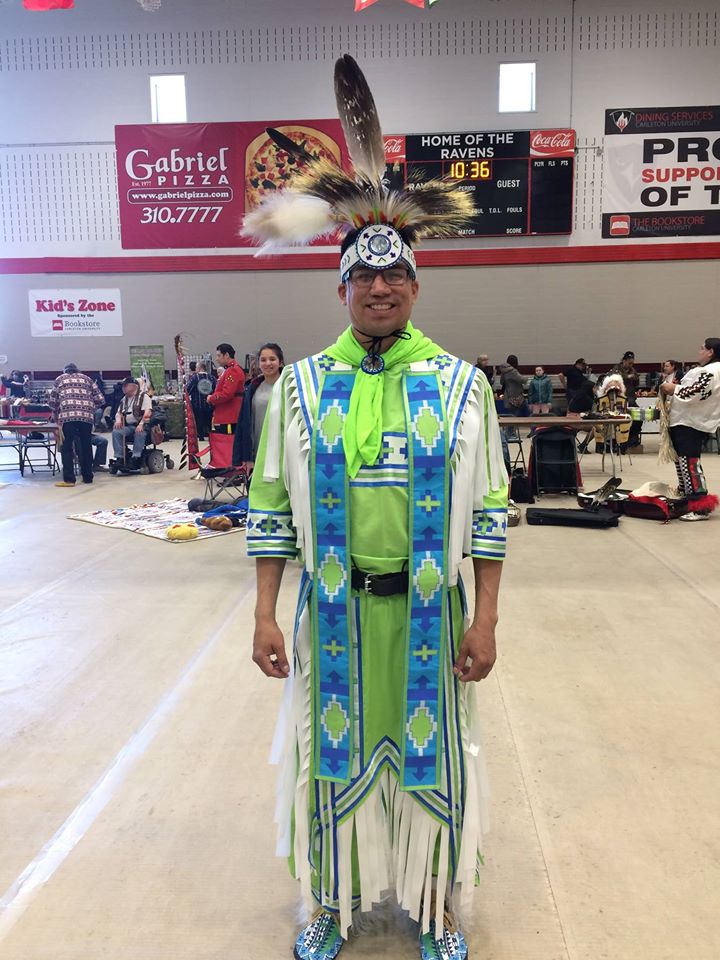
Randy Kakegamik in his grass dance regalia.
Three years ago, when Randy Blue Kakegamik was taking a cab after his treatment care in Ottawa the driver asked what he was passionate about. “I told my new friend that I really didn’t know,” he said. “I had no idea what I was going to do. I thought about it and came to the realization of music.”
Kakegamik knew he was on the path to sobering up. He wanted to start a new, better life for him and his family.
This was when Kakegamik joined the Algonquin College family. He enrolled in the music industry arts program, and before that, he took on the digital music production program.
“I chose the digital music production program because of its part-time length,” said Kakegamik. “I was just fresh out of treatment and didn’t want to go full-on in a full-time program. I did this as to not stress myself out and to be safe for my sobriety.”
The start of Kakegamik’s new life has been helped by the college. His courses gave him the motivation to start up again. Involving his culture in his school life – Kakegamik is Oji-Cree – also helped. He makes frequent appearances at the college’s Mamidosewin Centre.
“I’ve involved myself quite a bit at the college interacting with our community, met some interesting people,” said Kakegamik.
He has also found joy in grass dancing, which is part of his culture. This is a traditional native dance that had always been attractive to him.
It was only just recently, however, that he discovered that in order to really enjoy the beat of the drums, he needed to be physically involved with the music. So he began to dance.
Dancing hasn’t just given Kakegamik the ability to go places that he’s wanted to go but also do things he’s really loved. It has really helped him.
“The grass dance is a healing dance of warriors,” he said. “It is also a dance of the society of grass dancers.”
Kakegamik is a father of two and a grandfather. His journey as a father has been good. Yet in the beginning, it was rocky. When he said to himself that he needed to sober up, he spoke to his son about his problem with alcohol. In turn, his son understood and always knew where he was during treatment.
“The rewards come every day with him,” said Kakegamik. “He’s a happy boy. We have a great relationship and very open. I’ve taught him a lot and he listens. I’m trying to do my best and I think he knows that.”
Ken Jackson, 34, a reporter for APTN news and a friend of Kakegamik admires how far he has come. “He’s honest and is trying to be a better person every day,” said Jackson. “He doesn’t hide his scars.”
The pair have been friends for four years after meeting in a coffee shop through a friend, Mark Marsolais. At the time, Marsolais was writing his own Gladue report, which is a document that supports Indigenous accused adults, youth and justice personnel in applying the sentencing principles set out in the Criminal Code of Canada and of the Youth Criminal Justice Act.
More recently, due to the pandemic that has occurred, Kakegamik finds himself exercising, beading, making music, cleaning, reading, and trying to learn a new language. He also reaches out to family. No longer being in school on campus hasn’t swayed Kakegamik’s morale.
“I’m slowly trying to find my bearings and keep busy now that our courses are proceeding,” he said. “I really am concerned for a lot of reasons and this school deal comes secondary. It is stressful to add on more things at this point. Being a parent and the worries I have are daily. Taking steps to push through [and stay] level headed is a challenge.”
Life
Mamidosewin center | Music industry arts | Randy Kakegamik
When the pandemic started in Ottawa, I did my best to follow the government’s request to just stay home, stay clean and try to stay healthy. It wasn’t until workers were sent home from their jobs and told not to come back until COVID-19 was all over, did the situation really start to affect my […]
Camryn Majuary
Photos: Camryn Majuary
April 7, 2020 Revised: April 7, 2020 4:18pm
Photo: Camryn Majuary
When the pandemic started in Ottawa, I did my best to follow the government’s request to just stay home, stay clean and try to stay healthy. It wasn’t until workers were sent home from their jobs and told not to come back until COVID-19 was all over, did the situation really start to affect my life.
For three and a half years I have worked at a pharmacy with a postal outlet inside. My department has always been in the postal services and it has been a great job. As both the pharmacy and post office are essential services we have stayed open while other retail outlets have had to shut down.
At first, I was happy. I got to keep my hours at work and keep my steady pay coming in. Being a typical “broke college student,” every penny helps. The first day I worked during the pandemic it was a shift from 1 p.m. to 6 p.m., which is not bad right?
Not until you’ve seen the number of people who just come in to roam around the store, touching things and putting items back on the shelf. I got anxious watching this. You want to just put a sign up reading “please just stay home!” But you will never have control over anyone but yourself.
The customers who have come into the post office are doing a good job of protecting me and themselves. Some come in wearing gloves, some have masks. No one brings their kids in anymore and they even keep a good distance away from me when I’m serving them.
The company I work for is being great during this time. They are making sure their employees feel comfortable and safe. Every station has a bottle of hand sanitizer and lots of cleaning products and the post office has received a sheet of plexiglass that hangs in between me and the customer.
I sanitize my hands like it’s nobody’s business. By the end of my shifts, however, my hands are so dry. (It doesn’t help that I have eczema.) My hands have gotten to the point where I had to buy a little bottle of hand cream because I started using all the hand lotion we had at our station.
I have three family members at home: my mom, my dad and my brother. My mom voices her concern for me the most. She wants me to stay clean and safe while I’m at work. When I’m done my shift and come home, she makes me go straight to the bathroom. When I’m in there, I’m to strip every piece of clothing I’m wearing and put it right into the hamper, then I’m right into the shower to wash myself off.
Personally, when I’m working, I feel fine. I feel like I can get through COVID-19 and be okay. I’m not scared for myself. I just make sure I stay keep washing my hands and sanitizing them. I am scared for those around me. I don’t want any of my customers to want to get sick. I’m also scared of transferring the virus.
My employers have provided us with gloves if we want them and face masks as well if they would make us feel more protected. I think that’s why I feel so calm while I’m at work because my managers have kept it a calm and well-functioning environment.
One big thing that really helps me while I’m at work is all the people who look at me and just say thank you for coming to work and staying open and the ones who tell me to stay safe before they leave.
It really impacts how you feel while working during this pandemic. It makes it feel worth it and like you’re actually making a difference.
I may not be a health worker in a hospital – and they do deserve all the thank yous, appreciation and praise because they are doing great work – but when my regular customers thank me, it makes me feel like what I’m doing is worth it.
Algonquin students Tian Boon and Beth Hernan don’t know each other, but they do have something in common: the early childhood education and electrical engineering students (respectively), both suffer from diseases that weaken their immune systems. It’s a vital component of their health that can determine whether COVID-19 will mean life or death for them. […]
Laura Nelson
Photos:
April 6, 2020 Revised: April 6, 2020 9:12pm
Algonquin students Tian Boon and Beth Hernan don’t know each other, but they do have something in common: the early childhood education and electrical engineering students (respectively), both suffer from diseases that weaken their immune systems.
It’s a vital component of their health that can determine whether COVID-19 will mean life or death for them.
Boon, 19, was diagnosed with an invisible disease called Lupus in December 2010 and has had to endure chemotherapy between 2011-2013 to help with her Lupus.
According to Lupus Canada, Lupus is a chronic autoimmune disease defined by inflammation in one or more parts of the body. It can target any tissue or organ of the body. Symptoms include inflammation, swelling and damage to kidneys, blood, heart and lungs. Currently there is no cure for Lupus.
The Government of Canada website on coronavirus lists people with compromised immune systems as having an increased risk of more serve illness including pneumonia or death.
Elderly people, newborns and pregnant women also have compromised immune systems. Some medications such as steroids can weaken your immune system.
Boon has had moved back to her hometown in Barrie, Ont. and has not left the house since March 18.
“My mom wanted me to come back to my hometown to be close to her if something happened,” said Boon.
Hernen, is one of about 4,370 Canadians with the autoimmune disease Cystic Fibrosis, according to Cystic Fibrosis Canada.
Cystic Fibrosis is a genetic disorder that affects the lungs, the pancreas, liver, kidneys and intestines. Long-term issues include difficulty breathing and coughing up mucus because of frequent lung infections.
Hernen, 23, was diagnosed with Cystic Fibrosis when she was three weeks old.
People with regular immune systems can create antibodies to fight against infection and lower their chances of any issues from coronavirus.
Boon and Hernen’s immune systems, however, lacks those essential antibodies to fight off viruses so they’re both forced to take extra precautions, like washing their hands more often.
“Since I have no immune system, it’s hard for me to fight off sickness when I get a cold I could get strep or even end up in the hospital,” said Boon.
Lung viruses, such as a coronavirus, can cause severe illness in people who have a weak immune system, and can sometimes result in death.
Self-isolation is important to keep Hernen and Boon healthy. Hernen has already experienced low lung function along with her weakened immune system.
“If I catch anything as small as a cold, it can be life-threatening, so something as serious as COVID-19 would be a death sentence,” said Hernen.
As for Boon, self-isolating is what’s helping to keep her healthy.
“I would say don’t always think about yourself, consider other people and what your actions can affect,” said Boon.
Hernen has been told by her doctor to self-isolate for 12 weeks. She has been in isolation for the past 12 days. Hernen is prepared to self isolate until June 1 if she has to.
“People need to understand that their actions are risking others and their families,” said Hernen.
For Boon and Hernen, the choices made by others now can have serious and deadly consequences to their health.
“I shouldn’t have to die because strangers can’t listen to an easy request to stay home,” said Hernen.
When a Times photographer visited campus briefly to empty her locker, she saw what Algonquin looks like without its community
Katelin Belliveau
Photos: Katelin Belliveau
April 3, 2020 Revised: April 3, 2020 6:35pm
Photo: Katelin Belliveau
In a March 27 announcement, President Claude Brulé said this spring’s convocation ceremony would be postponed until the fall of 2020. Considering measures to stop the spread of COVID-19 through social distancing, Brulé added the decision was in line with what most other post-secondary institutions are doing.
After the college announced on March 13 that it would suspend classes and shift to online learning due to COVID-19, an Algonquin Times reporter visited campus to retrieve her belongings from her locker.
These are some of the photos that were taken during that brief visit on March 20.
At that time it was apparent that students and faculty were respecting the college’s directives on limiting trips to campuses. There were security staff members on site taking note of the few students entering the once-crowded hallways and grounds.
The first six weeks of the spring term are set to begin on May 19, according to Claude Brulé. In his March 27 statement, he confirmed that there will be a one-week break at the end of the winter term followed by six weeks of online classes and the re-introduction of face-to-face activities at the end of June. The statement assured students that this would only be the case if it is assumed that face-to-face learning is safe. Photo credit: Katelin BelliveauIn light of challenges that COVID-19 can pose on a student's learning, the college has decided to offer new options for final grades of the winter 2020 term. Students will be able to receive an Aegrotate (AG) grade instead of their standard A-F grade. If students passed a class, choosing an AG grade will remove that class’ mark from the student’s Grade Point Average while crediting the course itself. According to the March 31 statement, the Registrar’s Office will provide an online form for students to fill-out to make the change once final grades are in at the end of April. Photo credit: Katelin BelliveauAs the flow of traffic to the college has come to a near stand-still, the college started addressing potential parking and U-pass refunds. Campus services said students who prepaid for parking will receive a refund upon request. The Students’ Association has said it is looking towards what other institutions are doing in terms and are considering U-pass refunds. Photo credit: Katelin BelliveauAlgonquin’s Health Services remain open but are reducing their hours, according to President Claude Brulé in an April 3 statement. While students can access campus if they have an appointment with Health Services, it will only be open between 10 a.m. and 3:30 p.m., Monday to Fridays. Photo credit: Katelin BelliveauIn an email statement on April 3, President Claude Brulé stated that the college has seen an increase in financial support requests from students from the impact of COVID-19. Brulé encouraged those who can to donate to the Algonquin College Emergency Student Fund, after a series of faculty members reached out to ask how they could help students in need. The donation form can be found here: https://www.algonquincollege.com/advancement/donate/ . Photo credit: Katelin Belliveau
News
Algonquin college | Covid-19 | Photography | Woodroffe campus
The spring convocation ceremony has been postponed until fall 2020 due to the ongoing COVID-19 pandemic, according to a statement issued by President Claude Brulé on Friday, March 27. In his update about college services and the spring 2020 term, he explained that because of social distancing measures being taken by the college, spring convocation […]
Meara Belanger
Photos:
April 3, 2020 Revised: April 3, 2020 5:37pm
The spring convocation ceremony has been postponed until fall 2020 due to the ongoing COVID-19 pandemic, according to a statement issued by President Claude Brulé on Friday, March 27.
In his update about college services and the spring 2020 term, he explained that because of social distancing measures being taken by the college, spring convocation ceremonies are postponed at the Woodroffe, Pembroke and Perth campuses.
Brulé called the move to reschedule the ceremonies — which were originally set to take place in June — unprecedented.
“This decision was not made lightly,” said Brulé. “But it is in the interests of the health and safety of our college community and our learners’ families, and is in line with the direction that most post-secondary institutions are now taking.”
Soon-to-be graduate Mackenzie Miklovich has been working hard on her diploma in interior design while raising her daughter and working part-time in retail. She’s been looking forward to graduation.
“I understand the school is doing their best to keep people safe and I’m not mad at Algonquin for postponing the ceremony,” said Miklovich. “But that doesn’t stop it from being disappointing that we’ll have to wait for the acknowledgment and celebration of something graduating students have worked so hard for.”
Convocation will be rescheduled for some time in fall 2020, with more updates to come.
Marie-Chantal (MC) Ozorak, 21, a much-admired defender on the Algonquin Thunder women’s volleyball team, has ended her four-year run as a varsity player. The second-year social service student will complete her program this spring – she graduated from the police foundations two years ago – and is moving on from the college Originally from Saint-Pascal-Baylon, […]
Camryn Majuary
Photos: Camryn Majuary
April 2, 2020 Revised: April 2, 2020 8:20pm
Photo: Camryn Majuary
MC Ozorak, 21, a fourth-year Algonquin Thunder women's volleyball player.
Marie-Chantal (MC) Ozorak, 21, a much-admired defender on the Algonquin Thunder women’s volleyball team, has ended her four-year run as a varsity player.
The second-year social service student will complete her program this spring – she graduated from the police foundations two years ago – and is moving on from the college
Originally from Saint-Pascal-Baylon, Ont., Ozorak has played volleyball since grade seven, amounting to 10 years of playing the sport. “I loved playing,” Ozorak said. “And when it came to college, I thought I’d try out and see if I could make the varsity team here. There’s nothing wrong with trying right?”
She didn’t know at the time what the experience would mean to her.
“It was really life-changing,” Ozorak said.”Those are the words I would use to describe the last four years on the team, ‘life-changing.’ I was surprised when I made it on the team in my freshman year, but I was excited.”
Ozorak tried out every year she was at Algonquin and made it on the varsity team each time. And each time she was happy she was a part of the team.
Ozorak was admired on and off the court by her teammates and had an impact on everyone she played with. “MC is very competitive and motivative,” said Inge Hoogenboom, 18, an advanced pre-health student and a women’s volleyball team player. “She liked to have fun but also knows when to take things seriously. I always admired how fast she is on the court. She’s a great role model.”
Ozorak’s coach agrees.
“She is an excellent passer and one of the best defenders we have ever had on the women’s team,” said Everton Senior, the women’s volleyball coach. “MC is like a daughter to me. I have really gotten to know and admire her over her four years and I will truly miss her.”
While on the court, Ozorak met some lifelong friends.
“MC and I have been on the volleyball team since our rookie year,” said Rylee Leger, 22, an early learning and community development student. “We have learned to grow together both on and off the court and, in the meantime, have built an extremely close friendship.”
“MC is a firecracker; her true colors truly show as soon as she hits the court,” Leger said. “Every practice and every game she is ready to compete to her best abilities and brings a special energy to the team. Her intensity and love for the sport has benefited everyone on and off the court, she is someone our rookies have always looked up to.”
When Ozorak first started playing for the Algonquin Thunder, she struggled to try to juggle school and volleyball but eventually got the hang of it. Ozorak also had a part-time job working with Algonquin. She coached intramurals and worked at the front desk in the gym, which are jobs that are usually reserved for athletes at the college.
Ozorak knows she will be bored when September rolls around that she isn’t playing but thinks a break is good. She thinks it’s time to figure life out and figure out where she will be going from here.
“It’s bittersweet, but eventually you have to move on and you can’t always be athletes and students,” Ozorak said. “I’m definitely going to miss my girls and playing with them.”