A year after the college announced the suspension of 37 programs, the question remains about the fate of current students and CKDJ 107.9 FM
Reilly Armstrong
Photos: Reilly Armstrong
January 27, 2026 Revised: January 27, 2026 4:14pm
Photo: Reilly Armstrong
Radio equipment at CKDJ.
For 54 years students have flocked to Algonquin’s radio program, searching for opportunity, to develop a presence, to have their voices be heard.
Here, they’ve found not only that but so much more: success, lasting careers, friendships and community.
“It’s a really tight-knit group,” says program coordinator Jessica Brando. “They walk in as strangers and by the end of the two years, they’re like family.”
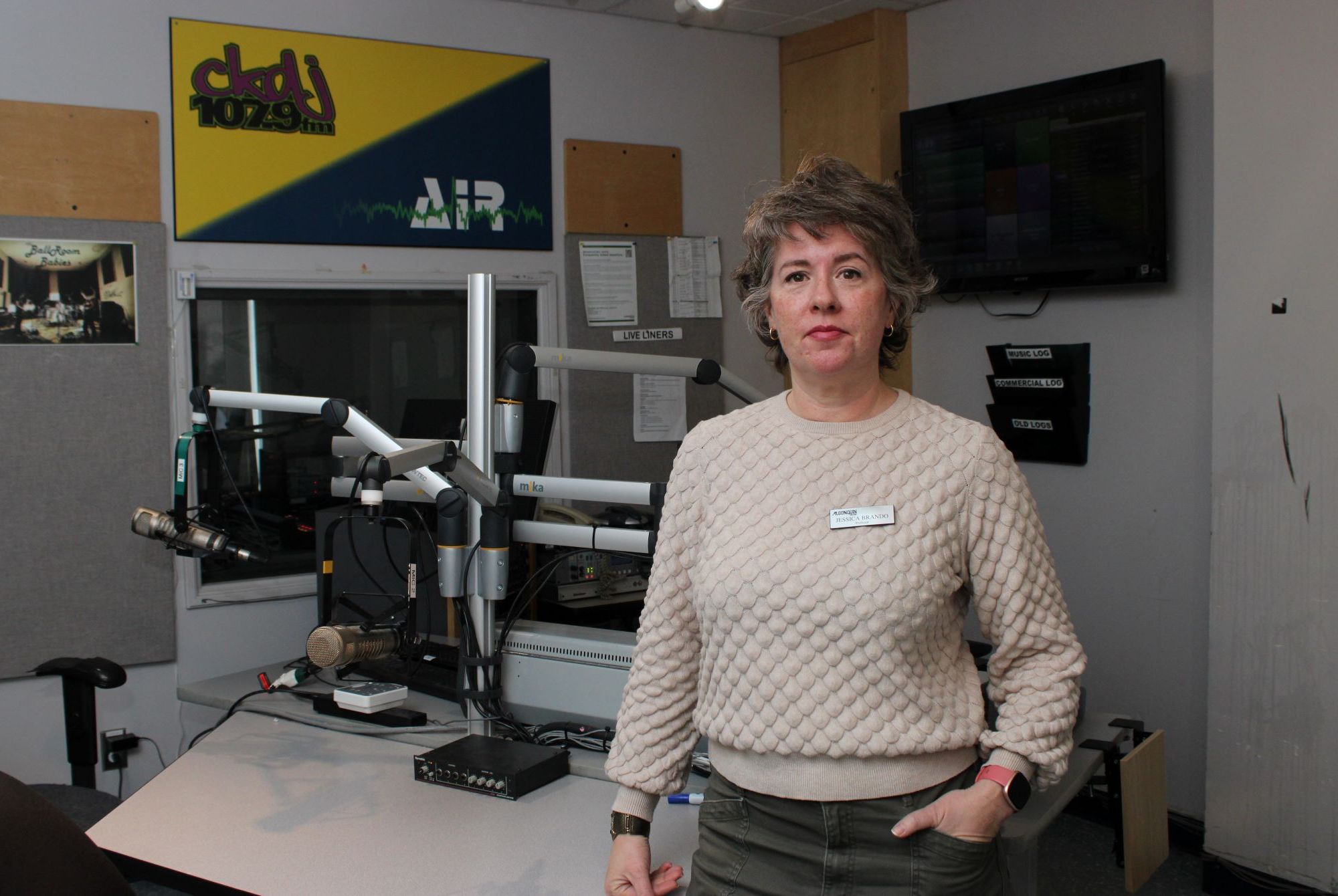
Broadcasting, radio and podcasting program coordinator Jessica Brando in the CKDJ studio. Photo credit: Reilly Armstrong
In February 2025, the radio program was suspended by the college and did not accept any new students in the fall. The reaction within the program was immediate and intense.
“When the news actually broke, our program director at the time, Dan Mellon, who’d been here close to 20 years, was so emotionally impacted that it broke us all,” says second-year radio student Tristan Escobar. “For the rest of that year, everybody was all down in the dumps.”
Escobar is one of the students on track to graduate when the program wraps up at the end of the semester. He says that despite the program’s looming shutdown, his peers have tried to make the best of the situation.
“We all kind of came together and said, ‘Okay, in this new year, we’re gonna have a different mindset. We can’t just be sad. Let’s go out with a bang, let’s give it everything we got… And really make these people regret that they’re shutting our program down.’”
Sitting and watching Escobar on air with fellow second-year radio student Owen Landry highlights a hole that will be left in the media school: the student-run radio station CKDJ 107.9 FM.
Radio students Tristan Escobar and Owen Landry on air talking sports. Photo credit: Reilly Armstrong
The college was granted the licence for the station in 1993, and since the following year CKDJ has operated as an FM radio station completely run by college students, covering everything from pop hits to local sports.
“Getting to work with sports has been really fun and it’s helped me get a good look at the real world,” says Landry. “That’s what I want to do in the future.”
Landry is set to graduate this year alongside Escobar, but not all radio students share that good fortune.
Brando explained that the closure means that faculty and students alike will be scrambling to find equivalencies in order for students to graduate.
“We still have some students that won’t graduate this year,” says Brando. “It’s a bit of a head-scratcher. Right now, myself and the academic chair are trying to find different ways so that these students can get that learning, and they might have to go outside the college, which is kind of crazy.”
Algonquin is just one of many institutions, like Humber College and Fanshawe College, closing their radio programs. While it seems like the program itself may be at an end, the future of the station and the license of CKDJ is still up in the air.
“It just feels like we’re being made extinct,” laments Brando. “(Our radio) licence is valid until 2030, but just because the licence exists doesn’t mean it’ll be played out until the end.”
Escobar is similarly concerned for the future of students, and radio as a whole.
“Most of the people in our program, and even from the students last year, there’s probably a quarter of us who are actually guaranteed to have a job in radio in the future,” he says.
“From my experiences with talking to so many different radio hosts, my conclusion is that it’s just very much stagnant at the moment.”
Brando challenges those who say radio is a dying art.
“There’s a lot of pessimists who say, ‘Oh, well, radio is a technology of the past’… But it’s not. We have 20 students right now out on placements in different radio or radio-adjacent fields,” she says.
“I think that it’s a bit of a misnomer. I think they should say what it is,” says Brando when asked about the suspension.
“There’s no going back from this. It’s not like they’re going to unsuspend us.”
Featured Hero | Featured Story | Home Feature | Home Hero | News
Voices, nerves and applause filled the room during an open karaoke night
Mariana Vega Andrade
Photos: Mariana Vega Andrade
January 27, 2026 Revised: January 27, 2026 11:58am
Photo: Mariana Vega Andrade
A student performing on stage.
Students gathered in the Observatory on Jan. 16 at 6 p.m. for Algonquin’s free karaoke night, an event designed to bring the campus community together and give students a fun, social outlet.
Around 60 people attendees filled the space, supporting friends on stage, clapping along to performances, and enjoying the shared excitement of a night focused on music, laughter and connection. From shy first-times to confident performers, the evening showcased not only talent but also the strong sense of friendship and community among Algonquin students.
The karaoke night has been running for over 10 years and continues to be one of the association’s most successful events. “As part of the Students’ Association, our goal is to see what we can do to increase the student experience,” said Matteo Mongroo from the Students Association.
Mongroo explained that when the event first started, organizers weren’t sure if students would be willing to get up and sing, since it takes courage to perform in front of peers. Over the years, the turnout has been steadily positive, with students becoming more comfortable each time. The association also highlighted plans to host more events, including monthly karaoke nights and other music-focused activities that give students the chance to perform and even earn small rewards.
For many students, karaoke night was the perfect opportunity to have fun with friends and express themselves.
Lina Ahmed, one of the first performers of the night, shared her experience taking the stage.
“I always loved singing when I was younger, and I think in my opinion I have a pretty good voice. I just want to show people that I actually have it,” Ahmed said. She chose an Avril Lavigne song Complicated, which she described as meaningful, with a message she enjoys and considers a cool song.
Ahmed admitted feeling nervous at first. “It felt nerve-wracking because I forgot the lyrics,” she said.
She encouraged shy students to participate. “Go for it,” Ahmed said.
Ahmed also reflected on the social impact of events like karaoke night.
“When you sing in front of people, they get to know you better,” she said.
Another performer, Tabechukwu Azonobi, chose Creep for its emotional meaning.
“I chose Creep because it’s very emotional for me.” Azonobi said.
He offered advice for students hesitant to try.
“It’s always okay to close your eyes or stay at the back, just always try. You never know until you try. Even me, I used to be very shy, and I would hold the mic and close my eyes, but eventually you start being more comfortable.” he said.
Nicolas Gatien stepped onto the stage and chose Hotel California for his performance.
“I chose Hotel California because it’s a song a lot of people know, and I wanted to, I guess, warm up as well because it’s a song I know is in my range before I do other songs” Gatien said.
He admitted feeling nervous at first, but the nerves faded once he started singing.
“Yes, I am nervous until I am singing and then I feel fun, and subsequent songs afterwards I can completely find it.” he said.
Having experience performing in front of audiences helped him feel more confident.
“I’ve been playing guitar for like 12 years, so I’ve been performing in front of people for a number of years.”
Gatien also encouraged other students to participate, emphasizing the fun and social aspect of karaoke.
“It’s fun. Come sing. People are here to have fun. They’re not judging you, there are so many different levels of skill when it comes to singing, and people don’t come to karaoke expecting the highest quality singing. We’re here to have fun and enjoy doing this kind of thing,” he added.
Reflecting on the night, Mongroo from the Students’ Association described the atmosphere in one word.
“Awesome. The people that come are awesome, our vendor’s amazing, and everyone always has a great time.” Mongroo said.
Arts & Entertainment | Featured Story | Home Feature
The Student Commons was packed with many beaming faces dealing with academic stress through arts and craft
Ann Saratu Balogun
Photos: Ann Saratu Balogun
January 27, 2026 Revised: January 27, 2026 11:51am
Photo: Ann Saratu Balogun
Student Commons packed with students socializing and making art.
The Students’ Association, AC Hub and the Ginkgo Centre for Creative Arts Therapies brought smiles to students’ faces on Jan. 21 at the Drop-In Art Therapy event, hosted in the college’s E-building.
Students filled the Student Commons to paint, make collages and socialize.
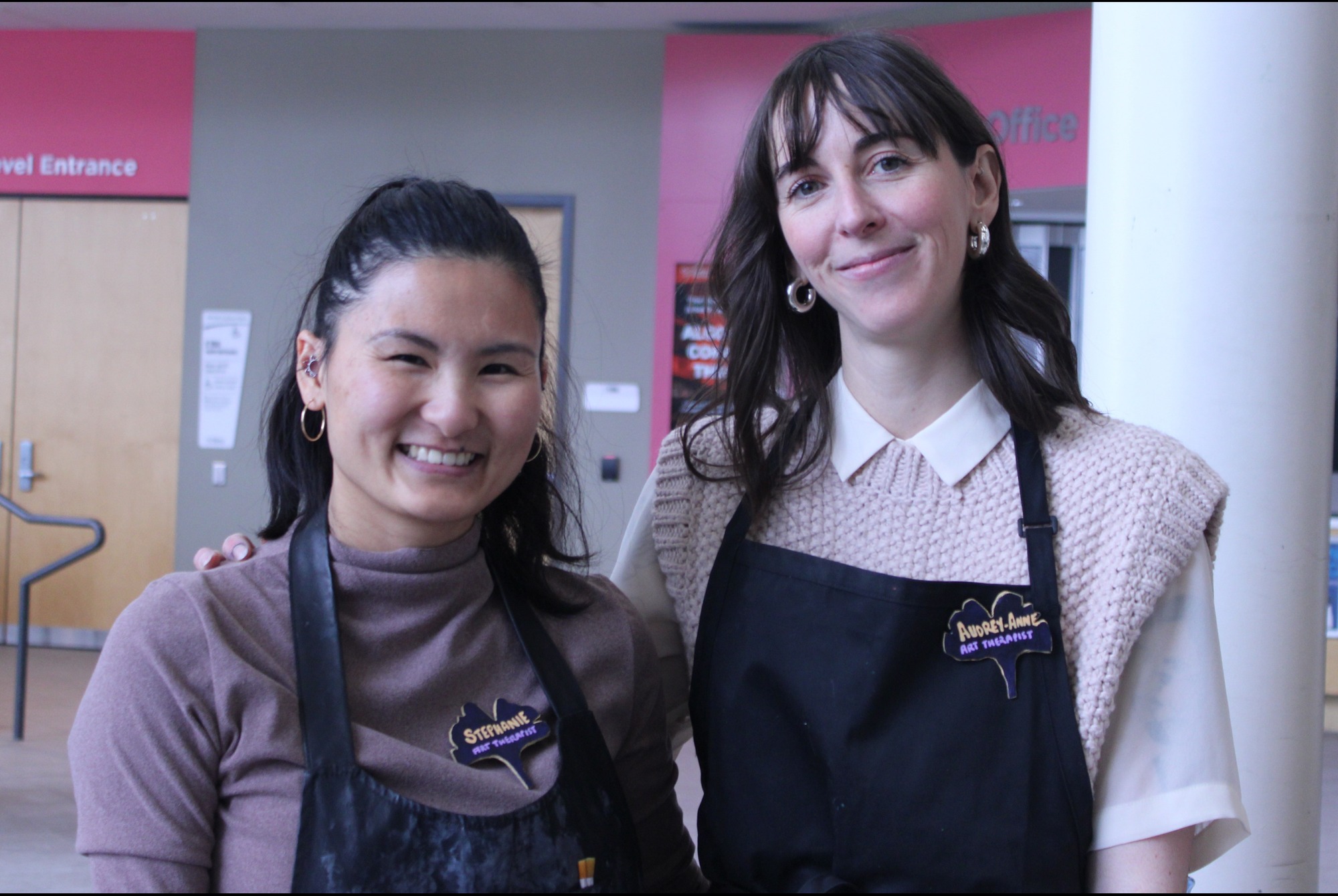
Art therapists and co-founders of Ginkgo, Stephanie Sing and Audrey-Anne Frenette, had tables stocked with art supplies for students to use, and pamphlets with tips on how to develop a healthy mindset.
Stephanie Sing (Left) and Audrey-Anne Frenette (Right) at Drop-In Art Therapy, welcoming students to the event. Photo credit: Ann Saratu Balogun
The event was free for students to drop in and take their minds off the academic workload.
“It was really fun,” said Jorja Patterson, a first-year graphic design student. “I like how they had supplies that were free.
Some students even popped in from other schools to join in on the fun.
Charlotte Cameron, a University of Ottawa student, shared some of her thoughts.
“I’m always stressed but some weeks are more intense… I try to see my friends and be more creative. This event kind of combines those for me.”
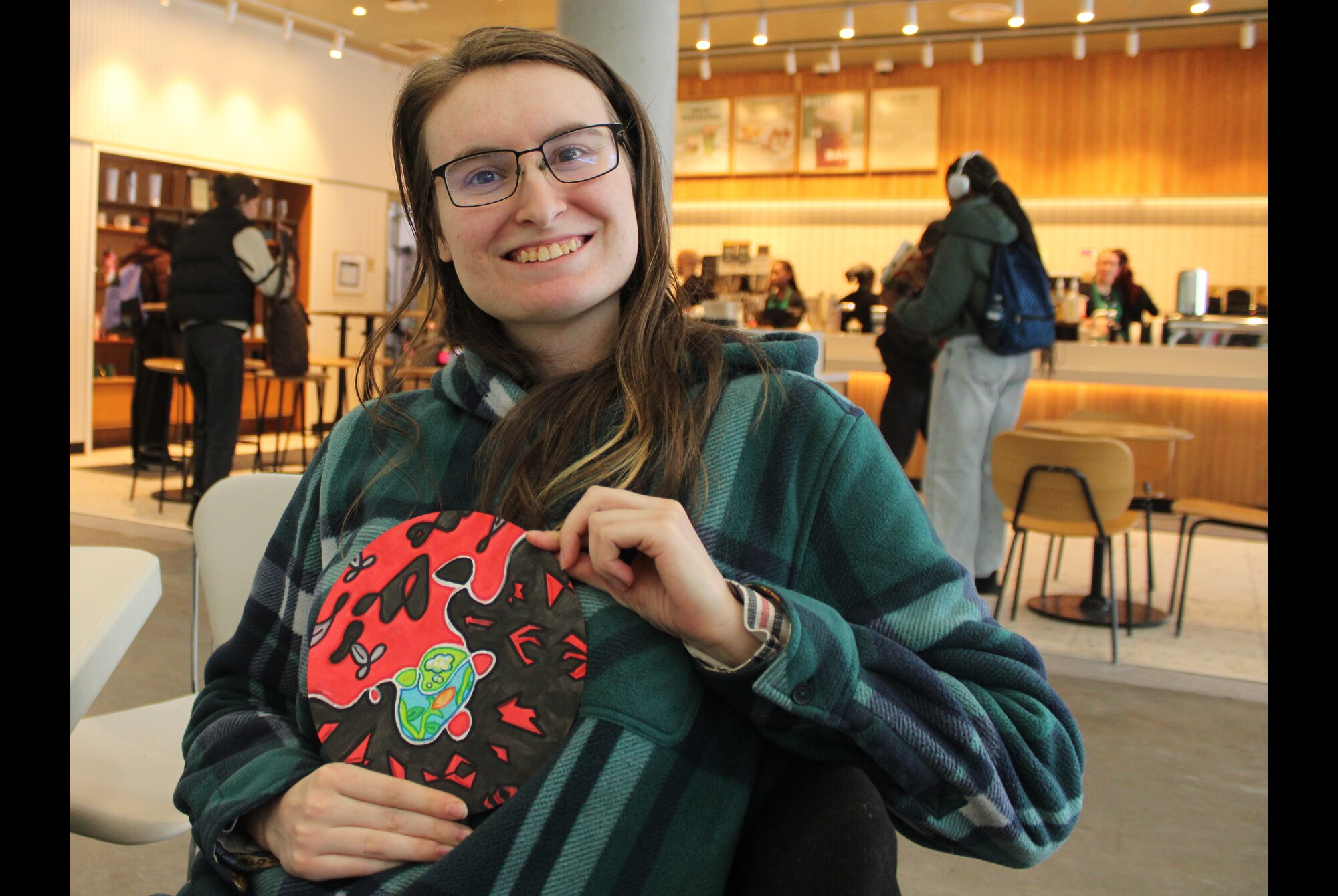
Jorja Patterson (Right) and Charlotte Cameron (Left) admiring their artwork. Photo credit: Ann Saratu Balogun
“I think a lot of students really want some mental health resources, because it’s all really difficult and stressful,” Sing explained. “We’re focusing on balancing the chaos, and it’s really to help students balance the stress of schoolwork and life outside of school.”
“We’re also trying to help them learn about art therapy because most people don’t know what it is,” Frenette said. “Here, it’s really about exploration, curiosity, playing around.”
Ilana Goldfarb and Matteo Mongroo, the event organizers, were active throughout the day, offering assistance to students who needed it.
“I think this event serves two purposes,” Goldfarb said. “It helps students find a calm, creative space for them to express themselves, and when people are sitting together, they may not know each other, but they start talking, so they’re making connections with other students.”
Many students shared positive feedback.
“If you’re stressed, this is an easy way to relax and chill,” said Winnie Demanou, a first-year student of biotechnology.
“I follow the Students’ Association, so I always come for AC events.”
Sina Manesh, a project management student, said “my water bottle looked ugly and I wanted to paint it.
“My program is only eight months, so it’s always go, go, go,” he added. “I’m definitely in the zone now.”
Some art students found this especially satisfying.
“There’s a lot of art students, so we like it when there’s art programs — our little art stuff. It’s really nice,” said Makayla Gosselin, a first-year student of interactive media and design. “They have a lot of different products that you can use. You’ve got your paint, you’ve got crayons, you’ve got markers — even some people were scrapbooking.”
An art piece by Makayla Gosselin. Photo credit: Ann Saratu Balogun
“For me, drawing is always a way to release stress into the art, kind of like how some people go hug a dog to release their emotions… for some of us, art is a way to show how we feel without actually having to confide in someone else.”
Arts & Entertainment | Featured Hero | Featured Story | Home Feature | Home Hero
Campus fruit and vegetable sale lasts only 40 minutes as students purchase affordable produce
Rory Haley
Photos: Rory Haley
January 26, 2026 Revised: January 26, 2026 4:29pm
Photo: Rory Haley
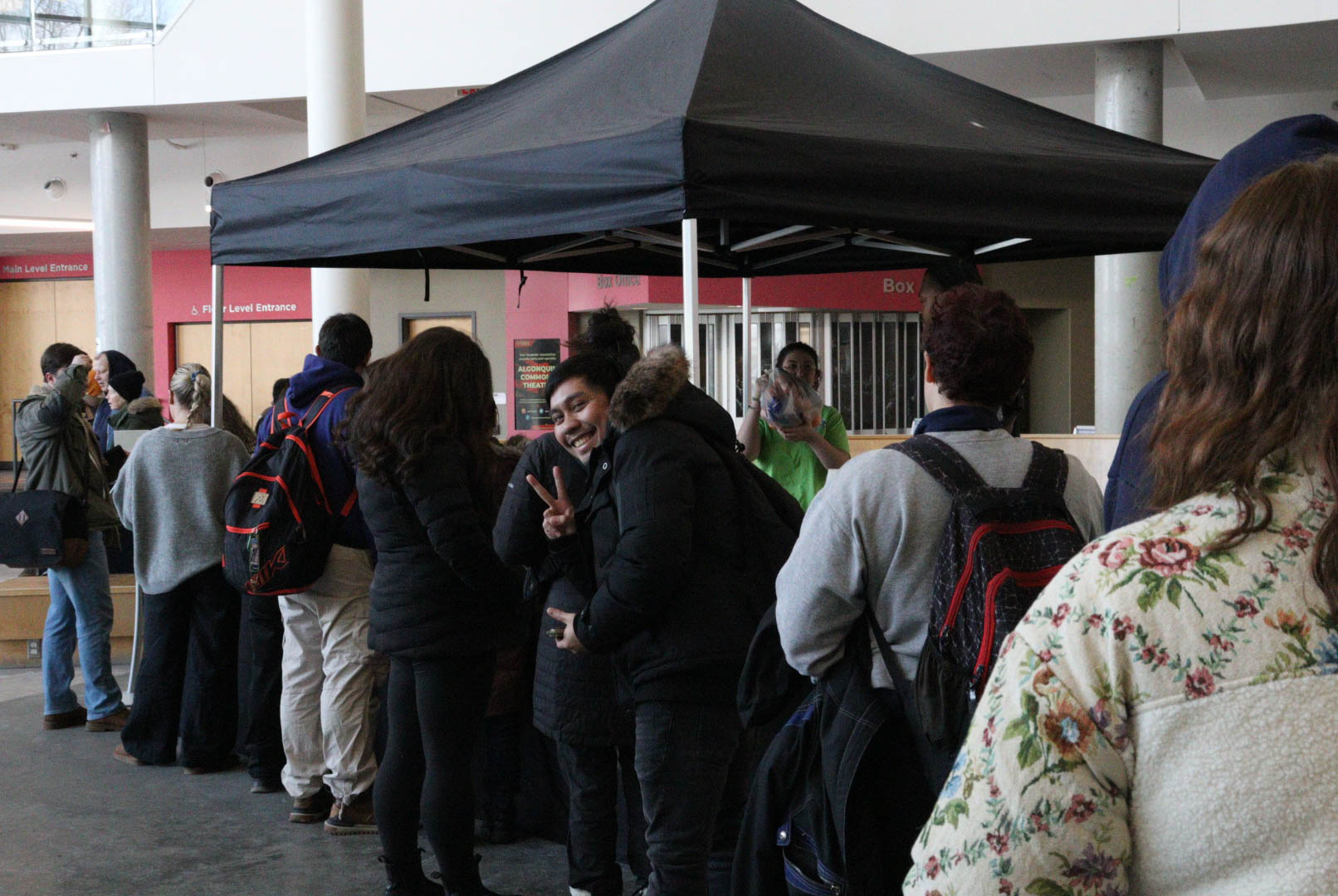
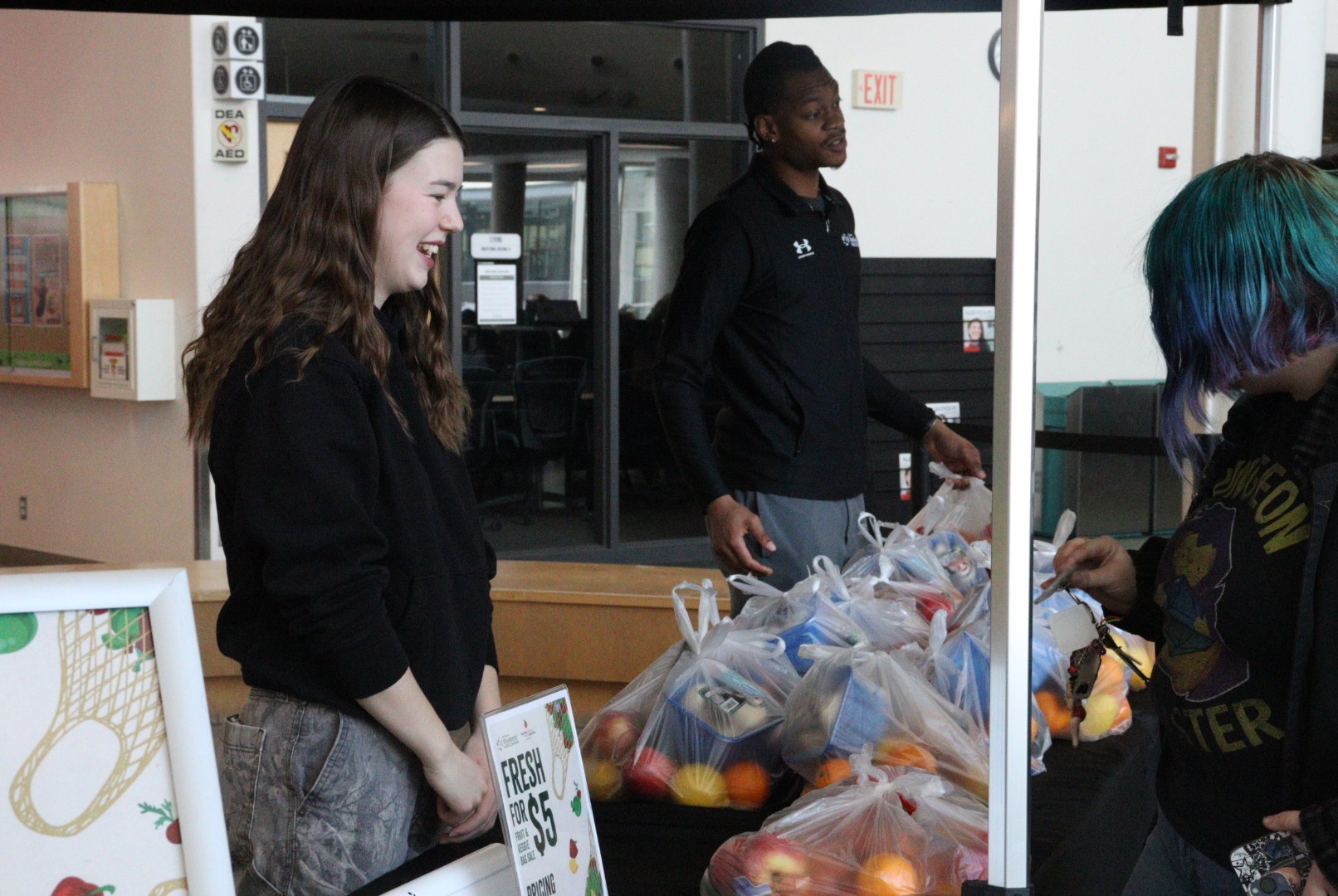
Students reach for fresh food bags at Fresh for $5 sale in the Student Commons on Jan 22.
Bags of fresh produce were purchased quickly on Thursday morning at the Algonquin Students’ Association’s Fresh for $5: Fruit and Veggie Bag Sale.
The Fresh for $5 sale was originally predicted to last from 11 a.m. until 1 p.m. However, due to high student interest, they sold their entire stock of 100 bags within the first 40 minutes of the sale.
Student poses for a photo, eagerly lined up with others for the Fresh for $5 sale at Algonquin College on Jan 22. Photo credit: Rory Haley
Algonquin College students and staff were able to purchase discounted bags of assorted fresh produce. The bags were sold to students for $5, and non-students and staff were charged $10.
They each included an assortment of a two-pound bag of onions, a two-pound bag of carrots, an eight-ounce package of whole mushrooms, two lemons, two Empire apples, two oranges, one English cucumber and one avocado.
The event was co-hosted by the Ottawa Good Food Box, a non-profit organization focused on selling affordable, healthy food.
Algonquin College’s food cupboard coordinator, Abby Muir, emphasized the importance of having events to provide fresh produce for students while still selling it at an affordable price.
“It’s just to get some fresh fruits and veggies into people’s diets, and into people’s fridges because everything is so expensive nowadays,” Muir said.
Abby Muir (Left) sells fresh produce bags to students at the Algonquin College Students' Association fresh food market on Jan 22. Photo credit: Rory Haley
Daniela Leal, a Level 2 architecture technician student, was one of many students who lined up early in anticipation of the sale.
“It’s basically impossible to get so much veg for such a price,” Leal said.
Leal also believes the college should provide affordable, healthy food options for students.
“I used to go to another university, and there were more of these activities more often,” Leal said. “I think if the Students’ Association is capable of doing it, we should be getting more of these.”
Students reach for fresh food bags at Fresh for $5 sale in the Student Commons on Jan 22. Photo credit: Rory Haley
Scarlett Washer, a Level 2 child and youth care student, said that the produce sale helped encourage healthy eating for college students.
“It helps college kids not just eat mac and cheese and french fries, and stuff,” Washer said.
For Algonquin College students who live on campus, it is important to have easy access to more nutritious food options.
“I thought it was a great idea because it’s kind of a pain to have to walk over to the grocery store to get fresh food everyday,” Washer said. “So, having it here, especially a whole bag for $5, I think it’s a good idea.”
As the country prepares for a polar vortex over the next few days, Algonquin students share how they manage commuting during major winter weather events
Amanda Mcleod
Photos: Amanda Mcleod
January 24, 2026 Revised: January 24, 2026 1:08pm
Photo: Amanda Mcleod
Algonquin College's snow removal team was busy on Jan. 15.
The snowstorm of Jan. 15 saw upwards of 40 centimetres of snow dumped on the capital region in less than 24 hours.
Another major winter weather event was in the works as a polar vortex dipped across the country starting Jan. 24. Temperatures were expected to remain well below zero until Sunday, with wind chill projected to be in the -30s to -40s C range.
Many commuters, including Algonquin students, find themselves having to adjust their travel plans when winter weather hits.
Miranda Betker, a second-year business management and entrepreneurship student, says that while she considers the weather before she leaves home, growing up in Northern Ontario prepared her very well for extreme winter conditions.
“Where I’m from, we have so much snow — down here, this is nothing compared to what I’m used to,” she said. “Pretty much every year we get nailed.”
Betker walks to school, but when she does use her car in the winter, she’s prepared.
“I can’t plug my car in where my parking lot is, but I’ll pull my wipers up and start my car 10 minutes before I have to leave,” she said, adding “make sure you have all-season wiper fluid.”
Miranda Betker says growing up in Northern Ontario prepared her for extreme winter conditions. Photo credit: Amanda Mcleod
Payton Fleming, a first-year student in pre-health sciences, lives an hour and a half drive outside of Ottawa, staying with a relative from Ottawa during the week and using OC Transpo to get to and from the college.
Similar to Betker, Fleming makes sure to winterize her vehicle before the season starts.
“Always make sure to get the winter tires on before the snow…and change the windshield fluid to the stuff that’s meant for frozen (weather),” said Fleming.
“Other than that, just make sure my snowbrush is in my car — sometimes I forget and that’s not good.”
Payton Fleming suggests preparing for winter before the season hits. Photo credit: Amanda Mcleod
Public transit users also have to contend with winter conditions.
Georgia Griffin is in the early childhood education program at Algonquin and buses each day from Gatineau.
She generally spends up to 3.5 hours on the bus per day, commuting both ways — and when winter storms hit, sometimes more.
“For one, I have to leave earlier. I have to pack a bunch of different clothes because it’s cold and I’ll be standing outside,” Griffin said. “I’ll be waiting (already) for 10 minutes, and then the bus won’t show up because it got cancelled because of the weather — and then I’m kind of screwed.”
She added that when there is a big snowfall, the bus ride can be tedious.
“When I woke up that morning and saw all that snow coming down, I did not want to go…I had to leave (even) earlier to get there, like two hours. It was probably the longest bus ride of my life. I was loving it.”
While Algonquin College remained open and classes ran on Jan. 15, the college did post a winter storm warning to its Facebook page advising students and staff to take caution when travelling to and from campus, and to remain in contact with professors.
Featured Hero | Featured Story | Home Feature | Home Hero | News
Board of Governors will meet on Feb. 23 to decide if up to 30 programs will meet the chopping block
Amanda Mcleod
Photos: Tyrell Taylor
January 22, 2026 Revised: January 22, 2026 7:38pm
Photo: Tyrell Taylor
Algonquin College's Woodroffe campus may see further program closures.
Reporting by Amanda Mcleod, Reilly Armstrong, Kindra Paul, Tyson Purvis, Ryan Harkness, Pedro Mendez, Mohamed Abdallah Jbili, Tyrell Taylor and Madelene Mcneely
Algonquin College students received an email Thursday morning from senior vice-president Julie Beauchamp announcing recommendations to suspend up to 30 academic programs.
“At the upcoming Feb. 23, 2026 meeting of the College’s Board of Governors, we will be bringing forward a recommendation to suspend 30 academic programs, effective Fall 2026,” the email read.
“If you are currently enrolled in an impacted program, or have been admitted for the Spring 2026 term in an impacted program, you will be given the opportunity to complete your studies and graduate as planned.”
Horticultural industries, manufacturing engineering technician, applied museum studies, design foundations, journalism, bachelor of culinary art and food science and law clerk are among the programs proposed to be suspended.
The recommendations follow the college’s announcement in early 2025 that 37 programs would be suspended and the Perth campus would close after the 2025-26 academic year.
Students at the Woodroffe campus had mixed reactions to the announcement.
Sabrina Ducharme, a second-year student in the horticultural techniques program, which is one of the programs on the college’s cut list, said she was disappointed by the decision.
“(I’m) mostly confused and concerned,” she said. “They said that we would still get to graduate our program, but they won’t be taking anymore intakes.”
She also raised concerns about the long-term effects of cutting the program.
“It’s kind of scary to think where (people) will continue to get plants from if you don’t have the next generation of people to grow them,” she said. “It’s just wild to think that people expect to continue to get food if there’s nobody to grow it…good luck keeping the ecosystem in check.”
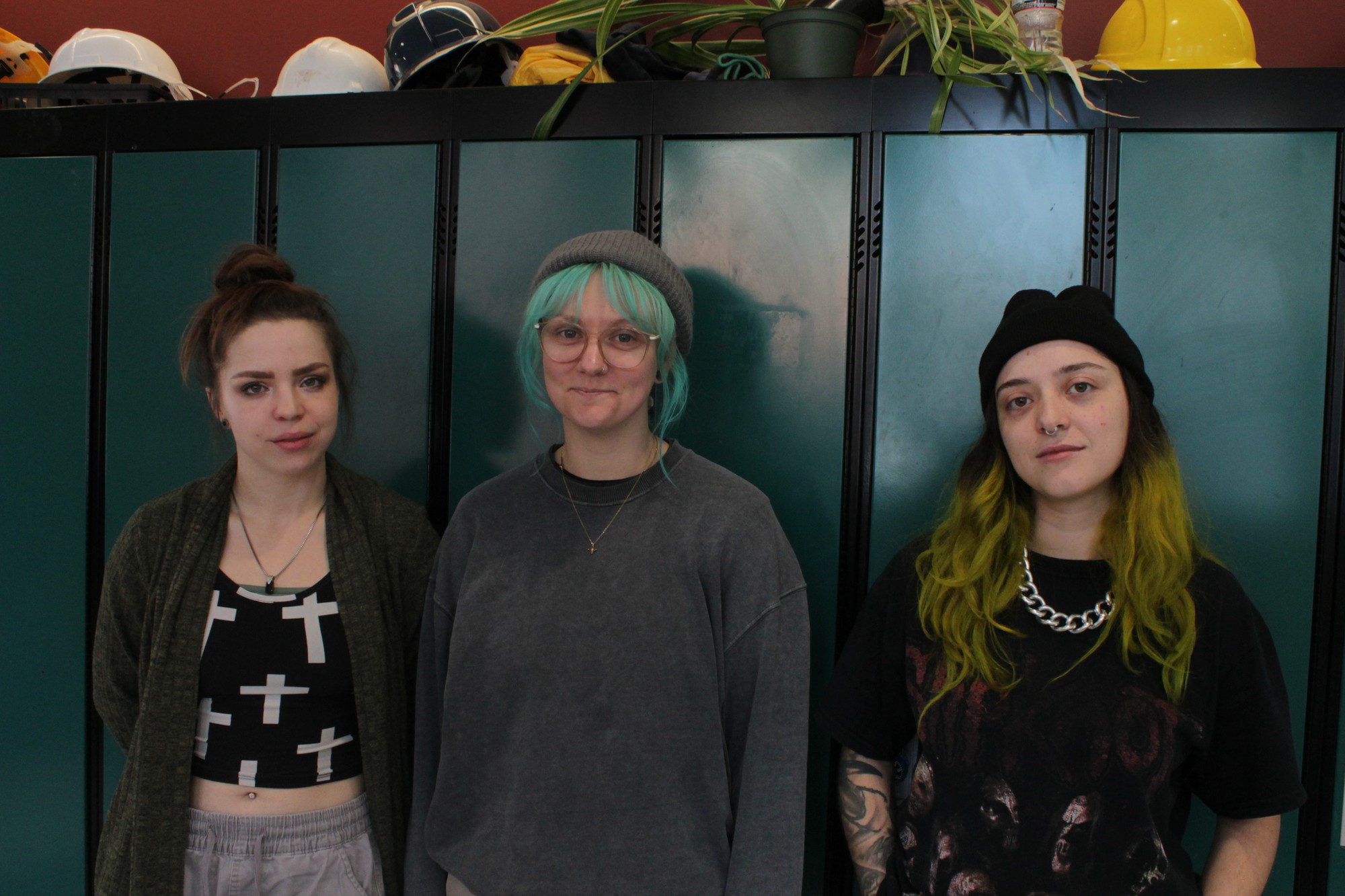
Sabrina Ducharme, Stephanie Caron and Kacey Griffiths are all second-year students in the Algonquin College's horticulture program, which is on the suggested list of programs for closure. Photo credit: Amanda Mcleod
Ajax Foote, a first-year music, media and film foundations student, said she had planned to continue into the music industry arts program, which is also expected to be suspended.
She said she feels angry and frustrated.
“Last year I wanted to do a music program from home, but that got cut,” Foote said. “I was hoping to continue into music industry arts, and now it looks like that might be going too.”
Foote emphasized the importance of the arts, saying they should be supported rather than eliminated.
“The arts are very important, and if anything, we should be embracing creative people who want to share their work,” she said.
She added that cutting these programs has broader consequences.
“By cutting these programs, it takes away a lot of employment opportunities for people afterward.”
The proposed suspensions are also affecting students in programs not currently on the list.
Aimee Shields, a third-year development student, is the communications contact-person for the game development programs capstone project this year.
“My job is making sure everyone else has a job to do,” Shields says.
She said students are nervous about the future of their programs, citing what they see as a pattern of cancellations.
“Any program…that they feel isn’t leading to a career that the college feels is worthy of respect or that makes significant income is in danger,” Shields said.
“It’s really daunting. If programs like these in the arts and in humanities aren’t respected or really engaged with at the administrative level, then people won’t have the opportunity to make things like video games anymore.”
Shields is concerned if suspensions like these continue, the creative side of Algonquin College will be gradually eroded away.
The Board of Governors is scheduled to consider the recommendations at its Feb. 23 meeting. The full list of program suspension recommendations has been published on the college’s website.
Featured Hero | Featured Story | Home Feature | Home Hero | News
The event may be over but the Students' Association has some more in store this term
Tyson Purvis
Photos: Tyson Purvis
January 19, 2026 Revised: January 19, 2026 9:30am
Photo: Tyson Purvis
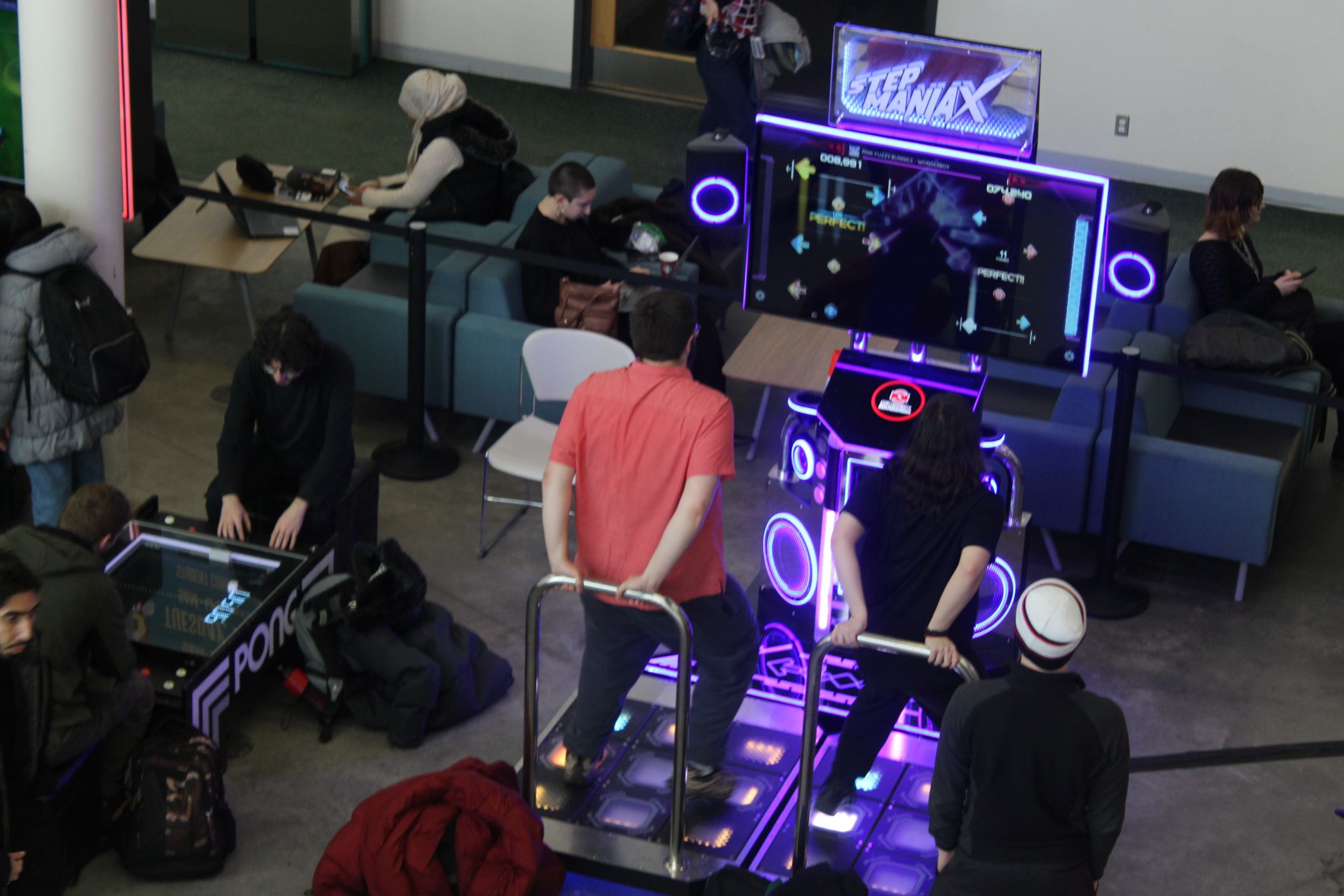
A pair of students playing a game of Pong next to another pair playing StepManiaX.
Students made new friends and played classic arcade games on Jan. 12 and Jan. 13 during the AC Day 1 event,with even more events to come, according to the Students’ Association.
“The Students’ Association was running this arcade for two days,” says Ilana Goldfarb, Students’ Association events manager. “On Monday it was a full day from 9 a.m. until 7 p.m.”
Ilana Goldfarb sits in the welcome booth of AC Day 1 helping students with whatever they may need. Photo credit: Tyson Purvis
Students and staff were free to spend some time in the Student Commons to have some fun.
“There was an open arcade with some of the old-school arcade games, some new ones, and a few others as well,” Goldfarb said.
The games included foosball, Guitar Hero, Marvel vs. Capcom, and StepManiaX.
Outside during the first day of the event, students could claim a free treat.
“For students who wanted them, there were free BeaverTails,” said Goldfarb. “They could sign up here at the front, give us their student number and their name, and we’d give them a ticket for the BeaverTail truck that was outside.”
Students getting their free BeaverTail treats outside of the Student Commons. Photo credit: Tyson Purvis
Students had positive feelings about the event.
“I think it’s really great that they put something together for us,” said Sophie Paul Paquette, a first-year film and media student.
“They’re getting people all together, you know, having fun and stuff for a good start to the semester. So I really think it’spretty cool.”
“I think it was really cool, especially since it was free. It was nice to have a lot of fun and just to take a break. It’s especially nice since we just started school again,” Paquette added.
A group of students playing a game of foosball in the heart of the arcade. Photo credit: Tyson Purvis
Some students feel like these events are the SA’s way of making up for the recent program and budget cuts from the school.
“I mean, at least the school as a whole is putting something together for its community,” said Ethan Laing, a first-year film and media student.
“Like, the school is releasing budgets and everything for some things because they were cutting more programs. So, I think the SA does this kind of stuff to say, ‘If the college is gonna kick your asses, we’re gonna at least butter you up’,” he added.
Sophie Paul Paquette (Right) and Ethan Laing (Left) enjoying their time at the arcade. Photo credit: Tyson Purvis
The open arcade was the main attraction for AC Day 1 this semester, with much time and money invested to make it happen.
Conversations about this event began around six months ago, according to Goldfarb, with finances being a big talking point.
“There’s a lot of conversation in terms of you know, setup, insurance costs and all of that,” Goldfarb said. “So, two days in Ottawa, and then one day they were in Pembroke. In total, it was $30,000 because of three days. So, $10,000 per day.”
A welcome sign for Arcade Battle, the primary event for AC Day 1. Photo credit: Tyson Purvis
The experience students had made it all worthwhile, according to Alain Cyr-Russo, senior student life manager for the SA.
Paquette was impressed.
“I just got here so we’ve only played the soccer game so far, and that was really fun,” Paquette said. “I can’t wait to see what else is happening here. I’ve got my eyes on the basketball court and the racing one. I’mpretty excited.”
While the open arcade event finished this past Tuesday, the SA has more events in the works.
“Well for this week, it’s movie night tonight, Wednesday is Dirty Bingo, Friday is karaoke, and then next week is our mental health awareness week,” Cyr-Russo said.
“We’ve got Fresh for Five next week too, where students can buy bags of fresh fruits and vegetables for just five bucks each.
“We’ve got other big events coming up as well, such as Algonquin’s Got Talent, an Ottawa Charge PWHL game we’re selling tickets for, and we’ve got wrestling in February,” he added.
Amid the forest of pines, the heart of the farm lies not just in the activity, but in the family stories behind it
Lara Simard
Photos: Lara Simard
December 22, 2025 Revised: December 22, 2025 11:59am
Photo: Lara Simard
A revisiting family, Elizabeth Leung (top), Kateri Leung (14) (left), Meaghan Leung (middle) and Damien Leung (7), sitting by the fire after a fun day at Thomas Tree Farm on Nov. 28.
Just as the morning sun has barely risen over the trees, Christine Thomas steps out onto her 50‑acre coniferous property. These are the quietest moments of the day for her. She loves to feel the fresh breeze on her face, anticipating another heartwarming day at the farm.
“I love the early mornings when it’s just me, my husband and the kids organizing before the crowds arrive,” she said.
Nearly three generations strong, Thomas Tree Farm was founded by Gary and Ruth Thomas in 1990. They passed down their love of the outdoors and strong work ethic through the generations.
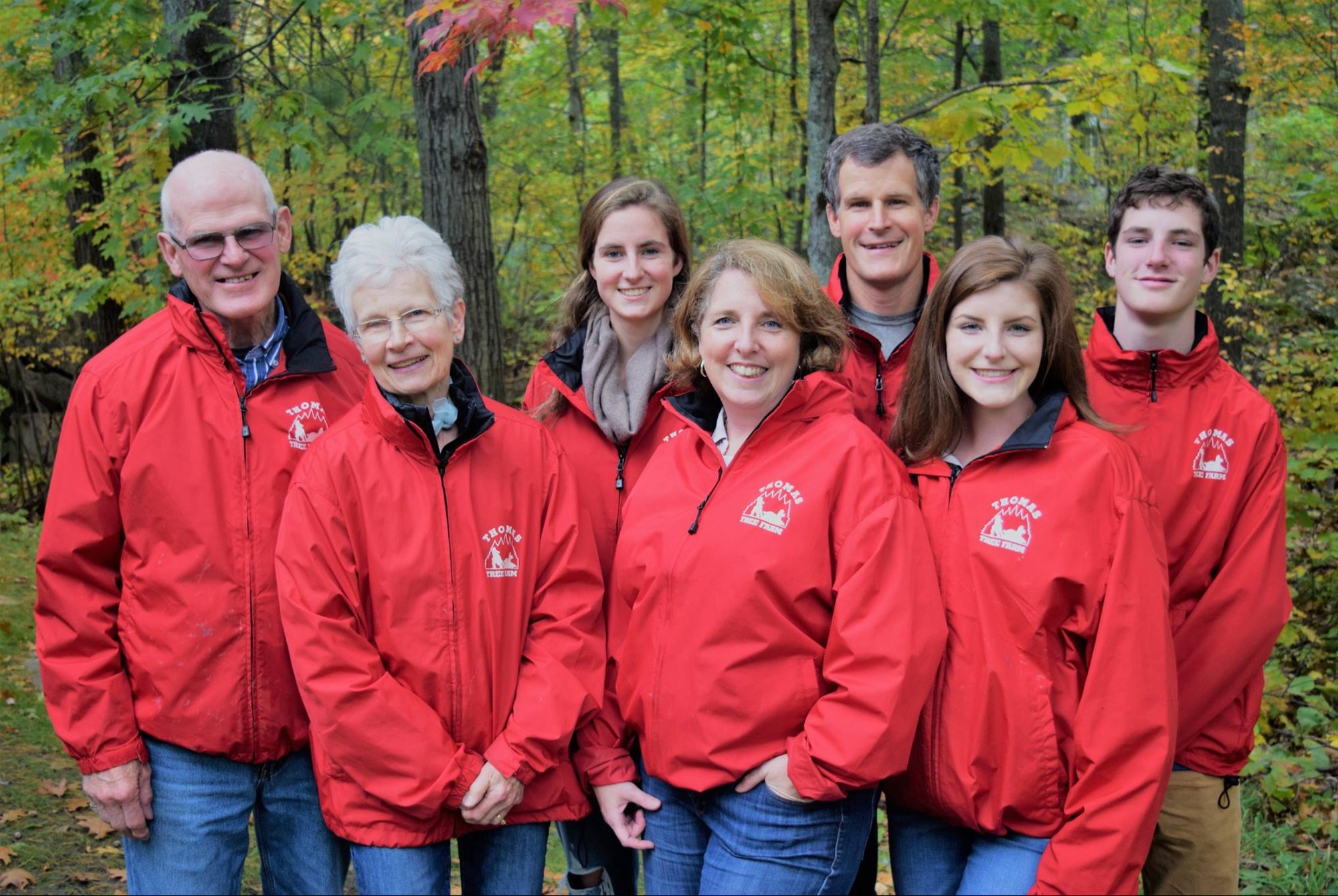
The three generations of the Thomas family stand together on their property in North Gower Photo credit: Lara Simard
Located in North Gower, Ont., it has become a place where faithful customers build lasting memories rooted in family traditions. Although the farm has undergone minor changes over the years, it has kept its charm, down to the stones that intricately frame the front of the house.
“The house that we live in was built by my husband, his two brothers, his sister and his parents. They built this house themselves, and there’s a story behind every part of it,” Christine said.
It all started when Gary and Ruth bought the property in 1985. In his early adult years working as an engineer for the Ministry of Natural Resources, Gary was surrounded by passionate foresters — so much so that he soon became interested in what kind of farming he could do himself. The land quickly became the canvas upon which the family would paint its future.
Gary’s son, Ian, continued down the engineering path. He now works part-time and spends the rest of his week on the farm with the help of their three children.
This year marks the farm’s 35th year in business, open Thursdays to Saturdays. Families have already started gathering their favourite trees for the winter season since opening day on Nov. 21.
With bells ringing and laughter chiming, the farm is more than ready to bring the spirit of Christmas festivities to life. Its exuberant and brightly decorated atmosphere makes this cherished family-owned property a source of special memories for all.
“Gary and Ruth, my in-laws, really built the foundations for the business. But every year we try to add something new or do something different,” Christine said.
Recently, Ian and Christine added an evening opening where families can gather. After 5 p.m., cut-your-own trees are unavailable, but the family makes the most of the time by creating an atmosphere where couples and families alike can form lasting memories, with music playing and lights strung over the fire’s glow.
The wreath shop and hot chocolate shack lit up for a beautiful evening at Thomas Tree Farm on Nov. 28. Photo credit: Lara Simard
Some nights, in the calm of the evening, when everyone has brought their trees home to decorate, the couple loves to sit beneath the starry sky and dazzling lights and enjoy a soothing bottle of wine.
On a typical day, visiting families take a tractor-drawn hayride through the forest, where they explore a selection of hand-pruned trees — Scotch pine, spruce and balsam — and enjoy a steaming cup of hot chocolate and cookies around the fire, made from a secret recipe that has carried through for 35 years.
Each tree takes about eight years to grow, undergoing a meticulous process of planting in the spring, mowing the grounds, irrigating the fields and pruning the trees.
The selection of trees at Thomas Tree Farm’s 50-acre on Nov. 29, ready to be hand-cut
“Every tree gets hand-pruned, which takes about 400 hours annually,” Christine said.
The Thomases like to hire students and family members to help with the maintenance and care of the farm.
But the cookies and trees are not the only things with long-standing traditions. Even the wreaths sold at the wreath shop were first created by Ruth Thomas. When the farm was passed down to Ian and Christine in 2018, Christine quickly grew a love for wreath decorating, which is now her favourite pastime.
Christine loves greeting people as they walk in and seeing families’ children grow up.
“We have one family that’s been coming since it opened, pretty much,” she said. “Now all of their grandkids come, and they have a big family reunion here basically every year. They buy, like, ten trees because all the kids come.”
For Christine, nothing is more important than family. Her son Matthew is hopeful to take ownership of the farm in the near future. He would like to expand and modernize the farm to make it more accessible to visitors.
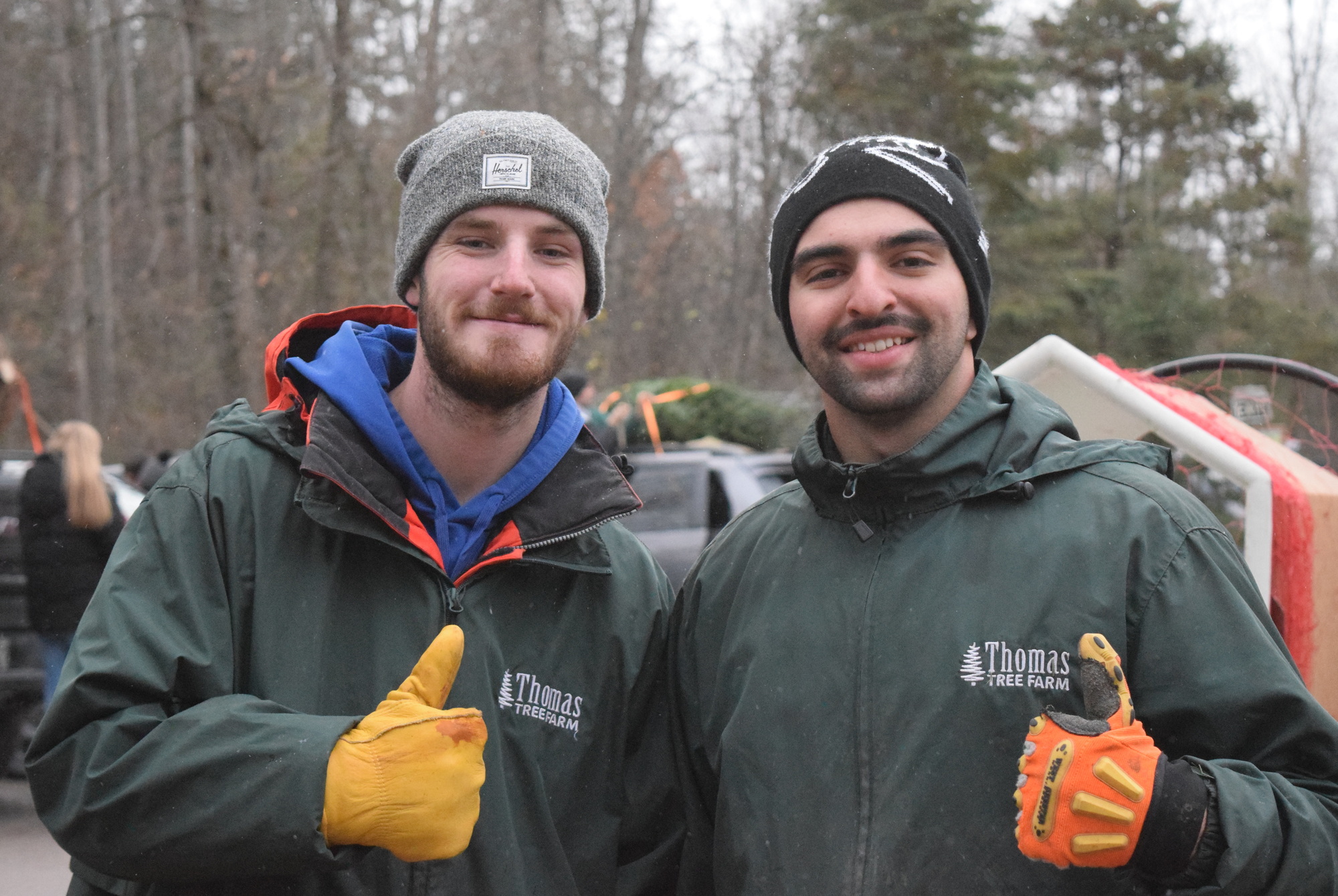
Matthew Thomas (Left) and David Olynik (Right) pause from their daily tree bailing activities at Thomas Tree farm on Nov. 28 Photo credit: Lara Simard
“I’d say my vision for the farm moving forward is to keep our cozy, forest vibe at the farm, but hopefully get some new things like a new building soon, and maybe improvements with things like parking,” he said.
Matthew, who is finishing school in April, said the transition will likely be a slow process, especially as he continues to work at his federal government job as a student. Eventually, he hopes to work with his family to ensure a smooth handover.
“I’m excited to continue the legacy that my grandpa started so long ago,” he said.
His sister Sophie is also excited to continue the legacy of the farm, hoping to have dual ownership alongside her brother.
“Growing up on the farm has been very fun — lots of hard work — but it’s made me into the person I am today,” she said.
In the summer, Sophie would work at her full-time job and help her parents with pruning and planting in any spare time she had, supporting them where she could.
Sophie (Left) and Christine Thomas (Right) pose for a picture at Thomas Tree Farm during one of the busiest days this season on Nov. 29 Photo credit: Lara Simard
In a modern world where everything feels rushed, the Thomas family truly values long-lasting memories, meaningful moments and a welcoming environment for generations to come.
“These days we have fast fashion, fast food, fast everything. Just getting time outside with your loved ones and spending time together — it’s special,” Christine said, a little teary-eyed.
As the legacy lives on, Thomas Tree Farm will continue to be a truly special wintry experience for all.
Featured Hero | Featured Story | Features | Home Feature | Home Hero
Haitians look to Canada for escape as homeland becomes unsafe
Janella Milord Ashford
Photos: Janella Milord Ashford
December 22, 2025 Revised: December 22, 2025 11:53am
Photo: Janella Milord Ashford
Sebastienne Carine Durand, a single mother of two daughters who recently emigrated in Ottawa from Haiti following gang violence.
Sebastienne Carine Durand had no choice but to leave Haiti with her two young daughters in 2022 because her life was at risk.
“These girls have really been able to adapt to different environments, different circumstances, especially my eldest daughter,” says Durand. “When we had to go to the border to leave, all I told her was that we were going to leave the country. I told her, ‘We’re not coming back’.”
As long as they weren’t separated, her daughters were ready to brave any storm.
The island had undeniably been struggling post-earthquake since 2010, but things got worse when Haïti’s president, Jovenel Moïse, was assassinated on July 7, 2021.
The latest displacement tracking matrix report from the International Organization for Migration shows that, as of October 2025, the number of people displaced by violence and instability in Haiti reached abnormal levels, with over 1.4 million people forced to evacuate their homes this year.
The month of July 2025 marked a noticeable increase in asylum claims after U.S. President Donald Trump’s administration decided to end the Temporary Protected Status.
The Canada Border Services Agency reported a 263 per cent rise in asylum requests at a port of entry in Saint-Bernard-de-Lacolle, just south of Montréal, compared to the same period last year.
After many hardships along the journey of leaving Haiti, Durand was able to get help from an old friend she used to go to school with back home. Communications and community engagement officer at Centre Toussaint L’ouverture de Service et d’Orientation (CETSO), Daphnée Orizier, who now resides in Ottawa, assisted Durand with joy.
“We helped her find a place to rent since the city was helping with rent allocation,” says Orizier. “Once she settled in her one-bedroom apartment, we started the job hunt and she landed a corporate job at the Transport Canada office in January 2024.”
Durand is now residing in the city’s east end and is pursuing her masters in business administration with a major in human resources.
THE START OF HER PROBLEMS
Back in Haiti, Durand lived a comfortable life where she studied secretarial practices. She holds a bachelor in law and worked for the American government as a consular assistant.
Her life took a turn for the worst when all she needed was her car fixed.
“I had to get a new transmission for my car. I paid for the item and labour which was supposed to take 24 hours,” says Durand. “The gentleman mounted the first transmission to the car. The car wasn’t running properly. I went back to see him and said it wasn’t good. The situation then turned sour. He didn’t want to reimburse me, then tried to intimidate me, telling me you don’t know who you’re messing with.”
Durand took matters into her own hands and contacted authorities but then, she started getting followed home which also led to intimidating phone calls.
“It’s a rather corrupt system. There was a matter of conflict of interest and some commissioners didn’t bother passing over the file to someone else,” says Durand.
As she was trying to wash her hands of the situation and clear her name from vehicle ownership records, the same men, who were linked to gangs, began making death threats.
After much thought and many years in hiding, Durand grew tired of her lifestyle.
“I told myself no more battles, then I saw myself folding my life away in two briefcases with my children, leaving a career, my life, my stability and really facing the uncertainty and everything that comes with it,” says Durand.
Durand had an American tourist visa from previously working at the U.S. embassy in Haiti, so as soon as she left Haiti in 2022, she took that chance to go to New York and stay with her parents. This gave her some time to process everything she went through along with preparing herself for what’s to come.
After some time, Durand decided it was time to leave Brooklyn. She arrived in Canada on July 11, 2022 where, at the time, you didn’t need family or relatives to cross the border.
Following a few months of couch hopping, she was able to secure an appointment with social services to secure stable housing for her small family.
“Once I got to the office, they didn’t want to believe that I was homeless or that I needed help. One of the workers told his colleague ‘she looks like a hijacker’ and I’m like ‘No. Who are you to tell me I’m a hijacker, is it because I’m Black?’,” says Durand.
There was also much difficulty for her to find a job in her field of administration once she got to Ottawa. But with much prayer and drive, she conquered.
“It was only when a random recruiter from the office called and told me ‘I looked at your resume. There’s no way that you can’t work with us,’” says Durand. “There are things that I experienced in Canada where no one gave me a briefing on how to manage.”
FROM POLITICAL TURMOIL TO A HUMANITARIAN CRISIS
As Durand settles in Canada, the violence in Haiti continues.
Just recently, Associated Press reported on an incident that took place over the weekend of Nov. 28, 2025, where gangs in Haiti’s central region left hundreds of locals to flee gunfire and burning homes.
Gang leaders cover all entry and exit points inside Port-au-Prince, where local authorities and politicians left the capital with no one left to protect citizens.
As of late June, Trump’s orders put over 300,000 Haitians living in the U.S. at risk of deportation. A federal judge temporarily blocked the order, but legal challenges are ongoing, and the situation remains unclear.
This leaves many Haitians in the U.S. with a feeling of uncertainty and unease. According to CBSA, more than 5,500 asylum seekers have turned to Canada since July, with a significant portion of people coming from the U.S.
LIFE IN HAITI
Menesly Alexandre was born in a coastal commune called Léogane, Haiti in 1989 then moved to La Plaine, the fourth communal section in the Nippes department of Port-au-Prince, Haiti where he currently resides. Alexandre studied social work but is in need of a higher education.
Neighbourhood in La Plaine, Port-au-Prince. Alexandre tries to display the living conditions in which him and his neighbours are subject to. Photo credit: picture provided by menesly alexandre
“Nowadays, it’s become a little tough to find a good job if we don’t have a master’s degree, although we have a social work license, the positions are really demanding,” says Alexandre. “This is why I would like to get a master’s degree in Canada. It can increase my chances to find a job, and return to my country.”
Canada was Alexandre’s first choice for a new home after much research and his appreciation for its welcoming ambiance, plus many of his friends live in Laval.
He applied recently for a student visa to complete social work studies at Laval University but was denied when he couldn’t prove he had enough money to fund his schooling.
Temporary study permits in Canada are $150, but many other costs are for medical records, police checks and other identification purposes.
In September 2025, the Canadian government also increased the financial proof requirements for international students applying for student visas in order to reflect the higher cost of living in Canada.
Despite Alexandre’s different motivations for leaving the country, he says that the living situation in Haiti is still a major cause for concern. He says he and his two year-old son were attacked on the way home one day.
Guards stop and threaten locals for money all the time, Alexandre says.
As a practising Christian, he says only his faith keeps him hopeful for a brighter future.
THE NEXT GENERATION
Because of the country’s collapse, many people lost jobs and some public servants, especially teachers, had to get out of Haiti which could potentially leave a lot of children with no education.
“Unfortunately, the situation in Haiti is extremely worrying. If it continues like this, we may come to a stage where universities and schools will have to close their doors,” adds Alexandre.
Despite the need for acceptable living conditions, Alexandre believes what needs to be prioritized is the next generation. He says the youth are targets and are being molded into joining gangs.
“There is the social pressure that exerts itself when living as a teenager for all young people,” says Alexandre. “You can be influenced and easily integrated into the armed groups as well. These people give them (the youth) money without difficulty. Young girls have relationships with whom they would never have a relationship with.”
Priscilla Zelaya and Bertrhude Albert, two alumnae of the University of Florida, co-founded “P4H” (formerly known as Projects for Haiti), an organization who offers training programs for educators in Haiti with over 16,000 teachers trained.
P4H is currently running a fundraiser with a goal of $50,000 to bring quality education to another 35,000 students in 2026.
Durand is currently awaiting her permanent residency card and Alexandre says he will not stop fighting for his study permit.
Undefeated by all difficulties put against them, both Alexandre and Durand are looking to help the next person facing similar barriers and are hoping others can do the same.
“The first thing I want people to do is not to stigmatize us,” says Durand. “I say this because, not everyone comes to Canada with the idea of lying or taking advantage of the system.”
Featured Hero | Featured Story | Features | Home Feature
Since their arrival to Bytown, the Sisters have provided social infrastructure, despite minimal recognition
Vasileios Tselios
Photos:
December 20, 2025 Revised: December 20, 2025 12:44pm
On Feb. 20, 1845, the church bells of Bytown were ringing as residents rushed out onto the frozen Ottawa River. Mother Élisabeth Bruyère, along with three other Grey Nuns of Montreal, had completed their two-day journey to the town. By the request of Kingston’s Bishop Phelan, Bruyère was sent to establish social infrastructure for the women, children and elderly of Bytown, now Ottawa.
“Bytown was rejoicing with the arrival of the Sisters. They knew there would be all kinds of activities that would enhance their quality of life,” said Sister Louise Charbonneau, the vice-postulator of the cause of the venerable Élisabeth Bruyère.
The Sisters of Charity of Ottawa were established on that day and 2025 marked their 180th anniversary. The original celebrations were counter-intuitive to the charity’s humble nature. The Sisters seldomly celebrate their own achievements.
They carry on Bruyère’s legacy in silence through the Sisters of Charity Motherhouse and the Bruyère Health hospital on Bruyère Street.
The Motherhouse exhibits multiple artifacts of the Sisters’ foundress, including Bruyère’s coffin which features a vase with her heart in it and a museum in their Historical Site.
“I like to think of Bruyère as one of Ottawa’s best kept secrets,” explained Charbonneau. “Most people have never heard about Bruyère, and even less about her works of charity and the Sisters of Charity of Ottawa.”
Charbonneau and Sister Louise Séguin, the curator of the Historical Site, have guided many tours of the Motherhouse, educating visitors on Bruyère and her impact in Ottawa, alongside her Sisters of Charity.
Emma Anderson, a University of Ottawa professor who specializes in religious studies, has been arranging class field trips with the Sisters for years.
“I have been taking students there for almost 20 years,” said Anderson. “It shows visitors a lot about the flavour of Canadian Catholicism in the mid-19th century.”
The Sisters of Charity often find themselves in Anderson’s lectures across various courses, such as religion in Canada and saints and heretics. Despite teaching religious studies, Anderson admitted most students had never heard of the Motherhouse before their class trip.
“It is pretty rare for people to know about it. The only time I had a student who did know about the Motherhouse was because one of his aunts was a nun there,” she said. “It is a real shame that the Historical Site is so little known: it is a little jewel of local history.”
As the vice-postulator of Élisabeth Bruyère’s cause, Charbonneau aims to spread the word of Bruyère and her works in a Bytown with very few social services.
“Bytown was a small and rough lumber town. There weren’t a lot of social, medical, or educational services,” said Anderson. “The Sisters of Charity undertook to provide all of these: a huge job for a very small number of nuns.”
The plaque on the sign of Élisabeth Bruyère coffin inside the Motherhouse of the Sisters of Charity of Ottawa
By her fourth month in Bytown, Bruyère became a pioneer of social innovation. The Sisters of Charity had established a school, an orphanage, a home for the elderly and a hospital, which would become Bruyère Health.
“Others might have seen what the need was, but they didn’t commit to making a difference. Bruyère and her group committed to making a difference,” said Charbonneau.
In 1847, the typhus epidemic hit Bytown, due to a large number of Irish immigrants who migrated over in unsanitary ships. The small number of Sisters in the town cared for hundreds of patients. Most of them, including Bruyère, ended up getting sick because of the constant exposure to the disease.
Bruyère’s group gained the trust and adornment of the Bytown citizens for their medical bravery. However, this reputation would be questioned in 1871, when Ottawa experienced its first smallpox outbreak.
Patients were treated very poorly, at the time, due to the contagiousness of smallpox. The Sisters would care for people in private isolated spaces, to limit the spread of it. Any dead bodies were buried at night, so the citizens did not see them.
The community criticized the efforts of the Sisters, as they were not as visible as they had been during the typhus epidemic. Bruyère chose to not publicly defend her group.
“One of the priests wanted Mother Bruyère to speak up and defend herself. She said, ‘No, God knows what we are doing and that’s sufficient’,” said Charbonneau.
The Sisters continued to treat patients with smallpox, away from the public eye and to minimal fanfare.
Bruyère passed away on April 5, 1876. Her medical legacy is carried on to this day by the hospital she helped build.
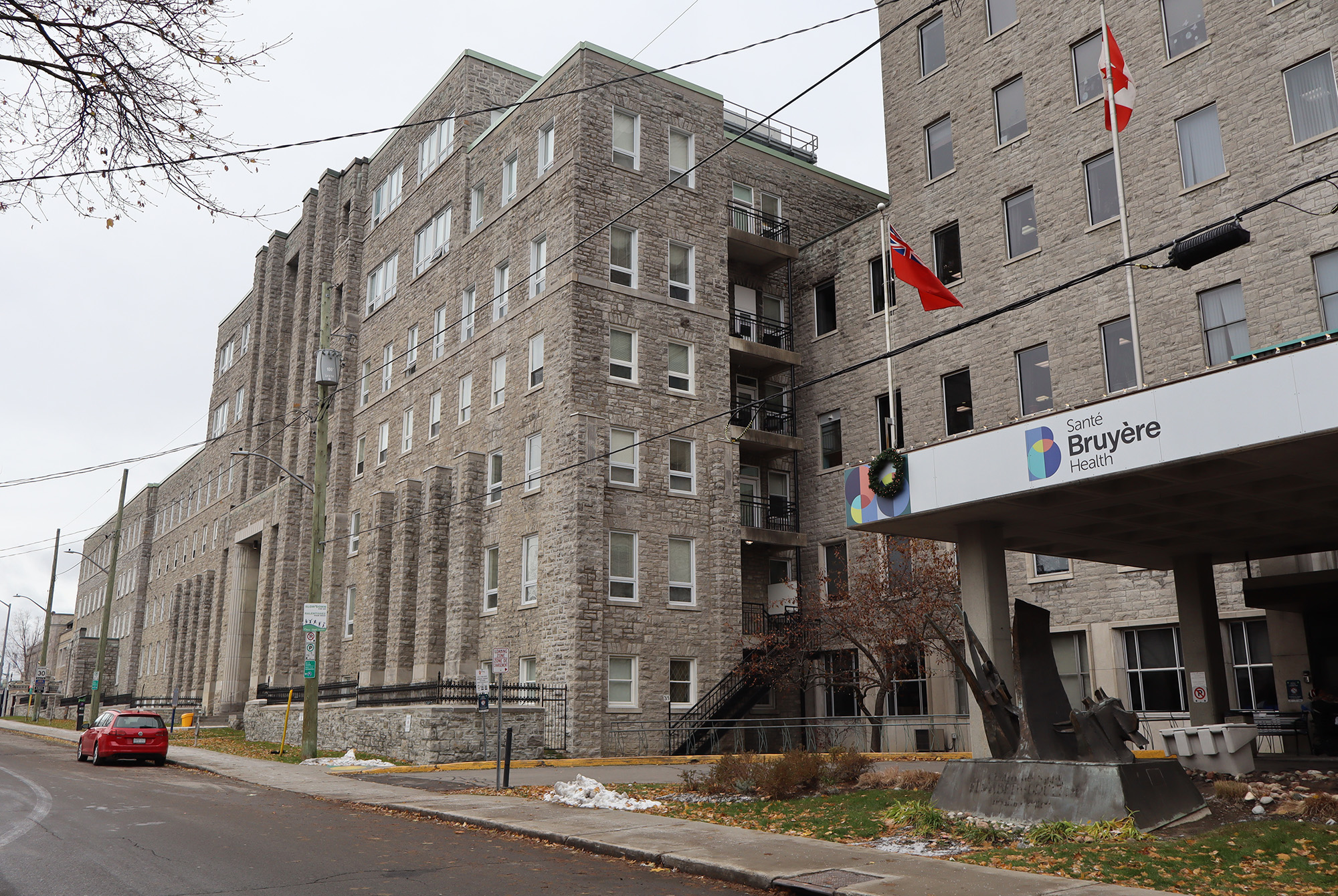
Bruyère Health beside the Sisters of Charity Motherhouse on Bruyère Street
Originally known as the Ottawa General Hospital, Bruyère Health took after the Sisters’ foundress, in her name and values. The hospital’s mission statement mentions compassionate care, the Catholic mission and educating the future generation. All the while focusing on rehabilitation, complex care and research.
“(Bruyère Health) truly fits a gap in our system. I often say if Bruyère wasn’t here, there would be a slow down in the entire healthcare system in Ottawa,” said Marie-Eve Pinard, Bruyère Health’s director of mission effectiveness.
As of April 2025, Bruyère Health had 863 beds across their four locations, and had 58,200 visits in the last fiscal year across their two Academic Family Medicine facilities.
A Sister has not been on the board of Bruyère Health since the early 2000s, however the hospital still maintains its Catholic values thanks to the Catholic Health Sponsors of Ontario.
Today, the Sisters of Charity of Ottawa are less visible than ever before, but their impact is still apparent all around their city. Rather than singing their own praises, they prioritize the causes their foundress did 180 years ago.
“Our nature as a religious institute is humility and support in the background. People might think, ‘The Sisters have gotten older and we don’t see them as much anymore,’” explained Charbonneau. “We’re still there and our heart still beats to the rhythm of Élisabeth Bruyère’s heart for God’s people.”
Featured Hero | Featured Story | Features | Home Feature