Explorer: War Games museum exhibit prompts you to consider big questions
About 10 years ago, Andrew Burtch, a historian who works at Ottawa’s Canadian War Museum had an idea about how to offer something that directly appealed to young people. “After […]
Photo: Noah Leafloor
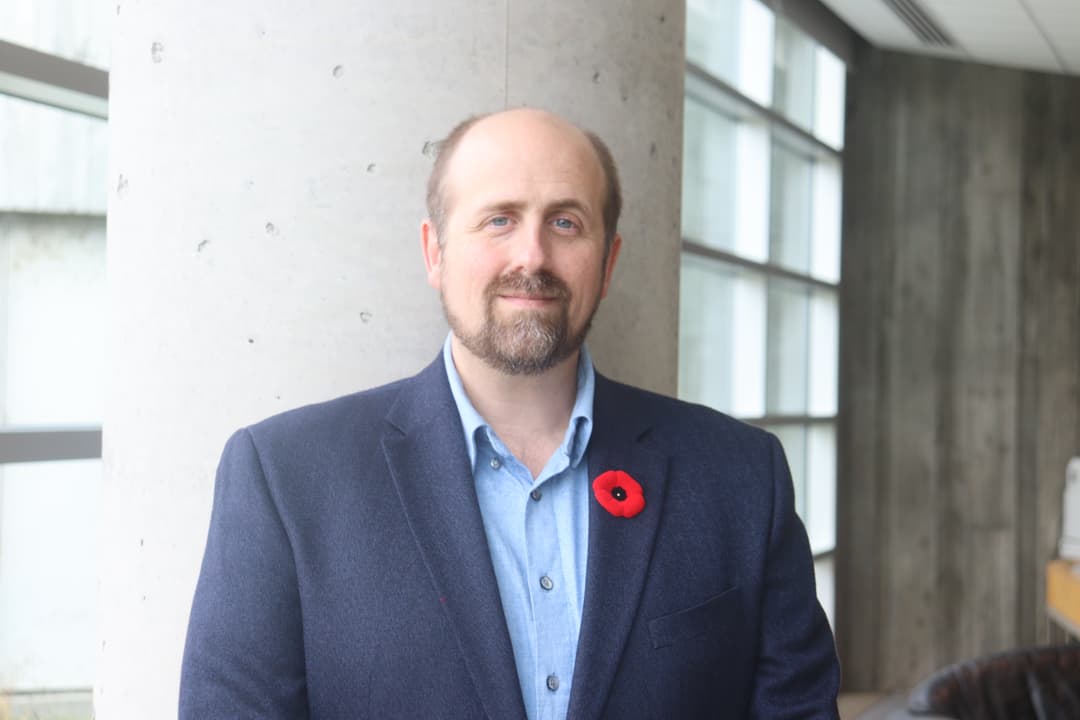
Andrew Burtch, a historian at the Canadian War Museum, is a co-author of the War Games exhibit with Marie-Louise Deruaz.

About 10 years ago, Andrew Burtch, a historian who works at Ottawa’s Canadian War Museum had an idea about how to offer something that directly appealed to young people.

“After observing and approaching groups of youth in our galleries discussing arms cases, it occurred to me their point of entry was because of video games like Call of Duty,” said Burtch.

Burtch is the post-1945 historian at the Canadian War Museum, and an adjunct research professor in Carleton University’s history department. He’s done a number of commemorative exhibitions, including one about the anniversary of the Korean War armistice.

Burtch simmered on the idea for a few years.

Finally, after lots of development – and pandemic-related delays – Burtch and co-author Marie-Louise Deruaz saw the War Games exhibit open on June 9, 2023.

“People can play video games at home,” said Burtch. “What we wanted to do was produce an experience where you couldn’t get on the couch.”

Why should you visit?

The War Games exhibit offers five zones of history and play made possible by dozens of contributions from the CWM and Canadian Museum of History.

The CWM also received a lot of interesting responses on the exhibit.

They had a sizable amount of visitors and it is one of the more popular exhibits in recent years. Approximately 100,000 people came through between the summer and early fall. A fair number of those lie under the young age demographic.

In these zones you’ll see five sets of history that all have forms of interactive games. From small tactic games to first-person simulators, the exhibit offers a wide range of learning. Here are five highlights:

1. Some old games live alongside new ones

Since the dawn of civilization, games and toys found their way into the homes of many. Board games and figures were made to show the urgency of conflict in all areas of war.

“We wanted to have examples of some very old games,” said Burtch. “Some of which have been lost versus widespread games like chess.”

One of the most distinguishable is the Elder Brothers Chess Set by artist Angel Doxtater from Six Nations of the Grand River. It features traditional corn-husk doll game pieces. They represent the elder brothers of the Hodinohso:ni Confederacy.

The Elder Brothers, a chess set made by Kanienโ€™kehรก:ka (Mohawk) artist Angel Doxtater, uses traditional corn husk dolls to represent Hodinohso:ni history and culture.
The Elder Brothers, a chess set made by Kanienโ€™kehรก:ka (Mohawk) artist Angel Doxtater in 2020, uses traditional corn husk dolls to represent Hodinohso:ni history and culture. Photo credit: Canadian War Museum

The exhibit also showcases Little Wars by author H.G. Wells. Little Wars is a war game using tin soldiers which was published in 1913.

Little Wars by H.G. Wells can be found in zone two of the war games exhibit at the CWM.
Little Wars by H.G. Wells can be found in zone two of the war games exhibit at the CWM. Photo credit: Noah Leafloor

2. The Cold War era, which lasted between 1947 and 1991, offers familiar games to check out and play

As this era saw many games developed, the exhibit highlights many of the games that were swiftly games developed.

For instance, the 1970s, role-playing board games had started to become mainstream. Dungeons and Dragons (D&D) was created and is still one of the most popular games today. It is based on medieval warfare.

The board game Dungeons and Dragons can be found in zone three of the war games exhibit at the CWM.
The board game Dungeons and Dragons can be found in zone three of the war games exhibit at the CWM. Photo credit: Canadian War Museum

The era also saw development of Atari’s game Missile Command. Museum visitors can play it in the zone.

3. Although an abundance of violent games have been created, the exhibit reminds us that war is not a game

War is a terrible human activity. The exhibits zone four explores the war on terrorism and how world security has been threatened.

The game Killbox is the highlight of the zone. It is about drone warfare where you simulate both ends of the experience inspired by American drone strikes documented.

4. Humans have new wars to fight today

Present-day games feature scenarios where players focus on climate change, pandemics and world powers, can be more important than fighting wars.

“A lot of our attention to preparation turned towards NATO reassurance, great power competition and a changing global climate,” Burtch said.

5. The exhibit will leave you asking a big question.

Game over – play again?

“People may walk away from it and say, ‘Oh, I’d like to try this or maybe I’ll bring this game out for tonight,'” Burtch said. “You’ll ask yourself: do I enjoy playing this game when it’s dealing with such a terrible thing?”

The CWM’s war games exhibit is open to the public until Dec. 31.

Ottawa campus names streets after traditional Anishinaabe names

All four of the Ottawa campus’ roads were officially named as city streets on Oct. 19. These names are Wajashk Private, Nigig Private, Adjidjàk Private and Wàbisheshì Private. The changes […]
Photo: Mathew Dicsi
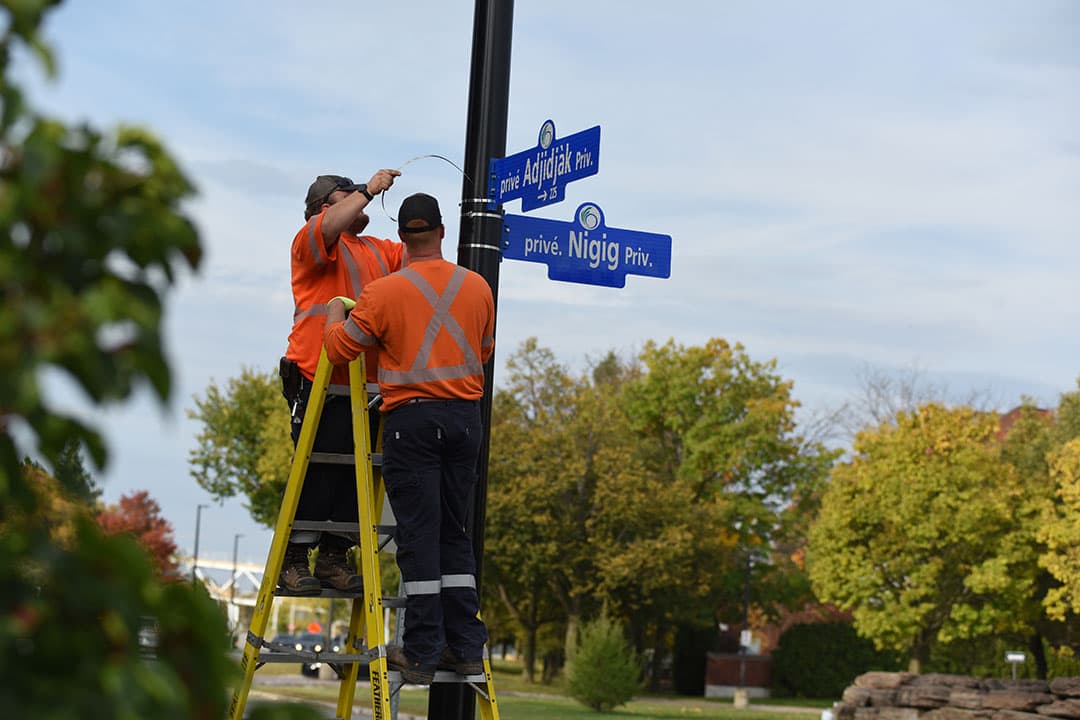
City of Ottawa employees setting up the new street signs for Adjidjร k Private and Nigig Private on Oct. 19

All four of the Ottawa campus’ roads were officially named as city streets on Oct. 19. These names are Wajashk Private, Nigig Private, Adjidjàk Private and Wàbisheshì Private.

The changes came as part of Algonquin College’s Indigenization Strategy of embedding Indigenous ways of knowing into the strategic planning process and beyond.

Not only will the streets be officially named, but each building will be given a unique address, with D-building and H-building sharing one.

In a statement, the college said the changes will “improve organization, accessibility, and efficiency.”

One improvement is better deliveries for students ordering food. With the building-specific addresses, co-ordination between students ordering food and those delivering food will be easier.

“A student in residence calling to ask for a pizza delivery could send the address of 1385 Woodroffe,” said Ryan Southwood, executive director of Facilities Management. “It depends where the pin falls, but sometimes the pin falls on G-building so G-building ends up with deliveries that just get left there.”

The Algonquin Times reached out to the Mamidosewin Centre for comment on the street naming program but didn’t hear back by deadline.

The new street names were chosen by the Indigenous Education Council which prioritized names based on cultural and historical significance.

“The actual authority to use the names is given by the city and the signs are city signs, but the streets are owned by Algonquin College.” said Southwood.

Not everyone thinks this change gets to the heart of the issue.

“The traditional language is a beautiful thing,” said program manager of applied research Brenda Slomka. “But I’m tired of checkboxes.”

An updated map of the campus can be found here.

Algonquin College entrepreneurs rendezvous over reading week

Reading week: A time for post-secondary students to catch up on assignments, rest, reconnect with loved ones or work a few extra hours. But for the eager Algonquin College entrepreneurs, […]
Photo: Marcelo Jaramillo
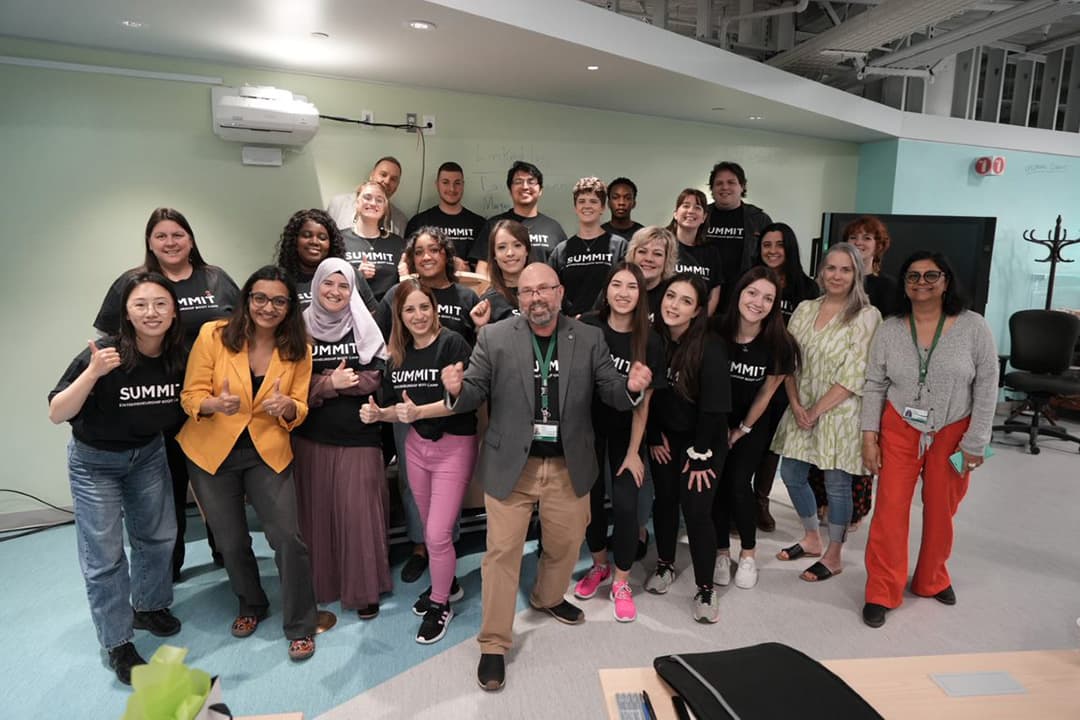
In May, 25 students participated in the SUMMIT Entrepreneurship Boot Camp.

Reading week: A time for post-secondary students to catch up on assignments, rest, reconnect with loved ones or work a few extra hours.

But for the eager Algonquin College entrepreneurs, it is a time to continue building their own unique visions and using all the college has to offer.

On Oct. 23, a rendezvous was held for past and future participants, coaches, speakers, judges and supporters of the yearly spring boot camp, SUMMIT, a competition resembling the American reality television series Shark Tank.

Yuefeng Wang, an Algonquin College alumnus from the web-development program, had participated in SUMMIT a previous year and had pitched a software program which would aid prospective students in choosing their future program.

“I want to solve the real-world problems,” Wang said, adding that ChatGPT and AI can be used to people’s advantage, even in minuscule ways.

Beginning eight years ago in the applied research department (though it currently resides as part of the business department), the SUMMIT Entrepreneurship Boot Camp is a yearly week-long opportunity for anyone who is currently studying at or has recently graduated from Algonquin College with an interest in business entrepreneurship.

In May, 25 students participated in the SUMMIT Entrepreneurship Boot Camp,
In May, 25 students participated in the SUMMIT Entrepreneurship Boot Camp, Photo credit: Marcelo Jaramillo

Much of the week consists of workshops and sessions led by guest speakers. The group last May was additionally given the opportunity to tour Invest Ottawa, a local economic development agency.

But what most students have their sights set on is the end-of-week Shark Tank-like competition where students pitch their start-up concepts in front of judges. Cash prizes between $750 and $2,000 are given to the winners, and all finalists receive access to additional coaching, mentorship, and legal services.

David Cronier, a computer programming student, was the third-place finalist in May after pitching Slide Wizard, a web-based presentation software.

“I was pitching (Slide Wizard) to one of my friends — I wanted him to join me,” said Cronier about his start-up concept. “And he actually convinced me to join his idea instead. So, I’ve pivoted.”

While his original idea remains on the back burner, Cronier and his friend are working on developing a different web application to help the lives of call centre agents, a job they both previously had.

“We understand very well the pains of a regular agent, so we’re trying to build software to make their lives easier,” said Cronier.

Aric Morrow pitches his start-up concept, a multiplayer terraforming simulator video game, in May 2023. His idea landed him in first place during the competition.
Aric Morrow pitches his start-up concept, a multiplayer terraforming simulator video game, in May 2023. His idea landed him in first place during the competition. Photo credit: Marcelo Jaramillo

Aric Morrow, a web development and internet applications student who won the competition this past May after pitching a multiplayer terraforming simulator video game, also found his start-up on hold.

“I don’t have time to build such a large project, and so I wish I had pitched something a little smaller,” said Morrow. “But every time I have ideas, I open my notepads or jot stuff down.”

While the simulator game is in the works, Morrow has published two other games through his game development studio, Lucky Leaf Games.

Residence installs new laundry machines after ‘maintenance’ period

The qualms of laundry day in residence at Algonquin College are finally over for most students. On Oct. 27, residents woke up to brand-new laundry machines after a week-long maintenance […]
Photo: Kit Gervais
"There are pros and cons," said resident Brayden Grooms about the new laundry machines in residence.

The qualms of laundry day in residence at Algonquin College are finally over for most students.

On Oct. 27, residents woke up to brand-new laundry machines after a week-long maintenance closure of both laundry rooms.

Students learned they would be unable to access the laundry rooms from Oct. 23 to Oct. 27 after an email from the residence days prior. They were hopeful the old machines would be fixed to settle the struggles of guessing which ones would be functional on laundry day.

On the day maintenance ended, residents were surprised to see shiny new machines in both laundry rooms. The initial email never mentioned the change, only that the machines would be under maintenance.

Finally, students were able to wash their clothes worry-free.

“It’s my first time using them,” said resident Kierstyn Auger. “Now they’re like, so nice and they’re bigger. It’s just easier to use.”

She explained the last machines were unsatisfactory and were always out of order.

On the other hand, some think it wasn’t a huge change.

“The dryers heat up and the washers fill and they’re deeper than the old ones were so you can fit more in the load. Bad news is, they didn’t upgrade the (payment) system,” said resident Brayden Grooms.

The payment system allows residents to tap their student card after loading money onto it.

“They still constantly eat money, which is disappointing. They took these facilities down for what, like a week? And all they did is put new washers. Yeah, they wash and dry, but what good is that if they don’t even take money?” said resident Marcus Harrison.

“Also, you can’t use pods in them now,” said Grooms, looking at the bold “No Pods” lettering printed on the detergent slot on a machine. “I mean, you can. You just have to take the nasty pod gelatin out of your clothes after.”

The issues with the AC card system seemingly weren’t fixed or replaced during the maintenance, while the issue with detergent pods is listed on the machines. Despite the flaws, they’re still considered an improvement by students.

“I mean, the way I’m looking at it right now is at least they don’t throw up errors anymore. So, we know right away if something’s wrong instead of coming back and finding out the dryer didn’t have any gas or the washing machine didn’t have any water,” said Harrison.

“At the very least it’s ‘No, it ate my money’ instead of ‘I just waited the past hour for it to dry, only for it to still be wet’.”

College introduces gender-neutral bathrooms in three buildings

Algonquin College has introduced gender-neutral bathrooms in the P-building and E-building, as well as the four-corner washroom in the A-building. The four-corner washroom in A-building has 12 singular washrooms, two […]
Photo: Blaire Waddell
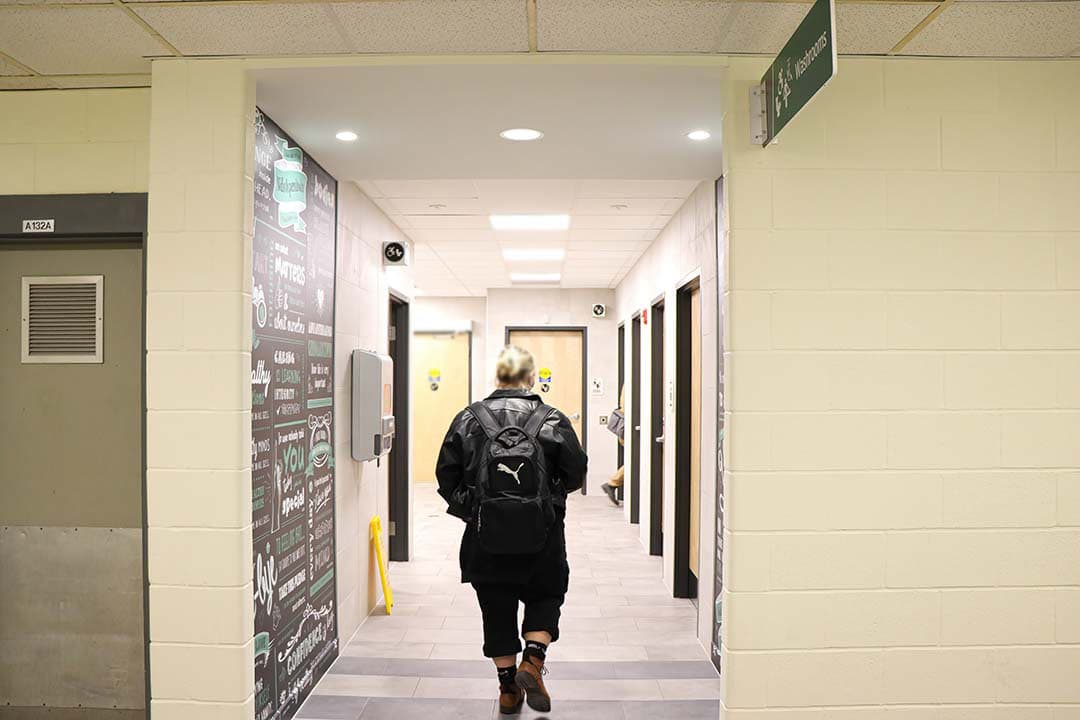
Ari Tantos in the four-corner gender-neutral washrooms in A-building.

Algonquin College has introduced gender-neutral bathrooms in the P-building and E-building, as well as the four-corner washroom in the A-building.

The four-corner washroom in A-building has 12 singular washrooms, two accessible washrooms, and a washroom with a nursing/changing table. The renovation of the E-building universal washroom, E127, has been updated to the most current accessibility code requirements. The college has also added a universal washroom in P-building, P109, by expanding the existing washroom.

Ziyu Qiao, a student in the early childhood education program, believes the new washrooms reduce people’s sense of security.

“I think there is no privacy. If I come out from the bathroom and see a lot of males standing at the entrance, I feel uncomfortable,” said Qiao.

On the other hand, Ari Tantos, a television broadcasting and streaming media student, feels that having these washrooms is a good step toward gender inclusivity.

“Gender-neutral washrooms are a good step towards gender inclusivity in terms of having a public space where queer people can exist and not feel restricted as to what their gender identity is,” said Tantos.

With these washrooms being introduced to the campus, Tantos is concerned that they will be used for the wrong reasons.

“I think the manner in which the four-corner washroom is made with a bunch of individual bathrooms, it is streamlined and it is created for total privacy and is very helpful,” said Tantos. “In another way, it opens up a whole other door for the bathrooms to be misused and in high school, the handicapped washrooms would be used for vaping and other things.”

Confederation College, located in Thunder Bay, has been working to improve access to facilities across Canada. According to Confederation College, 47 per cent of post-secondary students in Canada witness or experience discrimination due to their gender, gender identity and sexual orientation. This leads to students not feeling safe on campus and not attending school.

A first-year film and media production student at Algonquin College, Lauren Pare, feels it’s is a step in the right direction.

“I feel like it is a great way to make people comfortable in their skin, but I also know that many people have mixed emotions about them just because of being vulnerable with the other gender,” Pare said. “In terms of inclusivity, it’s not an issue that I have ever faced before, so if it makes people feel more comfortable and who they are, I say go for it.”

Algonquin College says gender-neutral washrooms will soon be available in other buildings across campus, starting with J-building.

From Stalin’s repression to the Communist club at Algonquin College

Anton Bogdanovich was born in 1889. He worked as a switchman at the Kalay railroad station in the Siberian city of Krasnoyarsk. On May 17, 1938, he was arrested. On […]
Photo: Arty Sarkisian
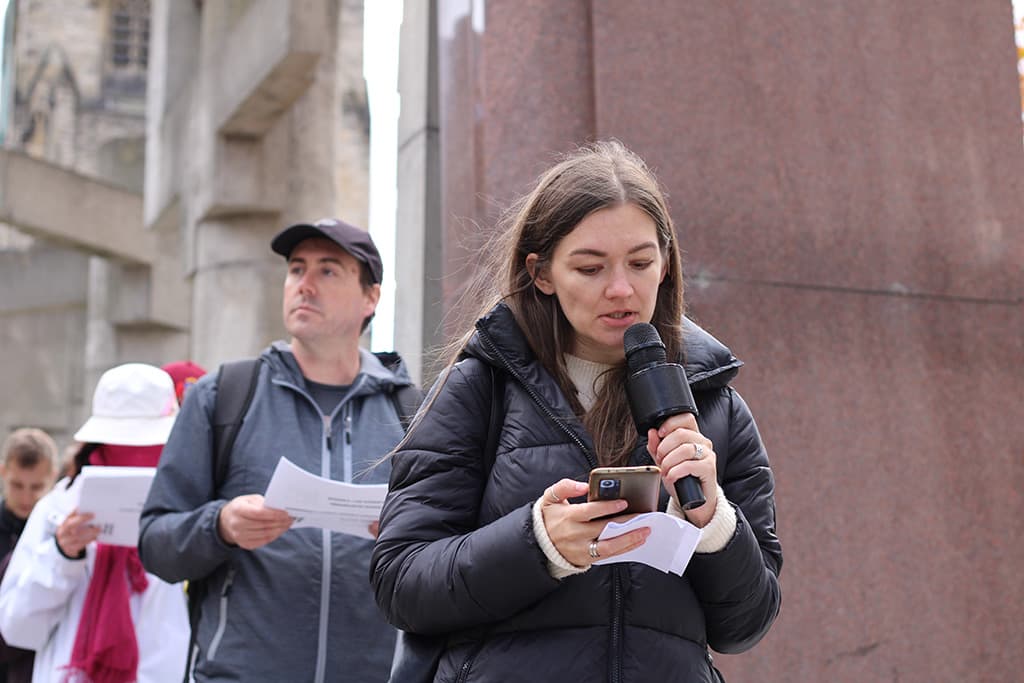
Polina Sysueva reads her great-grandfather's name at the Canadian Tribute of Human Rights. "If you know the stories of those people, those who were murdered, if you are not running away from them, you canโ€™t possibly still talk about the great achievements of the Stalin era," Sysueva says.

Anton Bogdanovich was born in 1889. He worked as a switchman at the Kalay railroad station in the Siberian city of Krasnoyarsk.

On May 17, 1938, he was arrested. On Oct. 15 that year, he was shot.

Eighty-five years later, on Oct. 27, 2023, his great-granddaughter, Polina Sysueva, read out his name on the pedestal of the Canadian Tribute to Human Rights in Ottawa.

Ottawa was one of the 88 cities in 35 countries that took part in the project called “Return of Names” honouring the millions who were unjustly executed in the former Soviet Union. Sysueva’s great-grandfather was one of the 33 names that were read out that day.

Ottawa was one of the 88 cities in 35 countries that took part in the project called โ€œReturn of Namesโ€ honouring the millions that were unjustly executed in the former Soviet Union.
Ottawa was one of the 88 cities in 35 countries that took part in the project called โ€œReturn of Namesโ€ honouring the millions that were unjustly executed in the former Soviet Union. Photo credit: Arty Sarkisian

The event was organized by Memorial International, a Nobel Prize-winning human rights organization created in 1989 by the “Soviet Oppenheimer” or the “father of the hydrogen bomb,” Andrei Sakharov. He became the most prominent human rights advocate in Europe with the European Parliament issuing an annual human rights award in his name. The first award was given to Nelson Mandela in 1988.

So, Memorial International created a 12-hour-long stream that went live on Oct. 29, before the official Day of Remembrance. Hundreds of people around the world, one by one, read out the names of victims of political repression.

“It’s important to me to remember the past,” says Sysueva who moved from Russia in the fall of 2022. “I think the past gives us a lot. We need to take lessons from the past.”

At the same time, a very different organization is preparing its own rally. The Young Communist League of Canada is organizing an “All Out” protest for free post-secondary education on Nov. 8.

The League is represented at Algonquin College by the Young Communist Club and its leader, Robert Langille.

“We’re trying our best to agitate, educate, organize, (and) raise the class consciousness of the workers, of the people,” Langille says.

Langille gladly took off the many bracelets to show the red hammer and sickle tattooed on his wrist. "That&squot;s how serious I am about it," he says.
Robert Langille gladly took off the many bracelets to show the red hammer and sickle tattooed on his wrist. "That's how serious I am about it," he says. Photo credit: Arty Sarkisian

When Langille was 20, he used to play a video game with his dad. It was called Fallout, and it was about a post-apocalyptic world after the nuclear war between the United States and China. Naturally, the question of capitalism versus communism comes up.

“I asked my dad, what is communism?” Langille remembers. His dad told him to do his own research.

And he did.

It has been three years that Langille has been reading books by Marx, Engels, Lenin and Stalin.

He says that he wants to spend his entire life on “social and political change.” He is “willing to do that at whatever cost or sacrifice.”

But soon he corrects himself: “Maybe I shouldn’t use the word sacrifice. I should use the word devotion. I am willing to devote myself.”

Devoting himself to the ideology as a local club leader, Langille is a part of the larger League which was created 100 years ago in 1923.

The goal of the organization is to “defeat capitalism.” According to its website, it is an anti-racist, anti-sexist, anti-homophobic, anti-chauvinist, anti-transphobic and anti-ableism organization.

In February 2017, a political sciences student, Igor Sadikov, had to resign from the Students’ Society of McGill University.

“Punch a Zionist today,” he tweeted before his resignation on Feb. 6, 2017. He later deleted the tweet.

“It was interpreted as, you know, call to violence when obviously it was never intended to be that,” Sadikov says.

In 2020 Sadikov became the editor-in-chief of Rebel Youth Magazine published by the Young Communist League.

Anyone from any communist club around the country can contribute to the magazine. The League wants to have the sense that they are “speaking with the same voice and working toward the same goals,” Sadikov says.

The magazine has no editorial independence and is edited by the League’s leadership. So, the content must align with the organization’s ideology.

The contributors to Rebel Youth are often using terms like “NATO’s war against Russia via Ukraine” and “the ruling class media apparatus.” They refer to Joseph Stalin, the Soviet dictator responsible for the millions who were unjustly murdered and were later rehabilitated for the lack of evidence, as the “leader in the fight against the vanguard of imperialism” and they advocate “on behalf of the Eastern nationalities and oppressed peoples.”

“In some cases, they are full-blooded authoritarians loving a ‘strong man,’” Trevor Connolly says. He is an English tutor in Ottawa, and he was at the Canadian Tribute to Human Rights on Oct. 27.

“In other cases, I think there are people who see the wrongs of the West, of the U.S., of NATO, and they just assume because Russia and the Soviet Union opposed that, they must be good,” Connolly says. “But Russia is certainly not better, and the Soviet Union was not a paradise.”

Trevor Connolly (left) and
Trevor Connolly (left) and Vassili Kolomatski (right) at the Canadian Tribute to Human Rights in Ottawa reading names of victims of political repressions. Photo credit: Arty Sarkisian

“These are people who have never lived in the Soviet Union,” Vassili Kolomatski says. He moved to Ottawa in 1996. Before that, he lived in Soviet Ukraine and Russia. “They talk about their dreams and fantasies. They dream of free healthcare and education not understanding the reality of that life.”

The reality is that the main branch of Memorial International in Moscow was officially liquidated by the Moscow City Court on Dec. 29, 2021. It existed for 32 years (longer than the Russian Federation, which was formed in 1991).

It was banned along with hundreds of independent newspapers and human rights advocacy groups.

“Loss of historic memory always brings society downwards,” Kolomatski says. “Towards a new dictatorship, towards new executions.”

College plans to increase parking prices in 2024-2025 to match inflation

Despite the financial burden students are facing to try and keep up with the steady pace of inflation, they must prepare for another blow as Algonquin College parking prices are […]
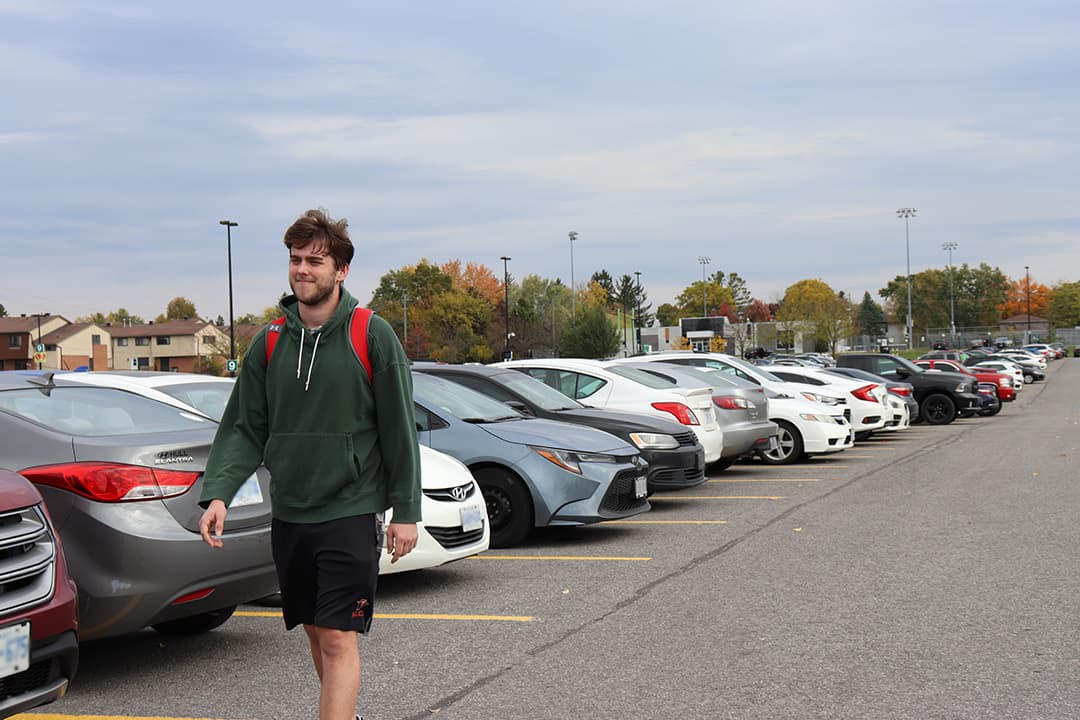
Alex Hobgod purchased an $800 parking pass for Lot 9. โ€œWith rent being so high and then on top of parking and tuition itโ€™s just a lot," Hobgod said.

Despite the financial burden students are facing to try and keep up with the steady pace of inflation, they must prepare for another blow as Algonquin College parking prices are set to rise another three per cent for the 2024-2025 academic year.

Parking rates at the Ottawa campus froze during the pandemic due to the lack of traffic coming through the school. However, the prices were raised by three per cent for the 2023-2024 academic term, the first time the prices had changed since 2019.

“This year, we decided to offset some of the costs that are coming our way,” said Roch Lafond, the parking services operation manager at Algonquin College.

Now, with the pandemic in the rear-view mirror, the prices are set to continue rising to match inflation.

“Everything has gone up,” said Lafond. “Food, transportation, all that good stuff, so the same applies for us. We have to pay for all the services that we hire.”

Students are already struggling to keep up with the current parking prices on campus, and frustration is running high.

“It’s pretty expensive,” said Alex Hobgod, 22, a law clerk student who bought a Lot 9 parking pass. “Especially since I think this parking lot (Lot 9) is $800 for the year which is a lot, and across the street (Lot 8) is over $1,000. It’s pretty ridiculous that 20 feet is $200.”

“Parking passes-wise, it’s kind of ridiculous that they make you book it before you get your OSAP,” said Victoria Halcrow, 23, a community and justice services student. “I couldn’t afford $800-$1,000 before I got my OSAP, but there are no buses that come to where I live.”

There is no financial aid or options for students who cannot afford the parking passes and annual parking passes must be paid in full before the beginning of September.

“It’s kind of unfair for them to make you pay the whole thing up front,” said Halcrow. “In my second year, I’m going to have placement for my second semester, so I’m not going to need a parking space realistically. I think they should have some spaces where they do a month-by-month basis.”

Some students had to change their methods of travelling to school to avoid the cost of parking, while others had to park off campus altogether.

“I know a couple of people that were driving and now because they can’t afford it they’re just using the bus,” said Hobgod. “But it’s two extra hours because they live far out of town.”

“I was very fortunate that one of my boyfriend’s friend’s roommate moved out, and he lives close to campus, so he’s letting me rent his parking space,” said Halcrow. “That’s on a month-to-month basis and it’s still a lot cheaper than if I got a parking pass.”

Students who commute to school with their own vehicle and live within the OC-Transpo area are unable to opt out of the school-provided U-pass, despite the lack of use.

“I think it’s kind of ridiculous,” said Hobgod. “If I’m going to pay for parking I shouldn’t have to pay for the bus.”

The parking fees are used to fund new programs, student infrastructure, college bills, employees and parking maintenance like snow removal and asphalt repair. However, there are some grievances regarding the quality of those services.

“I think they need to find a new company to do the snow removal for campus that actually does it properly,” said Meghan Kennedy, 20, an advertising and marketing communications management student who parks in Lot 9. “No snow removal company in their right mind does snow removal in the middle of the day when all the cars are parked there.”

During the winter months, early commuting students are forced to battle with unplowed lots, making it difficult to see the actual parking spaces.

“As someone who used to work in snow removal it’s an abomination,” said Kennedy. “It’s not how snow removal should be done and certainly not how it should be done for parking that costs that much.”

Since the pandemic, the number of students and staff making the daily commute to campus has increased exponentially. Both public transit and the parking lots are congested with daily users, and students cannot find sufficient space anywhere.

“The buses are already packed,” said Hobgod. “You want them on the campus and they’re full, so it’s not like that’s really helping because the parking lots are still full.”

Inflation is impacting everyone in Canada, and students have a lot of financial burdens resting on their shoulders. The added expense of parking on campus is weighing down heavily.

“With rent being so high and then on top of parking and tuition it’s just a lot,” said Hobgod. “It’s an extra expense that you don’t really need.”

New heritage conservation-focused degree program launching in fall 2024 at Perth campus

Algonquin College is launching a new degree program with a focus on heritage conservation techniques in both theory and practice at the Perth campus, a credential that is unique in […]
Photo: TJ Sider
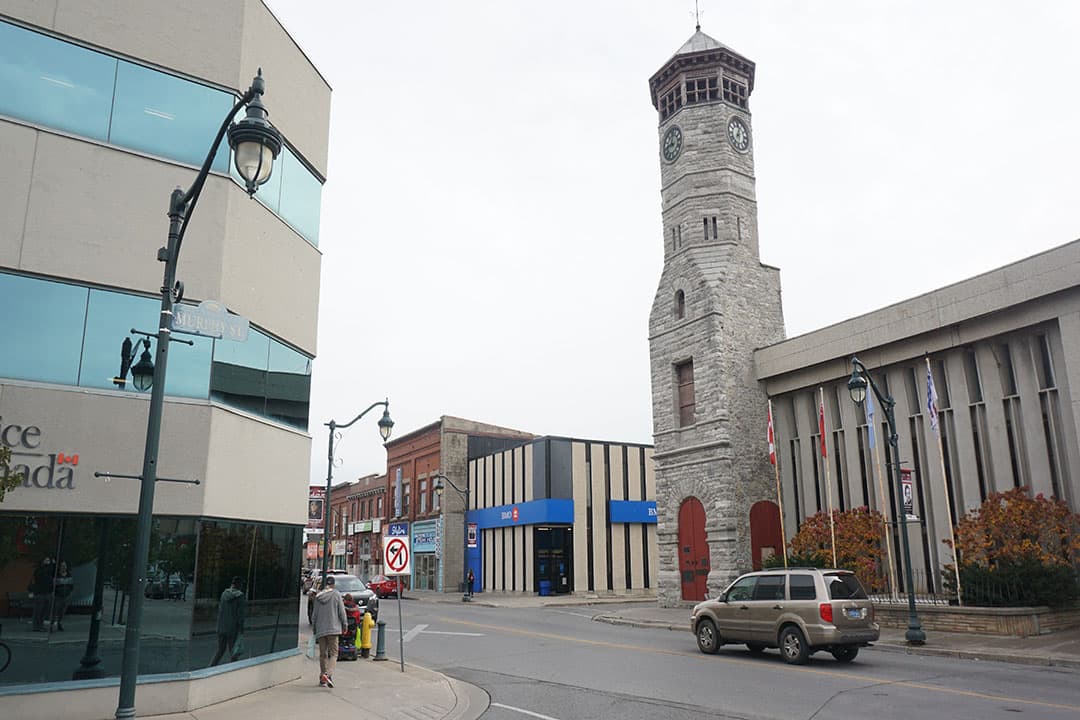
Downtown Trenton, Ont. is pictured with the old post office clock tower (centre-right) on Oct. 25, 2023. The clock tower was constructed in 1888.

Algonquin College is launching a new degree program with a focus on heritage conservation techniques in both theory and practice at the Perth campus, a credential that is unique in Canada.

The new program, a Bachelor of Applied Science with a Heritage Conservation focus, will kick off in the fall 2024 semester. The degree program is distinct as it focuses on the theoretical aspects of heritage conservation which includes the planning of conservation districts in municipalities, navigating legislation surrounding heritage preservation and consulting with various stakeholders on projects. It also focuses on fighting climate change and sustainability practices through preventing the demolition of heritage buildings.

Darren Taubman has been developing the new program for years. Taubman said students have told him that they want more comprehensive knowledge in the field that the diploma program doesn’t cover.

“This is going back at least 10 years,” Taubman said. “There was a change in the construction environment.”

Taubman mentioned the ongoing restoration work underway in Ottawa’s Parliamentary Precinct and recently approved plans by the City of Ottawa to restore the 127-year-old Somerset House as examples of increased demand for heritage conservation skills.

“All these sorts of elements pop up all of the sudden and it’s like hey, this heritage stuff is pretty important,” Taubman said. “(Companies) are always coming to us for students. They’ve all said the same thing: ‘We need more graduates. We need skilled tradespeople who are focused on the heritage aspect.'”

Consulting requires analysis of the historical significance, physical conditions and sustainability factors of heritage projects. Canada’s aging infrastructure is creating unique problems that can be difficult for architects to manage. Post-secondary programs often lack the heritage conservation expertise desired in the field.

Elana Zysblat works as a heritage consultant for Ance Building Services in Vancouver. Zysblat noted the various issues arising in Canada and the role heritage professionals can play in tackling them.

“There are major societal changes that are happening,” Zysblat said. “Our standards and guidelines don’t address the reality on the ground of what we are dealing with, which is very quickly shifting policies on climate resilience, energy efficiency and the need to address the housing crisis. As a heritage professional, we are actually very well positioned to address these crises and be at the table and propose very robust solutions but that’s not how our field is perceived.”

According to Taubman, there are many transfer options in place for students who have completed diploma programs in the trades. While the transition to the program will be easier for students who completed the heritage carpentry and joinery program in recent years, there are still transfer opportunities available for past graduates.

“It may not be as clean of an entry of somebody who has just graduated in the last couple years,” Taubman said. “We’ll find a way to work it through. So rather than being two years, it might take them three years.”

Braeden Suggitt is a second-year student in the heritage carpentry program who is considering taking the degree program in the future.

“There’s a lot more to learn than just simply building techniques in old buildings,” Suggitt said. “You learn all of your general construction and it sets you up that you could walk onto a job site and have a job pretty much anywhere. You wouldn’t necessarily be doing all the heritage stuff, but you could walk onto just about any site and be a framer or be an assistant carpenter or whatever and it sets you up really well for that.”

The Perth campus is known within the heritage conservation space as a leader in this specialized field. In fact, it is only one of a handful of programs in Canada,

including the existing heritage carpentry and joinery diploma program at the Perth campus, which has a specific focus on heritage conservation.

The heritage conservation degree program is now accepting applications for the fall 2024 semester. Students can learn more and apply here.

International students get a taste of small town life outside of Ottawa

Ottawa is constantly teaming with life, the night as lively as the day. For some international students at Algonquin College, that is all they know. But just outside Ottawa’s borders […]
Photo: Kate Playfair
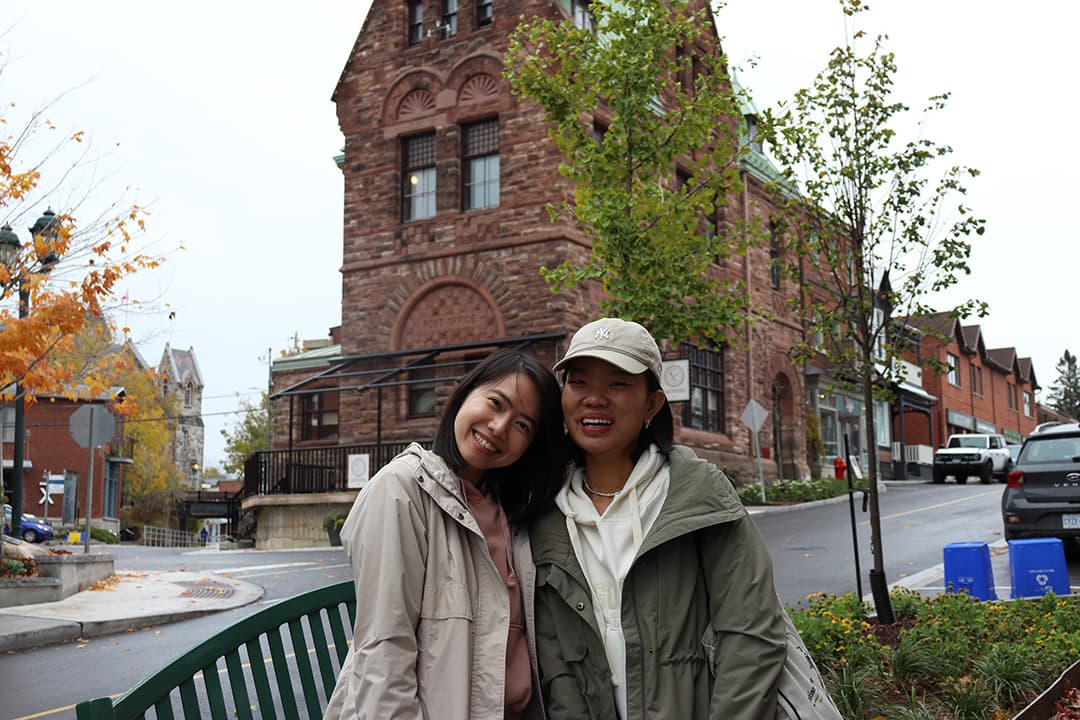
Trang Nguyen (left) and Melissa Yang (right) stand in front of the former Almonte post office converted into a restaurant.

Ottawa is constantly teaming with life, the night as lively as the day. For some international students at Algonquin College, that is all they know.

But just outside Ottawa’s borders lies a sleepy little town far from the bustling streets of the city, quiet and inviting. An escape from city life for a few hours in historic Almonte may introduce the students to a whole new way of life in Canada.

For Diva Valencia, 32, an early childhood education student from Chile, Almonte could be the perfect place to move with her husband and three-year-old daughter.

“It’s like a little town in Europe,” said Valencia. “When we were arriving on the bus, I said this is the kind of place I would like to live.”

The International Education Centre took a group of international students to Almonte on Oct. 25 to show them a different scene from the lively city. Full of historic buildings, picturesque walkways, and quaint stores, Almonte is one of the many towns around Ottawa that is open to explore.

“We thought we’d give the international students an experience of a small Ontario town,” said Leah Grimes, the intercultural programming support officer with the International Education Centre.

The Almonte tour started at the Metcalfe Geoheritage Park, then students branched off, wandering towards the centre of town, passing by the Mississippi Grand Falls, and snaking up Mill Street to discover the history of downtown Almonte. Some walked along the scenic river walks, while others explored the countless antique shops lining the street.

“It’s pretty here, there’s a lot of trees and a beautiful landscape,” said Johanna Alcamtara, 36, a business accountant student from Chile. “Where I come from, I lived in the city, so there’s a lot of buildings compared to here. I love here that you are connected to nature.”

The International Education Centre provides services to international students, including aid with immigration when they get accepted to Algonquin College and helping them integrate into the city and college.

The trip to Almonte was designed to show international students what Ontario has to offer outside of Ottawa.

“It’s good for us to come and not just stay there in the city,” said Valencia.

“Little towns have a lot to offer,” said Grimes. “When you go to a smaller town there’s that feel of community, and I think it’ll be really cool to get them exposed to that and to maybe encourage them to seek out other places to visit while they’re here in Ottawa.”

Almonte is an old mill town of Lanark County and home to the inventor of basketball, James Naismith. Many of the original buildings still stand, including the mill and the original post office now converted into a restaurant. A statue of James Naismith sits at the centre of the main street and has become a hotspot for tourists.

“I feel like in this kind of place you can feel the culture of a country,” said Valencia. “You can go and understand and see people from here.”

This trip is the first of its kind for the International Education Centre, but different trips like hikes at Gatineau Park are commonly introduced to students.

“I encourage all the students to take these kinds of trips that Algonquin offers,” said Alcamtara. “You can discover another place instead of downtown and Ottawa.”

Different people are drawn to different places. Some drink in the bustling life of the city, while others like to take a step back and slow down.

“This area is so far away from the city,” said Valencia. “Now, in this stage of my life, I like these kinds of places.”

November Horoscopes

Algonquin Times podcast

Stay Informed

Sign up for our newsletter

Subscribe

* indicates required