False alarm on campus closes classes

The first week of the Algonquin College’s summer semester ended eventfully on May 12, after a fire alarm was set off in T-building, during the late morning. The Ottawa Fire Department was quick to the scene and reported it as a false alarm. The alarm’s cause is still unknown, but students had their own theories. […]
Photo: Thomas Gordon
Ottawa Fire Department responds to false alarm at Algonquin College's Ottawa campus.

The first week of the Algonquin College’s summer semester ended eventfully on May 12, after a fire alarm was set off in T-building, during the late morning. The Ottawa Fire Department was quick to the scene and reported it as a false alarm.

The alarm’s cause is still unknown, but students had their own theories.

“Smoking, vaping – or even someone yanking the fire alarm with their bag,” theorized Enica Hopper, a student at the college’s Ottawa campus.

Algonquin security did not comment on the alarm’s cause,

Students had some difficulty while evacuating the building, with some unsure where to stand, and others were reportedly crowding a stairwell.

“People were tripping over each other trying to get out,” said Vivian Brown, a student at the school.

In the event of a fire, students are instructed to leave the building immediately, and only return when advised by fire services, according to Algonquin’s website

Students with disabilities are instructed to head for the nearest collection point, or safe exit, and wait for emergency services, according to the website.

After the initial confusion, some students took the opportunity to enjoy the summer weather.

“We really enjoyed being outside – even just doing our schoolwork while this was going on,” said, Bolina Diundik, a student at Algonquin College.

Algonquin College students compete in entrepreneurship boot camp

Twenty-five Algonquin College students began their summer break by participating in a week-long Shark Tank-like competition, with the opportunity to pitch their start-up concept to a panel of judges. The SUMMIT Entrepreneurship Boot Camp was born eight years ago in the applied research department and has run every summer since, including seminars over Zoom during […]
Photo: Photo supplied by Marcelo Jaramillo
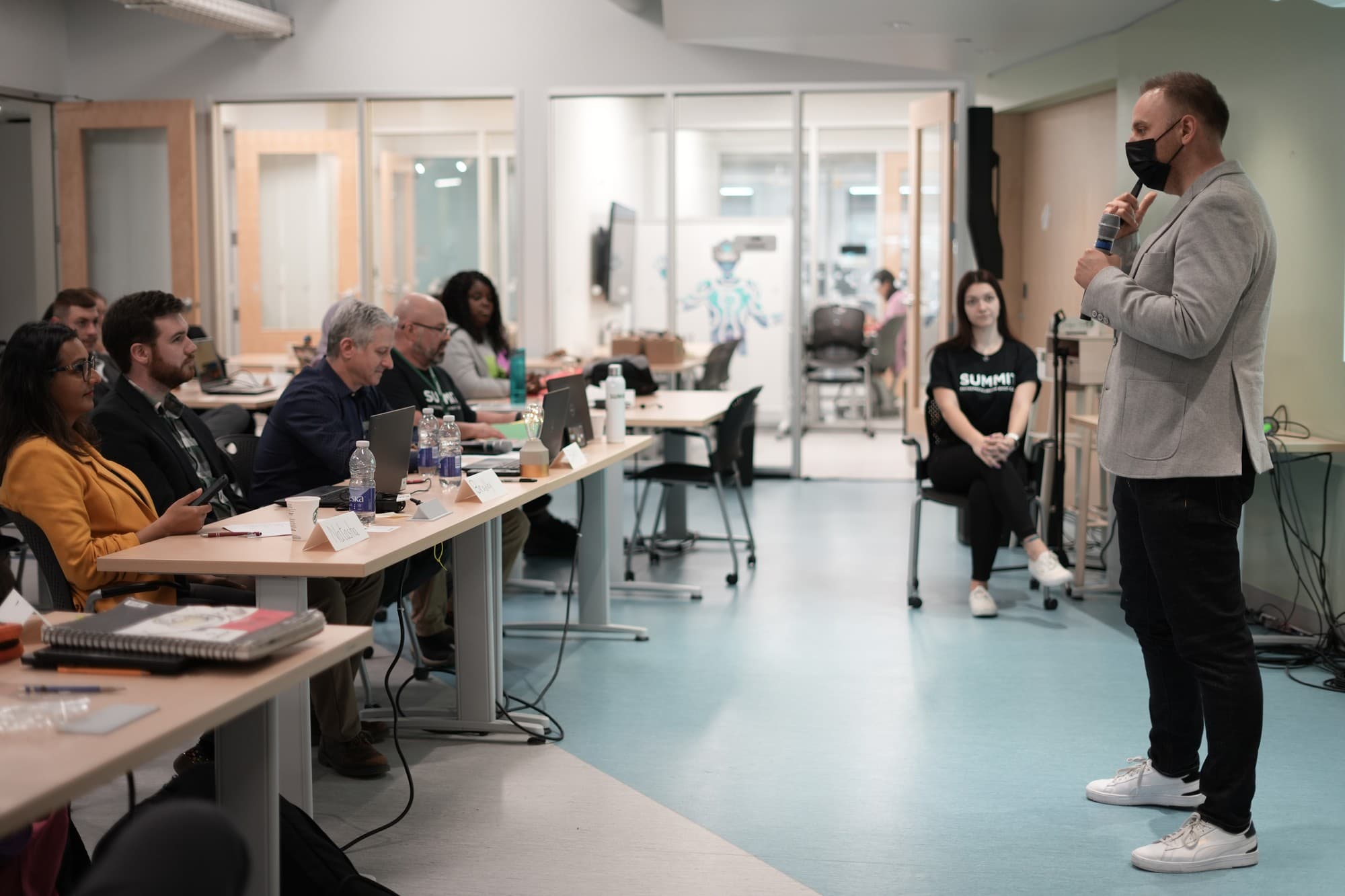
David Cronier, the third-place finalist, presenting his pitch, Slide Wizard, to the judging panel.

Twenty-five Algonquin College students began their summer break by participating in a week-long Shark Tank-like competition, with the opportunity to pitch their start-up concept to a panel of judges.

The SUMMIT Entrepreneurship Boot Camp was born eight years ago in the applied research department and has run every summer since, including seminars over Zoom during the height of the pandemic. It has since migrated to the business department. Despite generally attracting business students, SUMMIT is open to anyone who is currently studying at or has recently graduated from Algonquin College. It attracts about 50 applicants.

Much of the week consisted of sessions and lectures led by guest speakers, touring Invest Ottawa and, most importantly, networking with fellow students and other entrepreneurs. By the end of the week, all participants were given the opportunity to compete against one another by pitching their start-up concept in front of judges.

This year’s winner, Aric Morrow, a level two web development and internet applications student, pitched a multiplayer terraforming simulator video game.

Morrow said nearly a decade has passed since the last major terraforming video game had been released, offering a gap in the market.

“We got introduced to a ton of resources that I am looking forward to using in the future,” says Morrow. “Just the exposure to everything outside of my program, really just opened your eyes to everything that’s available through the college.”

The top three winners were given varying cash prizes, between $2,000 and $750, and all finalists were given access to additional coaching, mentorship, and legal services.

“This boot camp has lit a fire within me, like nothing else,” says David Cronier, a level four computer programming student. “As bad as it sounds, seeing the imperfectness in other people kind of reassures you about your own and it’s really great to see in which area people shine.”

Cronier landed himself in third place after pitching Slide Wizard, a web-based presentation software.

Tristan Morris-Desmarais, a competition finalist and business management and entrepreneurship student, agrees there was something magnetic about this year’s group.

“Meeting all these people, they’re so much more motivated than some of the students in our own program,” says Morris-Desmarais. “I mean, our program is designed around entrepreneurship. But these people, they’ve all got a fire lit to them; they all have this inspirational kind of energy.”

Nyasha Shameer and Emilie Tunn, business administration and marketing students, won second place with their start-up pitch, Bleumwell, a mind, body, and soul fitness centre.

“We have done marketing competitions through the school as well,” says Shameer. “ So, we’ve been exposed to the opportunity to network and get trained with other individuals to build on our skill set, because we do have marketing backgrounds, but this is a very different environment as we do get to be exposed to other competitors and individuals from all different backgrounds, which was very interesting.”

Even without walking home with a cash prize, SUMMIT students and volunteers recognized the advice given to them and the networking they were able to do was invaluable.

“When you have good people around you, things just go an easier instead of starting . . . alone, and throughout the week, you just saw the participants take that feedback in mind,” says SUMMIT volunteer and recent business marketing graduate, Sabrina Drouin.


The pandemic has deeply impacted children’s mental health

At the age of 10, many kids are in Grade 5 learning about different things that would aid them into their final year of elementary school. When children turn 14, they are gradually moving to their first year of high school. Finally, when these teenagers approach the age of adulthood, they are not only thinking […]
Algonquin Times writer Itunu Olayiwola

At the age of 10, many kids are in Grade 5 learning about different things that would aid them into their final year of elementary school.

When children turn 14, they are gradually moving to their first year of high school.

Finally, when these teenagers approach the age of adulthood, they are not only thinking about graduation, but also how they want their lives to be laid out.

The pandemic has affected people all over the changing world.

One of the concerning changes included the mental health of children, and how badly their mental health had degraded. Monica Armstrong, director of mental health for the Youth Services Bureau, told the CBC that the organization’s 24/7 crisis line is handling a much larger proportion of suicide calls. Armstrong added that the proportion had risen from about 12 per cent in 2018-2019 to roughly 28 per cent.

Funny enough, I felt part of the 28 percent that had caused the rise of concern toward mental health. If I was told a year ago that I would constantly be going back and forth to a hospital named CHEO, I certainly would have disagreed.

The pandemic had already distorted the growth of my mental health, forcing my brain to adapt to situations that it was not prepared for and survive as an adult without any tools for support.

My concerned parents had to take me to CHEO, and I suddenly became a regular customer at the hospital. A few months before college started, I had finished my first 12 sessions with my therapist recommended by my lawyer. However, it took three months for the hospital to get me in contact with a psychiatrist and a new therapist. I was constantly being told that I could not have access to a psychiatrist because there were too many patients.

The many restrictions from COVID — masks, online classes, and isolation from the world — confirmed the first highlight of my already degrading mental health, depression.

It is 2023, and the world is gradually changing and growing from its post-pandemic era. Many things have changed and affected kids, forcing them to develop faster mentally rather than just being kids and having fun.

Global Open Science, a research group, decided to study the effects of the pandemic on kids. They compared the MRI scans of 128 children. Half the scans were taken before the pandemic and the other half at the end of 2020. They found that the children who had lived through the first year of the pandemic had brain ages that were older than their chronological age.

The researchers found out that at the start of the pandemic, the brains had developed an area called the amygdala that can help control stress and fear. There has also been a development in the hippocampus which is the area of the brain that controls access to memories.

The researchers further learned that tissue had thinned in the cortex, which is part of the brain that controls functioning.

Algonquin College students had different opinions about the rapid growth of kids mentally.

“I do believe that children are maturing at a faster rate mentally. I notice that when I compare myself to my younger cousins, they are much more mature than I was when I was their age. They seem to know more about the world. However, as a kid, I was more in a happy bubble,” says Amelie Bender-Olivas, an interior design student.

“I both agree and disagree. I think youth are maturing faster than before with society growing so fast. However, I feel like their actual maturity is not growing. They rely too much on their parents,” says Daly McGoey, a first-year architectural technician student.

Research has found that these physical changes discovered can be increased when a person goes through significant adversity in childhood. The team was not sure if these changes were long-term changes or if these changes will impact the future lives of the children.

Why are there only dogs in the Paws 4 Stress event?

Sometimes events need changing because they are just down-right boring. But how can an event with dogs get any better? “The Paws 4 Stress program offers Algonquin College students and employees an opportunity to take a break from their busy days and unwind with some furry friends, which can reduce stress and have lasting effects […]
Photo: Alex Lambert
Algonquin Times writer Noah Leafloor

Sometimes events need changing because they are just down-right boring. But how can an event with dogs get any better?

“The Paws 4 Stress program offers Algonquin College students and employees an opportunity to take a break from their busy days and unwind with some furry friends, which can reduce stress and have lasting effects on people’s emotional well-being. The AC Hub works with volunteer organizations that certify these therapy animals and enjoy sharing these pets with others,” according to the college’s Paws 4 Stress event description.

Support dogs provide emotional support and comfort, which helps people deal with their stress and challenges, according to the American Kennel Club. However, support dogs are still pets, not just service dogs, and that goes for other support animals that are domesticated.

They must be considered an emotional support animal (ESA). These can be cats, mice, rabbits, birds, hedgehogs, rats, mini-pigs, ferrets and more, according to UMass Chan Medical School. The ESA needs to stay calm in public, too, which can be hard because you don’t have to register an ESA for certification in Canada. All you need is an ESA letter issued by a licensed mental health professional, according to the TheraPetic organization.

Cat and dog lovers have always debated which is better. That’s a silly argument. Like dogs, cats provide purpose and meaning to people. People with illness or disability find comfort and emotional support through them, said the non-government organization MSAR.

Therapy cats are different from ESAs because they’re trained to help an individual’s treatment process.

So, does this mean therapy cats are just as effective as therapy dogs?

Well, dogs are generally more sociable and less worried about territory than cats. And in Canada, there are far more dog teams than feline.

Cats can form powerful social bonds, too. An Australian study found out that cat owners were more happy than non-pet owners. The benefits probably apply in therapy. It’s mostly about developing a relationship over time, which is different than dogs, according to UC Davis Veterinary Medicine.

Truffles, the cat that helps kids feel comfortable during appointments.
Truffles, the cat that helps kids feel comfortable during appointments. Photo credit: truffles_the_kitty - Instagram

Rabbits and guinea pigs are also common animals for therapy. Rabbits generally bond quickly and are social creatures. Rabbits are also quiet and do not require lots of space, which is great for Algonquin’s event. Rabbits give the same social benefits as cats and dogs do. They help increase self-esteem, nurturing skills and increased empathy, according to AmeriDisability.

Guinea pigs are like the animals already talked about. They are very empathetic and show their affection when they’re comfortable with their owner and surroundings. They also have personalities, which is great for therapy. However, guinea pigs are scared easily, especially in public.

The Ottawa Humane Society is an example of a program that has animal visits. Volunteers take these animals to facilities to help the people there. These visits are more for retirement homes or rehab places, but I’m sure Algonquin can get more people involved with Paws 4 Stress that have other animals to bring for simple therapy.

The main issue with this argument is that it’s going to be difficult to find volunteers that have these trained animals. They must be ready for public space and stay friendly. The animals I talked about can do that, but it’s uncommon.

I love that dogs are the main animal, but I’m sure there are trained cats, rabbits and even guinea pigs in Ottawa. I feel this could bring life to Paws 4 Stress. What does everyone else think?

Scriptwriting student wins second place in annual short film contest

Justine Stewart, a graduating student in the scriptwriting program at Algonquin College, won second place this month at the annual short film contest held by Open Screenplay, the world’s leading online screenplay platform. It started off as a project for school. Stewart needed to write a short film that was at least five to 10 […]
Photo: Justine Stewart.
Justine Stewart and her three-year-old daughter, Violet, who can't wait to go to school.

Justine Stewart, a graduating student in the scriptwriting program at Algonquin College, won second place this month at the annual short film contest held by Open Screenplay, the world’s leading online screenplay platform.

It started off as a project for school. Stewart needed to write a short film that was at least five to 10 minutes long, or about five to 10 pages of script.

She came up with We Don’t Have Those at Home, a story set in an American elementary school. It follows a new Canadian student and her classmate in a closet conversing and playing with each other. Stewart spent three months working on it.

“The script is a 10-minute short between two eight-year-old children and at the beginning of the piece, they’re hiding in a closet. You don’t know why but you know the little girl is upset and the little boy is comforting her, trying to play and kind of just trying to get her to come out of her shell,” Stewart said.

The reason why they’re in the closet is revealed at the end of the story, when a teacher comes to get them and the little girl is still frozen in fear not knowing what to do.

“The little boy has to explain to her, ‘This is what we do in the drills. The shooters moved past us, so now we go up the hall’, and the little girl just says, ‘I’ve never done those,’ because she’s already explained she’s from Canada,” Stewart added. “’We don’t have those at home.’”

Stewart is originally from Missouri and came to Ottawa on a student permit while she completes her yearlong studies. She said she took inspiration from the tragic frequency of school shootings in the U.S., especially the near normalization of them and what a child who doesn’t understand what’s happening might be feeling.

The idea for the theme came from having to take her stuff with her every time she left the classroom, since the classroom doors don’t lock.

“The first couple of times I was like, well that’s an annoyance, because you have all your big heavy stuff every time,” Stewart said. “And then I started thinking, that’s got to be a safety issue, right?”

Stewart brought the issue to her classmates, asking them what they do if there’s an emergency. At first, they thought she meant if there was a fire.

“I said, no, I’m the American here. What do you do if there’s a shooter? she asked. “And they said, ‘Oh, well, we don’t have those.’”

Open Screenplay awarded Stewart with a letter thanking her for sharing her talent and US$500, about C$670.

As for what’s next for Stewart, she plans to try and get a job so her family can stay in Canada permanently.

“I think we’re going to start looking at pathways to permanent residence. So even more important than getting a job as a writer is getting a job that can help my family stay here and become permanent residents.” Stewart said.

Music Monday’s

This week is our last MM feature for the semester:’(. It’s truly been so fun to discover local artists from Algonquin College, and the Ottawa Region, and share them with you! We hope you all enjoyed the weekly features and hopefully learned a thing or two! This week we have “The Balconies”, a trio formed […]

This week is our last MM feature for the semester:’(. It’s truly been so fun to discover local artists from Algonquin College, and the Ottawa Region, and share them with you! We hope you all enjoyed the weekly features and hopefully learned a thing or two!

This week we have “The Balconies”, a trio formed in Ottawa back in 2007. Composed of Jacquie Neville, Steve Neville and Liam Jaeger. The band started out as a side gig, and played classical music at the University of Ottawa. Their occasional rock sessions soon turned their world upside down, as they released their first self-titled debut in September 2009. The band drew influence from New Young Pony Club, and Interpool, resembling an indie rock sound.
In 2012, the band relocated to Toronto, and signed with famous producer Arnold Lanni, who’s well known for his work with Montreal band Simple Plan.

Check out the spotlight song of the week
“Boys and Girls”!!

Music Monday’s

This week’s spotlight band is “Bearings”, a pop-punk inspired group from Ottawa. The group consists of Doug Cousins, Ryan Culligan, Collin Hanes, and Connor Kingston who met taking the same program at Algonquin College. With the love of pop punk classics like Blink-182 or the Mezingers, the band bonded over their shared taste in music […]

This week’s spotlight band is “Bearings”, a pop-punk inspired group from Ottawa. The group consists of Doug Cousins, Ryan Culligan, Collin Hanes, and Connor Kingston who met taking the same program at Algonquin College. With the love of pop punk classics like Blink-182 or the Mezingers, the band bonded over their shared taste in music and begun playing together by 2014. Their first EP “Higher Ground” out in 2015, and later released “Home Is…” which consisted of 3 songs. The band later signed with Pure Noise Records and released a third EP in 2017.

The band currently has 142,522 monthly listeners on Spotify!
check out the spotlight song of the week, “Sway”!

Celebration of culture event helps curious students learn and have fun

Embassies from around the world welcomed students on April 5 as part of a collaboration between the Students’ Association and student support services to celebrate the diverse cultures on campus. The event was the 25th time embassies were invited to the college. “The celebration of culture happens every year with an exception to the restrictions […]
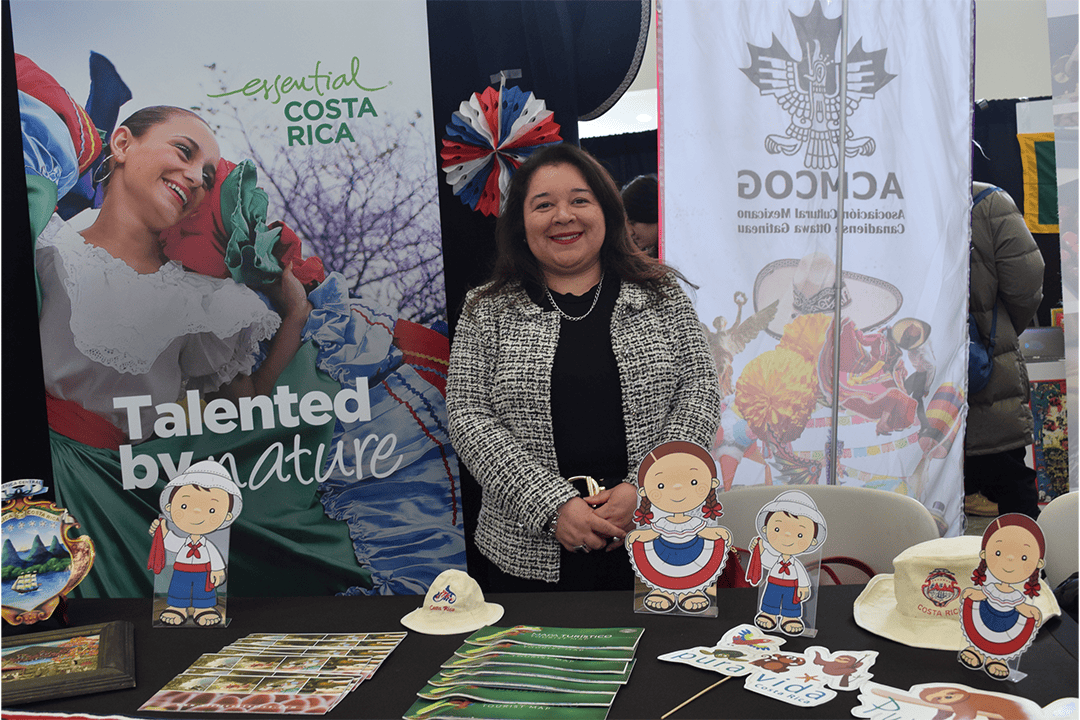
Marcela Calderon, a staff member with the embassy from Costa Rica, explained that she was present at the event because she wanted to help students learn a bit about Costa Rica.

Embassies from around the world welcomed students on April 5 as part of a collaboration between the Students’ Association and student support services to celebrate the diverse cultures on campus.

The event was the 25th time embassies were invited to the college.

“The celebration of culture happens every year with an exception to the restrictions during the pandemic lockdown,” said Nakeya Francis, the diversity and inclusivity event coordinator for the Students’ Association

Francis and Amanda Logan are event programmers for the Students’ Association that worked together with the AC event team, Lauren Larocqe and Samantha Therrien.

Some of the embassies that were present included Zambia, Haiti, Argentina and Vietnam.

Marcela Calderon, a staff member with the embassy from Costa Rica, explained that she was present at the event because she wanted to show her culture to the students and help them learn a bit about Costa Rica.

“We are a country of peace and we are very into the environment,” she said. “We have eco tourism, sustainable tourism, and that is why we are here for you to learn.”

Along with the food and culture displayed, songs and activities were performed to engage the students and make them feel welcomed.

The embassy of Vietnam conducted a game of matching names to food with a USB drive as a prize reward that was made from wood.

Representatives from Ivory Coast also introduced its traditional dance and drums played by one a performer.

Curious students walked through each stand observing clothes, statues and mini antiques that caught their eye. Each stand had a representative ready to explain the history of their country, where they were from and much more.

Camila Gil, a first-year student in the bookkeeping and accounting program at the college, said that she found the event amazing. She was not able to find her country at the event, but she was able to learn more about the culture of other countries.

“I am an immigrant, and as soon as I got an email saying that there was going to be a multicultural experience, I was definitely in,” she said.

Hailey Nguyen, a student from University of Ottawa studying nutrition and food science, explained that she got the information about the event on Facebook posted by a Vietnamese association.

“At uOttawa we don’t really do this,” she said. “The Vietnamese association said that they were going to be here, so I came here. I got to learn and try different foods from different cultures, and it was so much fun.”

PSAC workers’ strike begins its second day

Local CBC: Two groups of PSAC workers have begun their second day of striking including more than 155,000 workers within multiple government departments and agencies under the Treasury Board, as well as tax workers from the CRA. The two sides have agreed that the workers deserve a raise, however the current dispute between the union […]

Local

CBC: Two groups of PSAC workers have begun their second day of striking including more than 155,000 workers within multiple government departments and agencies under the Treasury Board, as well as tax workers from the CRA.

The two sides have agreed that the workers deserve a raise, however the current dispute between the union and the government is now about how big the raise should be.

The union proposed a larger raise to match the recent rise in the cost of living and high inflation. However, the government has proposed a smaller raise that purportedly balances the needs of taxpayers and the union’s workers.

Another driving factor in the negotiations between the PSAC union and the government is the addition of remote work rules which would allow workers to perform their full-time duties all from home.

Treasury Board President Mona Fortier has expressed her support for exploring the current hybrid model.

National

CBC: Police are investigating the theft of a “high value container” carrying gold and other valuable items worth an estimated $20 million from Toronto’s Pearson Airport.

Peel Regional Police explained the plane was unloaded according to normal procedure and its cargo was taken to an airport holding facility where it was ‘’Removed by Illegal mean.’’

The theft was reported quickly after it happened. Police believe this to be an isolated incident, and does not pose any concern to the general public who may be travelling at the airport.

Police have not yet made any arrests in relation to the theft and do not yet know where the gold was headed or if it is still in the country.

No suspect information has been released.

International

CBC: Elon Musk’s SpaceX Starship launch was both a failure and a success Thursday morning. The next generation rocket ship lifted off successfully from the Gulf Coast launch tower, but tumbled into an explosion after a failed separation of the second stage rocket.

The rocket ship, designed to take the future generation of explorers to the moon and Mars, stands a 394 feet tall, or 120 metres, making it taller than the Empire State building.

A live stream of the launch was available on Youtube. The stream showed the rocket successfully lifting off.

However four minutes after launch, the upper-stage Starship section failed to separate during a rotating manoeuvre, causing the entire ship to freefall into a spin as it burst into clouds of gas and debris.

Red Couch Innovations

Welcome to Red Couch Innovations, I’m Tyler Beauchesne and I am the host of this podcast. This mini-series goes behind the scenes at the Social Innovation Lab, – located at Algonquin College, in Ottawa Canada. The first episode talks about the SLiDE (Service Learning in Design & Engineering) initiative, the second episode talks about the […]

Welcome to Red Couch Innovations, I’m Tyler Beauchesne and I am the host of this podcast. This mini-series goes behind the scenes at the Social Innovation Lab, – located at Algonquin College, in Ottawa Canada.

The first episode talks about the SLiDE (Service Learning in Design & Engineering) initiative, the second episode talks about the SPEnD (Social Procurement & Enterprise Development) initiative and the third episode is about a pioneering medical platform called insightScope developed at the Lab. Join me as I dig into these topics and have deep conversations with my guests, and discover what makes the Social Innovation Lab  so special.  There’s a seat for everyone on the Red Couch Innovations.


Episode 1: Going SLiDEways

Every good podcast needs a solid starting point. SLiDE stands for Service Learning in Design & Engineering. It’s the program that runs in the Social Innovation Lab located at Algonquin College, and it provides opportunities to the student community to participate in social innovation. Host Tyler Beauchesne sits down to talk with the lab’s founder, Kevin Holmes, to discuss the importance of the lab and the program itself. We also interview Prajakta Amin, a research assistant and Diana Campbell of Zero Waste Canada, to explore how SLiDE helps the organizations they work with to pursue their goals.


Episode 2: SPEnD Some Time with Us

This episode is a deep dive into the opportunities that the Social Innovation Lab gives the students who join their program. One of those opportunities is called SPEnD, which stands for Social Procurement and Enterprise Development. It’s a 3-year initiative funded by the College and Community Social Innovation Fund meant to support market driven social enterprises. SPEnD is focused on the four key pillars of social innovation, which are social procurement, social finance, social enterprise, and social entrepreneurship. SPEnD interns Grace Aoun and Kariman Okby join me to explain the phases of this project and how it’s a great starting point for entrepreneurship.


Episode 3: An Insightful Observation

This episode focuses on one of the biggest projects that has come from the Social Innovation Lab: insightScope. 

Insight Scope is a medical platform that uses systematic review to accelerate the review process through crowdsourcing. This five-year collaboration between the Social Innovation Lab  and the Children’s Hospital of Eastern Ontario (CHEO) began in 2017. Medical professionals from CHEO and students in the Lab have come together for this project, headed by CHEO’s Dr. McNally. Ravi Rachamalla, a research associate with the Lab, and Katie O’Hearn, a research manager for the Compass Intensive Care Unit at CHEO, sat down with me to explain how insightScope came together and how the platform has made a big impact at the hospital and beyond.

Algonquin Times podcast
Algonquin Times on Instagram
Algonquin Times horoscopes
Follow Algonquin Times on Instagram
Algonquin Times podcast
Follow Algonquin Times on Instagram
Algonquin Times on Instagram
Algonquin Times horoscopes

Stay Informed

Sign up for our newsletter

Subscribe

* indicates required