main

Opinion: I’m tired of waiting for the ‘LateyLate’

Transit to campus is terrible. Can the college do anything to fix it?
Writer Claire Donnan wonders if the college can do anything to improve public transit for students.

It’s the first day of classes, and I’m running late.

I tap my foot impatiently at Hurdman Station, waiting on the 88 bus to take me the 28 stops from the train station to campus. Since I got to the station, the 88 has skipped two scheduled departures.

I left my house in Sandy Hill an hour early thinking this would be enough, although I was clearly, sorely mistaken.

The bus finally reaches Hurdman with 30 minutes to spare, and I burst into my first class as it begins. Since that first day, I’ve left the house an hour and a half early just to make it to campus 15 minutes early for class, and I’m not alone doing this. Indeed, the 88 in particular is absolutely packed morning and night, with the bulk of people getting on or off at campus.

Originally from Newfoundland and Labrador, where buses seem to take longer than just walking to your destination, I was quite unused to the idea of relying so heavily on public transit. To that end, I was – and still am – reticent of the idea of relying on transit that is this unreliable, skipping departures, running late, and constantly packed.

Simply put, the commute to Algonquin is terrible. Is there anything the college can do to fix this?

From downtown Ottawa, there are several main bus routes that service Algonquin College. The first three, buses 73-75, depart from the Tunney’s Pasture station frequently, but require you to go further on the train and drop students off at Baseline, a 10-minute walk from most campus buildings.

That just leaves the Terry Fox bus: The 88, which departs from Hurdman station every 15 minutes (allegedly). On Reddit, this bus is lovingly called the LateyLate bus, which replaced the former 118 (OneLateteen) bus route.

In the future, the City of Ottawa hopes to expand the LRT as far as Algonquin College, rendering these long haul bus routes less essential. But until then, surely the college can do more?

Aditya Mishra, the new Board of Governors student representative, believes the college can do more for commuting students, and that currently, buses don’t come often enough.

“Weekdays it [buses serving the college] is fully packed, like a matchbox,” said Mishra. “I think buses every 15 minutes, should be reduced to like, seven minutes or something.”

In addition to this, Algonquin College has a Transportation Strategy. Within this 2017 document prepared by Urban Equation, they stress the importance of improving transit to the college, and previous steps they had already taken to make the commute more reliable.

“In 2011, the college partnered with OC Transpo to redirect Route 118 [now 88] through the Ottawa campus, and add two new bus stops,” said Urban Equation in the document. They additionally planned for the expansion of the LRT and what this would mean for transit to the college.

These steps have admittedly already made significant improvements to the commute to Algonquin. However, with the LRT expansion looming further and further away, Mishra believes the college should do more to help students now.

“In my opinion, I think the college should talk to OC Transpo about the frequency because, they can do that,” said Mishra.

As it stands, I’ve restructured my commute to campus. Sick of waiting for buses in the cold, I instead brave the extra time on the train and the longer walk to take the 73-75 in the mornings. It’s much less packed, and actually comes when I expect it to. I have to admit, from Tunney’s Pasture at least, buses are dependable and fairly quick.

However, a lot more will have to be done before I can describe my commute as anything close to “reliable.”

Paramedic grad becomes new president of a local plant-based non-profit

VegOttawa hopes to raise awareness for veganism as more than just a diet, but as a lifestyle that can help the environment
Photo: supplied
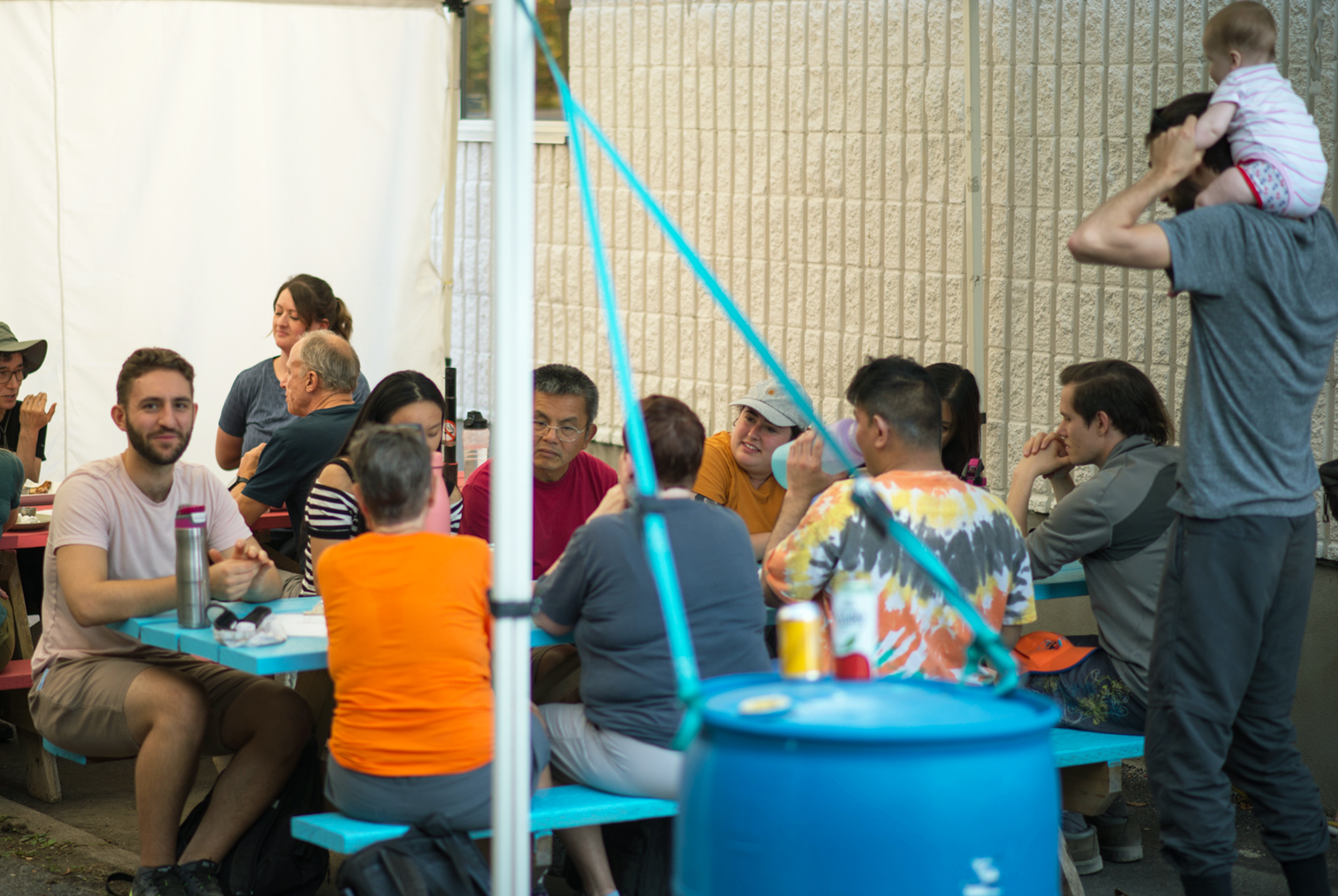
Vegan Hike and Hang Out is an event VegOttawa hosts to bring together the vegan community for some fun. The group hiked to the Kitchesippi Brewery on Sept. 30, 2023.

Despite graduating from Algonquin College’s paramedic program, Alan Wong decided he didn’t actually want to be a paramedic. Instead, Wong wanted to focus on a career he would be passionate about.

After graduating in 2011, Wong started working with OC Transpo. Working with buses, however, was not Wong’s dream either.

Nearly a decade later, Wong left OC Transpo and finally started pursuing something he is passionate about: veganism.

Wong started volunteering at VegOttawa, a local plant-based non-profit, in the summer of 2023. On March 24, 2024 he became president of VegOttawa.

“I just saw there was a need for some direction and organization within VegOttawa, so I just wanted to step up and do what I could,” said Wong. “It’s also experience I’m hoping to gain to help me and my career.”

VegOttawa’s mission is to promote veganism in Ottawa. They do this by hosting events such as Beyond Meat barbeques and planning hikes for vegans to get together and hang out.

Alan Wong, an Algonquin College graduate. is the new president of VegOttawa.
Alan Wong, an Algonquin College graduate, is the new president of VegOttawa. Photo credit: supplied

Members of VegOttawa receive discounts at various vegan-friendly businesses around Ottawa that have partnered with the non-profit. Recently, VegOttawa started giving student memberships at a 50 per cent discount.

“We have noticed many college and university students in Ottawa getting involved in animal rights and sustainability associations,” said Joyce Santos, vice president of VegOttawa. “It’s so encouraging to see so much passion and dedication to this cause. We wanted to acknowledge the student community.”

For VegOttawa, veganism isn’t just a diet, it’s a lifestyle. They are dedicated to promoting how veganism can help the environment and animals.

Last year broke numerous records related to climate change, including being the hottest year on record and having the highest concentration of greenhouse gases held in the atmosphere, according to the World Meteorological Organization.

In 2022, carbon dioxide concentrations in the atmosphere were 50 per cent greater than they were in the pre-industrial era. The amount of carbon dioxide in the atmosphere continued to grow in 2023, according to the WMO.

As long as carbon dioxide and other greenhouse gases such as methane continue to get trapped in the atmosphere, global temperatures will continue to rise, said the WMO in a press release.

VegOttawa believes that going vegan will produce less greenhouse gases, which will help the environment.

“Animal agriculture contributes largely to climate-warming greenhouse gases, as well as deforestation, water pollution from animal agriculture runoff and soil degradation,” said Santos. “Eating plant-based is beneficial to the environment and also an ethical choice for those who have compassion for animals.”

Wong pointed out a study published by Science, an academic journal, which shows that despite meat and dairy farming using 83 per cent of farmland and releasing around 60 per cent of greenhouse gas emissions, it only provides 18 per cent of calories.

“[It] is ridiculous, four-fifths of our land is making one-fifth of our calories,” said Wong. “In general, the best animal products, in terms of emissions, land use and water use, are still worse than the worst performing plant products.”

However, some students are finding it difficult to go plant-based.

Aryan Chandel is a fourth-level hospitality – hotel and restaurant operations management student. Growing up in India, Chandel was raised as a vegetarian. However, upon moving to Canada, Chandel realized it is more difficult to be plant-based in Canada as vegetarian food here isn’t as good as the food in India. Chandel has since started eating meat.

“The best vegan and vegetarian food is Indian, but Indian food is quite expensive,” said Chandel.

The rising cost of food is part of why VegOttawa wanted to provide students with a discounted membership.

“We know that, especially nowadays, food is not cheap, especially going out for food,” said Wong. “We are at least trying to help out a little bit.”

Wong never returned to school after finishing the paramedic program at Algonquin College. Despite this, he has found a career he is passionate about.

When Wong isn’t promoting veganism with VegOttawa he is doing research for an animal-focused organization, a job he absolutely loves.

Hundreds of students dance and celebrate at Holi festival

Students participated in the annual Holi festival on March 25 celebrating the spring equinox and the end of winter
Photo: Jude Osmond
Algonquin Student Matteo Mongroo popping one of the colour bombs.

Once the paint was set up, chaos rose and students threw colourful powder at each other, dumping red, green and orange colour bags on each others heads.

Over a hundred joyful Algonquin College students gathered in front of the E-building at 1 p.m. on March 25 to celebrate the Holi festival.

Holi, a Hindu festival of colours, is a celebration of good over evil. This festival has many meanings to it. One is about the story of how Krishna fell in love with the godess Radha but feared that she wouldn’t love him due to this blue skin, however Radha let Krishna dye her skin blue and they became a true couple.

When Leah Grimes, one of the event coordinators, was asked to describe the event.

“The event was lively and colourful,” Grimes said. “I wish we had more paint. Everyone was so excited.”

Students lined up to get their white T-shirts provided by the event. The event was coordinated by the Students’ Association.

No matter how far people were standing away from the festivities, they were getting colour on them. Students were spreading colourful powder on anybody they saw. If you had no colour, you were going to get some.

Everyone was smiling while covered in powder, dancing, filming and taking pictures.

There were paint bombs being shot by students, which would make colourful clouds.

“It was fantastic to see all this positive energy around the school,” said Tryla Thorpe, an early childhood education student.

Two students enjoying their time at the festival of colour
Two students enjoying their time at the festival of colour. Photo credit: Jude Osmond

The students got excited and the all crowded in front of the Student Commons, and “they created their dance floor,” according to Grimes.

A DJ at the event played all kinds of music to get the students dancing and singing along, and a small rave was started in front of the Student Commons.

The festival was scheduled to end at 3 p.m., but students were still dancing until around 40 minutes later.

After the event, the pavement in front of the E-building was covered in bright colours, and the grass in front of the student commons was painted red.

Students got in their cars, covered in paint, and still celebrating from their vehicles, with people throwing powder from their vehicles’ sunroofs.

Round Dance held in the Banquet Salon for Algonquin College students

Mamidosewin Centre invited singers, drummers and elders to celebrate the Round Dance ceremony
Drummers and singers performing during the Round Dance on March 22.

The Round Dance ceremony was put together by the Mamidosewin Centre for Algonquin College students to gather, socialize, remember loved ones and heal together on March 22, from 5 p.m. until midnight.

This event has been ongoing for the past four years and more people have continued to attend every time the event has been held. This year, there was an approximate total of 200 people.

The Round Dance comes from the west, and it is traditionally held to remember those who are not with us today. Nowadays, it can be held for different reasons, such as birthdays.

Just days before this event happened, a car collision killing five people happened in Waswanipi, a northern Cree community. A few people at the Round Dance were connected to those lost on that day.

“As we gather today, let’s remember those from the accident and dance for them,” said Fred McGregor, MC of the event.

At the beginning of the event, photos cannot be taken as it would be disrespectful towards the opening pipe ceremony performed by the pipe carrier, Vince Kicknosway from Walpole Island, First Nation.

The pipe ceremony is held with tobacco and smudge to cleanse everyone of negative energy to bring forth healing and to begin the Round Dance.

“The connection for the students is important as well as the culture and what we want to give,” said McGregor.

As the opening to the ceremony ended, the rest of the evening started. The invited singers and drummers began to play the traditional music. As the drums were being pounded and as they sang, the people who came to the event danced.

The dance circle was never empty as this was the healing part.

“For me, I think the most important part of the ceremony is to socialize,” said Shayna Shawogonabe, a museum studies student and Mamidosewin Centre worker.

Food was provided for the people late at night as Indigenous ceremonies traditionally end at midnight. They had pepperoni and vegetarian pizza for whoever was hungry.

At the end of the event, the singers performed the closing song to the ceremony to end the night.

“I hope this continues to happen as this has been going on for the past four years. We used to be scattered but now it’s a lot more organized,” said Randy Kakegamick, student advisor from Mamidosewin Centre.

Occupational program empowers Indigenous women

Graduates of Courage to Soar, a program partnered with AC Online, took part in a ceremony at the National Arts Centre on March 28
Photo: Stephanie Taylor
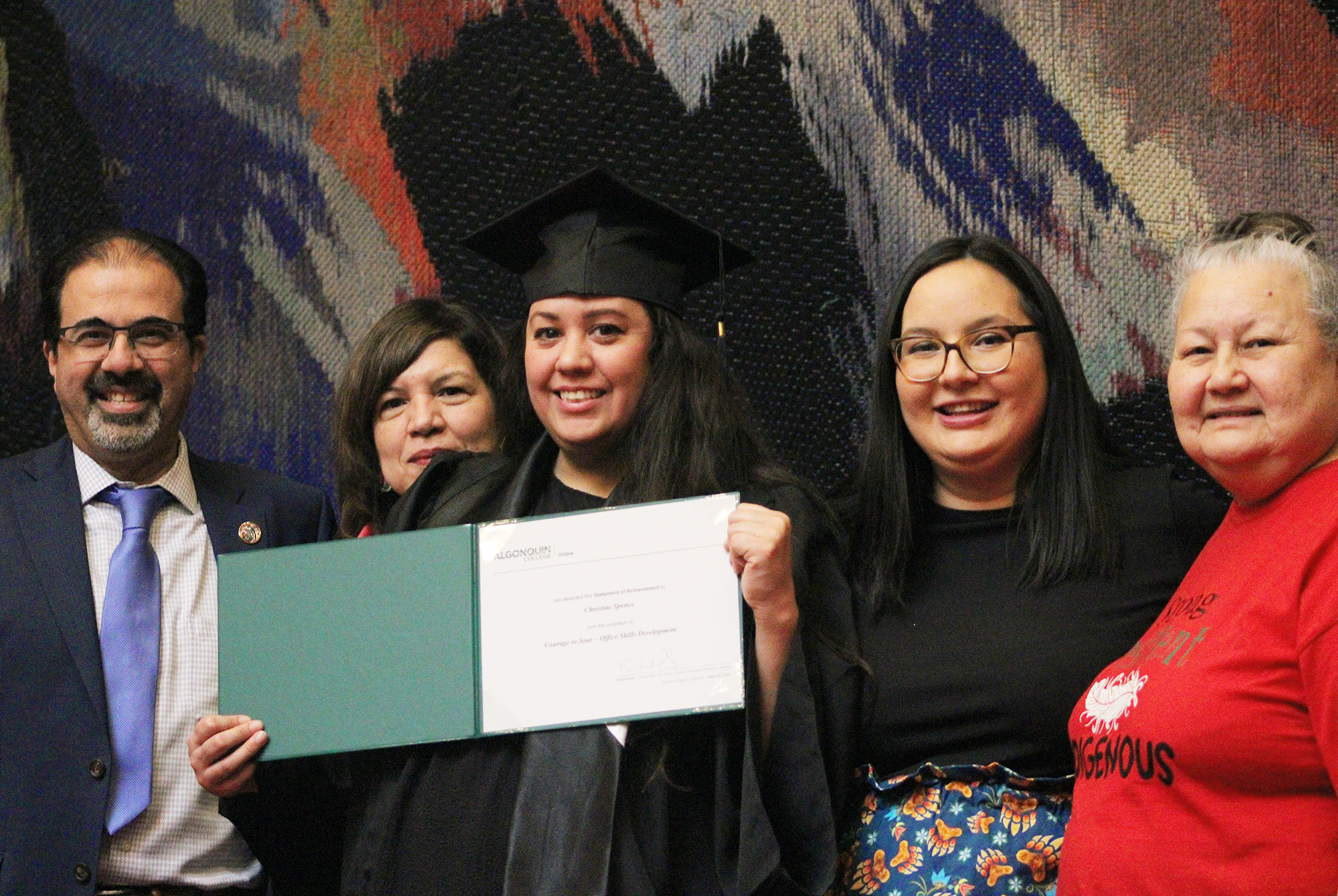
Christine Spence (middle) receiving her certificate of achievement for finishing Courage to Soar during the ceremony held at the National Arts Centre on March 28 . Alongside her are (from left to right) Farbod Karimi, Anita Tenasco, Sabrina Gideon and Irene Compton.

For Irene Compton, the co-founder of Minwaashin Lodge, it felt as if the Courage to Soar program was meant to happen.

Minwaashin Lodge, a support centre for Indigenous women located on St. Laurent Boulevard, describes Courage to Soar as a program dedicated to helping Indigenous women who have survived domestic abuse or are at risk of being abused empower their economic lives.

About 15 years ago, Compton was given the opportunity to start a program to empower women and teach them occupational skills. After Compton got accepted to start the program, that’s when the real work began.

“I remember I was walking down Bank Street and it was snowing very lightly. I was asking Creator, ‘Where do I start Creator?’” said Compton. “It just so happened I walked right by an employment centre.”

Compton went into the employment centre and told the staff there what she was doing. Within the day, Compton had the employment centre and Willis College, which was right across the street from the employment centre, on board to help start Compton’s program.

Courage to Soar’s first year saw only two graduates. This year there were 11, which was the largest graduation group the program has seen. This was also the first year Courage to Soar partnered with AC Online.

A graduation ceremony was held to honour the 11 graduates at the National Arts Centre on March 28.

“Throughout this program we have witnessed the transformative power of education and empowerment of Indigenous women to reach their fullest potential,” said Sabrina Gideon, the Courage to Soar coordinator, in her opening speech. “From overcoming barriers to embracing new opportunities, each graduate has demonstrated unwavering commitment to their personal and academic growth.”

Each graduate entered the program a different person compared to who they are today.

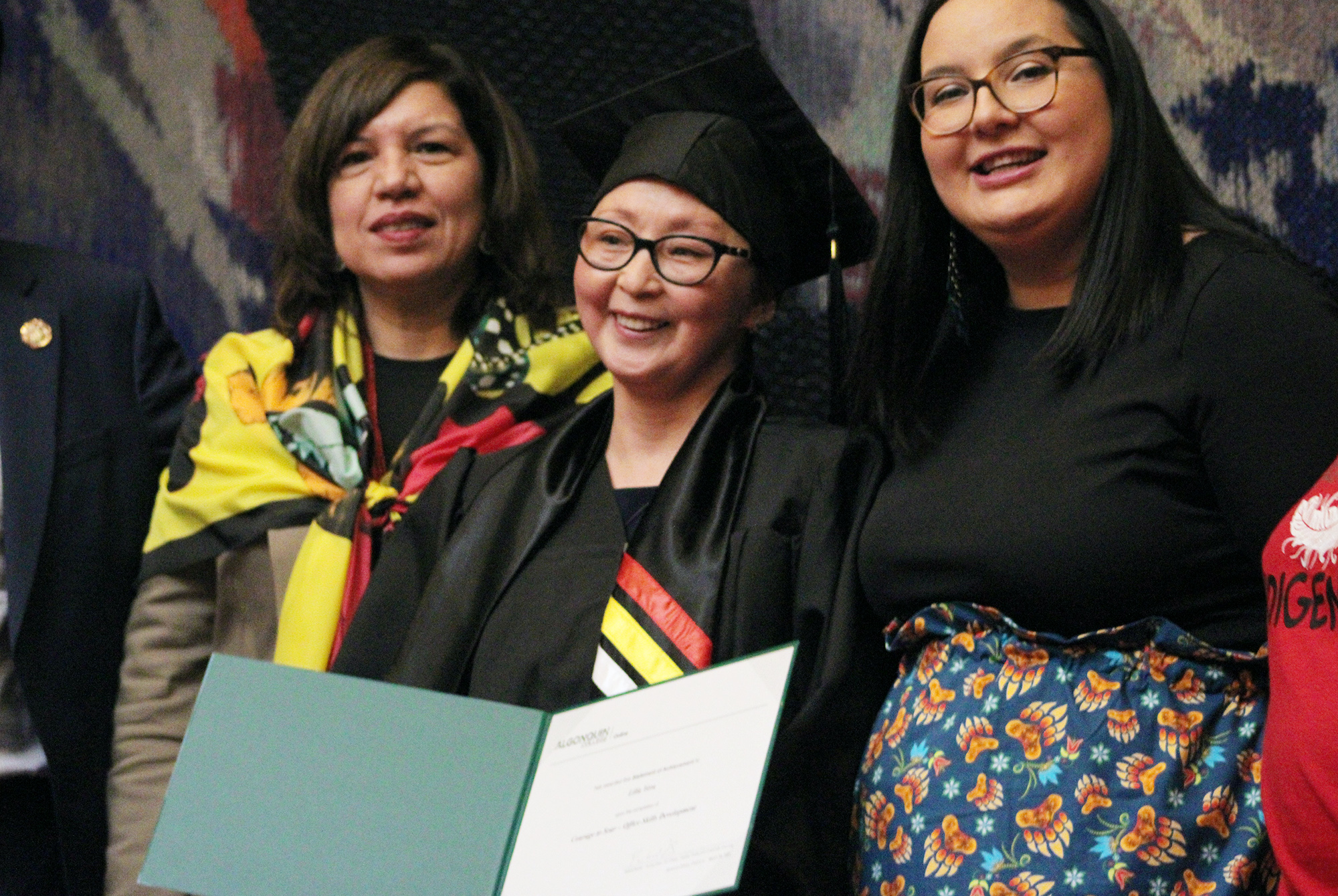
Lilia Taiberei (middle) receiving her courage to soar diploma during the graduation ceremony held at the National Arts Centre on March 28. She is with Anita Tenasco (left) and Sabrina Gideon (right).
Lilia Taiberei (middle) receiving her Courage to Soar certificate during the graduation ceremony held at the National Arts Centre on March 28. She is with Anita Tenasco (left) and Sabrina Gideon (right). Photo credit: Stephanie Taylor

“[Minwaashin Lodge] helped me escape violence, get my own apartment, go to Algonquin College and now get a job in the government,” said Christine Spence, a recent graduate of the program. “[Courage to Soar] saved my life.”

Ten of the 11 graduates have upcoming placements at Indigenous Services Canada. The remaining graduate opted to find a placement outside of the government.

Graduates Lilia Taibarei and Heather Hennessy-Goneau had trouble putting into words how happy they were to have had the opportunity to take Courage to Soar. Both of their faces were glowing with joy.

“We are so happy and just thankful for the help we have received,” said Taibarei.

Both Taibarei and Hennessy-Goneau entered the program seeking a career change.

“I was [working] in childcare since 2010 and have been in childcare ever since,” said Hennessy-Goneau. “[This program] gives us the opportunity to change and focus on something new.”

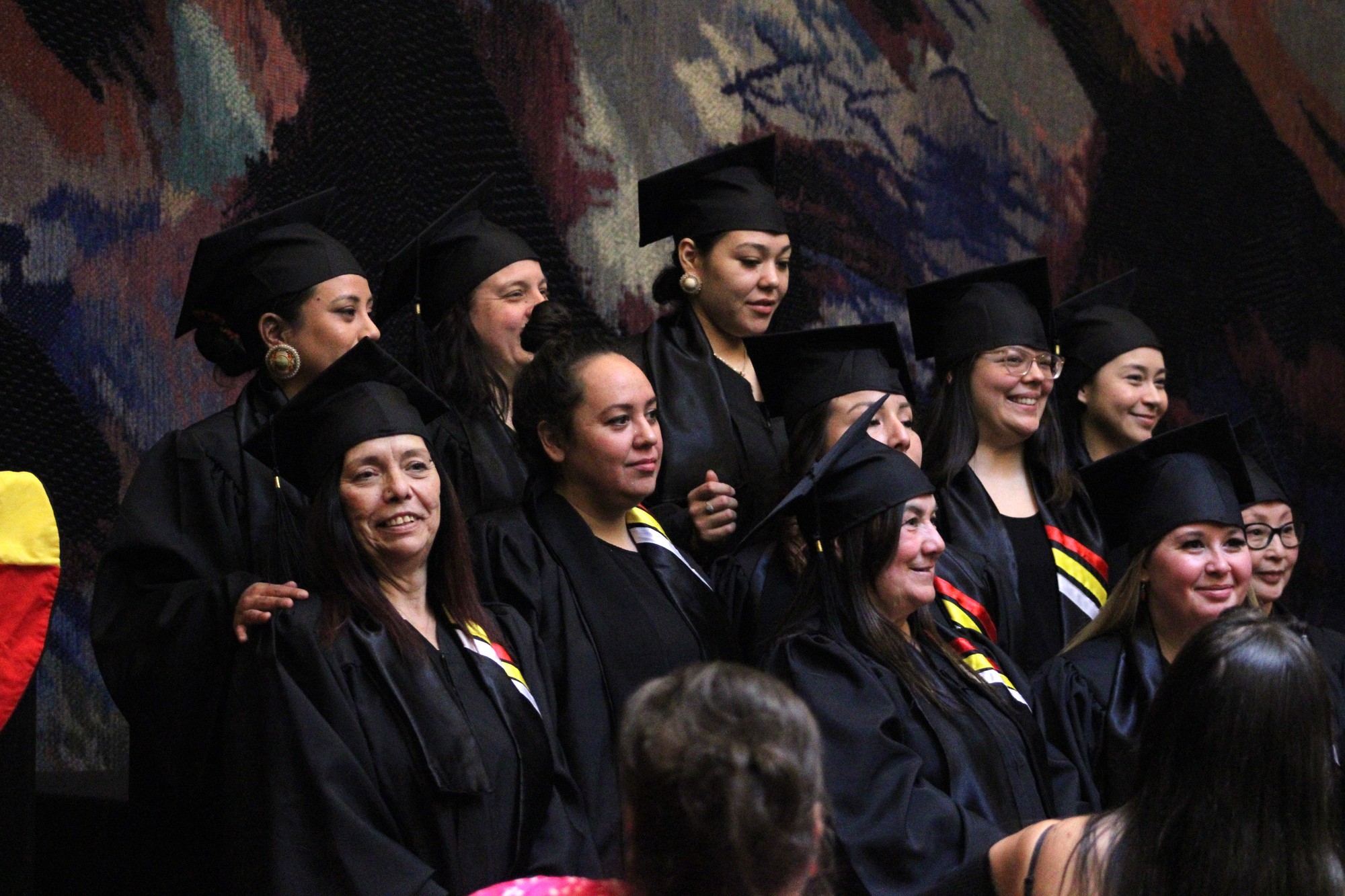
The Courage to Soar graduates getting ready to toss their caps at the end of their ceremony, which was held at the National Arts Centre on March 28.

While helping the women find jobs is a goal for Courage to Soar, Gideon hopes the women graduating the program leave with a sense of sisterhood. As the women finish the program and go start their new jobs, this hope becomes a reality.

“I’ve learned respect, determination, courage, sisterhood and to keep fighting towards [my] goals,” said Spence.

The Truth and Reconciliation Commission’s Calls to Action 62 to 65 call for better education for reconciliation in various ways, such as more funding to help teachers in post-secondary schools integrate Indigenous teachings into their classes.

These calls to action are part of the reason AC Online was so eager to partner with the Minwaashin Lodge to build Courage to Soar.

“Algonquin College should not wait for a report from the government to take action on such an important topic,” said Farbod Karimi, the acting dean of AC Online.

Karimi said he has learned more about Indigenous Peoples from Anita Tenasco in the past year than he has in the past three decades.

“Our best partner so far has been Algonquin College and they’re doing it because they know they are changing Indigenous women’s lives,” said Compton. “All our women that come to Minwaashin Lodge, they live in poverty, and I mean real poverty. Giving them this opportunity to really use their gifts and skills and show who they truly are, that’s a really big opportunity.”

Students learn about maintaining their nutritional health

A homemade mouth-watering kale slaw with maple and balsamic dressing had students salivating at the Adulting 101: National Nutrition Month event
Photo: National Nutrition Month event in the AC Hub. Photo credit
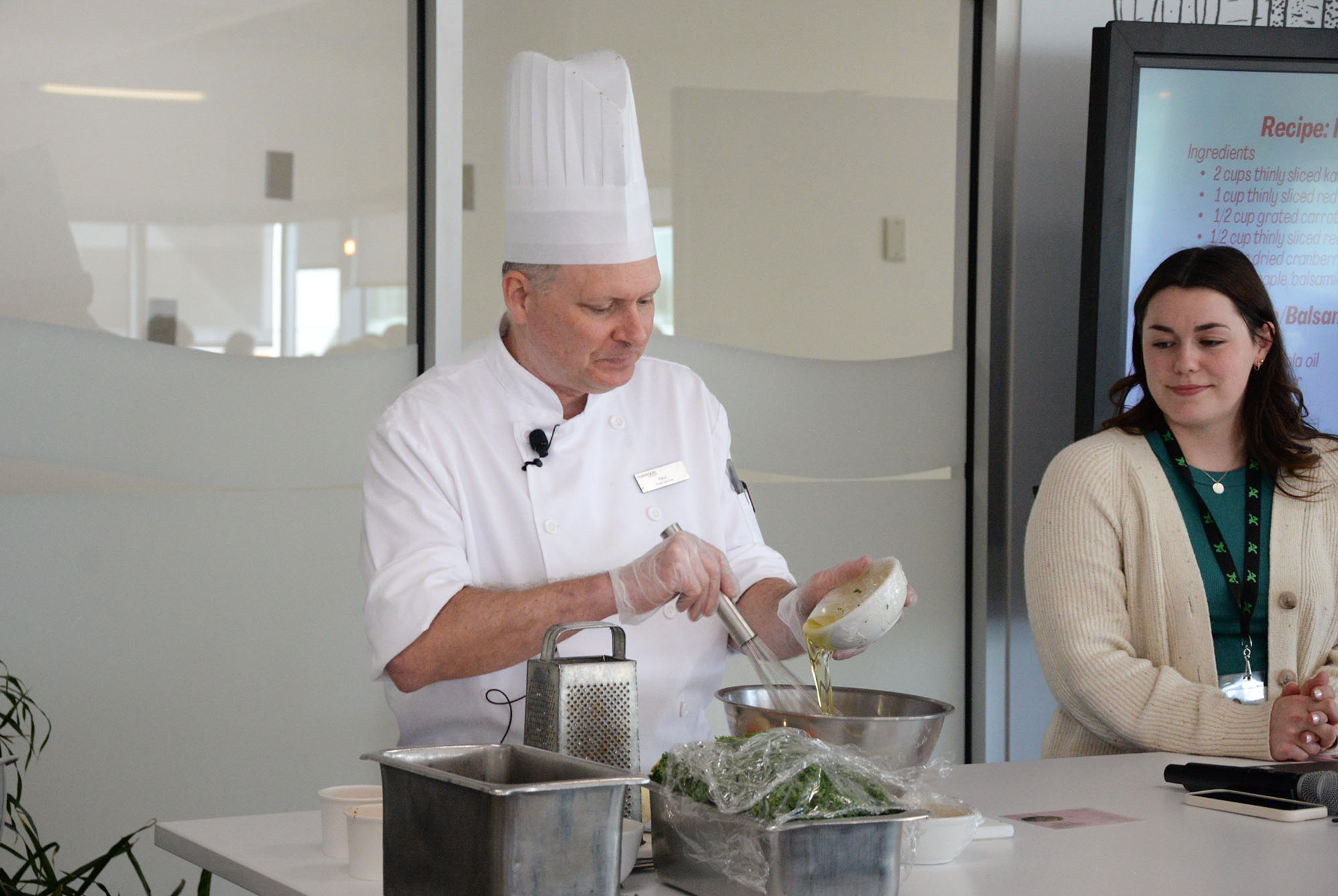
Emma Kaya (right) watching Chef Paul Schutter (left) make the vinaigrette during the Adulting 101

Chef Paul Schutter, the culinary coordinator from the Marketplace Food Court, showed the step-by-step recipe for this low-maintenance dish in the AC Hub on March 25.

The kale slaw recipe requires only six ingredients, making it affordable for students.

The aroma of fresh food filled the room as Schutter taught students what vegetables to use and possible substitutions for dietary restrictions during an Adulting 101 nutrition event.

Emma Kaye, a wellness and sustainability coordinator and registered dietitian, provided a slide presentation of nutrition-related information for students to maintain good well-being.

Pauline Thomson (left) and Miya Watson (right) getting a plate of kale slaw at the Adulting 101: National Nutrition Month event in the AC Hub. Photo credit: Isabella Disley
Pauline Thomson (left) and Miya Watson (right) get a plate of kale slaw at the Adulting 101: National Nutrition Month event in the AC Hub. Photo credit: Isabella Disley

Students recommended this one-hour event as it was helpful and eye-opening.

Miya Watson is a soon-to-be graduating bookkeeping and accounting practices student.

“Definitely come to Adulting 101,” said Watson. “It was definitely something I would suggest other people do. It was very informational.”

“It’s been beneficial because I got to learn a lot about food and how it affects the body,” said Watson.

Pauline Thomson, also a bookkeeping and accounting practices graduating student, found the event to be delicious.

“It was nice to see an actual recipe put into place, be made and the things that are in it explained. It’s been really eye-opening to all the things that we actually put in our bodies when we’re not paying attention,” said Thomson.

“Being able to eat something very different from what I normally would ever eat, especially learning that kale could just be put in such a salad with a balsamic vinaigrette. That was really good,” said Watson.

“Don’t be afraid to try new things that you haven’t tried before,” said Thomson.

Kaye says an overall balanced diet is the key to success.

“There’s not one thing that I would say is unhealthy or healthy in a diet,” said Kaye. “It is what’s nostalgic for you and your upbringing, what’s involved in your culture, what you like and don’t like to eat, if you have allergies, all of those things are involved.”

“A negative effect of having an unbalanced diet would be in general your mood. One that fits your lifestyle is going to make you feel better in general,” said Kaye.

When it comes to advice for students, Kaye mentions that it is best to “take it with a grain of salt.”

“Make sure you’re getting your information from the experts. I think for students in general, there’s a lot of information online about eating and diets and things like that,” Kaye said.

A stand-alone chalkboard in front of the AC Hub that illustrates Adulting 101: Food + Mood. Photo credit: Isabella Disley

More details on upcoming Adulting 101 events can be found on the AC Hub’s website. All events are open to Algonquin College students and registration is not required.

Muslim students navigate Ramadan during space and scheduling challenges

From March 10 to April 9, Muslims around the world celebrate their holiest month, a time of fasting, prayer, reflection and community
Photo: Algonquin College Muslim Student Alliance
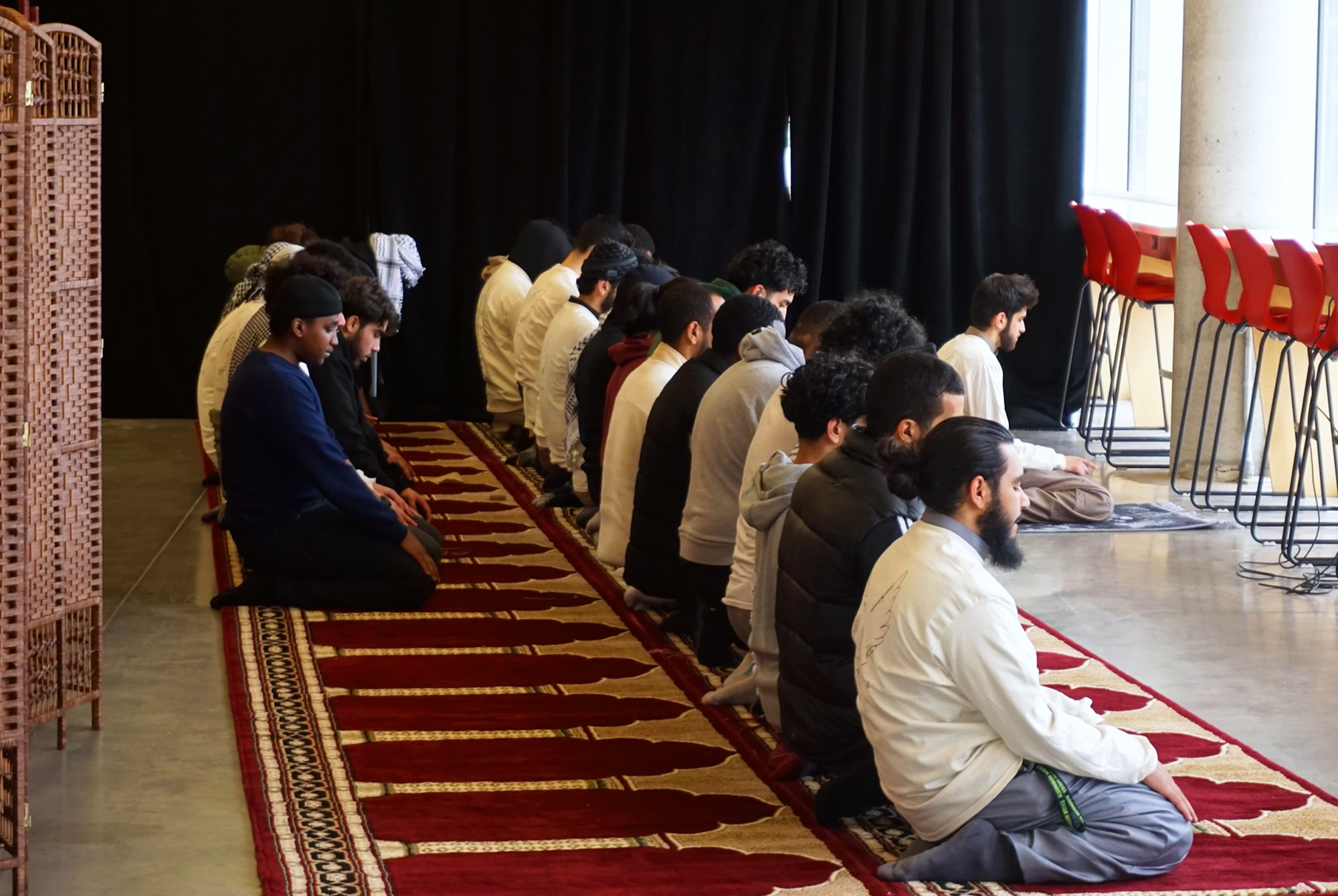
Muslim students pray in the Corner Lounge of the E building at Algonquin College.

As the sun dips below the horizon, Muslim students finally can have their first sip of water or first bite of dates since before dawn. Amidst the challenges of hunger and thirst, they learn self-discipline, gratitude and solidarity to become better versions of themselves.

During Ramadan, fasting from dawn until sunset means abstaining not only from food and water but also from backbiting and speaking to others disrespectfully.

“Relax, control yourselves. That’s how fasting is supposed to be,” said Nibras Khan, the Imam on campus at Algonquin College.

“The whole idea behind fasting is that we’re supposed to be in solidarity with people who don’t have food or water,” said Khan. “At the end of the day, when you have that one sip of water, you will be really thankful and grateful for whatever food and water we have.”

Fasting goes beyond religious concerns. Hussein Jalloul, a Level 2 student in the broadcasting-television and streaming video program, highlights the health benefits of fasting.

“It can help with digestion, give your body a break, and even boost brain function. It’s like hitting the reset button for your system. It’s not just a cultural thing. It’s good for you too,” Jalloul said.

Inspired by the strength and hope found in prayer during times of hardship, Pouya Honarvar became Muslim in a recent Islam event at Algonquin College. His first experience of fasting during Ramadan has deepened his gratitude for having access to daily necessities, like food and water.

“Fasting for my first Ramadan has made me feel grateful and appreciative for the blessings in my life. It serves as a reminder to care for and support the less fortunate in society,” said Honarvar.

However, fasting as college students is not an easy thing. “You need to do the whole day of fasting. And you need to go to classes, do assignments. No water. No drink. You’re tired. Your brain isn’t in there,” said Khan.

Ramadan requires fasting, but it also means balancing work, classes, and daily responsibilities without any concession, such as adjustments to schedules.

With 12 years of Ramadan experience, Jalloul has mastered the art of balancing academic responsibilities with the demands of fasting and prayer during Ramadan.

“It’s all about organizing your day, ensuring you have a balanced schedule that accommodates your fasting, prayer times, and study sessions. Staying hydrated and eating nutritious food,” he said. “You [will] find a rhythm between your spiritual practices and academic responsibilities.”

Another challenge faced by Muslim students is finding suitable food options when breaking their fast. While the Marketplace food court closes at 7 p.m., the Muslim Students Club provides water, dates, and snacks for immediate consumption. However, options for substantial meals are limited, leading students to seek halal alternatives at College Square.

Muslim students break fast together in the Corner Lounge in the E building.
Muslim students break fast together in the Corner Lounge in the E-building. Photo credit: Algonquin College Muslim Student Alliance

Prayer space in the Spiritual Centre is also a concern for Muslim students on campus.

“For a very long time, the space we were given was not adequate for us as Muslim students,” said Khan.

“We’ve tried to request to the college multiple times that we need a special space for Muslims because there are a lot of Muslim students on campus,” Khan said. “But there was always an excuse. We tried to negotiate, like putting forward a report, a petition from the students, and a letter from all the mosques in Ottawa. And that letter was also put forward and it was basically rejected by the college. It was a very disheartening and unfortunate situation.”

Until recently, the college has been opening room E204 as an additional space to alleviate the growing number of requests for booking at the Spiritual Centre.

“The additional space, which is currently being offered as a short-term solution, is available to be booked as a multi-faith space effective immediately,” said an emailed statement from Algonquin College’s Student Support Services.

However, the problem of limited space remains, especially on Fridays when Muslims must pray in person with the group, or when the main room is booked for other groups.

Currently, Muslims are facing difficulties organizing Friday prayer, according to Khan.

“The Friday prayer is the main issue right now because we don’t have accommodation from next week onwards as that room has been booked by another group,” said Khan. “We try to ask the college. They said that there is no space on campus and the college is not able to accommodate. So, we have to figure some solutions out.”

Despite all the constraints, Muslim students at college remain resilient and optimistic.

“Ramadan for us is a month of worshipping our Lord and connecting with the community,” said Khan. “And it is a month of joy, a month of fun.”

Music Monday’s

You just got Rick Rolled! What does getting Rick Rolled mean? You might ask. It was one of the first viral video trends to surface the internet. Gaining steam through […]

You just got Rick Rolled! What does getting Rick Rolled mean? You might ask. It was one of the first viral video trends to surface the internet. Gaining steam through Youtube and a popular website by the name of 4chan, Rickrolling used Rick Astley’s 1987 hit “Never gonna give you up” to do a type of bait and switch where one would click on a seemingly unrelated link and suddenly be surprised by the music video for “Never gonna give you up” instead. The meme gained mainstream attention in 2008 through several publicised events, particularly when YouTube used it on its 2008 April Fools’ Day event. Over the years the trend has gained so much popularity that the video for Astley’s “Never gonna give you up” has now hit approximately 1.5B views. So now that you know don’t waste your April Fools Day, go and start Rick Rolling people before they get you first!

Nutrition 101 event promotes healthy eating and healthy body choices

Students embark on a journey to better health
Photo: Mackenzie Cardinal
Students at the event discussing their troubles with being healthy.

Algonquin College students learned about the importance of eating healthy at Nutrition 101, an event that happened on March 20 at the AC Hub. Eight students came to the event with a taste for learning.

The event started out with coordinator Elizabeth Peña-Fernández handing out free Algonquin College lunch boxes, along with soup mugs. This was courtesy of the student health and wellness program at Algonquin College.

“This event is for people who are curious about how to be healthier and how to improve their body,” Peña-Fernández said. She is a part of Health Promotion at Algonquin College along with an education coordinator.

The topics at Nutrition 101 included the stigma around fat, the difference between vitamins and minerals and the differences between physiological hunger and psychological hunger.

She explained that there is a general stigma around fat. People interpret fat as entirely unhealthy, when sometimes that is not the case.

She said that if you were to eat McDonald’s, then that is bad for you because it has unhealthy fats like saturated fat or trans fat.

However, something healthy like an avocado has fat as well, but it’s healthier for you because it has healthier fats like unsaturated fat.

Peña-Fernández also explained that calories are simply a unit of energy. Calories aren’t necessarily a good thing or bad thing, they are just a concept. She insisted that anyone who is suffering through an eating disorder should contact a dietitian or a medical professional for help.

Sky Lees, a student in performing arts, explained that listening to your body is important in achieving a healthy body.

“Listen to your body when it tells you to stop. If you don’t listen to your body, then it deteriorates and you’ll feel worse about yourself as a result,” Lees said. Lees did not participate in the event.

The coordinator also stated that everyone goes through calorie loss and calorie gain differently. There are some people who gain calories very quickly due to a low metabolism, and people who don’t gain very many calories due to a high metabolism.

Cameron Dowell, a wall climbing attendant at the ARC, explained that some people try and gain or lose calories in very unsafe ways.

“A lot of people are concerned about calories and tracking them, but sometimes what you eat matters a lot,” Dowell said.

“There are a lot of gym goers that eat doughnuts to help them get bigger, but all of those carbs aren’t necessarily a good thing.”

When the event was over, Peña-Fernández gave everyone who attended a $20 Loblaws gift card.

More information about events like Nutrition 101 can be found at the student services event page: www.algonquincollege.com/studentsupportservices/events/.

Students get their game on at e-sports event

We Got Game brought students together to bond over video games
Photo: Ben Seabrook
Dave Miller, owner of We Got Game, visits the Student Commons to host an e-sports event.

The Algonquin College Students’ Association partnered with We Got Game to host two e-sports tournaments, FC 24 and Super Smash Bros. Ultimate, in the Student Commons on March 20.

The SA has worked with the e-sports organization We Got Game for over 10 years. They collaborate each semester to hold free e-sports events at the college open to all students.

Dave Miller, owner of We Got Game, wants to bring more awareness to these events each semester so people can compete against each other, but have fun too.

“We want to bring the best of both worlds and make sure it’s inclusive for everybody to come play and enjoy,” Miller said.

Fourteen schools across Ontario are participating in this event, and the top four winners from each school — two for each tournament — will compete for a prize in an online tournament on the first weekend of May.

According to Miller, We Got Game chose Super Smash Bros. because many people have played it since they were kids, and FC 24 was chosen to attract international students.

Patrick Tomas of Student Support Services joining the party
Patrick Tomas of Student Support Services, at the right, joined the party in the Student Commons for e-sports event. Photo credit: Ben Seabrook

Josh Nguyen, a first-year biotechnology student, grew up playing Super Smash Bros. since the original for Nintendo 64. He finished the tournament with two wins and two losses but didn’t advance to the second round.

“Next time I should actually play the game ’cause I haven’t touched the game for almost two years,” Nguyen said.

Ahmed Barry, a first-year construction engineering technician student, won the FC 24 tournament. He came from behind after being down 3-1 in the championship game.

There were a variety of other games for students to drop in and play casually, including Mario Kart 8 Deluxe, NHL 24, Street Fighter 6 Mortal Combat, and an area with Just Dance where students got together to dance off.

Shantal Gonzalez, a fourth-year bachelor of hospitality and tourism management, walked by the Student Commons and noticed the TV so she started dancing.

“It feels free because no one cares that you can’t dance well,” Gonzalez said. “I think it’s good because everyone is together, and people are watching and it makes them happy.”

Canadian Blood Services had a table set up near the Just Dance area for people to sign up to support their blood drive. They joined the dance as an opportunity to promote themselves.

“We had an idea that if we just participate, we’ll get people to know more about us and they can come to our tables, and it supports them too. t’s really a fun time,” said Monica Lefebvre, a second-year event and conference management student helping CBS.

The winners of the tournaments received $50 gift cards from the SA. For the online tournaments in May, the winner of the FC 24 tournament will get a $2,000 prize pool, while the winner of the Super Smash Bros. tournament will receive $1,000.

“We’re wishing the best to all teams and all players who qualified today, and we’ll see what happens in May,” Miller said.

Algonquin Times podcast

Stay Informed

Sign up for our newsletter

Subscribe

* indicates required