main

Michelle Young wins first Blair H. Tetreault Memorial Award

Michelle Young, a broadcasting-television student in her second year at Algonquin College, was visibly emotional after receiving the first Blair H. Tetreault Memorial Award on Oct. 21. “This means a […]
Photo: Magan Carty
In honour of her late husband, Louise Tetreault (left) presents Michelle Young (right) with the first Blair H. Tetreault memorial award.

Michelle Young, a broadcasting-television student in her second year at Algonquin College, was visibly emotional after receiving the first Blair H. Tetreault Memorial Award on Oct. 21.

“This means a lot to me,” Young said while tearing up during her acceptance speech at the ceremony and thanking the Tetreault family.

“I took a big risk in switching careers, and it’s touching my heart knowing my name was chosen to represent the values of such a special person. This will go up on the wall and it will stay there forever,” she said.

The annual $4,000 bursary was made possible by a $109,000 endowed gift from the family of Blair Tetreault, who worked in the live sports broadcasting industry for 40 years after graduating the same program as Young in 1981. His son, Scott Tetreault, is also a grad of the program.

Among many notable successes, Blair Tetreault covered the 1988 Winter Olympics in Calgary for CTV and the 1998 Winter Olympics in Nagano, Japan‎ for CBS. He and his crew won Emmy Awards for their coverage of the 1994 Winter Olympics in Lillehammer, Norway.

When Tetreault passed away in June 2021, his family decided to honour his memory with an award for students following in his footsteps.

“We wanted to give back because the college afforded Blair the opportunity to have such a wonderful career,” said his brother, David Tetreault.

Matthew McCooeye, the coordinator of the broadcasting-television program, described Tetreault as a “father figure” who worked hard to bring out the best in every member of his crew.

“Thank you for sharing Blair with the rest of us,” McCooeye said to the Tetreault family during his speech. “Blair was the perfect companion for this business. He was someone we admired and tried not to disappoint.”

The Blair H. Tetreault Memorial Award reinforces the values Algonquin College tries to instill in all its students, according to president and CEO, Claude Brulé.

What makes the award unique, Brulé said, is the fact that it’s not just about academic performance.

“Technical skills are one thing, and they are important,” he said, “but warmth and kindness are equally important. It’s about being a good person.”

Young was chosen as the first recipient of this award because she contributed meaningfully to a sense of collegiality among fellow students and professors. She exemplified integrity, caring, learning and respect in addition to earning a GPA of 3.6 or higher in her first year of study.

“We stipulated those criteria because Blair was that kind of person,” said his wife, Louise Tetreault, who presented the award to Young.

“Not only was he strong technically, but he also shared a great deal of warmth and collegiality with his crew and made a point of mentoring people just getting started in their career,” she said.

Young aspires to broadcast live sports and events after graduation, just like Tetreault, and “feel that rush.” McCooeye said he knows there’s a place in the broadcasting industry waiting for her.

Young described the experience of receiving the award and seeing her name alongside Tetreault’s as “extremely validating.”

“I must be doing something right,” she said. “It’s a boost of confidence. I’m on the right track.”

Algonquin College professor’s TrendifyLive provided statistics for municipal candidates

In 2018, all of Alem Legesse’s work culminated in a Twitter feed that provides statistics for corporations and electoral candidates. The statistics and tools gathered through TrendifyLive provide electoral candidates […]
Photo: Tyler Major-Mcnicol
Alem Legesse, founder of TrendifyLive and a part-time computer programming professor at Algonquin College.

In 2018, all of Alem Legesse’s work culminated in a Twitter feed that provides statistics for corporations and electoral candidates.

The statistics and tools gathered through TrendifyLive provide electoral candidates with the analytics necessary to better connect with their target audience.

For example, you could research a specific timeline to access information about leading mayoral candidates.

TrendifyLive saves people from skimming through pages of information.

“TrendifyLive empowers voters to make informed decisions by providing them with simple and easy-to-use visual reports containing public sentiment and ranked candidates’ promises. The software is always trusted for its accuracy and insightfulness specifically up to and days before election day because of its real-time projections,” said Legesse, the founder of TrendifyLive and a part-time computer programming professor at Algonquin College.

Legesse’s goal was to simplify finding advanced statistics for those seeking out specific content and it has become a tool his students use for projects and assignments.

Salah Griffith is an engineering program student at Algonquin College. Legesse described her as a role model for many women, specifically in underrepresented groups. The reason being is she doesn’t let outside noise, or her skin colour deter her from her goals.

“I believe TrendifyLive is a great tool for people like me who get overwhelmed by the continuous management of multiple social media pages. It is a simple way to keep track of social media and the tool can be customized to your liking,” said Griffith, a third-year computer engineering student.

Griffith met Legesse during an intro to database course during the first semester of her first year in her program and she feels he has increased her passion and drive. While Griffith is driven to succeed and sets big goals, such as running her own business after graduation, Legesse pushes her to pursue her own business venture, rather than working for a corporation.

“There were many times after class we would discuss the semantics of becoming a successful, black entrepreneur and he would often motivate me to strive for more than what I set out for myself,” said Griffith.

Legesse believes TrendifyLive responds perfectly to the upcoming municipal election for three reasons.

“It tracks Twitter activities, and many candidates use the platform to communicate with voters and supporters. For the past couple of years, we have been covering Canadian elections including the federal, Ontario provincial, and Ottawa municipal. And our software is always trusted for its accuracy and insightfulness specifically up to and days before election day because of its real-time projections. The City of Ottawa has been one of our lead customers that included Mayor Jim Watson, and other councillors who are familiar with our software,” said Legesse.

Griffith believes social media has become a popular way to promote and connect with supporters.

“Social media is a crucial aspect of receiving feedback about a campaign. TrendifyLive easily gathers social media analytics so that candidates can figure out the most effective way to connect with their target audience and tailor their online presence accordingly,” said Griffith.

Legesse explained some of the things you can learn using his Twitter tool.

“[It can] measure the impacts of a candidate’s election activities. Overall voters’ sentiments towards the election and different candidates can be derived from the software,” he said.

Live predictions about the election or the campaign can be tracked daily or weekly. Instant reports before, during, and after a debate are easily accessible.

For Legesse, he feels he has only scratched the surface and has plans to expand the software to other countries, with an emphasis on his home continent of Africa. This will potentially gain more exposure and frequency of women competing for important roles in municipal, provincial, and federal politics.

“When the time is right, our team would like to expand to two other continents [Europe and Africa] as well, hopefully soon. Because as a start-up venture, we are always busy not only refining the tool but also introducing it to potential markets,” said Legesse.

“If a single story is to be told from TrendifyLive analysis over Twitter, the demand for change is historically driven by women of all backgrounds, both influential and ordinary citizens,” said Legesse about who has driven the demand for change and growth and inspired the advancement of TrendifyLive.

Access to recreation amenities emerges as key municipal election issue

Ottawa’s municipal voters have indicated that one of the biggest issues for the next mayor to tackle is sports and recreation. According to a study by Broadbent Institute, 13 per […]
Photo: Tyler Beauchesne
A group of figure skaters participate in a session at the Nepean Sportsplex.

Ottawa’s municipal voters have indicated that one of the biggest issues for the next mayor to tackle is sports and recreation.

According to a study by Broadbent Institute, 13 per cent of the Ottawa population believes the issue of sports and recreation needs to be addressed. Many issues that need fixing include high enrollment fees, long wait times to register for programs, and the city’s website crashing due to high traffic.

However, candidates in this election have a clear plan to address this area if they get elected.

“What I can share with you is that one of the reasons I am running is that we have a real challenge with getting a lot of families and seniors out there to do sports and recreation,” Pat McGarry, a candidate in College ward, said on the recreation issue.

“We need to get on that as it gives opportunities to the youth to meet people and stay active which is the purpose of these facilities. What I keep hearing is that families and seniors cannot afford these activities and we need to do better as parents should not have to choose which of their children gets to do sports and which don’t.”

On the subject of expensive fees, Bernard Couchman, a mayoral candidate, said: “Since the cost of living is on the rise, I want to reduce the fees so that sports are more affordable. I want to make sure that everyone can have access to our facilities without issue because exercise can help everyone be better both physically and mentally. For sports, registration fees are way too high. I want to cap those fees at five dollars. I want the city to invest in this area and give the money back to you so that the public can participate in playing sports and creating memories. If you get young people involved in sports, they will develop life skills that will help them in the future such as teamwork, accountability, and leadership.”

Mick Mariani, a representative for mayoral candidate Mark Sutcliffe, talked about how Sutcliffe wants to fix the city’s website and how Algonquin College can be used to help out with the recreation issue:

“We have families who will wait until midnight on the city website to reserve their son and daughter and the website will just crash because of this,” Mariani said. “Mark wants to re-haul the website and hire more people to work on it. He has three kids and some of them are doing sports, so this issue is very important to him. Mark was on the board for Algonquin College, and he cares about this place a lot. The ARC is a great resource and Mark wants to use it to help with the issue.”

Amanda Presley, an English public school board candidate in the area of College and Knoxdale-Merivale wards, said that she wants to go back to using schools for public recreation.

“Our schools used to be used as recreation centres prior to COVID,” Presley said. “I would like to see a return to that where we use our schools after-hours for community groups. It would foster a sense of community that I feel we have lost in the last two years. For recreation fees, I would register my kids for swimming and it would be full within two hours. I think having more facilities, as well as more programs, will make it easier for multiple families to use these programs.”

Students also gave their opinions on what the city can do to fix the situation.

“Things need to improve,” said Alex Lara, a student at Algonquin College. “Maybe the city should start by making gyms just like the one here at Algonquin College. For these gyms, we can reduce the price of membership fees so that everyone can have access to them.”

Meet two current and former Algonquin College professors running for city council

Some of Algonquin College’s professors, both past and present, are running for city council in the Oct. 24 municipal election. Steve Desroches is running for city council in the Riverside […]
Photo: Tyler Beauchesne/Steve Desroches campaign
Michael Wood (left) and Steve Desroches (right) are both current and former professors at Algonquin College seeking election.

Some of Algonquin College’s professors, both past and present, are running for city council in the Oct. 24 municipal election.

Steve Desroches is running for city council in the Riverside South-Findlay Creek ward. He is a former local government professor at Algonquin College who was a city councillor and deputy mayor from 2006 to 2014.

“I decided to run because I was approached by many residents in the ward to put my name forward so that the area would have an experienced city councilor,” Desroches said. “There is much work to be done to keep up with the growth in the area.”

Desroches explained why public transit would be a top priority if he is elected.

“The city operates a large number of services that impact students, such as transit. Their voice is their say. Voting is one of the key duties of citizens and part of a healthy democracy. Public Transit is a top priority. We need to ensure that the new O-Train service benefits the residents of the ward with a reliable feeder system to access the new service.”

Michael Wood is running for councillor in the Knoxdale-Merivale ward. He is a current professor at Algonquin College where he has been teaching business, music, media and film for 15 years.

“The only reason I decided to run for office was that I have a passion for helping people,” Wood explained. “I can think of over the last 15 years of being a part-time professor at Algonquin College where students would all say the same things about me. I saw a post where a student talked about how they sent an email to me at 2 a.m. and I responded in 5 minutes. I don’t care how big or small your problem is, I will always try to help you. You may say, ‘It’s no big deal’, but it is to you so it’s a big deal to me. I want the people to know that I want to help you in any way that I can.”

Wood talked about why it is important to encourage students to vote.

“One of the advantages of myself running for office is that the students see that their prof is running which could get them to want to get involved in the community,” Wood said. “They see us wanting to be engaged in the community and I think that everyone should be involved as it would make the community a better place. I prefer my students to call me Mike over professor as I always viewed myself as a mentor than a professor. Students get to see first-hand what’s involved in a campaign and getting involved. They want to ask questions about the election and I think it’s a super cool way to inspire students to do something in the future.”

One of Wood’s main goals as city councillor would be to improve the transit system, based on his experience with his students.

“I have students come late to class and apologize as their bus was late,” Wood said. “I tell them to take a seat and don’t worry about it because it’s not their fault. Then, I have other students tell me that they waited for the bus and even went early to the stop, and nothing showed up.”

Wood described his plan for fixing this issue.

“I will take the stories I hear from others up with everyone involved with city transit so that we can come up with a viable solution on this issue,” Wood said. “We have to work together to make it more efficient, affordable, and reliable. Once we do that, it will help everybody who uses it.”

New book details alumni’s battle with leukemia

One Step at a Time is Algonquin College alumni Brian Fraser’s autobiography. He spent the last months of his life working on it but was unable to finish before he […]
Photo: Nathan Drescher
One Step at a Time is available on all major online book platforms.

One Step at a Time is Algonquin College alumni Brian Fraser’s autobiography. He spent the last months of his life working on it but was unable to finish before he died. His friend, Callum Fraser, also an Algonquin College alumni, took over and finished the book, which was released on Oct. 17.

One Step at a Time is an emotionally-charged, painfully honest first-hand look at living, and dying, with leukemia.

“Brian came to me in December 2020,” Callum said in an interview with the Algonquin Times. “The main reason for his call was him enquiring with me to help him out with a book project. He wanted to put together a professional-sounding book. I told him it would be an honour and a privilege.”

Brian Fraser graduated from the broadcasting radio program in 2016 and worked as 580 CFRA’s technical producer on The Morning Rush with Bill Carroll until 2020, when he was diagnosed with leukemia. Fraser then gained national attention through his advocacy for blood donations following a CTV interview from his hospital bed.

“We assembled four or five chapters very quickly, but we didn’t have enough time to finish it before we lost him,” Callum said.

“I had to figure out what to do. I decided to take the journalistic approach and talk to the big players in his life. I managed to put together five or six more chapters and really focused on the inside story of how he became the poster child for blood donations in Canada.”

Callum met Brian at the Bell Media building while Callum was working with TSN. Although both men studied at Algonquin College at the same time, Brian in the radio program and Callum one floor above him in the journalism program, they never ran into each other. But once out of school, they became great friends.

“He was the most candid person you could ever meet,” Callum told the Times. “We decided early on in the process of writing the book that the best way to deal with these heavy topics was with brutal honesty.”

The college renamed one of its Alumni of Distinction awards to the Brian Fraser Recent Graduate award in 2021 in honour of Fraser’s promotion of blood donations in Canada.

One Step at a Time is published by FriesenPress and is available online at various bookstores, including Amazon, Apple Books and Barnes and Noble.

International students will soon be able to work more hours off-campus

Starting Nov. 15, any student with a study permit and off-campus work authorization will be able to work more than the current maximum of 20 hours per week. The federal […]
Photo: Leslie Bader
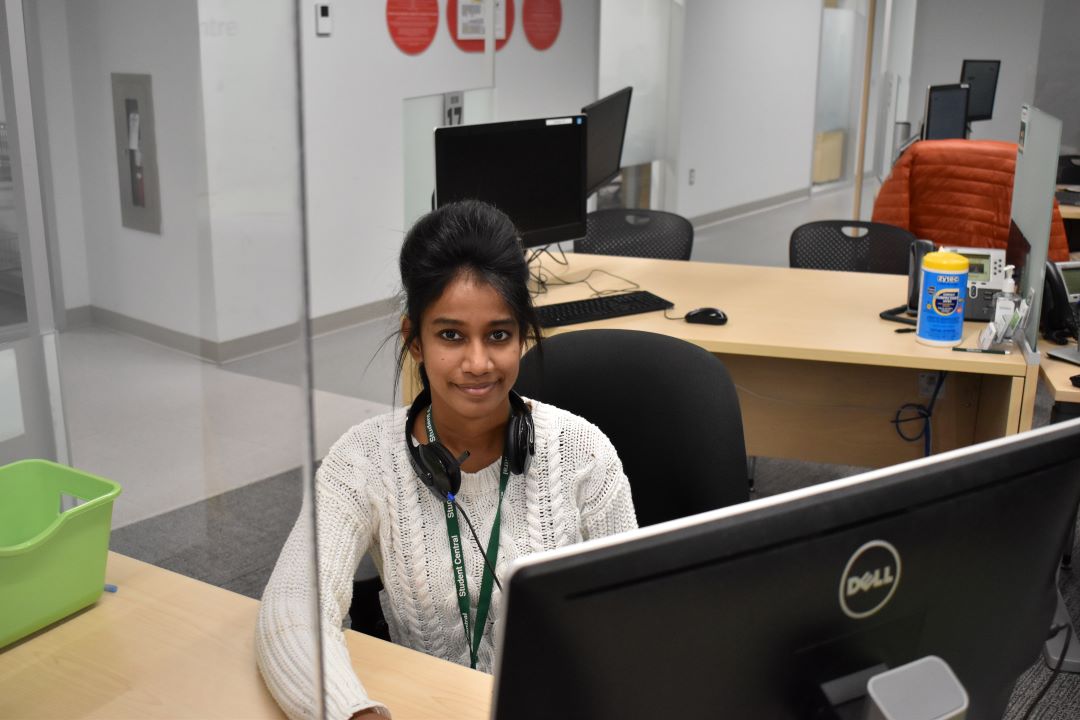
Algonquin College alumna Irene Thomas takes calls at Student Central.

Starting Nov. 15, any student with a study permit and off-campus work authorization will be able to work more than the current maximum of 20 hours per week.

The federal pilot project is being established to help combat the country’s labour shortages.

“International students will get to be exposed to a continuous working environment to help them prepare for their future endeavours,” said Brian Padre-e, a fourth-year business management and entrepreneurship student from the Philippines. “It will help the country deal with labour shortages while allowing students to save up for all their basic necessities.”

There is currently no limit on the number of hours international students can work in on-campus jobs, but the number of applicants greatly exceeds the positions available.

Irene Thomas, a graduate of the project management and regulatory affairs program, welcomed the government’s news.

“Yeah, I actually feel so happy for that. It was so hard for all of us to get some money to pay the fees,” said Thomas. “When I was a student, I always had eight-hour shifts, but then three shifts was 24 hours, so I was always stressed about that. I had to ask my employer to deduct my breaks so I wasn’t over 20 hours.”

Thomas, who now works as an enrollment services representative, echoed the sentiments of Padre-e.

“Now we can work full-time and build relationships with our employers. It will help us to be successful after our studies,” she said.

Damien Dunne is the acting director of the International Education Centre, which is located in the back corner of Student Central. While acknowledging the removal of the 20-hour cap will allow international students more flexibility as they balance their school and work commitments, Dunne stressed that academic success is the priority for Algonquin College students.

“I think it will allow students to work additional hours in weeks when their academic workload is not as demanding, and perhaps fewer when their program workload is higher,” said Dunne.

Padre-e, who also works as a student recruiter for Algonquin College, agreed there could be academic consequences to taking on more work.

“There is a huge possibility of loss of focus for students who want to earn more resulting in neglect of their studies,” he said.

The pilot project runs until Dec. 31, 2023.

Algonquin College throws a Diwali party

When 3 Peg by Sharry Maan started playing, a look of disbelief rippled through the throng of mostly Indian students in the Student Commons. It was immediately followed by incredulous […]
Photo: Aadil Naik
Bhangra originated in the Northern state of Punjab in India, and is traditionally performed in a circle by farmers during the harvest season. It is a popular dance form in India and will regularly be performed at parties and celebrations.

When 3 Peg by Sharry Maan started playing, a look of disbelief rippled through the throng of mostly Indian students in the Student Commons. It was immediately followed by incredulous acknowledgment and wild cheering. All inhibitions were immediately abandoned, pure joy and memories plastered on their faces, as everyone lost themselves in the dance.

On Oct. 20, the Students’ Association hosted the annual Algonquin College Diwali celebration in the Student Commons at the Woodroffe campus, filling the space with light, energy and the aroma of delicious snacks.

Diwali – also called the festival of lights – is one the biggest celebrations of the year in India. It symbolizes the spiritual victory of light over darkness, celebrating the day the Hindu deity Rama returned to his kingdom with his wife Sita after defeating the demon Ravana.

It is usually observed by members of all faiths in India and traditionally celebrated with fireworks, dance and food. Algonquin College has a sizable chunk of students from the region and every year the Students’ Association brings the celebration to them.

“I find it very important, especially for our foreign students who might not be able to go back home for holidays,” said Nakeya Francis, diversity and inclusivity events coordinator for the Students’ Association. “For them to feel seen and celebrated on campus is super important so they know they are a core and a great part of the community here at Algonquin.”

The celebration kicked off at 1 p.m. with a dance performance by Bhangrascape, an Ottawa-based group that teaches and performs a dance form popular in the Northern regions of India called bhangra. It is characterized by vigorous kicks, foot stomping and leaps accompanied with upraised thrusting arm and shoulder movements. It is played to the beat of a double-headed drum called the dhol.

After a few dance numbers, the group invited the rest of the attendees to join them, and everyone was happy to oblige. The dance party didn’t stop until 4 p.m.

Diwali is a very social festival for Indians and an opportunity to bond and spread good cheer. This event was a reflection of that spirit.

“It’s great fun, but it also reminds us of our culture and traditions. It’s a great perk,” said Kasha Deep Singh, a student in the business program, who came to Canada in May 2021, and is celebrating his first Diwali away from family. The last time he danced to bhangra music was at his brother’s wedding and he said this brought back all those memories. “I have no words to describe it,” he said, before running back to join the dance.

While the vast majority were from the Indian diaspora, there were others, too.

“These are moves I’ve never seen in my life, and I want to learn it,” said Francis Aikhuomon, a student in the computer systems technician networking program and a passionate Afrobeats dancer. He wasn’t aware of the event and was just passing by, heard there was a dance party and couldn’t resist joining in.

“I like it because it not only promotes dancing but it promotes culture and that’s what matters to me,” said Aikhuomon.

All around, people had their phones out smiling as they recorded the passionate dancers.

Applying intricate designs of henna on your hands is a popular tradition for Indians during festivals and weddings.
Applying intricate designs of henna on your hands is a popular tradition for Indians during festivals and weddings. Photo credit: Aadil Naik

Off to the side, Indian snacks like samosas and batata vadas were being served. The line to grab some of these tasty delights extended all the way to the Algonquin Commons Theatre. Further down, henna artist Shelina Syed was applying beautiful designs onto people’s palms – another popular Diwali tradition.

For the first time this year, the Students’ Association also had a Diwali celebration at the Algonquin College Perth campus on Oct. 17. It was a huge success, according to Francis.

College Ward Conversations, Ep. 2 – The Contenders

Join hosts Kolbe Devaux and Connor Lalande as they explore the good, the bad and the ugly sides of the race for city councillor.

College Ward Conversations turns up the volume on municipal politics in our own backyard. 

Join hosts Kolbe Devaux and Connor Lalande as they explore the good, the bad and the ugly sides of the race for city councillor.

It’s a podcast for voters who want straight talk about their issues, their candidates, and their ward.

Featuring reporting and editing by Connor Lalande, Kolbe Devaux, Nathan Drescher, Lara Faceroli, Sophia Adams and Adil Naik.

Click here to listen to episode one.

Cyclists are ready for change this municipal election

Every election cycle has a hot-button issue, and this year it is bike lanes. Two of the candidates in Ottawa’s mayoral race have gone back and forth on cycling infrastructure. […]
Photo: Myriam Landreville
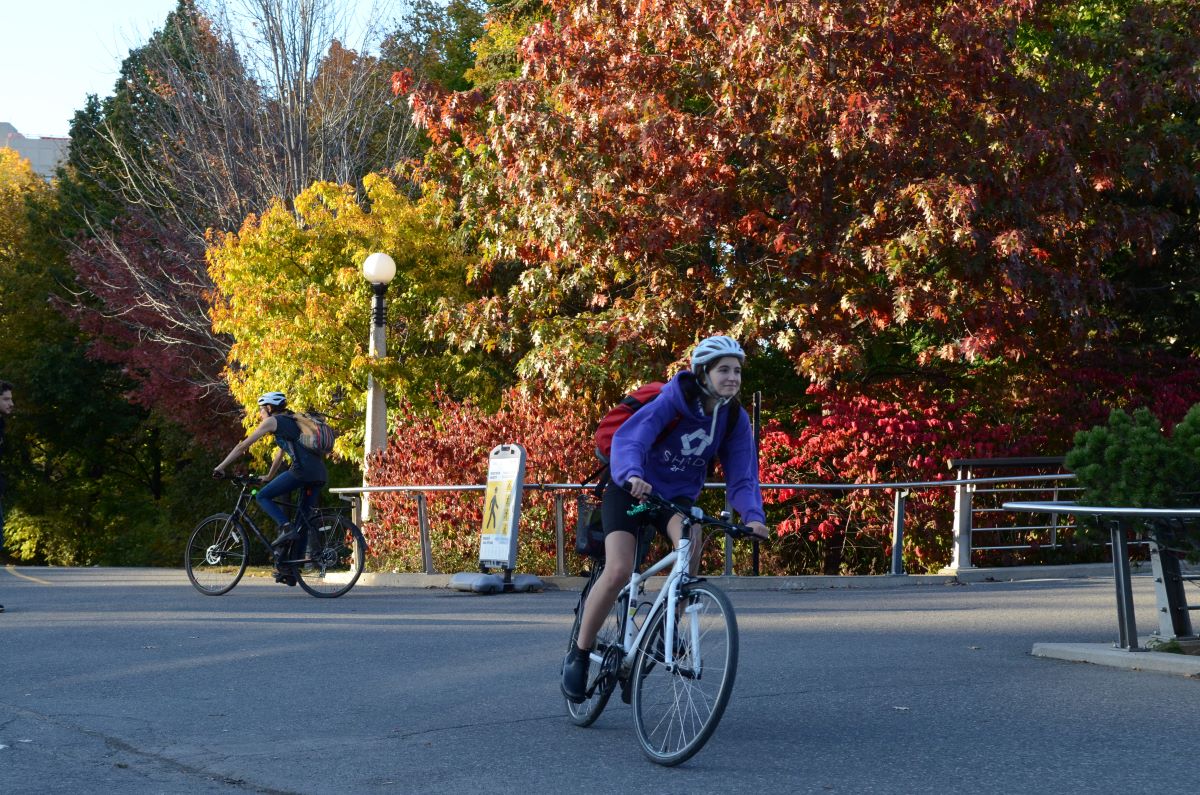
On a warm and sunny October afternoon, cyclists pack a pathway near the Rideau Canal.

Every election cycle has a hot-button issue, and this year it is bike lanes. Two of the candidates in Ottawa’s mayoral race have gone back and forth on cycling infrastructure.

Catherine McKenney’s campaign has been promising to extend bike lanes throughout the city. They intend to achieve this by spending $250 million by issuing green bonds.

“As mayor, I will transform Ottawa into one of the best cities in the world for cycling,” McKenney said.

Mark Sutcliffe, another prominent mayoral candidate, has opposed McKenney’s plan.

“Ottawa needs transportation priorities that work for them. Whether you’re getting groceries, taking your kids to school, getting to the community centre for hockey practice, bike lanes aren’t going to help you with that,” said Sutcliffe.

Sutcliffe has instead promised to spend $100 million on road maintenance.

According to Ottawa Insight, a project that collects local data, 2.5 per cent of commuters in Ottawa chose cycling as their method of choice to travel.

“It gives me much more independence than transit, it’s faster than walking and I don’t have a driver’s license. It’s also so much more fun,” said Christiane Wilke, an Ottawa resident who uses a bicycle as her main mode of transportation.

“We need to have a serious discussion about turning some of the mid-20th century scenic parkways into scenic bikeways: Queen Elizabeth Drive, Colonel By Drive and Sir John A. Macdonald Parkway, for example,” said Wilke. “Collisions become less likely if cyclists have space that cars can’t encroach on, and collisions become less severe when the speeds at which cars can go are lower.”

Andrea Emery, an Algonquin College professor of graphic design who uses a bike to get to school, echoed the sentiment.

“We need more protected bike lanes and pathways specifically for bikes. There has been an increase in cyclists since the pandemic with more people embracing the sport. Which is great. Our multi-use pathways are busier than ever with walkers, runners and cyclists. We need to prioritize bikes over cars for our city,” said Emery.

“Catherine McKenney has vowed to transform Ottawa into one of the best cycling cities in the world,” explained Emery. “Since they spend a good deal of time on their bike and in our communities, they are aware of the cycling infrastructure. I think their green bond plan is exciting and I hope they get the opportunity to implement it.”

Rodd Heino who used his bike as his main mode of transportation for more than 30 years explained his challenges while cycling.

“The biggest difficulties are the cars. Other road users make using a bike very stressful if you don’t choose your route carefully. The weather can be a challenge, too,” said Heino. “I am excited to see Catherine McKenney’s platform and I’m encouraged by the fact that they see the bigger picture. More facilities for cycling means more people on bikes.”

According to the Ottawa Road Safety Report, two cyclists died in 2020 due to road collisions, compared to four in 2019.

The Prince of Wales Drive and West Hunt Club Road intersection and Hunt Club Road and Riverside Drive intersection each had 32 collisions in 2020, making them tied for the intersections with the most collisions that year.

How did we become so desensitized to overt violence?

A stranger walked through the Algonquin College parking lot and threatened to shoot up the Woodroffe campus on Oct. 12, some time before noon. I was sitting in a stairwell […]
Photo: Rohan Kanchan
Violence is a part of our daily news intake, and it has stopped having the effect it should, writer Aadil Naik argues.

A stranger walked through the Algonquin College parking lot and threatened to shoot up the Woodroffe campus on Oct. 12, some time before noon. I was sitting in a stairwell with 10 colleagues when the news reached us. But it didn’t inspire fear or anxiety. At all. Only one of us reacted with the despair someone threatening to kill should receive. For the rest of us, it was straight on to discussing lunch.

That’s when it hit me. We have become truly desensitized to violence and death.

The last time news of violence or death really moved me was probably when the dastardly Al-Qaeda flew planes into the Twin Towers over two decades ago. That was a worthy reaction to obscene violence – shock, anger, fear and anxiety. I remember staying glued to the television for days. I was almost exactly on the opposite side of the world – it affected me not – and yet I remember it striking my heart with fear and sorrow.

Ironically, what followed played a huge role in desensitizing me to violence. With the U.S.-led invasion of Afghanistan, casualty reports became regular news fare. We followed them for a while, rejoicing when it was an evil Al-Qaeda operative, and mourning when it was an innocent child. We protested collateral deaths in horror. But it became so common that in a few years it stopped moving that part of us that makes us human – we stopped feeling. I could soon watch a live news broadcast of 40 people being killed while having dinner and go to the movies immediately after.

We had long believed it was video games made that us violent and desensitized us. That’s what my parents still tenuously believe, but that myth has long since been debunked. On the other hand, exposure to excessive violence early in life can make us emotionally desensitized in early adulthood.

But that still doesn’t explain this weird middle ground we exist on. Most of us are still empathetic people. The death of grandma still moves us, and we will open our purses and hearts for the local charity, but a school shooting doesn’t. Not anymore. Sure, we will talk about it and change our social media display pictures. But it does little more than that.

By the third school shooting in America, it didn’t make me nauseous imagining a 10-year-old being shot at point blank range. I didn’t feel sick reading accounts of parents getting a call at work that their kid was not going to make it home. Thinking about that now in retrospect makes my heart bleed for the kids and the anguish the parents go through. It makes my blood boil at the insufficiency and injustice of it just being another news cycle and will be forgotten in a week. And despite all this, when it happens again, I don’t feel.

Is it because today violence permeates our lives so deeply and regularly, our innate reaction is to avoid it? Our default is to protect ourselves from emotional distress, and with emotionally distressing news drowning us daily, our minds subconsciously run from it.

But the people who report on it make a living off making us empathize. And to truly empathize, you need pedantic visual and graphic details and it isn’t considered iniquitous anymore. But we don’t want to have those feelings. Ever. And yet, because we live in a world that’s so connected, there’s no escaping the news. Ever.

So even though we stoically avoid it, we receive it in headlines and blurbs nonetheless. On Twitter, Instagram and billboards. Devoid of all detail, but enough to know someone died or got shot. But devoid of detail, it doesn’t evoke the same response. It feels…normal. Because headlines are dehumanizing. A headline says “School shooting in Texas. 3 dead.” They are numbers and statistics, never feelings. And numbers are inanimate, while feelings are human. Is it any wonder then that we don’t feel the way we all believe we should be feeling?

Or is this just our generation’s coping mechanism? Because we know that if we did feel as we should, it would utterly consume us. It brings to mind something Barney Ross – played by Sylvester Stallone – says in the movie The Expendables 2. “That’s how we deal with death. We can’t change what it is, so we keep it light until it’s time to go dark.” And if I’m being honest, it works. It keeps us effective, and we continue to live and work, ignoring what we can’t change.

This approach can sometimes be beneficial. In the case of the threat made on campus, it amounted to nothing. When police were contacted, they confirmed that the person had been “spoken to and escorted off the property without incident. No charge was laid.”

But I wonder what that says about us as a society and species who have attained this stage of modernity through collaboration and empathy between each other. Is that where we stand today then – partially informed, physically awake but fully dead inside? Is this the true victory of violence? Not the lives lost, but our indifference to it.

Algonquin Times podcast

Stay Informed

Sign up for our newsletter

Subscribe

* indicates required