main

Solutions: Culinary students learn to cook mass portions while helping those in need

During their weekly food production classes, Algonquin College culinary management students learn to handle, prepare and serve dishes in bulk. Half of all dishes produced go to the college’s fine […]
Photo: Noah Leafloor
Elizabeth Kamau, Luc Prevost and Omar Atyeh, left to right, make egg sandwiches for the Shepherds of Good Hope Foundation on Nov. 22 in H118.

During their weekly food production classes, Algonquin College culinary management students learn to handle, prepare and serve dishes in bulk.

Half of all dishes produced go to the college’s fine dining restaurant, Restaurant International, and the other half are served to people in need at Shepherds of Good Hope.

The portions bound for the shelter made by just one class can often feed up to 150 people. The college’s culinary program has four production classes where each group makes 150 meals. This means that a lot of hungry people in Ottawa can benefit from their efforts.

Almost two years ago, during the COVID-19 pandemic lockdowns, a partnership between the college’s culinary program was formed with the organization. The shelter had issues with volunteer limits and services necessary to operate their community kitchen. The students were able to step in to help prepare the food.

But what was supposed to be a temporary event has turned into an opportunity that benefits both parties.

Culinary students who make the Shepherds food feel value when doing it.

“I feel good after making the food because of all the people that eat it,” said Preetkamal Kaur, level-two culinary student. “Making different dishes for the first time, I want people to like it.”

“It feels good to combine all the ingredients,” said Kaur.

Kaur wants to open a bakery after she graduates because she loves to bake.

Following the weekly food-making, Shepherds collect Algonquin’s culinary food for their services.

“When Algonquin college students take the time to work with raw ingredients and turn them into nutritious meals, this alleviates pressure of staff and volunteers who can then focus strictly on getting the food on to the plates of those visiting the community kitchen,” said Bernie Forestell, senior communications manager of Shepherds.

“The relationship was mutually beneficial and worked so well, Algonquin started to make it part of their classes. The skill and expertise of the culinary program and it’s student had a direct and immediate impact on the people who visit Shepherds in search of a meal,” he said.

Gordon Richards, kitchen manager at Shepherds agrees.

“With the food Algonquin provides, we’re able to bolster our sandwich numbers, and have a few dinners per week made in a way we don’t, and using ingredients we can’t,” he said. “It has been a great help to us, not only from the meals provided to our service users, but from a stock and food waste/management perspective.”

In addition to operating the largest adult shelter, and the only one in Ottawa for all, Shepherds offers a range of services to those in need and is one of the largest supportive housing providers in Ottawa.

Though not explicitly for those experiencing homelessness, the Shepherds’ community kitchen stands as a vital resource for Ottawa during Canada’s ongoing homeless epidemic –– with 235,000 people experiencing some form of homelessness across Canada, as of 2023 according to Statistics Canada.

Nov. 21: The Shepherds of Good Hope building is where many people seek hospitality.
The Shepherds of Good Hope building is a place where many people seek hospitality. Photo credit: Chris Sokulski

With the help of donations and food collaborations, Shepherds supplied 330,000 meals through their community kitchen and housing programs, between 2022 and 2023, according to Forestell.

As a charity organization, Shepherds relies on volunteers and donations from sources across Ottawa – with $8,393,443 donated by the City of Ottawa between 2022 and 2023.

However, the organization is facing challenges too. Shepherds has lost 80 per cent of their volunteer service from the peak of COVID-19. Slowly they are building it back up. But with the rise of food insecurity, they can only help so many. Staff limitations are still an issue. And cooking is usually left to one volunteer or staff, while the rest do daily prep.

The Algonquin culinary program came through for Shepherds in one of their toughest times. But they have also came through for others.

The program reached notable charitable milestones over the years. For instance, in the spring students prepared 950 meals for the Ottawa Food Bank.

Today, the students learn contemporary food production once per week, and are primarily focused on the process behind bulk food production.

“The really nice thing about the students, is that built into our program is their need to cook food in quantity – we make certain we send larger meals to Shepherds of Good Hope,” said Scott Warrick, an Algonquin College culinary management professor.

“They get graded on the quality of the food, the amounts they’re making, and following recipes,” said Warrick. “Instead of making something for twelve, you’re making it for three hundred.”


Detailed information regarding donations, volunteering, and events is available through Shepherds of Good Hope’s official website.


Campus celebrates cultural diversity at fair

The International Education Centre brought back the Culture Fair on Nov. 23, following a well-received debut earlier this year. There are numerous cultures that make up the international community at […]
Photo: Zaynab Safa
Students show off their table with information about their people, food and country.

The International Education Centre brought back the Culture Fair on Nov. 23, following a well-received debut earlier this year.

There are numerous cultures that make up the international community at Algonquin College. There were booths at the college dedicated to the different countries and cultures that are represented, along with games and foreign snacks.

“We’ve done this in the past (at) the culture fair where students get invited to kind of put together a team, usually from their country of origin, and then they are encouraged to put together a booth that represents their country, as well as to bring in some snacks and anything that they really want to showcase that represents their culture/country,” said Leah Grimes, intercultural programming support officer with the International Education Centre.

Each year, educational establishments and governments worldwide celebrate International Education Week during the third week of November to acknowledge, honour and advance international education on a global scale.

“We’re showcasing the different things that are going on in the International Education Centre, we have cultural activities and events funds, where students if they have culture activities that they want to put on, we support them financially. They do all the planning and we help with logistics for booking spaces and stuff like that,” said Grimes.

Algonquin College demonstrates through the event the diversity of the student community. Domestic students get the chance to socialize with international students and educate others about their backgrounds.

“In this cultural fair, we want to represent our country which is Morocco, as an African country. It’s contributed in many things such as in the World Cup. A lot of people don’t know where Morocco is situated and we want to present them the many different cultures in our country,” said Safae Moudkar, a business management and entrepreneurship student.

Solutions: Learning about tap water helps students value, conserve and protect it

Tracy Webb used to teach science classes in Wolfville, N.S. Most of the time those classes were very similar to what millions of schoolkids in thousands of Canadian classrooms usually […]
Photo: Safe Drinking Water Foundation
Students get to test their local water quality and learn about the importance of water preservation. Here, a student is doing an arsenic test. “We are teaching students about the environment and our role in being responsible citizens,” Tracy Webb says. “They need to know what’s valid to be able to make informed decisions.”

Tracy Webb used to teach science classes in Wolfville, N.S. Most of the time those classes were very similar to what millions of schoolkids in thousands of Canadian classrooms usually experienced.

But once a year, her students had a very special class. A class that many of them would later call “the best class” in their end-of-year feedback.

They used educational water testing kits distributed by the Safe Drinking Water Foundation to test their local water.

This might not sound very exciting at first, but students loved it.

A couple of days before the class, Webb would ask five volunteers to bring water samples from their homes. The school had a large feeder zone, so she would try to have samples from different geographical areas in and beyond Wolfville.

The students would then put on some lab coats and safety goggles and do some science.

They would test the samples from their kitchens and bathrooms for alkalinity, ammonia, arsenic, copper, iron, manganese, nitrate, sulphate, chlorine and other things the municipal governments usually test the water for.

Student doing an alkalinity test.
A student doing an alkalinity test. Photo credit: Safe Drinking Water Foundation

“The students would get into debates. ‘Oh my God, look at my water, I’ve got so much chlorine. It’s gross!’” Webb said, remembering her students’ comments.

Webb would then ask them: “Why do you think there’s so much chlorine in your water? What time of the year is it? Is it in the spring when they’re trying to get rid of any algal blooms (seaweed-like organisms) in the water?”

Webb is the longest-serving board member of the Safe Drinking Water Foundation. She has dedicated 20 years of her life to the foundation whose goal aligns perfectly with her own – to educate.

“We are teaching students about the environment and our role in being responsible citizens,” Webb said. “They need to know what’s valid to be able to make informed decisions.”

When the Foundation was created in 1996 its purpose was to help developing countries with their water issues. However, soon the founders felt the need for more “environmental education, public awareness and environmental literacy” here in Canada, according to the foundation’s executive director, Nicole Hancock.

The foundation has created educational water testing kits that they send out to schools across Canada. Those kits have reached more than half a million students in more than 3,100 schools.

Safe Drinking Water Foundation has created educational water testing kits that they send out to schools across Canada. Those kits have reached more than half a million students in more than 3,100 schools.
“We are teaching students about the environment and our role in being responsible citizens,” says Tracy Webb, the longest-serving board member at the Foundation.
Source: Safe Drinking Water Foundation
Safe Drinking Water Foundation has created educational water testing kits that they send out to schools across Canada. Those kits have reached more than half a million students in more than 3,100 schools.
“We are teaching students about the environment and our role in being responsible citizens,” says Tracy Webb, the longest-serving board member at the Foundation.
Source: Safe Drinking Water Foundation Photo credit: Arty Sarkisian

Four schools in Ottawa have received the kits recently and are planning to use them in the upcoming year.

The foundation is always surveying the participating students before they get the classes.

The question is simple: “Where does your water come from?” Less than four per cent can answer.

That’s also one of the first questions professor Catherine Eimers asks her second-year students in her water resources class at Trent University.

“Knowing the source of water where you’re drinking from pushes people to try and protect it,” said Eimers.

However, even in the university students are unable to give the source.

And the source – Otonabee River – flows right through their campus.

“Ignorance is a big threat to our drinking water,” Eimers said. “Students should have more information about drinking water so that they can make good choices.”

Eimers says there can be a lack of trust in municipal water, and it’s prompting people to buy bottled water and contribute to plastic pollution even though it’s not necessarily better.

“Bottled water is not tested as well as tap,” she said. “It’s treated as food and there is less scrutiny.”

So, Eimers thinks that the program’s main benefit is that students are learning that they can and should trust in the quality of the tap water.

“Municipal drinking water is so heavily tested that it would be very difficult nowadays post-Walkerton for a contaminant to slip through,” Eimers said.

She is referring to the drinking water contamination in the City of Walkerton in south-east Ontario in May 2000. That spring more than 2,300 people fell sick in this community of 5,000. Seven died.

After that, Ontario adopted the Safe Drinking Water Act implementing mandatory drinking water testing standards in all communities. Now the drinking water has to be tested every six hours which adds up to more than 6,000 times a year.

The kits are not intended as something that would be able to spot dangerous pollution in a water sample. Students can’t follow all the necessary procedures required to accurately test the water. However, using them to test samples can still give them an idea of how the process works.

Webb always calls them “science in the box.”

The prices for these “boxes” vary from $76 to $170 for a single class.

Most of the distributed kits are sponsored by independent charities, individual donors or the schools themselves. But still, the number of sponsored kits is limited and occasionally teachers who want to incorporate those kits in their classes have to pay the full price themselves.

“That is a huge limitation,” Webb said. “Teachers either choose to pay for the kit out of their own pockets or just don’t do it.”

Nicole Hancock, president of the Safe Drinking Water Foundation, provided an in-depth interview about the purpose and future of the water testing kits. You can listen to it in an audio version of the article:

Leadership program promotes idea that ‘anyone can become a leader’

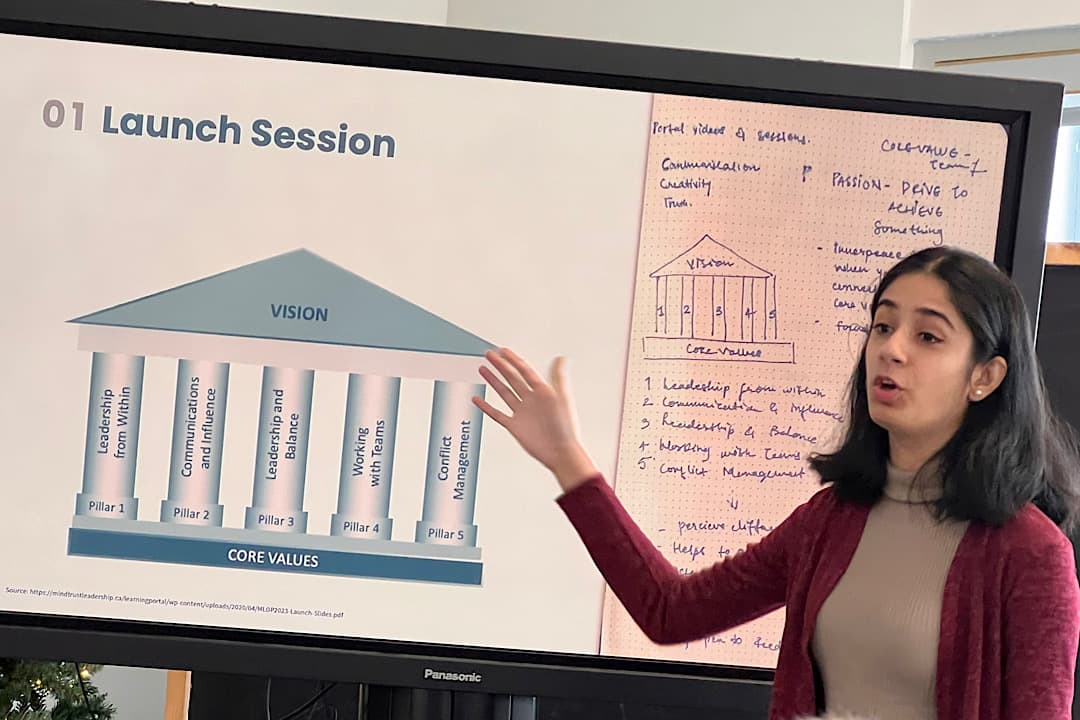
Algonquin College students and professors gathered for a presentation about the Mindtrust Leadership Development Program (MLDP) at the AC Hub on Dec. 1. Founded in 2001, Mindtrust is a charity […]
Photo: William Bailey
“Learning about leadership is a great way to get involved with the community and help grow self-confidence," said Miti Akhani, a student in the Mindtrust Leadership Development Program’s 2023 session.

Algonquin College students and professors gathered for a presentation about the Mindtrust Leadership Development Program (MLDP) at the AC Hub on Dec. 1.

Founded in 2001, Mindtrust is a charity that is focused on providing youth leadership development programs. With other programs run by Mindtrust, such as the Youth Leadership Program and the Mentorship Program, the MLDP dives into the basics of what it truly means to be a leader.

“The program itself is a hybrid program, with seven modules total,” said Matthew Haw, Mindtrust’s director of programs and technology.

“Modules one, four and seven will be delivered in person, at the University of Ottawa, Carlton University and Bayview Yards respectively. The other four modules will be delivered through Zoom. As long as you have some interest in leadership, this program is for you.”

The first module is a launch session, where students learn about the characteristics of a leader.

Module two dissects this further by teaching what makes a great leader.

The third module focuses on communication and how can one’s influence lead others.

Module four is all about team collaboration and how to work effectively in groups.

The fifth module teaches about balanced leadership and how to maintain a work/life balance.

Module six consists of learning how to use leadership skills to manage conflict.

In the final module, students present leadership statements to the class, stating what being a leader means to them.

Although the MLDP stresses attendance and active participation, one’s success of this course is not determined through evaluations or letter grades, but through feedback.

“It is important to realize that this is not management, this is leadership,” said Jason Abt, Mindtrust’s director of funding.

“In management, you’re a line manager and people are reporting to you from an organizational standpoint. The MLDP has nothing to do with that. This is about helping a group of people trying to achieve some kind of common goal. Whether you’re a designated line manager of an organization or not, it makes no difference at all. But through our lives, we have the opportunity to help people around us and that’s by showing leadership in our professional or personal lives. Every leader can be a manager, but not every manager is a leader.”

Miti Akhani, a student in the MLDP’s 2023 session, believes anyone who signs up will be in for a life-changing experience.

“Anyone can become a leader,” she said.

“Learning about leadership is a great way to get involved with the community and help grow self-confidence. Being in this program has helped me break boundaries and be more vocal than ever before. It’s tiny changes like this that can really make you feel better about yourself.”

Thirty spots are available for Algonquin College students to sign up for the 2024 session, but you must be within six months of graduating to be eligible. The first module will be covered at the University of Ottawa on Jan. 19.

Students look ahead to holiday events on campus and surrounding city

With the fall semester wrapping up and the holiday season upon us, students are looking for fun activities to take part in and enjoy the most wonderful time of the […]

With the fall semester wrapping up and the holiday season upon us, students are looking for fun activities to take part in and enjoy the most wonderful time of the year.

“I was a fan of Christmas as a child, but now that I am older, I mostly enjoy the family time,” says Shelby Johnston, an early childhood education student. “My family enjoys participating in fun events like going to see Christmas lights or watching Christmas movies together.”

While many students are excited to wrap up the fall semester and spend time with their loved ones, some won’t be able to do that until well into December.

“I am living away from my family to go to school here in Ottawa and I am missing the tree decorating, the baking and everything while I am here at school,” says Stephanie Pedneault, a hairstyling student. “Being away from family is always tricky this time of year so I am always looking for something festive to do.”

For students who enjoy the holiday season and are looking for ways to relieve stress while enjoying this time of year, there are options.

Here are three things you can do on or near campus this holiday season.

Annual Christmas Tree Lighting

The AC Hub and the Students’ Association have organized the 12th Annual Christmas Tree Lighting event that will take place on Dec. 4 in the Algonquin College Student Commons. The event will be held from 3 p.m. to 6 p.m. and will include activities like festive face painting, a gingerbread house-making contest, stories and photos with Santa, hot chocolate, cookies and music.

“I like that the SA is creating events like this for us,” says Matthew Baker, a business student. “Who doesn’t want to watch a giant tree being lit? Events like that start the holiday season off right.”

The Nutcracker

The Algonquin Commons Theatre and Trio Danceworkers present the Nutcracker Ballet on Dec. 9 and Dec. 10. The story follows a young girl, Clara, as she falls asleep at a Christmas party and dreams that her Nutcracker doll comes to life to defend her from an army of rats.

“All our ballet students over the age six have the opportunity to perform. Our students appreciate the opportunity to participate in a professional-quality full-length ballet, and an opportunity not available at other ballet studios,” says the Trio Danceworkers website.

Ottawa Christmas Market

The Christmas Market is back in Ottawa and there are a ton of things you can do at Landsdowne Park this holiday season. The market runs from Nov. 24 to Dec. 31 and will hold many different exciting events, like performances from local stars, pictures with Santa and shopping at more than 45 vendors.

Students’ Association helps wrap up the term with Food Cupboard fundraiser

The Students’ Association offered a gift wrapping station at the Holiday Market in the Student Commons on Nov. 29 to raise money for the campus Food Cupboard. “This year we […]
Photo: Guillaume Laflamme
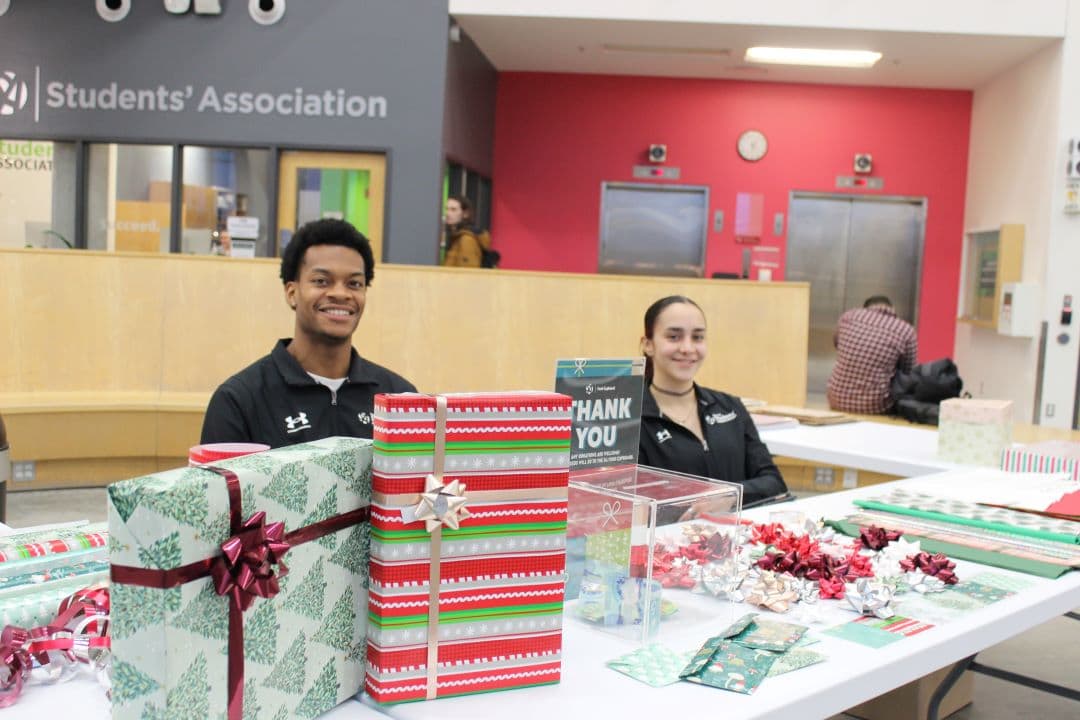
Matteo Mongroo and Veronica Sanchez offer gift wrapping services in exchange for donations to the campus Food Cupboard during the Holiday Market.

The Students’ Association offered a gift wrapping station at the Holiday Market in the Student Commons on Nov. 29 to raise money for the campus Food Cupboard.

“This year we hosted our second annual Holiday Market and had the idea to set up a gift wrapping station alongside the event,” said Amanda Logan, events programmer for the Students’ Association, in an email. “The holiday season is also a giving season, therefore we thought this was the perfect opportunity to collect donations for our Food Cupboard.”

The new initiative came as a surprise for many students who were caught off guard by the offering from the Students’ Association.
The new initiative came as a surprise for many students who were caught off guard by the offering from the Students’ Association. Photo credit: Guillaume Laflamme

The gift wrapping station offered a fun way for people to donate canned goods, as well as clothing items and monetary donations in exchange for having their presents wrapped.

“It’s a gift wrapping drive so students, faculty or anybody can come and make a donation to the Food Cupboard, either a monetary donation, a clothing item or a food item,” said Matteo Mongroo, an events assistant for the Students’ Association and a student of the commerce marketing bachelor’s program.

The new initiative came as a surprise for many students.

“It’s been busy so far. A lot of students that came today didn’t know that this was going on, so they didn’t have anything to donate. Like for example, not a lot of people carry cash. If we were doing debit or credit people would be able to donate,” said Mongroo.

Eventually, anyone could get a gift wrapped without making a donation.

“We kinda switched it now so anyone who wants to can come by and just get (presents) wrapped,” said Mongroo.

Veronica Sanchez, event assistant for the SA, was excited about the opportunity to help wrap gifts for students.

“I love it, I think it’s very useful,” said Sanchez. “I think most people struggle with wrapping presents for Christmas, or it’s the annoying part of giving a present. Maybe you don’t know how to wrap it correctly, so having somebody who has an idea, is very helpful.”

The Students’ Association was happy about how the event unrolled and are looking at the possibility of holding gift wrapping drives in the future. “Overall, we are quite happy with how the gift-wrapping station went. We won’t have another this year, but we will consider bringing it back for next year!” said Logan
“Overall, we are quite happy with how the gift-wrapping station went. We won’t have another this year, but we will consider bringing it back for next year!” said Amanda Logan, events programmer for the Students’ Association Photo credit: Guillaume Laflamme

“Also it’s for free and it’s for a good cause, which is the Food Cupboard. We’re really happy to help the Food Cupboard and the students at the same time,” she added

“Honestly it’s great,” said Mongroo. “Like me personally, when I used to wrap gifts I was terrible at wrapping. I would shove it all together and put them under the tree. So there are people that are still like that out there. So it’s kind of a great opportunity for them to get their gifts wrapped almost professionally I would say, while still supporting a good cause right? So it’s like a win-win situation.”

“Overall, we are quite happy with how the gift-wrapping station went. We won’t have another this year, but we will consider bringing it back for next year,” said Logan.

Career workshop offers communication advice for job searches

The Algonquin College community left a professional communication workshop with clarity on what to do and what not to do during the job search process. In a virtual workshop hosted […]
Photo: William Bailey
“Being able to communicate verbally, while also skillfully interpreting nonverbal signals will help you become a more efficient communicator in the workplace,” said Katherine Yamamoto, a career advisor for the Algonquin College Co-op and Career Centre.

The Algonquin College community left a professional communication workshop with clarity on what to do and what not to do during the job search process.

In a virtual workshop hosted by AC Co-op and Career Centre on Nov. 30, a handful of proper communication methods were discussed. From identifying the factors that make good communication to the importance of phone call etiquette and the dos and don’ts during an interview.

But what do you gain from communicating professionally while looking for a job?

“Communication is important, not just for a job, but in every part of life,” said Mira Zaatari, holder of a bachelor’s degree in medical laboratory sciences and a master’s degree in business administration.

“Good communication portrays that an individual has good people skills, and that’s an asset for anyone who is looking to hire you.”

Effective communication is important to gain interest from employers. Any form of efficient verbal communication, whether it’s spoken or written, are key skills that you should be good at to obtain most jobs, workshop participants heard.

But non-verbal communication is often underestimated.

“Being able to communicate verbally, while also skillfully interpreting non-verbal signals, will help you become a more efficient communicator in the workplace,” said Katherine Yamamoto, a career advisor for the Co-op and Career Centre.

“Not being aware of things like tone of voice, posture, facial expressions or body language can negatively affect the whole energy of a conversation when talking to an employer.”

Phone call and voicemail etiquette were also discussed, with a particular focus on why it’s important to speak slowly and clearly to the person on the other line.

Especially when it comes to voicemails, always know what you want to say with no details left behind.

“I’ve received many voicemails from people who just state their name and leave the number for me to call back,” Yamamoto said.

“With so little information, I have no idea why they are calling. In that situation, I’m not the type of person who’s inclined to return those calls.”

The workshop concluded with the interview process, highlighted by what is and isn’t appropriate to ask during an interview.

“Asking about what skills make somebody successful at this job, what a typical day on the job looks like, or what advice can the interviewer give to help the interviewee prepare for the job are all questions that show the employer your determination to be the next hire at your desired job,” said Leah Grimes, the intercultural programming support officer with the International Education Centre.

“However, if you are going to ask about the job’s pay, the amount of vacation weeks you would get or if you can apply for other jobs once you start working there, you’re insinuating that you aren’t that interested in the position you applied for.”

For further assistance on how to write resumes, cover letters or any other career planning resources, you can book virtual or in-person appointments with the AC Co-op and Career Centre. Office hours are Monday to Friday between 8 a.m. and 4 p.m. in room C226.

Students learn how to prepare for wintertime in Ottawa at Adulting 101

As the snow began to swirl outside, the AC Hub filled with students eager to learn about winter weather in Canada with an event called Adulting 101. Every month, an […]
Photo: Rebekah Houter
Elizabeth Pena-Fernández talks with students about Seasonal Affective Disorder or SAD during Adulting 101 at the AC Hub.

As the snow began to swirl outside, the AC Hub filled with students eager to learn about winter weather in Canada with an event called Adulting 101.

Every month, an event put on by the campus safety team teaches students how to live life as grown-ups, with the month of November spent learning about SAD, or Seasonal Affective Disorder, and other winter-related topics.

On Nov. 27, health psychologist and health promotion and education co-ordinator Elizabeth Pena-Fernández talked with students about the importance of taking care of yourself to prevent the winter blues.

“It is very important to take good care of your physical health but also your mental health as well,” said Pena-Fernández, who moved from Mexico to Ottawa two years ago and had plenty of advice for international students new to the ice and cold.

“Don’t be scared, don’t be afraid of winter, just embrace it,” said Pena-Fernández. “Dress properly for winter that is the key part and then enjoy it because you can find lots of activities and just have tons of fun during winter.”

Topics covered during the event included taking care of yourself with winter colds, overall wellness and the importance of fitness and eating well. All the advice was given with practical tips and resources.

Students also went home with a hug in a mug. The gift came with a winter-themed mug, a toque, a tea and hot chocolate packet, cough drops and resource pamphlets for winter wellness for international students and what to do for a sore throat.

International student Sahib Vilkhu from India said the coldest weather he had experienced before coming to Canada was 8 C.

“I was expecting it to be more on seasonal affective disorder and while she covered that, she also covered most of everything I need to know about winter,” said Vilkhu, who is looking forward to trying outdoor ice skating for the first time.

Marketing student Meghan Kennedy says the hardest part of adulting is the adjustment from high school to being out on your own and these events help with the transition.

“I think the hardest part is they just don’t prepare you in school and then you get to the part of adulting” and that’s when the trouble starts, said Kennedy. “And then that’s where things like seasonal depression come in.”

More Adulting 101 events are planned for every month. The next event was scheduled for December about financial aid.

“Adulting 101 is a series we started planning in about August to start up in October. The whole point is to find guest speakers who are at the college to speak to expertise based on the student life cycle,” said Raivyn Halcro, the event co-ordinator.

“There are valleys and mountains that students experience, and we just want to address main concerns through the various themes each month.”

College, authors ‘walking together’ to educate students about appreciating nature

Students and professors gathered in Nawapon this fall to hear Elder Albert Marshall and Louise Zimanyi discuss their book, Walking Together. Marshall, who’s from the Moose Clan of the Mi’kmaw […]
Photo: Supplied by Louise Zimanyi
Elder Albert Marshall and Louise Zimanyi pose for a photo.

Students and professors gathered in Nawapon this fall to hear Elder Albert Marshall and Louise Zimanyi discuss their book, Walking Together.

Marshall, who’s from the Moose Clan of the Mi’kmaw Nation, talked to the students through a Zoom call and Zimanyi, who was present in the room, educated the students about the book and the importance of appreciating nature during the Sept. 23 event.

Students and professors sat in a circle reading different lines of the book.

Students were also given the option to pick out little stuffed animals that visually represented ancestors of the Indigenous people, with their own special sounds because there were many animal illustrations presented in the book. They were all taught the importance and meaning of each animal along with other illustrations like the rock, water and many more.

Zimanyi is a French-Canadian and an early childhood education professor at Humber College in Toronto.

She explained that the book is mainly for preschoolers, but it’s also used with early childhood education students, high schoolers and elementary students. The purpose was to explain what “two-eyed seeing” meant by being together and appreciating nature.

The book contains some Mi’kmaw words. Zimanyi explained she would have loved to include a lot more, but starting with keywords was more important.

Emily Poldem, an Algonquin College student in the bachelor of early learning community development, said her program has a nature-based course that aligns with the book. Poldem said it was a great way to know the book more intimately.

“Indigenous teaching and nature-based learning has been growing especially at Algonquin College, and so having the opportunity to learn a little bit more about the people who are experts on it, is a great opportunity,” said Poldem.

Kerry Potts, an indigenous pedagogy and curriculum consultant at Algonquin College, was also one of the organizers for the book event. She said her job is to support teachers at the college, bring Indigenous people to the college and support Indigenous education in a broader sense at the college.

“I think the impact could be that our early childhood educators could start thinking about the principle of two-eyed seeing and respecting the land and starting these programs that are land-based programs here at Algonquin College,” Potts said.

Zimanyi believes this book should be integrated into the courses of the early childhood program, as she is an advocate for land-based courses.

“If you are going to be connected to the land, you should be learning the languages of the Indigenous communities that you are with,” said Zimanyi.

Half Moon Run comes full circle, wraps up world tour with two sold-out shows at ACT

Montreal’s Half Moon Run made a winning return to Ottawa with a pair of sold-out shows at Algonquin Commons Theatre on Nov. 25 and Nov. 26. It was the final […]
Photo: Kerry Slack
Devon Portielje and Half Moon Run light up the stage at the ACT in back-to-back sold-out shows Nov. 25 and Nov. 26

Montreal’s Half Moon Run made a winning return to Ottawa with a pair of sold-out shows at Algonquin Commons Theatre on Nov. 25 and Nov. 26.

It was the final stop of their 2023 world tour, which kicked off in England on Sept. 9.

The ACT was filled with all ages of fans, family and friends.

This was Ottawa native and frontman Devon Portielje’s homecoming show.

The whole vibe of the show was intimate and friendly. Friends swayed, sang and danced with very few phones in sight.

Billie Marten opened the night with a solo set, her debut in Ottawa.

A soft voice full of authenticity in her songs and banter in between, Marten recalled times working in pubs in London while she grew as a songwriter.

Sipping her whiskey, Marten asked, “Anybody Irish? I’m not,” she joked with the crowd. “Whisky is medicinal.”

Billie Marten warms up the ACT crowd with her easeful tone.
Billie Marten warms up the ACT crowd with her easeful tone. Photo credit: Kerry Slack

The intermission brought happy concertgoers to the bar.

“The first act was awesome, but we can’t wait for Half Moon Run to start,” said Tara Lerer.

“Half Moon Run is why we came here but we’re leaving the opening act happy.

We’re ready to hear our group now,” said Vicky McNeil (R) with her friend Tara Lerer (L)
“Half Moon Run is why we came here but we’re leaving the opening act happy. We’re ready to hear our group now,” said Vicky McNeil (right) with her friend Tara Lerer (left) Photo credit: Kerry Slack

“Half Moon Run is why we came here but we’re leaving the opening act happy. We’re ready to hear our group now,” said Vicky McNeil before scurrying back to their seats.

Half Moon Run solidified the warm, community feeling by dedicating Heartbeat to a pair of local friends who the band lost this past summer as well as another dedication to Portielje’s adorable nephew sitting in the audience.

Devon Portielje and Half Moon Run light up the stage at the ACT in back-to back sold out shows Nov. 25 and Nov. 26
Devon Portielje and Half Moon Run light up the stage at the ACT in back-to back sold out shows Nov. 25 and Nov. 26 Photo credit: Kerry Slack

Being a smaller venue, ACT provided the setting for a much more intimate concert than previous concerts at Bluesfest and TD Place.

Sheila Clark agreed. She is the manager of sponsorship development with Bluesfest and City Folk Festivals and an alumna of the business administration program.

“They always put on a good show,” said Clark. “Remember the rain when they played last year at Bluesfest? They waited it out and put on a great show anyhow.”

The coziness of the ACT wrapped the crowd in a sense of familiarity and a snug sentiment to accompany Half Moon Run’s reflective songs, which had the crowd swaying and singing every word.

Their harmonies were just as perfectly fused, and with the support of their string quartet, was fitting their sincere acoustic numbers and their upbeat songs.

There were instrument switches mid-song, often multiple times. Portielje alone played acoustic and electric guitars, mandolin, drum, cymbal, maracas and, at one point, even played piano with the head of his guitar.

Just as skilled, Conner Molander spent most of the show between acoustic and electric guitars, bass, keyboards and a quick stint on the drums, plus some harmonica.

Conner Molander and Half Moon Run light up the stage at the ACT in back-to back sold out shows Nov. 25 and Nov. 26
Conner Molander and Half Moon Run light up the stage at the ACT in back-to back sold out shows Nov. 25 and Nov. 26 Photo credit: Kerry Slack

Dylan Phillips stayed behind the modified drum kit that included its own keyboard for most of the set but came out front to join his bandmates for an acoustic rendition of Devil May Care.

Having played most of their hits already, the band launched their encore with the help of opener Billie Marten for an incredible cover of Fleetwood Mac’s Dreams before closing the show with Need It, Favourite Boy and the hit that launched it all, Full Circle.

“I’ve been following Half Moon Run for about seven or eight years. They’re different, so good live and local,” said Lauren Laroque.

“I’d never heard of the opener, Billie Marten, but I’ll be searching her on Spotify or YouTube. Playlist adds, for sure,” said Laroque.

Staying after the show to talk to new fans, Marten shared one of her secrets of being at ease on stage.

“If I’m relaxed the crowd is relaxed, so for me, it’s to stay in that frame of mind. It makes the whole show better,” said Marten.

Staying after the show to talk to new fans, Billie Marten shares one of her secrets of being at ease on stage.

“If I’m relaxed, the crowd is relaxed, so for me, it's best to stay in that frame of mind. It makes the whole show better.”
Staying after the show to talk to new fans, Billie Marten shares one of her secrets of being at ease on stage.

“If I’m relaxed, the crowd is relaxed, so for me, it's best to stay in that frame of mind. It makes the whole show better.” Photo credit: Kerry Slack

Marten’s relaxed demeanour set the tone for an unforgettable performance from her and Half Moon Run, and perhaps it hints at the incredible lineup and experiences awaiting Ottawa at Bluesfest this summer.

Algonquin Times podcast

Stay Informed

Sign up for our newsletter

Subscribe

* indicates required