main

‘Entertainment royalty’ shares super slimy history with scriptwriting students

Combining quirky set design, colourful anarchy and gallons of raining green goop for nearly every episode of the ’80s show, You Can’t Do That on Television has been certified as […]
Photo: Alex Lambert
Abby Hagyard chats with scriptwriting students.

Combining quirky set design, colourful anarchy and gallons of raining green goop for nearly every episode of the ’80s show, You Can’t Do That on Television has been certified as a cult classic.

When CJOH Ottawa debuted the show nearly 45 years ago, it wasn’t a sure-fire success. But two years later in the hands of Nickelodeon, it would grow to become an international sensation.

During a youth programming presentation by scriptwriting student Anna-Lisa Karhinen, her professor, Rick Kaulbars, seized the opportunity to reconnect with Abby Hagyard, who played the mom from the show.

Having previously worked together on the renowned comic For Better or For Worse, Kaulbars, feeling nostalgic, invited Hagyard to speak to his class. To their delight, she agreed to the visit.

On Nov 16., the class gathered for a speech about the highs and lows of show business from entertainment royalty herself. Kaulbars introduced Hagyard affectionately as “one of the cherished bad pennies you’ll see when you’re working in the business.”

Roger Price cast Hagyard in 1982 alongside one other adult, Les Lye, to portray the hapless parents ruling the children’s lives on the show.

The primetime show defied television norms with slime blasts, pie slaps, viewer calls, skits and more, before producers cut their hour on the air in half.

The sole rule of the show: no overarching plot, just unrestrained chaos.

Since its introduction in Ottawa, “being slimed” became synonymous with Nickelodeon. Embracing the slime for nearly four decades, they feature it in their annual Kids’ Choice Awards. The beautiful relationship even merited a slime geyser at their Universal Studios location in Florida.

Officially launched in 1979, Nickelodeon had been producing shows that parents wanted, but they weren’t appealing to kids. Initially, they were a tiny cable network with two shows.

Their transition to a pay-per-view channel marked a turning point, and You Can’t Do That On Television is closely tied to their early success. It went on to be syndicated in 53 countries and it was the channel’s highest rated show at the time.

They were then sub-licensed to the U.S. Armed Forces, meaning every United States military base was subject to rambunctious fun twice a day for seven days a week. It aired on one of the two channels and, Hagyard explained, when the kids came home from overseas, they were “addicted to us.”

Hagyard is no stranger to the military life having lived a portable childhood. It started with her Air Force family routinely packing up and leaving to faraway places. She remembered coming home to moving boxes and suddenly her school play would need a replacement. Often moving meant a new school, culture or even different languages. Occasionally it meant people drove on the wrong side of the road.

“The interesting thing about being a military kid is it’s remarkably similar to show business, because you never have the faintest idea how long your series will last,” Hagyard said.

Embracing a nomadic lifestyle, she started out acting and modelling on Miami Beach. But, like any respected actor, her career had less glamorous moments of uncertainty.

Despite being a local celebrity, having dined with Pierre Trudeau, her only option for work at the time was a delivering balloons for eight bucks a gig. Renowned yet humble, she’ll never forget waiting in a closet at Tunney’s Pasture to surprise a man with balloons on his birthday, clad in clown-wear.

And then, fellow actor Christine McGlade mentioned a golden opportunity when she least expected it. Initially the idea of acting with kids instead of for them filled her with a sense of reluctance. But that was before hearing the salary.

“Suffer the children. Where do I sign?”

Hagyard traipsed into uncharted territory with her own costume and, shocker, she fit right in. The one part that made it easier was the show using all of the kid’s real names so it felt authentic.

“It was improv in the way they were invited to respond spontaneously. So, knowing that was the premise, we invited anybody that was interested all through Ottawa to submit a script,” she explained.

Featuring a new topic with each episode, the show served as a criticism of society and its impact on the lives of adolescence. Addressing a kid’s mundane existential issues, the notorious slime was a symbol for life spilling down on them.

Between taping after school and on weekends, Hagyard voice acted for various cartoons like The Adventures of Teddy Ruxpin, Dennis the Menace and The Care Bears.

Ottawa’s own Alanis Morrisette was even a part of the cast in 1986, appearing on five episodes when she was in junior high school.

Due to licensing issues, less than half of the 144 total episodes are available in broadcast quality and there may never be a full release of the series, leaving fans to speculate about a reboot.

Hagyard’s latest project is Pivotry in Motion, a personal excellence mentorship program. At the end of the talk, she handed out posters and forms so students could volunteer to work with her in the future.

One scriptwriting student, Logan Indewey, felt it was the opportunity of a lifetime. “I was starstruck,” he said. “I didn’t know how decorated she was.”

Coffee break connects students over games and snacks as exams approach

As the fall semester drew to a close and exams quickly approached, an event on Nov. 30 enabled students to meet new people and take a break. The international coffee […]
Photo: Zaynab Safa
Students gather at a table during the coffee break event to play games while enjoying snacks and coffee.

As the fall semester drew to a close and exams quickly approached, an event on Nov. 30 enabled students to meet new people and take a break.

The international coffee break saw international students and domestic students to get together over a warm coffee and snacks with some of the members of the International Education Centre.

“The coffee break event is something we do biweekly on Thursdays and we invite international students and domestic students to come and enjoy some free coffee, get some popcorn and it’s just an opportunity for them to just put down their studies for an hour, chat with some like-minded people, connect with some maybe new friends,” said Leah Grimes, intercultural programming support officer with the International Education Centre.

“It’s a coffee break! You meet new people around you, get to know others and meet your friends who you usually cannot find time for in day-to-day life, we have popcorn and coffee and we play games like UNO, Jenga and more,” said Sahil Sharma, a second-level student in project management.

It’s always enjoyable to socialize while sipping a nice cup of coffee, and taking a break is usually beneficial—especially when free snacks and coffee are included.

“These events are weekly, it’s a chance to meet others from around the world and it’s important for students to meet others and to learn other cultures and we can also have a good time, help relieve stress at the same time. It also helps us find answers about our concerns and questions related with our program or the college,” said Yerda Kimiksiz, a postgraduate student in the project management program.

Holiday Crossword

Unwrap the joy of the season with our festive holiday crossword puzzle! 🎄✨ Print it Answers

Unwrap the joy of the season with our festive holiday crossword puzzle! 🎄✨

Print it

Answers

Winter months bring holiday warmthย 

As we approach the winter semester, I extend warm wishes to each of you during this well-deserved break. The upcoming holiday season provides an opportunity to step back from the […]

As we approach the winter semester, I extend warm wishes to each of you during this well-deserved break. The upcoming holiday season provides an opportunity to step back from the demands of college life, connect with friends and family and indulge in some rejuvenating downtime. I encourage each of you to savour this time, reflect on your accomplishments over the past months, and recharge for the challenges and opportunities that Winter 2024 will bring.  

To those of you who completed your studies in Fall 2023, I would like to offer my heartfelt congratulations. The entire Algonquin College community is proud of your success and we all look forward to seeing what you do next. 

Looking ahead, the College remains committed to delivering an exceptional learner-centred experience. Our commitment to personalized education is aimed at meeting the unique needs of every learner and I am grateful to have you on this journey with us. 

A key part of being a learner-drive institution is recognizing the challenges our student community face and taking steps to assist wherever we can. I want to draw your attention to the various avenues of financial aid available. A number of bursaries are available for the Winter 2024 semester, with applications open from Dec. 19 to Jan. 23. The College also offers a wide range of scholarships, the Algonquin Studentsโ€™ Association Food Cupboard, part-time employment options for learners and more.  

Additionally, Campus Services is hosting a holiday book buyback that will last until Jan. 19, an initiative that will give learners the chance to sell select used textbooks for up to 50 per cent of the current price. These books will then be available at significant discount through Connections, giving learners a more affordable option to support their studies.  

As we look forward to times of rest and good cheer, let us also be mindful of the need for togetherness and understanding, especially in challenging times globally. It is these periods of unrest and conflict that make it all the more important for us to support one another, offer a kind word and share in the joys of the season together.  

These times also highlight the incredible compassion and generosity of Algonquin College learners who go to great lengths to support those around them. I was deeply moved when I attended the Community and Justice Services programโ€™s 24 Hours of Homelessness fundraising event a few weeks ago, where learners took to the streets to raise funds and awareness for the cityโ€™s homeless population. This important event saw learners sacrifice time, energy and comfort to help those who needed it most.  Your commitment to supporting those in need is truly inspiring. 

This is also a time to recognize that this festive season does not necessarily bring joy to everyone, and that melancholy and anxiety are common during the holiday season. We should all take the time to ensure everyone in our community feels a sense of belonging, compassion and companionship in the coming weeks. To anyone struggling, please remember that the College has resources available to you, including counselling services, spiritual support, academic distress counsel and peer support options.  

I hope that every member of the Algonquin College community finds moments of relaxation, joy and peace over the holiday season. Take this time to set stress aside and focus on what matters the most to you. Despite the winter chill, may you find warmth in the company of friends and family. I wish you and your loved ones the happiest possible holiday season, and I look forward to seeing you all in the new year! 

Mid-Week Memes

Take a break from the stress of the week and enjoy these silly memes!

Take a break from the stress of the week and enjoy these silly memes!

First Person: Change can be hard, but it’s necessary for a well-lived life

“Next in line please.” Fully encapsulated in a medical protection suit, the immigration officer still managed to welcome me with a genuine smile, visible through her eyes. “Eyes don’t lie,” […]
Photo: Guillaume Laflamme
Studying in Canada has lead me to unexpected places and instilled in me the value of embracing changes.

“Next in line please.”

Fully encapsulated in a medical protection suit, the immigration officer still managed to welcome me with a genuine smile, visible through her eyes.

“Eyes don’t lie,” I remembered my grandma telling me.

I wished she was there with me, telling me I was doing great, just like she always did.

It was a Thursday, Aug. 12, 2021, and just like any other Thursday during the pandemic, people at the Halifax airport where I’d just landed all seemed terrified.

It was also the Thursday where I boarded a one-way flight for the first time.

Apart from the exhaustion caused by over a 30-hour flight between Shanghai and Halifax, my heart was filled with excitement.

Growing up in China, I always hated our education system. It was tedious, strict and “sucks your soul out of your body,” as my friends put it. I’ve finally had enough of it coming out of high school, and I told my parents I wanted to study abroad.

“Go study computer science then,” they told me. “It’s the future.”

Despite never being interested in mathematics, 18-year-old-me would do anything just to escape the country’s education system.

So, 18-year-old me, boarded the flight to Halifax to study computer science at Dalhousie University, with little regret.

Little did I know that this journey would lead me to unexpected places and instill in me the value of embracing changes.

I wasn’t lying about not liking math. Although I can speak four languages fluently, programming languages and algorithms were definitely not something I was able to grasp.

“Sometimes I wish all the stereotypes were real and I could be master in math,” I thought to myself.

For countless nights I wanted to just pack my stuff and head back home. Then I would feel guilty wasting the tuition money, and I was too afraid to just tell everyone I know that I just decided to drop out.

Finally, two months in Halifax, one night, I called my grandma and told her I was struggling with school.

“You were brave enough to leave the country, why stick to something you don’t like?” she said. “Even if you managed to graduate, do you really want to do a job that you hate for the rest of your life?”

“Take a deep breath, you’re doing great.”

Looking back from now, those words changed the course of my life.

I’d always been interested in journalism when I was a kid, going to different places to report on breaking news seems like such great adventures to me.

One night at waterfront in Halifax, I decided that journalism was the right choice for me. So on Aug. 14th, 2022, I boarded a one-way flight, for the second time, to the country’s capital.

I’m not alone in having made a big life-changing program switch. While I was working on this story, an old friend I made when I first came to Canada came to my head.

Ruslan Barshpol, dropped out of his linguistics program back in Ukraine and came to Canada to pursue his studies in forestry.

“You don’t decide to make changes in your life because it is the easy thing to do,” he told me over the phone. “You do it because it is the necessary thing, life is too short and no one deserves to be stuck with something they hate for their entire life.”

For me, transition into new program wasn’t easy. Yet with each journalistic assignment, I felt a renewed sense of fulfillment. The initial “life decision” I made moving to Halifax was merely a stepping stone, a detour that eventually led me to explore my true passions.

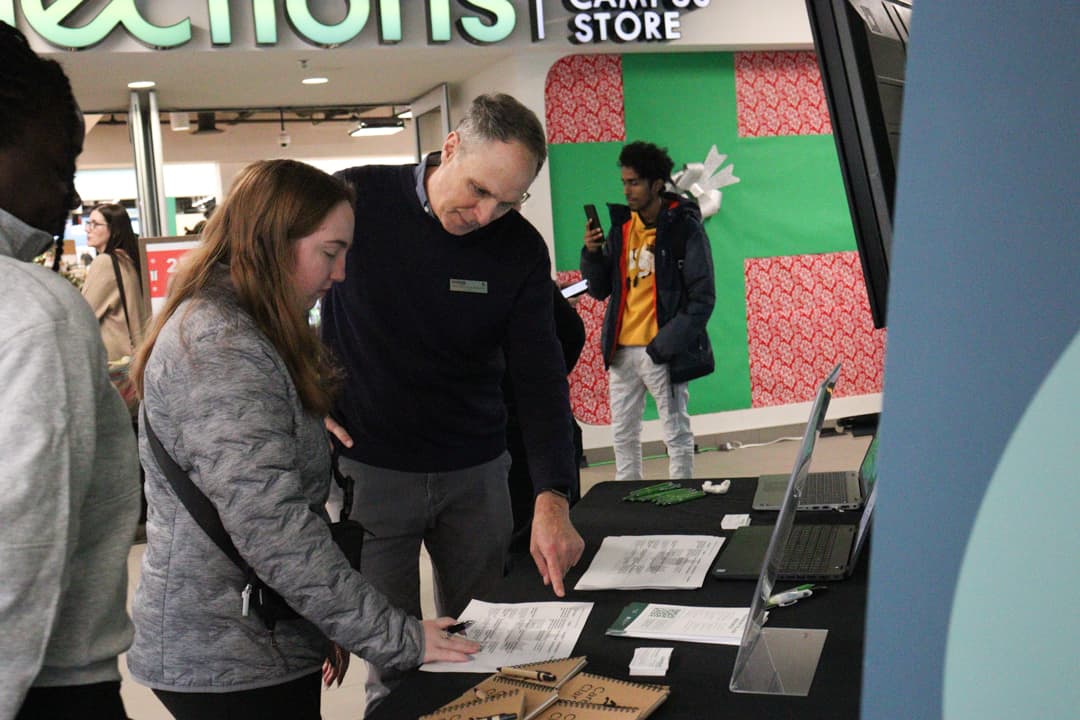
Students encouraged to plan post-graduation life through career counselling

November was recognized as global “career month,” with schools holding events to highlight the initiative. At Algonquin College, Counselling Services helped students choose small, doable steps that will add up […]
Photo: Zaynab Safa
David Glickman, a counsellor, guides a student step by step during a "career month" event.

November was recognized as global “career month,” with schools holding events to highlight the initiative.

At Algonquin College, Counselling Services helped students choose small, doable steps that will add up to a significant impact on putting them on the correct career path in the future.

Counselling Services encourages students to participate in their top career priority activity.

“What we hope to do is to raise awareness about steps that people can take to move towards their career, so to get people ideas and suggestions and then they can choose from a menu of options and then walk away with a plan,” said David Glickman, a career and academic counsellor.

According to statistics by the careers exploration website AllAboutCareers.com, 44 per cent of undergrads are unable to identify the industry they would like to work in after graduating.

“We want students to walk away with some ideas and action steps that they can take, because a lot of students wait until graduation to come up with a plan and so there’s a lot of things that you can do well before you graduate. But we understand the focus on studies and prioritizing finding a job or taking steps while in school but there’s a lot of steps that people can do,” said Glickman.

Peace Lyunade, a volunteer who was helping during a career month event, said students often don’t plan beyond their academic careers.

“It’s career month, and most students don’t really have an idea about what their going to do after graduation and most of the time everyone assumes they know what their going to do, but the thing is, you have to plan ahead and so this initiative is to just let them know where they are at right now and what steps to take and to speak to a career counsellor, it’s just to help know what they are going to do before graduating,” said Lyunade, a computer programming student.

One of Melissa Spears’ specialties is career counseling. Spears said career decision-making and planning are specific to each person. It’s not a one size that fits all.

“November is globally career month and so we are having lots of different activities celebrating just the importance of career development and finding purposeful and meaningful work in the future and so one of our events today is just identifying some quick career priorities some things students and others can do that can help with moving towards their future career,” said Spears, who is a counsellor.

First Person: What happens when your soccer career doesn’t go as planned?

When I was 13 years old, I knew what my passion was. That passion was running as hard as I could and winning the ball to make a pass. Most […]
Photo: Alex Lambert
Everything happens for a reason. Embrace what life has in store for you.

When I was 13 years old, I knew what my passion was. That passion was running as hard as I could and winning the ball to make a pass.

Most people growing up don’t have a clue what they want to be when they got older. But I knew.

From something that just started as a hobby quickly turned into my whole life. Something that I couldn’t go a day without thinking about. When I was working, in school or just doing everyday life activities, soccer would always be on my mind.

When I was 15 years old there was nothing I wanted more than to be a professional soccer player. It was something I manifested to the point where I thought it was inevitable. I trained almost every day from early mornings to late nights to pursue my dream.

However, at 18 years old, reality hit. I was playing for Futuro, which was a very good team in Ottawa. I did my job. I worked harder than anybody and played my best on the pitch. But although I had some college interests, I was not willing to move away because I didn’t want to leave my family and friends. I knew play time would be limited as I would be a new player and it wasn’t something I was willing to sacrifice leaving my loved ones.

So, I made that decision and after that, my life changed. I went from playing something every day to just stopping. Not only did I stop doing what I loved, I had to find another career choice.

I know that other students or people my age have change their goals when they get older but It feels a bit more different when you visualize a blueprint, and the idea doesn’t go as planned. Now, what I have to figure out and others like me, is what to do with uncertainty after have being so focused for so long.

Like me, Matin Ljajic, made the decision to change his goal.

“I got an opportunity to go to Portugal to tryout to play soccer professionally. I played there for two weeks and played very well with my age group,” said Ljajic

“The team really liked the way I played. They invited me back for another two weeks to tryout with the first team. The coaches were telling me how much they wanted me on the team.”

“They offered me a U23 contract which was only 50 euros a month. I didn’t want to take it. I was only going to sign there if it was for the first team because 50 euros a month would not be livable as an 18 year old with no education yet.”

“Now I am uncertain if I will get another opportunity again, I will keep working hard and see what will come from it.”

David Shvartsman also made a choice.

“Soccer here in Canada is very expensive. If you want to be professional, you need to play for the best teams which cost a crazy amount of money,” said Shvartsman.

“I probably had enough to be able to pay that amount, but I just didn’t think it was worth it. I didn’t want to pay that much just for nothing to come from it. I made a choice not to fully pursue it.”

In my case, soccer was my life, I wanted to do something that involved the sport. I took the journalism program at Algonquin College to write about soccer and sports.

This was something I really enjoyed. When I think everything is going right, another roadblock hits. I learnt the difficulty of securing a job with a sustainable salary while writing about sports.

I have a coaching job that I do which I really enjoy. It’s for sure something I can see myself doing for a very long time. There could be ways I can make it a career, but it’s most likely to end up a hobby.

This is where my uncertainty lies. I have opportunities to do jobs that I like but won’t likely make enough financially.

This uncertainty won’t be for long. I will find a way. I always do in the end.

First Person: Fungi can help us or harm us but they’re always fascinating

While stepping over the large roots holding up the Merrickville forest last August, cracking twigs as I walked, I stumbled upon a body. Not human, but once alive all the […]
Photo: Mathew Dicsi
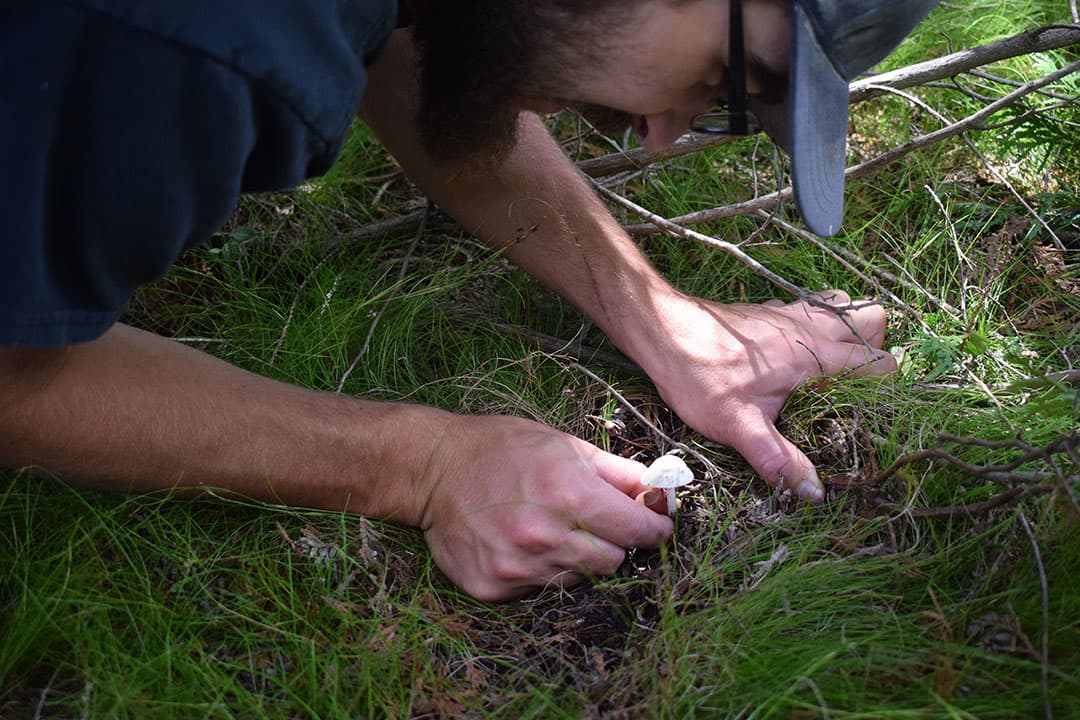
Ottawa-based forager, Gabe Roulston, 19, picks a young meadow mushroom.

While stepping over the large roots holding up the Merrickville forest last August, cracking twigs as I walked, I stumbled upon a body.

Not human, but once alive all the same. A rabbit corpse laid in front of me, its pungent smell yet to be dragged from its bones like the coyotes did to its flesh.

Yet out of this horrid display stemmed a small show of beauty in the form of mushrooms, growing around the body, feeding off its nutrients. Despite the disgusting scent of rot, I couldn’t help but appreciate how beautiful nature’s recyclers are.

I have always been fascinated by fungus, but only fell in love with it ethrough early high school. Originally, mushrooms were this weird, creepy, unlovable plant that I would kick every time I saw them.

The ones around my home, and most kickable, were the Coprinus comatus – otherwise known as the Shaggy ink cap. These mushrooms look like they perpetually shed their skin while getting blacker and blacker the lower down the cap they go. While edible, they begin to decay once picked, and they’ll turn to an odorous black sludge within 10 hours. Seeing this when I was eight years old left me with nightmares for weeks.

What if I turned into sludge too? Would it hurt? Can I still watch my cartoons as sludge?

My creepy feelings around mushrooms were proven valid in recent years with fungus being adopted by the horror medium with shows like The Last of Us and The Blob along with books like What Moves The Dead by T.kingfisher and Mexican Gothic by Silvia Moreno-Garcia.

“There are thousands of mushrooms and millions of fungi, most of which we don’t see,” said Charles Naesmith, an Algonquin College professor who teaches the general elective course Fungus Among Us. “Like an apple tree shows apples, the mushroom is the fruit that fungus decides to show us.”

Some of these mushrooms are downright nasty, like the Hydnellum peckii, otherwise known as a bleeding tooth. A fitting name for this white, porous mushroom loosely resembles a tooth. The only difference is this tooth exudes a blood-like liquid to spread its spores. While we don’t know exactly why this liquid is red, it is speculated the colour helps to attract bugs who then spread their spores even more.

“When people think of fungus, they think of gross and weird,” said Brooke Caicco, an interior design student.

“These are organisms that aren’t interested in our interest of them, they just do what they do,” said Naesmith. “They can harm us, and they can help us, but they are what they are.”

A crop of witches hats sprouting out from the Merrickville Forest
A crop of witches hats sprouting out from the Merrickville Forest. Photo credit: Mathew Dicsi

But the creepiest fungus of all is the Cordyceps.

Most commonly found in ants, Cordyceps will infiltrate the nervous system of an insect before cutting off the brain’s connection to the muscles. Once the creature is immobile, the Cordyceps release chemicals in the brain, taking control of the creatures’ movement and bringing them to an area with perfect humidity and temperature for the Cordyceps to grow.

The creature will be forced to chomp down as hard as possible to lock their body in place before the Cordyceps begins to bloom, sprouting a cream coloured mushroom from the head of its victim, and spreading its spores. Through this entire, excruciating experience, the insect stays alive and conscious, but the Cordyceps stole the wheel.

“You’ve got a fungus that in it’s own evolutionary pathway, alters socialized insects like ants,” said Naesmith. “It doesn’t just kill them, but changes what insects do to the benefit of them.”

If you were thinking Cordyceps would make a great antagonist for a thriller, you’d be right.

With the recent Last of Us television adaptation, Cordyceps have been getting a lot of love. The show takes place in a post–apocalyptic world following a zombie-like infection caused by Cordyceps infecting humans These zombies lose control once infected, as the Cordyceps’ hyphae (roots) burrow their way to the brain from underneath the skin, taking control of the muscles. Once fully infected, the no-longer-human sprouts these greyish orange mushrooms around the head, the same way real Cordyceps would to insects.

“It’s scary real,” said Gabe Roulston, an Ottawa-area forager. “We eat a lot of fungus as humans and the human body is unpredictable. Who’s to say Cordyceps won’t evolve and affect us too.”

The Last of Us–love is far reaching, even hitting Algonquin College in this years Halloween costume contest where first place went to Grace Thompson, an illustration concept student, and her zombie costume including the Cordyceps growing out of her head.

Though some find fear in fungus, others find beauty.

“Seeing fungus makes me imagine a weird world where people could live in it. It’s a whole new world,” said Roulston.

What is strange to some, is safe to others.

“Mushrooms give off a homely vibe,” said Caicco. “The Smurfs had the right idea.”

December Horoscopes

Algonquin Times podcast

Stay Informed

Sign up for our newsletter

Subscribe

* indicates required