Students voice support, frustrations as OPSEU strike continues at Algonquin College
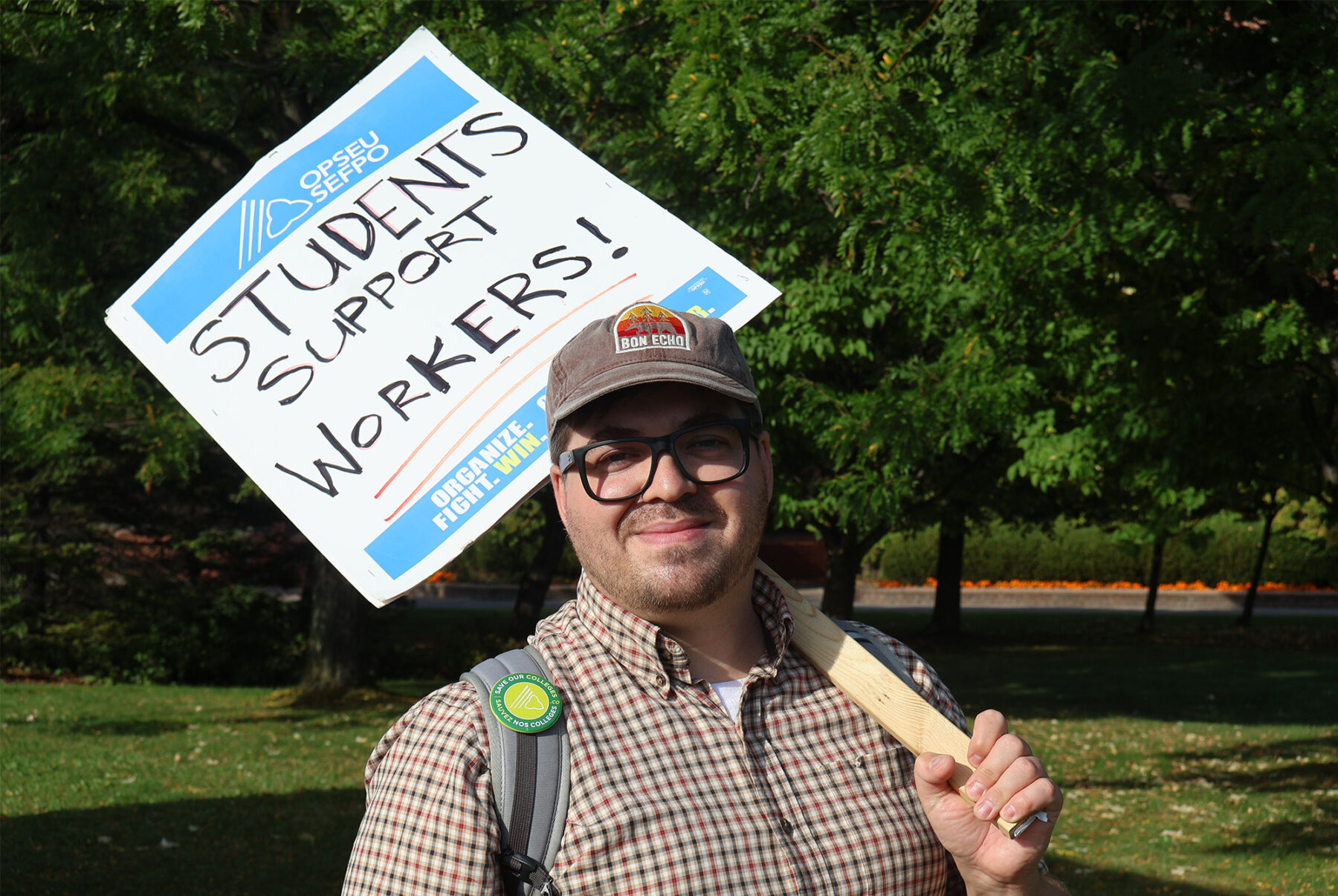
For the past two weeks, when Ashton Starr’s classes have finished before 5 p.m., he has walked out to the campus’ Woodroffe entrance, picked up a sign and joined the picket line.
“I made it myself,” he proudly says, pointing to his picket sign that reads “Student Labour Solidarity.” “Students Support Workers” is written on the other side.
“If I wanted to be punnier,” he says with a chuckle, “I would have written ‘Student Support Workers,’ because that’s the reason why I’m out here.”
A student in the one-year bookkeeping and accounting program, Starr says he plans on seeking employment in administrative work after graduating.
His goal is to work at a college like Algonquin, but he’s disheartened to hear about the recent job cuts across Ontario’s public colleges.
“It means I might not be able to get a job, because there might not be any,” he says.
Now entering its third week, college full-time support staff across Ontario, including at Algonquin College, continue to be on strike.
On Sept. 26, OPSEU and the government returned to the negotiating table “with the assistance of a Ministry-appointed mediator.” However, employees will remain on the picket lines until an agreement can be reached between the two parties.
Advocating for enhanced job security protection, more substantial benefits, a pause to college or campus closures or mergers and an embargo on staff reduction, OPSEU says it’s part of an effort to protect Ontario’s public post-secondary institutions.

While Starr is not part of the union, he says he still feels deeply impacted by the situation.
“If support workers are being replaced, and (colleges) are understaffing workplaces, then when is it going to start happening to the workplaces I work in?”
Starr says support workers deserve to get their voices heard and are trying to raise awareness about their importance.
Indeed, students are becoming aware. After two weeks of reduced services, strain is evident throughout the campus.
Daimon Quaile is a student in the electrical engineering technician program. As someone who drives to school every day, Quaile says he is getting frustrated with driving past the picket lines.
“(Getting to school) can definitely be delayed,” he says. “I wish that they’d let a couple more cars go. Every time, it’s only one car per light.”
Mathis Pivetta, who’s in the computer system technician-networking program, leads the AC Kali Club, a club all about learning ethical hacking.

With services left with a reduced staff for the past two weeks, “booking rooms and tables are severely impacted,” Pivetta says.
Pivetta says part of the Kali Club is also having “a platform with documentation, walkthroughs, tutorials and many other things called the Kali Wiki.”
Run by academic technologists in the T-building, the Kali Wiki was under migration to a new operating system when the strike began. Without them, a key component of their club is currently at a standstill.
Across multiple services around campus, part-time or casual employees are now left with duties normally completed by their full-time colleagues. From the authority to release documents, grant accommodations or approve certain requests, some services just can’t be completed right now.
To supplement non-full-time employees, managers, administration and academic chairs are now also assisting in providing college services, including at Financial Aid and N-building’s Production Services.
Faced with a more personal dilemma, Abby McQuirter, a student in the early childhood education program, says getting her OSAP assistance has been more difficult this semester.
“There were people there to help me, but they couldn’t provide the exact support I’m looking for,” McQuirter says.

McQuirter is sympathetic to the part-time and casual employees, though. “It’s not really their specifications. They’re doing the best they can,” she says.
For Starr, he debated applying for accommodations from the Centre for Accessible Learning, “but I would have had to apply a long time ago, and I probably still would not have received a response.”
Speaking to his friends, he says some are still waiting for access to their Brightspace.
“They’re not getting that (support) because there’s both not enough staff and the staff there aren’t full-time,” Starr says. The growing backlog, he says, does not help either.
Despite their troubles, some students are still supportive of the strike, including McQuirter.
“Everyone has a right to protest,” she says.
Pivetta also continues to back the striking employees.
“Is it annoying? Yes. But I won’t complain, because they should be getting rewarded correctly,” Pivetta says.
However, Quaile says that the union should focus more on explaining to students why they are on strike and why students should care.
“I had to Google what it even was that they were striking for,” he says.
In blocking traffic into the college, “I think it’s partially to annoy people because that puts pressure on the college to take action, but I think people would be a lot more supportive if they knew what this was about and why what’s happening is unjust,” Quaile says.
“I’m not sure if they’re handing out pamphlets, but if they are, it hasn’t reached me yet.”
Still, knowing why the strike is happening, Quaile says he agrees with and supports the employees.
“It’s good that they’re able to do what they’re doing.”