Each session lasts one hour and students engage in English conversations on specific topics.
Zixuan Li
Photos: Zixuan Li
January 30, 2024 Revised: January 30, 2024 11:04am
Photo: Zixuan Li
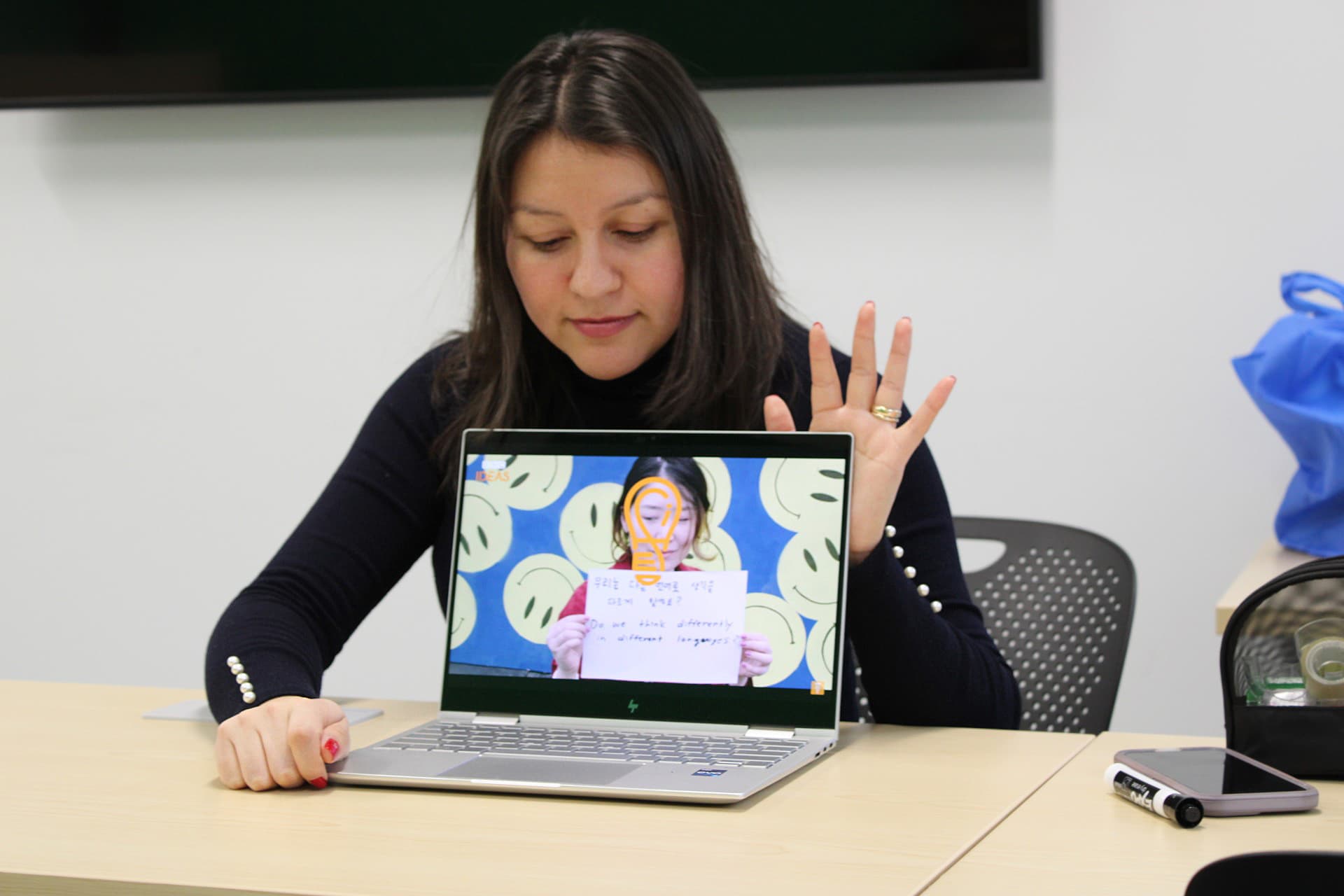
Ana Chavez presents a YouTube video discussing how language can influence and shape the way individuals perceive and think.
The Student Learning Center has expanded its English conversation program to support the large number of students eager to enhance their English language skills.
“There’s a high volume of students coming from other countries that struggle a lot with the language,” said Ana Chavez, a part-time ESL coach in the Student Learning Centre. “I believe that’s why the Student Learning Center decided to grow this area, because they found out that there are many students, especially international students, in need of improving their language skills.”
“We have more opening, more time slots; many students have the opportunity to practice their language, especially the speaking skills,” said Chavez.
International students at Algonquin College are welcome to join English conversations several times a week to practice their language skills on campus or online at no charge.
“The more, the merrier,” said Chavez.
The program is held on Mondays at 2 p.m. and Fridays at 10 a.m. in room C262, while the online English conversation is conducted four times a week, on Tuesdays at 2 p.m. and 7 p.m., Thursdays at 1 p.m. and Fridays at 7 p.m.
Each session lasts one hour and within this timeframe, students engage in English conversations on specific topics.
The coach provides additional explanations of grammatical concepts based on the students’ English responses. Additionally, midway through the session, enjoyable games are incorporated to enhance the overall learning experience.
Registration opens 24-hours in advance. The sessions usually limit the number of participants to five people. However, sometimes the coach allows people on the waitlist to join.
“I have encountered a day when there were nine people,” said Jason Zhu, a Level 1 student in the business management and entrepreneurship program. “That day, I was on the waitlist, and the teacher let me in.”
English conversation is under theESL coaching program, offering personalized assistance in various aspects of English language learning. The program also offers one-on-one appointments, where individuals can receive support with oral presentation, communication, reading comprehension and basic writing skills.
Students are able to participate in as many English conversation sessions as they wish. However, one-on-one conversations are limited to two appointments a week.
Currently, there are three coaches providing these services, ensuring a focused and tailored approach to language development for students. Chavez is the only coach hosting the on-campus English conversation.
Zhu said that English conversation plays a significant role in enhancing his English proficiency.
“I basically enroll in all the classes I could fit into my schedule and consistently attend two one-on-one sessions every week,” said Zhu. “Sometimes, I would take three classes in a single day, comprising one one-on-one session and two conversation groups.”
Algonquin College's Purple Couch Project encourages students to speak out about mental health.
Itel Sapozhnikov
Photos:
January 30, 2024 Revised: January 30, 2024 11:08am
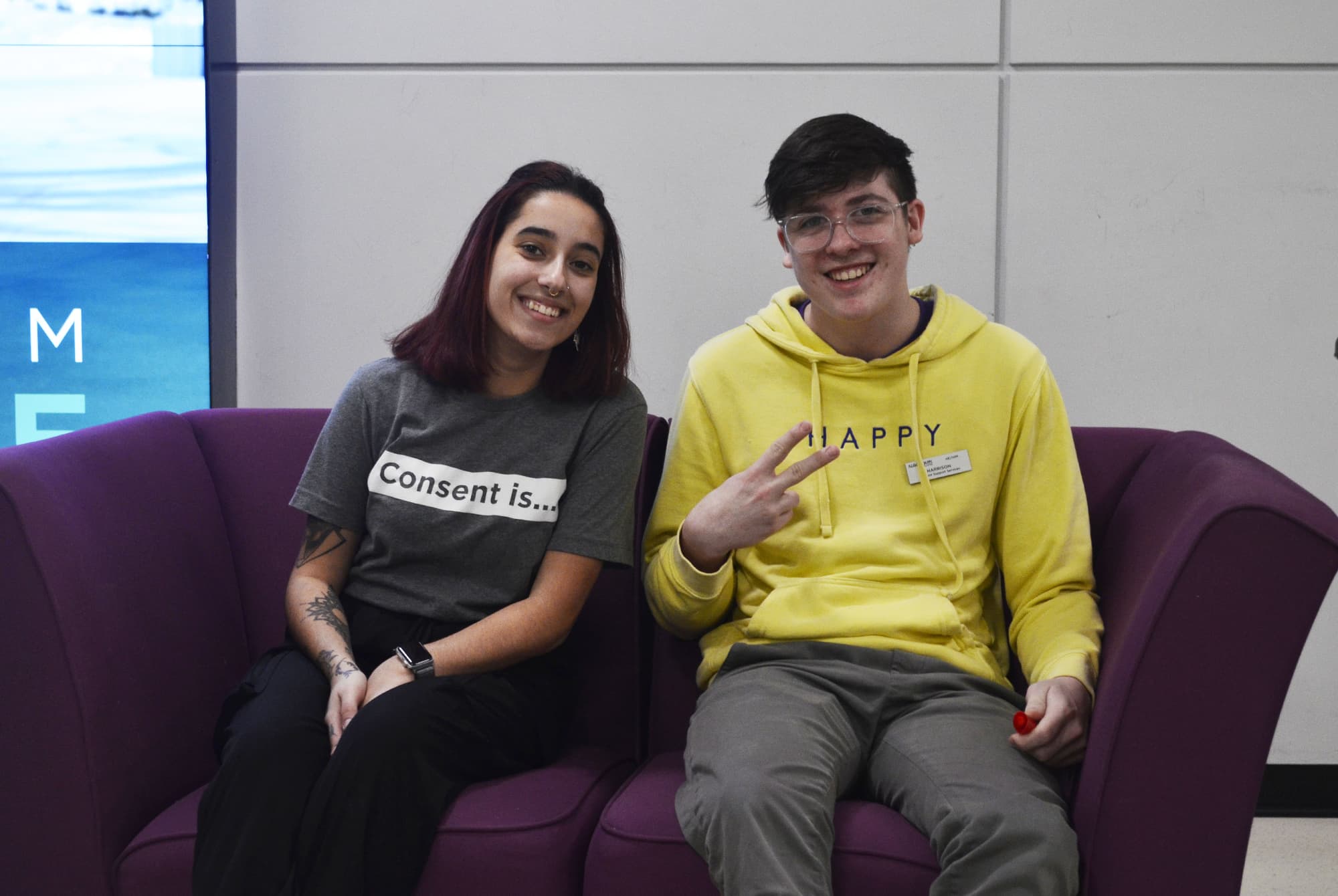
Peer support workers Shelina Syed and Harrison sat on the purple couch in D-building.
The AC Purple Couch Project made its third appearance since the start of winter term in D-building on Thursday, Jan. 25, from 10 a.m. to 1 p.m. just outside of the Marketplace Food Court during Mental Health Awareness week.
The project is a safe space that aims to spread awareness about mental illness amongst students on campus as well as provide resources to support them throughout their college experience.
The project was inspired by the “Do It For Daron” (DIFD) movement and has become a significant part of Algonquin College’s support services which is accessible to all students.
Whenever the AC Purple Couch is seen, students are encouraged to sit down on the couch and talk, share or even start a conversation about mental health with the peer workers and mental health professionals that are stationed around.
The event featured a whiteboard shaped as a speech bubble that has a question or a prompt written down in hopes that it will strike a conversation with students walking by.
“I think it’s a great way to engage students, because you just see a couch randomly in a hallway and you’re like, ‘what the heck is happening?’ “said Shelina Syed, a peer support worker at the Health and Wellness Zone and a student in the bachelor of early learning and community development program.
“Mental health is a topic here on campus that Algonquin really tries to communicate and express, that we need to break the stigma around it,” Syed said, “so the Purple Couch also offers an opportunity as an initiative for that.”
Right beside the couch, there was a table with a variety of pamphlets and cards full of resources that students are welcome to grab. Some of the resources included: WeConnect, Good2Talk, an AC Purple Couch activity book full of exercises and much more. The event also provided pins and other trinkets for students to take.
The AC Purple Couch website provides resources that can be found around campus like: AC Counseling Services and AC Health Services, as well as other resources.
“I think that’s a great idea to help people,” said Noah Charbonneau, a first-year game development student. “Whether it be pretty much anything that is going on in their lives or just to sit down and talk to someone.”
The AC Purple Couch Project event is hosted every Thursday. You can catch the next couch sighting on Feb. 1st, from 10 a.m. to 1 p.m. at Nawapon, in the C-building.
Comedian packs theatre during Tales of Bravery and Stupidity tour
Chantal Lapierre
Photos: Chantal Lapierre
January 29, 2024 Revised: January 29, 2024 8:27pm
Photo: Chantal Lapierre
Bruce McCulloch gets a surprise from his assistant.
Bruce McCulloch caused echoes of laughter during his show at the Algonquin Commons Theatre on Jan. 26.
McCulloch, who is a part of the Canadian sketch group Kids in The Hall and known as “the dark one” of the group, visited the Algonquin College campus for his Tales of Bravery and Stupidity tour.
The show, which was age-restricted, had the floor seats and main seats packed with its adult audience. McCulloch had the whole audience laughing at his many life tales and mishaps. McCulloch kept lively interactions with the crowd during the show, as he would talk to audience members sitting on the floor.
Greg Sidebottom, a fan of McCulloch since the original run of Kids in The Hall, said his wife found out about the event and they just had to go.
“We were big Kids in The Hall fans from way back in the ’90s, and I got the news of him coming here from [his wife],” Sidebottom said. “He’s great, he’s pretty funny. He’s always funny.”
Bruce McCulloch Photo credit: Chantal Lapierre
Sue Sidebottom, Greg’s wife, shared how she first heard of his show at the college.
“We are on an email list for events at the college,” she said. “We had actually gone to see him when he came with his troupe to the NAC previously, so if he came back that would be pretty cool.”
McCulloch kept the audience engaged and laughing. His electric presence and perfect comedic timing filled the room.
McCulloch had varying jokes but many of them involved his family members, whether it was a joke about teen angst or if it was recollecting the bad summer house they stayed at where they found baby diapers in the heat vent. McCulloch also, in a kind way, poked fun at his wife in a few of his bits. His wife is Tracy Ryan, a fellow Canadian actress who is well known for her role as Nancy Drew in The Hardy Boys, which was the main ploy of McCulloch’s jokes about her.
Daniel Sylvester, another Kids in The Hall fanatic, didn’t want to know what the show was about beforehand.
“I didn’t look into it ahead of time because I wanted to be surprised. I didn’t know if it was stand-up or a one-man show, and it was kind of both which was pretty amazing.” Sylvester said after the show.
The 90-minute show ended with McCulloch receiving a well-deserved standing ovation from the crowd.
Arts & Entertainment | Featured Hero | Featured Story | Home Feature | Home Hero
Students learn how to properly communicate with their partners
Mackenzie Cardinal
Photos: Mackenzie Cardinal
January 29, 2024 Revised: January 29, 2024 12:26pm
Photo: Mackenzie Cardinal
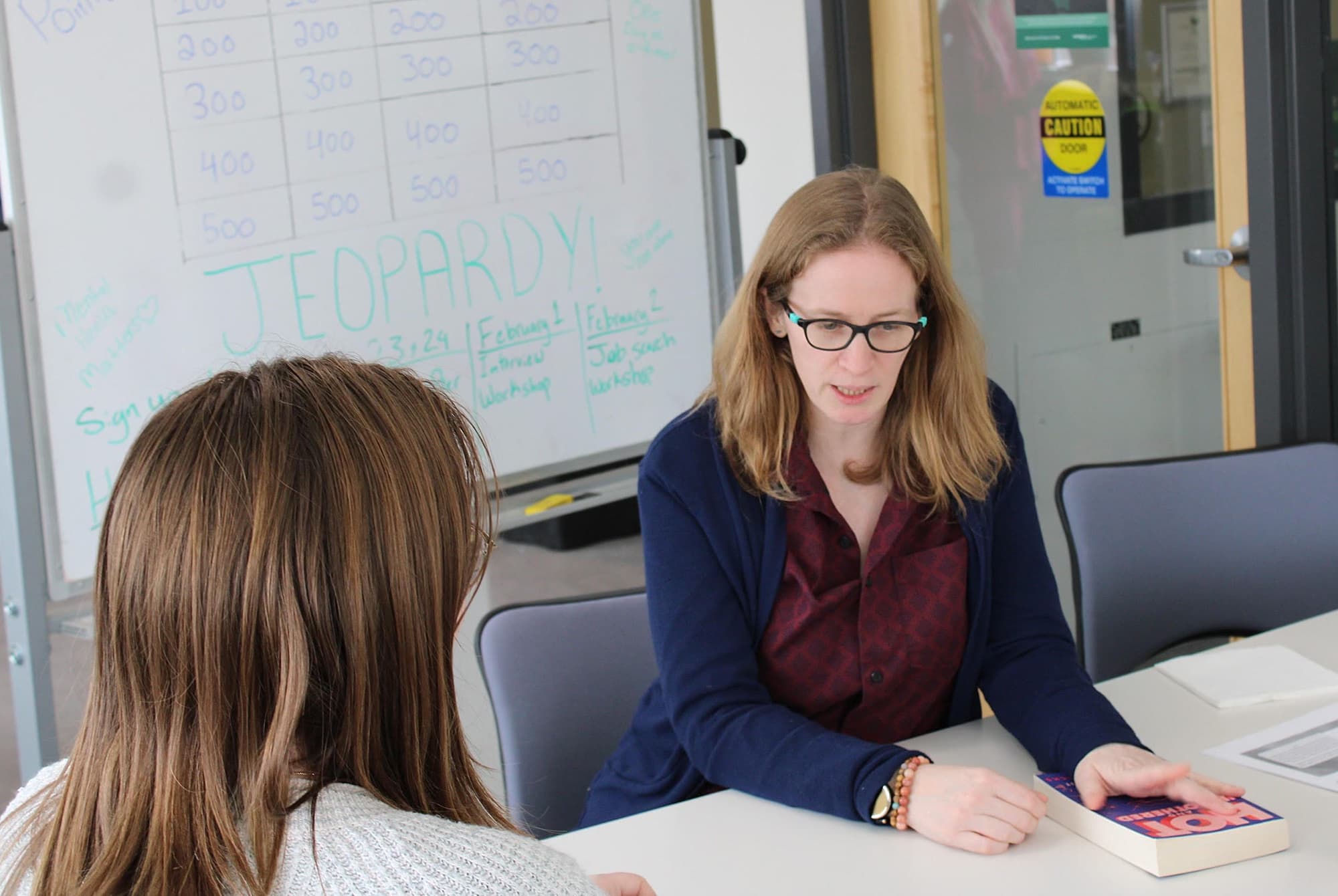
Nicole Lewis, coordinator of the Lust & Learn, talking with one of the students.
A Lust & Learn event on Jan. 25 helped students learn about sexual relationships, especially the importance of communication.
Five students attended the event, which occurred at the Student Health and Wellness Zone on the third floor of the Student Commons.
The topics were about defining wants and needs in a sexual and romantic relationship and how to properly communicate them with your partner. Each Lust & Learn event has different topics. The event was about defining wants and needs in a relationship.
There was also a discussion on how to properly communicate your thoughts and feelings to others.
Sarah Crawford, one of the coordinators of the Lust & Learn event, said: “The only way we can get what we want out of relationships is to communicate with our partners.”
Crawford is also the manager of sexual violence prevention, harm reduction and health promotion at Algonquin College.
Students were quick to point out how to quickly identify problems in a relationship.
“Find the red flags in a relationship and don’t ignore them,” said Gabriel Brocardi, a student of hospitality tourism management.
“The purpose of this event is to provide information about the basics of relationships,” counsellor Nicole Lewis, the lead coordinator of the event, said. “It gets students to communicate their wants and needs with third-party help.”
Lewis also said that the purpose of creating the Lust & Learn event was to make sex and sexual relationships more comfortable to talk about.
“By making sex taboo, it makes people more nervous to talk about sexual relationships,” Lewis said. “It also gives people toxic ideas about relationships, be it romantic or sexual.”
The next Lust & Learn event is scheduled for Feb. 1 at the at the Student Health and Wellness Zone on the third floor of the Student Commons.
College has flagged financial resources as bordering on high risk
Arty Sarkisian
Photos: Arty Sarkisian
January 29, 2024 Revised: January 30, 2024 3:36pm
Photo: Arty Sarkisian
Duane McNair, Algonquin College’s vice president of finance and administration, wishes the provincial government provided funding that was aligned with the actual cost to deliver programs and services.
The Federal Government has announced a national cap on the number of study permits issued in 2024.
The decision bears risks to an already shaky financial sustainability of Algonquin College and other Ontario post-secondary institutions.
What happened?
The federal government projects it will issues approximately 360,000 new study permits in 2024.
So, the intake that has been steadily growing in the past decades will decrease by 35 per cent from 2023.
Collectively, Ontario’s colleges received 68 per cent of their tuition fees from international students, according to the Ontario Auditor General’s annual report in 2021.
International students are filling the “seats left empty by the shortfall experienced in domestic enrolments,” according to the Algonquin College’s Board of Governors meeting materials of Oct. 23.
While domestic enrolment was down 5.3 per cent from the projected number for this academic year, international increased 13.4 per cent.
With international students paying $5,740 per semester in premium fees in addition to the tuition, the college’s revenue increased five times, from the planned $4 million to $19.9 million.
Tuition freeze
The federal cap comes as Algonquin College, along with other Ontario colleges and universities, flag risks to their financial sustainability.
Failure to “effectively manage financial resources” is bordering “high” and “critical” risk scores, according to the Algonquin Board of Governors meeting materials.
It’s been four years since Doug Ford’s government cut post-secondary tuition fees by 10 per cent and froze them at that level.
Now Ontario has the lowest provincial per-student funding in all of Canada.
In 2021-2022, funding per college student was $6,891 – 44 per cent of the national average. And Ontario universities received $11,471 per student, or 57 per cent of the average.
Photo credit: Blue-Ribbon Panel report
Those factors have made financial sustainability a common risk among post-secondary institutions in Ontario including Algonquin.
“If the province were to provide funding that was aligned with the actual cost to deliver programs and services and accommodated a tuition fee policy that was more market-driven and more comparable to other provinces, that would help us achieve greater financial sustainability,” said Duane McNair, Algonquin College’s vice-president of finance and administration.
Faculty are being “squeezed”
With college’s finances at risk, professors are also pushed to be make their classes more financially sustainable.
It can be challenging to get the allocation of dollars to participate in professional development or academic conferences for faculty, said Jonathan Parker, a professor at the college.
“The things that keep us relevant and current require investment from the college,” said Parker. “Many faculty feel that too frequently the answer is ‘no’ to those requests.”
Colleges across Ontario are also “squeezing faculty” when it comes to workload, Annette Bouzi, an Algonquin College professor and the president of the college’s academic union wrote in an email.
“Weekly, we are given a maximum of four minutes per student to evaluate and provide feedback. We are regularly mandated to teach in new modes of delivery, knowing that student participation online and asynchronously have impacts on student learning in the short and long term,” she wrote.
This also applies to after-class activities. There is less investments in rental vehicles, travel, hospitality or whatever “faculty shouldn’t pay out of pocket,” Parker said.
So, professors need to find the workarounds as best as they can.
Instead of a metaphorical Disneyland, students would go to a metaphorical Calypso Waterpark, he said.
Law change makes it easier for survivors to remove publication bans if they choose to
Meg Wall
Photos:
January 29, 2024 Revised: January 30, 2024 3:36pm
Warning: This article contains details of sexual assault that some readers may find disturbing or triggering.
When Kelly Favro found out she legally couldn’t share her name and her story due to a publication ban, it had already been five years since her sexual assault.
In Canada, legislation under the Criminal Code automatically places a publication ban on survivors of sexual assault. That, and with the National Sex Registry not being public information (but is accessible to law enforcement through their provincial or territorial Sex Offender Registry Centre), survivors can often feel as though the criminal justice system is on the side of the offender.
Favro remembers feeling frustrated during the years-long appeals process between her and her attacker, Kenneth Charles Erickson. At the time, she couldn’t find any information on her case and the Crown wasn’t telling her anything, but for reasons she says had never been communicated to her.
“I remember thinking, ‘This is ridiculous’,” Kelly said. “Why can’t I find this guy? People need to know about him. He’s a convicted sex offender and we don’t have any system; we don’t have anybody to tell us what’s up.”
That all changed on Oct. 26, 2023, when royal assent was given in the Senate of Canada to amend legislation under the Criminal Code, which included publication bans. The modifications included placing the responsibility of informing the subject of the publication ban of the ban’s existence on the prosecutors, as well as making it easier for survivors to remove the ban if they choose to.
It had been a fight Favro, and many survivors across Canada who are part of the group My Voice, My Choice, had fought hard for, but say it is just the beginning.
“We’ve made progress towards a more victim-centred criminal justice system, but we still have a lot of work to do to ensure victims are adequately informed about their rights,” said Dr. Benjamin Roebuck, the Federal Ombudsperson for Victims of Crime in a statement.
The office of the federal ombudsperson for victims of crime said it recommends further improvements in informed consent and victim-centred information.
My Voice, My Choice is an initiative led by Canadian victim-complainants across the country who have or have had publication bans on their names as a result of the nature of their court cases.
Originally from Brampton, Ont, Favro is one of the leaders of the initiative. She had moved across Canada to British Columbia when she met Kenneth Charles Erickson at a bar in Victoria in 2015.
“I just got to know him,” Favro said. “He seemed cute, he seemed nice. I can talk about sports for days, and he was able to keep up with me.”
After casually dating for six weeks, Erickson began to “reveal his true colours.” According to Favro, Erickson was allegedly a heavy drinker who didn’t have a high opinion of women.
“When you look back on relationships, and you can see so many red flags, you ask yourself, what happened? That should have been a huge red flag,” Favro said.
For Favro, those red flags began to wave during a pre-operation examination when she had to undergo an emergency surgery to remove a Bartholin’s cyst, a result of a sexually transmitted infection allegedly given to her by Erickson.
The surgeon examining her was startled to see “a lot of damage” and asked if she was okay.
Though Favro had thought her experiences with Erickson were “normal” at the time, those memories now bring back painful memories.
“If I hear a beer can opening, my heart skips a beat. If I hear ice cubes hit a glass, my heart will jump out of my chest,” Favro said. “And it’s been eight years since the attack.”
In the early hours of a September 2015 morning, Favro awoke to Erickson coming into her room, demanding sex and sexually assaulting her. After it was over, she said she didn’t understand the gravity of it.
“I pretended like nothing happened,” Favro said. “I didn’t think anything had happened, because I thought I was able to fight”.
Like many survivors of sexual assault, Favro didn’t report her assault right away.
“I didn’t think I was going to be believed,” Favro said. “I didn’t have [the] underwear, I didn’t have pictures of my bruises, I went to work the next day, I didn’t report, I didn’t get a rape kit. I didn’t do it [all], like you’re told to do.”
Fortunately for Favro, when the police came by to take her statement, they believed her right away, taking it very seriously. Two months later, Erickson was charged with two counts of sexual assault, one of which he was later convicted.
However, it wasn’t until January 2021 that Favro was told the Crown has placed a publication ban on her name. When she asked for its removal, she was told it wasn’t that simple.
“There’s not a lot of information online on how to get these publication bans off your name,” Favro said. “There’s nothing federally and nothing provincially. So, I kept going back to the courts asking what I needed to do, and they didn’t even know what to do.”
In Canada, publication bans are often put in place to protect the integrity of a case, or protect the privacy of a victim or witness to prevent the identity of a minor. Depending on the case and the laws in place, they can be automatic, mandatory upon request or directed by the court’s discretion.
But critics of the law say it can take away a survivor’s agency, such as the 2021 case of a sexual assault survivor in Waterloo, Ont., who shared the case privately with family members. She was then charged with breaching her own publication ban and fined $2,000, plus an additional $600 victim surcharge by Ontario Court Justice Thomas McKay.
“It means I am gagged, I cannot share my story, I cannot share my name, I can’t do anything,” Favro said.
In June 2021, Favro became the first person in British Columbia to successfully remove the publication ban on their name through self-representation, which empowered her to continue advocating for policy changes surrounding publication bans.
As part of an Algonquin College Board of Governors meeting last year, the Sexual Assault/Sexual Violence Prevention Annual Report was released. It reported 45 total formal complaints and reports of sexual assault during the college’s 2022-2023 school year, 15 reports higher than the year before.
“This is a global issue,” said Sarah Crawford, manager of sexual violence prevention, harm reduction and health promotion for Project Lighthouse. “Even if there is sexual violence, it doesn’t necessarily mean it’s happening on campus, because sexual violence is such a big issue in the community and worldwide.”
While most crime statistics have gone down in Canada, sexual violence has been on the rise since 2014, with the exception of a decrease in 2020.
In 2022, Statistics Canada reported a three per cent increase in police-reported level one sexual assaults — an assault sexual in nature, but causing no physical injuries — across the country last year.
On Oct. 28, 2022, the Supreme Court of Canada ruled that automatically adding individuals convicted of sex offences to the National Sex Offender Registry was unconstitutional. This provided My Voice, My Choice the opportunity to “piggyback” on the conversation.
A Supreme Court of Canada ruling in October 2022 gave way for the My Voice, My Choice initiative to join the conversation surrounding publication bans.
“[My Voice, My Choice] started a massive campaign, we started doing presentations,” Favro said. “We started getting very, very angry about this and very, very loud.”
A year later, with the support of Green Party Leader Elizabeth May by means of a loophole that allowed outsider parties to discuss amendments, Bill S-12 was passed, and survivors such as Favro were given to power to share their stories.
Now a mother of two and a provincial public servant in British Columbia, Favro says the most important thing for other survivors to know is she believes them.
“What happened doesn’t matter what you were wearing, no matter what you drink, I believe you.”
Nayana Nayana is a 21-year-old country singer and songwriter, born and raised in Ottawa with a deep love for music that set her apart in a family deeply rooted in sports. From an early age, Nayana’s love for music was apparent, as she found herself singing entire songs before stringing together full sentences, foreshadowing her natural […]
Emma Stronge
Photos:
January 29, 2024 Revised: January 29, 2024 9:53am
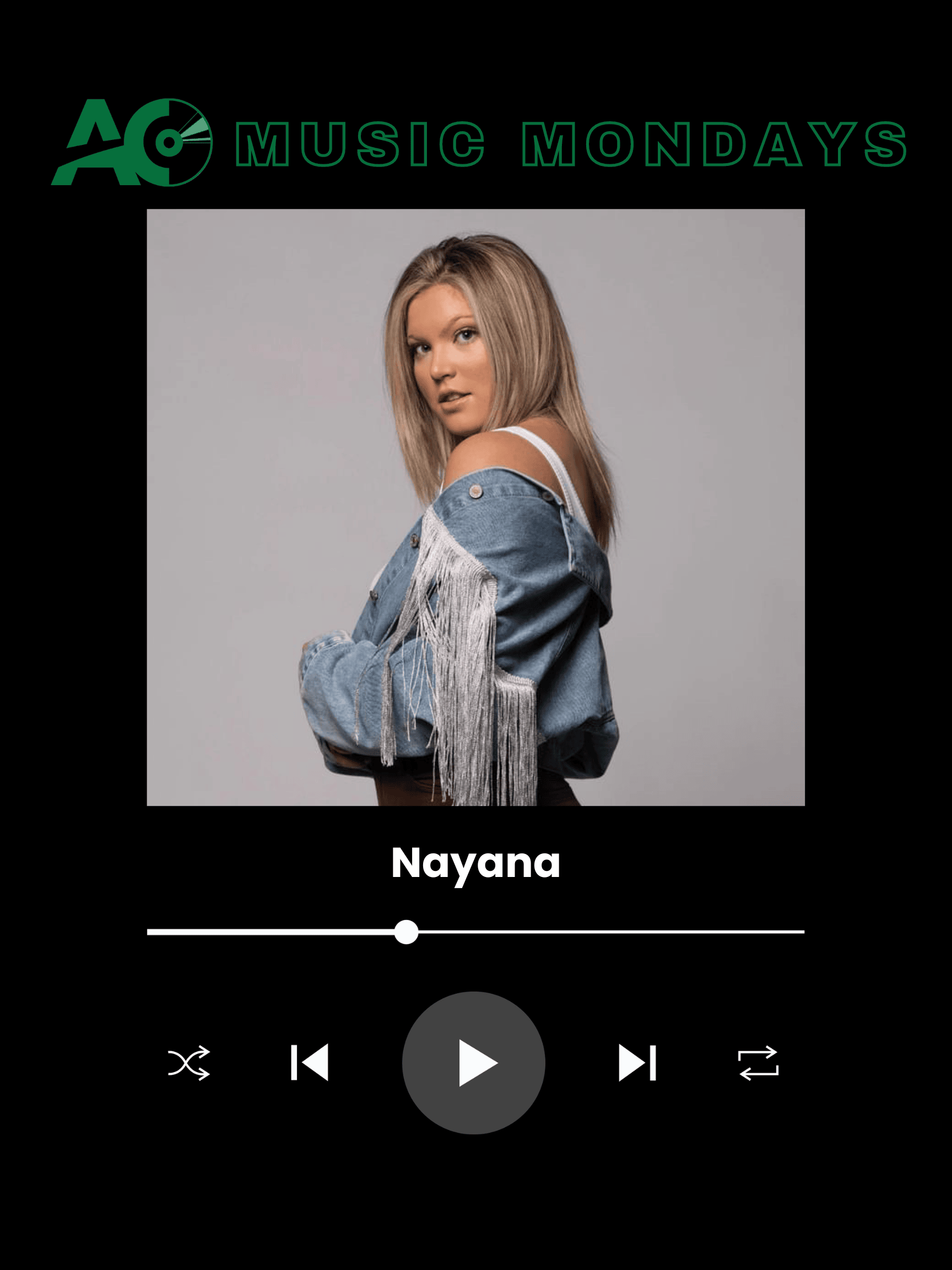
Nayana
Nayana is a 21-year-old country singer and songwriter, born and raised in Ottawa with a deep love for music that set her apart in a family deeply rooted in sports. From an early age, Nayana’s love for music was apparent, as she found herself singing entire songs before stringing together full sentences, foreshadowing her natural musical talent.
Influenced by artists like Taylor Swift and Miley Cyrus, Nayana embarked on her musical journey at the age of 11, mastering the guitar and diving into songwriting. Her prodigious talent was quickly recognized, earning her a Golden Ticket on YTV’s The Next Star at just 12 years old, marking the beginning of a promising career.
Nayana’s commitment to her craft extends beyond her hometown. She makes regular trips from Ottawa to Nashville, accumulating over 2 million digital streams and building a global fan base. A testament to her artistry, she secured the OneArtist Ontario award in 2019, solidifying her presence in the vibrant Ontario music scene.
As she approaches graduation from Carleton University, Nayana eyes a move to Nashville to fully immerse herself in her musical pursuits unless a breakthrough moment occurs sooner. Anticipation is high for her upcoming projects, with new music and an EP slated for release in 2024. Her most recent single, “No Reply,” is now available on all streaming platforms, offering listeners a glimpse into Nayana’s evolving sound. Stay connected and be part of Nayana’s musical journey by following her on social media.
Last home game for seniors ends in tearful goodbyes, well-earned win
Nathalia Lencioni
Photos:
January 28, 2024 Revised: January 30, 2024 3:36pm
The Wolves' Kieran Raymo (left) blocks an attack.
A 3-0 victory over the Fleming Phoenix on Jan. 27 began with a graduation ceremony to celebrate eight of the women’s Wolves volleyball players, who played their last home game.
The ceremony was presented by the Wolves coach Everton Senior, who delivered moving words about each player’s impact on the team.
The Wolves started the first set with a solid lead and won the set 25-18. Six of the points were kills by left side Faith Billaney, one of the graduating seniors.
“I think my favourite moment was definitely the first set,” said Jordan Faig, libero for the Wolves. “We had every single senior on the court, we all got to be together for one last time, which was really nice.”
After ending the first set with a seven-point advantage, the team felt confident going into the second set. However, the match quickly became tense as Fleming caught up to the Wolves.
The Wolves recovered and took the second set 25-22, yet the team was not completely satisfied with its performance.
The Wolves' Grace Pate serving.
“I think the girls were emotional being at graduation day. We just never really focused on the match,” said Senior. “And maybe took Fleming a little too lightly. As a result, we made the sets much closer than they had to be.”
The third set unfolded just as tense and close as the second, with the rivalling teams constantly trading leads. However, with a final kill by Kieran Raymo, the Algonquin Wolves triumphed 25-22.
“I had the game point kill at 24 and I honestly didn’t even see where the ball went, I just hit it into the block and everyone started cheering,” said Raymo. “So I was like, we got it! And it’s my final game here, I’m a graduating senior.”
Senior was happy with the win, but in his opinion, that was not the most significant part of the match.
“It was playing my captain [Emilie Menard] in right side for her last home game. She’s usually just in the barrel, but she played right side for us today,” said Senior. “I think that was really fun for her and for us to see. She’s an awesome player.”
The Wolves will be back in action Feb. 2 against the Georgian Grizzlies at the Michele McConney Court in Barrie.
Featured Hero | Featured Story | Home Feature | Home Hero | Sports & Recreation
The event was part of Mental Health Awareness week
Zhiqi Zhou
Photos: Zhiqi Zhou
January 28, 2024 Revised: January 28, 2024 7:33pm
Photo: Zhiqi Zhou
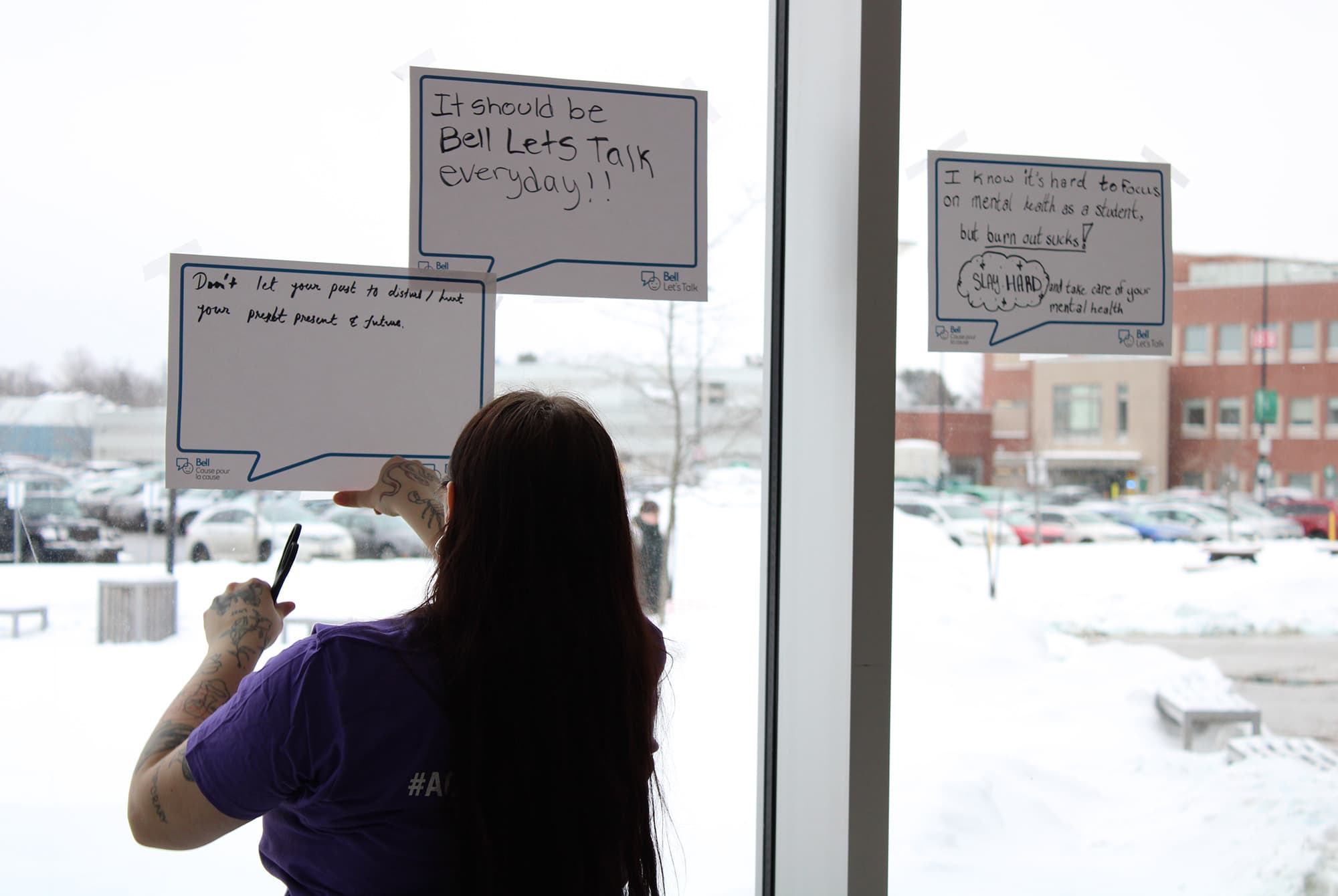
A staff member at the Students' Association displays some of the messages written by students at the event.
The Algonquin Students’ Association and Student Support Services offered students a mental health coffee break from 11 a.m. to 12 a.m. on Wednesday, where they could spend some free time relaxing in the corner lounge room in the E-building.
The event was part of the annual Mental Health Awareness week. “This is an annual event to talk openly about mental health and to help our community to reduce stigma and to encourage them to reach out for help, so that’s why that’s happening today,” said Elizabeth Peña-Fernandez, a health promotion and education coordinator at Algonquin College.
This coffee break was mainly for the students to relax. Students were busy with their studies and if they wanted to take a break and relax this was a great place to take one.
Yenling Lin, a level-3 student in computer engineering technology, said she didn’t come to the event looking for any mental health support.
“I saw a poster, and I ended my class at 10 o’clock, so I think I can come here to take a break because I’m really busy with my program,” Lin said. “I want to have a break.”
There were many forms of mental health support and activities during the week, and the coffee break format provided students with a relatively relaxed environment to connect.
“We want to make mental health resources available, accessible and visible to all of our students, so they can feel comfortable talking about mental health and mental illness,” Peña-Fernandez said.
Danvil Noshad, a level 1 advertising and marketing communications student, attended as well. “I am an international student,” he said. “One thing that I’m worrying is that I am not able to make friends, so I was very depressed, and I thought this program will make me feel better, so I came here, I’m doing fun here.”
Peña-Fernandez said in the interview that Sam Demma will be speaking after the coffee break. “He is very engaging and he wants to talk about that and how to cope with stressors,” said Peña-Fernandez.