From almost cancelled to virtual: the annual Boot Drive marches on
The pre-service firefighting program’s annual Boot Drive avoided cancellation and went virtual thanks to the initiative of program leader Ashley McKenny. As fate would have it, the pandemic pushed the pre-service program from June 2020 to December 2020, creating a unique opportunity wherein students in the program could run the fundraiser twice. “Because we did […]
Photo: Ashley McKenny, Brooke Congdon and Cheryl Coulas. Photo credit
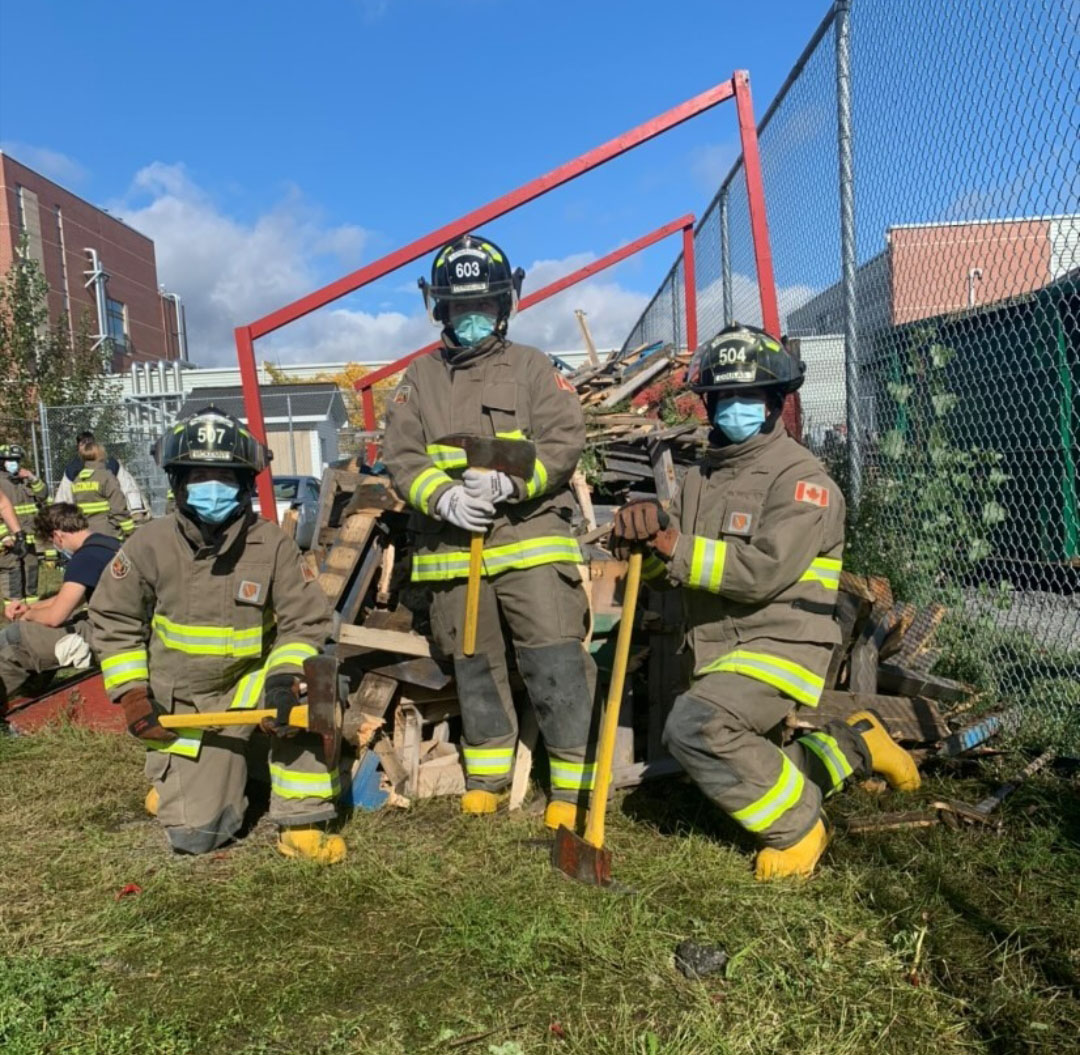
Left to right, students in the pre-service firefighting program at Algonquin College

The pre-service firefighting program’s annual Boot Drive avoided cancellation and went virtual thanks to the initiative of program leader Ashley McKenny.

As fate would have it, the pandemic pushed the pre-service program from June 2020 to December 2020, creating a unique opportunity wherein students in the program could run the fundraiser twice.

“Because we did it last year, I thought, why can’t we do it this year, even if it’s not in person?” McKenny said. She then reached out to Chief Cheryl Hardwick, her instructor, about the novel idea of having a virtual fundraiser.

The Boot Drive fundraiser started three years ago and served as a way to show students what can be done in an hour. The response from the college community has always been incredible, Hardwick wrote in an email to the Times.

McKenny organized last year’s in-person Boot Drive so that when she approached Chief Hardwick, it was an easy yes.

Next, she reached out to Jessica Clark, coordinator of the Food Cupboard — who was immediately on board. Due to the pandemic or other circumstances, the Food Cupboard has seen twice the students this past summer than in the previous year. Clark said they are doing what they can to adapt and was eager to help out with the initiative.

In conversation, Clark highlighted the creativity of the pre-service students in past years as well as this year. “It just blows my mind, she said, adding that last year, the students went out in their firefighting gear. “It’s such a visually eye-catching thing.”

“And Ashley specifically, has reached out to me two years in a row to start the initiative,” she said. The Virtual Boot Drive was her brainchild.

Preparation for the event took two weeks.

McKenny and her co-coordinator Cheryl Coulas, who acted as a second voice, worked on getting the two groups of 20 students motivated. Posts on social media had to be shared with friends and family.

McKenny and Coulas shared it with media organizations such as CTV News and Magic 100, who reposted their event.

The process, McKenny admitted, was harder than she had expected compared to the previous Boot Drive. Last year, the two platoons fanned out across the campus soliciting donations during a lunch hour. Within the span of two hours, the students managed to raise $1,600 for the Food Cupboard. This is in stark contrast to this year’s Virtual Boot Drive which is in the second week of its three-week run.

Although the prolonged fundraising was McKenny’s idea, she intuitively understood how the fundraiser would play out. “You can’t compare the two,” McKenny said. “But even if we just get over $1,000, I think that would be a huge help.” The fundraiser has raised over $800 so far.

The Virtual Boot Drive is on now and continues until Oct. 28, 2020. Find more information here.

Thunderdome comes down after cancellation of winter varsity season

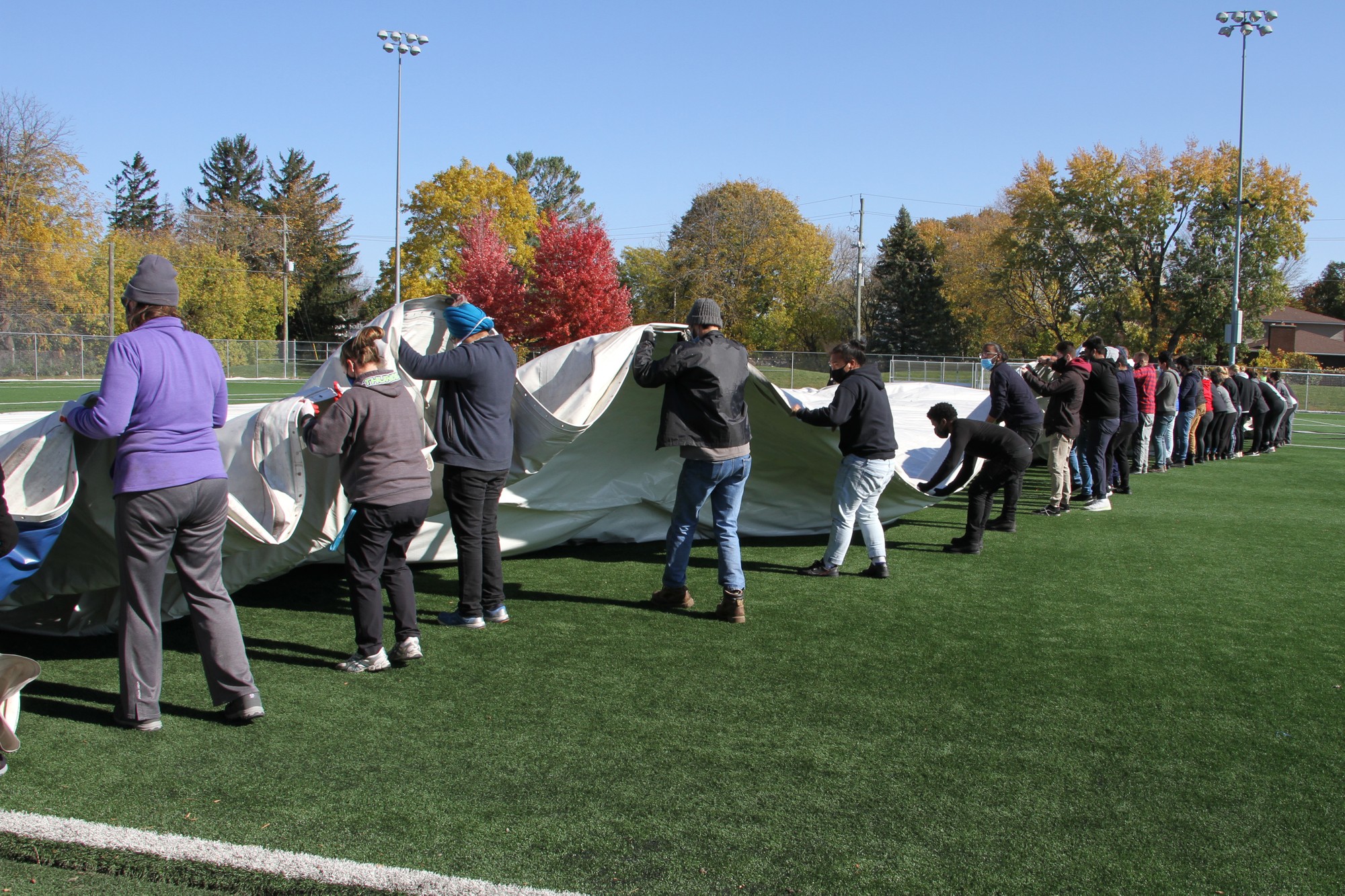
Participants gathered at the Thunderdome Soccer Facility on Saturday Oct. 17 to take down the sports structure.
Photo: Jocelyn Galloway
Due to rainy weather, the dome take down event was pushed back from Friday, Oct. 16 to Saturday, Oct. 17.

Participants gathered at the Thunderdome Soccer Facility on Saturday Oct. 17 to take down the sports structure. Continue reading “Thunderdome comes down after cancellation of winter varsity season”

October Horoscopes

Student athletes continue their sports journey remotely

If you were to look eight months ago at the college’s sports scene for the Algonquin Thunder, winter varsity sports were going to go as planned along with regular basketball and volleyball games. Fast forward to today, and it seems like the sports world at Algonquin College and the Ontario Colleges Athletic Association (OCAA) has […]
Photo: Kened Sadiku
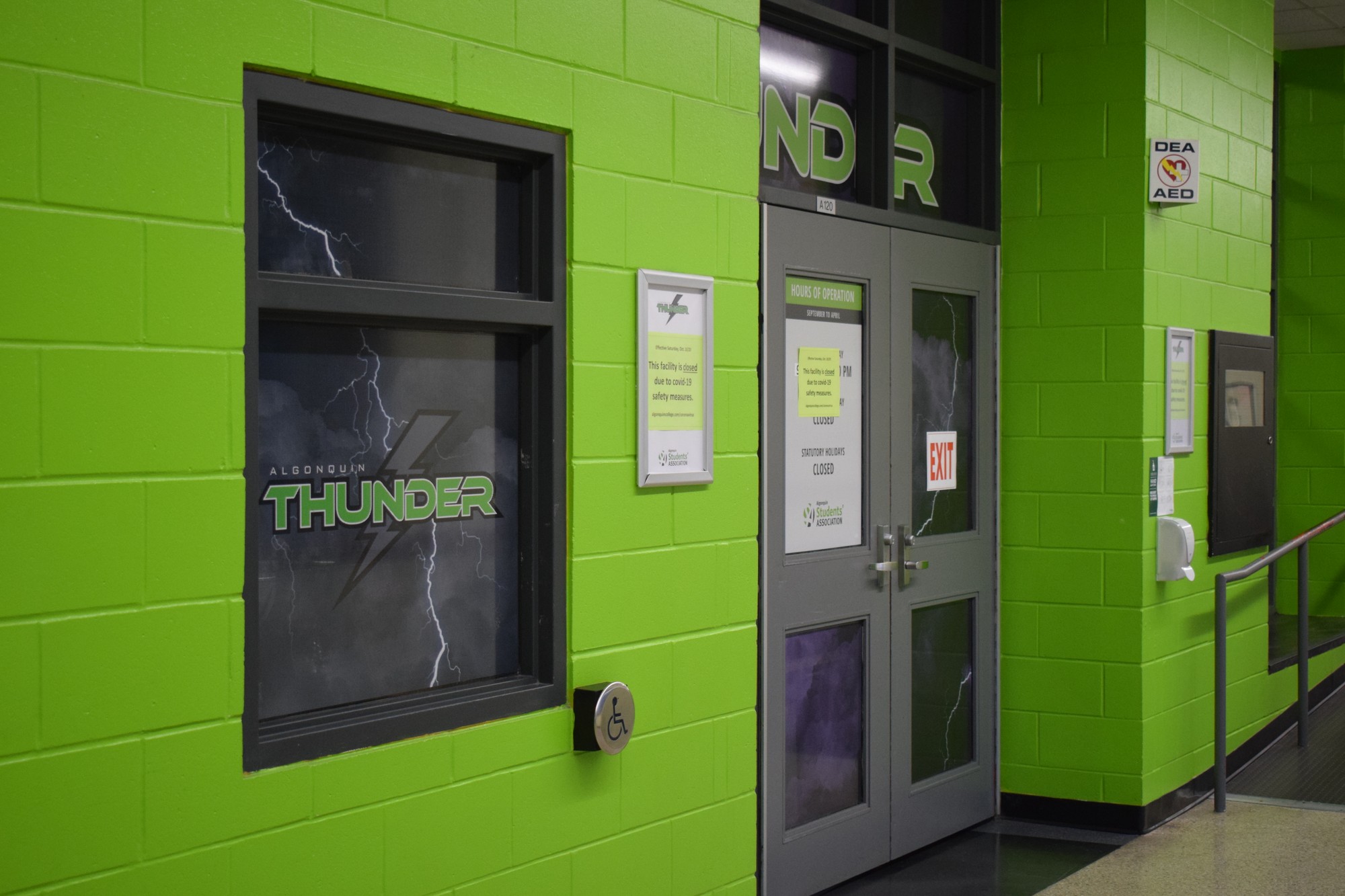
The Ron Port Athletic Facility entrance doors with a sign that says the gymnasium is currently closed.

If you were to look eight months ago at the college’s sports scene for the Algonquin Thunder, winter varsity sports were going to go as planned along with regular basketball and volleyball games.

Fast forward to today, and it seems like the sports world at Algonquin College and the Ontario Colleges Athletic Association (OCAA) has a lineup of question marks around it.

With the recent announcement of winter varsity sports being cancelled by the OCAA, athletes at Algonquin College will have to wait another semester to get back on the court.

For athletes, this can be tough as the thought of missing what they love to do can have a negative impact on them.

Take Julien Caswell for example.

Caswell, 20, is a second-year student in the health and fitness promotion program and is also a senior player for the men’s volleyball team. He says the bond his team had, is something he misses in during times like these.

“The other aspect that hurts is team bonding,” said Caswell. “The sooner we take this seriously and get it over with, the sooner we get to hop back on the court.”

Despite the closure of the Fitness Zone for a second time, Caswell was able to find another way of continuing his workouts from home.

“Fortunately for me, I have a best friend who happens to have a very well-equipped home gym,” he said. “I also managed to be able to play in a max volley beach league this summer but other than that, it’s really hard to stay in ‘volleyball’ shape; if you will.”

Ian Campbell, athletics communication and events coordinator spoke on what he’s seen from athletes before the closures; as students were coming to the gym to continue working at their game.

“Until the recent drawback to phase two, the gymnasium was open a little bit for students to come in throughout the day and do some activities throughout social distancing,” said Campbell. “I saw some of our basketball players, volleyball players and coaches come in through that period.”

Although some players took advantage of the open gymnasium, Campbell explained it was tough for some athletes to adjust.

“It’s challenging for the athletes to maintain their conditioning,” explained Campbell. “You can go in the gym and have one coach come to one hoop and talk to the basketball players, and go to another hoop and talk to another basketball player, but that will never replace you being able to actually play.”

While this season remains uncertain, Algonquin College athletes have continued to find other ways to work around the circumstances.

Though the situation of sports at Algonquin College has no answers just yet, the OCAA’s season remains to be a bleak one.

OCAA announces cancellation of 2020-21 winter varsity sports

The OCAA announced on Oct. 15 that varsity sports for the 2020-21 winter season is cancelled as a result of the COVID-19 pandemic. The Algonquin Thunder already saw themselves out of the picture for the fall varsity sports season, and now it has hit home for the winter months as well. In a release from […]
Photo: Kened Sadiku
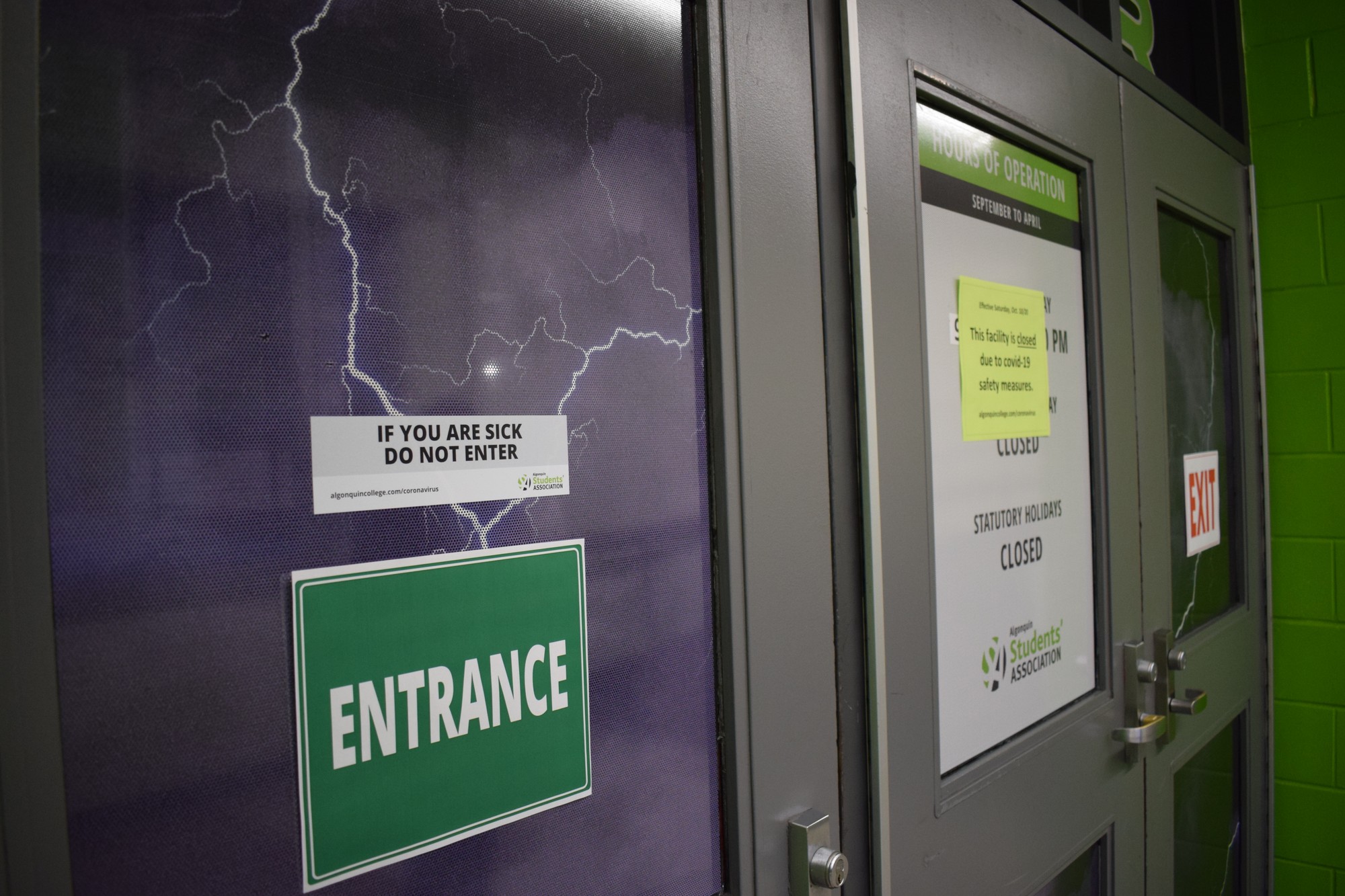
A sign on the door of the Ron Port Athletic Facility explains that nobody should enter the gym if they are feeling ill

The OCAA announced on Oct. 15 that varsity sports for the 2020-21 winter season is cancelled as a result of the COVID-19 pandemic.

The Algonquin Thunder already saw themselves out of the picture for the fall varsity sports season, and now it has hit home for the winter months as well.

In a release from OCAA’s website, the decision regarding the cancellations was made based on orders from public health and sanctioned competition not being able to take place because of health and safety concerns.

Everton Senior, head coach of the women’s volleyball team said the news is not something he wanted to hear.

“It is disappointing to hear that the varsity season has been cancelled,” said Senior. “But not surprising given the climate of our society at this current time.”

Whether it’s been getting ready for game-time or anything else, Senior feels bad for athletes that were looking to continue their journey in varsity sports.

“I really miss being around the team and feeding off of their youthful energy,” he said. “I feel especially bad for the athletes who were looking forward to continuing their athletic journey, and the new athletes who were looking forward to cracking a post-secondary varsity lineup for the first time.”

Ian Campbell, athletics communication and events coordinator for the Students’ Association’s athletics department says that the cancellation was no surprise to him when he heard about it.

“My initial reaction was really just a confirmation of what I thought was going to happen,” said Campbell. “That’s not from me having any inside info, it’s just having seen the general progression over the last six months.”

With the OCAA competition being held in a lot of the areas surrounding hotspots of COVID-19 case spikes, Campbell says with the way things have been trending in Ottawa right now it was clear this would happen.

“I see the hotspots are Toronto and Ottawa and those are the people that we compete with,” he explained. “You see a storm forming, so I guess it wasn’t a shock.”

Through these times, coaches and other members aren’t the only one feeling the disappointment in the news that came out on Thursday.

Julien Caswell, 20, a senior on the men’s volleyball team says the news really struck home.

“Hearing that the season is cancelled definitely sucks,” said Caswell. “There’s no other words to describe it. The boys were definitely looking forward to getting our second year with our new coach started up. Sure we can hang out individually while respecting social distancing rules and whatnot, but I haven’t seen all of them together since March.”

Much like Senior, Caswell acknowledges that the cancellation will hurt the development for veteran players who won’t be returning next varsity year, and potentially the mojo of things when they all get back on the court.

“We get it, stuff happens and it could be worse but it’s especially tough for the veteran players,” said Caswell. “Which means that next season we will have less veterans and twice the wave of rookies, and that could be a real challenge to overcome and work with.”

Sisters in Spirit session brings community together to talk about MMIWC

Sage Lacerete, national ambassador of the Moose Hide Campaign, knows about the issue of Missing and Murdered Indigenous Women and Children first hand. “I have a very shaken reality that two of my first cousins have gone missing and been murdered in British Columbia,” she said on Oct. 9 when Sisters In Spirit partnered with […]
Photo: Akira Cooper
A National Women's Association of Canada pin promotes conversation and support of the Missing and Murdered Indigenous Women and Children movement.

Sage Lacerete, national ambassador of the Moose Hide Campaign, knows about the issue of Missing and Murdered Indigenous Women and Children first hand.

“I have a very shaken reality that two of my first cousins have gone missing and been murdered in British Columbia,” she said on Oct. 9 when Sisters In Spirit partnered with the Moose Hide Campaign and Project Lighthouse to host an information session.

Lacerte and her family founded the campaign in 2011 to spread awareness about MMIWC and those who stand up and support the movement. They distribute moose hide pins to educate people across Canada and to date, they’ve shared over 3 million of them.

“The tool in choosing to use as an act of healing and resistance of these atrocities is my voice, is to be with Moose Hide Campaign and to spread our message,” said Lacerete.

It is a campaign that is for Indigenous and non-Indigenous men and boys who are standing up and in support of no violence towards MMIWC.

Held during Mental Illness Awareness Week, the Zoom meeting was for all students and staff who wished to attend and educate themselves on Indigenous matters. The registered event had 31 participants including the four representatives and an introduction from Algonquin College’s president Claude Brulé.

“No health without mental health,” said Brulé before the meeting began.

“The Mamisdosewin Centre has always proactively supported the MMIWC,” said Nathaniel Parant, activities and events representative with the Mamidosewin Centre. “It has always been an active centre echoing the importance of these movements.”

He was one of the hosts during the meeting and later spoke about the importance of meetings like these. “It’s really something that spreads to everyone’s hearts, really meaningful,” said Parant.

Along with Parant, key speakers Jackie Tenute, Aboriginal Counsellor at the Student Support Centre Welcome Centre and Sarah Crawford, fellow spokesperson started off by singing the “Strong Women Song” which is about a woman from Kingston Penitentiary whose inmates sung to her throughout the night so she would feel strong.

The end of the meeting consisted of a healing circle where anyone who wished to share their thoughts about anything whether that was a story or a statement about the meeting was welcome to and where the recording was then cut for the circle and its participants to be private.

Fitness Zone and gymnasium are closed once again

The doors to the Fitness Zone and gymnasium at Algonquin College will once again be closed to students as the City of Ottawa has re-entered modified stage two of restrictions due to a spike in COVID-19 cases. While open, the guidelines regarding students entering the gym were heavily enforced with sanitization measures in place. The […]
Photo: Kened Sadiku
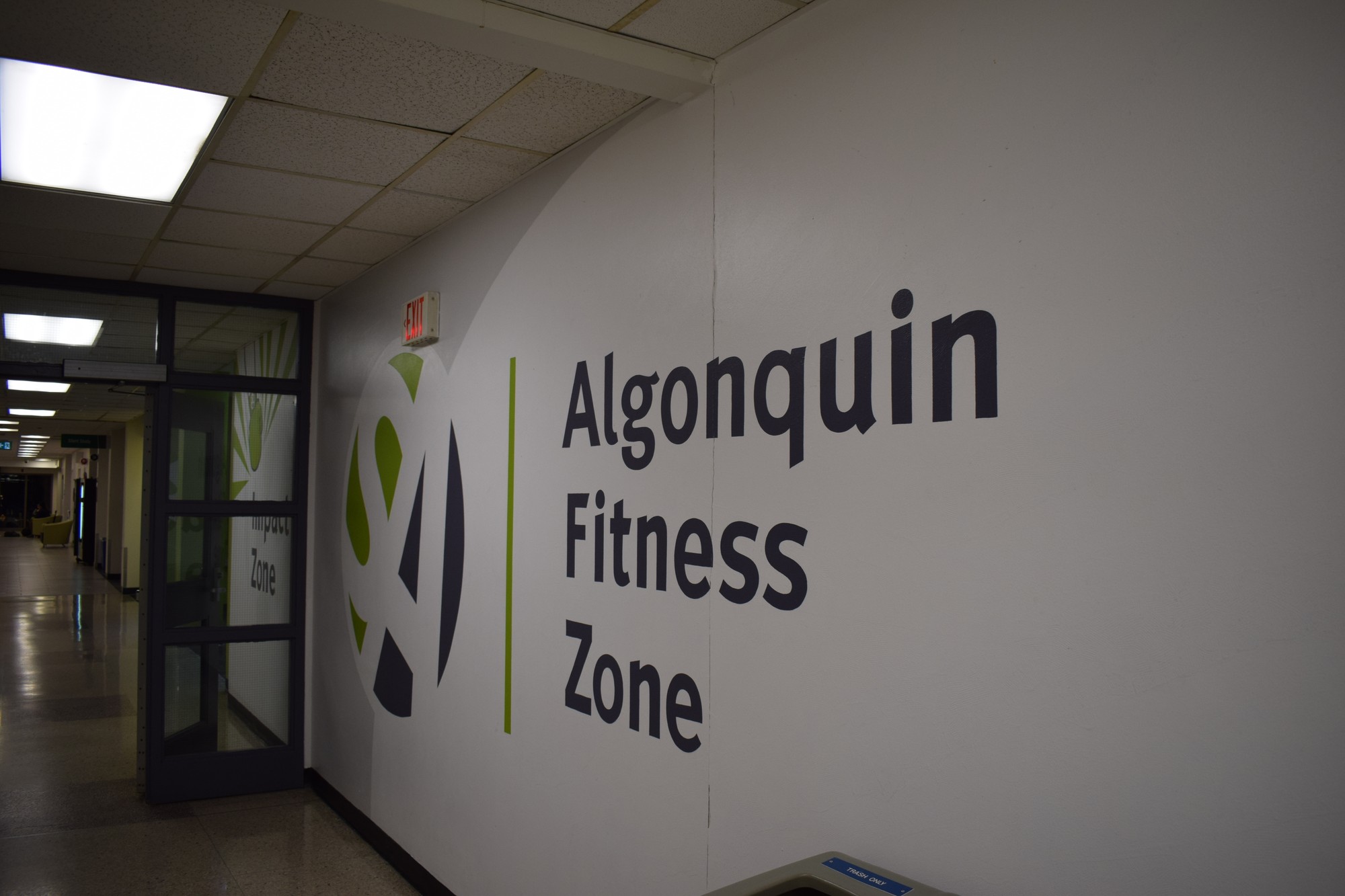
The Algonquin Fitness Zone has closed again due to a recent spike in COVID-19 cases, and the City of Ottawa entering a modified stage two phase.

The doors to the Fitness Zone and gymnasium at Algonquin College will once again be closed to students as the City of Ottawa has re-entered modified stage two of restrictions due to a spike in COVID-19 cases.

While open, the guidelines regarding students entering the gym were heavily enforced with sanitization measures in place.

The Fitness Zone was only open beginning on Sept. 8 and it had reduced its hours from 9 a.m. to 5 p.m. on weekdays for walk-ins.

The Students’ Association took to their instagram page on Oct. 13, 2020 to announce the closures once again.

Max Labovitch, 20, is a recent graduate of the fitness and health promotion program at the college. He says he supports the closing of the gym in these unprecedented times.

“I think that the closure of the gym is the correct thing to do at this time,” Labovitch said. “Fitness is a great way for students to help release stress and anxiety but at the end of the day no one knows what to expect from this pandemic and your health should be the main priority.”

In the announcement, the SA mentions that updates will be sent out as soon as they become available regarding a possible re-opening of the Fitness Zone and gymnasium.

The SA says it is advising patience through these difficult times.

Midnight classes for students around the world

Basil Kavangumpillil, 19, is an introduction to Canadian healthcare studies student who isn’t studying from Ottawa this semester but from Kochi, India where the time is nine hours and 30 minutes ahead of Algonquin. “I face some issues with sleeping,” said Kavangumpillil. “Some classes are in the middle of the night, for example at 3:30 […]
Photo: Hritika Jimmy
A total of 3,085 international students enrolled in the fall semester, 2020. The college has accommodated 150 new international students and 35 returning students already.

Basil Kavangumpillil, 19, is an introduction to Canadian healthcare studies student who isn’t studying from Ottawa this semester but from Kochi, India where the time is nine hours and 30 minutes ahead of Algonquin.

“I face some issues with sleeping,” said Kavangumpillil. “Some classes are in the middle of the night, for example at 3:30 a.m.”

With only 42 courses operating on-campus this fall, 3,085 students from around the world had to postpone their plans to travel to Ottawa for education at Algonquin College.

After COVID-19 required the world to collectively set a new pace, the doors of the college remained open to international students for the fall intake – only via Zoom rather than in person.

One course that was suspended during spring was business administration. Arya Raju, 17, is a student of the program, who enrolled in school this semester. She lives with her parents in Dubai, UAE, which is eight hours ahead of the time in Ottawa.

“Since this is my first semester of college,” said Raju, “I’m missing out on a lot of the first-time college experience, especially when it comes to learning. But with everything that’s going on in the world right now, it is a much safer option.”

Yet Arya is adapting to the situation.

“I have adjusted and gotten used to the time difference and I haven’t faced any particular issues when it comes to submission and access to sites for my assignments yet,” she said.

Charmil Patel, 19, an ICHS student, isn’t finding the situation so easy

“I have encountered many problems with the time difference as I have two classes in a day,” said Patel. Patel is in Gujarat, India and due to the time difference, all his classes fall during night-time. “I don’t think my course requires me to be on campus for this semester but I am planning to come to Canada soon.”

Kavangumpillil, a student of the same course, is coming up with learning new ways to adjust to the remote delivery of classes to get his desired results.

“This type of virtual classroom is a new experience for me,” said Kavangumpillil. “It changed my whole learning methods and with the help of Rubric, assignments are much easier to score marks on.”

Students of the ICHS program received an email stating that they need to finish 50 per cent of the course on- campus to successfully apply for a work permit. A work permit is a legal document required by international students to work in Canada after their study permit expires.

“I received an email yesterday from the college that stated, I must come to Canada for studying practical nursing since it includes hands-on learning but they did not mention anything about my travel letter.”

On the other hand, Raju’s course does not require her to be on campus but does have a field placement during the latter part of her course for which she plans on coming.

“My course is 100 per cent remote delivery and therefore does not require me to be on campus,” said Raju. “But I am hoping to reach Canada by the end of this year.”

Turkey and tofu at Algonquin’s annual Thanksgiving meal

Although the Marketplace Food Court’s ovens only cooked a third of the food they normally would have for the annual Thanksgiving feast at Woodroffe campus, staff still strived to warm the hearts of the Algonquin community with a hot meal. A customer appreciation Thanksgiving meal was served to students and faculty in D-Building on Thursday, […]
Photo: Chanelle Pinard
Second-year animation student, Oliver Gleeson, treats his tastebuds to a Thanksgiving bite with a side of honey glaze.

Although the Marketplace Food Court’s ovens only cooked a third of the food they normally would have for the annual Thanksgiving feast at Woodroffe campus, staff still strived to warm the hearts of the Algonquin community with a hot meal.

A customer appreciation Thanksgiving meal was served to students and faculty in D-Building on Thursday, Oct. 8 from 10:45 a.m. to 6 p.m.

Food services used 150 pounds of potatoes to whip up the mashed potatoes, 7 kilograms of cranberries to make the cranberry chutney and 45 pounds of vegetables for the assorted cooked greens.

Nineteen large 20-pound turkeys and three smoked legs of ham were prepared in order to produce enough food for the 300 people that Russell Weir, executive chef of food services estimated to serve.

“At the end of the day, that’s a third of what we would’ve normally done but very happy with those numbers given the situation,” he said.

Food services would serve 10,000 people per day in a normal school year. This is now down to 400 to 500 customers. The Thanksgiving dinner typically serves 1000 people.

Students enjoy the hot Thanksgiving meal served at Algonquin's Marketplace Food Court on Oct 8.
Students enjoy the hot Thanksgiving meal served at Algonquin's Marketplace Food Court on Oct 8. Photo credit: Chanelle Pinard

The customer appreciation meal also accommodated plant-based diets. The tofu was marinated in the same spices as the turkey and vegan stuffing sat in-between two pieces like a sandwich.

Because Algonquin’s Marketplace is self-managed, they have the ability to react to customers’ suggestions and needs more easily. “Now with COVID and such a reduced number of people, we’re getting to know almost all of our customers and we can almost do requests,” Weir said with a laugh.

Oliver Gleeson, a second-year animation student who lives on campus purchased the Thanksgiving ham special. “The ham was well cooked and it was quite delicious,” he said. “That honey glaze flavour really brings a punch, you know?”

Some students took their meal to go while others socially distanced and dined either alone or with a friend in the cafeteria’s reconfigured seating area.

“Overall it’s a good meal, like seven and a half, eight out of 10 I’d say, if this were Yelp or something like that,” Gleeson said with a laugh.

The food court arranges special dinners for occasions like this weekend, Christmas, and Easter. These are the moments that bring individuals together to be grateful, to keep growing and to celebrate.

Weir explains these are some of the only times they can see some of the students and faculty because of everyone’s busy schedules. “It’s always great because it brings people from all over the campus here, they look forward to it and we get to see them sometimes.”

Taking care of one’s own mental health should be top priority

The Fall term has always been a time of excitement – but also of increased responsibility and stress within our College community. Amidst the pandemic, I know many of us are struggling with additional feelings of anxiety and isolation this year. That’s why I call on each and every one of you to make mental […]

The Fall term has always been a time of excitement – but also of increased responsibility and stress within our College community. Amidst the pandemic, I know many of us are struggling with additional feelings of anxiety and isolation this year.

That’s why I call on each and every one of you to make mental health your top priority.

Six years ago, the Mental Health Commission of Canada released a report highlighting how post-secondary student populations across the country are at a higher risk of mental health issues.

The report detailed how half of all lifetime cases of diagnosable mental illness start by 14 years-of-age, and 75 per cent by the age of 24. Half of all Canadians will have, or will have had, a mental illness by the age of 40.

In the intervening years since that report, Algonquin College has taken many steps to enhance its support networks and resources to help our learners and employees look after their mental health.

That work continues with an even greater sense of purpose today, as we now face new personal challenges brought upon us by the COVID-19 pandemic. With a return to normal still on the horizon, taking care of ourselves has become even more critical.

Algonquin College takes pride in being an inclusive, caring community. We strive each day to support and respect one another – to show kindness and empathy. By doing this, we break down the old and harmful stigmas around mental health.

Building awareness is crucial, and I encourage every learner and employee to take the time to reflect on how they are feeling and coping during these unprecedented times. Part of being aware is accepting that it is okay to be vulnerable. Asking for help is a sign of strength not weakness. Never hesitate to reach out when in need. In addition to the resources referenced above, there are also many apps and online tools available to you, and excellent resources offered by Ottawa Public Health.

One of the recent developments in our continuing efforts around mental health is the expanded partnership Algonquin College has with The Royal. This summer, thanks to a $250,000 contribution from RBC Foundation, more of our learners in need will be able to meet online with a psychiatrist from The Royal and get the support they need through  a customized treatment plan.

We also offer a complete range of counselling services and general supports in an effort to cater to the individual needs of every learner, understanding the broad range of challenges and lived experiences across our student population. These services are provided by professionals who can accommodate you virtually from the comfort of your own home.

Like everyone, I am looking forward to the time when we can all safely be together again, enjoying the vibrancy and energy of being on campus. Until then, please know you are not alone. We want you to turn your dreams into lifelong success and are committed to helping you on the journey.

Follow Algonquin Times on Instagram
Algonquin Times on Instagram
Algonquin Times horoscopes
Algonquin Times podcast
Follow Algonquin Times on Instagram
Algonquin Times podcast
Algonquin Times horoscopes
Algonquin Times on Instagram

Stay Informed

Sign up for our newsletter

Subscribe

* indicates required