On-campus special: Discovery at the ARC

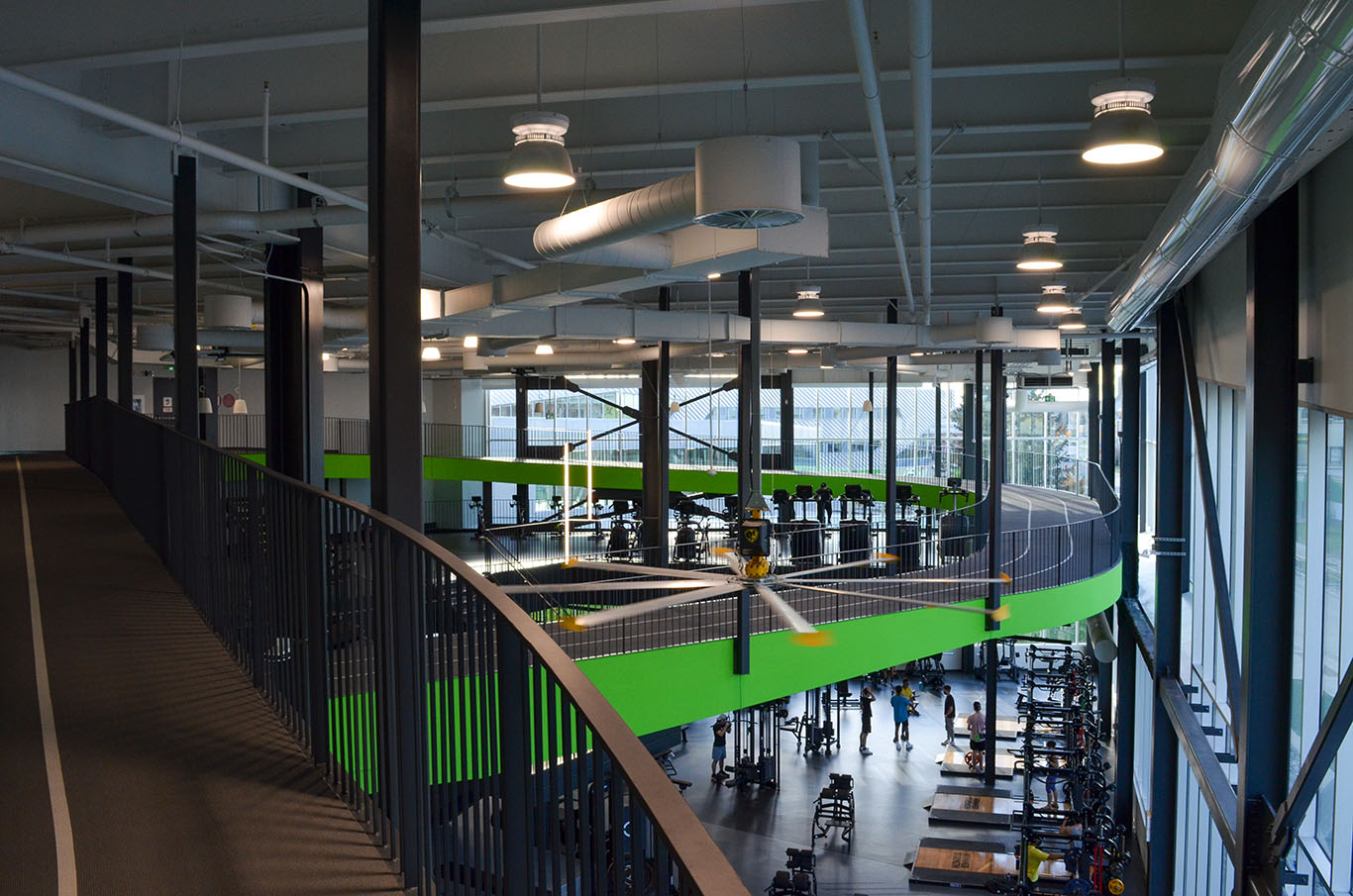
One of the most recognizable features of Algonquin College’s newest building, the Jack Doyle Athletics and Recreation Centre (ARC), is undoubtedly the Discovery Track. The 346-metre-long figure-eight shaped track winds and inclines around the second floor of the ARC. Its easily accessible, just up the stairs from the main entrance and front desk. The track […]
Photo: Tanner Reil
The Discovery Track winds and inclines around the second floor of the ARC.

One of the most recognizable features of Algonquin College’s newest building, the Jack Doyle Athletics and Recreation Centre (ARC), is undoubtedly the Discovery Track.

The 346-metre-long figure-eight shaped track winds and inclines around the second floor of the ARC. Its easily accessible, just up the stairs from the main entrance and front desk.

The track is divided into three lanes, each designated for walking, running and passing. As users make their way around the ARC, they can enjoy a bird’s-eye view of the entire building, as well as the residence across the street through the large windows.

“We haven’t put it up yet, but we will have signage for like the 150-metre sprints and different options as well,” said Alexandra Laneville, a full-time ARC staff member and graduate of Algonquin’s fitness and health promotion program.

Users can run, walk or wheel their way around the track, in a designated direction which changes daily. At any time, users can jump off the track to enjoy the ARC’s second floor fitness area which includes equipment ranging from treadmills, rowing machines, ellipticals, ladders and air bikes.

According to Laneville, the track tends to be busiest in the mornings and evenings when less students are in class.

The ARC is committed to creating a welcoming environment, allowing seasoned sprinters or those in need of a walk or wheel during the cold winter months, to enjoy the Discovery Track equally.

On-campus special: Bowling enthusiasts rejoice

Since the closure of the last 10 pin bowling lane in Ottawa in June of 2021, people have been desperately searching for their bowling fix. Algonquin College students can enjoy their own brand-new bowling alley in the Jack Doyle Athletics and Recreation Centre (ARC) building on campus. The bowling alley has six lanes, a variety […]
Photo: Maggie van Lith
Bowling is available on campus.

Since the closure of the last 10 pin bowling lane in Ottawa in June of 2021, people have been desperately searching for their bowling fix.

Algonquin College students can enjoy their own brand-new bowling alley in the Jack Doyle Athletics and Recreation Centre (ARC) building on campus.

The bowling alley has six lanes, a variety of bowling balls with a range of weights and sizes and multiple theme options to choose from when playing.

Joe St. Amand is the front of house manager for the ARC who oversees the bowling alley.

“The great thing is, it’s included in their students’ association fee,” he said. “Sometimes students don’t know what they’re paying into and this is a clear representation of what it is.”

Located just past the Wolves Den, students can grab some food and drinks and enjoy 50 minutes of bowling.

“It’s nice to have something on campus where you can come in and have fun and you’re not paying anything extra for it,” he added.

Brand management student, Anirudh Arora, decided to check out the bowling alley with a friend after seeing promotions on the Algonquin College Instagram page.

“I was regularly into bowling when I was in my home country but since I’ve been in Ottawa for four months, this is the first time I’m here,” said Arora. “We’re planning on meeting other classmates here because it’s near and accessible to everyone.”

On-campus special: Drive into the automotive building

For Tyler Arruda, a level three automotive service technician, S-building is home to the garages, tech labs and a lounge area for his course’s programs. He works with the various disassembled engines to learn how to properly perform routine and complex procedures on cars. Home to the automotive service technician and motive power technician students, […]
Photo: Julien Bernier
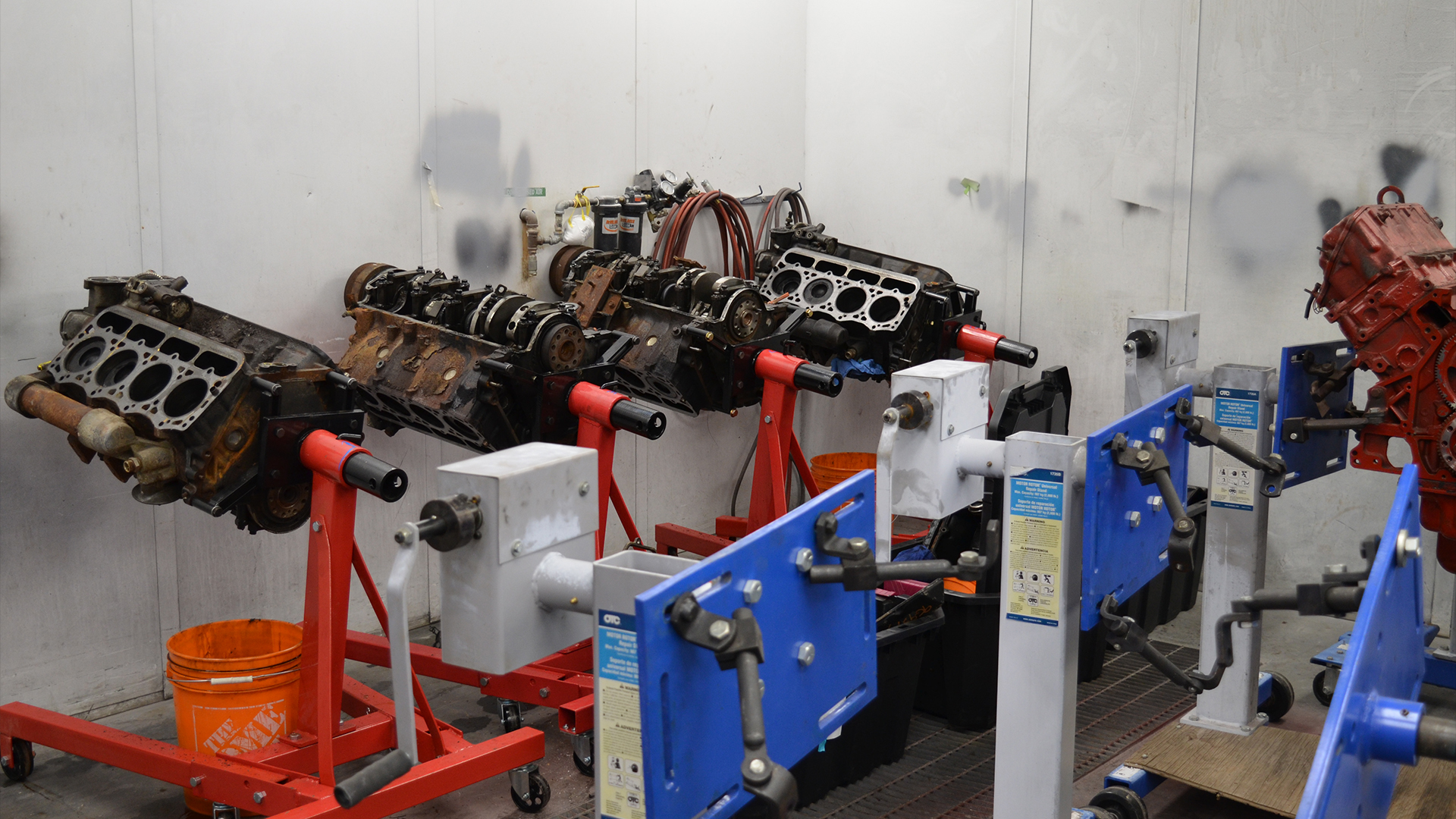
Algonquin College's automotive areas provides car enthusiasts with accessible learning environments.

For Tyler Arruda, a level three automotive service technician, S-building is home to the garages, tech labs and a lounge area for his course’s programs.

He works with the various disassembled engines to learn how to properly perform routine and complex procedures on cars.

Home to the automotive service technician and motive power technician students, S-building is made up of labs and features a large garage, an area one cannot and should not enter without proper safety gear.

“You get to check out the cool automotive stuff,” he said. “You can see all the cars we get to work on.”

The building’s proximity to the largest parking area on campus provides convenience during the cold winter months.

Car enthusiasts may be interested in paying a visit as it provides the opportunity to see what goes into the maintenance of their vehicles.

The classrooms are open, which allows anyone to take a look at students working on various car parts. There are many cars out on in the large garages as well as large transport trucks

If you are interested in the inner workings of a car then this building would be of great interest to you, as within the shops, engines that have been taken apart are out to be seen.

S-building remains a building that car fanatics would enjoy, but there is no reason why other should not give it a chance.

On-campus special: Accessible printers

While the need for a physical copy of any document is decreasing, sometimes it is a necessity. With limited space in shared living spaces and costs associated with printer ink, many students opt to not buy a printer. Algonquin College has 48 accessible printers for students at the Woodroofe campus and each student receives $10 […]
Photo: Ethan Grove
"In the current year, student colour printing has already exceeded the total amount of student colour printing for the entire year last year," said Michael Heaslip.

While the need for a physical copy of any document is decreasing, sometimes it is a necessity.

With limited space in shared living spaces and costs associated with printer ink, many students opt to not buy a printer.

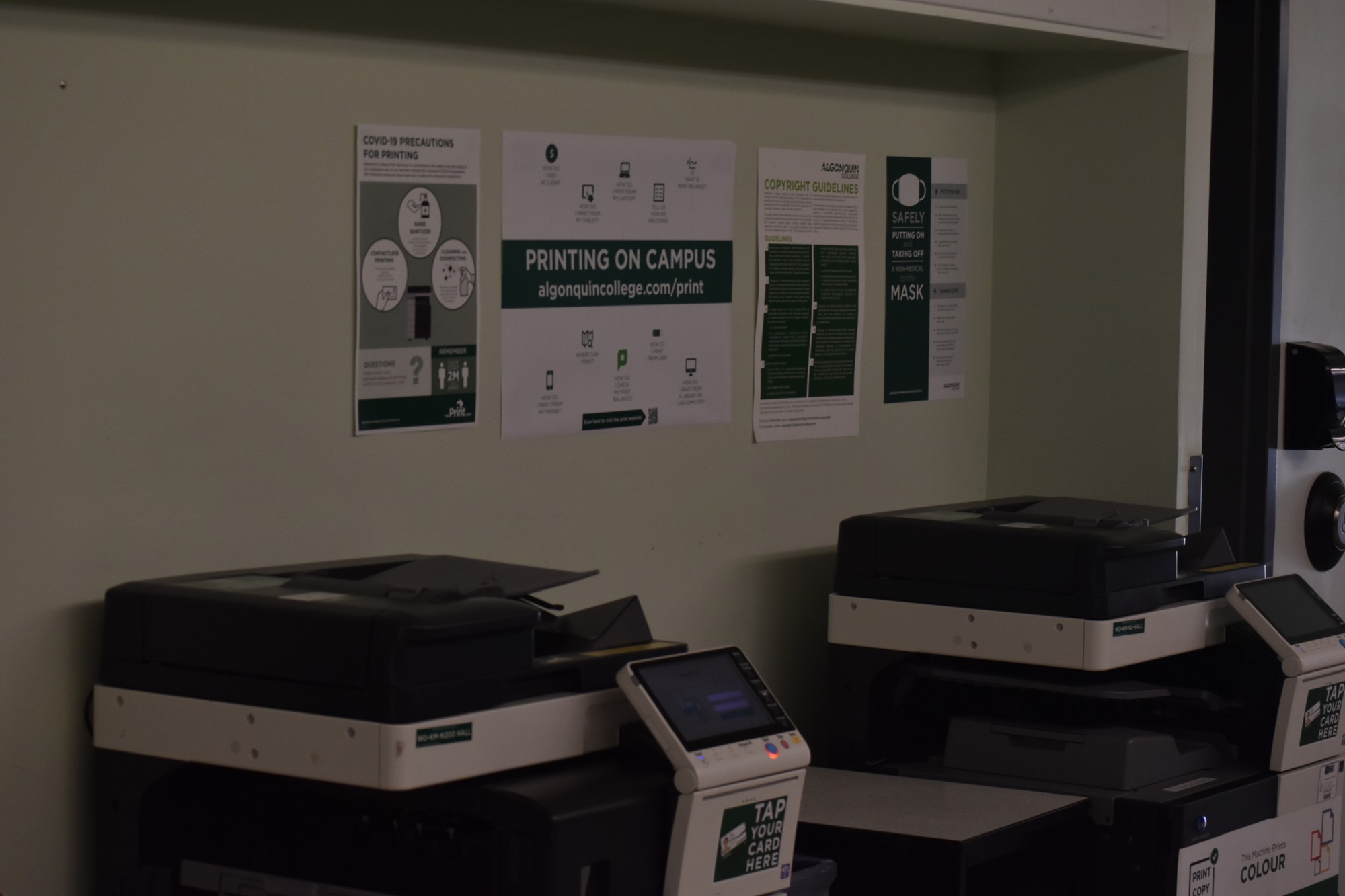
Algonquin College has 48 accessible printers for students at the Woodroofe campus and each student receives $10 a semester on their student card towards printing. Using the printers can cost students anywhere from $0.10 to $1.40 depending on the size of paper. and whether the documents need colour ink.

“Student printing on campus has never been easier with Mobility Print,” said Michael Heaslip, manager of print services at Algonquin College. “Mobility Print is a method of printing to college printers from any phone, tablet or laptop device. The campus printing website (algonquincollege.com/print) includes instructions, videos, a printer map and much more information about printing on campus.”

The implementation of Mobility Print on campus was introduced in January of 2021 to address student feedback about the difficulties of printing on campus.

“Printers on campus are available to students 24 hours/day and are accessible throughout spaces at each campus,” said Heaslip. “The printers are maintained by student employees who work to ensure that paper jams are cleared and paper and toner are replaced in a timely manner. The same student employees are available to assist other students with printing, and of course Mobility Print is available to everyone for an ease of use print experience.”

What is Algonquin College doing with student data?

The college is projected to spend between $69.7 to $75.5 million by 2025 on modernizing its student information system, and more broadly, its entire internal software, according to a report presented to the Algonquin College board of governors on October 25, 2021. This overhaul is called the R3 project. “R3 is a more than just […]
Photo: Brett Thoms
The college says the R3 project is meant to aid in the mission of turning itself into a "global leader in personalized, digitally connected, experiential learning," according to the R3 information page.

The college is projected to spend between $69.7 to $75.5 million by 2025 on modernizing its student information system, and more broadly, its entire internal software, according to a report presented to the Algonquin College board of governors on October 25, 2021.

This overhaul is called the R3 project.

“R3 is a more than just a student information project, it’s many projects rolled into one,” said Claude Brulé, president of the college.

The R3 system aims to improve the way students interact with the college, improve security and allow the college to stay up-to-date on the current technologies, among other things, according to the R3 information site.

The R3 system also aims to “improve college data as it relates to the Student Information System and position the college to support data initiatives over the long term,” according to the site.

This leads to questions about how the college uses the student data it processes both currently and in the future.

The college uses student and alumni data for several purposes, according to Stefano Bianco, senior privacy specialist at the college. Student data is retained and used for student requirement, student retention and determining financial assistance. It is also used to rate, review and improve academic programs, and for institutional planning, research and statistics.

“Algonquin is a public sector institution, which is subject to the Freedom of Information and Protection of Privacy Act, which strictly controls the release of private information,” according to Bianco.

“The college’s general policy is that it won’t disclose data to third parties without student consent unless required or authorized by law,” said Bianco. “For example, applicable privacy legislation allows the college to share student data with venders who support the operations of the college.”

An example of this would be Brightspace, which has been procured by the college but is managed by a third party.

“That doesn’t mean that the third-party monitors learner data — they are confined to only use it under the data conditions of the agreement we have with them and they cannot use it or disclose for their own purposes,” said Bianco.

Bianco assured that the college does not sell or share student data with private companies for their own marketing or for any other commercial purposes.

Furthermore, he does not anticipate that student data will be used in any new ways with the R3 system.

“If we see the stakeholders want to use learner data in different ways will first access if this is allowed under our current privacy policies and relevant legislation, and if so, we will endeavour to modify our publicly available privacy statement so we can create awareness of these changes,” said Bianco.

The R3 project is currently in development; therefore, the college and company responsible for the project, Thesis, are currently consulting with different stakeholders.

“We have a SA rep that sits on that committee to give student input,” said Emily Ferguson, president of the students’ association. “There is a diverse group that sits on the R3 implementation committee.”

This SA rep will provide a student perspective, according to Ferguson.

Cyber security is also a stated priority of the college’s data management system.

“We are designing privacy and cyber security considerations which are integrated into the system from the get-go as a part of the design,” said Brulé.

“Every other day in the news there is a story about a ransomware attack,” said Bianco. A ransomware attack is a cyber-attack in which hackers steal data from a public institution or corporation, and then encrypt it to make it unreadable. The attacked party then essentially has the ability to read their own data ransomed back to them.

“The damage from an attack like this to public infrastructure is very heavy,” said Bianco. “Without going into too much detail, we are taking precautions such as state-of-the-art encryption and compartmentalizing the data, meaning that users can only see a subset of data that they need to be able to see to do their jobs.”

The new R3 is expected to be implemented at the end of 2022.

What happened to the vending machines during the pandemic?

Vending machines at Algonquin College have been left alone since the start of the pandemic. With students and staff back on campus, the vending machines are being used more so now than in the past year. The two companies that own and take care of the vending machines are Coca-Cola – for beverages – and […]
Photo: Christina Korotkov
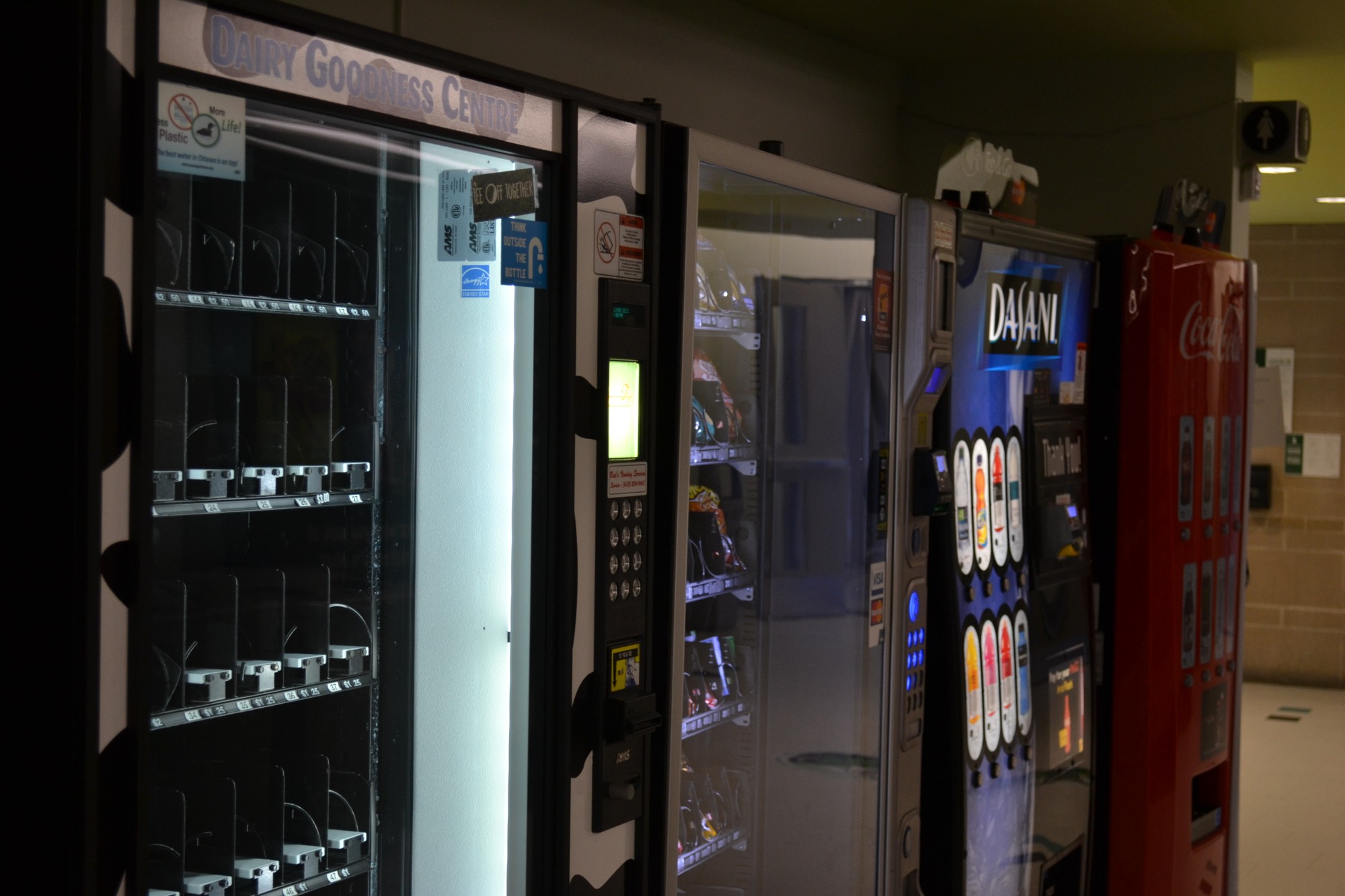
These are some of the vending machines located in the Robert C. Gillett Student Commons building on campus. Four of many spread within campus buildings.

Vending machines at Algonquin College have been left alone since the start of the pandemic.

With students and staff back on campus, the vending machines are being used more so now than in the past year.

The two companies that own and take care of the vending machines are Coca-Cola – for beverages – and Bests Vending – for snacks and beverages or other drink options, such as milk.

These companies are responsible for monitoring, operating, maintaining, and repairing the machines if there are problems.

“If issues arise with vending machines on campus, students can bring it to the attention of Food Services and we are happy to notify the responsible company,” says Mara Lowrey, marketing and communications manager for Campus Services.

One thing the college has control over is what specific snacks or beverages are sold in the vending machines.

Lowrey says what goes in the vending machines is dependent on the sale of specific products.

Over the last year, the number of working machines and volume of products has seen a decrease because of inactivity on campus. However, these numbers are set to rise once “the campus returns to a pre-pandemic population.”

College officials must follow the Broader Public Sector Procurement (BPS) rules and regulations – rules made by the ministry of government and consumer services on the purchase of goods and services using public funds in public sectors when choosing which companies place vending machines at the college.

“Any company that feels that they are qualified and able to attain the described service requirements can submit a bid that is evaluated by the college,” said Lowrey.

Once chosen and the machines have been installed, Coca-Cola and Bests Vending have to monitor the machines regularly.

“They are on campus at least once a week checking on the machines, stocking, rotating product and of course, technology is also helpful with monitoring the machines,” Lowrey added.

Students can suggest changes to the vending machines at any time by reaching out to Food Services through email vending@algonquincollege.com or by telephone at 613-727-4723 ext. 7615.

“We change the beverage mix based on new releases,” said Lowrey. “We can suggest new snacks to our vendor at any time – for example, masks were added during the pandemic and we added a fresh food option machine in ACCE Building when The Fix was closed.”

Michael Korn: trainee to chef de cuisine

Chef Michael Korn had been cooking in restaurants for five years when he decided to attend college to refine his craft so he could transition into higher-end cuisine. Upon graduating from the culinary management program at Algonquin College in 2011, he worked at Sidedoor in the ByWard Market as a sous chef for two years, […]
Photo: Zach Zimmerman
"There's something exciting and addicting about opening a new restaurant, but it's also really hard," said Michael Korn, an Algonquin grad and veteran in Ottawa's fine dining scene.

Chef Michael Korn had been cooking in restaurants for five years when he decided to attend college to refine his craft so he could transition into higher-end cuisine.

Upon graduating from the culinary management program at Algonquin College in 2011, he worked at Sidedoor in the ByWard Market as a sous chef for two years, eventually making his way back to Beckta, a modern, fine-dining restaurant and wine bar where he was a trainee during his time in college.

Michael Radford, the executive chef at Whalesbone on Elgin, offered the Algonquin grad a job when he was a senior saucier at Bekta. Initially, Korn turned down the offer.

“I kinda thought about it for the next couple months,” said Korn, who felt like he had “hit a bit of a ceiling at Beckta.”

Although Korn spoke highly of his time at Beckta, he knew there wasn’t going to be much room to grow past where he was.

Korn spent five years at Whalesbone on Elgin, and was promoted to chef de cuisine, a post he held for three and a half years.

Will Plummer, who graduated with Korn, was Korn’s sous chef at Whalesbone and took over Korn’s job as chef de cuisine when he left.

“It was awesome,” said Plummer about the experience working with Korn.

“He’s very knowledgeable, you can tell he really cares about what he’s doing,” said Plummer. “He’s passionate. Just a great guy to work with. He taught me so much.”

When Korn was offered a job at Harmon’s Steakhouse, a restaurant under the Whalesbone group, he jumped at the chance.

“I felt like it was time for me to have a challenge in my career,” said Korn.

Korn’s experience working for the Whalesbone group has been exceptional and he can’t see himself working for anyone else for the rest of his career.

“I just can’t say enough good things about the ownership or what kind of mentor Michael Radford has been to me,” said Korn. “This is food that we developed a passion for over the last couple years at Elgin. It just seemed like a great opportunity to open something special in the city.”

Nick McGee, Harmon’s head butcher, graduated with Korn from the same program.

He worked at restaurants in Ottawa for a few years and eventually made his way to Vancouver where he was the production manager for a cured meat company for four years.

Back in Ottawa, McGee heard what was happening with Harmon’s and reached out to Korn: “I saw he was doing really good things and always seemed to be a good guy to work with and saw the opportunity and definitely wanted to jump on it.”

After not seeing each other for almost eight years, the two met up and McGee left with a job.

“He’s an incredibly supporting leader,” said McGee. “He’s not part of the old school mentality where it’s just yelling at people until they’re better, but ‘how can we actually make these people better.'”

Korn’s advice for culinary students is very simple: work hard, commit to it and don’t be an egotistical dick.

“You have to be willing to put yourself into it,” he said. “If it’s something you want to do as a career there’s no easy way, you can’t replace working on a line. There’s no quick way to being a chef.”

Algonquin College has no plans to divest from fossil fuels companies

In light of the increasing urgency over climate change, there is growing pressure on both public and private institutions to act in order to address the crisis. Recently, the University of Toronto has pledged to completely divest from fossil fuels, joining other post-secondary institutions like Université du Québec à Montréal. As of right now, Algonquin […]
Photo: Brett Thoms
Ottawa residents marching in the city's downtown core for a climate strike on Sept. 24, 2021.

In light of the increasing urgency over climate change, there is growing pressure on both public and private institutions to act in order to address the crisis.

Recently, the University of Toronto has pledged to completely divest from fossil fuels, joining other post-secondary institutions like Université du Québec à Montréal.

As of right now, Algonquin College has no plans of doing the same.

“While we have not made any plans to explicitly divest from all investments in fossil fuels, we consider all feedback received from the community when refining and amending our investment strategies and policies,” said communications officer at Algonquin College, Bruce Hickey. “At this time, the college’s investment policies do require our investment manager to take steps to ensure that Environmental, Social and Governance (ESG) factors are adequately addressed in the selection, retention and realization of investments.”

Currently, five per cent of Algonquin College’s endowment fund is invested in fossil fuel companies, according to Hickey. An endowment fund is an investment fund used by non-profit foundations, schools, ect… which allows money to be continuously made available for the institution.

Using numbers from Mar. 30, 2021 the market value of the Algonquin endowment fund Algonquin College Endowment Fund is a little over $34 million, according to a report presented to the Algonquin College board of governors in October of 2021. Therefore, Algonquin is currently investing around $1.5 million in fossil fuel companies; however, exact up-to-date numbers are currently unavailable.

Divest Coalition Canada describes itself as a coalition of 30 Canadian student groups that call for universities and colleges to divest from fossil fuels.

Divest Coalition Canada calls for removing investments in companies that generate revenue from the extraction, transport, or processing of oil, gas and coal. The organization believes that in order to avoid catastrophic effects of global warming over 2 C, the global economy needs to be rapidly decarbonized.

Divest Coalition cites a 2015 study by Christophe McGlade & Paul Ekins which suggests that a third of oil reserves, half of the gas reserves and over 80 per cent of current coal reserves should remain in the ground in order to limit global warming to under 2 C.

To groups like Divest Coalition Canada and 350.org, this means that fossil fuel extraction needs to be halted as soon as possible.

Algonquin College is only investing in energy companies that are committed to reducing their environmental footprint, according to Hickey.

These companies include Tourmaline, Canadian Natural Resources, Pembina Pipeline, Topaz Energy, HESS Corporation, Phillips 66, Pioneer Natural Resources, Total Energy, Royal Dutch Shell, SBM Offshore, TGS ASA and Royal Vopak N.V., according to a financial document provided by the college.

According to the financial document provided by Algonquin’s investment manager, Leith Wheeler, many of these companies have committed to net zero by 2050, reducing carbon intensification and investing in technologies like carbon capture.

However, it is heavily contested whether or not concepts like net zero by 2050 and carbon capture technologies are sufficient to address the crisis.

“The college’s investment policies are reviewed and approved annually by the Audit and Risk Management Committee,” says Hickey. “A decision on divestment would need to be recommended by this committee and approved by the College’s board of governors.”

Are pre-programs helpful for students?

Pre-programs offer Algonquin College students insight and experience in multiple different fields within a faculty to give students the opportunity to try out different programs at the college. Algonquin College offers pre-programs in health and science, art and entertainment, music and media and more. “I honestly found the program amazing, all the knowledge I gained […]
Photo: Ethan Grove
"If you take that instead of the full program you can take a step back and evaluate whether you think you’ll need the full program," said Aidan McCulloch, a graduate of the intro music industry arts program at Algonquin College.

Pre-programs offer Algonquin College students insight and experience in multiple different fields within a faculty to give students the opportunity to try out different programs at the college.

Algonquin College offers pre-programs in health and science, art and entertainment, music and media and more.

“I honestly found the program amazing, all the knowledge I gained would be considered base-level knowledge, but I feel like it was a bit more than that,” said Aidan McCulloch, a graduate of the general arts and science, intro to music industry arts pre-program. “It gave a good base to go off in almost everything that comes with being an artist, but it gave you more than just that. I learnt how to manage a social media platform, how to run different ads and how each would work in my favour, I learnt how to fully read and understand contracts, learnt how I could get the most out of a manager or just being a manager myself.”

Some students find great success and interest in the topics they’ve learnt and continue to the full-term diploma programs that their intro program has prepared them for.

“Many of our students get employed into a variety of animation studios in Ottawa and in other cities after taking the advance course of Animation at Algonquin college of which we prepare them to take,” said Rich Lauzon coordinator and professor of drawing foundations for animation and illustration.

Pre-programs also offers students, who are returning to school, a chance to become acclimated to college life with professors who are in place to help them do so before entering the full program.

“Most students find it initially hard to acclimate to college life, juggling multiple assignments at the same time, but they do find their teachers engaging, patent and encouraging and knowledgeable. Most students do walk away with a better foundation of drawing to help them get to the next level of their education,” Lauzon continued.

Pre-programs also offer students a chance to meet requirements for jobs and other programs, either at the college or university level.

“The pre-health sciences pathway programs often help students meet the admission requirements to continue their studies in other vocational programs,” said Myriam Thanasse, coordinator of the pre-health sciences pathway programs. “Students complete the program with a stronger set of study skills and the motivation that they can be successful in their next program.”

Some students even find the intro programs enough to continue to their careers without having to go back and continue into the bigger programs.

“Honestly, it was worth taking the intro, not only do you get a taste of what’s to come if you take the full program, but the knowledge you gain just off the intro course is enough for you to start building yourself as a musician or artist,” said McCulloch.

Shifter Magazine founder encourages Ottawa to consume its own culture

About seven-and-a-half years ago, Amen Jafri, a film director in Ottawa, released a documentary called The City That Fun Forgot?, which chronicles the capital city’s reputation of being a buttoned-up bore. On Nov. 25, 2021, Shifter Magazine founder Kevin Bourne and his colleague Vladimir Jean-Gilles paid a visit to journalism students at Algonquin College to […]
Photo: Tamara Condie
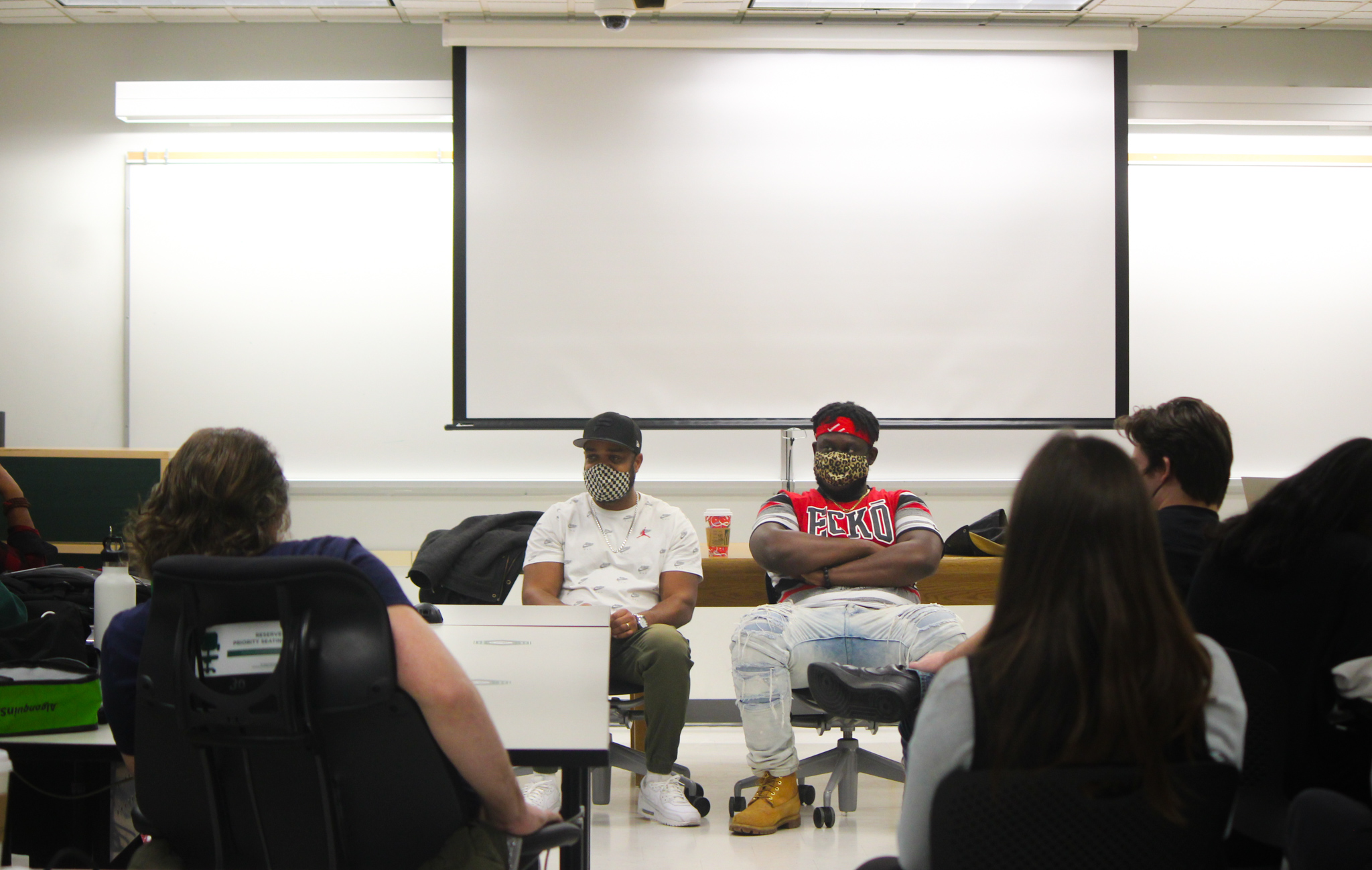
Kevin Bourne, Shifter Magazine founder and Vladimir Jean-Jilles, Shifter Magazine film critic, talk to Algonquin College journalism students about the importance of hitting deadlines and professionalism.

About seven-and-a-half years ago, Amen Jafri, a film director in Ottawa, released a documentary called The City That Fun Forgot?, which chronicles the capital city’s reputation of being a buttoned-up bore. On Nov. 25, 2021, Shifter Magazine founder Kevin Bourne and his colleague Vladimir Jean-Gilles paid a visit to journalism students at Algonquin College to prove Jafri’s claims wrong.

Bourne, who also happens to be a part-time TV broadcasting professor at Algonquin College, founded Shifter Magazine in August of 2013, just under a year before Jafri’s documentary came out.

According to the magazine’s website, Shifter was created to “platform talented people and share their views on the world.”

Born and raised in Toronto, Bourne and his co-founder Koliah Bourne, who also happens to be his wife, decided to move their business to Ottawa shortly after launching it. Upon their decision to relocate, they quickly learned that the media landscape in Ottawa looked nothing like Toronto’s.

“I immediately felt like there was an opportunity to start something creative here,” said Bourne to level three journalism students. “I used to be a suit and tie guy in the public service, but in the back of my mind, I always saw opportunities with the media.”

What Bourne saw in the back of his mind was a media outlet that would exonerate Ottawa’s reputation of being the city that fun forgot by calling attention to arts, culture and Black culture moguls in Ottawa.

“We have artists here like Night Lovell who are doing big things, but that story just isn’t being told,” said Bourne. “But that’s where the opportunity lies… we created a space for our magazine to tell BIPOC and urban stories because no one else seemed to be telling them.”

Film critic and Shifter contributor Jean-Gilles spoke to his experience with taking that space to create niche content in the capital city.

According to Jean-Gilles, cities like New York and Toronto have saturated media markets that make it more difficult for those entering the arts and entertainment field to gain experience than Ottawa does.

“When I was hired on as a film critic for CBC Radio in 2017 they were looking to diversify their portfolio and I was the only Black film critic in Ottawa at the time,” said Jean-Gilles. “A lot of people will put the pressure on you to move to big cities like Toronto or L.A. right away to do this kind of work, but I advise against that — you can build your portfolio from here.”

Jean-Gilles not only talks the talk, but he walks the walk — he has had the pleasure of meeting Denzel Washington, Al Pacino and once had breakfast with Anthony Hopkins. He is also a member of the Critics Choice Awards, which allows him to travel to places like Hollywood and Manhattan to attend movie screenings.

Bourne and Jean-Gilles both agree that Ottawa has been a great place for them to grow and expand Shifter into a national brand, as the magazine has now tapped in to Ottawa, Montréal, Toronto and Vancouver.

The one downside of the current media landscape in Ottawa, though, according to Bourne, is that the city struggles with consuming its own culture.

“Toronto just got over that hump with Drake and Ottawa will get there too,” said Bourne. “That’s the reason we need more people to put eyes on our local culture — if you can get involved, you can be the person that brings it all to light.”

Bourne and Jean-Gilles encourage anyone who has a story to share or an idea to pitch to check out the Submission page on the Shifter Magazine website.

Algonquin Times horoscopes
Algonquin Times podcast
Algonquin Times on Instagram
Follow Algonquin Times on Instagram
Algonquin Times on Instagram
Algonquin Times podcast
Follow Algonquin Times on Instagram
Algonquin Times horoscopes

Stay Informed

Sign up for our newsletter

Subscribe

* indicates required