Creative Collisions art exhibit empowers student artists

The DARE MakerSpace in C-building was host to total artistic liberty on March 29 thanks to efforts made by project management grad students. The event was funded by the Algonquin […]
Photo: Anthony Peck
The exhibit ran from 2 p.m. to 4 p.m. and drew large crowds on March 29.

The DARE MakerSpace in C-building was host to total artistic liberty on March 29 thanks to efforts made by project management grad students.

The event was funded by the Algonquin College Innovation Fund and sponsored by the Centre for Accessible Learning as well as MakerSpace, affording opportunities for the college’s talented student artists.

Art pieces included intricate paintings, photography, jewelry and even sweaters inlaid with Indigenous patterns from South America. Live musical performers kept guests entertained while they admired the nearly 50 pieces displayed.

Creative Collisions was a series of over 40 classes students could participate in this year without registration.

Classes focused on exercising the creative aspects of those who attended with guided or unguided instruction. Some activities included VR, vinyl cutting, laser cutting and even 3D printing.

It started Nov. 19 before ending on March 15. The art show was the culmination of the year’s classes.

Zoe Laflamme, a graphic design student and maker of handmade necklaces, earrings and other jewelry, was thankful for the recognition the exhibit provided.

“There was a spot open and I’ve always wanted to sit at a table and present my work. I like it when people compliment me on my work,” said Laflamme.

For Dana Mills, a photography student, it was also a chance to push limits.

“I wanted to get out of my comfort zone and try something new,” Mills added. “It’s helped my self-esteem.”

Organization and curation were handled by a team of six students graduating this year from project management, a one year long program offered on the Ottawa campus.

Organizing the event was their final project, but to the team, it was more than just schoolwork.

“When we created the plan, I felt like I owned it – I cared for it – I genuinely feel invested in the cause and the mission as well,” said event organizer and grad student Milad Moghadamyekta.

That mission was always to create a welcoming environment for artists to display their work and network with other creatives, putting artistry and originality first. To do this, the team created a floor plan that could cater to everyone.

“The very mission statement at the core of this all is to expand and push the boundaries of what it is creative. So, in that spirit we realized we have physical creative pieces, we have digital creative pieces, so we wanted to address that in terms of delivery and attendees to be inclusive of all,” Moghadamyekta added.

The show was separated into six distinct sections. The performance zone had a stage for live musical performances. The exhibit zone featured physical art displayed in rows for onlookers. A digital art zone had TVs showing photography and a projector displaying AI generated art. The learning zone offered guidance on channelling creativity into productive artwork. In the chill zone, observers could connect and take a break from surveying art. Finally, the MakerSpace tours section allowed for students to learn about the numerous classes the DARE MakerSpace puts on.

Those interested can check out what services are provided in the DARE Makerspace and when they’re offered here.

Zoe Hopkins gives memorable insights to scriptwriting students

Posters of Run Woman Run and Kayak to Klemtu stood in the background of Zoe Hopkins’ room as she talked about her triumphs and tribulations in the film industry with […]
Photo: Noah Leafloor
Zoe Hopkins, creator of the movie Run Woman Run, talked with scriptwriting students on March 27, offering insights about filmmaking and writing.

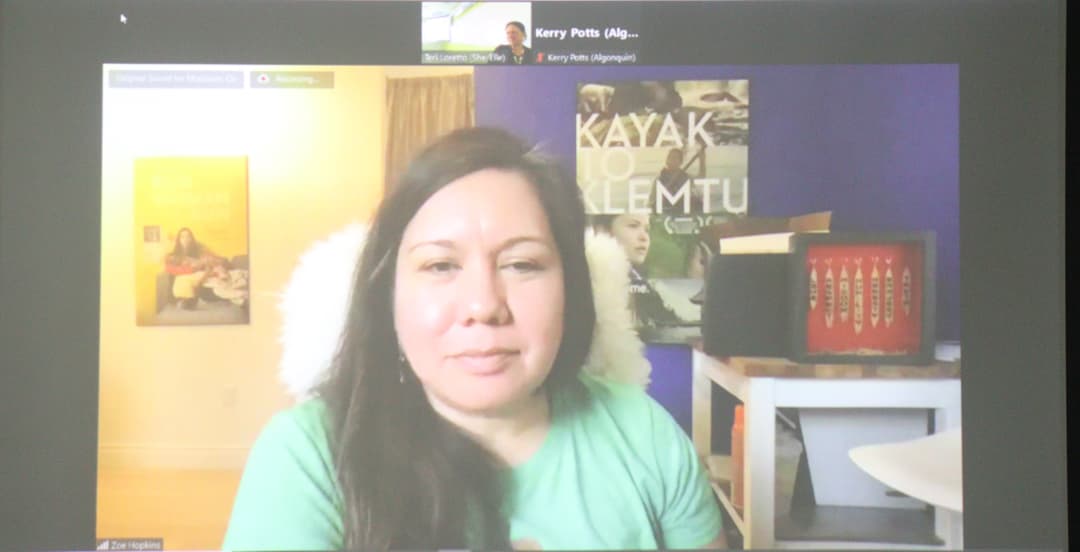
Posters of Run Woman Run and Kayak to Klemtu stood in the background of Zoe Hopkins’ room as she talked about her triumphs and tribulations in the film industry with scriptwriting students.

Hopkins, a Heiltsuk First Nation, who is also fluent in the Mohawk language, has been a Canadian writer and filmmaker since graduating from Ryerson in 1997. She joined the Algonquin College scriptwriting students via Zoom on March 27 to discuss her career, give insights on writing and answer their questions.

“She’s a brilliant writer,” said Teri Loretto, coordinator of the scriptwriting and performing arts programs.

Kerry Potts, a professor and Indigenous pedagogy and curriculum consultant, brought Hopkins in for the Zoom call.

“It was important to introduce the uncovered class concepts, but also to show how Indigenous filmmakers are telling great stories,” said Loretto.

“There weren’t very many roles for people like me,” said Hopkins. She talked about her love for acting and how it was hard finding work as a First Nation woman. She was in a movie called Black Robe in 1991 at age 15. She felt disheartened about the lack of roles for people like her, so she decided to make valuable Indigenous stories through film.

The scriptwriting students watched her most recent lighthearted, but emotional film made during the pandemic called Run Woman Run; there was not a single dry eye.

“It’s like your culture was taken away and you have to find it again,” said Rina Gencher, a scriptwriting student.

Run Woman Run addresses the intergenerational trauma that Indigenous people live with. As a Jewish person, Gencher connected with this because it reminds her of the trauma Jewish people have faced.

Through Hopkins’ career, she’s learned to not let other people affect her work.

“If you hear a note, it doesn’t have to ring true,” said Hopkins. “I’ve come from people who’ve had their dreams crushed.”

Hopkins has faced the industry’s casting traditions many times. She doesn’t let anybody replace her cast with white actors because she wants Indigenous culture and actors to feel represented. “When they say cast someone with a little more clout, they mean a white person,” said Hopkins.

Hopkins learned to be who she is today through two women’s mentorship and guidance. “Mentorship is so important. I wouldn’t be who I am without their guidance,” said Hopkins.

And with that guidance and support, Hopkins is glad to give it all back.

“I feel like I get to give back after getting help,” she said.

“Run Woman Run was one of the best things to show to my community,” Hopkins said. While producing the film, she used her home community as the set, and once it was finished they all went to watch it together.

The hardest part of Hopkins’ job is “putting my body in the chair,” she said. “But it’s all worth it once the first joke hits and people laugh. All my worries go away.”

Faculty recognition awards special to Algonquin College staff

The Faculty Recognition Awards last Tuesday night pulled at the heartstrings of professors and staff. “It seems a bit inappropriate to be receiving an award like this in recognition of […]
Photo: Kerry Slack
Rebeca Feria, Caren Olmedo and Kerry Surman travelled from Pembroke to celebrate their professor Craig Flinn (second from left).

The Faculty Recognition Awards last Tuesday night pulled at the heartstrings of professors and staff.

“It seems a bit inappropriate to be receiving an award like this in recognition of what we do because this is the easiest job I’ve ever done. It’s not a job at all, is it?” said James Stinson, professor of heritage carpentry and joinery at the Perth campus.

“I’m surprised, deeply humbled, deeply honoured. I think we are so lucky to work with people like this every day. Receiving an award like this is so incredibly touching and meaningful, knowing who it comes from,” said Stinson.

An emotional second-time win for James Stinson, technician, heritage carpentry, Perth campus
An emotional second-time win for James Stinson of the heritage carpentry program at the Perth campus. Photo credit: Kerry Slack

Michaela Hickman-Pearce was emotional as she explained why her professor deserved this recognition.

“He’s so thoughtful in a way I don’t even have the right words for. His teaching style is riddled with evidence of how much thought and care he puts into his students’ learning,” said Hickman-Pearce.

Students were sent an email in February to nominate staff who have made a difference in their educational journeys. This was not a nomination that simply wanted boxes checked. It was a detailed inquiry as to how the staff stood out.

“A committee reads all the nominations and carefully weighs the winners. The Students’ Association gives their input, and we decide together,” said Lauren Shepherd, marketing manager for the SA.

“This year was tough. We usually have seven or eight nominees,” said SA manager of board communications and process Matt Regnier. “This year we had 80.”

Awarded excellence in teaching awards were:

  • James Stinson, heritage carpentry and joinery
  • Karl Soopalu, applied nuclear science and radiation safety
  • Craig Flinn, business marketing
  • Stephane Lacroix, motive power technician
  • Nastia Touhlova, office administration
  • Timothy Tosh, occupational therapy

The Chris Warburton Award of Excellence was awarded to Mary Baxter from food services.

The SA Board of Directors Award was given to Jamie Bramburger from the Pembroke campus.

“When it comes from the students it’s always more special. That’s who we work for. The partnership the SA has with student services is paramount to student success. We put students first. For the students to recognize that, again, it’s very special,” said Bramburger.

From Pembroke campus, Jamie Bramburger and Karl Soopalu happy to accept their awards.
From Pembroke campus, Jamie Bramburger and Karl Soopalu happy to accept their awards. Photo credit: Kerry Slack

Caren Olmedo, a business marketing student, presented Flinn’s award.

“He goes above and beyond to ensure that we have a classroom experience that is inspiring and motivates us to achieve our goals,” Olmedo said. “We feel comfortable asking for help when needed and that is crucial to our success.”

“It means a lot when it comes from my students. I’m blushing on the inside. Winning an award like this, wow,” said Craig Flinn, professor of business marketing,

During the pandemic, food services was one of the industries that suffered greatly. Mary Baxter, general manager of food and conference services, has played a pivotal role in getting food services running again.

“Who isn’t passionate about food?” said Baxter. “Quality means doing what is right, even when no one is looking.”

"Who isn&squot;t passionate about food?" said Baxter.
The Chris Warburton Award of Excellence was awarded to Mary Baxter in food services. Photo credit: Kerry Slack

The nuclear science and radiation safety program at the Pembroke campus rarely gets any fanfare but it had the spotlight when professor and coordinator Karl Soopalu accepted his award.

“I’m one member of a large team,” said Soopalu.

“The fact that is a student award makes it very, very special. It means a lot to me, and I’ll be humbled for quite some time.”

Diabetes workshop discusses awareness and prevention

A great deal of knowledge was gained during the diabetes awareness workshop, held at the Mamidosewin Centre on Monday, March 27 at Algonquin College. This event, hosted by Elizabeth Peña-Fernández […]
Photo: William Bailey
Summer Wabasse, co-host of the diabetes awareness workshop, discussed the value of healthy eating. "We can never go wrong with fish, for example, since it’s known for lowering negative cholesterol levels and increasing positive cholesterol levels,” she said.

A great deal of knowledge was gained during the diabetes awareness workshop, held at the Mamidosewin Centre on Monday, March 27 at Algonquin College.

This event, hosted by Elizabeth Peña-Fernández and Summer Wabasse, defined diabetes and the varied types. The talk also explained how lifestyles could play a role in developing diabetes and explored solutions about how it can be prevented.

“Since March is nutrition month, we feel it is important for people to understand more about what diabetes is because it’s a very common chronic disease that affects many families here in Canada,” said Peña-Fernández, acting health promotion and education coordinator of health services.

Diabetes affects over 3 million people in Canada, taking up almost 9 per cent of the country’s population. It is also prevalent in the Indigenous community, as 17.2 per cent of First Nations individuals living on-reserve are directly affected by it.

“Even though there are certain foods that should be avoided for health’s sake, we still enjoy eating our traditional foods because it ties us with our identity and sense of belonging,” said Wabasse, the events and communications officer. “But there are also alternatives that we love. We can never go wrong with fish, for example, since it’s known for lowering negative cholesterol levels and increasing positive cholesterol levels.”

Characterized as having high levels of blood sugar, diabetes is comprised of three main types.

Type 1 diabetes is the inability of the pancreas to produce insulin to regulate blood sugar levels. Although the cause is unknown, type 1 diabetes can be acquired from family genetics. Type 1 diabetics make up 9 per cent of all cases in Canada.

Type 2 diabetes is the pancreas not producing enough insulin. Although it makes up 90 per cent of all diabetes cases in Canada, type 2 diabetes can be preventable.

Gestational diabetes is diagnosed during pregnancy but typically goes away after delivery. However, someone with gestational diabetes and their babies are more likely to develop type 2 diabetes. Gestational diabetes is the rarest type of the three, accounting for less than 1 per cent of all diabetes cases in Canada.

Prediabetes is another common form of diabetes, defined when blood sugar levels are higher than normal, yet not high enough to be a type 2 diabetic.

Some symptoms that come with having diabetes are tiredness, hunger, weight loss or loss of sensitivity in the limbs. The main causes of diabetes include unhealthy eating, a lack of physical exercise and the use of tobacco. Reversing these habits, however, will greatly reduce the risk of diabetes.

But beyond these physical factors, there are other causes that most people don’t consider.

“Diabetes can also be caused by various social, economic or mental factors,” said Peña-Fernández. “Income can be a huge factor that impacts our lifestyle choices. For those who live on a lower income, they will tend to gravitate towards less nutritious foods because they are cheaper. We can also be greatly affected by our emotions and thoughts. Sometimes the thought of food can make us lose control, and we prioritize eating foods that make us feel satisfied over more nutritious options.”

Those in need of health assistance can visit Health Services in C-141, open weekdays from 8:30 a.m. to 4:30 p.m.

Vatican formally renounces the Discovery Doctrine

Local CTV Ottawa: Staffing shortages saw two classes at Ottawa’s Roberta Bondar Public School sit empty on Thursday. The lack of teachers left working parents scrambling for child care. A […]

Local

CTV Ottawa: Staffing shortages saw two classes at Ottawa’s Roberta Bondar Public School sit empty on Thursday.

The lack of teachers left working parents scrambling for child care.

A letter from the school states, “Despite our best efforts, we have not been able to secure enough replacement staff to cover all classes.”

Since early November the Ottawa Carleton District School board has closed 173 classes due to a shortage of staff.

In an effort to mitigate the issue, Ontario’s Ministry of Education has changed the rules to allow retired teachers to spend more time in the classroom. They may now work up to 95 days a year without violating pension rules, rather than the previous 50 days.

National

CTV News: The final report into the 2020 mass shooting that killed 22 people in Nova Scotia will be released today.

The federal-provincial inquiry examined the 13-hour rampage in the community of Portapique, N.S. which ended in the suspect’s death, 55 km south.

The report will be released in Truro, N.S., and hopes to make recommendations as to how to improve community safety nationwide.

International

Global News: The Vatican formally renounced the Doctrine of Discovery on Thursday.

A statement from the Vatican’s development and education offices said the 15th-century decrees, “Did not adequately reflect the equal dignity and rights of Indigenous peoples.”

The Vatican admits the documents had been manipulated for political purposes to justify immoral acts against Indigenous people and seizure of Indigenous lands, and still forms the basis of some property laws today.

They recognize these errors and effects of the colonial-era assimilation policies and ask Indigenous peoples for forgiveness.

Music Mondays

Happy Monday!This week’s Music feature is “Artificial Joy club”. A band that originated in the 90’s in Ottawa, that started as “Sal’s Birdland”. The band includes Louise Reny, Leslie Howe, […]

Happy Monday!
This week’s Music feature is “Artificial Joy club”. A band that originated in the 90’s in Ottawa, that started as “Sal’s Birdland”. The band includes Louise Reny, Leslie Howe, Michael Goyette, Tim DuPont, and Andrew Lamarche. The group signed an international deal in 1995 with Discovery Records where they reworked their famous album “So Very Happy” and released “Nude Photos Inside”. In following years the band then signed with Interscope Records, leading to the change in band name.
The band went on a North American festival tour during 1997, and later released a three-track EP called “Spaceman” including a music video. The band was well known for their alternative Canadian rock sound, but later broke up in 1999.
The band currently has 1,844 monthly listeners on Spotify.
The spotlight song of the week is “Sick & Beautiful” which appeared on their “Melt” album in 1997.

A rare flesh-eating bacteria from the U.S. could reach Canada in the future

Local Ottawa Citizen: Sandra Moore, a trustee for the Ottawa Catholic School Board who presides over zone two, decided to hop behind the wheel of a school bus amid the […]

Local

Ottawa Citizen: Sandra Moore, a trustee for the Ottawa Catholic School Board who presides over zone two, decided to hop behind the wheel of a school bus amid the shortage of bus drivers.

She’s been working a 25 to 30 hour work week and enjoys it very much.

Moore tries to remember the names of every one of her passenger because she believes it promotes trust.

National

Global News: On the east coast of the United States, a rare flesh-eating and water-borne bacteria called Vibrio vulnificus is expanding 48 kilometres a year.

According to researchers, it could reach Canadian soil in 70 years.

This is caused by an increase in warmer temperatures from climate change that continues to heat up our oceans and lakes.

A researcher from the UK believes that if greenhouse gas emissions are lowered, this will curb the spread of this bacteria.

International

The Guardian: Protests erupted in France on Tuesday when the government decided to increase the retirement age.

President Emmanuel Macron used executive powers to increase the retirement age from 62 to 64. The Senate passed the bill in a 193 to 114 vote.

Citizens assembled en masse in Tante, Rennes and Lyron. Most protests were peaceful.

Police fired tear gas into the crowds. Some men in masks and hoods fought with police.


Free tampon and pad dispensers now available on campus

Algonquin College has partnered with Citron Hygiene to supply free menstrual products to students at the Ottawa campus. The products are being provided by Aunt Flow, a company dedicated to […]
Photo: Kate Playfair
Meghan Kennedy, an advertising and marketing communications management student, stands next to a Flow menstrual product dispenser.

Algonquin College has partnered with Citron Hygiene to supply free menstrual products to students at the Ottawa campus.

The products are being provided by Aunt Flow, a company dedicated to providing away-from-home menstrual products to those who need them, and dispensers are currently being installed in washrooms across campus.

Dispensers are available in 43 washrooms on campus, including gender-neutral washrooms and some men’s washrooms. If there is a washroom without a dispenser, a “Go with the Flow” QR code placed in every washroom mirror will provide students with the locations of the dispensers.

Algonquin College is independently financing the products and has become one of the 17 post-secondary institutions in Canada to provide free menstrual products to students. The college didn’t have an exact cost; it’s still determining how many products it needs to purchase on a monthly basis.

The installation of the dispensers has been met with positive feedback from the students.

“I think it’s necessary,” said Emma Ratz, 18, who’s in the social service worker program. “I don’t think that those are things women should have to pay for, because we don’t really have an option to have our period.”

“It’s private,” said Ratz. “I know that there’s pads and tampons in, like, health services and certain offices, but I like that in the washroom setting kind of get it for yourself.”

“It’s helpful,” said Kevin Miskelly, 20, who’s in the fitness and health promotion program. “I mean if they need it, and they don’t have the time to go purchase one (tampons) if it’s like really urgent, it helps out a lot.”

The project is currently in the implementation phase, with an official launch planned for May 28, World Menstrual Hygiene Day. Making the dispensers available for use prior to the launch date allows the college to assess adequate restock levels and students’ adaption to the new service.

The Facilities Management team is working with Aunt Flow to ensure the college community has access to free menstrual products. Patricia Thome, supervisor of custodial and grounds operations, said the students have an essential role in supporting this project and each other.

“We are thrilled with the feedback given by the college community, and it motivates us immensely,” Thome said in an email. “We still have work to do and are counting on the college community’s support while we continue developing this and other wonderful projects that are coming up.”

Aunt Flow products are made from 100 per cent organic cotton, chemical-free and cardboard applicators to maintain sustainability. The dispensers are also designed to be accessible to everyone.

“There are so many great aspects to this initiative, besides the fact that now students have access to free tampons and pads,” said Thome. “Like the dispensers being designed to be accessible for people that cannot pinch and turn, for example, and for offering the opportunity for us to discuss menstruation more openly.”

“The free feminine hygiene products is progress,” said Janelle Niles, a stand-up comedian and a former message therapy student at Algonquin College. “I remember being a student and not having, let’s say a pad or a tampon, and having to ask the ladies in my class. Thankfully, I was in a class full of ladies in massage therapy, but what about the women who are doing other male-dominated programs?”

Added Niles: “This is a step up in Algonquin College being one of the most progressive colleges here in Canada.”

Governing Liberals table 2023 federal budget

Local CityNews: One person has died after a fire broke out at a single family home in Kanata Tuesday morning. The call was received at approximately 5:30 a.m. at Castlefrank […]

Local

CityNews: One person has died after a fire broke out at a single family home in Kanata Tuesday morning.

The call was received at approximately 5:30 a.m. at Castlefrank Road near Terry Fox Drive, according to Ottawa Fire Services.

A witness called 911 and reported “big flames and smoke from the house” with a person inside.

The witness then proceeded to break a window to rescue one of the victims in the fire. A woman in her 90s was saved and taken to hospital with non-life threatening injuries.

The Ottawa Police arson unit is working with the Ontario Office of the Fire Marshal on a joint investigation of the incident.

National

CBC: The governing Liberals tabled their 2023 federal budget in Ottawa Tuesday afternoon.

The budget calls for a deficit of $40.1 billion in 2023-2024, a figure that is $10 billion higher than initially forecasted.

Other proposals in the budget include a one-time GST rebate for low-income Canadians and multi-billion dollar tax credits toward clean energy initiatives.

Conservative leader Pierre Poilievre said his caucus would vote against the budget, saying the budget continues to “pour fuel on the inflationary fire.”

International

CBC: Thirty-eight people are dead after a fire broke out at a Mexican migrant facility near the U.S.-Mexico border.

Migrants placed mattresses against the bars of their detention cells and set them on fire, leading to their deaths.

According to surveillance footage, security guards appeared to make no attempt to save those trapped in the fire.

Twenty-eight people were reported injured in “delicate-serious” condition after the blaze.

Dietician notices ‘people don’t eat enough,’ leads cooking workshop at college

Health Services celebrated Nutrition Month with a cooking workshop and invited registered dietitian Tatiana Hunt to be the host. The March 21 workshop on the third floor of the E-building […]
Photo: Stephen Priel
Elizabeth Peña Fernandez was the main organizer of the workshop. She encourages students to eat more regularly.

Health Services celebrated Nutrition Month with a cooking workshop and invited registered dietitian Tatiana Hunt to be the host.

The March 21 workshop on the third floor of the E-building was attended by students who were either looking for a good snack or who were interested in learning more about leading a healthy lifestyle.

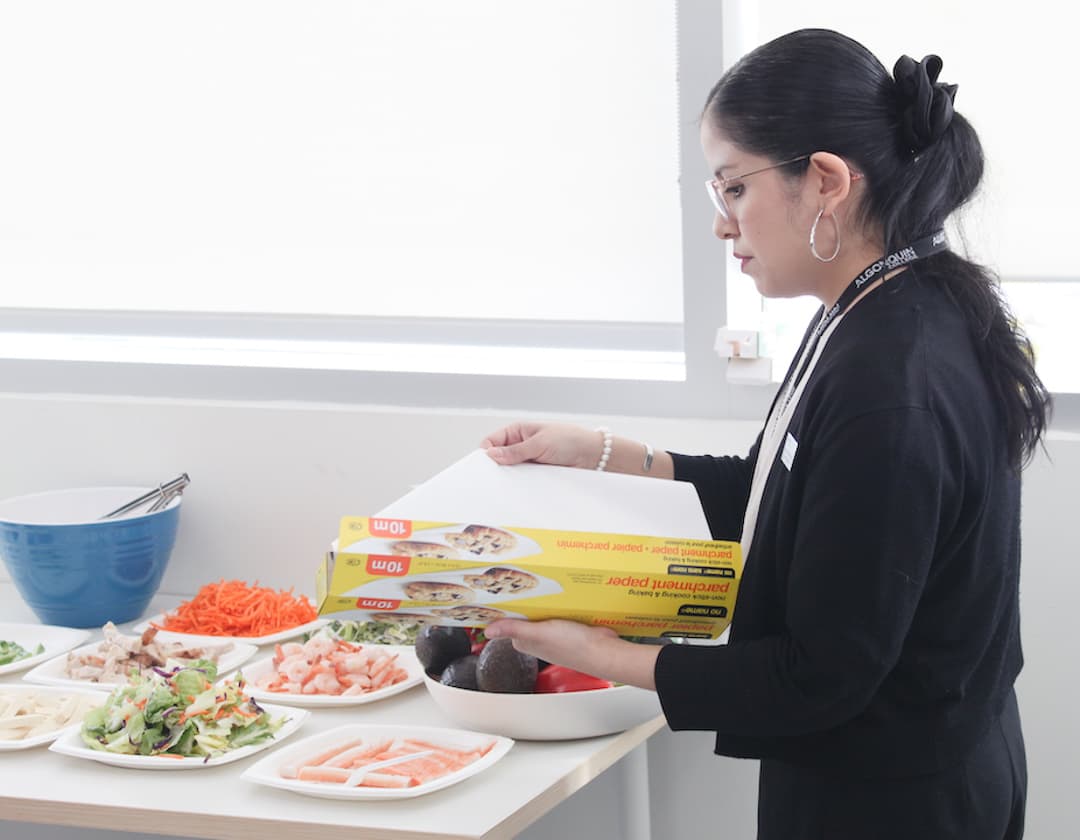
With Hunt’s guidance, students made their own spring rolls with a multitude of ingredients to choose from.

Hunt highlighted the importance of teaching students to put a high priority on living a long and healthy life.

“So that you can live a life well, you want to make sure that you are getting adequate nutrients to support a healthy lifestyle,” said Hunt.

Elizabeth Peña Fernandez, a health promotion coordinator and a key organizer of this event, said that the college is also aware of how effective these workshops can be and how students’ lack of time or knowledge on how to eat well might negatively affect their eating habits.

“Sometimes students struggle a little bit to have a proper and balanced meal. There are different factors that interfere in that, whether that be an economic factor, a time factor or a knowledge factor,” said Fernandez.

“Sometimes students probably want to eat a balanced meal, but they don’t know exactly how to do that, that is why here in the college we try to provide resources to cover these factors in different ways and with different workshops.”

Nader Ibrahim, a business fundamentals student at the college, explained what drew him to the workshop and how his academic commitments have affected his eating habits.

“I was passing by and I smelt the food and I’ll be real with you, I haven’t had a decent meal in about two or three weeks. To eat something that is somewhat healthy kind of made my day a whole better and made up for the five days of not eating very well,” said Ibrahim.

The biggest discovery Hunt has made since beginning her career is that there is a definite sign that people are not getting the necessary sustenance they need.

“People don’t eat enough. I think diet culture is telling people to eat less and to live in a smaller body and then it has the opposite effect where your body goes into starvation for whatever you eat it will hold on to and store as fat,” said Hunt.

Algonquin Times podcast

Stay Informed

Sign up for our newsletter

Subscribe

* indicates required