Purrfect day at Sportsplex as cat club celebrates 20th show

Rows of cages with space-themed decorations on fold-out tables lined a room at the Nepean Sportsplex, with purrs and meows filling the air. Cats and kittens of all breeds and […]
Photo: Mathew Dicsi
Ottawa Valley Cat Club founder and president Kim Monkhouse, posing with her kitty Bruce.

Rows of cages with space-themed decorations on fold-out tables lined a room at the Nepean Sportsplex, with purrs and meows filling the air. Cats and kittens of all breeds and sizes drew eyes as they got judged on their feline features.

The Ottawa Valley Cat Club hosted their 20th annual Ottawa Cat Show at Sportsplex on Sept. 23 and Sept. 24. This year’s theme was cats in outer space.

“There are prizes to be won, games to be played,” said Kim Monkhouse, Ottawa Valley Cat Club founder and president. “Fun to be had by all.”

Stalls selling everything from cat-themed bags to scent-safe candles to cat-sized hamster wheels covered every wall of the hall. Scores from judging were announced at the end of each day.

“Each day represents its own showing,” said Lynne Jette-Hull, vice-president of the Ottawa Valley Cat Club.

Only cats registered to be judged as part of the show and service animals were permitted in the show hall to ensure the health and safety of all cats.

“Being a non-profit organization, we rely on our gate, and money brought in from the raffle tables to pay for the show,” said Jette-Hull.

The Ottawa Valley Cat Club has organized shows every year since 2000, except for 2018, when the show hall lost power due to tornados, and in 2020 and 2021 due to COVID-19.

“We have been donated the grand prize of a two-night’s stay at Chateau Morritt in Mont-Tremblant,” said Jette-Hull. “You must be 21 or older to win the prize. We will be selling tickets to help pay for the repairs of our cages.”

The event hosted games for attendees, activities and numerous stalls from local vendors. Activities included “ID the breed” games, spectators’ choice cat awards and raffles for prizes.

“I’ve been to the one (cat show) last year,” said April Kibzey, owner of cat furniture shop SpockZoltaZoomieWheelz Cat Furniture Emporium. “It was pretty good. This year is much bigger so I’m excited to be part of it.”

Kibzey hosted a stall at the show where she sold cat furniture, from cat trees to jute nests to cat wheels.

“All the proceeds from the cat furniture we make and sell will go to the Save the Vanier Cats rescue,” said Kibzey.


Take a walk (for your own good)

Getting to campus can be a nightmare. From Nepean to Orléans, students are faced with consistently late buses and ever-climbing gas prices. But, there is another often overlooked way. Across […]
Photo: Thomas Gordon
Ottawa stands as Canada's walking capital, with 28.9 per cent of people living downtown choosing to walk to work, according to Statistics Canada.

Getting to campus can be a nightmare. From Nepean to Orléans, students are faced with consistently late buses and ever-climbing gas prices.

But, there is another often overlooked way.

Across Ontario, only 5.3 per cent of people listed walking as their go-to transportation method, according to the Government of Ontario’s 2016 census.

Sure, it might seem a chore. But, as little as 11 minutes of brisk walking per day –– 75 minutes per week –– can reduce your chances of an early death by 23 per cent, according to a study by the University of Cambridge.

With just 11 minutes a day, your chance of developing cardiovascular disease lowers by 17 per cent, and the risk of developing lung, liver, colon and breast cancer decreases by 11 per cent, according to the study.

Aside from physical benefits, the risk of depression is lowered by 18 per cent, according to a study by the American Psychological Association.

Now, if you don’t feel like hoofing it across Ottawa, that’s okay.

Algonquin College hosts weekly Mood Walks aimed at providing students with a social, mental health-focused walk through Algonquin College’s scenic Horticulture Gardens or nearby Centrepointe Park.

During the walks, led by AC counsellor Christina Latifi, students are encouraged to look inward and express themselves with fellow students.

“I truly believe the benefits walking brings us as humans,” said Latifi. “It’s an easy way to be healthy, and an easy way to stay healthy.”

If the great outdoors don’t appeal to you, Algonquin College offers a 346-metre track, winding through the spacious Jack Doyle Athletics and Recreation Centre (ARC).

The track offers three distinct lanes to accommodate all speeds of walking and running.

Mood Walks are available every Monday from 2 p.m. to 3:30 p.m. For more information, click here.

SA puts on Pride resource fair for LGBTQ students

To kick off the Students’ Association’s Pride Week, volunteers organized booths full of resources for LGBTQ students on Sept. 25. Between overflowing pamphlets and business cards, one booth had a […]
Photo: Kit Gervais
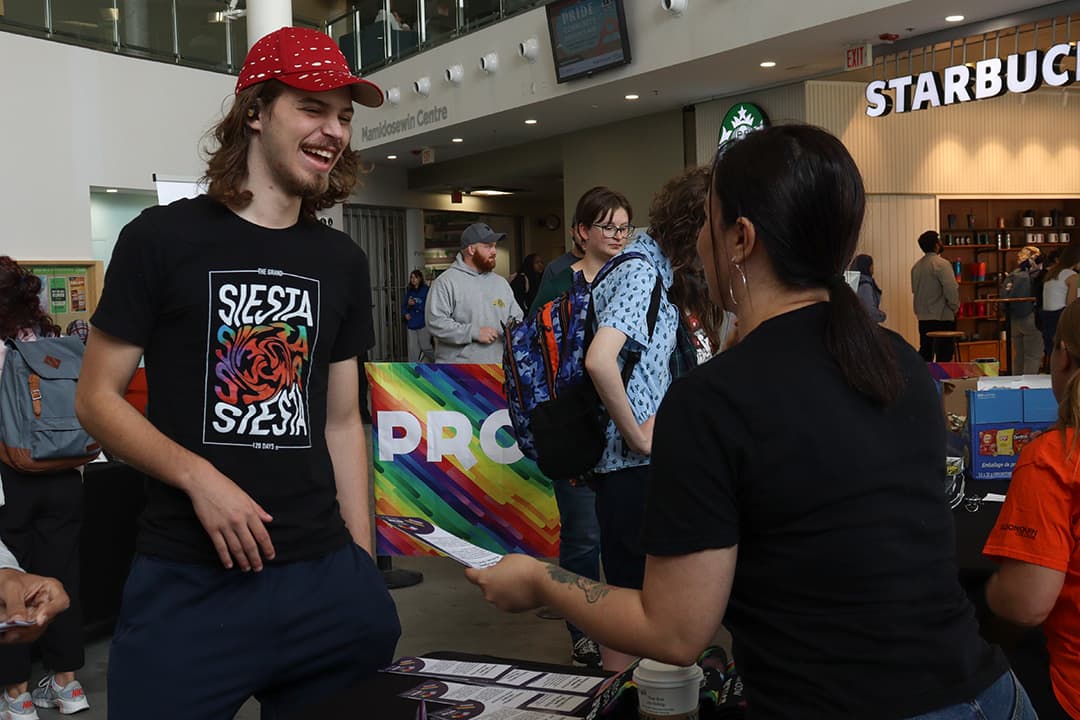
Volunteer Elianne Roy explains LGBTQ resources to Algonquin College student Connor Sunderland.

To kick off the Students’ Association’s Pride Week, volunteers organized booths full of resources for LGBTQ students on Sept. 25.

Between overflowing pamphlets and business cards, one booth had a spinning wheel for Pride-themed prizes: rainbow print Algonquin Wolves jerseys, Skittles and rainbow stickers.

“It’s kind of a fun, interactive thing for students who can come on by and check it out,” said bachelor of commerce student and volunteer Matteo Mongroo.

Students attending the event in the Student Commons said it helped remind them there is somewhere they belong at the college, especially in light of the protests against LGBTQ rights across Canada.

“Yeah, quite frankly, it’s scary. I mean, hearing about the counter-protests, it’s comforting in some capacity,” said applied museum studies student Connor Sunderland, who uses any pronouns.

“Having resources like this can help alleviate some of the fear, people are still looking out for you.”

The event offered many different services, mostly about physical and mental health, and shone light on resources for LGBTQ people outside of the campus community.

One booth in support of the Bruce House, which provides housing and support for those living with HIV, was placed right next to the table handing out at-home HIV testing.

“Our clientele has actually grown so much because of the dire need for (it), like it used to be housing, but now it’s also food and then mental health services, addiction services and even getting in contact with like social services,” said Bruce House receptionist Grace Kelly-Gorman.

She said the goal of coming to the college is to recruit new volunteers, specifically younger students who’ve had a better education on LGBTQ people and are willing to help out.

Other booths took up a more lighthearted space with inclusive clubs — rugby and running.

A volunteer with the Pride Fair, Vanessa Bruneau, and their booth-mate, Leena King, were advertising an inclusive rugby team, the Ottawa Wolves RFC, for anyone wanting to join.

“There’s only five teams in Canada in total that are part of that organization. So we accept anybody who wants to play, regardless of your body size, your sexuality or gender,” said Bruneau.

“Rugby is also a sport that is inclusive to start with because you need different body types to fill positions.”

The running group table, hosted by volunteers Vincent Lemay and Jose Mari Perez, provided an extensive description of the club’s activities like women-specific runs on Friday nights and all-around interest in running, regardless of identity. Anyone wanting to participate is welcome to join the Front Runners Ottawa.

“I think it’s important to show that we are present in our in everyday life and to showcase that we are part of the community, you know, the fabric of this city,” said Perez.

Students can access resources through the college health services for domestic students or WeConnect for short-term therapy sessions. Anyone interested in group resources can head over to the Student Commons for Spill the Tea to have sexuality-specific chats or enjoy other therapeutic activities.

Ticket website crashes ahead of first Dirty Bingo of the fall term

How popular is Dirty Bingo at Algonquin College? The demand from students crashed the website for tickets. The Sept. 7 event took place at the college’s Algonquin Commons Theatre hosted […]
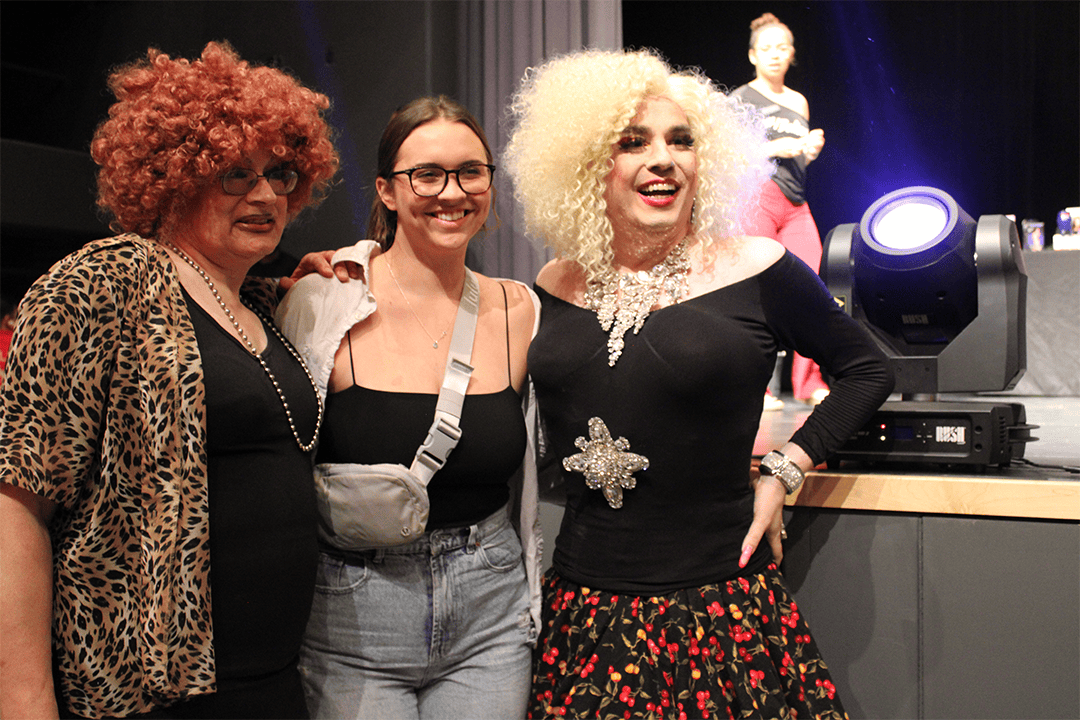
Zelda Marshall and Krystal Caring pose with first-year fitness and health promotion student Jocelyn Brown (middle).

How popular is Dirty Bingo at Algonquin College?

The demand from students crashed the website for tickets.

The Sept. 7 event took place at the college’s Algonquin Commons Theatre hosted by drag queens Krystal Caring and Zelda Marshall and the Students’ Association. Over 400 students were in the theatre.

It is the 12th year of the event being hosted at the college, making it one of the most popular and longest-running events organized by the SA.

This was the first R-rated event for Milo Bernique, a first-year graphic design student.

“I’m here to meet new people,” said Bernique. “This is the first time I am in college, and I know basically no one.”

The event included participation, music and gifts. The highlight of the event was a stuffed penis as a giveaway present.

Caring, who is an Algonquin College graduate from the commercial photography program, explained that the event is a comedy show that allows people to have a good time and loosen up about sexuality.

“I know we’ve had a couple of people from different shows come after the show and say to me like, ‘I play on the football team, and my roommate felt comfortable after your last show to tell me he was gay’,” said Caring.

“I think having drag queens hosting these events, being loud and proud is incredible for the LGBTQ population, as well as they are very inclusive in the way that they talk to students and making sure that the prizes are inclusive of all genders. There is something for everyone and I hope it makes students feel safe,” said Amanda Logan, an event programmer for the Students’ Association.

Caring said that one of the goals of the event was to get people to talk about their sexuality, enjoy themselves and not take everything so seriously.

According to Caring, it’s all about “just being out there, giving the glamour and enjoying each other.”

The next Dirty Bingo is scheduled for Oct. 4 in the Observatory.

Explorer: Ottawa’s new Somalian culture museum is the first in Canada

Somalian bread is generally made out of four types of flour: plain, wheat, self-rising and sorghum. After it’s baked, it looks like the French crêpes. And it’s the kind of […]
Photo: Arty Sarkisian
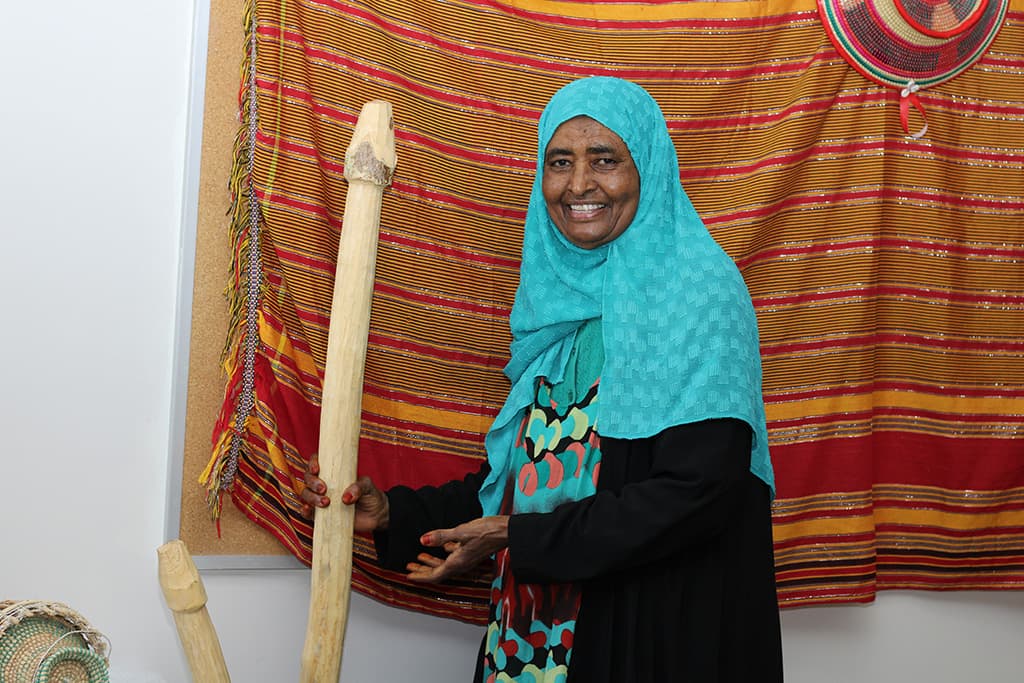
Kaltoun Moussa holding a wooden stick that Somalians use to grind the crops in the new Khayrhaye Museum. "The bottom part is making the grain well." They repeat this phrase like a song while using the grinder.

Somalian bread is generally made out of four types of flour: plain, wheat, self-rising and sorghum. After it’s baked, it looks like the French crêpes. And it’s the kind of thing a Somalian mother would make early in the morning so that the kids would wake up to the fresh bread.

It’s called Lahoh. Or Lahooh. Or Laxoox. Although absolutely untranslatable, this bread is the culture that you can taste at the newly established Museum of Somalian Culture in Ottawa.

Why you should go?

The Khayrhaye Museum is thought to be the first of its kind in Canada. It had its grand opening on Aug. 31 and was opened to the public on Sept. 21.

Everything in the museum was made in Somalia and shipped to Canada over the past six years.

The museum’s goal is to teach the Somalian youth in Canada about their heritage, and also to give other cultures the opportunity to learn and appreciate the Somalian way of life.

What should you do?

For now, the museum is small. But that makes the number of artifacts even more staggering.

The life-size traditional Somalian hut, rugs, musical instruments, clay jugs, wooden stools and a gigantic stone mortar that you might even get a chance to try out.

The museum has a lot to look at. But if you are planning to go there as a group, try calling in advance to let the museum know that you are coming. They might make some traditional Somalian treats special for you.

Who you might meet there?

Kaltoun Moussa is the main creator of the museum along with her son Hersi Osman.

Moussa came to Canada right after the start of the Civil War in Somalia, in 1991. For many years she has been working as a caregiver at senior homes in Ottawa thinking about this project that seemed too huge to ever come true.

Moussa wanted to dedicate the museum to her country as a whole and to her family in particular. “Khayrhaye” is an abbreviation of the names of her four sons, parents, husband, brother and her own. And also it’s a Somalian word meaning “all the good things.”

Kaltoun Moussa and two of her sons Younis Osman (on the left) and Hersi Osman (one the right).
Kaltoun Moussa and two of her sons Younis Osman (on the left) and Hersi Osman (on the right). Photo credit: Arty Sarkisian

Location

Rideau Community Hub on St. Laurent Boulevard.

Hours

The museum is open Monday, Thursday and Friday from 3 p.m. to 7 p.m.

Ticket Price

Adults – $15
Youths age 17 and under – $7

Q&A: Entrepreneur has tips for students about how to save money

One morning in mid-September, three students wearing hoodies and small waist bags, rummaged through big boxes of different electronic gadgets at an Ottawa discount store. Visiting big shopping malls to […]
Photo: Brahim Ait Ouzineb
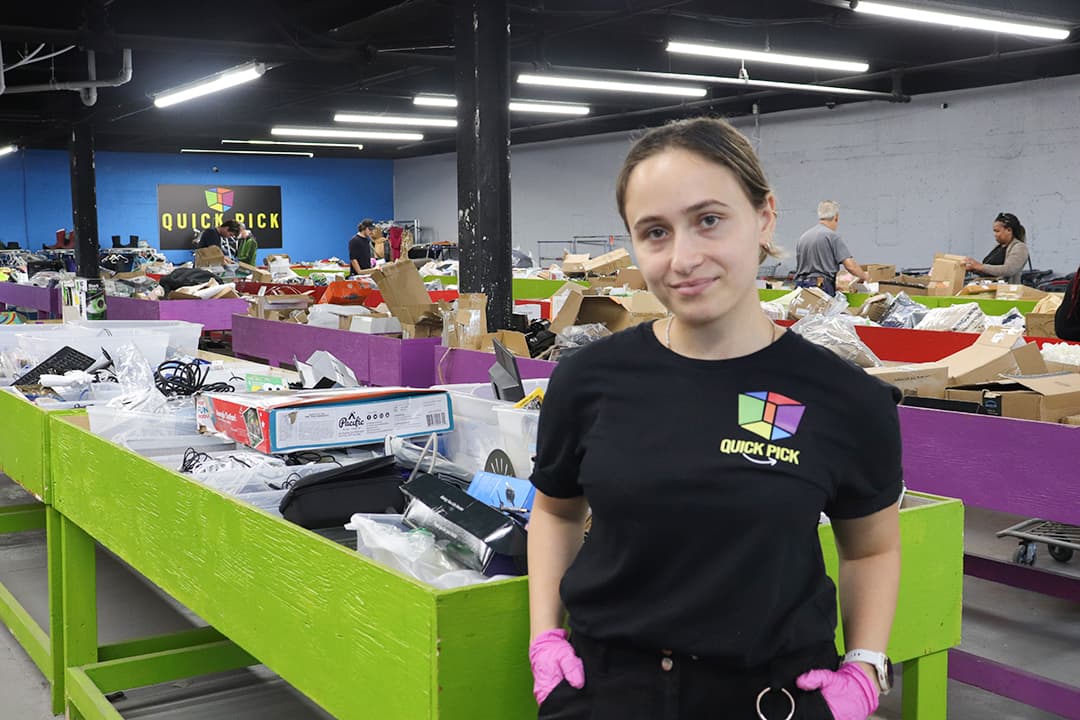
Despite not having any formal experience in the retail business, entrepreneur Nidaa Yassin has already opened seven stores.

One morning in mid-September, three students wearing hoodies and small waist bags, rummaged through big boxes of different electronic gadgets at an Ottawa discount store. Visiting big shopping malls to find deals is not for them.

Loyal customers of Quick Pick, a liquidation store with eight locations in the Ottawa area, sets a fixed price for all freshly stocked bin items. This means shopping there is like a hunt for a treasure amongst the huge pile of boxes of different sizes.

Every day, the price of each item gradually drops from $25.99 to $0.99.

Algonquin College students often visit the closest store to the Woodroffe campus at 2444 Wildwood Ave. There they can purchase items ranging from electronics and clothes to tools, home accessories, beauty products and more. With the rising cost of living, the store is coming to the aid of those in need.

“Many students get their school supplies from here,” says Nidaa Yassin, manager and founder of Quick Pick. Yassin launched her first store in 2021 and it has been growing ever since.

Growing up in business next to her father, Yassin knows the value of every penny. Fame does not interest her but serving her community to the best of her ability does.

Q. How did you start your business journey?

I am a Palestinian but was born and raised in Jordan. I came here for a few years ago. Prior to founding Quick Pick, I took online business courses at various universities and earned several scholarships.

I was inspired by my father and always wanted to be a businesswoman. When I was 10 years old, I travelled with him on business trips. I used to go with him every day to the company.

Q. Do you have any tips about the best deals in your store?

Yeah, for sure. Friday, Saturday and Sunday are the best days after the restocking day. Products are brand new, and the boxes are not ransacked by the first coming customers.

We just added the Free Gift Raffle. Customers who get two products from the bins get to enter a draw. They have the chance to buy premium items for the same amount of money.

It’s better to come the first three days. Although the price is higher, the products are intact. If you’re looking for cheaper stuff – $5.99, $2.99 or $0.99 – come the other days.

Q. Why would you encourage college and university students to come?

Basically, having everything for cheaper prices. Why would you spend money on something when you can actually save? It just calls for patience and a thorough search. For a student these days a penny saved is a penny earned.

Currently, there are no ongoing offers aimed at students, but we plan in October to introduce a 10 per cent discount specifically for students.

Q. What initiatives did you take to reduce costs in these hard times?

Right now, everything is really getting expensive hence the importance of our store.

There are a lot of bin stores in the U.S. which inspired us to open one. We have, of course, our own identity and have different pricing scheme and strategy. That’s why we’re branding and franchising Quick Pick to serve those in need in the best possible way.

Q. What is your favourite customer story?

Honestly, there are a lot of people who come to me saying we sell your products for a living. They would resell these as a side hustle and they would live on that money and that warms my heart.

Q. What are the challenges that you face as a female entrepreneur?

I personally encountered this bias of being a woman at the beginning but my strength and self-confidence helped. I’m determined not to let anyone take advantage of me.

Launching and franchising our business is just the beginning. Until then, I prefer to remain relatively low-key. It’s interesting how most customers assume I’m an employee, and I’m quite content with that.

Looking ahead, my future plans involve working on various innovative business ventures to address gaps in the Canadian market and benefit all communities.

Missed the City Folk Festival? Here are the 5 things you need to know

If you missed celebrating the start of the new school year by attending the City Folk Festival, don’t fear: consider this a reminder to go next year. The festival, which […]
"Every time I see the Arkells, they just get me so fired up," said Liam Powers, a Carleton University student. "My friends and I just start dancing from the moment they come on stage until the moment they leave."

If you missed celebrating the start of the new school year by attending the City Folk Festival, don’t fear: consider this a reminder to go next year.

The festival, which ran between Sept. 13-17, was back in Ottawa for the 29th time. Originally founded as the “Ottawa Folk Festival,” it was inspired by the folk scene in the city.

“The event is modelled on long-standing major Canadian festivals and features multifaceted artistic disciplines and an inclusive programming philosophy,” according to the City Folk website.

Here are the five things you need to know about this year’s festival:

1. Busty and the Bass are the band to get a festival up and going

The band started the festival on Sept. 13 and according to some fans, they were the perfect ones to get the festival started. “I really enjoyed the way those guys started the evening for us,” said Shana Parsons, a student at Algonquin College. “It was an interesting type of music and really started the night off right.”

2. Ever need to feel so strong you could run through a wall? The Arkells could help you get there

To close out the show on Sept. 14 CP, the Arkells performed and had an impact on fans. “Every time I see the Arkells, they just get me so fired up,” said Liam Powers, a Carleton University student. “My friends and I just start dancing from the moment they come on stage until the moment they leave.”

3. Fortunate Ones are the reason that the festival is called the City “Folk” Festival

The band was the last performance of the evening on Sept. 15 and some students said they were very impressed. “I hadn’t listened to the Fortunate Ones before, but I really enjoyed their music,” said Mckenzy Walker, a hairstyling program student at Algonquin College. “It was very folky and I really hope they come and play next year.”

4. Canadian music is alive and well and Kristine St-Pierre is a Canadian star

St-Pierre opened the Sept. 16 show and showed everyone that folk music can be written by a Canadian and sang perfectly by one as well. St-Pierre was nominated for a Canadian Folk Music award in 2018 and is currently working on her fourth album that she plans on releasing soon.

5. Hozier needs to play at the City Folk Festival every year

Hozier made his name in 2013 when releasing his hot single “Take Me To Church” and students at this years festival were loving it. “I remember when that song first came out, I would listen to it all the time,” said Will Rice, a Carleton University student. “I really hope he comes back and plays again next year.”

City Folk has confirmed they will be back next year and the dates will be determined at a later time.

Climate zone: while some hands on campus are damp, waste has been reduced

Students and staff at the Woodroffe campus do not all have a case of jazz hands: They are flicking their dripping hands and wiping them on their clothing after washing […]
Photo: Kerry Slack
Students risk being late for class while taking the time to blow dry their hands. On some machines, it can take more than a minute and a half to get to dry digits.

Students and staff at the Woodroffe campus do not all have a case of jazz hands: They are flicking their dripping hands and wiping them on their clothing after washing them in the bathrooms.

The wet handprints on everyone’s jeans are indicative of valuable savings: savings to the environment, to labour and with money. All three Algonquin College campuses are cutting waste by changing the way we dry our hands.

Paper towels are not recyclable paper which means they were all going to landfills.

At the Woodroffe campus, hand paper towels alone represented 44,200 garbage bags last year that went to landfills.

“The college is not only avoiding costs with less garbage collection but this initiative also supports our goal of reducing waste,” said Ryan Southwood, executive director of Facilities Management on campus.

Costing $44.69 per case, removing paper towels from the campus bathrooms has saved the campus a lot of money.

In 2022 the college spent $190,000 on paper towels and related labour costs.

That’s $96,100 in paper and $ 93,900 in labor-related costs per year at 313 days of campus life.

Additionally, 60 hours per week of labour costs are saved on restocking, removing and replacing garbage bags in the 170 bathrooms on campus. That’s 26 hours removing waste and 34 hours spent replacing paper towels. (Note: all of the previous numbers refer to the Woodroffe campus alone.)

Patrica Thome, supervisor of custodial and grounds operations shared a fun fact:

“The Woodroffe campus was using approximately 2900 kms of paper towel in a year,” said Thome. “That’s the distance from Quebec City to Miami.”

For some, however, there are some downsides to the move away from paper towels.

Reagan Mellan, a second-year culinary management student who has taken her Canada Safe Food Handlers course, understands the importance of proper hand washing and drying.

“We wash our hands every time we walk into the lab anyway but it is a lot more sanitary to use paper towel than a hand dryer,” said Mellan. “When we come through doors we touch them, contaminating our hands again.”

More fun, random numbers – because who doesn’t like random number facts?

Based on this reporter’s informal survey of several older-style hand dryers – the ones with the silver nozzles – at several locations around campus, it takes approximately 45 seconds for one dry cycle. It thus takes three rounds of drying to effectively dry one’s hands.

But replacing the old dryers is not as simple as it seems, explained James Hopkins, associate director of facilities engineering, operations and maintenance. In keeping with the spirit of reducing waste, the old ones still in place won’t be thrown away as long as they are functional.

The cost of replacing the dryers in the older buildings is approximately $1,000 in labour alone. This amount includes the cost of replacing the circuits from the panel. And in the older buildings on campus, the capacity of the electrical panels is lower than it is in the new buildings, hence the older hand dryers.

The Algonquin Times also conducted an informal study where this reporter stood outside three bathrooms on campus and listened to 100 students at each. The findings?

Most students don’t even bother to stop to dry at all.

In the DARE District near the Maker Space, 28 students used hand dryers while 72 did not.

In the B-building near room B165, 24 students used the dryers while 76 did not.

In the ACCE-building near the level one entrance, 38 people dried while 62 did not.

The decision to remove the paper towels comes with big ecological and fiscal savings. So digit-drip seems to be something community members will have to get used to.

Perhaps it’s time to pack a hand towel in our bags?

Sunshine and soccer make a bright start for the intramural season

A sunny Thursday at Algonquin College had the sports field full of eager students in sports gear ready for the season’s start of intramural sports. Campus recreation coordinator Stephanie Rheaume […]
Photo: Rebekah Houter
Liam Holtzhaver (left) and William Wafo (right) fight it out during the first soccer game of the season.

A sunny Thursday at Algonquin College had the sports field full of eager students in sports gear ready for the season’s start of intramural sports.

Campus recreation coordinator Stephanie Rheaume stood with clipboard in hand on the sideline keeping score for the players on the field.

She said it’s the busiest time of year as everything is starting up after the summer break.

“This is our soccer intramurals,” Rheaume said, gesturing to the soccer players in their bright jerseys running by. “This is actually our first year doing it outside.”

All sports were originally held inside of the Jack Doyle Athletics and Recreation Centre, but soccer moved outdoors for the first time this year for more space, a move Rheaume says the players have been happy about. She jokes people have been enjoying not running into walls.

The sports offered for intramurals are co-ed, open to all part-time, full-time, and online students and host roughly 600 to 800 students per semester depending on what is offered, according to Rheaume, herself an Algonquin College graduate of the rec and leisure program.

As intramurals at Algonquin College have been running for roughly 45 years, Rheaume says it’s time to expand into other types of activities. A first-time bowling league is one of the first changes happening, with a one-day pickleball, badminton, and table tennis tournament also in the works.

And the most requested sports not currently offered? Ice hockey and cricket.

“We do want to do cricket again. We do want to bring back ultimate frisbee,” Rheaume said. “We talked about doing baseball just so we would be off campus. We used to do a hockey tournament as well, so there are definitely ideas.”

The future plans for expansions also include expanding existing sports into competitive and non-competitive teams, depending on how many players sign up.

Soccer, basketball, volleyball, ball hockey, and bowling are offered this fall, with volleyball and soccer being the most popular. Wintertime sees more sports offered in the dome, such as touch football and ultimate frisbee.

Emeric Wall races for the soccer ball during the first game of the season.
Emeric Wall races for the soccer ball during the first game of the season. Photo credit: Rebekah Houter

Thomas Poulin from the electrical technician program says it’s a fun time even though people don’t always follow the rules, like not showing up when the game is supposed to start or entering the playing field from the corner instead of the middle as the rules state.

“Disappointed that three people on my team didn’t show up, and one didn’t show up till halfway through the game. That makes it kind of hard when you don’t have any subs,” Poulin said.

Having played soccer for three semesters during his time in the business administration program, Denzel Manzi says his advice for those looking to join up is to register early, whether that means talking to classmates or signing up by yourself.

“Find the team early, which may be tough because you don’t know who is in your class, or if it’s completely new people who don’t know how to play,” Manzi said. “Sometimes you have to look around for someone familiar you know.”

Manzi added, “But it’s all good fun. I came here, I didn’t have a team and I just wrote my name down to (a new) team.

“I just like the game so getting to play is nice because usually, I don’t know, everyone has a tight schedule, but it’s nice just taking your mind off of classes.”

The winter intramurals registration date has yet to be announced, but drop-ins are welcome for open badminton and volleyball on Mon. and Tues. for the rest of the semester at the ARC.

Crabapple-picking events on campus bring out students and faculty

Crabapples filled the trees, and the ground was covered in them. Students and faculty gathered to pick small crabapples on campus Sept. 14 just outside the B- building near parking […]
Photo: Linda Verreault
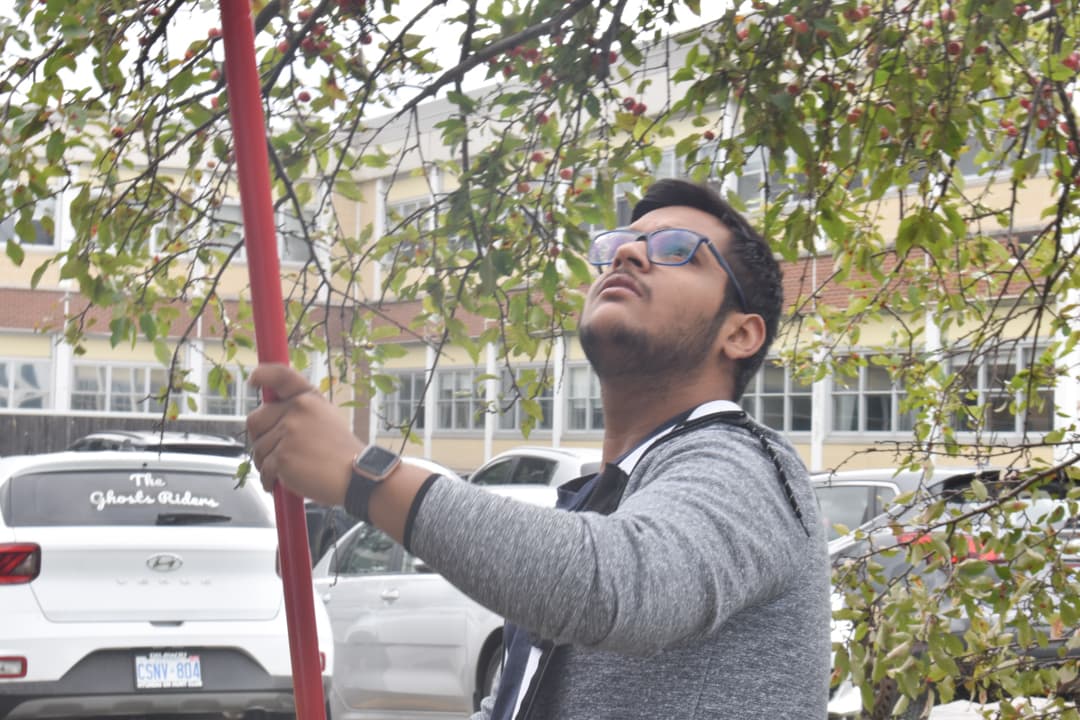
Eshaan Bansal volunteered to pick apples for the culinary student program to reduce waste.

Crabapples filled the trees, and the ground was covered in them. Students and faculty gathered to pick small crabapples on campus Sept. 14 just outside the B- building near parking lot 1.

These tiny apples were a handful to capture as attempts were made to reach them with apple pickers.

The devices used were long adjustable metal poles, with a basket attached at the end. The tiny apples slipped through the baskets as pickers gathered them and landed on their heads. But this did not deter any attempts to capture them.

The crabapple picking event was held for the first time this year. The event was created by the volunteer center and the Facilities Management team to help clean up and reduce waste from the fallen apples, while reducing the presence of bees and wasps.

The college is hoping to make it an annual event. Two previous events were held on Aug. 31 and Sept. 7.

“As you can see, we have an abundance of crabapples available on site,” said Amanda Barr, grounds coordinator. “In the past, they’ve just been allowed to fall and rot and it’s quite a waste of resource so we’re trying to leverage that we’re actually having these apples donated to our culinary department.”

Carol Ann Mahoney - Volunteer Centre 
Amanda Barr - Grounds Coordinator 
Arlen Findley - Horticulturist
Carol Ann Mahoney of the volunteer centre,
Amanda Barr, the grounds coordinator, and
Arlen Findley, a horticulturist, all took part in the event on Sept. 14. Photo credit: Linda Verreault

They were able to collect over forty bags of ten pounds each of apples.

“They’re beautiful apples and actually, the bigger ones are quite tasty compared to smaller apples that are more sour and more bitter,” said Barr.

“Some students stayed for an hour, some stay for 20 minutes between classes just to get some fresh air and some sunshine and a break,” said Carol Ann Mahoney, community engagement officer with the AC Hub.

Students and faculty can register with the volunteer center and whenever there are activities and volunteer opportunities they get contacted through email.

Eshaan Bansal, 18, a student in the computer system technician program, heard about the event from the volunteer center and decided to participate.

“I don’t know anything about apples trust me if I am taking them home, I am wasting them,” said Bansal.

He decided to help collect them for the culinary program.

Sara Cherif, 37, a student in the autism and behavioural studies program also participated.

“I like volunteering and I love nature,” said Cherif. She was also going to take some home to make jam or a dessert. Cherif is going to get her mom to teach her how to make some jam as all her aunts make jams, like strawberry and orange.

Andrew Skorzewski, an instructor in the culinary arts program, is one of the chefs involved in this initiative.

“Last week we cooked and strained about 150 pounds of crab apples producing 40 liters of apple sauce,” said Skorsewski. “This week we are cooking it all up and should end up with about 25-30 liters of finished product.”

The products should be available for sale at Savoir Faire on campus shortly.

Algonquin Times podcast

Stay Informed

Sign up for our newsletter

Subscribe

* indicates required