A high-energy game that saw many chances for both teams ended in a 3-1 win for the Algonquin Wolves against the St. Lawrence Surge on Oct. 3 in Ottawa. This […]
Stephen Priel
Photos: Stephen Priel
October 6, 2023 Revised: January 30, 2024 3:36pm
Photo: Stephen Priel
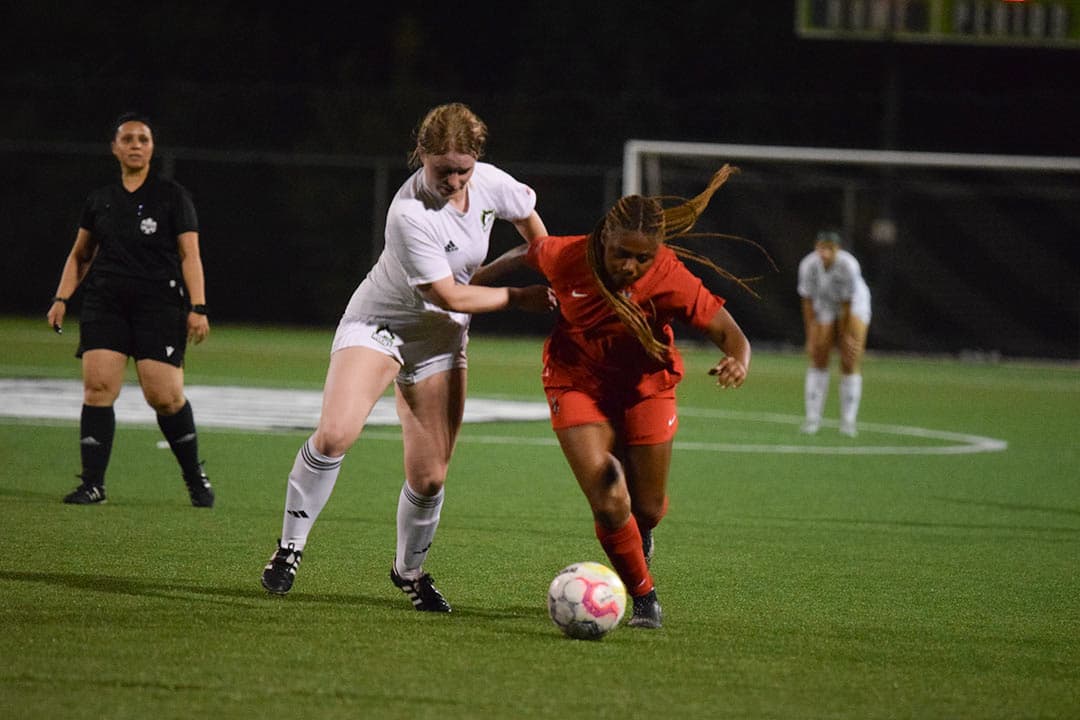
Algonquin Wolves celebrate Nada Ghadban's opening goal of the game on Oct. 3.
A high-energy game that saw many chances for both teams ended in a 3-1 win for the Algonquin Wolves against the St. Lawrence Surge on Oct. 3 in Ottawa.
This was the Wolves’ last home game of the regular season and they finished with a home record of three wins and two losses.
The Wolves had a great start, taking an early lead thanks to winger Nada Ghadban, who scored her fourth goal of the season. Ghadban was grateful to help her team succeed and move past the loss against Seneca.
“I think we collectively forgot about that game and told ourselves that we were going to move on and learn from it. I think we had a plan and executed it and we did very well,” said Ghadban.
The Wolves conceded an equalizer midway through the first half after a defensive mix up which the Surge took advantage of.
The Wolves responded well and they earned a well-deserved penalty. Wolves midfielder Lisa Hartill, stepped up and confidently scored the penalty to give the Wolves a 2-1 lead as they headed into halftime.
It seemed either team could win at the start of the second half.
The Wolves remained confident their confidence was rewarded when Cayla Latimer’s 87th minute shot took a fortunate deflection and found its way into the goal to make it 3-1 for the Wolves.
Assistant coach Stephen Ball expressed his satisfaction with the victory but acknowledged that it hadn’t been a straightforward one.
“We had a lot of early opportunities that I thought if we capitalized on them would’ve changed the complexion of the game. I think the longer they stayed in it a little bit of panic entered into our own game and I think getting that third goal settled us down again,” said Ball.
The Wolves will take their 4-3-1 season record into their next match on Oct. 6 against Loyalist at the Belleville campus.
A special performance took place on Oct. 1 at the Algonquin Commons Theatre celebrating the traditional Chinese Mid-Autumn Festival, as well as the 53rd anniversary of Canada-China diplomatic relations. China’s […]
Mingan Wang
Photos: Mingan Wang
October 5, 2023 Revised: January 30, 2024 3:36pm
Photo: Mingan Wang
Nepean MP Chandra Arya (left) talks with China's ambassador to Canada, Cong Peiwu, on Oct. 1 at the Algonquin Commons Theatre.
A special performance took place on Oct. 1 at the Algonquin Commons Theatre celebrating the traditional Chinese Mid-Autumn Festival, as well as the 53rd anniversary of Canada-China diplomatic relations.
China’s ambassador to Canada, Cong Peiwu, told the audience in his opening remarks that the two countries need to “seek common ground.”
The two nations’ relations are strained due to political disputes. However, the event showcased a break in the clouds.
“China will stay committed to upholding the policy of peace,” said Cong. “We do hope the Canadian side will work with the Chinese side, towards the same direction, (to) improve bilateral relations on the basis of mutual respect and equality.”
Nepean MP Chandra Arya echoed Cong’s comments.
“We have to look forward to how to improve the diplomatic relations between Canada and China, which is slightly under stress today,” said Arya.
“Ambassador Cong is a wonderful representative of the People’s Republic of China,” said Yuen Pau Woo, Canadian senator from British Colombia. “He’s sincere in his efforts to try and build stronger relations. He is willing to listen to anyone that speaks sincerely to him about the challenges in the Canada-China relations.”
Woo added, “We in Canada have to reciprocate by finding solutions on our side, so that both sides can find a way to resume high-level discussions and dialogues, deeper trade and investment.”
Kevin Wu, a member of the audience who traveled from Kanata for the performance, said he hopes Canada and China could work together to mend their relations.
“I don’t see a reason why Canada and China can’t get along,” said Wu. “I think the two countries should let differences aside and co-operate where they can. After all, no one benefits from conflicts and confrontations.”
Hosted by the Canada-China Culture and Art Association, the event featured 15 programs, ranging from traditional Chinese opera to ethnic dancing performances.
Jenny Shen, the lead of the dancing team Style-out, which performed the opening dance, said she was “beyond satisfied” with her team’s performance.
“I do think we could’ve done more in terms of marketing,” said Shen. “We were expecting more audience, but overall I’d say we put up a fantastic show tonight.”
Woo felt the same way.
“The event is wonderful. I’m so impressed by the performance,” said Woo. “While they’re amateurs, the performances were so professional.”
Ruolong Tang, the director of Ottawa-Beijing Association who provided support for the event, said he was glad to see all the guests attending the event.
“The event was a big success, and I’m delighted to see the MP Chandra Arya, Senator Yuen Pau Woo and Chinese ambassador Cong Peiwu joining us tonight.” said Tang.
“There are some difficulties in the current Canada-China relations, but I believe they will all be overcome given some time,” Tang added.
The Algonquin Wolves men’s soccer team lost 4-0 against the unbeaten George Brown Huskies on Sept. 30 in Ottawa. The Wolves didn’t have a particularly bright start to the game. […]
Stephen Priel
Photos: Stephen Priel
October 4, 2023 Revised: January 30, 2024 3:36pm
Photo: Stephen Priel
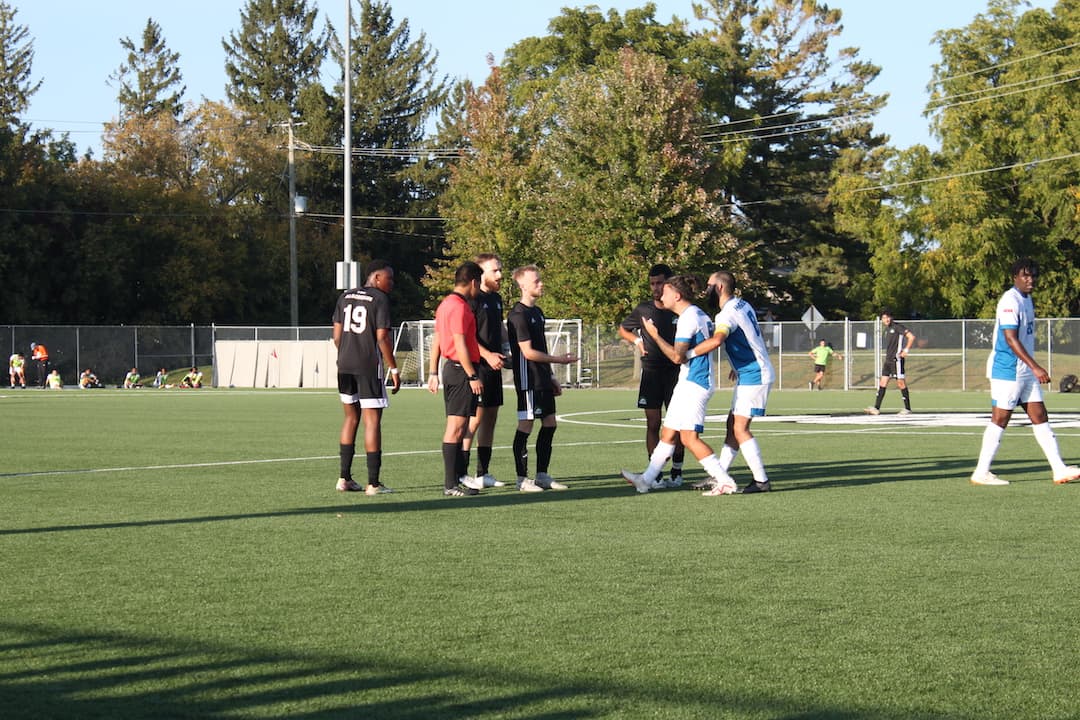
George Brown Huskies midfielder Julian De Sousa argues with Algonquin Wolves midfielder Oscar Foward after his teammate Matthias Broomes got a red card on Sept 30.
The Algonquin Wolves men’s soccer team lost 4-0 against the unbeaten George Brown Huskies on Sept. 30 in Ottawa.
The Wolves didn’t have a particularly bright start to the game. The first half was dominated by George Brown. The Wolves had very little of the ball in the first half and were unable to string more than four passes together before the ball got intercepted.
“I think we were fatigued as we had a tough game the night before against a very strong Seneca side. We put a lot of effort into that one and then come back to 14 hours later with not much recovery to play against another strong side in George Brown” said Wolves captain Cristian Aviles-Molina.
“It was a big ask from us, as at the end of the day you could see who had the fresher legs, you could see who in the end wanted it more,” said Aviles-Molina.
The way the game had started is also how it would end up going into halftime. The Wolves were down 2–0 due to two self-inflicted mistakes in defence and were never really able to get into gear with only one shot on target in the opening 45 minutes.
The Wolves did pick up their intensity in the second half with the help of some half-time substitutions. The confidence started to build for the Wolves who were attacking well in George Brown’s half of the field, but were unable to connect that final pass that could lead to a goal.
George Brown took advantage of the lack of goal-scoring ability from the Wolves and scored two more goals in the 52nd minute and the 78th minute to put the match beyond doubt.
Despite the damaging loss for the Wolves, who hadn’t lost a game going into this weekend, defender Kerim Tosun had a level-headed and rational opinion on this game.
“To be honest I don’t think there are many positives that we can take away from it. Maybe one is that for a mentality aspect of the game is that George Brown is a very strong team, everyone knows that, but it shows that we can actually play against them and actually compete and battle for new things this year and reach higher goals,” said Tosun.
Aviles-Molina pointed out what he will do in the future as a leader of the team to overcome obstacles and set the right example.
“I think individually to improve as a leader (and) as the captain probably to motivate my team better and to push through these barriers and these tough moments against these tough teams,” said Aviles-Molina.
“To uplift us, to keep us going, to keep us pushing, even when the result may not be going our way to at the very least keep our spirits high and give 100 per cent even when were down 2-0, 3-0, 4-0,” said Aviles-Molina.
Finding a place to call home can be challenging in today’s economy, but for asylum-seekers coming to Canada for refuge, the barriers can be insurmountable. Working to ease the transition […]
Meg Wall
Photos: Brynn Brieda, Matthew House Ottawa
October 4, 2023 Revised: January 30, 2024 3:36pm
Photo: Brynn Brieda, Matthew House Ottawa
Established in 2010, Matthew House believes in going beyond housing for those seeking asylum and striving to create new beginnings.
Finding a place to call home can be challenging in today’s economy, but for asylum-seekers coming to Canada for refuge, the barriers can be insurmountable.
Working to ease the transition period for those applying for refugee status in the Ottawa area, Matthew House Ottawa is a local not-for-profit organization in College Ward offering refugee assistance for those with nowhere else to turn.
Modelled off of an organization of the same name in Toronto, Matthew House was established in 2010. Its mission is to provide transitional housing and refugee settlement assistance within the Ottawa area for refugee claimants who have come to Canada without any form of assistance from family, friends or the government.
“Our clients with the Refugee Services program are only the refugees who are coming into Canada with no other sponsorship,” said Brynn Brieda, fundraising and communications coordinator of Matthew House Ottawa.
“They don’t have a sponsorship family who’s helping them set up here. They basically cross the border with absolutely nothing, and are most of the time homeless.”
Just last year, Matthew House provided shelter, food and settlement assistance to 79 refugee claimants in Ottawa, as well as furnished 1,040 homes through their Furniture Bank program, where newcomers, low-income families and teenagers aging out of the foster care system can receive donated furniture and houseware.
Despite that achievement, the organization’s beds are always full.
“As soon as someone moves out, we take someone from the waitlist and move them in immediately,” said Brieda.
In 2022, Matthew House fully furnished 1040 homes and provided support to 79 refugee claimants. Many of their clients come from sub-Saharan Africa. Photo credit: Brynn Brieda, Matthew House Ottawa
The Refugee Services program operates in two segments. When a client receives the call to say they are off the waitlist, they will be placed at a reception home where volunteers are on site 24/7 to help the newcomers adjust. After two-to-three months, if the client is still in need of support, they are moved to a transition home where assistance remains available, but is not on site.
In Ottawa, Matthew House has 13 housing locations — three reception homes and 10 transition homes — across the city, currently occupied by around 100 residents.
Even then, the organization has to turn away at least five referrals per week.
University of Waterloo pre-law student Maheer Mubtasim, who began his four-month co-op program with Matthew House last month, has found the process “really rewarding.”
“My job is to help them,” said Mubtasim. “So when I help them with something, they’re so grateful for it. It fills my heart. What I did for them, didn’t make a difference to me. But for them, I made a difference in their life.”
As of August, Canada had processed over 80,000 applicants from asylum seekers in 2023, a nearly 52 per cent increase from last year’s same time frame, according to Immigration, Refugees and Citizenship Canada.
College Ward city councillor Laine Johnson, who advocated for affordable housing in her 2022 municipal election campaign, says there is “good energy” in the political area of creating more affordable housing.
“So what I’ve been advocating to the mayor is that the solutions are in the community that Matthew house is able to scale up,” said Johnson.
“The city just needs to be putting themselves in a position to say yes.”
Orange rocks stood their ground all over, reminders of what the week embraced: strength, courage, fortitude, but most of all, remembrance of the children of Indigenous communities all over this […]
Kerry Slack
Photos: Kerry Slack
October 3, 2023 Revised: January 30, 2024 3:36pm
Photo: Kerry Slack
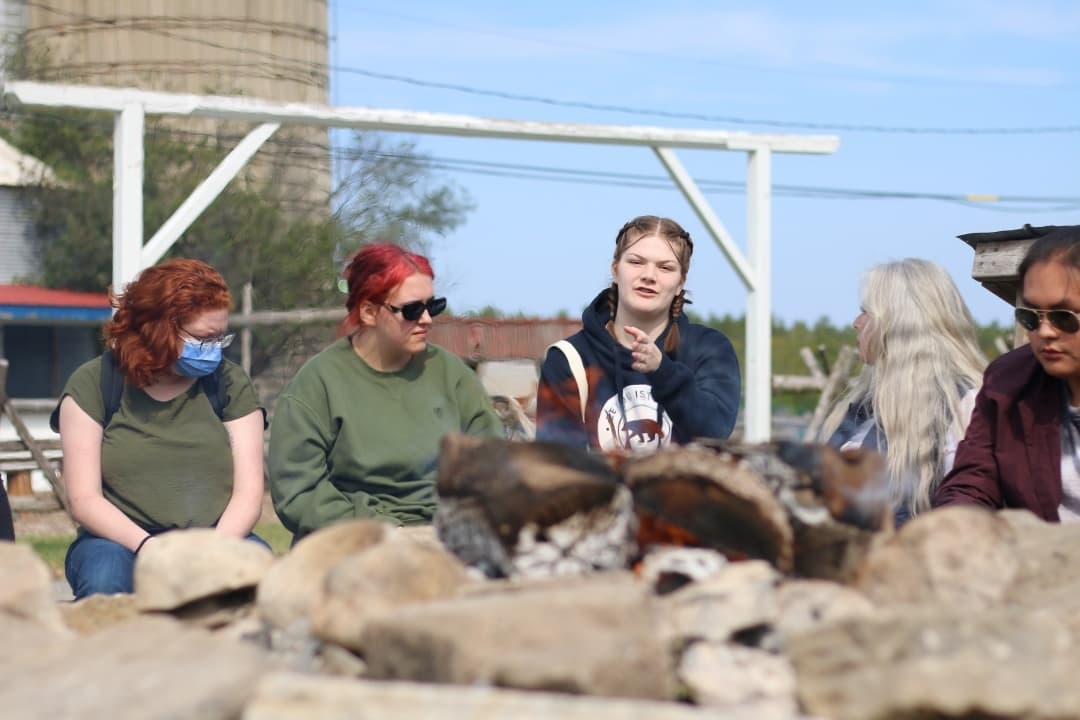
The Aboriginal studies and Pathways to Indigenous Empowerment groups bonded by a fire at Madahoki farm on Tuesday, Sept. 24. 2023
Orange rocks stood their ground all over, reminders of what the week embraced: strength, courage, fortitude, but most of all, remembrance of the children of Indigenous communities all over this land.
Each rock is a reminder of a child who never made it out of the residential school system. A reminder of the trauma left behind.
The cool temperature on the Tuesday morning of Truth and Reconciliation Week did not chill the inclination to get out on the land and share culture, stories and great food.
Nineteen students from the Aboriginal studies program ventured out to Madahoki Farm for a land-based learning day.
Madahoki Farm, which is located just southwest of Algonquin College on Hunt Club Road, offers land-based cultural and culinary programming, event space, powwow grounds, hiking trails and a year-round riding arena.
After over 20 years of cultural programming on Victoria Island, Indigenous Experiences acquired the 164-acre property, formerly the Lone Star Ranch.
The farm is the new home for a series of Indigenous events celebrating the seasons: Sīgwan (spring), Tagwàgi (autumn) and Pibòn (winter) and the annual Summer Solstice Indigenous Festival formerly held at Vincent Massey Park.
Madahoki is the year-round home of an Indigenous marketplace that promotes products made by Indigenous makers and artisans as well as the permanent home for a growing herd of endangered Ojibwe Spirit Horses.
Photo credit: Kerry Slack
Students started the day with teachings and a song with the cultural director, Awema Tendesi, who welcomed the group with songs, cultural teachings and general farm rules.
“It touched me when he (Tendesi) sang to welcome us,” said Aboriginal studies student, Anika Lachance. “It made me tear up a bit.”
The autumn sun brought a gorgeous day, with the group moving outside for teachings about the Ojibwe Spirit Horses, followed by free time to roam the farm, see the horses and other animals and walk the trails.
“I have a special connection to the land and to the animals,” said Dawson Lemire, an Aboriginal studies student. “It’s been a great day outside of class.”
A traditional lunch of soup and bison meatballs with wild rice and balsamic reduction was served by the catering staff while the culture experience team lit a fire.
The eclectic group of students bonded by the fire before learning protocol and how to enter a teepee.
Star Beaudoin shares some childhood memories with the group. Photo credit: Kerry Slack
The Aboriginal studies program has been missing these types of outings since the beginning of COVID-19.
“Land-based learning trips are integral, not only to share and learn culture, but to build bonds and create safe spaces for learning,” said Marina Westbrook, program director of Aboriginal studies.
Madahoki Farm has a strong connection with Algonquin College. Tendesi, who has been speaking at events since the age of eight, attended the college in the Aboriginal studies program.
“The course opened my view to Indigenous issues in North America, where it stems from, how it affects Indigenous people and how/what steps I can take to fix these issues at home as well as off-reserve,” said Tendesi.
In June, 95 Algonquin College volunteers helped the farm prepare for the Summer Solstice Festival, doing physical labour such as laying mulch, raking the heritage trail and making new bird feeders and chicken coops to prepare the grounds to receive thousands of visitors throughout that week.
“The school trips and tours, in my opinion, are the first baby step when it comes to reconciliation. Coming and learning about the culture is a very good starting-off point. But I do stress that this is in fact a tiny first step towards reconciliation,” said Tendesi.
“We encourage everyone who visits the farm to go out and do their own research about more complex Indigenous issues as well as go out and create those relationships with Indigenous communities and Indigenous organizations in their area.”
In an epic yet disappointing showdown, the Algonquin Wolves ended their five-game winning streak, taking their first loss of the season against the Seneca Sting 2-1 on Sept. 29 in […]
Sahlym Florestal
Photos: Sahlym Florestal
October 3, 2023 Revised: January 30, 2024 3:36pm
Photo: Sahlym Florestal
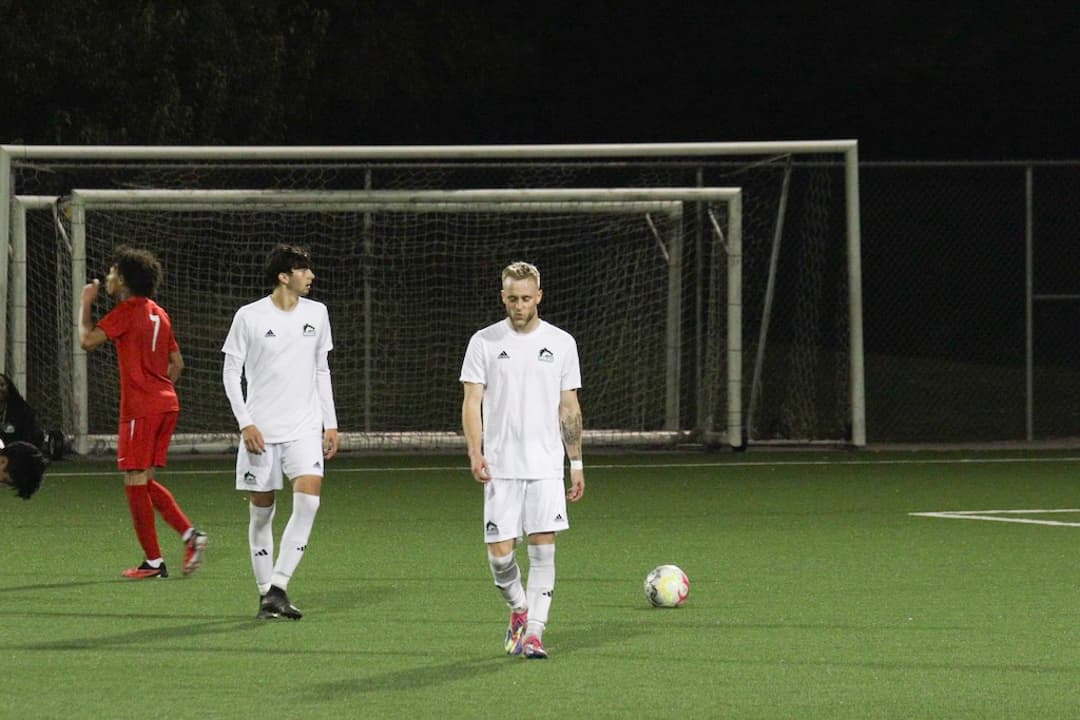
Oscar Forward walking off the field after the Wolves first loss of the season on Sep. 29.
In an epic yet disappointing showdown, the Algonquin Wolves ended their five-game winning streak, taking their first loss of the season against the Seneca Sting 2-1 on Sept. 29 in Ottawa.
After dominating the first half by keeping the ball and pressuring the Sting’s defence, the Wolves took the advantage thanks to Mecheri Mohammed Houssam, who opened the score with his right foot on an assist from his centre-back Kerim Tousan in the 35th minute.
With an equalizer caused by a defensive mistake, Seneca was looking hopeful as they took the momentum from the Wolves’ thanks to Rashad Griffith in the 76th minute.
The game went back and forth and looked like it would end in a draw, but the Sting managed to take the advantage at the 89th minute. This left the Wolves stunned, chasing for a last-minute equalizer that never arrived.
Post-game, in an assessment of the team, Wolves’ coach Angus Wong expressed a mix of pride and disappointment.
Mecheri Mohammed Houssad dribbles past Seneca's players. Photo credit: Sahlym Florestal
“The performance overall was good. The guys didn’t lack in effort. Obviously, we had some costly mistakes. But all in all, I think we’re progressing in the right way. We made some mistakes and did not get the result today,” said Wong.
Oscar Forward, the holding midfielder for the Wolves, also expressed his thoughts on the game.
“The first half, we did great. The second half, when we conceded, we didn’t know how to react,” said Forward.
Although the Wolves are facing a setback, coach Wong is confident the team will bounce back.
“In two weeks, the next time we’re facing them, we’ll just be a little bit sharper, a little bit better at doing the things we do,” said Wong.
Squash, beans and corn are sisters. When planted together, they grow and support each other as any good sisters would. Corn supports bean’s. Beans give corn nitrogen, fertilizing it. Squash […]
Arty Sarkisian
Photos: Arty Sarkisian
October 3, 2023 Revised: January 30, 2024 3:36pm
Photo: Arty Sarkisian
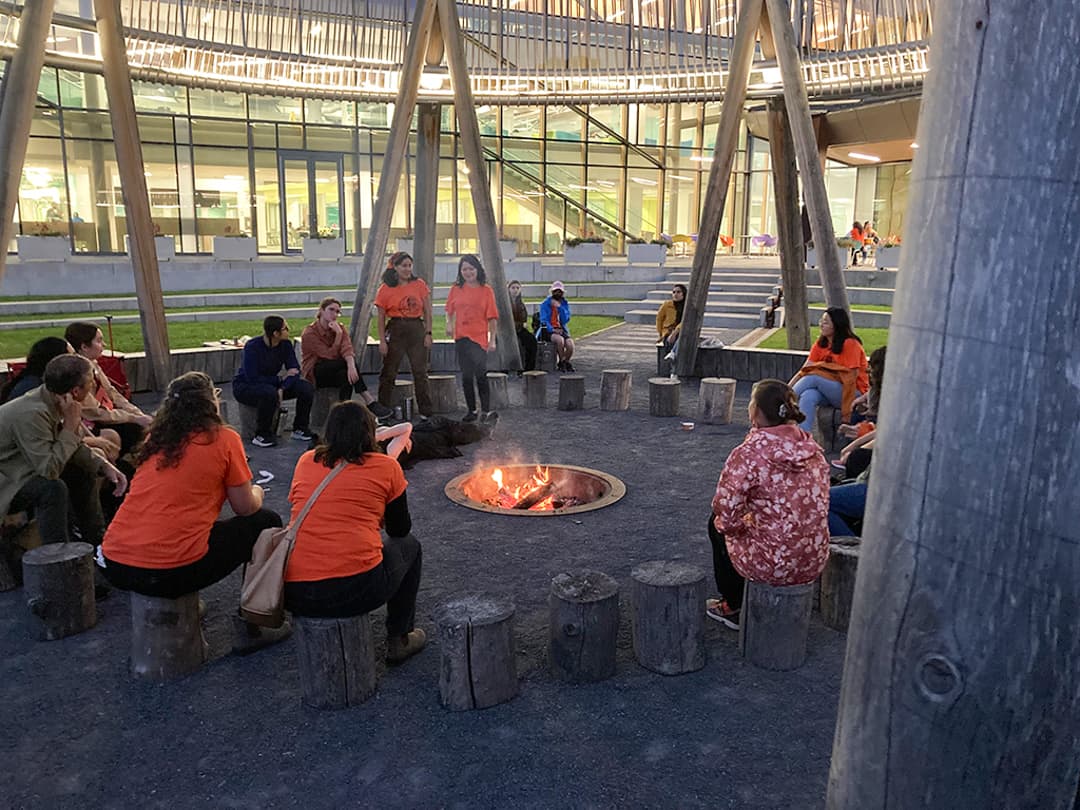
People sit in the Gathering Circle at college’s Ishkodewan courtyard in the DARE district after the screening.
Squash, beans and corn are sisters. When planted together, they grow and support each other as any good sisters would.
Corn supports bean’s. Beans give corn nitrogen, fertilizing it. Squash provides shade and protects other sisters from weeds.
Together, they are Three Sisters, the traditional Indigenous soup.
Algonquin College students, staff and alumni had a chance to try it on Sept. 29 after the screening of two movies dedicated to the National Day of Truth and Reconciliation.
“We seek truth to reconcile,” said Claude Brulé, president and CEO of the college.
The first movie was Honour to Senator Murray Sinclair produced by the National Film Board of Canada in 2021. It is based on the speech given by the now-former senator when accepting the Canada World Peace Award in 2016.
At the time Sinclair was the co-chair of Canada’s Truth and Reconciliation Commission. In the movie, his speech was interrupted by stories of those who went through the Canadian residential school system.
“I thought I would be brave to face the demons that haunted me for 49 years,” said Paul Voudrach. He was one of the many who were separated from their family never to see them again. One of the many who were beaten. One of the many who were sexually abused.
Of course, there were stories that could not be told. Stories of kids who did not survive.
“The spirits of these children are bringing this reconciliation,” said Kerry Potts, the organizer and the Indigenous pedagogy and curriculum consultant. But she quickly corrected herself. “(They) are bringing this truth up through the ground, not reconciliation.”
Reconciliation is the job of the living, and it goes way beyond the residential school system of the past century. That was the notion of the Colonization Road, the second movie at the screening.
It was narrated by Ryan McMahon, Anishinaabe comedian and the creator of Thunder Bay — first the podcast, then the short series about violence against Indigenous people in northern Ontario.
McMahon takes us on a little voyage across Ontario starting with his hometown, Fort Frances.
“We need to talk,” he says. He is talking to Colonization itself. He grew up on the road of its name – Colonization Road. He explores the history of colonization and its roots in every aspect of Canadian life.
But no matter what, he concludes with a firm, “Colonization, you lose.”
After the screening, everyone grabbed their soup cups with Three Sisters and moved to the college’s Ishkodewan courtyard in the DARE district to sit in the Gathering Circle.
People around the fire, Indigenous and non-Indigenous, were sitting on Indigenous land and eating Indigenous soup.
Some threw tobacco into the fire. It is said that tobacco smoke opens the soul to allow the spirits to bring their healing powers. True or not, that’s the culture that has the right to exist. That’s the culture that Algonquin College had the chance to explore.
Arts & Entertainment | Featured Story
Indigenous cultures | Indigenous history | National Day of Truth and Reconciliation | Screening
On Sept. 9, the Algonquin Wolves women’s soccer team faced off against the Seneca Sting for the first time this season. The game ended with 8-0 for Seneca. “It’s going […]
Mathew Dicsi
Photos: Mathew Dicsi
October 3, 2023 Revised: January 30, 2024 3:36pm
Photo: Mathew Dicsi
The Wolves try to stop the Seneca Sting on a breakaway just before Seneca scores their seventh goal in a game on Sept 9.
On Sept. 9, the Algonquin Wolves women’s soccer team faced off against the Seneca Sting for the first time this season. The game ended with 8-0 for Seneca.
“It’s going to be a big one,” said assistant coach Stephen Ball in an interview before the game in Ottawa. “They’re (Seneca) competitive, usually either first or second place team.”
“We’re expecting to play the whole field. We’ve got skill on every position, they do as well,” Ball added.
Seneca’s aggressive play style earned them four goals and two yellow cards in the first half, with cards called on midfielder Francesca Famele and forward Faith Metcalfe-Simiana.
The Wolves received an injury in the first half when a Seneca player fell on Kassandra Da Cruz.
Wolves midfielder Kassandra Da Cruz being carried off the field following an ankle injury Photo credit: Mathew Dicsi
“I went in for the tackle, then I think she fell on my ankle and I heard a little crack,” said Da Cruz. “It went so fast, I don’t really remember what happened, but tomorrow I’ll be up and ready.
Seneca then earned four more goals in the second half, with the last one coming at the 90-minute mark.
The Wolves’ next match is Oct. 3 against St. Lawrence at the Z-building Sports Field.
In the centre of a room with a face-painting booth to one side and a photo-wall with rainbow props set against the far wall, Eldrich Glazier, a 22-year-old human services […]
Kate Playfair
Photos: Kate Playfair
October 2, 2023 Revised: January 30, 2024 3:36pm
Photo: Kate Playfair
"I'm a little bit extra." Eldrich Glazier did not miss the opportunity to show off his dance moves at the Pride Dance in the Observatory.
In the centre of a room with a face-painting booth to one side and a photo-wall with rainbow props set against the far wall, Eldrich Glazier, a 22-year-old human services foundation student, dances to Diana Ross’s I’m Coming Out with as much enthusiasm as a performer on a stage.
As a child whose parents are transgender and non-binary respectively, Glazier is never ashamed to be himself, but with controversy surrounding the 2SLGBTQIA+ community, he has become more reserved.
At the Students’ Association’s Pride Dance hosted at the Observatory on Sept. 27, Glazier’s reservations fell away.
The Student Association dedicates a week every year to celebrate Pride and highlight the 2SLGBTQIA+ community on campus. However, the SA is looking to expand the week into a series of yearly events and is in the beginning phases of introducing the SA’s Queer All Year.
“It’s a way to celebrate Pride year-round,” said Amanda Logan, the events coordinator for the SA. “We see over the summer such a big boom of Pride celebrations across Canada, across the world, but we want to make sure it’s celebrated throughout the entire year, especially because we don’t have a lot of students here during the summer.”
The SA is in the process of hiring an equity, diversity and inclusivity coordinator, who will be heavily involved in the Queer All Year initiative as a subject matter expert and advocate for Algonquin College’s diverse population.
An official announcement of the Queer All Year initiative is pending further planning.
Amid the protests and counter-protests that raged across the country last week, including the “1MillionMarch4Children” advocating for the elimination of the sexual orientation and gender identity curriculum, students are left feeling uneasy about expressing themselves on campus.
“A lot of my mindset on keeping it a little bit low-key is what’s going on in the world right now,” said Glazier. “Especially with the whole anti-trans protest going on and having to out kids.”
“With the controversy with the protests, I don’t really know how everyone feels,” said Ben Jolly, 21, a film and media production student who attended the Pride Dance. “This is a public college, and everyone has different opinions and nowadays it’s more vocal.”
The Pride Dance is a place for students to be themselves in a safe environment, and the upcoming events associated with the Queer All Year initiative will build from that with new events and opportunities.
“We are advocates for the student body, and we want to make sure that students know that the SA is a place where they can be themselves,” said Logan.
Initiatives currently in the planning stage for Queer All Year involve bringing in some bigger name drag queens and re-introducing the Gender Blender event, where students who fall somewhere on the gender spectrum can mingle and find like-minded individuals.
Events such as the Pride Dance are important for students to give them a space to be themselves.
“They’re so open in letting anybody who is LGBTQ to go,” said Glazier. “You have all these different types of people who are coming together to be like, ‘This is who we are and we’re not all the same’.”
“It gives us an opportunity to get in touch with people more than what you see on television,” said Jolly. “The media has a very bad history of showing one side of the community, especially LGBT, so seeing what’s actually happening and meeting real people is much better.”
#IBelieveYou day has become a national social campaign, going from a local Albertan cause to spreading to colleges across the nation, including Algonquin College. “We believe you. We want you […]
Alex Lambert
Photos: Alex Lambert
September 30, 2023 Revised: January 30, 2024 3:36pm
Photo: Alex Lambert
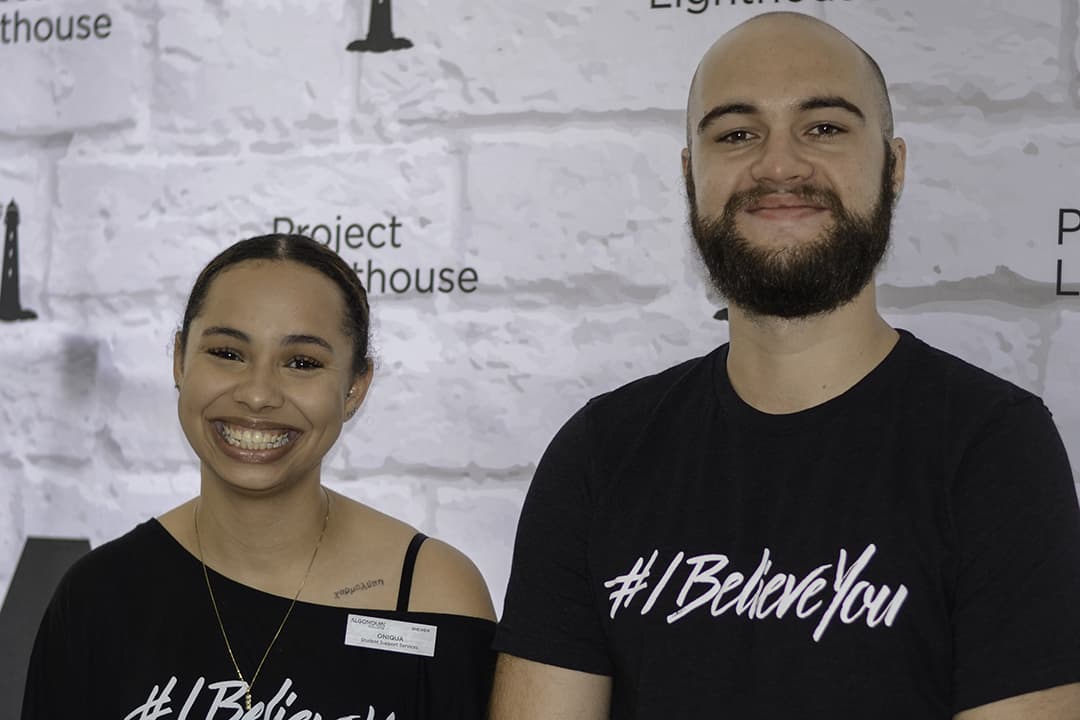
Oniqua Kamaka (left) and Connor Jamison-Guitard (right). The event staff work part-time co-op positions with The Lighthouse.
#IBelieveYou day has become a national social campaign, going from a local Albertan cause to spreading to colleges across the nation, including Algonquin College.
“We believe you. We want you to be heard and we’re here to support you. This is a safe space,” said Oniqua Kamaka, a student support services volunteer at Algonquin College.
“We know survivors feel withdrawn from society because they feel like it was their fault. We want to let them know there are people who will believe and support them.”
Nearly two million Albertans have experienced sexual abuse in their lifetime, according to an AASAS press release.
At Algonquin College, a booth was available for students to take photos to share online from 11 a.m. to 2 p.m., on Sept. 19. Eighty students visited the booth. It was expected to return on the same day next year.
The #IBelieveYou campaign has reached nearly 50 million people online and taken hold of campuses and communities across the province.
The social campaign was started to educate students on navigating healthy relationships and responding to a disclosure of an assault. Similar to the #MeToo movement, it was organized with empathy and awareness.
In doing so, they are sending a vital message to survivors.
“Outreach initiatives like this put the conversation in the public eye so it’s not a taboo subject,” said Connor Jamieson-Guitard, a third-year child and youth care student. “Real people are affected by this.”
Project Lighthouse, a Student Support Services program, organizes sexual violence prevention training, events and giveaways during the first six weeks of school.
The Student Wellness Zone set up a table with condoms, safe sex guides and a Project Lighthouse branded photo backdrop.
Featured Story | News
Algonquin college | Project Lighthouse | Sexual assault | Sexual Assault Support Center of Ottawa | Student support services