Sound Bites event raises over $1,000 for Food Cupboard

Toes were tapping and hands were clapping in the Observatory while the Sound Bites event organized by students from the music industry arts program was in full swing Friday night. Sound Bites is a music concert organized, promoted and produced by the students of the music industry arts program. The event featured local artists and […]
Photo: Kate Playfair
"It's nerve-wracking up until you're actually up there, and then it just kind of fades away and you're just having fun," said Jillian Katzenback, an Algonquin College alumnus and performer at the Sound Bites event.

Toes were tapping and hands were clapping in the Observatory while the Sound Bites event organized by students from the music industry arts program was in full swing Friday night.

Sound Bites is a music concert organized, promoted and produced by the students of the music industry arts program. The event featured local artists and all proceeds went to the Students’ Association Food Cupboard, where $1,005 was raised over the course of the evening.

“The students are doing everything,” said Colin Mills, the program coordinator for the MIA program. “It was completely up to them, and they voted on the Students’ Association Food Cupboard.”

“Everyone playing is a fantastic talent. You guys are in for a hell of a show,” said Jackson Kibzey, 19, a student in the MIA program working at the event.

Students, staff, alumni and family members all gathered around the Observatory stage as lights flashed, drinks were served and everyone anticipated a fun-filled evening.

Jillian Katzenback, an alumnus of the MIA program, started off the music with her original song Miscommunication that she wrote when she was 16 years old. She was thrilled to be performing at the event.

“I took the program and it’s just so much fun to be here back at Algonquin and working with everyone.” Jillian Katzenback, Algonquin College alumnus and performer at the Sound Bites event.
“I took the program and it’s just so much fun to be here back at Algonquin and working with everyone.” said Jillian Katzenback, an Algonquin College alumnus and performer at the Sound Bites event. Photo credit: Kate Playfair

“It’s amazing, I mean it’s for a great cause, with some great people,” said Katzenback. “I took the program and it’s just so much fun to be here back at Algonquin and working with everyone.”

After Katzenback left the stage, the crowd was treated to an invigorating performance by singer Risus Rome. Flashing lights and enthusiastic dancing from the artists only added to the crowd’s excitement.

Risus Rome performing at the Observatory at Algonquin College. He did not take off the mask during his entire performance.
Photo credit: Kate Playfair

A blend of R&B, funk, jazz and old school hip-hop reverberated around the room as Mecca of Stank took the stage. The Ottawa-based band rocked guitar solos between sips of beer and hair flips.

Two more Algonquin grads took the stage, accompanied by cheers of delight. Nepture brought with it an intricate combination of four separate electric guitars and mash-music by Nepture’s DJ. The two MIA alumni raised the energy of the room tenfold with guitar solos that made the crowd collectively hold their breath.

Algonquin College alumni Nepture performing incredible guitar solos and mash-up music at the Observatory for the Sound Bites event at Algonquin College
Algonquin College alumni Nepture performing incredible guitar solos and mash-up music at the Observatory for the Sound Bites event at Algonquin College Photo credit: Kate Playfair

Aphelion woke up the crowd with a metal performance few are soon to forget. With three guitars, two keyboards and a set of drums, the band brought a flare to the night.

The Aphelion band performing metal music with gusto at the Observatory for the Sound Bites event at Algonquin College
The Aphelion band performing metal music with gusto at the Observatory for the Sound Bites event at Algonquin College Photo credit: Kate Playfair

To end the evening, Shim in the Cut had everyone jumping and dancing to his rap. He even pulled a few people on stage and danced along with them.

Students enjoyed watching the concert.

“I love it,” said Carter Jonssens, 21, a student in the finance program. “I really liked the first performer.”

“It gets everybody together in a group setting,” said Hunter Mahoney, 21, a student in the sports and health program. “It’s an opportunity for people with similar interests to cross paths, and it’s open access to everyone.”

The event lasted until after midnight. It was a huge success for the first Sound Bites music event at Algonquin College.

Students aim to build career foundations at networking event

The atrium in the Algonquin Centre for Construction Excellence was filled with over 100 students, alumni, and corporate representatives on March 29 during the fourth annual networking event. Civil engineering technology student Joseph Florean, 21, said he wanted to meet potential employers. He hoped to make good contacts and connections. Florean was looking to find […]
Photo: Linda Verreault
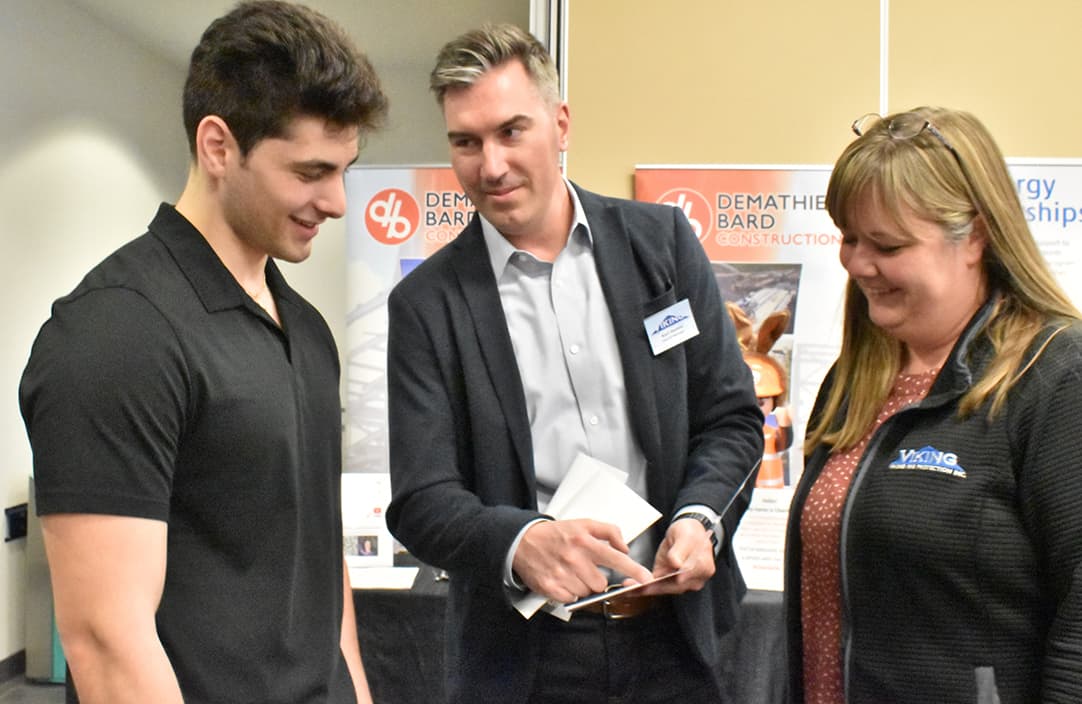
Joseph Florean speaking with Karl Sexton and Sonya Robinson of Viking Fire Protection.

The atrium in the Algonquin Centre for Construction Excellence was filled with over 100 students, alumni, and corporate representatives on March 29 during the fourth annual networking event.

Civil engineering technology student Joseph Florean, 21, said he wanted to meet potential employers. He hoped to make good contacts and connections.

Florean was looking to find employment as a field engineer heading toward project management. “I wouldn’t want to jump in without getting experience. I think starting near the bottom would be good,” said Florean.

Nick Paquette, a civil engineering technology student, was part of the event organizing committee.

”I was always asking when I was promoting this event: Do you have a job for the summer? What are you doing after you graduate? I have not really encountered an issue with students finding work,” said Paquette, 34.

“The pool is not large enough to satisfy all the employers right now, that is what I would say is the issue at this time,” said Paquette.

This is a sentiment shared by the Algonquin College president and CEO Claude Brulé, who has said “the province faces an escalating shortage of qualified people in key sectors” and that it is estimated “nearly 300,000 jobs are going unfilled. Ontario colleges will be pivotal to producing graduates with the expertise to fill that demand.”

Marcel Prezotto, 37, a student in the construction engineering technician program, was at the networking event looking for work.

“I am not particularly looking for something special as long as it is construction or construction-related. I am open to every possibility. Big companies such as PCL because they are really big, they give you more possibilities to rise in your career, so that is a really interesting company for me.” said Prezotto.

Architectural technician student Seidra Winsler 20, said she was looking for work and was “flexible and willing to go where the work is. Anywhere the doors are open for me.”

Art showcase draws a crowd

Meet Delora. You saw her throughout campus but didn’t know her name. Delora is the beautiful, animated character in the visual art poster advertising this year’s art showcase featuring the artwork of the students in the drawing foundations for animation and illustration courses. The event was held at the student commons on April 13 and […]
Photo: Linda Verreault
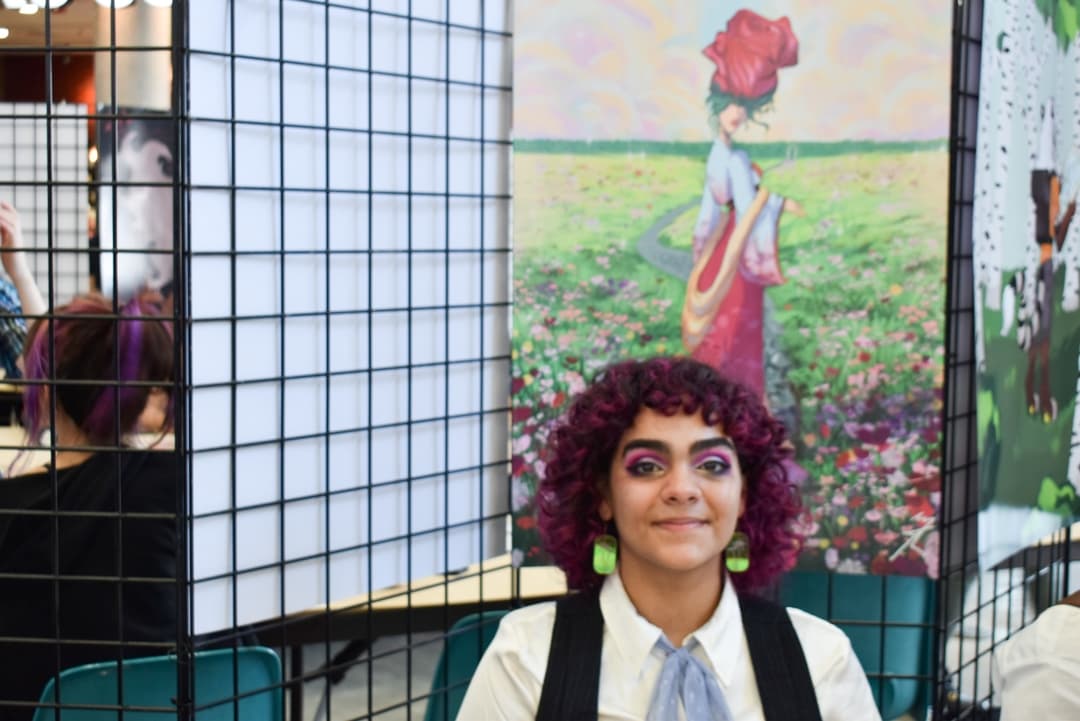
Delora is a character created by artist Mal Alghadban.

Meet Delora. You saw her throughout campus but didn’t know her name.

Delora is the beautiful, animated character in the visual art poster advertising this year’s art showcase featuring the artwork of the students in the drawing foundations for animation and illustration courses.

The event was held at the student commons on April 13 and featured the art of the students in drawing foundations for animation and illustration programs.

Delora’s creator is Mal Alghadean, 18, a student in the foundations for animation course.

Alghadean started to create Delora while still in high school.

“I created her as I was wondering how a person would look like with a headpiece that is a rose,” said Alghadean.

Her initial inspiration came from an album cover she had seen, and she just continued to build on it. She then modified it by adding a wide garden with wildflowers.

“I first begin with the traditional, so I draw with a paper and a pencil and then I put it through digital, like Photoshop, and chose my colours,” said Alghadean.

“I love this, it makes me happy. I have a wide imagination and I am very creative. I want to continue to grow. I am so glad that I took this program.”

She said that her professors were “amazing, understanding, and diverse,” and she felt supported and understood by them.

“They will teach you and encourage you, while making it fun,” said Alghadean.

It takes years of drawing to be an artist and the college pre-program helps students develop their skills.

“I saw that they had a pre-program. It was perfect because I didn’t think my skills were at the level they should be. The pre-animation program built my skills so much so fast that I was able to get into the animation program the next year,” said Eva O’Neil, 19, a student in the animation program.

For many young artists, the inspiration to become artist came after realizing it was a possibility.

“I didn’t realize artist could be a job until Grade 7. I couldn’t see myself working any other job. I want to do something creative,” said Kidane Dabay, 19.

Dabay’s artwork featured rats — lots of rats. “I love drawing rats, rats are great!” Dabay said

His cartoon drawing of rats filled the pages on the tabletop and were featured in his posters.

In contrast, one of the pieces from Harley Nalby, 20, had a serene softer image of a female character he called “a goddess of the moon and protection.”

“I started doodling and creating at a young age. I actually figured out what anime was. It pushed me into a media arts course in high school and Photoshop,” said Nalby.

There was also on display a striking image of an unusual character: an old woman, holding a glowing flower, surrounded by darkness.

“I always see people drawing young people, but I wanted to show that older people can be beautiful too,” said Talya Blakely.

Hawaiian-themed fundraiser at Restaurant International raises funds for charity

While a warm island breeze did not sweep through Restaurant International at Algonquin College on the evening of April 12, the bouquets of faux tropical floral decorations made it almost feel like one did. Fourth-year students in the bachelor of hospitality and tourism management program hosted the Aloha Akua charity dinner, raising funds for the […]
Photo: Huijun Li
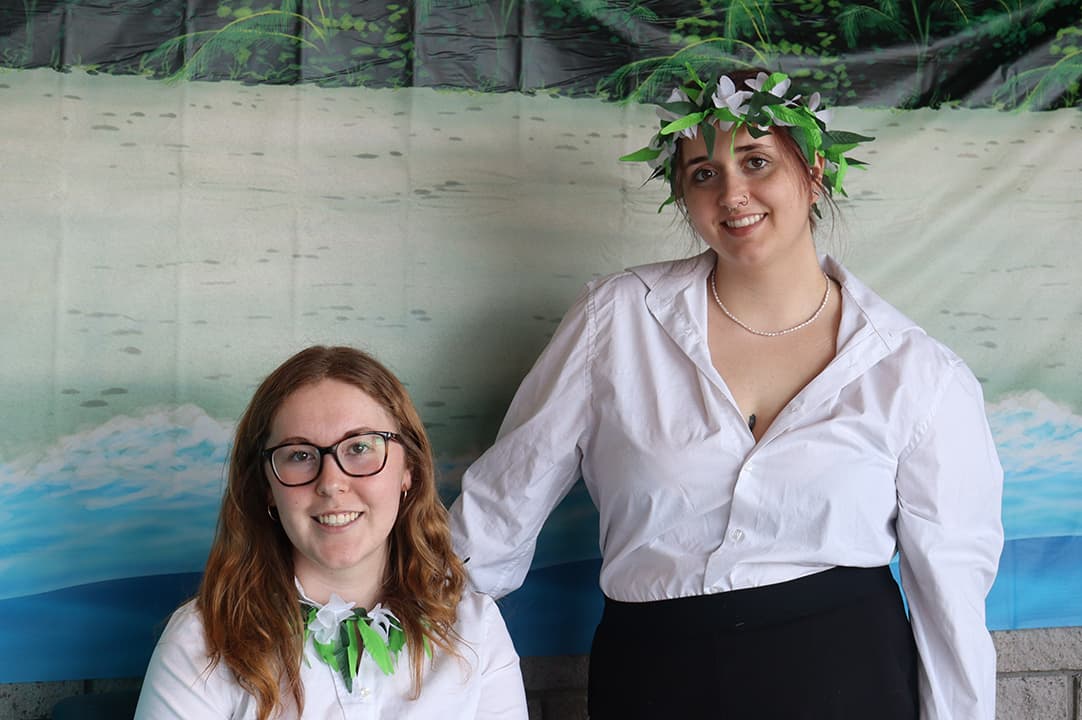
Fourth-year students Maraiaah Keeping (left) and Alison Wert (right) helped with the raffle activity and darts game.

While a warm island breeze did not sweep through Restaurant International at Algonquin College on the evening of April 12, the bouquets of faux tropical floral decorations made it almost feel like one did.

Fourth-year students in the bachelor of hospitality and tourism management program hosted the Aloha Akua charity dinner, raising funds for the Ottawa Regional Cancer Foundation and transforming the H-building into an inviting Hawaiian haven.

“This is our final project for graduation,” said Alison Wert, a fourth-year hospitality and tourism management student, reflecting on the purpose behind the event. “We choose a party theme and partner with a charity for a joint dinner. It’s a tradition that has been going on for years.”

At the entrance, guests were presented with traditional flower leis. They then proceeded to the photo area to pose with Disney characters Lilo and Stitch which were dressed up by the students. The resulting Polaroid pictures, complete with guests’ names, were then stuck up at the entrance to make a photo wall.

The evening’s agenda included a raffle for prizes from sponsors such as the Fairmont, the Westin and the Beer Store.

Attendees also enjoyed games like darts and balloon-tying. A three-course meal, prepared by Algonquin’s culinary students, emerged as the evening’s highlight. Each course offered a selection of dishes accompanied by Hawaiian-inspired mocktails and beer pairings. The appetizer, main and dessert courses provided three, three and two options, respectively.

“One part of us is responsible for catering the dinner and hosting guests, while the other part ensures the event runs smoothly. It’s a collaborative effort,” said Maraiaah Keeping, another student from the same program. “For example, we’re in charge of the darts game today.”

Following the dinner, Tricia Ross, manager of events and community engagement at the Ottawa Regional Cancer Foundation, spoke about its goals and unwavering support for cancer patients and the community.

“We chose the Ottawa Regional Cancer Foundation in January when our semester began,” said Isabella Granati, a fourth-year hospitality and tourism management student and the host of the night. “We specifically chose this charity as we had learned that they are accommodating and a joy to work with, which was entirely true. We were very happy with the attention given to us throughout the event to ensure we had the right resources for our audience. Not to mention, the cause of the charity is something all of us are very close to one way or another, either personally, through a family member, friends or someone we know.”

The Aloha Akua Charity Event will contribute 90 per cent of its proceeds to the foundation and 10 per cent to scholarships at Algonquin College.

Thousands of public servants demand fair wages and better conditions

Local Ottawa Citizen: Over 155,000 public servants began striking on Wednesday, marking the largest federal work stoppage since 1991. Members of the Public Service Alliance of Canada are demanding higher wages and better working conditions. Negotiations have been ongoing for two-and-a-half years, with picket lines now established at over 250 locations nationwide. The main issue […]

Local

Ottawa Citizen: Over 155,000 public servants began striking on Wednesday, marking the largest federal work stoppage since 1991.

Members of the Public Service Alliance of Canada are demanding higher wages and better working conditions.

Negotiations have been ongoing for two-and-a-half years, with picket lines now established at over 250 locations nationwide.

The main issue remains wage increases, as current government offers fail to match inflation.

National

CBC News: Canada’s Jewish community faced a “disturbing and elevated level of violence” in 2022, with 25 violent incidents reported, says B’nai Brith Canada.

While anti-Semitic incidents declined slightly from the all-time high in 2021, online antisemitism remains prevalent.

Calls for legislation targeting social media platforms and addressing online hate gain traction in response to these trends.

International

From CBC News: An 85-year-old Missouri man has been charged with armed assault for shooting Black teen Ralph Yarl, who mistakenly knocked on the wrong door.

Yarl is now recovering at home.

Clay County prosecutor Zachary Thompson stated there was a racial component to the case.

The incident has sparked outrage and renewed scrutiny of “stand your ground” laws, which allow for the use of deadly force in self-defense.

Volunteer appreciation night pays tribute to selfless service

Skylar Dale, a student in the online autism studies and developmental services worker program, did an outstanding 90 hours of volunteering this year. “I started volunteering with an organization called Rude Nature, ” said Dale. “It made me realize how much I love gardening and being outdoors.” On April 12 Dale was just one of […]
Photo: Brahim Ait Ouzineb
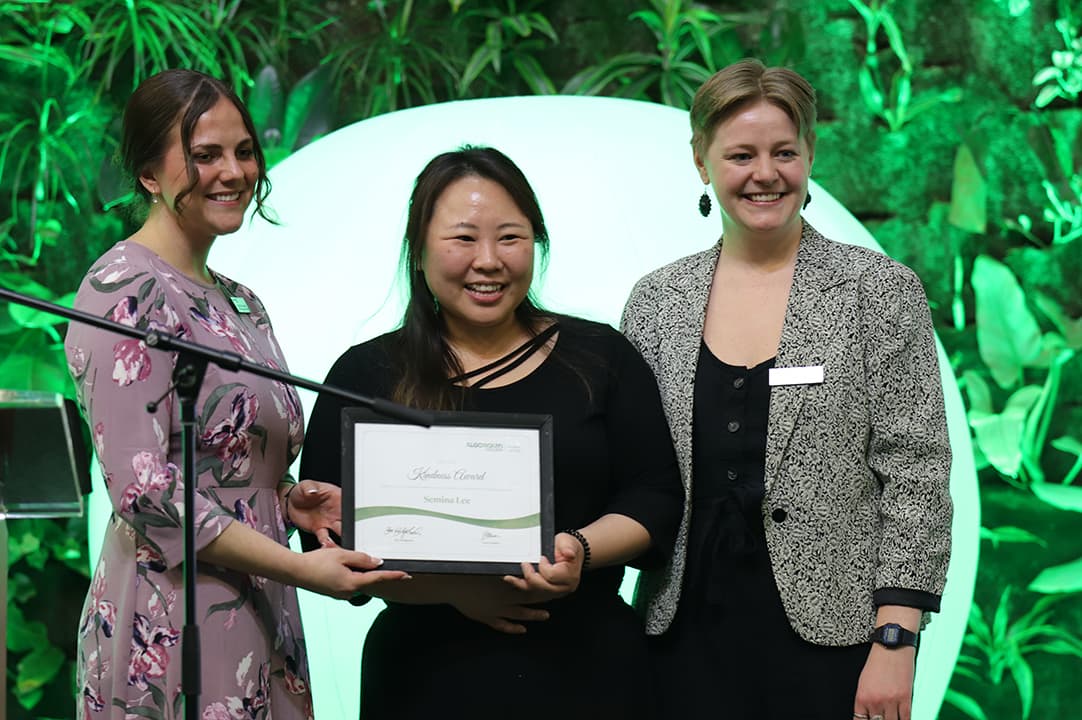
Semina Lee receiving the Kindness Award posing with Elizabeth Holmes and Leah Grimes from Student Support Services. Lee showed up to volunteering events with the biggest smile on her face.

Skylar Dale, a student in the online autism studies and developmental services worker program, did an outstanding 90 hours of volunteering this year.

“I started volunteering with an organization called Rude Nature, ” said Dale. “It made me realize how much I love gardening and being outdoors.”

On April 12 Dale was just one of many students who took to the stage in Minto Hall in the ACCE building’s lower floor to share their experiences with volunteering at the Student Volunteer Appreciation Night.

The event honours and pay respect to volunteers. It’s an event for which the Volunteer Centre devoted around a hundred hours of preparation.

“This year, the event is of a smaller scale, but just as wonderful,” said Lauren Larocque, events officer. “In previous years, it was a volunteer gala but because of the pandemic we had to scale things back.”

Students, loyal to their volunteering habits, showed up on time. Much to the delight of the volunteer center 570 students volunteered in this year’s activities. Five trophies were handed out to the best achievers:

– The Community Impact Award: Valijeta Nuhijaj for participating in Cleaning the Capital and Buskerfest.

– The Commitment Award: Fabiana Ferraresso for her work for Cleaning the Capital, Take Back the Night and Rockcliffe Park Public School Book Fair.

– The Hard Worker Award: Julian Dubois for participating in Cleaning the Capital, Cleaning the Campus, Postcards for Peace and Winter AC Day 1.

– The Kindness Award: Semina Lee for Cleaning the Capital and Cleaning the Campus events.

– The Enthusiasm Award: Devjapunsada Lokuliyana for Cleaning the Capital, Cleaning the Campus, Buskerfest and Winter AC Day 1.

Attendees at the event enjoyed the tunes from musician TJ Morrison’s guitar. Some of the college’s management team attended to show their appreciation for student volunteers.

TJ Morrison, the Ottawa-born artist, performed intimate acoustic songs. He was kind enough to let the guests request any song.
TJ Morrison, the Ottawa-born artist, performed intimate acoustic songs. He was kind enough to let the guests request any song. Photo credit: Brahim Ait Ouzineb

Ben Bridgstock, student support services director in his speech, shared his personal experience with volunteering. For him, volunteering provided new experiences, friendships, new skills and unexpected opportunities.

“We understand that volunteering is not easy for our students,” Bridgstock said. “So tonight we want to recognize each and every student. They try something new and give back to the community the most valuable of their assets, their time.”

Fabiana Ferraresso, a public relations student, opted for volunteering to connect with more people since she was new to Ottawa. Her favourite volunteering experience was for a book fair in her neighbourhood.

“It helps me feel more connected. It also offers networking opportunities which benefits my program too,” said Ferraresso.

Some of the ladies who run the show are in the photo booth at Minto Hall. Just like the student volunteers, they deserved all the spotlights. Left to Right: Elizabeth Holmes, Rebecca Valerio, Lauren Larocque, Joanne Cairns, Amanda Pickerd.
Just like the student volunteers, the women who ran the volunteer event deserved the spotlight too. In the photo booth in Minto Hall, from left to right: Elizabeth Holmes, Rebecca Valerio, Lauren Larocque, Joanne Cairns, Amanda Pickerd. Photo credit: Brahim Ait Ouzineb

Since their work is a marathon, not a sprint, the volunteer center is seeking a few ways to connect with more students next year.

Elizabeth Holmes, the community engagement officer, and her team will reach out to program coordinators that require volunteer hours. Their main concern is to bring back community projects and link student volunteers to their 80 community partners.

Gender-neutral bathrooms are saving the college in ways you might not realize

You’d think there would be more of a push to ensure transgender people can thrive safely in space. Well, for those who identify as transgender, discriminatory laws are being pushed at higher rates only to aggravate these negative experiences. Kentucky and Florida introduced bans on transgender-affirming treatments for transgender minors. We are lucky to have […]
Photo: Annika Schlarb
Algonquin Times writer Justin Hancock-LeFebour

You’d think there would be more of a push to ensure transgender people can thrive safely in space. Well, for those who identify as transgender, discriminatory laws are being pushed at higher rates only to aggravate these negative experiences.

Kentucky and Florida introduced bans on transgender-affirming treatments for transgender minors. We are lucky to have tens of thousands of Canadian activists pushing to give access to international transgender people to seek refuge amidst these discriminatory laws.

Luckily for Algonquin College transgender students who attend the campus in Ottawa, they’ll be pleased to hear that nine buildings have at least one gender-neutral bathroom in the facility, and for those attending the Perth or Pembroke campus, they’ll be pleased to hear at least five rooms have gender-neutral bathrooms.

Those who probably won’t use these gender-neutral bathrooms are probably thinking, “Why is my tuition money going into these new stalls?” But if you think about it, that money is saving lives.

These bathrooms will create a safer use of public bathrooms for all genders. Being able to safely use the bathroom of your choice should be a right, not a privilege. We are failing transgender individuals by not educating the general public as to what being trans is like and how these gender-neutral bathrooms are useful.

I don’t remember ever learning anything about transgender individuals or genders because we never were taught i for some reason. I knew what being transgender was, but I never learned the full extent of all these different genders and why anyone would transition in the first place. Studies have shown it’s healthier for those who suffer from gender dysphoria to transition.

Those with gender dysphoria are prone to having low self-esteem, becoming withdrawn or socially isolated, and having depression or anxiety.

I graduated high school two years ago and only started to read up on it due to the rise of hate crimes against transgender people.

The National Centre for Trans Equality (NCTE) reported that a quarter of transgender people faced bias-driven assaults, with rates being higher for transgender women and transgender people of colour. Reports from UCLA said trans individuals were four-times more likely to face violence than any other demographic.

Up to 70 per cent of transgender people have experienced a negative reaction when using public bathrooms. Fifty-seven per cent of transgender Ontarians have avoided using public washrooms when they have needed to go due to fear of harassment. Avoiding bathroom use can result in a variety of health problems ranging from urinary tract infections to kidney problems.

By the looks of it, it seems we haven’t been trying hard enough to create safe environments for transgender individuals.

It’s why gender-neutral bathrooms are an important step toward creating more inclusive and welcoming spaces for people of all gender identities and expressions and reducing violence transgender people face.

Even if transgender people only count for less than one percent of the Canadian population, it’s still not a reason to think this is a small deal. People who use wheelchairs count for the same amount percent of the population, yet we still add accessibility buttons to as many doors on the college campus. At the end of the day, transgender individuals are still people, and respecting these decisions would be the bare minimum.

And look, even if you still don’t agree with the idea of gender-neutral bathrooms, these bathrooms are at your service as well. Remember, when the bathroom you’re assigned to has a long lineup, you won’t need to wait since there’s an extra bathroom.

Why ask for preferred names? They won’t get used anyway

I’m not comfortable with people knowing my legal name. I changed it for a reason. It didn’t fit me as a person or align with my gender identity. It was something I’ve hated ever since I was a kid. Now as a college student, I find myself dreading bringing my friends to my dorm, or […]
Photo: Guillaume Laflamme
Algonquin Times writer Kit Gervais

I’m not comfortable with people knowing my legal name. I changed it for a reason. It didn’t fit me as a person or align with my gender identity. It was something I’ve hated ever since I was a kid.

Now as a college student, I find myself dreading bringing my friends to my dorm, or even just sending an email. I get anxious waiting for them to find out that Kit isn’t written on my birth certificate.

On my Algonquin College email, the display name is my deadname. For those unfamiliar, a deadname is the term used to describe a trans or non-binary person’s legal or given name.

My deadname has been revealed to several of my classmates and colleagues and has been used as if it were the correct name by the director of the Students’ Association and other people I’ve emailed for interviews.

Not to fault them entirely, it is the name displayed above the email’s content, but I always make sure to introduce myself as and sign off as Kit. Please read my whole email. Thank you.

Now, if you’re not familiar with signing guests into residence, you’re given a card the guest has to carry around in case security or a residence advisor (RA) notices they don’t live there. On it is written the name of the visitor, the arrival and departure date, the room number they’ll be staying in, along with the host’s name.

Three times out of five, my guests have been handed a card with my deadname on it.

I’ve tried everything from handing them my school ID that clearly displays Kit Gervais to double or even sometimes triple-signing my emails with the correct name, yet still I manage to get deadnamed.

The small wins I do get when signing guests in only come from specific front desk staff. Sometimes they get my name right and others just write my last name; both are acceptable to me.

A question I’ve been asking myself since the beginning of the year is, why did the college even ask for my preferred name if they’re not going to use it?

Sure, the name appears correctly on Brightspace and on attendance sheets, but I send emails more than any of my professors take attendance out loud.

This isn’t just my problem. Other students struggle with it.

“It pisses me off,” Em Baker, a hairstyling student, said. “I’ve reminded them enough times.”

According to residence life coordinator Raivyn Halcro, students’ preferred names are written in brackets next to their legal name in the computer system. Apparently, most staff are unaware of what those brackets mean.

Those few members of front desk staff who use the correct name seem to be former RAs. Halcro explained that the RA team is more familiar with the layout of the information system used in residence.

Why would this not be common knowledge to the rest of the team? Halcro made sure to call front desk management and relay my concerns about deadnaming, though it didn’t answer the question at hand.

Halcro provided me with a link to a form with instructions on how to get your name changed in the overall school system, like on Brightspace or email. Students can request to switch a preferred name or gender identity on their school documents —transcripts and credentials not included — by filling out the form and submitting it, along with a request to the registrar’s office.

“Request” is a term Halcro used loosely. There hasn’t been an incident, to her knowledge, of a student’s signed form being rejected.

Regardless, this is just another hurdle in the way for trans and non-binary students trying to receive their education relatively stress-free. The application itself seems unnecessary when there’s a specified slot for preferred name and gender identity on the documentation for admissions.

I always return to the question: Why did the college even ask for my preferred name if they’re not going to use it?

It’s something I haven’t had answered. Yet.

The cost of sleeping in is killing students’ mental health

Waking up in the morning and realising you don’t have class until the afternoon is one of the best feelings in the world. Until it’s not. For the better part of the winter semester, curling up in my bed without a worry until my 1 p.m. class was my favourite thing. That is, until I […]
Photo: Rebekah Houter
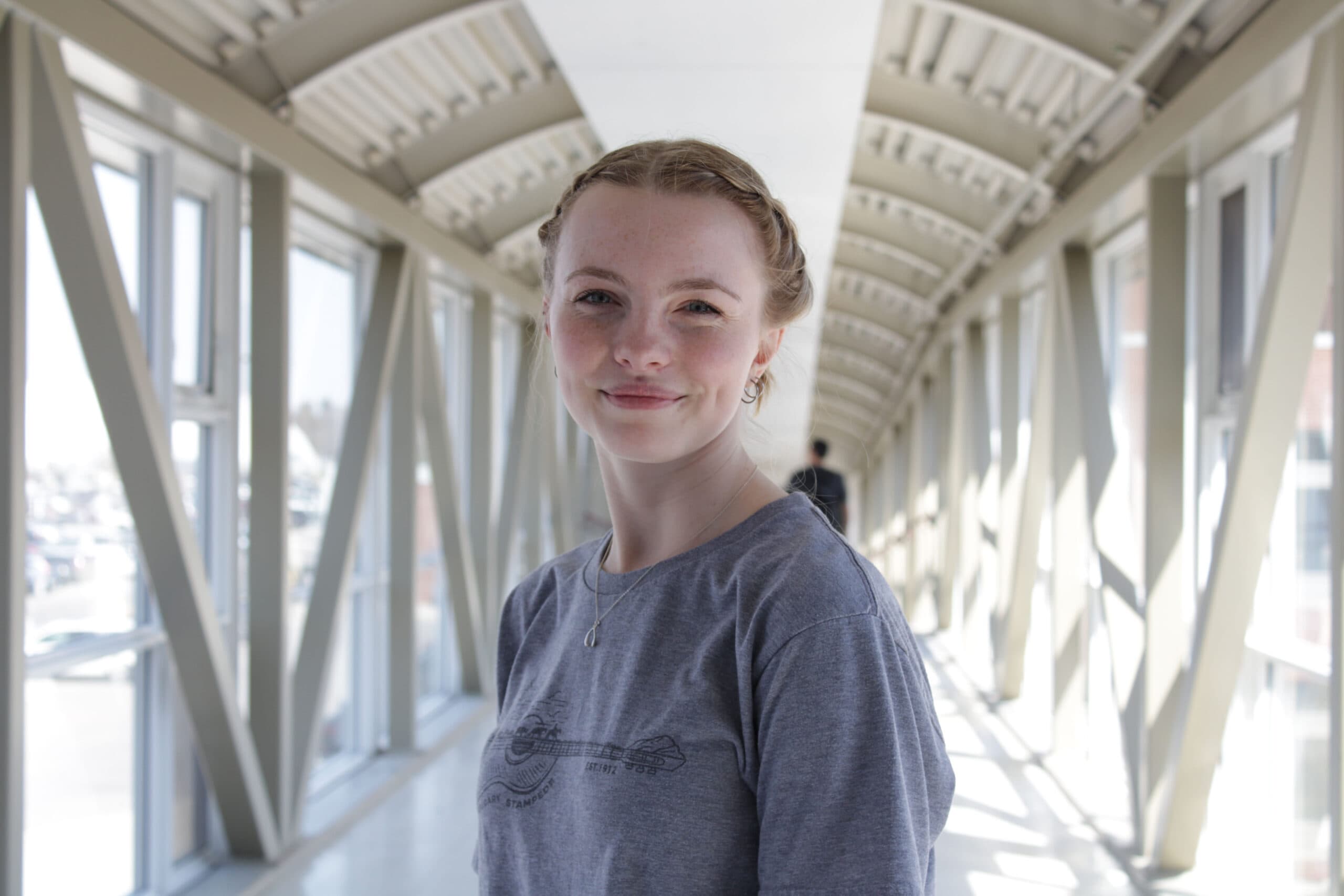
Algonquin Times reporter Kate Playfair

Waking up in the morning and realising you don’t have class until the afternoon is one of the best feelings in the world. Until it’s not.

For the better part of the winter semester, curling up in my bed without a worry until my 1 p.m. class was my favourite thing. That is, until I found my mood growing sour, my stress levels peaking at an all-time high and my sleep schedule becoming so erratic that I was losing hours every night to restless tossing and turning.

All of this stemmed from late afternoon and evening classes.

Students who consistently have late classes, particularly those who do not have any morning classes to balance them out, will experience a decline in their quality of sleep, mental stability and physical health. Late classes disrupt students’ circadian rhythms and falter our biological clocks.

Now, not everyone is the same, so not everyone will have the same reaction to late classes. Some students love having the morning to themselves, and function well despite the atypical schedule.

However, if you are like me, then late classes could become a hazard to you.

My typical weekday consists of waking up between 9:30 a.m. and 10 a.m. I get ready at my leisure, sometimes spending several unproductive minutes on my phone in bed, before leaving for school. After my 35-minute drive, mercifully skipping traffic, I attend my classes as normal, leaving school after 5 p.m. on most days. The commute home, as well as any necessary errand I have to run, take up the majority of my evening. Then there is my nightly routine — eat dinner, shower, etc. And finally, there is the homework or assignments I must complete before bed.

With all that work to do after the evening class, time slips away and before I know it, I’m facing a midnight bedtime.

To understand how bad going to bed late truly is, we must examine the opposite.

Waking up early and starting your day as the sun rises is how our bodies were meant to function. In a study by the Marsh McLennan Agency, physiologist and sleep expert Nerina Ramlakhan and neuroscientist Chelsie Rohrscheib say humans are meant to follow the sun’s progression around the earth.

Humans have a biological clock, and light is what sends signals to our brains that tells us when to sleep. It’s called the circadian rhythm. When the sun is shining, our eyes suppress the melatonin — the hormone in our bodies that sends signals to our body to sleep — keeping us awake, and vice versa when the sun sets.

Consistently going to bed late or after midnight disrupts that rhythm. If you go to sleep after midnight and wake up later in the day, you are not getting enough sun exposure to maintain the circadian rhythm. This results in poor mental stability and chronic exhaustion that will affect your daily life.

According to a study done by Centers for Disease Control and Prevention (CDC) published in September 2022, 60 per cent of college students experience poor quality of sleep and 26 per cent suffer from insomnia. The study concluded that students who suffered from poor sleep results in irritability, increased tension, depression, decreased life satisfaction and poor academic performance.

Students who have later classes have a disturbed circadian rhythm that affects their quality of life beyond what is recommended. As a result, their academic performance and overall mental stability is suffering due to later classes.

Prioritizing students’ health and well-being should be a priority for the college, and that starts with their sleep schedule. Many of the problems students face — fatigue, burnout, depression, etc. — can be helped by starting their day earlier and leaving school at a decent time, before the sun sets, to maintain that circadian rhythm and improve quality of life.

Because that’s what it all boils down to. Students’ quality of life is being crushed under a heavy weight, and late classes have a direct involvement with that weight. In order to resolve this issue, we need to go back to the fundamental necessities humans need to live: nutrition, environment and sleep.

Students are people. It’s time to start treating them as such.

Powwow for children and youth returns after the pandemic

The Odawa Native Friendship Centre hosted its annual Children and Youth Pow Wow on March 25 at the Shaw Centre. The event began with a grand opening of elders starting the dance at noon along with veterans performing their traditional dance before other dancers took their turn to participate in the dance. Traditional instruments and […]
Photo: Itunu Olayiwola
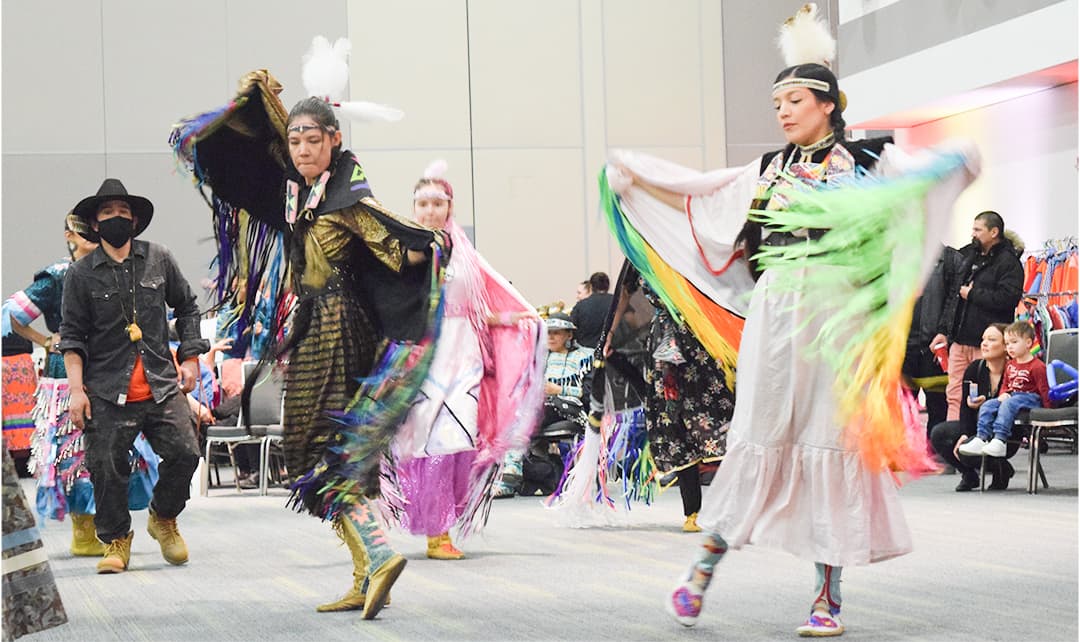
Dancers performed the grass dance during the powwow at the Shaw Center on March 25.

The Odawa Native Friendship Centre hosted its annual Children and Youth Pow Wow on March 25 at the Shaw Centre.

The event began with a grand opening of elders starting the dance at noon along with veterans performing their traditional dance before other dancers took their turn to participate in the dance.

Traditional instruments and dresses were showcased at booths to remind many of how things were exchanged during the earlier years before the concept of money was introduced.

One of the event’s attendees was Randy Kakegamick, an Algonquin College television and broadcasting student. Kakegamick has been attending powwows since birth.

“I was at the powwow singing,” he said. “This is an ongoing thing for me. It is a part of my life, it is a healing tool.”

Bob Crane, a Blackfoot veteran explains that the jingle dresses worn were invented less than a hundred years ago.

”A gentleman’s granddaughter was dying and he had a dream that if in the dream he was told, if he made a dress like that, she would heal. So he did and the granddaughter was healed,” explained Crane. “And so jingle dress dancers are highly, highly regarded because there’s no better, health dance. So whenever anybody has to heal, whether it’s mental or physical, you’ll always see jingle dress dancers.”

Additional Information and sources were provided by booths that had collaborated with the ceremony to those who needed help with housing, health care, daycare services and many more.

Some of these booths included, the Gignul Non-Profit Housing Corporation responsible for subsiding housing, the Inuuqatigiit, a centre for Inuit children, youth, and families and Ottawa Public Health.

Crane explains that traditional dances are taught to the children at a young age, and all are welcomed to learn about their culture and history.

“We are unique,” said Crane. “We are constantly battling to make the government and Indigenous people recognize that.”

Algonquin Times on Instagram
Follow Algonquin Times on Instagram
Algonquin Times podcast
Algonquin Times horoscopes
Algonquin Times podcast
Algonquin Times horoscopes
Follow Algonquin Times on Instagram
Algonquin Times on Instagram

Stay Informed

Sign up for our newsletter

Subscribe

* indicates required