College has flagged financial resources as bordering on high risk
Arty Sarkisian
Photos: Arty Sarkisian
January 29, 2024 Revised: January 30, 2024 3:36pm
Photo: Arty Sarkisian
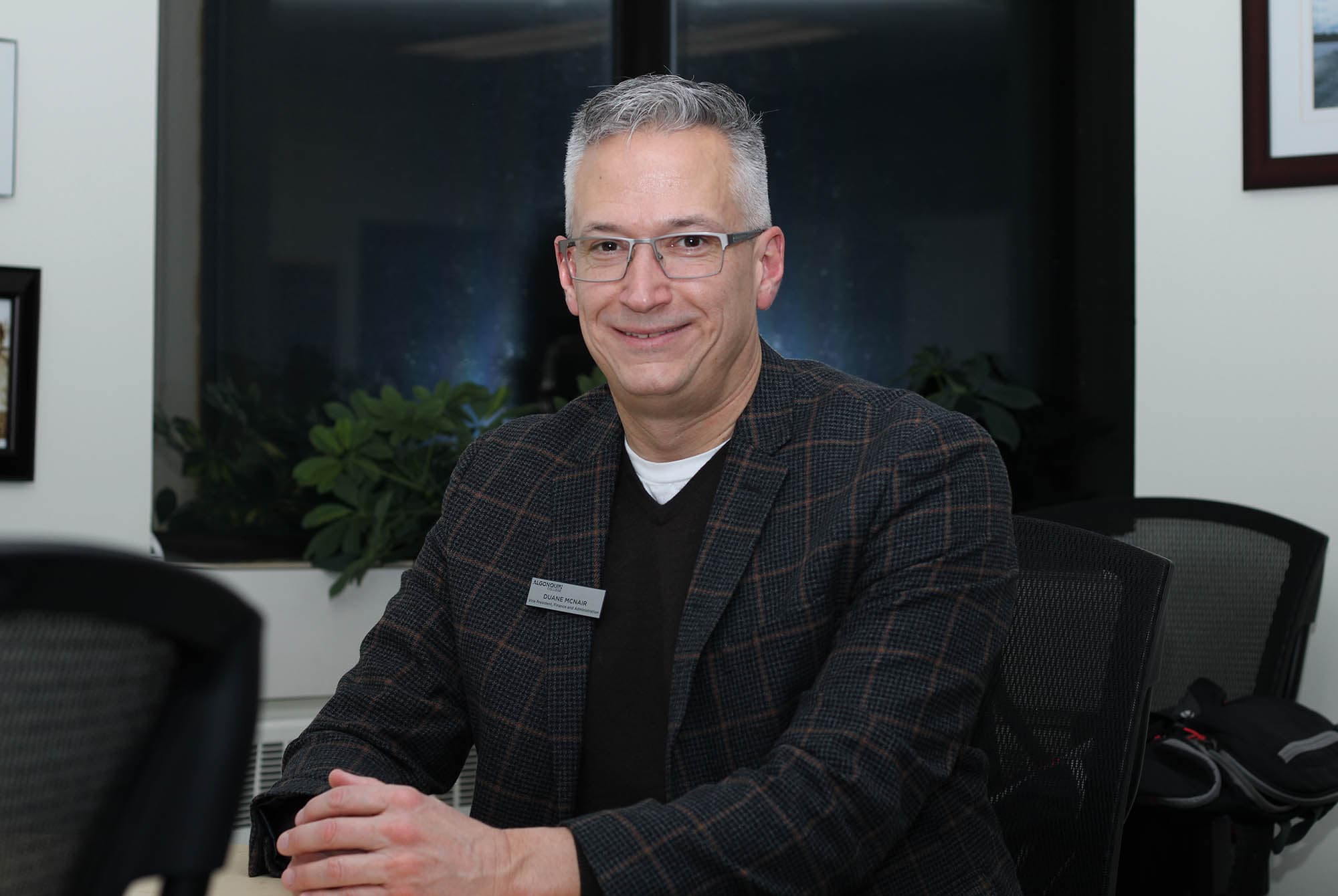
Duane McNair, Algonquin College’s vice president of finance and administration, wishes the provincial government provided funding that was aligned with the actual cost to deliver programs and services.
The Federal Government has announced a national cap on the number of study permits issued in 2024.
The decision bears risks to an already shaky financial sustainability of Algonquin College and other Ontario post-secondary institutions.
What happened?
The federal government projects it will issues approximately 360,000 new study permits in 2024.
So, the intake that has been steadily growing in the past decades will decrease by 35 per cent from 2023.
Collectively, Ontario’s colleges received 68 per cent of their tuition fees from international students, according to the Ontario Auditor General’s annual report in 2021.
International students are filling the “seats left empty by the shortfall experienced in domestic enrolments,” according to the Algonquin College’s Board of Governors meeting materials of Oct. 23.
While domestic enrolment was down 5.3 per cent from the projected number for this academic year, international increased 13.4 per cent.
With international students paying $5,740 per semester in premium fees in addition to the tuition, the college’s revenue increased five times, from the planned $4 million to $19.9 million.
Tuition freeze
The federal cap comes as Algonquin College, along with other Ontario colleges and universities, flag risks to their financial sustainability.
Failure to “effectively manage financial resources” is bordering “high” and “critical” risk scores, according to the Algonquin Board of Governors meeting materials.
It’s been four years since Doug Ford’s government cut post-secondary tuition fees by 10 per cent and froze them at that level.
Now Ontario has the lowest provincial per-student funding in all of Canada.
In 2021-2022, funding per college student was $6,891 – 44 per cent of the national average. And Ontario universities received $11,471 per student, or 57 per cent of the average.
Photo credit: Blue-Ribbon Panel report
Those factors have made financial sustainability a common risk among post-secondary institutions in Ontario including Algonquin.
“If the province were to provide funding that was aligned with the actual cost to deliver programs and services and accommodated a tuition fee policy that was more market-driven and more comparable to other provinces, that would help us achieve greater financial sustainability,” said Duane McNair, Algonquin College’s vice-president of finance and administration.
Faculty are being “squeezed”
With college’s finances at risk, professors are also pushed to be make their classes more financially sustainable.
It can be challenging to get the allocation of dollars to participate in professional development or academic conferences for faculty, said Jonathan Parker, a professor at the college.
“The things that keep us relevant and current require investment from the college,” said Parker. “Many faculty feel that too frequently the answer is ‘no’ to those requests.”
Colleges across Ontario are also “squeezing faculty” when it comes to workload, Annette Bouzi, an Algonquin College professor and the president of the college’s academic union wrote in an email.
“Weekly, we are given a maximum of four minutes per student to evaluate and provide feedback. We are regularly mandated to teach in new modes of delivery, knowing that student participation online and asynchronously have impacts on student learning in the short and long term,” she wrote.
This also applies to after-class activities. There is less investments in rental vehicles, travel, hospitality or whatever “faculty shouldn’t pay out of pocket,” Parker said.
So, professors need to find the workarounds as best as they can.
Instead of a metaphorical Disneyland, students would go to a metaphorical Calypso Waterpark, he said.
Law change makes it easier for survivors to remove publication bans if they choose to
Meg Wall
Photos:
January 29, 2024 Revised: January 30, 2024 3:36pm
Warning: This article contains details of sexual assault that some readers may find disturbing or triggering.
When Kelly Favro found out she legally couldn’t share her name and her story due to a publication ban, it had already been five years since her sexual assault.
In Canada, legislation under the Criminal Code automatically places a publication ban on survivors of sexual assault. That, and with the National Sex Registry not being public information (but is accessible to law enforcement through their provincial or territorial Sex Offender Registry Centre), survivors can often feel as though the criminal justice system is on the side of the offender.
Favro remembers feeling frustrated during the years-long appeals process between her and her attacker, Kenneth Charles Erickson. At the time, she couldn’t find any information on her case and the Crown wasn’t telling her anything, but for reasons she says had never been communicated to her.
“I remember thinking, ‘This is ridiculous’,” Kelly said. “Why can’t I find this guy? People need to know about him. He’s a convicted sex offender and we don’t have any system; we don’t have anybody to tell us what’s up.”
That all changed on Oct. 26, 2023, when royal assent was given in the Senate of Canada to amend legislation under the Criminal Code, which included publication bans. The modifications included placing the responsibility of informing the subject of the publication ban of the ban’s existence on the prosecutors, as well as making it easier for survivors to remove the ban if they choose to.
It had been a fight Favro, and many survivors across Canada who are part of the group My Voice, My Choice, had fought hard for, but say it is just the beginning.
“We’ve made progress towards a more victim-centred criminal justice system, but we still have a lot of work to do to ensure victims are adequately informed about their rights,” said Dr. Benjamin Roebuck, the Federal Ombudsperson for Victims of Crime in a statement.
The office of the federal ombudsperson for victims of crime said it recommends further improvements in informed consent and victim-centred information.
My Voice, My Choice is an initiative led by Canadian victim-complainants across the country who have or have had publication bans on their names as a result of the nature of their court cases.
Originally from Brampton, Ont, Favro is one of the leaders of the initiative. She had moved across Canada to British Columbia when she met Kenneth Charles Erickson at a bar in Victoria in 2015.
“I just got to know him,” Favro said. “He seemed cute, he seemed nice. I can talk about sports for days, and he was able to keep up with me.”
After casually dating for six weeks, Erickson began to “reveal his true colours.” According to Favro, Erickson was allegedly a heavy drinker who didn’t have a high opinion of women.
“When you look back on relationships, and you can see so many red flags, you ask yourself, what happened? That should have been a huge red flag,” Favro said.
For Favro, those red flags began to wave during a pre-operation examination when she had to undergo an emergency surgery to remove a Bartholin’s cyst, a result of a sexually transmitted infection allegedly given to her by Erickson.
The surgeon examining her was startled to see “a lot of damage” and asked if she was okay.
Though Favro had thought her experiences with Erickson were “normal” at the time, those memories now bring back painful memories.
“If I hear a beer can opening, my heart skips a beat. If I hear ice cubes hit a glass, my heart will jump out of my chest,” Favro said. “And it’s been eight years since the attack.”
In the early hours of a September 2015 morning, Favro awoke to Erickson coming into her room, demanding sex and sexually assaulting her. After it was over, she said she didn’t understand the gravity of it.
“I pretended like nothing happened,” Favro said. “I didn’t think anything had happened, because I thought I was able to fight”.
Like many survivors of sexual assault, Favro didn’t report her assault right away.
“I didn’t think I was going to be believed,” Favro said. “I didn’t have [the] underwear, I didn’t have pictures of my bruises, I went to work the next day, I didn’t report, I didn’t get a rape kit. I didn’t do it [all], like you’re told to do.”
Fortunately for Favro, when the police came by to take her statement, they believed her right away, taking it very seriously. Two months later, Erickson was charged with two counts of sexual assault, one of which he was later convicted.
However, it wasn’t until January 2021 that Favro was told the Crown has placed a publication ban on her name. When she asked for its removal, she was told it wasn’t that simple.
“There’s not a lot of information online on how to get these publication bans off your name,” Favro said. “There’s nothing federally and nothing provincially. So, I kept going back to the courts asking what I needed to do, and they didn’t even know what to do.”
In Canada, publication bans are often put in place to protect the integrity of a case, or protect the privacy of a victim or witness to prevent the identity of a minor. Depending on the case and the laws in place, they can be automatic, mandatory upon request or directed by the court’s discretion.
But critics of the law say it can take away a survivor’s agency, such as the 2021 case of a sexual assault survivor in Waterloo, Ont., who shared the case privately with family members. She was then charged with breaching her own publication ban and fined $2,000, plus an additional $600 victim surcharge by Ontario Court Justice Thomas McKay.
“It means I am gagged, I cannot share my story, I cannot share my name, I can’t do anything,” Favro said.
In June 2021, Favro became the first person in British Columbia to successfully remove the publication ban on their name through self-representation, which empowered her to continue advocating for policy changes surrounding publication bans.
As part of an Algonquin College Board of Governors meeting last year, the Sexual Assault/Sexual Violence Prevention Annual Report was released. It reported 45 total formal complaints and reports of sexual assault during the college’s 2022-2023 school year, 15 reports higher than the year before.
“This is a global issue,” said Sarah Crawford, manager of sexual violence prevention, harm reduction and health promotion for Project Lighthouse. “Even if there is sexual violence, it doesn’t necessarily mean it’s happening on campus, because sexual violence is such a big issue in the community and worldwide.”
While most crime statistics have gone down in Canada, sexual violence has been on the rise since 2014, with the exception of a decrease in 2020.
In 2022, Statistics Canada reported a three per cent increase in police-reported level one sexual assaults — an assault sexual in nature, but causing no physical injuries — across the country last year.
On Oct. 28, 2022, the Supreme Court of Canada ruled that automatically adding individuals convicted of sex offences to the National Sex Offender Registry was unconstitutional. This provided My Voice, My Choice the opportunity to “piggyback” on the conversation.
A Supreme Court of Canada ruling in October 2022 gave way for the My Voice, My Choice initiative to join the conversation surrounding publication bans.
“[My Voice, My Choice] started a massive campaign, we started doing presentations,” Favro said. “We started getting very, very angry about this and very, very loud.”
A year later, with the support of Green Party Leader Elizabeth May by means of a loophole that allowed outsider parties to discuss amendments, Bill S-12 was passed, and survivors such as Favro were given to power to share their stories.
Now a mother of two and a provincial public servant in British Columbia, Favro says the most important thing for other survivors to know is she believes them.
“What happened doesn’t matter what you were wearing, no matter what you drink, I believe you.”
Nayana Nayana is a 21-year-old country singer and songwriter, born and raised in Ottawa with a deep love for music that set her apart in a family deeply rooted in […]
Emma Stronge
Photos:
January 29, 2024 Revised: January 29, 2024 9:53am
Nayana
Nayana is a 21-year-old country singer and songwriter, born and raised in Ottawa with a deep love for music that set her apart in a family deeply rooted in sports. From an early age, Nayana’s love for music was apparent, as she found herself singing entire songs before stringing together full sentences, foreshadowing her natural musical talent.
Influenced by artists like Taylor Swift and Miley Cyrus, Nayana embarked on her musical journey at the age of 11, mastering the guitar and diving into songwriting. Her prodigious talent was quickly recognized, earning her a Golden Ticket on YTV’s The Next Star at just 12 years old, marking the beginning of a promising career.
Nayana’s commitment to her craft extends beyond her hometown. She makes regular trips from Ottawa to Nashville, accumulating over 2 million digital streams and building a global fan base. A testament to her artistry, she secured the OneArtist Ontario award in 2019, solidifying her presence in the vibrant Ontario music scene.
As she approaches graduation from Carleton University, Nayana eyes a move to Nashville to fully immerse herself in her musical pursuits unless a breakthrough moment occurs sooner. Anticipation is high for her upcoming projects, with new music and an EP slated for release in 2024. Her most recent single, “No Reply,” is now available on all streaming platforms, offering listeners a glimpse into Nayana’s evolving sound. Stay connected and be part of Nayana’s musical journey by following her on social media.
Last home game for seniors ends in tearful goodbyes, well-earned win
Nathalia Lencioni
Photos:
January 28, 2024 Revised: January 30, 2024 3:36pm
The Wolves' Kieran Raymo (left) blocks an attack.
A 3-0 victory over the Fleming Phoenix on Jan. 27 began with a graduation ceremony to celebrate eight of the women’s Wolves volleyball players, who played their last home game.
The ceremony was presented by the Wolves coach Everton Senior, who delivered moving words about each player’s impact on the team.
The Wolves started the first set with a solid lead and won the set 25-18. Six of the points were kills by left side Faith Billaney, one of the graduating seniors.
“I think my favourite moment was definitely the first set,” said Jordan Faig, libero for the Wolves. “We had every single senior on the court, we all got to be together for one last time, which was really nice.”
After ending the first set with a seven-point advantage, the team felt confident going into the second set. However, the match quickly became tense as Fleming caught up to the Wolves.
The Wolves recovered and took the second set 25-22, yet the team was not completely satisfied with its performance.
The Wolves' Grace Pate serving.
“I think the girls were emotional being at graduation day. We just never really focused on the match,” said Senior. “And maybe took Fleming a little too lightly. As a result, we made the sets much closer than they had to be.”
The third set unfolded just as tense and close as the second, with the rivalling teams constantly trading leads. However, with a final kill by Kieran Raymo, the Algonquin Wolves triumphed 25-22.
“I had the game point kill at 24 and I honestly didn’t even see where the ball went, I just hit it into the block and everyone started cheering,” said Raymo. “So I was like, we got it! And it’s my final game here, I’m a graduating senior.”
Senior was happy with the win, but in his opinion, that was not the most significant part of the match.
“It was playing my captain [Emilie Menard] in right side for her last home game. She’s usually just in the barrel, but she played right side for us today,” said Senior. “I think that was really fun for her and for us to see. She’s an awesome player.”
The Wolves will be back in action Feb. 2 against the Georgian Grizzlies at the Michele McConney Court in Barrie.
Featured Hero | Featured Story | Home Feature | Home Hero | Sports & Recreation
The event was part of Mental Health Awareness week
Zhiqi Zhou
Photos: Zhiqi Zhou
January 28, 2024 Revised: January 28, 2024 7:33pm
Photo: Zhiqi Zhou
A staff member at the Students' Association displays some of the messages written by students at the event.
The Algonquin Students’ Association and Student Support Services offered students a mental health coffee break from 11 a.m. to 12 a.m. on Wednesday, where they could spend some free time relaxing in the corner lounge room in the E-building.
The event was part of the annual Mental Health Awareness week. “This is an annual event to talk openly about mental health and to help our community to reduce stigma and to encourage them to reach out for help, so that’s why that’s happening today,” said Elizabeth Peña-Fernandez, a health promotion and education coordinator at Algonquin College.
This coffee break was mainly for the students to relax. Students were busy with their studies and if they wanted to take a break and relax this was a great place to take one.
Yenling Lin, a level-3 student in computer engineering technology, said she didn’t come to the event looking for any mental health support.
“I saw a poster, and I ended my class at 10 o’clock, so I think I can come here to take a break because I’m really busy with my program,” Lin said. “I want to have a break.”
There were many forms of mental health support and activities during the week, and the coffee break format provided students with a relatively relaxed environment to connect.
“We want to make mental health resources available, accessible and visible to all of our students, so they can feel comfortable talking about mental health and mental illness,” Peña-Fernandez said.
Danvil Noshad, a level 1 advertising and marketing communications student, attended as well. “I am an international student,” he said. “One thing that I’m worrying is that I am not able to make friends, so I was very depressed, and I thought this program will make me feel better, so I came here, I’m doing fun here.”
Peña-Fernandez said in the interview that Sam Demma will be speaking after the coffee break. “He is very engaging and he wants to talk about that and how to cope with stressors,” said Peña-Fernandez.
Training introduced in fall semester has four modules
Caroline Kirkey
Photos: Caroline Kirkey
January 26, 2024 Revised: January 26, 2024 2:16pm
Photo: Caroline Kirkey
Oniqua Kamaka, a peer support at Algonquin College's Health and Wellness Zone.
Project Lighthouse has launched new online training designed to educate students on sexual violence prevention.
The training was introduced in the fall semester of 2023, and students can take it online for free. The course is open to all students from Algonquin College, and they are allowed to take the training at any time.
“Basically the goal is to end sexual violence on campus,” said Sarah Crawford, Algonquin College’s sexual violence prevention and reduction coordinator.
There are four modules that the training focuses on. The first module is designed around what sexual violence is and how to notice it. The second module is on what sexual consent is.
The third module focuses on bystander intervention and the effect of bystander intervention. The fourth and last module is on supporting survivors and the restrictions some face when trying to help a friend or family member.
According to the the Journal of American College Health, the frequency of sexual violence victimization on college campuses is “approximately 5 per cent for men and 25 per cent for women.”
The training that is offered by Project Lighthouse allows students to understand all areas of sexual violence. For four weeks, students can win prizes by taking the online training.
Crawford said the training should only take about 20 to 30 minutes for a student to complete.
Crawford said not everyone provides feedback on the online training, but the feedback from students so far has been mostly positive.
“I think it’s super useful for individuals who have zero knowledge of any sexual violence training,” Oniqua Kamaka said, a peer support at Algonquin College.
Although, Kamaka took the employee sexual violence training, she believes that students will benefit by enrolling themselves into the student training.
Kamaka said sexual violence is “something that we should all talk about and be made aware of.”
The sexual violence prevention training being provided by Project Lighthouse allows students to have an asynchronous experience that they can take from home.
“Sexual violence doesn’t just happen on campus and it’s not isolated, we want to help provide students with information on how to have a healthy relationship,” Crawford said.
Keynote speaker makes stop at Bell Let's Talk event on campus
Ben Seabrook
Photos:
January 26, 2024 Revised: January 26, 2024 2:25pm
Sam Demma came to Algonquin College during his “Empty your Backpack” tour on Jan. 24 for Bell Let’s Talk Day and did a presentation on unpacking negative beliefs.
At 17 years old, after suffering three knee injuries pursuing his dream to play professional sports, Demma went down a challenging path.
Demma had a teacher who helped him transition his passion for professional sports towards youth empowerment, and he started doing presentations in schools across North America.
“I think he’s a perfect student ambassador for this space to have these conversations,” said Sarah Crawford, manager of student support services.
Over 100 people attended the show in the Student Commons.
Demma wrote his book Empty Your Backpack during the COVID-19 pandemic to encourage readers to realize the thoughts they carry around will impact the choices they make, which will affect their future careers.
“My goal with the book is to help people realize that their thoughts matter, and they don’t have to carry negative ones that weigh them down, and they can let those things go,” Demma said.
Demma offered his book to the most enthusiastic audience member. Elijah Joseph, a Level 1 general business student, was invited on stage.
“I’ve known Sam Demma for years,” Joseph said. “He did Launch 2021 and Launch 2022 for my high school so I’ve seen him online do talks like this so I was interested.”
Elijah Joseph, a Level 2 general business student, on stage with Demma.
The Algonquin Students’ Association teamed up with Student Support Services to organize this event to end the stigma and get everyone more comfortable talking about their mental health.
“We try catering these messages more around students, but I think it’s important for staff to understand too,” said Alain Cyr-Russo, senior manager of student life. “You see someone you know, just go say hi, there’s nothing wrong with that.”
Student Support Services provided many booths with additional services around campus to bring mental health to the forefront, giving out Bell Let’s Talk Day merchandise and talking about supporting students.
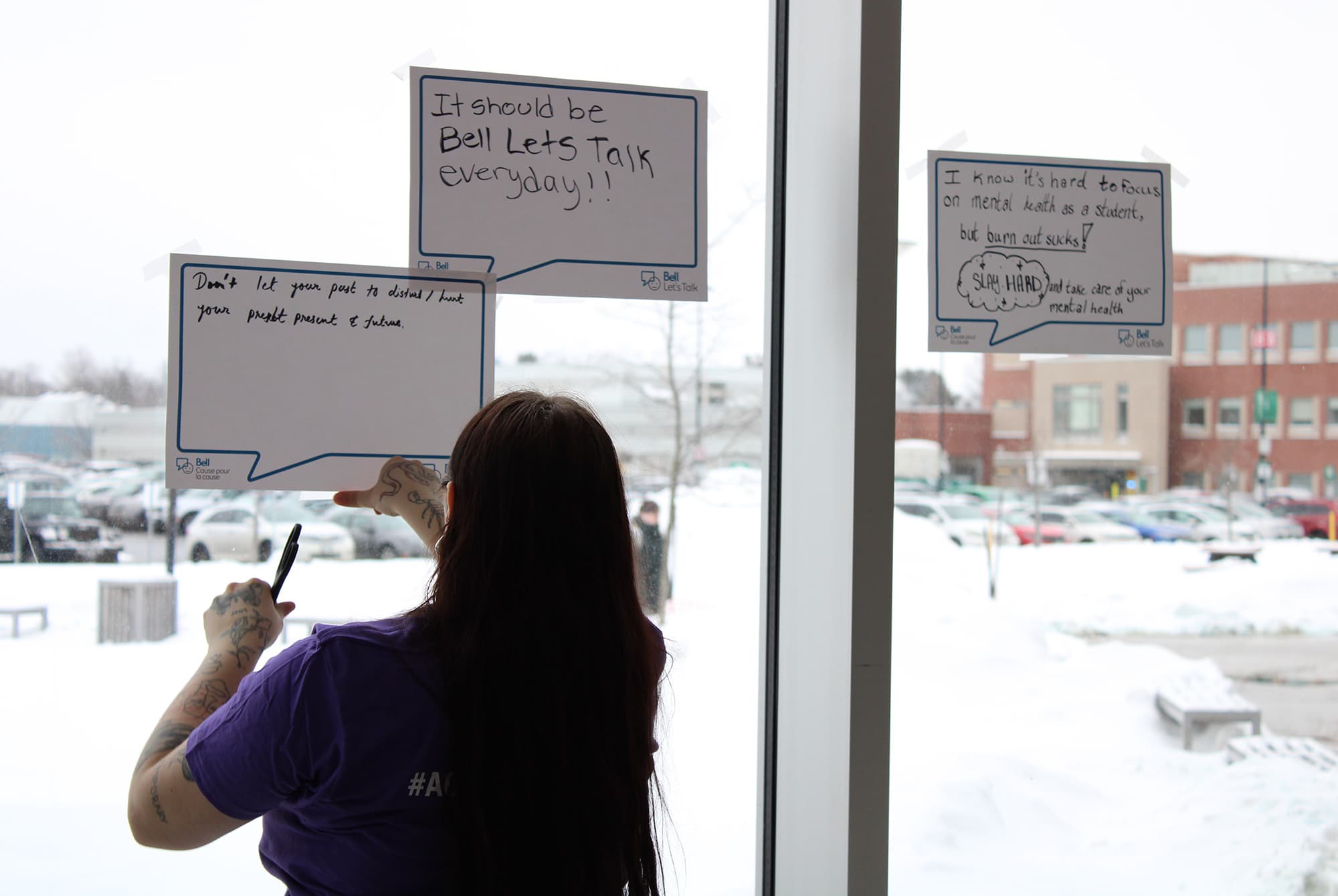
Bell Let’s Talk notes were distributed, allowing students to write positive messages which were put on walls around campus.
Student Support Services provides mental health support, including a drop-in space where students can connect with student peers and many groups in the Health and Wellness Zone located on the third floor of the E building.
“Find someone you can have a conversation with about the things you may be carrying because it’s a lot easier to empty your backpack when there’s another human being around,” Demma said.
Local CTV: Ottawa Police Const. Pierre Fournier was found guilty of discreditable conduct after an off-duty physical altercation with teenagers in 2021. The incident took place at the Osgoode sand […]
Stephanie Taylor
Photos:
January 25, 2024 Revised: January 25, 2024 4:16pm
Local
CTV: Ottawa Police Const. Pierre Fournier was found guilty of discreditable conduct after an off-duty physical altercation with teenagers in 2021.
The incident took place at the Osgoode sand and gravel pit on April 24, 2021. Fournier was off-duty and in the area with his brother when they spotted a group of teenagers trespassing.
Fournier went to confront the teenagers as a police officer instead of a citizen. Fournier grabbed one of the boys’ shoulder or bike and said “You’re not going anywhere,” which escalated the situation into a verbal and physical fight, resulting in a 9-1-1 call being made.
Since Fournier wasn’t on-duty during this incident it was found that he had violated the boy’s rights by illegally detaining him.
Fournier was suspended with pay in June of 2021.
Ottawa Police have declined to say whether Fournier is still employed with them after Fournier had been found guilty.
Fournier’s sentencing will take place at a later date.
National
CBC: London Police have reportedly ordered five players from Canada’s 2018 world junior hockey team to surrender themselves to face sexual assault charges.
The alleged victim, E.M., wrote in a statement of claim that in 2018 she had met the hockey team when they were in London, Ont. for the Hockey Canada Foundation Gala and Golf event.
The statement of claim alleges that E.M. went up to a hotel room with one of the players. This player, allegedly, brought in seven other players after some time.
After the seven others were invited in, the statement of claim alleges that the players began to sexually assault E.M. The statement of claim said E.M. was, “directed, manipulated, and intimidated into remaining.”
Hockey Canada and the NHL are both doing their own investigations into this matter, however no findings have been released at this point.
International
CBC: A Russian plane carrying an alleged 65 Ukrainian prisoners of war has crashed in the Belgorod region of Russia, said Russia.
The plane held 74 people and the crash resulted in no survivors, according to Belgorod Governor, Vyacheslav Gladkov.
The POWs on the plane were to be a part of a swap between Russia and Ukraine, according to the Russian Defence Ministry.
There hasn’t been confirmation as to what caused the crash, however the Russian Defence Ministry has accused Ukraine of shooting the plane down.
The Corner Lounge in the Student Commons had a line of people almost out the main doors on Jan. 23 waiting to pet some dogs. The Paws 4 Stress event […]
Sophie Daly
Photos: Sophie Daly
January 25, 2024 Revised: January 25, 2024 4:44pm
Photo: Sophie Daly
Daisy, a St. John's Ambulance therapy dog, enjoying all the pets from students.
The Corner Lounge in the Student Commons had a line of people almost out the main doors on Jan. 23 waiting to pet some dogs.
The Paws 4 Stress event at the college has always generated huge interest. It’s a free-access event for students and employees to come and hang out with therapy dogs.
Amanda Logan, the events programmer for the Students’ Association, was helping organize the event.
“This is the first time the SA has partnered with the Volunteer Centre for Paws 4 Stress,” Logan said.
The Volunteer Centre and Students’ Association worked with St. John’s Ambulance therapy dogs to run the event.
“The event has been going on for a few years now, and it’s always been very popular. Students really do get the therapeutic needs and comfort through the dogs,” Logan said.
“This week is Mental Health Awareness Week, so we thought it was the perfect time to bring it into a little bit of a bigger space, bring out a few more dogs, and really give students that access to the therapy dogs,” Logan said.
With the Volunteer Centre and SA working together, they went with a larger space at the college to accommodate more dogs. There were five dogs available to students and staff.
Students at the Paws 4 Stress event. Photo credit: Sophie Daly
The oldest dog at the event was Shadow, a 13-year-old golden retriever owned by Larry King.
“He’s on his second career now, didn’t make it as a guide dog so now he’s a therapy dog,” Kind said.
Daisy, a 10-year-old Great Pyrenees, was accompanied by her owner Martin Davidson. Davison has had Daisy for nine years.
Rachel Meltotto, a business management and development student, and Chata Ben Galeb, a project management student, were enjoying their visit to the Corner Lounge. They were giving lots of love to the gentle giant Daisy.
“I found out about this from a school email,” Meltotto said. “I love animals, I just have a cat, but I love dogs as well,”.
Andrea Denyer is the owner of Lily, a 12-year-old mini Bernedoodle.
“She’s on the older side for a dog, she’s a senior now. She’s been a therapy dog since 2018, so five or six years now,” Denyer said about Lily.
Nichapat Phondee, 24, a marketing management student, soaked in all the love the volunteer therapy dogs had to give at this year’s Paws 4 Stress event.
“I’m actually a cat person, but I really miss my cat. I’m an international student so I wanted to see some pets,” said Phondee, who is from Vietnam, “I heard about the event from the Algonquin College’s Instagram story.”
The Paws 4 Stress is an annual event, but the Students’ Association has more events planned for their Mental Health Awareness Week.