main

The Times on Tuesday

Local (from CBC News) The intersection at Somerset Street and Elgin Street is open again after it had been closed for construction since July. However, the intersections at Cooper and […]

Local (from CBC News)

The intersection at Somerset Street and Elgin Street is open again after it had been closed for construction since July. However, the intersections at Cooper and MacLaren have been closed at Elgin and are scheduled to be closed until December.

https://www.cbc.ca/news/canada/ottawa/ottawa-gatineau-traffic-september-30-1.5302420

Provincial (from CBC News)

Education workers across Ontario are preparing to begin work-to-rule action on Monday after contract negotiations fail. Some 55,000 education workers from 63 school boards came after talks broke down between CUPE and the Council of Trustees’ Association.

https://www.cbc.ca/news/canada/toronto/education-workers-work-to-rule-1.5302209

National (from CBC News)

Clashes at a Maxime Bernier event led to four arrests in Hamilton. Opponents of the People’s Party of Canada met to hold a peaceful protest against party policies before being confronted by PPC supporters. Police said arrests were made for “breach of peace.”

https://www.cbc.ca/news/canada/hamilton/mohawk-bernier-violent-clashes-1.5302342

International (from BBC)

France declared a day of mourning to honour former president Jacques Chirac who died last week at 86. A memorial service was held today and was attended by dozens of world leaders, including former U.S. president Bill Clinton and Russian president Vladimir Putin.

https://www.bbc.com/news/world-europe-49876257

Entertainment (from CTV)

Robert De Niro said that Democrats had no choice but to open an impeachment inquiry into President Donald Trump. De Niro made the comment on Brian Stelter’s Reliable Sources program on CNN. Last week, House Speaker Nancy Pelosi announced a formal impeachment inquiry into Trump’s actions after a whistleblower said that the president had pressured the leader of Ukraine into investigating Hunter Biden. Biden is the son of Democratic presidential candidate Joe Biden.

https://www.ctvnews.ca/entertainment/robert-de-niro-has-some-choice-words-and-a-couple-f-bombs-for-his-critics-1.4616627

Impact of opt-out option less than anticipated

With the initiation of the province’s Student Choice Initiative, which allowed students to opt-out of some ancillary fees, there will be changes to services offered by the Students’ Association. However, […]
Sienna Benson, clubs and communities coordinator standing inside the Clubs and Communities room. Benson says the school was well prepared for cuts related to opt-out fees, despite the short notice.

With the initiation of the province’s Student Choice Initiative, which allowed students to opt-out of some ancillary fees, there will be changes to services offered by the Students’ Association.

However, staff say they won’t be as drastic as initially anticipated.

“Prior to the actual opt-out period happening we did a whole bunch of preliminary actions to offset whatever financial cuts might have happened,” said Deijanelle Simon, president of the Students’ Association.

According to the Tuition Fee Framework and Ancillary Fee Guidelines document released by the Government of Ontario for the 2019-2020 school year, colleges and universities in Ontario are required to provide students with the option to opt-out of fees deemed non-essential.

According to the document, anything outside of health and dental plans, student transit passes, and a series of fees called ‘essential services’ must be optional.

This meant that for schools, including Algonquin, students’ associations were on the cutting block.

With this in mind, Algonquin’s Students’ Association, began preparing in advance to minimize the effects of the new mandate on student life.

Simon explained that the Students’ Association was prepared for a larger number of students opting out as opposed to the numbers that are currently reflected.

“We planned for a 50 per cent opt-out,” she said. “We’re looking at about 15 [per cent], but we won’t know for sure because those numbers fluctuate a lot for the first month and a half.”

Simon also added that no services have been fully cut as a result of students opting out.

Although the number of students opting out of non-compulsory fees is expected to decrease the amount of funds available for clubs, Algonquin staff say the impact will be minimal.

“It’s just pretty much, the funding for students, to be able to use for their club, that’s the only thing that’s going to change,” said Sienna Benson, clubs and communities coordinator.

Benson also believes the school was well prepared for the cuts, despite the short notice before the cuts took effect, she added that the quality of services won’t be impacted.

“I think we’re in a great spot and I think services and everything like that will still be the same.”

Global climate strike attracts thousands of students

Thousands gathered in the streets of downtown Ottawa with their signs lifted high in support of the final day of the global climate strike on Friday, Sept. 27. In the […]
Photo: Bradley Legault
Young man Jackson shows his thoughts this Global Climate Strike day on Friday, Sept. 27.

Thousands gathered in the streets of downtown Ottawa with their signs lifted high in support of the final day of the global climate strike on Friday, Sept. 27.

In the days prior to this event, Algonquin College president Claude Brulé sent out an email to all students and faculty informing them about the event. “We need to hear what our students have to say,” Brulé said. “This is a historical moment, and we want to make sure we’re a part of this.”

School faculty were notified to allow students to miss scheduled classes to attend the protest in support of the climate strike.

Shanti Cosentino, a member of the Students’ Association Board of Directors, spoke about the importance of students attending the protest.“We’re very much in support that if students want to attend, absolutely go for it,” Cosentino said. “It’s more effective if students go gather all together.”

The streets were flooded with protesters left, right and center, many of whom were students from across the city.

Jim Watson, Ottawa’s mayor, took the time to mingle among the protesters. He was seen sharing his thoughts and speaking with many as the protest moved along.

DSC_1570 2.jpg
Mayor Jim Watson in full support of the Global Climate Strike on Friday, Sept. 27. Photo credit: Bradley Legault

Hannah Soni-Mahoney, a second-year police foundations student at Algonquin College, attended the event and shared her thoughts.“Citizens have to pressure the big companies that are doing the most to pollute the earth,” said Soni-Mahoney.

Creativity was on full display, as thousands shared their clever puns as well as informant messages on their signs. There was in one particular who took it one step further wearing a full-on earth as a helmet.

DSC_1684.JPG
One of many signs displayed for all to see on Global Climate Change Friday, Sept. 27. Photo credit: Bradley Legault

You couldn’t blink twice before seeing yet another sign in the crowd.

Algonquin College had many representatives attend the protest on Friday, but maybe none more than the Indigenous community.

Crystal Michaud, an Aboriginal success specialist helped coordinate Algonquin Indigenous students to attend as a group and travel to the protest downtown.

Michaud spoke about the importance of making sure climate change is brought up more often and taken more seriously as protests such as these would help prove her point.

“We are not owners of the land,” Michaud said. “We are protectors and we all have to do our part.”

“I have three young children,” Michaud said. “As a mother, I just want to be more cognizant of how I affect climate change.”

How will virtual reality help students learn?

For students in STEM programs at Algonquin College, using a cellphone and a Google cardboard are useful tools to learn about abstract concepts. Virtual reality is a tool which has […]
Photo: Farah Khan
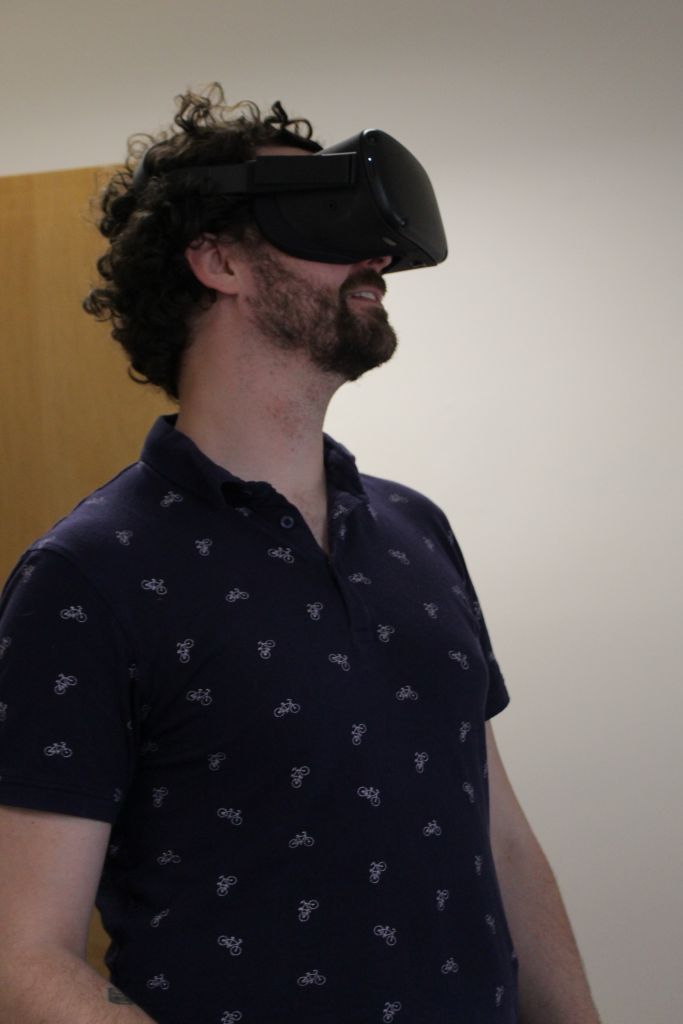
Professor Anthony Scavarelli demonstrating the VR Oculus headset.

For students in STEM programs at Algonquin College, using a cellphone and a Google cardboard are useful tools to learn about abstract concepts.

Virtual reality is a tool which has been around for decades but research surrounding it is new. VR is not only for video gamers – nor should it be. Aside from the wow factor, VR has started to play a huge role in learning.

“VR is basically referred to an avatar that represents yourself in a space and it’s in a virtual world,” said Anthony Scavarelli, Algonquin professor in the design studies program. “The display isn’t necessarily a part of that equation.”

One of Scavarelli’s latest projects on VR is a collaboration with Learning and Teaching Services at Algonquin. It is a VR learning component that would help professors and students learn about the challenges that women face in the field of STEM. Not only is it a great learning tool, it’s accessible too.

“It is based on web technologies so it will be quite easy to share with anyone wishing to check it out via a hyperlink,” Scavarelli said.

Living in a diverse country such as Canada where we have people of all backgrounds, abilities, and experiences, we know the one-size-fits-all approach is not a great one for education.

Nuket Nowlan, a researcher from Carleton University is helping students learn real-world skills.

“Students can hone skills such as critical thinking, the ability to think on the fly, or drawing conclusions,” Nowlan said. “Those are things that cannot easily be fostered from textbooks. We can create many experiential activities that might take place in real life. Students can go through those and try artificial tutoring; we can help them identify what they are missing in their thinking process.”

Another one of VR’s benefits is that you don’t need expensive headsets or complex programs. YouTube or other apps will do just fine to explore VR from your home.

“More than 80 per cent [of the time] we received positive answers,” said Hossain Qorbani, a researcher at Carleton. “They [students] said it helped them learn better and help them understand the confusing concepts.”

With VR education being a relatively new field, there’s still a lot to discover and This is your snapshot into the future, Algonquin students. VR has shown to help students across many skills. Take advantage of the VR resources available to you through MakerSpace and immerse in the virtual world.

Blackface: It is kind of a big deal

At first, I didn’t understand who it was – until I saw the headline of the tweets. I had to sit back in my chair and think about this for […]
Photo: Emily Hsueh

At first, I didn’t understand who it was – until I saw the headline of the tweets.

I had to sit back in my chair and think about this for a second. What was Prime Minister Justin Trudeau’s intention in this photo? Was his makeup meant to be inappropriate or was it just to embellish a character choice?

Growing up, I’ve never been bullied or discriminated against regardless of my skin colour. I was lucky enough to grow up in South Africa where diversity was celebrated or at least talked about even in the post-Mandela era. It should also be noted that brown face or blackface wasn’t taught in South African schools – or at least from what I recall. However, I still had an understanding of the pre-Mandela racism, otherwise known as apartheid, which we had to learn in school.

It was only until I moved to Canada, nine years ago, that my focus shifted from what cultural appropriation was, which was mainly derived from mainstream media. And my focus also shifted when people thought they couldn’t say the n-word around me because they thought I was black. This sparked a jolt in my brain – not on the offence line – but rather to the fact there are questions to be asked and thoughts to be provoked.

Don’t get me wrong; Canada has been known to recognize multiculturalism with open arms however, the explosive blackface pictures made me think about all the conversations we’re going to have as a result of this.

“It seems like he should have thought about it, I don’t know why he did,” said Harsh Vardhan, a project management student at Algonquin College. “I was not aware that he was 29, it doesn’t look good.”

Justin Trudeau admitting his mistake to have dressed in blackface – more than once – might be a good start in the cultural appropriation thread.

Yet, I still stumble at the fact that no one – even those around him at the time – would question the fact that maybe painting your whole body to reflect Aladdin’s (light-skin toned) character — would be questionable. I’m sure there were mumbles of uncertainty in 2001, but it wasn’t something that needed to be fleshed out in conversations. Rather, it was swept away quietly under the magic carpet. The cultural impact of movies such as The Color Purple (1985) and Roots (1977), should have still been lingering in those early days of the 21st century.

I also don’t understand how depicting a darker character – literally – would allow you to feel connected to a certain culture.

An apology may not be enough but it’s definitely a start to prompt cultural conversations.

All I know is, we can’t change the past, but giving things a second thought is not always a bad thing — especially if you’re a teacher.

Where have the parking spaces gone?

After four weeks into school and four weeks of being waitlisted, some students are wondering if more parking spots will be made as the ARC has occupied 250 prime spots […]
Photo: Emily Britton
Raymond Falardeau, business administration student, has a problem with the parking passes this year.

After four weeks into school and four weeks of being waitlisted, some students are wondering if more parking spots will be made as the ARC has occupied 250 prime spots in Lot 8.

Raymond Falardeau, a second-year business administration student, is one of these students.

“When I got my pass last year, I was late getting it, so I thought I could do the same for this year and still get it,” said Falardeau. So far, his plan hasn’t worked out.

Falardeau, along with other students like Courtney Pindur, have had problems reserving a parking spot.

”I think it’s absolutely ridiculous,” said Pindur, a second-year practical nursing student. “There’s a big wait list and the prices are way too high this year.”

Roch Lafond, manager of parking services. said that it’s not just the case for this year. In the years prior, the demand for parking spaces had always exceeded the amount available.

“We are releasing parking permits to our waitlist on a daily basis, as we understand evolving traffic patterns and peak parking periods on campus,” Lafond explained.

Lafond also said that for any waitlisted student receiving a parking pass from here on out, the rate would be pro-rated to reflect the delayed start.

The college has opened three new lots: Lot 1, 16 and 17. Lot 1 is a daily parking spot, while Lots 16 and 17 are open as permit parking. Lot 17 is adjacent to the T-building and goes for the same rate as Lot 8, while 16 is behind the S-building and has a mix of parking passes and daily parking.

Students’ Association president, Deijanelle Simon, explained with the additional parking spaces, there’s not really a loss.

“Good news is with the openings of these new parking spaces, right now, it’s in the snow removal areas and one over by T-building that’s being built,” said Simon. “So, once they’re finalized and if they’re kept open, it’s really only a loss of about 15 parking spaces.”

The college has also launched a carpool option for students, saying it will save money and that it’s better for the environment.

“We have introduced Ottawa Ride Match this year – a ride-matching option that allows you to find people who are commuting to the Ottawa Campus and carpool together,” Lafond said. “If you are driving to campus, you can log in and see if anyone has requested a ride. If you are looking for a drive to campus, you can request a ride and find a driver.”

Applause for Alumni Awards

As heavy rain drummed against the windows of the ACCE building on Sept. 26, it couldn’t drown out the sounds of many attendees laughing and celebrating another Algonquin Alumni of […]
Photo: Camilla Sola
The Alumnus of the Year, Ricardo Larrivée, gives his speech on how proud he is to be a alumni of Algonquin College.

As heavy rain drummed against the windows of the ACCE building on Sept. 26, it couldn’t drown out the sounds of many attendees laughing and celebrating another Algonquin Alumni of Distinction of Awards Gala.

Guests were greeted at the entrance by a duo of guitarists strumming John Mayer songs. The bartenders were ready to pour their finest wine. Alumni chatted with each other as they cheered for the award recipients. Everyone listened to the inspiring speeches throughout the night.

It was Algonquin College’s third annual Algonquin Alumni of Distinction of Awards Gala. Award winners spoke to the well-dressed audience in suits and cocktail dresses. During the evening of the event, guests sat in silver chairs tucked into black-clothed tables. Guests indulged themselves with delicious food prepared by Food Services.

For more information about the award winners, you can go to Algonquin College’s website for more information.

As fall semester kicks off, students adjust to changes in OSAP

The fall semester has started and students are adjusting to the changes in OSAP that were announced by the provincial government earlier this year. The changes, which were announced on […]
Photo: Qadeer Popal
Alex Ilareguy and Seana Medina sitting with friends in the AC Hub. Medina says that she will have to pick up shifts because OSAP isn't enough.

The fall semester has started and students are adjusting to the changes in OSAP that were announced by the provincial government earlier this year.

The changes, which were announced on Jan. 17, have resulted in some students receiving less grant money than in previous years while increasing the amount they are loaned.

The changes also include a decrease in the number of students eligible for OSAP by reducing the amount of family income one can have and still be eligible.

A change that is unwelcome by many students.

“I definitely don’t have enough to live off of,” said Seana Medina, a student in the fitness and health promotion program. “I’m 20- years-old, so they’re still looking at my parents income like, ‘Oh you’re fine.’ The thing is my mom is in university, she’s paying for her own education,”

Medina, like other students, has made plans to help cover school related cost.

“I don’t actually have enough money, I’m cool right now, but I’m going to have to pick up shifts.”

Other students are hoping that they will be able to pay off the increased loan amounts by getting jobs in their field, post-graduation.

“I think I lost a bit on my grants,” said David Nindorera, who studies computer programming. “When I’m studying I think it’s an investment on me. So as long as I’m studying, I hope to be able to pay it after school.”

Despite the decrease in funding and grants for some students, staff at Algonquin have not seen any indication that there is much of an increase in the number of students in financial stress.

“This is not something that we typically measure,” said Krista Marsden, manager, student financial support. “However, we are not seeing a noticeable difference as of yet in our emergency bursary requests or our food card distribution.”

Mission Possible: A Masterclass in Success with Peter Tilley

A Sudanese child soldier, a Cameroonian soccer player and a Canadian welder walk into a building. It sounds like the beginning of a joke but it’s not. It is a […]
Photo: Dana Simpson
CEO of the Ottawa Mission, Peter Tilley, on Sept. 25, where he hosted a masterclass for success at Algonquin College's Dare District.

A Sudanese child soldier, a Cameroonian soccer player and a Canadian welder walk into a building. It sounds like the beginning of a joke but it’s not. It is a list of people Peter Tilley has helped over the last six years as the CEO of the Ottawa Mission.

Help is a concept that Tilley knows all too well. “No one wishes to spend their days in a homeless shelter,” he said. But Tilley himself is familiar with the need for support having battled with substance abuse in his youth. People can fall on rough times. “I was an addict and I turned my life around,” Tilley said.

On Sept. 25, about 40 Algonquin students gathered in the college’s DARE District, in room C126, for a masterclass in passion and leadership hosted by the AC Hub. The event, which featured Tilley, was designed to inspire and inform Algonquin students to turn their passions into careers.

As an Algonquin College alumnus himself, Tilley demonstrated how he went from graduating in business administration management during the 1984 recession to making $60,000 dollars a year, 10 years later. And why, at the age of 34, he chose to drive a truck for $10 an hour with the Ottawa Food Bank.

“I did not let fear get in the way of my choice,” said Tilley. “It wasn’t so much a career choice; it was a choice of doing something I loved to do.”

And Tilley has done even more. Following his success at the Ottawa Food Bank which helped to increase revenue and food distribution, Tilley made the move to work for the Ottawa Mission. Here, he continued his passion for social change. When he began work with the Mission in 2013, the relapse rate was 60 per cent. Now, over 80 per cent of Mission guests are sober for one year or more.

One of these guests is Richard (a pseudonym used by Tilley during his talks). Richard came to the Mission a few years ago at the age of 57 following a history of sexual abuse, alcoholism, and five years on the street. And he still visits regularly. With help from the Men in Healing program and Addiction and Trauma Services, Tilley shared that Richard is back working in construction and has been sober nearly two and a half years.

And he is not alone.

Eric was a professional soccer player in his native country of Cameroon. Tilley mentioned that since Eric’s arrival at the Mission in 2013, he has worked with mental health supporters and the Royal Ottawa Hospital to escape his trauma. Healthier and happier, he has since gotten a job. Better than that – Eric recently became a Canadian Citizen.

Many Mission-goers have had success in the program. Several others, like the Sudanese former child soldier Tilley mentioned, are still struggling. But, as Tilley said to Algonquin students, it is most important to “always find a mentor.”

Whether struggling with addiction or a career, Tilley stressed that if you want to be successful you must always seek out the right people and “don’t be afraid to keep looking for your dream at whatever age.”

Algonquin’s newest addition with a familiar face

Over the summer, Algonquin College welcomed its ninth and newest president, a familiar face and long-time innovator at the college, Claude Brulé. President Brulé has worked at the college since […]
Algonquin College's newest President and CEO, Claude Brulé. Image courtesy of Algonquin College.

Over the summer, Algonquin College welcomed its ninth and newest president, a familiar face and long-time innovator at the college, Claude Brulé.

President Brulé has worked at the college since 1999. He’s been the driving force behind personalized learning and continues to place individual learners’ needs at top priority. The Times sat down with Brulé and asked about his new role and life on campus.

What does it mean to be president of Algonquin College?

For me, being president means being in service of the institution and being able to support all our employees to be their best, in support of our mission at Algonquin College. We have a great team and I’m delighted to be leading the institution. We have some exciting projects and initiatives that are underway right now, leading with our learners. Our first goal is always to be learner focused, and enhance the personalized learning experience and college experience for our students.

What are some challenges you faced in school when you were a student?

My goodness. For me, it was probably things that weren’t science. I loved physics, mathematics and chemistry. I was good with those. Where I needed more assistance was things like poetry, literature and writing.

What advice would you give to new students?

I always tell students to follow what they want to be passionate about. Study well, study diligently but don’t forget to have fun and find meaning in what you’re learning. It’s so important that you don’t want this to be a chore, you’re developing your craft, make this something you’re going to enjoy doing.

How do you handle stressful situations?

Well, I have a couple of puppies, that certainly when I get home, I can go for a walk with them and my wife. We have a gym in our basement as well if I need to sweat it out. (He has two Shih Tzus, both of which are small, portable and hypoallergenic.)

If you could single-handedly change something at the college what would it be?

I used to joke about having a water feature [at the college.] Eventually, we developed the Storm Water Management Pond (located behind P and S buildings) and people said, ‘Well there you go. Claude, you’ve got your water feature.’ But what I had in mind was something that you could sit around, something that was a bit more zen. A fountain or something that creates a focal point for people to be around and to take pictures. In the winter it could freeze, and you could skate on it.

What’s your favourite spot to hang out in on campus?

The Ishkodewan Courtyard; the beautiful re-design, all the Indigenous plants, it’s a beautiful spot and I’m so glad our students are discovering it.

What’s your favourite place to eat on campus?

I like the main food court area. (Marketplace Food Court in D building) I usually end up at the salad bar, I’m a vegetarian by the way. So for me, I always go for those things that cater to the vegetarian diet.

Who is your role model?

I have people that have mentored me over the years, people that have helped me throughout my career as I moved up. Certainly they’re my go-to people when I have questions or have things I want to bounce off them. No one specific.

Did you ever have a role model growing up?

For me, it was probably my parents, my mom in particular. Somebody that I took a lot of wisdom and inspiration from.

What was the last thing that you read/saw in the news that interested you?

I believe it was a study from StatsCan speaking to the earnings of college degree grads versus university degree grads. It positions our graduates very well in that study. There’s always been questions whether a college degree is like a university degree, and our degrees are on par. To see that validation in a study like this is nice to see.

What’s your most memorable summer moment?

Ah there’s so many, hah. Being with the family, our daughter and her boyfriend at our house, doing an activity. It doesn’t have to be anything big, just spending family time together.

What’s your favourite vacation hot spot?

The Caribbean. I’m partial to Grenada. I just love the island, love the people.

What would you say your spirit animal would be?

Hah, my spirit animal? Gosh… well, my wife always says I’m an otter.

Algonquin Times podcast

Stay Informed

Sign up for our newsletter

Subscribe

* indicates required