I first learned about Julie Payette, the former Canadian astronaut, in my grade six science class when we touched on space. She and fellow Canadian space pioneer Roberta Bondar had […]
Farah Khan
Photos:
October 3, 2019 Revised: October 3, 2019 4:00pm
Governor General Julie Payette answering questions from students.
I first learned about Julie Payette, the former Canadian astronaut, in my grade six science class when we touched on space. She and fellow Canadian space pioneer Roberta Bondar had both always inspired me. To me at the time, she only existed in the books and PowerPoint presentations my teacher put up.
Fast forward 11 years and I got the chance to learn more about Payette’s new role as Governor General and hear stories from her missions – directly from her.
On Oct. 2, I got the chance to participate in an event to mark Gov. Gen. Payette’s second year of her mandate. It took place in a tent room at Rideau Hall filled with students of all ages and students tuning in live from across Canada for a Q&A session.
One of the first few questions Payette received was about her favourite part of the job. Her Excellency highlighted her passion towards the young generation which was indicative of her choice to celebrate her second year with Canadian youth.
“I really like applauding other people that do great things,” said Payette. “Meeting young people is the best.”
Payette encouraged the youth to learn as much as possible and decide for ourselves who we want to be. Of note was that she also embraced diversity and teamwork.
“It doesn’t matter where you were born, what language you spoke, what colour is your skin, what kind of hair you’ve got,” she said. “If you decide to work together to construct something big, to advance knowledge, you can. I call it the power of working together. Once you work together, you can accomplish anything, absolutely, and that’s true on Earth just as much as in Space.”
Payette said her motto is “through hardship to the stars” which refers to her beliefs in everyone everywhere being able to do great things. By inspiring and encouraging youth to do so, she has truly stuck by her motto.
It’s one thing to be inspired by someone, but it’s a different feeling when they say they are inspired by people like you.
In a gaming arena with black walls and lime green accents sit 46 high-end gaming PCs that have no input lag and can run at the highest graphic resolution. These […]
Joshua Ambar
Photos: Joshua Ambar
October 3, 2019 Revised: October 3, 2019 1:54am
Photo: Joshua Ambar
Chris Boettcher (left) and Wil Warren (right) are the president and vice president of the Esports team the college. They have expressed concerns about the formation of a Thunders team.
In a gaming arena with black walls and lime green accents sit 46 high-end gaming PCs that have no input lag and can run at the highest graphic resolution. These glowing green beauties, Lenovo Legions, and the Monster-sponsored gaming chairs in front of them, support student gamers in their sport of choice.
But this facility and the varsity team that uses it isn’t at Algonquin – it’s at Durham College, just east of Toronto. It is Ontario’s first Esports arena and it opened in April 2019.
Although the gaming sport has been growing in popularity at universities and colleges across North America and many of them now have varsity teams, arenas and scholarships, Algonquin isn’t quite there yet.
But Martha Peak, athletics administrator for the SA, says that although the SA doesn’t have a varsity team yet, this doesn’t mean it won’t have one in the future.
“We are defiantly, at the SA, opened to different avenues,” she said.
Peak says she has heard about Esports more in the last year than ever before as it has been growing in popularity.
Although Peak is on board for a team, she believes that it would be more expensive than other sports. The SA also doesn’t really have the space for the gaming sport either, she says.
What would help is if the Esports team was built into a specific program. “Now I know it is something that maybe they are trying to develop academically to, so if there was a program that was run by the college that was more geared to that to, than that would help and they can recruit people in that,” said Peak.
Still, the SA would be open to options. “It doesn’t mean we can’t outfit a gymnasium or do that work in cooperation with the college,” said Peak.
For now, Peak explained, Esports has been directed to the Clubs and Communities and from there they grew a huge following.
According to Chris Boettcher, president of Algonquin College Esports, and Wil Warren, vice president, the college’s club has grown massively as they have adopted other gaming clubs into their own. The club has competed in tournaments and have been sponsored by Tespa, an Esports organization based within the offices of Blizzard Entertainment.
Much of the base work has been done for an Esports team as they have created their own agreements.
They worked out as to how their media is to be used, branded their own guidelines and implanted their own code of conduct.
Niko Giguere is a member of the Algonquin College Esports club. He is playing, League of Legends, one of the main games the club competes in. Photo credit: Joshua Ambar
Boettcher believes that since the club is so large with operations so high, the Student Association did not think anything like this could come out of the Clubs and Communities area. Boettcher said that no one can compete with the club, as they are the first ones to get sponsors.
“I believe we run at a higher level then the SA does and any other club,” said Boettcher.
Although the club does get sponsored, they do not have enough funds to send their team to tournaments that take place outside of the Ottawa area. This is where the SA would be a great help when it comes to making the team varsity. They said that receiving the support Thunder teams get would be a huge step forward.
Deijanelle Simon, president of the SA, explained that there are different types of criteria that must be met for the SA to accept varsity teams. The college does not donate to Thunder teams and varsity is already expensive as it is.
However, Warren, the club’s vice president, is critical not only of the slow communication with the SA, but suggests they may be inefficient with the management of their budget.
“I don’t think they know what they want to do with their own money before they get it,” said Warren. “These are all just guesses, I haven’t actually talked to anybody in the SA because they don’t talk to us.”
Sienna Benson, Clubs and Communities coordinator, is an advocate within the SA for a Thunder Esports team as she sees this as huge student interest.
Benson explained that the SA is here for students and if a video game sports team is what they want, than she believes that is something they can push forward with as well as having a space for them on campus.
“That would be amazing because I know other post-secondary institutions are looking to do that as well,” said Benson.
Benson said that some of the roadblocks for creating a team can come from a lack of understanding of what Esports is, as it is more of a generational type of sportsmanship.
Benson says that students and club members who want an Esports team, need to go into full detail about what is required from the SA.
“I think there is a need on campus, and I think students would be really passionate and excited about it and we as the Student Association should definitely talk about how we can push forward with that and see how we could make that happen,” said Benson.
Beatriz Sinoni Santos, early childhood education student, thinks that the club is absolutely “amazing.” When she joined in January, Santos didn’t imagine that Esports was a thing. She said that the club didn’t get much attention and recently they are gaining more traction now. Santos believes it is time for a Thunder team to make a debut at the college.
“I think we need one, everybody else already has one,” said Santos.
Sports & Recreation
Clubs and Communities | Esports; | SA | Students Association | Varsity
Students who are enrolled in evening classes mostly rely on meals packed from home or items from vending machines. “I don’t normally eat on campus,” said Cici Liu, abusiness administration […]
Moiz Adil
Photos:
October 3, 2019 Revised: October 3, 2019 1:50am
Vending machines are often the last choice for students with evening classes
Students who are enrolled in evening classes mostly rely on meals packed from home or items from vending machines.
“I don’t normally eat on campus,” said Cici Liu, abusiness administration student. “It’s hard to find a hot, fresh meal [in the evening].”
A few times a week Liu’s classes start at around 5 p.m. and end at 10 p.m. She has time to grab a bite before class but ends up choosing to ignore her hunger or settle for less appealing options.
Most Food Services outlets close at 7:30 p.m. on weekdays. The Portable Feast, which closes at 8:30 p.m. and 35th Street Market Café located in residence closes at 11 p.m.
The café has changed its hours from 9 a.m. to 11 p.m. on weekends.
“I bring my food when I can,” said Ammar Suleman, an informative technology student. “I’d rather eat here but It doesn’t make sense when I’m going back to back between building B and T.”
Suleman doesn’t have enough time to walk to residence for the 35th Street Market. And by the time he leaves the T building, Bits & Bytes is closed.
“The vending machines are reliable enough,” Suleman said. “If I need something to pick myself up I usually go for a candy bar or chocolate milk.”
An on-campus 24-hour restaurant could likely solve the issues these students face. But, Food Services has its reasons not to implement it.
“There just isn’t enough traction to keep a business running [by the end of the day],” said Andre Villeneuve, senior operations manager of Food Services.
Students staying late still have options off-campus. Restaurants in the vicinity include Popeyes which closes at 10:30 p.m., and open 24 hours is a Tim Hortons and Kettleman’s Bagels.
With the college slowly transitioning towards a three-semester system, this could mean an influx of students and more spread out timetables, with possibly a prominent student base for evening hours.
“We’ll have to see if we get more business at our outlets,” Villeneuve said.
Food Services outlets include The Portable Feast, Tim Hortons, Bits & Bytes, Marketplace Food Court, Booster Juice, 35th Street Café, and The Fix Eatery.
“B building is one of the more centralized locations where Portable Feast is,” Villeneuve said. “It creates for an efficient location that students from anywhere on campus can grab and go.”
Food Services tries to bring nourishing meals for students on campus. It is currently not feasible from a business standpoint to hold for 24 hours of operation.
“We’re able to understand our areas,” Villeneuve said.
Dressed in a skin-tight sparkly bodysuit under the purple lights, The Queen of the North otherwise known as Brooke-Lynn Hytes, slayed the stage with the lip sync performance of Beyoncé’s […]
Perushka Gopalkista
Photos:
October 2, 2019 Revised: December 2, 2019 8:02pm
Brooke-Lynn Hytes talked to fans Algonquin Commons Theatre on Sept. 30.
Dressed in a skin-tight sparkly bodysuit under the purple lights, The Queen of the North otherwise known as Brooke-Lynn Hytes, slayed the stage with the lip sync performance of Beyoncé’s Partition.
The first Canadian contestant on RuPaul’s Drag Race made waves at the Algonquin Commons Theatre and was the show stopper for the start of Algonquin’s Pride Week on Sept. 30.
Over 40 fans, were lined up backstage for the meet and greet session before the show, where they had the opportunity to pose for a photo with Hytes. The first floor of the auditorium was near the capacity while there were a few empty seats along the side exits.
University of Ottawa student, Emily Lombardo said she was excited to watch Brooke-Lynn Hytes perform on stage. “We just saw that they were having the show here, so we wanted to come [and] see,” said Lombardo. “She’s a dancer as well as a drag queen so I feel like that’d be really cool within her show to have the dancing and the drag act at the same time.”
“I mean, she’s just amazing,” said St. Pius X High School student Melissa Lombardo. “She does ballet, that’s like so cool. She knows how to put on a good show.”
Originally from Toronto, the 33-year-old drag queen gained more stardom when she became the first Canadian contestant – and runner-up – on RuPaul’s Drag Race, season 11.
It was also announced during the summer, that she would become the first Canadian judge on Canada’s Drag Race.
While snacking on a bag of black licorice in her dressing room, Hytes recalls in an exclusive interview with the Times, that she wasn’t allowed to reveal her judge position to the public.
“I was sitting on it for the whole three months. It was hard, I did so many interviews and they were like, ‘So, what’s next for Brooke-Lynn Hytes?’ and I was like, ‘I can’t say anything,'” said Hytes. “It felt like being announced on Drag Race all over again.”
During her time on RuPaul’s Drag Race, the only thing she wished she could have known before, was how much of a time limit there is to prepare. “Well, I knew a lot because I knew a lot of people who’ve been on the show,” said Hytes. “I think my least favourite thing about it, was how little time we got for everything like to prepare for challenges and stuff.”
Brooke-Lynn Hytes talking to the audience at the Algonquin Commons Theatre on Sept. 30. Photo credit: Perushka Gopalkista
The youngest Rupaul’s Drag Race fan was an 8-year-old boy who attended the show with his mom. Hytes then shared advice with the audience by commemorating the show’s impact on the community.
“When I was growing up, there was nothing,” said Hytes. “The way the world is today. There’s so much visibility for every kind of queer person. Parents are now accepting it and bringing their children to things like drag-cons and drag shows.”
In between Hytes’ costume changes, Ottawa’s Drag Queen and winner of Ms. Capital Pride, Adrianna Exposé took to the stage her lip-sync performance of Turn Me On by Nicki Minaj. Shortly after Exposé’s musical number, she realized that she may have pulled a leg muscle and had to sit on stage, in exchange for her second musical number.
“Probably take advantage of this because I’m too weak for whatever I just pulled,” said Exposé, as her audience roared with laughter. “I usually say, ‘slay the stage’, but I think it’s “lay” the stage.”
When Hytes returned to the stage for her second song, which was Céline Dion’s It’s All Coming Back To Me Now, she was dressed in a long-sleeve, snow leopard print dress and an orange wig. Afterwards, Hytes sat on the edge of the stage, where she answered questions from the audience.
Brooke-Lynn Hytes lipsyncing to Cèline Dion's "It's All Coming Back To Me" in the Algonquin Commons Theatre on Sept. 30. Photo credit: Perushka Gopalkista
The audiences’ questions ranged from her time on RuPaul’s Drag Race to where her fashion inspiration comes from.
Despite the fact that she has to slay on the stage all the time, style-wise, she highly recommends thrifting. “Visit your local thrift store. Go dumpster diving. I recommend that over buying things at the mall,” said Hytes. “If you buy something at like, Forever 21 or H&M, make sure you kind of change it up. Never wear off the rack [stuff], kind of alter it – that’s where your creativity comes in.”
Although Hytes, is Canadian, she says she’s never really spent much time in Ottawa and how she was glad to be in the city. “I would like to spend more time here, I’ve never really spent time here, it’s our nation’s capital and I’m the Queen.”
Rolling thunder rumbles from within the Lodge. Students study under a massive wooden canoe and rest in an upturned fishing weir, surrounded by medicinal plants and warmed by a sacred […]
Emily Hsueh
Photos: Emily Hsueh
October 2, 2019 Revised: October 23, 2019 6:52pm
Photo: Emily Hsueh
Jeff Turner, partnership development specialist with a focus on the DARE District, stands under the structure in the Ishkodewan courtyard. The structure resembles an upturned fishing weir and is one of many Indigenous aspects of the building.
Rolling thunder rumbles from within the Lodge. Students study under a massive wooden canoe and rest in an upturned fishing weir, surrounded by medicinal plants and warmed by a sacred fire. The college’s DARE District is home to numerous hidden Indigenous names, symbols and architecture, just waiting to be discovered by those who travel through.
Jeff Turner, partnership development specialist with a focus on the DARE District, explained that the building had to have a unique theme, and a strong Indigenous identity was a no-brainer.
“We introduced this Indigenous theme here so the wood, the etchings, they’re all the significant details,” said Turner.
On the first floor of the building is the Nawapon room, which means “gathering for the journey” and is described as the heart of the campus. Etched on its glass walls, passersby can find small animal symbols running along. At the back of the room is the Lodge, a large wooden room with a spiritual atmosphere.
“The significance of the Lodge is that it’s very ceremonial,” said Turner. The large curved wooden doors serve an interesting purpose to the Lodge’s placid atmosphere. When they are closed, “it’s like rolling thunder. It changes the tone of the room immediately. People come in here and it’ll be more serene.”
Turner stands in the spiritual room in Nawapon called the Lodge. It represents a teepee and is reserved for ceremonial purposes.
The round room also represents a teepee and is for reflection and discussion, said manager of Indigenous initiatives André O’Bonsawin.
“There’s no judgement done in that room,” he said. “We sit in a circle to share the day or purpose of the meeting. There’s no technology, no phones. We sit altogether and we have conversations, reflections and thank-yous.”
Though the Lodge is meant to be a place of gathering, it is not open for anyone to walk in, and for good reason, as Turner explains.
“The Lodge is kept locked for various reasons, but mostly because we want to use the Lodge in a purposeful fashion,” added Turner. “It’s really this special intimate place with the doors closed.”
Also included in Nawapon are a fully operational kitchen used for events and canvases depicting Canadian Indigenous scenes from coast to coast. These photographs were taken and donated by 2006 Algonquin alumna of the year, photographer Michelle Valberg, who gifted her work to the college to “add colour” the room and add even more of an Indigenous touch.
One of these images was also used in a limited edition two-dollar Canadian coin in 2017.
“She had these images blown up at her own expense and donated them,” said TK, “which is about an $18,000 gift to the college.”
The library also has several Indigenous aspects to be discovered.
“Students have been telling us for 25 years that we need a new library,” Turner said. “That was the opportunity we felt with this building fund; we would capitalize on that and the statement of indigenization and the college’s commitment to truth and reconciliation were all reasons that we created all these themes.”
The library features a vaulted ceiling made with vast wooden structures, which gives DARE its unique shape. It was created with 22 truckloads of wood, with five being used for the horizontal ribbing alone. Many visitors believe it resembles the underside of a canoe or an Indigenous gathering log house.
The library also put a ceremonial dancing shawl on display in the library on Sept. 13, which was gifted to the college by former president Cheryl Jensen as a goodbye and thank you to the school. It was acquired by Jensen at the Wabano Centre’s Igniting the Spirit event on July 20, 2019.
“The idea was to really have an Indigenous footprint to it,” Turner said. “It’s all about building identity.”
Students in Algonquin’s scriptwriting program have to raise an additional $1,500 for their annual trip to Toronto, as Doug Ford’s new opt-out policy takes effect province-wide. The trip, which provides […]
A Shah
Photos:
October 2, 2019 Revised: October 2, 2019 2:11pm
Scriptwriting students learning how to write for broadcast. The students are now working on alternate fundraising methods to cover their funding shortfall.
Students in Algonquin’s scriptwriting program have to raise an additional $1,500 for their annual trip to Toronto, as Doug Ford’s new opt-out policy takes effect province-wide.
The trip, which provides students in the single-year grad certificate program with the opportunity to pitch their scripts to producers like Netflix, CTV and CBC, used to be partially funded by the Students’ Association.
However, the new opt-out policy, which took effect in the 2019 school year, (that allowed students to opt-out of fees deemed non-essential), has resulted in the Students’ Association eliminating their contribution to the trip.
As a result, students in the program will have to engage in additional fundraising this year.
The contribution of the Students’ Association covered approximately half of the bus cost for the trip to Toronto and back.
Teri Loretto, the coordinator of the scriptwriting program, had initially hoped the Students’ Association would still be able to contribute but was informed by the Students’ Association that they would not be able to help.
Teri Loretto, coordinator of the scriptwriting program in her office. Staff and students in the program now have to raise more money than usual due to not receiving funding from the Students' Association.
“When I asked them flat-out ‘why not,’ it was directly correlated to Doug Ford’s policy to enable students to back-out of paying their student fees, voluntary student fees now,” Loretto said.
Students’ Association President Deijanelle Simon confirmed in an email to the Times that trip-funding had been ceased.
“ What that means is that $1,500 dollars is no longer available. Which, means the [full] burden of cost is now settled on the students’ shoulders, which is the worst place to put that cost,” Loretto said.
She says that the need to raise additional funds is taking away from much-needed study time. “Now we have to split our focus between teaching coordinating curriculum — all the stuff we need to get these students up to speed and we have to fundraise.”
This sentiment is shared by students in the program.
“It’s just really unfair that we should have to raise all this money in a limited amount of time on top of all the course work we’re going to have to be doing,” said Matthew Lipton, a student in the scriptwriting program.
However, students and staff aren’t sitting idly by and have already started several initiatives to help cover the cost of the trip, including a comedy event.
“For us, we’re taking it more as we need to now work harder on our fundraising, which is why we’re launching the Gonq Show,” said Alex Madill, another student in the scriptwriting program.
The Gonq Show is scheduled for Dec. 13, a GoFundMe is being set up for those that wish to donate.
When Dr. Jane Goodall walked out to a full house at Centrepointe Theatre on Sept. 27, I was immediately transported back to my grade school science class. Since third grade […]
Dana Simpson
Photos: Dana Simpson
October 2, 2019 Revised: October 3, 2019 7:21pm
Photo: Dana Simpson
Jane Goodall at Centrepointe Theatre on Sept. 27
When Dr. Jane Goodall walked out to a full house at Centrepointe Theatre on Sept. 27, I was immediately transported back to my grade school science class. Since third grade when I first saw footage of Goodall in the Gombe Stream Reserve, I have been struggling with how to make a difference in the environment when I am not scientifically minded.
At 28, I am now two years older than Goodall when she first arrived in Africa. This week, I came face to face with those childhood feelings all over again when I gathered with other lifelong admirers – and new ones too – for a night of anecdotes and climate talks.
When Goodall shared the story of Wounda the chimpanzee with the audience, it was clear that humans aren’t the only ones happy to see her upon first meeting.
To the Congolese, Wounda means “close to dying.” Severely injured by the bullet that killed her mother, Wounda spent years at the Tchimpounga Chimpanzee Rehabilitation Centre in the Congo being nursed back to health by the veterinarian team.
Upon introduction to her new Tchindzoulou Island home, the chimp stepped out of her crate and climbed on top to take in her surroundings. Before continuing her journey, Wounda looked Goodall in the eye, shuffled over to her and gave her a hug.
This was the first time the two had ever met.
And when Goodall showed the audience the video footage as she closed the show, as if by magic I was back in grade three science class again.
With Friday’s climate change march happening downtown, Goodall’s message to the audience was extra timely. “We have been stealing the future of our young people,” said Goodall. “If we get together now…we can start healing some of the harm.”
Since her first trip to Tanzania in 1960, Goodall has been an advocate for environmental science and youth activism.
As fans, we can’t help but be inspired by her. And what she inspired in me was the feeling of am I doing enough? A question I can easily answer: no. I am overwhelmed. I feel called to help as Goodall did in her youth. “I knew I had to do something but I didn’t know what,” she said.
But Goodall did do something. She did many somethings.
In 1991, she launched the Roots & Shoots environmental youth program. Beginning with 12 Tanzanian high school students, Roots & Shoots is now in over 60 countries worldwide and supported by youth pre-school to university.
In Ottawa, Roots & Shoots has a home at Carleton University.
And while, according to the Jane Goodall Institute, the chimp population is expected to decrease another 80 per cent in the next 40 years, Goodall said the youth give her greatest hope.
“It’s not that they can change the world, they are changing the world,” she said.
Andria Teather, CEO of the JGI, echoes Goodall’s statement. “We hear youth voices rising and calling attention to the devastation,” she told the Algonquin Times in an interview following the show.
But is it enough?
Being that I am not left-brained like Goodall, my ideas on how to help have been fairly limited. I have considered a hands-on approach like building communities abroad or volunteering on an animal sanctuary but those methods seem impossible on my budget. I have thought of staying based in Ottawa and fighting for the climate from home but my english degree with a minor in music isn’t overly helpful to me in this area either.
So I write.
Ultimately, I have been struggling with a feeling of helplessness since I first saw Goodall on that roll-in television set in elementary school. I wanted to turn thought into action. So writing became my action.
If we can amp people up and make them understand that a species dying affects not just that one species but a whole system, then maybe there will be more feet on the ground at the next climate change march. It is my hope that we might inspire more scientists, politicians, and artists to change the way we think about our planet and not just draw attention to the change that must be made.
Before saying goodbye on Friday, Goodall informed her fans that since Wounda’s release to Tchindzoulou in 2013, the chimp has become the dominant female on the island. She is also a proud mother to a little chimp named Hope.
Goodall remains adamant that the world is getting increasingly more ready to take action. And while I am lifted by Goodall’s faith, I am fearful that people like Jane Goodall are becoming even rarer than the chimpanzees she has spent the last 59 years trying to save.
A year after MakerSpace has been established, the MakerSpace is now equipped with more materials such as more 3-D printers, laser and vinyl cutters as well as automatic sewing machines; […]
Perushka Gopalkista
Photos: Perushka Gopalkista
October 1, 2019 Revised: October 1, 2019 10:51pm
Photo: Perushka Gopalkista
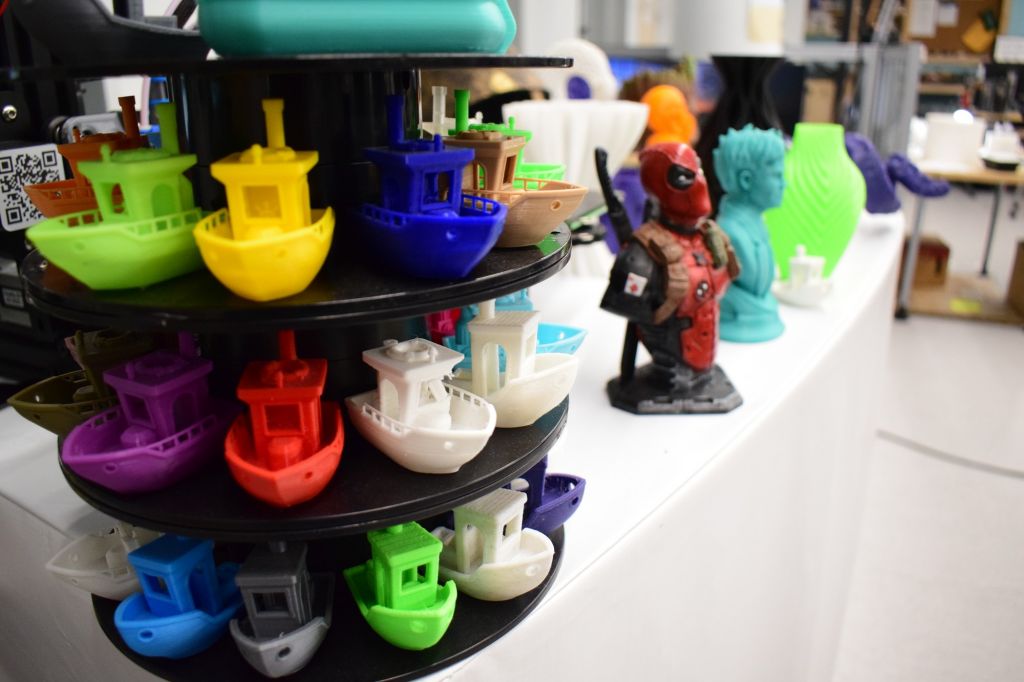
Some of the 3-D printed objects in MakerSpace made from bio-degradable plastic.
A year after MakerSpace has been established, the MakerSpace is now equipped with more materials such as more 3-D printers, laser and vinyl cutters as well as automatic sewing machines; which is all the more reasons to be curious about the space.
Matthew Jerabek, the impact coordinator for applied research & innovations program, says that the space is for all students to learn and be curious. “You don’t need to know how to operate any machinery or tools in the space,” said Jerabek. “We are there to help you and guide you.”
Students who are curious to print a model for the first time, can visit Thingiverse, a website with thousands of models to choose from. “One thing that you can do is find a model that hasn’t been created,” said Jerabek in reference to the website. “It’s great to peruse [different] models.”
A 3-D printed sculpture, printed by MakerSpace technician Ryan Kowtecky. Photo credit: Perushka Gopalkista
Based on the questions from students, the program creates workshops varying from 3-D printing to coding. “Workshop ideas have stemmed from the questions and skills most asked for, by students in the MakerSpace over the past year,” said Jerabek.
On Sept. 20, was the first 3-D printing workshop was held in the MakerSpace which was taught by MakerSpace technician Ryan Kowtecky, who showed students how to print simple models using the free modelling software, Fusion360. The workshop went through the process of how to draw a simple domino using the technical elements of the software.
Based on the positive feedback from students who’ve attended the workshop, the space will organize more workshops in the future.
Third-year graphic design student, Jenny Owens, says that MakerSpace is great for many visual projects. “Our projects — they’re interesting, it’s not like we’re doing accounting – it’s very engaging,” said Owens. “We get to do something that actually has a visual result at the end, which is cool. Every project is a creative project, it’s the type of skill set that I want to keep working on.”
Madeline Mei, who is also in her third year, but in the massage therapy program and (an ambassador for MakerSpace), says that she would like to use 3-D printing in the future to give clients a visual understanding of their injuries.
“I think working with kinesthetic clients that want to see the types of injuries that they’re working with, they [could] actually manipulate it.”
During a quick demonstration, Mei was able to show students how the small 3-D printer works. If students want to print something (three-dimensionally), they would first have to download an image or template from Thingiverse and download unto an SD card. From there, the SD gets slotted into the machine and the printer reads the particular code.
The 3-D printer was able to create this object with all the details as is, without the need to fit it together Photo credit: Perushka Gopalkista
“It works from the bottom up,” said Mei. “Something like this was on the machine and it comes off fully articulated – So, I didn’t have to put this together at all.”
Computer programmer student, Tinashe Chapfungasaid that he was fascinated with seeing 3-D printers for the first time and would like to visit the space for often. “I really want to [see] the motion of it,” said Chapfunga. “I heard that there are bigger and sophisticated ones.”
MakerSpace, located on the second floor of DARE District, in C276, is open to all students every day from 11.a.m to 4 p.m.
The program’s next 3-D workshop takes place on Friday, Oct. 18 from 12 p.m. to 1 p.m.
For more information about upcoming workshops, students can visit the Eventbrite website.
Participating in organized sports has great benefits – but it comes with a price. When Algonquin College students think back to their own childhoods, they may remember that not everyone […]
Farah Khan
Photos: Emily Hsueh
October 1, 2019 Revised: October 1, 2019 9:19pm
Photo: Emily Hsueh
Farah Khan
Participating in organized sports has great benefits – but it comes with a price.
When Algonquin College students think back to their own childhoods, they may remember that not everyone was fortunate enough to take part in such activities. Parents are the ones who played a huge role whether it was driving you to practice, staying late for games, and most importantly, paying.
For those of us who were lucky enough to have had this experience, we know we couldn’t have done it without them.
A CIBC poll from 2014 found that 82 per cent of Canadians know a child who cannot participate in organized sports because of the costs.
Enter Andrew Scheer’s pledge to bring back the Children’s Fitness and Art Tax Credit. This would mean that families can claim a maximum of $1000 and receive up to $150 back for sports.
That’s great – for higher-income families.
Though, the tax credit is supposed to help families, which it does, it would only be of benefit to those who can afford to spend the money, to begin with.
Parents still have to bear 85 per cent of the costs.
“My mom was spending over $20,000 a year,” said Mariah Harper, goalie for the Algonquin women’s soccer team. “A lot of families can’t afford that and it is so sad, because there are so many children that come from low income families that have so much potential and so much talent that just can’t pursue it because they don’t have the opportunity.”
Skills to compete at a competitive level isn’t enough. The disparity among low income and high-income households is prevalent in sports.
“I grew up in a low- to middle-income family,” said Rita Sibo, a player on Algonquin Thunder women’s basketball team. “So, it was definitely hard for my parents to put me and my brothers in sports. They would do their best to help us stay active.”
So, what I am really getting at with this?
Lots of people lose out on opportunities because of costs. In sport programs, only those who can afford to participate will receive the tax credit benefit. They are able to bear the costs and will also receive a portion of it back as a credit. At the end of the day, its only helping families who already have the funding.
With the tax credit brought back as an election platform issue, we need to consider the implications of our choices. We are the ones who have created this ever-present divide, one that will continue to amplify.
You should think twice before stepping out of the house as a Geisha or posting a picture dressed as a Mexican man for Halloween this year. Talks on freedom of […]
Betel Maria Hailu
Photos:
October 1, 2019 Revised: October 1, 2019 3:54pm
You should think twice before stepping out of the house as a Geisha or posting a picture dressed as a Mexican man for Halloween this year.
Talks on freedom of expression and cultural insensitivity are an ongoing debate. And what a better time to have this conversation than now, as Our Prime Minister Justin Trudeau’s blackface images have surfaced.
Thinking twice before putting on a Halloween costume is something more students are doing. Although freedom of expression is something we value in our society, racism and discrimination are things we strive to eliminate as Canadians.
However, realizing a costume is insensitive shouldn’t be that difficult.
Costumes that reinforce stereotypes or that use traditional, ceremonial or religious garments are offensive.
“I think you should think twice before you buy anything when dressing up in costumes,” said Katie Duncan, a dental assisting student. “Our generation makes fast decisions, and I don’t think we’re taking the time to think about the outcomes.”
Costumes are deeper than just the mere fun of it all. There are consequences in terms of what message you are sending, especially as an adult.
“What’s important, I think, is to understand why a costume would be offensive rather than just thinking that it could be offensive,” said Gloria Nishimwe, a law clerk intensive student. “Trudeau is not the same person he was when he was doing blackface so I would give him the benefit of the doubt. It is important for him to set the example by opening that conversation and saying what he did is not okay.”
Although Algonquin College hasn’t yet created a protocol on Halloween costumes, one post-secondary institution that has is Brock University.
After a group of students dressed as blackface won a costume contest at the campus pub in 2014, the student union at Brock University created a Halloween Costume Protocol to combat racist costumes.
The protocol has since been put on the student union’s website where students can refer to a list of offensive costumes.
Algonquin students should remain conscious nonetheless. Dress up – but don’t reduce someone’s identity to your costume choice.