main

Coding sessions support community interest and industry demand

Sam Murdock – Game Master at Lockdown Ottawa and participant at Algonquin College’s Arduino workshop on Sept. 24 – has coded before. If you attended a workshop with him, you […]
Photo: Jack Casselman
With the demand for people with the ability to code on the rise, it's becoming a much more attractive skill to learn.

Sam Murdock – Game Master at Lockdown Ottawa and participant at Algonquin College’s Arduino workshop on Sept. 24 – has coded before. If you attended a workshop with him, you might think he knew exactly what he was doing.

But Murdock was at the workshop, hosted by ARIE, because he had never coded with an Arduino, the low-powered mini-computer used in so many prototypes in the Applied Research Innovation and Entrepreneurship Lab.

Murdock equated the coding to puzzle-solving.

“You don’t know what the puzzle is supposed to look like. You’re both making it, and putting the pieces together at the same time.”

Darren Taubman, a carpentry professor from Algonquin’s Perth campus, was in attendance for more personal reasons.

“I appreciate that ARIE has been offering these courses,” Taubman said. “It expands our knowledge. I hear my kids talking about it all the time.”

Ontario’s math curriculum in elementary schools was updated in June 2020. According to the Ministry of Education, beginning in September 2020, children in the first grade will be learning to code.

The beginner’s workshop, was led by Stephen Gagne, a professor in the School of Business at the college. According to Gagne, “coding is more than just inputs and outputs. Being able to code teaches you how to think properly.”

“As it stands right now, coding is the number one most employable skill. If you have coding as part of your skillset, you are in demand in just about every industry.”

What was once a single-session workshop is now a four-part event. As the demand for basic knowledge in coding increases, ARIE is looking at expanding their events to cover the basics in every programming language.

Fitness Zone reopens with new rules in place

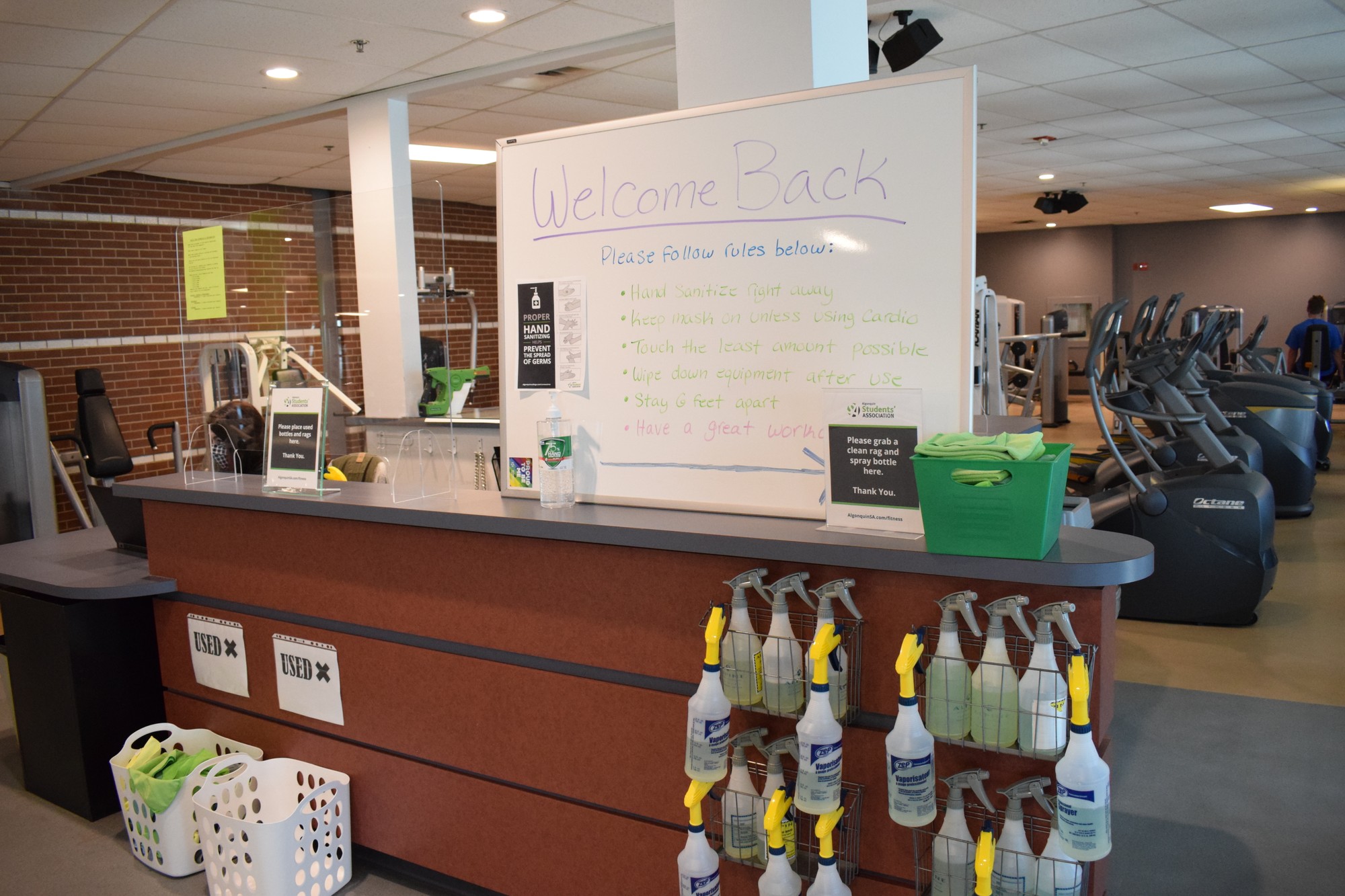
The Fitness Zone reopened Sept. 8 with new rules in place to account for the ongoing COVID-19 pandemic.

The Fitness Zone reopened Sept. 8 with new rules in place to account for the ongoing COVID-19 pandemic. Continue reading “Fitness Zone reopens with new rules in place”

Online convocation celebration for 2020 grads aims to bring students together

Algonquin is hosting its virtual graduation which will feature all of the traditional aspects of previous ceremonies, including the opportunity to connect with peers and faculty, guest speakers and music. […]
Photo: Phaedra Hamer
Graduates of 2020 will have a virtual ceremony where they can connect with the community, friends and family to celebrate their achievements.

Algonquin is hosting its virtual graduation which will feature all of the traditional aspects of previous ceremonies, including the opportunity to connect with peers and faculty, guest speakers and music.

With students unable to attend their convocation in June, the college has come up with new ways for graduates to gather and commemorate their successes on Oct. 28.

After missing her convocation in July, Abigail Crispin, a summer graduate from the practical nursing program at Algonquin, found other ways to celebrate.

“It was definitely disappointing to miss out on that opportunity,” said Crispin. “But, my friends and I got together and did our own little photo shoot.”

The ceremonies will be hosted on the college’s brand-new convocation website and available for viewing any time after each ceremonies’ dedicated start time.

Students who are registered will receive access to two links; one for their specific ceremony and one for their post-reception breakout room on Zoom.

Events manager Sophia Bouris recognizes how important community is for students on their graduation day.

“We are shifting the way we do things to make sure students feel connected to their college, peers and faculty,” said Bouris. “These connection points were all at the forefront of our decision-making process.”

Another way for students to be connected during the ceremony is on the live tag board where students can watch live tweets from their community.

“We want the community to be pumped about the convocation,” said Bonnie Chan, convocation officer, with excitement. “Ceremonies can be shared with friends and family so everyone can safely watch and celebrate together, even if we’re apart.”

SA President Emily Ferguson says that the college is trying to make convocation feel “as normal as possible.”

All speeches and music will be pre-recorded to be put into the virtual celebration.

“These traditions are so important to keep, and they’re not going anywhere,” said Bouris.

Confused about health plan options? Here’s what you need to know

Students have until Oct. 2, 2020 to either sign up for the health plan or opt-out, but how much do students know about this service? Algonquin offers a private health-care […]
Photo: Meara Belanger
William Dean, a second-year child and youth care student, hasn't taken advantage of AC's health plan even though he's used campus health services.

Students have until Oct. 2, 2020 to either sign up for the health plan or opt-out, but how much do students know about this service?

Algonquin offers a private health-care plan to full-time domestic students as part of the cost of their tuition. In Ontario, public health insurance (OHIP) partially covers a range of services from doctors’ visits to birth control. But there are certain restrictions — OHIP won’t cover everything, and that’s where private insurance comes in handy.

Availability is one thing, but awareness is another.

William Dean, a child and youth care student in his second year who has never used the college’s health plan, tries to explain what he remembers about the insurance policy from his first year.

Madeleine Thompson, a second-year tourism and travel student, says the health plan is just “another college cash grab.” She’s frustrated with the program’s accessibility.

“In my experience, nothing was ever explained thoroughly,” said Thompson. “I’ve had to contact them multiple times for clarification and so far I’ve found it useless and had to pay for everything because it takes so long to find out what’s covered and what’s not.”

To alleviate some of the confusion, the Times has broken down the health plan, how to access it and the various benefits included with different plans.

There are two basic options.

The Flex plan is the default health care option, which provides benefits to the student. This option is ideal for students who are single without any dependents. The family plan provides benefits to both students and their families. This option is great for students who want to add one or more family members to their plan, including spouses and children.

Depending on what you need, there are four plans to choose from.

On the WeSpeak website, click the white box at the bottom of the text boxes and type “Algonquin College”, and it will redirect you to a page that looks like this.
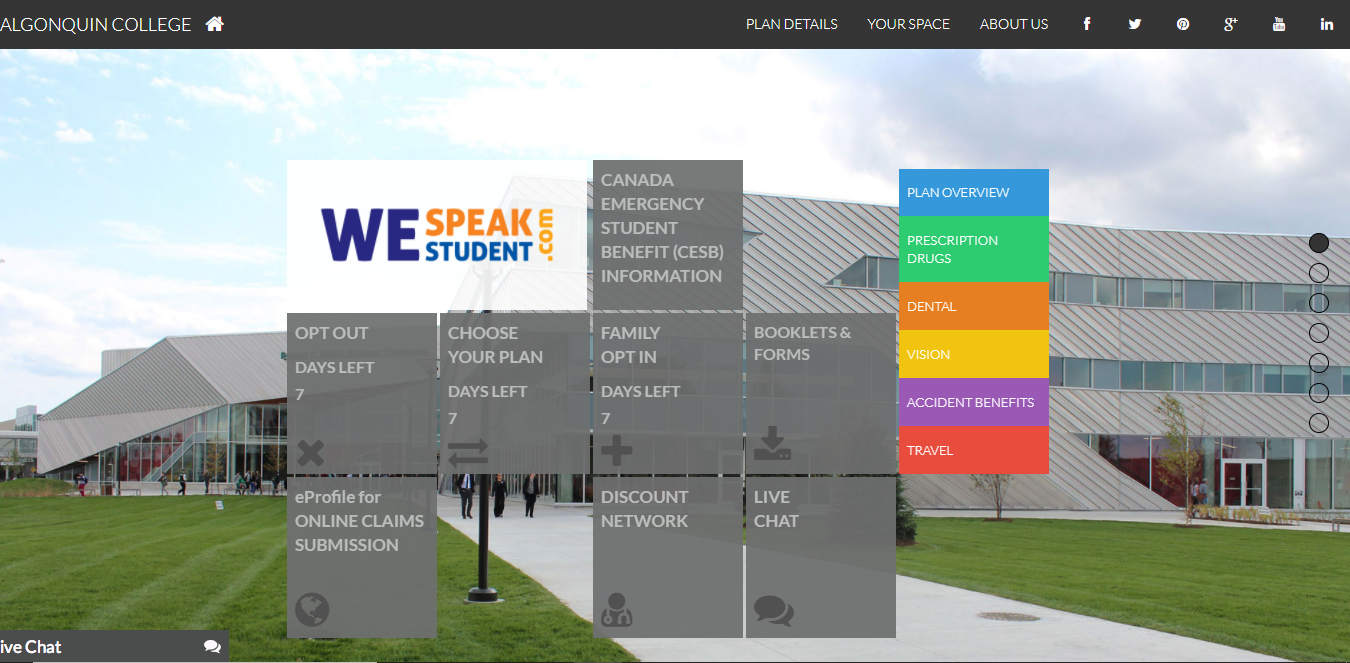
Students have until October 2 to click the “choose your plan” box. If they do, they can choose from one of four plans.

The balanced plan is the default benefit students are afforded if they don’t choose themselves. It has $3,000 maximum annual coverage for prescription drugs and 80 per cent coverage for most prescription drugs, $500 maximum annual coverage for dental, and 100 per cent coverage to a maximum of $50 for a general eye exam and $100 for prescribed contact lenses and frames.

The enhanced drug plan focuses on pharmaceutical care with $5,000 maximum drug coverage per year and 90 per cent coverage for most drugs. Dental coverage is reduced to a $300 annual maximum, while vision coverage remains identical to the balanced plan.

The dental focused plan allows $2,000 annual maximum drug coverage and 70 per cent coverage for most drugs, with a rise to $750 maximum basic dental coverage, as well as 100 per cent coverage of minor restorative work and 80 per cent coverage of extractions and oral surgery. Again, this plan offers the same vision coverage as the balanced plan.

The vision focused plan offers $2,000 maximum drug coverage annually and 70 per cent coverage for most drugs, with $300 maximum dental coverage per year. This plan offers 100 per cent coverage to a maximum of $50 for a general eye exam and $150 for prescribed contact lenses and frames every 24 consecutive months.

How can a student make a claim online?

From the WeSpeak website, click the box that says “eProfile for online claims submission”. This will redirect students to a page that will ask them to create a profile if they are first-time users. They will be asked to present the information provided to them via their health plan card. If you never received a health plan card via email, don’t panic. The information for all students is similar: the group number is 513970, the provider is ClaimSecure, and your student ID is “A” followed by your student number. After entering this information, students will be asked to login and fill out a claims form to submit online.

How can students opt-out?

Students can opt-out of the health plan by October 2, however, full-time students are not eligible for a refund of fees even if they’ve never used the health plan, and all other students will need to provide proof of an existing health insurance provider. Students can opt-out by clicking the box that says “opt-out” on the main page and following the instructions.

For students like Dean, more communication on the administration’s part is key.

“I’ve used the clinics before to get a concussion checked,” said Dean. “Now because of this interview maybe I’ll do some more research to see what’s covered. I feel like most people don’t even know that they’re paying for it.”

In a Zoom meeting with journalism students last week, Student’s Association president Emily Ferguson commented on the situation, revealing the high volume of inquiries the SA has been receiving regarding the health plan.

“We’re getting a lot of questions about the health plan,” says Ferguson. She further explained that frontline service associate Monica Saud handles most of the questions concerning the insurance policy.

The board of directors will be reviewing the health plan in “the next month or so,” according to Ferguson.

For more information about the health plan, visit the Student’s Association website, and to sign up for the health plan, visit wespeakstudent.com.

A welcome from your SA president

First, let me share a warm welcome to new Algonquin College students, and a warm welcome back to all of those returning! If this is your first time seeing me, […]

First, let me share a warm welcome to new Algonquin College students, and a warm welcome back to all of those returning! If this is your first time seeing me, my name is Emily Ferguson. I’m a full-time student in business administration, and last spring, I was elected President of the Algonquin Students’ Association.

Through the Algonquin Times, I am lucky to have a platform to speak freely and share my thoughts with you all once per month in this president’s column. This month, I want to share one of the essential services provided to students by the SA.

The Food Cupboard is located on the Ottawa campus in C033 and is operated by the Students’ Association. Since December of 2014, it has been a discreet and confidential service for students experiencing financial difficulty and cannot purchase food for their households.

Students can access the Food Cupboard once per month for a three-day supply of food and supplies.

If you require food but are in isolation or are not comfortable visiting in person, virtual options are available. The SA, and our Food Cupboard, are dedicated to continuing to help students. Now, more than ever, we need the support of the Algonquin College community.

We are seeing more students than ever who are struggling to find work because of the COVID-19 pandemic, and sometimes they find themselves having to decide between paying their rent over purchasing food.

On October 2, between 10:00 a.m. and 4:00 p.m., we will be hosting a contactless food drive outside of C building. We are looking for the support of our strong and resilient community. If you’d like to contribute but cannot attend the food drive in person, you can donate online through Canada Helps. You can find the information on our website at www.AlgonquinSA.com/food-cupboard.

Some of the most in-demand items are peanut butter, canned vegetables, canned fish, cereal, canned chickpeas, lentils, and beans.

I’ve seen how wonderful the Algonquin College community is, and we are at our best when we’re supporting each other.

The SA continues to support students, both in-person on campus, and online. Over the last seven months, we have worked hard to provide our services virtually and continue to adapt to the situation we are all finding ourselves in.

If you or a classmate are experiencing food insecurity, please reach out to the SA for support.

Bursary for Black business students launched by grad who wants to empower others

As Carl Clergé, a 2016 Algonquin graduate, scrolled through his social media feeds over the summer, he noticed a lot of posts aiming to educate people on racial injustices towards […]
Photo: Chanelle Pinard
William Street downtown Byward Market features Black Lives Matter art.

As Carl Clergé, a 2016 Algonquin graduate, scrolled through his social media feeds over the summer, he noticed a lot of posts aiming to educate people on racial injustices towards Black people. Clergé, however, wanted to do more than just educate his personal social circle.

When he contacted Algonquin College’s advancement office, he assumed there would already be a bursary in place supporting Black students so he could make a donation. However, this was not the case.

“It would be a good time to start one,” said Clergé. “If there was time, it would be right now.”

The Empowering Black Students Bursary he founded has been available to receive donations since Aug.12. Clergé’s goal is to raise $15,000 for the account so it will be eligible as an endowment fund. In this type of account, the interest collected on the principle amount will be distributed to students who meet the criteria of the bursary.

“If we have $15,000, it can stay there forever and for me that was a no brainer,” said Clergé.

Funds could be distributed to students as early as this coming winter semester but this will depend on how quickly the money is donated in order to reach the $15,000 minimum threshold. Clergé hopes funds will be available to be distributed by fall 2021.

The criteria to be eligible for the bursary is to identify as a Black student in the school of business at Algonquin College.

Clergé, 25, graduated from the business administration program with a major in finance in 2016 . He currently works as a risk analyst for Export Development Canada.

The desire to create a bursary was not only in response to racial injustice but was also a very personal decision.

Clergé’s mother moved to Canada from Haiti in 1989. As an immigrant, she did not have the opportunity to go to school as she needed to work right away to support their family financially.

His goal is to help support those who are pursuing education but may not have the financial means to do so entirely. After five years of post-secondary schooling, Clergé said he feels fortunate to have been able to attend Algonquin College and University of Ottawa after for economics.

“I just feel like everyone should have that opportunity,” said Clergé.

He is not the only person who thinks so. Clergé has received support from his current employer Export Development Canada. They have been matching 100 per cent of all employee donations since the bursary went live on Aug. 12.

In addition to Export Development Canada, Algonquin’s Jeremy McQuigge, manager of Course Material Services and former business professor, has also offered to match donations dollar for dollar up to $2,500 till Sept. 30.

“If you are someone who is able to contribute $30 that is actually going to translate to $60 right now,” said Kristen McCloskey stakeholder relations officer. “It is great to know your money will be doubled right now. “

Clergé met McQuigge during his first semester at college.

According to Clergé, McQuigge was a really good professor. He offered students who made a certain average in his class the opportunity to put him down as a character reference when applying for jobs. Clergé said it helped him start school off on the right foot and was able to use McQuigge’s reference on his resume.

As of Friday, Sept. 25, the bursary account was sitting at $11,000 which does not include the amount of money McQuigge is matching.

Where and when to eat on campus during the pandemic

Since COVID-19’s arrival in the community, Marketplace Food Court and Savoir Fare bakery have had to change how they operate for students and staff. The college’s main food court in […]
Photo: Akira Cooper
Marketplace Food Court is still open to serve students and staff.

Since COVID-19’s arrival in the community, Marketplace Food Court and Savoir Fare bakery have had to change how they operate for students and staff.

The college’s main food court in D-Building and the 35th Street Market Cafe in residence are the only two of food service’s seven locations open this fall.

“Most of the changes in the Marketplace Food Court are physical and operational changes,” said Mary Baxter, the general manager of food and conference services at Algonquin. “We have implemented barriers and flow of traffic with a dedicated entrance and exit.”

While Marketplace’s hours have remained the same, many other things are different.

“Everything has changed since last semester,” said Maryanne Murphy, a Savoir Fare bakery employee. “We don’t have the same amount of products like we used to but those students are still providing and doing their curriculum.”

The restaurants are experiencing a financial impact due to fewer students being present at the college. “Our revenue has been significantly reduced,” Baxter said. “Our catering, conference, and banquet business have also been impacted as there are currently no events on campus.”

Activity on campus is as minimal as possible, but those who are on campus are using the services to their advantage.

For some, they still like to visit the food services when they’re on campus. “We’ll come occasionally,” said Emma McKenna, 21, a first-year applied museum studies student, gesturing to her friend, first-year professional writing student, Megan Paul, 19. “Probably less than your average student.”

“The health and safety of our community is our top priority,” Baxter said. “Some of the measures put in place to support physical distancing include plexiglass partitions, signage, and floor decals, and tables in from of service counters.”

Algonquin is following the Public Health guidelines and has made sure the food services they offer areas needed to keep everyone safe.

“We have adjusted our self-serve models for our hot bars and salad bars to full-serve or grab and go models,” Baxter said. “Our menus have been adjusted to accommodate this. Certain areas are also not currently open however, our focus remains on providing a variety of freshly prepared, high-quality food offerings.”

Menus are available online and can be accessed through a QR code found on signs in the Marketplace. Seating has been rearranged to support physical distancing and contactless payments are encouraged.

Smoke from West Coast wildfires seen in Ottawa

Some residents in Ottawa saw a hazy sky Sept. 15 caused by the forest fires burning over the West Coast of the United States. Smoke travelled from California, Washington and […]
Photo: Charlotte Riethman
Trees stand tall at the Bill Mason Centre in Ottawa.

Some residents in Ottawa saw a hazy sky Sept. 15 caused by the forest fires burning over the West Coast of the United States.

Smoke travelled from California, Washington and Oregon across North America from fires started in August.

“Fire is a natural process of a forest,” said Cole Angeconeb, a 2020 forestry technician Algonquin Pembroke graduate. “It becomes bad with urban sprawl, and people moving into wildlands.”

“In southern California it’s all grasslands, so there’s not many trees burnt, it’s mostly shrubs that are six feet tall and are more prone to spreading,” said Angeconeb.

More fires are being started by humans not practicing safe fire handling while camping.

“They can pick up intensity quickly,” said Julia Charles, 23, a wildland firefighter crew boss with Red Lake Fire Management Headquarters. “There’s not always time to escape.”

Depending on the size of the fire, Charles could work up to two weeks trying to contain the fire before switching crews.

“It’s exhilarating, especially as a rookie it’s a lot to take in, you’re just looking at a wall of flames,” said Charles. “You really rely on your crew to help you through it.”

While fires in Ontario are fought with ground crews and aircraft, the lack of water in California leaves the crews to rely on hand tools for digging trenches to make fuel breaks.

“It all depends on management and the region,” said Angeconeb. “Places have prescribed burns to emulate a fire, if there are no prescribed burns more trees end up on the ground which leads to a more intense fire with no fuel breaks.”

Angeconeb says forest fires have always happened but a lot of people think it’s new with more media attention.

“Two hundred years ago it wouldn’t be affecting as much,” he said. “But people moving further into the wilderness doesn’t work out that way with fires.”

“Some trees are dependent on fire to spread seeds,” he said. “It can spark life again, and be a new beginning.”

Two-day Scholar Strike was a chance to discuss systemic racism

During his classes on the first week of school, Martin Lee, a biotechnology and chemistry professor, used some of his class time to discuss the issues that prompted the Scholar […]
The Scholar Strike is about taking a break from studies and focusing on educating oneself on the matters of Black Lives Matter movement

During his classes on the first week of school, Martin Lee, a biotechnology and chemistry professor, used some of his class time to discuss the issues that prompted the Scholar Strike on Sept. 9 and 10.

The strike was a work stoppage event taking place across Canada and the U.S. in support of anti-oppression, police brutality and racism.

“The strike was about amplifying the message for the day and making sure that the voices of the oppressed are being delivered,” explained Lee.

During the two-day strike, faculty and students are suggested to a break from normal studies to educate themselves on anti-oppression, police brutality and racism.

Dr. Anthea Butler, a professor at the University of Pennsylvania, was inspired by the game strike by WNBA and NBA players for the Black Lives Matter movement decided to create the Scholar Strike.

The students and teachers who support the movement hope that this becomes an annual strike event until the message about Black Lives Matter has been heard.

Whether it was through boycotting basketball games, printing slogans on jerseys, signing petitions or donating, every single person was encouraged to contribute to the movement in their own way.

To help spread the messages that the Black Lives Matter movement stands for, different organizations, companies and humans have been finding ways to pass it along.

Annette Bouzi, a law professor and president of the OPSEU local 415, the faculty union at Algonquin, always brings information about non-oppression studies and the Black Lives Matter movement to her courses as part of her ongoing curriculum.

As a person of colour who is oppressed and also a person who has significant power as a teacher and a leader of a union, when Bouzi heard about the strike, she supported and tried to push it to as many people as she could.

“Because of the recent events and everyone is homebound and watching, the world is experiencing acts of violence differently, this is important,” said Bouzi about the movement. “I hope we come to a point where we don’t need a call to action.”

In a letter to the Algonquin community about the Scholar Strike, Claude Brulé, Algonquin’s president wrote: “Algonquin College stands with everyone calling for equity and justice for Indigenous, Black, and Communities of Colour around the world.”

In an interview, Brulé added more: “It’s very important to shine a light on this subject and we require significant action and help from everyone,” he said. “There is more work to be done.”

Algonquin professor invents portable antimicrobial tool to fight COVID-19

Troy Crosby, a part-time professor in Algonquin’s manufacturing engineering technician program and a former student, aims to help Ottawans flatten the curve with a lightweight, antimicrobial tool that minimizes unnecessary […]
Photo: Kavya Nair
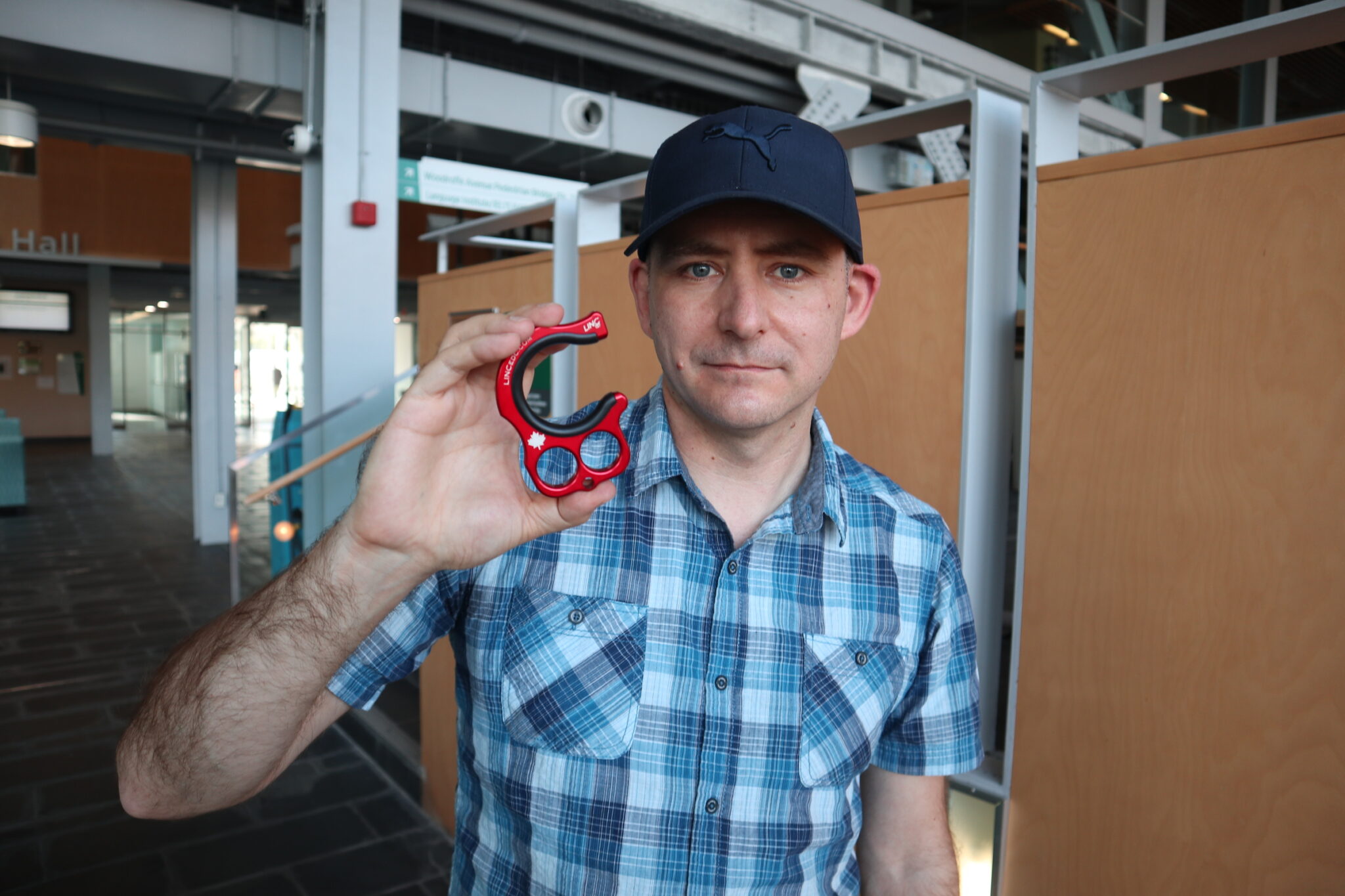
Troy Crosby, inventor of LINC with the product

Troy Crosby, a part-time professor in Algonquin’s manufacturing engineering technician program and a former student, aims to help Ottawans flatten the curve with a lightweight, antimicrobial tool that minimizes unnecessary touch.

Called the Linc, the tool allows users to turn doorknobs, press buttons, pull/push or hold onto handles and even use their smartphones so they don’t have to get in direct touch with unsanitized objects.

Crosby, a Computer Numeric Control machinist, explained that the Canadian-made product is durable, can lift to 125 lbs and the material prevents microbial growth from spreading on the tool itself.

“No other tool in the market can tackle the round style doors like Linc,” said Crosby. “It’s completely made in Canada and designed with your safety in mind.”

Contact-free and safe method to open doors
Contact-free and safe method to open doors Photo credit: Kavya Nair

With an ambition to help people stay safe during the pandemic and create job opportunities, Crosby, with his partner Karl Miller invested all their time and savings into creating this product.

The idea struck Crosby in April when a colleague mentioned that their company, Excel Precision Machining, needed a product of their own to survive the uncertain times.

“It seemed farfetched in the beginning but it got my mind thinking,” said Crosby. “I originally had an idea for a reusable mask to which I immediately bought a 3D printer to start building. While doing my research on masks I came across a product that screwed onto a latch style doorknob so you can open it with your arm. I liked the idea but the product had several limitations.”

Karl Miller, president of Excel Precision Machining calls Linc a practical tool that “seems to be right for the times.”

“I believe this product is an excellent tool to go along with other Personal Protective Equipment to help mitigate the risks we face in our daily lives,” he said.

After countless hours of researching, designing and then redesigning, creating prototypes, blueprints and several sleepless nights, Linc was born. But that was just the beginning, after creating Linc, the main goal is production and selling to the masses.

“We are currently running on Kickstarter, a crowdfunding page that allowed us to get our feet under us a bit,” he said.

With luck in their favour, Crosby told that his funding campaign was a success.

“We surpassed our goal of $4,500 in an astounding 16 minutes,” Crosby exclaimed.

Canada-based LINC tool aims to flatten the COVID-19 curve by reducing germ spread
Canada-based LINC tool aims to flatten the COVID-19 curve by reducing germ spread Photo credit: Kavya Nair

Jon Moore, chief development officer at the Asset uses a Linc.

“Apart from the regular use, Linc has also helped me carry grocery bags without getting cuts on my fingers. Carrying Linc around makes my family and me feel safer,” he said in his email.

After overcoming the hurdles of choosing the right material that has the perfect grip, sensors, antimicrobial properties and getting funds, the next step for the company is selling.

The initial cost of Linc would be between $26-$35, with an aim to streamline production and bring the costs down in the near future.

“We will be adding Shopify and Amazon stores in October. We have started building distribution connections to bring this tool to the public,” Crosby added.

Algonquin Times podcast

Stay Informed

Sign up for our newsletter

Subscribe

* indicates required