main

Grand opening of new recreation facility 10 years in the making
The Algonquin College Students’ Association celebrated the official opening of the ARC on Monday, April 4 with speeches by the college and SA’s presidents, a visit by the mayor, a […]
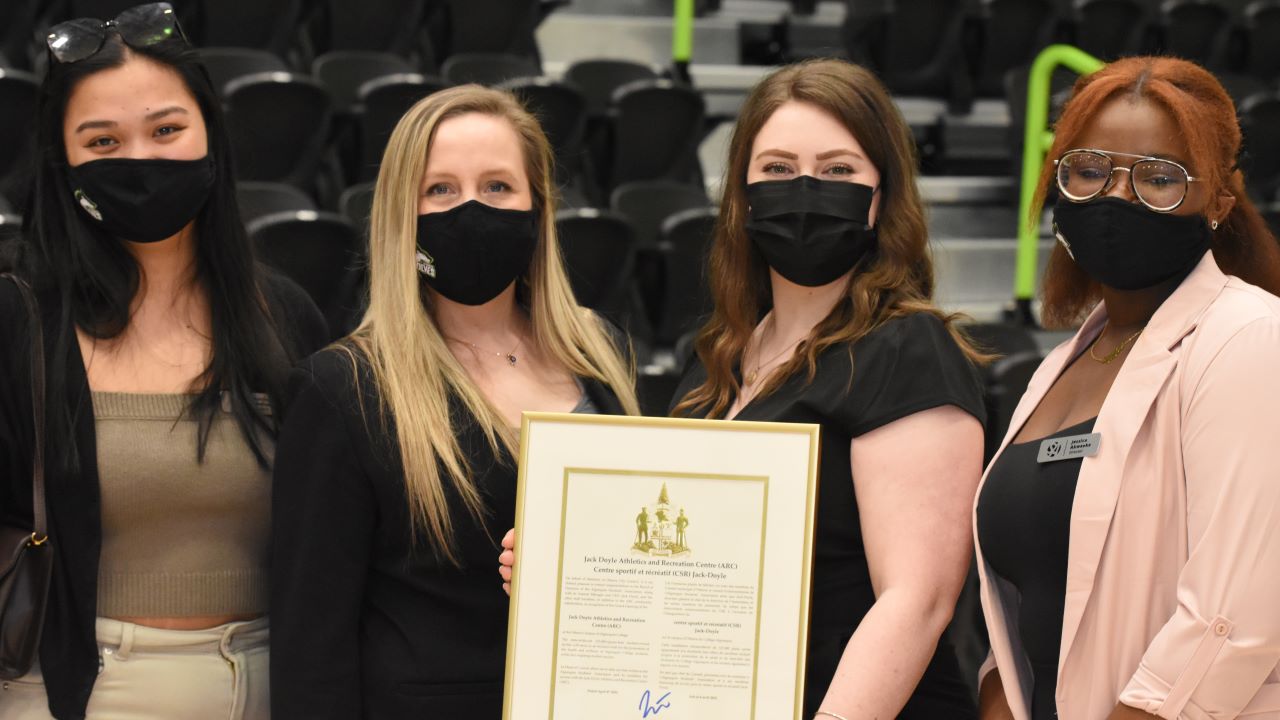
SA board members (left to right) Katrina Medina, Cat Coleman, Emily Ferguson and Jessica Akwaeke, took part in the facility's grand opening event.

The Algonquin College Students’ Association celebrated the official opening of the ARC on Monday, April 4 with speeches by the college and SA’s presidents, a visit by the mayor, a ribbon-cutting ceremony and building tours.

The 125,000 square foot Jack Doyle Athletics and Recreation Centre, located to the northeast of the Student Commons across from the residence building, has been open to students and staff since Sept. 27.

The ARC includes a rock-climbing wall, a turf training area, a 10,000 square foot free weight area, a walking/running track, a fitness area with cardio equipment, three gymnasiums, a golf simulator and bowling lanes, a restaurant and a bar.

It was jointly funded by the Students’ Association, which contributed $49.9 million, and Algonquin College, which gave $5.5 million toward construction and $11.9 million for the pedestrian link, road upgrades and other infrastructure upgrades.

The state-of-the-art facility provides many activity options to students and staff, and is also the home base for the Algonquin Wolves women’s and men’s basketball teams.

Emily Ferguson, president of the Algonquin Students’ Association, said she was there from the start and was able to see it grow throughout the pandemic.

“To have everyone in one place, in one giant building, to see everyone there was emotional,” said Ferguson.

Ferguson said that she was happy to see everything and celebrate all the hard work that was done.

“To actually have students coming in and playing and working out and doing everything here, it’s been incredible to see them walk in and their eyes light up when they see the building,” said Ferguson.

The Students’ Association president said students wanted something for their physical and mental health and this facility has something for everyone.

“If you’re not a huge gym geek, you can bowl or get great food and to just be with friends is wonderful,” said Ferguson. “I think coming out of this pandemic and having a social place that students can go to is healthy and fantastic.”

Jack Doyle, the SA’s general manager and the building’s namesake, said all students can take advantage of the facility.

“[The students] have the right to come here and use all the facilities, the bowling and climbing wall and there are no user fees,” said Doyle. “So that’s designed to make it accessible. We’re just so excited that Algonquin students will have a facility like this for the next 30 or 40 years.”

Claude Brulé, president of Algonquin College, said the facility symbolizes the meaning of collaboration and partnership.

“I want to sincerely congratulate our Students’ Association, the many college departments involved, and our partners for completing this building during a global pandemic,” said Brulé. “You were met with challenges unlike any we have seen before.”

Jim Watson, the mayor of Ottawa, congratulated the student body for the great initiative.

“Funded through student fees, not from the college itself, I think that’s a remarkable achievement in itself,” Watson said. “Getting it built-in during COVID is really quite special. Congratulations to the student leaders and the students who will benefit from this facility for decades to come.”

Watson also congratulated the many people who contributed to making the building possible, including Jack Doyle.

“He was the guiding force to help the Students’ Association transition after every election,” Watson said. “And obviously, his fingerprints are all over this project. Because you need that kind of expertise to take a project of this magnitude and then see it over the finish line.”

Staff from the facility were assigned to do a walking tour around the building.

Timothy Lee, manager, athletic operations – fitness, said that after seeing all the senior management, the board of directors and Jack Doyle can now really celebrate the fruits of their labour.

“They’ve all worked so hard with their planning for several years,” Lee said. “It started 10 years ago with this and then to build it during COVID, with all the challenges faced with that, I really do think that’s a highlight for me and to see them realize this dream.”

Lee encourages students to come and enjoy the facility.

“My team and I welcome you with open arms,” said Lee. “We’ll work hard to make this a very positive experience for you that you’ll remember for the rest of your lifetime.”


Online Editor

The Algonquin Times is a newspaper produced by journalism and advertising students for the Algonquin College community. Follow us on social media! Algonquin Times Twitter Twitter (Events & Promos) Facebook Facebook (Events & Promos) Instagram Snapchat

Spring can bring housing concerns for students

Exams and final assignments are not the only reason students tend to stress out around this time in the second semester. Finding a new place to live is also high […]
Photo: Jantina Huizenga
Julia Timewell, a nursing student, can walk to school from her off-campus rented house.

Exams and final assignments are not the only reason students tend to stress out around this time in the second semester. Finding a new place to live is also high on their priority list. Many leases end in April or May and students in residence have to be out soon after their last exam.

For students who want to move out of residence after their first year, they have to find housing typically on their own or with their parents’ help. Finding a place to live that is affordable, safe and practical is only getting harder as the housing market is at an all-time high.

“The housing search was hard when I don’t have a car and still want to be near the college, especially when a lot of renters don’t want students as tenants,” said Gwyneth Jones, an architectural technician student at Algonquin College.

Jones stayed in residence this past year but has since decided to search for off-campus housing. The COVID-19 restrictions that have stayed in place in residence despite the provincial guidelines changing have impacted her decision to leave residence, she wants to make sure she can have her family and friends come to visit her.

Magann Baptiste, a performing arts student at Algonquin College, had help from her mom when looking for a house last year and found a roommate listing on Kijiji. Baptiste chose to not apply for residence this past year because she was able to find a house that would save her money in the long run and she was able to live there during the summer.

Julia Timewell, a nursing student at Algonquin College, lives with Baptiste and three other women in a bungalow that is only a 15-minute walk to the Woodroffe campus. Their lease started on May 1 and is twelve months long. They have both found different off-campus housing for the upcoming year.

While most students aren’t looking to buy houses, that doesn’t mean that the housing market isn’t affecting the rental prices. According to Zumper, a rental website, the average monthly rent in 2022 for a one-bedroom apartment is $1,529 which is a 5 per cent increase from 2021.

According to Canada Mortgage and Housing Corporation, Ottawa’s renting vacancy rate is the highest its been in 25 years but only 15 per cent of rental units are affordable for lower-income individuals. Residence is available for students, although for first-year students a meal plan has to be included, which significantly raises the price of living on residence.

There are resources on the Algonquin College website available to students who are looking for off-campus housing. Kijiji, Zumper, Rentals.ca and housing4students are all websites that have helped students find available rental units.

Comedian Nemr Abou Nassar wins big laughs from live audience

Nemr Abou Nassar performed a stand-up comedy show at the Algonquin Commons Theatre on March 25, 2022 as part of his current tour in Canada. Abou Nassar’s show ran for […]
Photo: Elio Elia
Nemr Abou Nassar performed at the Algonquin Commons Theatre on March 25.

Nemr Abou Nassar performed a stand-up comedy show at the Algonquin Commons Theatre on March 25, 2022 as part of his current tour in Canada.

Abou Nassar’s show ran for about two hours Friday night, as the comic told jokes about a range of topics including parenting, vaccines, the pandemic and the strength of women.

The Lebanese-American comedian has had shows in Toronto and Montreal in the past, but this was his first time performing in Ottawa.

The theatre was packed with people, with only a few empty seats. The majority of the people who attended were Lebanese, indicated by the many enthusiastic hands that were raised when the comedian asked if there were any people from the Middle Eastern country.

“It was fantastic, it was brilliant,” said Oliver Kittan, an Ottawa resident and fan of Abou Nassar who loved the show. “I had high expectations coming in and I can say I was not disappointed.”

The feeling was mutual for many members of the audience, as the comedian was met with cries of laughter each time he made a joke, and was met with a standing ovation at the end of the show.

“I thought the show was quite hilarious. It was so funny, we loved the whole thing,” said Nada El Bouchi, another fan. El Bouchi came to the show with her family of five, all of whom were eagerly waiting for months to see Abou Nassar having been fans for years.

A Lebanese couple who came to the show on a date, Tchjar Aoun and Melissa Boulous, both loved Abou Nessar’s performance as well. “It was amazing, hilarious. He was so relatable,” said Boulous.

“Tears were coming down cause we were laughing so much,” added Aoun. “My only regret was not bringing my whole family.”

When asked what was the best joke of the night, all three interviewees agreed that it was the comedian’s “beating the kids” joke, which out of context may sound silly, but was met with cries of laughter from the crowd.

The joke was about the need for parents to beat their children, as has traditionally been done to discipline some kids in Lebanon, as a way to fix to the entitlement of the people of the United States.

Abou Nassar went on to perform in Montreal the next night, and will take a short break before touring the United States later this summer.

Algonquin students dodge the stigma

A series of dodgeball games took place at the Jack Doyle Athletics and Recreation Centre recently. The event, called dodge the stigma, was organized by the Jack.org club. Jack.org is […]
Photo: Cameron Ryan
Participant Ethan Fisher used his baseball experience to his advantage.

A series of dodgeball games took place at the Jack Doyle Athletics and Recreation Centre recently.

The event, called dodge the stigma, was organized by the Jack.org club. Jack.org is a nationwide organization with chapters in every province and territory.

Jack.org is a charity aimed at increasing awareness of mental health issues and providing resources for people struggling with their mental health.

The dodgeball game featured 13 participants who competed in a series of highly competitive games of dodgeball for an hour.

“A lot more effort than I thought, to be honest, I wasn’t really feeling today, but I put it in, and it was fun,” said Ethan Fisher, a first-year pre-health sciences student. Fisher benefitted from his experience playing baseball.

Algonquin College’s Jack.org club is organizing events every month to open the conversation about students’ mental health.

“The ultimate message that we are trying to promote is mental wellness and mental well-being should be of prime importance of every individual and we should break the barrier of mental health stigma,” said Yaser Siddiqui, one of the organizers of the event.

This is the first year Algonquin College has had a Jack.org chapter and Siddiqui said it is planning more events in the coming months.

Online program offers workers holistic training in addictions and mental health

When Christine Rothmaier was in her early twenties, she was in a bad accident which left her struggling with PTSD. To cope with her feelings, she started drinking alcohol, which […]
Photo: Leslie Bader
Taking a walk in the woods can improve our mental health, says Christine Rothmaier, a graduate of the addictions and mental health program.

When Christine Rothmaier was in her early twenties, she was in a bad accident which left her struggling with PTSD. To cope with her feelings, she started drinking alcohol, which made her depression worse. Rothmaier began counselling sessions with a therapist, and this helped her recover from past trauma.

After completing a degree in sociology at the University of Windsor, Rothmaier, 25, enrolled in the newly established addictions and mental health graduate certificate program at Algonquin College.

Offered through the AC Online campus, this 42-week program teaches students about concurrent disorders and how to develop appropriate strategies for clinical practice. There were over 400 applications for the inaugural full-time semester in fall 2021, which greatly exceeded the program’s capacity of 35 seats.

Spring 2022 offers 30 seats and there are plans to add 10 more for Fall 2022.

How are addiction and mental health connected? “You have to work on why you are drinking, and the drinking,” said Rothmaier. “Mental health is where my heart is at.”

Her goal is to eventually complete a graduate degree in counselling psychology.

Sabrina Bellefeuille, 35, is a subject matter expert who developed the courses for the addictions and mental health program. Bellefeuille has 14 years of experience working in clinical recovery and is 18 years sober.

The program’s curriculum consists of self-guided modules which include theory, filmed case studies and practicum preparation.

“The pandemic blew up mental health as a sector,” said Bellefeuille.

Students can do the asynchronous courses at their own pace, which helps people who are trying to balance work and school. A final field placement with a community agency is facilitated by a dedicated coordinator. Service settings may include homeless shelters, residential treatment programs and hospices.

The program works with the concept that recovery is on a continuum, from harm reduction to abstinence. Motivational interviewing, relapse prevention, ethics and discharge planning are taught with a client-centred appoach. The student comes to understand the family and community behind them and with them, according to Bellefeuille.

“Before you do this program, ask yourself: ‘Have I done the work myself?” said Bellefeuille. “Am I bringing my authentic and healed self to this work?’”

“You do not need to be perfect,” she said. “But you do need to be there for the person in front of you.”

Ontario government holds firm in re-opening, despite growing COVID cases

Local news CBC News: Minister of Health Christine Elliot stated there are no plans to reintroduce masking mandates or other restrictions if there is a sixth wave of COVID-19. “We […]

Local news

CBC News: Minister of Health Christine Elliot stated there are no plans to reintroduce masking mandates or other restrictions if there is a sixth wave of COVID-19. “We need to get on with our lives and learn to live with COVID as it still exists with us,” said Elliot. There is no current threshold of hospital admissions at which restrictions would be re-introduced. Dr. Kieran Moore, Ontario’s chief medical officer of health, has ceased holding regular press briefings on COVID-19. Elliot says the lack of media scrums is a good sign that “the peak of the pandemic has passed us.”

National news

CTV News: The Quebec Superior Court has ordered the ringleader of Canada’s great maple syrup heist to pay a $9-million fine. Richard Vallières was part of a group of 16 people who stole around $18 million worth of syrup from a warehouse near Quebec City between 2011 and 2012. The theft was discovered during a routine check of inventory, barrels were found to contain water. Vallières made a $1-million profit on the illegal sale of maple syrup. Chief Justice Wagner of the Supreme Court of Canada said he must pay the fine within 10 years or else go to prison for six years.

International News

National Observer: Ukraine President Volodymyr Zelenskyy urged the United States to provide more military aid, saying his country’s defense against the Russians is at a ‘turning point.” Russia had just reneged on its promise to pull back troops from Kyiv and Chernihiv, and was shelling a humanitarian convoy into the latter city. To date, four million refugees have fled the war in Ukraine, half of them children. During Tuesday’s peace talks in Istanbul, there seemed to be some progress when the offer was made for Ukraine to remain a neutral territory, and not seek NATO membership. Shortly after the meeting, new attacks were made on some of Kyiv’s outlying areas.

A Beacon of hope for students

Project Lighthouse launched a new student peer support space called The Beacon on March 15, which serves as a confidential, non-judgmental and safe space for students to speak about any […]
Photo: David Rotel
Student peer Ana Vlajkov says The Beacon support space is a way for students to alleviate stress and pressure.

Project Lighthouse launched a new student peer support space called The Beacon on March 15, which serves as a confidential, non-judgmental and safe space for students to speak about any problems they are facing.

“The Beacon is all about peer support. It’s students helping other students,” said Sarah Crawford, the sexual violence prevention and harm reduction co-ordinator of Algonquin College.

“That could be talking to someone about mental health, sexual health, sexual violence, substance use or just getting connected to a service,” Crawford said.

Crawford said the purpose of The Beacon is to make students feel “connected” and have someone to talk to when they feel stressed out.

“We know some of our students might not want to go to counselling, or think it’s a little bit scary. That’s why we’ve created The Beacon. Talking to a student is less of a barrier,” she said.

So far, the majority of students who have accessed The Beacon have mostly been online. Crawford is hoping that changes as the year goes on.

“There’s not a ton of awareness about it. We’ve tried doing stuff, but without everyone being back on campus, it’s harder to promote,” Crawford said.

The idea of a student peer support space was discussed a few years ago, but with the rise of COVID-19, Crawford and her team weren’t able to reach the funding they had hoped for.

Student staff has been hired to help support this project. The three students that run the peer support space are Ana Vlajkov, Oniqua Kamaka and Melissa Marchand.

“They all receive training from myself and one of the counsellors. They’re trained on sexual health, sexual violence disclosures, substance use and harm reduction approach,” Crawford said.

“I think COVID really illustrated that there’s a lot of issues with mental health and being able to access resources. Our current counselling department is pretty overloaded with people trying to access mental health services,” said Ana Vlajkov, a student in the social services worker program.

“I think the peer support space is just a way to help alleviate that pressure and allow students who are going through similar situations to help other students,” Vlajkov added.

The Beacon peer support space is in room E346, located on the third floor of the Student Commons building. The room has a couch and TV to make students feel comfortable.

“We wanted to create a home-like environment for people to come in and have that nice connection,” Crawford said.

It is open on campus Monday to Thursday from 12 p.m. to 5. p.m. and open online Monday to Friday from 12 p.m. to 5 p.m. Students can access The Beacon virtually via Microsoft Teams for face-to-face conversation, use the live chat feature for text-based chatting or text the peer support line at 613-703-8883.

As a country fights for freedom, a new journalist searches for purpose

I am a peace-loving person. I believe in the power of non-violent resistance. I support Canada’s military, but have traditionally avoided the topic of armed defense, preferring to focus on […]
Photo: Stephane Gunner
"I was struggling with the idea of being a reporter, and how close I would need to be to the news - the good, the bad and the ugly," writes the author.

I am a peace-loving person. I believe in the power of non-violent resistance. I support Canada’s military, but have traditionally avoided the topic of armed defense, preferring to focus on their humanitarian missions.

The invasion of Ukraine by Russian forces, and their brutal attacks on civilians has shifted my perspective: we need to answer their call for lethal aid.

On Feb. 24, Russia initiated the biggest military attack in Europe since WWII. Troops began moving into Ukraine by land, as air strikes targeted infrastructure and civilian homes. The assault was launched under a false premise – Vladimir Putin wanted to “demiliterise and denazify” Ukraine.

Ukraine’s president, Volodymyr Zelensky, immediately denounced the invasion as a ploy to stretch Russia’s territory. He began telling the world what was happening as the country mobilized its military. A former comedian, Zelensky delivered a series of passionate speeches in which he described the willingness of Ukrainians to stand united in a fight for their country.

Men and women took up arms as families with children started heading to the borders. As battles ensued in the south, journalists began sharing reports and images of civilians being targeted in their homes, and as they were trying to evacuate their cities.

I started following their stories on Twitter and was shocked and saddened by what I read and saw. But I could not turn away – I wanted to know the truth, no matter how hard it was to bear. I know my sentiments are likely felt by many in the Algonquin College community.

By this time, I was regularly listening in on Twitter spaces which are dedicated to discussing the war in Ukraine. Under the banner of OSINT, or Open-Source Intelligence, citizens, analysts and military vets share information from validated and trusted sources. I spent many hours on Twitter, doom-scrolling, which inevitably left me feeling helpless and depressed.

I began to question if I really wanted to work as a journalist – having to keep current with news and report on potentially horrible situations. The stories started to come in of reporters being injured and killed in Ukraine while chasing a story.

I thought back to the “Freedom Convoy” in Ottawa, and the numerous accounts of media personnel being targeted and harassed on the streets. My schoolwork seemed less important than the tragic accounts of Ukrainian refugees, and the families torn apart by war.

I shared my feelings with my classmates – how I was struggling with the idea of being a reporter, and how close I would need to be to the news – the good, the bad and the ugly. I was in this frame of mind for a few weeks, all while parenting a pre-teen and trying to keep up with other life-stuff. But there was a point when I decided to bring more attention to my school program.

I thought, if I quit journalism because I am too upset about the actions of a political dictator, then I am letting the bully win. And that made me angry – I did not want to give up a potential career and my passion for writing because of a warmonger, or because I know that horrible events are taking place in a country I cannot directly help.

But the journalists in-country are making a difference – by reporting the truth to the world, Ukraine is getting the help it needs to triumph over the occupiers. I know I can be effective in this role, covering events close to my home, or wherever life takes me.

And so, I continue work on my assignments, donate to Ukraine’s armed forces and keep in touch with the news on Twitter. Only this time I spend more minutes engaged with a story, versus more page views. And more time for self-care.

Ottawa Public Health implores residents to wear masks indoors

Local News: Due to the possibility of a COVID-19 resurgence, Ottawa Public Health is encouraging residents to wear masks indoors and is launching a third dose campaign. “I am always […]

Local News: Due to the possibility of a COVID-19 resurgence, Ottawa Public Health is encouraging residents to wear masks indoors and is launching a third dose campaign. “I am always reviewing the situation and thinking about what could be done locally, including taking a look at whether this is a time where it would make sense to use a Section 22 order,” said Vera Etches, Ottawa’s medical officer of health. Section 22 of the provincial Health Protection and Promotion Act gives medical officers of health the power to create rules, such as mandating masks. “The pandemic is not over and we are currently experiencing another resurgence,” said Etches. As of now, there are no plans to reintroduce mask mandates.

National News: A union in Toronto says that workers from a Metro and Food Basics distribution warehouse could be going on strike this Friday. According to Unifor, 99 per cent of workers voted to go on strike if a collective agreement can not be reached by April 1. “Metro has profited tremendously during the pandemic but it is the shareholders who have benefited, not the front line workers,” Unifor Ontario Regional Director Naureen Rizvi said in a statement.

International News: Actor Bruce Willis has announced his retirement from acting after being diagnosed with aphasia, a condition that causes loss of the ability to understand or express speech. The caption of an Instagram post of Willis’ eldest daughter, Rumer, reads “As a result of this and with much consideration, Bruce is stepping away from the career that has meant so much to him.” The statement is also signed by Willis’s wife, Emma Heming Willis, his ex-wife Demi Moore, and his five children, Rumer, Scout, Tallulah, Mabel and Evelyn.

Wastewater data shows a spring wave of COVID-19 is possible

Local Ottawa Citizen: A design has been chosen for the new LGBTQ2+ national monument, Canadian Heritage announced Thursday morning. The winning bid came from a Winnipeg-based team whose design is […]

Local

Ottawa Citizen: A design has been chosen for the new LGBTQ2+ national monument, Canadian Heritage announced Thursday morning. The winning bid came from a Winnipeg-based team whose design is called Thunderhead. The design is meant to evoke a cloud which the team says stands for “strength, activism, and hope.” The monument will be built on Wellington Street and is slated to be completed by 2025.

National

CTV News: As COVID-19 restrictions are lifting across the country, experts who have been analyzing wastewater data are warning of a potential uptick in infections. The data suggests that another wave of the virus could be coming in the next few weeks. The scale of this wave is hard to predict but experts are worried about the relaxing of restrictions and the effects this could have on Canadians.

International

BBC World: The leaders of the NATO countries including Canada’s Justin Trudeau, attended an emergency meeting of the organization today in Brussels. They approved the mobilization of 40,000 troops into Slovakia, Hungary, Bulgaria and Romania to buttress against Russian encroachment through Ukraine. Further sanctions and admonishments were issued by both UK Prime Minister Boris Johnson and Joe Biden.

Algonquin Times podcast

Stay Informed

Sign up for our newsletter

Subscribe

* indicates required