main

Algonquin College to lift COVID-19 restrictions on May 1

As of May 1, Algonquin College will be lifting its vaccine and mask mandates to align with provincial regulations. In an email sent to students and faculty, President Claude Brulé […]
Photo: Rory Friend
Screening checkpoints are among the measures set to disappear on May 1.

As of May 1, Algonquin College will be lifting its vaccine and mask mandates to align with provincial regulations.

In an email sent to students and faculty, President Claude Brulé announced the incoming changes. “The change is based on recent lifting of most provincial restrictions, advice from our public health and government officials,” he wrote.

These changes will see the college return to life prior to the enactment of COVID-19 regulations. All doors to the school will be open for the first time since the start of the 2020 school year, allowing students to enter and exit through whichever door they prefer.

With the lifting of restrictions on entering and exiting the buildings, the active screening measures in place at entrances will end and the self-screening mobile application will be discontinued.

While the screening checkpoints will no longer be in place, community members are still encouraged to self-screen for symptoms and to stay home if they are feeling unwell.

Despite rising case numbers in Ottawa, the latest relaxing of restrictions includes the lifting of the mask mandate. Masks may still be required in certain instances such as health care or clinical settings within the college.

While there will be no requirement to wear masks, the email reminds the community to “respect individuals’ personal choice in this regard.”

The college will continue to closely monitor the situation and Brulé notes any signs of a new wave or a change in provincial regulations could result in the reimplementation of these health measures.

Brulé closed his email with a message of hope.

“These are encouraging signs and I have been really pleased to see many more employees and learners on campus since the mid-term break,” he wrote. “I look forward to seeing an even more vibrant and lively atmosphere on our campuses with the advent of our spring-summer term.”

National Muay Thai champion teaches classes at the ARC

Three times a week, Muay Thai classes are offered in studio A at the Jack Doyle Athletics and Recreation Center. Every Monday, Tuesday and Thursday from 6 p.m. to 7:30 […]
Photo: Sahlym Florestal
At the end of a class, Muay Thai students pay their respect to their teacher.

Three times a week, Muay Thai classes are offered in studio A at the Jack Doyle Athletics and Recreation Center.

Every Monday, Tuesday and Thursday from 6 p.m. to 7:30 p.m. sensei Warwick Fluke, a national Thai boxing champion teaches a martial art and combat sport that uses stand-up striking along with various clinching techniques.

For students who are martial arts amateurs, this is a great place to learn. “I was heavily invested and was delighted that the gym here actually had practice,” said Noah Montgomery, a first-year student in the heating refrigeration and air conditioning technician program.

It’s also a great place for students who are new to the discipline and want to learn how to defend themselves.

“I saw the schedule and wanted to try it out,” said Allan Russel, a second-year electro-mechanical engineering technician program student. “It’s a good opportunity to practice self-defense.”

To get better you need to be invested and practice over and over.

“Practice doesn’t make perfection, but perfect practice makes perfection,” said sensai Fluke.

Some students are heavily invested and have never missed a class.

“I usually go three times a week and I’ve only missed one practice,” said Montgomery who wants to eventually be able to compete but is only in it for the health benefits, strength and endurance until he is ready to take it to the next level.

And others just have smaller objectives, “It is fun and a good opportunity to meet people,” said Russel. Others like Mohamed Wazzi Moukahal, a first-year in the electrical engineering technician program come three times a week with the goal of getting to his potential while learning how to fight.

Others who have heavier schedules such as Jun Sleede, a lab technician for the paramedic program, the goal is to get back in the practice of martial arts train once a week.

The classes are not just open for students but also for staff and teachers at Algonquin. “I would recommend this class to anyone because the teacher is highly technical,” said Sleede.

According to one of the partitioners Montgomery, Muay Thai is not just an exercise, something for your body but also for your mind.

“I found so many benefits, it boosted my self-confidence. I feel like a million bucks leaving here,” said Montgomery.

Algonquin Times print edition makes a comeback

Campus newsstands were stacked with the first physical edition of the Algonquin Times in two years, as staff distributed the newspaper in mid-March. The Times has been the college’s community […]
Photo: Aadil Naik
Mayor Jim Watson with the latest copy of the Algonquin Times.

Campus newsstands were stacked with the first physical edition of the Algonquin Times in two years, as staff distributed the newspaper in mid-March.

The Times has been the college’s community paper for around four decades, with its first edition ever coming out on Sept. 17, 1986. Produced by the students in the journalism and advertising marketing program it’s been delivering news to student, faculty, staff and neighbouring communities ever since.

Although the Times has been delivering community stories online for some time, it had always continued to publish physical copies of the paper.

That all changed in March 2020 when the COVID-19 pandemic forced the staff and faculty to shut down publication of the print edition.

Midway through fall 2021, it became clear to faculty that the students would enjoy making the editorial decisions on the paper. They’d also enjoy being able to show it off to family and friends.

“I couldn’t be happier,” said Julie McCann, journalism professor and program coordinator. “I couldn’t be more excited for the current students to experience a newspaper to hold. Finding a way to produce this paper with the current students has been extremely rewarding.”

For Magan Carty, journalism student and the editor of the Algonquin Times, being able to bring back the print edition of the paper makes “normal” feel closer than ever. Having it in hand helps create a sense of community.

“It feels super special to be a part of the team making the first print edition of the paper since March 2020,” said Carty.

Other members of the college community are enthusiastic about the return of the paper too.

“It’s a welcome return,” said Karen Kavanagh, coordinator of the Algonquin College advertising and marketing communications program. Kavanagh’s students sell the ads in the newspaper, run community events and produce marketing content.

Algonquin Times staff with Mayor Jim Watson
Some members of the Algonquin Times staff visited with Mayor Jim Watson at Ottawa City Hall.

Lydia Peever, a former professor in the journalism program and currently the paper’s graphic designer, says print editions can be be helpful for keeping new students and alumni informed – but they can also make people smile.

“Having the newspaper as a touchstone in the halls may be more important than we suspect,” said Peever.

The return of the print edition of the paper wasn’t just noticed on campus. After the city’s mayor, Jim Watson, shared his congratulations with students on Twitter, staff members visited his office to deliver an edition.

“When I saw the paper issue come out, when I read about it on Twitter,” said Watson. “I thought this was great because we need to encourage papers to stay in business and help support them anyway we can.”

“Not everyone is going to go electronically to find the news. They like to have something in their hands,” Watson said. “I’ve always found that the community paper sticks around your house longer, you take it and read it more like a book.”

Watson admitted to being an avid reader of the Times for many years, and that its return is a sign that we are getting back to our regular lives pre-COVID.

“Pick up the paper. Read it,” he said. “Appreciate all the work that’s been into it, and let’s hope that next year you get out to ten issues.”

For the Times staff, the hope is that reading the print paper might help to bring the community closer together.

“You are lucky enough to be a part of a rich, diverse , interesting college community,” said McCann to would-be readers. “Read your own stories, read about the people who graduated, about current students and about faculty members in your community.

“You will not be disappointed to know about the company you keep.”

Public relations students launch campaign to support victims of sexual assault

During a launch event held on April 6, 2022, in the Student Commons, students of the public relations program announced their new campaign to raise money for victims of sexual […]
Photo: David Rotel
Tejah-Mae Davis, a public relations student and team lead, is fundraising with her classmates on behalf of the Sexual Assault Support Center of Ottawa.

During a launch event held on April 6, 2022, in the Student Commons, students of the public relations program announced their new campaign to raise money for victims of sexual assault.

The organizers are hoping to collect around $10,000 on behalf of the Sexual Assault Support Center of Ottawa. They are optimistic that they may even make more as most of their events have already sold out.

“Tonight we have a paint night, tomorrow we’ve got our gala,” said Tejah-Mae Davis, the team leader of the public relations campaign. “Coming up, we’ve got a ball hockey tournament, a family barbeque, karaoke, and, finally, we have a drag show.”

Over the years, Stephen Heckbert, a public relations professor, has worked with students on 15 different charity campaigns. “We have been changing the way we fundraise,” he said.

They have mostly changed from on-campus fundraisers to off-campus events.

“More than anything, our goal from the beginning has been to raise funds because this is an incredible program that provides an invaluable service, but also to raise awareness of this issue,” said Davis.

The public relations class had discussed various different charities before settling on the Sexual Assault Support Center of Ottawa, due in large part to the fact that several women on Davis’ team have been sexually assaulted.

The SASC offers services such as peer support, individual support, advocacy, workshops, public education on issues facing young women, accompaniment to courts and other services, as well as empowerment groups.

Music Industry Arts graduate Elijah Woods returns to campus

When musician Elijah Woods, who has amassed over 590,000 streams on Spotify alone, needed quality guitar strings for a late-night recording session a few months ago, he knew just who […]
Photo: Aadil Naik
Elijah Woods visited the CKDJ studio on campus in March to talk about his time at the college, his early days with Jamie Fine and the future.

When musician Elijah Woods, who has amassed over 590,000 streams on Spotify alone, needed quality guitar strings for a late-night recording session a few months ago, he knew just who to call: his former Algonquin College professor, Colin Mills.

“I was in a pickle,” Woods said. “We had to get this song done by 6 a.m the next day and all the stores were closed. I was like who can I call at 11 p.m. at night who will have guitar strings and who I know will have good ones? So, I text Colin I was like ‘hey man, been a while. Do you have guitar strings for me?’ and he was like ‘for sure come-over.’”

Woods, who found success soon after his graduation in 2015 with fellow Algonquin graduate Jamie Fine, is now recording his own solo music and is set to appear at music festivals this summer. The pair would go on to win the Canadian music competition The Launch with their rendition of “Ain’t Easy” originally by Ryan Tedder and Camila Cabello.

After their amicable breakup in 2020, which Woods says came down to different musical interests, he branched out and began singing and writing his own songs. His first solo song called “Lights” which was certified gold, remains a fan favourite months after its release.

Woods continues to be connected to the college. Along with connecting with Mills, he visited the CKDJ studio on March 21 to sit down with Liam Fox, an Algonquin Times reporter about his time at the college, his early days with Jamie Fine and the future.

The interview was a production of both the journalism students, as well as students in the advertising and marketing communications management program. in collaboration with the radio broadcast team. It was broadcasted on CKDJ 107.9 and simultaneously streamed on Zoom.

During the interview, Woods said that not only did he learn a lot during his time in the program, it was also valuable to him because it’s where he met Fine. “For a couple of years we made music together and that was kind of the start of my musical journey,” he said. “I had an amazing time at the college. All the profs, all the people, I really enjoyed my time here.”

During the interview, Woods reacted to a story from his former professor and 11-p.m. -phone-friend, Mills, spoke about his entry into the program

“I told him to not waste his $90 with Ontario Colleges and apply because he is not going to get in,” Mills had said to Woods when he’d first reached out to him.

Mills says he told Woods there was no way he’d be accepted for the upcoming academic year. The wait list was too long. He should try again next year. Woods’ reaction? He applied anyway.

“I feel really privileged that he did get in but it’s one of those things where we almost missed that connection,” Mills said. “It’s one of those things everything happens for a reason, and I am glad he didn’t listen to me and not apply.”

Upon hearing his professor’s story, Woods laughed.

“I haven’t thought about that story in forever. That’s kind of just how I live my life when someone tells me no. I’m like, ‘no fuck you. I’m going to do this anyways,'” he said, with a laugh. “Love you, Colin.”

Woods is slated to perform at Ottawa’s BluesFest music festival on July 17. He is also currently working on his first solo album, with a release date to be announced.

Mamidosewin hosts virtual show teaching budgeting and cooking skills

The Mamidosewin Centre, located at the Ottawa campus, will host the next Kiinwi Jiibakwe or “We Cook” virtual cooking show for students to learn budgeting and cooking skills on April […]
Photo: Stephane Gunner
Jason Kicknosway, the Mamidosewin Centre's retention support worker and event coordinator, hosted the We Cook virtual cooking show and made beef stew.

The Mamidosewin Centre, located at the Ottawa campus, will host the next Kiinwi Jiibakwe or “We Cook” virtual cooking show for students to learn budgeting and cooking skills on April 12, 2022, from 12 p.m. to 1 p.m.

Indigenous Counsellor Jackie Tenute, will host the session where she will make lentil soup.

The last Kiinwi Jiibakwe event happened on March 16, from 2 p.m. to 3 p.m.

Jason Kicknosway, the Mamidosewin Centre’s retention support worker and event coordinator, hosted the We Cook virtual cooking show and made beef stew.

Kicknosway said the Mamidosewin staff wanted to do something they could do on a monthly basis for the students and in the past, they would often cook for the students during the week.

“We Cook is what we started at the beginning of this term, but what we are doing is all the staff members take a turn preparing a meal,” Kicknosway said. “We do this virtually until we have the permission to come back on campus.”

By doing it all virtually right now, he said the students can sit down and see them prepare an entire meal.

“We are not a professional cooking show,” he said. ” So the students can see how an average everyday person cooks and how an everyday person goes out and shops and gets through groceries. And what we do with those groceries is the main focus.”

Kicknosway said that he liked how the students have been latching to the idea and seeing how they cook, as most of the cooking ideas came from the students themselves.

The goal is to teach students how to save money as they go out and do their shopping, go through recipes and teach them to cook because some new students do not necessarily know how to cook or maintain all the groceries they buy and will expire without them knowing.

“It is everything from picking up a bag of five-pound potatoes,” said Kicknosway. “Students do not know how to use all five pounds of potatoes. So we teach them what they can use and how to use all of the food they buy and create meal plans for the students—simple ones that are easy to follow, things that they can make week after week and for a low cost.”

He explained that their goal is to teach students to prepare a meal and save money as they get through their post-secondary studies.

Kicknosway said normally the event participation is about 12 to 25 students. In their efforts to help students, they issue a $25 gift certificate to every participant. And they will be able to use it once they sign up for the event and go buy the necessary items they need to purchase.

“I am very happy the students are responding because we, in the first attempt, just had our laptop cameras,” Kicknosway said.

“It has been a learning stage for us, and as I said, we are not a professional cooking program. So we are constantly being creative to find better ways to showcase to our students.”

Online Editor

The Algonquin Times is a newspaper produced by journalism and advertising students for the Algonquin College community. Follow us on social media! Algonquin Times Twitter Twitter (Events & Promos) Facebook Facebook (Events & Promos) Instagram Snapchat

Time to leave winter behind for the sun

After what can be described as a tumultuous college year, students are strapped-in for the final stretch of the 2022 winter term. Staff and students’ efforts and time have shifted […]
Photo: Tyler Major-Mcnicol
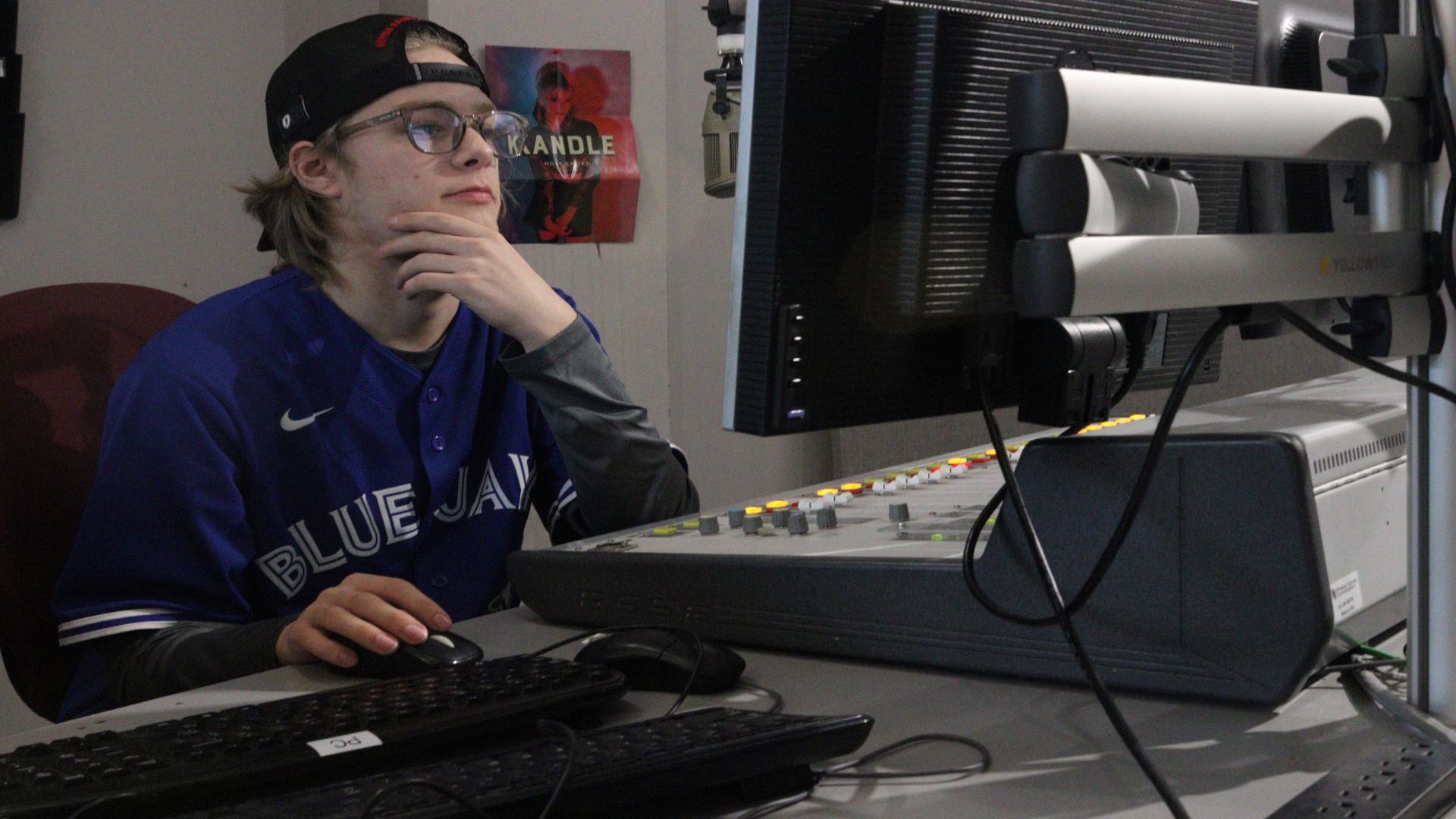
Tyler Cyr, a first-year radio broadcasting student at the college, editing audio files sporting his Blue Jays jersey with thoughts of attending baseball games this summer.

After what can be described as a tumultuous college year, students are strapped-in for the final stretch of the 2022 winter term.

Staff and students’ efforts and time have shifted to final assignments and tests, with the thoughts of summer break just ahead, which brings thoughts of hot sun, cold drinks and no studying.

Well, for almost everybody, explained Tyler Cyr, a first-year radio broadcasting student at Algonquin College.

“Us radio students do not have a summer break, we actually have a third semester during the summer, but we will have a three week break before . . . To sort of have the relaxing break, honestly, I just take school out of the picture,” said Cyr.

While Cyr doesn’t get to enjoy a full summer off to himself to unwind, he does use the time he has off to the best of his ability.

“I like to treat summer as a training time for hockey, but it’s all the season of baseball. So, the thoughts of going down to Toronto to see the Jays play has come in and out of my mind. As well as the warm weather; Ottawa is just too cold in the winter,” he said.

Relaxing and resting, are both synonymous with summer and the same sentiment goes for Martin Munoz, a first-year public relations student at the college.

“My best method for total relaxation is a warm day at the beach with a cold beer. That is what I plan to do with my free time during the summer. After such a long winter I just want to go out and enjoy every second of the nice weather,” said Munoz.

While Munoz looks forward to days spent at the beach, he is aware of the debts which come along with the life of a college student.

“First thing I want to do during my summer break is start working full-time. It is a bit hard to pay for everything I owe during the school year because I do not have enough time to work as much as I would like to,” he said.

The final stretch of the term can invoke anxiety for students.

Professors are familiar with stress induced by finals which prompts them to offer advice, according to Dave Eibner, professor in the massage therapy program.

“Keep on keeping on. The last stretch is the time to gear down, not up (of course no one drives manual anymore – so this reference may be lost) don’t spend time on content you know, isolate the content you’re unclear about, organize and prioritize learning it based on how it’s weighted in your summative evaluations,” he said.

Once exams and final assignments switch to the rear-view, vacation planning and relaxation comes to the fore and personal time becomes priority, according to Joseph Ieradi, a police foundations professor.

“Relaxing, spending time at the cottage and fishing,” said Ieradi. “Jumping in the pool on the hottest summer days.” These are the methods Ieradi uses to disconnect from school.

Studio Time

While The Algonquin Times is run by journalism and advertising programs, those are only two of the amazing programs at Algonquin College. This series consists of Times students sitting in […]

While The Algonquin Times is run by journalism and advertising programs, those are only two of the amazing programs at Algonquin College. This series consists of Times students sitting in on other programs to highlight them and some of the awesome opportunities Algonquin College has to offer. We are starting with Studio Time, a highlight of the Music Industry Arts program.

2022: The sucker punch we didn’t deserve

Older generations leave no opportunity to remind us that the decades prior were harder. There was more struggle and effort in everything, and the current era is easy. A walk […]
Photo: Liam Fox
The severity of the truckers protest in late January hit unexpectedly and set the tone for the emotional rollercoaster the rest of the term would hold.

Older generations leave no opportunity to remind us that the decades prior were harder. There was more struggle and effort in everything, and the current era is easy. A walk in the park. But the last two years proved them woefully wrong.

Since COVID-19 surfaced in late 2019, the world has seen over 490 million confirmed cases. Over six million of those have been fatal. Relentlessly, the virus pummelled humankind. What used to be a breath of fresh air became an inhalation of fear and uncertainty.

But by the end of 2021, things had started to look better. In early December – just as we were wrapping up a semester online – cases were down, and vaccination numbers were up. Travel restrictions were starting to lift, and Christmas was around the corner. Algonquin College – like many other educational institutes in Canada – intended to go back to a mainly in-person teaching model for the upcoming winter term. The calls informing of sudden demises, and the constant depressing news cycles had tapered.

There was hope and positivity in the air. The Rideau Canal Skateway would be thrown open to the public, soon. Businesses were getting back on their feet. And people were starting to step out in as safe a way as possible. A new year was coming and with it good things that would lead us away from the last two years we so badly needed to forget.

So positive were we, that when the first trucks showed up on Thursday, Jan. 27 at Parliament Hill, we barely took notice. COVID-19 mandates were easing up and restaurants were reopening for dine-in. But then the trucks stayed, and the city was once again held at ransom – this time by man-made causes.

We had barely recovered from the compounded dread of the last two years, and here we were once again – fear stricken. Those who stayed downtown faced the brunt of it – abuses and heckling were a daily affair, with the odd beer can chucked at innocents. And while they weren’t common, even a single Nazi flag in a protest is one too many to be acceptable.

It took the brave actions of a 21-year-old Ottawan to bring the incessant honking to a stop, but the feeling of dread stayed. The police needed another three weeks to clear the streets – three weeks of commuting nightmares, cancelled buses and reroutes. And if you lived across the river in Gatineau, you might as well have stayed home. The damage was done, though. We were back to our gloomy, defeated mental states.

But 2022 was just getting started. On Feb. 24, Russian troops invaded neighbouring Ukraine. A narcissistic Putin went after civilians and threatened nuclear retaliation against other nations that interfered. The rest of us watched on in helpless horror, as the stench of death and destruction repopulated our barely healed psyches. As is the case with any violent conflict, collateral damage was immediate. Russian and Ukrainian students at Algonquin felt it, too.

As journalists, this incessant negativity was starting to have a toll on the Algonquin Times staff. Reporting in an accurate and timely manner is our job. Our duty. We do our best to stay updated and true to the facts. But beneath it all, we are human. And humans don’t do well when most of their waking hours are spent doom scrolling.

But we stoically pushed on. Not because we wanted to, but because we had to. We published the Algonquin Times’ first print edition in two years – something we are extremely proud of given the circumstances. And we toiled away at assignments – being occupied is a good way to avoid our worries. It was the only thing that was normal.

Until fate decided that wasn’t bad enough. The Ontario Public Service Employees Union’s negotiations with the College Employer Council suddenly broke down, and they announced they were going on strike March 17. That meant immediate cessation of all faculty activities. No class. No college. And no Algonquin Times.

Once again, the emotional rollercoaster picked up speed. Once again, we were plagued with uncertainty and fatalism ­– waiting with baited breath. Like the universe was plotting against us. How would we complete the term? Would we ever make up lost time in the course? What about international students who had come from across the world, only to sit it out? And most importantly, what else did 2022 have in store before it was done with us?

Fortunately, an agreement was reached, and the strike called off at the eleventh hour (quite literally). And we dared to be skeptically hopeful, again.

The end of the term was in sight, and while it had become academically stressful – procrastination and deadlines were at their peak – it was stress we recognized and understood from decades in an education system. It was familiar territory.

The government of Ontario seemed to be feeling positive, too, as it lifted all mask mandates on March 21. It’s not like COVID-19 was dead; they just felt enough people were vaccinated (or responsible enough) to reopen safely. Some argue it was politically motivated.

Unsurprisingly, what followed was a resurgence in positive cases. Two from the Algonquin Times team fell victim within a week. But COVID-19 is physically draining. The exhaustion lasts for days after recovery. And this time, the world doesn’t stop for the afflicted, anymore. Now, you’re the only one missing out. And you still need to submit those assignments.

And that’s where we are, right now. A year that was supposed to put us back on our feet has been more of an exsanguinating rollercoaster ride, reminding us how we plot and plan, and how truly powerless those plans are.

With two weeks left for the semester to conclude, the uncertainty of the next sucker punch hangs like a sword over our heads. But we want to be hopeful. There are good things that happened, even though our brains work overtime to remember the bad.

The Algonquin Wolves women’s basketball team made it to the semi-finals of the OCAA championship. We published a print edition of the paper. The Jack Doyle Athletics and Recreation Centre was officially inaugurated. And the college has booked the Canadian Tire Centre for convocations.

Looking back, we have had one heck of a start to 2022. It’s like we were in a bubble at the end of 2021, and when it burst the universe poured all its pent-up resentment in one fell swoop. And now with the end in sight, the compounded mental exhaustion is taking its pound of flesh.

But, it has failed to strike a fatal blow. We are hobbling to the end, but our heads are held high. We are skeptical, but continue to hope. Wary about the summer we love so much, but looking forward to it nonetheless. We know another sucker punch is coming – we would be naïve to believe fate left us alone, suddenly. But we will endure.

It is, after all, what makes us human.

April Horoscope

Algonquin Times podcast

Stay Informed

Sign up for our newsletter

Subscribe

* indicates required