Algonquin College staff members gathered for the President’s barbecue on June 1 to celebrate the end of the academic year, marking the highest guest count since the pandemic began. With […]
Thomas Gordon
Photos: Thomas Gordon
June 6, 2023 Revised: January 30, 2024 3:36pm
Photo: Thomas Gordon
Enjoying the President's staff BBQ
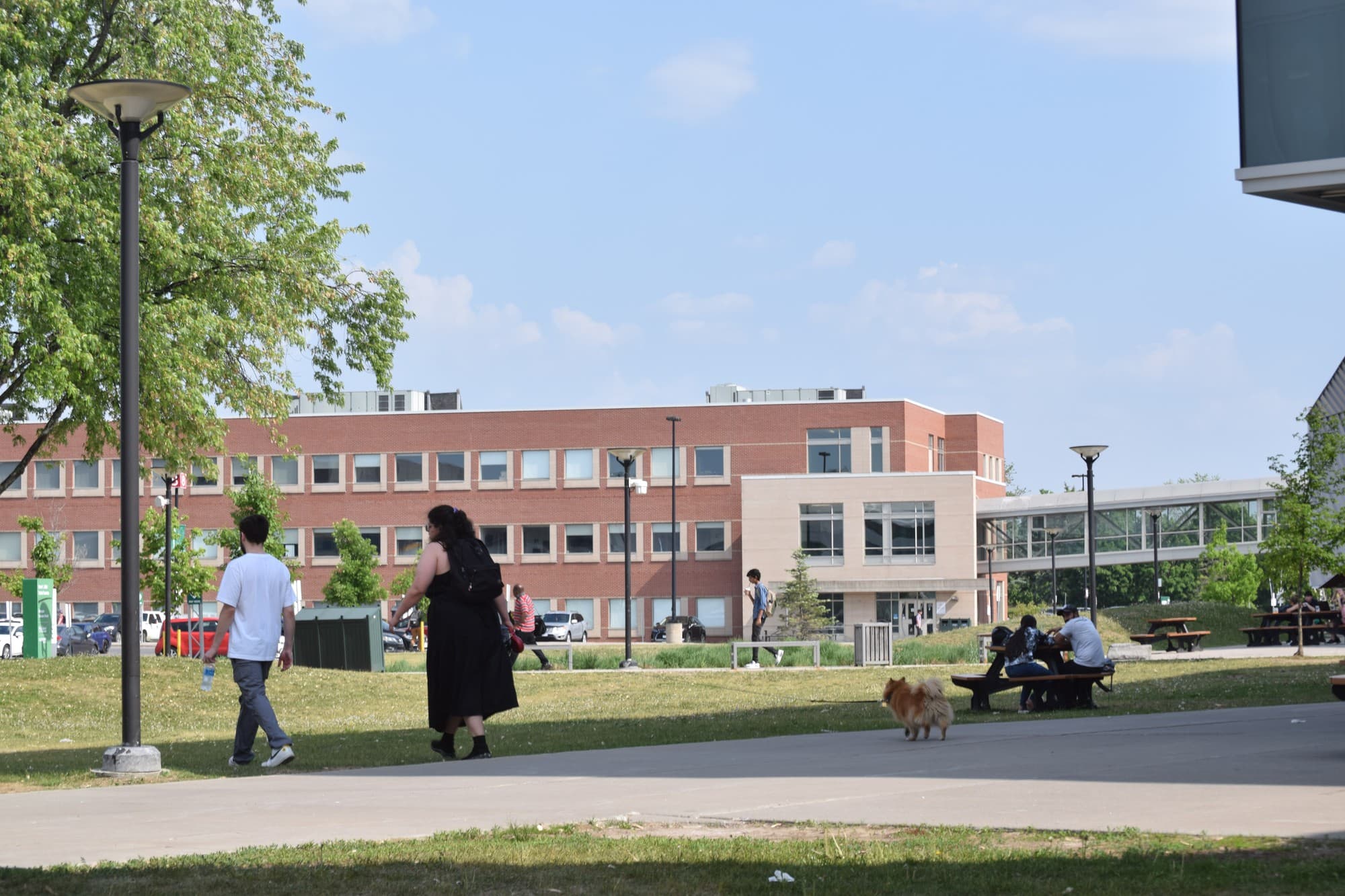
Algonquin College staff members gathered for the President’s barbecue on June 1 to celebrate the end of the academic year, marking the highest guest count since the pandemic began.
With the school year wrapping up, the college hosted its annual President’s barbecue – designed for staff to celebrate, reflect and socialize.
Algonquin’s president, Claude Brulé, spoke at the event and reflected on the record registration numbers.
“Its terrific to see people coming back in person for work, for studying and for activities,” said Brulé, “It warms my heart – it’s really good medicine.”
This year marked the highest guest count since the pandemic, with 800 staff members in attendance – a 60 per cent increase from 2022.
“I think the numbers are up from last year – it was a little Covidy – it’s nice to be reminded what a diverse and pretty awesome community we have here,” said Teri Loretto, a scriptwriting and performing arts co-ordinator at the college.
The event made use of Algonquin’s spacious Ishkodenwan Courtyard, and featured a live performance by Ottawa band Jackson Miles.
“They’re a great band – they just have that really nice rock ‘n roll type of sound.” said Felix Lebeau, the event’s sound engineer.
The Algonquin College Students’ Association is kicking off the summer weather with a free, outdoor movie night on Thursday, June 22, at the Ottawa campus. The original date of June […]
Meg Wall
Photos: Meg Wall
June 3, 2023 Revised: January 30, 2024 3:36pm
Photo: Meg Wall
Ottawa campus hosting a movie night
The Algonquin College Students’ Association is kicking off the summer weather with a free, outdoor movie night on Thursday, June 22, at the Ottawa campus.
The original date of June 8 had to be changed because of weather.
Now that the hot temperatures have arrived, the Students’ Association is offering a free showing of Top Gun: Maverick on the Student Commons front lawn (E Building), from 8 p.m. to approximately 10 p.m.
Nakeya Francis, the Students’ Association’s diversity and inclusivity events co-ordinator, hopes the movie night will provide current students the opportunity to enjoy the campus with their peers while simultaneously attracting future students.
“It is a great way to welcome the community on to our campus and help integrate our new students into the Algonquin community in general,” says Francis.
The event will be open to anyone in the college body and general public (but is advised for those aged 13 and up).
When the 2022 film (starring Tom Cruise, Miles Teller, and Val Kilmer) hit theatres last year, it received a 96 per cent rating on Rotten Tomatoes’ “tomatometer”.
Level two TV broadcasting students, Vera Scultety and Mike Taylor, say gathering a bunch of movie lovers together for an evening is bound to create a great night.
“Top Gun: Maverick was my favourite movie of last year,” says Taylor.
“I think it’s a great idea,” says Scultety. “But alternating different genres – if we do this more than once – would be a really cool idea too, and I think it has potential to keep going.”
However, some Algonquin College students are concerned about logistics.
“There’s nothing really flat here,” says Denis Vykhodtsev, a level two massage therapy student, when asked about the front lawn being a good location for the event. “I’d have to be at the back, since I’m a pretty tall individual.”
Vykhodtsev also expressed concern over the number of mosquitos this year.
Attendance is free, but the net capacity will be limited to 150 people. For those visiting the campus by vehicle, paid parking will be available in Lots 8, 9, 10, and 12.
For additional information on the event, the Students’ Association can be contacted by phone at (613) 727-4723 x7711 or by email at studentsassociation@algonquincollege.com.
If you have ever passed by Antonios Vitaliotis in the hallways of the H-building, you’ve probably got a friendly pat on the back followed by a cheerful, “Don’t worry, we […]
Arty Sarkisian
Photos: Arty Sarkisian
May 29, 2023 Revised: January 30, 2024 3:36pm
Photo: Arty Sarkisian
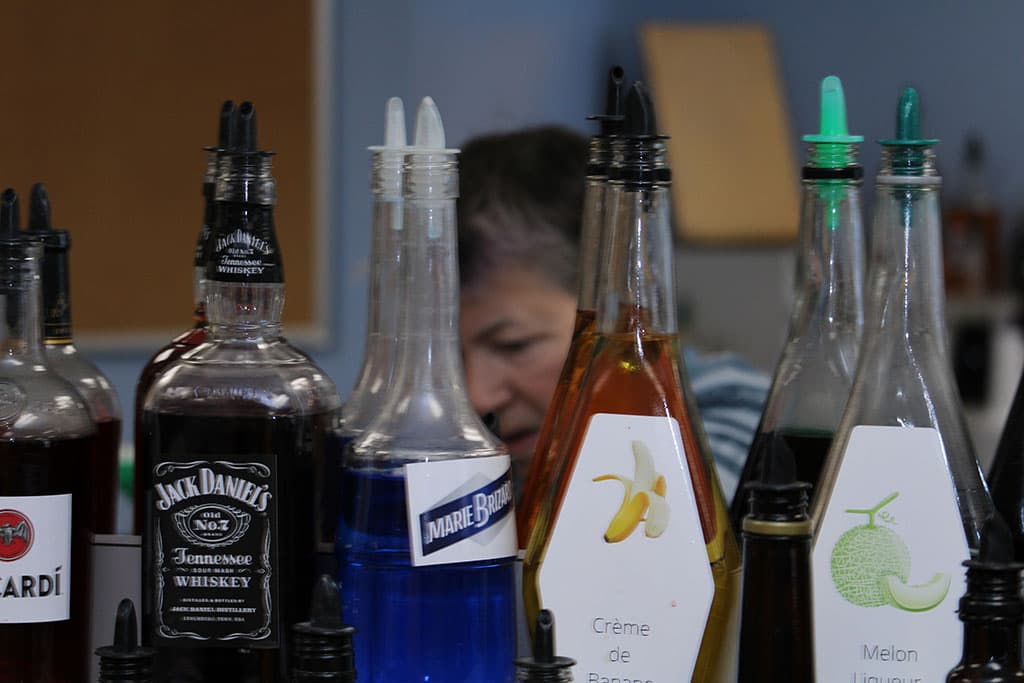
Mixology classes at the college try to recreate the experience of real bars. However, students use coloured water instead of real alcohol when they practice.
If you have ever passed by Antonios Vitaliotis in the hallways of the H-building, you’ve probably got a friendly pat on the back followed by a cheerful, “Don’t worry, we don’t bite in here.”
Vitaliotis is a bartending professor at the college. He seems as cheery as the industry he teaches. The industry that never feels “blue.”
But COVID-19 changed everything for him and the industry.
“I saw a world which I never wish anyone to go into,” Vitaliotis said, remembering the quarantine and the online teaching.
Vitaliotis studied in an all-boys school in Athens. In the early 80s, the school was still strictly following the educational traditions of the past. All boys wore uniforms. They all had shaved heads to prevent lice. And the teachers had sticks. They were the “kings.”
“It was about memorizing rather than learning,” Vitaliotis said. “The information was coming one way, and you’re sending it back the very same way.”
Vitaliotis vowed never to teach like that. He vowed to be as approachable and engaging as he possibly can.
But in 2020 he was forced to teach via Zoom to a bunch of squares with names on the screens. And that reminded him the way he was taught. But now he was in the role of those teachers.
He was still trying to make things entertaining. The college provided some extra cameras and lighting gear, so that he could show rather than tell.
“Now I know how hard it it to produce a TV show,” Vitaliotis said.
He was putting more and more effort into each class. But he still didn’t feel like he was doing his job properly.
“My heart started beating funny,” Vitaliotis said, describing one of his Zoom classes. “I couldn’t breathe. I got a bit dizzy.”
Vitaliotis ended the Zoom call for everyone.
“I just sat there for a second. I didn’t know what it was.”
He connected to the conference once again and told the class that he was having “technical issues.”
When that happened again, Vitaliotis went to the emergency department. “I thought I was dying,” he said. “I thought my heart was going to explode.”
Vitaliotis was prescribed antidepressants.
“I’ve never thought of suicide. I started thinking of suicide.”
Antonios Vitaliotis studied in an all-boys school in Athens. “It was about memorizing rather than learning,” Vitaliotis remembered. “The information was coming one way, and you're sending it back the very same way. That’s how Zoom felt too.” Photo credit: Arty Sarkisian
COVID-19 destroyed almost every aspect of normality in our lives. Restaurants and bars were shut down in the earliest stages of the quarantine, since they were considered “pandemic accelerators.” Many of them closed permanently. A large number of employees left the industry.
All college programs had to follow the new regulations and switched to online learning. Bartending was one of the first programs to go back in person. It had to come back. Otherwise, students wouldn’t have had the chance to get their degrees that year.
“It would have defeated the purpose,” said Marie-France Champagne, the bartending program coordinator. “You need to own your skills; you need to practice. If you don’t have a bar in front of you, it’s hard to bartend, right?”
Marie-France Champagne, the bartending program coordinator, believes that the program coped well with the pandemic difficulties. "Of course, at first, you needed to adjust your mask a few times. It got a little hot in there, but then it was just business as usual.” Photo credit: Arty Sarkisian
Champagne is a frequent guest on CTV. In 2019, on Valentine’s Day, she and her colleague, chef Harsh Singh, were matching fortified wine with a coffee truffle in the studio of CTV Morning Live.
A year later, Champagne and Singh appeared on CTV once again, now in masks and via Zoom. They were still pairing wine with chocolate for Valentine’s Day. In a world where nothing seemed certain, it’s nice to know that lemon truffle still goes well with Moscato d’Asti.
“We’ve adapted rather quickly,” Champagne said. “Of course, at first, you needed to adjust your mask a few times. It got a little hot in there, but then it was just business as usual.”
But the business was still quite unusual.
Classes had to be split up to follow the social distancing regulations. Restaurant International, where all the hospitality students get to practise their skills, had to follow the constantly changing provincial regulations for restaurants.
However, Champagne believes that the program coped well with the pandemic. She argues that the industry that we have collectively pronounced dead is actually very much alive and prosperous.
“Restaurants and bars are booming,” she said. “People are tired. They want to go to restaurants. Even the higher prices don’t change that.”
This instant “boom” has led to labour shortages. There are not enough waiters and hostesses because many of them lost their jobs and left the industry during COVID-19.
The bartending program had to change.
From now on, bartending and sommelier students are also trained to be waiters, managers and fronts of the house.
They are trained for the new, post-pandemic normality.
Vitaliotis feels okay. It’s the new, post-pandemic okay. An okay that follows the world that almost made him quit everything.
“If it wasn’t for my family and my surroundings,” Vitaliotis said, “if I was younger and and on my own, it would have been a no-brainer.”
Vitaliotis still takes some of his antidepressants, but he is “90 per cent well.”
“I was brought back to reality,” he said. “It’s like day and night. I walk into the classroom, and I am feeling super confident.”
The bartending classes are back to being chaotic and loud.
Can it really be different when students can be barely seen behind all the bottles of alcohol? As it turns out, all of them are just coloured water, but let’s be blind and deaf to this disappointing detail.
Almost every five minutes someone would approach a huge ice maker to scoop up a bucket of ice. Ten minutes later the same person would come again. And again.
This is all very “in person.” Every little detail of this in-personness is vital.
At some point, Ezio Margiotta, one of the bartending professors, paused Ed Sheeran’s Shape of You that was playing on his laptop during a class.
What followed was the definition of deafening silence.
“See? It’s horrible,” Margiotta said.
He laughed as if nothing like that could ever happen. Nothing can silence this noisy industry, right?
Algonquin College is renovating three washrooms across campus. A universal washroom is being developed in Room 127 of E-building, Room 109 of P-building, and the Four-Corners washroom of A building. […]
Mathew Dicsi
Photos: Mathew Dicsi
May 28, 2023 Revised: January 30, 2024 3:36pm
Photo: Mathew Dicsi
Algonquin College is renovating three washroom across campus.
Algonquin College is renovating three washrooms across campus.
A universal washroom is being developed in Room 127 of E-building, Room 109 of P-building, and the Four-Corners washroom of A building. These washrooms will be closed until the currently projected completion date of September or October 2023, according to the school’s Facilities Management announcements website.
The Four-Corners washroom in A-building will gain 12 gender neutral stalls, three accessible washrooms, a universal washroom with an adult lift/changing table along with a dedicated nursing room.
The washroom located in E-building Room 127 will be renovated to meet the most current accessibility code.
“As a trans man, I couldn’t use the men’s bathroom until I started growing facial hair – the other guys would stare at me like I was in the wrong place.” says animation student Tyler Lucas. “A universal bathroom being available when I was going through that would have been perfect for my situation.”
Lucas also referred to his friends who are non-binary saying: “They don’t feel comfortable using either men’s or women’s washrooms. Having a universal washroom will create a space where they feel most comfortable and welcome.”
“Being more inclusive for everyone is important” says Andre Bolton, a business administration student at Algonquin College. “It’s a step in the right direction, everyone should feel wanted and included.”
“It would be easier for me to clean,” says Algonquin College Janitor Juana Garcia.
“People can be whatever they want to be” says Garcia. “So, the washroom they use is their choice.”
A common fear which comes with genderless washrooms is the increase in people using it. With double the number of people, the number of toilets needs to double with it.
This fear is being combated by not only renovating but expanding the P109 washroom according to the Facilities Management press release.The exact number of toilets has yet to be determined.
Rosin Sara Roy never imagined Canada would be this expensive. Her 10-hour night shift with the Amazon fulfillment center starts at 8 p.m. after a long day of classes at […]
Brahim Ait Ouzineb
Photos:
May 26, 2023 Revised: January 30, 2024 3:36pm
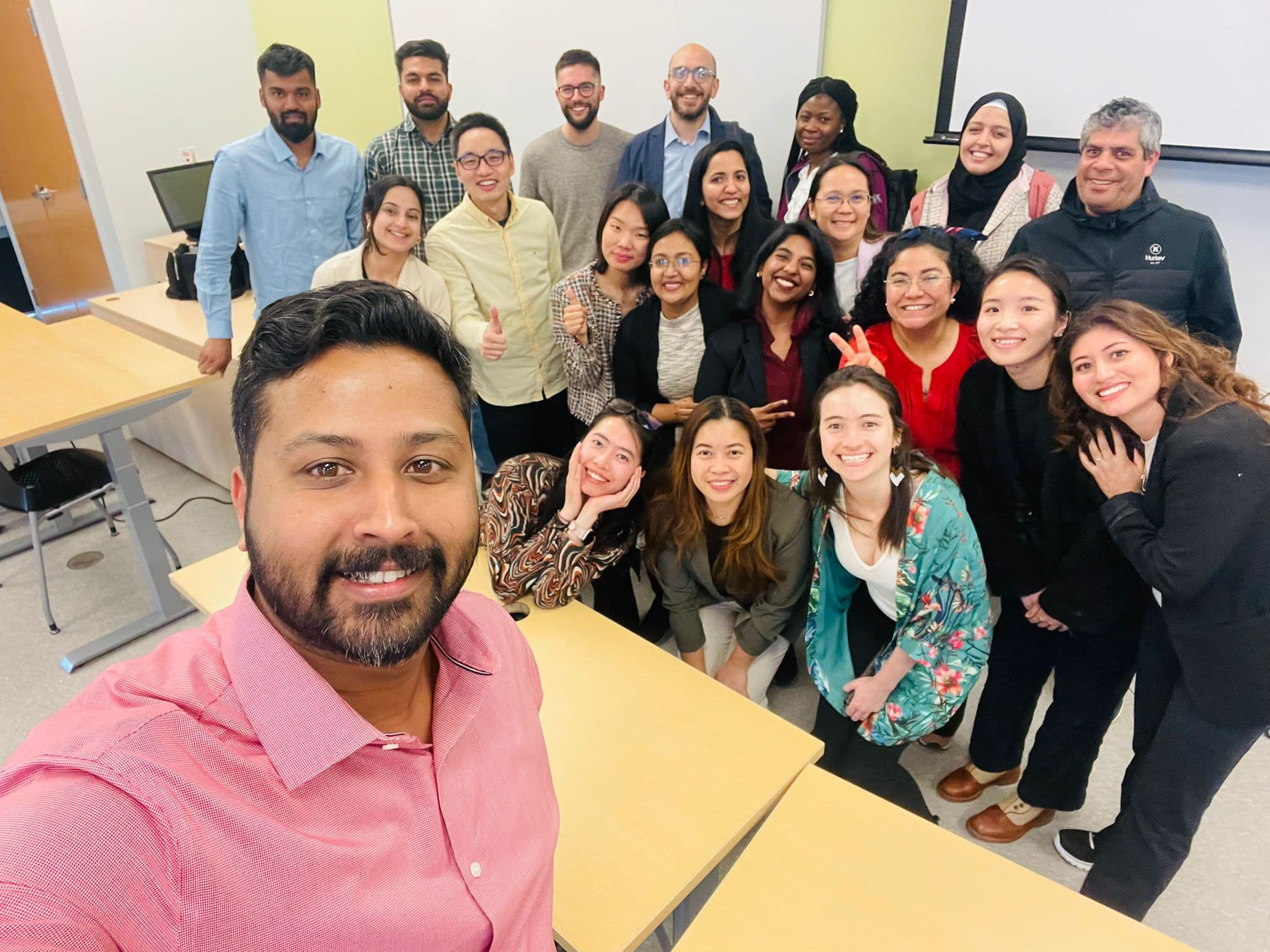
Rosin Sara Roy enjoys brand campaigns, social media strategy and brand measurement courses. Here she is with her classmates - center, in the second row from the back - at the end of a class at Ottawa campus.
Rosin Sara Roy never imagined Canada would be this expensive. Her 10-hour night shift with the Amazon fulfillment center starts at 8 p.m. after a long day of classes at school. Sara Roy is currently looking for another job to make ends meet.
The level-one brand management student left sunny Kerala in 2022 to fight the cold weather in Ottawa. Along with the climate challenges, the food shocks and the high cost of living, Sara Roy also had to spend four months in a house without a lease. Like most international students, adjustment to the new life in Canada comes at a cost.
However, there are bright spots too. For instance, Sara Roy enjoys learning about brand campaigns, social media strategy and brand measurement in her courses at Algonquin College.
Students in the brand management program want a career in Canada. However, as 100 per cent of them are international, the approach and the curriculum need to be a bit different from traditional programs.
The program, which was introduced at Algonquin College in 2014 in a one-year format, has a 90 per cent employability rate. Last year, the program added a second year.
Graduates get full-time jobs related to their studies within two years of graduating. According to the program’s co-coordinator, Kindha Gorman, half of the graduates end up working for all kinds of agencies – advertising, campaign, market research, social media – or for companies.
“We live in a complicated world that is developing at a lightning-fast pace,” said Gorman. “Brands don’t live in their own little world. They are part of the news cycle and social conversation, so we pay a lot of attention to the news and trends.”
Even when the program lasted only a year, it helped a lot of international students understand the Canadian landscape.
“I feel now that I have been working in the Canadian advertising industry, I realize how important this course was for me,” said Pranav Kundra, an alumnus of the program who graduated in 2022. “Without it, this would have been weird for me to mingle and understand the Canadian humour, the etiquettes and the intangibles.”
Kundra’s love for brands goes back to his childhood. It was a TATA-AIG ad in which a child helps an old lady with her groceries. As a gesture, the old lady gives the child a coin. The little boy was so excited that he run to his father’s office to show him his earnings. He told him that it was his first salary. This ad had a deep impact on Kundra the kid. It pushed him to save money he got from his parents or relatives on occasions. Till now, this ad makes Kundra realize the value of money and the innocence in kids.
Thanks to the courses and the group projects, Kundra is familiar with the nuances of a brand. Today, his daily routine at Response Advertising Inc. is handling nameplates for Toyota and deciding the assets to use like Google display banners, Facebook ads, radio spots or TV commercials.
What Kundra learned in the program time fits seamlessly with what he is doing. Things they were taught are valid in today’s scenario as well. However, the faculty strives for continuous improvement in order to better serve students.
In 2022, the program was extended to two years to allow students more time for exposure to brand behavior and market research. A two-year program also allows international students to obtain a post-grad work permit, which wasn’t possible in the shorter format.
It would also improve their chances of finding work in Canada. The new longer program prioritizes leadership, professional communication skills and innovative mindset development.
“These are three key courses that didn’t exist in the past,” said Norma Perez Cervantes, professor and program co-coordinator. “So now, we are helping our students to get those skills that they need to start their professional careers here in Canada.”
For Perez Cervantes, the key to a brand’s success is its customers, but the shopper is the one who purchases the product. Students must understand the difference and adapt their brand strategy accordingly.
“I think the program itself is giving us tools to control the perceptions of the people about the brand,” said Shams Rehan, a level-one student. Photo credit: Noah Simmons
Putting the students in real-life situations in their class is far more fulfilling for Shams Rehan, a level-one student. Coming straight from Malaysia in 2022, the first month of adaptation was tough. In the beginning, he had his apprehensions about racism, being accepted or feeling included. Despite the high cost of living, a two-hour bus ride to college and the cold weather, Rehan gets to enjoy the numerous facilities on campus, especially the ARC.
Level one international students need time to adjust to a demanding curriculum. The most challenging course so far for Rehan is marketing research. For instance, on one assignment he received a 50 per cent deduction on his mark because of a lowercase first letter of a brand’s name. Proper research on brands is essential and students are given tools to navigate that.
“I think the program itself is giving us tools to control the perceptions of the people about the brand. Our professors actually work in the industry,” said Rehan.
Most professors work for big firms or have their own business. The program designers maintain strong ties with community partners to understand the changes in the business environment. Brand management is not their job but a passion. Being at the top of the game drives them and they make sure to infect their students.
Kindha Gorman believes brand management goes way beyond logos and ad campaigns. The team analyzes the world to look at best practices, develop comprehensive strategies and spend lots of time thinking creatively. It is a true balance of both sides of the brain.
Successful brand managers need a set of competencies, but the most sought ones are curiosity and agility. Gorman advises students to challenge how brands fit into the big picture. It is important to ask questions and go over assumptions.
“We help students hone the skills of writing, problem-solving, analytical and critical thinking skills because they are key,” she said. “We push them to apply the fundamentals to hands-on exercises and projects. There is never a dull moment in the program.”
Featured Story | News
Communication | Faculty | International | Leadership | Management | Research
On May 13, Algonquin College’s Dental Assisting program held its first children’s dental clinic of the season, with five more to come in the months of May and June. For […]
Roxanne Lamarche
Photos: Dental clinic administrator Sherry Portt, dental clinic co-ordinator Jodie O'Brien and dental clinic manager Lisa O'Connor. Photo credit
May 19, 2023 Revised: January 30, 2024 3:36pm
Photo: Dental clinic administrator Sherry Portt, dental clinic co-ordinator Jodie O'Brien and dental clinic manager Lisa O'Connor. Photo credit
From left to right
On May 13, Algonquin College’s Dental Assisting program held its first children’s dental clinic of the season, with five more to come in the months of May and June.
For $25, children between the ages of six and 16 receive an oral health assessment by a dentist, a hygienist and a dental assisting student.
“We offer dental at a very reduced price,” said Lisa O’Connor, the dental clinic manager. “It helps those people in the community who can’t afford to go to regular dentists. They get a lot of their dental assessments done here for minimal cost.”
Up to two radiographs can be provided by the dentist. If the dentist finds any tooth decay or cavities, parents can take those radiographs and other recommendations from the dentist and bring them to another dentist elsewhere for further treatment.
In addition, third-term students of the Dental Assisting program provide tooth plaque removal, pit and fissure sealants and oral hygiene instruction.
Sealants are a protective coating applied to shield teeth from food and bacteria, according to the Oral Health Foundation.
“The students arrive 30 minutes before the clinic starts, set up their unit and get prepared for their client,” said Jodie O’Brien, the clinic co-ordinator.
“They bring their client in and have some discussions with the parent about the client’s health history and they get consent to proceed with the exam. When the parent leaves, the student does the exam with the hygienist.”
“Once the client is ready for treatment, we bring the parent back in to get consent to continue . . . When the treatment is over, the client is dismissed.”
Evelyn Lau and Wilco Yeung, parents of a child who received the service, said they were satisfied, but warned of long booking times.
“This is the second time I’ve come here for my kids,” Lau said. “It’s been good, except we have to wait a long time before we can get an appointment.”
“We had to wait four months before we could get this appointment,” Yeung said.
O’Brien said the program has clinics specialized for children in May, June and September.
The next Children’s Dental Clinics will be held on May 23 from 5:30 p.m. to 8:30 p.m., May 27 from 9 a.m. to 4 p.m., June 3 from 9 a.m. to 4 p.m., June 9 from 5:30 p.m. to 8:30 p.m. and June 10 from 9 a.m. to 4 p.m.
To book an appointment, the Algonquin College Dental Clinic can be reached at (613) 727-4723, ext. 2017 or by email at dentalclinic@algonquincollege.com.
The first week of the Algonquin College’s summer semester ended eventfully on May 12, after a fire alarm was set off in T-building, during the late morning. The Ottawa Fire […]
Thomas Gordon
Photos: Thomas Gordon
May 17, 2023 Revised: January 30, 2024 3:36pm
Photo: Thomas Gordon
Ottawa Fire Department responds to false alarm at Algonquin College's Ottawa campus.
The first week of the Algonquin College’s summer semester ended eventfully on May 12, after a fire alarm was set off in T-building, during the late morning. The Ottawa Fire Department was quick to the scene and reported it as a false alarm.
The alarm’s cause is still unknown, but students had their own theories.
“Smoking, vaping – or even someone yanking the fire alarm with their bag,” theorized Enica Hopper, a student at the college’s Ottawa campus.
Algonquin security did not comment on the alarm’s cause,
Students had some difficulty while evacuating the building, with some unsure where to stand, and others were reportedly crowding a stairwell.
“People were tripping over each other trying to get out,” said Vivian Brown, a student at the school.
In the event of a fire, students are instructed to leave the building immediately, and only return when advised by fire services, according to Algonquin’s website
Students with disabilities are instructed to head for the nearest collection point, or safe exit, and wait for emergency services, according to the website.
After the initial confusion, some students took the opportunity to enjoy the summer weather.
“We really enjoyed being outside – even just doing our schoolwork while this was going on,” said, Bolina Diundik, a student at Algonquin College.
Twenty-five Algonquin College students began their summer break by participating in a week-long Shark Tank-like competition, with the opportunity to pitch their start-up concept to a panel of judges. The […]
Meg Wall
Photos: Photo supplied by Marcelo Jaramillo
May 16, 2023 Revised: January 30, 2024 3:36pm
Photo: Photo supplied by Marcelo Jaramillo
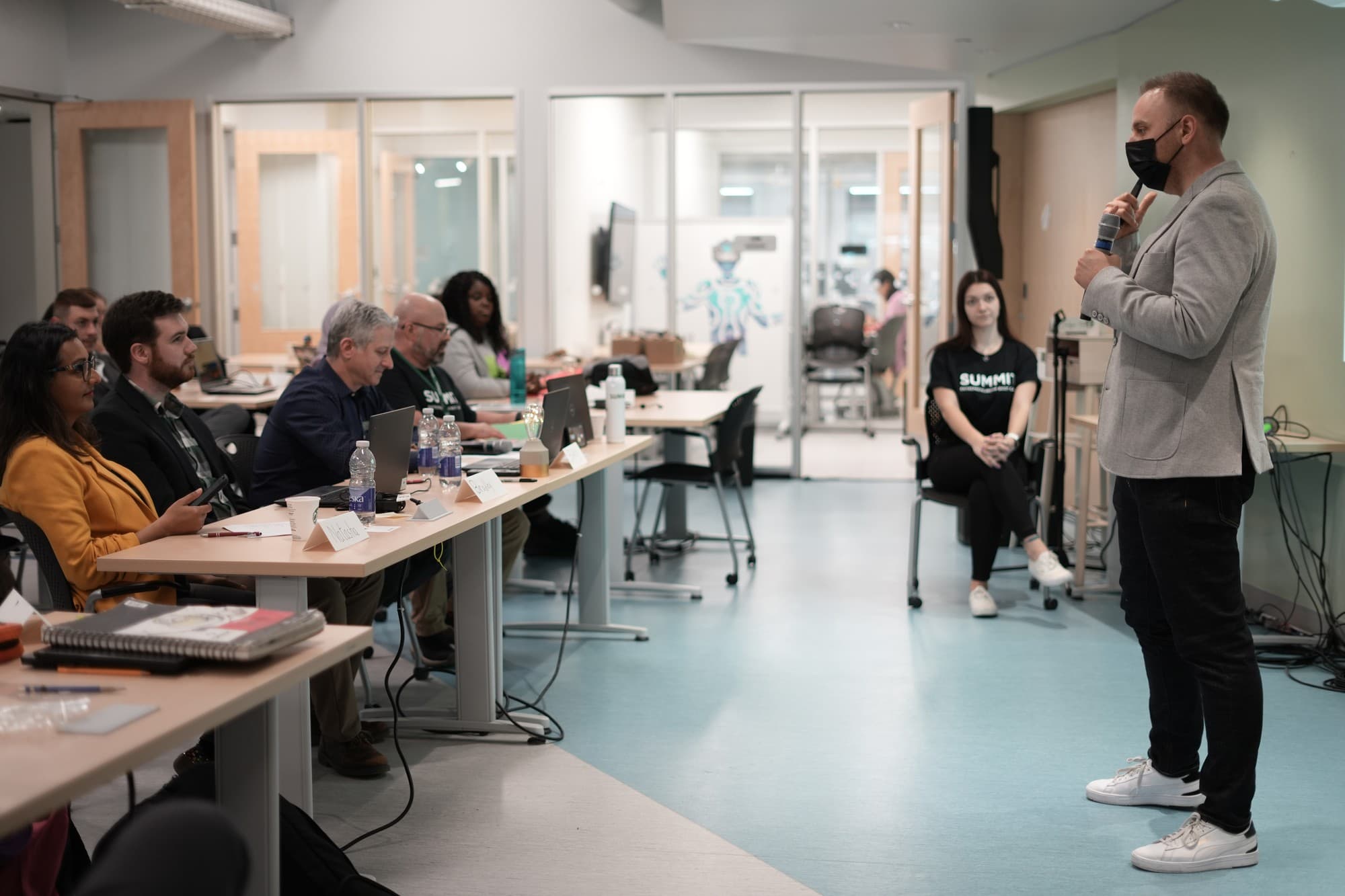
David Cronier, the third-place finalist, presenting his pitch, Slide Wizard, to the judging panel.
Twenty-five Algonquin College students began their summer break by participating in a week-long Shark Tank-like competition, with the opportunity to pitch their start-up concept to a panel of judges.
The SUMMIT Entrepreneurship Boot Camp was born eight years ago in the applied research department and has run every summer since, including seminars over Zoom during the height of the pandemic. It has since migrated to the business department. Despite generally attracting business students, SUMMIT is open to anyone who is currently studying at or has recently graduated from Algonquin College. It attracts about 50 applicants.
Much of the week consisted of sessions and lectures led by guest speakers, touring Invest Ottawa and, most importantly, networking with fellow students and other entrepreneurs. By the end of the week, all participants were given the opportunity to compete against one another by pitching their start-up concept in front of judges.
This year’s winner, Aric Morrow, a level two web development and internet applications student, pitched a multiplayer terraforming simulator video game.
Morrow said nearly a decade has passed since the last major terraforming video game had been released, offering a gap in the market.
“We got introduced to a ton of resources that I am looking forward to using in the future,” says Morrow. “Just the exposure to everything outside of my program, really just opened your eyes to everything that’s available through the college.”
The top three winners were given varying cash prizes, between $2,000 and $750, and all finalists were given access to additional coaching, mentorship, and legal services.
“This boot camp has lit a fire within me, like nothing else,” says David Cronier, a level four computer programming student. “As bad as it sounds, seeing the imperfectness in other people kind of reassures you about your own and it’s really great to see in which area people shine.”
Cronier landed himself in third place after pitching Slide Wizard, a web-based presentation software.
Tristan Morris-Desmarais, a competition finalist and business management and entrepreneurship student, agrees there was something magnetic about this year’s group.
“Meeting all these people, they’re so much more motivated than some of the students in our own program,” says Morris-Desmarais. “I mean, our program is designed around entrepreneurship. But these people, they’ve all got a fire lit to them; they all have this inspirational kind of energy.”
Nyasha Shameer and Emilie Tunn, business administration and marketing students, won second place with their start-up pitch, Bleumwell, a mind, body, and soul fitness centre.
“We have done marketing competitions through the school as well,” says Shameer. “ So, we’ve been exposed to the opportunity to network and get trained with other individuals to build on our skill set, because we do have marketing backgrounds, but this is a very different environment as we do get to be exposed to other competitors and individuals from all different backgrounds, which was very interesting.”
Even without walking home with a cash prize, SUMMIT students and volunteers recognized the advice given to them and the networking they were able to do was invaluable.
“When you have good people around you, things just go an easier instead of starting . . . alone, and throughout the week, you just saw the participants take that feedback in mind,” says SUMMIT volunteer and recent business marketing graduate, Sabrina Drouin.
At the age of 10, many kids are in Grade 5 learning about different things that would aid them into their final year of elementary school. When children turn 14, […]
Itunu Olayiwola
Photos:
April 26, 2023 Revised: April 26, 2023 11:37am
Algonquin Times writer Itunu Olayiwola
At the age of 10, many kids are in Grade 5 learning about different things that would aid them into their final year of elementary school.
When children turn 14, they are gradually moving to their first year of high school.
Finally, when these teenagers approach the age of adulthood, they are not only thinking about graduation, but also how they want their lives to be laid out.
The pandemic has affected people all over the changing world.
One of the concerning changes included the mental health of children, and how badly their mental health had degraded. Monica Armstrong, director of mental health for the Youth Services Bureau, told the CBCthat the organization’s 24/7 crisis line is handling a much larger proportion of suicide calls. Armstrong added that the proportion had risen from about 12 per cent in 2018-2019 to roughly 28 per cent.
Funny enough, I felt part of the 28 percent that had caused the rise of concern toward mental health. If I was told a year ago that I would constantly be going back and forth to a hospital named CHEO, I certainly would have disagreed.
The pandemic had already distorted the growth of my mental health, forcing my brain to adapt to situations that it was not prepared for and survive as an adult without any tools for support.
My concerned parents had to take me to CHEO, and I suddenly became a regular customer at the hospital. A few months before college started, I had finished my first 12 sessions with my therapist recommended by my lawyer. However, it took three months for the hospital to get me in contact with a psychiatrist and a new therapist. I was constantly being told that I could not have access to a psychiatrist because there were too many patients.
The many restrictions from COVID — masks, online classes, and isolation from the world — confirmed the first highlight of my already degrading mental health, depression.
It is 2023, and the world is gradually changing and growing from its post-pandemic era. Many things have changed and affected kids, forcing them to develop faster mentally rather than just being kids and having fun.
Global Open Science, a research group, decided to study the effects of the pandemic on kids. They compared the MRI scans of 128 children. Half the scans were taken before the pandemic and the other half at the end of 2020. They found that the children who had lived through the first year of the pandemic had brain ages that were older than their chronological age.
The researchers found out that at the start of the pandemic, the brains had developed an area called the amygdala that can help control stress and fear. There has also been a development in the hippocampus which is the area of the brain that controls access to memories.
The researchers further learned that tissue had thinned in the cortex, which is part of the brain that controls functioning.
Algonquin College students had different opinions about the rapid growth of kids mentally.
“I do believe that children are maturing at a faster rate mentally. I notice that when I compare myself to my younger cousins, they are much more mature than I was when I was their age. They seem to know more about the world. However, as a kid, I was more in a happy bubble,” says Amelie Bender-Olivas, an interior design student.
“I both agree and disagree. I think youth are maturing faster than before with society growing so fast. However, I feel like their actual maturity is not growing. They rely too much on their parents,” says Daly McGoey, a first-year architectural technician student.
Research has found that these physical changes discovered can be increased when a person goes through significant adversity in childhood. The team was not sure if these changes were long-term changes or if these changes will impact the future lives of the children.
Sometimes events need changing because they are just down-right boring. But how can an event with dogs get any better? “The Paws 4 Stress program offers Algonquin College students and […]
Noah Leafloor
Photos: Alex Lambert
April 26, 2023 Revised: April 26, 2023 11:17am
Photo: Alex Lambert
Algonquin Times writer Noah Leafloor
Sometimes events need changing because they are just down-right boring. But how can an event with dogs get any better?
“The Paws 4 Stress program offers Algonquin College students and employees an opportunity to take a break from their busy days and unwind with some furry friends, which can reduce stress and have lasting effects on people’s emotional well-being. The AC Hub works with volunteer organizations that certify these therapy animals and enjoy sharing these pets with others,” according to the college’s Paws 4 Stress event description.
Support dogs provide emotional support and comfort, which helps people deal with their stress and challenges, according to the American Kennel Club. However, support dogs are still pets, not just service dogs, and that goes for other support animals that are domesticated.
They must be considered an emotional support animal (ESA). These can be cats, mice, rabbits, birds, hedgehogs, rats, mini-pigs, ferrets and more, according to UMass Chan Medical School. The ESA needs to stay calmin public, too, which can be hard because you don’t have to register an ESA for certification in Canada. All you need is an ESA letter issued by a licensed mental health professional, according to the TheraPetic organization.
Cat and dog lovershave always debatedwhich is better. That’s a silly argument. Like dogs, cats providepurpose and meaning to people. People with illness or disability find comfort and emotional support through them, said the non-government organization MSAR.
Therapy cats are different from ESAs because they’re trained to help an individual’s treatment process.
So, does this mean therapy cats are just as effective as therapy dogs?
Well, dogs aregenerally moresociable and less worried about territory than cats. And in Canada, there are far more dog teams than feline.
Cats can form powerful social bonds, too. An Australian study found out that cat owners were more happy than non-pet owners. The benefits probably apply in therapy. It’s mostly about developing a relationship over time, which is different than dogs, according to UC Davis Veterinary Medicine.
Truffles, the cat that helps kids feel comfortable during appointments. Photo credit: truffles_the_kitty - Instagram
Rabbits and guinea pigs are also common animals for therapy. Rabbits generally bond quickly and are social creatures. Rabbits are also quiet and do not require lots of space, which is great for Algonquin’s event. Rabbits give the same social benefits as cats and dogs do. They help increase self-esteem, nurturing skills and increased empathy, according to AmeriDisability.
Guinea pigs are like the animals already talked about. They are very empathetic and show their affection when they’re comfortable with their owner and surroundings. They also have personalities, which is great for therapy. However, guinea pigs are scared easily, especially in public.
The Ottawa Humane Society is an example of a program that has animal visits. Volunteers take these animals to facilities to help the people there. These visits are more for retirement homes or rehab places, but I’m sure Algonquin can get more people involved with Paws 4 Stress that have other animals to bring for simple therapy.
The main issue with this argument is that it’s going to be difficult to find volunteers that have these trained animals. They must be ready for public space and stay friendly. The animals I talked about can do that, but it’s uncommon.
I love that dogs are the main animal, but I’m sure there are trained cats, rabbits and even guinea pigs in Ottawa. I feel this could bring life to Paws 4 Stress. What does everyone else think?