main

Explorer: Pinecrest Cemetery’s quiet is an oasis for the living

We humans have been burying our dead since, well, before we were human. . . or Homo Sapient, at least. Our ancient ancestors, Homo Naledi, have burial sites dating 335,000 […]
Photo: Thomas Gordon
Located in Nepean, Pinecrest Cemetery opened in 1924.

We humans have been burying our dead since, well, before we were human. . . or Homo Sapient, at least. Our ancient ancestors, Homo Naledi, have burial sites dating 335,000 years ago. That’s 260,000 years before any homo sapient, according to the Smithsonian.

Naturally, graveyards have acquired a spooky rep over those 260,000 years, with countless horror classics such as Night of the Living Dead, the Omen or Pet Cemetery unfolding between their stony rows.

Pinecrest Cemetery, a 15-minute bus ride from from Algonquin College, isn’t just a great spot to consider these scary movies – it can be an oasis from the busy sounds of Ottawa life too.

Why should you go?

Cemeteries can offer a valuable commodity that many lack: silence.

Even in coffee shops and libraries, which are thought to be society’s designated quiet places, you’re still bound to pickup on stray conversations, squelching sneakers and shrieking cafe appliances.

And these sounds build up, even if we don’t notice them.

“Our minds are like water, and we must work to clear that water,” said Christina Latifi, an Algonquin College counsellor. “We hear these sounds throughout the day, and though we may not think of them, they stay in our subconscious.”

What can you do?

Across Pinecrest’s 60 acre property, you’ll find well-defined roads and trails, winding through eclectic stone architecture and spiraling gardens. Don’t worry about stepping on anyone either – the grounds are for you to, respectfully, enjoy.

You can walk the trails, reflect and enjoy a quiet hobby. You can even read that book you’ve been putting off.

“I try to visit at least once a week,” said Ben Gosse, a Statistics Canada technician, and neighbour to Pinecrest Cemetery. “It’s not like any park –– I’ve walked the whole lot without being bothered.”

Where is it?

Pinecrest Cemetery is located at 2500 Baseline Rd., just 15 minutes from Baseline Station, making it a convenient, after-school activity for Algonquin College students.

Pinecrest Cemetery offers free onsite parking for visitors.


First Person: Despairing over climate change will not make it better

I have walked on the same path for seven years, and in all that time it has never changed. While the seasons shift, the path running through the heart of […]
Photo: Crys Playfair
To grieve your country, your planet, while it still lives and breathes is a slow, painful torture. One that gets worse over time.

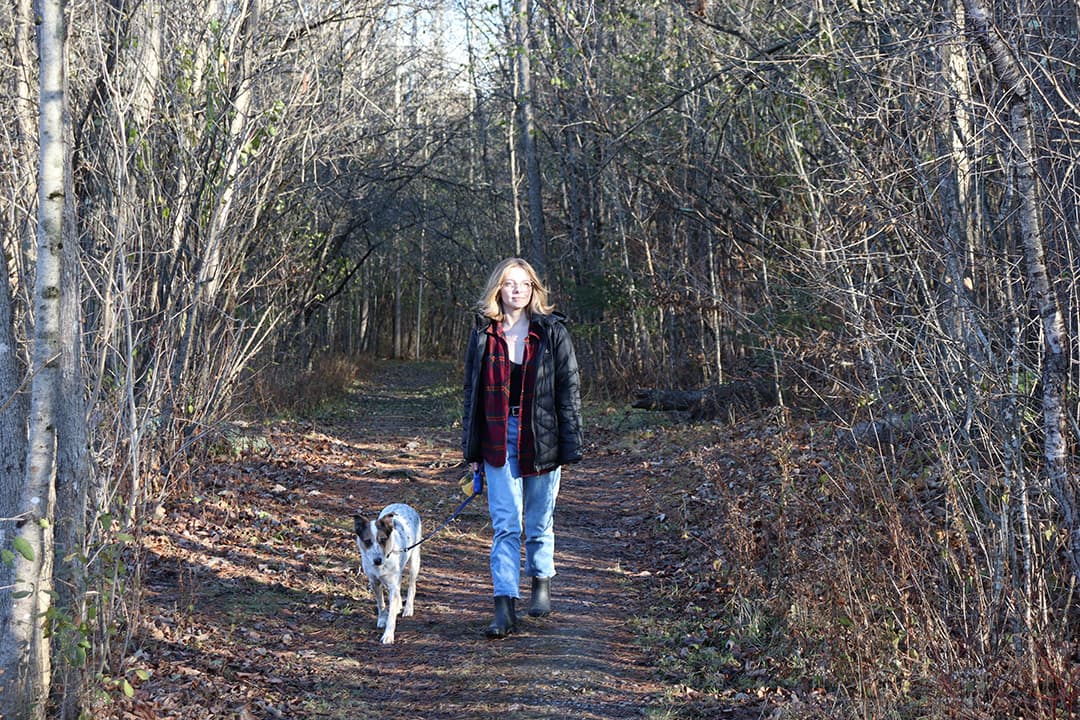
I have walked on the same path for seven years, and in all that time it has never changed. While the seasons shift, the path running through the heart of Gemmill Park near my home in Almonte has remained the same.

It’s a shady forest trail, something out of a fairy-tale. The dirt path is narrow with roots snaking across it and trees shading the ground, which let sunlight trickle through gaps in the leaves. The end of the trail looks like the opening of a tunnel, the land just beyond the tree-line blanketed in crisp sunlight, the entrance to another world altogether.

My dog, Lizzy, loves that trail. I’ve been walking with her on that trail since she was a puppy. When I let her off leash, she runs through the undergrowth, chasing anything that moves until she runs out of sight. I can always find her just around the corner, patiently waiting for my slow human legs to catch up.

That trail has always been our sanctuary, our escape from the harsh world beyond the dense trees.

Until June 2023.

The air hung heavy, thick and nauseating. The weak sun did not penetrate the canopy of leaves. Everything was quiet, unnaturally so. No birds called to one another; no squirrels scuttled between trees. My dog’s whine cut through the silence, fitting the scene. Smoke, dense and toxic, blanketed the trees, leaving a foul taste on my tongue.

All I could do when I visited my path that spring was stand there, heart heavy as I lost the battle with tears. Because what else could I do? What can I do when it seems as if my whole world is on fire?

This year, Canada suffered through its worse forest fire season in history. Over 6,132 fires decimated 16.5 million hectors of land by Sept. 5, 6.6 times the average forest fire consumption in previous years, Natural Resources Canada. For days, the sun was blotted out by staggering amounts of smoke, daily weather warnings urging people to stay indoors.

“Our planet is burning alive,” said Harmon Pope, 23, a student in the community and justice services program. “At a certain point you have to feel the fire.”

Grief is a funny thing. It carries so many forms, as fluid as liquid. I have grieved many things in my 20 years of life, but never something quite like this. To grieve your country, your planet, while it still lives and breathes is a slow, painful torture.

Every day, I heard more news of the devastation. I was shattered when I watched British Columbia, the province of my birth—my home, alight with toxic flames. I was constantly checking the Canadian Wildland Fire Information System, watching the fires creep steadily towards my family’s cottage in northern Mattawa, consumed with anxiety over the likelihood of it being lost to me forever. The countless stories of people ripped from their homes, losing everything, the fear in the air as thick as the smoke. It simply became too much.

I started therapy in July. I was ashamed of it, that this had affected me so much, but I had lost every ounce of hope I had left. In my eyes, this was the beginning of the end. I didn’t believe I would ever reach my eighties, would ever have my own children, would ever live the same way again. To me, we had already lost our fight with climate change, it was already too late. We were all going to die, and I was going to have to watch.

I believed it up until my therapist said one very simple, very powerful phrase:

“I have a lot of hope for your generation; if anyone’s going to save us, it will be you guys.”

And there it was. The seed was planted, tentative roots drilling into my fear, my grief, breaking it gently apart. Because of course we will. Out of everyone I’ve ever spoken to, people in my generation seem to be the most climate conscious, the most passionate about finding solutions to our detrimental situation.

The AC Environmental Society is a group of students passionate about the environment and climate activism at the Ottawa campus. They coordinate events to raise awareness and educate others on sustainability and reducing waste.

Pope, a member of the AC Environmental Society feels the mental strain of the climate crisis with an uncertain future ahead.

“It affects me because I don’t know if the world will have breathable air by the time I’m 60,” said Pope. “At the rate things are going, I don’t know what the world outside my window is going to look like.”

The smallest actions still have weight. We all have an opportunity to be part of the solution, despite our age, our financial situation, or our education. Even if it is simply recycling properly, or using reusable bags, or writing climate stories to bring awareness to these issues. Everything counts, and everything matters.

“I focus on what I can change,” said Pope. “There’s only so much I can do.”

Carbon Removal Canada, an independent policy initiative, is focused on carbon removal solutions and making Canada a global leader in in carbon dioxide removal. They hosted their launch event at the National Art Centre on Wednesday, Nov. 8.

“Change happens when you’re actually doing something better,” said Grégoire Baillargeon, President of BMO financial group, and a panelist at the Carbon Removal Canada launch event.

Reminding myself that there is still a world to fight for, that nature is still alive and thriving across the globe, is challenging even today. Every day, I think about the devastation of the wildfires, the damage they caused and the likelihood that next summer will be even worse.

But I can see past that. I can envision a world where life on Earth is plentiful and bright, where net-zero has been achieved and we work with the environment for the benefit of every living being on this planet.

The fear and the grief will always be present, but it’s time to use it. Without those emotions, change wouldn’t be possible. Fear of the future that surely lies ahead, grief for the world that is rapidly slipping away, drives us to find the light, to make things better. For in their dark shadow, hope sparks.

Don’t despair, our world is not gone.

Have hope. We are the future.

First Person: Learning to smile again brought back my confidence

My fists are clenched, my jaw is tight and my stomach is loose and wild. The fear I feel has taken over me and I almost turn around and leave. […]
Photo: Mathew Dicsi
"It is with a smile on my face that I can now proclaim that my teeth no longer hold me back, and my confidence sprouts in every social interaction," says the author.

My fists are clenched, my jaw is tight and my stomach is loose and wild.

The fear I feel has taken over me and I almost turn around and leave. My thoughts swirl a mile a minute and I can’t stop the feeling that I may puke. No, I am not pregnant.

In late May 2023, I found myself trying to soothe my anxiety with a cigarette and the white noise of downtown. I was preparing to face the biggest fear I had.

I did not want to go in. I have neglected my own well-being for so long that my teeth have gone beyond what I could have ever imagined. The pain comes and goes but when it comes it’s staggering.

I gulped and took a deep breath before facing the monstrous building that is my dentist’s office,

I was not always afraid of the dentist. It was the braces at 16 that started the fear. Anyone who has had braces knows the incredible feeling of discomfort and pain at seeing the orthodontist.

Teeth are underestimated in their significance. They can play a significant role in one’s self-esteem and how they navigate the world around them. From an early age, I struggled with my dental health. Irregular teeth alignment, gaps and discoloration became constant companions, silently chipping away at my confidence.

The mere thought of smiling in public was enough to make me cringe. It felt like a secret I carried, a burden that weighed me down in social situations and affected my overall well-being. One of the most challenging aspects was the stigma associated with decayed teeth. Society tends to judge, making assumptions about an individual’s hygiene, intelligence and even socioeconomic status based on the appearance of their teeth.

It was disheartening to witness the subtle shifts in facial expressions, and the slight hesitation before someone offered a smile or engaged in conversation.

My journey towards self-acceptance and confidence took flight when I encountered a group of people who shared similar dental insecurities in an online support community. Connecting with people who understood the emotional toll of dental imperfections became a turning point for me.

Combine that with my face beginning to swell due to a severe tooth infection and a life-changing call a co-worker made to her dentist on my behalf, and I was able to summon the courage to visit the dentist.

Dr. Ulyana Lenyk, is a young dentist who is already known for her expertise in cosmetic dentistry. Her professionalism, love for her work and almost fanatic attention to detail have played a crucial role in my transformation.

Lenyk has seen firsthand the positive impact that dental intervention can have on individuals.

“Addressing dental concerns can lead to a remarkable change in one’s self-perception, paving the way to increased confidence and improved quality of life,” said Lenyk.

Lenyk and her assistant assured me that they were going to numb my face up well. I was not going to feel anything but still, I could not stop my stomach from turning and the tears from falling.

They numbed me up and gave me a few minutes and came back in the room and got settled ready to do their work.

My dentist nodded toward her assistant and said, “Put the music on.”

I don’t know why but, at that moment, I calmed down a bit. It was clear to me this person loves her job, loves helping people and is an absolute perfectionist in her work.

I left the office that day with a different type of tears: happy ones. My once rotten tooth looked beautiful and that gave me the confidence to keep going back.

Under Lenyk’s guidance and expertise, I embarked on a dental treatment plan. Over a span of several months, I experienced a series of restorative procedures, including two root canals, many fillings and a cleaning.

Each visit to the dentist brought me closer to the smile I had missed and desired, and with each treatment milestone reached, my confidence grew.

It also feels great to go to the grocery store and not worry about the crunch factor of foods when I shop.

As I look back on my journey, I realize that the physical changes to my teeth were just one part of the equation. Transforming my insecurities required a shift in mindset and a deep exploration of the roots of my self-doubt.

It is about embracing imperfection and understanding that beauty lies in authenticity.

I’m slowly learning to adapt that same philosophy in my writing.

It is with a smile on my face that I can now proclaim that my teeth no longer hold me back, and my confidence sprouts in every social interaction.

No longer weighed down by the burden of bad teeth, I am now able to engage fully with the world around me, both personally and professionally.

International students embrace winter preparedness at ‘beginners’ event

As winter looms, the International Education Centre and Algonquin Students’ Association teamed up to host Winter for Beginners, an event aimed at helping international students navigate the Canadian winter. The […]
Photo: Sebastian Pinera
Ricky Kumar outside ACCE Building alongside the coat he brought to be donated at the event

As winter looms, the International Education Centre and Algonquin Students’ Association teamed up to host Winter for Beginners, an event aimed at helping international students navigate the Canadian winter.

The event, held on Nov. 8, attracted a diverse crowd eager to learn about essential winter tips. Attendees were not only treated to informative sessions but also had the opportunity to contribute to a good cause. The SA organized a drop-off bin for gently used coats, supporting their annual coat drive.

“We want students to not only survive but thrive in the Canadian winter,” said Jess Guilbault, a guest speaker at the event. “Taking care of yourself physically and mentally, understanding the nuances of winter weather, dressing appropriately, and staying engaged are crucial elements. Winter can be challenging, but with the right knowledge, it can also be a season of beauty and growth.”

Guilbault encouraged everyone to not just get through winter but actually enjoy it. The event wasn’t just about talking — it was about helping people, especially newcomers.

“Winter can be terrifying, especially for newcomers. People always ask if you’re ready for Canadian winter, but they never really tell you how to overcome it. So, I think having this event was very handy,” said Meryem Hasdou, an architectural technician student at the event.

The importance of being ready for winter’s challenges turned the act of donating coats into a shared commitment to facing the upcoming chilly months together.

“I came here to donate one of the coats that I don’t really use anymore. I’m sure there’s someone else that will give it a way better use than I do,” said Ricky Kumar, another architecture technician student at the event. “With winter and freezing weather starting so early this year, people should already have at least an idea of what to expect in the next months.”

Arab standup comedy takes centre stage at Algonquin College with John Achkar’s first visit to Canada

The Algonquin Commons Theatre (ACT) goes dark, and a man’s voice tears through the room: “Ottawa, are you ready to have some fun?” On Nov. 15, comedian John Achkar stepped […]
Photo: Brahim Ait Ouzineb
John Achkarโ€™s career started in 2010 and when COVID hit, the few comedians in the Lebanese scene thrived. โ€œThe audiences finished all their Netflix shows and thought why not give these comedy guys a chance,โ€ said Achkar.

The Algonquin Commons Theatre (ACT) goes dark, and a man’s voice tears through the room: “Ottawa, are you ready to have some fun?”

On Nov. 15, comedian John Achkar stepped onto a packed ACT stage for the first time to perform his show “Wayn 3ayich?” (Where do you live?).

The audience was privileged because it would be his last performance of this show ever.

The voice backstage got the audience’s permission to address sensitive topics such as religion, race and marriage. The Lebanese fans, who constituted most of the audience, shouted in Arabic, “Do as you please!”

Achkar has a unique approach to comedy.

The commanding theme of his standup comedy is self-deprecation and his shrewd observation of Lebanese society is subtly interwoven into lived experiences.

Achkar met with the Algonquin Times in the green room, casually dressed. Facing a Canadian audience didn’t seem to shake him at all. He tried between questions to have a snack, but his passion for comedy preceded food. On his social media, he asked his fans to vote for the colour of clothes that would fit his Canada tour. Black it is!

“It was evident that (the audience) thoroughly enjoyed John’s performance. The atmosphere was filled with laughter, and the audience responded exceptionally well to his act,” said Tifanni Kenny, the ACT’s bookings coordinator.

Achkar’s career started in 2010 and when COVID hit, the few comedians in the Lebanese scene thrived.

“The audiences finished all their Netflix shows and thought why not give these comedy guys a chance,” said Achkar during the interview.

Despite his successful family business in Lebanon, comedy takes most of his time and offers him a lot of second chances.

For Achkar, failing is part of the comedian’s journey. Lebanese comedians come from a culture where failing is not an option. However, the only way to grow is to fail more and more. It forces them to try new things.

Achkar got out of his comfort zone to start a new adventure on national television in Lebanon. He launched his talk show “Tar El Waet” (Coffee Break) and it is the third-most watched show on the channel.

His fierce criticism of his surroundings, be it his life, his parents or his relations with the other sex, strikes the right note with the audience.

In a country with a 34 per cent divorce rate, Achkar jokes about his own divorce in the show. It took him two years to get divorced after being married only three months. It even caused him separation anxiety.

Achkar lives now in Dubai, but he is not disconnected from Lebanon. For him, every comedian has a unique voice to bring to society. It’s the unique view of a Lebanese Dubai resident.

“People live in a certain microenvironment, like the sectarianism in Lebanon. Comedy is about bringing all these views together to build this society,” Achkar told the Times.

Achkar’s hope for a better country is what motivates his comedy, and it has nothing to do with debunking this or that community.

He made sure to hammer the message before leaving the stage.

“Are we just victims of the system or are we contributing to putting the country in the shitty situation in which it is now?” Achkar said before the end of the show.

U-Pass increase and route replacements: Five takeaways from proposed OC Transpo changes

Students can expect changes to bus routes, U-Pass prices and other fares if Ottawa city council approves the 2024 transit budget on Dec. 6. Here are five takeaways for students. […]
Photo: Noah Leafloor
Students board the 75 Cambrian at Baseline Station on Nov. 15.

Students can expect changes to bus routes, U-Pass prices and other fares if Ottawa city council approves the 2024 transit budget on Dec. 6.

Here are five takeaways for students.

U-Pass prices going up

U-Pass prices are always changing and the trend continues with the proposed transit budget.

The U-Pass price for students per semester is proposed to increase from $223.48 in 2023 to $229.07 in 2024.

“Negotiation is still in place for U-Pass price,” said SA president Abigail Soto Carvajal in a press conference with the Algonquin Times on Nov. 16.

“We will try to guide it to a win-win situation,” she said regarding concerns of affordability for students.

“The prices need to remain the same, or service needs to get better,” said Carvajal. “If prices are going to increase, then we demand better service.”

Transpo focuses on 15-minute service, but reduces total hours

OC Transpo aims for 15-minute service for riders on major bus routes. This means customers wouldn’t wait more than 15 minutes for the next bus.

At the same time, dozens of routes are proposed to be replaced all over Ottawa, eliminating 74,000 hours of service.

CTV Ottawa quoted transit services general manager Renée Amilcar saying, “Many customers will have no substantial change to the trips they make day to day and the overall reliability of the system will see improvements.”

Connexion routes are also being affected

Several Connexion routes are being removed and replaced with nearby routes. The routes being removed are: 232, 236, 252, 257, 258, 265, 267, 268, 270, 271, 273, 278, 282, 290 and 291.

OC Transpo’s proposal to cut many 200-series routes between residential neighbourhoods and O-Train stations adjusts current ridership levels and boosts service to 15 minutes in needed areas. Low ridership routes have been redirected to higher population areas.

Other transit fares will go up

The report to council also shows a 2.5 per cent transit fare increase. The adult monthly pass would increase from $125.50 to $128.75 on Jan 1. 2024.

New, important routes for Baseline Station

OC Transpo is planning more bus routes through Baseline Station at Algonquin College. Here is a snapshot:

Kanata and Stittsville:

  • Route 68 would operate from Terry Fox Station to Baseline.

West Ottawa and North Nepean:

  • Route 58 and 81 would be expanded to operate from Tunney’s Pasture Station to Baseline.
  • New all-day route 112 would operate between Baseline Station and Billings Bridge Station.
  • New weekday peak period Route 115 would operate between Baseline Station and Greenboro Station.
  • New Route 116 would operate from Baseline Station to Greenboro Station.
  • New weekday Route 189 would operate from Baseline Station to Colonnade.

South Ottawa and Alta Vista:

  • New weekday peak period Route 115 would operate between Baseline Station
    and Greenboro Station.
  • New Route 116 would operate from Baseline Station to Greenboro Station.

OC Transpo hasn’t decided when it would implement the route changes.

Music Mondays

KeviZ is a 20-year-old hip hop artist from Canada’s capital of Ottawa. When first starting out KeviZ made gangsta rap music that depicted the street life and everything that comes […]

KeviZ is a 20-year-old hip hop artist from Canada’s capital of Ottawa. When first starting out KeviZ made gangsta rap music that depicted the street life and everything that comes with it. โ€œThatโ€™s the life that mans were living back thenโ€ KeviZ stated in an interview with media outlet Lane Switching. But since then KeviZ has switched gears and has begun to make gospel rap. He states in the same interview โ€œSomething hit me you know, I guess you can say the holy spirit or something, and I changed my life around.โ€ With that KeviZ took his smooth melodies and rapping talent and began to use it on music he feels can inspire the youth and keep them out of the streets. Check out his latest music video for his song โ€œHopeโ€ below.

Instagram

“Hope” Music Video

Report recommends ending tuition freeze as Algonquin College flags financial sustainability

Ontario is being advised to lift its tuition freeze at the province’s post-secondary institutions, while Algonquin College faces high risks to its financial sustainability. In 2019 the Ontario government introduced […]
Photo: Prime Minister Justin Trudeau and the Algonquin College president Claude Brulรฉ (on the right) in the B-building of the college on Feb. 10, 2023, after a Q&A session with Algonquin nursing students. Photo credit
The federal government is considering limiting the yearly intake of international students as a measure to ease the housing crisis. Photo

Ontario is being advised to lift its tuition freeze at the province’s post-secondary institutions, while Algonquin College faces high risks to its financial sustainability.

In 2019 the Ontario government introduced a 10-per-cent tuition cut and froze fees at that level. That has forced post-secondary institutions to increase their dependence on international student tuition that are much higher than domestic fees.

The government-commissioned report released on Nov. 15 by an external expert panel said ending the tuition freeze would help post-secondary institutions.

“Data shared with the panel confirm that colleges and universities have come to rely more and more on international student tuition fees to the point where the revenue from this source is fundamental to the sector’s financial sustainability,” the report said.

Collectively, Ontario’s colleges received 68 per cent of their tuition fees from international students, according to the Ontario Auditor General’s annual report in 2021.

Algonquin College is a part of that trend.

This academic year, the domestic enrolment was down 5.3 per cent from the projected number outlined in the Approved Annual Budget target, while international increased 13.4 per cent.

The shift has increased the college’s overall revenue almost five times, from the planned $4 million to $19.9 million. This is due to the premium fees — the $5,740 per semester that all international students pay in addition to their tuition fees.

International students are filling the “seats left empty by the shortfall experienced in domestic enrolments,” according to Board of Governors meeting materials of Oct. 23.

However, not being able to “manage its financial resources to ensure ongoing operations” is considered a “high” risk to the college’s financial sustainability, according to the document.

Risk to financial sustainability is described as both the most impactful and likely among the five that were listed in the document.

The risk that Algonquin College might not effectively manage its financial resources is considered the most impactful and likely out of the five discussed in the Board of Governors's meeting.
The risk that Algonquin College might not effectively manage its financial resources is considered the most impactful and likely out of the five mentioned in the Board of Governors's meeting materials. It's on the border of "high" and "critical" risk scores.
Source: Board of Governors meeting materials of Oct. 23 Photo credit: Arty Sarkisian

The college plans to recruit an “optimal mix of international students to domestic” as one of the key mitigation plans, the document said.

However, on Aug. 21, federal Housing Minister Sean Fraser announced that the federal government is considering limiting the yearly intake of international students as a measure to ease the housing crisis.

In the past two decades, the intake of international students in Canada has been continuously rising and reached 621,600 foreign students in 2021. The number is forecasted to double by 2027. Currently, there are 807,260 valid study permit holders living in Canada.

So the potential federal cap is an additional threat to the college’s financial sustainability, according to the Board of Governors document.

It says the possible impacts of the financial sustainability risk include:

• Deterioration of buildings and facilities beyond acceptable levels
• Employee layoffs and incentivized retirements
• Increased Governmental oversight
• Deterioration of college’s reputation amongst stakeholders
• Failure to achieve Key Objectives
• Capacity constraints
• Inability to invest in initiatives of significance
• Capital investments stifled

First Person: My knee injury taught me to value everyday mobility

For as long as I can remember I’ve been playing soccer. In those many games I played, I’d never once received a significant injury. I thought I was invincible, until […]
Photo: Justin Hancock-Lefebour
I was taught as a young kid both literally and metaphorically, when you get knocked down your first instinct is to get back up and fight.

For as long as I can remember I’ve been playing soccer. In those many games I played, I’d never once received a significant injury. I thought I was invincible, until I suffered an excruciating injury one rainy night in July 2022 at Immaculata High School where my invincibility no longer existed.

I was playing in a 7V7 soccer game and had just scored a goal for my team. The next time I touched the ball I planted my foot on the the ground and turned my body in the opposite direction. A second later, I heard a loud pop. Then, I found myself on the ground with my kneecap dislocated and my leg essentially split into two.

I remember screaming my brother and teammate’s name, “Nari!,” asking him for help, then thinking to myself “oh my god what just happened to me knee?” I always thought to myself that I’d be smart enough, savvy enough to be the player who never gets injured playing a sport and I’d be able to navigate a way to keep myself safe. This injury taught me that I am not immune to getting hurt.

I was on the ground thinking about the the best plan of action for the situation. I was taught as a young kid both literally and metaphorically when you get knocked down your first instinct is to get back up and fight.

So, staying true to the way that I was taught, I popped my kneecap back into place and stood up as if nothing happened and walked off the field. I may have appeared as if I was okay, but the amount of pain I felt in my knee was the most excruciating pain I’ve ever felt in my entire life.

Thankfully, I only had a very slight tear in my meniscus, which is the small bone between your thigh and lower leg that absorbs the shock from your body weight. I gratefully didn’t need surgery, as it was a slight tear. I was however, bedridden for around three to four months whilst doing physiotherapy but was unable to walk properly for nearly half a year.

My experience was also extremely humbling and made me realize how fragile humans are and how quickly things can change from one moment to the next. One second, I was celebrating a goal I scored with my teammates, and the next instant, I’m on the ground thinking I’ll never be able to walk again.

I was unable to play soccer again fully for close to a year. It had been the longest time I’d ever not played the sport, which was very mentally taxing and forced me to pick up other hobbies. Things such as reading and writing poetry became the activities I took up until I fully recovered.

I am not the only one who has experienced an injury like this however, as my good friend and Carleton Ravens men’s soccer team player Kevin Kaba. He had a similar experience.

“I had some crazy injuries this year,” he said. “I pulled my left groin, sat out for about a month and a couple weeks.”

“When you get hurt there’s a lot of feelings that go through your head,” said Kaba. “There’s doubts of when you’ll be back, if you’ll be back the same as before the injury. You have to be strong mentally. Being away from the team while injured, kind of disrupted my mental in a way, for the simple fact that I felt as if I was alone during those times.”

I had seen numerous gruesome injuries in my life so I was familiar with what an injury could look like but I was unfamiliar with the recovery process and just how debilitating it could be. Normally, I would just get an ice pack or sleep it off and be fine the very next day, but this was an significant injury that taught me a lot of lessons.

The big lesson is to appreciate and not overlook the everyday things we can do without even thinking about them. The basic ability most share to be able to walk is truly a blessing. My physiotherapist said that injuries like this can force you to never be able to walk the same or play sports again, so I got off lucky.

Physiotherapist Tony Azzi says that how quickly your knee heals and how severe the injury is can vary based on different factors.

“It depends on the severity of the situation, each individuals body weight, history, assessment everything about them is unique so I’d have to assess them accordingly,” said Azzi.

Watching my family members and friends walk casually and easily while I had to gingerly move myself in slow motion, almost crawling to an extent, to get to where I wanted to go really struck me. Other basic human functions such as tying your shoelaces or picking up grocery bags from the trunk of your car were things I could not do unassisted.

I had to work tirelessly and follow physio instructions to rehabilitate my knee and get the full mobility I had before. I did walks around my neighbourhood and would walk up and down my steps trying to rebuild the muscle I had lost.

It was a very depressing time for me as the soccer season wasn’t over yet. So, to keep myself connected with my team I decided to become their coach and encourage them from the sidelines.

I’m now able to play freely but there’s always a thought in the back of my mind to be cautious when I’m playing so that I don’t hurt something else or re-injure the same knee as I did many years ago.

To this day, I still feel some minor clicks in my knee, and I’m forced to be attentive of the fact that it isn’t as strong as it used to be. I have been back to the field of the incident, but I have not played on it. However getting the injury i sustained truly taught me a lot.

First person: An ode to Yu-Gi-Oh! on its 25th anniversary

I will never forget the first time I laid eyes on a Yu-Gi-Oh! card. It was a winter day in early 2013. I was a 10-year-old kid and my cousin, […]
Photo: Alex Lambert
The author, a fan of the the game since childhood, says the Yu-Gi-Oh! community is welcoming and open to new duelists.

I will never forget the first time I laid eyes on a Yu-Gi-Oh! card. It was a winter day in early 2013. I was a 10-year-old kid and my cousin, my uncle and I went to Toys R Us ahead of a sleepover at his house. We wandered the aisles until my cousin wandered into the section containing the Yu-Gi-Oh! cards.

It had two decks, one featuring a blue box with a creature resembling a sea dragon on it, and other a red box featuring a creature resembling a phoenix, sporting a multitude of colors on its massive wings. My cousin asked my uncle to buy us each a deck, and he agreed. My cousin got the blue box, and I got the red box. We went home and played.

With the game’s 25th anniversary slated for February 2024 and the release of the 25th Anniversary Rarity Collection on Nov. 2, long-time fans, myself included, have begun reminiscing and speaking on the love we have for this card game.

On my first day with my deck, I ended up getting beat bad and I figured it would be a one-off time. I quit playing for a few months, until someone at my elementary school brought a deck of Yu-Gi-Oh! cards and asked if anyone else had any. The next day we all showed up with our decks and started playing. We played Yu-Gi-Oh! the entire lunch period that day and many other days after, and we continued to play after school at each other’s houses, with my front yard being the most usual location.

We’d play on the school bus seats on the way to field trips and sports tournaments, we’d play at lunch on the pavement, we’d play at home on my walkway. Even though we didn’t really know what we were doing and didn’t even play by the rules, it didn’t matter.

We were transfixed.

Yu-Gi-Oh! is a simple game. Each player starts with eight thousand Life Points and the goal of the game is to reduce that number to zero through the use of Monster Cards, which are summoned to your “field” as pieces to attack your opponent’s life and monsters with Spell Cards, which can have a variety of effects. Trap Cards are typically used to counter an opponent’s play in some way.

One thing that separates Yu-Gi-Oh! from its competitors is that unlike games like Magic the Gathering and Pokémon, cards of every era are playable. That copy of Dark Magician or Cyber Dragon you pulled out of a pack when you were a kid is still as useful today as it was 20 years ago.

The game, created by mangaka Kazuki Takahashi for his manga of the same name, was released in 1999 in Japan and 2002 in North America, with what fans know as The Legend of The Blue-Eyes White Dragon, otherwise known as Vol. 0 in Japan. The game was featured in his story about a young teenager possessed by an ancient Egyptian pharaoh, and people liked the concept of the game so much that they sent letter to Takahashi and Yu-Gi-Oh!’s publisher Shonen Jump asking where they could play Yu-Gi-Oh!

That was just a teaser of what was to come in terms of the fans’ love for the game. Over the 25 years the game has been out, fans have still remained dedicated to the art of dueling.

“The game is a means to make friends,” said Peter Howe, a former student in the business administration program at Algonquin College. ” A means to have a non-toxic hobby that keeps my brain thinking. I enjoy it because it invokes math and problem-solving skills. “

“The sensation is just great,” said Jefferson Colin, an Ottawan and avid Yu-Gi-Oh! fan who plays at Carta Magica, an east-end card store where the Yu-Gi-Oh! players go to play. “I love the collecting, getting my rarities up. I love playing against other people face to face, like in person.“

In high school, we expanded our friend group, and although almost everyone petered off, even in senior year I would still play Yu-Gi-Oh! with my friends at the cafeteria lunch table. (Now with sleeves, better decks and deck boxes to prevent our cards from ending up like our older ones.) We’d go to local card shops to play, and some of us even played in tournaments, getting beaten down by the regulars in the place.

Over time those friends left my life, and I stopped playing. By this point my cousin had stopped playing as well, meaning the only option was to go to the card store and just play there, which wasn’t fun without my friends. However, that all changed one night, as I laid in bed scrolling YouTube, I found a video by the channel MoonDoggie about his personal experiences with the game, and I returned yet again, still playing to this day.

And, for those who see this and think “this looks pretty cool, I want to learn to play Yu-Gi-Oh!”, our community is always welcoming and open to new duelists. I am certain that someone who plays would be happy to introduce you to the game and show you the ropes. My other piece of advice is to find some resources to help you get started. I would recommend watching this video by Team APS, a popular Yu-Gi-Oh! YouTube Channel, for some insight on things you can do to get started easier.

Or, if you want to get started, the red box of cards that got me hooked over a decade ago is being reprinted starting Dec. 7. The Fire Kings structure deck is a great way to learn the game and the cards inside include that phoenix-loke creature, now called Sacred Fire King Garunix, who you’ll grow to love as much as I loved my version of Garunix from a decade ago.

Sadly, Kazuki Takahashi, the game’s creator, passed away in 2022 while attempting to save three other people from drowning in a rip current. He will not be here to witness the 25th anniversary, but the game he dreamt up has changed the lives of thousands of people, myself included, forever.

Algonquin Times podcast

Stay Informed

Sign up for our newsletter

Subscribe

* indicates required