Local CTV: Two Ottawa police officers were left with serious injuries after their cruiser was struck by a suspected stolen car on Friday evening near Woodfield Drive and Merivale Road in Ottawa’s west end. A statement by police on Tuesday says officers observed a vehicle that was reported stolen at approximately 11:15 p.m. One youth […]
Kylie Molson
Photos:
April 4, 2024 Revised: April 4, 2024 4:51pm
Local
CTV:Two Ottawa police officers were left with serious injuries after their cruiser was struck by a suspected stolen car on Friday evening near Woodfield Drive and Merivale Road in Ottawa’s west end.
A statement by police on Tuesday says officers observed a vehicle that was reported stolen at approximately 11:15 p.m.
One youth passenger was charged with possession of property obtained by crime and failure to comply with a release order.
The second youth passenger was charged with possession of property obtained by crime.
National
CBC:Ontario’s premier Doug Ford slammed the new federal carbon tax hike on Tuesday April 2, at a news conference in East Gwillimbury, Ont.
“We stand against the carbon,” said Ford. “We know Ontario businesses can’t afford this costly burden.”
Drivers will pay extra 3.3 cents per litre at the gas pumps.
Prime Minister Justin Trudeau has said that while the price of pollution is rising, so is the Canada Carbon Rebate.
The increase will also mean larger cheques to help families offset the higher cost of fuel.
In Ontario, a single-person household will receive $140 and a family of four will receive $280 every three months, said Trudeau. Families are next set to receive a cheque on April 15.
International
Global News:Bird flu continues its global spread according to World Health Organization, wiping out sea lions and millions of birds.
Concerns remain on a high alert regarding the viruses potential risks to human health.
The latest development Centers for Disease Control and Prevention on Monday reported a human case of avian influenza in a person who had contact with dairy cows in Texas presumed to be infected with the virus.
“So, this highly pathogenic avian influenza has been circulating around the world at a very high rate for a number of years now,” explained Matthew Miller, the director of the Degroote Institute for Infectious Disease Research at McMaster University.
Pressuring people into supporting a cause is ineffective, especially as it pertains to issues of war and politics
Grinje Randa Bringi
Photos:
April 4, 2024 Revised: April 5, 2024 10:30am
Genuine support for any cause should come from a place of understanding, says writer Grinje Randa Bringi.
Can the pressure to adopt a political stance lead to real change, or does it merely result in superficial support?
Engaging in discussions, whether for or against a cause, should be open to those who are either capable of or choose to speak on the matter, rather than coercing individuals into adopting a stance.
Being compelled to voice an opinion does not equate to genuine support but rather is a performative action driven by peer pressure.
Advancements in technology have significantly improved access to information. The rise of social media platforms has heightened global awareness of various issues, shifting the landscape of how information is consumed and trusted.
This shift has led to a decline in reliance on legacy media sources, as a growing number of individuals now place their trust in the information disseminated through social networks.
That being said, it’s important to note that not all people are well-informed about global issues or politics, nor are they equipped to discuss said topics.
In recent years, we’ve seen an increase in public pressure to support or take a stance on the war in Ukraine, announce if you’re vaccinated or protest against the occupation in Palestine.
In an article published in the McMaster Undergraduate Journal of Psychology in October 2022, Amira Abdalla found that the fear of cancel culture leads to an increase in online activism.
“More often, those who engage in online activism treat it as a trend and fail to enact real and positive changes in regard to social causes,” said Abdalla.
When people are pressured to take a stand, their support may become performative. It’s a case of going along with the crowd to avoid scrutiny, which doesn’t truly help the cause.
However, public pressure towards for-profit corporations and political entities is necessary as they often finance or are responsible for the atrocities of the world and hold the power to assert change.
As seen during the Black Lives Matter protests and the Free Palestine protests, boycotting brands is impactful. However, it’s not sufficient to just pressure brands to acknowledge social issues without a detailed plan of action.
Melissa Jiménez, digital content coordinator at King’s College, shares that organizations have realized that making empty statements can damage their reputation a necessary plan of action is required.
“Voicing support without meaningful actions to back it up is not wise to do from a reputational standpoint,” said Jiménez. “It causes more harm to the reputation. People are more savvy when it comes to the brands that they support.”
Genuine support for any cause should come from a place of understanding, a personal connection to its values and a voluntary decision to advocate for change.
Superficial support might look good in terms of public perception, but it doesn’t build a strong foundation of advocates who can push for sustainable change.
Cringe culture has always existed but we have always survived it, writer Siobhan Rollo says.
Cringe culture is a relatively new thing to members of “Gen Z.” We’ve all seen them suggested to us on social media: cringe compilations, try not to cringe challenges, entire meme pages dedicated to those they deem “cringey”. The word eventually makes you, well, cringe. However, I need to ask, why does all of this matter anyway?
Cringe culture is a way of reintroducing shame-guilt-fear culture. Shame-guilt-fear culture is a sociopolitical term which describes the idea of excluding people because you feel that they do shameful things, they do things that they should feel guilty about or they do something that makes others fear them.
While it has its place, shame-guilt–fear culture eventually became a way of vetting out “undesirable” people in the 19th century. It would be an easy way to whistleblow people of colour, queer individuals, neurodivergent people, immigrants, the list goes on.
With the sudden fear of cringe culture further developing, it just creates more outsiders. Do you dare to like a cartoon made for children? That’s cringe! Do you dress differently than our social norm? That’s cringe! It’s another way to ostracize people.
Cringe culture is also an excuse to cyber bully people at large. If you post something that someone deems “cringe,” it puts you at risk of being plastered in a cringe compilation. You become a jester because of your passion. The worst part is that the concept of “cringe” is subjective, as most terms are.
So you — yes, you who dared to post a TikTok about something you are passionate about — can be selected at random by someone who doesn’t enjoy your passion. Just like that, you’re made into a public spectacle. The comments aren’t any better. They take the opportunity of screen anonymity to tear people apart. The more vulnerable a person seems, the better.
I’ll tell you something, a secret some of you may not know. All of us are cringey. If you dare to be an individual, you’re subject to being labelled cringey. There’s always something you do that’s cringey. For some, it’s their interest in anime. For others, it’s the way they get excited to ride a rollercoaster. Everyone is cringey.
The Disney movie Turning Red is a good example of how cringe culture is received by the general public. When the movie came out, there was a lot of controversy surrounding the way the characters acted. Mei, our main character, is your average preteen girl. She likes boy bands. She likes to make silly videos with her friends. She tries her best in school. She’s got weird crushes on grody teenage boys. But this was enough for audiences to get upset. Her crushes are cringe. The way she dances on tape is cringe. The way they talk about her going through puberty is cringe. The way she likes to sing boyband songs with her friends is cringe. That’s right, not even fictional characters are immune to the label of being cringe.
If there was one thing I’d ask you to take away from this, is that cringe culture doesn’t matter. It’s always existed, but we’ve always survived it. I promise you that being cringe isn’t the end of the world. Let yourself be passionate and vulnerable. Disregard those who hate you for it. Because for every bully that calls you cringey, there are lots of people who are cringey just like you. Doing “cringey” things doesn’t make you cringey. It just makes you an individual.
Targeting international students deflects responsibility from those in the position to remedy long-standing national troubles
Nathalia Lencioni
Photos:
April 4, 2024 Revised: April 4, 2024 3:29pm
International students shouldn't be used as scapegoats for nationwide issues, writer Nathalia Lencioni says
In 2023, Canada had over one million international students in all education levels according to the Canadian Bureau for International Education. In the early months of 2024, the Canadian Ministry of Immigration announced a two-year intake cap on international students, crediting their decision to concerns regarding predatory practices by some educational institutions and lack of support for the students. However, the statement also blamed them for some of the biggest and long-standing challenges Canada faces today.
The government’s official news release, along with the media coverage of the announcement, stated that rapid increases in the number of international students arriving in Canada put “pressure on housing, health care and other services.”
I believe this to be neither accurate nor fair, but overly simplistic, untrue, and an unnecessary contribution to already growing xenophobic rhetoric, which will disproportionally affect people of colour.
International students deserve access to the support and services they need to prosper in Canada. The majority of those students cannot financially compete with Canadians for homes or rentals. After graduation, they continue to earn less than domestic students, according to Statistics Canada.
The idea that international students are “ideal immigrants” has been commonly broadcasted when the country requires skilled labour or an economic boost, however, the idea that they contribute to issues such as housing and healthcare access decline has also been commonly spread. I believe given the contrast between these ideas, the rate of recurrence they are exchanged in public opinion fosters an unstable atmosphere that is harmful to students’ mental health.
Governmental and public discourse that implicitly or explicitly assigns blame for nationwide concerns such as the housing crisis to immigrants and international students shifts the responsibility away from those truly responsible: elected officials with the power to enact change in housing legislature and foreign investors indiscriminately adding to their real estate portfolio.
This tactic also draws attention away from immediate and long-term solutions elected officials could take to increase the housing supply.
The consequences for post-secondary institutions have been the focus of reports since the announcement of the cap. However, the same information sources have been consistently remiss in considering the international students — many of whom struggle to get by in Canada — have been commodified for decades, and are clearly seen as a revenue source in place of weaning or missing provincial investments and grants.
Canada is often selected as a study destination due to its image as a safe and inclusive society, but if international students continue to be used as scapegoats for nationwide issues, I believe that will quickly change. The issue of insufficient resources for the number of international students is an issue entirely manufactured by the Canadian government’s policies and should be spoken of as such.
Transit to campus is terrible. Can the college do anything to fix it?
Claire Donnan
Photos:
April 4, 2024 Revised: April 4, 2024 3:01pm
Writer Claire Donnan wonders if the college can do anything to improve public transit for students.
It’s the first day of classes, and I’m running late.
I tap my foot impatiently at Hurdman Station, waiting on the 88 bus to take me the 28 stops from the train station to campus. Since I got to the station, the 88 has skipped two scheduled departures.
I left my house in Sandy Hill an hour early thinking this would be enough, although I was clearly, sorely mistaken.
The bus finally reaches Hurdman with 30 minutes to spare, and I burst into my first class as it begins. Since that first day, I’ve left the house an hour and a half early just to make it to campus 15 minutes early for class, and I’m not alone doing this. Indeed, the 88 in particular is absolutely packed morning and night, with the bulk of people getting on or off at campus.
Originally from Newfoundland and Labrador, where buses seem to take longer than just walking to your destination, I was quite unused to the idea of relying so heavily on public transit. To that end, I was – and still am – reticent of the idea of relying on transit that is this unreliable, skipping departures, running late, and constantly packed.
Simply put, the commute to Algonquin is terrible. Is there anything the college can do to fix this?
From downtown Ottawa, there are several main bus routes that service Algonquin College. The first three, buses 73-75, depart from the Tunney’s Pasture station frequently, but require you to go further on the train and drop students off at Baseline, a 10-minute walk from most campus buildings.
That just leaves the Terry Fox bus: The 88, which departs from Hurdman station every 15 minutes (allegedly). On Reddit, this bus is lovingly called the LateyLate bus, which replaced the former 118 (OneLateteen) bus route.
In the future, the City of Ottawa hopes to expand the LRT as far as Algonquin College, rendering these long haul bus routes less essential. But until then, surely the college can do more?
Aditya Mishra, the new Board of Governors student representative, believes the college can do more for commuting students, and that currently, buses don’t come often enough.
“Weekdays it [buses serving the college] is fully packed, like a matchbox,” said Mishra. “I think buses every 15 minutes, should be reduced to like, seven minutes or something.”
In addition to this, Algonquin College has a Transportation Strategy. Within this 2017 document prepared by Urban Equation, they stress the importance of improving transit to the college, and previous steps they had already taken to make the commute more reliable.
“In 2011, the college partnered with OC Transpo to redirect Route 118 [now 88] through the Ottawa campus, and add two new bus stops,” said Urban Equation in the document. They additionally planned for the expansion of the LRT and what this would mean for transit to the college.
These steps have admittedly already made significant improvements to the commute to Algonquin. However, with the LRT expansion looming further and further away, Mishra believes the college should do more to help students now.
“In my opinion, I think the college should talk to OC Transpo about the frequency because, they can do that,” said Mishra.
As it stands, I’ve restructured my commute to campus. Sick of waiting for buses in the cold, I instead brave the extra time on the train and the longer walk to take the 73-75 in the mornings. It’s much less packed, and actually comes when I expect it to. I have to admit, from Tunney’s Pasture at least, buses are dependable and fairly quick.
However, a lot more will have to be done before I can describe my commute as anything close to “reliable.”
VegOttawa hopes to raise awareness for veganism as more than just a diet, but as a lifestyle that can help the environment
Stephanie Taylor
Photos: supplied
April 4, 2024 Revised: April 4, 2024 2:52pm
Photo: supplied
Vegan Hike and Hang Out is an event VegOttawa hosts to bring together the vegan community for some fun. The group hiked to the Kitchesippi Brewery on Sept. 30, 2023.
Despite graduating from Algonquin College’s paramedic program, Alan Wong decided he didn’t actually want to be a paramedic. Instead, Wong wanted to focus on a career he would be passionate about.
After graduating in 2011, Wong started working with OC Transpo. Working with buses, however, was not Wong’s dream either.
Nearly a decade later, Wong left OC Transpo and finally started pursuing something he is passionate about: veganism.
Wong started volunteering at VegOttawa, a local plant-based non-profit, in the summer of 2023. On March 24, 2024 he became president of VegOttawa.
“I just saw there was a need for some direction and organization within VegOttawa, so I just wanted to step up and do what I could,” said Wong. “It’s also experience I’m hoping to gain to help me and my career.”
VegOttawa’s mission is to promote veganism in Ottawa. They do this by hosting events such as Beyond Meat barbeques and planning hikes for vegans to get together and hang out.
Alan Wong, an Algonquin College graduate, is the new president of VegOttawa. Photo credit: supplied
Members of VegOttawa receive discounts at various vegan-friendly businesses around Ottawa that have partnered with the non-profit. Recently, VegOttawa started giving student memberships at a 50 per cent discount.
“We have noticed many college and university students in Ottawa getting involved in animal rights and sustainability associations,” said Joyce Santos, vice president of VegOttawa. “It’s so encouraging to see so much passion and dedication to this cause. We wanted to acknowledge the student community.”
For VegOttawa, veganism isn’t just a diet, it’s a lifestyle. They are dedicated to promoting how veganism can help the environment and animals.
Last year broke numerous records related to climate change, including being the hottest year on record and having the highest concentration of greenhouse gases held in the atmosphere, according to the World Meteorological Organization.
In 2022, carbon dioxide concentrations in the atmosphere were 50 per cent greater than they were in the pre-industrial era. The amount of carbon dioxide in the atmosphere continued to grow in 2023, according to the WMO.
As long as carbon dioxide and other greenhouse gases such as methane continue to get trapped in the atmosphere, global temperatures will continue to rise, said the WMO in a press release.
VegOttawa believes that going vegan will produce less greenhouse gases, which will help the environment.
“Animal agriculture contributes largely to climate-warming greenhouse gases, as well as deforestation, water pollution from animal agriculture runoff and soil degradation,” said Santos. “Eating plant-based is beneficial to the environment and also an ethical choice for those who have compassion for animals.”
Wong pointed out a study published by Science, an academic journal, which shows that despite meat and dairy farming using 83 per cent of farmland and releasing around 60 per cent of greenhouse gas emissions, it only provides 18 per cent of calories.
“[It] is ridiculous, four-fifths of our land is making one-fifth of our calories,” said Wong. “In general, the best animal products, in terms of emissions, land use and water use, are still worse than the worst performing plant products.”
However, some students are finding it difficult to go plant-based.
Aryan Chandel is a fourth-level hospitality – hotel and restaurant operations management student. Growing up in India, Chandel was raised as a vegetarian. However, upon moving to Canada, Chandel realized it is more difficult to be plant-based in Canada as vegetarian food here isn’t as good as the food in India. Chandel has since started eating meat.
“The best vegan and vegetarian food is Indian, but Indian food is quite expensive,” said Chandel.
The rising cost of food is part of why VegOttawa wanted to provide students with a discounted membership.
“We know that, especially nowadays, food is not cheap, especially going out for food,” said Wong. “We are at least trying to help out a little bit.”
Wong never returned to school after finishing the paramedic program at Algonquin College. Despite this, he has found a career he is passionate about.
When Wong isn’t promoting veganism with VegOttawa he is doing research for an animal-focused organization, a job he absolutely loves.
Students participated in the annual Holi festival on March 25 celebrating the spring equinox and the end of winter
Jude Osmond
Photos: Jude Osmond
April 4, 2024 Revised: April 4, 2024 2:38pm
Photo: Jude Osmond
Algonquin Student Matteo Mongroo popping one of the colour bombs.
Once the paint was set up, chaos rose and students threw colourful powder at each other, dumping red, green and orange colour bags on each others heads.
Over a hundred joyful Algonquin College students gathered in front of the E-building at 1 p.m. on March 25 to celebrate the Holi festival.
Holi, a Hindu festival of colours, is a celebration of good over evil. This festival has many meanings to it. One is about the story of how Krishna fell in love with the godess Radha but feared that she wouldn’t love him due to this blue skin, however Radha let Krishna dye her skin blue and they became a true couple.
When Leah Grimes, one of the event coordinators, was asked to describe the event.
“The event was lively and colourful,” Grimes said. “I wish we had more paint. Everyone was so excited.”
Students lined up to get their white T-shirts provided by the event. The event was coordinated by the Students’ Association.
No matter how far people were standing away from the festivities, they were getting colour on them. Students were spreading colourful powder on anybody they saw. If you had no colour, you were going to get some.
Everyone was smiling while covered in powder, dancing, filming and taking pictures.
There were paint bombs being shot by students, which would make colourful clouds.
“It was fantastic to see all this positive energy around the school,” said Tryla Thorpe, an early childhood education student.
Two students enjoying their time at the festival of colour. Photo credit: Jude Osmond
The students got excited and the all crowded in front of the Student Commons, and “they created their dance floor,” according to Grimes.
A DJ at the event played all kinds of music to get the students dancing and singing along, and a small rave was started in front of the Student Commons.
The festival was scheduled to end at 3 p.m., but students were still dancing until around 40 minutes later.
After the event, the pavement in front of the E-building was covered in bright colours, and the grass in front of the student commons was painted red.
Students got in their cars, covered in paint, and still celebrating from their vehicles, with people throwing powder from their vehicles’ sunroofs.
Mamidosewin Centre invited singers, drummers and elders to celebrate the Round Dance ceremony
Ethan Macleod
Photos:
April 3, 2024 Revised: April 3, 2024 3:35pm
Drummers and singers performing during the Round Dance on March 22.
The Round Dance ceremony was put together by the Mamidosewin Centre for Algonquin College students to gather, socialize, remember loved ones and heal together on March 22, from 5 p.m. until midnight.
This event has been ongoing for the past four years and more people have continued to attend every time the event has been held. This year, there was an approximate total of 200 people.
The Round Dance comes from the west, and it is traditionally held to remember those who are not with us today. Nowadays, it can be held for different reasons, such as birthdays.
Just days before this event happened, a car collision killing five people happened in Waswanipi, a northern Cree community. A few people at the Round Dance were connected to those lost on that day.
“As we gather today, let’s remember those from the accident and dance for them,” said Fred McGregor, MC of the event.
At the beginning of the event, photos cannot be taken as it would be disrespectful towards the opening pipe ceremony performed by the pipe carrier, Vince Kicknosway from Walpole Island, First Nation.
The pipe ceremony is held with tobacco and smudge to cleanse everyone of negative energy to bring forth healing and to begin the Round Dance.
“The connection for the students is important as well as the culture and what we want to give,” said McGregor.
As the opening to the ceremony ended, the rest of the evening started. The invited singers and drummers began to play the traditional music. As the drums were being pounded and as they sang, the people who came to the event danced.
The dance circle was never empty as this was the healing part.
“For me, I think the most important part of the ceremony is to socialize,” said Shayna Shawogonabe, a museum studies student and Mamidosewin Centre worker.
Food was provided for the people late at night as Indigenous ceremonies traditionally end at midnight. They had pepperoni and vegetarian pizza for whoever was hungry.
At the end of the event, the singers performed the closing song to the ceremony to end the night.
“I hope this continues to happen as this has been going on for the past four years. We used to be scattered but now it’s a lot more organized,” said Randy Kakegamick, student advisor from Mamidosewin Centre.
Graduates of Courage to Soar, a program partnered with AC Online, took part in a ceremony at the National Arts Centre on March 28
Stephanie Taylor
Photos: Stephanie Taylor
April 3, 2024 Revised: April 12, 2024 10:09am
Photo: Stephanie Taylor
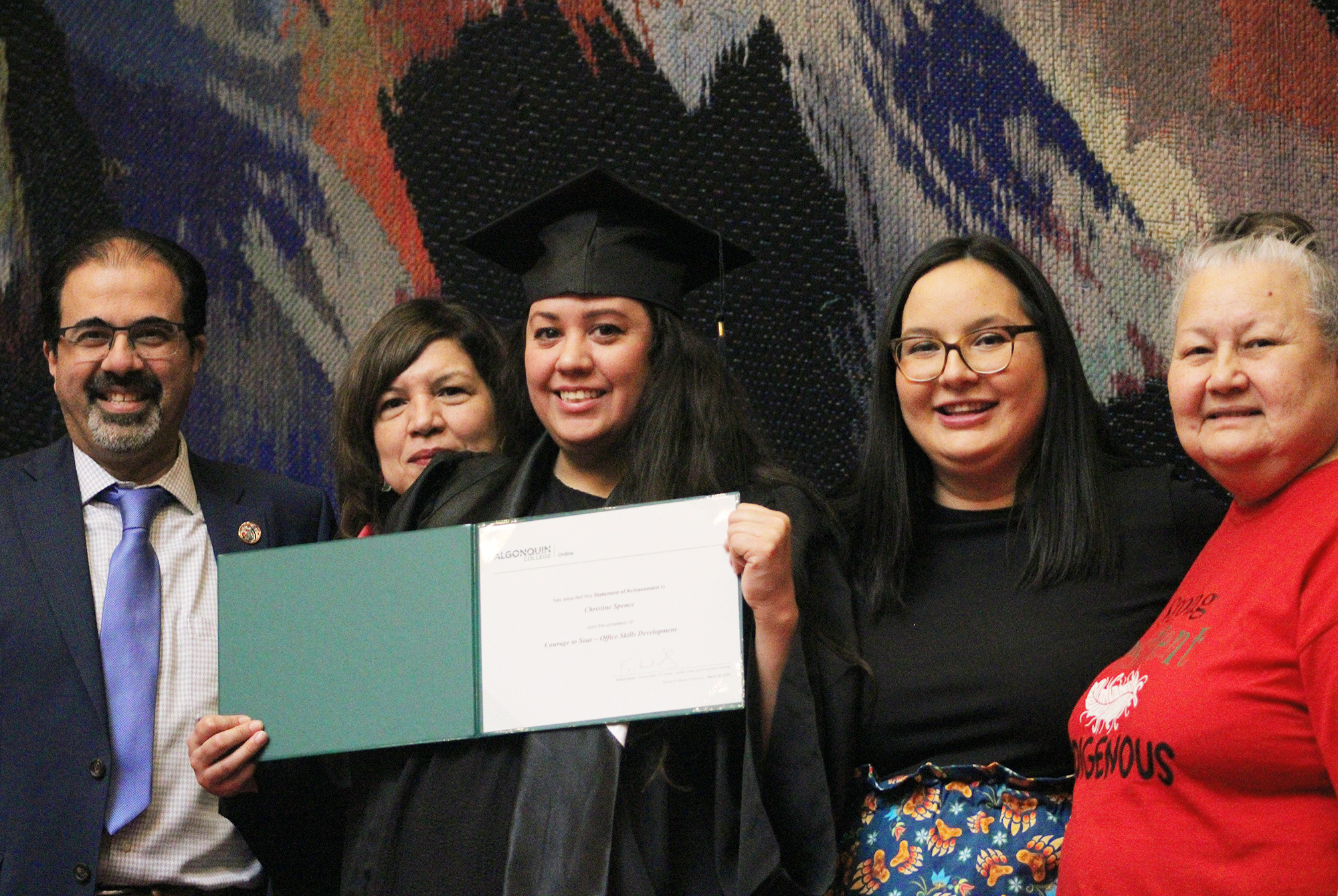
Christine Spence (middle) receiving her certificate of achievement for finishing Courage to Soar during the ceremony held at the National Arts Centre on March 28 . Alongside her are (from left to right) Farbod Karimi, Anita Tenasco, Sabrina Gideon and Irene Compton.
For Irene Compton, the co-founder of Minwaashin Lodge, it felt as if the Courage to Soar program was meant to happen.
Minwaashin Lodge, a support centre for Indigenous women located on St. Laurent Boulevard, describes Courage to Soar as a program dedicated to helping Indigenous women who have survived domestic abuse or are at risk of being abused empower their economic lives.
About 15 years ago, Compton was given the opportunity to start a program to empower women and teach them occupational skills. After Compton got accepted to start the program, that’s when the real work began.
“I remember I was walking down Bank Street and it was snowing very lightly. I was asking Creator, ‘Where do I start Creator?’” said Compton. “It just so happened I walked right by an employment centre.”
Compton went into the employment centre and told the staff there what she was doing. Within the day, Compton had the employment centre and Willis College, which was right across the street from the employment centre, on board to help start Compton’s program.
Courage to Soar’s first year saw only two graduates. This year there were 11, which was the largest graduation group the program has seen. This was also the first year Courage to Soar partnered with AC Online.
A graduation ceremony was held to honour the 11 graduates at the National Arts Centre on March 28.
“Throughout this program we have witnessed the transformative power of education and empowerment of Indigenous women to reach their fullest potential,” said Sabrina Gideon, the Courage to Soar coordinator, in her opening speech. “From overcoming barriers to embracing new opportunities, each graduate has demonstrated unwavering commitment to their personal and academic growth.”
Each graduate entered the program a different person compared to who they are today.
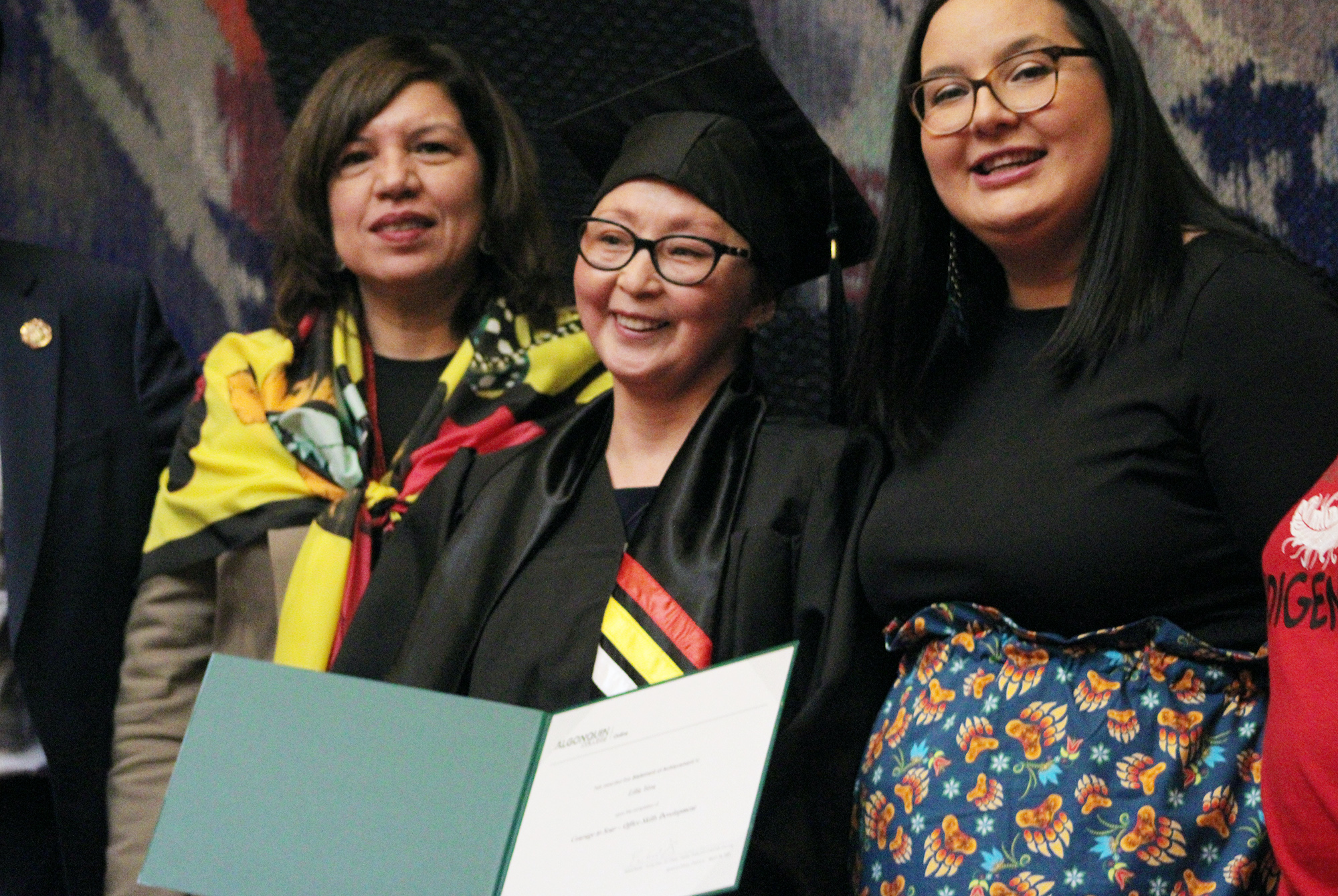
Lilia Taiberei (middle) receiving her Courage to Soar certificate during the graduation ceremony held at the National Arts Centre on March 28. She is with Anita Tenasco (left) and Sabrina Gideon (right). Photo credit: Stephanie Taylor
“[Minwaashin Lodge] helped me escape violence, get my own apartment, go to Algonquin College and now get a job in the government,” said Christine Spence, a recent graduate of the program. “[Courage to Soar] saved my life.”
Ten of the 11 graduates have upcoming placements at Indigenous Services Canada. The remaining graduate opted to find a placement outside of the government.
Graduates Lilia Taibarei and Heather Hennessy-Goneau had trouble putting into words how happy they were to have had the opportunity to take Courage to Soar. Both of their faces were glowing with joy.
“We are so happy and just thankful for the help we have received,” said Taibarei.
Both Taibarei and Hennessy-Goneau entered the program seeking a career change.
“I was [working] in childcare since 2010 and have been in childcare ever since,” said Hennessy-Goneau. “[This program] gives us the opportunity to change and focus on something new.”
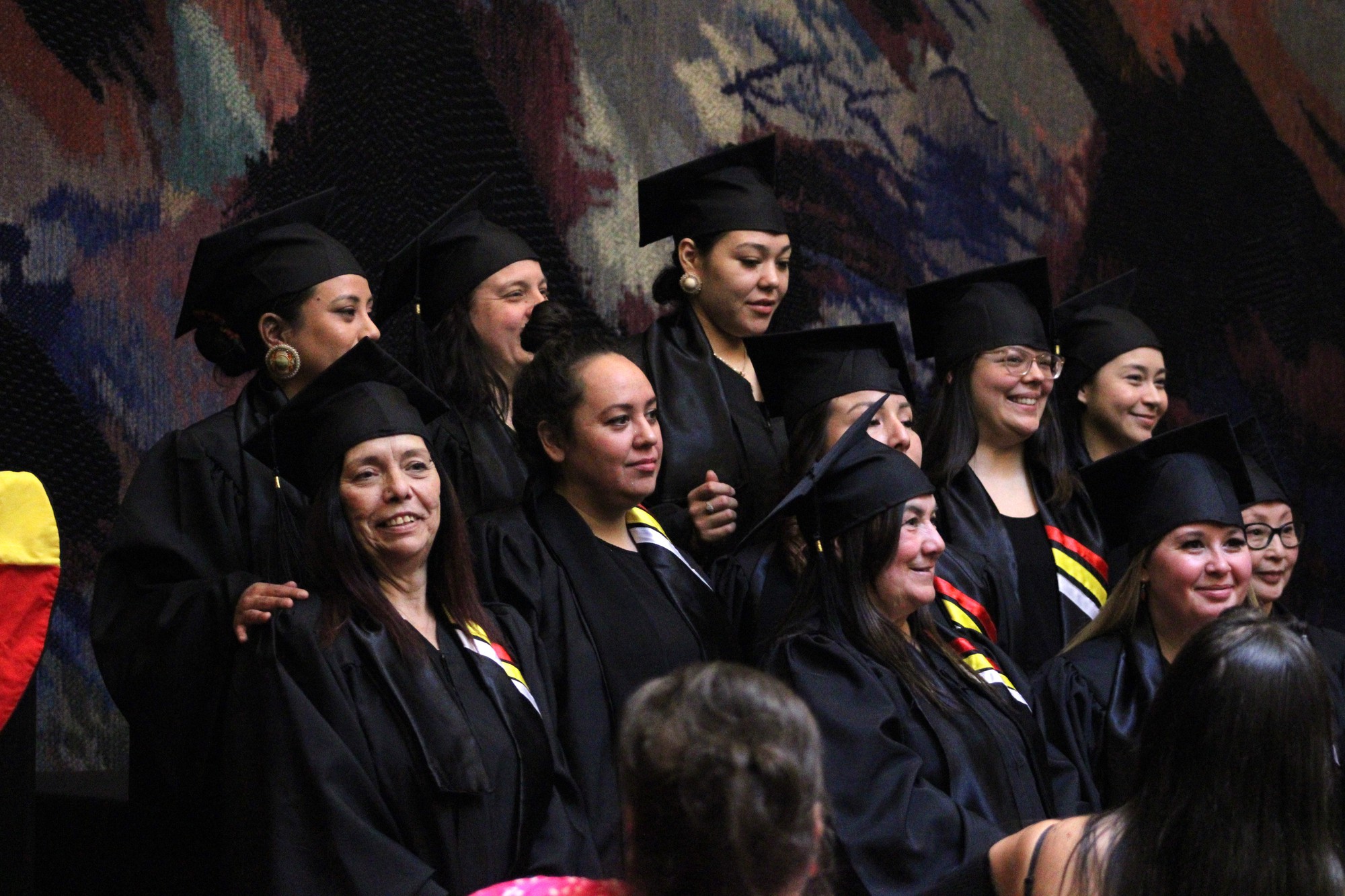
The Courage to Soar graduates getting ready to toss their caps at the end of their ceremony, which was held at the National Arts Centre on March 28.
While helping the women find jobs is a goal for Courage to Soar, Gideon hopes the women graduating the program leave with a sense of sisterhood. As the women finish the program and go start their new jobs, this hope becomes a reality.
“I’ve learned respect, determination, courage, sisterhood and to keep fighting towards [my] goals,” said Spence.
The Truth and Reconciliation Commission’s Calls to Action 62 to 65 call for better education for reconciliation in various ways, such as more funding to help teachers in post-secondary schools integrate Indigenous teachings into their classes.
These calls to action are part of the reason AC Online was so eager to partner with the Minwaashin Lodge to build Courage to Soar.
“Algonquin College should not wait for a report from the government to take action on such an important topic,” said Farbod Karimi, the acting dean of AC Online.
Karimi said he has learned more about Indigenous Peoples from Anita Tenasco in the past year than he has in the past three decades.
“Our best partner so far has been Algonquin College and they’re doing it because they know they are changing Indigenous women’s lives,” said Compton. “All our women that come to Minwaashin Lodge, they live in poverty, and I mean real poverty. Giving them this opportunity to really use their gifts and skills and show who they truly are, that’s a really big opportunity.”
Featured Hero | Featured Story | Home Feature | Home Hero | News
A homemade mouth-watering kale slaw with maple and balsamic dressing had students salivating at the Adulting 101: National Nutrition Month event
Isabella Disley
Photos: National Nutrition Month event in the AC Hub. Photo credit
April 2, 2024 Revised: April 2, 2024 10:12am
Photo: National Nutrition Month event in the AC Hub. Photo credit
Emma Kaya (right) watching Chef Paul Schutter (left) make the vinaigrette during the Adulting 101
Chef Paul Schutter, the culinary coordinator from the Marketplace Food Court, showed the step-by-step recipe for this low-maintenance dish in the AC Hub on March 25.
The kale slaw recipe requires only six ingredients, making it affordable for students.
The aroma of fresh food filled the room as Schutter taught students what vegetables to use and possible substitutions for dietary restrictions during an Adulting 101 nutrition event.
Emma Kaye, a wellness and sustainability coordinator and registered dietitian, provided a slide presentation of nutrition-related information for students to maintain good well-being.
Pauline Thomson (left) and Miya Watson (right) get a plate of kale slaw at the Adulting 101: National Nutrition Month event in the AC Hub. Photo credit: Isabella Disley
Students recommended this one-hour event as it was helpful and eye-opening.
Miya Watson is a soon-to-be graduating bookkeeping and accounting practices student.
“Definitely come to Adulting 101,” said Watson. “It was definitely something I would suggest other people do. It was very informational.”
“It’s been beneficial because I got to learn a lot about food and how it affects the body,” said Watson.
Pauline Thomson, also a bookkeeping and accounting practices graduating student, found the event to be delicious.
“It was nice to see an actual recipe put into place, be made and the things that are in it explained. It’s been really eye-opening to all the things that we actually put in our bodies when we’re not paying attention,” said Thomson.
“Being able to eat something very different from what I normally would ever eat, especially learning that kale could just be put in such a salad with a balsamic vinaigrette. That was really good,” said Watson.
“Don’t be afraid to try new things that you haven’t tried before,” said Thomson.
Kaye says an overall balanced diet is the key to success.
“There’s not one thing that I would say is unhealthy or healthy in a diet,” said Kaye. “It is what’s nostalgic for you and your upbringing, what’s involved in your culture, what you like and don’t like to eat, if you have allergies, all of those things are involved.”
“A negative effect of having an unbalanced diet would be in general your mood. One that fits your lifestyle is going to make you feel better in general,” said Kaye.
When it comes to advice for students, Kaye mentions that it is best to “take it with a grain of salt.”
“Make sure you’re getting your information from the experts. I think for students in general, there’s a lot of information online about eating and diets and things like that,” Kaye said.
A stand-alone chalkboard in front of the AC Hub that illustrates Adulting 101: Food + Mood. Photo credit: Isabella Disley
More details on upcoming Adulting 101 events can be found on the AC Hub’s website. All events are open to Algonquin College students and registration is not required.
Home Feature | News
AC Hub | Algonquin college | Featured stories | Food | Health | National nutrition month | Nutrition | Nutrition month