Two-day Scholar Strike was a chance to discuss systemic racism

During his classes on the first week of school, Martin Lee, a biotechnology and chemistry professor, used some of his class time to discuss the issues that prompted the Scholar Strike on Sept. 9 and 10. The strike was a work stoppage event taking place across Canada and the U.S. in support of anti-oppression, police […]
The Scholar Strike is about taking a break from studies and focusing on educating oneself on the matters of Black Lives Matter movement

During his classes on the first week of school, Martin Lee, a biotechnology and chemistry professor, used some of his class time to discuss the issues that prompted the Scholar Strike on Sept. 9 and 10.

The strike was a work stoppage event taking place across Canada and the U.S. in support of anti-oppression, police brutality and racism.

“The strike was about amplifying the message for the day and making sure that the voices of the oppressed are being delivered,” explained Lee.

During the two-day strike, faculty and students are suggested to a break from normal studies to educate themselves on anti-oppression, police brutality and racism.

Dr. Anthea Butler, a professor at the University of Pennsylvania, was inspired by the game strike by WNBA and NBA players for the Black Lives Matter movement decided to create the Scholar Strike.

The students and teachers who support the movement hope that this becomes an annual strike event until the message about Black Lives Matter has been heard.

Whether it was through boycotting basketball games, printing slogans on jerseys, signing petitions or donating, every single person was encouraged to contribute to the movement in their own way.

To help spread the messages that the Black Lives Matter movement stands for, different organizations, companies and humans have been finding ways to pass it along.

Annette Bouzi, a law professor and president of the OPSEU local 415, the faculty union at Algonquin, always brings information about non-oppression studies and the Black Lives Matter movement to her courses as part of her ongoing curriculum.

As a person of colour who is oppressed and also a person who has significant power as a teacher and a leader of a union, when Bouzi heard about the strike, she supported and tried to push it to as many people as she could.

“Because of the recent events and everyone is homebound and watching, the world is experiencing acts of violence differently, this is important,” said Bouzi about the movement. “I hope we come to a point where we don’t need a call to action.”

In a letter to the Algonquin community about the Scholar Strike, Claude Brulé, Algonquin’s president wrote: “Algonquin College stands with everyone calling for equity and justice for Indigenous, Black, and Communities of Colour around the world.”

In an interview, Brulé added more: “It’s very important to shine a light on this subject and we require significant action and help from everyone,” he said. “There is more work to be done.”

Algonquin professor invents portable antimicrobial tool to fight COVID-19

Troy Crosby, a part-time professor in Algonquin’s manufacturing engineering technician program and a former student, aims to help Ottawans flatten the curve with a lightweight, antimicrobial tool that minimizes unnecessary touch. Called the Linc, the tool allows users to turn doorknobs, press buttons, pull/push or hold onto handles and even use their smartphones so they […]
Photo: Kavya Nair
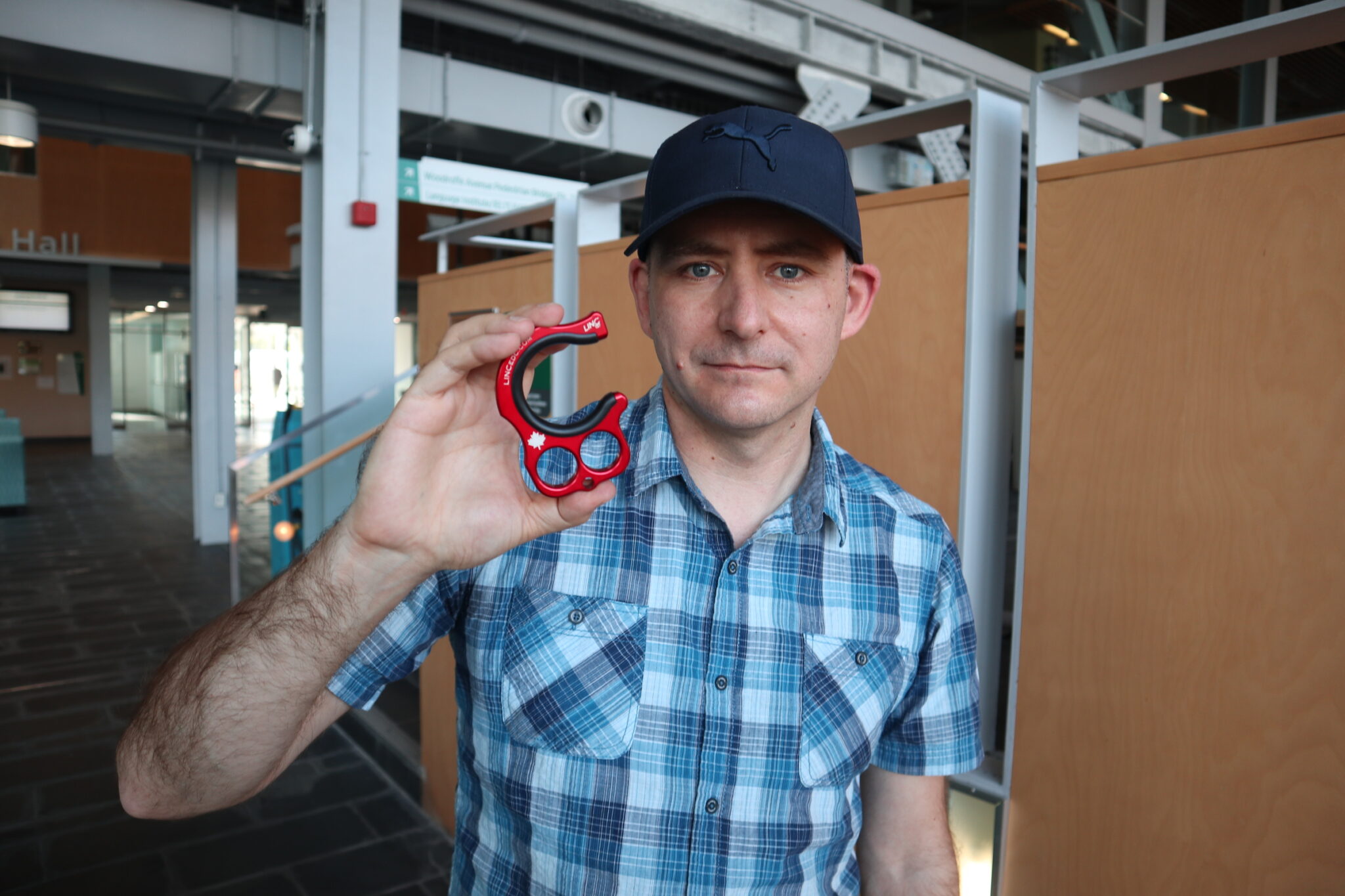
Troy Crosby, inventor of LINC with the product

Troy Crosby, a part-time professor in Algonquin’s manufacturing engineering technician program and a former student, aims to help Ottawans flatten the curve with a lightweight, antimicrobial tool that minimizes unnecessary touch.

Called the Linc, the tool allows users to turn doorknobs, press buttons, pull/push or hold onto handles and even use their smartphones so they don’t have to get in direct touch with unsanitized objects.

Crosby, a Computer Numeric Control machinist, explained that the Canadian-made product is durable, can lift to 125 lbs and the material prevents microbial growth from spreading on the tool itself.

“No other tool in the market can tackle the round style doors like Linc,” said Crosby. “It’s completely made in Canada and designed with your safety in mind.”

Contact-free and safe method to open doors
Contact-free and safe method to open doors Photo credit: Kavya Nair

With an ambition to help people stay safe during the pandemic and create job opportunities, Crosby, with his partner Karl Miller invested all their time and savings into creating this product.

The idea struck Crosby in April when a colleague mentioned that their company, Excel Precision Machining, needed a product of their own to survive the uncertain times.

“It seemed farfetched in the beginning but it got my mind thinking,” said Crosby. “I originally had an idea for a reusable mask to which I immediately bought a 3D printer to start building. While doing my research on masks I came across a product that screwed onto a latch style doorknob so you can open it with your arm. I liked the idea but the product had several limitations.”

Karl Miller, president of Excel Precision Machining calls Linc a practical tool that “seems to be right for the times.”

“I believe this product is an excellent tool to go along with other Personal Protective Equipment to help mitigate the risks we face in our daily lives,” he said.

After countless hours of researching, designing and then redesigning, creating prototypes, blueprints and several sleepless nights, Linc was born. But that was just the beginning, after creating Linc, the main goal is production and selling to the masses.

“We are currently running on Kickstarter, a crowdfunding page that allowed us to get our feet under us a bit,” he said.

With luck in their favour, Crosby told that his funding campaign was a success.

“We surpassed our goal of $4,500 in an astounding 16 minutes,” Crosby exclaimed.

Canada-based LINC tool aims to flatten the COVID-19 curve by reducing germ spread
Canada-based LINC tool aims to flatten the COVID-19 curve by reducing germ spread Photo credit: Kavya Nair

Jon Moore, chief development officer at the Asset uses a Linc.

“Apart from the regular use, Linc has also helped me carry grocery bags without getting cuts on my fingers. Carrying Linc around makes my family and me feel safer,” he said in his email.

After overcoming the hurdles of choosing the right material that has the perfect grip, sensors, antimicrobial properties and getting funds, the next step for the company is selling.

The initial cost of Linc would be between $26-$35, with an aim to streamline production and bring the costs down in the near future.

“We will be adding Shopify and Amazon stores in October. We have started building distribution connections to bring this tool to the public,” Crosby added.

Pastry arts students know why the pandemic bread-baking trend happened

In the early weeks of the pandemic when feelings of uncertainty were high, some kitchen staples flew off supermarket shelves faster than many anticipated. “I couldn’t find any yeast or flour,” said Smridhh Kaul, 27, a second-year baking and pastry arts management student. “I even asked my friends who work at Walmart to save me […]
Photo: Madalyn Howitt
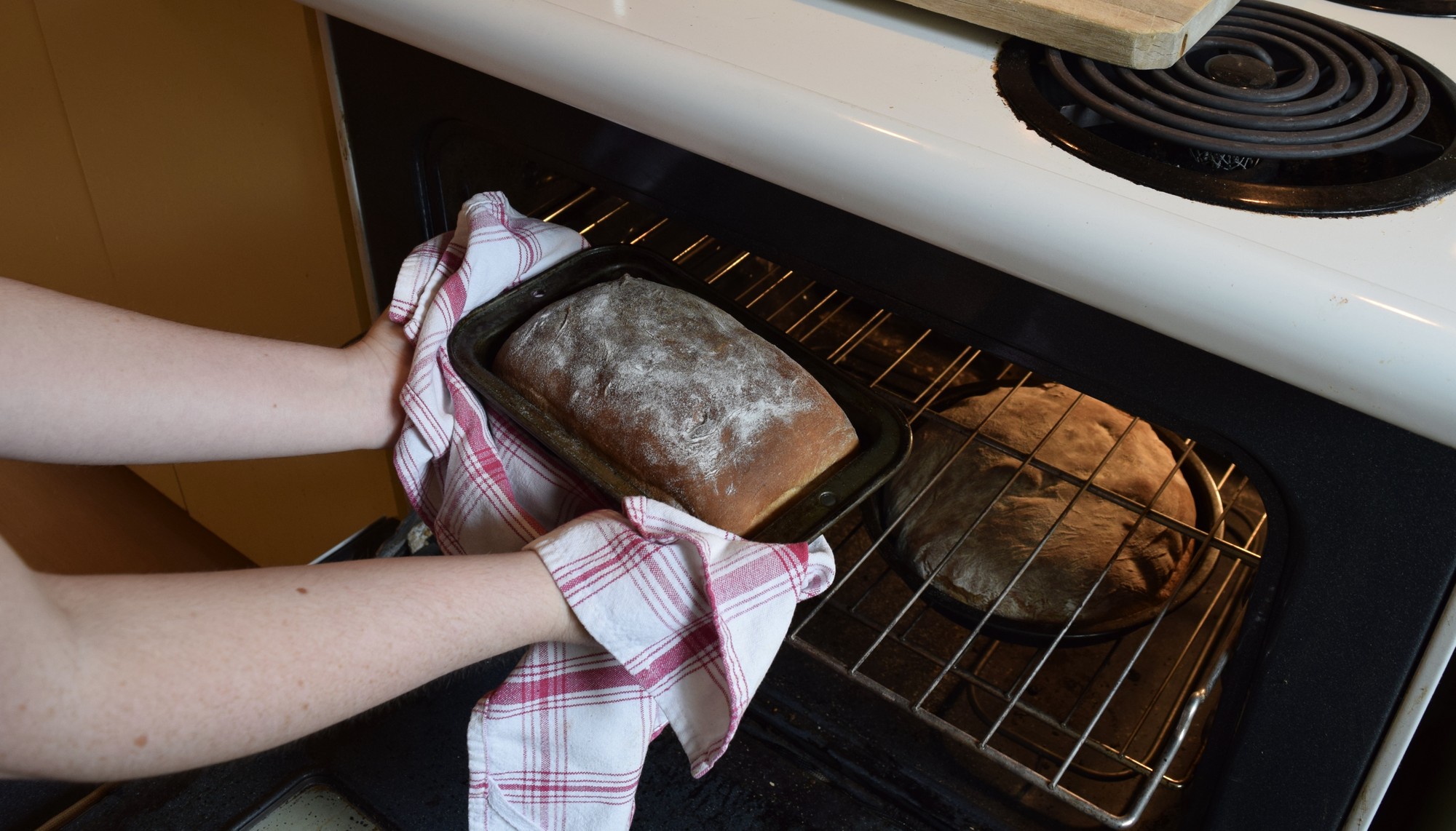
A student tries her hand at baking bread at home. Baking was a popular activity for many during the early weeks of the pandemic.

In the early weeks of the pandemic when feelings of uncertainty were high, some kitchen staples flew off supermarket shelves faster than many anticipated.

“I couldn’t find any yeast or flour,” said Smridhh Kaul, 27, a second-year baking and pastry arts management student. “I even asked my friends who work at Walmart to save me some, but they couldn’t get it for me.”

It seemed baking was suddenly the hot new trend of spring.

“I can’t think of one friend who didn’t try baking at home,” added Kaul.

Google Trends reported that searches for “baking bread” in particular rose between March 14 and April 11 worldwide, at the same time that baking ingredients sold-out in stores.

So why did baking become such a popular activity to do in quarantine? Chef Harsh Singh, program coordinator for the baking and pastry arts program, says it likely has to do with baking being a “comforting” activity.

“Baking is very therapeutic,” he said. “Working with your hands, kneading dough – it has anti-stress effects on the body.”

Especially during a pandemic, “you want your family to be healthy and to feel safe,” Singh added.

Melanie Berndt, 43, is a graduate of Algonquin’s child and youth care program. Formerly a support counsellor, she changed careers this past July and now works at a bakery in Nelson, B.C. “Baking is a very nurturing act,” she explained. “I’ve always loved baking. I bake a lot with my family.”

Baking however was not only popular with families self-isolating. When lockdown limited social activities, many people looked for new ways to occupy their time.

“The pandemic really pushed people to do new stuff and get creative and baking bread is a perfect example,” said Laurence Falardeau, 19, a first-year student in the pastry arts management program.

Angelica Leclaire, 24, a student in her second year of the program, believes that people enjoyed the challenge of baking bread.

“People like the feeling of making something from scratch.”

It’s an activity that requires lots of time and patience, she noted, but not many ingredients.

“It’s just flour, water, salt, and yeast – it’s very accessible,” said Leclaire.

Bailey Zeman, 27, a second-year student, added that yeast is often not even needed “for flatbreads and sourdough.”

Supermarket shelves may now be fully restocked with yeast and flour, but the bread-baking phenomenon of early spring hasn’t slowed down on campus.

To accommodate new health and safety measures, classes on campus are running “non-stop” most days from 7 a.m. to 10 p.m., according to Singh, with only 12 students per class to allow for physical distancing in lab facilities.

With the colder months of fall and winter approaching, Algonquin’s pastry students suspect the comforts of baking bread at home will become popular once again.

“The pandemic has forced us to go ‘back-to-basics’ in a sense, and baking our own bread is an example of that,” said Kaul. “After all, everybody loves fresh bread.”

Tornado memories are still fresh for Dunrobin grads and students two years later

One Friday afternoon in late September 2018, Charlotte Gardner, then in her first year of the photography program, was working at Walmart in Kanata, when a severe thunderstorm caused a power outage. With no power, Gardner and her coworkers sat by the entrance waiting to see what they should do next. When an emergency alert […]
Photo: Charlotte Riethman
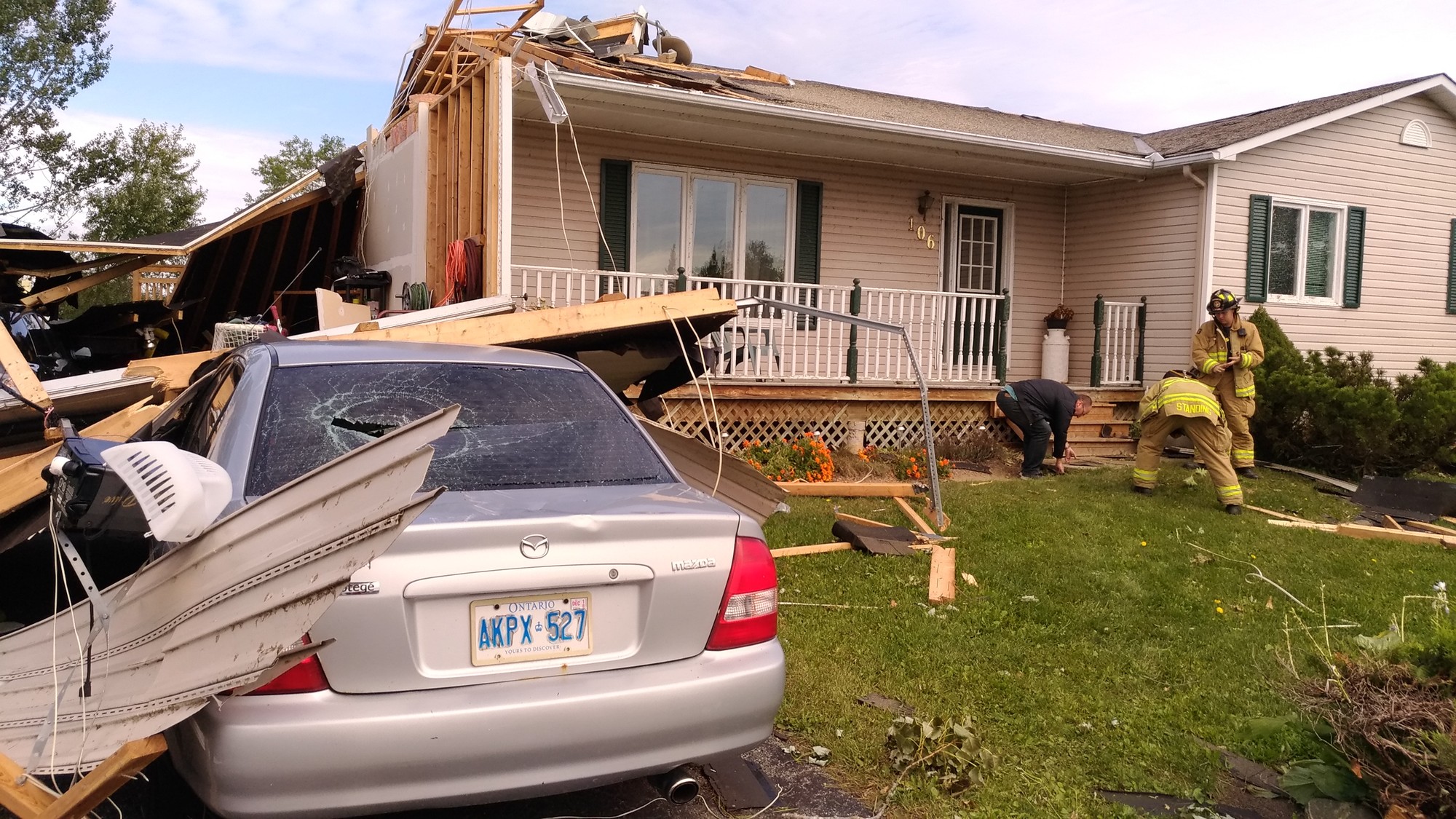
Volunteer firefighters escorting families into damaged homes to collect personal items a few days after the tornado in Dunrobin.

One Friday afternoon in late September 2018, Charlotte Gardner, then in her first year of the photography program, was working at Walmart in Kanata, when a severe thunderstorm caused a power outage.

With no power, Gardner and her coworkers sat by the entrance waiting to see what they should do next. When an emergency alert for a tornado warning came through on some phones.

“There’s no tornadoes in Canada,” thought Gardner at the time.

It wasn’t until her step-dad called moments later asking if she was okay that Gardner learned that a tornado had indeed touched down – and it had destroyed her family’s house.

Shortly before 5 p.m. on Sept. 21 2018, an EF-3 tornado touched down in the village of Dunrobin, with winds up to 265 km/h according to Environment Canada reports.

Environment Canada later stated six tornadoes touched down in the Ottawa-Gatineau area. An EF-2 tornado was reported near Arlington Woods and Greenboro as well as an EF-1 tornado in Calabogie. One man was killed by a falling tree, dozens of people were sent to hospital and tens of thousands of residents were without power.

The community in Dunrobin is mostly rebuilt, the homes under construction are a reminder of the devastation that occurred two years earlier.

Trees, hydro poles and homes were destroyed as local volunteer firefighters rushed to make sure neighbours were safe.

“My first thought was, ‘Are my siblings okay?’ since they were at home when it happened,” said Gardner. “I kept thinking of how terrified and upset they were.”

Local firefighters helped pull Gardner’s younger siblings out of the basement after parts of the home were damaged.

“They were all okay, but my younger sister felt bad she didn’t grab our cat when they went to the basement,” said Gardner, who graduated from her program in spring 2020. “Our cat was found later stuck under a couch.”

While many residents were at the Carp Fair, an annual fair 15 minutes from the Dunrobin village, some were still at home when devastation hit.

“It was really upsetting, not the night of because the shock hadn’t really worn off,” said Elliot Cooney, who graduated from welding and fabrication techniques in 2018 and HVAC in 2019.

“The next day, walking through the neighbourhood was heartbreaking,” he said. “To see everything that was lost, old friends houses, my grandparents house, that’s when the reality set in.”

Cooney stayed with family for a week until their house was deemed safe to live in while repairs were happening. Others were out of their homes for longer.

Lauren Hoekstra, a 2016 business marketing graduate, had to rent for a little over a year and moved back to Dunrobin at the end of December 2019.

“I was in shock, I didn’t know it was a tornado at first,” she said. “It was so loud it didn’t feel like it was happening with all the adrenaline.”

Leyla Atallah, now a second-year fitness and health promotion student, was at home during the storm.

“We were looking out the window and saw a bunch of garbage blowing around,” said Atallah. “Then we saw our gazebo flying and went into the basement.”

“Walking out for the first time was like a movie scene,” she said. “It was all quiet then all you heard was sirens coming and there was mess everywhere.”

Atallah’s home had minimal damage and they could continue to live there safely.

Those who didn’t have to leave helped clean up neighbours yards the following days along with volunteer groups from across the city.

“We were working for probably 10 hours a day helping clean,” said Atallah. “Everyone came together and we’d work on one property at a time, then move to the next, working property by property.”

At the time, Algonquin College community members also set out to help forming an “integral part” of a musical fundraiser called “After the storm” at TD Place.

Since the tornado, the community has seen houses rebuilt, support from surrounding areas and each other.

“I would undoubtedly say the community is closer,” said Cooney. “We all understand that in situations we can rely on each other.”

Classes unaffected by initial COVID-19 cases on campus

The college is coming face to face with the COVID-19 pandemic as five community members who have tested positive have recently been on the Ottawa campus as of Sept. 24. Despite the recent influx of cases, students on campus feel reassured by the college’s handling of the situation. “I feel safe,” said James Hope, a […]
Photo: Julien St-Jean
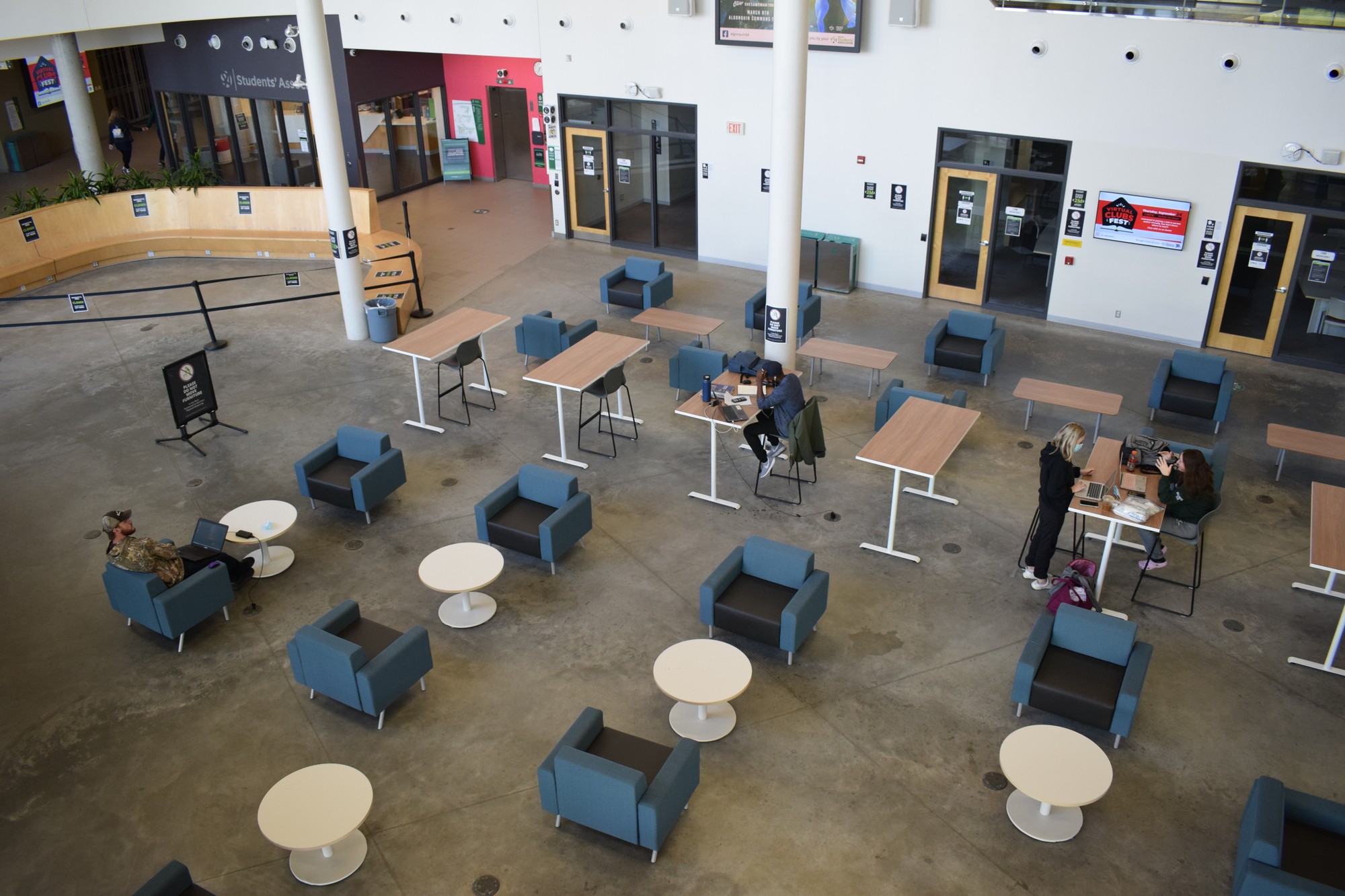
Students make use of E-building's common area while adhering to the college's guidelines. Despite the ongoing COVID-19 pandemic, student life continues on campus.

The college is coming face to face with the COVID-19 pandemic as five community members who have tested positive have recently been on the Ottawa campus as of Sept. 24.

Despite the recent influx of cases, students on campus feel reassured by the college’s handling of the situation.

“I feel safe,” said James Hope, a first-semester mechanical engineering technician student. “I see them sanitize the labs and everything. It makes me feel confident I won’t catch anything in the labs.”

So far, cases have not affected classes. However, the cases have reminded some students not to let up.

“I think it added a little stress and anxiety and everything for everyone,” said Carson Stewart, a first-semester photography student. “It hasn’t really affected class or anything. It gets everyone on their toes again, I think people got a bit relaxed.”

The college is disinfecting and sanitizing at-risk areas by following procedures outlined in their Occupational Health and Safety Guidelines for COVID-19. The president has also recently asked that members of the community remain vigilant in their efforts to minimize spread of the virus.

“I have full confidence in our campus health and safety plans and campus access procedures,” said Claude Brulé, Algonquin’s president, in his Sept. 16 email. “With our continued focus on remote learning and limited face-to-face activity, and renewed vigilance by those members of our community required to be on campus, I am confident we can continue to minimize the risk of cases.”

Cleaning and disinfection procedures

Beyond asking students to stay home if they feel sick, wear a mask, practice physical distancing, proper hand-hygiene, cough and sneeze etiquette, the college is disinfecting different high-touch areas to minimize potential spread of the virus.

High-touch areas are frequently touched by members of the community and allow for the virus to survive long enough to potentially transfer to someone else. High-touch areas include: door handles, lunchroom tables, public printers, desktops, countertops, bathroom stalls, computer mice and keyboards, etc.

“College cleaning contractors use hospital grade cleaners on all College surfaces and touch points. In addition to routine cleaning, surfaces that have frequent contact with hands should be cleaned and disinfected twice per day and when visibly dirty,” states the college’s Occupational Health and Safety Guidelines for COVID-19.

If a student or employee of the college who has recently been on campus tests positive for COVID-19 and an area is suspected of being contaminated, the college will initiate deep cleaning and disinfection protocols.

“When areas are being deep-cleaned or disinfected they may be closed to personnel for periods of time. Specialized equipment, such as misting and fogging equipment, and specialized PPE(Personal protective equipment) may be used for these processes,” states the college’s Occupational Health and Safety Guidelines for COVID-19.

If a community member suddenly develops symptoms while on campus, they are asked to immediately go home, start self-isolating and contact college officials.

“So the message to students and employees continues to be: Do not come to campus if you have any symptoms,” said Chris Lackner, a spokesperson for the college. “That means if any member of the College community develops a symptom while on campus, they should go directly home, continue practicing physical distancing and wearing a mask – and follow Ottawa Public Health direction to manage their illness and determine next steps.”

Community Tracing

After a student is reported as showing symptoms or is confirmed to have COVID-19, the college informs Ottawa Public Health, who then contact students for community tracing.

Community tracing is the act of identifying, contacting, assessing and managing those who have potentially been exposed to someone carrying the virus. Individuals who have recently been nearby a virus carrier will be asked questions to identify whether or not they are considered to be at risk of having contracted the virus.

The college assists Ottawa Public Health in community tracing by providing information about students who may be considered at risk of transfer such as: identities, class lists and contact information.

“Isolated COVID-19 instances are to be expected given the current public context – especially given the large size of any post-secondary community,” said Lackner. “As the President said in his message, COVID-19 cases have been documented at other post-secondary institutions in Ottawa and across Canada, and we will no doubt experience additional isolated cases amidst our own population in the days, weeks and months ahead.”

Health services presents virtual lunchtime yoga

Focus on your breath, close your eyes, plant your feet in your mat and reach over towards the person to your left. Only there is no one to your left. You are in your living room, virtually connected to a bunch of yoga enthusiasts all over, looking to take the edge of the new school […]
Photo: Breanna St-Jean
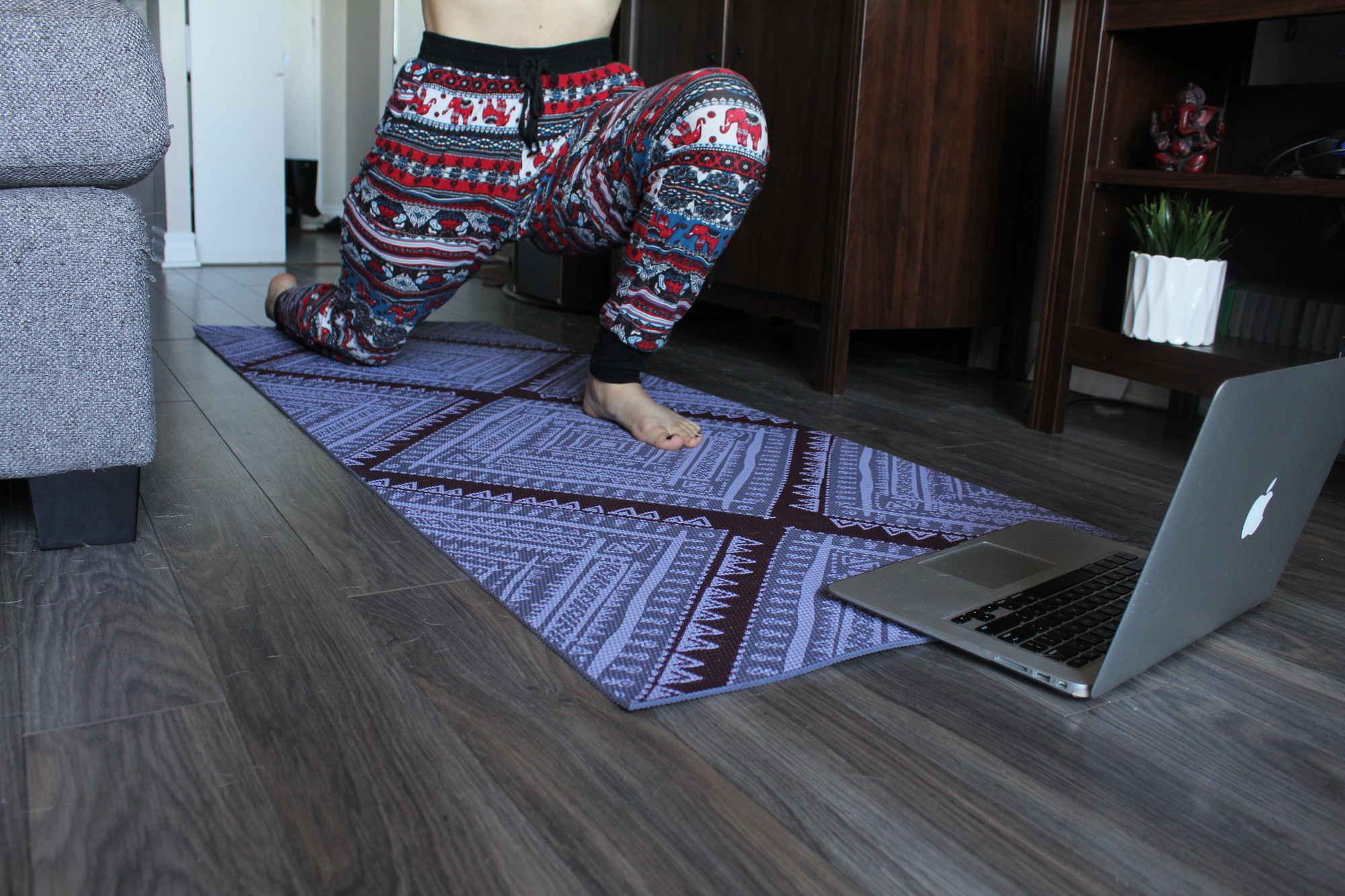
Algonquin College health services is presenting a weekly remote yoga class that is free for students and employees.

Focus on your breath, close your eyes, plant your feet in your mat and reach over towards the person to your left. Only there is no one to your left. You are in your living room, virtually connected to a bunch of yoga enthusiasts all over, looking to take the edge of the new school year and the global pandemic off their shoulders.

Algonquin College health services is presenting a weekly online yoga class that is free for students and employees looking to ease stress and reduce anxiety during these trying times.

Every Monday, sessions are hosted by Karen Chiarelli, yoga instructor. The mission is to get students and faculty to prioritize their physical and mental health during times of adaptation and uncertainty.

The first session was on Monday, Sept. 21, at lunch time. Chiarelli opened the session by speaking on foundation which was a grounding theme for this session. Foundation in yoga refers to building a strong connection between the ground below us and the parts of our body that touch the Earth: core, hands, feet and base of the spine.

With the start of fall, we are entering a new cycle,” Chiarelli explained. “We cook differently, dress differently, temperatures change, our sleeps patterns may change so it’s important to really build that foundation in times of change and stress, especially now with COVID-19.”

Over 15 people attended the session from their homes, some from their living rooms and others from their balconies and backyards.

No experience is required for these classes. All levels, from beginner to advanced, are welcome to sign up online on the health services website.

“The great thing about yoga is that it’s not a one-size-fits-all, you can really customize it to your body,” Chiarelli said.

The virtual classes are available to those who register through Eventbrite.

Parents want to succeed academically while maintaining children’s needs

As the school year begins, parents enrolled at Algonquin College try to balance the health and educational needs of their children while starting their own studies. Every parent of a minor has had to make the decision to either choose remote learning or send their child to school. These are the two options for parents […]
Photo: Jocelyn Galloway
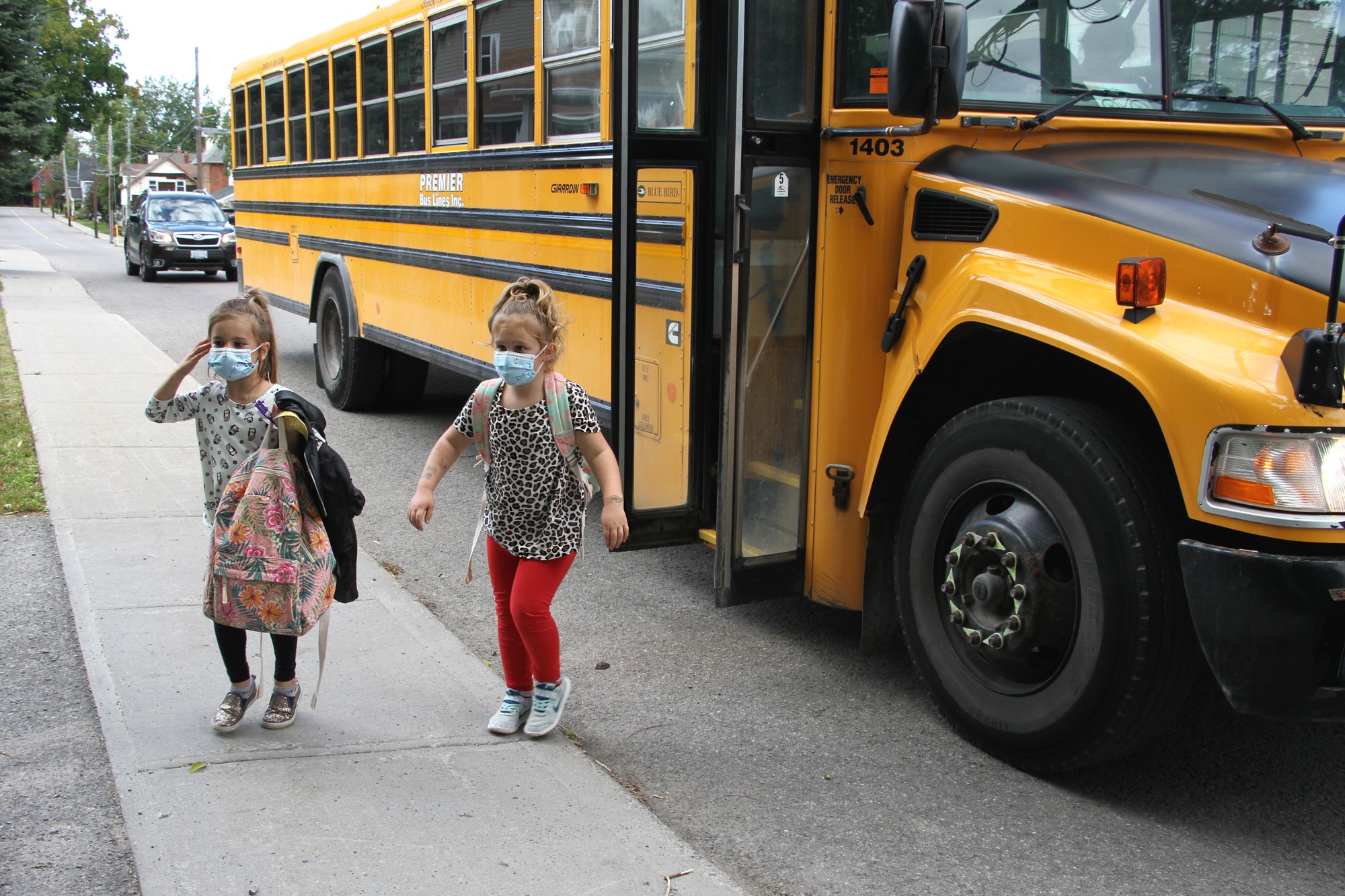
According to the government of Ontario, children in Kindergarten to Grade 3 are encouraged, but not required to wear a mask at school.

As the school year begins, parents enrolled at Algonquin College try to balance the health and educational needs of their children while starting their own studies.

Every parent of a minor has had to make the decision to either choose remote learning or send their child to school. These are the two options for parents to weigh while trying to navigate their families’ need during the COVID-19 pandemic. Both options have their advantages and disadvantages.

For student Rana Albaw, the decision to keep her child home was one she does not regret despite the challenges it brings.

“I’m not relaxed at all,” said Albaw. “I thought, ‘When school begins, I’m going to keep her at home and monitor what is going around.’ Thank God I did, because I’m seeing relatives of mine getting the flu and doing COVID tests. Now they are all panicking.”

Rana Albaw has lived in Canada for a year with her husband and daughter. She said the move from Lebanon was a difficult one for her daughter, who is now five. The transition to school was hard during the last school year. Just as she was beginning to adjust, COVID-19 forced the school to close.

In addition to her difficult school experience, Albaw’s daughter has a history of requiring medical attention when fighting viruses such as the common cold and flu. This is not a risk Albaw is willing to take. She is still waiting to hear back from her daughter’s school about the remote learning.

Yet, Albaw is determined to keep pursuing her own educational goals. She started the media and communication program this month and is enjoying it.

“I don’t care what the conditions are,” said Albaw. “I have to do this. It is for myself.”

The normal school experience is what Albaw longs to have, but she said having her camera on during class has been distracting for her peers and herself. She said she hopes her professors will be understanding with attendance and the camera being off as the semester continues.

Chao Li is another student parent who has decided to keep his child home and participate in remote learning. His son started his first class on Friday, Sept. 18.

As an international student from China, Li does not have a lot of support other than his wife, who is also a student. Li was originally in the journalism program in the winter and decided to switch programs this fall to script writing.

“When we could go to campus, I could have a whole block of time to dedicate to learning, but now I have to cut my time,” said Li. “I am really concerned about the grade I am going to get in the end.”

When asked if the college was doing anything to accommodate him in his studies, Li said he is not aware of anything and even if there was, he does not think he would be eligible due to his international student status.

He said if the college could provide a forum for international students or students with kids that would be helpful. He said to the best of his knowledge there is not.

MRT student placements delayed due to pandemic: making up for lost time

Algonquin College students who are part of the medical radiation technology program have been affected by the COVID-19 pandemic, like most Canadian students. Rachel Houde, a medical radiation technology student expecting to graduate in December, has had to work extra hours in a hospital to make up practical hours. Due to COVID-19, the government deemed […]
Photo: Breanna St-Jean
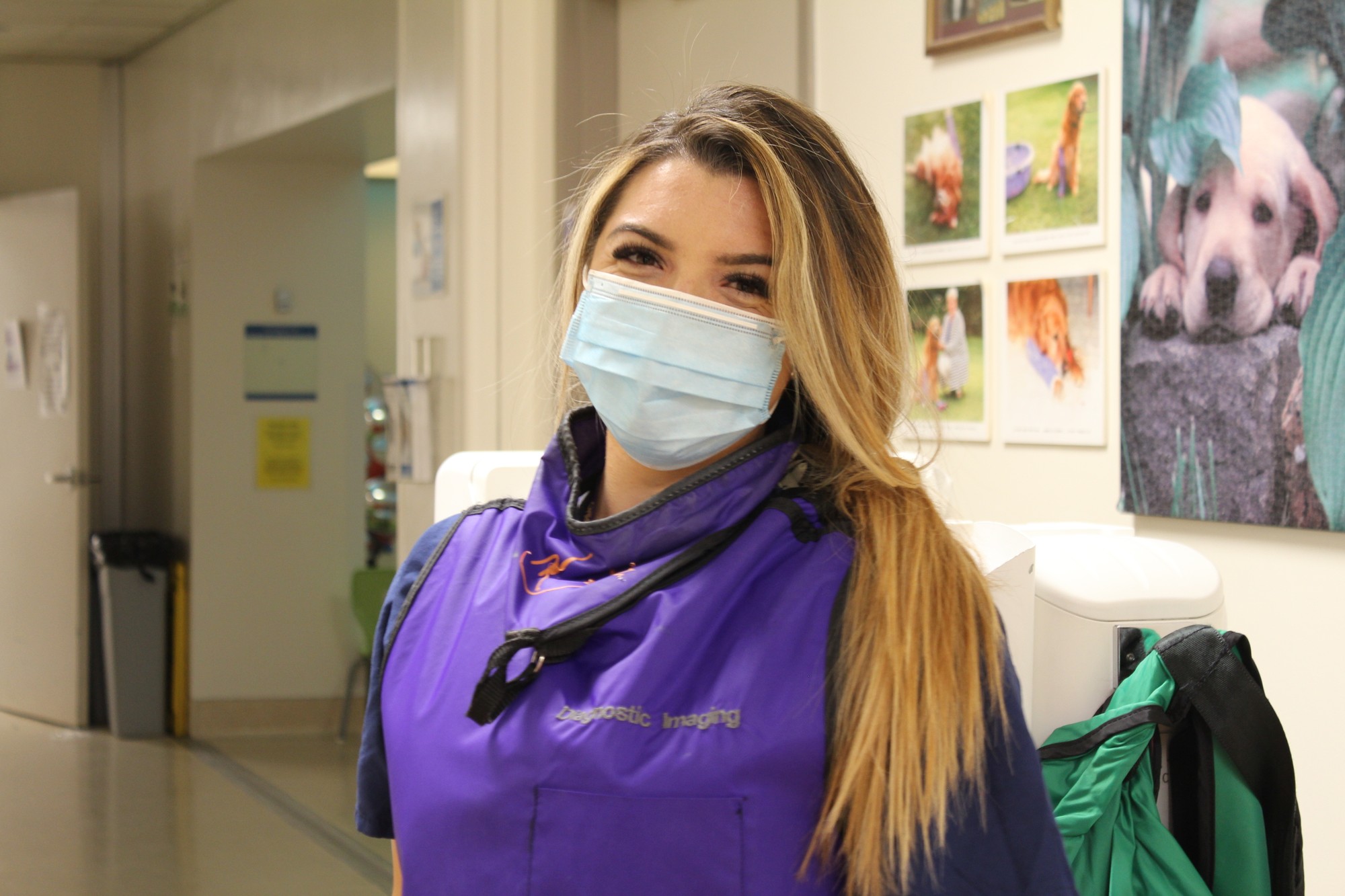
Rachel Houde, medical radiation technology student with Algonquin College, is doing her field placement at CHEO.

Algonquin College students who are part of the medical radiation technology program have been affected by the COVID-19 pandemic, like most Canadian students.

Rachel Houde, a medical radiation technology student expecting to graduate in December, has had to work extra hours in a hospital to make up practical hours. Due to COVID-19, the government deemed it was unsafe for students to attend clinical placement from March to July 2020.

“Due to this delayed start, we had to make up loss time which came up to 80 hours,” Houde said. This meant working 12-hour shifts or working on weekends.”

Houde is doing her clinical placement at CHEO in Ottawa. She has been back on hospital grounds accumulating hours and acquiring hands-on experience for about five months.

“I came from a university background that was purely theoretical,” Houde said. “When I graduated, I did not feel like I was prepared to enter the work field. The Algonquin College program has a year-long placement and prepares you extremely well for the job.

About 4.7 million Canadians are now working from home based on a survey by Statistics Canada released in March. Hospital workers and students are still required to be on the front lines. Medical Radiation technologists are not part of the group of people that can work remotely as they are essential in a coronavirus pandemic: chest X-rays are used to diagnose infection in the lungs.

“A major advantage of doing a placement during the pandemic is being an extra set of hands in the case of an influx of patients coming through the diagnostic imaging department,” Houde said. “It was also a great opportunity to decide if this was the career path I wanted to take, especially during a pandemic.”

Though some MRT students may finish their placement sooner than others depending on how many hours they able to make up, all of them are expected to write their licensing exam in January.

“I am still expected to graduate from the MRT program in December,” Houde said. “However, it is ultimately up to my clinical and my program coordinator to decide if I am competent enough to work as a technologist.”

Students learning remotely may need a lesson in ergonomics

Thanks to most classes being delivered remotely, students are all too familiar with beds, kitchen counters and dining room tables becoming their new classrooms. But workspaces aren’t the only things having to adapt to difficult circumstances – your body could be taking the brunt of it. Wayne Boucher, the Students’ Association leadership and engagement specialist, […]

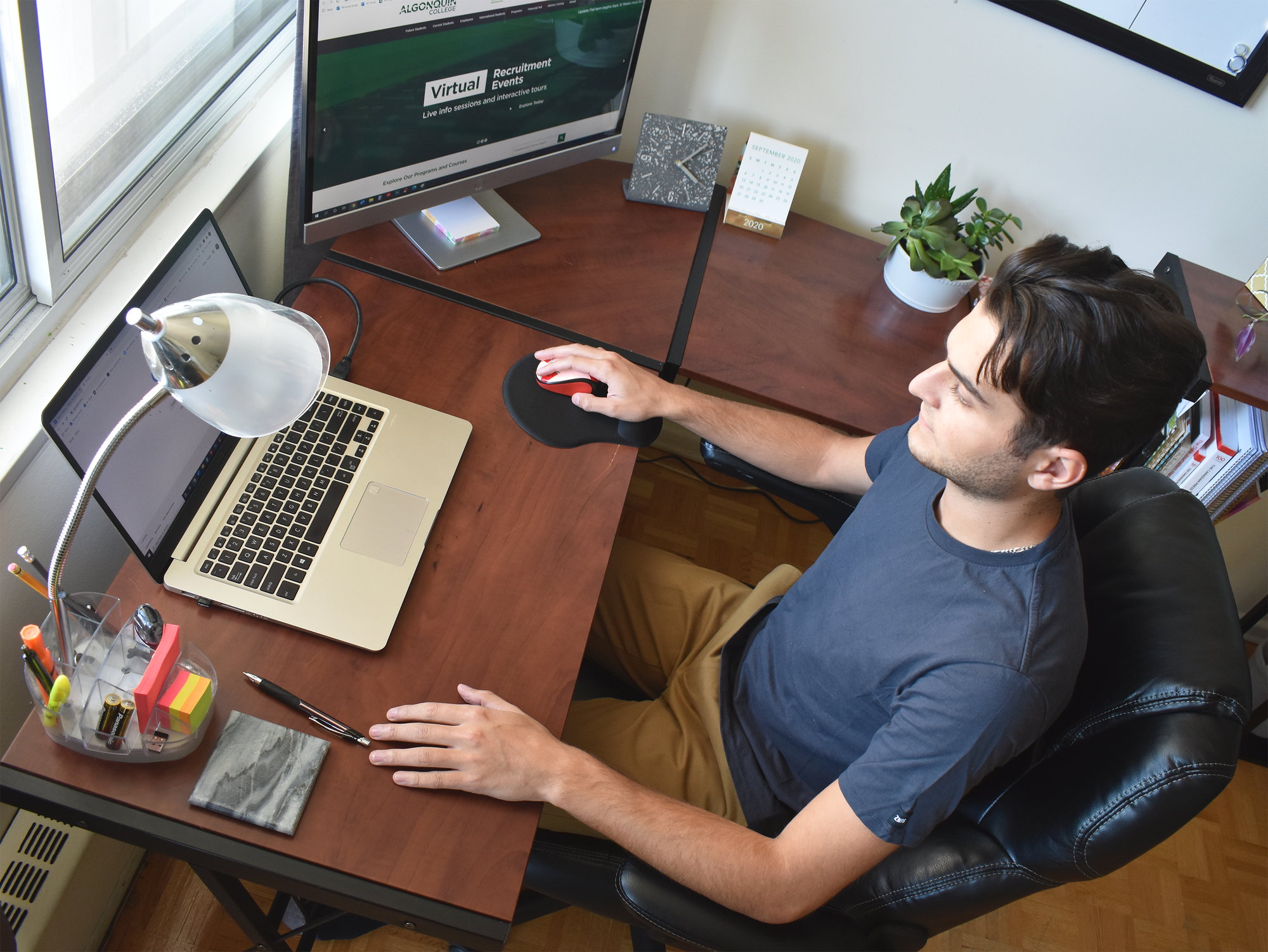
Thanks to most classes being delivered remotely, students are all too familiar with beds, kitchen counters and dining room tables becoming their new classrooms.

But workspaces aren’t the only things having to adapt to difficult circumstances – your body could be taking the brunt of it.

Wayne Boucher, the Students’ Association leadership and engagement specialist, has seen the damaging affects of poor posture – which is part of poor ergonomics – firsthand.

As a strength coach and former health and wellness coordinator for the Students’ Association, he has worked with clients to relieve pain and correct their posture.

“One of the number one postural issues I encountered was upper cross and lower cross syndrome,” Boucher explained in an email. “These were directly related to sitting in a chair improperly for hours at a time,”

But what exactly is ergonomics?

“Ergonomics can be defined as the science of matching work or tasks to the body,” according to Algonquin College’s Occupational Health and Safety Office Ergonomics Program.

In other words, students working long hours on a computer need to adjust their workspace to their bodies – not the other way around.

According to the program, poor ergonomics can lead to serious physical issues such as musculoskeletal disorders (MSDs). These pains in the muscles, tendons and nerves usually demand long recoveries and often reoccur.

An image taken from the Algonquin College Risk Management Office Ergonomics Program (July 2016) demonstrates a neutral sitting and standing position.
An image taken from the Algonquin College Risk Management Office Ergonomics Program (July 2016) demonstrates a neutral sitting and standing position. Photo credit: Algonquin College

Before we get into solving this problem, let’s understand what brings it on.

Algonquin’s Office Ergonomics Program outlines causes of work-related injuries:

  • When similar movements are performed on a regular basis
  • When the body is in an awkward or non-neutral posture for a long time
  • When the body is kept in the exact same position for a long time
  • When there is not enough recovery time between movements

Boucher explained he takes the right steps to avoid painful injuries. “From my personal experience, the chair is one of the most important components regarding keeping posture and avoiding back pain.”

Not only is your chair, desk, keyboard and mouse important, it’s also about being conscious of your posture and adjusting your tools properly.

The college’s guide describes several ways to correct the way you sit while working.

Adjust the back of your seat so it supports your back’s natural curve – lumbar support is important. Make sure the height of your seat is right so both of your feet are flat on the ground.

Your elbows should set on the armrests tight to your sides at a 90-degree angle. Your keyboard and mouse should be directly within reach and at your midsection’s height, supporting your wrists.

Not only does a proper ergonomic assessment help avoid serious injuries, it also has great benefits such as increased productivity and higher quality of work, according to the Government of Ontario’s website.

For step-by-step guidance on setting up your workspace, stretching exercises and more, consult this Office Ergonomics Program.

Hopeful plans for the winter term’s athletic season

While the Ontario College’s Athletic Association’s decision to suspend all varsity sports during the fall term is complete, there still may be hope for the winter 2021 athletic season. While it’s still up in the air whether or not 4,000 student-athletes across Ontario involved in the OCAA will have a season beginning in January, there […]
Photo: Akira Cooper
Students athletes wait for the day they can return to this gym and play for their 2021 winter term varsity athletics.

While the Ontario College’s Athletic Association’s decision to suspend all varsity sports during the fall term is complete, there still may be hope for the winter 2021 athletic season.

While it’s still up in the air whether or not 4,000 student-athletes across Ontario involved in the OCAA will have a season beginning in January, there is optimism that an answer may come end of October.

The OCAA’s decision to cancel of all varsity sports during the fall term because of the COVID-19 situation was a disappointment to all 27 Ontario schools, with faculty and student-athletes alike being impacted. But the change was made for the safety and well-being of the student-athletes and membership as a whole.

Athletes and coaches involved in most of the sports that usually take place in the fall won’t see a 2020 season. While originally soccer had been approved to return to play in phase two as of Sept. 17, this plan has been paused. Ontario Soccer, with the Government of Ontario, Ontario Public Health and Canada Soccer will continue to monitor the most recent events surrounding COVID-19, and the impact on Ontario Soccer’s original Return to Play plans.

Yet for the indoor winter 2021 athletics, there is a vision for a safe reconstructed season with reduced schedules and a shorter season altogether. These sports include basketball, volleyball, badminton, curling, and indoor soccer.

“So much depends on where the Ontario government stands and the phase that the provincial sports organizations are in,” said Nathan McFadden, OCAA president. The OCAA had been creating multiple contingency plans for the upcoming varsity sports seasons since May in hopes of what can be done to see term athletics through.

The hope is that all the task force recovery efforts being made will pay off and a January start gate for competitions will ensue and operate as planned.

McFadden says it’s time for things to move forward in a positive direction. “We’re hopeful and excited to have our student athletes back,” he said. “They love to play and we love to watch them.”

As athletic facility members and student athletics await a sure answer of the fate of their seasons, Josh Bell-Webster, OCAA representative says they are still monitoring the situation closely.

“It is still early in the process to provide a clear picture of what our sports structures and safety protocols may look like if there is a return to sport in the new year,” says Bell-Webster.

Algonquin Times horoscopes
Algonquin Times on Instagram
Algonquin Times podcast
Follow Algonquin Times on Instagram
Algonquin Times on Instagram
Algonquin Times podcast
Algonquin Times horoscopes
Follow Algonquin Times on Instagram

Stay Informed

Sign up for our newsletter

Subscribe

* indicates required